


When George W. Bush went public in 2005 to convince Americans that his administration had the right plan for Social Security reform, he played what the NAACP called “the race card”: he appealed to Blacks' racial group interest in Social Security reform. The President called the current system “inherently unfair” to African Americans because of their lower life expectancies, implying his plan would fix the resultant racial discrepancy in benefits.1
See: Associated Press. “NAACP: Bush ‘playing race card’ with Social Security,” USA Today April 11, 2005 and Fagan, Amy. “NAACP Fights Bush Social Security Plan” Washington Times April 12, 2005.
Despite advances in our understanding of how racialized messages affect the opinions of White Americans, noticing this “other race card” in American political discourse points to a number of important unanswered questions about the effects of racial messages on the American public. Most glaring is that of how racialized portrayals of ostensibly nonracial political issues affect Black opinion. Not only do most studies of racial priming not include analysis of Black opinion (but see Gilliam and Iyengar 2000 and Bobo and Johnson 2004), but most studies of Black public opinion do not consider the possibility of the manipulability of the attachment of race to political issues for Blacks. Is Blacks' racial thinking about politics at all responsive to racial cues? And if it is, are there distinctions between the effects of “explicit” and “implicit” racial cues on Black opinion? Could politicians accomplish the same effect on Black opinion without making explicit appeals to group interest? And finally, are there different implications for White opinion from explicit racial cues that merely mention Black group interest in an issue, rather than the explicitly pejorative cues on which the existing literature has focused?
The purpose of this article is to forward our understanding of the consequences of racial appeals in American politics by answering the previous questions. To do so, I pull from the literatures on racial priming and Black politics to develop, and then test, a theoretically grounded account of the effect of racial cues on Black Americans, and to clarify expectations about White Americans' responses to the explicit group-centric racial cues commonly invoked in appeals to Blacks. This account delineates the type of racial cues that should be accepted or rejected by each racial group. It challenges conventional wisdom that the role of racial attitudes in Black political decision making is chronic, arguing instead that the racial meaning of ostensibly nonracial issues among African Americans is malleable and dependent on appropriate racial cues to encourage racial interpretations. Moreover, by accounting for the effects of racial cues on both Black and White Americans, this study contributes to a more complete picture of how race is—and is not—used in American politics.
THEORIES OF RACIAL PRIMING
Generally speaking, work on racial priming in political science suggests that by associating race with certain political issues or candidates, the media and other political elites have the power to alter White Americans' views about politics, by making their views of Blacks important in shaping their political judgments.2
Priming as a mental process refers to the activation of particular associations in memory when making political evaluations (Price and Tewksbury 1997).
Although Mendelberg's work concentrates on the effects of implicit racial visual cues, others have argued that some verbal cues also can be implicitly racial (Hurwitz and Peffley 2005; Valentino, Hutchings, and White 2002). Valentino, Hutchings, and White argue that those ostensibly nonracial issues that have already been “coded” as racial offer implicitly racial rhetoric. That is, previous connections between Blacks as a group and issues such as crime and social welfare provided through media portrayals and other political communication (e.g., Gilens 1999; Gilliam and Iyengar 2000) render implicit racial meaning to these ostensibly nonracial issues. References to these issues, in turn, function as verbal implicit racial cues. As Valentino, Hutchings, and White note, an apt example of this type of implicit racialization can be found in Bob Dole's 1996 campaign, where he “criticized Bill Clinton for sponsoring several ‘wasteful spending proposals’ such as ‘midnight basketball’ or ‘alpine slides in Puerto Rico’” (76). Such an ad, without making any visual or explicit verbal references to race, works to attach racial attitudes to Americans' evaluations of Clinton through references to policies linked to minority communities. Hurwitz and Peffley find that invoking even a single racially coded phrase—“inner city”—can work to attach Whites' racial attitudes to their preferences on ostensibly nonracial policies. Thus, although explicit racial verbal cues fail to prime racial thinking among White Americans, implicit verbal cues have been shown to be effective.
Despite the usefulness of Mendelberg's theoretical paradigm and its elaboration by Valentino, Hutchings, and White (2002), and Hurwitz and Peffley (2005) in explaining the workings of racial messages for White Americans, the ability of this theoretical perspective to account for how racial messages might shape the opinions of Black Americans is not clear. Most notably, the theoretical justification for the ineffectiveness of explicit racial cues among Whites does not extend to African Americans. The norms of racial equality and tolerance that lead Whites to reject explicitly racial messages are not necessarily in tension with Blacks' racial group identification as they are with Whites' racial resentment. Hence, racial attitude activation among African Americans may not necessitate an automatic priming process dependent on a lack of awareness of the racial content of a message. The explicit appeals to Black racial group interest and the needs of the black community commonly offered by Black political leaders may be rejected by Whites anxious not to appear intolerant, but if Black racial group interest is about overcoming discrimination and inequality, such explicit racial appeals would contain no such grounds for rejection among Blacks.
THEORIES OF BLACK PUBLIC OPINION
Although little is known about the effects of racial cues on African Americans' political attitudes, previous research examining the origins of Black political opinions may offer some insight about how Blacks might respond to racialized political messages. The perception of psychological connectedness or closeness to Blacks as a group (i.e., group identification) has been found to be essential in accounting for the largely liberal views that Black Americans hold on a range of important political matters from affirmative action, to guaranteed jobs for the unemployed (Dawson 1994), to increased spending on food stamps (Tate 1993). Due to the power of racial considerations in explaining such a wide array of political attitudes, racial group identification has come to be regarded by some as the central organizing construct through which African Americans come to understand politics—surpassing other explanations of opinion formation in both statistical significance and substantive importance. Dawson, for instance, points out the centrality of racial identification in his comparison of the importance of individual self-interest and racial group interest in explaining Black political behavior. Citing the enormous disparities between the social positions of Black and White Americans, Dawson argues that “as long as African Americans' life chances are powerfully shaped by race, it is efficient for individual African Americans to use their perceptions of the interest of African Americans as a group as a proxy for their own interest” (61). Indeed, Dawson and others find that racial considerations matter more to Black political opinion formulations than more widely held beliefs such as party identification and liberal/conservative ideology (Allen, Dawson, and Brown 1989; Kinder and Sanders 1996; Tate 1993).
The attention given to understanding the effects of racial group identification on Black opinion, however, has not produced conceptual clarity about the conditions under which racial group identification should or should not matter in explaining Black opinion. Do African Americans see all political issues through a racial lens, or is it necessary for issues to be defined as racial in order for African Americans to think of them as such? Some have suggested that racial group identification should be chronically accessible for Black Americans because of its repeated activation in Black institutions and politics (e.g., Dawson 1994; Lau 1989). That is, because Black Americans experience repeated political appeals to their racial identities, those identities should be more available, generally speaking, as Blacks construct their political opinions. Yet, chronic accessibility would only imply higher activation potential for Blacks' racial attitudes (Higgins 1996; Price and Tewksbury 1997), not necessarily answering the question of what makes Blacks realize that potential in some situations and not in others. Answering that question seems imperative given that scholars have observed variation in the attachment of racial group identification to political issues. While racial group identification explains Blacks' opinions about issues that are explicitly racial, such as affirmative action (Dawson; Tate 1993), and reparations for slavery (Dawson and Popoff 2004), there is less evidence that racial group identification consistently matters in forming Blacks' opinions on ostensibly non-racial issues. For example, although Tate, using the 1984 National Black Election Study, finds a relationship between racial group closeness and Blacks' support of social welfare programs that might have implicit racial meaning, such as food stamps and guaranteed jobs, Kinder and Winter (2001) find little evidence of a relationship between in-group closeness and opinions on social welfare policies in the 1992 National Election Study. Tate also finds no relationship between racial group identification and Blacks' opinions on other ostensibly non-racial issues, including matters of foreign policy, funding for public schools, and universalistic programs like Medicare.
There is another set of observations that arise from the literature on Black politics that should inform our understanding of when and how racial cues may matter in the formation of Black political opinion—that of Blacks' recognition and opinions of diversity within the Black community. More than a century ago, DuBois (1903) implored White Americans to recognize the promise of “the talented tenth” of Black America for engendering uplift of the race. He also documented intraracial politics driven by concern over how some segments of the Black population, particularly those of the “criminal class,” reflected poorly on the race (DuBois 1899). Scholars since DuBois have documented the ways factors such as social class, age, and gender cause real divisions in Black politics (Gilliam and Whitby 1989; Wilson 1978). More recently, scholars have begun to hone in on the specific question of the conditions under which an issue is deemed a “Black issue”—one that warrants Blacks' attention on the grounds of group interest. Most notably, Cohen (1999) argues that the interests of marginal groups within the Black community are commonly shunned from the “Black politics” agenda. Her argument, in particular, implies that linked fate politics are qualified by which segment of the Black population is perceived to be affected by the issue. In sum, this line of research suggests that the effect of racial cues among Blacks may depend on what representations of Blackness the cues invoke.
ACTIVATING BLACK RACIAL GROUP IDENTIFICATION
The preceding discussions highlight the need for a conceptual framework for understanding how racial messages influence Black opinions that accounts for when and how Blacks' racial attitudes are activated. Despite the powerful influence Black racial identification has on Blacks' political judgments, its attachment to ostensibly nonracial issues cannot be assumed as automatic. Further, an account of racial attitude activation for Blacks must deviate from explanations of racial priming developed in reference to White Americans in its treatment of the work of explicit and implicit racial cues.
I argue that, in the realm of ostensibly nonracial issues, racial cues within most forms of political communication serve to activate racial attitudes for Black Americans. In response to a racial cue, Black Americans should not only engage the nonracial considerations—such as partisanship or liberal/conservative ideology—suggested by the content or framing of the issue, but should also increase their reliance on racial considerations. On the other hand, when racial cues are not present, African Americans— like White Americans—have no reason to attach their racial beliefs to an ostensibly nonracial issue. Absent a racial cue, Blacks should see the policy in much the same way as Whites, using non-racial predispositions such as partisanship and ideology. There are, however, two important distinctions to be made between racial attitude activation for Blacks and Whites.
First, because Blacks, themselves, are the objects of racial cues, we should not expect these cues to elicit out-group attitudes as they do for Whites. Instead, racial cues that associate African-Americans with a particular policy should activate Black in-group attachment or racial group identification. This point is rather straightforward and reflects one of the essential differences in Black and White Americans' understandings of racial policies (Dawson 1994; Gurin, Hatchett, and Jackson 1989; Kinder and Sanders 1996).
Second, and more important, there should be differences in the types of racial cues that activate racial thinking among Black and White Americans. Existing theories of racial priming imply that Whites' racial attitudes should be activated only by implicit racial messages; explicit racial cues draw attention to a violation of norms of racial equality and tolerance, causing Whites to reject the racial message. Such norms, however, are not necessarily in tension with Blacks' racial group identification, as they are with Whites' racial resentment. Thus, the reason for Whites' rejection of explicitly racial messages should not apply for Blacks. Explicit racial cues should activate Blacks' racial attitudes because they define a racial group interest in the issue.
Implicit racial cues, however, may not be as effective in activating racial thinking among Blacks on ostensibly nonracial issues. The work of implicit cues depends on a connection between the actual construct identified by the cue—inner city residents, for example—and racial meaning. Previous work on how implicit racial verbal cues, or “code words,” function among White Americans posits that the racial meaning comes from repeated association of the code words with “blacks”: welfare recipients are repeatedly (and disproportionately) portrayed as black (Gilens 1996, 1999), as are violent criminals (Gilliam and Iyengar 2000). Such coding is, of course, stereotype-consistent among Whites, conforming to negative views of Blacks. Such negative meaning, however, may be grounds for the cues' rejection among Blacks. To the extent that implicit racial cues are those that invoke “marginal” elements of the Black community, their racial meaning among Blacks may be interpreted as not in the interest of the race. Without explicit appeals to race, Blacks may find it easier to reject linked fate politics for these “marginal” segments of the Black community.
METHODS AND PROCEDURES
Experiments have become an important tool within the study of political communication and media effects to isolate the causal impact of communication on political attitudes and behavior (e.g., Iyengar and Kinder 1987; Miller and Krosnick 2000; Nelson, Clawson, and Oxley 1997). By manipulating media content, and randomly assigning subjects to treatment and control conditions, researchers have been able to isolate the essential components of a message that alter citizens' attitudes. Exactly because of their ability to isolate the causal effect of political communications, experiments seem the ideal tool for examining the effect of implicit and explicit racial cues in political discourse on African-American and White public opinion.
I employ two experiments to test my hypotheses about the effect of racial cues on ostensibly non-racial issues. Both studies manipulate exposure to racial cues about the issue through construction of news articles that offer different issue frames. Similar to Druckman (2004), I define issue frames as messages that emphasize “a subset of potentially relevant considerations [which] leads individuals to focus on these considerations when constructing their opinions” (672). How the issue frames enable the creation of implicit and explicit racial cues will be discussed in the details of each experiment. The first experiment centers on an emerging political issue with no obvious connection to race: the (then pending) Iraq War. The Iraq experiment allows me to test whether explicit group-centric and implicit racial cues can attach racial attitudes to a nonracial issue. In the second experiment, I turn to an ostensibly nonracial issue that others have suggested should already have implicit racial meaning: social welfare programs. The welfare experiment, then, allows me to test the effectiveness of explicit and implicit racial cues in changing the importance of racial attitudes to preferences on an issue that may already be loaded with racial meaning.
THE IRAQ EXPERIMENT
The issue of the (then pending) 2003 Iraq War provided an ideal opportunity to examine the effects of explicit and implicit racial verbal cues by employing variations of the oppositional frames actually used in elite political debate. That is, from the debate over pending military action in Iraq, I was able to isolate nonracial, implicitly racial, and explicitly racial rhetoric against the war, which I used to create three frames for the argument against military action in Iraq for use in the experiment. Each of these frames provided different justifications for opposing the use of military force in Iraq and each of the frames had varying degrees of racial emphasis. The issue frame, then, provided the cue about the racial meaning of the war, invoking either an implicit or explicit verbal racial cue, or excluding any language that might be thought to have inherent racial meaning.
The explicitly racial frame, termed the Minority/Black Soldiers Frame, drew on arguments that Black political elites had begun to articulate expressing a conflict between racial group interest and the war. Opposition to the war was linked to concern for the disproportionate number of poor and minority soldiers in the enlisted ranks of the United States armed forces that would be put in harm's way.
The implicitly racial frame, labeled the Domestic Issues Frame, was also drawn from the rhetoric of Black political leaders, although other Democratic politicians made similar appeals. Without making any explicit reference to race, this frame emphasized the potential cost of war for domestic social programs, particularly those for the poor and underprivileged. This frame employed an implicit racial cue, similar to those that have previously been found to prime racial thinking among Whites, although it seems that the use of such frames by Black leaders was in an attempt to use issues that rest at the foundation of their support—social welfare programs—to mobilize opposition to the use of military action in Iraq.
Within the mainstream partisan debate, arguments in opposition to a war in Iraq centered on the fact that the United States lacked the support of the United Nations and stressed that the use of military force in Iraq would not be justified without that support. This rhetoric supplied the nonracial opposition frame, labeled the UN Support Frame, which focused only on the lack of support for military action from allies and international institutions.
Each of these three oppositional frames was employed in the experiment as a separate manipulation, which consisted of a news magazine article detailing a fictitious debate between two Ohio congressmen—one Democrat and one Republican—on the proposed war in Iraq. All of the experimental conditions presented two-sided messages about the war: the Republican expressed a consistent statement in support of using force to remove Saddam Hussein from power, and the Democrat voiced opposition. What changed across the conditions were the terms in which the Democrat articulated his argument against the war. Table 1 summarizes the key verbal cues in each of the conditions.

The experiment was carried out in computer labs at three separate locations: the University of Michigan in Ann Arbor, Michigan; Southern University in Baton Rouge, Louisiana; and Louisiana State University in Baton Rouge, Louisiana. Both student and nonstudent adult subjects were recruited to participate in the study from the areas surrounding each university and were told that they would receive $10 cash for their participation. One-hundred and thirty-three self-identified African-American subjects and 101 self-identified White subjects participated in the experiment.3
These numbers represent valid cases not individuals who completed only a portion of the experiment.
As participants entered the lab, they were randomly assigned to one of three experimental conditions or a control condition. Participants in the control group did not read any article about Iraq, but instead read a nonpolitical article.4
Subjects in the control condition read a story about the computer industry's efforts to gradually phase out 3¼-inch floppy disks in desktop computers. All subjects read two filler stories: one that dealt with advances in mp3 technology and another that discussed the injuries children face on playgrounds. These stories were exactly the same across all conditions.
The sample does not differ dramatically from that of the nation as a whole on most political dimensions, although there are some marked differences, of course, in other demographics. On the important dimensions of partisanship and racial group identification, Black subjects were very similar to the national population. For Whites, the experimental sample is slightly more Democratic and somewhat more racially liberal than the population as a whole. Although 30% of the participants were nonstudents, in terms of age and education the sample still differs from the national population for both Blacks and Whites. The median age of experimental participants is 22 years and the average participant is college educated. Analysis of variance, however, indicated that neither these sociodemographic variables nor the partisan and attitudinal variables differed across conditions, so we can be reasonably confident that the results observed are, in fact, the result of exposure to the various conditions.
Finding Racial Interest in the Prospects for War in Iraq
Turning to the data from the Iraq experiment provides opportunity to test the distinct effects of explicit and implicit racial cues on the opinions of Black and White Americans. Again, consistent with previous research on racial priming, the expectation is that for Whites, only the frame that obliquely cues race—through reference to racially “coded” welfare programs—will encourage racialized thinking about the use of military force Iraq. For Blacks, the explicit racial frame (Minority/Black Soldiers Frame) should cue racialized interpretations of the pending war in Iraq via its clear connection between racial group interest and opposition to the war. Although only oblique references to race are made in the implicit racial frame (Domestic Issues Frame), given the traditional focus of Black leaders on social welfare issues, I expect that African Americans will recognize the relevance of antipoverty programs to African-American racial group interest, and thus use their racial considerations to evaluate the use of military force in Iraq.
To evaluate these expectations, I model subjects' level of support for the use of military force in Iraq as a function of the three sets of considerations most relevant to the frame cues: racial, ideological, and dove/hawk predispositions. Support for military action in Iraq is captured by a scale of three questions; each referenced the pending conflict with Iraq in slightly different terms, but answers to all three are significantly related. Racial considerations are captured by measures of both in-group identification and out-group resentment. In-group attitudes are assessed by a measure of racial group linked fate, gauging the degree to which Black and White respondents' believe their own welfare is related to that of their own racial group. As do Kinder and Winter (2001), I measure out group resentment using the reverse coding of the out–group feeling thermometer (Black/White). Ideology is measured with the standard 7-point scale, with higher values indicating a more conservative ideology. The dove/hawk measure taps subjects' general attitudes about the appropriateness of military force versus diplomacy in foreign conflicts. All measures are scaled to range from 0 to 1(see Appendix A for question wording and scale construction). Each attitude is interacted with each condition in order to test for the activation of each attitude following subjects' exposure to the explicit racial, implicit racial, and nonracial cues.5
To insure that differences in the distribution of students in each condition do not account for the differences in the results, I include a measure of student status as a control variable. Dummy variables for the baseline effects of each condition are also included in the model.
The results of the models of Black and White subjects' support for military action in Iraq are presented in Tables 2 and 3, respectively. Interactions between each experimental condition and the explanatory political attitudes highlight the differences in the ingredients of subjects' evaluations of the Iraq War depending on exposure to explicit racial, implicit racial, and nonracial frames of the argument against the war. For ease of interpretation, the tables present the baseline effects of each variable in the control condition in the first column, and the total effect of each variable within each condition (i.e., baseline plus interaction coefficient) in the following three columns. Bolded cells indicate that the attitude by condition interaction was statistically significant (p < .05). Given the oppositional stance of the manipulated frame, the predictions are unidirectional. Specifically, the expectation is that in-group identification should be a more significant predictor of opposition to the war among Blacks in the Minority/Black Soldiers Frame and the Domestics Issues Frame conditions. Among Whites, out-group resentment should become a stronger predictor of support for the Iraq War, but only in the implicitly racial Domestic Issues Frame condition.


As expected, race was a relevant consideration in evaluating the Iraq issue for those Blacks who were exposed to the explicitly racial Minority/Black Soldiers Frame. In this condition, where subjects read references to the consequences of the war for Blacks and other minorities, in-group identification became an important predictor of significantly less favorable opinions about the use of military force in Iraq among Blacks. The model predicts, in fact, that support for the war among highly racially identified Blacks would be nearly half of that among Blacks with no sense of group identification. In addition, as expected given that Blacks are the objects of the racial frames in this condition, Black subjects' attitudes about Whites (out-group attitudes) did not appear to be related to their support for military action. Moreover, increased reliance on racial group identification in evaluating the issue of war in Iraq was the only significant change caused by the message containing the explicit racial cue.
Whites exhibited a very different pattern in the explicitly racial frame condition. Consistent with previous research, Whites' racial attitudes were unrelated to their attitudes about the use of military action in Iraq when the racial consequences of an issue were explicitly discussed. Neither in-group identification nor out-group resentment became predictors of White subjects' support for a war in Iraq in the Minority/Black Soldiers Frame condition.
Turning to the implicit racial cue offered by the Domestic Issues Frame condition, the results indicate that, also just as previous research would suggest, when Whites were exposed to a frame of the war in Iraq that associates the issue with obliquely racial issues, a strong connection was created between Whites' support for the use of military action in Iraq and their racial attitudes. The statistically significant effect of Whites' racial attitudes comes, as expected, from their out-group resentment. More racially resentful White subjects in this condition reacted to the implicitly racial arguments against a war in Iraq by becoming far more likely to support a war in Iraq. The implicit racialization of the Iraq issue also dislodges the effect of general predispositions about the use of force in international affairs. A statistically significant positive coefficient on the interaction between the Domestic Issues Frame condition and the dove/hawk measure added to the negative baseline dove/hawk coefficient implies a zero effect of these attitudes in this condition. Implicit racial cues, then, can work so effectively that race can trump other considerations among Whites.
Although implicit racial verbal cues significantly altered the ingredients of Whites' assessments of the Iraq issue, African-American subjects' opinions were not significantly affected by the implicit racial issue frame in any way. Most important, there is little evidence to support the expectation that implicit racial cues elicit racial thinking among African Americans. The effect of Black in-group identification is statistically indistinguishable from zero. There is also no discernable relationship between out-group resentment and support for military action in Iraq in this condition. The results of this manipulation indicate that there may, in fact, not be a direct connection—at least in the minds of African Americans—between racial considerations and domestic issues that disproportionately affect African Americans as a group. What is an implicit racial cue for Whites may not, in fact, hold significant racial meaning for Blacks. It is also possible, however, that the references to social welfare issues, despite their regular appearance in Black political discourse, activated Blacks' concerns about “marginal” segments of the Black community, causing them to reject the implicit racial appeal. Although I am unable to test these propositions in this experiment, I will return to them in the welfare experiment.
Finally, exposing subjects to the nonracial UN Support Frame condition, as expected, did not increase the importance of racial considerations in shaping opinions about the conflict in Iraq among Blacks or Whites. Absent any racial cue to connect Black or White group interest, or attitudes about Blacks or Whites, to the use of military force in Iraq, racial considerations played little or no role in shaping subjects' opinions about this particular ostensibly nonracial policy. In fact, neither Whites' nor Blacks' opinions were significantly shaped in any discernible way by the condition: none of the attitude by condition interaction coefficients was statistically discernible from zero.
Although the results for Whites in this experiment and the existing results on the priming of race on ostensibly nonracial issues that focus primarily on White Americans demonstrate that implicitly racial cues do the work of racializing issues for White Americans, the results of this experiment for Blacks underscore the need for race-specific understandings of racial priming. The results of this study point to important racial differences in the effectiveness of explicit and implicit racial cues in activating racial thinking about a previously non-racial issue. The results of the experiment are also clearly supportive of the argument that African Americans do not see all political issues through a racial lens; instead racial thinking about politics among African Americans is something that is strongly shaped by how public policies are discussed. When exposed to a message that lacked explicit racial content, Blacks used other issue-relevant considerations to formulate their opinions about politics. When race was brought front and center in the discussion of the war in Iraq, Blacks' in-group identification, as measured by Black linked fate, mattered most. When race was merely cued implicitly, however, Blacks did not connect their group identification with the ostensibly nonracial issue of war. Inconsistent with theories of racial priming based on White Americans, then, implicit cues are not the driving force behind activating racialized thinking in the American public. Yet, questions remain about why implicit racial cues fail to elicit racial thinking among Blacks and whether the attachment of race to an ostensibly nonracial issue is still malleable when the issue may already contain implicit racial meaning.
THE WELFARE EXPERIMENT
The welfare experiment was designed both to test whether the key results about the effectiveness of explicit and implicit racial cues in the Iraq experiment extended to other issue domains, and to increase leverage specifically on the question of why Blacks are unresponsive to implicit racial cues. I employed the same logic and general design as in the Iraq experiment, using verbal cues embedded in a fictitious news story about a debate between two Ohio congressmen, one Republican and one Democrat. This time the debate is over proposed federal spending cuts on social welfare programs, with food stamps and Medicaid mentioned specifically. The key difference in the design is that there are now four experimental conditions: one with explicit racial cues, one without racial cues (other than the issue, itself), and two conditions that offered different types of implicit racial cues. The differences in the implicit racial cues were designed to help unpack whether the effectiveness of implicit racial cues depends upon the representation of the Black community that they suggest.
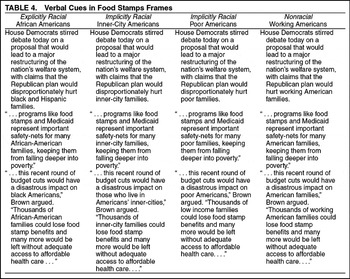
Across all of the experimental conditions the news story offered the same account of a Republican proposal for federal social welfare spending cuts, and of the opposition of the Democratic Party to those cuts. Manipulation of the racial cues across conditions was even more precise than in the Iraq experiment, as it was accomplished simply by replacing the description of the group the Democratic congressman claimed would be particularly affected by the spending cuts as he voiced his opposition. Table 4 presents the passages that changed across conditions to provide the cues. The explicit racial condition included references to Black and African-American families, while the non-racial condition replaced those references with “working” American families. One of the implicit racial conditions used the term “inner city” to describe the families affected by the cuts. Given the effect of this term in Hurwitz and Peffley's (2005) study of White opinion, I expect this implicit cue to be associated particularly with negative depictions of Black ghettos and urban crime scripts (Gilliam and Iyengar 2000). The second implicit racial condition refers to the families most vulnerable to the cuts simply as poor Americans. Given the traditional concern about disproportionate rates of poverty among African Americans and the concentration of Black leaders on anti-poverty and social welfare programs, I expect that the label “poor Americans” should carry an implicit connection to race among Blacks. Given the degree to which others have found antipoverty and welfare programs inherently racially coded among White Americans, the reminder of the programs' concentration on “the poor” may also function as an implicit racial cue among Whites.
This experiment was carried out both in computer labs at the University of Texas in Austin, Texas and Southern University in Baton Rouge, Louisiana, and at various locations in both cities through the use of laptop computers, from February 28 to March 23, 2006. The sample is comprised of adult subjects, half students and half non-students, who were recruited to participate in the study from the areas surrounding each university. Nonstudent subjects were told that they would receive $10 cash for their participation. One-hundred sixty self-identified African-American subjects and 181 self-identified White subjects participated in the experiment. Participants were much younger than the national population; the median age is approximately 26 years. The participants were also more educated than the national population, with most subjects indicating that they had some college education. Analysis of variance, however, indicates that neither sociodemographic variables nor relevant partisan and attitudinal variables differed across conditions.
As participants entered the lab (or equivalent facility), they were randomly assigned to one of the four racial cue conditions or a control condition. Subjects in the control group did not read any article about welfare issues, but instead read a nonpolitical article about the accidental shattering of an antique vase in a London museum. After reading the articles, subjects answered an extensive battery of posttest questions, which included questions about their support for increased spending on food stamps, issue importance ratings, and racial and political attitudes. On completion of the post-test questionnaire subjects were debriefed, paid, and dismissed.
Welfare in Black and White
I begin the evaluation of the racial cues in the welfare experiment by modeling subjects' level of support for increased spending on the central welfare program discussed in the manipulated articles—food stamps—as a function of the most relevant considerations that might be used forming an opinion on the issue. Thus, in addition to racial attitudes, the model includes measures of ideology, individualism, egalitarianism, and general feelings about the poor. In-group racial identification is again gauged by a measure of racial in-group linked fate, while the measure for out-group resentment is captured by outgroup stereotyping. Ideology is measured with the standard seven point scale, with higher values indicating a more conservative ideology. Individualism is measured with a scale comprised of questions that capture the subjects' perception of link between hard work and success. Egalitarianism is measured by a scale which captures peoples' beliefs about equality. Feelings about the poor are gauged by a 101 point feeling thermometer assessing the subjects' feelings of warmth or coolness toward poor people (see Appendix A for question wording and scale construction). All measures are again scaled to range from 0 to 1, and each attitude is interacted with each condition to test for its activation by each cue type. The model is estimated separately for Blacks and Whites using OLS regression.
Results of the models of Blacks' and Whites' support for increased spending on food stamps are presented in Tables 5 and 6, respectively. As in the Iraq experiment, the tables present the baseline effects of each attitude in the control condition in the first column and the total effect of each variable within each condition in the following columns, with bolded cells indicating a statistically significant attitude by condition interaction. The predictions are unidirectional: effective racial cues should make racial group identification a significantly stronger predictor of support for increased spending among Black subjects, while they should make racial out-group resentment a significantly stronger predictor of opposition to increased spending among Whites. Only the implicit racial cues are expected to activate racial attitudes among Whites. Explicit racial cues are again expected to be effective among Blacks, but the expected effectiveness of the implicit cues among Blacks is conditioned by type. If Blacks are rejecting connections between racial group interest and the interests of particularly “marginal” elements of the Black community, then the negatively loaded “inner-city” cue should be ineffective among Blacks, while the “poor” cue should be more likely to activate racial thinking about the food stamps issue.


The results for Whites generally conform to expectations, with the exception that the “poor Americans” cue did not work to attach racial attitudes to support for food stamps spending. Although the coefficient on the interaction between the poor Americans condition and out-group resentment is in the hypothesized negative direction, it fails to reach traditional levels of statistical significance. There are, in fact, no significant changes in the ingredients of Whites' opinions about spending on food stamps across any of the conditions except for in the implicitly racial “inner city” condition. As expected, in response to the “inner city” cue, Whites' out-group resentment becomes an important factor in shaping their level of support for increased spending, with the most resentful Whites being less than half as supportive as the least resentful, all else constant. It is also worth noting that despite previous work on the extant racial coding of welfare programs, among this particular group of Whites there was no discernable relationship between their racial attitudes and their opinions on this particular welfare issue in the control condition.
Blacks also exhibit a pattern of results that generally adheres to expectations. As in the Iraq experiment, whereas racial attitudes were apparently not related to Blacks' evaluations of the issue in the control condition, exposure to the explicit racial cues readily attaches racial group interest to Blacks' expressions of support for increased spending on food stamps. Unlike the Iraq experiment, the results for the implicit cue conditions lend some insight into whether and how implicit racial cues can activate racial thinking on an ostensibly nonracial issue among Blacks. The more precise implicit racial cues used in this experiment suggest a difference in Blacks' responses to different cue types. The inner city cue—the implicit cue expected to be most closely associated with negative representations and/or “marginal” elements of the Black community—produced no change in Blacks' use of racial attitudes in constructing their opinions about the issue of food stamps. There is some evidence, however, that the less negatively loaded poor cue was effective in activating racial thinking about the issue. A positive, statistically significant coefficient on the interaction of the poor Americans condition and racial group identification suggests that Blacks in this condition were more likely to use their racial attitudes in deciding their level of support for spending on food stamps. The predicted effect of racial group identification, however, while positive as expected, is quite small. Not only is the predicted effect of racial group identification on support for increased welfare spending less than half of that in the explicit racial cue condition, but the results also indicate that the general principle of egalitarianism became far more important than racial group identification in shaping Blacks' opinions in the poor Americans condition. In sum, while there is some evidence that the right sort of implicit racial cue might be effective in activating racial thinking about an ostensibly non-racial issue among Blacks, that evidence is far from overwhelming.
To more directly test the hypothesis that it is the connection of the implicit racial cue to negative representations of Blacks that causes the rejection of a link between racial group interest and the issue being discussed, I turn next to a set of analyses that consider whether such negative representations are activated by the implicit cue conditions. If so, I examine whether this moderates the effect of the implicit racial cue on the connection between racial group interest and the relevant issue position. Given that previous work in Black politics, beginning with that of DuBois (1899, 1903), has pointed to sharp intraracial politics around the issue of crime, and given the complete ineffectiveness in the welfare experiment of the implicit racial cue assumed to be tied more to crime—rather than just poverty—“criminal” seems a likely negative representation of Blacks to moderate the effect of implicit racial cues (see Mendelberg 1997 and Valentino 1999 for further discussion of the connection between welfare and crime). That is, what DuBois termed the “criminal class” may be the element of the Black community that the implicit racial cues, particularly the inner city cue, are bringing to mind. Deeming this element of the Black community's interests outside of the interests of the race would cause Blacks to reject the cue's suggested connection between the racial group interest and the issue being discussed. I therefore turn to a measure that gauges subjects' concern about crime. The measure captures whether subjects listed crime among the three most important issues facing the country. I look first at the distribution of this measure across the experiment's conditions to see if concern about crime was, in fact, more common in the implicit cue conditions. I then examine the power of concern about crime to moderate the effect of racial group interest on opinions on food stamps across the conditions.
The percentages of respondents in each condition who listed crime among the top three problems facing the United States are presented in Table 7, with the results for White and Black subjects listed in separate columns. For the sake of comparison, the table also includes the percentages of subjects who mentioned two other issues relevant to the social welfare concentration of the experiment, poverty and race, as well as the percentages for the other two most commonly mentioned issues, education and war. Among Black subjects, only one condition produced a significant change in the importance of any issue. Consistent with expectations about the negative coding of the inner city cue, Blacks in the inner-city condition were almost twice as likely to mention crime as an important issue (37% did so) as those in the control group (19%). Thus, in the only condition meant to activate racial thinking about the food stamps program that completely failed to do so among Blacks, there is some evidence to suggest that Black subjects were more likely to be thinking about negative, criminal representations of their racial group. In comparison, Whites also worried significantly more about crime when exposed to the implicitly racial inner city cue (24%) than in the control condition (2%). This is consistent with the increased role of negative attitudes about Blacks in the formation of Whites' opinions about food stamp spending in the inner city condition. Whites were also more likely to say that crime was an important issue in the explicit racial cue condition (20%).

Although the importance ratings are suggestive of a role for the activation of negative or marginal representations of Blacks in moderating the effect of the inner city cue's ability to activate racial thinking about food stamps, they do not directly test the hypothesis. It is also unclear from the importance ratings that such a moderating effect can explain why the implicit cues in the poor Americans condition were less effective than the explicit cues in linking racial group interest to increased support for spending on food stamps. Crime, after all, was not more likely to be mentioned by Blacks in the poor Americans condition. In order to test the moderating hypothesis, I model support for increased spending on food stamps among Blacks as a function of their racial group identification and their ratings of the importance of crime, including the interactions of those two attitudes across each condition. That is, the model includes the three-way interactions between racial group identification, crime importance, and condition. I estimate the model using OLS regression. The moderating hypothesis predicts that the coefficients on the three-way interactions for the two implicit racial conditions should be negative and significant; Blacks who become more concerned about crime in response to the implicit cues should be rejecting the cues' attempts to link racial group identification with support for social welfare programs, including food stamps.
Indeed, the results are consistent with the moderating hypothesis. As shown in Table 8, the only conditions in which the three-way interaction coefficients are statistically significant are the two implicit cue conditions. These negative interaction coefficients indicate that when Blacks became more concerned about crime in response to the implicit cues, the connection between higher levels of group identification and increased support for spending on food stamps was attenuated.

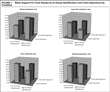
To ease interpretation of the implications of the moderating effect, Figure 1 graphically displays mean levels of support for increased spending on food stamps among Blacks across the experimental conditions, with subjects broken into groups defined by high and low levels of racial group identification and levels of concern about crime. The top left cell of the figure demonstrates that within the explicit race cue condition, blacks with higher levels of group identification expressed more support for increased spending on food stamps than those with low levels, regardless of their concerns about crime. This simple pattern, expected if subjects are using the cue of group interest in the food stamps program consistently to attach their racial group identification to their opinions about the program, is not replicated in any of the other cells. Blacks in the nonracial working Americans condition—displayed in the bottom right cell of the figure—which should not have activated concerns about crime nor group identification, behave accordingly by exhibiting no significant differences in the mean support for food stamps spending.6
One alternative hypothesis might be that the accessibility of racial considerations is mediating the effects of racial frames for African Americans. Utilizing a procedure identical to that used by Valentino, Hutchings, and White (2002) I found no support for the idea that racial accessibility mediates the effect of the frames. These results are available on request.

Black Support for Food Stamps by In-Group Identification and Crime Importance by Condition
The graphs of Blacks' support for food stamp spending in the two implicit racial conditions tell the more complicated story of the moderating effects of activated concerns about crime. In the top right cell, the graph illustrates that among Blacks exposed to the inner city cue, those with higher levels of group identification who were concerned about crime seemed particularly likely to distance themselves from the concerns of inner city families; they expressed lower levels of support for food stamp spending than all the other subjects in the condition. The bottom left cell of Figure 1 highlights that for those in the poor Americans condition, concerns about crime also changed the relationship between group identification and support for spending on food stamps. Among those unconcerned about crime, Blacks more highly identified with the racial group were, as in the explicit racial cue condition, more supportive of the program. For those who felt crime was an especially important issue, however, stronger group identifiers were less supportive. Implicit racial cues, it seems, can do the same work on Black opinion as explicit racial cues, but only to the extent that they do not simultaneously activate Blacks' concerns about negative representations or marginal elements of the Black community.
CONCLUSION
This study has sought to clarify the role of race in shaping American public opinion by detailing and testing a theoretical account of when and how Blacks' racial attitudes become attached to ostensibly non-racial issues. Contrary to accounts that would suggest racial group identification is the consistent central organizing principle of Black political opinion, the results of the study suggest that the attachment of Blacks' racial predispositions to ostensibly non-racial issues is malleable, and that racialized context can play an important role in defining the racial implications of politics for Black Americans. Additionally, the results support the argument that implicit and explicit racial messages play different roles in activating Blacks' racial group identification and Whites' racial group resentment. Although racial cues are only effective in activating Whites' racial attitudes on ostensibly non-racial issues when they are implicit, the same is not true for Blacks. Explicit racial cues successfully activated Blacks' in-group identification across two very different ostensibly non-racial issues, while implicit racial cues did not reliably activate racial thinking among Blacks.
Yet the differences between Blacks' and Whites' responses to explicit and implicit racial cues imply a degree of similarity across the two racial groups: the effect of racially coded political communication for both is moderated by ambivalence. For Whites, as others have shown, tension arises when they have to negotiate between attitudes of egalitarianism and those of racial conservatism. The root of Blacks' ambivalence, however, centers on tension in the definition of whose interests belong on the Black agenda. Connecting Blacks' in-group attitudes and their positions on public policies hinges on a tension between belief in a common racial group interest and negative representations of some subsets of the group. Thus, when an issue is linked to a marginalized subset of the in-group, the role of Black group identification in determining support for that issue is attenuated; the issue, despite implication of its racial meaning, is treated as beyond the “boundaries of Blackness.”
Finding that the effect of racial cues on Blacks' policy positions is moderated by ambivalence when those cues make particular representations of the racial group salient raises several important questions for future research. First are questions about the work of subgroup specific cues. In the context of the racial politics of Black and White, the expectation for Whites is that implicit racial cues activate negative attitudes about the out-group. Yet this expectation is predicated on the notion that attitudes about differences between the in-group and the out-group are generally negative. The question remains whether it might be possible with subgroup specific cues to tap positive attitudes about the out-group—whether some particular portrayal of Blackness could resolve the tension between egalitarianism and racialized thinking for Whites. Moreover, while conflicting attitudes about the in-group did the moderating work among Blacks, the question remains whether conflicting attitudes about the out-group could do that same work. That is, outside of the realm of racial politics, where a political discourse that has highlighted the tension between out-group resentment and the norm of equality provides the limit on anti-out-group politics, are subgroup specific cues possible sources of ambivalence that might moderate the effectiveness of out-group-based politics?
Finally, although the findings presented in this paper demonstrated when race matters and when it doesn't for African Americans' thinking about ostensibly non-racial issues, it also highlighted how much more there is to know about the roles race plays in Blacks' political decision-making. Most centrally, it opened questions about when and how race matters for issues that offer a more universal benefit to the Black community, such as affirmative action or reparations for slavery. With such inherently racialized issues, we might expect that race would be a chronically salient feature of Blacks' political thinking. Yet if issue frames characterized such policies as benefiting only certain marginal subsets of the Black population, could the broader in-group meaning of the policy be deactivated? The results presented in this paper would suggest that this might be possible, but that the effectiveness of such framing might hinge on whether these issues really could be discussed without explicit references to race. While there are limitations on identity politics among Black Americans, group identification is easily invoked when politics take on any explicit tension between Black and White.
APPENDIX A: QUESTION WORDING
Support for the War in Iraq
- Iq1. Do you favor or oppose having U.S. forces take military action against Iraq? Those who favor the use of military action against Iraq are at point 1 and those who oppose the use of military force are at point 7 and, of course, some other people have opinions somewhere in between at points 2, 3, 4, 5, or 6. Where would you place yourself on this scale?
- Iq2. Do you favor or oppose having U.S. forces (including U.S. ground forces) take military action against Iraq?
- Iq3. What do you think is more important—for the United States to move quickly against Iraq, even if that means acting without international support; or for the United States to gain international support, even if that delays action against Iraq?
All items were recoded to range from 0 to 1 with 1 equaling greater support for the use of military force. The items were then additively scaled.
(Blacks: Mean = .24; Standard deviation = .23; Cronbach's alpha = .69)
(Whites: Mean = .34; Standard deviation = .24; Cronbach's alpha = .81)
Support for Increased Spending on Food Stamps
- Fs1. Do you think that federal spending on Food Stamps should be increased, decreased or kept about the same?
- Fs1a. Do you think that federal spending on Food Stamps should be increased/decreased greatly or just a little? 1 = Increased greatly, .75 = Increased a little, .5 = Kept about the same, .25 = Decreased a little, 0 = Decreased greatly
(Blacks: Mean = .69; Standard deviation = .29)
(Whites: Mean = .47; Standard deviation = .29)
In-Group Identification
Do you think that what happens generally to Black/White people in this country will have something to do with what happens in your life? 1 = a lot, .66 = something, .33 = not very much, 0 = nothing at all. Blacks were asked about Blacks and Whites were asked about Whites.
Iraq War Experiment
(Blacks: Mean = .75; Standard deviation = .34)
(Whites: Mean = .74; Standard deviation = .29)
Food Stamps Experiment
(Blacks: Mean = .70; Standard deviation = .33)
(Whites: Mean = .72; Standard deviation = .30)
The wording of this measure is identical to the measure of linked fate used by Dawson (1994). Although this measure was originally designed to measure Blacks' closeness to their racial group (Dawson) other researchers have similarly tailored such measures to capture Whites' closeness to their racial group (Kinder and Winter 2001).
Out-Group Resentment
In the Iraq War experiment out-group resentment was measured by the reverse coding of the White/Black feeling thermometer. Blacks were asked how they felt about Whites and Whites were asked how they felt about Blacks. The thermometer scores where then coded so that 1 = Cold and 0 = Warm.
(Blacks: Mean = .35; Standard deviation = .35)
(Whites: Mean = .29; Standard deviation = .23)
In the food stamps experiment out-group resentment is measured by the respondents' willingness to make stereotypical attributions to the racial out-group. Subjects were asked to rate on a seven-point scale how well the words hardworking, intelligent and lazy described either Blacks or Whites as a group. The responses to each of these questions was measured on a seven-point scale and coded to run from 0 to 1 where high values represented negative responses. The items were then additively scaled.
(Blacks: Mean = .59; Standard deviation = .27; Cronbach's alpha = .48)
(Whites: Mean = .56; Standard deviation = .21; Cronbach's alpha = .54)
Ideology
Ideology is measured by the following question: We hear a lot of talk these days about liberals and conservatives. On a 7-point scale, where 1 is very liberal and 7 is very conservative, where would you place yourself on this scale, or haven't you thought much about this? For this analysis, this variable was recoded to run from 0 to 1 with 1 representing a very conservative self-placement.
Iraq War Experiment
(Blacks: Mean = .50; Standard deviation = .29)
(Whites: Mean = .44; Standard deviation = .25)
Food Stamps Experiment
(Blacks: Mean = .53; Standard deviation = .27)
(Whites: Mean = .51; Standard deviation = .24)
Dove/Hawk
Dove/Hawk dispositions were measured by a single item which asked: Which do you think is a better way for us to keep the peace—by having a very strong military so that other countries won't attack us, or by working out our disagreements at the bargaining table? (1 = Bargaining Table, 0 = Strong Military).
(Blacks: Mean = .66; Standard deviation = .47)
(Whites: Mean = .77; Standard deviation = .42)
Individualism
- Ind1. What do you think makes most poor people poor? Most of them are poor because…0 = They don't get the training and education they need. 1 = They don't try hard enough.
- Ind2. Do you agree or disagree with the following statement: Most people on public assistance could get by without it if they really tried.
(Blacks: Mean = .40; Standard deviation = .29; Cronbach's alpha = .23)
(Whites: Mean = .39; Standard deviation = .29; Cronbach's alpha = .51)
Equality
- Eq1. Do you agree or disagree with the following statement: Our society should do whatever is necessary to make sure that everyone has an equal opportunity to succeed.
- Eq2. If people were treated more equally in this country we would have many fewer problems.
(Blacks: Mean = .85; Standard deviation = .19; Cronbach's alpha = .51)
(Whites: Mean = .69; Standard deviation = .24; Cronbach's alpha = .56)
Feelings toward the Poor
Poor People feeling Thermometer—0 = Cold—1 = Warm
(Blacks: Mean = .71; Standard deviation = .24)
(Whites: Mean = .58; Standard deviation = .19)
For helpful feedback and advice, I thank Sharon Austin, Darren Davis, Vincent Hutchings, Cindy Kam, David Lublin, Eric McDaniel, Tasha Philpot, Nicholas Valentino and the journal's anonymous reviewers. I am especially indebted to Corrine McConnaughy for extensive comments. For research assistance, I am grateful to Troy Allen, Saiid Allen, Khephren Allen, Tonya Isom, Kenyatha Loftis, Vincent Shaw Jr., Doris White, and Lia White-Allen. All errors are my own.





Comments
No Comments have been published for this article.