




Introduction
Social connectedness is an important contributor to life satisfaction and health among older adults (O’Rourke & Sidani, Reference O’Rourke and Sidani2017; Wang et al., Reference Wang, Gao and Han2023). Numerous intersecting personal and social factors can lead to lack of social connectedness, or loneliness, such as lack of spouse or partner, limited social network and social activity, poor health, and depression (Dahlberg et al., Reference Dahlberg, McKee, Frank and Naseer2022). One way to enhance connections for older adults is through intergenerational programs, broadly defined as ‘vehicles for the purposeful and ongoing exchange of resources and learning among older and younger generations’ (Hatton-Yeo & Ohsako, Reference Hatton-Yeo and Ohsako2000, p.3). Reviews of intergenerational programs, in which older adults interacted with young children or university students, reported benefits such as decreased social isolation and enhanced well-being among older adults (Zhong et al., Reference Zhong, Lee, Foster and Bian2020), enhanced positive perceptions across generations, and enhanced feelings of community (Krzeczkowska et al., Reference Krzeczkowska, Spalding, McGeown, Gow, Carlson and Nicholls2021). Intergenerational programs in which older adults interacted with university students have also been associated with benefits among older adults, including enhanced physical health (Strand et al., Reference Strand, Francis, Margrett, Franke and Peterson2014), improved sense of purpose (Chippendale & Boltz, Reference Chippendale and Boltz2015), reduced social isolation (Nicholson & Shellman, Reference Nicholson and Shellman2013), building relationships (Park et al., Reference Park, Lee and Dabelko-Schoeny2016), and increased well-being (Yuen et al., Reference Yuen, Huang, Burik and Smith2008).
A limitation of intergenerational programs is that they are often short-term, often resulting in superficial or fragmented relationships (Zhong et al., Reference Zhong, Lee, Foster and Bian2020). In addition, most intergenerational programs aim to connect young children and older adults, as opposed to young adults and older adults (Hock & Mickus, Reference Hock and Mickus2019). One way to bring older and younger adults together in a manner that is frequent, consistent, and facilitative of meaningful relationships is through intergenerational housing (Hock & Mickus, Reference Hock and Mickus2019).
Intergenerational housing programs exist in many different forms, such as home sharing (Labit & Dubost, Reference Labit and Dubost2016), cohousing communities (Labit, Reference Labit2015), university-based retirement communities (Carle, Reference Carle2006), and programs in older adult residences (Hock & Mickus, Reference Hock and Mickus2019; Kilaberia & Ratner, Reference Kilaberia and Ratner2018). While these programs vary in their characteristics, such as number of young people, length of tenancy, and roles and responsibilities, they all create a living environment in which the young and old live in close proximity to enable meaningful connections between generations.
While innovative intergenerational housing programs have been initiated worldwide, limited research about such programs has been published, particularly exploring the experiences of young adults and older adults living and engaging in activities together. The research published to date supports the potential benefits and challenges of these housing programs. For example, Even-Zohar (Reference Even-Zohar2022) conducted a phenomenological study that explored the experiences of students who had lived with older adults in their homes in Israel and reported common activities such as conversation, eating meals together, watching television, and going for walks. Student participants described the program and the relationships they developed as generally positive, and noted that some relationships were strained by factors such as personality and ethnicity differences and expectations about the frequency of interaction (Even-Zohar, Reference Even-Zohar2022). Regarding intergenerational housing in residences for older adults, Landi and Smith (Reference Landi and Smith2019) conducted an evaluation of the Humanitas retirement home. Six young adults lived in the residence during their post-secondary studies (an average of 3.5 years) and were expected to spend 30 hours per month with the older adults (Landi & Smith, Reference Landi and Smith2019). The Humanitas program was based on social reciprocity and collaboration in order to generate a strong community (Landi & Smith, Reference Landi and Smith2019). Landi and Smith (Reference Landi and Smith2019) found that the younger adults often assisted the older adults with using technology and provided companionship through playing games, shopping, and dining out, while the older adults often discussed personal life experiences and traditional hobbies. As a result, Landi and Smith (Reference Landi and Smith2019) described a mutual relationship, in which the older adults gained information and skills, and the students obtained increased knowledge regarding old age and the ageing process. Additionally, in a case study, Arentshorst and colleagues (Reference Arentshorst, Reinier Kloet and Peine2019) found that, in the same Humanitas home, older adults noted that the students contributed to a lively, joyful, and inclusive living environment, brought the outside world in, and enabled the older adults to reconnect with their youth. Furthermore, Hock and Mickus (Reference Hock and Mickus2019) explored the feasibility of a program in the United States in which three occupational therapy students lived in an assisted living facility in order to prepare the students for future work with the ageing population. Students and older adults engaged together in recreation activities, conversation, and meals (Hock & Mickus, Reference Hock and Mickus2019). While Hock and Mickus’ (Reference Hock and Mickus2019) findings reflected several benefits, including students’ increased skills in communicating with older adults, reductions in student expenses, increased social activities and support for older adults, and greater tolerance and understanding between generations, they also noted challenges. These challenges included a lack of understanding of the students’ role by the staff members, the residents’ perceptions about the cost of having the students live at the facility, concerns about students’ privacy, and high demand for student time (Hock & Mickus, Reference Hock and Mickus2019). As a final example, Kilaberia and Ratner (Reference Kilaberia and Ratner2018) reported on a senior’s housing community in which up to 10 students lived in the community at a time and were expected to spend about 10 hours per week with residents, during activities, meals, or conversation. They conducted an ethnographic and phenomenological study involving data collection by one university student living there for 3.5 years (Kilaberia & Ratner, Reference Kilaberia and Ratner2018). The authors note the important role of the student as a ‘stranger’, someone who belongs to a group yet is not an organic member (Kilaberia & Ratner, Reference Kilaberia and Ratner2018). The student’s status as a stranger helped create trusting relationships in which the student could meet some of the needs of the residents, such as listening or offering assistance (Kilaberia & Ratner, Reference Kilaberia and Ratner2018).
Existing literature suggests that the activities that young and older adults do together are central to intergenerational housing programs (Arentshorst et al., Reference Arentshorst, Reinier Kloet and Peine2019; Hock & Mickus, Reference Hock and Mickus2019; Landi & Smith, Reference Landi and Smith2019). Such activities can be considered ‘occupations’, defined as ‘the everyday activities that people do as individuals, in families and with communities to occupy time and bring meaning and purpose to life’ (World Federation of Occupational Therapists, 2019). ‘Co-occupations’ seem particularly important, which are occupations that are performed by two or more people, ‘involving shared time and space and involving both shared and personalized meanings’ (van Nes et al., Reference van Nes, Jonsson, Hirschler, Abma and Deeg2012, p. 352). Co-occupations are a key means of connecting with others, shaped by many features of the person and the context (Crepeau, Reference Crepeau2015; van Nes et al., Reference van Nes, Jonsson, Hirschler, Abma and Deeg2012). Co-occupation includes shared physicality, shared emotionality, and shared intentionality, all embedded within shared meaning (Pickens & Pizur-Barnekow, Reference Pickens and Pizur-Barnekow2009). Although there has been little attention to non-familial intergenerational co-occupations, research addressing co-occupations among older adults points to diverse benefits and has generated knowledge regarding the transactional nature of co-occupations. Two studies by van Nes et al. (Reference van Nes, Runge and Jonsson2009, Reference van Nes, Jonsson, Hirschler, Abma and Deeg2012) explored co-occupation in older adult couples. In one study, the majority of the couples’ daily occupations were intertwined, challenging an individualistic view of occupation and demonstrating interdependence and a collective understanding of occupation (van Nes et al., Reference van Nes, Runge and Jonsson2009). Additionally, van Nes et al. (Reference van Nes, Jonsson, Hirschler, Abma and Deeg2012) explored an older couple’s most valued co-occupation, going for a walk together. They found that walking was a way of representing their togetherness while still being individuals, with shared and personalized meanings, which contributed to maintaining their health and well-being (van Nes et al., Reference van Nes, Jonsson, Hirschler, Abma and Deeg2012). Furthermore, Crepeau (Reference Crepeau2015) explored the community co-occupation of older adults preparing and serving church suppers together and identified situational factors that shaped the co-occupation such as relationships, routines, and context. They also described the multiple forms of coordination and collaboration that took place (Crepeau, Reference Crepeau2015). Other studies have indicated that disruption in co-occupational experiences may reduce the social participation of older adults, leading to social isolation and increased symptoms of physical or mental illness (Pickens & Pizur-Barnekow, Reference Pickens and Pizur-Barnekow2009).
Although co-occupation is likely a key element of intergenerational programs, most research in this area has focused on describing the programs and detailing challenges, benefits, and recommendations (Arentshorst et al., Reference Arentshorst, Reinier Kloet and Peine2019; Hock & Mickus, Reference Hock and Mickus2019; Landi & Smith, Reference Landi and Smith2019). While some literature has explored the activities that university students and older adults engage in together, minimal details are provided, for example, Hock and Mickus (Reference Hock and Mickus2019) who simply noted categories of activities. The co-occupations that take place in intergenerational housing settings, as well as the factors that facilitate and constrain co-occupations, are poorly understood. Such knowledge could inform future programming by deepening understanding of the dynamics of intergenerational housing programs, the meanings behind the activities that are engaged in together, the relationships formed, and how ‘doing together’ can promote connection, belonging, and well-being. To address this gap, this study explored how older adults and university students living together in a retirement home in Canada enacted co-occupations, the factors that shaped the co-occupations, and how the co-occupations affected intergenerational relationship-building and connections.
Methodology and methods
Theoretical framing
We applied a constructivist-interpretivist paradigm, a combination of two paradigms that ‘share the goal of understanding the complex world of lived experience from the point of view of those who live it’ (Schwandt, Reference Schwandt, Denzin and Lincoln1998, p. 221). In an interpretivist paradigm, knowledge is obtained through the process of social interaction (O’Donoghue, Reference O’Donoghue2018). Within a constructivist paradigm, researchers assume that multiple dynamic realities exist, and these realities are constructed through dialogue between the researcher and participants (Guba & Lincoln, Reference Guba and Lincoln1994). In line with a constructivist-interpretivist paradigm, we practiced reflexivity throughout the study to continually evaluate how personal behaviours, biases, relationships, and social context influenced the research methods and findings (Finlay, Reference Finlay2002).
In addition to drawing on the concept of co-occupation, described above, we employed a transactional perspective, which involves viewing person and context in continual transaction, each forming part of the other (Dickie et al., Reference Dickie, Cutchin and Humphry2006). Occupation is the embodiment of the transaction of person and context (Dickie et al., Reference Dickie, Cutchin and Humphry2006), and the meaning of the occupation is continually re-created through re-coordination of person and place (Heatwole Shank & Cutchin, Reference Heatwole Shank and Cutchin2010). Likewise, the meanings of co-occupations are continually negotiated within the person–place relationship, involving shared and personalized meanings, which are influenced by personal factors, as well as the sociocultural and relational context (van Nes et al., Reference van Nes, Jonsson, Hirschler, Abma and Deeg2012).
Methodological approach
We conducted a focused ethnography, an approach to ethnography that focuses on smaller elements of a field, including specific situations, interactions, and activities, while analyzing the structure and patterns of interaction (Knoblauch, Reference Knoblauch2005). We focused on co-occupations and relationships within an intergenerational housing program, as opposed to exploring the intergenerational housing program as a whole (Knoblauch, Reference Knoblauch2005). The first author was a health and ageing master’s student at the time of the study who shared similarities with the student participants and had limited intergenerational experiences outside of family. The first author conceptualized and designed the study, collected and analysed data, and co-authored the paper with the second author. The second and third authors contributed to study design, analysis, and writing. This study was approved by the Non-Medical Research Ethics Board of the University of Western Ontario.
Participants and setting
The study site was a retirement home located in a mid-sized Canadian city. The intergenerational housing program was initiated by the retirement home in 2017, and it recruited two to three graduate-level music students to live in the home each academic year (September–April). During the study period (September 2019–February 2020), two students (a vocalist and a pianist) lived in the retirement home. Within this program, the students lived at the retirement home free of charge, received three free meals per week, and were expected to spend 10–12 hours per week with the older adults, including music events and activities. The students spent this time performing musical entertainment, hosting and attending leisure activities, and attending mealtimes with the older adults throughout their time there.
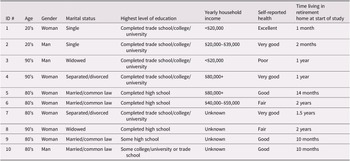
The first author gained approval from retirement home management to conduct the study, and retirement home staff shared information about the study in a monthly newsletter. Study participants included two university students (one man and one woman) and eight older adult residents who participated in interviews, informal conversations, and observations. Many additional older adults were involved in informal conversations and observations only. See Table 1 for demographic characteristics of study participants involved in interviews. To recruit participants to participate in interviews, we used purposive sampling techniques (Higginbottom et al., Reference Higginbottom, Pillay and Boadu2013). As it was important to obtain the student perspective, we recruited the two university students who were living in the home. We also recruited older adults who had been observed as frequently engaging in co-occupations with the students, who could therefore provide rich information. The first author discussed the study interviews during casual conversations with retirement home residents, and retirement home staff distributed information about recruitment for interviews, including study posters, information cards, and in the retirement home newsletter.
Demographic characteristics of participants

Table 1. Long description
Column headers from left to right are I D number, Age, Gender, Marital status, Highest level of education, Yearly household income, Self-reported health, and Time living in retirement home at start of study. Row 1: I D 1, age 20s, woman, single, completed trade school or college or university, less than dollar sign 20,000, excellent health, 1 month. Row 2: I D 2, age 20s, man, single, completed trade school or college or university, dollar sign 20,000 to dollar sign 39,000, very good health, 2 months. Row 3: I D 3, age 90s, man, widowed, completed trade school or college or university, less than dollar sign 20,000, poor health, 1 year. Row 4: I D 4, age 90s, woman, separated or divorced, completed trade school or college or university, dollar sign 80,000 plus, very good health, 1 year. Row 5: I D 5, age 80s, woman, married or common law, completed high school, dollar sign 80,000 plus, good health, 14 months. Row 6: I D 6, age 80s, woman, married or common law, completed high school, dollar sign 40,000 to dollar sign 59,000, fair health, 2 years. Row 7: I D 7, age 80s, woman, separated or divorced, completed trade school or college or university, income unknown, very good health, 1.5 years. Row 8: I D 8, age 90s, woman, widowed, completed high school, income unknown, fair health, 2 years. Row 9: I D 9, age 80s, woman, married or common law, some high school, income unknown, good health, 10 months. Row 10: I D 10, age 80s, man, married or common law, some college or university or trade school, income unknown, good health, 10 months.
Data collection
Consistent with the literature regarding focused ethnography (Knoblauch, Reference Knoblauch2005), semi-structured interviews, informal conversations, and field observations were used simultaneously to collect data. Data were collected over a 5-month period, from September 2019 to February 2020. We had planned on the option to collect data until the end of the academic year in April 2020; however, due to the COVID-19 pandemic, in March 2020, the students moved out of the home, and in-person data collection was not possible. We decided not to pursue additional, remote data collection due to the richness and comprehensiveness of the data collected to that point. The first author conducted two interviews with each of the students, one interview each with six older adults, and one interview with an older adult married couple. Interviews addressed perceptions about the intergenerational housing program, co-occupations in which they took part, relationships, and beliefs regarding university students and older adults. Each interview was about 1 hour long and was audio-recorded and transcribed verbatim. Interview participants provided written informed consent to participate.
The first author conducted 12 field observations of approximately 1–2 hours each, during scheduled events and activities, as well as while entering and exiting the retirement home. During observations, the researcher engaged in informal conversations with residents. Retirement home residents were informed that observations may be taking place throughout the home through the newsletter and posters, as well as by signage in specific areas where longer observations took place, allowing residents to make an informed decision about engaging with the study. Observations focused on the co-occupations that were taking place, the relationships and interactions between the students and older adults, and the physical space and objects that were being used. Observations were documented through written notes and floor-mapping techniques (Knoblauch, Reference Knoblauch2005).
The first author played an observer-as-participant role to create trust with participants (Higginbottom et al., Reference Higginbottom, Pillay and Boadu2013). Crystallization, through using multiple data collection methods and data sources, enabled complex understandings (Tracy, Reference Tracy2010). In addition, throughout data collection, the first author completed reflexive notes on her positionality as a researcher, the research process, and initial findings.
Data analysis
Data were analysed using inductive, reflexive thematic analysis techniques (Braun & Clarke, Reference Braun and Clarke2019), starting at the onset of data collection. The first author re-read transcripts, observation notes, floor maps, and reflexive notes to gain a thorough understanding of the data set. During transcription, an informal list of ideas and potential codes was generated from small segments of raw data and discussed with co-authors. Transcripts were then uploaded to a qualitative analysis software program, Quirkos version 2.1 (https://www.quirkos.com/index.html), and the first author began initial coding of data, during which additional ideas were identified, the draft code list was expanded and refined, and codes were defined. All transcripts were then coded with the refined code list. Next, using the results of the coding process, initial codes were grouped into potential themes, followed by visual techniques to flexibly re-arrange, combine, and divide themes. To further develop themes, we returned to the raw data, including transcripts, observation notes, and floor plans, to generate additional codes and ideas, then further developed themes through collaborative writing. A structure of themes and sub-themes was collaboratively generated to provide rich interpretations of the data. Incorporating perspectives from three researchers during analysis promoted the credibility of the findings (Tracy, Reference Tracy2010). Throughout this process, all authors practiced reflexivity, for example, by considering the impact of the lead author’s age in interviewing younger and older adults and considering alternate interpretations of data. Data analysis ended once we reached a thorough understanding of the study aim.
Findings
We found that co-occupations were a key means through which older adults and students formed connections and relationships. Older adults and students engaged in certain co-occupations, as well as re-shaped co-occupations, to support interactions and relationship development. We developed three themes including: (1) navigating structured co-occupations and transforming them to enable social interactions, (2) connecting through informal co-occupations, and (3) creating diverse and mutually beneficial intergenerational relationships through co-occupation.
Navigating structured co-occupations and transforming them to enable social interactions
The intergenerational housing program was structured such that the students received complementary housing and three meals per week in return for providing musical performances and joining in leisure activities with the older adults at the retirement home. The older adults had been aware that the students who were moving into the retirement home were music students, giving the older adults a potential point of entry and shared interest to support relationship-building. However, as explored in the following sections, the music-related co-occupations, such as choir or concerts, were typically structured, with specific times, dates, roles, and other norms. In this context, it appeared that both the retirement home management and the older adults saw the students’ role as service provision, and retirement home residents were audience members or participants. These prescribed roles limited the extent of social interactions and connection and were not conducive to developing close intergenerational relationships. At the same time, both the students and older adults took many actions to re-shape these structured co-occupations in ways that generated more interaction and connection.
For example, the co-occupation of choir seemed to prescribe that the students take on a role involving authority over the older adults by acting as teachers or instructors. At choir practices the students ran a warmup, choose the songs to sing, and directed the older adults. One of the students acknowledged this role, saying ‘in the choir situation [the vocalist] and I are in a seat of power. We have authority and we lead the choir; we direct them how to sing, what to do really’ (Participant 2). While the students were acting as instructors, the older adults were active learners. The older adults would listen to the students’ instructions and guidance and sing the choir songs accordingly. The structure of this co-occupation left little room for more personal interactions and appeared to constrain connections that fostered building personal relationships.
In other instances, the students and older adults aimed to transform the co-occupations they engaged in, in ways that supported interaction and connection. Formal concerts had similar dynamics to the choir, with older adults in listener roles and students in performer roles, leaving few opportunities for personal connections. One way in which the older adults sought to transform this co-occupation and connect more through music was through making music requests to retirement home staff. The students were then instructed to perform a variety of music genres and stay away from performing classical or opera music during certain performances. The student explained ‘[the staff person] was like “maybe take a break from the classical stuff” so we did that. I’d sing Connie Francis and some older stuff’ (Participant 1). Playing music that was more familiar to the older adults seemed to promote enjoyment, stronger connections to the music, and intergenerational connections in this co-occupation. This small transformation set the stage for further relationship-building.
In addition, during pub nights, which took place several nights a week, the students played music and sang for about an hour, as well as served food and beverages while the older adults socialized. During this co-occupation, the students took on a service role, as opposed to the instructor role they played within the choir. The room had several different seating areas and activities to enable the older adults to have social interactions such as conversations, play games, and enjoy refreshments. The pianist explained that during these pub nights he initially thought that he would be playing background music, a familiar occupation for him that would involve very little interaction between himself and others in the room. Instead, the older adults appeared to want more interaction with him, and those who attended began taking actions that transformed pub nights into a more social event involving the performer. They began by treating the student’s playing of the piano as a musical performance for them to actively engage in. The student explained how he felt like the centre of attention, as he would when performing in a concert, ‘it’s embarrassing because I love being background music.… I just sit in the back and play the music…down [in the pub] it’s full-blown concert-mode again’ (Participant 2).The older adults took additional actions to transform the co-occupation and promote social interactions in pub nights. For example, the older adults often turned their chairs towards the student playing the piano, changing the physical environment to better support socializing. Another older adult suggested further changes to the physical environment, that seemed to support her involvement in the co-occupation and her interactions with the student performer, stating:
[The pianist] is great at that piano! Wow can he ever play. So, I’ve asked the girls downstairs if they could turn the piano around a little bit so we would see his hands because he just plays so fast and such nice music. (Participant 8)
The student acknowledged the older adults’ interest in taking part in the pub night performances and as a result he engaged with the audience, taking song requests from the older adults, and often hosting conversations surrounding the music being played. The older adults’ song requests within the pub night co-occupation supported social interactions and relationship-building. The songs requested were often older songs that the older adults remembered from different time periods throughout their lives. Both students described putting in extra effort to build a repertoire of older songs to play and how it allowed them insight into the lives of the older adults. One of the students said ‘we have music that we have no idea how to play, we never heard of, but it’s interesting in the sense that we see through their lives and their experiences and it’s like story time basically for us’ (Participant 2). As seen throughout these examples, it is evident that the norms of a specific co-occupation and the physical setting impacted social interactions. It appears that the older adults sought interaction and engagement with the students, and both students and older adults took a variety of actions to transform structured co-occupations and support building relationships. Musical co-occupations seemed especially useful in facilitating connections between the generations, based on each person’s history with and appreciation of music.
Connecting through informal co-occupations
Informal co-occupations, such as mealtimes or having coffee in the cafe, provided an opportunity for the students and older adults to form more intimate connections, through engaging in more personal conversations. The older adult participants enjoyed this informal time with the students and expressed their hope for more of these opportunities. During more formal, scheduled activities, the conversation usually surrounded the activity that was taking place, such as choir, chess, or conversations about the selected music at a pub hour. In contrast, during mealtimes, there was no activity being discussed, leading the students and the older adults to converse about topics of their choice such as personal stories about themselves and their families, the students’ university program, and keeping up with each other’s day-to-day thoughts and feelings. One of the older adults explained this by saying:
It’s the only way you really get to know everybody is to sit with them through a meal or something…if you’re at activities you don’t get that much chance to talk, so more time is good and it’s good to move around. (Participant 9)
One of the students elaborated:
[Mealtimes are] the best opportunity to connect on a personal level… Obviously in choir and stuff we have little moments of jokes and that kind of interactions, but one-on-one personal conversations and stories and stuff happen a lot at mealtimes… you get a chance to have genuine conversations. (Participant 1)
This depth of personal interactions during meals was also observed. For example, one conversation focused on the student’s recent activities and one of the older adults showed the student photos of herself as a child and told stories from throughout her lifetime. This style and depth of conversation was not present during the other co-occupations observed.
In addition to the informal structure of certain co-occupations, and a shared goal of connecting over meals, it appears that additional factors impacted the formation of connections between the students and older adults during informal co-occupations. For example, having students that were outgoing and personable created ease in conversation during informal co-occupations with the older adults. These characteristics were valued by the older adults, for example, one participant stated ‘they’re personable with everybody…I think this young couple are far more outgoing than the students we had before, and [the older adults] feel more connected to them’ (Participant 6). Another factor that fostered connections between the students and older adults was the flexible nature of the dining room. As there was no assigned seating, the students expressed intentionally varying who they sat with. One student said, ‘I try to sit with different people every time’ (Participant 1). The older adults echoed the idea of sitting with different people as well, one participant said, ‘we get to know everybody because we sit in different places…everybody knows everybody else and is friendly’ (Participant 4). The lack of assigned seating and lack of a specific structured activity also allowed students and older adults to continue a conversation from one meal to the next, deepening their connection. One student stated, ‘sometimes if I had a good conversation last time and I want to check in with that person I’ll sit near them’ (Participant 1).
Some participants expressed their wish to have more time for informal conversations with the university students, similar to that which occurred at mealtime. Participant 10 and his spouse made it clear that he did not often take part in scheduled leisure events at the retirement home, and he would have preferred more time for informal conversations with the students. The couple discussed how they envisioned the students joining them for a conversation in the lobby café, stating ‘even if they stopped for 5 minutes’ (Participant 9), ‘doesn’t have to be long, doesn’t have to be a meal’ (Participant 10). One student described how she often tried to do this with the older adult residents. She said ‘I like to do coffee and chat every morning on the way to school…I’ll have a mini conversation depending on how much time I have before class’ (Participant 1). While this time for coffee and conversation appeared to be what the older adults were looking for, the students’ busy school schedule sometimes made it difficult for this co-occupation to take place for as long or as often as the students and the older adults may have wanted. Additionally, some participants stated that allowing the students to have more meals in the dining room would have better promoted connections and conversations. One participant said, ‘it would give them a chance to get to know people better…if you only have three meals a week you can’t interact with too many people’ (Participant 9).
Our analysis showed that many personal connections that developed between the students and the older adults could be attributed to engaging in informal co-occupations. Furthermore, factors such as having no specific activity to discuss, outgoing students, and no assigned seating arrangement contributed to the informal nature of the co-occupations of mealtimes and conversations over coffee.
Creating diverse and mutually beneficial intergenerational relationships through co-occupation
Our analysis showed that the students and older adults created diverse forms of relationships through co-occupation, which were often mutually beneficial. These relationships, in turn, shaped the co-occupations that they engaged in together. As evident through interviews and observations, the older adults and students engaged in co-occupations within a wide spectrum of personal relationships. These relationships ranged from friendships to relationships that resembled grandchild–grandparent, and even a relationship that appeared to be somewhat flirtatious. As discussed in what follows, this spectrum of relationships played a role in how the students and the older adults treated and communicated with each other during engagement in co-occupations, as well as the type and frequency of a variety of co-occupations. The closer the relationship between a student and an older adult, the more likely they were to partake in a co-occupation outside of the scheduled leisure activities.
One of the students explained how he plays piano differently when he plays for one of the older adults with whom he said he had a grandson–grandmother relationship. He said ‘[she] is the one resident that whenever I play, I notice that I play with more intention. [She] just sits there and closes her eyes, enjoying everything, shutting everything out’ (Participant 2). Furthermore, the student spoke about the time that the same older adult joined him while he was cooking eggs in the communal kitchen. These impromptu, intimate experiences contributed to a deeper connection between the student and older adult.
An additional form of student–older adult relationship was the sometimes-flirty relationship the female student had with one of the older adults. She said:
He is kind of funny-flirty with me. Like he says, ‘tall glass of water’, you know? Like funny things. I was teasing him because he was taking his recyclables … he had a big collection, and I was like ‘oh did you have a party this weekend?’… that’s not really something I would say to my grandfather. (Participant 1)
It is evident that due to the relationship they had formed, the student and the older adult felt comfortable joking with one another, engaging in ways that did not occur with other residents in the home.
Additionally, some older adults did not seek friendships with the students, instead viewing them as acquaintances who were in the retirement home for the purpose of hosting and attending scheduled activities. One older adult said ‘I don’t see [friendships] as the reason they’re here. I think it’s to help us enjoy their activities and they enjoy our activities. It’s that sort of relationship which is really nice’ (Participant 4). During co-occupations, those in more acquaintance-type relationships focused on the occupation at hand, rather than building personal connections. These acquaintance relationships with students appeared to be an important aspect of the intergenerational program for the older adults.
Furthermore, some participants formed deeper relationships with open and honest sharing of experiences and feelings. Such relationships appeared to be mutually beneficial, which was evident within their co-occupations. One of the students stated ‘it is a mutual respect kind of thing. It’s not just respect because she’s older…she was completely comfortable to opening up…I felt so honoured, so I did the same thing’ (Participant 2).
Similarly, one of the older adult participants stated ‘we share lots of stuff together, you know, the young person learns from the older person, the older person definitely learns from the younger person’ (Participant 7). While both the student and the older adults discussed their relationships and co-occupations as mutually beneficial, each received different benefits and ascribed diverse meanings to performing the co-occupations together. A benefit the older adults appeared to gain was a source of entertainment in the home, as one older adult stated, ‘he comes down and plays the piano for an hour… he’s fabulous’ (Participant 4). Other benefits include having companionship and feeling youthful and more alive. For example, one participant stated ‘you’re thinking of your health that’s going, and you think of death, and you may not see your family the way you’re used to…so when you have somebody youthful in here it makes you feel better’ (Participant 6). In contrast, the students recalled gaining opportunities to perform music, and perhaps more importantly, life lessons, support, and genuine connections. For example, one of the students stated ‘they give us so much…life experiences, they give us comfort, we can talk to them, we can rant to them…truly they’re here to support us’ (Participant 2). The data demonstrated the complexity of the relationships that were formed through co-occupation, and how co-occupation in turn shaped the relationships that were developed. A key part of co-occupation is shared and personalized meanings (van Nes et al., Reference van Nes, Jonsson, Hirschler, Abma and Deeg2012). Our analysis showed that the students and older adults shared a view of the co-occupations as mutually beneficial, while also holding more personalized meanings about the specific benefits of engaging together.
Discussion
This study adds to existing literature by illustrating the processes of co-occupation in an intergenerational living setting, including the older adult and student participants’ interest in creating intergenerational connections and how co-occupations supported such connections. The students and older adults engaged in a variety of co-occupations together including musical performances, choir, pub hour, chess, mealtime, and coffee and conversation. Music seemed to be a key point of connection between generations, allowing shared enjoyment and connecting over stories about music, similar to intergenerational music programs involving older adults and young adults (Castro de Jong et al., Reference Castro de Jong, Pike, West, Valerius, Kay and Ellis2021; Jang, Reference Jang2020). All participants had familiarity with music in their lives, and experienced individual and shared meanings related to these co-occupations (van Nes et al., Reference van Nes, Jonsson, Hirschler, Abma and Deeg2012) that provided a strong foundation for relationship-building.
Structured co-occupations often limited interactions, but in some cases, participants took steps to collaboratively and organically re-shape the co-occupations to enable interaction and connection, in alignment with a transactional perspective (Dickie et al., Reference Dickie, Cutchin and Humphry2006). The structure of the co-occupations was initially heavily shaped by contextual factors, such as the program expectation that the students were to perform music. In contrast, in intergenerational housing studies by Hock and Mickus (Reference Hock and Mickus2019), Landi and Smith (Reference Landi and Smith2019), and Arentshorst et al. (Reference Arentshorst, Reinier Kloet and Peine2019), the students were free to engage in any activities with the older adults that they wished and were largely based on the personal interests of the students such as technology. In the current study, it appeared that having some structured activities supported co-occupations between the students and older adults as they provided a means of gathering the generations together in a predictable manner. In the current study, informal co-occupations were also important and allowed for flexibility. Meals were best for deeper connections, as they involved flexible seating arrangements and opportunities for extended personal conversations. Relatedly, Aguilera-Hermida et al. (Reference Aguilera-Hermida, Anderson and Negrón2020) found that older adults and university students in an intergenerational program preferred participating in activities that involved more conversation. Having a mix of informal and structured co-occupations appears beneficial to intergenerational housing programs.
In the current study, engaging in co-occupation helped the students and older adults to create mutually beneficial relationships, in which each received different benefits. Landi and Smith (Reference Landi and Smith2019) and Arentshorst et al. (Reference Arentshorst, Reinier Kloet and Peine2019) reported similar benefits as the current study, in that the students learned from the older adults’ life experiences, while the students enabled interesting conversation topics and reconnection to youthfulness. Jang (Reference Jang2020) reported mutual support and bonding as benefits of an intergenerational choir. Another study noted that intergenerational living among occupational therapy students and older adults helped enhance the students’ communication skills (Hock & Mickus, Reference Hock and Mickus2019). The current study’s focus on music illustrated additional benefits, including older adults gaining a source of entertainment and students having an opportunity to practice performing. It is clear that the students’ area of study influences the type of co-occupations and perceived benefits.
Relationships that were mutually beneficial were also important in the current study. Similarly, reciprocity was a key component of intergenerational living (Arentshorst et al., Reference Arentshorst, Reinier Kloet and Peine2019; Landi & Smith, Reference Landi and Smith2019) and intergenerational programs (Blais et al., Reference Blais, McCleary, Garcia and Robitaille2017; Jang, Reference Jang2020). Previous research has demonstrated the value older adults place on reciprocal relationships, leading to feelings of independence and meaningful relationships (Bruggencate et al., Reference Bruggencate, Luijkx and Sturm2018). The current study findings also illuminate various ways of enacting reciprocity through co-occupation, such as sharing personal stories, participating in activities, and being part of performances.
This study also contributes to the existing literature by identifying the variety of roles that were engaged in by participants, such as instructor, service provider, performer, and audience member. The current study also illustrated types of intergenerational relationships. Previous research has noted that young adults interacting with older adults in a long-term care home sometimes developed familial, grandparent–grandchild relationships (Verhage et al., Reference Verhage, Schuurman and Lindenberg2021). The current study expands previous findings to include friendships, flirtatious relationships, and open and honest relationships.
The findings of the current study are a strong illustration of recommended conditions for promoting positive intergenerational relations. Verhage et al. (Reference Verhage, Schuurman and Lindenberg2021) summarized recent literature to note that these conditions include one-to-one contact, equal status, working together, sharing personal information, and occurring in a formal environment. In the current study, all of these conditions were present at various times.
Finally, the current study contributes to conceptualizations of co-occupation by exploring how it is experienced between young and older adults, rather than among multiple older adults (van Nes et al., Reference van Nes, Jonsson, Hirschler, Abma and Deeg2012). In the current study, the elements of shared meaning in co-occupations that were identified by Pickens and Pizur-Barnekow (Reference Pickens and Pizur-Barnekow2009) were apparent, including shared physicality and shared physical spaces, shared emotionality (e.g., joy in music, sharing emotions over personal stories), and shared intentionality (e.g., an intention to connect, cooperate, and experience together). While van Nes et al. (Reference van Nes, Jonsson, Hirschler, Abma and Deeg2012) explored how shared meanings evolved over the course of a long and close marriage, the current study highlights how shared meanings can be created over a shorter time frame of several months. In addition, the current study adds detail about the factors that shape co-occupations. Previous research has identified that situational factors such as ‘individual and group relationships, habits and routines, and the cultural, social, and historical context’ (Crepeau, Reference Crepeau2015, p. 54) shape the co-occupational experience. The current study identifies further situational factors that shape co-occupation, including roles within co-occupations, the physical space, and the nature of the co-occupation (such as informal versus structured). Finally, this study highlights how co-occupations shaped relationships and relationships shaped co-occupations in a reciprocal way and how features of the person, context, and co-occupation all intersected and impacted one another, in accordance with a transactional perspective (Cutchin & Dickie, Reference Cutchin, Dickie, Cutchin and Dickie2013).
Limitations
Despite careful attention to rigour in this study, some limitations are apparent. Data collection could not continue beyond March 2020 due to the COVID-19 pandemic, however, the data collected up to that date were rich and sufficient to reach the study objectives. Additional insights could have been gained by collecting data after the students had been living in the retirement home for a longer period of time; however, the study process was constrained by the fact that this program involved each set of students living in the home for a single academic year (September–April). In addition, different study samples could have provided new perspectives, such as non-English speakers or older adults with longer tenure in the home. Moreover, despite intergenerational housing programs often being used as a means of reducing social isolation, the participants in this study did not describe feeling socially isolated. Collecting data from older adults who had experienced social isolation may have revealed additional findings about co-occupation and relationships in intergenerational housing.
Implications for research and practice
While this study enhances our understanding of how co-occupation takes place between university students and older adults living together within a retirement home, this area of research remains relatively unexplored. Further research could be conducted at different sites with different intergenerational living structures to explore how students and older adults engage in co-occupations together. The impact of characteristics such as student field of study, age and personality of the young adults, structure of the program, and level of students’ involvement in the home are important areas to explore. In addition, examining sites in which intergenerational living lasts for an extended period would enable exploration of relationships and co-occupations over time.
The current study also has implications for practice. Several studies, including the current study, have indicated that intergenerational living is a positive addition to residences for older adults. The current study highlighted the important role that co-occupations play in intergenerational relationships. While the co-occupations presented in this program are not necessarily transferable to other settings, music-related activities seem to be an especially good way to develop connections, particularly for residents who have had a connection to music over their lives. Mealtimes, with flexibility in seating, were also critical opportunities for making connections and intergenerational housing programs could consider maximizing such opportunities. Staff at residences that are considering intergenerational programs can also engage in co-design with residents to identify the co-occupations the older adults would like to perform with university students. In addition, many different types of valued relationships may develop between the students and older adults over the course of time that they live together and as such it is important to give space to let these relationships develop. Furthermore, a combination of structured and unstructured co-occupations seemed to support this variety of relationships. These relationships in turn can lead to a variety of co-occupations that the students and older adults engage in together. Finally, the physical setting in which the co-occupations will take place should be taken into consideration. As seen in this study, the physical space played a large role in shaping the co-occupation, power relations, and interactions. Physical features such as seating arrangements, flexibility of furniture arrangement, or layout of objects in the room are all important to consider.
Conclusion
This research study contributes to the understanding of relationship-building and co-occupation within intergenerational housing programs in which university students and older adults live together in retirement homes. We demonstrated (1) how older adults and students navigated structured co-occupations and transformed them to enable social interactions, (2) how older adults and students connected through informal co-occupations, and (3) how these participants created diverse and mutually beneficial intergenerational relationships through co-occupation. Further research is needed regarding intergenerational housing and how engaging in co-occupation relates to building relationships, specifically research that takes place over at least several months and involves diverse participants and diverse intergenerational housing structures. Important features of intergenerational housing appear to be a combination of co-occupations that are formal and informal, flexibility to modify co-occupations, and attention to how physical spaces and features of co-occupations may impact experiences of the co-occupations and relationship-building.
Acknowledgements
We thank the participants in this study for generously sharing their perspectives and the retirement home staff for facilitating this study. Raw data from this study are not available due to ethical restrictions. Additional information about study methodology and methods can be obtained by contacting the corresponding author.
Competing interests
We have no conflict of interest to declare.

 Open access

