

The shadow of public opinion looms over the decision to employ military force. Whether leaders expect to be able to persuade the public to support a military venture, and to sustain public support in the face of casualties, affects whether they deploy force in the first place, what military strategy they pursue, and how they publicly frame the campaign (Baum and Potter Reference Baum and Philip2015; Berinsky Reference Berinsky2009; Sobel Reference Sobel2001). Scholarship on public opinion with respect to military force persuasively emphasizes that factors associated with a rationalist calculus—the stakes of conflict, the likelihood of victory, the operation’s costs (especially in blood), and individuals’ knowledge of and sensitivity to those costs—shape the attitudes of members of the mass public toward prospective and ongoing military operations (Gelpi, Feaver, and Reifler Reference Gelpi, Feaver and Reifler2005; Reference Gelpi, Feaver and Reifler2009; Jentleson Reference Jentleson1992; Jentleson and Britton Reference Jentleson and Britton1998; Kriner and Shen Reference Kriner and Shen2010; Mueller Reference Mueller1973).
However, recent scholarship has suggested that culturally rooted factors, reflected in common assumptions about soldiers’ motivations for enlistment, can also affect public support for military operations. That research offers preliminary evidence that public opinion on prospective military interventions rests partly on the belief that soldiers support their own deployment, and that people associate soldiers’ enlistment motivations with their greater or lesser support for the armed forces, their missions, and specific uses of force (Krebs, Ralston, and Rapport Reference Krebs, Ralston and Rapport2021). However, since the surveys at the heart of that research were administered only to US residents, it is not known whether the theoretical logic and findings apply to other democracies, including those in which republican citizenship discourse predominates. In addition, existing research has not established the causal mechanisms linking soldiers’ perceived support for an operation to public support for it: why do people tend to favor military operations if they think the deployed soldiers are also supportive, and why do they tend to oppose those operations if they think the opposite?
This article addresses both these lacunae. First, it develops the theoretical underpinnings of this line of argument. It considers and evaluates three mechanisms:
-
1. Performance: people may reason that soldiers who support the operation are likely to be more effective on the battlefield, and therefore those operations are more likely to be successful.
-
2. Consent and empathy: thanks to the human capacity for empathy, people may be comfortable sending soldiers into battle only when they believe soldiers themselves support the mission.
-
3. Social debt: people may be more sensitive to soldiers’ views when they feel more indebted to those who serve.
Second, this article evaluates these propositions using experimental evidence collected in four democracies with fully or partly volunteer militaries and recent combat experience—France, Israel, the United Kingdom, and the United States (for replication data, see Krebs et al. Reference Krebs, Ralston, Balzacq, Blagden and Shenhav2025). Within the universe of cases defined by these criteria, the research employs a “most different” design that leverages critical differences among these nations with respect to their citizenship traditions, their exposure to international threats, their militaries’ operational tempos, and their armed forces’ recruitment format. If soldiers’ perceived support for an operation shapes the broader public’s views in similar ways across four such very different democracies, we can have greater confidence that these logics have general explanatory purchase.
In the survey experiments, we explore whether soldiers’ perceived support for a military operation shapes public attitudes toward the operation. We expose respondents to treatments about a prospective military operation that feature a news story and interview with a soldier readying for potential deployment. The treatments vary the soldier’s self-reported motivation for enlistment, which—according to previous research—respondents closely associate with the soldier’s support for the operation (Krebs, Ralston, and Rapport Reference Krebs, Ralston and Rapport2021). We ask respondents questions about their attitudes toward the prospective military operation and their beliefs about the soldier.
Despite significant differences in these countries’ historical and present-day experiences with military service and military operations, the experimental results are quite consistent. In all four nations, respondents’ support for military operations depends significantly on whether they believe that soldiers themselves favor the operation. This is partly because they believe that supportive soldiers fight better (performance), but also because they feel empathy for these soldiers and want for them whatever they want for themselves (consent and empathy). We find little empirical support for the possibility that the impact of soldiers’ views is mediated by respondents’ perceived obligation to soldiers (social debt).
The paper proceeds in five parts. First, we explore the relevant literature on public opinion and the use of force. Next, we develop contending and complementary theoretical logics about why and when citizens take soldiers’ views into account when deciding whether to support a military operation. Third, we introduce our survey experiments and methods. Fourth, we present and analyze the experimental findings. Finally, we explore this study’s implications for both future research and contemporary politics and policy.
Public Opinion and the Use of Force in Contemporary Democracies
Existing research has focused on the characteristics of both individuals and events as drivers of public opinion on the use of force. On the one hand, individuals’ political ideology and partisanship, ethnicity and race, gender, personal hawkishness, and moral values shape whether and to what extent they favor deploying military force. These factors affect individuals’ views and choices regarding force through their basic predispositions and preference structures as well as through their information processing and thus their sensitivity to the costs of military force (Brooks and Valentino Reference Brooks and Valentino2011; Eichenberg Reference Eichenberg2019; Gartner and Segura Reference Gartner and Segura2000; Kertzer et al. Reference Kertzer, Powers, Rathbun and Iyer2014; Nincic and Nincic Reference Nincic and Nincic2002).
On the other hand, rational decision making about initiating, continuing, or expanding military operations requires considering their costs, their benefits, and the likelihood of victory. Public support for the use of force is greater when casualties—both projected and experienced—are lower (Baum and Groeling Reference Baum and Groeling2010; Mueller Reference Mueller1973), and the public particularly welcomes offshore uses of force (e.g., missiles, drones, naval bombardment) that transfer the human costs of military operations onto the target (Walsh Reference Walsh2015; Walsh and Schulzke Reference Walsh and Schulzke2018). Publics are more willing to tolerate high costs for military operations seen as securing vital interests, as opposed to secondary interests like humanitarian goals (Jentleson Reference Jentleson1992; Jentleson and Britton Reference Jentleson and Britton1998). Finally, publics are more tolerant of casualties, and their support for military operations are greater and more enduring, if they believe that the cost in soldiers’ blood is necessary for and likely to result in battlefield victory (Gelpi, Feaver, and Reifler Reference Gelpi, Feaver and Reifler2005; Reference Gelpi, Feaver and Reifler2009). People vary—by nature, by dint of their categorical identities and personal experience (including military service), and by virtue of their social networks—in how they estimate the costs, stakes, and prospects of military operations, and in how they weigh and evaluate incoming information about them. In general, the closer casualties come to people’s lives, the more salient they are. Civilians then estimate those costs to be higher, and those costs weigh more heavily on their overall assessments of the operation (Althaus, Bramlett, and Gimpel Reference Althaus, Bramlett and Gimpel2012; Fazal Reference Fazal2021; Gartner Reference Gartner2008; Gartner and Segura Reference Gartner and Segura2000; Kriner and Shen Reference Kriner and Shen2010; Reference Kriner and Shen2012). The same logic extends to veterans, despite their presumptive familiarity with the costs of war. A careful analysis of US casualty tolerance, based on data from the late 1990s, concludes that “people, whether civilians or military, who are socially connected to other military personnel tend to be more casualty sensitive than people who are not” (Feaver and Gelpi Reference Feaver and Gelpi2004, 150).Footnote 1
An important implication is that, as industrialized nations gradually turned away from the draft from the 1960s onward and as the distance between the public and soldiers naturally grew, their citizens should have become less casualty sensitive and more supportive of using force.Footnote 2 Mass armies are relatively representative of the population, and the citizenry at large therefore feels the costs of large-scale military operations. Voluntary recruitment alters the social composition of the military: it leads to smaller forces, composed of long-serving professionals who are drawn from particular classes, regions, or ethnicities and races. Thanks to voluntary recruitment, citizens’ extended social networks include fewer active-duty soldiers, veterans, or their families, and they may not have much awareness of, or sensitivity to, casualties. The conventional wisdom among military sociologists and historians, reinforced by experimental evidence (Horowitz and Levendusky Reference Horowitz and Levendusky2011; Kriner and Shen Reference Kriner and Shen2016), is that, with the end of mass conscription, Western publics increasingly embraced using force to address their nations’ international challenges (Cohen Reference Cohen2001a; Moskos Reference Moskos1977; Segal Reference Segal1989).
However, deaths among volunteer soldiers have been more politically salient in the West than this conventional wisdom would expect (Auerswald and Saideman Reference Auerswald and Saideman2014; Burk Reference Burk1999; Luttwak Reference Luttwak1995). Such casualty sensitivity is puzzling if, with the end of the draft, as Charles Moskos (Reference Moskos1977) contended, military service had become merely a “job” and soldiers had become simply employees who freely take up military work aware of its dangers (see also Burk Reference Burk and Bacevich2007, 444; Segal Reference Segal1989, 45). An alternative view consequently highlights the possibility that people’s views of military operations are shaped by the “logic of consent” (Krebs, Ralston, and Rapport Reference Krebs, Ralston and Rapport2021). This framework argues that, informed by the “golden rule” and its ethic of reciprocity—to do unto others as you would have them do unto you—people are more likely to support sending soldiers into battle when they think soldiers deploy willingly. People infer soldiers’ preferences, in part, from their perception of soldiers’ motivations for joining the military. They believe that those who enlist in exchange for pay and benefits are less devoted to, and identify less closely with, the military than those who enlist because of patriotism and duty.Footnote 3 People thus infer that intrinsically motivated soldiers go off to fight readily, because they are dedicated to the organization and its values, and that extrinsically motivated soldiers deploy only because their contracts and military discipline demand it. Abiding casualty sensitivity is ironically then a product of voluntary recruitment, which forces the military to compete with civilian employers for desirable labor and which casts soldiers as often motivated by the pay and benefits they receive in exchange.Footnote 4 In many countries, however, the reality of market-based recruitment sits awkwardly alongside prevalent discourses highlighting soldiers’ civic virtue (Bacevich Reference Bacevich2005; Fallows Reference Fallows2015; Krebs Reference Krebs2009; Millar Reference Millar2022). Discourses valorizing and romanticizing soldiers make citizens, already distant from war’s costs, even more comfortable with using military force.Footnote 5
This article extends this promising line of research in two ways. First, these claims have received empirical support, via observational and experimental surveys, only from US-based respondents. It is possible that they do not hold in other democracies that differ from the United States on various dimensions. Second, existing research has not theorized or empirically explored the causal mechanisms linking soldiers’ perceived views to public support for the use of force. Understanding why people favor military operations if they think the deployed soldiers are also supportive has important implications for the scope of this theoretical claim and potentially for policy. This article develops three conceivable mechanisms, draws testable propositions out of them, and then tests these propositions using experimental evidence collected in four quite different democracies.
Why and When Soldiers’ Views Matter
Our null hypothesis is that rank-and-file volunteer soldiers’ judgment of a military operation has no impact on the mass public’s views of whether to undertake that operation (H1). It is well established that Americans take their cues about military and foreign affairs in part from the views of senior military officers, at least when they believe officers share their partisan commitments, and that they grant significant deference to senior officers, even in policy domains far removed from their seeming area of expertise (Golby, Feaver, and Dropp Reference Golby, Feaver and Dropp2018; Jost and Kertzer Reference Jost and Kertzer2024; Robinson Reference Robinson2022). Public opinion on political matters and especially foreign policy derives in significant measure from the views of trusted elites (Lupia Reference Lupia2016; Page and Shapiro Reference Page and Shapiro1992; Zaller Reference Zaller1992),Footnote 6 and senior military officers are generally trusted elites (Accorsi and Krebs, Reference Accorsi and Krebsforthcoming). However, it would be surprising if this same deference were extended to low-ranking volunteer soldiers. First, military effectiveness hinges in significant part on discipline and thus on soldiers’ anticipated obedience to “lawful commands,” in the words of the US Uniform Code of Military Justice.Footnote 7 Neither civilian officials nor senior officers grant enlisted soldiers a veto over military operations. They fear the detrimental impact on military effectiveness if soldiers could reject orders or operations they deemed merely unwise. Second, deferring to military members’ judgment on strategic questions undermines democracy. These decisions lie properly with elected officials, whom voters can hold accountable.Footnote 8 Third, volunteer soldiers are contractually bound to serve as their commanding officers determine. Inviting them to evaluate prospective deployment invites them to rewrite their contract. In contrast, we argue against the null hypothesis that respondents support a military operation when they believe soldiers themselves favor the operation.
H1 (null): respondents’ support for a military operation is not significantly related to their beliefs about whether deployed soldiers favor the operation.
Three complementary causal mechanisms might conceivably account for the rejection of the null hypothesis and explain why people consider the views of soldiers themselves: battlefield performance, consent and empathy, and social debt. The first mechanism centers on the performance of soldiers. All else being equal, soldiers who themselves support an operation enter combat with higher morale and are likely to perform better on the battlefield, improving the chances of victory.Footnote 9 They are more likely to trust their commanding officers and to follow orders that entail risk. They require less monitoring, are less likely to abandon the field of battle, and are more likely to complete their operation. Soldiers who do not favor a military operation are less likely to put themselves in harm’s way and therefore require more supervision. Commanders may be more comfortable designing complex operations that grant soldiers significant autonomy when those soldiers support the mission.Footnote 10 Put differently, soldiers’ support for the operation conveys valuable information about the military’s expected performance and the likelihood of victory. Rational respondents should therefore be more likely to favor a military operation when they believe soldiers do as well (H2). According to this mechanism, the relationship between respondents’ belief that a soldier favors an operation and their own support for the operation is causally mediated by their belief in the soldier’s strong battlefield performance.Footnote 11
H2 (performance mechanism): when respondents believe that soldiers themselves favor a military operation, they are more likely to believe that soldiers perform well on the battlefield, and are more likely to favor the operation themselves.
The second mechanism, rooted in both liberal philosophy and human beings’ capacity for empathy, more directly connects respondents’ support for a military operation to soldiers’ support for that operation via the logic of consent. Liberal polities, especially in the Anglo-American tradition, are uncomfortable with the top-down imposition, by the state, of civic or political obligations on citizens, including and especially military service. Consequently, they have avoided demanding compulsory military service except in times of existential threat and absolute necessity (Levi Reference Levi1997). Lacking a persuasive theoretical and discursive basis for the duties of citizenship (Horton Reference Horton2010, 18–50; Pateman Reference Pateman1979; Walzer Reference Walzer1970), the liberal tradition can legitimate military service only in terms of individuals’ free consent to the terms of the “liberal military contract” (Millar Reference Millar2022).
However, while volunteer soldiers necessarily consent to military service, they are not all equally committed to the organization and its mission. They are not all equally supportive of military operations and their own deployment into a warzone. Empathy renders people especially sensitive to the consent of those who bear the costs of action. Human beings typically have some capacity for empathy—that is, to identify with others and, to some extent, adopt others’ beliefs, perceptions, and feelings as their own (Batson Reference Batson, Brown and Leary2017; Eisenberg and Strayer Reference Eisenberg and Strayer1987; Stocks and Lishner Reference Stocks, Lishner, Braddick, Hogg, Kolb, Peiró, Rottenberg, von Hofsten and Wykes2018). But the human capacity for empathy is variable. More empathetic individuals are especially reluctant to coerce others. They are more likely to endorse potentially costly policies—such as sending troops into dangerous circumstances—when those who bear those costs do so willingly. More empathetic individuals are not opposed in general to the use of force, but rather are more likely to respond to prospective military operations based on what they believe soldiers themselves want. When they believe that soldiers are hostile to an operation, they object too. When they believe that soldiers approve of an operation, they also favor it (H3). We theorize respondent empathy as moderating the impact of soldiers’ support for the military operation on respondents’ support.Footnote 12
H3 (consent and empathy mechanism): empathetic respondents are more likely to support a military operation when they believe soldiers themselves favor the operation, and to oppose the operation when they believe soldiers themselves do not favor it.
The third mechanism that might be at work connects respondents’ support for a military operation to soldiers’ support for that operation via the logic of social debt. Sociologists highlight the challenges posed by circumstances of diffuse reciprocity, in which significant periods of time intervene between an individual’s provision of some benefit and their eventual payment, and of indirect reciprocity, in which the particular recipient of the benefit does not themselves repay the provider of the benefit (Bearman Reference Bearman1997; Molm Reference Molm1994; Savage and Whitham Reference Savage, Whitham and Burke2018; Simpson et al. Reference Simpson, Harrell, Melamed, Heiserman and Negraia2018). In his influential work, Gouldner (Reference Gouldner1960) argued that strong norms of reciprocity govern well-ordered societies. Debts are ultimately repaid, he maintained, because, as long as the relationship in question lay under “the shadow of indebtedness,” it imposed obligations on the debtor for repayment (1960, 174). More recent research has emphasized the role of gratitude in sustaining generalized reciprocity (Bartlett and DeSteno Reference Bartlett and DeSteno2006; DeSteno et al. Reference DeSteno, Bartlett, Baumann, Williams and Dickens2010).
The relationship between society and its soldiers is a condition of diffuse, indirect reciprocity par excellence. When the burdens of service are borne by relatively few—in countries where voluntary recruitment results in relatively small, professional armies—the sacrifices of soldiers cast the shadow of indebtedness widely. Volunteer soldiers recruited on the open labor market receive compensation—material and sometimes social—for their service. But formal compensation packages represent only a partial repayment of society’s debt to its military servicepeople—as expressly articulated in the UK’s Armed Forces Covenant, for example.Footnote 13
The more citizens feel indebted to soldiers, the greater their imperative to repay that debt, and the greater the weight they accord soldiers’ own views when considering prospective military operations. Feelings of social debt vary in accord with the conditions of military service. The more people believe that soldiers’ services have been acquired at discounted rates—that is, when their compensation is below the market rate—the more indebted they feel to soldiers, and the more deferential they are to soldiers’ views, whether supportive of or opposed to the operation. The more they believe that soldiers’ services have been acquired at market rates, the less indebted they feel, and the less deferential they are: perceived soldier support for the operation then matters less to respondents’ own support for the operation (H4). Perceived social debt moderates the impact of soldiers’ views of the military operation on respondents.
H4 (social debt mechanism): when respondents believe that soldiers’ services have been acquired at discounted rates, respondents are more likely to support a military operation when they believe soldiers themselves favor the operation and oppose the operation when they believe soldiers do not favor it.
In sum, per figure 1, we propose three mechanisms that might conceivably link respondents’ perceptions of soldiers’ support for a military operation and respondents’ own support for that operation: battlefield performance (H2), consent and empathy (H3), and social debt (H4). The first operates as a mediating variable, but evidence for the latter two mechanisms hinges on potential moderators: respondent empathy and compensation rates. We theorize them as causally independent from each other (see section 2 of appendix 1 in the online appendix). These mechanisms may be complementary or competing, and we are agnostic as to their respective explanatory power.
How Soldiers’ Views May Matter: Three Mechanisms

Research Design and Methods
The preceding hypotheses cannot be evaluated with existing data. Thus, to assess these hypotheses, we fielded online surveys in France (N = 1,089), Israel (N = 1,624), the United Kingdom (N = 2,448), and the United States (N = 2,451) to population samples that were largely comparable to existing national benchmarks.Footnote 14
Given this article’s hypotheses, the universe of relevant cases is defined by a democratic form of government, an armed forces composed of soldiers and/or officers who have volunteered for service, and a military with recent combat experience. Within this universe of cases, however, this article employs a cross-national “most different” research design to address the possibility that respondents located in different democracies may not be equally responsive to soldiers’ views of military operations. For instance, these diverse national settings reflect substantial differences in citizenship discourse. Israel and France have historically been exemplars of republican citizenship (Fourquet Reference Fourquet2019; Kimmerling Reference Kimmerling1993; Levy Reference Levy2007), while, at least since World War II, liberal citizenship has predominated in the United States and the United Kingdom (Henkin Reference Henkin1990; Primus Reference Primus1999). In countries steeped in liberal discourses, citizens are holders of rights, to which they are entitled based on their status. In contrast, republican discourses emphasize the importance of civic virtue in sustaining a polity protective of liberty and hostile to domination (Dagger Reference Dagger, Isin and Turner2002; Lovett Reference Lovett, Zalta, Nodelman, Allen, Kim, Oppenheimer, Pease, Thomas and Alama2022; Pettit Reference Pettit1997). Republican citizens prove their virtue by actively contributing to the common good, especially through their willingness to die for the political community (Pocock Reference Pocock1975). Divergent citizenship discourses could systematically affect survey responses. Because liberal citizenship discourses lack a persuasive basis for civic obligation (Horton Reference Horton2010, 18–50; Pateman Reference Pateman1979; Walzer Reference Walzer1970), soldiers’ support for a prospective deployment may be especially powerful in shaping public views in the US and UK. Because, in contrast, republicans invoke military service as the civic obligation par excellence, whether soldiers support their deployment may matter less to respondents located in France and Israel. In addition, the four countries diverge on threat profile (with Israelis’ perceived national insecurity notably higher); military recruitment system (Israel still has conscription, France had conscription until 1997, and Britain and the United States abandoned the draft in 1960 and 1973, respectively); and military operational tempo (with the Israeli military’s involvement in kinetic activity, followed by that of the US, noticeably higher than that of France and the UK). However, according to our “most different” research design, such variation is analytically advantageous. If we were to find consistent results across countries, despite these many potentially critical differences, that would give us particular confidence in the cross-national findings.
In the survey experiments, respondents were presented with a vignette portrayed as an edited selection from a real online news article “describing the deployment of [country] forces overseas.” Respondents were told that “the names of individuals, military branches, and countries have been changed from the original article so that you may read it as open-mindedly as possible.” In the US, UK, and France surveys, the vignette described an interview with a soldier awaiting deployment on a prospective military operation in “Martesia,” which had requested foreign forces to “bolster its defenses” in response to “attacks across its southern border.” Government officials “support intervention because it would uphold [country’s] treaty with Martesia, strengthen international law, and further [country’s] strategic interests.” This depiction of the operation’s stakes was identical across treatments, and the wide range of rationales was designed to minimize ideological objections.Footnote 15 In the Israel vignette, the portrayed interview subject was an officer, because Israeli enlisted soldiers are overwhelmingly conscripts, and a pilot survey found insufficient variation in their attributed motivation for service. In addition, because Israeli audiences would find the Martesia intervention scenario unrealistic,Footnote 16 they read a news story about a cross-border operation “whose purpose is the elimination of a senior commander of a terrorist organization in Lebanon” (see appendix 2). None of the vignettes conveyed information about the operation’s likely costs or outcome.Footnote 17
In line with the theoretical exposition, the experimental treatments varied soldiers’ implied support for, or opposition to, the prospective operation. Priming respondents directly with soldiers’ expressed views of the operation would have been a clean and intuitive experimental design. However, priming respondents directly with soldiers’ express opinions might have too heavily tipped the scales against the null hypothesis. Even those inclined to disregard soldiers’ views might be deferential when presented with a soldier’s explicit opposition to deployment. Our findings, therefore, cannot be dismissed as resulting from an “experiment demand effect” (Iyengar Reference Iyengar, Druckman, Greene, Kuklinski and Lupia2011, 77). Moreover, the intuitive design would have complicated interpretation of the experimental results. Respondents might have treated a direct prime of soldiers’ views as an informational signal: they may have surmised that soldiers had access to classified information that the costs of the operation were expected to be low, the stakes high, or the prospects of victory good—that is, the many other factors that prior scholarship has persuasively shown to shape public opinion on the use of force.Footnote 18 We would ideally design the experiment using a proxy for soldier approval that could not plausibly be linked to information regarding the military operation itself.
To address both concerns, we opted for treatments that exposed respondents to service narratives that, according to published research, respondents closely associate with perceptions of soldiers’ personal support for operations. When soldiers attribute their own service to intrinsic motivations—whether love of country or good citizenship—respondents assume soldiers support their deployment. Conversely, when soldiers attribute their own service to extrinsic forces—whether the lure of pay and benefits or desperation to escape adverse circumstances—respondents assume soldiers oppose their deployment (Krebs, Ralston, and Rapport Reference Krebs, Ralston and Rapport2021). Soldiers’ declared enlistment motivation serves, in this study, as a proxy for their perceived support of the prospective military operation. Because soldiers’ enlistment occurred prior to the prospective operation, and thus cannot have been motivated by the operation, it cannot convey information about other variables related to the prospective operation that might themselves account for respondents’ views. While we think our design choice is justifiable, we return to its limits and to the future research they can inspire later in the article.
Respondents based in France, the UK, and the US were randomly exposed to four distinct portraits of the soldier in question, corresponding to the intrinsic and extrinsic service narratives referenced above, thereby varying the soldier’s presumed support for the operation. In the news article about the prospective intervention in Martesia, the interviewed soldier or officer explains why he signed up for military service and confirms that most of his platoon joined for the same reason. The article further claims that surveys indicate that the soldier’s motives are typical of most service members. Finally, a pull quote—“the Armed Forces seemed like as good a way as any to pay the bills;” “I was desperate … I didn’t see any other way except to join the Army;” “I’m patriotic … I want to do my country proud;” “I signed up … because I felt like it was my duty as a citizen”—highlighting the essence of the interviewed soldier’s motivation appears next to a generic photo of a soldier, pictured from the rear.Footnote 19 In Israel, a pilot survey—as well as interviews with experts—confirmed that respondents found it implausible that an officer would serve because he had “no other options.” To preserve the typology’s coherence, the experiment’s balance, and the survey’s external validity, we consolidated the patriotism and good-citizenship primes into a single intrinsic prime. Therefore, the Israel survey experiment exposed respondents to two service narratives: a combined patriotism/good-citizenship prime (intrinsic) and a pay-and-benefits prime (extrinsic). All surveys also included a control vignette, which presented no information about the soldier or his motivation, only general information about the site of the prospective military operation (see appendix 2).
The hypotheses can therefore be restated straightforwardly in terms of the soldier’s asserted enlistment motivation. However, the relationship between soldier motivation and respondents’ beliefs about whether soldiers’ services have been acquired at a discount (per H4) requires some elucidation. Soldiers spurred by patriotism or good citizenship are not inclined to drive a hard bargain: because they are strongly motivated to volunteer, the state can pay them less for their labor than they would command in the marketplace. Soldiers who are desperate to escape adverse circumstances may wish in principle to drive a hard bargain, but cannot, because they lack alternative employment options. Patriotic, good-citizen, and desperate soldiers thus all enlist at a discounted rate, implying higher levels of social debt. H4 therefore suggests that, when soldiers are portrayed as patriots, good citizens, or desperate, respondents are more likely to echo what they presume to be soldiers’ own views of the operation. In contrast, soldiers moved by the military’s pay-and-benefits package provide their services at market rates. Respondents recognize that soldiers motivated by pay and benefits do not support the operation, but, per H4, perceived soldier support is then not predictive of respondents’ own attitudes toward the operation.
The primary dependent variable (DV) across all four surveys was respondents’ support for the prospective operation, measured on a seven-point scale. The hypotheses also reference independent, mediating, and moderating variables, beyond those experimentally manipulated. All hypotheses refer to respondent beliefs about the soldier’s support for, or opposition to, the operation. Partly to ascertain whether the experimental prime produced the expected beliefs about the soldier’s preferences, but also to estimate mediation effects, the surveys asked respondents posttreatment whether they thought the featured soldier “personally approved of the mission.” To evaluate whether the impact of soldiers’ perceived support flowed through respondents’ expectations about battlefield efficacy (H2), surveys also asked respondents posttreatment to predict the featured soldier’s “performance on the battlefield.” The consent mechanism suggests a potentially critical interactive role for empathy (H3). Later surveys, following existing psychological literature on empathy, added a pretreatment battery (adapted from M. Davis Reference Davis1983) to measure respondents’ capacity for (1) perspective taking (putting oneself in the shoes of another), and (2) empathetic concern (feeling concern for others).
Respondents read all questions measuring control variables before their randomly assigned vignette. The surveys included common controls for demographic factors including age, sex, income, education, race or ethnicity or family immigration origin, and religiosity, tailored to national context. They also contained controls for party identification, political ideology, warmth toward the military, and hawkishness. The surveys included batteries of questions to gauge respondents’ “blind patriotism,” “right-wing authoritarianism,” and “social dominance orientation,” which are associated with, but distinct from, political ideology (van Hiel and Mervielde Reference van Hiel and Mervielde2002). We also controlled for personal and household military status. Finally, because respondents may have had relevant prior beliefs about soldiering, they were asked pretreatment to identify soldiers’ primary reasons for enlisting.
The previous discussion has highlighted several differences across the surveys. Most are quite minor, involving the inclusion or exclusion of controls as appropriate for national context—for example, Jewish religious affiliation in Israel, lists of political parties for partisan affiliation—and the tailoring of survey question and vignette language to accommodate local idioms (see appendix 2, table 1). Three significant differences, relating to dependent and independent variables, warrant further discussion. First, empathy is a core element of our theoretical framework, but we became aware of standard empathy batteries, and therefore the possibility of providing a clearer test of this hypothesized causal mechanism, only after we had already deployed surveys in Israel and the United States. It was unfortunately not practical to deploy revised surveys in these countries. As a result, direct tests of H3 were possible only in France and the UK. Second, in the Israel survey, control questions about respondent beliefs regarding officer motivation, experimental primes regarding officer motivation, and the nature and location of the operation depicted in the treatment deviate substantially—for reasons of verisimilitude—from those in the other three countries. The data from Israel must therefore be treated with caution. However, these experimental differences would be of greater analytical concern if the findings from Israel were at odds with those from the other sites. However, that is not the case. That all four surveys yield parallel conclusions despite notable differences in the survey and experimental setup reinforces our confidence in the findings. Third, the battlefield performance question was not asked in the earliest survey, fielded in the United States. That mechanism emerged in response to that survey’s results and was therefore included in the subsequent surveys, fielded in France, Israel, and the United Kingdom.
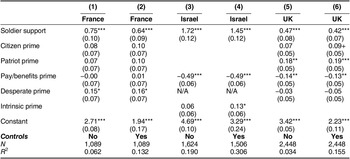
Respondent Belief in Soldier Support for the Operation and DV Respondent Support for the Operation

Notes: Reference group: control treatment. Control variables include prior beliefs in service, ideology, right-wing authoritarianism, social dominance orientation, blind patriotism, military-feeling thermometer, hawkishness, age, education, income, household service, personal military service, gender, and race (white in France, the UK, and the US, ethnicity in Israel). Additionally, we control for respondent religiosity in Israel. For the full table, see appendix 1, table 4. For models that do not include the primes as controls (as a robustness check), see appendix 1, table 12. These models produced substantively similar findings. Standard errors in parentheses. Variables standardized to fall between zero and one. Ordinary least squares. + p < 0.10; * p < 0.05; ** p < 0.01; *** p < 0.0001.
For three reasons, we expect the treatment effects to be fairly modest in magnitude. First, the vignette depicts an operation that respondents should generally support: intervening on behalf of Martesia would “further [country X’s] strategic interests” (as conservatives and realists would wish) and “strengthen international law” (as liberals would like). It would also “uphold the treaty with Martesia,” and alliance commitments tend to increase the public’s willingness to support intervention (Tomz and Weeks Reference Tomz and Jessica2021). As a result, the experimental treatments’ substantive effects should understate the actual impact of soldier approval. Second, our experimental design is also conservative, suppressing treatment effects, in that it does not directly cue soldiers’ views. Third, we asked respondents for their prior beliefs about military service motivation pretreatment. Respondents might anchor themselves to those existing beliefs, which would make it harder to prime them.
Finally, the experiment reflects realistic accounts of soldiering and is thus externally valid. While it is true that political leaders in all four countries typically refer to soldiers as exemplars of patriotism and good citizenship, news articles—like that in the experiment—often include interviews with soldiers that offer more realistic portraits of soldiers’ motivations for service and complicate the simplistic narratives favored in political discourse.Footnote 20 Moreover, all four service narratives resonated with respondents. After being asked to select from among the four presented options, respondents were invited to write, in an open text box, what else motivated enlistment. Most respondents either did not enter any alternatives or indicated that the options covered the full range. Very few respondents—between 1% and 3% of the total, depending on the survey—suggested other motivations, which were typically family or adventure/travel based. Finally, it is especially common to hear an extrinsic account from soldiers themselves, as in our experiment. Respondents with military experience, especially those who served since the end of the draft, were more likely to identify an extrinsic motivation as service members’ primary reason for enlistment in France, the UK, and the US (see appendix 1, table 14).
Results and Discussion
Across all four nations, we find little support for the null hypothesis that soldiers’ opinions have no bearing on public attitudes toward the prospective military operation. The evidence overwhelmingly rejects the null: respondents who believed that the soldier approved of the operation were significantly more likely to favor it. Among the three mechanisms—battlefield performance, consent and empathy, and social debt—we find strong support for both the performance and consent/empathy mechanisms. Those who favored the operation tended to have a more favorable view of soldiers’ expected performance on the battlefield, and this belief causally mediated the impact of respondents’ belief that deployed soldiers favor the operation on their own support for it. Meanwhile, our evidence is not consistent with the social debt mechanism. In contrast, respondents’ sensitivity to soldiers’ views was, as hypothesized, more apparent in more empathetic respondents. Finally, the consistency of these results across the four countries is striking: not only did soldiers’ presumed views powerfully shape public support for military operations in all four countries, but the underlying mechanisms were common to all four as well.
Descriptive Data
In the four countries, public opinion on the prospective operation ranged from neutral to strongly supportive. Baseline support varied, perhaps in line with the national military’s recent operational tempo, the country’s threat profile, and the population’s hawkishness. Reflecting perhaps their greater underlying inclination to use force—or perhaps the more realistic present threat in the experimental vignette—Israeli respondents were the most favorable toward the prospective operation, averaging 5.74 (σ = 1.10) on a one-to-seven scale. US-based respondents were the next most supportive, at 4.54 (σ = 1.39). The average in France and the UK—respectively 4.23 (σ = 1.07) and 4.17 (σ = 1.27)—came closer to the midpoint. The median response in Israel was strongly supportive of the operation (six on the one-to-seven scale), while that in the United States was weaker but still supportive (five). The median response in France and the UK was neutral (four).
Respondents’ pretreatment views of soldiers’ primary motivations for enlistment were consistent with their nations’ dominant citizenship traditions (Krebs et al. Reference Krebs, Ralston, Balzacq, Blagden, Shenhav and Steinbrecher2024). Intrinsic accounts resonated more strongly with respondents located in France and Israel, steeped in republican discourse. Nearly 60% of respondents in France said that soldiers primarily joined out of either patriotism or good citizenship, and just 26% identified pay and benefits as the chief driver. Similarly, around 62% of respondents in Israel thought officers signed up for intrinsic reasons. In contrast, respondents in the United Kingdom were particularly likely to endorse extrinsic accounts: fully half attributed service to the associated pay and benefits, and just under 38% preferred an intrinsic account. US-based respondents were nearly equally divided between intrinsic and extrinsic service narratives (see appendix 1, table 2).
Respondent Belief in Soldier Support for the Operation and DV Respondent Evaluation of Likely Battlefield Performance
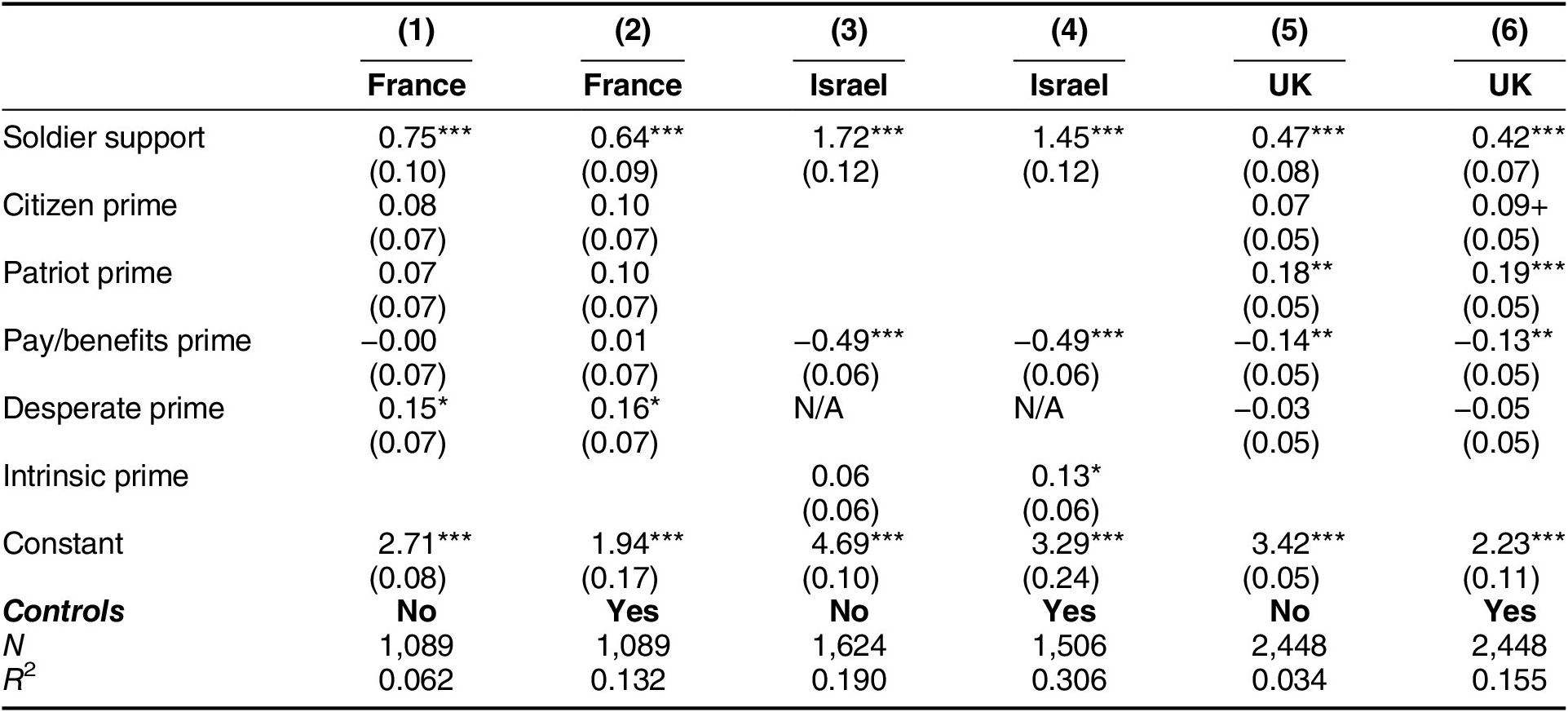
Notes: Reference group: control treatment. For control variables, see notes for table 1. For the full table, see appendix 1, table 5. For models that do not include the primes as controls (as a robustness check), see appendix 1, table 13. These models produced substantively similar findings. Standard errors in parentheses. Variables standardized to fall between zero and one. Ordinary least squares. + p < 0.10; * p < 0.05; ** p < 0.01; *** p < 0.0001.
Respondents were asked to estimate what percentage of people join the military for each of the four supplied reasons. We term those who assign scores of 50% or more to their top identified reason as “strong believers.” Not surprisingly, given Israel’s experience with conscription, over 80% of respondents there were “strong believers”—far more than in any other country. While military service has grown distant from most Americans’ lives, the US military remains larger relative to population than in nearly all other Western nations, and it has had a higher operational tempo. More than half of US-based respondents were “strong believers” in their preferred service narrative. Finally, perhaps reflecting the more marginal position of the armed forces in France and Britain, under 50% of respondents in those nations were “strong believers” (see appendix 1, table 3).
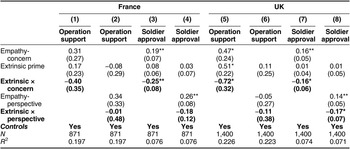
Respondent Empathy and DV Respondent Support for the Operation, and DV Respondent Belief in Soldier Support for the Operation

Notes: Reference group: intrinsic treatment. For control variables, see notes for table 1. For the full table, see appendix 1, table 9. Standard errors in parentheses. Variables standardized to fall between zero and one. Ordinary least squares. Interaction terms in bold. + p < 0.10, * p < 0.05, ** p < 0.01, *** p < 0.0001.
Analysis and Discussion
Do people anchor their support for a prospective military operation to the perceived views of soldiers themselves? The cross-national evidence speaks unequivocally in favor of this claim—and contra the null hypothesis (H1). In all four countries, as expected, the primes were closely associated with perceived soldier support for the operation: those exposed to an intrinsic treatment were significantly more likely to think soldiers themselves favored the operation, relative both to those who received an extrinsic treatment and to respondents in the control group, who did not receive any prime with respect to soldiers’ motivation or their view of the operation (figure 2). The differences between treatment groups and respondents’ perceptions of soldier approval were also substantively significant. For example, in the US sample, 32% of respondents who received an intrinsic prime believed that it was “very likely” that the soldier portrayed in the vignette personally approved of the operation. In contrast, only 13% of respondents who received an extrinsic prime believed the same. In Israel, 20% of respondents who received the extrinsic prime thought it “very likely” that the officer approved of the operation, while more than twice as many respondents (42%) who received the intrinsic prime thought the same.
Respondent Belief in Soldier Support for the Military Operation
Notes: Base category = control primes. Model with no further control variables. Constant dropped from figure.
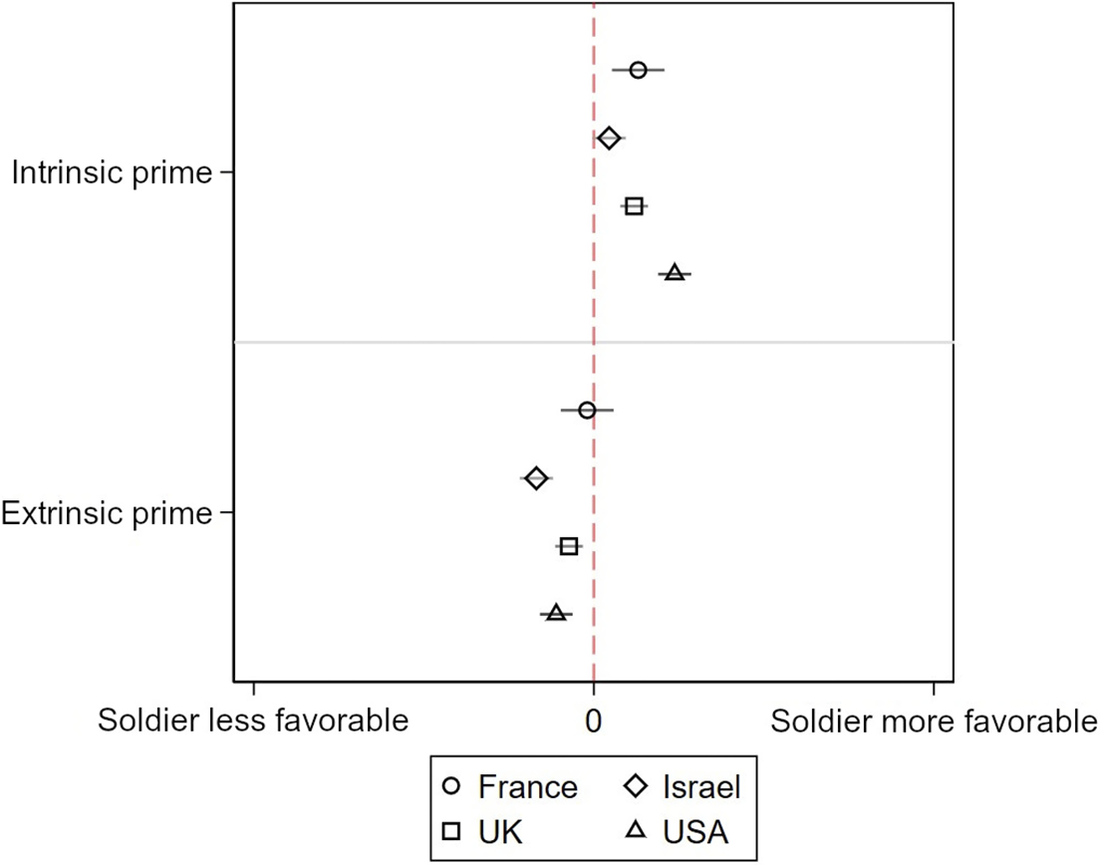
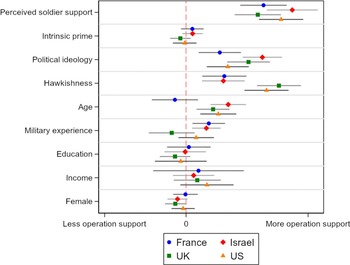
Respondents who believed that the soldier favored the operation were more likely to favor it, even when controlling for a host of variables, including the experimental primes (table 1). This finding is consistently statistically and substantively significant. Because all variables in table 1 (and all tables below) have been normalized to fall between zero and one, their relative substantive effects are readily interpretable. Moving from believing that it is “very unlikely” to “very likely” that the soldier approved of the operation corresponded to an increase of between 0.80 and 1.48 points (on a one-to-seven scale) in respondent support for the operation across the four countries—that is, an increase of approximately 13% to 25%. Moreover, as displayed in the coefficient plot in figure 3, the effects of soldier approval on respondents’ support for the operation were substantively significant relative to other variables: the impact of soldier approval on respondents’ attitudes toward the operation generally exceeded that of all other variables—even hawkishness, political ideology, age, and gender.
DV Respondent Support for the Military Operation: Coefficient Plot
Note: Constant dropped from figure.

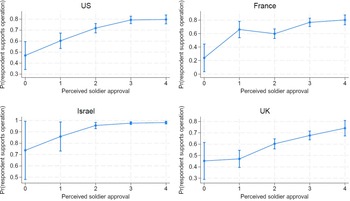
We can also assess the substantive significance of soldier support for the prospective operation by examining the predicted probabilities of respondents favoring the operation across the former variable. Per figure 4, those who believed that the soldier opposed the operation were, in all four countries, much less likely to favor the operation than those who believed the soldier approved. In the UK and US, respondents who said that the soldier “strongly opposed” the operation were roughly 30% less likely to favor it than those who believed that the soldier “strongly approved.” In France, the effects were even greater: moving from strong soldier opposition to strong soldier approval translated into a 56% increase in the likelihood of respondent support. In Israel, the variable’s impact was somewhat muted, presumably because baseline support was unusually high. Even under conditions of strong officer opposition, there was a 74% likelihood that an Israeli respondent would favor the operation—more than three times the predicted support in France, and over 50% higher than in the UK and US. But even in Israel the substantive effects were great, producing nearly full support (98%) at the highest level of perceived officer approval. While some differences across countries—notably, low French baseline support—are not readily explicable, the trend lines were the same across all four nations.
Predicted Probability of Respondent Support for the Operation across Respondent Perception of Soldier Support for the Operation
Note: Based on a binary operation support variable and the variables in table 1, models 1, 3, 5, and 7.

It is possible that the causal direction is reversed—that respondents projected their own support for the operation onto the depicted soldiers, hence the association between soldier and respondent approval—but we do not think it likely that endogeneity is powerfully at work. First, our analyses controlled for the usual variables associated with support for the use of force, yet perceived soldier approval remained significant. Second, endogenous processes cannot explain the robust association between either the treatments’ depiction of the soldier’s enlistment motivations and soldiers’ perceived support for the operation or respondents’ prior beliefs about soldiers’ reasons for enlistment and soldiers’ perceived support for the operation (see appendix 1, table 11). These relationships, which are not plausibly driven by respondents’ views of the operation, give us greater confidence that perceived soldier approval gave rise to respondent support for using force—rather than the other way around.
How and under what conditions does perceived soldier support for the operation have significant effects on respondents’ attitudes toward the operation? We find considerable support for the first hypothesized mechanism: battlefield performance (H2). In all cases in which respondents were asked posttreatment to evaluate the portrayed soldier’s likely performance on the battlefield (France, Israel, and the UK), those who believed the soldier favored the operation were more likely to think that the soldier would perform well (table 2). These results held across model specifications with full controls, indicating a consistently strong relationship. The relationship was also substantively significant. Moving from believing it “very unlikely” to “very likely” that the soldier approved of the operation corresponded, in models with controls, to an increase of between 0.42 and 1.72 points (on a one-to-five scale in the UK and France, one to seven in Israel) in the belief that the soldier would perform well on the battlefield—that is, 8% in the UK, 12% in France, and 20% in Israel.
However, expected battlefield performance does not appear to be the only pathway through which soldier support for the operation bolsters public support. Including battlefield performance in the statistical models did not render soldier approval statistically insignificant with respect to operation support and did not even substantially reduce the size of the soldier approval variable’s coefficient (see appendix 1, table 6). In addition, a causal mediation analysis found that, in France, Israel, and the UK, 30%–36% of soldier approval’s causal effect on respondents’ support for the operation was mediated by perceived soldier performance. However, in all three countries, the average direct effect of respondents’ belief in the soldier’s approval of the operation on respondents’ support for the operation was much greater—between 1.8 and 3.5 times larger—than the average causal mediation effect of battlefield performance. This suggests that most of the effect of soldier approval—between 64% and 70%—did not flow through battlefield performance, but rather along some other pathway(s) (see appendix 1, section 2).
The second mechanism, consent and empathy, is one of those other pathways. As expected by H3, empathy appears to moderate the effect of soldiers’ presumed approval of the operation on respondents’ support for the operation. In the surveys that included empathy batteries—that is, those deployed in France and the UK—more empathetic respondents who were exposed to extrinsic primes were both less supportive of the operation and less likely to think these extrinsically motivated soldiers approved of the operation, as indicated by the typically negative signs of the interaction coefficients in all the models in table 3. In both countries, more empathetic respondents were generally more sensitive to the experimental prime, regardless of how empathy was measured—whether in terms of concern for the other or the capacity to adopt the other’s perspective as one’s own. When more empathetic respondents read an extrinsic treatment, they especially tended to perceive the soldier as less supportive of the operation, per the negative signs on the interaction terms (models 3, 4, 7, and 8).
The findings were somewhat less consistent regarding respondents’ own views of the operation. In the UK, more empathetic respondents exposed to an extrinsic prime were less favorable toward the operation, when empathy was measured in terms of concern for the other (model 5). When empathy was measured in terms of perspective taking, the coefficient was not statistically significant, but its sign remained negative (model 6). Among respondents in France, the coefficient for the interaction between the extrinsic prime and empathy was not statistically significant (models 1 and 2), and its sign was surprisingly positive with respect to empathetic perspective taking (model 2). However, the French sample scored consistently lower on experimental comprehension checks than respondents in the three other countries (see appendix 1, table 7). When the analysis was limited to French respondents who passed the comprehension check, not only was the interaction’s sign then negative as expected, but it was also statistically significant (see appendix 1, table 8). Overall, these results suggest fairly strong support for H3.
In contrast to the battlefield performance and consent/empathy mechanisms, we find little evidence that social debt, or the logic of obligation, links soldiers’ perceived support for the operation to respondents’ attitudes toward the operation (H4). Soldier approval was strongly predictive of respondents’ support for the operation in all treatment groups, regardless of whether the primes suggested that soldiers had joined at or below market rates (table 1). Moreover, there were no significant interactions between the primes and soldier approval, providing further evidence that the effect of soldier approval did not vary by treatment (see appendix 1, figure 1). These results are at odds with H4, which hypothesized that soldier approval should be insignificant among those exposed to the pay-and-benefits prime. Respondents’ sensitivity to soldiers’ views was not related to their degree of social indebtedness.
In sum, the findings presented here provide strong cross-national evidence that soldiers’ views shape public opinion on the use of force. In all four of the countries we surveyed, public support for military operations depended significantly on whether respondents believed that soldiers themselves favored the operation. Across liberal and republican democracies alike, people clearly care whether soldiers support their own deployment. This research also sheds light on the underlying mechanisms. On the one hand, respondents associated soldiers’ support for the operation with their likely battlefield performance, and, consistent with a rational calculus, they were then more supportive of using force. On the other hand, in line with the consent mechanism, soldiers’ views of the operation—whether in favor or against—resonated more strongly with more empathetic respondents, whose own attitudes were more likely to mirror those of the depicted soldier. Reason and emotion thus worked hand in hand to shape public opinion. The logic of obligation, or social debt, however, did not.
Our confidence is further bolstered by the common findings across countries, despite significant differences in their historical and current realities as well as in the experiments’ design. However, we acknowledge some limitations of the research design and process. First, as expected, the substantive impact of the treatments was fairly small. The treatments’ modest impact on respondents may, as discussed earlier, have been partly a result of our decision not to prime respondents directly to soldiers’ views, but we cannot be sure without conducting additional experiments. Second, we cannot be confident that respondent empathy would have the same mediating effects in the US and Israel that it had in France and the UK. Again, greater confidence would rest on additional experiments. Third, our design choices did not allow us to test the informational cue mechanism that may also potentially mediate between perceived soldier approval and respondent support. Fourth, although we suspect the impact of endogenous processes to be slight, for reasons already articulated, we cannot completely exclude the possibility that respondents’ views of the operation underpinned their beliefs about soldiers’ views. Finally, because the experiment did not vary the portrayed operation, the impact of soldier approval may be limited to medium-stakes, out-of-area operations like that depicted in the vignettes. In a pilot study, we found that varying the operation’s objectives and stakes did not have a significant interactive effect with our proxy for soldier approval on respondent support for the operation.Footnote 21 However, it remains possible that soldier support for deployment would have little impact in large-scale, near-existential wars.
Conclusion
This article provides preliminary cross-national evidence that models of public opinion on the use of force have overlooked an important factor: the perceived opinions of soldiers themselves regarding their own deployment. Via survey experiments conducted in France, Israel, the United Kingdom, and the United States, we show that beliefs about soldiers’ views shape public attitudes in favor of, or in opposition to, military operations. We find significant support for two complementary mechanisms—battlefield performance and consent/empathy. The cross-national “most different” research design varied the dominant citizenship tradition, the military’s recruitment format, its operational tempo, and the threat level, yet the findings hold across these different democracies and militaries. The evidence does not support another intuitive mechanism, grounded in the logic of social debt.
These findings have implications for several important research programs in the field of international security. First, this article expands our understanding of the factors shaping public opinion on the use of force beyond those favored by rationalist models. The stakes of conflict, the likelihood of victory, casualties and other costs of warfare, and individuals’ personal knowledge of and sensitivity to those costs all affect how people think about war. But so too do factors that fit less comfortably into the rationalist model—among others, individuals’ ethnic identities (Berinsky Reference Berinsky2009), the framing of military intervention (Maxey Reference Maxey2020; Western Reference Western2005), and dominant metaphors and narratives of national security (Branch Reference Branch2021; Krebs Reference Krebs2015). Emphasizing the impact on public opinion of political rhetoric, symbolism, and theater that portray soldiers as paragons of good citizenship, patriotism, and self-sacrifice, this article advances nonrationalist sources of public thinking about national security and warfare.
Second, the public valorization of soldiers is just one of several practices that have, in recent decades, helped to insulate democratic decision makers from the political costs of using force. Democracies have increasingly relied on drones and other offshore means of bombardment, invested in capital-intensive forces, phased out conscription and installed voluntary recruitment, financed wars by floating debt rather than by raising taxes, and improved the provision of military medicine (Caverley Reference Caverley2014; Fazal Reference Fazal2024; Kaag and Kreps Reference Kaag and Kreps2014; Kreps Reference Kreps2018). This article expands the catalog of ways in which politicians in wealthy democracies have, whether consciously or not, forged a secure and sustainable foundation for war and military intervention.
Third, this article deepens understanding of the challenges currently confronting democratic civil–military relations. Previous research has underscored the depth of the public’s deference to the uniformed military, especially senior officers (J. Davis Reference Davis, Feaver and Kohn2001; Golby, Feaver, and Dropp Reference Golby, Feaver and Dropp2018; Jost and Kertzer Reference Jost and Kertzer2024; Krebs, Ralston, and Rapport Reference Krebs, Ralston and Rapport2023; Schake and Mattis Reference Schake and Mattis2016). Democratic decision making on matters of national security rests on a dialogue between civilians and military officers, but the dialogue is always unequal: at the end of the day, decisions regarding the use of force must rest with elected officials (Cohen Reference Cohen, Feaver and Kohn2001b; Feaver Reference Feaver2011). Deference to the military involves civilian politicians replacing their own judgment with that of military officers, which is at odds with the core normative principles of democratic civil–military relations (Krebs, Ralston, and Rapport Reference Krebs, Ralston and Rapport2023, 608–11). This article’s central finding—that the public is inclined to send soldiers into battle when soldiers approve of their deployment, but is disinclined when soldiers do not favor the operation—suggests that the problem of civilian deference runs very deep, beyond the top brass.
This article has documented that soldier approval, in part via the logic of consent and empathy, shapes public opinion on the use of force in all four of these nations, but it does not explain this convergence. Existing literature would have expected stark differences between countries with more liberal citizenship traditions, like the United Kingdom and United States, and those where republican discourse is dominant, like France and Israel (Krebs Reference Krebs2006; Levi Reference Levi1997). Future research should seek to adjudicate between at least two alternative interpretations. On the one hand, this convergence may reflect the steady creep of an Anglo-American strain of liberalism, with its emphasis on individual rights and its silence with respect to duties (Bell Reference Bell2014, 689 and passim; Rosenblatt Reference Rosenblatt2018). Perhaps globalization has eroded the onetime power of republican citizenship discourse. On the other hand, this article’s findings may also reflect an enduring, cross-national, but varied human capacity for empathy. If empathy is key, perhaps this study would have reached the same conclusions had it been conducted a century ago. Future research should explore whether growing empathy for soldiers or the advance of Anglo-American liberalism is driving this shared cross-national pattern.
Future research might also be inspired by the previously discussed limits of this article’s research design. A series of additional experiments across national contexts that consistently included an empathy battery and tested both direct and indirect ways of priming respondents to soldier approval of the operation would bolster confidence in these findings. Additional experiments might also vary the stakes and size of the military operation, exploring potential scope conditions of the logic of soldier approval. Subsequent research could also facilitate more direct tests of other mechanisms that might conceivably mediate between perceived soldier approval of their deployment and respondent support for the operation. Such extensions could also help to address concerns about the potentially endogenous relationship between soldier approval and respondent support.
If research along these lines supports this article’s central thrust, it has significant implications for our grasp of politics and policy. At first blush, these findings may seem to empower soldiers. If soldiers’ support must be secured, they can refuse to give it or they can wrest concessions in exchange. But it is more likely that politicians, by casting soldiers as exemplars of patriotism and good citizenship, can manipulate public opinion in favor of military operations by portraying soldiers as good citizens and patriots. This is one reason that politicians have incentives to hail soldiers’ selflessness and sacrifice. Some might contend that romanticizing or idealizing soldiers is fairly harmless.Footnote 22 This article is a warning that it is not.
Supplementary material
To view supplementary material for this article, please visit http://doi.org/10.1017/S1537592724002214.
Data replication
Data replication sets are available in Harvard Dataverse at: https://doi.org/10.7910/DVN/SACURB.
Acknowledgments
This article is dedicated to the memory of our late colleague Aaron Rapport, formerly of the University of Cambridge, whose incisive comments profoundly shaped the project. For helpful comments on earlier versions of the surveys and the article, the authors thank the audiences at the annual meeting of the International Studies Association as well as Pedro Accorsi, Mark Bell, James Burk, Bud Duvall, Tanisha Fazal, Peter Feaver, Chris Federico, Paul Goren, Lukas Herr, Tyler Jost, Kwanok Kim, Tony King, Sarah Kreps, Andy Kydd, Howie Lavine, Yagil Levy, Renanah Miles-Joyce, Joanne Miller, Jon Pevehouse, Robert Schub, Daniel Silverman, Jennifer Spindel, and Jessica Weeks. For their generous support of this research, the authors thank the University of Minnesota through its Grant-in-Aid of Research, Artistry, and Scholarship program; the Levi Eshkol Institute for Social, Economic, and Political Research in Israel at the Hebrew University of Jerusalem; and the Israel Institute.




 Open access

