


Introduction
Paraprionospio is a genus of the family Spionidae, which was initially erected as a subgenus of Prionospio by Caullery (Reference Caullery1914) to include Prionospio pinnata (Ehlers Reference Ehlers1901). Later, Foster (Reference Foster1971) recognized Paraprionospio as a separate genus, but considered it as monospecific and synonymized it with Paraprionospio pinnata (Ehlers Reference Ehlers1901). All the species then recognized were Prionospio africana (Augener Reference Augener1918), Prionospio alata (Moore Reference Moore1923), Paraprionospio tribranchiata (Berkeley Reference Berkeley1927), Prionospio treadwelli (Hartman Reference Hartman1951) (new name for P. plumosa Treadwell Reference Treadwell1931), Prionospio ornata (Berkeley and Berkeley Reference Berkeley and Berkeley1961), and Prionospio pinnata inaequibranchia (Caullery Reference Caullery1914). However, Fauchald (Reference Fauchald1972) proposed that P. pinnata, P. inaequibranchia, P. africana, P. alata, and P. treadwelli should each be considered as valid species. Posteriorly, authors like Yokoyama and Tamai (Reference Yokoyama and Tamai1981), Delgado-Blas (Reference Delgado-Blas2004), Yokoyama (Reference Yokoyama2007), Zhou et al. (Reference Zhou, Yokoyama and Li2008), or Delgado-Blas and Carrera-Parra (Reference Delgado-Blas and Carrera-Parra2018) described new species and introduced new morphological characteristics to differentiate them or to refute previous synonymies.
Accordingly, 14 species of Paraprionospio are now recognized as valid (Read and Fauchald Reference Read and Fauchald2025). From these, five have been reported from the Western Atlantic: P. treadwelli from Chesapeake Bay, Northwestern Atlantic; P. pinnata across the Gulf of Mexico (Delgado-Blas Reference Delgado-Blas2001; Granados-Barba and Solís-Weiss Reference Granados-Barba and Solís-Weiss1998; Hernández-Arana et al., Reference Hernández-Arana, Rowden, Attrill, Warwick and Gold-Bouchot2003; Johnson Reference Johnson, Uebelacker and Johnson1984; Quintanar-Retama et al., Reference Quintanar-Retama, Armenteros and Gracia2022); P. dibranchiata (Delgado-Blas and Carrera-Parra Reference Delgado-Blas and Carrera-Parra2018) from the Southern Gulf of Mexico; and P. tamaii (Delgado-Blas Reference Delgado-Blas2004) and P. yokoyamai (Delgado-Blas Reference Delgado-Blas2004) from the Grand Caribbean.
In particular, Prionospio plumosa was described by Treadwell (Reference Treadwell1931) from Chesapeake Bay, but Hartman (Reference Hartman1951), examining individuals collected in Louisiana, USA, noted that this name had already been preoccupied by Prionospio plumosa M. Sars in Sars (Reference Sars1872). Thus, she proposed a new replacement name, P. treadwelli, to the species described by Treadwell (Reference Treadwell1931). However, several authors (Delgado-Blas and Carrera-Parra Reference Delgado-Blas and Carrera-Parra2018; Fauchald Reference Fauchald1972; Foster Reference Foster1971; Yokoyama Reference Yokoyama2007) noted that the individuals described by Hartman (Reference Hartman1951) as P. treadwelli from Louisiana bore four branchial pairs, whereas the individuals described by Treadwell (Reference Treadwell1931) had only three pairs. So, although the new replacement name proposed by Hartman (Reference Hartman1951) remains valid, the specimens from Louisiana did not correspond to P. treadwelli and likely belong to another species of Prionospio (Delgado-Blas and Carrera-Parra Reference Delgado-Blas and Carrera-Parra2018).
Later, Yokoyama (Reference Yokoyama2007) suggested that P. treadwelli, together with P. tamaii and P. yokoyamai, could be synonyms of P. alata, a species described from California, due to the shape of the branchial lamellae and the occurrence of dorsal crests. However, Delgado-Blas and Carrera-Parra (Reference Delgado-Blas and Carrera-Parra2018), based on type material, redescribed P. treadwelli, discussed its taxonomic status together with that of P. yokoyamai and P. tamai and concluded that these three species differ in many morphological characteristics and must all be considered as valid and different. In addition, they also redescribed P. alata and P. inaequibranchia, restricting their distribution to Southern California and Indonesia, respectively.
Accordingly, in the present study, we report for the first time the presence of Paraprionospio treadwelli in the Gulf of Mexico. Certainly, the identification and taxonomic arrangements of the species belonging to Paraprionospio is difficult but, to support our identification, we describe the morphological characteristics of the individuals belonging to P. treadwelli collected during three oceanographic expeditions made in the Mexican region of the Western Gulf of Mexico shelf and provide SEM photographs of their distinctive features, including the description of the pygidium, which was, up to now, unknown in this species. The environmental variables of depth, temperature, salinity, dissolved oxygen, and sediment type where P. treadwelli was found and its abundance seasonal pattern are also presented.
Materials and methods
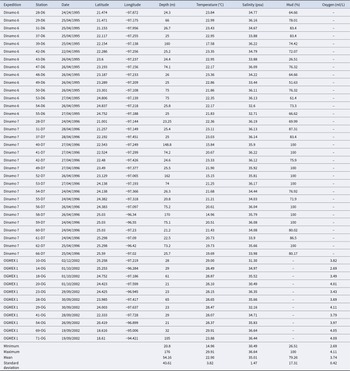
The specimens identified as P. treadwelli in the present study were collected in the continental shelf of the Western Gulf of Mexico (18°37′–25°36′N; 94°26′–97°58′W) during three oceanographic expeditions: DINAMO 6 in April 1995, DINAMO 7 in April 1996, and OGMEX 1 in September–October 2002 (Figure 1). The samplings were carried out on board of O/V ‘Justo Sierra’ of the Universidad Nacional Autónoma de México (UNAM) and the stations where this spionid species was collected were georeferenced with its Global Positioning System (GPS). Depth was determined with a Kongsberg echosounder, the temperature and salinity were measured with a Niels Brown CTD, and the dissolved oxygen was determined by the Winkler method (Strickland and Parsons Reference Strickland and Parsons1977). The biological samplings were collected with a Smith-McIntyre grab (0.1 m2) and sieved through a 0.5 mm mesh size to separate the macrofauna. A separate sample of sediment was taken to analyze its composition, which was determined following the sieving method (Folk Reference Folk1980); the grain sizes were arranged following the Wentworth scale (Wentworth Reference Wentworth1922) and the percentage of sand, silt, and clay were thus established. Due to logistical problems, during the expedition OGMEX1 no sedimentary samples were taken, while the dissolved oxygen was only measured in that expedition (Table 1).
Location of the study area showing the sampling stations where Paraprionospio treadwelli was collected. Oceanographic expedition: DINAMO 6 (▲); DINAMO 7 (●); OGMEX 1 (■).

Geographic position, environmental data and abundance by sampling station where Paraprionosio treadwelli was collected

The specimens of P. treadwelli were found in 44 stations between 20.8 and 176 m depth; they were fixed on board the ship in 4% formaldehyde in sea water and later, back at the laboratory, washed, identified and then preserved in 70% ethanol. Stereoscope and compound microscopes were used to examine their morphological characteristics, to measure the specimens, and to take the respective photographs. The taxonomic identification of the specimens was based on the recent redescription of P. treadwelli carried out by Delgado-Blas and Carrera-Parra (Reference Delgado-Blas and Carrera-Parra2018), supported with the original description of this species (Treadwell Reference Treadwell1931). A JEOL JSM6360L microscope at the ICML, UNAM was used to make the scanning electron photographs; the specimens were initially dehydrated via graded ethanol series, dried with liquid-CO2 at critical point and coated with gold.
The identified specimens were catalogued and deposited in the Colección Nacional de Anélidos Poliquetos, Instituto de Ciencias del Mar y Limnología, Universidad Nacional Autónoma de México, in México City (CNAP-ICML, DFE.IN.061.0598). The information about the abundance and distribution of this species in the Western Gulf of Mexico is shown in Table 1 and its relationships with the environmental conditions recorded in all expeditions (namely, depth, salinity, and temperature) were examined with a Principal Component Analysis (PCA) and linear regression models (Clarke et al., Reference Clarke, Gorley, Somerfield and Warwick2014).
Results
Taxonomy
Class Polychaeta (Grube Reference Grube1850)
Family Spionidae (Grube Reference Grube1850)
Genus Paraprionospio (Caullery Reference Caullery1914)
Paraprionospio treadwelli (Hartman Reference Hartman1951)
(Figures 2A–K, 3A–M)
Synonymy
Prionospio plumosa (Treadwell Reference Treadwell1931): 3–5. Not (Sars Reference Sars1872).
Pronospio treadwelli (Hartman Reference Hartman1951): 84–85 (replacement name for P. plumosa (Treadwell Reference Treadwell1931).
Paraprionospio pinnata: (Foster Reference Foster1971): 101. Not (Ehlers Reference Ehlers1901).
Paraprionospio treadwelli: (Fauchald Reference Fauchald1972): 188–189. Maciolek, 195: 328. (Delgado-Blas and Carrera-Parra Reference Delgado-Blas and Carrera-Parra2018): 15–17 (redescription).
Paraprionospio alata: (Yokoyama Reference Yokoyama2007): 257–258. Not (Moore Reference Moore1923).
Type locality
Chesapeake Bay, Maryland (Atlantic Ocean).
Examined material
GULF OF MEXICO, DINAMO 6: 77 specimens: • 5 specs.; Sta. 28-D6; PO-09-069/2042-GMX-CS • 1 spec.; Sta. 29-D6; PO-09-069/2043-GMX-CS • 6 spec.; Sta. 31-D6; PO-09-069/2044-GMX-CS • 8 spec.; Sta. 37-D6; PO-09-069/2045-GMX-CS • 1 spec.; Sta. 39-D6; MEB-PO-09-069/2046-GMX-CS • 5 spec.; Sta. 42-D6; PO-09-069/2047-GMX-CS • 2 spec.; Sta. 43-D6; PO-09-069/2048-GMX-CS • 2 spec.; Sta. 47-D6; PO-09-069/2049-GMX-CS • 12 spec.; Sta. 48-D6; PO-09-069/2050-GMX-CS • 9 spec.; Sta. 49-D6; PO-09-069/2051-GMX-CS • 5 spec.; Sta. 50-D6; PO-09-069/2052-GMX-CS • 1 spec.; Sta. 53-D6; PO-09-069/2053-GMX-CS • 1 spec.; Sta. 54-D6; PO-09-069/2054-GMX-CS • 19 spec.; Sta. 55-D6; PO-09-069/2055-GMX-CS. GULF OF MEXICO, DINAMO 7: 137 specimens: • 1 spec.; Sta. 28-D7; PO-09-069/2056-GMX-CS • 14 spec.; Sta. 31-D7; PO-09-069/2057-GMX-CS • 15 spec.; Sta. 37-D7; PO-09-069/2058-GMX-CS • 17 spec.; Sta. 40-D7; PO-09-069/2059-GMX-CS • 3 spec.; Sta. 41-D7; PO-09-069/2060-GMX-CS • 39 spec.; Sta. 42-D7; PO-09-069/2061-GMX-CS • 8 spec.; Sta. 49-D7; PO-09-069/2062-GMX-CS • 1 spec.; Sta. 52-D7; PO-09-069/2063-GMX-CS • 6 spec.; Sta. 53-D7; PO-09-069/2064-GMX-CS • 1 spec.; Sta. 54-D7; PO-09-069/2065-GMX-CS • 4 spec.; Sta. 55-D7; PO-09-069/2066-GMX-CS • 2 spec.; Sta. 56-D7; PO-09-069/2067-GMX-CS • 5 spec.; Sta. 58-D7; PO-09-069/2068-GMX-CS • 11 spec.; Sta. 59-D7; PO-09-069/2069-GMX-CS • 4 spec.; Sta. 60-D7; PO-09-069/2070-GMX-CS • 2 spec.; Sta. 61-D7; PO-09-069/2071-GMX-CS • 1 spec.; Sta. 62-D7; PO-09-069/2072-GMX-CS • 3 spec.; Sta. 66-D7; PO-09-069/2073-GMX-CS. GULF OF MEXICO, OGMEX 1: 28 specimens: • 1 spec.; Sta. 10-OG; PO-09-069/2032-GMX-CS • 10 spec.; Sta. 14-OG; PO-09-069/2033-GMX-CS • 1 spec.; Sta. 18-OG; PO-09-069/2034-GMX-CS • 2 spec.; Sta. 20-OG; PO-09-069/2035-GMX-CS • 1 spec.; Sta. 23-OG; PO-09-069/2036-GMX-CS • 2 spec.; Sta. 28-OG; PO-09-069/2037-GMX-CS • 1 spec.; Sta. 29-OG; PO-09-069/2038-GMX-CS • 3 spec.; Sta. 41-OG; PO-09-069/2039-GMX-CS • 3 spec.; Sta. 54-OG; PO-09-069/2040-GMX-CS • 1 spec.; Sta. 69-OG; PO-09-069/2031-GMX-CS • 3 spec.; Sta. 71-OG; PO-09-069/2041-GMX-CS. Specimens collected by V. Solís-Weiss and P. Hernández-Alcántara: D6 and D7; specimens collected by P. Hernández-Alcántara: OG. Details on geographic position, collection date, and environmental characteristics of the sampling stations are shown in Table 1.
Description of the specimens from the Western Gulf of Mexico
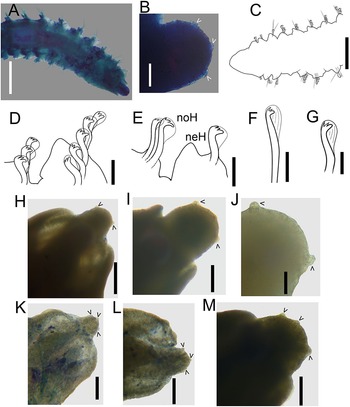
One complete specimen measured 11 mm long for 64 chaetigers; all the other specimens were incomplete, with 10–85 chaetigers, 1.5–40 mm long. Body long, slim, pale in ethanol, without special pigmentation (Figure 3A). Prostomium spindle-shaped, anteriorly rounded (Figure 2A–D), extending posteriorly as a low ridge reaching down to chaetiger 1 (Figure 2A, D); two small ventrolateral peaks on each side of prostomium (Figure 3H–J), some specimens, including the complete specimen (Figure 3B), also bear a small peak frontally on prostomium (Figure 3K–M); two pairs of dark-brown eyes in trapezoidal arrangement, not visible in most specimens. Palps missing in all specimens. Peristomium dorsally extending as lateral wings, partially enclosing the prostomium (Figure 2A, D); posterior margins of wings lacking pigment spots or a marginal papilla. Branchiae on chaetigers 1–3, all with flabellate lamellae; first pair largest, basally joined by a low transverse ridge, lacking processes or slender filaments along its anterior edge; most specimens with the first branchial pair missing (Figure 2A).
Paraprionospio treadwelli (Hartman Reference Hartman1951) (MEB-PO-09-068/2046-GMX-CS): (A) Anterior region, lateral view; (B) prostomium and chaetiger 1, lateral view; (C) prostomium and first branchiae, dorsolateral view; (D) prostomium, dorsal view; (E) chaetiger 1, right parapodium, frontal view; (F) chaetiger 2, right parapodium, frontal view; (G) chaetiger 3, right parapodium, frontal view; (H) chaetiger 24, right parapodium, frontal view; (I) median region, dorsal view; (J) hooded hooks, neuropodium 30; (K) hooded hooks, neuropodium 26. Arrow = prostomial peak. Scale bars: A = 500 μm; B, D, H, I = 100 μm; C = 200 μm; E, F, G = 50 μm; J = 40 μm; K = 20 μm.

Paraprionospio treadwelli (Hartman Reference Hartman1951), complete specimen (PO-09-069/2031-GMX-CS; Sta. 69-OG): (A) anterior region, dorsal view; (B) prostomium, dorsal view; (C) pygidium, dorsal view; (D) neuropodial hooded hooks, chaetigers 20–21; (E) noto- and neuropodial hooded hooks, chaetiger 42; (F) notopodial hooded hook chaetiger 40; and (G) neuropodial hooded hook chaetiger 40. Prostomium of incomplete specimens: (H–J) prostomium with two peaks; (K–M) prostomium with three peaks. Abbreviations: neH = neuropodial hooded hook; neH = notopodial hooded hooks; arrow = prostomial peak. Scale bars: A = 500 μm; B, J, K = 100 μm; C = 400 μm; D–G = 0.5 μm; H = 300 μm; I = 150 μm; L, M = 200 μm.

Notopodia of chaetigers 1–3 with prechaetal lamellae short, inconspicuous thereafter. Notopodial postchaetal lamellae elongate and triangular (Figure 2E–G), longest on chaetiger 2 (Figure 2F), subtriangular lamellae on chaetigers 4–7, gradually smaller on following chaetigers (Figure 2H). Neuropodia with prechaetal lamellae very small on anterior chaetigers (Figure 2G), inconspicuous lamellae on median and posterior chaetigers. Neuropodial postchaetal lamellae subtriangular on chaetigers 1–2 (Figure 2E, F), becoming wider and rounded on chaetigers 3–10 (Figure 2G), gradually smaller in following chaetigers, as small rounded lobes (Figure 2H). The ventral edge of the postchaetal notopodial lamellae does not touch the dorsal edge of neuropodial postchaetal lamellae (Figure 2E–G). Chaetiger 8 without interparapodial pouches or ventral crest. Dorsal transverse crests and semitransparent dorsal cuticle from chaetigers 18–22 to 23–28.
Noto- and neuropodia with thick capillaries arranged in two rows (Figure 2E–G), neurochaetae shorter and thinner than notochaetae (Figure 2E–H). One or two sabre chaetae in neuropodia from chaetiger 9, stout, lacking limbation (Figure 2I, K). Hooded hooks in neuropodia from chaetiger 9, with 2–3 pairs of small accessory teeth above main fang (Figure 3G), accompanied by capillaries (Figure 2J–K). Hooded hooks in notopodia from chaetiger 35–40 (Figure 3E), with 2 pairs of small teeth above main fang (Figure 3F). Both noto- and neuropodial hooks with striated outer hood, covering distal part of shaft; inner hood absent; notopodial hooks are longer and thinner than those hooks from neuropodia (Figure 3F, G).
Pygidium rounded lobe bearing three thin cirri: one long mid-dorsal cirrus and two shorter ventral cirri (Figure 3C).
Remarks
The morphological characteristics of the individuals identified by us as P. treadwelli in the Gulf of Mexico agreed well with the redescription of this species made by Delgado-Blas and Carrera-Parra (Reference Delgado-Blas and Carrera-Parra2018) based ontype material from Chesapeake Bay. However, during the original description and posterior redescription of this spionid species, all individuals examined were incomplete, including the holotype (Delgado-Blas and Carrera-Parra Reference Delgado-Blas and Carrera-Parra2018; Treadwell Reference Treadwell1931). Then, since during the present study, we collected one complete individual in the gulf, it was also possible for the first time, to describe the pygidial characteristics of this species.
Up to now, four species of Paraprionospio had been reported from the Gulf of Mexico: P. yokoyamai, P. tamai, and P. dibranchiata from the southern gulf (Delgado-Blas Reference Delgado-Blas2004; Delgado-Blas and Carrera-Parra Reference Delgado-Blas and Carrera-Parra2018), and P. pinnata from the northern (Johnson Reference Johnson, Uebelacker and Johnson1984), and mainly from the southern gulf (Delgado-Blas Reference Delgado-Blas2001; Granados-Barba and Solís-Weiss Reference Granados-Barba and Solís-Weiss1998; Hernández-Arana et al., Reference Hernández-Arana, Rowden, Attrill, Warwick and Gold-Bouchot2003; Quintanar-Retama et al., Reference Quintanar-Retama, Armenteros and Gracia2022). Thus, P. treadwelli is now recorded for the first time from the gulf, and can be separated from those species previously reported in this marine region, but also from all species from the genus Paraprionospio, because it is the only one with peaks on the anterior margin of the prostomium, with rounded middle and posterior notopodial postchaetal lamellae, and hooded hooks lacking small inner hoods (Delgado-Blas and Carrera-Parra Reference Delgado-Blas and Carrera-Parra2018).
Paraprionospio treadwelli was initially described from Chesapeake Bay at 7.32–47.58 m depth (Treadwell Reference Treadwell1931); thus, besides identifying this species for the first time in the Gulf of Mexico, we also extend its depth range to 176 m.
Distribution
Chesapeake Bay, Maryland (Treadwell Reference Treadwell1931). Mexican shelf of the Northwestern Gulf of Mexico.
Habitat
In Chesapeake Bay: 7.32–47.58 m depth (Treadwell Reference Treadwell1931). In the Western Gulf of Mexico: 20.8–176 m depth; 14.96–29.91°C; 30.49–36.64 psu; 26.51–100% mud; 2.69–4.11 ml/L dissolved oxygen (Table 1, Figure 4A–D).
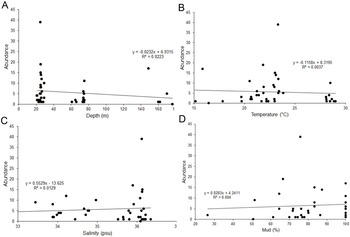
Correlations of abundance of Paraprionospio treadwelli with: (A) depth (m); (B) temperature (°C); (C) salinity (psu); (D) mud (%).

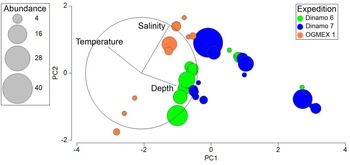
The abiotic variables measured in all the oceanographic expeditions considered here: depth, temperature, and salinity were analyzed using a PCA test to examine their correlations with the abundance changes of P. treadwelli in the Western Gulf of Mexico (Figure 5). The first component (PC1) explained 66.9% of the environmental variability, mostly related to changes in depth (eigenvector = 6.28) and temperature (−0.598), while the PC2 only explained 22.7% of the variance, mainly associated with the salinity variations. However, we did not find significant differences among the values of these parameters and the abundance variations (R 2 < 0.02).
Two-dimensional PCA ordination based on environmental characteristics, with the abundance values of Paraprionospio treadwelli by oceanographic expedition/station.

In average, during the spring season (DINAMO 6 and 7), the sampling stations were deeper (mean = 56.9 and 67.16 m, respectively) with temperatures of 22.01 and 20.06°C, respectively. However, the higher abundances (mean = 5.13 and 7.61 ind./station, respectively) were found in shallow stations at 24.6–26 m depth (Figure 4A) and temperatures between 21.83 and 23.36°C (Figure 4B). By contrast, during the summer (OGMEX 1), the stations were at 43.22 m in average and were slightly warmer (mean = 26.81°C), but definitely harboured less specimens (mean = 2.55 ind./station) (Figures 4A, B, 5). No clear relationships with the abundance changes were noticed with salinity, though in summer, a slight increase in abundance was found related to higher salinities (Figures 4C, 5).
Since the sediment composition was not measured in the expedition OGMEX 1 (summer), only data on the mud content during the spring were available. So, in spring, the higher abundances of P. treadwelli were found in sediments with intermediate percentages of mud (70%) (Figure 4D). The dissolved oxygen was only measured during expedition OGMEX 1, showing that the sampled bottoms were well oxygenated (>2.6 ml/L); even so, these values were associated with the lower abundances of P. treadwelli (Table 1).
Discussion
Paraprionospio is a difficult genus in the family Spionidae in the sense of determining its correct identification and taxonomic arrangement and, since Foster (Reference Foster1971) recognized it as a separated genus, synonymizing with P. pinnata the six species then described, the validity of its species and their synonymies has been repeatedly discussed. This is because some of their distinctive characteristics can be confused and misinterpreted (Delgado-Blas and Carrera-Parra Reference Delgado-Blas and Carrera-Parra2018; Fauchald Reference Fauchald1972; Foster Reference Foster1971; Maciolek Reference Maciolek1985; Yokoyama Reference Yokoyama2007). Nonetheless, at present, 14 species of Paraprionospio are considered valid; of those, half of them have been described in this first quarter of the 21th century (Read and Fauchald Reference Read and Fauchald2025).
Paraprionospio treadwelli has been considered as a synonym of P. pinnata by Foster (Reference Foster1971), or P. alata by Yokoyama (Reference Yokoyama2007), but other authors, such as Fauchald (Reference Fauchald1972), determined that it should be retained as a valid species. Then, based on type material, Delgado-Blas and Carrera-Parra (Reference Delgado-Blas and Carrera-Parra2018) redescribed P. treadwelli, P. alata, P. plumosa, and P. inaequibranchia, clarified their synonymies and recognized their taxonomic status as valid species, but also proposed some specific morphological characteristics to separate P. treadwelli from close species. Accordingly, and following these authors, the presence of peaks on the anterior margins of prostomium, the rounded middle and posterior notopodial postchaetal lamellae and the presence of hooded hooks lacking a small inner hood, all missing in other species of this genus, allowed us to properly recognize the presence of P. treadwelli in the Gulf of Mexico.
Paraprionospio treadwelli was found to be widely distributed in the Western Gulf of Mexico shelf, as it tolerates a broad range of environmental conditions. However, the distribution of P. treadwelli was mainly associated with depth and temperature changes, with the higher abundances (135 ind.; 55.8% of total specimens) found at shallow depths (24.6–26 m) and at temperatures between 21.83 and 23.31°C. The expeditions DINAMO 6 (mean = 22.01°C) and DINAMO 7 (mean = 20.6°C), carried out during the spring season, showed few differences in their temperature values, and provided the highest number of individuals (77 and 137 ind., respectively). On the contrary, at the end of the summer (OGMEX 1), the evident decrease in abundance (28 ind.) was related to the higher values of temperature recorded (mean = 26.8°C). This trend has also been observed in spionid populations from temperate environments, where the density showed a spring/summer seasonal pattern (Holland Reference Holland1985). Although there is no information on the feeding and reproduction trends of P. treadwelli, in other spionid species, it has been observed that this seasonal behaviour is likely associated with their reproductive cycles: the adults respond to a gradual increasing in temperature (up to an optimal point and food availability during spring, starting the gametogenesis and producing egg capsules. Then, the larvae produced by these adults rapidly mature, generating more capsules and larvae (Blake Reference Blake, Blake, Hilbig and Scott1996).
Although the information on sediment composition was limited to the spring season, the higher abundances of P. treadwelli in the inner shelf were associated with higher mud percentages (around 70–80%). The polychaete deposit feeders, such as spionids, are more important in muddy bottoms with large organic matter concentrations (Chouikh et al., Reference Chouikh, Gillet, Langston, Cheggour, Maarouf and Mouabad2019; Muniz and Pires Reference Muniz and Pires1999); unfortunately, we have no data on the organic matter amount but, the smaller grain size of sediments is potentially better for ingestion for the deposit feeders than large grains, because the detritus or organic matter amounts that can adhere to muddy particles is higher (Taghon et al., Reference Taghon, Self and Jumars1978).
As happened with the sediment composition, the oxygen concentrations could not be measured in all the expeditions but, at least during the summer, the bottoms were well oxygenated (mean = 3.74 ml/L). Although the spionids tolerate well oxygen variations and are even able to live permanently in hypoxic environments (Levin et al., Reference Levin, Gage, Martin and Lamont2000), it seems that in the study area, during summer, the well oxygenated bottoms did not necessarily favour the presence of P. treadwelli, since lower abundance was found in this season. It is thus necessary to carry out more observations to carefully examine the influence of the oxygen levels on the occurrence of this spionid.
Paraprionospio is a taxonomically difficult genus of spionid polychaetes, and the redescriptions of its species and the recent new species described in the Southern Gulf of Mexico are clearly demonstrating that exhaustive verifications are still required to clear the validity of some of them. In this sense, molecular analyses could be very helpful to clarify many taxonomic issues, and we look forward to their availability in the near future so they can support the taxonomic studies on the polychaete species inhabiting the Gulf of Mexico.
Conclusions
The present study results can be considered as evidence for the presence of P. treadwelli in the Western Gulf of Mexico, extending its distribution southward from Chesapeake Bay, Maryland, USA. The individuals of this species were distributed along the continental shelf (20.8–176 m), and collected in a wide range of environmental conditions; we also extend here its bathymetric range down to 176 m depth. The higher abundances of P. treadwelli (135 ind.) were found during the spring season at shallow depths (24.6–26 m) and temperatures of 21.83–23.31°C; by contrast, in the summer, with warmer waters (mean = 26.8°C), clearly less specimens were recorded (28 ind.)
Acknowledgements
We would like to thank all the participants (students and academic personnel) of the oceanographic expeditions DINAMO 6, DINAMO 7 and OGMEX 1 for their valuable help in the sampling onboard the R/V ‘Justo Sierra’ from UNAM. We acknowledge Píndaro Díaz Jaimes, Director of the ICML, UNAM, for the institutional support provided for this publication. We are also thankful to the two anonymous referees for their valuable suggestions and recommendations which greatly improved the manuscript.
Author contributions
PH-A: conceptualization, design, taxonomic revision, validation, data analysis, writing, review and editing. RM-V: taxonomic identification, cataloguing of the specimens, preparation of figures and tables, writing. AAM-G: taxonomic identification, validation, cataloguing the specimens, writing. VS-W: investigation, writing, reviewing and editing, obtained the financing for this work.
Funding
This study was financially supported by the Instituto de Ciencias del Mar y Limnología, Universidad Nacional Autónoma de México.
Competing interests
No potential conflict of interest was reported by the authors.
Data availability statement
All data supporting the results of the present study are available within the article (tables and figures).



 Open access

