





Introduction
Italian ryegrass is a herbaceous winter annual grass species native to the Mediterranean region and introduced as a forage, turf, or cover crop in several temperate and upland tropical zones across the globe (Humphreys et al. Reference Humphreys, Feuerstein, Vandewalle, Baert, Boller, Posselt and Veronesi2010; Lacefield et al. Reference Lacefield, Collins, Henning, Phillips, Rasnake, Spitaleri, Grigson and Turner2003; NIES 2023; Seebens et al. Reference Seebens, Blackburn, Dyer, Genovesi, Hulme, Jeschke, Pagad, Pyšek, Winter, Arianoutsou, Bacher, Blasius, Brundu, Capinha, Celesti-Grapow, Dawson, Dullinger, Fuentes, Jäger, Kartesz, Kenis, Kreft, Kühn, Lenzner, Liebhold, Mosena, Moser, Nishino, Pearman, Pergl, Rabitsch, Rojas-Sandoval, Roques, Rorke, Rossinelli, Roy, Scalera, Schindler, Štajerová, Tokarska-Guzik, Van Kleunen, Walker, Weigelt, Yamanaka and Essl2017) because of its adaptability and fast growth rate (Ball et al. Reference Ball, Klepper and Rydrych1995). Despite its forage and turf utility, Italian ryegrass has become a problematic weed worldwide (Matzrafi et al. Reference Matzrafi, Preston and Brunharo2021).
In the United States, Italian ryegrass was ranked as a top 10 most troublesome weed species of wheat in 10 of the 13 southern states (Webster and Nichols Reference Webster and Nichols2012). This weed has prolific seed production of up to 45,000 seeds plant−1 (Bararpour et al. Reference Bararpour, Norsworthy, Burgos, Korres and Gbur2017) and a vigorous growth rate. For instance, Ball et al. (Reference Ball, Klepper and Rydrych1995) observed that Italian ryegrass leaf production rates were greater than those of wheat (Triticum aestivum L. ‘Stephens’) and winter triticale [×Triticosecale Wittm. ex A. Camus (Secale × Triticum) ‘Breaker’]. In addition, Bararpour et al. (Reference Bararpour, Norsworthy, Burgos, Korres and Gbur2017) reported that Italian ryegrass produced more tillers and more spikes per plant than did rigid (Lolium rigidum Gaudin), perennial (Lolium perenne L.), and poison (Lolium temulentum L.) ryegrass, which resulted in Italian ryegrass producing 3.2 to 10.4 times more seeds per plant than any of the other Lolium species. Previous literature has reported yield losses ranging from 3.8% to 4% in wheat for every 10 Italian ryegrass plants m−2 (Liebl and Worsham Reference Liebl and Worsham1987). Bailey and Wilson (Reference Bailey and Wilson2003) reported up to 75% wheat yield loss when Italian ryegrass was left uncontrolled. Furthermore, Nandula (Reference Nandula2014) reported up to 60% of corn yield loss from Italian ryegrass densities of 4 plants m−2.
Italian ryegrass has a high outcrossing rate (Fearon et al. Reference Fearon, Hayward and Lawrence1983) and high genetic variability (Karn and Jasieniuk Reference Karn and Jasieniuk2017), which may increase the chances of evolution of herbicide resistance and rapid spread of weedy traits. Currently in the United States, biotypes of this weed species have evolved resistance to acetyl CoA carboxylase– (Weed Science Society of America [WSSA] Group 1), acetolactate synthase– (WSSA Group 2), photosystem II– (PSII; WSSA Groups 5 and 6), 5-enolpyruvylshikimate-3-phosphate synthase– (WSSA Group 9), glutamine synthetase– (WSSA Group 10), very-long-chain fatty-acid- (WSSA Group 15), and PSI-inhibiting herbicides (WSSA Group 22) (Heap Reference Heap2024; Liu et al. Reference Liu, Hulting and Mallory-Smith2016).
Diclofop-methyl was introduced for Italian ryegrass control in wheat in 1980 (Khodayari et al. Reference Khodayari, Frans and Collins1983) and was largely adopted across all wheat-growing regions (Stanger and Appleby Reference Stanger and Appleby1989). However, its extensive use selected for diclofop-resistant biotypes in the southern United States, of which 25% exhibit cross-resistance to pinoxaden (Salas et al. Reference Salas, Burgos, Mauromoustakos, Lassiter, Scott and Alcober2013). The same study reported that ∼80% of diclofop-resistant biotypes were also resistant to acetolactate synthase (ALS) inhibitors, exhibiting complex resistance patterns to mesosulfuron, imazamox, and pyroxsulam. Similarly, a recent study from California demonstrated a high frequency of multiple- and cross-herbicide-resistant Italian ryegrass biotypes (Brunharo and Hanson Reference Brunharo and Hanson2018). In addition, glyphosate-resistant Italian ryegrass has also been widely documented across the country (Heap Reference Heap2024).
In North Carolina, Italian ryegrass has been problematic in wheat and other small grain crops since the late 1970s (Liebl and Worsham Reference Liebl and Worsham1987). The first recorded case of herbicide-resistant Italian ryegrass in the state was a biotype resistant to diclofop-methyl and sethoxydim reported in 1990. Since then, biotypes resistant to ALS inhibitors (WSSA Group 2) and glyphosate (WSSA Group 9) have been reported across the state (Heap Reference Heap2024). While investigating the susceptibility of Italian ryegrass to diclofop, pinoxaden, mesosulfuron, and pyroxsulam across North Carolina, Jones et al. (Reference Jones, Taylor and Everman2021) observed widespread distribution of herbicide-resistant biotypes, with 100%, 5%, 11%, and 19% of biotypes tested resistant to the aforementioned herbicides, respectively. In addition, the same study reported that the four biotypes resistant to all the herbicides tested were collected in the Southern Piedmont region of North Carolina. However, with limited options for postemergence Italian ryegrass control in wheat, growers have continued to rely on WSSA Groups 1 and 2 herbicides (Carleo and Everman Reference Carleo and Everman2020), increasing selection pressure. Moreover, Italian ryegrass biotypes resistant to glyphosate, which was typically used for burndown applications, have quickly spread across North Carolina (C. W. Cahoon and W. J. Everman, personal communication, 2022). Consequently, growers have shifted to paraquat for preplant burndown of multiple herbicide–resistant Italian ryegrass. However, owing to overreliance on paraquat and lack of alternative postemergence options, multiple reports of suspected paraquat-resistant Italian ryegrass emerged from the Southern Piedmont region of North Carolina during fall 2020. Therefore the objectives of this study were to confirm the presence of a putative paraquat-resistant Italian ryegrass biotype in the Southern Piedmont region and to investigate the distribution of multiple herbicide–resistant biotypes within that region.
Materials and Methods
Plant Material
In October 2020, multiple farmers reported ineffective control of ≤10-cm-tall Italian ryegrass with paraquat. Preliminary assessments at the reported locations were consistent with observation by farmers as Italian ryegrass plants were found to survive paraquat at rates up to 3,362 g ai ha–1 or 4X the standard rate (data not shown). Surviving plants from three locations (named B, H, and SB) were collected, placed in separate greenhouses to avoid cross-pollination, and grown for seeds. When seeds reached maturity, seedheads were harvested, kept at room temperature (20 C) for 10 d to reduce moisture while maintaining viability, manually threshed, and stored at −10 C. Four putative paraquat-susceptible biotypes (named S1, S2, S3, and S4) were obtained from an herbicide-resistant Italian ryegrass distribution study conducted previously in North Carolina (Jones et al. Reference Jones, Taylor and Everman2021).
Whole-Plant Dose–Response Bioassay
Progeny from each putative paraquat-resistant biotype were then seeded in 21 × 28 cm flats and transplanted at the coleoptile stage into plastic pots (a single plant per pot; 12 cm diameter by 10 cm deep) containing potting soil mix (Fafard® 4P Mix, SunGro, Agawam, MA, USA) and approximately 1 g of Osmocote® Flower Food Granules (14-14-14; Scotts Company, Marysville, OH, USA) for optimal growth. Greenhouse temperature was maintained at 25/15 C diurnal fluctuation, irrigation was applied overhead to maintain field capacity, and supplemental artificial lighting was provided (600 to 1,000 μmol m−2 s−1 photosynthetic photon flux density) for a 14-h photoperiod. Each experimental unit consisted of a single plant, and plants were treated once they reached 10 cm in height.
The study was conducted as a randomized complete block design with five replications and two experimental runs. Seven biotypes (three putative resistant and four putative susceptible) were tested, and treatments consisted of ten paraquat (Gramoxone® SL 3.0, Syngenta Crop Protection LLC, Greensboro, NC, USA) rates plus a nontreated control. Paraquat rates were 0.0625X, 0.125X, 0.5X, 1X, 2X, 4X, 8X, 16X, and 32X of the label recommended rate (840 g ai ha−1); crop oil concentrate at 1% v/v was included with all treatments. Herbicide treatments were applied with a CO2-pressurized backpack sprayer calibrated to deliver 187 L ha−1 with TeeJet® 11002AIXR nozzles (TeeJet® Technologies, Wheaton, IL, USA).
At 28 d after application, aboveground biomass was collected by clipping Italian ryegrass plants at the soil surface; plants were individually packaged in paper bags, dried at 65 C for 10 d, and weighted. Biomass reduction was calculated as
 $${\rm{BR}} = 100 \times \left( {1 - {{T}\over{C}}} \right)$$
where BR is the biomass reduction relative to the nontreated plants, T is the treated plant weight, and C is the average weight of nontreated plants.
Statistical analysis was performed in R (R Core Team 2019) utilizing the base packages plus the drc package (Ritz et al. Reference Ritz, Baty, Streibig and Gerhard2015). The four-parameter log-logistic model was used to describe the relationship between Italian ryegrass biomass reduction and paraquat rates in g ai ha−1 (De Sanctis et al. Reference De Sanctis, Barnes, Knezevic, Kumar and Jhala2021; Knezevic et al. Reference Knezevic, Streibig and Ritz2007):
 $$Y = C + {{{d - c}}\over{{\left\{ {1 + \exp \left[ {b\left( {\log x - \log e} \right)} \right]} \right\}}}}$$
where Y is the response variable (Italian ryegrass biomass reduction), c is the lower limit, d is the upper limit, x is the paraquat rate in 840 g ai ha−1, e is the GR50 (paraquat rate where 50% response between lower and upper limit occurs; inflection point), and b is the slope of the line at the inflection point.
Root mean square error (RMSE) and modeling efficiency (ME) were calculated to evaluate goodness of fit for Italian ryegrass biomass reduction (Barnes et al. Reference Barnes, Jhala, Knezevic, Sikkema and Lindquist2018; De Sanctis et al. Reference De Sanctis, Barnes, Knezevic, Kumar and Jhala2021):
 $${\rm{RMSE}} = {\left[ {{{1}\over{n}}\sum\nolimits_{i=1}^n {{{\left( {Pi - Oi} \right)}^2}} } \right]^{{1}\over{2}}}$$
where Pi and Oi are the predicted and observed values, respectively, and n is the total number of comparisons. The smaller the RMSE, the closer the model-predicted values are to the observed values. The ME was calculated using the following equation (De Sanctis et al. Reference De Sanctis, Barnes, Knezevic, Kumar and Jhala2021; Mayer and Butler Reference Mayer and Butler1993):
 $${\rm{ME}}=1 - \left[ {{{\sum\nolimits_{i=1}^n {{{\left( {Oi - Pi} \right)}^2}} }}\over{{\sum\nolimits_{i=1}^n {{{\left( {Oi - \bar Oi} \right)}^2}} }}} \right]$$
where $\bar Oi$
is the mean observed value and all other parameters are the same as in Equation 3. An ME value closer to 1.00 means more accurate prediction.
$\bar Oi$
is the mean observed value and all other parameters are the same as in Equation 3. An ME value closer to 1.00 means more accurate prediction.
Herbicide Screening of Whole-Plant Dose–Response Biotypes
Biotypes utilized in the dose–response bioassay study were also screened against five commonly used POST herbicides from different sites of action (SOAs). Growing conditions in the greenhouse, plant size, and application parameters were the same as aforementioned for the dose–response bioassay study.
The study was conducted as a randomized complete block design with five replications and two experimental runs; each individual plant was considered an experimental unit. Treatments consisted of five herbicides (clethodim, nicosulfuron, glyphosate, glufosinate, and paraquat) each belonging to a different SOA plus a nontreated control. Rates, WSSA group numbers, and adjuvants are described in Table 1.
Herbicide products and application rates for greenhouse experiments conducted at the North Carolina State University Weed Science Laboratories. a

a Abbreviation: WSSA, Weed Science Society of America.
b Nonionic surfactant at 0.25% (v/v) as included as instructed by label directions.
c Ammonium sulfate at 3% (v/v) as included as instructed by label directions.
d Crop oil concentrate at 1% (v/v) as included as instructed by label directions.
Data collected consisted of weekly visible estimation of control (VEC) until 28 DAT. Statistical analysis was conducted in R (R Core Team 2019) utilizing the base packages plus the lme4 package. VEC data were subjected to analysis of variance (ANOVA) to test for significance of fixed and random effects and means. Experimental run and replications were treated as random effects and herbicide treatment and biotypes as fixed. Fisher’s least significant difference was used to separate means at α = 0.05.
Italian Ryegrass Accessions Study
Over the course of fall and winter 2020–2021, additional reports of ineffective paraquat control of Italian ryegrass in the same general area of initial putative resistant biotypes were received (Figure 1). Owing to the historical issues with herbicide-resistant Italian ryegrass in the Southern Piedmont region of North Carolina, a local assessment of Italian ryegrass response to POST herbicides from different SOAs was deemed necessary. Italian ryegrass seeds were collected in June 2021 when plants reached maturity. A total of 38 seed samples were randomly collected from fields naturally infested with Italian ryegrass in Stanly, Union, Anson, Cabarrus, and Rowan counties. Samples were kept at room temperature (20 C) for 10 d to reduce moisture while maintaining viability and then manually threshed, cleaned, and stored at −10 C.
Geographic distribution of Italian ryegrass accessions collected from counties within the Southern Piedmont region of North Carolina and the resistance profile of those accessions. Data from the 38 accessions evaluated for clethodim, glufosinate, glyphosate, nicosulfuron, and paraquat applied postemergence are presented. Multiple resistance indicates the number of herbicides from different sites of action that the specific populations exhibited mortality ≤50%, and paraquat sensitivity indicates whether the population exhibited mortality ≤50% to paraquat.

Treatments, experimental design, growing conditions in the greenhouse, plant sizes, and application parameters were the same as described in the herbicide screening of whole-plant dose–response biotypes. Data collected consisted of weekly VEC, and at 28 DAT, plant mortality was assessed visibly as dead (no green tissue; assessed value of 1) or alive (green tissue with evidence of regrowth; assessed value of 0). Accessions with ≤50% mortality were classified as resistant to the specific herbicide (Faleco et al. Reference Faleco, Oliveira, Arneson, Renz, Stoltenberg and Werle2022). Statistical analysis was conducted in R (R Core Team 2019) utilizing the base packages plus the lme4 package. Italian ryegrass VEC data were subjected to ANOVA to test for significance of fixed and random effects and means, where experimental run and replications were treated as random effects and herbicide treatment and biotypes as fixed. Fisher’s least significant difference was used to separate means at α = 0.05.
Results and Discussion
Whole-Plant Dose–Response Bioassay
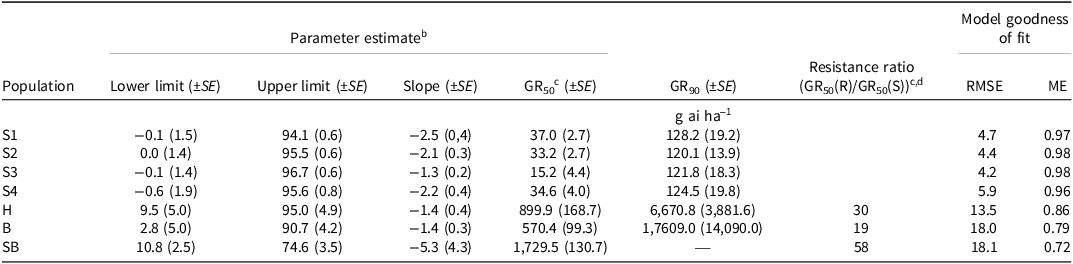
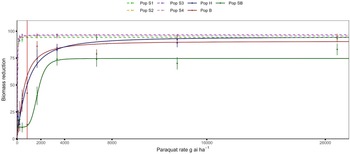
Confirming susceptibility of the putative susceptible biotypes, paraquat GR50 and GR90 (paraquat rate required to reduce biomass by 90%) values ranged from 15 to 37 and from 120 to 128 g ai ha−1, respectively. The GR50 values of the putative paraquat-resistant Italian ryegrass biotypes were 899.9 (H), 570.4 (B), and 1,729.5 (SB) g ai ha−1. The GR90 for H and B was 6,670.8 and 1,7609.0 g ai ha−1, respectively; however, this value was not observed for the SB biotype (Table 2; Figure 2). The calculated resistance ratio based on the GR50 was 30-, 19-, and 58-fold for the H, B, and SB biotypes when compared to the averaged values of susceptible biotypes, respectively. Therefore, owing to the high levels of differential susceptibility observed, paraquat-resistant Italian ryegrass was confirmed in North Carolina. In the United States, paraquat-resistant Italian ryegrass was first observed in a California orchard (Brunharo and Hanson Reference Brunharo and Hanson2018) with a GR50 of 1,089 g ai ha−1 and a resistance ratio of 19-fold. Recently, another paraquat-resistant Italian ryegrass population was confirmed in Louisiana sugarcane (Saccharum officinarum L.) (Coco Reference Coco2022), where paraquat is the only labeled postemergence herbicide. For this biotype, the GR50 was 643 g ai ha−1 with a resistance ratio of 15-fold. In both instances, biotypes were found in perennial cropping systems, where the paraquat-resistant biotypes from North Carolina would be the first case reported in an annual crop setting. The precise mechanism of resistance is yet to be determined. Restricted paraquat translocation primarily caused by vacuolar sequestration has been observed in paraquat-resistant biotypes from California (Brunharo and Hanson Reference Brunharo and Hanson2017). Enhanced reactive oxygen species detoxification has also been hypothesized as a potential mechanism of paraquat resistance (Hart and Di Tomaso Reference Hart and Di Tomaso1994). To this date, no binding-site mutations or enhanced metabolisms have been observed as mechanisms of paraquat resistance in plants (Hawkes Reference Hawkes2014).
Estimates of the model parameters, paraquat dose required to reduce the aboveground biomass of Italian ryegrass biotypes by 90% (GR90), resistance ratio, and model goodness of fit at 28 d after paraquat treatment in a whole-plant dose–response bioassay conducted in a greenhouse at the North Carolina State University Weed Science Laboratories. a

a Abbreviations: GR90, effective paraquat rate that reduces Italian ryegrass biomass by 90%; ME, modeling efficiency; R, resistant; RMSE, root mean square error; S, susceptible; SE, standard error.
b Four-parameter log-logistic model: Y = c + (d – c)/{1 + exp [b (log x – log e)]}, where Y is the response variable (biomass reduction), c is the lower limit, d is the upper limit, x is the paraquat rate expressed in g ai ha−1, e is the GR50 (paraquat rate where 50% response between lower and upper limit occurs; inflection point), and b is the slope of the line at the inflection point.
c Resistance ratio was determined by dividing the predicted value of the putative resistant (R) accession by the predicted value of the average of the susceptible (S) accessions.
d All values are significant based on 95% confidence intervals.
Dose–response curves of three putative paraquat-resistant biotypes (B, H, SB; solid lines) and four putative susceptible biotypes (S1, S2, S4, S4; dashed lines) collected from North Carolina. Graph represents the effect of aboveground biomass reduction of Italian ryegrass biotypes harvested at 28 d after herbicide treatment in the whole-plant dose–response bioassays conducted in the greenhouse at the North Carolina State University Weed Science Laboratories. The red vertical line represents the standard paraquat rate (840 g ai ha‒1).

Herbicide Screening of Whole-Plant Dose–Response Biotypes
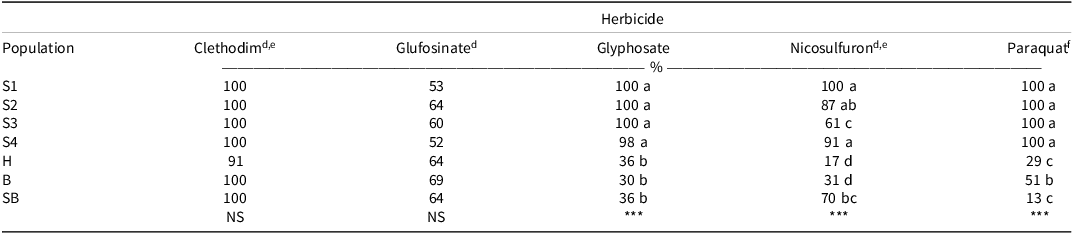
Italian ryegrass biotypes resistant to enolpyruvyl shikimate phosphate synthase–, ALS-, and acetyl CoA carboxylase (ACCase)-inhibiting herbicides have already been confirmed in North Carolina (Chandi et al. Reference Chandi, York, Jordan and Beam2011; Heap Reference Heap2024; Nandula et al. Reference Nandula, Giacomini, Lawrence, Molin and Bond2020). Therefore an herbicide screening was established to investigate the resistance profile of biotypes used in the dose–response study. Clethodim was the most effective herbicide, with ≥91% control for all biotypes (Table 3). Moreover, glyphosate performed poorly on all paraquat-resistant biotypes, with ≤36% control when compared to ≥98% control for the susceptible biotypes. Biotypes B and H had the lowest nicosulfuron control, with 31% and 17%, respectively. Furthermore, no differences among biotypes were observed in response to glufosinate, and control ranged from 52% to 69%. California researchers reported variable Italian ryegrass control by glufosinate, ranging from 58% to 83% (Moretti Reference Moretti2021). As expected, paraquat controlled susceptible biotypes 100% and resistant biotypes ≤51%.
Italian ryegrass visible estimations of control at 28 d after herbicide application on paraquat-resistant and -susceptible biotypes tested in a whole-plant, dose–response assay conducted in a greenhouse at the North Carolina State University Weed Science Laboratories.a,b,c

a Means presented within the same column and with no common letter(s) are significantly different according to Fisher’s protected LSD.
b Abbreviation: NS, nonsignificant at α = 0.05
c Herbicide treatments: clethodim (272 g ai ha‒1), glufosinate (880 g ai ha‒1), glyphosate (1,260 g ae ha‒1), nicosulfuron (34.4 g ai ha‒1), and paraquat (840 g ai ha‒1).
d Nonionic surfactant at 0.25% (v/v) as included as instructed by label directions.
e Ammonium sulfate at 3% (v/v) as included as instructed by label directions.
f Crop oil concentrate at 1% (v/v) as included as instructed by label directions.
*P ≤ 0.05. **P ≤ 0.01. ***P ≤ 0.001.
Italian Ryegrass Accessions Study
It is important to note that the goal of the accessions study was to identify multiple-resistant biotypes in the area. Therefore plant samples were collected only from agronomic fields where Italian ryegrass seedheads were visible, which might indicate that these plants survived preplant burndown and postemergence herbicides.
Among the herbicides tested, nicosulfuron and glyphosate resulted in the lowest mortality rates; 97% and 60% of the 38 accessions exhibited ≤50% mortality, respectively, and thus were classified as resistant (Figure 3). Furthermore, 29%, 13%, and 10% of accessions were resistant to paraquat, glufosinate, and clethodim, respectively. Although variable Italian ryegrass response to glufosinate was expected, as this herbicide is generally more effective on broadleaf weeds compared to grasses (Takano and Dayan Reference Takano and Dayan2020), glufosinate-resistant Italian ryegrass has been confirmed in North Carolina (Molin et al. Reference Molin, Nandula and Wright2017), and our results indicate that such resistance is present in different locations across the Southern Piedmont region.
Italian ryegrass plant mortality (±SE) in response to commonly used spring burndown herbicides. Accessions with mortality ≤50% (represented by the red line) were classified as resistant. Data from the 38 accessions evaluated for all herbicides applied postemergence are presented. This study was conducted under greenhouse conditions at the North Carolina State University Weed Science Laboratories.

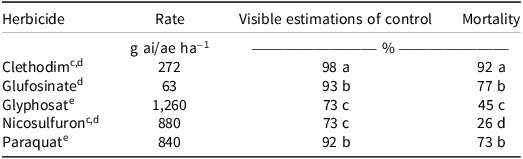
A similar trend was observed for VEC and mortality pooled over accessions (Table 4), where glyphosate and nicosulfuron were the least effective treatments, with both resulting in 73% VEC and 45% and 26% mortality, respectively. In addition, clethodim was again the most effective, with 98% VEC and 92% mortality. Bobadilla et al. (Reference Bobadilla, Hulting, Berry, Moretti and Mallory-Smith2021), while investigating the frequency and distribution of herbicide-resistant Italian ryegrass accessions from western Oregon, reported that 88% of accessions tested were resistant to at least one herbicide, while 84%, 43%, 11%, and 8% of biotypes were resistant to mesosulfuron-methyl, glyphosate, clethodim, and paraquat, respectively.
Italian ryegrass visible estimations of control and mortality at 28 d after herbicide application on 38 accessions collected from the Southern Piedmont region of North Carolina.a,b

a The study was conducted in a greenhouse at the North Carolina State University Weed Science Laboratories.
b Means presented within the same column and with no common letter(s) are significantly different according to Fisher’s protected LSD.
c Nonionic surfactant at 0.25% (v/v) was included as instructed by label directions.
d Ammonium sulfate at 3% (v/v) was included as instructed by label directions.
e Crop oil concentrate at 1% (v/v) was included as instructed by label directions.
Only one accession (NC34) exhibited susceptibility to all herbicides, whereas 97% and 74% of accessions tested resistant to ≥1 and ≥2 SOAs, respectively (Figure 3; treatments applied separately). Among the 11 accessions resistant to paraquat, all also exhibited resistance to nicosulfuron and glyphosate. Two accessions, NC16 and NC37, were classified as resistant to four herbicides. NC16 was resistant to clethodim, glyphosate, nicosulfuron, and paraquat, while NC37 was resistant to glufosinate, glyphosate, nicosulfuron, and paraquat. The existence of four-way-resistant Italian ryegrass biotypes is concerning and poses a great challenge to farmers who may not have a viable postemergence herbicide option to control this biotype. These results indicate that the majority of Italian ryegrass within the Southern Piedmont region of North Carolina has resistance to at least one herbicide; such findings reflect the consequences of excessive reliance on a single approach to weed management. Reports of Italian ryegrass populations resistant to multiple herbicides are abundant in the literature. In California, Brunharo and Hanson (Reference Brunharo and Hanson2018) reported a population resistant to clethodim, fluazifop-P-butyl, pyroxsulam, glyphosate, and paraquat (WSSA Groups 1, 1, 2, 9, and 22, respectively). Italian ryegrass biotypes from Washington and Idaho were reported to be resistant to herbicides from WSSA Groups 1, 2, and 15 (Rauch et al. Reference Rauch, Thill, Gersdorf and Price2010); in the same study, the authors reported that 12% and 25% of accessions were cross-resistant to all ACCase- and ALS-inhibiting herbicides tested, respectively (Group 1: diclofop, clodinafop, quizalofop, tralkoxydim, sethoxydim, pinoxaden, and clethodim; Group 2: triasulfuron, mesosulfuron, flucarbazone, and imazamox). Bobadilla et al. (Reference Bobadilla, Hulting, Berry, Moretti and Mallory-Smith2021) reported that 75% of Italian ryegrass populations screened were resistant to multiple herbicides, and 20% were resistant to herbicides from WSSA Groups 1, 2, 9, and 15. In a statewide survey of North Carolina, Jones et al. (Reference Jones, Taylor and Everman2021) reported Italian ryegrass biotypes resistant to multiple ACCase- and ALS-inhibiting herbicides; in addition, the authors reported that all 155 populations evaluated were resistant to diclofop-methyl. Therefore it is likely that the majority of the 38 accessions in this study also exhibit diclofop resistance.
Practical Implications
Results from the whole-plant dose–response bioassay confirmed high levels of paraquat resistance in all three biotypes tested, with resistance ratios of 19- to 58-fold. The confirmation of paraquat-resistant Italian ryegrass further complicates management of a weed that North Carolina farmers rank as one of the most troublesome in the state. More worrisome, the widespread distribution of multiple herbicide–resistant biotypes in the Southern Piedmont region leaves farmers with limited postemergence herbicide options to effectively manage this weed. Biotypes resistant to glyphosate and paraquat pose a challenge to preplant burndown operations, and growers may have to rely on alternative methods to manage Italian ryegrass during the fall and winter months, such as fall-applied residual herbicides, cover crops, and/or tillage. Furthermore, in small grain systems, virtually no postemergence herbicide options are available to effectively manage four-way-resistant Italian ryegrass. Preemergence herbicides, especially those from WSSA Group 15, remain an effective and reliable option, but selection pressure on this valuable SOA will only increase as postemergence options are lost.
To successfully manage multiple-resistant Italian ryegrass, a multifaceted approach that does not rely solely on herbicides is needed. Best management practices for mitigating the evolution and/or spread of herbicide-resistant weed biotypes include using multiple effective herbicide SOAs, preventing or reducing weed soil seedbank replenishment, and incorporating cultural and mechanical practices (Norsworthy et al. Reference Norsworthy, Ward, Shaw, Llewellyn, Nichols, Webster, Bradley, Frisvold, Powles, Burgos, Witt and Barrett2012). Fall-applied residual herbicides have been studied for fallow management of herbicide-resistant Italian ryegrass (Bond et al. Reference Bond, Eubank, Bond, Golden and Edwards2014); however, the activity of residual herbicides is reduced over time, and additional preplant control tactics might be necessary. Cover crops can effectively suppress troublesome winter annual weeds during the fallow months (Hayden et al. Reference Hayden, Brainard, Henshaw and Ngouajio2012; Pittman et al. Reference Pittman, Barney and Flessner2019) if adequate biomass is produced, with studies estimating at least 5,000 kg ha–1 for satisfactory weed suppression (Nichols et al. Reference Nichols, Martinez-Feria, Weisberger, Carlson, Basso and Basche2020). Cechin et al. (Reference Cechin, Schmitz, Torchelsen, Durigon, Agostinetto and Vargas2022) reported that 3 yr of continuous use of fall and winter cover crops resulted in up to 96% Italian ryegrass control and up to 99% reduction in Italian ryegrass soil seedbank when compared to nontreated check. De Sanctis et al. (Reference De Sanctis, Cahoon, Everman, Gannon, Jennings, Taylor, Dean, Forehand and Lee2025), while investigating fall-applied residual herbicides combined with cover crops, observed up to 85% control and 96% seed reduction in Italian ryegrass by the following growing season when these two tools were effectively integrated. However, the authors also observed that the efficacy of this strategy was reduced when a significant cover crop injury occurred as a result of the preemergence herbicide selection. Furthermore, windrow burning is a technique widely implemented in Australia to reduce seedbank replenishment of herbicide-resistant rigid ryegrass (Walsh and Newman Reference Walsh and Newman2007). In the United States, Lyon et al. (Reference Lyon, Huggins and Spring2016) reported that this tactic reduced Italian ryegrass seed viability by 99%. Other harvest weed seed control tactics include impact mill seed destruction, chaff lining, and chaff removal (Beam et al. Reference Beam, Mirsky, Cahoon, Haak and Flessner2019; Walsh et al. Reference Walsh, Aves and Powles2017). Although several alternative and effective weed control tactics exist, further research is needed to determine how to best integrate chemical and nonchemical tactics to better control multiple herbicide–resistant Italian ryegrass.
Funding
Funding for this work was provided in part by Cotton Incorporated, the North Carolina Cotton Producers Association, the Corn Growers Association of North Carolina, and Syngenta Crop Protection.
Competing interests
The authors declare no conflicts of interest.




 Open access

