




Policy Significance Statement
The integration of administrative informatics into the policy cycle proposed in the article enables a comprehensive analysis of policymaking processes. Particularly through its application to processes in the context of the European Green Transformation, changes become clearly visible, providing practical added value for the integrated design of the so-called “Twin Transformation,” which encompasses the linkage of digitalization and green transformation.
1. Introduction
The disruptive changes caused by the simultaneously occurring processes of digitalization and sustainability present extensive challenges for the state and public administration (Höchtl et al., Reference Höchtl, Parycek and Schöllhammer2016, 149; Frank, Reference Frank, Boockmann, Braun, Dillbahner and Tonn2025, 73). The state must address these challenges in accordance with the democratic will. This article defines the “Green Transformation” as the state’s effort to achieve climate neutrality, understood per Article 4 of the Paris Agreement as “a balance between anthropogenic emissions by sources and removals by sinks of greenhouse gases” (United Nations, 2015, 4). In order to use financial, personnel, and administrative resources efficiently and effectively (von Lucke, Reference von Lucke and von Lucke2017, 46) and to avoid counterproductive effects, such as rebound effects, lock-ins (Jevons, Reference Jevons1866; Lange et al., Reference Lange, Pohl and Santarius2020, 3; Ahmadova et al., Reference Ahmadova, Delgado-Márquez, Pedauga and Leyva-de la Hiz2022, 3; Saito, Reference Saito2023, 55), or emission-intensive digitalization (Digitalization for Holm, Reference Holm and Englund2009; Santarius, Reference Santarius2014; Sustainability, 2022), digitalization and the green transformation should be strategically linked and synergistically integrated (Boehme et al., Reference Boehme, Bahle, Wille, Hartwig and Wichmann2023, 5; see Co:Lab, 2023, 23; Pagel, Reference Pagel2023, 91). Although various studies have explored this linkage (Watson et al., Reference Watson, Boudreau and Chen2010; Loeser, Reference Loeser2013; Sarkis et al., Reference Sarkis, Koo and Watson2013; Kranz et al., Reference Kranz, Kolbe, Koo and Boudreau2015; Seidel et al., Reference Seidel, Bharati, Fridgen, Watson, Albizri, Boudreau, Butler, Kruse, Guzman, Karsten, Lee, Melville, Rush, Toland and Watts2017; Bakker and Ritts, Reference Bakker and Ritts2018, 202; Lehnhoff et al., Reference Lehnhoff, Staudt and Watson2021; Bianchini et al., Reference Bianchini, Damioli and Ghisetti2022; Veit and Thatcher, Reference Veit and Thatcher2023), actual integration remains more sporadic than systematic (Jetzke et al., Reference Jetzke, Richter, Ferdinand and Schaat2019, 8; Müller-Brehm, Reference Müller-Brehm2022, 4; Frank, Reference Frank, Boockmann, Braun, Dillbahner and Tonn2025, 74). Research on agenda changes through these transitions “has not been equal in terms of effort and reward” (Christmann et al., Reference Christmann, Crome, Graf-Drasch, Oberländer and Schmidt2024, 489).
A considerable body of research examines how information and communication technologies have affected administrative practice and political decision-making (Reinermann, Reference Reinermann2010, 72; Kamateri et al., Reference Kamateri, Panopoulou, Tambouris, Tarabanis, Ojo, Lee, Price, Janssen, Wimmer and Deljoo2015; Höchtl et al., Reference Höchtl, Parycek and Schöllhammer2016, 150; Manazir, Reference Manazir2023). Still, “although there is general agreement that Information and Communication Technology (ICT) will fundamentally challenge the conduct of governance, there is still a research gap as to how the process of policy formation and implementation will be affected” (Höchtl et al., Reference Höchtl, Parycek and Schöllhammer2016, 149). For decades, the digitalization of public administration was scarcely subject to targeted political steering (Lenk, Reference Lenk2011, 325). Some authors conclude that many studies view technology merely as an extension of existing policymaking processes rather than examining how technology could trigger structural changes in decision-making processes (Höchtl et al., Reference Höchtl, Parycek and Schöllhammer2016, 147). Especially in Europe, the digitalization of public administration has neither been consistently analyzed by political science nor holistically examined regarding its impact on all policymaking processes (Meijer and Löfgren, Reference Meijer and Löfgren2015). Based on the understanding that public administration is involved in all phases of the widely used policy cycle (Bogumil and Jann, Reference Bogumil, Jann, Bogumil and Jann2020, 13; von Lucke and Gollasch, Reference von Lucke and Gollasch2022, 15) and the assumption that executive bodies are essential in the democratic separation of powers (legislative, executive, and judiciary), this article argues that administrative digitalization—and thus administrative informatics—must be included as an analytical lens in policy analysis. This would allow current and future changes in policymaking processes to be examined and shaped more holistically. As early as 1999, Hudson emphasized the added value of using political science approaches to examine digitalization in public administration (Hudson, Reference Hudson1999, 318).
Additionally, there is an urgent need for action to mitigate the impacts of climate change, driven by real and present dangers, such as extreme weather events and natural disasters (see Gasparrini et al., Reference Gasparrini, Guo, Sera, Vicedo-Cabrera, Huber, Tong, Coelho, Saldiva, Lavigne, Correa, Ortega, Kan, Osorio, Kyselý, Urban, Jaakkola, Ryti, Pascal, Goodman, Zeka, Michelozzi, Scortichini, Hashizume, Honda, Hurtado-Diaz, Cruz, Seposo, Kim, Tobias, Iñiguez, Forsberg, Åström, Raget-tli, Guo, Wu, Zanobetti, Schwartz, Bell, Dang, Van, Heaviside, Vardoulakis, Hajat, Haines and Armstrong2017; Müller et al., Reference Müller, Albrecht and Gabrysch2018; Bussemer and Kipping, Reference Bussemer and Kipping2021, 123; Yang et al., Reference Yang, Zhou, Ren, Li, Wang, Liu, Ou, Yin, Sun, Tong, Wang, Zhang, Wang, Guo and Liu2021; Hetzer et al., Reference Hetzer, Forrest, Ribalaygua, Prado-López and Hickler2024, 1; Jones et al., Reference Jones, Kelley, Burton, Di Giuseppe, Barbosa, Brambleby, Hartley, Lombardi, Mataveli, McNorton, Spuler, Wessel, Abatzoglou, Anderson, Andela, Archibald, Armenteras, Burke, Carmenta, Chuvieco, Clarke, Doerr, Fernandes, Giglio, Hamilton, Hantson, Harris, Jain, Kolden, Kurvits, Lampe, Meier, New, Parrington, Perron, Qu, Ribeiro, Saharjo, San-Miguel-Ayanz, Shuman, Tanpipat, van der Werf, Veraverbeke and Xanthopoulos2024, 3602), to protect living beings and property. Given this context, designing the most effective and efficient policies to mitigate the effects of climate change requires addressing public administration as both a driver and an actor in policymaking. Many studies subsume the steering potential of public administration under the broader category of politics and fail to analyze it independently (Frank, Reference Frank, Boockmann, Braun, Dillbahner and Tonn2025, 82). This is despite the fact that public administrations often make climate-relevant decisions in their daily operations, operating below the level of parliamentary resolutions, and despite the potential of public administration to implement policies related to the European Green transformation through everyday actions (von Lucke and Frank, Reference von Lucke and Frank2025, 97).
This article, therefore, proposes a heuristic that integrates administrative informatics into the policy cycle and examines, using the example of the European Green transformation, how this integration alters the analysis of policymaking processes. Following the introduction, a literature review (Section 2) presents the current state of scientific research on this topic. Subsequently, the theoretical foundations and methodological approach of this article are explained and outlined (Section 3). In the following sections, the proposed heuristic is developed (Section 4). First, its purpose is described, and the differences from the traditional policy cycle are highlighted. Furthermore, this chapter discusses the anticipated added value and potential areas of application of the heuristic. The final chapter draws a conclusion, identifies the limitations of the study, and offers suggestions for future research (Section 5).
2. Literature review
Administrative informatics is an interdisciplinary science in Central Europe that applies information technology and computer science to optimize public administration processes, improve efficiency, and enhance digital governance. The prevailing theoretical approaches in administrative informatics have several origins, but some are in political science (Hudson, Reference Hudson1999, 318; Bogumil, Reference Bogumil2005, 669). Lenk repeatedly emphasized in his work on administrative informatics the necessity of linking electronic government and electronic administrative activities (e-Government). For the definition of e-Government, see von Lucke and Reinermann (Reference von Lucke and Reinermann2000, p. 1) with administrative policy (Reinermann, Reference Reinermann2010, 69). Different authors point out that the concept of e-Government, established through administrative informatics, must be understood broadly enough to encompass all consequences and impacts of the digitalization of public administration (Lenk, Reference Lenk2011, 317; see Fachausschuss Verwaltungsinformatik der Gesellschaft für Informatik e.V. und Fachbereich 1 der Informationstechnischen Gesellschaft im VDE, 2000, 15; Lenk and Traunmüller, Reference Lenk, Traunmüller and Prins2001). The inherent claim of administrative informatics to analyze, design, and manage processes (Lenk, Reference Lenk2011, 320)—including those related to policymaking—and its focus on the information dimension of public action (Reinermann, Reference Reinermann2010, 70) reinforces the argument that it can contribute essential solutions to public sector challenges (Reinermann, Reference Reinermann2010, 70). This design- and application-oriented focus (Lenk, Reference Lenk2011, 318; see von Lucke, Reference von Lucke and von Lucke2017, 39; see Reinermann, Reference Reinermann and Heinrich2011, 136) has historically evolved and been emphasized by key thought leaders (von Lucke, Reference von Lucke and von Lucke2017, 38). Being interdisciplinary, administrative informatics is also tied to political science and examines the political implications of administrative digitalization (von Lucke, Reference von Lucke and von Lucke2017, 46). Höchtl et al. describe this research focus with the term “e-policy,” referring to policymaking via e-Government (Höchtl et al., Reference Höchtl, Parycek and Schöllhammer2016, 148), noting similarities to “policy informatics” (Johntson, Reference Johntson2015) and “policymaking 2.0” (Ferro et al., Reference Ferro, Loukis, Charalabidis and Osella2013; Misuraca et al., Reference Misuraca, Mureddu, Osimo, Government and Gascó-Hernández2014). In Germany, public administration research increasingly integrates political steering and rejects a rigid division between administration and politics, emphasizing the policy role of administrations (Svara, Reference Svara2001, 176; Bogumil, Reference Bogumil2005, 669).
Human-induced climate change (Oreskes, Reference Oreskes2004; Doran and Kendall Zimmermann, Reference Doran and Kendall Zimmermann2009; Cook et al., Reference Cook, Nuccitelli, Green, Richardson, Winkler, Painting, Way, Jacobs and Skuce2013; Cook et al., Reference Cook, Oreskes, Doran, Anderegg, Verheggen, Maibach, Stuart Calton, Lewandowsky and Skuce2016; Lynas et al., Reference Lynas, Houlton and Perry2021; Myers et al., Reference Myers, Doran, Cook, Kotcher and Myers2021; Yan et al., Reference Yan, Schroeder and Stier2021, 3; Sommer et al., Reference Sommer, Schad, Kadelke, Humpert and Möstl2022, 13; Chakrabarty, Reference Chakrabarty2023, 13) and the digital transformation affect nearly all areas of society and cause disruptive changes for state and administration (see Christmann et al., Reference Christmann, Crome, Graf-Drasch, Oberländer and Schmidt2024, 489). The resulting challenges for public administration are substantial (Veit and Thatcher, Reference Veit and Thatcher2023, 1233) and extend to wider societal systems. These shifts question traditional concepts (Harari, Reference Harari2015, 251; Höchtl et al., Reference Höchtl, Parycek and Schöllhammer2016, 147; Frank, Reference Frank, Boockmann, Braun, Dillbahner and Tonn2025, 73) and require effective political strategies (von Lucke and Frank, Reference von Lucke and Frank2025, 88 f.). The state must proactively and democratically shape these developments to prevent long-term harm to sovereignty, capacity to act, and resilience (Bundesministerium für Umwelt, Naturschutz und nukleare Sicherheit, 2020, 1; Co:Lab, 2023, 5; see Rahmstorf, Reference Rahmstorf and Wiegandt2022, 29; Vorrath, Reference Vorrath and Parianen2023, 27). There are binding legal, political, and administrative commitments across the European Union (EU) and its member states to lead on climate change and digitalization (Boehme et al., Reference Boehme, Bahle, Wille, Hartwig and Wichmann2023, 5; Kovacic et al., Reference Kovacic, García Casañas, Argüelles, Yáñez Serrano, Ribera-Fumaz, Prause and March2024, 2255; Frank, Reference Frank, Boockmann, Braun, Dillbahner and Tonn2025, 75). The claim that “digitalization is a core component of the green transition” (Gritsenko et al., Reference Gritsenko, Aaen and Flyvbjerg2024, 1) and the European Green Deal (Kovacic et al., Reference Kovacic, García Casañas, Argüelles, Yáñez Serrano, Ribera-Fumaz, Prause and March2024, 2252) summarize both this study’s hypothesis and the EU Joint Research Centre’s findings in “toward a green and digital future” (Muench et al., Reference Muench, Stoermer, Jensen, Asikainen, Salvi, Scapolo and Center2022). Most studies focus on the emissions, resource use, and energy consumption of digital products (Doleski et al., Reference Doleski, Kaiser, Metzger, Niessen and Thiem2021, 242; Gritsenko et al., Reference Gritsenko, Aaen and Flyvbjerg2024; von Lucke and Frank, Reference von Lucke and Frank2025, 88), while rarely addressing the governance potential for political and administrative action (Muench et al., Reference Muench, Stoermer, Jensen, Asikainen, Salvi, Scapolo and Center2022, 81; von Lucke and Frank, Reference von Lucke and Frank2025, 97). Drawing on dynamic capability theory, Christmann et al. conceptualize the interplay of digital and green transformation and offer a capability framework for the Twin Transformation (Christmann et al., Reference Christmann, Crome, Graf-Drasch, Oberländer and Schmidt2024, 495 f.). Academic debates remain divided on whether digitalization promotes or hinders ecological goals (Ahmadova et al., Reference Ahmadova, Delgado-Márquez, Pedauga and Leyva-de la Hiz2022, 8; Digitalization for Jetzke et al., Reference Jetzke, Richter, Ferdinand and Schaat2019; Sustainability, 2022; Pagel, Reference Pagel2023; Kovacic et al., Reference Kovacic, García Casañas, Argüelles, Yáñez Serrano, Ribera-Fumaz, Prause and March2024, 2252).
The EU has launched initiatives to integrate both transitions, including a data space for the “European Green Deal,” a digital twin of the Earth (European Commission, 2019, 9; European Commission, 2021, 8), and the “GreenData4All” initiative (European Commission, 2020b, 22; European Commission, 2024). It highlights the role of climate-relevant data for achieving political goals like climate neutrality by 2050 (European Commission, 2020b, 26). The EU underscores the interconnectedness of digitalization and green transformation (Gritsenko et al., Reference Gritsenko, Aaen and Flyvbjerg2024), stressing coordination to avoid counterproductive effects and meet both challenges effectively (Muench et al., Reference Muench, Stoermer, Jensen, Asikainen, Salvi, Scapolo and Center2022, 2). Several EU strategies—including the Green Deal, Digital Strategy, and Data Strategy—jointly address administrative digitalization and sustainability (Friedrichsen, Reference Friedrichsen2017; European Commission, 2008; European Commission, 2019, 2020a, 2020b; Boehme et al., Reference Boehme, Bahle, Wille, Hartwig and Wichmann2023, 5). The EU urges member states to collect and openly share environmental data (Börner et al., Reference Börner, Bluhm, Fechner, Illes, Lubahn, Ostkamp, Richter, Schromm, Voges, von Zadelhoff, Rudolf, Hantsche, Lütkemeyer, Zschiesche, Niebuhr and Nöske2021, 5). The Joint Research Centre lists measures for a successful Twin Transformation but notes that the political implications of linking both processes remain underexplored (Muench et al., Reference Muench, Stoermer, Jensen, Asikainen, Salvi, Scapolo and Center2022, 81). While public administration is identified as a central stakeholder and data user, its potential contribution to evidence-based policymaking remains insufficiently examined. The implementation of the Twin Transformation varies greatly across EU member states (see Muench et al., Reference Muench, Stoermer, Jensen, Asikainen, Salvi, Scapolo and Center2022). The integration of these two themes seems to be only partially realized on both institutional and strategic levels within overarching EU frameworks. Kovacic et al. (Reference Kovacic, García Casañas, Argüelles, Yáñez Serrano, Ribera-Fumaz, Prause and March2024) regard the Twin Transformation as a discursive concept that does not solve sustainability problems (p. 2254) but is based on a simplified win–win rhetoric that does not deliver on its promises (p. 2273). Further studies question its effectiveness in reducing greenhouse gases (Bianchini et al., Reference Bianchini, Damioli and Ghisetti2022), point to possible intensification of economic imbalances in the EU (Maucorps et al., Reference Maucorps, Römisch, Schwab and Vujanović2023), as well as to complex structures, inconsistent implementation, and fragmented financing (Raza, Reference Raza2025). Other authors criticize the lack of an ecological sustainability perspective in the discourse on European artificial intelligence (AI) regulation (Hacker, Reference Hacker2024). The political and regulatory framework would neglect the ecological impacts of artificial intelligence (Perez Victorio et al., Reference Perez Victorio, Celeste and Quintavalla2024), while Gao points to a lack of coherence between governance levels and policy areas, as well as implementation deficits (Gao, Reference Gao2025, 9). The European Twin Transformation is indeed strategically and rhetorically present but shows considerable weaknesses in implementation, regulation, effectiveness, and coherence. Nevertheless, real climate-induced challenges and commitments require effective, democratically legitimized action by the EU in both transformation processes.
3. Theory of the policy cycle and methodology
Many different older and more recent theoretical frameworks, such as the Multiple Stream Framework (Kingdon, Reference Kingdon2011), the Punctuated Equilibrium Theory (Baumgartner and Jones, Reference Baumgartner and Jones1993), and the Advocacy Coalition Framework (Sabatier, Reference Sabatier1987), have dealt with the study of policymaking processes, which are intended to serve both scientific analysis and practical application (Manazir, Reference Manazir2023). The Multiple Streams Framework and the Punctuated Equilibrium Theory focus more on agenda-setting (Beyer et al., Reference Beyer, Boushey, Breuning, Wenzelburger and Zohlnhöfer2015, 356; Herweg, Reference Herweg, Wenzelburger and Zohlnhöfer2015, 326; Wenzelburger and Zohlnhöfer, Reference Wenzelburger, Zohlnhöfer, Wenzelburger and Zohlnhöfer2015, 20), while the Advocacy Coalition Framework rather brings beliefs and evaluations (Bandelow, Reference Bandelow, Wenzelburger and Zohlnhöfer2015, 306; Wenzelburger and Zohlnhöfer, Reference Wenzelburger, Zohlnhöfer, Wenzelburger and Zohlnhöfer2015, 20) into focus for the study of policymaking. These frameworks concentrate primarily on causes, contexts, conditions, and actor interactions in the context of political change (Manazir, Reference Manazir2023) and are, therefore, only of limited suitability for the aim of this contribution. The focus here is rather on the question of how the understanding of the design process itself changes through the integration of administrative informatics perspectives across all phases of policymaking. The contribution thus focuses on concrete changes in the policy process, not on its causes or contextual conditions.
The policy cycle inspired by Laswell (Laswell, Reference Laswell1956) is a common heuristic tool (Howlett and McConell, Reference Howlett and McConell2016, 67) used to generically describe, analyze, and illustrate complex policymaking processes within an ideal-typical sequence (Höchtl et al., Reference Höchtl, Parycek and Schöllhammer2016, 156). (For further variations, texts, and studies on the policy cycle, its history, and its utility, see Brewer (Reference Brewer1974), Jann and Wegrich (Reference Jann, Wegrich, Fischer, Miller and Sidney2007), Lindquist and Wellstead (Reference Lindquist, Wellstead, Hildreth, Miller and Lindquist2021), and Ronit and Porter (Reference Ronit, Porter, Lodge, Page and Balla2015).) The number and composition of the phases can vary depending on the model and its interpretation (Höchtl et al., Reference Höchtl, Parycek and Schöllhammer2016, 156; Howlett and McConell, Reference Howlett and McConell2016, 67; Blum and Schubert, Reference Blum and Schubert2018, 159). The phases are often understood as dynamic and flexible, as well as mutually influencing each other (Bridgman and Davis, Reference Bridgman and Davis2003, 102; Höchtl et al., Reference Höchtl, Parycek and Schöllhammer2016, 156). With its ideal-typical understanding of politics, the policy cycle is the subject of academic debates (see Sabatier, Reference Sabatier1991; Everett, Reference Everett2003; Howard, Reference Howard2005; Höchtl et al., Reference Höchtl, Parycek and Schöllhammer2016, 156; Howlett and McConell, Reference Howlett and McConell2016, 67), and it was already noted early on that the description of individual functional activities is, to a certain extent, arbitrary (Nachmias and Felbinger, Reference Nachmias and Felbinger1982, 303). Manazir criticizes that the nonlinear course of policymaking and the influence of political will are often not sufficiently considered and, therefore, proposes to integrate political will into the policy cycle (Manazir, Reference Manazir2023). At the same time, he notes that his framework also cannot cover all specific issues and shows similarities with the elements of the stage heuristic model of the policy cycle (Manazir, Reference Manazir2023). According to Manazir’s assessment, political will has a major influence on the “trajectory of policymaking” (Manazir, Reference Manazir2023), substantially contributing to the nonlinearity of the policymaking. Digitally based policymaking processes could respond to these effects in a significantly different way and, through policy design based on data, measurements, evaluations, and simulations, be more proactive rather than reactive or dependent on will, emotions, or ideas like policy entrepreneurs (Mintrom and Norman, Reference Mintrom and Norman2009; Ruvalcaba-Gomez et al., Reference Ruvalcaba-Gomez, Criado and Gil-Garcia2020). However, other responses are also conceivable and should continue to be empirically investigated and considered.
The Advocacy Coalition Framework also emerged on the basis of a critique of the division of policymaking into linear phases by textbook approaches, such as the policy cycle (Bandelow, Reference Bandelow, Wenzelburger and Zohlnhöfer2015, 306). The policy cycle thus appears useful with regard to the research interest, but should not be understood as a strict representation of real processes (Howard, Reference Howard2005, 3; Manazir, Reference Manazir2023). By dividing complex policy processes into phases, policymaking is systematically structured and thereby made accessible to targeted academic investigation (Anderson, Reference Anderson2010, 33; Wenzelburger and Zohlnhöfer, Reference Wenzelburger, Zohlnhöfer, Wenzelburger and Zohlnhöfer2015, 20; Höchtl et al., Reference Höchtl, Parycek and Schöllhammer2016, 156) and, according to other authors, enables good measures and policies to be derived (Edwards et al., Reference Edwards, Howard and Miller2001, 4; Bridgman and Davis, Reference Bridgman and Davis2003; Wenzelburger and Zohlnhöfer, Reference Wenzelburger, Zohlnhöfer, Wenzelburger and Zohlnhöfer2015, 20). Its purpose is to enable complex political decision-making processes to be subjected to a detailed and categorized analysis through ideal-typical phases (see Pump, Reference Pump2011; Höchtl et al., Reference Höchtl, Parycek and Schöllhammer2016, 156; Howlett and McConell, Reference Howlett and McConell2016; Bogumil and Jann, Reference Bogumil, Jann, Bogumil and Jann2020, 13; von Lucke and Gollasch, Reference von Lucke and Gollasch2022, 15 f.; Villa Alvarez et al., Reference Villa Alvarez, Auricchio and Mortati2022, 94). The nonlinearity of policymaking must, however, always be considered in this analysis.
Methodologically, this contribution builds on these theoretical findings on the policy cycle and develops a heuristic model for the conceptual and interdisciplinary extension of the policy cycle through the integration of the perspective of administrative informatics. This contribution is oriented toward similar and relevant works, such as that by (i) von Lucke and Gollasch, who integrate the concept of “Open Government”—open administrative and governmental actions—into the six-stage policy cycle (von Lucke and Gollasch, Reference von Lucke and Gollasch2022, 15); (ii) the study by Höchtl et al. (Reference Höchtl, Parycek and Schöllhammer2016)), which examines how political decision-making processes could, in future, be shaped through the integration of big data analytics into the policy cycle; and (iii) the work by Valle-Cruz et al. who integrate AI into the policy cycle and analyze its effects on policymaking (Valle-Cruz et al., Reference Valle-Cruz, Criado, Sandoval-Almazán and Ruvalcaba-Gomez2020). This heuristic model aims to create added value for the description, analysis, and design of policies in connection with the European Green Transformation and, thus, provides a relevant contribution to the concrete implications for policymaking. The aim is to provide a theoretical analytical tool through the combination of political science and administrative science perspectives that can be used both descriptively and in practice, and that systematically captures administrative informatics as an aspect of policymaking. The resulting changes are made accessible and systematically recorded on the basis of the phases of the policy cycle and are compared with the classical model, without negating nonlinear and complex policymaking processes. Like Höchtl et al., this contribution also aims to provide an approach to counteract a separation between the social sciences in general and administrative informatics (Höchtl et al., Reference Höchtl, Parycek and Schöllhammer2016, 148). Challenges of the structuring approach of the policy cycle are identified, practice-relevant challenges of the model developed are discussed, and a critical classification of the findings and limitations of the model is carried out in order to differentiate the results of the work.
4. Administrative informatics and the policy cycle as analytical tools in policy research
Analyzing the policymaking process in the context of the European Green Transformation from the perspective of administrative informatics makes it possible to identify previously hidden needs, risks, and opportunities. Furthermore, an integrated perspective helps uncover practical challenges that may emerge when policymaking processes are based on a digitalized administration. Building on this, policy recommendations can be derived to adequately address the challenges posed by digital tools and methods. Many examples can be attributed to multiple phases of the policy cycle simultaneously, which is logical given the cross-cutting and disruptive nature of digitalization and sustainability. New AI-based systems could enable seamless integration across all phases and partially or fully automate administrative and parliamentary tasks (von Lucke and Frank, Reference von Lucke and Frank2025; Weng et al., Reference Weng, Li, Cao, Lu, Gamba, Zhu, Xu, Zhang, Qin, Yang, Ma, Huang, Yin, Zheng, Zhou and Asner2024).
4.1. Description of the phases in the integrated policy cycle
In the first phase of problem definition, the focus is on identifying and delineating the problem, which is recognized as a challenge to be addressed and resolved. In the phase of problem definition, data, as well as automated or semiautomated analyses, forecasts, and observations of mobilization trends, enable the identification of problems or enforcement deficits (Manazir, Reference Manazir2023), for example, in the area of the European Green Transformation, which may make regulation or policy appear reasonable (see Kovacic et al., Reference Kovacic, García Casañas, Argüelles, Yáñez Serrano, Ribera-Fumaz, Prause and March2024, 2253). Specific applications such as Big (Green) Data, AI applications and systems, media monitoring, digital demoscopy, as well as text and data analyses, can help to comprehensively understand the urgency and likelihood of challenges in a field such as the European Green Transformation. Proactive actions, predictions, planning, and preparations would be supported within the respective policy field. Automated and legally compliant data collection could uncover previously unknown challenges, connections, and problems, or even trigger automated warnings (Höchtl et al., Reference Höchtl, Parycek and Schöllhammer2016, 149).
In the agenda-setting phase, the primary focus is on placing an issue on the political agenda to initiate a solution process. Various actors—such as political decision-makers, the media, or public administration—hold the power to introduce topics into the political process and generate public attention for them. The agenda-setting phase is also affected by changes driven by digital applications, systems, networks, and processes. Target group-specific or broadly managed participation processes, co-creation initiatives, and citizen engagement processes can be significantly promoted—but also manipulated—through digital applications and processes. Consequently, numerous implications arise for policymaking processes, such as the European Green Transformation, when applications like online platforms, AI-driven analyses, audience segmentation models, and the solutions articulated through these tools are incorporated into the agenda-setting phase. Citizens, intelligent everyday objects, and businesses already generate vast amounts of data, which state entities are increasingly seeking to access (von Lucke, Reference von Lucke2018, 117ff.). Climate and environmental data play a central role in advancing ecological sustainability transformation (Blab et al., Reference Blab, Stojanovic-Blab and Lutter2023, 13; Boehme et al., Reference Boehme, Bahle, Wille, Hartwig and Wichmann2023, 28).
The phase of decision-making focuses on the development and selection of appropriate political solution options. Decision-making in a policy field, such as the European Green Transformation, is undergoing significant changes under the influence of digital applications. Digital tools and methods could enable decisions or emergency systems—such as those related to resource scarcity—to be automated or semiautomated. Digital systems and applications, including visualizations, simulations, impact assessments, or data-driven follow-up evaluations, could empirically substantiate decisions and contextualize them with other questions or legal frameworks based on selected criteria. Data-driven analyses and digital networks facilitate the assessment of any decision in terms of parameters, such as compliance with applicable laws, benchmarks, or policy objectives. Such digital effectiveness evaluations, already conceptualized under terms like a “decision control radar” (von Lucke and Etscheid, Reference von Lucke and Etscheid2020, 68; Etscheid and von Lucke, Reference Etscheid, von Lucke, von Lucke and Pidun2024, S.25; von Lucke and Frank, Reference von Lucke and Frank2025, 96), also carry risks of manipulation and unwanted third-party influence. Unintended effects would become more visible, and decision-making processes would gain in transparency. The digitalization of public administration could significantly reduce the costs and efforts associated with accessing information, making it considerably more accessible and available more quickly (Höchtl et al., Reference Höchtl, Parycek and Schöllhammer2016, 148).
In the implementation phase, the practical realization of the previously developed policy measures takes place. This occurs through the enactment of new legislation and the concrete application and enforcement of these laws in administrative practice. Furthermore, administrative informatics can provide insights into how implementation related to the European Green Transformation should be processed and presented—for example, through digital twins, augmented reality experiences, dashboards, or control systems—to achieve maximum efficiency and effectiveness (Dembski et al., Reference Dembski, Wössner, Letzgus, Ruddat and Yamu2020; Maronga et al., Reference Maronga, Banzhaf, Burmeister, Esch, Forkel, Fröhlich, Fuka, Gehrke, Geletič, Giersch, Gronemeier, Groß, Heldens, Hellsten, Hoff-mann, Inagaki, Kadasch, Kanani-Sühring, Ketelsen, Khan, Knigge, Knoop, Krč, Kurppa, Maamari, Matzarakis, Mauder, Pallasch, Pavlik, Pfafferott, Resler, Rissmann, Russo, Salim, Schrempf, Schwenkel, Seckmeyer, Schubert, Sühring, von Tils, Vollmer, Ward, Witha, Wurps, Zeidler and Raasch2020; Schrotter and Hürzeler, Reference Schrotter and Hürzeler2020). Digital applications and automation, such as process management, warning, emergency, or control systems, are fundamentally transforming the implementation phase of a policy, particularly in fields like the European Green Transformation. These systems can help to protect, monitor, plan, distribute, restrict, and make scarce resources or values—such as air pollution rights—more efficiently available. Digital contract and insurance models can assist in managing, mitigating, and realizing policies. Disaster protocols or emergency plans can be automated or semiautomated through digital systems and applications, provided that the relevant parameters for such scenarios have been identified. Digital systems could also help to detect implementation deficits across various sectors and contexts and, depending on the applicable legal framework, enforce sanctions automatically or semiautomatically, thereby ensuring compliance. Given the ecological urgency, climate protection measures, particularly in the context of state activities, should be data-driven, according to some experts (see Boehme et al., Reference Boehme, Bahle, Wille, Hartwig and Wichmann2023, 4).
In the monitoring phase, assessments are gathered to evaluate the impacts and changes resulting from the policy decisions. In the monitoring phase, digital applications enable the rapid and empirical oversight of processes and organizations. Potential information asymmetries can be reduced through the digital collection and processing of data. Digital feedback systems, reporting tools, visualizations, data repositories, and real-time processing can provide significant added value to a policy field such as the European Green Transformation. Anomalies or rebound effects within a policy area could become more visible and measurable. Proactive actions based on data could be supported close to real time and promoted through digital applications. Administrative informatics could also help to determine how and when policymaking processes are influenced by various events or significant occurrences, and how public opinion on these topics can be representatively captured and processed (Höchtl et al., Reference Höchtl, Parycek and Schöllhammer2016, 148).
In the final evaluation phase, it is assessed whether the decisions taken and the implemented changes have achieved the desired outcomes and successfully addressed the defined problem. The evaluation phase of policies could fundamentally change through the integration of administrative informatics—away from exclusively ex-post evaluations toward a continuous, ongoing process that already uses monitoring data. Thus, the administration can, based on the ongoing monitoring data, potentially take countermeasures in case of shortcomings before political decision-makers decide on a new framework based on the evaluation. Control and warning systems, recommendations, and reports could fundamentally reshape the evaluation of policy fields, such as the European Green Transformation. AI-supported applications, automated or semiautomated assessments, comparisons, analyses, recommendations, and improvement proposals also represent a profound transformation in policy evaluation. A digitized administration could revolutionize traditional climate and environmental evaluation, which has historically been based on time-consuming audits and organizational analyses. It offers the potential to monitor, measure, manage, regulate, and make informed decisions regarding climate and environmental actions in real time—and thereby significantly improve climate and environmental governance (Bakker and Ritts, Reference Bakker and Ritts2018, 202).
4.2. Possible practical problems and solution approaches
The use of digital systems influences all phases of policymaking and brings technology-related risks. In particular, the interaction of data, actors, systems, and outcomes raises complex problems that have not yet been conclusively clarified. A central risk lies in incomplete, biased, or manipulated data, which can lead to flawed analyses and decisions, especially in decentralized structures, such as the EU. In addition to unintentional biases, targeted influence is also possible. Digital participation carries the risk of increasing power asymmetries when organized groups dominate discourse and digitally disadvantaged actors are further marginalized. Without real opportunities for influence, a loss of legitimacy looms. Another problem is selective steering by politics, administration, or service providers, for example, in data selection or problem definition. This can turn evidence-based policy into policy-based evidence. A lack of critical feedback weakens democratic control and conceals responsibility. Data-based arguments can devalue political debates, especially when algorithmic systems favor certain interpretations and suppress alternative perspectives. Indicators, dashboards, or early warning systems also bear the potential for misunderstanding, especially in the case of nontransparent or proprietary systems. Qualitative knowledge, especially local or indigenous knowledge, is often excluded. AI-generated texts, based on stochastic procedures, lack contextual sensitivity, which can impair political effectiveness, such as the European Green Transformation. Digital systems often oversimplify complexity, imply causality, and risk rebound effects or mismanagement when real problem structures are not represented. A flood of data-based recommendations can overload decision-making processes, complicate prioritization, and hinder learning, especially without participatory evaluation. The fixation on technical solutions threatens to depoliticize normative questions and displace societal negotiation.
A coherent and secure approach to digital policymaking requires the integration of technical, organizational, and normative dimensions. At the center are data quality, participation, transparency, epistemic diversity, and the learning capacity of political systems. Digital dependencies must be avoided, and cybersecurity must be consistently ensured. Political negotiation processes, especially in the context of the green transformation, must remain visible and negotiable. Digital tools should support deliberation, not replace it. Governance should combine technology design, democratic discourse, and sustainability. Digital systems are to be used as hypothesis-generating instruments; their logics must be communicated transparently and examined politically. Mixed methods, supplemented by qualitative perspectives, strengthen the validity of findings in transformation processes. In all phases, interdisciplinary validation of digital outputs—including algorithms, indicators, and model assumptions—is needed. Capacity building in administration and politics, as well as ethics or security councils, can help reduce risks. To ensure data integrity, high quality standards, plausibility checks, interoperable data infrastructures, and traceable source labels are required. Open data and independent audits enhance transparency and trust. Power asymmetries and pseudo-participation can be reduced through barrier-free access, targeted support for marginalized groups, quotas, random selection, and limits on lobbying influence. Transparent selection processes and accountability obligations strengthen participation equity. Digital systems must allow for divergent perspectives, scenarios, and critical trade-offs—for example, through local information, qualitative models, and explicit uncertainties. The integration of experiential, local, and indigenous knowledge requires context-adaptive frameworks, regional data spaces, and analog interfaces. To prevent overload, clear decision boundaries, user-oriented visualizations, and structured evaluation frameworks are helpful. Iterative monitoring, feedback loops, co-participation, and workshops promote institutional learning in dealing with digital systems.
4.3. Changes resulting from the integration of the science of administrative informatics
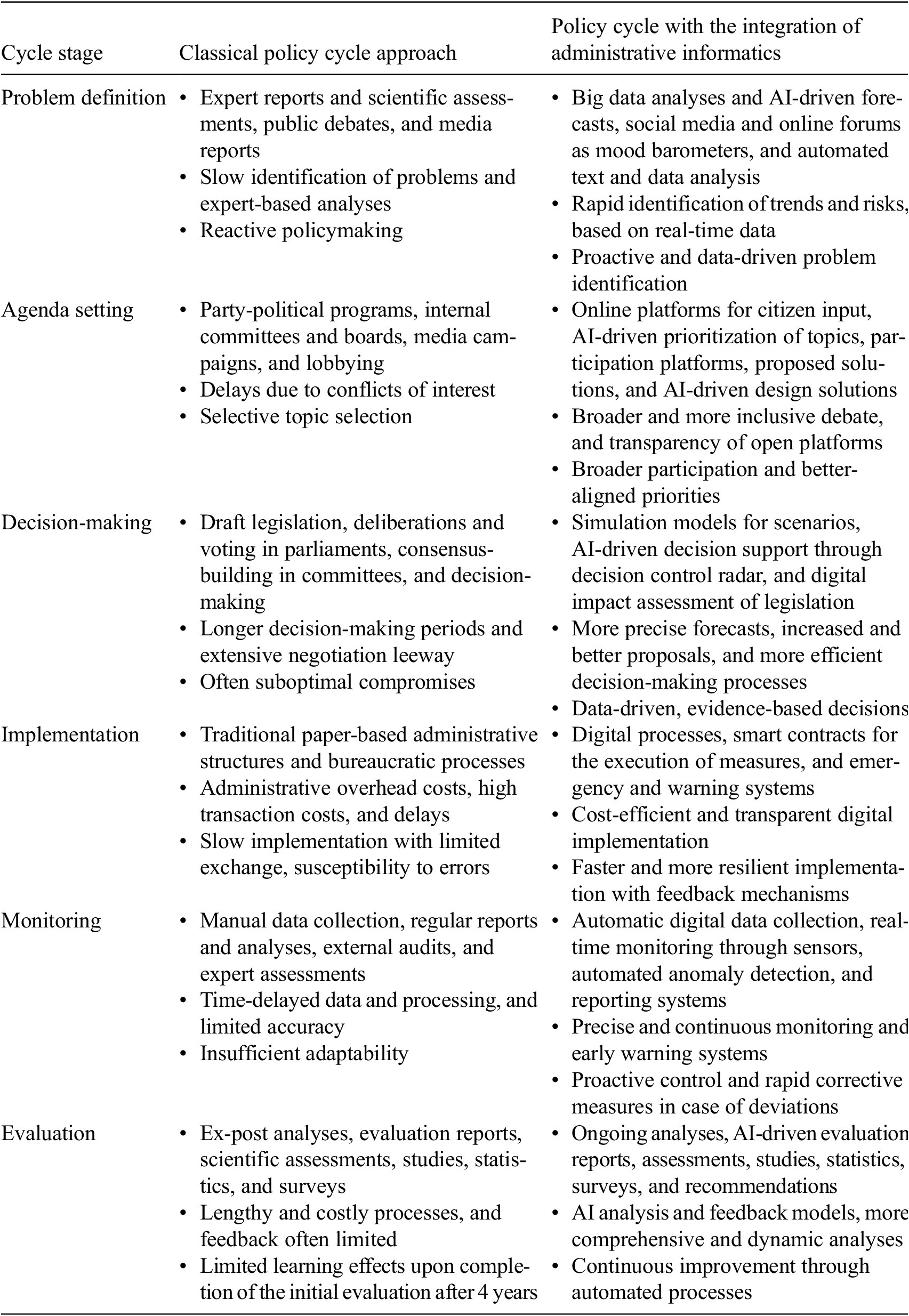
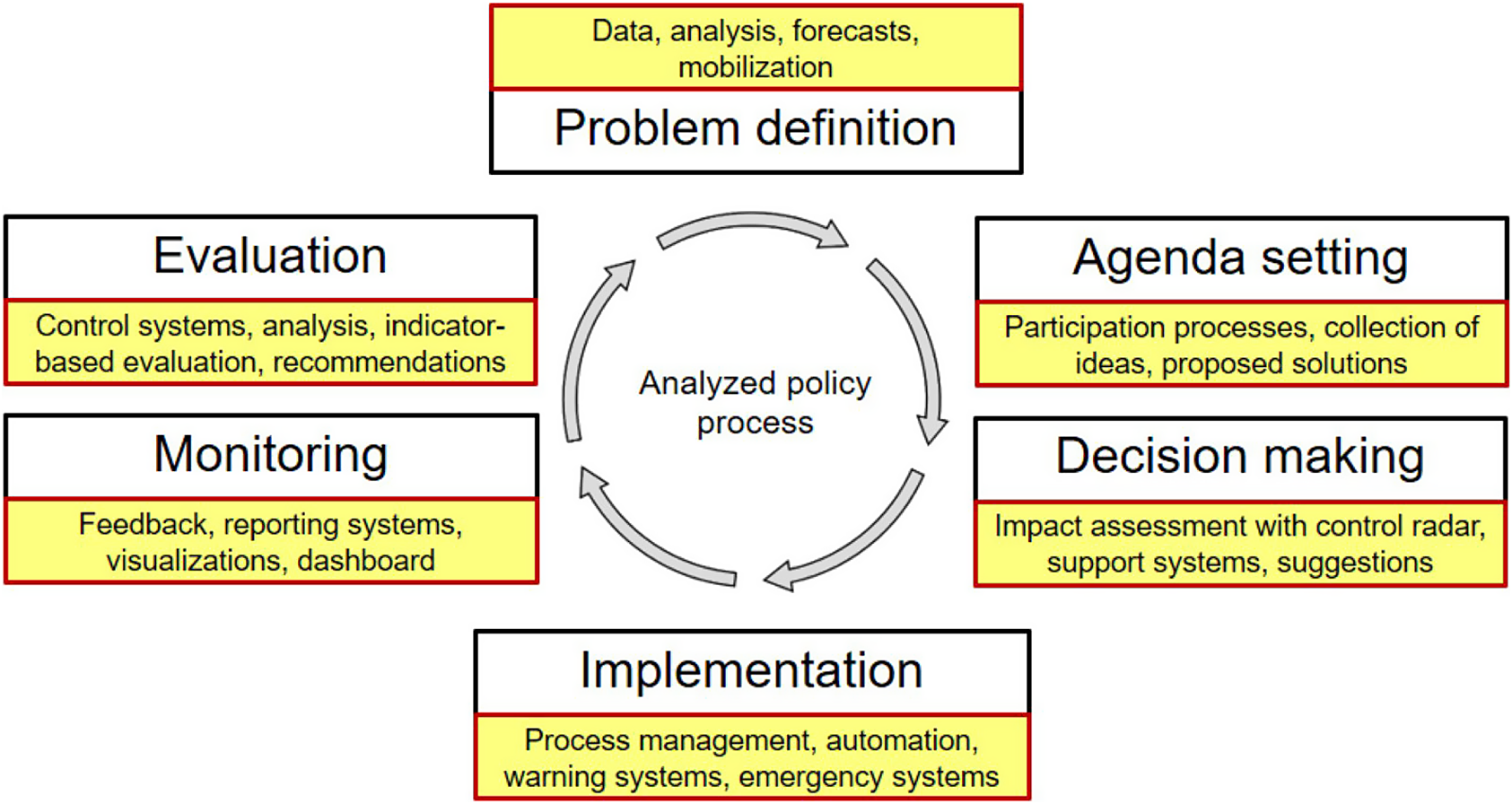
The traditional political approach is based on analog systems and closed processes, which are only to a limited extent in constant exchange and tend to proceed sequentially and statically rather than being interconnected and interactive. The traditional policy cycle was primarily conceived and implemented within analog structures, with little consideration given to innovative, digital approaches. This perspective largely persisted until the era of New Public Management, which emphasized performance improvement and efficiency gains. As the proposed integration of administrative informatics into the policy cycle instrument aims to demonstrate as shown in Figure 1, incorporating administrative informatics as a valuable perspective into research on European policymaking holds significant potential. In this integrated framework, the transformation of political processes becomes noticeable. Political decisions, consultations, negotiations, and actions are inherently dependent on data, information, knowledge, expected efficacy, and real-world conditions. The perspective of a digitized and interconnected public administration offers valuable insights into the digital tools available for policymaking, the challenges and opportunities within a digitalized administration, the arguments likely to resonate with different target groups, and how political decisions or actions can be weighed, predicted, or simulated based on various parameters and in diverse contexts. The Table 1 provides a summary of the differences between the traditional analog policy cycle approach and the digitally integrated policy cycle approach.
Comparative presentation of the classical and the integrated approach
Integrated Policy Cycle for the Twin Transition
4.4. Recommendations
Sustainability potentials for public administration arise not only from the use of digital technologies themselves but also from the design of political frameworks (Bieser et al., Reference Bieser, Hintemann, Beucker, Schramm and Hilty2020, 48; Müller-Brehm, Reference Müller-Brehm2022, 4). “Future work needs to critically evaluate the role of the state in enabling Smart Earth processes in different geographical and cultural contexts […]” (Bakker and Ritts, Reference Bakker and Ritts2018, 208). The capabilities framework by Christmann et al. also highlights that such questions should be incorporated into the political decision-making process in the context of the Twin Transformation (Christmann et al., Reference Christmann, Crome, Graf-Drasch, Oberländer and Schmidt2024). Further research should focus on closing knowledge gaps and understanding how a green transformation can be effectively implemented politically and administratively using data and digital processes. Analyses must remain dynamic and adaptable to reflect evolving realities, particularly in digitalization and the European Green Transformation. An interdisciplinary approach is essential, as transformations evolve over time. Rather than capturing a fixed reality, the proposed method serves as a basis for further research and highlights the need to embed administrative informatics in policy studies. However, data protection, technical barriers, and digital inequalities must be addressed to fully harness digitalization’s potential.
As shown in this article, considering the risks, challenges, and opportunities of digital processes reveals new implications for policymaking. Integrating administrative informatics clarifies which applications, data, processes, and structures matter, especially in the European Green Transformation. The EU and its member states should create frameworks that link sustainability with administrative digitalization while ensuring a liberal-democratic and ethical digital transformation. Public sector employees should also receive training in digital tools to better integrate administrative informatics into policymaking.
5. Conclusion
Past and present observations suggest that recent advances in administrative digitalization have the potential to influence the internal logic and structure of bureaucratic organizations, thereby profoundly transforming the policymaking process within the EU (see Höchtl et al., Reference Höchtl, Parycek and Schöllhammer2016, 147). Integrating administrative informatics and information technologies into policymaking analysis has proven to offer genuine added value, making such integration strongly advisable. Public administration, including its principals and agents in the sense of principal-agent theory, should be seen as a driver of political change in the European transformation process. Administrative informatics can contribute significantly to enabling a data-driven, impact-oriented transformation and addressing related requirements. It can reduce opportunistic behavior stemming from information asymmetries and facilitate a more holistic analysis of policymaking processes. Efficiency and effectiveness in the context of the green transformation should be assessed through the lens of administrative informatics. This article lays a foundation for future research at the intersection of administrative informatics, policymaking, and the European Green Transformation. While the policy cycle’s ideal-typical approach allows for flexible application, it favors broad insights over specificity, meaning real policy processes may differ from theoretical models. Future studies could analyze specific policies, such as the energy transition or circular economy, to better understand the outcomes from an administrative informatics perspective. This article provides an initial research basis that should be further developed and rapidly applied in practice to support the European Green Transformation, build data spaces, advance a smart power grid, and promote sustainability initiatives. These processes should not be left to chance or external actors. The European Union must lead the way in ensuring the successful, equitable implementation of the Twin Transformation by supporting policymaking with digital tools and scientific expertise.
Data availability statement
The article builds on the findings of previous research and develops a heuristic model based on them. The underlying texts are partly openly accessible and partly monetized. Usable or machine-processable data in the classical sense are not utilized.
Author contribution
Conceptualization: J.v.L. and S.F. Methodology: J.v.L. and S. F. Visualization: J.v.L. and S. F. Writing original draft: J.v.L.and S. F. Both the authors approved the final submitted draft.
Provenance
This article was submitted for consideration for the 2024 Data for Policy Conference to be published in Data and Policy based on the strength of the conference review process.
Competing interests
S.F. is a member of the municipal council of the city of Friedrichshafen. From the authors’ perspective, however, there is no conflict of interest in this context. The political work is entirely independent of the academic work.


 Open access


Comments
No Comments have been published for this article.