

1 Introduction
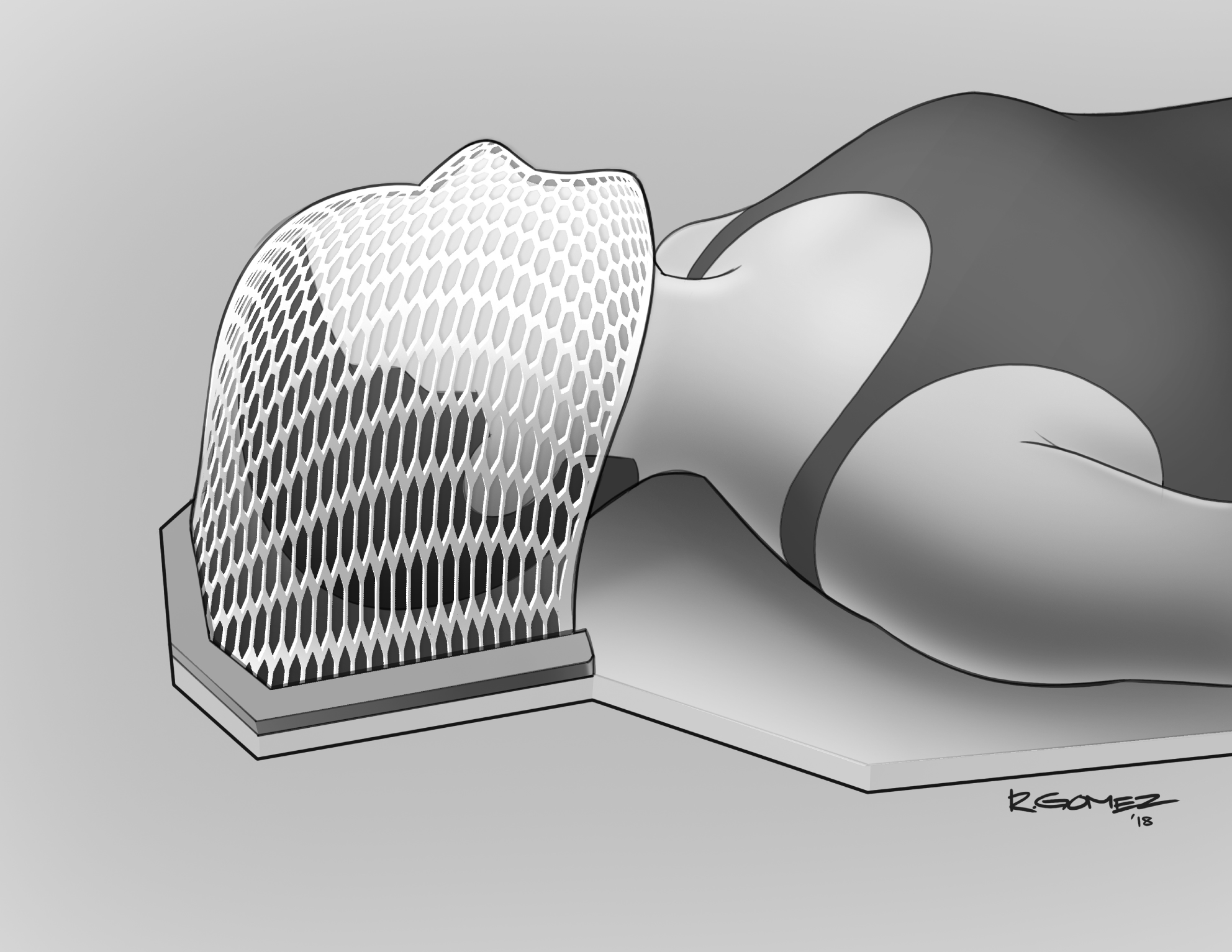
Designers have long recognized the need to create products and systems that meet the functional needs of end users. As Herbert Simon, one of the first to mention design as a science, says, ‘Engineers are not the only professional designers. Everyone designs who devises courses of action aimed at changing existing situations into preferred ones’ (Simon Reference Simon1996). In this paper, the term ‘designer’ has been used to collectively address anyone who is the creator of an artifact, like a designer, engineer, artist etc. However, many researchers have gone beyond focusing solely on functional needs to also focusing on the users’ practical (Ullman Reference Ullman2002) and emotional (Norman Reference Norman2005) needs and to understand how positive ‘emotional chain reactions’ can be created by designers (Stacey & Tether Reference Stacey and Tether2015). Methods such as human-centered design (HCD), co-design, and others provide a means to help designers better understand the needs and experiences of the users (Sanders & Stappers Reference Sanders and Stappers2008; Zoltowski, Oakes & Cardella Reference Zoltowski, Oakes and Cardella2012). However, in some contexts, end users’ interactions with the design elicit negative emotions such as fear and helplessness, which could be due to many factors, one of them being that their emotional needs may not have been met by the experience or the design. For example, a radiation mask (Figure 1) used by cancer patients is designed so that the person’s head will not move, but it looks intimidating and may elicit a sense of lost control and less power, especially for cancer patients already facing extreme stress and trauma. As a reporter describes it, the mask is made of white, transparent, plastic mesh that is molded around the patient’s face and ‘looks almost human, like a ghostly person frozen in place’ (Siner Reference Siner2014). Another example is a mammogram machine, which is large and noisy, with moving parts that can frighten some patients (Peek, Sayad & Markwardt Reference Peek, Sayad and Markwardt2008). Such products and systems that impact the user’s emotional well-being served as the inspiration for the conception of Compassionate Design (CD) (Seshadri, Reid & Booth Reference Seshadri, Reid and Booth2014).
Sketch of a radiation mask.
Design is not just a means to solve problems but to also explore the various possibilities and positive experiences that it can create (Desmet & Hassenzahl Reference Desmet and Hassenzahl2012; Jensen Reference Jensen2014). Although there are a number of methods to help designers use HCD thinking, there is a need to support the designers’ thought processes beyond ‘only usability’ and also focus on needs like dignity (Buchanan Reference Buchanan2001; Frediani Reference Frediani2016).
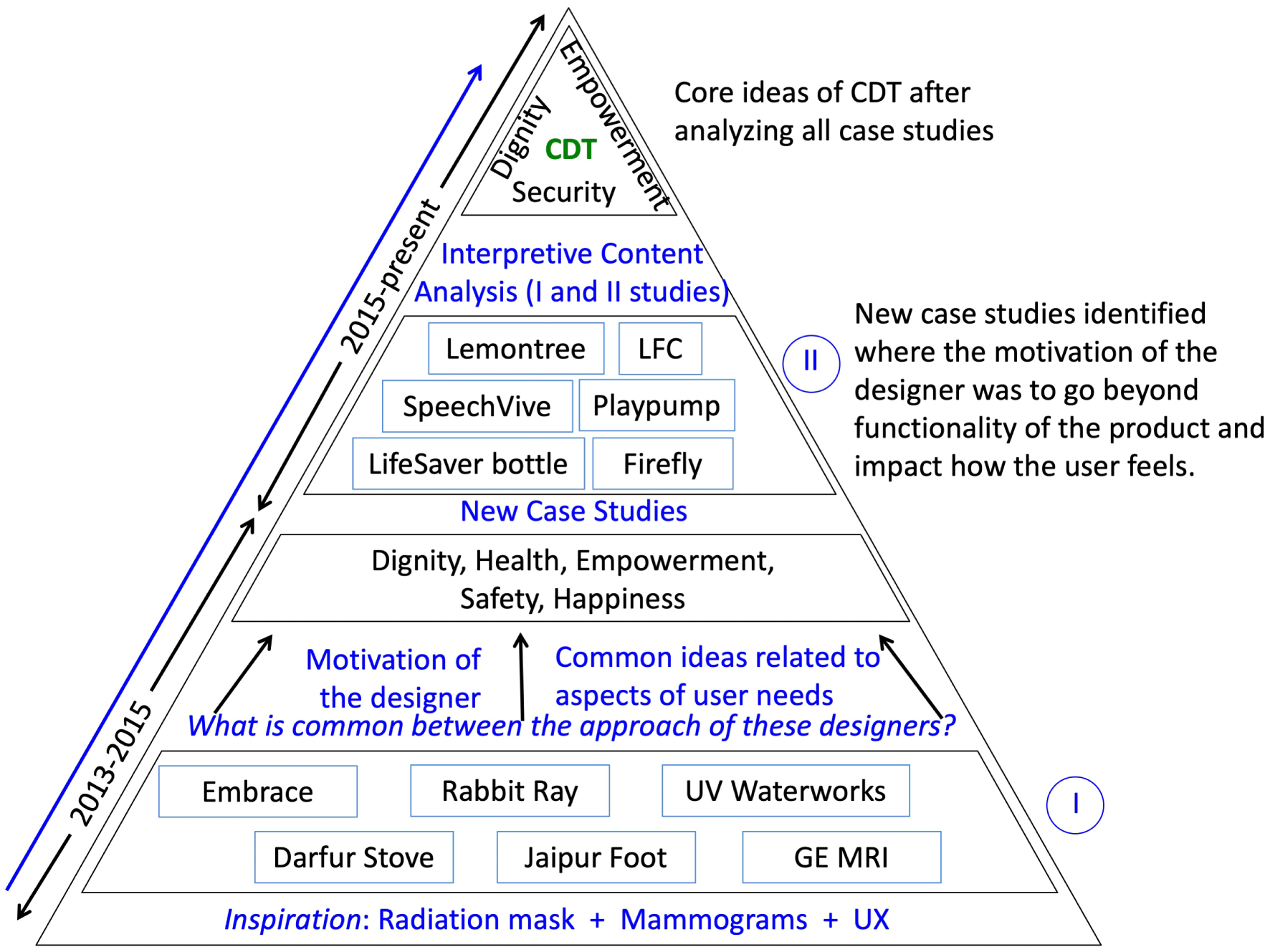
While exploring this idea of focusing on not just user needs but also feelings of the user, we came across a few designs (products and services) which were very successful in creating more positive user experiences. These designs include Jaipur Foot prosthetic leg, General Electric (GE) Magnetic Resonance Imaging (MRI) machine and Darfur Stove (see Figure 2). What set them apart from many others was the motivation of the designers to go above and beyond in identifying user needs which deeply affected the user. During pre-recorded interviews with or presentations given by the designers, they typically discussed the rationale for what they did and how they approached a certain problem. Therefore, videos were useful for understanding the motivation of the designer, which was conveyed by their expression of deep concern for the user and was similar in all the cases. We refer to the products and designs that we have analyzed in this work as cases, where ‘a case is an instance of a class of events’ (George & Bennett Reference George and Bennett2005; Dumez Reference Dumez2015). When we started seeing a pattern between some of the designers’ motivations, who expressed more compassion toward the user, we started looking for different cases with a similar lens, where the designer would express a deep concern for the user which further went along to motivate her/him. Further analyses (explained in the sections that follow) helped us to distill the common themes behind the user needs that were intuitively addressed by these disparate designers. The designers addressed the users’ sense of dignity, empowerment and security. Since these themes stemmed from a deep concern or compassion for the user, we call this approach Compassionate Design (CD). CD is intended to draw our attention toward these niche needs of dignity, empowerment and security, which are not the main focus of many other design approaches. CD falls under the realm of HCD but distinguishes itself by focusing on the users’ needs, not generically but specifically on their sense of dignity, empowerment and security. These themes have been discussed in detail in the ‘discussion’ section of the paper, but are also briefly defined here. ‘Dignity’ refers to a sense of self and recognition of the user as an individual. ‘Empowerment’ refers to the user’s sense of control and competence in a situation. ‘Security’ refers to the user’s sense of safety and assessment of risk.
Overview of the process used to distill the core ideas of CD. It shows the evolution of the initial ideas (based on the foundational set of cases) to the core ideas of CD after more cases were analyzed. Section 2 provides more details.
Delving more into the literature, we discovered that although many design thinking approaches foster and encourage focus on the user and users’ needs, there is a lack of specific mention of the dignity, empowerment and security of the user. From the cases, these needs are more apparent in vulnerable situations where there is a chance of high emotional engagement of the user. The core ideas of CD emerged as a result of iteratively examining and analyzing the various cases.
Various researchers have emphasized the importance of the users’ self-esteem and dignity (Buchanan Reference Buchanan2001; Nieusma Reference Nieusma2004; McDonagh & Thomas Reference McDonagh and Thomas2010), independence (Imrie & Hall Reference Imrie and Hall2001; Nieusma Reference Nieusma2004) and empowerment (Nieusma Reference Nieusma2004; McDonagh & Thomas Reference McDonagh and Thomas2010; Desmet & Hassenzahl Reference Desmet and Hassenzahl2012). However, what is not yet available is a framework that could directly help engineers and designers use CD in their work.
This paper presents the evolution of CD and its framework by describing the results from the analysis of 12 cases in which the designers addressed needs related to the users’ dignity, empowerment and sense of security. In the following section, we first present a review of the design literature, in particular, user-centered design (UCD), human-centered design (HCD), empathic design, and participatory design. Second, the research method is described, which includes the selection of cases and how the cases were analyzed. Third, the results of the analyses are presented which include details about the three foundational cases that informed the initial conception of the themes of CD. We also include two other cases as examples of the design of a service and an unsuccessful design. Next, we summarize all 12 cases and contextualize the elements of CD in literature. Finally, we discuss the implications and provide conclusions.
2 Literature review
We ground CD in the existing design traditions of HCD and UCD literature as well as other relevant design approaches. Our goal is not to argue for one approach over another, but to identify the underlying principles of these approaches that inform CD and that highlight the need for such thinking. The literature review is structured to show that CD is rooted in the different design approaches and briefly explain each design approach to support this. Although CD is rooted in existing approaches, it is differentiated by the designer’s motivation and intention to alleviate the users’ problems and improve their condition. Hence, we have used the word compassionate based on the definition that follows. Although there are various perspectives on the word ‘compassion’ (Lazarus & Lazarus Reference Lazarus and Lazarus1991; Lama & Thupten Reference Lama and Thupten1995; Kanov et al. Reference Kanov, Maitlis, Worline, Dutton, Frost and Lilius2004; Gilbert Reference Gilbert2009, Reference Gilbert2010; Goetz, Keltner & Simon-Thomas Reference Goetz, Keltner and Simon-Thomas2010), it is noted that there is ‘a broad consensus that compassion involves feeling for a person who is suffering and being motivated to act to help them’ (Strauss et al. Reference Strauss, Taylor, Gu, Kuyken, Baer, Jones and Cavanagh2016)
The earliest documented references to the use of the term ‘design thinking’ date back to 1959 by John E. Arnold (Arnold Jr Reference Arnold2018). Although ‘design’ has been in practice for a long time, it did not receive scholarly attention until 1962 as mentioned by Horst Rittel (Rittel Reference Rittel1988). Rittel mentioned how design penetrates many areas of human experience and emphasized on ‘wicked problems’ (Rittel & Webber Reference Rittel and Webber1973) and problem solving. In 1969, Herbert Simon made one of the first references to design as a science or way of thinking in the book ‘The Sciences of the Artificial’, in which he talks about design as science and makes a comparison with the natural sciences (Simon Reference Simon1996). Simon has elaborated on the various stages in the design process (Simon Reference Simon1995) that form the pillars of ‘design thinking’ today. Nigel Cross explains the field of design research and ‘designerly ways of knowing’, especially focusing on problem solving (Cross Reference Cross1982). Schön talks about design practice by studying practicing designers who share patterns of reasoning (Schön Reference Schön1988) and how reflection in design helps the designer to reflect on the problem and the actions (Schön Reference Schön2017). Many researchers contributed to the body of literature in design research and the early stages of design thinking (Arnold Jr Reference Arnold2018; Rowe Reference Rowe1987) by studying how designers think, focusing on problems and solutions (McKim Reference McKim1972; Cross Reference Cross1982; Lawson Reference Lawson2006), understanding the design space and that design problems are wicked, ill structured and ill defined (Rittel & Webber Reference Rittel and Webber1973; Simon Reference Simon1973; Cross Reference Cross1982; Buchanan Reference Buchanan1992). Many design methods and approaches were also developed as with advances in the field of design research, including UCD and HCD.
Compassionate design is rooted in the tradition of UCD and HCD. Many authors conflate UCD and HCD approaches using the terms interchangeably by expanding the boundaries of UCD to include what some would distinguish as HCD (e.g., (Norman Reference Norman2005; Norman & Verganti Reference Norman and Verganti2014)). Others use the term HCD because it suggests concern for people whereas UCD suggests a narrow focus on individuals’ roles as users (e.g., (Steen Reference Steen2011)). Still, some draw a distinction between the two approaches (e.g., (Gasson Reference Gasson2003; Giacomin Reference Giacomin2014)). There have been many conceptions of UCD since it was introduced in the 1980s, such as a philosophy of design (Norman Reference Norman1988), a methodology (Norman & Draper Reference Norman and Draper1986; McKelvey Reference McKelvey1994; Baek et al. Reference Baek, Cagiltay, Boling and Frick2008; Endsley Reference Endsley2011), a process (Vredenburg et al. Reference Vredenburg, Mao, Smith and Carey2002; Gulliksen et al. Reference Gulliksen, Göransson, Boivie, Blomkvist, Persson and Cajander2003; Mao et al. Reference Mao, Vredenburg, Smith and Carey2005), and an umbrella term to represent multiple design methods and methodologies (McDonagh-Philp & Lebbon Reference McDonagh-Philp and Lebbon2000). Likewise, there have been various conceptions of HCD such as a methodology (Gasson Reference Gasson2003; Krippendorff Reference Krippendorff2005), a process (ISO 13407:1999 1999; ISO 9241-210:2010 2010; IDEO 2011), a way of thinking (Brown & Katz Reference Brown and Katz2011; IDEO 2015), and an umbrella term representing multiple design methodologies that share common principles (Steen Reference Steen2011). HCD is the broader approach considering other stakeholders and not just users, while UCD typically focuses more on the users. Regardless of the various distinctions, UCD and HCD share a common value for broad understanding of people and including them in the design process to varying degrees. For the purpose of this paper we use the term HCD to refer to design approaches that share these common values.
HCD is based on the needs and interests of the user by asking users about their goals, the tools they need, the tasks they want to do, and their preferences (Norman & Draper Reference Norman and Draper1986; Norman Reference Norman1988). Underlying the methodology is a desire to ‘start with the users, and to work from there’ (Norman & Draper Reference Norman and Draper1986). The goal of the HCD approach was to make products that are usable and understandable (Norman Reference Norman1988). However, Norman later admitted that this original conception did not consider users’ emotions in addressing issues of function, form, utility, and usability. Norman has since extended this conception – based on scientific advances that have led to new understandings of how emotions and cognition are interconnected – to consider matters of emotion and aesthetics (Norman Reference Norman2005). Furthermore, HCD is based on values that emphasize human meaning; thus, it naturally focuses on questions, insights, and activities that take place with the people that will ultimately use the product, system, or service rather than with the professionals ‘doing design’, materials used, or artifacts that are created (Giacomin Reference Giacomin2014).
Compassionate design is also rooted in a design approach that has recently emerged from the HCD tradition, namely, empathic design (Leonard & Rayport Reference Leonard and Rayport1997; Koskinen, Battarbee & Mattelmäki Reference Koskinen, Battarbee and Mattelmäki2003; Lin & Seepersad Reference Lin and Seepersad2007; Steen Reference Steen2011; Zoltowski et al. Reference Zoltowski, Oakes and Cardella2012; Mattelmäki, Vaajakallio & Koskinen Reference Mattelmäki, Vaajakallio and Koskinen2014). The last few decades have seen the articulation of empathic design methodologies and approaches that further define the nuance of designing for people.
Empathic design has been ‘built on a long history of HCD’ (Mattelmäki et al. Reference Mattelmäki, Vaajakallio and Koskinen2014). This approach has been used in various applications for design practitioners (Leonard & Rayport Reference Leonard and Rayport1997; IDEO 2011), in business strategies (Leonard & Rayport Reference Leonard and Rayport1997; IDEO 2011) and in various contexts, such as engineering service learning (Zoltowski et al. Reference Zoltowski, Oakes and Cardella2012) and product design (Koskinen et al. Reference Koskinen, Battarbee and Mattelmäki2003). Empathic design can involve a narrative that might involve little or no direct contact between designers and users (Mattelmäki et al. Reference Mattelmäki, Vaajakallio and Koskinen2014), yet it can also involve contact with real users (Koskinen et al. Reference Koskinen, Battarbee and Mattelmäki2003). In other words, this approach helps designers to understand the users and the context in which the users are situated but does not necessarily require contact or interaction with the users. Empathic design methods have been used as tools for developing designers’ abilities, making them more sensitive to people and mitigating missed design opportunities (Mattelmäki et al. Reference Mattelmäki, Vaajakallio and Koskinen2014). According to Koskinen, Battarbee and Mattelmäki (Reference Koskinen, Battarbee and Mattelmäki2003), ‘The key to empathic design is understanding how the user sees, experiences and feels some object, environment or service in the situation in which he or she uses it’. Based on the literature, the two central tenets of empathic design are understanding the broader design context by focusing on users’/customers’ everyday environment (Leonard & Rayport Reference Leonard and Rayport1997; Koskinen et al. Reference Koskinen, Battarbee and Mattelmäki2003; Zoltowski et al. Reference Zoltowski, Oakes and Cardella2012; Mattelmäki et al. Reference Mattelmäki, Vaajakallio and Koskinen2014) and considering the feelings and emotions of users/customers (IDEO 2011; Steen Reference Steen2011; Mattelmäki et al. Reference Mattelmäki, Vaajakallio and Koskinen2014). Compassionate design will help to hone the focus on specific feelings related to dignity, empowerment and security of the user.
Compassionate design also draws from the tradition of participatory design, which has been distinct from HCD due to its underlying principles. Participatory design seeks ‘humanization and democratization as overriding design goals, in keeping with the aim of building an egalitarian society’ (Floyd et al. Reference Floyd, Mehl, Reisin, Schmidt and Wolf1989). In other words, it is rooted in democratic values for the workplace and in worker emancipation (Kyng & Greenbaum Reference Kyng and Greenbaum1991; Törpel Reference Törpel2005). However, participatory design, especially as commonly practiced in the United States, does not necessarily share this underlying philosophy (Mattelmäki et al. Reference Mattelmäki, Vaajakallio and Koskinen2014).
Participatory design has primarily been utilized in software systems design and development for users in their work environment (Floyd et al. Reference Floyd, Mehl, Reisin, Schmidt and Wolf1989; Blomberg & Henderson Reference Blomberg and Henderson1990; Piela, Katzenberg & McKelvey Reference Piela, Katzenberg and McKelvey1992; McKelvey Reference McKelvey1994; Baek et al. Reference Baek, Cagiltay, Boling and Frick2008; Steen Reference Steen2011). The focus of the design endeavor is not simply to develop new technology but also to consider the users’ work, work conditions, and quality of work life; for example, ‘improving the quality of work life may involve rearranging the furniture, reallocating work tasks, or creating flexible hours’ (Blomberg & Henderson Reference Blomberg and Henderson1990). Participatory design focuses on drawing users into the design process (Blomberg & Henderson Reference Blomberg and Henderson1990; Piela et al. Reference Piela, Katzenberg and McKelvey1992; Schuler & Namioka Reference Schuler and Namioka1993; McKelvey Reference McKelvey1994; Baek et al. Reference Baek, Cagiltay, Boling and Frick2008; Steen Reference Steen2011). More recent work also shows the participation of pre-users and non-users in the design process (Kelly & Matthews Reference Kelly and Matthews2014). The three tenets of participatory design are: (1) improving the quality of the users’ work life is the goal; (2) collaboration is essential; and (3) the process is iterative (Blomberg & Henderson Reference Blomberg and Henderson1990). Piela, Katzenberg and McKelvey (Reference Piela, Katzenberg and McKelvey1992) suggest that participatory design endeavors must: (1) establish common criteria for establishing success by all members of the group, (2) strengthen the character of user–developer interaction, (3) improve the quality of work life, and (4) emphasize design as an iterative process.
Co-design takes a different approach than participatory design, wherein the users are working together with the designers to create designs. Sanders and Stappers (Reference Sanders and Stappers2008) use co-design to ‘refer to the creativity of designers and people not trained in design working together in the design development process’. Prahalad and Ramaswamy (Reference Prahalad and Ramaswamy2004) explain how customers and firms co-create value together and that the ‘co-creation experience becomes the very basis of the value’. There are various types of design participations that cover the ideology of co-design, ‘which is based on the idea that all people have different opinions and should collaborate in any design process’ (Lee Reference Lee2008). When designs are not created ‘for’ the people but designs are created ‘with’ them, they have more control over the process and they experience an ‘unconventional way of designing’ (Lee Reference Lee2008).
Compassionate design places emphasis on considering the user holistically and focusing on the entire experience and not just on improving the functionality of products, similar to what is emphasized in ‘User-sensitive inclusive design’. User-sensitive inclusive design is an extension of ‘Inclusive design’. The literature has divided views on inclusive design. One view focuses on inclusive design as designing for specific populations while the other one focuses on not separating the different groups and designing for use by all. Waller et al. (Reference Waller, Bradley, Hosking and Clarkson2015) make a case for inclusive design being a segmented design response for a specific population and explain how it is not practical to design one product to meet the needs of all. The other view on inclusive design claims that it aims to create designs that can be ‘used by all’ without making user groups that need to be treated as special, either due to age or disability (Coleman & Lebbon Reference Coleman and Lebbon1999). It is a design philosophy that focuses on creating pragmatic design solutions that cater to different users such that it includes more users instead of excluding a specific user group (Pattison & Stedmon Reference Pattison and Stedmon2006). Heylighen & Bianchin (Reference Heylighen and Bianchin2018) view these contrasting views as a paradox faced by inclusive design where it is meant to cater to a wider range of users with differences but addressing such differences in the design solution may also restrict the range of users. Keates, Clarkson, Harrison and Robinson (Reference Keates, Clarkson, Harrison and Robinson2000) elaborate on an inclusive design approach that distinguishes itself from universal design, which typically uses a broad user base so that one product is accessible and usable by more and more people. They say that it is unlikely that one product will be suitable for everyone and provide different approaches that can be used including one that involves ‘modular/customizable design’ (Keates et al. Reference Keates, Clarkson, Harrison and Robinson2000). Newell, Gregor, Morgan, Pullin and Macaulay (Reference Newell, Gregor, Morgan, Pullin and Macaulay2011) extend this approach to ‘User-sensitive inclusive design’. They point out how certain designs for older and disabled people focus only on functionality and not so much on the aesthetics, assuming these user groups are motivated entirely by the functionality of the products. They suggest that the designers should develop empathy for their users considering the whole person and not just their physical characteristics.
Although CD draws on various principles of the aforementioned design approaches, it is aimed at addressing niche user needs relevant to their sense of dignity, empowerment and security. HCD addresses various aspects of the user in a broader way, considering not only users but all stakeholders in the process. While all the design approaches have differences, they all address various aspects of the stakeholder. Figure 3 is a depiction of how the various design approaches are related, yet distinct. They all focus on the user and are rooted in HCD and UCD but still have a unique character in the special ways that they handle different aspects of the users. CD falls within the realm of HCD and focuses on the user by drawing the designer’s attention to niche user needs, specifically related to their dignity, empowerment and security.
This figure shows that while CD and other design approaches have specialized ways of considering various aspects of the user (like the separate walls of the prism) in the design process, they are rooted in and share the same founding principles as HCD and UCD (like the base of a prism).

Analyzing the 12 cases used in the development of CD, we found that the designers and engineers in the cases have been addressing these needs intuitively, mostly based on their own experience and their concern for the user. All the cases that we have analyzed are situated in contexts where the user has a high level of emotional engagement, for example, getting an MRI scan, or losing a limb and not being comfortable using the prescribed prosthetic that is provided to her/him. CD is an attempt to sensitize the designers by bringing their attention to the niche user needs, especially in contexts with a high level of emotional engagement of the user. These 12 cases were chosen based on the following: (1) the designers’ articulation of their motivation to solve the problem. In the designers’ discourse on their work, they specifically mention details that indicate considerations about the end user that go beyond functionality or usability, but consider more in-depth social contexts of the end users that are indicative of CD; (2) the credentials of the designers. All the speakers are either designers, scientists, engineers and/or entrepreneurs who are respected and widely acknowledged in their field of work; (3) the accessibility of the videos. The videos analyzed were Technology, Entertainment, Design (TED) talks, interviews or news reports that can be found online or on YouTube. TED talks and YouTube videos have been noted as a valuable resource in education (DaVia Rubenstein Reference DaVia Rubenstein2012) and research (Snelson Reference Snelson2011; Kousha, Thelwall & Abdoli Reference Kousha, Thelwall and Abdoli2012). A complete list of the 12 cases along with links to their videos can be found in Table 6 in the Appendix. The key cases that laid the foundation of the CD framework are discussed in the Results section.
3 Research methods
An overview of the whole process from the conception to the initial development of a framework for CD is explained in this section and illustrated in Figure 4. The development of CD was not a linear process and happened over a period of 3–4 years. The initial process started with two researchers but then expanded to four researchers, all of whom are co-authors on this paper. The team consisted of two professors (1 female; 1 male) and two PhD students (1 female; 1 male) with one student and faculty member, each from the schools of Mechanical Engineering and Engineering Education at a North American University. This research began with the research team from Mechanical Engineering and later, the team from Engineering Education brought expertise in qualitative research methods.
Observing and comparing designs like radiation masks and mammograms (as mentioned in the Introduction) to Jaipur Foot, Darfur Stove and GE MRI (explained in detail in the next sections) spurred discussions about these designs and the thought process behind them. Delving deeper into the thinking of the designers, that were successful in creating positive user experiences, we found various videos (interviews and talks) where the designers explained what prompted them to think in a different way. Discussing these videos in detail, we found that the motivation of the designer was a deep concern for the user and how the users’ situation could be improved. With this idea in mind and a lens that looks at the motivation of the designer, a few more designs were evaluated. The first six cases (I in Figure 2) helped to develop the initial themes of CD including dignity and empowerment. As CD was being developed, we were looking at the design literature to see if any of these themes were addressed, specifically dignity and empowerment. At the same time, we were finding more designs where the dignity, empowerment and security of the users were addressed. Since there was no formal method that these designers were following, we wanted to find the commonality between their approaches and thought processes. Hence, we performed analyses of these cases iteratively until we arrived at the core ideas that form the framework of CD. The details of the method are presented below.
The CD development process was not linear and included multiple iterations and phases of analyses.

3.1 Interpretive Content Analysis
For our study we chose to conduct an Interpretive Content Analysis (ICA) to explore CD as a new way of looking at certain design endeavors. ICA is a systematic method for exploring and describing meanings within various communications (e.g., books, images, physical artifacts, audio/video files, other media) (Morgan Reference Morgan1993; Drisko & Maschi Reference Drisko and Maschi2015). Furthermore, it departs from traditional qualitative content analysis (Calloway & Ariav Reference Calloway and Ariav1995; Hsieh & Shannon Reference Hsieh and Shannon2005; Magenheim et al. Reference Magenheim, Nelles, Rhode, Schaper, Schubert and Stechert2010; Schreier Reference Schreier2012; DeFranco & Laplante Reference DeFranco and Laplante2017) by respecting latent and contextual content (Drisko & Maschi Reference Drisko and Maschi2015) to prevent latent content from being overlooked and to maintain the distinctive nature of individual cases (Drisko & Maschi Reference Drisko and Maschi2015). Researchers use ICA not only to describe content and meanings by answering questions of ‘what’ and ‘how’, but also to make inferences about intentions, thoughts, and feelings. These inferences are based on various forms of communication by answering questions about ‘why’, ‘for whom’, and ‘to what effect’ (Krippendorff Reference Krippendorff2013; Drisko & Maschi Reference Drisko and Maschi2015).
This methodology offered a contextual advantage for identifying explicit manifestations of CD as well as inferring considerations for dignity, empowerment, and security from latent or symbolic content within the cases we explored (Ahuvia Reference Ahuvia2001; Drisko & Maschi Reference Drisko and Maschi2015). Interpretive, contextualized inferences made it possible to make judgments about the intentions, thoughts, or feelings of the subjects in each case (Drisko & Maschi Reference Drisko and Maschi2015), particularly as they related to the core components of CD (i.e., dignity, empowerment, and perceptions of security). Furthermore, ICA allowed us to extend the foundational exemplary cases by expanding the data (Schreier Reference Schreier2014).
3.2 Selection of cases
Case selection was loosely based on qualitative sampling techniques in that the ongoing process of adding more cases took place during data analysis and we focused on a purposive sample of cases (LeCompte, Tesch & Goetz Reference LeCompte, Tesch and Goetz1993; Drisko Reference Drisko2003; Drisko & Maschi Reference Drisko and Maschi2015). This ongoing process was especially appropriate for this study because new cases were added for analyses as we discovered them. This procedure also allowed us to continue to expand our data.
List of cases that were analyzed and helped in framing CD
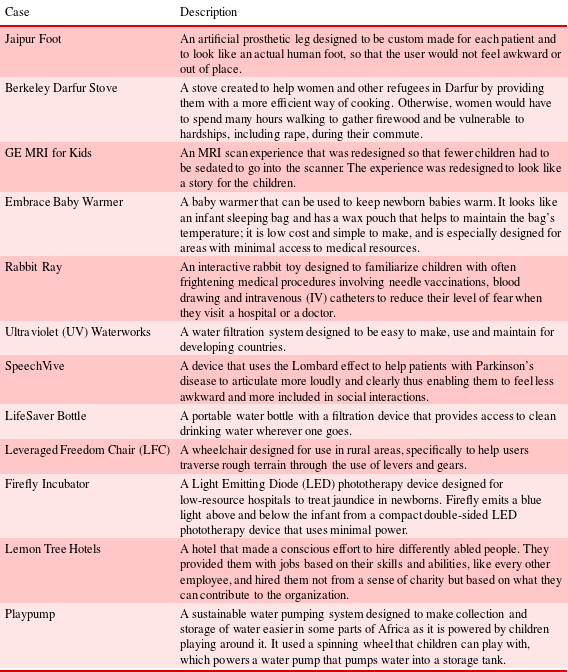
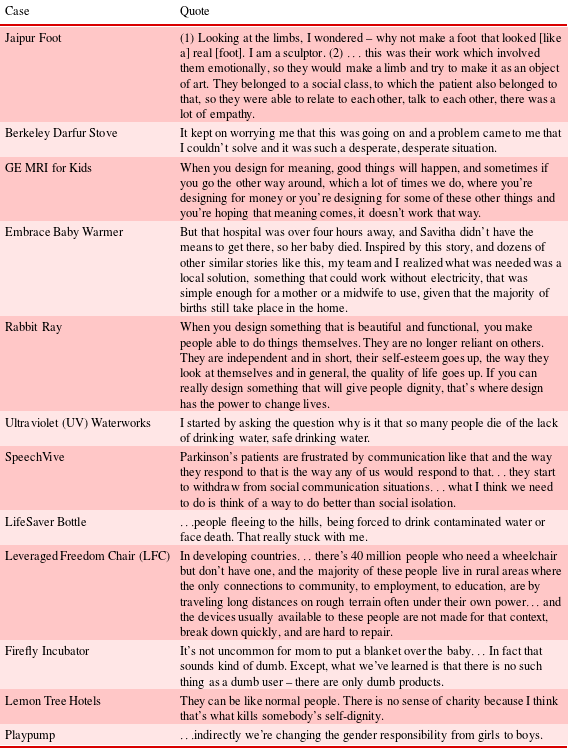
We found a number of cases where the designer expressed a deep concern for the users in vulnerable situations, approached the problem with a ‘helping the user’ instead of ‘solving a problem’ mindset, and paid special attention to the needs of the users that affect their sense of dignity, empowerment and security. A list of the 12 cases that we analyzed is given in Table 1. These cases are videos of various designs (products and services) wherein the designer has intuitively considered the emotions of the user in the problem-framing phase of design. We identified potential cases in an ongoing process as we developed the concept of CD. These cases have been chosen for explaining CD as they exemplify the use of CD. All these cases are based in contexts where the user is emotionally engaged and deeply affected by the problem, thus making her/him feel vulnerable and not being able to influence the situation she/he is in; cases exemplify feeling less dignified, less empowered and less secure. CD can be applied to any design problem, from that of a simple everyday object to that of more complex situations like in health care or contexts with fewer resources, as in the cases described in this paper. A CD approach is intended to enhance the dignity, empowerment and security of a user in general, but it is more applicable in situations where a lack of these can be identified to negatively influence the experience of the user. For example, CD is better suited to change the experience of a person from feeling inferior to feeling empowered than feeling empowered to feeling superior. It can be applied to any design problem which focuses on helping the users feel less vulnerable, threatened and more in control of the situation, for example, they have control on how their peers view them, or they feel empowered to change their current situation or feel more secure in their surroundings. The more extreme cases have been chosen to explain the development of CD as the users’ feelings of dignity, empowerment and security or the lack of these, are easier to notice in situations which have a high level of emotional engagement. For example, when one chooses to not wear a prosthetic leg to avoid feeling awkward and out of place even at the cost of this adversely affecting her/his life, we can see that ‘feeling dignified’ is important to the user. The severity of this cannot be compared to a situation when one feels awkward using an everyday object, like a wristwatch or water bottle and decides to not use it. Hence, we have chosen to explain CD using more extreme cases that have a bigger impact on the users’ lives. Quotes from the various cases that reveal a deeper concern for the user as expressed by the designers are listed in Table 2. These also reflect what seemed to motivate the designers and their influence on how the problems were framed.
Once a case was identified, it was shared with the research team (the authors) to discuss if it was suitable to be considered for analysis. Videos of these cases were chosen for analyses as they provided more insight into the thought processes and motivations of the designer.
Analyzing video data had many advantages (Jacobs, Kawanaka & Stigler Reference Jacobs, Kawanaka and Stigler1999). They were rich with language, visual content and could be watched and discussed multiple times. Videos were used as the designers would often ‘talk’ about their motivation to solve a problem. In printed media, the details of the product were there but the whole story of the design was often not mentioned. Even though we recognize that using videos had limitations like being edited, they were a readily accessible source where we could hear the designer talk about their stories. All the videos were either talks or interviews, where the designer verbally shared first-hand information about the design and how it came to be, which was typically missing from the printed media. The printed media typically contained information about the product and how it impacted the life of the user after the solution was created, but the videos were more impactful in the way the designers shared their stories of design, how they felt about the user and about their motivation to help the user. In their talks and interviews, the designers recollected their approach to the problem and why they actually wanted to solve it.
The coding of the videos occurred in many phases and revealed information that a mere transcription or audio recording could not. For example, one could see the facial expressions of the designers such as how perturbed they were to hear about the problem or how passionate they were about solving the problem. Watching and hearing the designers talk about the motivation and conception of the idea helped us to understand how and why the problems were approached in a certain way that made a difference in framing the problem. We observed that there were similarities among the ways that the designers (in our cases) approached their problems; all of them were intuitively using approaches similar to a CD approach.
Quotes from the designers that reflect deeper concern for the user
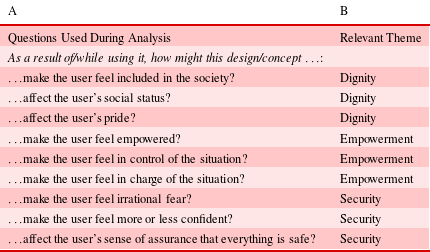
(A) Examples of questions that guided the researchers during analyses. (B) The emerging themes of CD that have been related back to these questions
3.3 Analysis of cases
As mentioned earlier, the development of CD was not a linear process (Figure 4). The main cases that helped the researchers to notice the differences in approach of the designers were Jaipur Foot, Darfur Stove and GE MRI. Looking for similar motivations of deep concern and empathy for the users from the designers, the researchers found more similar cases. After the preliminary analysis of these six cases, the initial set of themes that defined CD emerged: dignity, empowerment, safety, health and happiness (Seshadri et al. Reference Seshadri, Reid and Booth2014). The coding and analysis here were ‘not literal, but [were] arguable low-inference interpretations’ (Drisko & Maschi Reference Drisko and Maschi2015). These interpretations were used in the light of the context and latent content in the cases to develop the initial set of themes for CD during the preliminary analysis.
In the next phase, these cases were analyzed alongside new cases to conclude that happiness and health are generic themes and not unique to these cases. During the next and final phases of analyses, the researchers approached the analyses of the cases with three main themes: dignity, empowerment and safety. While listening to the videos, we were looking for the latent content or meanings that alluded to these themes. Examples of questions that guided the researchers are presented in Table 3.
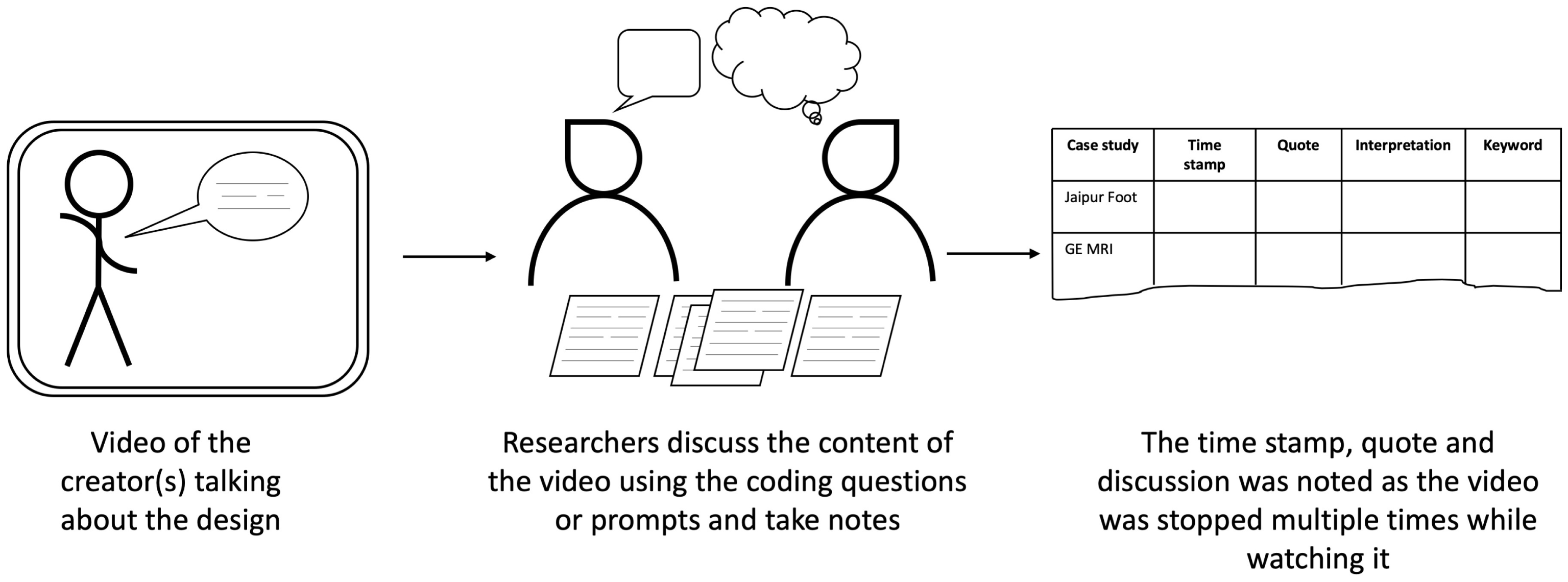
The initial discussions were guided by the notion of dignity, empowerment and security being absent or present, which also informed the questions shown in Table 3. After the themes began to emerge, we discussed how these user needs could impact the users’ lives and formalized these discussions into a list of questions that were then used in the later stages of the study. During these iterative analyses and discussions, the research team developed an underlying and coherent understanding of CD and the themes. When a researcher heard something relevant, the video was paused and the researchers discussed the content of the video, meaning and intention of the designer during the design process. If consensus was reached, the quote from the video was extracted, recorded and notes taken about the discussion (as shown in Figure 5). CD has been developed as a model that is constructed as a result of the analyses of the cases, the emergent codes, contextualization in Maslow’s hierarchy of needs and addressing a gap in literature to draw focus to niche aspects of sensitive user needs. The analyses and the development of the framework of this model did not rely on counting words or codes but was based on ‘inferences about the likely inner thoughts, purposes, and views of others that are not explicitly communicated’ (Ginger Reference Ginger2006). The coding was ‘largely descriptive’ (Drisko & Maschi Reference Drisko and Maschi2015) where sections of the data were selected and the meaning behind these were inferred. There were no pre-determined coding categories at the commencement of the analysis and different ideas emerged as the analysis proceeded, which were later grouped into themes of dignity, empowerment and security. Reliability and congruence were achieved by ‘negotiating agreements and disagreements’ (Armstrong et al. Reference Armstrong, Gosling, Weinman and Marteau1997), checking the analysis with the other researchers, discussions and reaching consensus through discussions. The three main themes are based on connotative categories (Drisko & Maschi Reference Drisko and Maschi2015) where the content is not explicitly stated but the latent and overall meaning is considered while discussing the intention of the designer. For instance, the word ‘dignity’ was seldom used but the designer referred to contexts and user needs which reflected how she/he considered the dignity of the user. The questions that guided the researchers while doing the analyses are presented in section A of Table 3 while the themes that emerged as a result of the analyses are presented in section B of the same table. The questions were a result of the discussions around the ideas of dignity, empowerment and security, even though these terms had not been formally coined to be the pillars of CD. For example, during discussions, the research team discussed how the user felt out of place, inferior, embarrassed, a sense of risk or fear etc. Even though the specific words, ‘dignity, empowerment and security’ were not always used, the content guiding the discussions was synonymous to these. It helped to frame the questions that were used in the later stages of the analyses, after which the themes of CD were formally coined to be dignity, empowerment and security. In Table 3, the questions and themes have been related side by side for better understanding.
Overview of the process used for coding the videos.
One of the key observations was differences in problem framing (by the designers) where the problem was not only framed to create a solution but was influenced by the designer’s motivation to help and focus on the feelings of the user. After doing numerous iterations of watching, discussing, and analyzing the videos (Jacobs et al. Reference Jacobs, Kawanaka and Stigler1999), it emerged that the designers had been focusing on the dignity, empowerment and/or security of the user. These were identified as the core ideas of CD. Although these were rarely explicitly mentioned by the designers, the model of CD was informed by the common themes in the cases, which were identified by using ICA and the approach of the designers who framed the problem to focus on enhancing the experience of the user and not just addressing a certain user need. The three exemplary foundational cases that laid the foundation of CD will be discussed in the next section. We watched the videos additional times and extracted excerpts using the core philosophy of CD i.e., sense of dignity, empowerment and/or security.
4 Results and discussion
The results are presented in three parts. First, we explain how the questions have been used with ICA to interpret the quotes and later identify the themes. Then three exemplary foundational cases are presented in detail to show how dignity, empowerment and security were observed during the analyses. We also observed that the designers in these cases were motivated by compassion and their willingness to help the user and did not want to merely solve a problem in terms of function; this differentiated them in the way they framed their problem. Some of the designers explicitly mentioned the end user in the problem-framing statements. They placed more emphasis on the users’ feelings like perception of threat, risk etc. than on a design solution for the product. For example, in the case of the Berkeley Darfur Stove, the difference between asking: How do we make a better cook stove? vs. How do I help these women and save them from violence?, reflected the motivation of the designer that guided the way the problem was framed. The focus was not just technical improvement or a generic consideration for the user but a deeper concern toward the plight of the user that was reflected in the way the designer spoke about it in her/his interview.
Since all the cases have been analyzed in a similar way, a summary of all the cases is presented. After this, two more cases are presented. One of them shows the application of CD in the design of a service and not product. The other case shows how one of the products, failed due to lack of holistic thinking in the design process.
Key quotes used by designers that illustrate CD were first identified while watching the video and then interpreted. Table 4 presents examples of these quotes and how the team interpreted them using questions, examples of which have been presented in Table 3. The meaning and context of the quotes helped the team to identify the themes that they represented. It is important to note that the designers rarely used the words dignity, empowerment and security but the underlying meaning of what they said reflected these major concerns.
Representative quotes that the team interpreted as reflections of the designer’s/engineer’s CD approach

The three foundational cases below exemplify the theoretical framework for CD. These cases are compilations of various videos describing the designs. We have chosen videos for analyses because the creators of the designs in most of these cases have addressed their motivations and intentions in these videos. It was clearly noticeable that the motivation helped them to frame the problem in a way that they could address the sensitive needs of the users. From these videos we draw out and highlight the main elements of the CD framework. The designers did not necessarily use the words dignity, empowerment and security but we identified these as themes by asking ourselves the following questions: What aspects of the user experience did the designers want to address? What feelings did the designers hope to elicit with their design/product? What outcomes were achieved by the design/product?
Each case presented below is divided into three sections: Problem Framing, Implementation and Evaluation, based on the three general stages of a design process. In the ‘Problem Framing’ section we explain how being sensitive to the users influenced the way the designer or engineer framed the problem. In these cases, the designer or engineer has naturally considered the dignity, empowerment and/or security of their users. The ‘Implementation’ section illustrates how the designer or engineer implemented the ideas from problem framing into solutions. The ‘Evaluation’ section details how the designs improved the lives of the users and stakeholders with respect to their dignity, empowerment and/or security. Each section includes quotes from the designer, engineer, user or stakeholder to illustrate how the research team interpreted the statements while analyzing the cases.
4.1 Foundational case 1: The Jaipur Foot
The Jaipur Foot is a below-knee prosthetic leg that was collaboratively designed in 1968 by a doctor and a sculptor. Dr. P. K. Sethi, an orthopedic surgeon working with patients with below-the-knee amputations, was perturbed by the patients’ high rejection rate of the prosthetic limbs with which he fitted his patients. At the same time, Ram Chandra Sharma, a sculptor who was conducting craft classes for children in the hospital at the time, learned about this problem and thought, ‘What if the foot looked like a foot?’. He used rubber to give the prosthetic limb the look of a real foot. The doctor–sculptor pair focused on developing a prosthetic that looked real, and adapted to the unique lifestyles and culture of their patients that many other prosthetic solutions did not. They also considered the socio-economic context of the patients by making the Jaipur Foot as inexpensive as possible and by providing meals and lodging for the patients who could not afford it. Their unique business model was developed not to be incredibly profitable, but to be low cost and easy to fit, and sustainable to manufacture; soon it became quite successful and became a popular prosthetic across the world. The acceptance rate of the product increased, and people from different parts of India and the world started using it. Since then, there have been many developments to the Jaipur Foot. One of the latest ones is in the calipers for paralytic poliomyelitis, where wood and metal conventional calipers have been replaced with low weight thermoplastic calipers (Jain Reference Jain2016). Dr. Jain says, ‘Since these are total contact orthosis, they can be worn inside the cloth[e]s and are not visible from outside. [A] 90% rejection rate converted to above 95% acceptance rate’ (Jain Reference Jain2016).
Problem framing: The problem was framed not only to address the function of a prosthetic to enable a person with an amputated below-the-knee leg to walk but also considered aspects of patients’ lifestyle and emotional well-being. As Dr. P. K. Sethi noted, ‘Fitting an artificial limb is not a simple biomechanical problem. It is a problem which involves the entire lifetime, lifestyle and culture of the people, which in our context meant that they should be able to walk barefoot, then the foot should look like a foot, they should be able to squat on the floor, sit cross-legged on the floor, [and] walk on uneven terrain.’
This quote highlights that the designers not only focused on the functional use (i.e., enabling the user to walk) but also an emotional need of the user, as it empowered users to independently engage in their lifestyle and cultural norms of squatting, sitting cross-legged, and traversing rugged terrain barefoot. The empowerment of the users was considered in a holistic manner beyond simply getting them walking again. A quote by the sculptor–designer Ram Chandra Sharma, ‘Right next to my room was an artificial limb workshop. Looking at the limbs, I wondered – why not make a foot that looked [like a] real [foot]?’ shows intentional thinking about the users’ need for dignity and social acceptance. He realized that prosthetic users do not want to feel awkward or different from others and want to be seen as equal members of society. Dignity of the users was specifically addressed by making the prosthetic foot look like a natural foot while meeting their practical needs and the resulting design was widely accepted by the users.
Implementation: While implementing the design, the creators emphasized the holistic aspects of the prosthetic beyond its effectiveness or function, for the end user. They considered the complete user experience including how the users would come to the medical office to be fitted or to obtain the prosthetic, how long it would take to be fitted, how they would be fitted, and the long-term maintenance of the prosthetic. They even considered the users’ ability to pay for the prosthetic (e.g., their sense of financial security) and their need to feel empowered in the face of losing a limb, an extremely disempowering experience, as reflected by the following quote: ‘Free boarding and lodging is provided to needy patients and up to 70 of them can be accommodated here at any point of time,’ and ‘One of the key reasons for the widespread acceptance of the Jaipur Foot amongst the poor is the organization’s emphasis on complete rehabilitation.’ The Jaipur Foot designers also employed staff who themselves were proud users of the Jaipur Foot, which indicated that they respected their value as individuals; this empowered the workers as well as the prosthetic clinic patients. This hiring of Jaipur Foot users also helped to dignify those with prosthetics as valuable employees in their own right and as role models for patients just starting their journey of change and acceptance. They also recognized that the users would be more aware of and understand the importance of each step in the creation, fitting and distribution of Jaipur Foot. Some excerpts from the videos illustrate the importance of precise measurements taken by a staff member who also uses the Jaipur Foot: ‘Even a small error in measurements could mean a lot of discomfort for the user. As someone who uses the Jaipur Foot himself, Prajapati knows this only too well.’
Evaluation: The Jaipur Foot team assessed the success of the Jaipur Foot not only in terms of solving the problem of walking again for those with below-the-knee amputations, but by how the prosthetics supported their need for dignity and to be valuable members of society, their need to return to their day-to-day activities and work and to fit into society versus being ostracized for being different or ‘less than’. D. R. Mehta, the founder and chief patron of Bhagwan Mahaveer Viklang Sahayata Samiti (BMVSS), the organization that provides Jaipur Foot, described his work as ‘so satisfying, personally. [A] person comes in calling, he gets a limb in day or two and for no charge at all and walks out. It’s not merely the thought of giving a limb, it’s also restoring their economic power.’
4.2 Foundational case 2: The Berkeley Darfur Stove
The Berkeley Darfur Stove was developed by Dr. Ashok Gadgil, a professor in Civil and Environmental Engineering at the University of California, Berkeley and his team. The stove was designed to help refugees (predominately women who cooked for their families) in Darfur by providing them a more efficient way of cooking. The new fuel efficient stove, ‘Berkeley Tara’, was made of metal and reduced the fuelwood consumption by 70%–75% as compared to the three-stone fire traditionally used by the refugees (Gadgil & Amrose Reference Gadgil and Amrose2006). As it was more efficient and used less fuelwood, this stove reduced the number of times the refugee women had to walk to fetch firewood, and hence reduced the hardships and danger that they faced while doing so. The motivation for the stove was to make the refugees feel more secure by making stoves with increased fuel efficiency which reduces their time fetching wood, away from the safety of the refugee camp, and in the process also empowering these women to continue to cook in ways they were accustomed to.
Problem framing: The problem was framed with the intention to improve the physical security of the user while also empowering them in their local context. This might be in contrast to an approach focused on finding the best technical solution (e.g., a gas-powered stove) without regard for the user’s traditions or situational/cultural context. The office of Foreign Disaster Assistance, a part of the US agency for international development called Dr. Ashok Gadgil, asking for help in Africa. Gadgil says, ‘[The officer] said, literally, that the Darfur refugee women are being raped in droves as they ‘must’ leave the safety of the camps to gather fuel wood. Can you do something about it? $\ldots$
Since the Darfur crisis started, I was aware of what was going on and felt terrible about it, but like most of us, I didn’t think I could help.’ These statements along with the one from Table 2 reflect Gadgil’s motivation to dive deeper into this problem. Another excerpt highlights the plight of the users; ‘[W]omen are forced to travel far outside the camps, often walking for up to seven hours to find wood [to use for cooking]. Any encounter with the Janjaweed militiamen while searching for firewood almost certainly would result in rape.’ He explained that the women ‘
$\ldots$
Since the Darfur crisis started, I was aware of what was going on and felt terrible about it, but like most of us, I didn’t think I could help.’ These statements along with the one from Table 2 reflect Gadgil’s motivation to dive deeper into this problem. Another excerpt highlights the plight of the users; ‘[W]omen are forced to travel far outside the camps, often walking for up to seven hours to find wood [to use for cooking]. Any encounter with the Janjaweed militiamen while searching for firewood almost certainly would result in rape.’ He explained that the women ‘ $\ldots$
have to go because there are a few men in the camps, about twenty percent of the camp residents are men, but if the men get caught outside, they are killed. Its a horrible choice [for the women].’ The problem was framed with an intention to solve this desperate situation of the users.
$\ldots$
have to go because there are a few men in the camps, about twenty percent of the camp residents are men, but if the men get caught outside, they are killed. Its a horrible choice [for the women].’ The problem was framed with an intention to solve this desperate situation of the users.
Implementation: Before implementing the design, a team traveled to Sudan in 2005 to better understand the context and the problem. A team led by Gadgil went to Sudan and spoke with the Sudanese women and their families to gather more information to design a better cook stove that would be suitable to their traditional cooking practices. The team learned details about their typical cooking methods, types of pots used and how they gathered fuel for cooking. Thus, the designers were able to keep the lifestyle of the user in mind while creating the product. They created a stove that not only empowered the users to facilitate them to keep themselves safe but also use their current utensils and cooking styles in a more efficient way. As Gadgil explains, ‘I figured one should be able to design the stove that should be cheap, should work with their pots, with their fuel, with their cooking style.’ He was considering their financial, socio-cultural and practical needs.
Evaluation: The stove did not eliminate the problem – the women’s need to leave the refugee camp to forage for wood, but it reduced the problem to a large extent as it required 75% less wood for cooking. According to Gadgil, ‘Something that should be at least 25%–30% efficient, that’s a four fold gain in their efficiency and that means instead of going out every other day they would [have to] go out once a week.’ The creators thought not only about solving the problem but considered the safety and dignity of the users; they aimed to improve the refugees’ lifestyle and sense of self by helping them build their economy as noted in this quote: ‘For the team, finding a way to manufacture the simple sheet-metal stoves locally, thereby helping to build the internal economy of the refugee camps is more important than the bottom line. We do want to foster innovation in Darfur.’ Gadgil adds, ‘This project gives me one more reaffirmation that use of modern science and engineering technology can go very far in solving desperate problems of people who are at the very bottom of the economic pyramid.’
4.3 Foundational case 3: General Electric (GE) Magnetic Resonance Imaging (MRI) for kids
Getting an MRI scan can be a frightening procedure for people, especially for children. When children typically get an MRI scan, they are scared, nervous and cannot keep still. Therefore, in order to complete the procedure, 80% of the time children have to be sedated. Doug Dietz, an industrial designer for GE who also created the MRI machine, explained how he redesigned the experience of getting an MRI scan for children. Dietz explains that he became interested in the problem when he learned that most children had to be sedated before going into the MRI machine. Upon visiting the hospital, he noticed that the MRI procedure created enormous stress for parents in addition to their concern for their child’s health. So he decided to try to change this very cold, noisy, isolating and scary procedure into one that would be more enjoyable for the children by turning the MRI experience into an adventure, like a ‘pirate journey’ or a ‘nautical adventure’ for the children.
Problem framing: Dietz explains how he came to realize the problem when he looked at it from the patient’s and their parents’ perspectives:
I saw this young family coming down the hallway and I’m just standing in the hallway and they’re coming toward[s] [me] and I can tell as they get closer, the little girl is weeping and as they even get closer to me I notice the father just leans down and just goes, ‘Remember we’ve talked about this, you can be brave.’ $\ldots$
and she just freezes and I
$\ldots$
and she just freezes and I $\ldots$
looking at her angle and just seeing in that same environment where I was just standing, I realize that this is something totally different.
$\ldots$
looking at her angle and just seeing in that same environment where I was just standing, I realize that this is something totally different.
Dietz understood that it is not only the emotions and feelings of the child but also those of the parents that are affected when a child has to undergo an MRI scan:
[S]o the little girl just starts to really cry, I mean she’s just breaking down $\ldots$
they don’t know how they’re going to get their child through this, so that was a huge awakening for me. So the challenge we have here is you got that little guy and he needs to go through a scan
$\ldots$
they don’t know how they’re going to get their child through this, so that was a huge awakening for me. So the challenge we have here is you got that little guy and he needs to go through a scan $\ldots$
.
$\ldots$
.
Dietz understood that he needed to do something that focused on enhancing the sense of security for young MRI users and their families.
Implementation: Dietz wanted to better understand children in order to address the anxiety they were facing due to the MRI procedure. He visited a day-care center and realized that he ‘had to learn more about some of the developmental stages of children, some of these things that would cause the anxiety.’ He mentions that children have a fertile imagination and considering this, the team included many elements in the final design that would cater to all the senses and change their experience, for example, to that of a ‘pirate journey’ or ‘nautical adventure’. They were able to change the sense of security of the children and make them feel less scared of the scan by changing the design of the room to a ‘story-based theme’ and making the scan as a part of the story, thus giving the children an experience of play rather than that of a medical procedure.
Evaluation: Initially, approximately eighty percent of children had to be sedated before going for the scan. With this new redesign, they sedated just two children in over a year when the redesigned machine was being used in this hospital. The designer himself assessed the redesign based on his success in how calm the parents and children felt and in the reduction to their anxiety. He says, ‘What I really think I would measure myself in this kind of a project is have I had influence on that conversation in the car on the ride home for that family and if I have had that opportunity to make that a different kind of conversation for this family.’ He also mentions that not only most children did not have to be sedated, some children even wanted to come back to play, which shows that the redesign made a difference in the experience of the children.
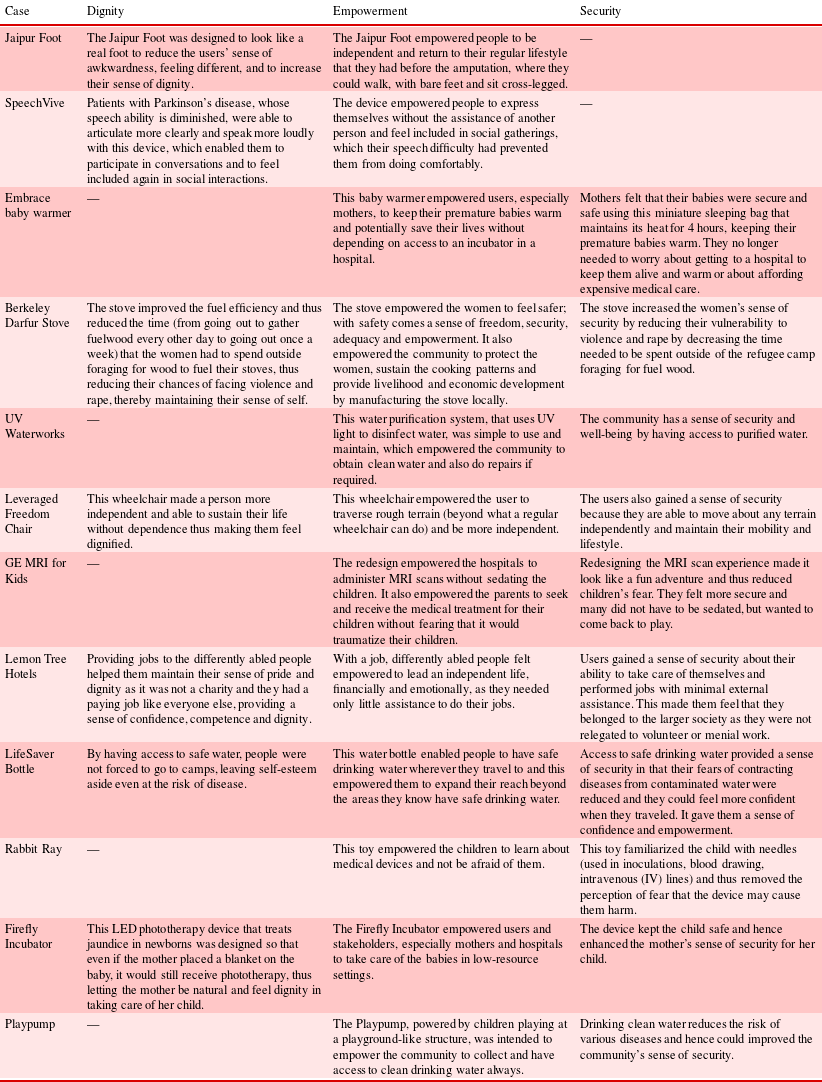
All 12 cases contained quotes from their designers that reflected at least two of the three themes. Since a similar method was used to analyze all 12 cases, we do not present detailed analyses of all the cases here. However, a summary of all the studies is presented in Table 5, which shows how each case addressed particular theme(s).
The three themes addressed in the 12 cases
Two more cases that are different are discussed in more detail in the following section. The Lemon Tree group of hotels provides jobs to differently abled people and is an example of how CD can be also used for designing a service and not necessarily a product. The other case, Playpump, shows that just using the elements of CD is not enough for the design to be successful with the users, but that a holistic approach toward design and other aspects of HCD, like user feedback are imperative for a design to be well accepted and successful.
4.4 Case 4 (related to service): Lemon Tree Hotels
Lemon Tree Hotels is a group of hotels in India that in 2016 had a staff of 3500 employees, 15% of which were ‘employees with disabilities’ or differently abled individuals, and another 10% were from socially, educationally and economically disadvantaged backgrounds. In the various interviews with the media, the staff from Lemon Tree have spoken about respect and dignity of the special people that they employ and how they need to be treated equally. The organization not only empowers disabled people by employing them but also provides them an environment where they feel dignified and respected.
Problem framing: Lemon Tree Hotels not only address the problem of high rates of unemployment for differently abled people but the jobs that they provide also help them (the people) to maintain their self-esteem, sense of empowerment and dignity, while providing them with a livelihood. The organization has shown compassion toward disabled people and this can be seen in excerpts such as ‘we tried to bring people with disability to the mainstream while respecting the dignity of the person.’ They have taken care to not impact the self-respect of their employees but provide them with mainstream jobs like everyone else has that helps them to feel respected, self-sufficient and capable, ‘We wanted to give some opportunity to people who would not otherwise get a job. But over time we found they are great employees. We also found that close to 10% of India is disabled in some form or the other and they [the differently abled] don’t get jobs easily because there is no social net in our country. So we said why shouldn’t we look at roles in our organization where their disability isn’t actually an element, that is, they can be like normal people. There is no sense of charity because I think that’s what kills somebody’s self-dignity.’ One speech-impaired employee expresses his satisfaction with the job in this quote (transcribed sign language): ‘The employees here treat me at par with all others. When I am serving guests in the restaurant, the guests are delighted by my service. I feel very happy to [serve] them. I am as good at my work as anyone else.’
Implementation: People with different disabilities like down syndrome, speech, hearing or any other cognitive impairments are hired at the Lemon Tree Hotels. The Human Resources (HR) department places the special staff in different roles, based on their abilities. For example, a woman who has difficulty walking works as a front desk attendant, greeting customers. The customers are also made aware about the special staff as they wear name tags with a description about themselves that provides more information. Lemon Tree HR also emphasize that they sensitize their other staff to work with the special people: ‘It is important to sensitize the existing staff. The employees are instructed to behave in a normal way with the disabled staff and make way for their development $\ldots$
[Additionally to] make the work atmosphere truly inclusive, sign language is taught to all the able-bodied staff members. This ensures free communication and efficiency amongst all employees.’ Lemon Tree management thinks holistically about their staff. They not only want to provide them with regular work but also think about their career: ‘The next challenge is like, once we (are) sensitized toward these ‘kids’, how we have to give them the career graph also.’
$\ldots$
[Additionally to] make the work atmosphere truly inclusive, sign language is taught to all the able-bodied staff members. This ensures free communication and efficiency amongst all employees.’ Lemon Tree management thinks holistically about their staff. They not only want to provide them with regular work but also think about their career: ‘The next challenge is like, once we (are) sensitized toward these ‘kids’, how we have to give them the career graph also.’
Evaluation: This design is not only targeting the end users but also stakeholders by changing the mindset of the customers who come to the hotel: ‘This initiative by the Lemon Tree Hotels to employ people with disabilities is empowering lives and changing mindsets.’ They want to scale up and create more opportunities as noted by Rattan Keswani, Deputy Managing Director (MD): ‘We’re actually trying to design a hotel in other part of Gurgaon [in India] where the entire design is based on the requirements of people with disabilities, and our vision is that we could we make 90+ percent of the employees $\ldots$
[those] who have some disability or the other.’
$\ldots$
[those] who have some disability or the other.’
In this case, dignity and empowerment of an individual was the goal. In the next case, community empowerment was a design goal, but designers failed to think it through thoroughly enough, which led to the failure of the product.
4.5 Case 5 (an example that failed): Roundabout Playpump
The Playpump was developed and installed in KwaZulu-Natal province in South Africa in 1994 to make water collection more fun and reduce the labor involved in pumping water. Trevor Field, an agricultural executive and a key member of this Playpump project team says, ‘The idea was to try and develop a system that would make the collection of water a lot easier and a bit more fun.’ A Playpump system was designed as a children’s merry-go-round connected to a borehole that is attached to an overhead storage tank. As the children spin on the merry-go-round, the force pumps water from a borehole to an overhead storage tank. This system was installed at various locations in grade schools and crèches (day-care centers) where children play on a regular basis. This design was aimed to empower the community to get easy access to clean water always.
Problem framing: Field explains that prior to the installation of the Playpump, children were falling sick due to drinking unclean water from a well with a shallow water table. The water drawn from a borehole using the Playpump was tested and safe for drinking. He also explains that girls or women have more responsibility of fetching water in many communities in Africa, but by using the Play Pump, boys also became involved in collecting water as they play on the merry-go-round. He says, ‘indirectly we’re changing the gender responsibility from girls to boys.’ The problem was framed to develop a solution that capitalizes on a common daily life activity (play). They wanted to empower the user and also tried to keep the system simple: ‘Tap-stand is very simple, just nice and sturdy so that it doesn’t get damaged by cattle or over-enthusiastic children. It’s got a very simple tap $\ldots$
.’ The design was created to provide the community with continuous and easy access to clean water by utilizing one of the regular play activities of the children. Water could be drawn from a deeper water table so it is clean and stored in an overhead tank, so people can get clean water at any time.
$\ldots$
.’ The design was created to provide the community with continuous and easy access to clean water by utilizing one of the regular play activities of the children. Water could be drawn from a deeper water table so it is clean and stored in an overhead tank, so people can get clean water at any time.
Implementation: While implementing the solution, they kept various aspects in mind: the pump was installed at schools and crèches where many children aged six to fourteen years play. The wheel could be spun either left or right to pump water and the design was kept very simple so that it would be easy for the children to use and also reliable. They kept it simple, with only two moving parts. As Field explains, ‘Keeping it that simple then the reliability increased dramatically.’ They also installed some billboards surrounding the storage tanks and the funds generated from the advertisements helped to maintain and sustain the pump; other billboards offered public service announcements. He also mentions that they were planning to expand this Playpump project to other regions where they needed this kind of pump.
Evaluation: Upon installation, the Playpump was very successful in providing clean water to the people in Africa. The children did not fall sick as often and the school attendance increased. Field saw this as a measure of their design team’s success: ‘The kids used to get really sick. They used to get diarrhea and vomiting and all sorts of things before we put the Playpumps in $\ldots$
school attendance has increased quite dramatically and that is really, for me, that’s great success
$\ldots$
school attendance has increased quite dramatically and that is really, for me, that’s great success $\ldots$
.’
$\ldots$
.’
A few years after installation, the Playpumps were breaking down in many locations. 1000 Playpumps had been installed by 2008 with the aim of scaling to 4000 pumps by 2010 (Chambers Reference Chambers2009). Amy Costello, a reporter for Frontline/World, who had covered the Playpump’s initial success story followed up with another story when the pumps started failing about three years after installation:
I think part of it was this push to get many, many Playpumps into the ground on a fairly quick timeline and I think that proved to be challenging from a maintenance point of view [in] that pumps would break down and they were not able to be fixed and that had significant repercussions because you know, as I say we are not talking about television sets that are breaking down, we are talking about people’s access to clean drinking water, so when a pump breaks down, that’s really critical and can be detrimental to a community and I think there were also kind of cultural issues that arose. I think that not every community where a Playpump was installed necessarily in the end wanted this technology, so there was some push back from the users themselves $\ldots$
.
$\ldots$
.
Even though the Playpump was installed with intentions to empower the community, it was not fully successful due to various reasons, including a lack of foresight and holistic thinking. The community was not empowered to repair and maintain it and the design relied solely on children to play in order to pump the water, not considering that children may not want to play with it always. The reporter adds, ‘ $\ldots$
children, like everywhere in the world, sometimes get tired of playing on one toy all the time but if they were relying on the energy of children they really needed them to be spinning and spinning literally for hours a day to provide adequate water and of course they weren’t
$\ldots$
children, like everywhere in the world, sometimes get tired of playing on one toy all the time but if they were relying on the energy of children they really needed them to be spinning and spinning literally for hours a day to provide adequate water and of course they weren’t $\ldots$
.’ As reported by The Guardian (Reference Chambers2009), if children played for two hours constantly on the merry-go-round then the bare minimum water requirements for 200 people a day could be met.
$\ldots$
.’ As reported by The Guardian (Reference Chambers2009), if children played for two hours constantly on the merry-go-round then the bare minimum water requirements for 200 people a day could be met.
For example, a pump was installed in a remote area in Mozambique, where there were only a few children, thus requiring the women to turn the merry-go-round to pump water. One of the women said that after working for six hours in the field they had to turn the merry-go-round wheel that would cause their arms to hurt. Using the old handpump was much easier, they reported. Even after turning the wheel, no water was getting pumped to the storage tank, which was a bigger problem. Whenever they would call the repair line, they received no response. One of the officials at Mozambique’s Rural Water Authority said, ‘Once the pump breaks, and takes more than 3 months to repair, people in these communities no longer trust the Playpumps, because they are demoralized. It does not work properly. We know it is for free, but it does not work properly.’ Costello also found a report stating many problems, like, there were pumps out of commission for up to 17 months, maintenance was ‘a real disaster’, the operation technique of the pump was not suitable for African women and children were not using it in the intended way. When the women were asked if they knew that this Playpump was going to be installed, they said that they had no information about it prior to its installation. The users were not involved throughout the process, which proved to be a problem. There were no advertisements on the billboards to pay for the maintenance. The idea of funding maintenance through billboard advertisements and relying on children to operate the pump may have worked well for some parts of Africa, but not all. This lack of holistic thinking in the implementation of the Playpump had dire consequences on the social climate within the communities where they were installed and failed. People had to travel to neighboring villages to obtain water which led to conflicts and tension among the people. Such product failures and subsequent consequences began to hamper the sense of dignity and empowerment of the users as they had to seek help from outside the village to fulfill a basic necessity as access to clean water.
The lack of maintenance and repair was a key cause for the failure of the Playpumps. One of the officials says, ‘You can put in a beautiful, perfect pump and if it breaks down and there’s no spare parts, then it was only as good as the six weeks or six months that it ever lasted for in the first place.’
This case of the Playpump shows that even though empowerment of users was a goal, the plan was not thought through well enough. For instance, the designers did not consider the differences in the populations of neighboring communities, nor did they consider what aspects needed to be included to promote user acceptance of this pump system. And while the designers wanted to empower the local community to maintain and repair the pump, somehow the education piece was not provided nor were mechanisms set up to enable community maintenance. These resulted in the decline of the Playpump project. There was also a push to scale up quickly which may have prevented proper planning and implementation of some of these aspects.
Clearly in this case, the approach of CD was not enough; the design also needed a holistic approach (in other words, consider all aspects of installing a Playpump system). This case is included to show that only CD will not be helpful to create better user experiences; a holistic approach considering the various aspects of design thinking, especially including approaches from HCD together with CD will be important for a design to succeed.
Each case does not equally focus on the three themes, but they help to illustrate how the ideas of dignity, empowerment and security emerged and were identified by the research teams. We define CD as an approach that addresses niche sensitive needs and involves a way of thinking where engineers and designers pay special attention to the users’ dignity, empowerment and sense of security. Niche sensitive needs include specialized needs that have the potential to strongly or subtly affect a person’s feelings and emotions if left unfulfilled. For example, a person feeling inferior to someone may not be getting her/his need to ‘feel equal’ fulfilled and hence feel unhappy.
The three themes that form the framework for the CD model emerged from the analysis of the data and will be contextualized in the next section. In the next section, we discuss these three elements in detail by providing more thorough definitions from the literature in design and psychology. Then we relate the cases to these definitions and also discuss some potential implications of CD.
5 Contextualizing key elements of CD in literature
The three elements of the CD framework: dignity, empowerment and security have been derived based on the various cases. Here we discuss these elements based on literature from design and psychology. The definitions so obtained are used to contextualize CD and evaluate how the cases adhere to these definitions.
As the term compassionate implies, compassionate design would include some focus on a sensitive view of the users for which the engineer or designer is designing, with a desire to improve the users’ condition. As noted earlier, this design focus is not new to design and is embodied within participatory and empathic design approaches. However, we view CD as involving thinking that pays special and intentional attention to the end users’ human dignity, empowerment, and security. We relate this to Maslow’s (1968) hierarchy of human needs where the designer’s attention is on helping users walk down their path toward self-actualization. Fulfilling the basic physiological needs related to food, shelter, and clothing are critical; however, we would not expect these to be the focus of CD as in this context, the user direly requires these basic needs and is unlikely able to function until they are met. That is not to say that someone following CD would not create solutions related to food, shelter, and clothing, but that these solutions would likely be fulfilling needs higher up in the hierarchy. The next steps up on Maslow’s hierarchy are safety or security needs, which relate to one’s expectation that her/his needs are met and will be met for the foreseeable future. These are often manifested as a sense of personal security (i.e., of feeling physically safe; not threatened by war, accidents or natural disaster), economic security (i.e., a sense that the individual will be able to provide for her/his financial needs), or sound health and well-being (i.e., that the individual is physically, mentally, and emotionally fit to take care of her/his needs). It is often the lack of these types of security that impede individuals from fulfilling needs higher up Maslow’s hierarchy. A CD solution would look to empower the users to achieve this sense of security, safety, health and well-being, enabling them to pursue self-actualization. The top three needs of the hierarchy – love and belonging, esteem, and self-actualization – are critical to CD. These needs are also likely the most difficult to operationalize and define specific criteria and constraints for within the process of design. What satisfies one’s feelings of belongingness, confidence, and fulfillment of purpose will vary between cultural contexts, situational contexts, and across the range of individuals and personality types. However difficult this may be, a designer operating from the CD perspective would look to understand the user’s unique contextual situations. This would include their emotions, state of mind, and sense of security and well-being. A compassionate designer would aim to develop solutions that empower users, in the name of dignity, to choose and fulfill goals related to their self-actualization. Criticism of Maslow’s hierarchy centers on the distinction between levels of the hierarchy that imply that once a lower set of needs are satisfied, a higher set of needs will ‘emerge and dominate’ thus leading an individual to focus on the next level of needs (Wahba & Bridwell Reference Wahba and Bridwell1976). CD does not embody distinct levels, as implied, but uses Maslow’s hierarchy as a framework to describe the opportunity to empower individuals to fulfill needs all along the hierarchy, for themselves, with a particular emphasis on those needs above the most basic needs.
In this section, we frame CD as a process to promote the humanization of the user by aiming to empower them within a framework of dignity. To do this, we relate the constructs of dignity, empowerment, and security to engineering and design outcomes with the fulfillment of Maslow’s self-actualization as the backdrop.
Human dignity – Valuing end users as individuals and recognizing them as capable of setting and achieving goals important to them and their pursuit of self-actualization.
Dignity is at the heart of CD. Human dignity can be represented with two basic distinctions: inherent dignity and moral dignity (Andorno Reference Andorno2009). What Andorno terms inherent dignity is the inalienable right each of us as humans is born with. That is to say that we as human beings should never be treated inhumanely irrespective of the situation, and shall always have the right for our lives to be valued. Within their profession, engineers and designers are expected to practice ethically and to uphold this basic inherent dignity as they design solutions that involve people. Moral dignity is Andorno’s second distinction referring to the dignity each person embodies (at varying degrees) through their behaviors and actions and may be fostered or impeded by their context. This includes our right as individuals to the autonomy to fulfill our individual personal needs in the pursuit of self-actualization. It is within this context that an engineer or designer may have the opportunity to identify problems that impede this pursuit, and develop solutions that empower their users to continue the pursuit of their goals as they see them. This may look different for every user and is highly dependent on the context, culture, and situation for each individual. Few designers have explicitly considered the dignity of the user while going through the design process (Haines-Gadd et al. Reference Haines-Gadd, Hasegawa, Hooper, Huck, Pabian, Portillo, Zheng, Williams and McBride2015). The Jaipur Foot team described their respect for the human dignity of their end users as central to their approach, knowing that it was not the most prudent from a purely profit-making perspective. The complexity of this kind of design context, as with most design contexts, makes it challenging to specify clear, generalizable heuristics for CD; however, we attempt to provide a foundational framework that defines the philosophy behind the CD approach.
Empowerment – Enabling end users to be agentic, motivated, and competent in their pursuit of self-actualization.
As was noted in the description of human dignity, empowerment is at the heart of the dignity of the individual and it helps designers provide users with pathways toward independence rather than providing them with solutions that act upon them taking away their agency. Ryan and Deci (Reference Ryan and Deci2000b ) define self-determination theory as ‘the investigation of people’s inherent growth tendencies and innate psychological needs that are the basis for their self-motivation and personality integration, as well as for the conditions that foster those positive processes’. From this perspective, Ryan and Deci have noted three basic needs as essential for fostering the conditions for these positive processes – competence, relatedness, and autonomy. We posit that these three needs can be a target for the designer in understanding how to empower end users. The Jaipur Foot, for example, aims to provide individuals without a leg from the knee down with newfound competence in the tasks requiring a leg (i.e., standing, walking, and climbing). It also was delivered within a context of relatedness where the Jaipur Foot team understood their users and developed a caring relationship by considering the unique social and financial challenges that each of their clients faced and developed an approach that treated each client individually. In the end, the solution provided autonomy to the users, not only by providing them their former (able-bodied) abilities that came along with the Jaipur Foot, but also the confidence that they would be supported, which took into account the users’ desire for social belongingness and financial security. In their analysis of how empowerment is enunciated in participatory design, Ertner, Kragelund and Malmborg (Reference Ertner, Kragelund and Malmborg2010) highlighted the complexity of empowerment and how it is highly dependent on the situation of specific user groups, and affected by the power relations or political structures of the contexts, which requires highly reflexive practice from the designer. Thus, empowering users from a CD perspective is multi-faceted, complex, and central to driving the design constraints and the criteria upon which possible solutions are evaluated.
Security – The end user’s sense of positive well-being in both the short and long term related to health, safety, finances, physical security, etc.
A compassionate designer respects human dignity and focuses on empowering end users, which relates to the end user’s sense of positive well-being and security. The literature has rich bodies of work concerning human well-being and happiness and their myriad underlying factors and constructs that contribute to human attainment. Ryan and Deci (Reference Ryan and Deci2001) describe well-being from two distinct perspectives. One perspective is hedonism, which relates to the human desire and behavior that seeks pleasure and happiness while the other, eudemonism, relates to the human desire to fulfill one’s potential (i.e., self-actualization). Keyes, Shmotkin, and Ryff (Reference Keyes, Shmotkin and Ryff2002) note several important factors that contribute to personal well-being – life satisfaction, positive affect, negative affect, self-acceptance, positive relations, personal growth, purpose in life, environmental mastery, and autonomy. As one might expect, these factors are all highly dependent on many other aspects of a person’s life such as their finances (McKee-Ryan et al. Reference McKee-Ryan, Song, Wanberg and Kinicki2005), relationship status (Gove, Hughes & Style Reference Gove, Hughes and Style1983), age and social status (Keyes et al. Reference Keyes, Shmotkin and Ryff2002), and personality traits (Keyes et al. Reference Keyes, Shmotkin and Ryff2002). Again, in the Jaipur Foot example, the group focuses on the financial situations of their clients, the age and unique challenges of designing prosthetic legs that accommodate changes in the body (e.g, changes in height or weight) and more frequent follow-ups among young clients. They also consider how the leg and associated interactions with the clients will address numerous non-technical factors (e.g., socio-cultural context) that support the long-term satisfaction of the user and the success of their prosthetic.
CD embodies a holistic approach for developing solutions that consider complex factors related to end users’ dignity, empowerment, security, and well-being. The technical features of solutions, users’ interactions with solutions, and the implementation of the solutions must be carefully conceptualized within this framework. The framework carefully addresses numerous challenging and complex criteria and constraints. Many of these constraints and criteria lie outside the traditional, technical design space and within the hearts and minds of the end user.
In the next section we discuss how the various cases adhere to the definitions of dignity, empowerment and security.
5.1 Relating cases to the definitions
The cases highlight various aspects of the sense of dignity, empowerment and security that have been addressed by the CD approach. In most of the cases, these three themes are interwoven but we highlight the most prominent of the three themes in each case.
As defined earlier in this paper, human dignity means valuing end users as individuals with the need to feel empowered, safe and secure, dignified and valued members of their community. It also means recognizing them as capable of setting and achieving goals important to them and their pursuit of self-actualization. The Jaipur Foot, SpeechVive, and the Firefly Incubator along with the Lemon Tree Hotel’s hiring of disabled individuals emphasize valuing the end user as an individual by creating products and services that empower them, support their natural behavior and encourage them in the pursuit of self-actualization. They not only encourage the users by valuing them as individuals but also provide means to enable them to do the same. Each of these cases show that the user’s dignity was considered, whether by respecting their need to feel that they are valued members of society in the Jaipur Foot and SpeechVive cases or by providing them with means that support their sense of dignity, personal empowerment and efficacy as in the case of Lemon Tree and Firefly.
Empowerment in the CD approach means enabling the end user to be agentic, motivated, and competent in their pursuit of self-actualization. Additionally, the ‘Embrace’ baby warmer, the Berkeley Darfur Stove, the LifeSaver water bottle, Rabbit Ray, UV Waterworks and Leveraged Freedom Chair also empower the users to feel more competent by enabling them to be in control of their environments. They enable the users to maintain an independent lifestyle and go about their daily activities without depending on external sources such as, help from other people including therapists or family members, whether it be for Parkinson’s disease patients who could speak more clearly as in the case of SpeechVive, gain the independence to move around various types of outdoor terrains in the case of LFC, or feel more empowered to keep themselves safe as in the case of the Berkeley Darfur Stove. The Berkeley Darfur Stove project also demonstrates elements of economic empowerment by creating a means by which the community could manufacture and sell the stoves themselves.
Dignity and empowerment also relate to the end user’s sense of well-being and security. Security is a sense of positive well-being for both the short and long term related to health, safety, work and belonging to society. The 12 cases presented here show, to some degree, that the design had a positive influence on the sense of well-being and security of the user. Some of the cases such as the GE MRI for Kids, Jaipur Foot, Embrace baby warmer, Berkeley Darfur Stove, Firefly Incubator, LifeSaver and Rabbit Ray focus more on the security, safety and health of the users. The Rabbit Ray and the GE MRI for Kids help the users (children) feel more secure in unknown, frightening environments such as hospitals and clinics and help the users gain a sense of positive well-being.
We observed three common themes across all 12 cases: the designers aimed to enhance the users’ sense of dignity, empowerment and security even though they did not use these exact words. The next section summarizes some implications of our findings for the development of CD.
6 Implications
Identifying the themes and creating the framework is only the first step in the development of CD. After further development and testing these themes to gather feedback, we envision that these concepts can be brought to design classrooms in engineering, architecture, and user experience design. When fully developed, these themes can augment the creation of a frame (Dorst Reference Dorst2011) during the problem-framing phase and will have the potential to help the designers to address the user needs related to dignity, empowerment and security. We expand upon a few key concepts below.
6.1 CD probes that can be used in the design process
The cases described above show that many engineers and designers already incorporate some level of CD into their work. For instance, many designers think about users’ emotional needs such as the need to feel empowered, independent, capable and valued members of society. The goal of this work is to provide a foundation to help increase the intentionality of this thinking in the design process. When designers follow a typical HCD process, there are no specific guidelines to consider the sense of dignity, empowerment and security of the user. The questions in Table 3 that were used for analyzing how the designers in the cases were considering the dignity, empowerment and security of the user may also be used to probe the thought process of the students/designers while creating new designs. These questions will not provide designers with direct solutions but can be used to probe the discussions (about dignity, empowerment and security) according to the context of use. Cardoso, Badke-Schaub and Eris (Reference Cardoso, Badke-Schaub and Eris2016) have indicated that use of questions facilitates inflection moments during the design process. The inflection moments help the designers to reflect on the current design ideas and change trajectory if required. The question-based probes presented in Table 3 are intended to prompt discussion and reflection about the dignity, empowerment or security of the user among the design team. They are intended to help the designers think about these social and psychological needs of the users and address them through their designs.
The authors of ‘Built to Love’ (Boatwright & Cagan Reference Boatwright and Cagan2010) discuss the importance of designing products that generate positive emotions for customers and provide a tool called ‘The eMap’ to assist companies in this process. The tool includes sixteen emotion categories some of which capture the spirit of CD (Boatwright & Cagan Reference Boatwright and Cagan2010). Thus, considerations of this kind are important to industry.
6.2 CD included in engineering and design education
The CD framework has the potential to not only impact end users, but designers themselves. These and several other probes are currently being tested in an engineering design class at a North American University. When the graduating designers understand and absorb these ideas as a part of their design education, they may be able to implement them in the design process in industry. Through initial observations of design students in freshman engineering, sophomore mechanical engineering, and senior capstone design at a North American University, the CD framework has challenged students to think in new ways. Regardless of the design project, students thought through the set of questions and used them as probes for CD in the design process and as they evaluated their designs, particularly at the conceptual design phase. Aspects of dignity, empowerment and security of the users were reflected and also explicitly mentioned in some of the final design outcomes. Freshman engineering students used similar guidelines to provide peer-to-peer feedback on design concepts.
7 Conclusion
Understanding user needs is an important part of the design process, and HCD has provided a means for enhancing this process by considering and integrating users’ needs. However, CD involves a way of thinking where designers pay special attention to the users’ sense of dignity, empowerment, and security. While HCD encompasses a wider variety of generic considerations of various aspects of the users, CD aims to target niche and specific needs of the users. CD lies within the realm of HCD in considerations of the user but distinguishes itself by focusing on niche aspects of the user, specifically their dignity, empowerment and security.
In this work, a total of 12 design related cases were analyzed that led to the development of a CD framework. Three exemplary cases: The Jaipur Foot, Berkeley Darfur Stove and GE MRI for kids, provided a foundation for the development of CD which led to the identification of the main themes most evident in CD. Further insights were gained from additional cases that specifically involved designers articulating their deep concerns for and desire to help the user. Through a parallel and iterative process with the team, the core themes of dignity, empowerment, and security emerged as the final elements characteristic of CD thinking.
These three aspects of the human experience are related to Maslow’s hierarchy of needs and thus the designer seeks to assist users to achieve self-actualization. CD also draws on the aspect of being more sensitive to the users and stakeholders and aims at improving the whole experience of using a product by considering how the users may feel in terms of their sense of dignity, empowerment and security and not only focusing on making the solution functional to solve a problem. Future work involves identifying the category of design problems and stage of design process most amenable for using the CD framework. In addition, considering other aspects of the designer such as intrinsic motivation (Ryan & Deci Reference Ryan and Deci2000a ) and their predisposition toward altruism and empathy (Decety & Jackson Reference Decety and Jackson2004; Batson Reference Batson2010) is important in future work.
The potential benefits of implementing CD with HCD could help in creating products and services that improve stakeholder experiences in a variety of contexts. Such thinking will inspire designers to ask questions about their design decisions and potential consequences that could impact the users’ sense of dignity, empowerment or security. In the cases that were analyzed to create the framework for CD, these niche user needs were being intuitively addressed by the designers, based on their experiences, professional or personal. This research is a step in creating a design approach so that designers, both novice and experts, can attempt to consider and address the often unarticulated needs of dignity, empowerment and security, intentionally and not intuitively or by chance.
Acknowledgments
This work has been partially funded by the National Science Foundation [EEC award#1544277]. Any opinions, results, or recommendations expressed in this paper are those of the authors and do not necessarily reflect the views of the National Science Foundation. We would like to thank Dr. Sherylyn Briller from Purdue University for her feedback to improve the paper. We would also like to thank Robert Gomez, the graphic designer who created the artwork in Figure 1 and Dr. Robin Adams from Purdue University for feedback on an early draft of the manuscript.
Appendix
List of videos for the cases that were analyzed


 Open access

