





Introduction
In the field of d/Deaf and hard-of-hearing (d/DHH)Footnote 1 language and literacy, the question of whether d/DHH learners’ second language (L2) development mirrors that of hearing (non-disabled) literacy learners has been a topic of debate. The qualitative similarity hypothesis (QSH) (Paul & Lee, Reference Paul and Lee2010) proposes that d/DHH learners exhibit qualitatively similar L2 development and literacy to hearing learners. Although the rate and amount of L2 acquisition in d/DHH learners may be quantitatively delayed, these learners follow a similar developmental trajectory and process, including in making errors and applying strategies. Ultimately, they progress through the same developmental stages as literacy learners (Paul & Wang, Reference Paul and Wang2012; Yan & Paul, Reference Yan and Paul2021).
Despite scholarly interest in this issue, d/DHH learners’ L2 development itself has not yet been comprehensively theorized or assessed. Instead, research has often focused on changes in only specific L2 components, such as knowledge of reading components and perceptions of phonemes, offering limited insight into d/DHH learners’ overall L2 development (e.g., Mathew & O’Donnell, Reference Mathews and O’Donnell2020; Wang et al., Reference Wang, Trezek, Luckner and Paul2008).
To better understand d/DHH learners’ L2 development, well-established research on L2 development can offer intriguing possibilities for extending an existing theoretical framework to this group. Specifically, processability theory (PT) posits a universal implicational order of development that all learners go through while learning an L2 (Pienemann, Reference Pienemann1998, Reference Pienemann and Pienemann2005). At each stage, L2 learners can acquire processing procedures that enable them to produce specific morphosyntactic structures, with the scope of these procedures expanding in later stages. The steadiness hypothesis in PT further proposes that the L2 language developmental orders predicted by PT remain consistent across diverse contexts and different populations (Pienemann, Reference Pienemann and Pienemann2005), provided that L2 learners can apply identical knowledge in language production. Motivated by such proposals, this study seeks to extend the PT theoretical framework to d/DHH learners’ L2 development.
This study investigates d/DHH learners’ L2 development on the basis of PT, specifically examining whether these learners’ language development follows the universal order predicted by PT. Additionally, in line with the QSH, this study explores whether d/DHH learners’ developmental patterns in L2 are comparable to those of literacy learners and the extent to which their L2 language development demonstrates qualitative similarities and quantitative differences.
Literature review
L2 development of d/DHH learners
In the field of d/DHH language and literacy, language acquisition has long been recognized as a central challenge that most d/DHH learners face, regardless of their communication modes, such as spoken or sign language (Marschark et al., Reference Marschark, Lang and Albertini2001; Moores & Martin, Reference Moores, Martin, Moores and Martin2006). Due to limited auditory access to spoken language input, the acquisition process for d/DHH learners is difficult, and they must rely on available visual compensations to access the input (e.g., lip reading, facial expression, signed renditions of spoken sentences; Berent & Kelly, Reference Berent, Kelly and Schueler-Choukairi2009).
To investigate d/DHH learners’ language development, previous research has primarily focused on individual differences in producing deviant structures (i.e., errors; Paul et al., Reference Paul, Wang and Williams2013; Paul & Wang, Reference Paul and Wang2012; Wang et al., Reference Wang, Trezek, Luckner and Paul2008) and development of specific L2 components, such as vocabulary (Lederberg & Spencer, Reference Lederberg, Spencer, Fletcher and Miller2005; Ouellet et al., Reference Ouellet, Normand and Cohen2001), grammatical structures (Berent et al., Reference Berent, Kelly and Schueler-Choukairi2009), and written outputs (Domagala-Zysk, Reference Domagala-Zysk2012). Paul and Wang (Reference Paul and Wang2012) found, for example, that d/DHH learners made errors regardless of their age (children vs. adolescents). Wang et al. (Reference Wang, Trezek, Luckner and Paul2008) have suggested that these incorrect productions may stem predominately from external or sociocultural factors, such as inadequate instructional strategies and exposure to an incomplete or degraded model of English.
However, external or sociocultural factors alone may not account for all the errors that d/DHH learners produce. Nor is making errors in L2 learning exclusive to d/DHH learners. Rather, L2 learners’ errors may reflect their L2 developmental processes and current learning status (Selinker, Reference Selinker1972; Tarone, Reference Tarone1982). These errors are often systematic and predictable, and all L2 learners make errors in comprehension and production, some of which are universally observed (Ellis, Reference Ellis2010). Therefore, the developmental features of d/DHH learners may not be fundamentally different from those of hearing learners; rather, their L2 development may be aligned with widely recognized L2 developmental patterns. Considering the long history of L2 development research that has provided various types of empirical evidence from hearing learners’ cases, their well-documented developmental patterns may serve as a useful reference point for understanding d/DHH learners’ L2 development.
Despite this compelling possibility, little research has explored whether d/DHH learners are similar to or different from their hearing peers in terms of L2 development (e.g., King, Reference King1981; Mayberry et al., Reference Mayberry, Lock and Kazmi2002). In a pioneering study, King (Reference King1981) examined qualitative and quantitative differences in learning English syntax among four groups of children: hearing native English speakers, hearing L2 learners (age: 8–11), deaf native English speakers, and deaf L2 learners (age: 8–13). King (Reference King1981) assessed whether the qualitative (i.e., differences in manner of acquisition) and quantitative (i.e., scores on the test of syntactic abilities [TSA; Quigley et al., Reference Quigley, Steinkamp, Power and Jones1978]) aspects of d/DHH learners’ L2 acquisition were distinctive from those of their counterparts. The TSA employed a multiple-choice format in which learners were asked to (1) choose sentences with identical meanings and (2) select grammatically correct sentences. The test assessed learners’ understanding of nine structures in English: negation, conjunction, question formation, verb processes, determiners, pronominalization, relativization, complementation, and nominalization. The results indicated that L2 learners followed a similar order of acquisition (e.g., past tense as the earliest structure acquired) and made similar errors (e.g., using a declarative form instead of a question, such as The kitten is black?), regardless of disability. However, d/DHH learners exhibited limited knowledge of syntax compared to their counterparts, indicating a slower rate of development. These findings lent support to the idea of similar L2 development between d/DHH learners and their hearing peers, with minor differences in speed of development.
Aligned with this study by King (Reference King1981), the QSH (Paul & Lee, Reference Paul and Lee2010) posits that d/DHH learners’ development in certain subject areas, notably English language and literacy, is similar to that of hearing learners (Paul, Reference Paul2009), though it may be quantitatively slower or delayed. According to the QSH, d/DHH learners have access to the same knowledge and information as literacy learners (Kontra et al., Reference Kontra, Csizér and Piniel2015). When learning English as an L2, d/DHH learners progress through similar stages (e.g., levels of difficulty within and across structures), make similar errors, and apply similar strategies to hearing learners (Paul & Lee, Reference Paul and Lee2010). Despite the similarities, the QSH suggests that d/DHH learners experience delays in the pace of their L2 development, which may be attributed to reduced quality of language input and limited access to natural, incidental language exposure, which is often a consequence of deafness. However, it is important to note that deafness is not a cognitive disability, and d/DHH learners eventually catch up with their hearing peers in terms of L2 development (Paul et al., Reference Paul, Wang and Williams2013). This suggests that all learners, regardless of condition or disability, acquire the identical fundamentals, such as phonemic awareness, phonics, fluency, vocabulary, and comprehension, as outlined by Foorman et al. (Reference Foorman, Beyler, Borradaile, Coyne, Denton, Dimino, Furgeson, Hayes, Henke, Justice, Keating, Lewis, Sattar, Streke, Wagner and Wissel2016) (Paul, Reference Paul2024; Paul & Lee, Reference Paul and Lee2010).
All in all, investigating d/DHH learners’ L2 development has been highlighted as an important area of research in d/DHH education, yet relatively few studies have explored d/DHH learners’ development in L2 learning (e.g., Kontra, Reference Kontra2017). While some research has demonstrated changes in d/DHH learners’ production of particular linguistic structures (e.g., Berent et al., Reference Berent, Kelly and Schueler-Choukairi2009; Domagala-Zysk, Reference Domagala-Zysk2012; Lederberg & Spencer, Reference Lederberg, Spencer, Fletcher and Miller2005; Ouellet et al., Reference Ouellet, Normand and Cohen2001), these gains often reflect partial aspects of L2 development rather than full language development. Although the QSH suggests that hearing and d/DHH learners’ development is qualitatively similar, it remains unclear whether d/DHH learners acquire the necessary processing and production skills for L2 development in the same way as hearing learners do. To provide appropriate support—such as tailored instruction, materials, and assessment—for d/DHH L2 learners, it is essential to understand their L2 development (Lee et al., Reference Lee, Son and Lee2024). Therefore, this study aims to apply a theoretical framework of language development from the field of SLA to d/DHH learners’ production to investigate whether L2 development between d/DHH learners and their counterparts is comparable, as QSH suggests.
Processability theory
PT, proposed by Pienemann (Reference Pienemann1998), hypothesizes that L2 learners’ language development follows the acquisition of processing procedures based on the feature unification process posited by lexical functional grammar (Kaplan & Bresnan, Reference Kaplan, Bresnan and Bresnan1982). Pienemann demonstrated that language learners advance through certain developmental stages in a universal order as they develop their interlanguage. In other words, all individual learners follow the identical developmental sequence and cannot bypass certain stages to reach higher ones.
According to PT, when L2 learners reach each developmental stage, they acquire a processing procedure that enables them to process grammatical information related to specific morphosyntactic structures. The scope of the processing procedure broadens at the later stages, allowing learners to produce more complex and varied morphosyntactic structures. Thus, PT argues that L2 learners’ production of these morphosyntactic structures reflects the extent to which their L2 processing procedure has developed.
PT proposes six developmental stages. In Stage 1, learners lack the ability to process linguistic information and instead rely on non-linguistic strategies, such as facial expressions and gestures in communication. In Stage 2, learners begin to associate lexical items with categorical information, although feature unification occurs only within a single constituent. For instance, learners can add the past tense marker (i.e., -ed) to verbs and the plural marker (i.e., -s) to nouns (e.g., enjoyed, dogs, respectively). Syntactically, learners begin producing sentences with canonical word order (i.e., subject–verb–object; I love you).
Then, in Stage 3, known as the phrasal procedure stage, grammatical features can be exchanged between single items within a phrasal category. For instance, learners can mark both the noun and other elements that hold the plural feature in the phrase (e.g., these girls). Regarding syntax, learners start to move certain linguistic constituents to the front of sentences (e.g., Yesterday, Tom went to school) and begin forming questions with do-verbs (e.g., Do you love me?). In Stage 4, the verb phrase procedure stage, learners can consistently apply grammatical features across phrases with identical heads, such as verb phrases (VPs) and noun phrases (NPs; e.g., I walked down the street and met my friends). At this stage, learners also begin inverting the subject and auxiliary verb to form yes–no questions (e.g., Can you help me?) and producing wh-questions with copular verbs (e.g., Where are you?).
In Stage 5, grammatical features become consistent across different phrases (e.g., VP → NP). For instance, the number feature of the subject NP, Tom, is matched with the verb, finds, in the sentence, Tom finds this book. Learners also start producing wh-questions with auxiliary verbs in the second position (e.g., When did you hear the news?). Finally, in Stage 6, learners develop the processing procedure for subordinate clauses, allowing them to produce sentences such as Jane tells me what she found yesterday. The developmental stages are summarized in Table 1.
Processing Procedures Applied to English (Pienemann, Reference Pienemann and Pienemann2005, p. 24)

In the field of SLA, previous research has shown that L2 development can be examined using PT, even with learners from diverse backgrounds and typologically different languages (e.g., Bonilla, Reference Bonilla2015; Di Biase & Kawaguchi, Reference Di Biase and Kawaguchi2002; Dyson, Reference Dyson2009; Jansen, Reference Jansen2008; Pienemann, Reference Pienemann1998; Son, Reference Son2024; Spinner, Reference Spinner2011). Analyses of L2 learners’ language use across a variety of communicative tasks have revealed that learners consistently produce certain morphosyntactic structures at specific stages, which confirms their current developmental stage. As their processing procedures develop—through instruction and/or increased exposure to the L2—learners begin to produce structures from later stages.
The PT’s assertion that developmental order is universal opens up the possibility of assessing the language development of diverse L2 learners, regardless of individual differences, such as age and nationality (e.g., Bonilla, Reference Bonilla2015; Jansen, Reference Jansen2008; Pienemann, Reference Pienemann1998; Son, Reference Son2024; Spinner, Reference Spinner2011). When standardized tests are insufficient for assessing L2 knowledge or timely intervention is needed, PT can provide researchers and educators with valuable insights into learners’ L2 developmental status (e.g., Lee et al., Reference Lee, Son and Lee2024; Mackey & Sacks, Reference Mackey and Sachs2012).
For instance, Mackey and Sachs (Reference Mackey and Sachs2012) suggested the practicality of using the PT scale to assess the L2 development of learners who may be “vulnerable” to standardized testing. They highlighted age-related differences in L2 development, noting a gradual decline in cognitive abilities among older adult learners. In their study, they assessed the L2 development of nine older adult learners (age: 65–89) through a series of communicative tasks with native English interlocutor. The communicative tasks consisted of a pretest, an immediate posttest right after three treatment sessions, and two delayed posttests (one week and four weeks after the immediate posttest, respectively). Over the five-week period, which involved several interactions with the native interlocutor, Mackey and Sachs (Reference Mackey and Sachs2012) examined whether the learners could take advantage of these interactions to develop their ability to produce questions—a target structure at higher PT stages—and whether this development could be sustained. The results showed that over 60% of the older learners produced English questions at least once during the posttests; however, unlike younger adults, their development was not sustained.
More relevantly, Lee et al. (Reference Lee, Son and Lee2024) suggested the potential of using PT as an alternative method to assess d/DHH learners’ L2 development. Similar to the older learners in Mackey and Sach (Reference Mackey and Sachs2012), d/DHH learners’ disabilities may complicate the assessment and understanding of their L2 development, potentially hindering timely interventions and instruction. Through interviews, Lee et al. revealed the challenges faced by d/DHH learners and the difficulties their teachers experience due to lack of assessment tools and/or knowledge of the learners’ status. They then conducted a case study with two d/DHH learners (Joon and Koh) by implementing several speaking tasks targeting morphosyntactic structures in stages two and five in PT. The results showed that only Koh produced more complex structures from stage 5, indicating that he had reached that stage, whereas Joon had not yet achieved it. These findings suggest that d/DHH learners follow a predictable pattern of development while learning L2. However, since the study involved only two d/DHH learners and lacked a comparison with hearing learners, future research with a larger sample is needed to strengthen the findings.
Furthermore, Pienemann’s PT originally proposed a hierarchical order of developmental stages, defined by specific morphological and syntactic structures, suggesting that the same processing procedures could apply to all structures within a particular developmental stage. More recent studies, however, have provided evidence for “intrastage” progress, in which structures within the same stage emerge at different times. For example, Dyson (Reference Dyson2009) found that among L1 Chinese ESL learners, syntactic structures emerged earlier than morphological ones at each developmental stage in communicative tasks and interviews (e.g., in Stage 3, Neg+V emerging earlier than plural -s). Similarly, Di Biase et al. (Reference Di Biase, Kawaguchi, Yamaguchi, Bettoni and Di Biase2015) observed a different order of morphosyntactic structures in a Japanese child’s English oral production over two years after her arrival in Australia. Their findings showed a distinct order: -ing emerged first, followed by possessive ’s, plural -s, and past -ed, indicating “soft barriers” between these structures within the same developmental stage. These results suggest that not all morphosyntactic structures at a given stage emerge simultaneously, and that there can be variability in how quickly they emerge.
As Di Biase et al. (Reference Di Biase, Kawaguchi, Yamaguchi, Bettoni and Di Biase2015) noted, learners’ distinct characteristics, such as their L1, may possibly contribute to intrastage sequencing. In other words, while learners may reach the same developmental stage, individual differences can result in variability within that stage. In this regard, d/DHH learners’ individually unique language processing patterns, as well as their disability, may lead to particular developmental features within a certain stage. This suggests that investigating intrastage sequencing may provide a better understanding of the similarities and differences between d/DHH and hearing learners’ L2 development.
To address this issue, the present study applies the PT scale to measure d/DHH learners’ L2 development. Given the variability that previous studies observed within particular developmental stages, this study also explores whether d/DHH learners exhibit similar overall developmental patterns to hearing learners, with some unique differences.
The present study
The present study examines how d/DHH learners develop their L2, whether d/DHH learners’ L2 developmental patterns align with PT’s predictions, and whether d/DHH learners show distinctions within specific stages of development. Given that d/DHH learners’ L2 development has been a subject of debate, this study seeks to provide concrete evidence supporting either of two perspectives: whether d/DHH learners develop their L2 in a similar manner, albeit at a different pace (as proposed by the QSH), or whether d/DHH learners’ L2 development is fundamentally distinct from that of hearing learners. Additionally, the current study also aims to apply PT to d/DHH learners’ L2 development and to explore potential distinctions within individual stages, contributing theoretical insights into their developmental processes.
A series of communicative tasks was employed with both d/DHH learners and hearing learners. To isolate the effects of disability, both groups were placed in identical instructional settings and given the same amount of L2 exposure. This arrangement provided an opportunity to identify developmental parallels between the two groups based on PT.
Research Questions:
-
1. Do morphosyntactic structures in the oral production of d/DHH L2 learners with and without hearing impairment follow the developmental order predicted by PT?
-
2. To what extent is the language development of d/DHH L2 learners comparable to that of hearing L2 learners in terms of the predictions of PT?
Method
Participants
The participants (age: M = 14.01, SD = 1.58) included 32 d/DHH (14 female) and 38 hearing (22 female), all of whom were Korean secondary school learners of English as a foreign language (EFL). None of the participants had resided in English-speaking countries. They had learned English as a mandatory subject, as designated by the South Korean Ministry of Education (2023), starting from third grade (ages eight to nine).
All d/DHH participants had been raised by hearing parents and supported by hearing technology (e.g., cochlear implants), which allowed them to be exposed to spoken Korean as their first language (L1). Furthermore, they were all enrolled in inclusive education settings where they had no opportunity to learn Korean Sign Language and received the same English curriculum as their hearing peers (see Lee et al., Reference Lee, Son and Lee2024). The d/DHH participants had a range of hearing conditions and varied onset times for using hearing technology. Their degrees of hearing acuity varied (Brown, Reference Brown, Katz, Medwetsky, Burkard and Hood2009): Participants’ pure-tone decibel (dB) averages in aided ears were distributed as follows: 11 participants had slight hearing loss (16–25 dB), 20 had mild hearing loss (26–40 dB), and one had moderate hearing loss (41–55 dB). However, the variation in hearing loss did not affect their performance in the experiment (χ2 [6, N = 32] = 3.04, p = .80).
Due to logistical challenges caused by the COVID-19 pandemic, the experiment was conducted via Zoom in one-on-one sessions between each individual participant and the second author. In this context, the learners’ familiarity with Zoom and their level of computer literacy were also assessed. Prior to the experiment, the learners had been taking all of their school lessons online throughout the pandemic (for at least two years), so they were already familiar with the platform.
Materials
Four types of speaking tasks, adopted from Son (Reference Son2024), were conducted in this study. Originally, Son employed 11 speaking tasks designed to elicit most of the grammatical structures predicted by PT, with participants who were undergraduate students. Because the participants in the current study were younger than those in Son’s study, their cognitive abilities were presumably at an earlier stage of development (see Butler, Reference Butler and Schwartz2022; Winke et al., Reference Winke, Lee, Ahn, Choi, Cui and Yoon2018). The researchers therefore considered whether using all of the original experimental tasks from Son would place an undue cognitive burden on these younger participants and lead to excessive mental fatigue. Indeed, in a pilot study using Son’s 11 experimental tasks, two secondary students reported feeling fatigued and requested several breaks. As a result, the researcher decided to use only four of Son’s task types for this study. The tasks targeted the following structures: S neg V (Stage 2), Progressive -ing (Stage 2), Plural -s (Stage 2), NP agreement (i.e., Plural NP; Stage 3), and 3rd person singular -s (Stage 5). Each structure was targeted by two or three questions (in total nine tasks), which provided ample opportunities for learners to produce the structures.
Specifically, two tasks were designed to elicit S neg V (e.g., You should not take a picture while watching a movie). Learners were shown a series of pictures depicting some restrictions that people should follow in a movie theater and an elevator, respectively. Based on these pictures, they were asked to make brief announcements of a few sentences to an audience for the first task and to people using the elevator for the second task. Next, the learners were required to describe a series of pictures featuring multiple people or entities performing various actions. These tasks were intended to elicit Progressive -ing, Plural -s, and Plural NP. The subjects’ physical characteristics, appearance, and actions were not repeated across the images. The picture description task was administered twice. Finally, one description task and one argumentative task were designed to elicit 3rd person singular -s. In the description task, the learners were asked to describe one of their family members. In the argumentative task, they expressed their own opinion after listening to an oral prompt (Do you think that it’s good idea to live with a roommate? Why or why not? Give reasons or examples to support your opinion.).
Son (Reference Son2024) determined the time constraints for each task type, taking into account the processing procedure required and the expected response length. This was based on similar task types from standardized English tests (e.g., TOEIC speaking test) and a pilot study. The time constraints were intended to encourage spontaneous responses, minimizing reliance on prior knowledge and promoting automatic processing, in line with the assumptions of PT (Kawaguchi & Di Biase, Reference Kawaguchi and Di Biase2012; Nicholas et al., Reference Nicholas, Lenzing, Ross, Lenzing, Nicholas and Ross2019). Following the approach of Son (Reference Son2024), learners were required to respond immediately in the tasks designed to elicit S neg V, while they had 60 seconds for the picture description tasks, and 90 seconds for both the description and argumentative tasks.
Each participant completed the speaking tasks while interacting with an interlocutor (the second author). The interlocutor provided a verbal prompt for each task along with relevant visual materials (e.g., pictures and flyers) and repeated or elaborated on the prompt if the participant did not fully understand it. After the interlocutor explained each task, the learners completed the tasks independently. However, the interlocutor occasionally intervened in the learners’ responses to encourage them to produce additional sentences by asking follow-up questions until the time limit was reached.
Procedures
As noted earlier, each participant completed the experiment via Zoom under the guidance of the second author. Considering the possibility that the platform’s limitations would interfere with the d/DHH learners’ comprehension (see Aljedaani et al., Reference Aljedaani, Krasniqi, Aljedaani, Mkaouer, Ludi and Al-Raddah2023), the second author employed appropriate lighting to ensure that his own facial features and mouth were visible to the participants for lip-reading purposes. They also began each Zoom meeting with a few minutes of casual conversation, giving participants time for introductory chatter, which allowed d/DHH participants to verify that they could hear the researcher’s speech properly and make any necessary adjustments to their auditory settings.
The researcher also provided additional oral instructions for using Zoom before the experiment, if requested. The participants were informed in advance about the experimental setup and the time limits for each task. An automatic stopwatch was displayed on the screen, allowing the participants to monitor the remaining time while responding to each task. The participants completed some practice tasks to become familiar with the experimental settings.
After the researcher gave an oral prompt for each task, the participants were asked to complete the task within the given time constraint. The order of the speaking tasks was pseudo-randomized to avoid consecutive tasks targeting the same grammatical structures. The participants were also allowed to take short breaks whenever requested throughout the experiment. To avoid disrupting the participants’ responses, only the entire session, rather than individual task responses, was audio-recorded. The experiment lasted approximately 40 minutes. Upon completion, participants were compensated $7 for their participation.
Measures
PT emphasizes that the emergence of specific morphosyntactic structures should be targeted when assessing L2 development. Emergence refers to “the point in time at which certain skills have, in principle, been attained or at which certain operations can, in principle, be carried out” (Pienemann, Reference Pienemann1998, p. 138). However, the occurrence of a single token does not necessarily indicate the systematic and productive use of a structure, which reflects how learners map form to function in language processing (Pallotti, Reference Pallotti2007). Instead, it is important to observe multiple tokens and/or varied contexts to confirm the development.
In line with previous research (Bonilla, Reference Bonilla2015; Jansen, Reference Jansen2008; Pallotti, Reference Pallotti2007; Pienemann, Reference Pienemann1998; Son, Reference Son2024; Spinner, Reference Spinner2011), this study arbitrarily defines emergence as the occurrence of at least four tokens and/or contexts for each morphosyntactic structure. As in Son (Reference Son2024), formulaic sequences and fixed expressions were not counted as tokens (Myles, Reference Myles2004). This exclusion is due to the difficulty of distinguishing whether a learner is creatively producing such expressions using their acquired processing procedures—indicating their developmental stage in PT—or simply using the expressions out of habit or as communicative strategies. For instance, learners tended to repeatedly produce hedging phrases, such as I do not think that…, to avoid pauses in their speech. These were treated as formulaic sequences and were excluded from the analysis.
Regarding morphology, a target structure had to appear with different lexical words in at least four contexts, and it had to be produced in morphological minimal pairs (e.g., girl vs. girls), in innovative constructions (e.g., overgeneralization such as eated and taked instead of ate and took), or with lexical variety (see Pallotti, Reference Pallotti2007). In addition, if a target item was used repeatedly within a fixed expression, such as seems in it seems that, it was not counted as one of the tokens for the 3rd person singular -s.
Coding and data analysis
The researchers transcribed the individual participants’ oral responses without correcting any grammatical or semantic errors. In addition, when participants self-corrected (e.g., the woman take taking is taking a picture) or repeated a particular form (e.g., the woman is taking yeah is taking a picture) while answering, only the final phrase was transcribed. The transcribed data were then coded by two native English speakers with master’s degrees in TESOL, who had taught English at an English Language Center at a Midwestern university. The coders extracted the target grammatical structures from the participants’ responses and counted the number of occurrences based on the criteria for emergence (intercoder reliability: Cronbach’s $ \alpha $
= .87). When a particular structure occurred more than four times, the researchers verified whether it met the criteria for emergence.
$ \alpha $
= .87). When a particular structure occurred more than four times, the researchers verified whether it met the criteria for emergence.
The emergence of target structures in participants’ responses was statistically analyzed using implicational scaling. Implicational scaling is a visual representation of L2 learners’ language development presented in table format. Because the results for each participant’s responses are displayed sequentially in the implicational table, the table provides cross-sectional evidence of L2 learners’ language progress. Participants who showed fewer emergences appear earlier in the table, while those who showed more emergences appear later. Similarly, grammatical structures from earlier developmental stages appear in earlier columns, while those from later stages appear in subsequent columns.
Based on the number of emergent structures from all participants’ responses, the predicted order of grammatical structures within the same stage was determined. When a particular structure appeared more than four times, it was labeled e (emergence), and the cell was shaded in gray. If the criteria for emergence were not met, the stage was labeled N (none). In the implicational scaling, if a structure in a later column emerged before one in an earlier column, it was considered an error, and a cell was left empty.
To confirm the predictability and reliability of the implicational scaling (Hatch & Farhady, Reference Hatch and Farhady1982), two follow-up calculations were performed: the coefficient of reproducibility (C of R) and the coefficient of scalability (C of S). The C of R measures the extent to which each learner’s developmental pattern can be predicted based on their rank in the implicational scale. A C of R above .9 indicates that the scale reflects a consistent and predictable pattern of L2 development among learners. The C of S assesses the reliability of the scaling results. A value above .6 suggests that the implicational scaling is sufficiently scalable and reliable for interpretation.
Results
A total of 3553 responses from 32 d/DHH learners (1529 responses; M = 47.78, SD = 11.66) and 38 hearing learners (2072 responses; M = 54.53, SD = 15.18) were analyzed. Following PT’s fundamental assumption (e.g., Pienemann, Reference Pienemann1998), this study considered a participant to have reached a particular developmental stage if one of the designated structures had emerged. Two separate implicational scales were created, one for the d/DHH learners and one for the hearing learners.
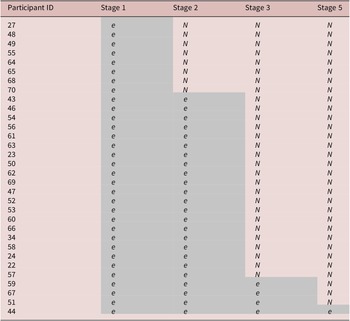
The implicational scaling for the hearing learners is shown in Table 2. There were 152 instances of emergence in the implicational scaling, with only three errors. The results confirmed that the implicational scaling successfully predicted the learners’ gradual progress in their L2 (C of R = .97) and provided reliable results for the learners’ L2 development (C of S = .89). The implicational scaling supported the PT prediction. Specifically, structures from earlier stages emerged in most of the hearing learners’ responses (e.g., Stage 2: 86.84% of the hearing learners’ responses), and the number of emergent structures gradually decreased from earlier stages to later stages. Structures from later stages appeared only in responses from more advanced learners (e.g., Stage 5: 36.84% out of the responses). Table 3 shows the implicational scaling for the d/DHH learners. Out of 128 instances of emergence, no errors were found (C of R, C of S = 1, respectively). Like the hearing learners, the d/DHH learners showed gradual progress in their L2 development (e.g., Stage 2: 75% vs. Stage 5: 3.12%).
Implicational Scaling for the Hearing Learners’ Responses

Implicational Scaling for the d/DHH Learners’ Responses

The overall trend in the d/DHH learners’ L2 development, as shown in the implicational scaling, was comparable to that of the hearing learners. However, the proportion of d/DHH participants who showed emergence in Stage 2, 3, and 5 was lower (e.g., Stage 5: 36.84% vs. 3.12%). In summary, both the d/DHH learners and hearing learners followed PT’s predicted pattern of L2 development, but there was a quantitative difference in their progress: the d/DHH learners required more time to reach each developmental stage.
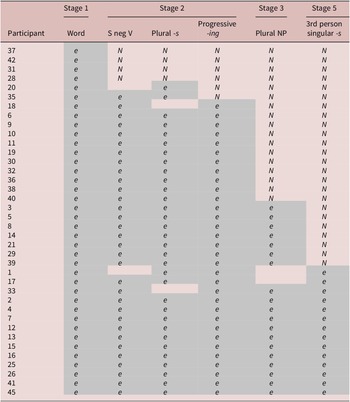
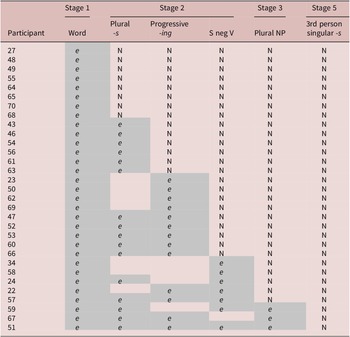
A comparison of the two previous implicational tables reveals that the d/DHH learners developed their L2 in a predicted manner, although at a slower pace. However, given that learners’ unique characteristics may lead to variability in intrastage sequencing, it remains unclear from this evidence alone whether both groups followed similar patterns of development within specific stages. To investigate this question, the implicational tables were modified by splitting the column for Stage 2 into three separate columns for each target structure (i.e., S neg V, Plural -s, and Progressive -ing; Table 4 and Table 5, respectively). Considering the limited number of d/DHH learners who reached Stages 3 and 5 (12.5% of the total sample) as well as the limited target structure in Stage 1 (single words), the data from Stage 2 were chosen for further analysis. The order of the structures in these columns was determined based on the number of emergences for each structure in Stage 2 across participants.
Implicational Scaling for Individual Morphosyntactic Structures in the Hearing Learners’ Responses

Implicational Scaling for Individual Morphosyntactic Structures in the d/DHH Learners’ Responses

Table 4 displays the implicational scaling for the hearing learners. There were six errors out of 228 instances, confirming that the table is both predictable and reliable (C of R = .97; C of S = .89). Similarly, the d/DHH learners’ implicational scaling with all target structures is shown in Table 5. Out of 192 instances, there were 12 errors (C of R = .94; C of S = .9). Although both implicational tables followed the predicted order (i.e., emergence from earlier to later stages), each scaling revealed different intrastage development in Stage 2. Specifically, in the hearing learners’ responses, all the target structures (S neg V, Plural -s, and Progressive -ing) emerged at a nearly similar pace. In contrast, the d/DHH learners showed more noticeable differences in the number of participants who exhibited emergence across the three structures (e.g., Plural -s: N = 17 vs. S neg V: N = 8), suggesting that d/DHH learners may require additional time to consistently use a designated processing procedure.
The order of emergence within Stage 2 also differed between the two groups. In the hearing learners’ table, S neg V and Plural -s emerged simultaneously, followed by the emergence of Progressive -ing. In contrast, in the d/DHH learners’ table, Plural -s emerged earlier than both Progressive -ing and S neg V.
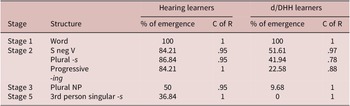
The C of R was also calculated for each structure to identify any structures that participants produced unpredictably (see Table 6). All C of R values for the structures in the hearing learners’ table were above .9, indicating that the structures emerged as predicted. However, in the d/DHH learners’ table, two structures had C of R values below .9: Plural -s (.78) and Progressive -ing (.88). Given the small number of emergences for Plural NP (N = 4) and 3rd person singular -s (N = 1) in the d/DHH learners’ table, the lower C of R values for Plural -s and Progressive -ing (rather than those for Plural NP and 3rd person singular -s, which met the criteria [over .9]) may provide further insight into the generalizability of the d/DHH learners’ L2 development. The larger number of errors, reflected in the lower C of R values, suggests that d/DHH learners may require a longer time to consistently produce the target structures.
Percentage of Emergence and Cs of R for Individual Morphosyntactic Structures in Both Groups’ Responses

In general, like their hearing counterparts, the d/DHH learners followed the gradual progress predicted by PT. However, the processing procedure required to produce specific morphosyntactic structures within a particular developmental stage appeared less stable in d/DHH learners’ responses than in those of hearing learners. While the hearing learners produced the designated structures at roughly the same time after reaching the developmental stage, the d/DHH learners seemed to need more time between the emergence of each structure, even after acquiring the processing procedure. Furthermore, the order of emergence for the morphosyntactic structures differed slightly in the d/DHH learners’ responses.
Pearson correlations were calculated twice: (1) for the number of participants who showed emergence at each stage, and (2) for the number of participants who showed the emergence of each target structure. This allowed for a comparison of the implicational scales between the d/DHH learners and the hearing learners. The implicational scales for the d/DHH learners were highly correlated with those of the hearing learners (stage: r = .99, p = .01; structure: r = .85, p = .03), which in turn suggests that the developmental patterns of both groups are qualitatively comparable, as predicted by PT.
Discussion
The aim of this study is to investigate how d/DHH learners develop their L2 and to what extent their developmental patterns are comparable to those of hearing learners. This study applies PT, a theory of language development, to the L2 production of d/DHH learners. A series of speaking tasks designed to elicit target morphosyntactic structures predicted by PT was utilized, and d/DHH learners’ responses were compared to those of their hearing counterparts. The results revealed that while d/DHH learners developed their L2 in a predictable manner, their progress was slower than that of hearing learners. After reaching a particular developmental stage, d/DHH learners made a larger number of errors, suggesting that they may require additional time and/or practice to consistently produce a designated morphosyntactic structure with stability.
The comparable developmental patterns of d/DHH learners and their hearing counterparts support the argument of QSH (Andrews & Wang, Reference Andrews and Wang2015; Paul & Alqraini Reference Paul and Alqraini2019; Reference Paul2024; Paul & Lee, Reference Paul and Lee2010). Paul & Alqraini (Reference Paul and Alqraini2019) argues that d/DHH learners develop their L2 in a similar way to hearing learners, despite quantitative differences, such as delays in the rate and extent of development. Essential fundamentals, such as a working knowledge of English components and the ability to apply this knowledge, are crucial for the acquisition of English language and literacy skills for all individuals, regardless of their condition or disability. Consistent with the QSH, both d/DHH and hearing learners progress through the same developmental stages and acquire the necessary processing procedure at each stage, as predicted by PT. In other words, all learners, regardless of disability, inherently follow a universal developmental sequence.
However, the proportion of d/DHH learners who showed emergence at each developmental stage was lower than that of hearing learners who showed emergence, indicating quantitative differences in the QSH. The QSH demonstrates that while deafness may lead to quantitative differences (Humphries et al., Reference Humphries, Kushalnagar, Mathur, Napoli, Padden, Rathmann and Smith2012), it is not a cognitive disability, and individuals can eventually catch up with their hearing peers (Paul et al., Reference Paul, Wang and Williams2013). Therefore, if the d/DHH learners are given additional time and opportunities to acquire the necessary processing procedures at each stage, the proportion of d/DHH learners who reach each developmental stage could eventually match that of hearing learners.
Building on King (Reference King1981), these findings provide further empirical evidence for the QSH in L2 learning. However, unlike King (Reference King1981), who investigated similarities and differences in the order of acquiring English components (i.e., nine specific structures) between L2 d/DHH learners and hearing native speakers, this study assessed the QSH in L2 learning using PT. This theory-driven approach can extend the applicability of the QSH in L2 learning, offering a better understanding d/DHH learners’ L2 development. Moreover, this study employed identical experimental settings for both d/DHH learners and hearing learners, comparing their developmental patterns based on responses to the same speaking tasks. King (Reference King1981), in contrast, compared d/DHH learners’ comprehension of linguistic structures to that of hearing native speakers, identifying some exceptional cases among the d/DHH learners and labeling them as unique errors. However, these differences could be attributed to factors related to different aspects of L1 and L2 learning, as well as the presence of deafness. The current study’s design helps disentangle these factors, providing more robust evidence for the QSH.
The differences in intrastage sequencing in Stage 2 also reflect the quantitative delays experienced by d/DHH learners to some extent. While hearing learners produced morphosyntactic structures requiring the same processing procedure at a similar pace, these structures did not emerge simultaneously or even around the same time in d/DHH learners’ responses. Similarly, d/DHH learners made more errors in producing certain structures, even after reaching the developmental stage.
Taken together, these findings suggest that d/DHH learners are capable of following similar L2 learning processes when provided with appropriate and accessible linguistic input, rather than requiring entirely different teaching methods (Paul, Reference Paul2024). The empirical evidence presented in this study is a first step, highlighting the need for further research on d/DHH learners’ L2 development on the basis of diverse theories and claims of language development to refine instructional guidelines and to help these learners catch up with their hearing counterparts by overcoming quantitative differences (Paul, Reference Paul2024).
By applying PT to d/DHH learners’ L2 development, the findings also support the steadiness hypothesis in PT (Pienemann, Reference Pienemann1998, Reference Pienemann and Pienemann2005), which expands the applicability of SLA theory to a less represented group (Andringa & Godfroid, Reference Andringa and Godfroid2020) and provides a better understanding of the multidimensional aspects of L2 learning. The steadiness hypothesis suggests that the L2 developmental orders predicted by PT remain stable across various contexts and populations, as long as L2 learners apply the same knowledge in production. It has been tested by analyzing L2 learners’ production in typologically different languages (e.g., English: Pienemann, Reference Pienemann1998; Spanish: Bonilla, Reference Bonilla2015), employing various communicative tasks (e.g., Ellis, Reference Ellis2008; Pienemann, Reference Pienemann1998; Spinner, Reference Spinner2011), and comparing task modality (Håkasson & Norrby, Reference Håkansson, Norrby and Mansouri2007; Son, Reference Son2024). In addition to these approaches, the focus on deafness in this study further supports the consistency of developmental patterns in L2 learning.
Similar to Mackey and Sachs (Reference Mackey and Sachs2012) and Lee et al. (Reference Lee, Son and Lee2024), the results of the current study suggest that implicational scaling in PT can be a practical tool for understanding L2 learners’ language development, especially for those who may have difficulties accessing standardized tests. As Lee et al. (Reference Lee, Son and Lee2024) pointed out, d/DHH learners may struggle with standardized test. Specifically, young d/DHH learners may experience listening fatigue due to the increased concentration and attention required (e.g., Hornsby et al., Reference Hornsby, Gustafson, Lancaster, Cho, Camarata and Bess2017; Hornsby et al., Reference Hornsby, Picou, Ricketts and Gifford2024) and may benefit from accommodations such as an extended testing time and signed test instructions and items (Cawthon & Leppo, Reference Cawthon and Leppo2013). However, few test developers and evaluators have expertise in deafness or such accommodations, which may lead to underestimation of d/DHH learners’ abilities and proficiency. In addition, in Korea, d/DHH learners in secondary school may request their English teachers to read aloud with precise pronunciation or provide listening test scripts in the classroom (Lee et al., Reference Lee, Son and Lee2024). Such accommodations, which are distinct from standardized test settings, could influence the learners’ test scores. Therefore, analyzing d/DHH learners’ production in familiar communicative tasks may provide a more accurate assessment of their L2 developmental status.
Another potential explanation for the quantitative differences in development between d/DHH and hearing learners could be the number of tasks and/or data. Because learners’ L2 language development is assessed by analyzing learners’ production of assigned morphosyntactic structures, providing the learners with sufficient opportunities for expression is essential. This study also took into account the secondary school learners’ ability to maintain consistent concentration. Based on this consideration, some tasks from Son (Reference Son2024) were removed, but two to three questions were included for each targeted structure. The arbitrary number of tasks may have contributed to the quantitative difference between the two groups to some degree. As this study initially sought to apply PT to the case of d/DHH learners, future research should examine the validity of task quantity to provide clearer evidence of how disability may contribute to the observed quantitative differences.
Conclusion
In this study, d/DHH learners produced target morphosyntactic structures in the developmental order predicted by PT, but progressed through the stages at a different pace than their hearing counterparts. In addition, the study revealed differences in intrastage sequencing between the two groups. The findings of this study shed light on the applicability of PT—a language development theory in SLA—to d/DHH learners’ L2 language development. This approach provides empirical evidence for the QSH in special education, which argues that disabled learners follow qualitatively similar developmental patterns, albeit with quantitative delays. By using identical communicative tasks for both d/DHH learners and their hearing peers, this study increases the validity of the findings and demonstrates that d/DHH learners’ L2 development can be effectively investigated using a language development theory.
The results also have pedagogical implications. As mentioned earlier, teachers and researchers may struggle to quickly assess the L2 proficiency and knowledge of d/DHH learners, who are “vulnerable” to standardized tests (Cawthon et al., Reference Cawthon, Schoffstalll and Garberoglio2014). By applying PT to d/DHH learners, it becomes possible to assess their knowledge promptly and scaffold instruction in a way that builds on the learner’s current developmental stage without overwhelming them (Pienemann, Reference Pienemann1989; Ziafar & Namaziandost, Reference Ziafar and Namaziandost2019). This approach can also help determine the extent of any quantitative delays and guide teachers in supporting learners as they work to overcome those delays (see also Paul, Reference Paul2024). In addition, rather than requiring entirely separate teaching methods and materials, appropriate accommodations—such as additional time and/or extended opportunities within inclusive pedagogical settings—may be sufficiently effective for supporting d/DHH learners’ L2 development.
This study has some methodological limitations that future research should address. Because this study was an initial attempt to apply PT to d/DHH learners’ L2 language development, it followed the criteria and methodologies of previous PT studies rather than designing entirely new experimental settings. In addition, for logistical reasons, this study included only secondary school learners, and all d/DHH learners were in the same class as their hearing counterparts. Consequently, it adopted only a small set of communicative tasks from Son’s (Reference Son2024) study, choosing those that the researchers expected to encourage the d/DHH secondary learners to produce the target structures during meaningful L2 use, which limited the study to targeting only a few specific morphosyntactic structures.
Future studies should explore whether d/DHH learners’ performance on a wider variety of tasks can be analyzed using PT, and whether different demographic factors, such as age and severity of deafness, might yield different results, which could extend PT to a broader range of d/DHH learners. In addition, considering the interconnectedness of productive and receptive systems, future research could examine d/DHH learners’ language development on the basis of PT by analyzing their understandings of morphosyntactic structures (see Spinner & Jung, Reference Spinner and Jung2018). Such research would reveal whether it is possible to generalize the applicability of PT to this population and deepen our understanding of the qualitative similarities and quantitative differences between d/DHH and hearing L2 learners.



 Open access

