





Introduction
Trust – the belief that others are safe and reliable – is fundamental for healthy psychosocial development, shaping social interactions, perceptions of others, and overall wellbeing (Erikson, Reference Erikson1993; Fonagy & Allison, Reference Fonagy and Allison2014; Poulin & Haase, Reference Poulin and Haase2015; Chan et al., Reference Chan, Hamamura, Li and Zhang2017). Trust research has often concentrated on interpersonal betrayal, a form of trust violation that occurs within close relationships, such as maltreatment or neglect. Indeed, children who experience maltreatment exhibit lower trust levels (Blager, Reference Blager1979; Martin, Reference Martin1976). Early life experiences shape social behaviors, including trust, that persist into late adolescence and adulthood, with childhood adversity showing negative associations with general trust levels and long-lasting mental health impairments (Afifi et al., Reference Afifi, Mather, Boman, Fleisher, Enns, MacMillan and Sareen2011; Zheng et al., Reference Zheng, Masuda, Matsunaga, Noguchi, Ohtsubo, Yamasue and Ishii2020). Childhood adversity consistently disrupts the formation of secure attachments, fostering increased mistrust and hypervigilance towards others in both children (Bernath & Feshbach, Reference Bernath and Feshbach1995) and adults (Foa & Rothbaum, Reference Foa and Rothbaum1998; Sandberg et al., Reference Sandberg, Suess and Heaton2010). Crucially, experiences of war trauma and displacement likely pose uniquely severe challenges in trust development. Examining how refugee populations perceive and form trust can provide vital insights into supporting their psychosocial resilience and wellbeing. The effects of war-related trauma and displacement on trust perception development have received limited empirical attention, although the role of interpersonal adversity on trust disruptions has been documented (e.g., Neil et al., Reference Neil, Viding, Armbruster-Genc, Lisi, Mareschal, Rankin, Sharp, Phillips, Rapley, Martin and McCrory2021).
Trust perception in the refugee context
Children and adolescents displaced due to violence and conflict reached 48.8 million at the end of 2024 (UNICEF, 2025), with nearly 90% residing in low- and middle-income countries (Kieling et al., Reference Kieling, Baker-Henningham, Belfer, Conti, Ertem, Omigbodun, Rohde, Srinath, Ulkuer and Rahman2011). Children refugees face a multitude of risk factors, from acute war-related trauma to chronic post-migration stressors, which can profoundly impact their cognitive, emotional, and social development (Hazer & Gredebäck, Reference Hazer and Gredebäck2023; Lustig et al., Reference Lustig, Kia-Keating, Knight, Geltman, Ellis, Kinzie, Keane and Saxe2004). War trauma and displacement represent unique forms of adversity that have distinct implications compared to other forms of maltreatment (e.g., interpersonal neglect or abuse by a close family member). Unlike localized abuse within families, war-related trauma often involves exposure to community-wide violence and injustices in the home country, loss of homeland, prolonged displacement, and cultural disruption or isolation. This confluence of stressors creates complex adversity that elevates risk for mental health difficulties in ways that may differ from maltreatment-related developmental trauma (Betancourt et al., Reference Betancourt, Newnham, Layne, Kim, Steinberg, Ellis and Birman2012; Fazel & Stein, Reference Fazel and Stein2002; Fazel et al., Reference Fazel, Doll and Stein2009; Jensen et al., Reference Jensen, Skårdalsmo and Fjermestad2014; Mortimore, Reference Mortimore and Rutter2001).
Jordan hosts approximately 650,000 Syrian refugees (UNHCR, 2023b). Syrian refugee families living in Jordan face significant economic challenges, unstable living environments, and a high prevalence of mental health issues (UNHCR, 2023a). Refugee children show high levels of anxiety, depression, and post-traumatic stress disorder (PTSD) symptoms, as well as emotion dysregulation and externalizing behavioral problems such as conduct disorder symptoms, aggression, and hyperactivity (Frounfelker et al., Reference Frounfelker, Miconi, Farrar, Brooks, Rousseau and Betancourt2020; Henley & Robinson, Reference Henley and Robinson2011; Hodes & Vostanis, Reference Hodes and Vostanis2018; Khamis, Reference Khamis2019; Panter-Brick et al., Reference Panter-Brick, Hadfield, Dajani, Eggerman, Ager and Ungar2018). Poorer psychosocial outcomes in refugee children have not only been linked to refugee children’s own exposure to trauma, but also to their caregivers’ trauma and psychopathology symptoms (Bryant et al., Reference Bryant, Edwards, Creamer, O’Donnell, Forbes, Felmingham, Silove, Steel, Nickerson, McFarlane, Van Hooff and Hadzi-Pavlovic2018; Eruyar et al., Reference Eruyar, Maltby and Vostanis2018; Sim et al., Reference Sim, Bowes and Gardner2018). Family support and social cohesion is particularly critical in disadvantaged populations (Betancourt et al., Reference Betancourt, McBain, Newnham and Brennan2015; Khamis, Reference Khamis2021), likely influencing refugee children’s trust judgments with implications for their psychosocial development. Overall, displaced children are at high risk for mental health issues and disrupted psychosocial functioning, highlighting the need to understand the developmental processes behind the risk factors and cognitive mechanisms associated with their development.
Development of trust perception based on facial cues
Initial judgments of trust are rapid and often based on the evaluation of facial cues. Adults can make immediate (within 100 ms) judgments of trustworthiness based on facial appearance alone (Willis & Todorov, Reference Willis and Todorov2006). Importantly, the ability to evaluate trustworthiness through facial cues develops during childhood (Caulfield et al., Reference Caulfield, Ewing, Bank and Rhodes2016; Charlesworth et al., Reference Charlesworth, Hudson, Cogsdill, Spelke and Banaji2019; Cogsdill et al., Reference Cogsdill, Todorov, Spelke and Banaji2014; Ewing et al., Reference Ewing, Caulfield, Read and Rhodes2014) and predicts real-world trustworthiness and peer acceptance (Li et al., Reference Li, Heyman, Mei and Lee2017), making it a valuable mechanism for examining children’s psychosocial functioning in different environments.
Evaluating trustworthiness from facial cues is a distinct cognitive ability that integrates multiple other cognitive components such as face perception and emotion processing (Adolphs, Reference Adolphs2002; Todorov et al., Reference Todorov, Olivola, Dotsch and Mende-Siedlecki2015; Zebrowitz & Montepare, Reference Zebrowitz and Montepare2008). Trust judgements encompass higher-order social cognitive processes that extend beyond recognizing emotional expressions, including the assessment of facial features empirically linked to perceived dominance and approachability (Oosterhof & Todorov, Reference Oosterhof and Todorov2008; Todorov et al., Reference Todorov, Said, Engell and Oosterhof2008). The stimuli used in trustworthiness assessments are systematically altered along multiple dimensions of facial features related to social judgements, such as subtle variations in facial structure that affect perceived dominance and valence, rather than depicting discrete emotional expressions (Todorov et al., Reference Todorov, Said, Engell and Oosterhof2008). The neural networks supporting trust judgements engage specific neural mechanisms partially distinct from those involved in basic emotion recognition, incorporating brain regions that integrate visual input with social memory and decision-making (Engell et al., Reference Engell, Haxby and Todorov2007).
Previous work consistently reports that trust tends to decrease with age (Clement et al., Reference Clement, Koenig and Harris2004; Flanagan & Stout, Reference Flanagan and Stout2010; Siddique et al., Reference Siddique, Sutherland, Palermo, Foo, Swe and Jeffery2022). Younger children demonstrate a pronounced tendency to overestimate trustworthiness, particularly when evaluating facial cues (Baccolo & Cassia, Reference Baccolo and Macchi Cassia2019; Caulfield et al., Reference Caulfield, Ewing, Bank and Rhodes2016). This age-related shift likely stems from both the improvement of facial analysis skills and the increase in social knowledge that informs more cautious interpersonal evaluations. Although studies have examined emotion processing in refugee populations (Fadhlia et al., Reference Fadhlia, Sauter and Doosje2025; Kurath et al., Reference Kurath, Bryant, Nickerson, Schnyder, Schick and Morina2024; Gredebäck et al., Reference Gredebäck, Haas, Hall, Pollak, Karakus and Lindskog2021; Michalek et al., Reference Michalek, Lisi, Dajani, Hadfield and Mareschal2023), behaviorally measured trust perception indices remain unexplored in children affected by war and displacement.
Child mental health and facial trust perception
Studies show that non-refugee children with internalizing mental health difficulties have dysregulated facial processing, manifesting as threat biases, or heightened attention to threatening faces, and negative biases in their interpretation of emotional facial expressions (Bar-Haim et al., Reference Bar-Haim, Lamy, Pergamin and Bakermans-Kranenburg2007; Eldar et al., Reference Eldar, Yankelevitch, Lamy and Bar-Haim2010; Pine et al., Reference Pine, Lissek, Klein, Mannuzza, Moulton, Guardino and Woldehawariat2004; Roy et al., Reference Roy, Vasa, Bruck, Mogg, Bradley, Sweeney, Bergman, Mcclure-Tone and Pine2008; Waters et al., Reference Waters, Henry, Mogg, Bradley and Pine2010). Children with high levels of externalizing symptoms, such as conduct problems and hyperactivity, were less accurate at recognizing fearful and neutral facial expressions, frequently misinterpreting fear as anger (Airdrie et al., Reference Airdrie, Langley, Thapar and van Goozen2018; Singh et al., Reference Singh, Ellis, Winton, Singh, Leung and Oswald1998). The tendency to preferentially attend to negative expressions and abnormal recognition patterns of negative emotions may hinder children from perceiving others as friendly and approachable, thus disrupting their perceptions of trustworthiness and leading to impairments in psychosocial functioning.
In addition to heightened biases in the perception of trust, mental health difficulties can also associate with the ability to detect changes in the level of trustworthiness conveyed through facial expressions, or trust sensitivity. Externalizing symptoms like attentional difficulties, encompassing inattention, impulsivity, hyperactivity, and problems with response inhibition (American Psychiatric Association, 2013), are often associated with challenges in processing and interpreting social cues, particularly those conveyed through facial expressions. For instance, children with attentional difficulties tend to allocate less time looking at the eye region of faces, potentially overlooking socially relevant information (Airdrie et al., Reference Airdrie, Langley, Thapar and van Goozen2018; Marotta et al., Reference Marotta, Pasini, Menotti, Pasquini, Pitzianti and Casagrande2017). Recognizing changes in trustworthiness requires sustained attention to subtle shifts in facial features, expressions, and eye gaze (Todorov et al., Reference Todorov, Pakrashi and Oosterhof2009), suggesting that those with attentional difficulties may exhibit poorer trust sensitivity. For instance, children with attention-deficit/hyperactivity disorder (ADHD) display deficits in recognizing emotional facial expressions (Kats-Gold et al., Reference Kats-Gold, Besser and Priel2007; Pelc et al., Reference Pelc, Kornreich, Foisy and Dan2006) and display shorter gaze fixations on faces compared to typically developing children (Muszkat et al., Reference Muszkat, de Mello, Muñoz, Lucci, David, Siqueira and Otta2015). This diminished sensitivity to subtle changes in socially relevant information from facial cues may impact children’s trust perception and overall psychosocial development.
Early adversity and trust development
Early life stress and adversity have consistently been associated with poorer mental health outcomes (see e.g., McLaughlin, Reference McLaughlin2018; Tottenham, Reference Tottenham2014). During early childhood, chronic or repeated stress exposure can disrupt both neurobiological maturation and cognitive development, affecting brain areas involved in stress regulation and social information processing (Jawahar et al., Reference Jawahar, Murgatroyd, Harrison and Baune2015; Lai & Huang, Reference Lai and Huang2011; Lupien et al., Reference Lupien, McEwen, Gunnar and Heim2009; Silberman et al., Reference Silberman, Acosta and Zorrilla Zubilete2016). These early disruptions elevate risk for later psychopathology (Lupien et al., Reference Lupien, McEwen, Gunnar and Heim2009) and may be related to enduring biases in social perception, including altered patterns in making trust judgements.
Adversity alters fundamental facial information processing. Individuals with a history of early adversity demonstrate heightened reactivity to threatening facial expressions (Ardizzi et al., Reference Ardizzi, Martini, Umiltà, Evangelista, Ravera and Gallese2015), with similar patterns observed among those who experienced physical abuse (Pollak & Tolley-Schell, Reference Pollak and Tolley-Schell2003) and family violence (McCrory et al., Reference McCrory, De Brito, Sebastian, Mechelli, Bird, Kelly and Viding2011). Early life stress has also been linked to atypical attention patterns, leading to heightened focus on negative and threatening facial cues (Pine et al., Reference Pine, Mogg, Bradley, Montgomery, Monk, McClure, Guyer, Ernst, Charney and Kaufman2005). Neil et al. (Reference Neil, Viding, Armbruster-Genc, Lisi, Mareschal, Rankin, Sharp, Phillips, Rapley, Martin and McCrory2021) found that maltreated children with experiences of neglect, abuse, and violence, perceived unfamiliar faces as less trustworthy than their non-maltreated peers, suggesting that trust judgements are shaped by early experiences. These patterns in childhood parallel documented trust perception abnormalities in adults with trauma histories (DiLillo & Long, Reference DiLillo and Long1999; Fertuck et al., Reference Fertuck, Tsoi, Grinband, Ruglass, Melara and Hien2016; Lau & Kristensen, Reference Lau and Kristensen2010; Gobin & Freyd, Reference Gobin and Freyd2014), though the mechanisms underlying these atypicalities are likely moderated by age and adversity type, and their links with psychopathology symptoms have yet to be fully understood.
Taken together, these findings indicate that both adult and child populations with high levels of trauma exhibit a maladaptive bias in trust perception. However, as the majority of studies focus specifically on interpersonal adversity (i.e., maltreatment/abuse), the development of trust perception in disadvantaged and underrepresented populations of children affected by war and displacement remains unclear.
Mother-child dynamics
Maternal mental health has a significant influence on children’s psychosocial functioning and prosocial behaviors (Dougherty et al., Reference Dougherty, Tolep, Smith and Rose2013; Goodman & Gotlib, Reference Goodman and Gotlib1999; Goodman & Liu, Reference Goodman and Liu2016; Wan & Green, Reference Wan and Green2009). Given the central role of trust in fostering other-oriented, prosocial behaviors (Chin, Reference Chin2014; Malti et al., Reference Malti, Averdijk, Zuffianò, Ribeaud, Betts, Rotenberg and Eisner2015), maternal mental health may be intricately linked to the development of children’s perception of facial trustworthiness. Poor maternal mental health and poor-quality mother-child relationships contribute to an increased risk of adverse developmental outcomes in children (Clavarino et al., Reference Clavarino, Mamun, O’Callaghan, Aird, Bor, O’Callaghan, Williams, Marrington, Najman and Alati2010; Feldman et al., Reference Feldman, Granat, Pariente, Kanety, Kuint and Gilboa-Schechtman2009; Nicol-Harper et al., Reference Nicol-Harper, Harvey and Stein2007; de la Rosa et al., Reference de la Rosa, Zablotny, Ye, Bush, Hessler, Koita, Bucci, Long and Thakur2023). For instance, Feldman et al. (Reference Feldman, Granat, Pariente, Kanety, Kuint and Gilboa-Schechtman2009) found that infants of mothers diagnosed with major depressive disorder and anxiety disorders exhibited lower levels of social engagement and greater negative emotionality compared to matched controls. Additionally, Parchment et al. (Reference Parchment, Small, Osuji, McKay and Bhana2016) found that when parents had better mental health, neighborhood social cohesion – including a dimension measuring the trustworthiness between neighbors – predicted greater prosocial behavior in children.
Parent-child dynamics are likely to play a particularly significant role in refugee populations, for whom the intergenerational transmission of trauma is well-documented (Flanagan et al., Reference Flanagan, Travers, Vallières, Hansen, Halpin, Sheaf, Rottmann and Johnsen2020). In refugee contexts, children’s psychosocial difficulties are linked to their caregivers’ own trauma exposure and psychopathology (Bryant et al., Reference Bryant, Edwards, Creamer, O’Donnell, Forbes, Felmingham, Silove, Steel, Nickerson, McFarlane, Van Hooff and Hadzi-Pavlovic2018; Eruyar et al., Reference Eruyar, Maltby and Vostanis2018). Family support and social cohesion are critical for disadvantaged populations experiencing displacement (Betancourt et al., Reference Betancourt, McBain, Newnham and Brennan2015; Khamis, Reference Khamis2021), and the disruptive effects of war and displacement on family cohesion, parenting practices, and maternal mental health are well-established (e.g., Eltanamly et al., Reference Eltanamly, Leijten, Jak and Overbeek2021; McEwen et al., Reference McEwen, Biazoli, Popham, Moghames, Saab, Fayyad, Karam, Bosqui and Pluess2023), as are their cascading negative impact on child socio-emotional outcomes (e.g., Eruyar et al., Reference Eruyar, Maltby and Vostanis2018; Khamis, Reference Khamis2021; Peltonen et al., Reference Peltonen, Gredebäck, Pollak, Lindskog and Hall2022). Despite these documented associations, the specific cognitive mechanisms through which maternal mental health and mother-child relationship influence refugee children’s social judgments, such as trust processing, remain unexplored.
Unexplored areas in trust research
Prior research highlights the notable influence of early adversity on the perception of trustworthiness of others (e.g., Neil et al., Reference Neil, Viding, Armbruster-Genc, Lisi, Mareschal, Rankin, Sharp, Phillips, Rapley, Martin and McCrory2021; Martin, Reference Martin1976; Sroufe, Reference Sroufe2009). However, two gaps remain in our current understanding of the development of trustworthiness in children affected by adversity. First, trustworthiness research in children after adversity has primarily emphasized cooperative behaviors and interpersonal relationships (Brown, Reference Brown2023; Hirano & Ishii, Reference Hirano and Ishii2024), whilst the cognitive processes involved in atypical trust judgements following adversity remain unclear. Recent evidence suggests that maltreated children have perceptual-level abnormalities in trustworthiness (Neil et al., Reference Neil, Viding, Armbruster-Genc, Lisi, Mareschal, Rankin, Sharp, Phillips, Rapley, Martin and McCrory2021), hinting at cognitive shifts in social judgments following early adversity, but investigations of these processing abnormalities in other contexts are limited. Second, childhood adversity in trust research is predominantly defined in the context of interpersonal adversity (Mell et al., Reference Mell, Safra, Demange, Algan, Baumard and Chevallier2022), neglecting the context of large-scale conflict and displacement affecting millions of children globally (McEwen et al., Reference McEwen, Biazoli, Popham, Moghames, Saab, Fayyad, Karam, Bosqui and Pluess2023; UNICEF, 2025,June). Furthermore, most previous studies of cognitive components of trust perception assessed adult, Western, non-refugee populations (e.g., Todorov et al., Reference Todorov, Said, Engell and Oosterhof2008). To our knowledge, the patterns of trust judgments in young children living under the conditions of forced displacement have not been studied. This is a striking omission, because the development of trust perception is likely key to improving the psychosocial functioning of at-risk, displaced children from socioeconomically disadvantaged backgrounds. Charting how children interpret and respond to social signals of trustworthiness will help identify early markers of social withdrawal or hypervigilance that might indicate long term adjustment difficulties. These insights could guide culturally sensitive interventions to strengthen social cognition and foster resilience.
This study
The main aim of our study was to investigate the relationship between Syrian refugee children’s facial trust perception - a critical aspect of inter-social relationships - and their mental health. We used a previously validated facial trustworthiness judgment task (Neil et al., Reference Neil, Viding, Armbruster-Genc, Lisi, Mareschal, Rankin, Sharp, Phillips, Rapley, Martin and McCrory2021) and collected mother-reported measures of maternal and child mental health. Although earlier research suggests that children’s mental health is linked to difficulties in interpreting facial expressions (Airdrie et al., Reference Airdrie, Langley, Thapar and van Goozen2018; Kats-Gold et al., Reference Kats-Gold, Besser and Priel2007; Marotta et al., Reference Marotta, Pasini, Menotti, Pasquini, Pitzianti and Casagrande2017; Pelc et al., Reference Pelc, Kornreich, Foisy and Dan2006), to our knowledge no studies have directly examined the relationship between mental health and trust perception in an at-risk population of refugee children affected by war and displacement. We hypothesized that: refugee children with more mother-reported internalizing (1) and externalizing problems (2) would perceive computer-generated faces as being less trustworthy than children with fewer internalizing and externalizing problems. Additionally, we hypothesized that those children with more mother-reported attentional problems would show lower sensitivity in detecting changes in trustworthiness levels (3). Finally, in series of exploratory analyses, we examined whether maternal mental health and wellbeing, as well as quality of the mother-child relationship, were associated with children’s trust perception. This study design and analyses were pre-registered on the OSF (https://osf.io/a34sp), and the data are publicly available (OSF).
Methods
Participants
Participants were Syrian refugee mother-child dyads living in Jordan (N = 324, child M age = 6.32 (1.18), [age range: 4 – 9 years old], 50% female; mother M age = 32.59 (7.02)). The majority of participating children were born in displacement (n = 261, 81%). To ensure that the place of birth did not account for our main findings, we conducted a set of sensitivity analyses, excluding children not born in displacement. These additional analyses did not alter the results in any of our models (Tables SM6 & SM7).
Data collection took place at participants’ homes in Amman (n = 235) and in the Al-Zaatari refugee camp (n = 86). Refugee families were recruited through a non-profit organization and were taking part in a randomized control trial (RCT) evaluation of a reading program for children (FIERCE). Maternal and child mental health, mother-child relationship, and the trust task were measured at T2 (the endline) of the project (May to August 2021). As we did not expect the reading program to affect our study outcomes, and the two groups did not significantly differ in task performance or mental health outcomes (all p > .44, Table SM8), data from all participating dyads, regardless of whether they were in the experimental group or control group in the reading program, were included in the analyses. However, we have also conducted a parallel set of analyses controlling for the reading program arm (treatment/control), which found that group did not have a significant effect on any of our outcomes of interests (all p > .43) and its inclusion as a control did not significantly alter any of the models. These results are presented in Tables SM9 and SM10.
Demographic data (mother age, child age and sex), child mental health, maternal mental health and wellbeing, and mother-child relationship were measured with questionnaires adapted to Arabic and administered by female Arabic-speaking fieldworkers during home visits. As data collection took place when some restrictions were in place in Jordan due to the COVID-10 pandemic, enhanced hygiene and distancing measures were implemented to ensure health and safety of participants and fieldworkers, such as masks, hand-sanitizers, and disinfecting equipment between sessions. However, key data collection procedures were not affected. All questionnaire data were collected using KoBo Toolbox offline survey tool (2021) on portable Dell laptops. Data were collected from the child and the mother at the same time. All questionnaire measures (mother and child) were obtained from the mother.
Ethics
The project was granted ethical approval from the Trinity College Dublin research ethics board (01E/2020/10) and the Jordan Prime Minister’s Office. All analyses in the current study have been pre-registered (https://osf.io/a34sp). Caregivers gave formal written consent and children gave their assent prior to taking part in the study. Families were reimbursed 10JOD ($14) for travel and participation.
Questionnaires: mental health, wellbeing, and parent-child relationship
Child mental health, maternal mental health and wellbeing, and mother-child relationship were assessed with mother-reported questionnaires. Detailed information on each of the scales used is available on the FIERCE OSF page (https://osf.io/gcv5z/) and in the Supplemental Material.
Child mental health measures were reported by mothers, using the short version of the Pediatric Symptoms Checklist (PCS-17, Jellinek et al., Reference Jellinek, Murphy, Robinson, Feins, Lamb and Fenton1988). The PCS-17 contains three subscales measuring separate constructs: internalizing (5 items, Cronbach’s α = .59), externalizing (7 items, Cronbach’s α = .74), and attentional problems (5 items, Cronbach’s α = .65). Higher scores indicated higher symptom severity.
Maternal symptoms of depression were measured using the Center for Epidemiological Studies – Depression Scale (CES-D, Radloff, Reference Radloff1977) where higher scores indicated greater symptom severity (10 items, Cronbach’s α = .79) and scores above 10 indicate symptom severity consistent with a clinical diagnosis of depression (Radloff, Reference Radloff1977). The anxiety subscale of the short form Depression, Anxiety, Stress (DASS-21, Henry & Crawford, Reference Henry and Crawford2005) was used to measure maternal anxiety symptoms (7 items, Cronbach’s α = .79). Scores between 10 and 19 indicated moderate to severe anxiety (Henry & Crawford, Reference Henry and Crawford2005). Maternal wellbeing was assessed with the Warwick-Edinburgh Mental Wellbeing Scale (WEMWBS; Tennant et al., Reference Tennant, Hiller, Fishwick, Platt, Joseph, Weich, Parkinson, Secker and Stewart-Brown2007) where higher scores indicated better wellbeing (14 items, Cronbach’s α = .82). The wellbeing data were collected from a subset of participating mothers (n = 130).
Mother-child relationship quality was measured with the short form of Pianta Child-Parent Relationship Scale (Driscoll & Pianta, Reference Driscoll and Pianta2011; Pianta, Reference Pianta1992) which assesses two separate constructs: mother-child closeness (7 items, Cronbach’s α = .63) and mother-child conflict (8 items, Cronbach’s α = .72). Higher scores indicated higher levels of closeness and conflict in the mother-child relationship, respectively.
Trust perception task
Stimuli
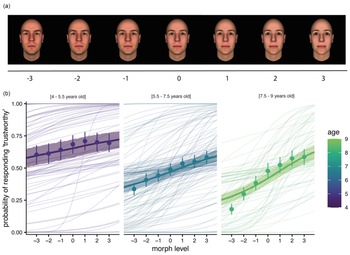
Stimuli consisted of computer-generated faces with neutral expressions of varying levels of trustworthiness from the database first described by Todorov et al. (Reference Todorov, Said, Engell and Oosterhof2008). These faces were developed to isolate trustworthiness perception by maintaining neutral expressions while systematically varying facial features associated with trust judgements. In this database, each identity face was manipulated with the FaceGen software (Singular Inversions, Toronto, Canada) to create seven morphs on a computationally modeled dimension of trustworthiness in 1SD increments ranging from −3 to 3 SD from the mean (Figure 1a; Todorov & Oosterhof, Reference Todorov and Oosterhof2011; Todorov et al., Reference Todorov, Dotsch, Porter, Oosterhof and Falvello2013). The computational model underlying these manipulations was based on adult ratings of trustworthiness which identified specific facial characteristics that influence trust evaluations. These characteristics include structural facial features related to facial dominance (e.g., jaw and brow ridge prominence, facial width) and subtle cues suggesting approachability, rather than explicit emotional displays. This methodology allows for the examination of trust perception as a social cognitive process that, while potentially influenced by emotion processing abilities, engages distinct evaluative mechanisms.
A) Example stimuli: one face identity at 7 morph levels of trustworthiness. B) Bayesian models of choice probabilities of response in the trust task presented for 3 different age groups. Thin lines represent individual model predictions, thick lines are averaged of model predictions with shaded areas representing 95% CI. Dots and error bars represent the average of responses with error bars the 95% CI across participants. Morph levels correspond to the level of trustworthiness of the stimuli (where −3 equals low trustworthiness and +3 represents high trustworthiness).
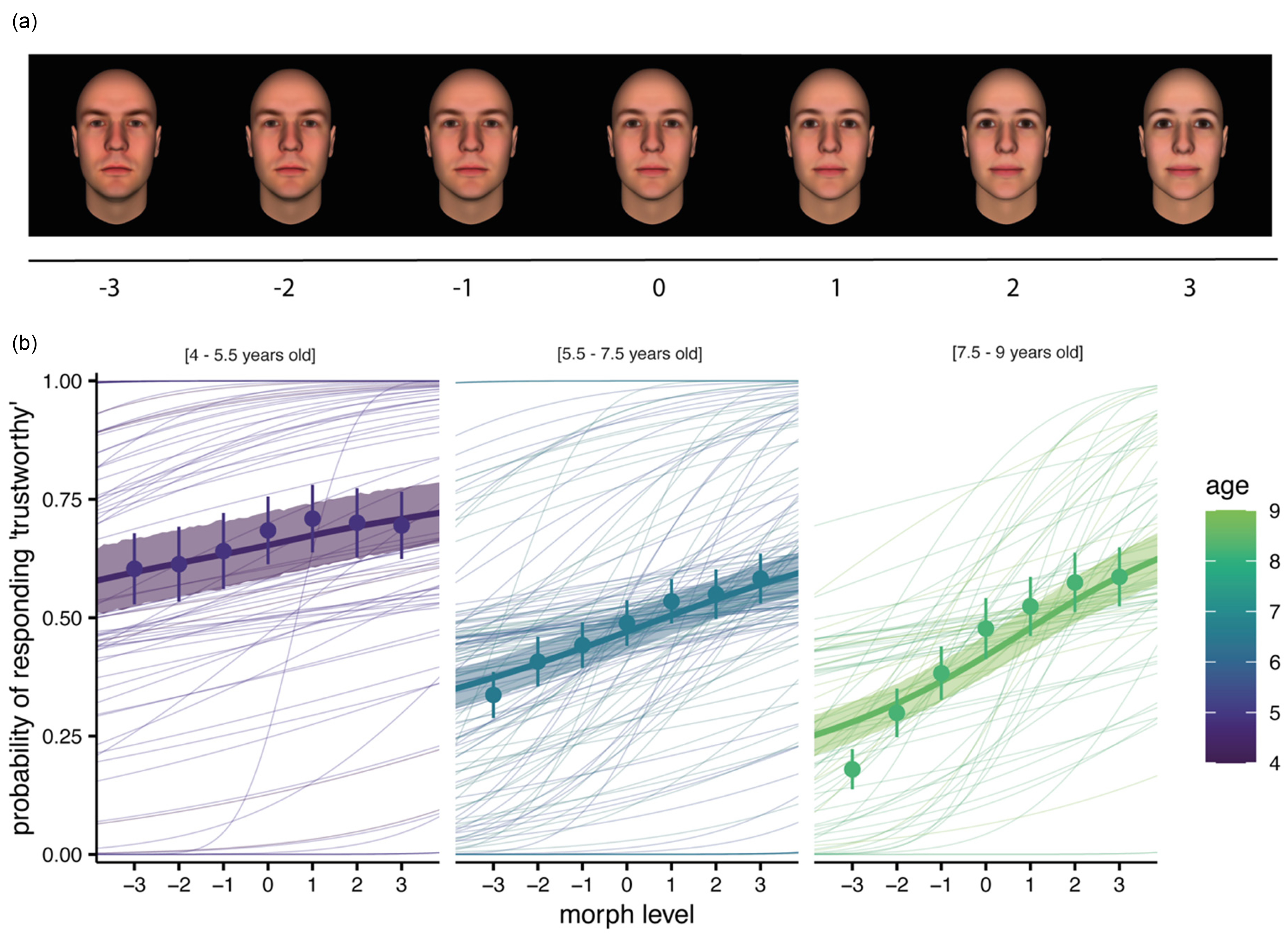
Initially, we randomly selected 10 face identities; however, after the fieldworkers reported the duration of the task was too long, the number of trials was decreased by using 7 face identities instead (Figure 1A). All participating children were shown the same face identities. This resulted in 71 children completing 70 trials (10 face identities) and 239 completing 49 trials (7 face identities). Both task versions sampled equally from the trustworthiness spectrum, ensuring comparable assessment of children’s sensitivity to trustworthiness cues despite the difference in trial numbers.
Procedure
To mitigate potential cultural differences around the understanding of the construct of trust, we aligned the study definition of trust in discussions with the Jordanian project manager during the design phase. We used the exact Arabic translation of the word “trust” along with a synonym of “trust” commonly used in the spoken language: , which translates to “Someone you trust and might feel safe around/someone you might confide in.” The fieldworkers explained the meaning of trust to the children, and then confirmed their understanding by having the children answer questions and explain it back to them in their own words before conducting the task. All children were able to explain the concept of trust back to the fieldworkers, suggesting a general level of understanding. A two-alternative forced-choice trust perception task with a method of constant stimuli was administered using MATLAB (Mathworks) and Psychtoolbox (Brainard, Reference Brainard1997) on Dell laptop computers. This task has been previously validated in primary school-aged children in a UK cohort (Neil et al., Reference Neil, Viding, Armbruster-Genc, Lisi, Mareschal, Rankin, Sharp, Phillips, Rapley, Martin and McCrory2021).
On each trial, children were presented with one of the face stimuli in randomized order and asked to report if the face presented appeared trustworthy or untrustworthy and were instructed to guess if they were unsure of the response. Responses were entered into the computer by the fieldworkers to minimize key press errors. Each trial began with a fixation point presented for 250 ms, followed by the test face which remained on the screen until a response was made. After the response, a noise mask was shown for 500 ms, followed by the next test face.
Data were compiled across the 7 trust levels and, for each child, we estimated a cumulative Gaussian psychometric function predicting the probability of responding that a face was “trustworthy.” The estimation was done using a hierarchical Bayesian approach that included random effects (both random intercepts and slopes) grouped according to participant and identity of the face stimulus. We then used the estimated model to extract individual measures of bias and sensitivity. More specifically, we computed the point of subjective equality (PSE): the morph level equally likely to be judged as trustworthy and untrustworthy. We took the distance between the PSE (i.e., the subjective middle point of the dimension) and the physical midpoint (i.e., central image on the trust dimension ranging from −3 to +3) to represent the child’s trust bias. Trust bias informs us about whether children perceive the ambiguous expressions (central stimulus) as trustworthy or untrustworthy. We also extracted sensitivity which is the slope of the psychometric function and indicates how well the child could detect changes in the different level of trustworthiness of the test faces. Children with higher sensitivity are able to discriminate small changes in the level of trust in the stimuli more than children with lower sensitivity. The log-transformed sensitivity measure was included in all subsequent analysis.
A subset of children (n = 39) consistently responded with the same answer throughout the task, marking all faces as either trustworthy or untrustworthy. As it is likely there is a high level of variability in the impression of trustworthiness elicited by the computer-generated faces and that these children may have genuinely perceived them all as trustworthy or untrustworthy, we decided to include all data in our final Bayesian analysis model. However, we have also conducted a series of sensitivity analyses excluding these children and found no significant differences in our results (Tables SM11 & SM12).
Results
Descriptive statistics
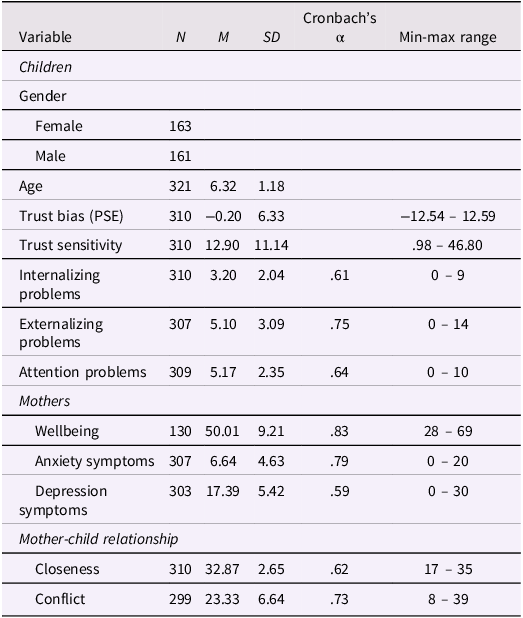
Demographic information, average child trust measures, child and mother mental health outcomes, and mother-child relationship quality are presented in Table 1. We used pairwise deletion to handle missing data in all analyses. Children ranged in age between 4 and 9 years old (M age = 6.32, SD = 1.18). The mothers’ reports of children’s internalizing (M age = 3.20, SD = 2.04), externalizing (M age = 5.10, M age = 3.09), and attention problems (M age = 5.17, SD = 2.35) are all within the “average” range of scores and well below the cut-off values (scores 5 and above for internalizing, and 7 or above for externalizing and attention problems may indicate a need for assessment), suggesting no need for clinical concern, and overall good child mental health in the sample (Stoppelbein et al., Reference Stoppelbein, Greening, Moll, Jordan and Suozzi2012). Children performed well on the trust perception task, but the trust sensitivity scores indicate that they found it difficult to differentiate between trustworthy and untrustworthy stimuli, although children appeared to get better at this with age (Figure 1B). Correlations across all variables in the analyses are presented in table SM5.
Descriptive statistics for trust perception, mental health, wellbeing, and mother-child relationship
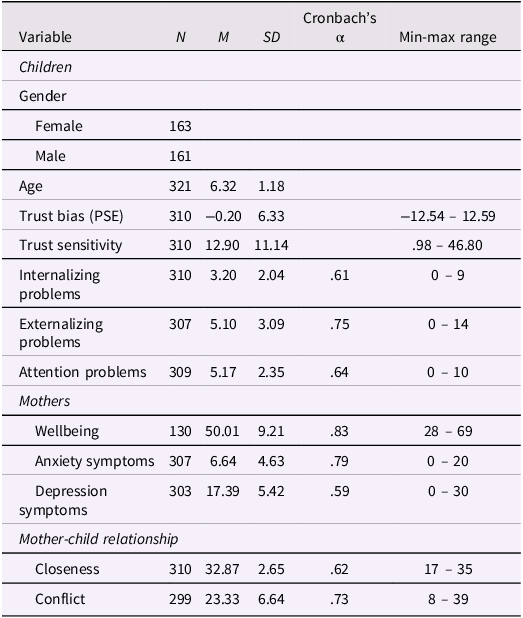
Note. Wellbeing: WEMWBS (Tennant et al., Reference Tennant, Hiller, Fishwick, Platt, Joseph, Weich, Parkinson, Secker and Stewart-Brown2007); Anxiety: DASS-Anxiety (Henry & Crawford, Reference Henry and Crawford2005); Depression: CES-D (Radloff, Reference Radloff1977); Child internalizing, externalizing, and attention problems: PSC-17 (Jellinek et al., Reference Jellinek, Murphy, Robinson, Feins, Lamb and Fenton1988); Mother-child relationship quality: Pianta Child-Parent Relationship Scale (Pianta, Reference Pianta1992).
Is children’s perception of trust linked to their mental health?
We first conducted a correlational analysis to examine the link between child internalizing and externalizing problems. As internalizing and externalizing symptoms were significantly positively correlated (r = .36, p < .001), we included both as predictors in the trust bias linear regression model, combining pre-registered hypotheses 1 and 2.
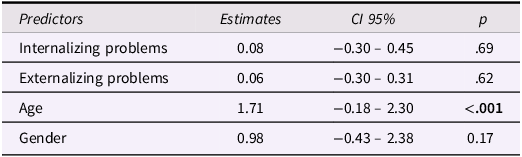
We used a linear regression model to test the associations between child mental health (internalizing and externalizing problems) and their trust bias (hypotheses 1 and 2), in which the predictors were child internalizing and externalizing symptoms, the outcome was child’s trust bias, and child age and gender were included as covariates. This model was significant in predicting child trust bias, F(4, 283) = 8.82, p < .001 (Table 2), however internalizing (B = .02, SE = .19, t = 0.40, p = .92) and externalizing (B = .03, SE = .13, t = 0.50, p = .85) symptoms were not significantly associated with the trust bias. The only significant predictor for the trust bias was the child’s age (B = .32, SE = .30, t = 5.75, p < .001), with older children perceiving faces as less trustworthy (Figure 1b).
Linear regression model of child mental health and trust bias
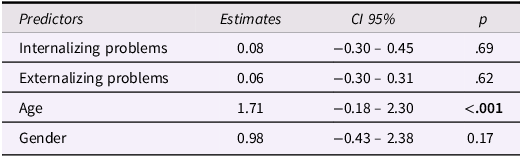
Observations = 288.
R2/R2 adjusted = 0.11/0.10.
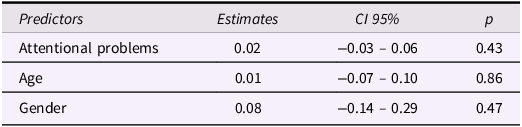
To test the third hypothesis, that child attentional problems are linked to child trust sensitivity, we conducted a linear regression with the child’s attention problems as the predictor, trust sensitivity (log-transformed) as the outcome, and child age and gender as covariates. This model was not significant overall, F(3, 287) = .37, p = .78 (Table 3).
Linear regression model of child attentional problems on trust sensitivity
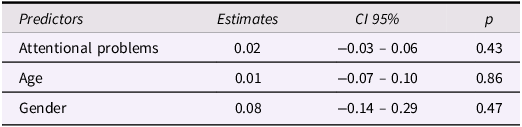
Observations: 291.
R2/R2 adjusted = 0.00/−0.01.
Is children’s perception of trust affected by their mother’s mental health and the quality of their relationship?
The aims of our exploratory analyses were to test the links between mothers’ mental health, wellbeing, the quality of the mother-child relationship and child trust perception. Firstly, we ran a linear regression model with maternal symptoms of anxiety and depression, and mother-child conflict and closeness as the predictors, and child trust bias as the outcome (model 1). As our measure of maternal wellbeing was collected from only a subset of participating mothers (n = 130), we then ran a separate model with maternal wellbeing as predictor only (so as not to artificially diminish the sample size and decrease power) and child trust bias as the outcome (model 2). Finally, we conducted the same analysis on child trust sensitivity as the outcome (models 3 and 4). We included child age and gender as covariates in all models.
We found that although both trust bias models were significant overall (F(6, 262) = 6.15, p < .001 and F(3, 120) = 5.69, p = .001), the effects were driven by child’s age (B = .33, SE = .31, t = 5.50, p < .001 and B = .32, SE = .50, t = 3.71, p < .001 for models 1 and 2 respectively). Maternal mental health, wellbeing, and mother-child relationship were not significant predictors of child trust bias (all p > .1, Tables SM1 & SM2). The exploratory models of child trust sensitivity were not significant overall (all p > .1; Tables SM3 & SM4).
Additionally, we also conducted an exploratory analysis to test the consistency of judgements in the youngest group of children (N = 85; M age = 4.89 years, SD = 0.31). As the plot in figure 1B shows more variable responses from this age group, we aimed to ascertain whether their judgements were random or influenced by the stimulus trustworthiness level. To this end, we employed the same Bayesian multilevel model used previously to extract the bias and the sensitivity score for the main analysis and compared it with a reduced model which did not include the stimulus trustworthiness level as predictor. We compared the two models using a Bayesian leave-one-out cross-validation (LOO) procedure (Vehtari et al., Reference Vehtari, Gelman and Gabry2017), which revealed a significant difference in predictive performance between the two models. The full model showed better predictive accuracy, with an estimated difference in expected log predictive density (elpd) of −39.1 (SE = 8.9) compared to the reduced model. This substantial difference in LOO information criterion indicates that the full model, which includes the influence of the stimulus trustworthiness level, provides more accurate predictions of the children’s trustworthiness judgements. In sum, this finding indicates that the youngest children’s responses were not merely random but were indeed influenced by the trustworthiness continuum of the faces.
Discussion
This study is the first to investigate the relationship between refugee children’s perception of trust, and child and mother mental health. Previous research in children with experiences of early life stress and poor mental health reported reduced trust perception suggesting that maltreated children are less trusting of others (e.g., Neil et al., Reference Neil, Viding, Armbruster-Genc, Lisi, Mareschal, Rankin, Sharp, Phillips, Rapley, Martin and McCrory2021; Martin, Reference Martin1976; Sroufe, Reference Sroufe2009). Surprisingly, we found no association between child mental health and their perception of trust (bias or sensitivity) in this cohort of war-affected Syrian refugee children residing in Jordan. Child trust perception was also unrelated to maternal mental health or to the quality of the mother-child relationship. However, interestingly, we found that age was consistently predictive of trust bias, in that older children judged faces as less trustworthy than younger children.
Trust bias
We found that child trust perception was not related to their internalizing or externalizing problems. This may be attributed to the distinct nature of adversity experienced by the refugee children in our sample in comparison to previously studied non-refugee populations. Experiences of neglect, emotional abuse, sexual abuse, and home violence (Neil et al., Reference Neil, Viding, Armbruster-Genc, Lisi, Mareschal, Rankin, Sharp, Phillips, Rapley, Martin and McCrory2021) all involve breaches of interpersonal trust and are conceptually different from war and other adversity related to displacement and refugee status. Forced displacement primarily disrupts community and family cohesion (Slobodin & de Jong, Reference Slobodin and de Jong2015), affecting family structure rather than the children at an interpersonal level (i.e., experiences of neglect, maltreatment, or sexual assault). Structured and supportive family environments have consistently been found to play a protective role for refugee children, promoting emotional wellbeing and resilience (Bean et al., Reference Bean, Derluyn, Eurelings-Bontekoe, Broekaert and Spinhoven2007; Bek-Pedersen & Montgomery, Reference Bek-Pedersen and Montgomery2006; Eltanamly et al., Reference Eltanamly, Leijten, Jak and Overbeek2021; Khraisha et al., Reference Khraisha, Sawalha, Hadfield, Al-Soleiti, Dajani and Panter-Brick2024). Previous studies have examined trust perception using self-report measures and interviews in refugee communities. For instance, research among Eritrean refugees in Sudan suggests that refugees may initially mistrust one another but develop high levels of interpersonal trust, respect, and social networks as their communities form over time (Kibreab, 2000, 2004). However, they maintained their distrust in the Sudanese government (Kibreab, Reference Kibreab2004). In another study, young refugees resettled in Australia reported that the challenges in their lives predominantly revolved around conflicts within their families that related to poor living conditions and a lack of resources to mitigate the risks linked to their refugee status (McMichael et al., Reference McMichael, Gifford and Correa-Velez2011). Although conflicts undoubtedly exist within refugee families, refugee children may still exhibit higher overall levels of trust in their caretakers. General mistrust among refugee populations is more often directed toward larger political entities (Hynes, Reference Hynes2003; Kibreab, Reference Kibreab2004), emphasizing the crucial protective role of family structures and community support in fostering interpersonal trust among child refugees. Although we did not find a direct association between mother-child relationship quality – an indicator of interpersonal relationship strength – and child trust bias, employing more comprehensive measures of social cohesion and trust in institutions could provide a deeper understanding of refugee trust dynamics. Combining cognitive measures of trust perception with qualitative exploration of interpersonal trust could further our understanding of the processes behind trustworthiness judgements in vulnerable populations of displaced children.
Child age was a significant predictor of trust bias in our analyses, with older children tending to perceive faces as less trustworthy than younger children. These findings align with the current literature, with recent work reporting a tendency for trust to decrease as children grow older (Clement et al., Reference Clement, Koenig and Harris2004; Flanagan & Stout, Reference Flanagan and Stout2010; Siddique et al., Reference Siddique, Sutherland, Palermo, Foo, Swe and Jeffery2022). Studies using facial trustworthiness task report that 5-year-old children tend to overestimate the trustworthiness of faces (Baccolo & Cassia, Reference Baccolo and Macchi Cassia2019; Caulfield et al., Reference Caulfield, Ewing, Bank and Rhodes2016), suggesting that sensitivity to trust from facial cues is not fully developed at this age, or that as we age and gain experiences in social interactions, we tend to perceive others as less trustworthy. This developmental pattern may align with the emergence of children’s ability to comprehend false beliefs (Perner, Reference Perner1991). Older children with a more developed theory of mind may better understand that others can hold false beliefs that differ from their own and are not influenced by their experiences. In an experimental task, Palmquist et al. (Reference Palmquist, Floersheimer, Crum and Ruggiero2022) found that children with a greater theory of mind ability were less likely to seek help from a previously inaccurate informant than from an unfamiliar one. These findings suggest that as children mature and their cognitive abilities develop, they become increasingly adept at evaluating trustworthiness in others, which may decrease their overall perception of trustworthiness. It is also worth noting that the majority of children in our study were born during displacement, and the older children were more likely to have experienced both war and displacement, as well as deprivation-linked adversity. It is possible that the age effects on trust perception we observed here are further influenced by their exposure to war or displacement; however, additional measures of child war trauma, which were not collected here, are needed to further explore these potential effects.
Trust sensitivity
We expected that children with elevated mother-reported attentional problems might exhibit reduced sensitivity in the trust task. Previous research using a computerized object recognition paradigm illustrated that preschoolers with hyperactive tendencies had more response omissions, higher variability in reaction times, greater variability in their performance, and overall deterioration in performance over time (Youngwirth et al., Reference Youngwirth, Harvey, Gates, Hashim and Friedman-Weieneth2007). We expected that children with attentional difficulties in this study might display similar behaviors such as inattentiveness toward facial stimuli which could lead to lower trust sensitivity. Contrary to our hypothesis, we found that children’s attentional problems did not reduce their sensitivity in the trust task. One explanation for this is that children with attentional difficulties may develop compensatory mechanisms to navigate social situations, including heightened vigilance, relying on non-verbal cues, or developing alternative strategies for interpreting social information (Mowlem et al., Reference Mowlem, Agnew-Blais, Taylor and Asherson2019; Young et al., Reference Young, Adamo, Ásgeirsdóttir, Branney, Beckett, Colley, Cubbin, Deeley, Farrag, Gudjonsson, Hill, Hollingdale, Kilic, Lloyd, Mason, Paliokosta, Perecherla, Sedgwick, Skirrow and Woodhouse2020a; Young et al., Reference Young, Hollingdale, Absoud, Bolton, Branney, Colley, Craze, Dave, Deeley, Farrag, Gudjonsson, Hill, Liang, Murphy, Mackintosh, Murin, O’Regan, Ougrin, Rios and Woodhouse2020b). Such compensatory processes may enable children with attentional problems to develop strategies that maintain sensitivity in trust-related tasks, although likely requiring more effortful processing (Fassbender & Schweitzer, Reference Fassbender and Schweitzer2006, Young et al., Reference Young, Adamo, Ásgeirsdóttir, Branney, Beckett, Colley, Cubbin, Deeley, Farrag, Gudjonsson, Hill, Hollingdale, Kilic, Lloyd, Mason, Paliokosta, Perecherla, Sedgwick, Skirrow and Woodhouse2020a). Refugee children in particular demonstrate adaptive strategies and resilience to navigate challenging circumstances, such as self-regulation skills, close and supportive relationships, and community supports (Masten & Narayan, Reference Masten and Narayan2012).
Family impact: maternal mental health and mother-child relationship
Our exploratory analysis focused on identifying maternal mental health factors that could influence refugee children’s trust perception. Mothers hold a pivotal role in shaping their children’s psychosocial development, with research consistently showing a positive association between maternal mental health and child wellbeing (Goodman et al., Reference Goodman, Rouse, Connell, Broth, Hall and Heyward2011). In our analyses, maternal mental health and wellbeing, and the quality of mother-child relationship were not significantly linked to child trust bias or sensitivity. It is possible that some protective factors counterbalance potential influences of maternal factors on trust perception in refugee children. In line with our findings, previous research has shown a lack of correlation between maternal psychopathology and child psychosocial development, though not specifically child trust perception. For instance, Keim et al. (Reference Keim, Daniels, Dole, Herring, Siega-Riz and Scheidt2011) found that maternal anxiety and prenatal and postpartum stress did not have a substantial negative effect on a child’s cognitive development. Similarly, Dib et al. (Reference Dib, Padovani and Perosa2019) found that, regardless of maternal chronic depression or anxiety disorders, children presented positive and negative affect equally in a validated interaction assessment protocol. The absence of a direct impact of maternal mental health and the mother-child relationship on facial trust perception in Syrian refugee children suggests the presence of other protective factors that may be mitigating this relationship. For instance, beyond the immediate family unit, refugee children often benefit from strong community bonds, shared cultural practices, and networks of mutual aid that provide emotional and practical support during resettlement (Betancourt et al., Reference Betancourt, McBain, Newnham and Brennan2015; Panter-Brick et al., Reference Panter-Brick, Dajani, Eggerman, Hermosilla, Sancilio and Ager2017; Sim et al., Reference Sim, Bowes and Gardner2019)
Limitations
While our study offers insights into child refugee trust perception, there are several limitations. Firstly, considering the overall performance on the trust perception task, the shallow average functions indicate that children struggled with discriminating between trustworthy and untrustworthy faces (Figure 1b), with some children judging all presented faces as either trustworthy or untrustworthy. Children’s discrimination ability increased with age, although this effect was not statistically significant. Although it is possible that there is very high variability of trustworthiness depicted by the faces, these discrimination difficulties could also be the result of attention lapses or children responding randomly when unsure. Additional perceptual tasks (such as emotion recognition) could be used in future studies to establish if these discrimination abilities are unique to trust processing. Another limitation of our study is the relatively low internal consistency observed for internalizing symptoms (α = .59) and attentional problems (α = .65), likely driven by the low number of items in the subscale, to which Cronbach’s alpha is susceptible. Inflated measurement error can obscure associations between constructs. As we investigated a population for which there is scarcity of psychometrically valid assessment tools, reliability concerns further highlight the need for the development and validation of culturally and contextually appropriate instruments to measure mental health in refugee youth.
Furthermore, the majority of children in our study were born and raised in Jordan (n = 261), meaning that although they had experienced displacement, it is unlikely they would have any direct exposure to war. Time spent in host country has previously been linked to reduced symptoms of PTSD among refugee youth (Khamis, Reference Khamis2019), which may also help explain the low levels of mental health problems in our sample (within the norm for all PSC subscales, Jellinek et al., Reference Jellinek, Murphy, Robinson, Feins, Lamb and Fenton1988). However, in a recent review, Hazer and Gredebäck (Reference Hazer and Gredebäck2023) highlighted that even after resettlement refugee children continue to face a multitude of chronic stressors that has cumulative impact on their psychosocial functioning and wellbeing. Nonetheless, abnormalities in trust perception may only be evident when higher (or clinical) levels of psychopathology symptoms are present. Indeed, certain cognitive biases involved in the mechanisms of anxiety and depression, such as interpretation and attention biases, are only reliably detected in clinical populations, but not in non-clinical groups with only some internalizing symptoms (Bar-Haim et al., Reference Bar-Haim, Lamy, Pergamin and Bakermans-Kranenburg2007; Nieto et al., Reference Nieto, Robles and Vazquez2020) and trust perception abnormalities might follow a similar pattern. Overall, refugee children in other host countries may have markedly different war and displacement-related circumstances and associated mental health outcomes, and our findings may not be readily generalizable to these diverse contexts. The lack of control group of non-refugee children living in Jordan further complicates the interpretation of our findings, as cultural and contextual differences might play important roles in trust perception development that we were unable to capture. Finally, the heterogeneity of experiences within our refugee sample and across refugee populations warrants careful consideration, as variability to adversity exposure and ongoing challenges could produce distinct patterns of social cognition that were not captured in our analyses. Addressing these limitations is integral for contextualizing our findings and highlighting areas for future research refinement.
Conclusion
Taken together, our results suggest that trust perception is not significantly linked to internalizing, externalizing, or attention problems in at-risk refugee children, nor is it linked to their mothers’ mental health, highlighting fundamental differences between trust perception development in the context of interpersonal trauma (e.g., abuse) versus adversity related to forced displacement and war. Consistent with findings from non-refugee populations (Clement et al., Reference Clement, Koenig and Harris2004; Flanagan & Stout, Reference Flanagan and Stout2010), older refugee children tended to exhibit lower levels of trust than younger children, although this age effect did not extend to trust sensitivity. Overall, our results indicate that in this understudied population of refugee children with a history of exposure to displacement and war related adversity, children’s mental health does not appear to be associated with trust judgements at perception level.
Supplementary material
The supplementary material for this article can be found at https://doi.org/10.1017/S0954579425100606.
Data availability statement
The data and code necessary to reproduce the analyses presented here are publicly accessible, as are the materials necessary to attempt to replicate the findings. Analyses were also pre-registered. Data, code, materials, and the preregistration for this research are available at the following URL: https://osf.io/gcv5z/.
Acknowledgments
We would like to thank all the families who took part in this study as well as research assistants and field workers who carried out the data collection.
Funding statement
This work was supported by the British Academy (grant number ERICC\190091).
Competing interests
The authors declare none.


 Open access

