

Recent years have seen a flourishing of studies on preindustrial inequality, which has matched a growing interest in long-term distributive dynamics and the factors leading to an increase or decline in inequality. The Great Recession heightened the interest in inequality and made it a hot topic in political debates (Wade Reference Wade2014; Alfani Reference Alfani2021). Academic interest in inequality has also been fueled by Piketty’s explicit attempt to “[place the] study of distribution and of the long-run back at the center of economic thinking” (Piketty Reference Piketty2015, p. 68). A crucial feature of the research projects that belong to this new wave of research on inequality is that they attempt to improve our knowledge of long-run dynamics.
For a long time, the distributive dynamics characterizing the prein-dustrial period have been the object more of speculation than of proper measurement. This is now changing, and the new evidence that has recently become available is affecting very significantly how we look at long-term trends in economic inequality, particularly in two respects: the causes of inequality change, and the distributive impact of major catastrophes. Regarding the first point, a crucial aspect is that the newly-available studies do not generally confirm the Kuznetsian paradigm (see Alfani Reference Alfani2021 for a synthesis). In 1955, Kuznets argued that inequality, starting from a low level in preindustrial times, increased at the beginning of industrialization, thereafter following an inverted-U path throughout the industrialization process: the so-called “Kuznets curve.”Footnote 1 But inequality was found to have been on the rise since at least the beginning of the early modern period in almost all areas object of systematic research, so that on the eve of industrialization it was already relatively high. This raises many questions about the causes of inequality change, which can no longer be assumed to consist solely in economic growth: the evidence for preindustrial times suggests that inequality growth also occurred in phases of economic stagnation or decline (Alfani Reference Alfani2010a, 2015; Alfani and Ryckbosch Reference Alfani and Ryckbosch2016; Alfani and Ammannati Reference Alfani and Ammannati2017; Alfani and Di Tullio 2019). In this sense, studies of preindustrial inequality contribute significantly to current debates on recent trends.
Regarding the distributive impact of major catastrophes, many have argued that the Black Death of 1347–1352 caused significant inequality reduction (Alfani Reference Alfani2015, Reference Alfani2022; Alfani and Ammannati Reference Alfani and Ammannati2017; Milanovic Reference Milanovic2016). Scheidel (Reference Scheidel2017) has extended this argument to include, among the events able to cause substantial leveling, catastrophes leading to large-scale material destruction, like major wars, and institutional collapse. And yet, while a strong case has been made about the ability of the world wars to reduce inequality (Piketty Reference Piketty2014), we lack direct evidence about the leveling power of preindustrial wars that tended to be much less destructive. On the contrary, it has recently been argued that in the medium- and long-run war, and more generally the growing investment in the military associated with the rise of the fiscal-military state, led to inequality growth because of the resulting increases in regressive taxation (Alfani and Di Tullio 2019; Schaff Reference Schaff2020; Alfani Reference Alfani2021).
Notwithstanding the recent focus, the debate on long-run inequality trends continues to suffer from a lack of research. This is especially serious for central and eastern Europe, which has been covered only marginally (if at all) by recent studies, bar for Poland (Malinowski and Van Zanden 2017). In particular, what is now the largest and most populous state of the European Union, Germany, has been neglected.Footnote 2 We set out to fill this gap by making use of new archival data and of a large amount of published information. We also contribute to the general debate about the long-term determinants of inequality change as well as to the more focused debate on the distributive consequences of catastrophes.
After discussing the pre-existing literature on German inequality, we document four alternating phases of inequality decline and growth during the period from ca. 1350 to 1850. As we show, Germany—like the rest of Europe—experienced a phase of reduction in wealth inequality triggered by the Black Death. This was followed by a phase of growth in economic disparities until the end of the sixteenth century. Afterward, the case of Germany departs from that of the other European areas that have been researched so far, because the exceptionally devastating Thirty Years’ War of 1618–1648 and the concomitant epidemics and famines led to the second phase of inequality decline. As we argue, had Germany not experienced this terrible conflict, it would probably have been much more unequal by the eighteenth or even the nineteenth century. We begin with a case-by-case analysis, followed by a reconstruction of the general wealth inequality trend across Germany. Given the political fragmentation that characterized this area until 1871, it would have been preferable to proceed first with reconstruction at the level of at least the main German pre-unification states: as done for Italy by the EINITE project.Footnote 3 Unfortunately, the information currently available simply does not allow us to do this—so we propose our overall reconstruction as the first step in a process whose ultimate goal is to integrate Germany adequately into the current debates about inequality.
WHAT WE KNOW ABOUT ECONOMIC INEQUALITY IN PREINDUSTRIAL GERMANY
This section reviews the distinct streams of literature that have dealt with economic inequality in preindustrial Germany. We begin with the studies of the early German Historical School, which tended to focus on the micro-level (inequality between households or individuals), then we explore the methodologically similar studies published since the postwar period. Finally, we briefly examine the recent literature that mapped broader trends across Europe. As Germany has been largely absent from this recent literature, we argue for a new approach to the study of inequality in this area, one capable of capturing broad secular trends. This approach must be backed by a large database of local inequality measures sufficiently homogeneous and comparable across time and space.
Economic Inequality in Germany: Lessons from Local Studies— from the German Historical School Until Today
The German Historical School was among the first to consider economic inequality in preindustrial Germany. Works by Schmoller (Reference Schmoller1895), Bücher (Reference Bücher1917), and Jecht (Reference Jecht1926) laid the groundwork. Their empirical, descriptive approach was followed by other scholars, which led to a number of case studies using wealth tax data from the fourteenth to the seventeenth century.Footnote 4 These early studies primarily left an empirical legacy of using (pre-) statistical data to describe the social structure of a community. However, they rarely attempted any kind of comparison beyond the immediate cases studied, and they contain little interpretation or analysis beyond their descriptive findings. Despite this apparent limitation, the works of the German Historical School achieved their intended purpose of providing fuel for the political advocacy of social reforms to curb rising inequality at the turn of the twentieth century. A detailed discussion of this literature is provided in Online Appendix 1.
Most post-war research on economic inequality is characterized by a methodological approach similar to that of the German Historical School.Footnote 5 Again, wealth tax registers of the preindustrial period were used as the main source of information. Usually, analyses of wealth distributions were embedded in detailed studies of the economic and social history of every single community (Kirchgässner Reference Kirchgässner1960; Fügedi Reference Fügedi and Bätori1980; Bätori and Weyrauch Reference Bätori and Weyrauch1982). These works have usually been published in German only and most of them have focused on the period from the fourteenth to the sixteenth century, with relative neglect of the seventeenth and eighteenth centuries.
This literature, while ambitious in its own respects, also has limitations. First, because it analyzes social structure by producing synthetic tables of wealth distribution, often expressed in the specific currency of a given community and time, using varying categories and often ad-hoc classifications. The absence of standard categories makes comparisons quite difficult (see, e.g., Hartung Reference Hartung1898, pp. 188–89; Fügedi Reference Fügedi and Bätori1980). Secondly, continuing the methodological tradition of the German Historical School, this literature analyzes inequality in single communities and over short time periods (Jütte Reference Jütte1984, p. 71; Röck Reference Röck1989; Uthmann Reference Uthmann1957, pp. 19–24; Fügedi Reference Fügedi and Bätori1980), which makes it difficult or even impossible to detect long-term trends.
After the 1980s, research on economic inequality in Germany was almost entirely abandoned, but it resurfaced in the new millennium (Warde Reference Warde2006; von Hippel 2009; Wegge Reference Wegge2021), especially after the Great Recession of 2008, which marked a renewal of interest in the history of distributive dynamics worldwide (see Alfani Reference Alfani2021 for a synthesis). However, most of these new studies focused on specific German areas or communities and did not attempt to reconstruct long-run trends. One notable exception is the recent work by Ulrich Pfister on income inequality (Pfister Reference Pfister2019, Reference Pfister and Nigro2020; Bracht and Pfister Reference Bracht and Pfister2020). While Pfister’s research contributes substantially to filling a gap in the literature, it focuses on macro-level variables, such as the land rent-wage ratio, from which broad distributive trends can be glimpsed but it does not attempt to measure inequality based on household-level distributions. Thus, we still miss a broader perspective based on a more direct and comparable reconstruction of the actual distribution of income or wealth.
What does the available evidence tell us about the development of economic inequality in preindustrial Germany from the Black Death until the Industrial Revolution? To our best knowledge, there is not a single recent case study that covers the late Middle Ages and the distributive impact of the Black Death (the pandemic affected Germany mostly in 1348–1349). A partial exception is Reference Rodepeter, Börsch-Supan and SchnabelRodepeter (1998), who has hypothesized that the demographic catastrophe caused by plague reduced income inequality. This, because agricultural and urban workers earned higher wages due to the increased marginal productivity of labor, while landowners suffered from lower rents and from having to pay higher wages. Although this seems plausible, Reference Rodepeter, Börsch-Supan and SchnabelRodepeter’s work remains highly speculative. It is based on assumptions of standard economic theory and fragmentary evidence about prices, wages and rents, partly drawn from other European regions, and not on direct information about the distribution of household income or wealth.
For the early modern period, few studies based on household-level distributions of economic resources have been published so far. Case-study evidence points toward a possible increase of inequality and poverty during the sixteenth century (Bätori and Weyrauch Reference Bätori and Weyrauch1982, p. 95; Robisheaux Reference Robisheaux1989, pp. 84–89; Sreenivasan Reference Sreenivasan2004, p. 146; Jütte Reference Jütte1994). Several arguments have been proposed that could explain this pattern, including economic growth, demographic expansion, and inegalitarian resource extraction by special-interest groups and public authorities (Scheidel Reference Scheidel2017, p. 335; Pfister Reference Pfister2019, p. 242, 2020; Ogilvie Reference Ogilvie1992, pp. 426, 429–34).
The seventeenth century was marked by the Thirty Years’ War (16181648) and the “general crisis” that ensued. This conflict, which was the most destructive of early modern Europe, took place mostly in the German territories (Ogilvie Reference Ogilvie1992). So far, the only evidence about how war affected economic inequality came from one single case study, the city of Augsburg (Roeck 1989). Based on this, it has been hypothesized that the Thirty Years’ War was a leveler, leading to a phase of decreasing inequality, which continued until ca. 1700 (Van Zanden 1995; Scheidel Reference Scheidel2017, pp. 335–41). The war had many characteristics that theoretically could have had egalitarian implications. However, the literature has mostly focused on the destruction or confiscation of physical assets and the enormous demographic decline—mostly caused by a plague from the 1620s, spread by roving soldiers (Eckart 1996; Outram Reference Outram2001)—as the drivers of inequality decline (Van Zanden 1995, p. 646; Scheidel Reference Scheidel2017, pp. 337–42; Pfister Reference Pfister and Nigro2020). Interestingly, based on the case of Augsburg, it has been argued that demographic collapse led to inequality decline because the plague disproportionately killed the poor (Scheidel Reference Scheidel2017, p. 338). This would fit recent hypotheses about different distributive dynamics following the Black Death and the seventeenth-century plagues. After the Black Death, poverty was reduced because the lower strata experienced an improvement in their relative position, for example, due to increases in real wages. But in the seventeenth century, major plagues in southern and central Europe led to a reduction in poverty mostly because they affected the poor more than any other component of society (Alfani Reference Alfani2022).
Published evidence about German economic inequality during the rest of the early modern period is again quite sparse. Some case studies have suggested that inequality increased between the late eighteenth and the early nineteenth centuries, although with some disagreement about the intensity of the process. Quick population growth and rising poverty linked to early industrialization have been highlighted as the primary drivers (Kocka Reference Kocka1990, pp. 117–20; Sabean Reference Sabean1990, pp. 454–55; Pfister Reference Pfister and Nigro2020). However, this phase of inequality change seems under-theorized in German literature. New concepts, such as the inequality-increasing role of early-modern state formation (see Alfani Reference Alfani2015, Reference Alfani, Diebolt and Haupert2019, Reference Alfani2021; Scheidel Reference Scheidel2017; Alfani and Di Tullio 2019) or of rent-seeking and extractive institutions more generally (Acemoglu, Johnson, and Robinson Reference Acemoglu, Johnson, Robinson, Aghion and Steven2005, p. 390; Ogilvie Reference Ogilvie2021) still have to be applied systematically to the study of prein-dustrial Germany.
Economic Inequality in Preindustrial Europe: A Brief Overview
Recent research has added considerably to the amount of information available to explore the dynamics and the underlying causes of inequality change in the very long run. We now have good-quality, data-rich reconstructions of long-term trends in (mostly wealth, sometimes income) inequality for many parts of Italy (Alfani Reference Alfani2015, Reference Alfani2017; Alfani and Sardone Reference Alfani and Sardone2015; Alfani and Ryckbosch Reference Alfani and Ryckbosch2016; Alfani and Ammannati Reference Alfani and Ammannati2017; Alfani and Di Tullio 2019), Spain (Santiago-Caballero Reference Santiago-Caballero2011; Garcia-Montero Reference Garcia-Montero2015; Alfani Reference Alfani2017), Portugal (Reis Reference Reis2017), the Low Countries (Van Zanden 1995; Ryckbosch Reference Ryckbosch2016; Alfani and Ryckbosch Reference Alfani and Ryckbosch2016; Alfani Reference Alfani2017), and Sweden (Bengtsson et al. Reference Bengtsson, Missiaia, Olsson and Svensson2018). Some of these reconstructions cover many centuries. Other recent research focused on single years when exceptional sources were available, for example, in Spain in 1759 (Nicolini and Ramos Palencia 2016, 2021) or Poland in 1578 (Malinowski and Van Zanden 2017). This broad research campaign reached beyond Europe, as preindustrial inequality was explored also for Anatolia under the Ottoman Empire (Canbakal, Filiztekin, and Kokdas Reference Canbakal, Filiztekin and Kokdas2018), for the pre-revolutionary United States (Lindert and Williamson Reference Lindert and Williamson2016), for Japan in the late Tokugawa period (Saito Reference Saito2015), and for Jamaica (Burnard, Panza, and Williamson Reference Burnard, Panza and Williamson2019).
Overall, these studies suggest that after a phase of inequality decline (of both income and wealth) triggered by the Black Death, from ca. 1450 inequality tended to grow across Europe (Portugal is a possible exception to this pattern: Reis Reference Reis2017). Importantly, this tendency toward inequality growth occurred both in areas and periods characterized by economic growth and in those characterized by stagnation or even decline. This finding prevents us from explaining preindustrial inequality growth as simply the by-product of economic development. Population change is another factor that has been explored as a possible determinant of inequality trends. However, population change did not generally prove any better than economic growth at explaining broad tendencies. More recently, researchers have focused on processes of state formation and of increase in regressive taxation associated with the rise of the fiscal-military state (Alfani and Di Tullio 2019; Alfani Reference Alfani2021). We will return to these interpretations in a later section.
Germany has hitherto been neglected by the new wave of research on preindustrial inequality.Footnote 6 A notable recent exception is the study of the principality of Hesse-Cassel in the 1850s by Wegge (Reference Wegge2021), based on a large sample of more than 1,000 towns and villages. This study, however, did not push into earlier epochs. Filling this gap is our first objective. To achieve it, we provide empirical inequality estimates based on fiscal sources, in line with the earlier German scholarship on inequality but with the longrun perspective, which is typical of recent research on other European areas. What we aim to provide is a quantitative, data-driven reconstruction of broad inequality trends based on a large sample of household-level distributions of wealth. Our second objective is to establish the major turning points in inequality trends, with a focus on the distributive consequences of the Black Death and the Thirty Years’ War. Our third objective is to compare inequality trends in Germany with the rest of Europe.
SOURCES, DATA, AND METHODS
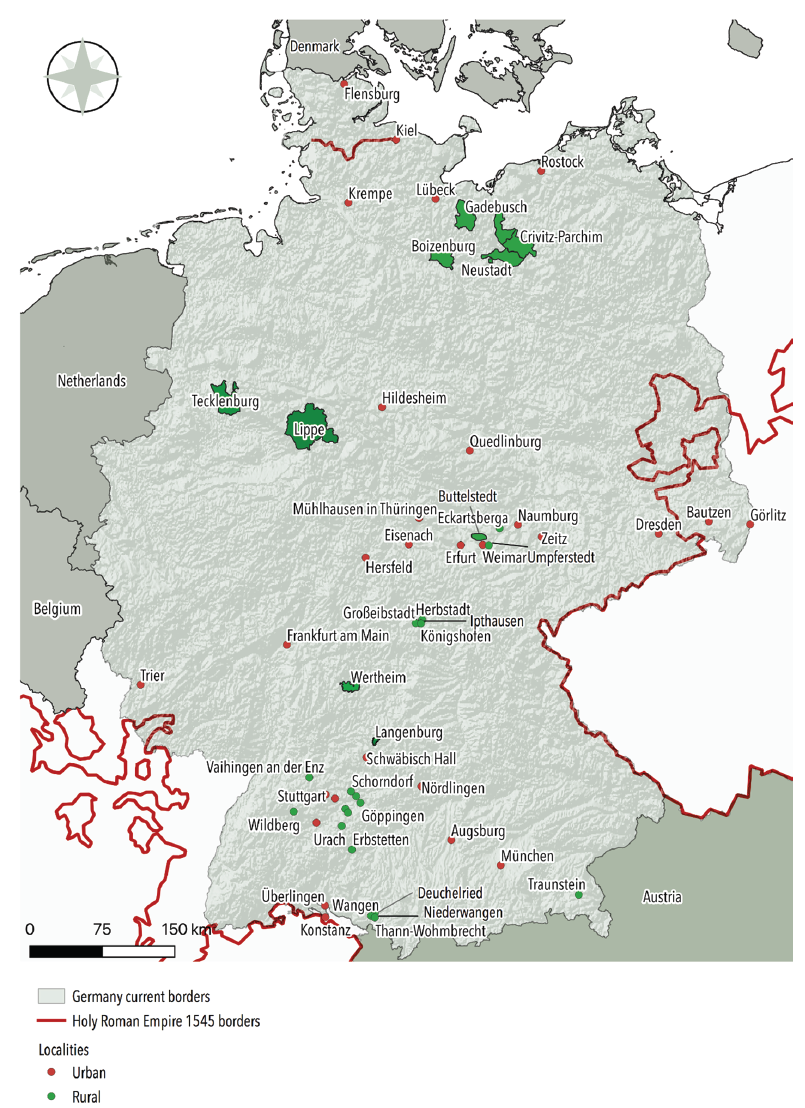
This section presents the sources, data, and methods that we use to generate the inequality estimates reported in later sections.Footnote 7 Our dataset comprises 29 cities and 76 rural communities.Footnote 8 To our knowledge, this is by far the most extensive dataset for the study of economic inequality in the German area, both in terms of geographical coverage and of the length of the period considered (compare with Fügedi Reference Fügedi and Bätori1980; Robisheaux Reference Robisheaux1989; Warde Reference Warde2006). All communities in our sample lie within the boundaries of present-day Germany, as seen in Figure 1, and almost all belong to the core area of the Holy Roman Empire. Communities were classified as urban if they held official city status (Stadtrecht) and their population exceeded 3,000 inhabitants at any point in the study. Moreover, any community with Imperial City status was classified as a city—regardless of population size—since Imperial Cities were self-governed city-states. This definition fits well with the classifications given by urban historians (Ammann Reference Ammann and Haase1978; Stoob Reference Stoob1985; Isenmann Reference Isenmann2014). See Online Appendix 3 for a detailed discussion of our classification scheme and population estimates.
COMMUNITIES COMPRISED IN THE DATABASE
Sources: Authors’ own elaboration. Borders of the Holy Roman Empire around 1545 from Volckart (Reference Volckart2020).
Sources and Data
The information we use comes from property tax registers. Exploiting these sources to study wealth inequality is a consolidated tradition in German scholarship (Fügedi Reference Fügedi and Bätori1980; Jütte Reference Jütte1984; Kocka Reference Kocka1990). Although, as discussed later, property tax registers also have some limitations, there is a consensus that they are the best sources available to study socioeconomic structures in preindustrial Germany. Moreover, they are analogous to the sources used to study inequality elsewhere in Europe and thus enable us to compare results (see Alfani and Di Tullio 2019; Alfani Reference Alfani2021 for a synthesis).
A significant part of the data is taken from works of the German Historical School. These authors provided wealth distributions in the form of tables including different wealth brackets and the number of taxpayers within each bracket. Although the information on within-bracket distribution is lost, these tables are sufficiently detailed to allow for the calculation of meaningful inequality measures like the Gini index. This is confirmed by a robustness check comparing Gini indexes built from full distributions with those built from data organized in tax brackets (reported in Online Appendix 4).
Other data come from published primary sources. These are word-forword transcriptions of tax registers kept in archives. They offer a more detailed picture of the wealth distribution, listing all heads of households with either the sum paid or the wealth owned. Additionally, we conducted new archival research on 13 localities: Konstanz, Lübeck, Traunstein, Überlingen, Wildberg, as well as Königshofen, Wangen, and six villages surrounding them (three each).Footnote 9
A challenge when dealing with medieval and early modern tax data is Germany’s political fragmentation. In its most fragmented state in the early modern period, the Holy Roman Empire consisted of more than 300 separate sovereign territories (Ogilvie Reference Ogilvie, Ogilvie and Cerman1996a, p. 121), leading to a variety of tax systems. These systems can be classified based on the Empire’s three-tier structure: Imperial taxes paid to the Emperor, territorial taxes collected by the territorial lords,Footnote 10 and city taxes collected by the city councils of—mostly but not exclusively—Imperial and Free Cities. All these taxes were not part of an integrated fiscal system that encompassed the entire Empire. Instead, each political unit constituted a complete fiscal system in itself. City taxes developed first, starting around the twelfth century. They were general wealth taxes collected once or twice a year and often called Schoß, Geschoss, or Gewerf (Isenmann Reference Isenmann and Bonney1999, p. 243 ff.). Territorial and imperial taxes developed later and were often similar in design to city taxes. Despite their wider geographic application, they were still collected at the local level by local authorities and then transferred to higher authorities. A widely-applied imperial tax was the so-called Türkensteuer, an extraordinary tax used in the fifteenth and sixteenth centuries for financing military activities against the Ottomans in the eastern territories of the Holy Roman Empire (von Hippel 2009, p. 6ff.). Online Appendix 3 shows the type of tax used in our analysis for each community in the sample.
A crucial question is who had to pay wealth taxes. The answer differs slightly from city to city. Everywhere, those having the formal status of citizens were the main taxpayers, but the duty to pay taxes was often extended to city dwellers without citizenship and sometimes to servants, usually conditional on surpassing a specific wealth threshold (Table 1 and Isenmann Reference Isenmann and Bonney1999, p. 244). Additionally, all communities granted tax exemptions to certain social categories. These usually included the clergy and sometimes other categories, such as the nobility (see Online Appendix 5 for details).
RESIDENTS’ TAX OBLIGATIONS BY CITY
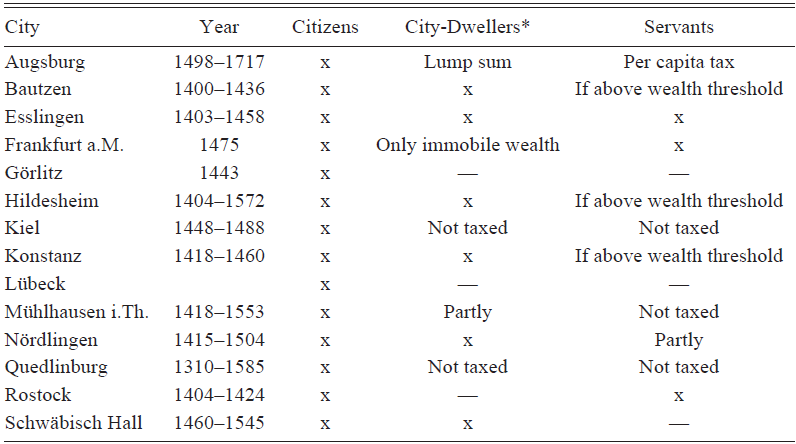
Notes: A hyphen indicates that the information is not available. * City-dwellers include non-citizens and guests.
Sources: See Online Appendix 5.
Fiscal exemptions granted to specific categories do not seriously trouble our reconstructions, because overall they were quite limited. Moreover, tax modalities remained fairly constant over time, which means the observed trends were not influenced by changes in regulations (Hartung Reference Hartung1898, pp. 175–76; Kirchgässner Reference Kirchgässner1964, pp. 80–81, 1967, pp. 78–80; Ohler Reference Ohler1978, pp. 5–7, 26). Instead, our main concern is the propertyless, that is, households that did not own any taxable wealth or were below a minimum threshold for taxation. As they did not have to pay property taxes, they were sometimes omitted entirely from the fiscal records. The exact definition of what constituted being propertyless varied from city to city and does not necessarily mean that these households owned absolutely nothing. In fact, most of the propertyless lived in low-grade dwellings and possessed certain goods necessary for survival.Footnote 11 More importantly, the propertyless were usually few in number, as even tiny morsels of land (like a small orchard) were taxed.Footnote 12
Given that we lack information about the number of propertyless households in certain localities, we remove them from all our distributions. This is a common procedure in studies of preindustrial inequality (Alfani Reference Alfani2015; Alfani and Ammannati Reference Alfani and Ammannati2017), meant to ensure the comparability of our measures of inequality (e.g., Gini indexes) across the sample. As the propertyless were few, even when omitting them the vast majority of the poor remain included in our analyses. This being said, removing the propertyless from the distributions biases our results toward greater equality. To remedy this shortcoming we make use of the information about the propertyless, which is available for 20 out of 29 cities and 69 out of 76 rural communities, to estimate their overall prevalence across time following the procedure detailed in Online Appendix 6. We use these estimates to produce tentative reconstructions that also include the propertyless.
Another shortcoming of property tax records is that—as all fiscal sources in any country or epoch—they do not record all components of wealth, but only those that were subject to taxation. These varied slightly from community to community, but real estate and arable land, which in preindustrial societies constituted by far the main component of wealth, were always taxed. Overall, we found substantial overlap in the definition of taxable wealth across our sample (Online Appendix 5, Figure A5.1 and Table A5.2). This is not surprising, given that many communities shared their tax codes with each other to improve their fiscal systems leading to legal convergence (Isenmann Reference Isenmann2014, p. 524). Nevertheless, the high degree of fragmentation of the German tax regimes makes the data presented here less coherent compared to other European regions for which long-term trends in wealth inequality have been reconstructed. However, by excluding the propertyless and using only property taxes we ensure a reasonable degree of uniformity in the data.
Similarly, one might wonder whether tax records were structurally different between city and country and consequently, whether our urban and rural data are comparable. We argue that they are comparable, for two reasons. First, several rural villages were taxed by nearby cities (e.g., Mühlhausen, Wangen, and Königshofen) and we have no reason to believe that the taxation procedures were substantially different between city and country as often the urban and rural payments were recorded in the same registers, following exactly the same recording methods. This is also confirmed by a range of in-depth studies of specific cases, like Erfurt (Schrader Reference Schrader1921, pp. 108–109). Secondly, the potential impact on our inequality estimates of small variations in taxation procedures is likely to be negligible. This is suggested by the fact that rural communities and cities follow the same trend and is confirmed by a regression-based robustness check.Footnote 13
Methods
In analyzing our data we follow the same approach as the recent literature on preindustrial inequality. First, we reconstruct household-level distributions for each community based on the archival sources previously described. The choice of the household level has been made by virtually all recent studies directly comparable to ours (e.g., Alfani Reference Alfani2015; Alfani and Ryckbosch Reference Alfani and Ryckbosch2016; Reis Reference Reis2017; Bengtsson et al. Reference Bengtsson, Missiaia, Olsson and Svensson2018).
Secondly, based on the observed distributions, we calculate Gini indexes for each community and year in our sample. This allows for a comparative analysis of local trends in inequality, which is performed in the next section.Footnote 14 The community-level analysis also provides a good benchmark to judge the validity of the aggregate reconstruction.
Thirdly, we produce an aggregate estimate of wealth inequality for Germany as a whole—defined as the area within the current boundaries of the Federal Republic of Germany—from 1350 to 1850. Ideally, one would like to know the actual distribution of wealth, based on information from every household in Germany expressed in one uniform currency. Unfortunately, such census-like information is not generally available for preindustrial societies. A practical solution to this problem is to model the aggregate distribution from sampled local distributions. In essence, we estimate the wealth share of each decile of the population for each locality. These wealth shares are then used to model the aggregate distribution representing all localities. In doing so, we weight the local distributions according to some principal population statistics so that the sample reflects the overall structural characteristics of the population. The goal of the aggregation is thus to approximate the actual distribution of wealth as best as possible. To do this, we follow the method introduced by Alfani (Reference Alfani2015) and subsequently applied to a range of preindustrial states. The method is synthetically described later, and Online Appendix 6 provides a detailed explanation.
As a first step, for every sample community in a given year, we model a corresponding distribution consisting of exactly 100 elements or “fictitious households.” Each fictitious household receives an empirically-estimated wealth value, based on the wealth shares calculated from the original distribution reconstructed from archival sources. We take the wealth shares of the population deciles because it is not possible to directly compare the actual taxable wealth of different communities. This, because different sources used different currencies that cannot be reliably converted into a common one. The tenth decile, the richest one, is modeled in greater detail, using information about the top 5 and top 1 percent of the wealth distribution.
In the second step, the fictitious distributions for each city and year are merged into an overall “urban” distribution. Similarly, the distributions for every single rural community and year are merged into an overall “rural” distribution. In order to combine the aggregate urban and rural distribution in an overall “regional” distribution representative of the whole of Germany (third step), two additional weighing issues remain to be solved. First, to take into account that rural households were, on average, less wealthy compared to urban households, we adjust their values taking into account the estimated rural-urban wealth ratio. Secondly, since only a small share of the German preindustrial population lived in cities, we weigh rural and urban distributions by the urbanization rate (5,000 inhabitant-threshold). This final weighing is meant to achieve, in the aggregate distributions, a ratio between the number of urban and rural elements that matches the urbanization rate. This procedure is analogous to that discussed by Milanovic (Reference Milanovic2005) to calculate “weighted international inequality.” After completing this step, our aggregate distributions representing the whole of Germany are finally ready to use, enabling us to calculate Gini coefficients from 1350 to 1850.
Finally, we provide a robustness check for our aggregate estimates. Outlined in more detail later, we adopt a regression-based method for aggregating our heterogenous database (see Clark Reference Clark2005), which yields very similar results compared to our preferred method.
INEQUALITY IN PREINDUSTRIAL GERMANY: EVIDENCE FROM CASE STUDIES
This section uses a case-by-case approach to first establish four clearly-recognizable phases of alternatively decline and growth in wealth inequality from ca. 1350 to 1850.
Phase I: The Aftermath of the Black Death
The first phase which we can detect spans from ca. 1350 to 1450 and is characterized by inequality decline, which we will argue was triggered by the Black Death. Figure 2 plots the developments for a range of cities. The series for several German cities, like Esslingen, Frankfurt, München, and Quedlinburg all show substantial reductions in wealth inequality from 1350 onwards. This declining trend continued well into the fifteenth century. Quedlinburg is a particularly revealing case since it is the only city for which pre-Black Death data are available. Unfortunately, the absence of intermediate observations between 1300 and 1500 leads to some uncertainty about the timing of the reversal of the trend, which might have begun before 1500.
LONG-TERM TRENDS IN ECONOMIC INEQUALITY IN URBAN GERMANY, 1300–1850
Sources: See the main text.
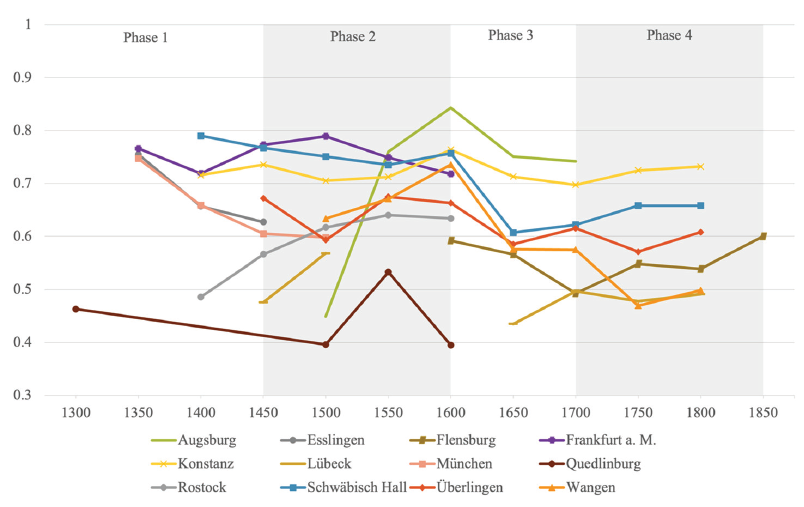
The case of Rostock is partially different. Starting from a low point of 0.426 in 1378 the Gini index of wealth inequality increased constantly at every following observation, reaching 0.64 around 1550.Footnote 15 This dynamic does not rule out the possibility that pre-Black Death inequality was higher than in the immediately post-crisis years. Indeed, inequality decline in the two-three decades immediately following the Black Death, and early recovery thereafter has been reported for cities in Tuscany (Alfani and Ammannati Reference Alfani and Ammannati2017). The case of Rostock might be explained by its demographic and economic flourishing as part of the German Hansa (Dollinger Reference Dollinger1999, pp. 46–47), which experienced a boom in its trading activities after the pandemic (Findlay and O’Rourke Reference Findlay and O’Rourke2007, pp. 119–124). This led to a mass migration of poor rural dwellers into Hansa cities, which might have driven up inequality.Footnote 16
The earliest continuous data available for rural areas cover the beginning of the fifteenth century (Figure 3). Therefore, they do not allow for an analysis of the immediate post-Black Death period. Nevertheless, from 1400 onwards, the rural districts of Neustadt and Boizenburg in Mecklenburg show declining inequality. Data prior to 1400 are only available for a number of villages in the County of Wertheim and the bailiwick of Buttelstedt. These data are limited to single years only and have to be interpreted cautiously, however they seem to confirm a decline in the immediate post-Black Death period as the Gini values reported for 1350 are substantially higher than those in 1400.
LONG-TERM TRENDS IN ECONOMIC INEQUALITY IN RURAL GERMANY, 1300–1850
Sources: See the main text.
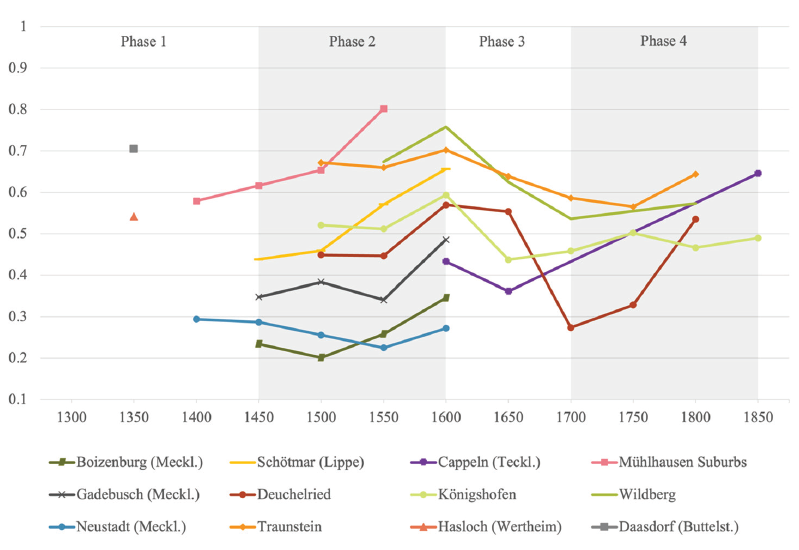
Phase 2: From the End of the Middle Ages to the Eve of the Thirty Years’ War
The second phase, from ca. 1450 to 1618, is characterized by rising wealth inequality. The rise was particularly drastic in the cities of Augsburg, Nördlingen, and Wangen (Figure 2, Phase 2). In Augsburg, wealth inequality increased from 0.449 in 1498 to 0.843 in 1604. Inequality growth was less pronounced in Schwäbisch Hall, Konstanz, and Überlingen. Two exceptions to this upward trend exist: Frankfurt and (from the mid-sixteenth century only) Quedlinburg. Both cities were struck by severe plagues in this period, whose timing coincides fairly well with their respective decline in inequality (Jütte Reference Jütte1984, p. 57; Wozniak Reference Wozniak2013, pp. 137–56).
Despite a couple of outliers, our data strongly support the view that the sixteenth century was a period of rising inequality in cities. This tendency is even clearer if we look at rural areas as, notwithstanding some short-term fluctuations, wealth inequality was higher everywhere at the end of the sixteenth century than it was at the beginning and sometimes the increase was substantial.
Phase 3: The Thirty Years’ War and Its Aftermath
The third phase, from circa 1618 to circa 1700, was strongly influenced by the Thirty Years’ War (1618–1648). This phase is characterized by declining wealth inequality across all cases in our sample, both urban and rural, reversing the trend in phase 2. Although the decline was particularly steep in the first half of the century, when the Thirty Years’ War was in full swing, many localities experienced inequality reduction in the following crisis-ridden decades as well. All communities in our database were affected by the war, but its impact varied by region. The most affected territories were Pomerania, Mecklenburg, Thuringia, Hesse, and Württemberg, whereas the least directly affected territories were the Austrian Duchies and parts of the northwest of the Holy Roman Empire (Whaley Reference Whaley2013a, p. 633). This is reflected in our sample, as cities such as Augsburg, Schwäbisch Hall, Überlingen, and Wangen, all of which suffered because of military occupation, show a particularly substantial drop in inequality during the first half of the century. We can reach similar conclusions looking at the rural areas. For example, the modest inequality decline reported for Tecklenburg, located in northwestern Germany which was less affected by the war, is in stark contrast to Königshofen, Wangen, and the surrounding villages. In these areas, which are known to have suffered grievously (Whaley 2013 a, p. 633; von Hippel 2009), we find large-scale inequality reduction. For example, in Königshofen the Gini index dropped from 0.594 in 1601 to 0.437 in 1664.
Phase 4: The End of the Holy Roman Empire and the Beginning of Industrialization
The fourth phase, covering the period from circa 1700 to circa 1850, is characterized by an increase in inequality, marking a reversal from the trend in phase 3. This period was defined by further state consolidation, particularly in Brandenburg-Prussia and Habsburg-Austria (Whaley Reference Whaley2013b, pp. 348–51). This was followed by drastic changes in the political landscape: in 1806, the Empire dissolved and most territories re-grouped in the German Confederation in 1815 (Whaley Reference Whaley2013b, pp. 646–50). Another major change during this period was the beginning of industrialization, which in this part of Europe took hold from around 1840, with some regions experiencing early industrialization from about 1780 (Ogilvie Reference Ogilvie, Ogilvie and Cerman1996a, p. 121).
Notwithstanding the magnitude of these economic and political changes, the increase in inequality during this period is rather modest in cities. In Wangen inequality even declined in the first half of the century, later experiencing very limited growth. However, in rural areas, there was a pronounced increase in inequality, except for Königshofen where it was more limited. Wealth inequality growth was particularly intense in the villages of Deuchelried and Niederwangen where the Gini increased from 0.274 and 0.332 respectively in 1700 to 0.535 and 0.392 in 1800.
Before proceeding, we need to mention one further relevant conclusion from our case-by-case analysis: across time, inequality levels tended to be higher in cities than in rural areas. This empirical finding has also been reported in studies of other European areas, such as Tuscany (Alfani and Ammannati Reference Alfani and Ammannati2017, p. 1084) and Holland (Van Zanden 1995, p. 649), as well as for the German region of Hesse-Kassel during the nineteenth century (Wegge Reference Wegge2021). This is an additional reason why we will also discuss aggregate reconstructions for cities and rural areas separately.
INEQUALITY IN PREINDUSTRIAL GERMANY: AN AGGREGATE ESTIMATE
This section focuses on the trends in wealth inequality in the whole of Germany using the method described previously. We validate whether the aggregate figures support our characterization of a four-phase development of German inequality from the Black Death until the beginning of industrialization. Moreover, we discuss the likely mechanisms behind the observed trends and the plausibility of some of the prevailing theories about preindustrial inequality change in Germany. Finally, Germany’s inequality trajectory is compared with other European regions.
Wealth Inequality in Germany, 1350–1850
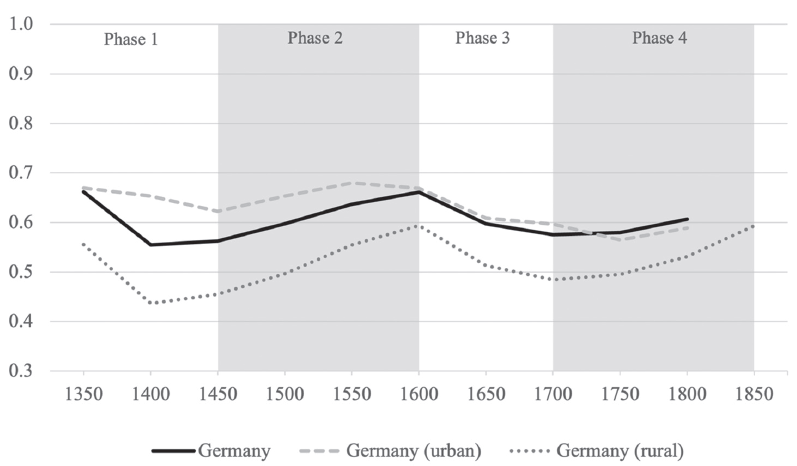
Figure 4 and Table 2 report our series of wealth inequality estimates for Germany as a whole, which are the main contributions of this article. We also report 95 percent confidence intervals calculated by employing a bootstrap technique.Footnote 17 The overall trend is in line with the evidence from our case-by-case analysis (compare with Figures 2 and 3). Germany started from a relatively high level of wealth inequality in 1350, with a Gini of 0.662, and experienced an overall decline following the Black Death. This decline in inequality lasted until about the mid-fifteenth century, when a secular minimum in the Gini level was reached, at 0.562. This result is consistent with Abel’s (Reference Abel1976) and Reference Rodepeter, Börsch-Supan and SchnabelRodepeter’s (1998) conjectures about income inequality. Indeed, a decline in both wealth and income inequality after the Black Death seems to have been a pan-European phenomenon (Alfani and Murphy Reference Alfani and Murphy2017; Scheidel Reference Scheidel2017; Alfani Reference Alfani2021, Reference Alfani2022). This important finding is worthy of some further discussion.
LONG-TERM TRENDS IN ECONOMIC INEQUALITY IN GERMANY (GINI INDEXES)
Notes: In most instances the inequality estimates for Germany as a whole will fall between the urban and the rural estimates simply because cities tend to be more unequal than villages. However, this is not a statistical necessity—see Online Appendix 6 for details regarding the estimation procedure. The reason is that regional inequality also depends upon the urban-rural differential in average household wealth, which is an important source of overall inequality. So, when cities experience a period of relatively low inequality it might be that the regional estimates temporarily exceed the urban ones. In our case, this happens during 1750–1800.
Sources: See the main text.
ECONOMIC INEQUALITY IN GERMANY, C.1350-1850 (GINI INDEXES. 95% CONFIDENCE INTERVALS IN BRACKETS)
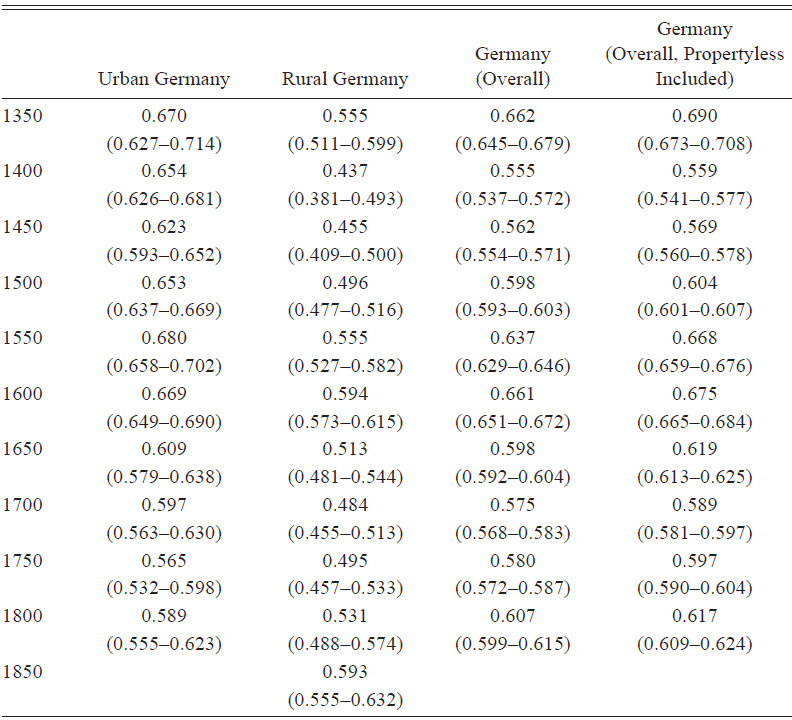
Notes: 95% confidence intervals have been produced by means of bootstrap techniques. The aggregate wealth distributions have been produced with the method introduced by Alfani (Reference Alfani2015). See Online Appendix 6 for details.
Sources: See the main text.
The Black Death killed approximately half the German population, and local mortality rates were sometimes substantially higher (Reference Rodepeter, Börsch-Supan and SchnabelRodepeter 1998, p. 5; Wilson Reference Wilson2017, p. 494). Both cities and rural areas were affected, which is confirmed by our urban and rural series in Figure 4, both showing inequality reduction from 1350. Importantly, the Black Death left physical capital, such as real estate, intact, damaging human capital instead. This had several consequences that help to explain why the pandemic led to a lower concentration of wealth. First, the scarcity of manpower led to the higher marginal productivity of labor. This drove up wages for the surviving workers in urban crafts and agriculture. Secondly, rising wages came alongside falling prices of real estate as its supply outstripped demand. Consequently, depopulation enabled the poor to take over empty real estate and to enlarge their plots (Abel Reference Abel1976, p. 66; Rösener 1996, pp. 65-66; Reference Rodepeter, Börsch-Supan and SchnabelRodepeter 1998, pp. 7–12).Footnote 18 Thirdly, there was a power shift that saw a weakening of the feudal lords relative to the peasants and thus a reduction of their rent extraction. The peasants’ feudal burdens were reduced and their rights improved since they were in a good position to negotiate with the landowners, who needed a workforce for their empty fields. Importantly, this relative weakening of seignorial power happened in regions to the west of the Elbe river only, the area most represented in our database. East of the Elbe the Black Death had the opposite effect, leading to higher contributions and more compulsory services to be provided by the peasants (Scott Reference Scott2002, pp. 153–60; Jenks Reference Jenks and North2005, p. 49; Ogilvie Reference Ogilvie and Cavaciocchi2014). More generally, across Western Europe labor became scarce in the aftermath of the Black Death, and for a period workers enjoyed a much stronger bargaining power (see Alfani Reference Alfani2022 for a synthesis). All these mechanisms jointly led to inequality decline.
The post-Black Death low point was reached around 1400 (slightly later for cities), after which a long phase of rising inequality followed. Overall wealth inequality peaked at a Gini of 0.661 around 1600. This result suggests that the late Middle Ages and the first part of the early modern period were a phase of growing inequality, eventually interrupted by the outbreak of the Thirty Years’ War. The historical literature hints at three possible mechanisms that could explain this pattern: economic growth (Scheidel Reference Scheidel2017, p. 335), demographic expansion (Pfister Reference Pfister and Nigro2020), and inegalitarian resource extraction by special-interest groups and public authorities (Pfister Reference Pfister2019, p. 242; Ogilvie Reference Ogilvie1992, pp. 426, 429–34). Our data do not allow us to test which of these arguments best explain Germany’s inequality pattern. However, economic growth does not appear to be a plausible candidate: the available data on GDP per capita show that Germany experienced a substantial economic decline during the sixteenth century, placing it clearly on the losing side of the so-called “Little Divergence” between North and South Europe (Pfister Reference Pfister2011; Broadberry et al. Reference Broadberry, Campbell, Bas van Leeuwen and Overton2015, p. 423).
There is some evidence that rising inequality had already started to level off in cities from ca. 1550 (Figure 4). This could be related to specific, local pre-war crises. From the late sixteenth century onwards, Europe’s economic center of gravity shifted away from the Mediterranean to the new Atlantic trade routes dominated by England and the Netherlands. As a consequence, former important trading posts such as Erfurt, Lübeck, and some of the great south German trading cities lost much of their clout. This coincided with the bankruptcy of a number of trading firms, involving rich merchants who were additionally strained by several state bankruptcies in Spain and France (Gömmel Reference Gömmel1998, pp. 1–6; Scott Reference Scott2002, pp. 115–32). These processes could have reduced inequality by curtailing the wealth of the richest part of the population in some urban settings, but not in rural areas.
Throughout the crisis-ridden seventeenth century and especially during the Thirty Years’ War (1618–1648) inequality declined in Germany, reaching its early modern low in 1700 with a Gini of 0.575. It is important to clarify that although the inequality-reducing effects of the Thirty Years’ War were expected (based on earlier literature), this conflict remains an exception because medieval and early modern wars did not usually lead to inequality reduction, in Germany or elsewhere.Footnote 19 In contrast to other preindustrial wars, the Thirty Years’ War had immense and exceptional spill-over effects, connecting several “egalitarian” factors in one event: widespread physical destruction, commercial and productive breakdown, and famine and death by the plague that selectively hit the poor. Each of these components requires some further discussion.
The Thirty Years’ War was the most ravaging conflict of early modern Europe. It saw large-scale destruction or confiscation of financial capital, real estate, food reserves, and productive assets such as agricultural livestock (Redlich 1959; Van Zanden 1995, p. 646; Wilson Reference Wilson2009, pp. 783–806; Scheidel Reference Scheidel2017, pp. 338–39). Additionally, the war led to a breakdown of market exchange and production. This was due partly to the loss of commercial capital, but also the interruption of trade routes and the long-lasting, highly insecure economic situation played a role. Consequently, commercial activity and production, especially in the agricultural sector, plummeted. Widespread bankruptcy ensued (Röck Reference Röck1989, pp. 941–43; Wilson Reference Wilson2009, pp. 795–801). These developments continued to weigh heavily on the German economy beyond the actual war in what is known as the general crisis of the seventeenth century (Ogilvie Reference Ogilvie1992).
The ravages of war and economic breakdown could have led to inequality reduction by curtailing the wealth of the economic elites. However, they could also have reduced inequality simply because they led to mass mortality. In fact, the decline in market exchange and production coincided with harvest failures and led to widespread famine. This might have facilitated the diffusion of plague by roving soldiers throughout Germany. In particular, during 1627–1629 Germany was affected by the worst plague since the Black Death. Plague and famine together led to a population decline of about 40 percent (Eckert Reference Eckert1996; Outram Reference Outram2001). This demographic catastrophe favored inequality reduction through two distinct channels: first, by reducing the price of agricultural goods and land, and by increasing marginal productivity of labor and therefore labor income (Pfister Reference Pfister and Nigro2020), which would be similar to what happened after the Black Death. Secondly, famine and plague were socially selective: poor people were more likely to die due to the specific socio-economic conditions created by the war (Outram Reference Outram2001; Scheidel Reference Scheidel2017, p. 338). It seems entirely possible that in the case of the seventeenth-century plagues the second channel prevailed, similarly to what has been argued for other European areas, for example, the Republic of Venice (Alfani and Di Tullio 2019, p. 119). This might have differentiated the redistributive dynamics associated with the Black Death and with the seventeenth-century plagues: in the case of the first, large-scale redistribution towards the poor occurred, but after the second, extermination of the poor prevailed, as has been pointed out by Alfani (Reference Alfani2022).
It is difficult to disentangle the distributive impact of war, famine, and plague in this period. Additionally, while population dynamics surely played a role, we believe that the evidence is not consistent with a demographic explanation of inequality decline during the Thirty Years’ War such as that proposed by Pfister (Reference Pfister and Nigro2020). Instead, the decline in wealth inequality experienced by seventeenth-century Germany was so intense and long-lasting because it resulted from a more complex interaction of several war-related mechanisms, together affecting both the top and the bottom of the distribution. This view finds support in a comparison of Germany with the case of the Sabaudian State (Piedmont) in northwestern Italy. This state was located just on the other side of the Alps and was even represented at the diet of the Holy Roman Empire (Reichstag). The Sabaudian State was affected by exactly the same plague wave that ravaged Germany. The plague entered north Italy at the end of 1629, and during 1630 it caused the death of about 35 percent of the overall population (Alfani Reference Alfani2013a): not far from the 40 percent reported for Germany. However, the Sabaudian State was only marginally affected by war in those years (the main conflict was the War of the Mantuan Succession of 1628–1631, fought mostly beyond the state boundaries). Consequently, while the plague might have affected the poor in ways not dissimilar from Germany, other “egalitarian” factors involving the top of the distribution, such as the destruction of capital or the wide-ranging breakdown of commercial activity and agricultural production, were mostly absent. Indeed, unlike in Germany, inequality continued to grow in Piedmont throughout the seventeenth century (Alfani Reference Alfani2015, pp. 1080–84). Even though there is some evidence of local plague-induced drops in inequality, they were of limited size and very short-lived (Alfani Reference Alfani2010b).
Additional support for the view that the Thirty Years’ War was able to lead to inequality decline only because of its truly exceptional scale and because it interacted with widespread famine and plague comes from a comparison with the other major wars affecting preindustrial Germany. None of these, including the German Peasants’ War of 1524–1525, which was very violent and killed about 100,000 people in only two years (Wilson Reference Wilson2017, p. 593), seem to have left even a trace in our series.
From around 1700, inequality rose again. This development continued until the end of the early modern period. For the rural areas, we have evidence of inequality growth until around 1850, when the Gini index, at 0.593, reached again the secular maximum that it had briefly touched on the eve of the Thirty Years’ War. In cities, inequality stagnated throughout the eighteenth century with signs toward growth from the mid-century only. Note that the overall tendency across Germany reflects more closely the dynamics characteristic of the rural areas because the vast majority of the population was rural. Also note that our inequality estimates for 1800–1850 are basically in line with the estimates reported by Wegge (Reference Wegge2021) for the principality of Hesse-Cassel, where ca. 1850 the Gini calculated on landholding sizes stands at 0.615.
There are several plausible explanations for this overall tendency toward inequality growth in eighteenth- and early nineteenth-century Germany. Firstly, it has been argued that, as during the sixteenth century, population growth led to inequality growth (Pfister Reference Pfister and Nigro2020). Secondly, the increase in industrial production might have contributed to rising inequality (Kocka Reference Kocka1990, pp. 117–20). This explanation points to higher wages of skilled workers and large profits as drivers of inequality during early industrialization (Kuznets Reference Kuznets1955; Ray Reference Ray1998, pp. 209–11). The explanation also meshes well with accounts of the gradual growth of industrial production from the late seventeenth century, especially in rural areas (Gewerbelandschaften) (Ogilvie Reference Ogilvie, Ogilvie and Cerman1996a).
While in principle both these arguments are compatible with our data, earlier literature on Germany has failed to consider another factor which has recently been proposed as a cause of inequality growth in early modern Europe: the rise of the fiscal-military state. According to this theory, states in early modern Europe increasingly extracted and redistributed economic resources in ways that promoted inequality growth, mainly because of increases in per-capita taxation in the context of regressive fiscal systems (Alfani and Di Tullio 2019; Alfani Reference Alfani2021). In Germany, state formation is usually considered to have been a longrun, indirect consequence of the Thirty Years’ War, accelerating in the major territories from the end of the early modern period (Ogilvie Reference Ogilvie and Ogilvie1996b, p. 266; Schilling Reference Schilling1994, p. 21).Footnote 20 Although Germany might have been affected by increases in regressive taxation at the state level later than other European areas, the fact remains that state formation might help to explain the observed final phase of inequality growth.
Robustness Checks and Additional Insights
Our conclusions about the overall trends in wealth inequality across Germany can be further strengthened by a series of robustness checks (additional technical details in Online Appendix 6). We begin by applying an alternative method to confirm the reliability of our findings. We adapted the regression-based approach introduced by Clark (Reference Clark2005) to our case and we applied it to the panel of local Gini indexes introduced in the previous section. We estimated a linear regression of the following form:
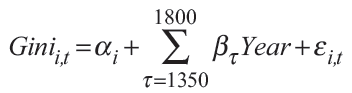 $$Gin{i_{i,t}} = {\alpha _i} + \mathop \Sigma \limits_{\tau = 1350}^{1800} {\beta _\tau }Year + \,{\varepsilon _{i,t}}$$
Our dependent variable is the Gini coefficient in locality i in year t (1350 to 1800, in steps of 50 years); a. is a full set of locality fixed effects, which capture time-invariant locality-specific characteristics. Our main interest is to estimate the parameters on the 7ear-dummies (1350 to 1800) to derive average Gini change. The omitted reference category is the year 1600, when we have the greatest number of observations.
This estimation resulted in a “dimensionless index,” in other words, an index that only reports increases or decreases in inequality relative to the benchmark year 1600. Using the Gini index of 1600 calculated with our original aggregation method to anchor the dimensionless index, we arrive at an alternative set of Gini estimates. The result from this alternative estimation is shown in Figure 5, where it is compared with our preferred estimates. The robustness check confirms that the trend in wealth inequality discussed earlier is not an artificial product of our preferred reconstruction method. Indeed, when the same Gini is assumed for 1600 the alternative estimates are within, or bordering with, the 95 percent confidence intervals calculated on our aggregate distributions over the whole period.Footnote 21
INEQUALITY IN GERMANY: PREFERRED VS. ALTERNATIVE ESTIMATES
Sources: See the main text.
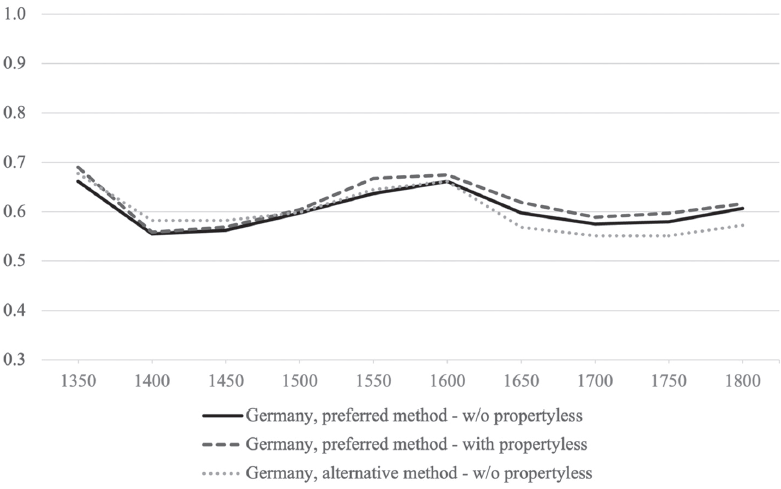
One shortcoming of our overall reconstruction is that it excludes the propertyless, and one might conclude that this leads to a significant underestimation of wealth inequality. To quantify this bias, we aggregated the available information on the propertyless in order to produce some tentative estimates of their prevalence over time. Since the term “propertyless” can cause confusion, we underline that this category should not be confused with that of “the poor.” Poor people were always included in tax registers and are therefore included in our distribution. The property-less are more properly understood as a subgroup of the poor—indeed, as the poorest of the poor: they had no taxable wealth whatsoever or fell below the threshold for taxation (Scott Reference Scott2002, pp. 44–45). Here we are not making any further claim about the nature of the propertyless, save for arguing (based on our archival sources) that they are the only category that is usually entirely absent from our distributions.Footnote 22
We estimated that during the early modern period the propertyless were only a small percentage of the German population, ranging from a low of 0.81 percent in 1400 to a high of 8.4 percent in 1550. Based on these estimates, we added to our aggregate distributions the corresponding number of extra elements, all set at zero wealth, and recalculated our inequality measures. As reported in Table 2 and Figure 5, adding the propertyless leads to only slightly higher Gini levels: our measures increase by a minimum of 0.004 points in 1400 to a maximum of 0.03 points in 1550. Importantly, the overall trend does not change and becomes even more pronounced during the early modern period. This result is even more significant considering that not all those “property-less” were entirely destitute. At least some of them had wealth above zero—but remained below the threshold for taxation. Consequently, the series including them should be understood as an upper boundary to the “real” level of wealth inequality across Germany.
Germany and Europe: A Comparison
We now focus on the path followed by Germany in relation to other European areas. In Figure 6, Germany is compared to those areas for which similar reconstructions are available. The overall trends in wealth inequality that we have detected match quite closely those found elsewhere with one important exception: the phase of inequality decline covering the seventeenth century, which is not reported elsewhere. In particular, until 1600 both levels and trends match those found for Italy and especially for the Sabaudian State quite well, but only a century later Germany was comparatively much more egalitarian. Note that levels of inequality between Germany and Italy are of broadly comparable nature because for both areas the series refer to wealth, while those for the Low Countries refer to income inequality (which is usually lower than wealth inequality, in the past as today). Consequently, with respect to the Low Countries only the trends, not the levels, should be compared (Alfani and Ryckbosch Reference Alfani and Ryckbosch2016). The same point could be made for England, for which estimates of income inequality produced with a different method (social tables) confirm the picture of growing inequality from the late fourteenth to the late seventeenth century and beyond (Broadberry et al. Reference Broadberry, Campbell, Bas van Leeuwen and Overton2015, p. 329; Alfani Reference Alfani2021). Figure 6 also suggests that without the decline in inequality during the seventeenth century, Germany might have found itself, by the mid-eighteenth century, in a much more unequal scenario—indeed, had it followed an “Italian” path after 1550 or 1600, its Gini index would have been 0.1–0.2 points higher (compare the Gini of 0.607 we reconstructed for 1800 Germany to the 0.782 found for the Sabaudian State or the 0.856 found for the Florentine State in 1750).
ECONOMIC INEQUALITY IN GERMANY AND EUROPE (GINI INDEXES)
Notes: The series refer to wealth inequality for Germany, the Sabaudian State, and the Florentine State, and to income inequality for the Low Countries.
Sources: See the main text.
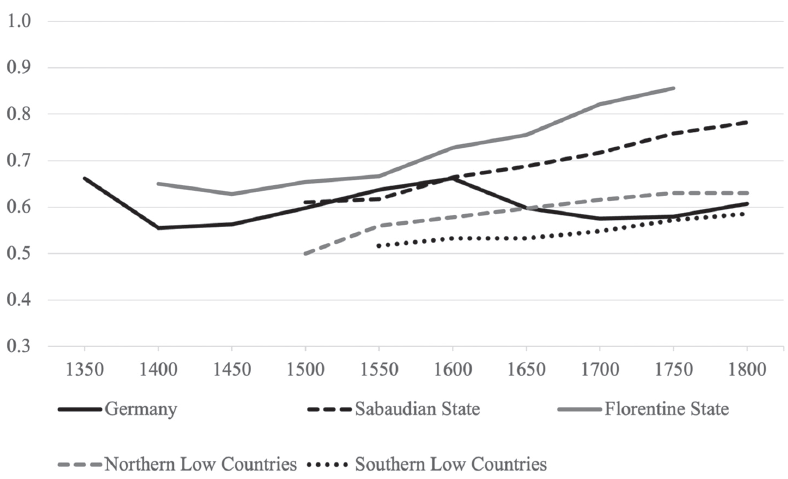
Germany followed a path similar to that of other European regions throughout the period, bar for the seventeenth century. Then, an exceptional event (the Thirty Years War, in combination with the worst plague since the Black Death) triggered a phase of inequality decline that has not been observed for any other European area so far. This interrupted a tendency toward inequality growth that otherwise could have been reasonably expected to continue undeterred.
The view that the Thirty Years’ War had a direct impact upon German inequality can be further supported by an empirical test. Table 3 reports difference-in-differences estimates of the effect of the Thirty Years’ War in Germany. As a counterfactual, we take the only European region integrated into the structures of the Holy Roman Empire but not exposed to the Thirty Years’ War and for which comparable inequality data exist: the Sabaudian State.Footnote 23 We code all our communities in Germany as “treated” and all communities in the Sabaudian State as “non-treated,” with the post-treatment period beginning in 1650.Footnote 24 Additional technical details are provided in Online Appendix 7.
THE LEVELING EFFECT OF THE THIRTY YEARS’ WAR: A DIFFERENCE-IN-DIFFERENCES ESTIMATE
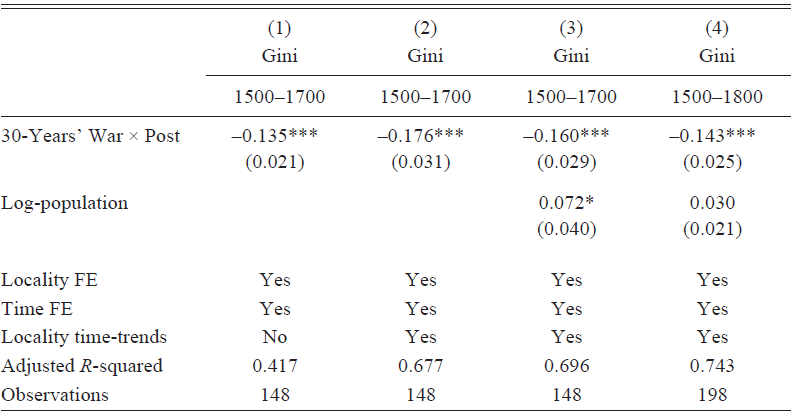
Notes: Estimation method is OLS. Robust standard errors clustered at the community level in parentheses. *** p < 0.01, ** p < 0.05, * p < 0.1.
Sources: See the text and Online Appendix 7.
The identifying assumption is: communities that were “treated” by the Thirty Years’ War would have experienced a similar inequality development to communities that were “not treated,” had the war not happened. Figure 6 shows that Germany and the Sabaudian State followed a similar inequality development until the outbreak of the Thirty Years’ War. This provides visual evidence for the common-trend assumption (Angrist and Pischke Reference Angrist and Pischke2009, pp. 231–33). To measure the effect of the Thirty Years’ War on inequality we estimate this linear specification:
 $$Gin{i_{i,t}} = {\alpha _i} + {\pi _t} + \beta (30Y{W_i} \times Pos{t_t}) + \delta \ln ({P_{i,t}}) + Tren{d_i} + {\varepsilon _{i,t}}$$
Our dependent variable is the Gini coefficient in locality i in year t (1500 to 1700 or 1800, in steps of 50 years). The interaction of the treatment-status indicator (30 YW) and the post-treatment indicator (Post) provides the coefficient of interest; a. and n t are full sets of locality and time fixed effects. To address concerns about unobserved time-varying locality-specific characteristics, we modify the benchmark model to include locality-specific time trends (Trend). We also control for a locality’s population size P (in logarithm).
Our baseline estimates in Column (1) and the more stringent specification in Column (2) suggest that the war reduced wealth inequality in German communities on average by about 0.135 to 0.176 Gini points. This is a sizeable effect compared to the inequality levels reported in Table 2. If we control for population size of communities (Column (3)) the effect gets smaller, but it still remains sizeable. Column (4) indicates that the effect of the war persisted, as communities in Germany were significantly less unequal even when considering the period until 1800.
Germany’s seventeenth-century divergence from the path followed by other European regions is hardly surprising if we consider the exceptional impact of the Thirty Years’ War in this area. This is clear in comparison to Italy, which in Braudel’s words was only “slightly scratched” by the conflict (Braudel Reference Braudel1986, p. 37; Alfani Reference Alfani2013b, p. 41), but overall this is valid for the Low Countries as well. Deaths among the military were much more numerous in the German area than in the Low Countries (compare, e.g., Clodfelter Reference Clodfelter2017, pp. 36–41) and the same holds for deaths among the civilian population, especially when considering the famines and epidemics that the war had induced or at least had favored. A confirmation comes from estimates of overall population change: by 1700, the German population remained 13 percent lower than in 1600, while the Dutch had grown by one-third (Alfani 2013 a, pp. 411, 424).
After 1700, Germany re-joined the European fold and returned to a path of continuous inequality growth, although starting from levels lower than those typical of other parts of the continent. Additional research, especially on the nineteenth-century distributive dynamics, would be required to fully grasp the possible implications of this German specificity. This, however, is beyond the scope of this article.Footnote 25
CONCLUSION
This article has provided an overview of long-term inequality trends in preindustrial Germany. By using a novel database of wealth inequality we were able to estimate inequality trends over five centuries (from ca. 1350 to 1850). This allowed us to document four alternating phases of inequality decline and growth.
The first phase of inequality decline was triggered, as elsewhere in Europe, by the Black Death of 1347–1352 and it lasted until ca. 1450. After this temporary calm in inequality, the trend turned toward growth again. Throughout the eventful sixteenth century, the time of the Protestant Reformation and religious wars, Germany experienced steadily rising inequality. Inequality reached its high point on the eve of the Thirty Years’ War (1618–1648). Subsequently, we find the second phase of significant inequality decline, triggered by this exceptionally destructive war and the widespread plague it brought with it in 1627–1629. This second phase of inequality decline is particularly important, as it distinguishes Germany from other European areas for which we have studies of long-term inequality trends. Indeed, from Italy to the Low Countries inequality growth was found to be monotonic throughout the early modern period, but in Germany, inequality growth resumed only from ca. 1700 onward. This interruption of inequality growth seems to have led eighteenth-century Germany to become, for a period at least, relatively egalitarian if compared both to its previous state in the sixteenth century and to other European regions in the eighteenth century. The implications of this will be the object of future research.
Our findings of the leveling power of large-scale catastrophes are particularly relevant in the view of recent literature about the drivers of inequality in the long run of history. While for the Black Death we confirm that Germany took part in a broader European process (see Alfani Reference Alfani2022 for a synthesis), regarding the Thirty Years’ War, we are the first to provide strong support for the potential of early modern wars to reduce inequality. In general, this confirms Scheidel’s (Reference Scheidel2017) hypothesis about the leveling power of catastrophes. However, the Thirty Years’ War was unique in its level of destruction and its high mortality, further boosted by the associated famines and plagues. These characteristics make it the only pre-industrial war for which we have evidence of a significant and long-lasting “egalitarian” impact on inequality. Consequently, this finding supports the view that we need to be very cautious when making generalizations about preindustrial distributive dynamics (Alfani Reference Alfani2021, Reference Alfani2022), and that we need more regional- or state-level studies to highlight commonalities as well as local specificities.
The picture that emerges from the case of Germany is indeed one of a succession of distributional waves, which supports the arguments put forward by Milanovic (Reference Milanovic2016, pp. 50–53), including his view that the events triggering phases of inequality decline were of an “idiosyncratic” nature. But at the same time, had those events not occurred, and had Germany continued along a path orientated toward inequality growth throughout the early modern period, as documented for other European areas (Alfani and Ryckbosch Reference Alfani and Ryckbosch2016; Alfani Reference Alfani, Diebolt and Haupert2019, Reference Alfani2021), it would have been much more unequal around 1800. In the nineteenth and early twentieth centuries, Germany followed an exemplary “Kuznets curve” with rising inequality from 1850 to 1913 followed by a decline at least until the 1970s (Kuznets Reference Kuznets1955; Dumke Reference Dumke1988, p. 13; Grant Reference Grant2005, p. 304; Bartels Reference Bartels2019, p. 689). However, our results show that in this area, as elsewhere in Europe, inequality was rising well before that. This means that we need to consider other drivers of inequality than industrialization per se or economic growth more generally. Indeed Germany, which was on the losing side of the Little Divergence from the sixteenth century, is yet another example of a preindustrial European area where inequality growth could occur without economic growth. Similar to other recent studies (Scheidel Reference Scheidel2017; Alfani and Di Tullio 2019; Pfister Reference Pfister and Nigro2020; Alfani Reference Alfani2021), we consider as alternative explanations the role potentially played by demographic forces, as well as by processes of state formation and by changes in the levels of regressive taxation. While admittedly many questions remain open and will have to be targeted by future research, our study of preindustrial Germany offers new and relevant material to current debates on the roots of inequality in western societies, past and present.


 Open access

