




Introduction
The term ‘experimentation’ or ‘experimental’ as applied to art, and particularly to music, had various meanings during the 1960s in Argentina. The significance often varied depending on the context of application and the individual using the term. In a binary presentation, the expression experimental music was commonly used to indicate something new or something in progress.Footnote 1 A symptom of the term’s ambiguity was the characterization of some ‘experimental music concerts’ as electronic music concerts. In this same vein, the production of music using electronic means emerged from what were called laboratories. This was precisely the name of the Electronic Music Laboratory of the Centro Latinoamericano de Altos Estudios Musicales (hereinafter CLAEM), which operated between 1962 and 1971 at the Torcuato Di Tella Institute in Buenos Aires. An interesting clarification about experimentation is a phrase attributed to Edgard Varèse, which some CLAEM fellows often referenced: ‘I throw experiments in the trash. What remains after the experiments are the works.’Footnote 2
Gerardo Gandini himself provided a more precise articulation of this idea in a 1968 interview: ‘I’d like to recall something Varese [sic] once said, which strikes me as particularly astute: he claimed that he threw away all the experimental works he produced – in other words, he only kept those he felt were accomplished and had ceased to be experimental. This implies, from a certain point of view, that experimental music doesn’t really exist. What can exist are experimental procedures – and they’re only of value once they stop being experimental and become music’.Footnote 3 Although it has not been possible to identify the source from which Gandini derived this idea attributed to Varèse regarding experimentation, it is intriguing that this notion of the distinction between experimental music and experimental procedures has persisted among a group of Argentine composers from the late 1960s to the early decades of the twenty-first century.
In the following pages, we will delve into the background that led to the formation of the Grupo de Experimentación Musical (GEM) of CLAEM: a collective of composer-performers that operated from 1969 to 1971 under the direction of Gerardo Gandini. We will present some previous international experiences regarding group improvisation, the context of their emergence, and the relationships that existed among these groups. Then, we will examine the creative process developed by GEM, particularly looking into the productive reception process that occurred both within the group and among some of its members. The main sources for this research come from textual and sound documents preserved in the CLAEM section of the Di Tella Archives (Torcuato Di Tella University, Buenos Aires), from articles in the press from 1968 to 1971,Footnote 4 and from interviews conducted with the composers who were part of GEM. Thus, we apply tools from historiography, oral history,Footnote 5 and reception theory.Footnote 6 By studying the productions of GEM, we aim to demonstrate that much of the context of reception was constituted by a series of notions and proposals – both theoretical and practical – related to composition, in addition to analysing particular musical works. As we will see, the origins of these notions about composition had different geographical origins as well as musical traditions.
As various scholars have already mentioned,Footnote 7 CLAEM was a postgraduate educational centre directed by Alberto Ginastera, operating from 1962 to 1971. It offered biennial fellowships for training Latin American composers, conducting regular courses, and holding special classes led by internationally renowned composers and other scholars. The primary initial source of funding came from a grant from the Rockefeller Foundation, which ended around 1968.
As part of its outreach activities, CLAEM organized conferences (mostly delivered by composers and invited personalities), concerts featuring contemporary music, and performances showcasing the works of the fellows. To carry out these concerts, the institution would hire the most prominent performers from the Buenos Aires music scene. In 1969, due to a series of economic problems in Argentina and the cessation of funding from the Rockefeller Foundation, various expenses had to be reduced, primarily the costs associated with hiring musicians for the concerts. Considering this limitation, and as a pedagogical strategy, it was proposed that the composers themselves create a group to study new sound production methods and create works collaboratively. This initiative emerged from Gandini, the young composer who served as Ginastera’s assistant professor during the ten years of CLAEM’s existence.Footnote 8 The proposal emphasized the exploration of sound materials and improvisation as a way of creating works.Footnote 9 It is worth highlighting that GEM, as such, was a collective and variable group.Footnote 10 While some performers were specifically invited for the concert, the weekly activities of GEM were carried out by a core group of composers.Footnote 11 According to testimonies from Ariel Martínez, Eduardo Kusnir, and Gabriel Brnčić, the heart of GEM consisted of Gandini, Martínez, Brnčić, Kusnir, Alejandro Núñez Allauca, and Jorge Antunes.Footnote 12 The group’s sound exploration activities and improvisation sessions began in mid-1969, with meetings typically held on a weekly basis. In a ‘Course Schedule’ from 1970 located in the archive of the Torcuato Di Tella University, it is noted that Gandini taught two weekly courses: on Tuesdays, ‘Nuevos Principios de Orquestación’, and on Thursdays, ‘Grupo de Experimentación Musical’, each lasting two hours.Footnote 13 GEM continued to operate until mid-1971, serving both as a space for free improvisation to explore sound and creative possibilities, and also as a platform for some public performances.
Improvisation groups in the mid-twentieth century
During the 1960s, there were several improvisation groups within the framework of ‘Western (art or contemporary) music’. This section will present an overview of those groups that are of particular interest here, as they helped lay the foundation for the productive reception process of GEM.
We will begin by mentioning the Improvisation Chamber Ensemble, founded in 1957 by Lukas Foss (1922–2009), where he himself performed the piano, Richard Dufallo played clarinet, and Charles DeLancey handled percussion. The Improvisation Chamber Ensemble started at the University of California, Los Angeles (UCLA), as a trio and, in 1959, expanded to a quartet with the addition of Howard Colf on cello. Foss’s initial foray into improvisation as a means of creation began around 1956 with his students at UCLA. Later, during the establishment of the Improvisation Chamber Ensemble, he formulated ‘what he called “system and chance music”, a kind of controlled improvisation’.Footnote 14
While Foss’s work and ideas circulated partially within CLAEM – primarily the album Time Cycle, in which each piece is interspersed with improvised interludes by the Improvisation Chamber EnsembleFootnote 15 – it will be demonstrated that the objectives and outcomes sought were not aligned with those of Gandini and GEM. Foss’s view of composition and its relation to improvisation aligns more closely with Ginastera’s tendency towards neoclassical organization, his incorporation of Renaissance forms in opera, and his preference for the concept of a fixed work of art over improvisation.Footnote 16 In addition to opposing the view of improvisation as composition, Foss supported the inclusion of improvised sections within composed works by referencing practices from the sixteenth century, such as the Sacra rappresentazione or Commedia dell’arte. For Foss, ‘in composition all becomes fate’.Footnote 17 Yet, ‘Improvisation . . . is not fate, [it is] . . . a hazard, kept within boundaries by the performer’s will’.Footnote 18 Despite some points of contact between the creative processes proposed by Foss and those applied by GEM, the resulting aesthetic and sound diverged. Both Foss’s group and GEM worked on the basis of pre-established patterns or frameworks. However, listening to the recordings reveals that the main difference between the improvisations of Foss’s group and those of GEM lies in the former’s tendency towards textures reminiscent of neoclassicism (or the common-practice period), whereas GEM’s approach departs from classical organization, favouring layered sound planes with no necessary interrelation.
Also in the United States, in June 1963, Larry Austin and a group of composers and performers established the New Music Ensemble (hereinafter NME) at the University of California, Davis. The group recorded two albums in 1964 and 1965.Footnote 19 The text on the first album serves as a manifesto, stating that ‘unlike other improvisation groups, the New Music Ensemble does not use plans or charts for their improvisations. Rather, they depend upon the group compositional feeling for structure from the smallest musical gesture to the total composition. Using contemporary musical vocabulary and innumerable conventional and unconventional virtuoso instrumental techniques, the New Music Ensemble creates total art improvisations’.Footnote 20 The description of the working method of Austin’s NME turned out to be quite similar to the improvisation sessions of GEM.
Larry Austin was one of the key figures who connected these three groups of composer-performers dedicated to improvisation as a means of creation across three countries (and continents): the NME (USA), the Gruppo di Improvvisazione Nuova Consonanza (GINC; Italy), and GEM (Argentina). The relationship between the Italian group and Austin’s was somewhat more direct than that with the Argentine group. Austin presented his work One-Man-Show, five theatrical pieces, during the VIII Festival de Música Contemporánea at CLAEM in September 1969. At that time, Austin was already an editor of the magazine Source: Music of the Avant-Garde and was on a concert tour in Brazil. The contact between Austin and Ginastera was mediated by Gilbert Chase, who suggested that Austin visit CLAEM, as it would be a great stimulus for the composition fellows.Footnote 21
In 1964, in Rome (Italy), Franco Evangelisti founded GINC.Footnote 22 GINC was one of the groups that emerged peripherally (or as a result) from the activities of Nuova Consonanza, an association of young Italian composers created around 1960 with the aim of promoting and disseminating contemporary music.Footnote 23 The group’s first performance took place in 1965 under the name Gruppo Internazionale di Improvvisazione Nuova Consonanza.Footnote 24 The designation ‘internazionale’ was due to the participation of a significant number of non-Italian musicians, including Larry Austin, alongside Evangelisti and Carmine Pepe. Evangelisti wrote a presentation text for the group, which was included in the concert programme.Footnote 25 In the text, he highlights Austin as the composer who introduced him to the existence of the NME: a group of composer-performers, ‘the first existing in the Western system working on truly current frameworks’. Evangelisti began his text by emphasizing the discussions among composers – since 1959 – about the limits and potential development of the ‘open work’, the challenges faced by performers trained in the nineteenth-century tradition when completing the performance of such works, where only certain instruments participate, and the limit of these open forms would be dictated by a ‘summa’ of elements with which the interpreter–co-creators could act instantly without instrumental determination.
In light of this, Evangelisti proposed the necessity for a new type of performer who is also a composer.Footnote 26 In March 1967, GINC held its second performance, no longer using the designation ‘internazionale’, and its existence continued until 1985, with some changes in its members and accompanied by a series of writings – mainly by Evangelisti – related to improvisation and the momentary form.Footnote 27 Some of Evangelisti’s postulates – particularly regarding the resolution of the gap between composers and performers – were echoed in various GEM texts prior to its first performance in 1969.
Another group dedicated to working on creation through improvisation was the Scratch Orchestra, which emerged in 1969 in London (England). The ensemble’s first performance took place in November 1969, and it focused on the creation and interpretation of various works until 1970–1972.Footnote 28 The primary reason cited for the group’s dissolution was the shift in musical and performative activity from experimentation towards politically committed activism aligned with Marxist ideas.Footnote 29 Makis Solomos stated that radical improvisation is often associated with political activism in other spheres and positioned the Scratch Orchestra as one of the major historical references.Footnote 30 The driving force behind the Scratch Orchestra was Cornelius Cardew,Footnote 31 a British composer who was musically and intellectually influenced both in England and Germany by the mentorship of Karlheinz Stockhausen – in whose circle he came into contact with John Cage, David Tudor, and the American musical avant-garde – and also in Italy, where he studied with Goffredo Petrassi in Rome in 1964.Footnote 32 Although the Scratch Orchestra grew to have one hundred members, Cardew was the principal ideologue. In mid-1969, he published a ‘Draft Constitution’ outlining a series of definitions and principles aimed at creation and participation in the public sphere, group decision-making, and inviting individuals to join the ensemble for future ‘– for lack of a better word – concerts’.Footnote 33 As Pisaro and Tilbury indicate,Footnote 34 the creation of the Scratch Orchestra came after years of improvisational experience by Cardew with the British ensemble AMM, which was dedicated to free jazz and free improvisation. This practice, along with exposure to the American avant-garde associated with Cage, Morton Feldman, and Earle Brown, among others, contributed to Cardew’s ideas.Footnote 35 Although the emergence of the Scratch Orchestra was almost simultaneous with GEM and, to our knowledge, there was no contact between the two groups,Footnote 36 it is relevant to mention its existence as another attempt – within a different country and context – to address the issues of freedom in interpretation and formal explorations in composition during the 1960s.
Indeterminacy, improvisation, calculation, and graphic scores in Buenos Aires
As already mentioned, the fellows at CLAEM received an education from invited foreign composers and intellectuals. This, together with a comprehensive library acquired through contributions from the Rockefeller Foundation and the organization of contemporary music festivals, connected CLAEM fellows with various works and theories concerning the possibilities of incorporating chance and improvisation into musical creation and interpretation. Between 1962 and 1970, CLAEM presented around forty-five works whose aesthetics or compositional procedures relate to some degree of indeterminacy, improvisation, or graphic representation. These works were showcased throughout nine contemporary music festivals and other concerts (excluding performances of works by the fellows). Thus, from a total of approximately 198 performed works, it was found that 22.7% used some degree of indeterminacy or improvisation, ranging from the nascent indeterminacy of Pierre Boulez’s Troisième sonate for piano to works by Earle Brown, Larry Austin, and Sylvano Bussotti. These pieces were presented, in very general terms, alongside ‘classical’ works of the twentieth century by composers such as Igor Stravinsky, Claude Debussy, Arnold Schönberg, Béla Bartók, Anton Webern, and Edgar Varèse, as well as electroacoustic works and other compositional trends emerging after 1950 (ranging from various types of serialism to combinations with different forms of neoclassicism).Footnote 37 This scenario illustrates part of the sound environment that circulated in Buenos Aires, solely within the concerts organized by CLAEM. Furthermore, within that microcosm represented by the Torcuato Di Tella Institute, we must also consider a set of events or artistic experiences – an aesthetic experience, as Hans Robert Jauss would term itFootnote 38 – directly related to improvisation and live composition.
The thirst for knowledge and openness to new and contemporary artistic expressions characterized the entire musical management of CLAEM. Particularly from 1969 onwards, two musical genres that diverged from the canon of Western art music were incorporated into CLAEM’s public activities: jazz (including free jazz) and ‘beat music’.Footnote 39 One of the most significant events was the presentation of the ‘environment’ La imagen eléctrica [The Electric Image] on 26 August 1969. This was an audiovisual show, akin to a happening, organized by Eric Salzman and Marta Minujín – an Argentine visual artist closely associated with pop art. Over the approximately five-hour duration of the event, films by Stan VanDerBeek and Minujín were screened, alongside electronic music by Salzman. The following groups participated successively (see Figure 1): the Grupo de Sonidos Imposibles del CLAEM (the designation given to GEM for this event); Barra de Chocolate (a beat ensemble); Federico Manuel Peralta Ramos (a conceptual artist and singer); Almendra (a beat group featuring Luis Alberto Spinetta, Edelmiro Molinari, Emilio del Guercio, and Rodolfo García); and Tiempo Lobo (a musical group that had previously performed a concert featuring works by Salzman).Footnote 40 Salzman was one of the invited faculty members at CLAEM in 1969, where he taught a course on ‘Music and Mixed Media Communication’ and also presented a monographic concert of his works.Footnote 41
Flyer of ‘La imagen eléctrica’ (with permission of Archivos Di Tella, Universidad Torcuato Di Tella).

Figure 1 Long description
Event program for ‘La Imagen Eléctrica’ featuring performances, electronic music, and film screenings. Handwritten in all-caps with boxed headings and section headers. Language: Spanish. TRANSCURSO PRIMERA SALA 9 HS GRUPO DE SONIDOS IMPOSIBLES DEL CLAEM 9.40 HS BARRA DE CHOCOLATE CONJUNTO BEAT 20.20 HS FEDERICO MANUEL PERALTA RAMOS 20.30 HS GRUPO DE SONIDOS IMPOSIBLES DEL CLAEM 21.10 HS ALMENDRA CONJUNTO BEAT 22 HS HASTA FIN TODOS JUNTOS LOS QUE QUIERAN EN CUALQUIER MOMENTO TIEMPO LOBO 2DA SALA SIEMPRE CONTINUADO SIEMPRE DISTINTO MÚSICA CINTAS DE SONIDOS MÚSICA ELECTRÓNICA ERIC SALTZMAN FILMS STAN VAN DER BEEK MARTA MINUJÍN SELECCIÓN DE SUJETOS CORTOS LA IMAGEN ELÉCTRICA MARTA MINUJÍN ERIC SALTZMAN
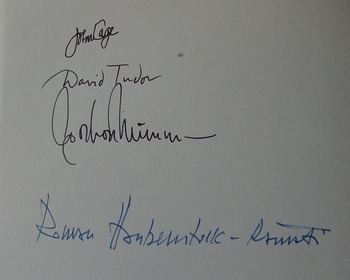
Another group of American composers who visited CLAEM included John Cage, David Tudor, and Gordon Mumma. The three composers attended the performance of the Merce Cunningham Dance Company at the Centro Cultural San Martín in Buenos Aires during August 1968. Cage held a press conference, and, along with Tudor and Mumma, he signed CLAEM’s guest book. A year later, Roman Haubenstock-Ramati added his signature beneath those of the three Americans (see Figure 2).Footnote 42 The performance of the Merce Cunningham Dance Company and Cage’s presence were extensively covered by the press.Footnote 43
John Cage, David Tudor, Gordon Mumma and Roman Haubenstock-Ramati’s signatures (from Eduardo Kusnir’s private collection, with permission).

Regarding jazz, aside from being a genre that circulated widely in Argentina,Footnote 44 the dissemination of two distinct trends, namely those cultivated by the Modern Jazz QuartetFootnote 45 and Ornette Coleman’s free jazz, marked a significant event in the history of free jazz in 1966. At the end of a tour through Latin America, saxophonist Steve Lacy and his ensemble recorded the vinyl The Forest and the Zoo during a live concert at the Audiovisual Experimentation Room of the Torcuato Di Tella Institute, using equipment from the CLAEM Electronic Music Laboratory.Footnote 46 This album ‘was the culmination of Lacy’s free improvisation period’.Footnote 47 According to Jason Weiss, Lacy’s proposal did not receive a warm reception from the Argentine audience. We have not been able to locate any testimonies regarding the impact of Lacy’s quartet among CLAEM’s fellows. However, it is worth noting Weiss’s observation: Steve Lacy was in Rome during 1965–1966 and returned to Rome in 1968 to work with the collective improvisation group Musica Elettronica Viva, which included, among others, Frederic Rzewski, Alvin Curran, and Richard Teitelbaum.Footnote 48 Thus, during his travels, Lacy was part of a collective of artists interested in exploring the limits and possibilities of freedom offered by open musical forms.
Following the visit of Steve Lacy’s quartet to Buenos Aires, the CLAEM hosted a series of concerts that combined the presentation of musical works by its fellows, live electronic music, and jam sessions. The approach to these was both artistic and theoretical. In 1969, a cycle of five lectures dedicated to the analysis of ‘Today’s Popular Music’ was held, featuring participants from CLAEM, the Social Research Centre of the Di Tella Institute, and several invited artists. Subsequently, towards the end of 1969, the first concert of ‘Live Electronic Music’ took place.Footnote 49 This concert was followed by a series of performances between 1970 and 1971, which combined improvisations in jazz, beat music, and live electronic music based on patterns. The musicians and composers often repeated their involvement in these concerts. The improvisations were combined with previous recordings by the performers and basic frameworks created by Rodolfo Alchurrón, Gustavo Bergalli, Jorge Cutello, Jorge González, Santiago Giaccobbe, Gerardo Gandini, and Francisco Kröpfl.
This diversity of musical genres and means of expression developed in parallel to – and following – courses taught by notable figures interested in aleatoric methods of composition, including Earle Brown (1966), Roman Haubenstock-Ramati (1968), Luis de Pablo (1969), Eric Salzman (1969), and Umberto Eco (1970).Footnote 50 Eco’s lectures aimed to question and reflect upon the poetics of avant-garde music, structural and serial thought, and the issues surrounding musical practice in the context of protest.Footnote 51
Another visiting composer at CLAEM worth mentioning is Iannis Xenakis (1966). While we cannot directly link Xenakis’s works to improvisation, there is a valid connection between his graphic and spatial concepts and the control of indeterminacy (stochastic) through the application of calculations, processes, and algorithms. Xenakis’s theoretical postulates and musical works had been known in Buenos Aires since the late 1950s.Footnote 52 Though perhaps not fully comprehended,Footnote 53 his compositions and proposals provided significant impetus for various CLAEM fellows and, as we shall see, to the working methods of GEM.Footnote 54 One aspect highlighted by Mariano Etkin was the impact Xenakis had in steering them away from the dichotomy proposed by Adorno between Schönberg and Stravinsky, leading them towards sound and a new ‘attitude towards the material’.Footnote 55 Many of these themes – including an initial distrust for electronic sounds, a strong commitment to exploring the possibilities of conventional instruments, and highlighting the work of Varèse – were widely disseminated by Jacobo Romano in two interviews published in the periodical Buenos Aires Musical during Xenakis’s stay in Buenos Aires.Footnote 56
Creative process and productive reception in GEM
In 1969, Gandini proposed the creation of the Grupo de Experimentación Musical at CLAEM, informed by his encounters with other artists abroad. In 1964, thanks to a scholarship from the Young Artist Project (supported by the Ford Foundation), Gandini spent a year in the United States, where he travelled to various cities, highlighting his stay in New York. There, rather than learning English, he learned to speak Italian from his flatmate, the composer Girolamo Arrigo.Footnote 57 Subsequently, with a scholarship from the Italian government, Gandini resided in Rome between 1967 and 1968, where he studied under Goffredo Petrassi at the Santa Cecilia Academy.Footnote 58 A review of the concert programmes organized by the Nuova Consonanza group reveals that Gandini actively participated as a pianist in three concerts of the IV Festival Nuova Consonanza in 1967; and as a composer, two of his works were performed at the V Festival Nuova Consonanza in 1968.Footnote 59 At present, no documents have been found that indicate Gandini’s participation as a performer in any presentation by GINC. However, given the time Gandini spent in Rome, it is evident that, in addition to encountering the composers who formed the GINC, he must have witnessed the group’s public performances or even attended some of their rehearsals.
At this point, it is possible to outline a trajectory of geographical mobility and successive interactions between individuals and ideas: from Larry Austin’s experience in California, which led him to Rome and later to Buenos Aires; Lukas Foss, also from California, who became well known in Buenos Aires; Cornelius Cardew, who moved from London to engage with the creative scene in the United States and collaborated – before Gandini – with Nuova Consonanza in Rome; and the circle is completed with the connections (and travels) between Gandini to the United States and Rome, and Austin in Buenos Aires. Thus, the United States, Europe, and South America formed the vertices of a triangle through which experimentation and discussion regarding the degree of freedom in live composition traversed from one location to another, both in theory and in practice.Footnote 60
A characteristic shared by all of the improvisation groups mentioned thus far, including GEM, is that each produced some written document (or set of documents) that functioned as a manifesto. In the case of GEM, there are three fundamental documents: the ‘Press Release’ from November 1969 announcing the first GEM concert;Footnote 61 the ‘Commentary on the Works’ drafted by Gandini and projected via slides during the concert;Footnote 62 and the GEM’s foundational text, signed by Gabriel Brnčić.Footnote 63 If we consider the discourse employed in these three texts, on the one hand, we can identify a pedagogical intention aimed at dissemination and explanation; on the other hand, the texts function as an artistic manifesto as they seek to justify the necessity of the group’s existence, its objectives, its operations, and the potential to publicly showcase a product understood as a concert-show. Furthermore, each of the texts reveals traces that allow us to detect (or relate to) the origins of the ideas, concepts, or readings of the authors.
From the dissemination text (‘Press Release’), we want to emphasize the following points: the concert is presented as the result of the Composition Seminar led by Gandini during 1969;Footnote 65 and ‘involves five experiences carried out collectively,Footnote 66 . . . with several months of preparation’. Three other statements were reiterated in all of GEM’s presentations: it is a group of improvisation aimed at ‘experimenting directly with sound’, ‘maximizing instrumental possibilities’, and ‘without resorting . . . to electronic generators’.
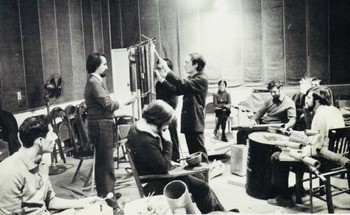
In other words, while technological means such as lighting, slide projections, recordings, and sound amplification were employed during GEM concerts, the improvisational work was confined to the use of musical instruments manipulated by the composers who participated as performers (see Figure 3 and Figure 4).Footnote 67 Furthermore, the text emphasizes that ‘the continuous search for new sources and materials that characterises the avant-gardes’ should be accepted for its coherence and “not merely for being experimental”’.
Photo taken during a GEM rehearsal in 1970. From left to right: Alejandro Núñez Allauca, Gabriel Brnčić, Gerardo Gandini (sitting), José Maranzano? (standing behind), Jorge Antunes, Mariuga Lisbôa (Antunes’ wife, sitting in the back), Eduardo Kusnir, unknown [Ariel Martínez?], and Pedro Caryevschi (Archivos Di Tella, with authorization).

Caricature of the members of GEM (Archivos Di Tella, with authorization).Footnote 64

The ‘Press Release’ is a synthesis, revision, and reworking of the extensive manifesto written by Gabriel Brnčić, dated 24 November 1969.Footnote 68 The revision of this text, from which two paragraphs were removed and redated 1 December 1969,Footnote 69 was distributed to the audience as part of the concert programme. Eduardo Herrera analysed Brnčić’s 1 December text and effectively demonstrated how some postulates attempt to define the use of the term experimental, as well as to justify the existence and public presentation of GEM in light of Ginastera’s apparent reluctance to allow concerts based on group improvisations.Footnote 70 In this case, particularly considering the first version of the text (24 November), we want to highlight the notions and practices undertaken by the previously mentioned foreign improvisation groups, which were adopted by Brnčić and GEM as a whole.
An interesting point is the challenge faced by composers at the end of the 1960s: performers trained in a musical tradition from the preceding century. Brnčić noted that ‘in the face of symphonic orchestras and chamber ensembles created for specific musical functions, today’s music – which transcends conventional instrumental customs and techniques – does not find adequate channels for dissemination, meaning performers and organisations to facilitate that dissemination’.Footnote 71 This statement – one of the paragraphs excluded from the final version – can be understood as a reworking of the assertion made in 1965 by Franco Evangelisti in the presentation text for the first concert of the Gruppo Internazionale di Improvvisazione Nuova Consonanza regarding the need for a new type of performer:
[In 1959] I spoke of the limits that [the open work] contained within itself and of the possibility of its ultimate developments. Since the performer had to complete in the performance the schemes provided by the composer, I stated that it would be necessary for a new type of performer to emerge, one who was also a composer, so that they could connect certain musical elements that, in performances by traditional performers, are constrained by the practices that such performers bring with them. . . . The limit of the open works would be a kind of ‘summa’ of elements with which the performer or the performer-cocreators could act instantly.Footnote 72
In the face of new sonic challenges, rhythmic textures, and proposals for formal development, a new type of performer was necessary. Several hypotheses can be presented to explain the relationship between Brnčić’s text and that of Evangelisti: Brnčić had access to the Italian text; Gandini discussed the issues addressed by the GINC with GEM members; or the proposal represented a shared solution to a common problem across different musical contexts within the avant-garde music of the time. At present, it is not possible to definitively determine which hypothesis is the most accurate based on documentary sources. However, it is evident that Gandini’s contributions were fundamental, owing to his time spent in Rome and his contact with the group. Moreover, regarding the unconventional use of musical instruments, the members of GEM sought to overcome the tension that often arises between the training of performers and the aspirations of avant-garde composers. The composer Eduardo Kusnir clearly articulated this fact and specified the working methods of GEM:
In the group, we were not specialists in anything. Extended techniques naturally emerged as we had to play instruments that we did not master. . . . After experimenting with the materials, we moved on to the stage of organizing how these sounds would be structured. . . . Gandini’s proposal was to transform these sessions into a product, to present that experience to an audience. Therefore, organization was necessary. In improvisation, there were certain guidelines that established a pathway; moments, directions, and objectives were planned without losing track of the temporal dimension.Footnote 73
Although not stated directly, creating music through sounds produced with a musical instrument that one is not adequately trained to play introduces a high degree of indeterminacy into the musical creation, independent of improvisation. This inclusion of indeterminacy, combined with the dissemination of John Cage’s work in Buenos Aires,Footnote 74 indicates an appropriation of the American composer’s proposals by the members of GEM.
In the presentation text prepared by Brnčić, although from a more intellectual and poetical ethos, the working methods of GEM described by Kusnir are outlined: ‘improvisation sessions that encompass various procedures and degrees of play’. The emphasis is placed on collective work, where ‘the overall result is the sum of relationships between diverse wills’, with the initial stage of improvisation aimed at discovering ‘new sound materials’, thus achieving ‘complex units of sound action – something characteristic of today’s music’.Footnote 75 Brnčić indicates two possibilities for how improvisations transform into works (which he refers to as transcursos [‘passings’]): one possibility arises ‘when a very good relationship is established among the participants’, and the formalization of the transcurso is resolved intuitively; the other possibility involves anticipating ‘approximate formal plans (itineraries) guided by a compositional idea that is continuously enriched during the course of spontaneous participation’.Footnote 76 In other words, GEM allowed for two outcomes from a work method rooted in freedom within improvisation, considering that individual participation could affect group behaviour.
It is essential to recall the proposals for collective improvisations among the groups from California, Rome, and London. While Foss’s Improvisation Chamber Ensemble suggested the use of patterns or charts, the NME offered total freedom, discarding the use of plans and charts in favour of a ‘group compositional feeling for structure from the smallest musical gesture to the total composition’.Footnote 77 In contrast, Evangelisti’s GINC proposed a confrontation with the development of ‘totally determined’ serial music through the use of what he termed ‘momentary, random, mobile, or open forms’, whose development is inherently indeterminate. Notably, Evangelisti insisted that the GINC was the ‘only improvisation group formed exclusively by composers’.Footnote 78
Although operating under what we might call the same Cagean precepts, Cornelius Cardew’s Scratch Orchestra invited not only composers but anyone willing to adhere to the strict rules that offered various impossible possibilities for controlling indeterminacy. Among these four options, GEM, led by Gandini, seemingly occupied a middle ground between guiding the development of improvisations based on an itinerary and allowing total freedom based on the feeling or groove that emerged within the group. Based on Brnčić’s manifesto and Kusnir’s testimony (as well as Antunes, Martínez, and Núñez Allauca),Footnote 79 we may assert that GEM reworked Evangelisti’s group proposals in Rome, and Davis (Austin’s) in a somewhat more formalized context. Notably, GEM distinguished between the experimental moment (as a process of exploring sound materials and interaction possibilities) and the creative moment when the transcurso was defined, giving rise to works created through improvisation.
This represents nothing less than the practical application of the thought expressed on various occasions by Gandini (attributed to Varèse) that we cited at the beginning: that experimentation is valid as an inquiry into procedures, and that these then disappear when they transform into music. Years later, Gandini would state that ‘the novelty lies in the syntax of a work’,Footnote 80 in an organized entity. As already mentioned, it has not been possible to identify the source from which Gandini and his circle of friends in Buenos Aires (mainly Mariano Etkin) obtained this expression attributed to Varèse. Until such a source is identified, we can hypothesize that it is a paraphrase or synthesis of a series of ideas from an unlocated interview with Varèse.
Let us return to Brnčić’s manifesto text to address two themes: the conscious link or relationship between GEM and popular music, and the awareness of other composer groups dedicated to improvisation. In a paragraph from the final version of December 1969, Brnčić states: ‘In this search for new sources and new materials, which has always been characteristic of certain popular music, especially contemporary jazz, our group is working simultaneously with other groups in other places’.Footnote 81 These lines indicate an awareness, a recognition, and a stance of equality with the popular music of the time, where jazz (notably defined by its improvisational nature) is not incidental. Moreover, the ending of the sentence highlights the knowledge and potential contact with composer groups dedicated to collective improvisation in other regions.
As previously mentioned, it is quite possible that GEM did not have contact or knowledge of the formation of the Scratch Orchestra, but they certainly had full awareness of the GINC in Rome (through Gandini) and the NME formed by Austin. The other paragraph from Brnčić’s text that requires further analysis pertains to the general context of Argentina. This is particularly relevant because this paragraph appeared in the version from 24 November 1969 and was excluded from the public version:
It is not coincidental that many contemporary composers, grouped according to certain aesthetic postulates, engage in a wide variety of musical activities, from composition to recording, as well as tasks such as copyist, manager, conductor, performer, and so on. There are clear economic reasons behind this, which ultimately generate a new way of thinking about aesthetics.Footnote 82
These lines raise four main issues: 1) the awareness and acknowledgement of the existence of contemporary composer groups; 2) the basis on which composers are grouped: ‘certain aesthetic postulates’; 3) the necessity to engage in ‘multiple musical activities’, encompassing the entire creative and cultural management circuit to disseminate new musical creations; and 4) the introduction of the economic, material (Marxist) variable, which composers must navigate, thereby justifying a ‘new way of thinking about aesthetics’.
Based on the relationship between the creative act and socioeconomic circumstances, a connection can be established regarding the aesthetic–ideological perspective shared with Cardew and some members of the Scratch Orchestra. Additionally, considering that the paragraph was omitted from the final version of the text and that some members of GEM had political ties to the left,Footnote 83 we can deduce three possible reasons for its exclusion: the paragraph solely expressed Brnčić’s thoughts; it reflected the positioning of a minority; or its content was shared by most of GEM’s members but was excluded to avoid potential political interpretations that could jeopardize the individual integrity of the fellows as well as the overall survival of CLAEM under the oppressive military government imposed by Juan Carlos Onganía in Argentina from 1966. In contrast to the broader context of dictatorship and social unrest in late-1960s Latin America, GEM constituted a microdemocracy, adopting a republican approach to artistic creation and the public presentation of musical works – resolving potential conflicts through internal and private discussion.
The specific sociopolitical conditions under which the group carried out its activities distinguish GEM from other composer groups engaged in collective improvisation in other countries. In the United States, Italy, and the United Kingdom, republican governments or parliamentary monarchies upheld individual freedoms, though these rights were historically reserved for white citizens – particularly in the United States during the 1960s. In contrast, in Argentina, the right to public protest had been under increasing scrutiny since 1966, and censorship was routinely practised across all areas of society.Footnote 84 In short, the deleted paragraph from the GEM text I cited earlier reveals two crucial dynamics: first, a structural similarity with other composer collectives in how aesthetic production intersected with political and economic conditions; and second, a strategic avoidance of public statements that might be interpreted as Marxist or leftist, in order to evade the scrutiny of Argentina’s staunchly anti-communist authorities at the time.
The works of the Grupo de Experimentación Musical of CLAEM and their ramifications
Analysing works that emerged from free improvisation is a task that involves various challenges. Whether or not there was a prior plan, a graphic representation, or a verbal proposal to serve as a guide, this does not guarantee that the sonic outcome can be anticipated. These works – or ‘formalized transcursos’ – are momentary productions, and without a sound recording, their appreciation or evaluation is impossible. Furthermore, as Thorsten Wagner (citing Ekkerhard Jost) indicates, there is a paradox in studying the existing sound documents to arrive at a definitive version of something that was not intended to be definitive. Additionally, since the recording reduces the work to its acoustic aspect, the performative and visual elements that help define the mode of improvisation are excluded from study.Footnote 85 In this instance, we will not conduct an analysis of the works but will focus on the working methods, the improvisation guides used (or not), and the aspects indicating the sources and the type of productive reception that took place in the creation of GEM’s works.Footnote 86
To explain the way of working in GEM, we will look at two main sources: the testimony of composer Ariel Martínez and the indications regarding the works of Gandini. Martínez emphasized that – unlike the instrumentalists in an orchestra – the members of GEM were ‘composers, very different, and with a very good connection to contemporary music that served as a lingua franca. On that basis, we improvised and understood each other’.Footnote 87 Martínez highlighted the starting point for a successful improvisation: a common language upon which to interact. He did not speak of techniques or aesthetics, but rather of the possibilities of acting with sound based on the information circulating among the members.Footnote 88 Despite this common agreement, Martínez underscored Gandini’s role as ‘director and ideologist in a general sense’. Furthermore, he specified the origins of some of the works and how the overall design was resolved:
In some cases, there was a pre-established formal plan, quite rigid; this was the approach we used to ensure results when the group was large. In other cases, the formal plan could be somewhat vague, reduced, partial, or even non-existent. The microstructure and details were never planned. At some point, more or less initially, drawing from the ideas of Iannis Xenakis, Gandini proposed a typology of textures: points – very short, isolated sounds – lines – sounds that continue – and clouds of points – very dense clusters of short sounds – and suggested a formal plan to arrange the succession of these elements. With this framework, we resolved the details of the texture on the fly, and we had a piece. Even today, forty-five years later and thousands of kilometres away, we still joke with Allauca about this way of making music. . . . In duos, trios, or quartets, everything was resolved on the spot, because we knew that we could produce something.Footnote 89
Despite the precise reference to Xenakis and how they worked, Martínez stressed that they did not try to replicate any specific style or idea:
It was not about creating a pastiche of styles, but rather a pastiche of the overarching style of contemporary music. . . . The idea of points and lines was an instant trigger that Gandini used, and besides being something typical of the time, it had been presented in one of Luis de Pablo’s early classes, but we did not attempt to copy it. In the GEM, prior knowledge did not dominate.Footnote 90
Here, another source of ideas that contributed to GEM’s productive reception is highlighted: the proposals of the Greco-French composer were reinforced or overlapped with the classes of the Spanish composer.
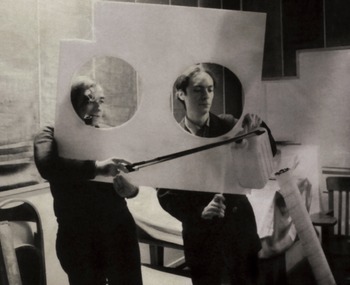
In the comments that Gandini prepared for GEM’s first concert, we read a summary of the various tasks, orientations, and procedures applied during both the exploratory phase (the improvisations where the timbral capacities of the instruments were tested) and the way the works presented to the public were organized. The typed document spans five pages and can be considered both a work report and a piece of concrete poetry, as it combines text, some graphics, interpolations of poetic quotes, and a spatial distribution of the text on the page.Footnote 91 That is, the pages present a combination of data and visual representation.Footnote 92 Figure 5 shows some of the resources indicated in the various works that formed the programme on 1 December 1969: Pianos, Tres, Objetos, Voces, and Suma.Footnote 93
Gerardo Gandini and Jorge Antunes posing with objects (Archivos Di Tella, with authorization).

These five works have been documented and will be briefly described.Footnote 94 The work Pianos consisted of twelve performers playing three pianos equipped with microphones attached to their soundboards. Each group of four performers executed one of the seventeen behaviours based on three actions: pizzicato, bowing, or percussion on the strings. The type of behaviour to be applied was communicated through instructions projected on stage via an overhead projector.
The performance of Tres consisted of a trio of recorder, zither, and viola, where each performer was required to play without voluntarily associating their sound with the others. Additionally, some actions were indicated but were discarded: theatrical actions, the use of a pre-existing plan, and coordinating the three parts. The description concludes in the form of a poem: ‘Our greatest achievement / will be to make silence / heard’.
In Objetos, the text indicates that the work originated from Jorge Antunes’ proposal to create a piece using ‘the sonic utilization of non-musical objects. After several trials . . . the group decided to move to the basement of the Institute and collected unused objects and materials’. ‘A selection of the best sounds produced by these objects’ was made, and, after attempting to outline a preliminary scheme, it was decided that the evolution of the form would arise from the resulting sounds. According to a critical review of the concert, the piece ended with the sound produced by ‘the violent closure of a folding chair’.Footnote 95 This work shows a strong relationship with some of Cage’s pieces in terms of the use of sounds produced by everyday objects. Later, in 1971, Antunes moved to Utrecht, took the piece Objetos – actually, the idea of that piece – wrote a score, named it Music for Eight Persons Playing Things, and received the Avro Prize at the 1971 Gaudeamus Week.Footnote 96
The description of Voces is one of the most conceptual. The objective set forth was to create ‘associations between instrumental and vocal sounds’.Footnote 97 Gandini introduces and defines the concept of masking [enmascaramiento]: ‘[which] in music, it is to conceal one sound with others’.Footnote 98 Moreover, Gandini indicated that masking would be accomplished both sonically and visually, suggesting the use of some theatrical or scenic action during the performance. Among the brief phrases that describe the options for the piece’s development, Gandini interspersed the first two lines of a poem by Percy Bysshe Shelley: ‘Music, when soft voices die / vibrates in the memory’. The recording of this piece was identified, and a significant contrast was noted between the intervention of the jazz trio (which applied defined touches, close to free jazz) and the ensemble of other instruments, which resisted producing precise sounds (with some exceptions from the piano).Footnote 99
In Suma, spatial distribution (‘stereophonic’) of the instruments (not specified) was employed, contrasting their ‘live music’ with the playback of a magnetic tape featuring ‘an elaboration of the same material’. The group of performers improvised under the guidance of a conductor based on ‘seven very defined actions’ (lines, points, noises, clouds of points, a single sound, simultaneous attacks, and glissandos) and under two premises: to integrate with or oppose the tape.
Additionally, GEM members participated as performers in some pieces composed specifically for the group or intended for the group to perform. Notably, the piece Play, for piano and improvisation group, by Gandini, deserves a special mention.Footnote 100 In the programme notes, Gandini remarked that the work was created from his experience in forming the improvisation group ‘with his fellow students from the CLAEM’.Footnote 101 However, the composer himself indicated that the first version of the work – originally for solo piano – was created in January 1969 (when GEM did not yet exist) and was premiered by the composer in March 1969 at a concert organized by the Sonda group at the Royal Conservatory of Madrid.Footnote 102 It is also noted that alongside the piano, the improvisation group worked with ‘seven types of behaviours provided by the composer: lines, noises, points, a single note, clouds of points, directional lines (glissandos), and simultaneous attacks’.Footnote 103 Gandini’s comments on this piece collectively reflect the mobility and circulation of ideas in which the composer participated: a work premiered in Madrid, developed after his experience in Rome, which applied a set of sonic behaviours derived from the thinking of Xenakis, whom he met during the Greek composer’s stay in Buenos Aires.
In addition to the previously mentioned work by Antunes, other fellows created pieces for GEM. Eduardo Kusnir composed Asómate a la ventana María (serenade for 11 people) in 1969; Ariel Martínez presented Nosotros y ellos, a piece that explores the opposition or exchange between the flute and cello against various combinations of violin–oboe and violin–English horn;Footnote 104 and, Alejandro Núñez Allauca created Moto ornamentale e perpetuo for piano, dedicated to and premiered by Gandini. According to Núñez Allauca’s testimony,Footnote 105 this work emerged from his participation in GEM’s improvisation sessions and structured the musical discourse based on different types of ornamentation. From this experience, during his time in the United States and Italy, the composer derived a set of works for various instrumental combinations and for orchestra, in which he applied the concept of ornamentation.Footnote 106
Conclusion
Currently, the available technology allows us to exchange and access information almost instantaneously. There is no need to wait for postal mail to transport an envelope with the latest news by air, for a telegram to reach its destination, or for a transatlantic telephone communication to be established. This, however, was the situation experienced during the 1960s by the protagonists of these stories. The circulation of ideas or musical works was not straightforward, and often required the physical movement of people who, in addition to words, brought texts, vinyl records, magnetic tapes, and performances with the latest developments. The CLAEM at the Instituto Torcuato Di Tella was, above all, a centre that facilitated communication between different generations of musicians from various regions of Latin America and professional composers and intellectuals from other continents.
Among the case studies that can be taken from the ten years of CLAEM’s activity, the exchange and implementation of musical stimuli that developed during the improvisation sessions and concerts of GEM may be one of the richest and most interesting. It was a pedagogical practice that strategically addressed a specific problem: the lack of resources to hire performers starting in 1969. However, this economic shortfall resulted in an enhancement and empowerment of the creative capacities of CLAEM’s fellows and a space that allowed for the realization of a long process of productive reception, primarily led by Gerardo Gandini, along with the other members of GEM, especially Gabriel Brnčić, who had been studying and collaborating as a teacher at CLAEM since 1965. Thus the improvisation sessions, which explored ways to produce sounds through an investigation of instrumental limitations, enabled a diverse range of ideas to be put into action. In this way, the productive reception of practices and concepts from Earle Brown, Larry Austin, John Cage, Roman Haubenstock-Ramati, Iannis Xenakis, Edgard Varèse, and Luis de Pablo, which the CLAEM fellows applied in Buenos Aires, also extended to other spaces such as the Netherlands, Spain, or Italy through the application of those ideas by Antunes, Brnčić, and Núñez Allauca. It also influenced Latin American countries with the return or internal migration of composers such as Rafael Aponte-Ledée (who returned to Puerto Rico); Antonio Mastrogiovanni (Uruguay), and Eduardo Kusnir (Argentina), who developed extensive activity in Venezuela. Gandini, meanwhile, continued his creative output in Buenos Aires, except for his years of international touring as a pianist with Astor Piazzolla’s ensemble, where he began by reading the scores he received and ended up improvising most of what he played.



 Open access

