



Global prevalence of obesity and associated co-morbidities has increased significantly in recent years. This increasing incidence is set to continue, with 1·35 billion and 573 million of the global population predicted to be overweight or obese by 2030, respectively(Reference Kelly, Yang and Chen1). CVD is currently estimated to be responsible for 17·3 million global deaths annually, with a predicted increase to 23·6 million by 2030(2), and diabetes incidence is set to increase from 415 million to 642 million by 2040(Reference Ogurtsova, da Rocha Fernandes and Huang3). Effective public health strategies are required to combat this global obesity epidemic and reduce the risk of CVD and diabetes.
Dietary fat is a key nutrient for growth and metabolism; however, not all fats exert the same effects, with dietary fatty acid (FA) composition playing an important role in health determinants(Reference Calder4). SFA and trans-fats have typically been associated with adverse CVD risk, while PUFA have been shown to be cardioprotective(5,6) . SFA intakes are typically recommended to be less than 10 % of total energy (%TE)(5,6) ; however, this is generally exceeded globally(Reference Eilander, Harika and Zock7). Irish SFA intakes are approximately 13 %TE(Reference Li, McNulty and Tiernery8), which is similar to other European countries(9), and slightly higher than the USA at 11 %TE(10). Trans-fat intakes are recommended to be ≤2 %TE(11), as they have been associated with adverse effects on the blood cholesterol profile; however, typical reported intakes are below this level in Europe(9,Reference Brouwer, Wanders and Katan12,Reference Gebauer, Dionisi and Krauss13) . The recommended daily intake for MUFA is ≥12 %TE, which is also typically achieved in European countries (11–18 %TE)(9), the USA (12·5 %TE)(10) and other countries(Reference Harika, Eilander and Alssema14). PUFA intakes are recommended to exceed 6 %TE(15), yet a review of global intakes across forty countries by Harika et al. reported that only 50 % of countries met the PUFA recommendation(Reference Harika, Eilander and Alssema14). A recent review of the evidence by both the UK Scientific Advisory Committee on Nutrition (SACN) and the WHO suggests that replacement of SFA with PUFA is a potential public health strategy to reduce disease risk(5,6) .
There are a number of ongoing public health strategies to improve population dietary fat intakes, including the increased availability of low-fat products and product reformulation(Reference Spiteri and Soler16). Alternatively, grass-based ruminant feeding practices naturally modify the FA composition of animal products by reducing SFA and increasing PUFA concentrations, including α-linolenic acid (ALA) and docosapentaenoic acid (DPA), in comparison to concentrate-based feeding(Reference Daley, Abbott and Doyle17). A recent predictive modelling analysis by Benbrook et al. characterised the FA profile of milk following grass-based feeding and applied nutrition modelling to investigate the potential impact on dietary fat intakes. In comparison to concentrate-fed and organic milk, there was a significant improvement in the FA composition of grass-fed milk, wherein n-3 PUFA levels were increased(Reference Benbrook, Davis and Heins18). Therefore, replacement of habitual beef and dairy intakes with grass-fed products may provide a potential strategy to improve dietary fat quality. This provides a cost-effective feeding practice for farmers and meat processors due to the availability of grazing grass for approximately 10 months per year, particularly in Ireland and the UK. However, it does have feasibility constraints, due to the increased feeding time, and associated environmental risks. In particular, beef production has been associated with increased greenhouse gas emissions, both from grass- and concentrate-feeding and concentrates, with recent reviews suggesting that red meat intakes should be decreased to reduce environmental risk(Reference Macdiarmid and Whybrow19,20) .
Furthermore, red meat is commonly consumed, providing an important source of protein, Fe and vitamins, particularly vitamin B12(Reference Cashman and Hayes21), and meat and meat dishes are important contributors to dietary total fat (22 %), SFA (22 %), MUFA (26 %) and PUFA (19 %) intakes(Reference Li, McNulty and Tiernery8). A randomised controlled trial by McAfee et al. investigated the impact on long-chain (LC) n-3 PUFA status following consumption of three portions of grass-fed or concentrate-fed lamb and beef for 4 weeks. Dietary intakes and plasma and platelet concentrations of LC n-3 PUFA increased significantly in the grass-fed red meat consumers(Reference McAfee, McSorley and Cuskelly22). However, the impact of grass-fed beef consumption at population level is currently unknown. Therefore, the aim of the current analysis was to apply a predictive modelling technique to assess the potential impact of replacing habitual beef intakes with grass-fed beef on dietary fat intakes in a nationally representative Irish adult cohort.
Methods
Ruminant dietary intervention
The FA data used in the current analysis were derived following a dietary intervention trial using three different animal feeding practices. Fifteen spring-born suckler Aberdeen Angus heifers were assigned to one of three diets: grass only (GRASS), grass finished on grass silage and concentrates (GSC) or concentrates only (CONC), until they reached a target carcass weight of 260 kg. The composition of the GRASS intervention was grass silage ad libitum plus a routine mineral supplement during the winter (123 d) followed by rotational grazing of a perennial rye-grass-dominant pasture until slaughter. The CONC intervention was comprised of ad libitum concentrates (870 g rolled barley/kg, 60 g soyabean meal/kg, 50 g molasses/kg, 20 g minerals and vitamins/kg) and grass silage (1 kg dry matter/animal daily), indoors(Reference McElhinney, Riordan and Monahan23). The third intervention group included grazed grass followed by grass silage ad libitum and 4 kg concentrates/d (GSC) for approximately 4 months. Four muscles (striploin, eye of the round, fillet, chuck tender) were collected at 48 h post slaughter and aged for 14 d at 2°C, prior to storage at –20°C. Prior to FA analysis, the samples were cooked to an internal temperature of 72°C. The lipids were subsequently extracted and analysed using GC(Reference French, Stanton and Lawless24). In brief, the FA were extracted using a two-step microwave-assisted (CEM Corporation) saponification and esterification process. Methanolic potassium hydroxide (10 ml, 2·5 % w/v) was added for saponification, microwaved and heated to 130°C, and held for 4 min. Methanolic acetyl chloride (15 ml, 5 % v/v) was added for esterification, microwaved, heated to 120°C in 4 min and held for 2 min. Pentane (10 ml) was added to extract the fatty acid methyl esters and saturated sodium chloride (20 ml) was added to induce phase separation. Fatty acid methyl esters were then measured using GC with flame ionisation detection for FA quantification, as described previously(Reference French, Stanton and Lawless24). An average of four muscles (striploin, eye of the round, fillet, chuck tender), chosen based on lipid concentration, muscle fibre distribution and consumer relevance(Reference Von Seggern, Calkins and Johnson25), and pooled fat samples (n 3) from each diet group were applied in the current analysis.
Food consumption data
The present study used population food intake data from the 2008–2010 cross-sectional Irish National Adult Nutrition Survey (NANS), which collected data from 1500 nationally representative adults (740 males and 760 females) aged 18–90 years.
Written consent was obtained from each participant, in accordance with the Declaration of Helsinki. A detailed description of the NANS recruitment, sampling and methodologies has been outlined elsewhere(26,Reference Cashman, Muldowney and McNulty27) . In brief, participants recorded their dietary intakes using a semi-weighed food diary, over four consecutive days, including one weekend day. Product packaging, brand information, recipes and cooking methods were also recorded. A food consumption database was created containing 2552 food codes, which were updated for nutrient composition(26). The methodology applied to calculate the dietary fat composition (total fat, SFA, MUFA, PUFA, ALA, EPA, DHA and trans-fat) for each of the NANS food codes has been previously detailed(Reference Li, McNulty and Tiernery8). All food codes were classified into thirty-three food groups which were representative of the overall diet, including unprocessed and processed red meat(Reference Lenighan, Nugent and Li28). These were further aggregated by beef product for the purpose of the current analysis and in total included fifty-two beef food codes and ninety-nine beef-containing recipes. Sixty-nine per cent (n 1044) of NANS participants were beef consumers, with a mean daily intake of 86 (sd 62) g/d.
Predictive modelling scenarios
The potential impact of replacing habitual beef intakes in three modelling scenarios was determined by substituting the FA data of beef-containing foods with data from beef from the GRASS, GSC or CONC intervention. For the modelling scenarios the beef compositions will be referred to as G-FB (grass-fed beef) as derived from the GRASS intervention, GC-FB (grass-fed beef finished on grass silage and concentrates) from the GSC intervention and C-FB (concentrate-fed beef) from the CONC intervention. FA concentrations (n 31) were provided for cooked muscle and fat components of beef from each intervention. The proportion of muscle and fat (g/100 g food) was calculated using the online McCance and Widdowson’s Composition of Foods integrated data set and manufacturer information(29). The beef food codes were then updated for FA concentration (n 31) for each of the three beef compositions (G-FB, GC-FB, C-FB) for both muscle and fat. Similarly, the codes for the beef-containing recipes, which accounted for weight loss factors, were disaggregated into their ingredient components and their percentage contribution to each recipe was calculated and subsequently reaggregated. Three versions of the original data set were created, containing the updated FA compositional data for the three different beef types and the aggregated recipes. Each FA was then converted from grams per 100 g of muscle/fat to grams per weight of food consumed. These data were subsequently used to characterise the impact of the compositional changes in beef as affected by the animal feeding practices. This included investigating the differences in FA composition of cooked beef by animal feeding practice, calculating total fat and fat subtype intakes using a 100 % replacement modelling scenario wherein dietary beef products in the NANS were replaced with equivalent products derived from altered animal feeding practices. The impact on intakes of fourteen individual FA, adherence to dietary fat guidelines and the impact of altering fat composition of the beef-containing food groups on contributions to overall dietary fat intakes in beef consumers were also determined.
Statistical analysis
Data analysis was carried out using the statistical software package IBM SPSS® Statistics for WindowsTM version 20.0. A one-way ANOVA was used to calculate differences between beef dietary modelling scenarios. Bonferroni correction was applied by multiplying each P value by the number of rows, each representing a trait, in each table. P ≤ 0·05 was considered significant and those that exceeded 1·0 were marked down to 1·000(Reference Bland and Altman30). The cohort was split by tertile of beef consumption, to create equivalent consumption groups to determine whether the quantity of beef consumed affected the dietary fat intake modelling scenarios. A 100 % modelling scenario was subsequently applied using the beef compositional data from the three beef interventions. Mean daily intakes of total fat and the fat subtypes were calculated and are presented as mean values with standard deviations. Mean daily intakes for fourteen compositional FA were subsequently calculated and a one-way ANOVA with Bonferroni correction applied. A χ 2 test examined differences in population adherence to dietary fat recommendations between beef scenarios. In brief, compliance with the UK Department of Health recommendations for total fat (≤33 %), SFA (≤10 %), MUFA (≥12 %) and PUFA (≥6 %)(31), the European Food Safety Authority recommendation for ALA (≥0·5 %)(9) and the SACN recommendation for trans-fat (≥2 %)(11) was determined by estimating the maximal subgroup of the population that complied with the population target, by ranking individuals based on their mean daily intakes, as outlined in Wearne and Day(Reference Wearne and Day32). The impact of altering the FA composition on overall dietary total fat, SFA, MUFA, PUFA and ALA contributions from beef-containing food groups was assessed using a one-way ANOVA.
Results
Fatty acid composition of cooked beef post feeding intervention
The FA composition of the cooked beef muscle and fat following the intervention with GRASS, GSC or CONC is presented in Table 1, with the entire complement of ruminant FA quantified presented in the online supplementary material, Supplemental Table S1. Significant differences were observed in the beef muscle and fat composition, particularly across individual SFA, MUFA and PUFA concentrations. The muscle concentration (g/100 g) of myristic acid (C14 : 0), palmitic acid (C16 : 0), myristoleic acid (C14 : 1) and oleic acid (C18 : 1) was significantly lower following the GRASS intervention, in comparison to both the GSC and CONC interventions, as were the n-6 PUFA, including linoleic acid (C18 : 2) (P < 0·05). The GRASS intervention increased concentrations of the n-3 PUFA, ALA (C18 : 3), conjugated linoleic acid (CLA; C18 : 2c9,t11) and DPA (C22 : 5) (P < 0·001).
Fatty acid composition (g/100 g) of cooked muscle (average of four cooked cuts†) and fat following the beef intervention

GRASS, grass-fed; GSC, grass finished on grass silage and concentrates; CONC, concentrate-fed; LA, linoleic acid; ALA, α-linolenic acid; CLA; conjugated linoleic acid; AA, arachidonic acid; DPA, docosapentaenoic acid; total n-6 PUFA: LA + AA; total n-3 PUFA: ALA + EPA + DPA + DHA.
a,b,cMean values with a row with unlike superscript letters were significantly different between ruminant dietary interventions, for muscle and fat separately (P < 0·05).
† Striploin, eye of the round, fillet, chuck tender.
‡ One-way ANOVA for comparison of means between beef interventions, with a Bonferroni post hoc test. Bonferroni correction was applied by multiplying the P value by the number of rows in the table. P values that exceeded 1·0 have been marked down to 1·000.
Impact of altering animal feeding practices on dietary fat intakes
Mean daily fat intakes following predictive modelling assuming 100 % consumption are presented in Table 2, by tertile of beef consumption. No difference was observed in total fat, SFA, MUFA and PUFA intakes; however, intakes of trans-fat were greater in the grass-fed beef groups (P < 0·001). Altering the composition ofbeef also increased trans-fat intake in the overall NANS cohort (n 1500; see online supplementary material, Supplemental Table 2).
Mean daily intakes of dietary fat (g/d and %TE) by beef scenario, split according to low (n 346), medium (n 354) and high (n 344) beef consumption, in a cohort of Irish beef consumers (n 1044) aged 18–90 years from the 2008–2010 cross-sectional Irish National Adult Nutrition Survey (NANS)
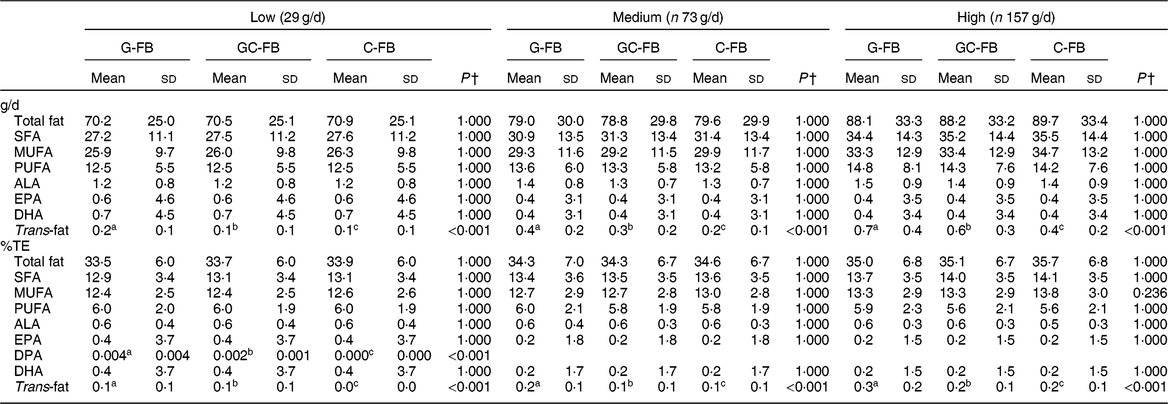
%TE, percentage of total energy; G-FB, grass-fed beef; GC-FB, grass-fed beef finished on grass silage and concentrates; C-FB, concentrate-fed beef; SFA, C14 : 0 + C15 : 0 + C16 : 0 + C17 : 0 + C18 : 0; MUFA, C14 : 1 + C16 : 1 + C18 : 1c9 + C18 : 1t11; PUFA, C18 : 2c9,12 + C18 : 2c9,t11 + C18 : 2t10,c12 + C18 : 3 + C20 : 4 + C20 : 5 + C22 : 5 + C22 : 6; ALA, α-linolenic acid; DPA, docosapentaenoic acid.
a,b,c Mean values within a row with unlike superscript letters were significantly different between beef scenarios, for low, medium and high consumers separately (P < 0·05).
† One-way ANOVA for comparison of means between beef scenarios, with a Bonferroni post hoc test. Bonferroni correction was applied by multiplying the P value by the number of rows in the table. P values that exceeded 1·0 have been marked down to 1·000.
Impact of altering animal feeding practices on intakes of individual fatty acids
Differences were observed in dietary intakes (%TE) of individual FA between the three beef scenarios (Table 3). In terms of intakes of individual FA related to SFA, a significant stepwise decrease of myristic acid (C14 : 0) and palmitic acid (C16 : 0) was observed across tertiles, wherein they were significantly lower in the G-FB scenario (P < 0·001). While intake of vaccenic acid (C18 : 1t11) was observed to be significantly greater in the G-FB scenario (P < 0·001), these differences were consistent across all three consumption groups. In terms of PUFA intakes, a significant increase in arachidonic acid (AA; C20 : 4) was noted from G-FB to C-FB (P < 0·001). Intakes of DPA (C22 : 5) and CLA (C18 : 2c9,t11) were significantly greater in the G-FB scenario, with a stepwise decrease across tertiles observed between GC-FB and C-FB (P < 0·001). Similar trends were observed when the intakes were expressed as g/d (data not shown). In addition, a reduction in the PUFA ratio (LA : ALA) was observed in the G-FB scenario in the high beef consumers (P < 0·001).
Mean daily intake of individual dietary fatty acids (%TE) by beef scenario, split according to low (n 346), medium (n 354) and high (n 344) beef consumption, in a cohort of Irish beef consumers (n 1044) aged 18–90 years from the 2008–2010 cross-sectional Irish National Adult Nutrition Survey (NANS)

%TE, percentage of total energy; G-FB, grass-fed beef; GC-FB, grass-fed beef finished on grass silage and concentrates; C-FB, concentrate-fed beef; PA, palmitic acid, OA, oleic acid, TVA, trans-vaccenic acid; LA, linoleic acid; CLA; conjugated linoleic acid; ALA, α-linolenic acid; AA, arachidonic acid; DPA; docosapentaenoic acid.
a,b,c Mean values with unlike superscript letters were significantly different between beef scenarios, for low, medium and high consumers separately (P < 0·05).
† One-way ANOVA for comparison of means between beef scenarios, with a Bonferroni post hoc test. Bonferroni correction was applied by multiplying the P value by the number of rows in the table. P values that exceeded 1·0 have been marked down to 1·000.
Adherence to population-based dietary guidelines
The predicted adherence to dietary fat recommendations of the UK Department of Health and SACN for total fat, SFA, MUFA and PUFA(5,31) , the European Food Safety Authority recommendation for ALA(9) and the SACN recommendation for trans-fat(11) is presented in Fig. 1. All three beef groups adhered to the MUFA, ALA and trans-fat recommendations. Greater compliance was observed in the G-FB scenario, compared with the GC-FB and C-FB scenarios, for total fat (98·5, 98·3 and 95·5 % adherence, respectively), SFA (57·4, 52·9 and 51·1 %, respectively) and PUFA (98·8, 94·0 and 93·7 %, respectively) recommendations (P < 0·05).
Percentage adherence to dietary fat guidelines by beef scenario ( , grass-fed (G-FB);
  , grass-fed beef finished on grass silage and concentrates (GC-FB);
  , concentrate-fed (C-FB)) in a cohort of Irish beef consumers (n 1044) aged 18–90 years from the 2008–2010 cross-sectional Irish National Adult Nutrition Survey (NANS). The χ 2 test was applied to compare between beef scenarios: *P < 0·05, ***P < 0·001. † Dietary reference values of the UK Department of Health(31). ‡ Recommendation of the UK Scientific Advisory Committee on Nutrition (SACN)(5). §Dietary reference value of the European Food Safety Authority(9). ‖ Target for trans-fat is from the UK SACN(11) (% TE, percentage of total energy; ALA, α-linolenic acid)

Impact of altering the beef composition on contributions of food groups to dietary fat intakes
Unprocessed and processed red meat are among the top contributors to dietary fat intakes in the Irish population (see online supplementary material, Supplemental Table 3). Modification of the FA composition of red meat therefore has the potential to improve dietary fat quality. The impact of modifying the red meat food groups on their contribution to overall dietary fat intakes in the current analysis is presented in Table 4. Grass-based animal feeding beneficially altered fat composition of unprocessed red meat (beef and veal) to reduce percentage contributions of SFA and MUFA to overall intakes, and to increase PUFA and ALA contributions (P < 0·05). However, modification of the FA profile of processed beef products did not affect dietary fat quality.
Impact of reformulating the fatty acid composition of red meat on dietary fat quality (% contribution of meat food groups to dietary fat intakes), by beef scenario, in a cohort of Irish beef consumers (n 1044) aged 18–90 years from the 2008–2010 cross-sectional Irish National Adult Nutrition Survey (NANS)

ALA, α-linolenic acid; G-FB, grass-fed beef; GC-FB, grass-fed beef finished on grass silage and concentrates; C-FB, concentrate-fed beef.
a,b Values with unlike superscript letters were significantly different between beef scenarios, for each fatty acid separately (P < 0·05).
† One-way ANOVA for comparison of means between beef scenarios, with a Bonferroni post hoc test. Bonferroni correction was applied by multiplying the P value by the number of rows in the table. P values that exceeded 1·0 have been marked down to 1·000.
Discussion
Grass-based feeding practices can alter the FA composition of beef, but whether this can translate into improvements in population dietary fat intakes was hitherto unknown. Using a predictive modelling approach, the current analysis demonstrated that consumption of grass-fed beef has the potential to change the composition of dietary FA and to improve population adherence to dietary recommendations for total fat, SFA and PUFA, in line with recent scientific recommendations(5,6) . Moreover, in this dietary modelling scenario, altering the FA profile of unprocessed, but not processed beef through grass-based feeding practices presented a potential strategy to improve the quality of dietary fat intakes.
Red meat is a primary source of dietary fat, with beef contributing 7·5 % of total fat and 8·2 % of SFA intakes in the overall NANS cohort, which is comparable to other countries(Reference Bates, Lennox and Prentice33,Reference Daniel, Cross and Koebnick34) . Red meat is also an important source of protein, Fe, vitamin D and vitamin B12(Reference Cashman and Hayes21). Nevertheless, high intakes have been associated with increased risk of heart disease(Reference Micha, Wallace and Mozaffarian35) and diabetes(Reference Pan, Sun and Bernstein36) in observational studies, although no such association was observed in the current cohort(Reference Lenighan, Nugent and Li28). To mitigate any such risk the World Cancer Research Fund recommends a weekly intake of three portions (≤500 g) of red meat(37), with Irish guidelines suggesting 50–75 g of cooked lean red meat daily(38). Of note, the recent EAT–Lancet Commission recommend that red meat consumption should be reduced to one portion per week, for health and environmental reasons(20). Therefore, future public health guidelines may promote less frequent consumption of higher-quality red meat. In the current analysis, the cohort was split by beef consumption, with low and medium beef consumers presenting mean daily intakes of 29 and 73 g, respectively, thus adhering to the red meat recommendations. This modelling scenario identified significant differences in dietary FA intakes across the low, medium and high beef consumers. Therefore, altering the ruminant feeding practice has the potential to improve the quality of the dietary fat consumed, and potentially health outcomes, without increasing consumption or exceeding the current red meat consumption guidelines.
In line with previous studies, the FA composition of the cooked muscle and fat differed significantly in the current analysis, with reduced SFA and increased PUFA concentrations observed following the GRASS intervention(Reference Daley, Abbott and Doyle17). However, with the exception of trans-fat this failed to translate into significant differences in dietary total fat and subtype intakes. The current modelling scenario suggested that intakes of trans-fat were significantly greater across all G-FB groups, regardless of the quantity consumed (P < 0·001). Analysis of the intakes of individual FA identified a significant increase in C18 : 1t11 (trans-vaccenic acid; TVA), which is a ruminant-derived trans-FA. Adherence to the trans-fat recommendation of ≤2 %TE(11) was achieved in all three beef scenarios. Moreover, while there was no observed impact on overall dietary SFA intakes, individual SFA intakes, in particular myristic acid (C14 : 0) and palmitic acid (C16 : 0), were significantly lower in the G-FB scenarios (P < 0·001). This is an important observation as both of these FA have been associated with increased CVD risk due to their adverse effect on LDL-cholesterol levels. Furthermore, levels of CLA (C18 : 2c9,t11) in cooked muscle and fat were increased significantly by the grass-based feeding practice, which translated into significantly greater intakes of C18 : 2c9,t11 (CLA) in the G-FB scenario (P < 0·001). The G-FB modelling scenario significantly reduced intakes of the n-6 PUFA, AA (C20 : 4), which was previously associated with increased inflammation; however, a recent review by Innes and Calder has challenged this due to a lack of association in healthy adults, concluding that the n-6 FA and inflammation paradigm is complex and requires further investigation(Reference Innes and Calder39). Moreover, a significant increase in muscle concentration of DPA (C22 : 5) was observed following the GRASS intervention; this translated into a predicted increase in DPA intakes in the G-FB modelling scenario. In comparison with the other LC n-3 PUFA, DPA is a major circulating FA in beef and is an intermediary in the conversion of EPA to DHA(Reference Calder40). The evidence relating to the biological role of DPA is limited; however, studies have demonstrated an association between intake of DPA and an improvement in markers of metabolic health, including inflammation and reduced risk of myocardial infarction(Reference Byelashov, Sinclair and Kaur41). Consumption of grass-fed beef, within the recommended dietary guidelines, may provide a strategy to increase intakes of the LC n-3 PUFA.
Modification of the FA composition of beef in the current cohort impacted adherence to population dietary fat recommendations. The majority of the G-FB scenario (98·5 %) achieved the total fat recommendation of ≤33 %TE, which was 3 % greater than the CONC group (P < 0·001). Adherence to the SFA recommendation of ≤10 %TE was achieved by 57·4 % of the G-FB scenario, which was 4·5 and 6·3 % greater than in the GC-FB and C-FB scenarios, respectively (P = 0·013). Similarly, 98·8 % of the G-FB scenario adhered to the PUFA (≥6 %TE) recommendation compared with 94·0 and 93·7 % in the GC-FB and C-FB scenarios, respectively (P < 0·001). Increased adherence to the SFA recommendation has been reported over the previous decade(Reference Li, McNulty and Tiernery8), potentially as a result of increased availability of low-fat dairy products or product reformulation(Reference Combet, Vlassopoulos and Mölenberg42) and reducing SFA contributions by replacement with PUFA(Reference Antoni and Griffin43). The current predictive modelling scenario suggests that consumption of grass-fed beef may further contribute to reducing population SFA intakes to the desired ≤10 %TE while retaining population intakes of red meat within consumption guidelines.
Processed red meat has been associated with increased risk of CVD(Reference Micha, Wallace and Mozaffarian35), diabetes(Reference Pan, Sun and Bernstein36) and colon cancer(Reference Chan, Lau and Aune44). Therefore, current dietary guidelines advocate limiting processed red meat consumption(37). The current modelling scenario investigated the impact of altering the composition of red meat products by altering animal feeding practices. Significant improvements were observed across unprocessed red meat groups, wherein the G-FB scenario displayed lower SFA and MUFA intakes and increased PUFA and ALA intakes (P < 0·05). This beneficial impact was not observed in the processed red meat groups. Thus, the present analysis supports the recommendation to limit processed red meat consumption and highlights the potential to improve dietary fat quality by consuming grass-fed unprocessed red meat, in line with current red meat recommendations.
The influence of grass and concentrate animal feeding practices on beef FA composition has been well characterised(Reference Daley, Abbott and Doyle17). However, as grass-based feeding alone is not always a feasible feeding option, the current analysis sought to investigate the impact of grass grazing followed by grass silage and partial concentrate-feeding on beef FA composition and subsequently population dietary intakes, using composition data from the GSC dietary intervention. In terms of beef FA composition, this group presented an intermediary FA profile to the GRASS and CONC groups. This translated into intermediate improvements in dietary fat intakes, wherein in comparison to the GC-FB scenario, intakes of individual SFA were reduced, adherence to the total fat recommendation was significantly greater and (as above) improvements in dietary fat contributions were observed following altering the composition of unprocessed red meat products in the GC-FB scenario. This suggests that both grass-only and partial grass-feeding present a healthier FA profile than solely concentrate-feeding; translating into improvements in dietary fat quality and potentially long-term health outcomes.
Recent reviews of the evidence, including the EAT–Lancet Commission report, have recommended that meat intakes need to be reduced in order to combat the current global health and environmental sustainability issues(Reference Macdiarmid and Whybrow19,20) . However, public health strategies will be required to achieve a gradual reduction of intakes, and the health and environmental properties of the replacement foods must also be considered. One such strategy includes enhancing the nutritional quality, yet reducing the quantity of red meat consumed(Reference Salter45). A recent review by Provenza et al. highlights the impact of the processed food consumption trend on global health, and while grass-fed diets do have some environmental constraints, a diet limited in processed foods and rich in natural, wholesome plant- and animal-based foods is required to improve health and environmental issues(Reference Provenza, Kronberg and Gregorini46). The current modelling scenario highlights the importance of beef quality on dietary fat intakes in an Irish population. This adds to previous findings from Benbrook et al. which found that grass-fed milk consumption was associated with improved PUFA status(Reference Benbrook, Davis and Heins18) and McAfee et al. that identified improved n-3 PUFA intakes and plasma and platelet LC n-3 PUFA status following replacement of replacement of habitual meat consumption with grass-fed beef and lamb(Reference McAfee, McSorley and Cuskelly22). Lamb was consumed by 15 % of the current cohort, therefore the impact of grass-based lamb feeding merits investigation. A recent review by Givens suggested that modification of the bovine diet could potentially reduce CVD risk but that further research, using randomised controlled trials, is required(Reference Givens47). The collective impact of dietary substitution with grass-fed beef, lamb and milk should also be investigated as this may provide a potential future public health initiative to replace SFA with PUFA, in accordance with the recent WHO and SACN recommendations(5,6) .
The use of data from the latest Irish food consumption survey was one of the strengths of the current predictive modelling analysis, due to the quality of the dietary data collected using a 4 d semi-weighed food diary and product information, which underwent rigorous quality checks, including post collection and post data entry checks. As FA composition changes with cooking(Reference Duckett and Wagner48), the beef was cooked prior to FA analysis and weight loss factors were accounted for in the beef-containing recipes, to obtain a more realistic modelling scenario. However, the present study has a number of potential limitations that must also be acknowledged. Due to the nature of the beef intervention the cattle were weight-matched at slaughter, therefore the grass-fed beef cattle were older, which may have affected PUFA : SFA(Reference Warren, Scollan and Enser49). Additionally, the study assumed 100 % replacement with an individual beef type, which is not reflective of true population intakes. Nevertheless, the inclusion of the GSC group strengthened the analysis, as it presented novel intermediary findings in the beef muscle and fat composition, which translated into differences in dietary fat intakes, highlighting that partial consumption of grass presents a more beneficial outcome on dietary fat quality than concentrate-feeding alone.
Conclusion
In conclusion, the present study is the first to model the impact of grass-fed beef consumption at population level. These findings suggest that altering ruminant FA composition using a grass-based feeding system has the potential to significantly improve dietary fat quality and adherence to population dietary fat recommendations. The WHO and SACN recently recommended that replacement of SFA with PUFA is a potential future health strategy to reduce the risk of disease(5,6) . Thus, the current analysis suggests that habitual consumption of grass-fed beef, either alone or in tandem with grass-based milk and lamb, is a promising initiative to further improve SFA and PUFA intakes. Further research is required to determine if the FA composition of grass-fed ruminants could be further improved through dietary manipulation. Furthermore, to encourage adherence to grass-based products consumption, governments could consider incentives for farmers who apply grass-based feeding practices, coupled with effective marketing strategies.
Acknowledgements
Acknowledgements: The authors acknowledge the NANS participants for providing detailed dietary intake data, Dr Edward O’Riordan (Teagasc) for managing the animal intervention study and Dr Cormac McElhinney (Teagasc) for beef FA analysis. Financial support: This research was supported by the Irish Department of Agriculture, Food and the Marine under the National Development Plan (2007–2013) (grant number 13/F/514) and the Health Research Board under their joint Food for Health Research Initiative (2007–2012) (grant number FHRIUCC2). The Irish Department of Agriculture, Food and the Marine and Health Research Board had no role in the design, analysis or writing of this article. Conflict of interest: The authors declare that they have no conflict of interest. Authorship: The authors’ contributions were as follows: B.A.M., A.P.N., H.M.R., A.P.M., F.J.M., J.W. and A.F. designed the research; Y.M.L., B.A.M., A.P.N., F.J.M. and A.P.M. conducted the research; Y.M.L., A.P.N. and B.A.M. analysed the data and prepared the manuscript. All authors read and approved the final manuscript. Ethics of human subject participation: This study was conducted according to the guidelines laid down in the Declaration of Helsinki and all procedures involving research study participants were approved by the Human Ethics Research Committee of University College Dublin and University College Cork Clinical Research Ethics Committee of the Cork Teaching Hospitals (ECM 3(p), 4 September 2008).
Supplementary material
To view supplementary material for this article, please visit https://doi.org/10.1017/S1368980019003471



