





Background
As the global population ages, the prevalence of dementia is anticipated to increase. Currently, nearly 10 million new diagnoses of dementia are identified each year (World Health Organization, 2025). Due to cognitive decline, people living with dementia face the risk of becoming lost or missing. Incidents of going missing can happen at any stage of dementia, regardless of the individual’s age (Rowe et al., Reference Rowe, Greenblum and D’Aoust2012). However, advanced age is associated with a higher frequency of dementia-related missing incidents (Miguel-Cruz et al., Reference Miguel-Cruz, Perez, Choi, Rutledge, Daum and Liu2024). Missing incidents are often labelled critical wandering to distinguish from simply wandering. Critical wandering is defined as behavior marked by spatial disorientation and difficulties in wayfinding, causing individuals to lose track of time and place (Neubauer et al., Reference Neubauer, Azad-Khaneghah, Miguel-Cruz and Liu2018).
Research suggests that between 40 and 60 per cent of individuals living with dementia may go missing at least once, with about 5 per cent experiencing repeated episodes (Miguel-Cruz et al., Reference Miguel-Cruz, Perez, Choi, Rutledge, Daum and Liu2024; Petonito et al., Reference Petonito, Muschert, Carr, Kinney, Robbins and Brown2013). Most dementia-related missing incidents happen in community settings and occur during daily activities such as walking or driving, even when accompanied by a care partner (Miguel-Cruz et al., Reference Miguel-Cruz, Perez, Choi, Rutledge, Daum and Liu2024; Rowe et al., Reference Rowe, Vandeveer, Greenblum, List, Fernandez, Mixson and Ahn2011). People who go missing may be exposed to extreme temperatures, dehydration, resulting in injury or death (Kikuchi et al., Reference Kikuchi, Ijuin, Awata and Suzuki2019; Rowe et al., Reference Rowe, Vandeveer, Greenblum, List, Fernandez, Mixson and Ahn2011). Missing person incidents are linked to higher rates of long-term care placements due to safety concerns about living independently at home, increased use of health care services, and added stress for care partners (Rowe et al., Reference Rowe, Houston, Molinari, Bulat, Bowen, Spring, Mutolo and McKenzie2015).
Research emphasizes the importance of implementing strategies that enhance the safety of people living with dementia at risk of going missing, while preserving their freedom to walk outdoors to promote autonomy, agency, and overall well-being (Adekoya & Guse, Reference Adekoya and Guse2019). Various programs aim to mitigate risks and facilitate safe return. The Finding Your Way™ program by the Alzheimer Society of Canada raises public awareness about the risks of going missing, offers community support and resources, and provides training about dementia for first responders (Hillier et al., Reference Hillier, Harvey, Conway, Hunt and Hoffman2016). The Safe Return program in the United States (US) and Australia registers individuals living with dementia, and provides identification (ID) bracelets or necklaces with an emergency response number (MacAndrew et al., Reference MacAndrew, Schnitker, Shepherd and Beattie2018; Petonito et al., Reference Petonito, Muschert, Carr, Kinney, Robbins and Brown2013). Similarly, Canada’s MedicAlert® links medical IDs to personal health records, accessible via a 24/7 hotline or digital system (Miguel-Cruz et al., Reference Miguel-Cruz, Perez, Choi, Rutledge, Daum and Liu2024).
Locating technologies such as Radiofrequency identification (RFID) and Global Positioning System (GPS) devices installed in watches, bracelets, belts, mobile phones, and shoes are used to track missing persons (Neubauer et al., Reference Neubauer, Azad-Khaneghah, Miguel-Cruz and Liu2018). Project Lifesaver®, used in Canada and the US, provides individualized radio-frequency transmitters tracked by search and rescue personnel (Neubauer, Miguel-Cruz, et al., Reference Neubauer, Miguel-Cruz and Liu2021; Petonito et al., Reference Petonito, Muschert, Carr, Kinney, Robbins and Brown2013). However, the use of these technologies raises some ethical concerns about privacy, autonomy, and the dignity of people living with dementia while also being costly for families with limited evidence supporting their effectiveness (Neubauer et al., Reference Neubauer, Azad-Khaneghah, Miguel-Cruz and Liu2018). The cost of Project Lifesaver varies by jurisdiction depending on the organization that manages the program. For example, in the city of Saskatoon, Canada, the transmitter costs $375 CAD, with an annual fee of approximately $50 for batteries and wristbands. Also, individuals are accountable for any replacement costs if the transmitter is lost or damaged (Project Lifesaver Saskatoon, 2025). Additionally, first responders in many countries, including Canada, are now using social media to alert the public about missing persons with dementia (Neubauer, Miguel-Cruz, et al., Reference Neubauer, Miguel-Cruz and Liu2021).
To address the urgent need for locating missing persons with dementia, alert systems have been proposed to engage the community in search efforts (Gergerich & Davis, Reference Gergerich and Davis2017; Rowe et al., Reference Rowe, Vandeveer, Greenblum, List, Fernandez, Mixson and Ahn2011). Alert systems refer to systems that utilize technology such as media outlets, emergency networks, social media (e.g., Facebook), and apps to disseminate information (e.g., name, age, photo, physical descriptions, medical conditions) about missing persons at risk of harm (Adekoya et al., Reference Adekoya, Daum, Neubauer, McLennan and Lili2021; Gergerich & Davis, Reference Gergerich and Davis2017). Alert systems exist for various populations, including the Green Alert for missing veterans (Geppert, Reference Geppert2022), Gold Alert for persons with dementia or cognitive impairments, and Feather Alert for Indigenous individuals who go missing under suspicious circumstances (Fox et al., Reference Fox, Stanek, Mukosi, Sharp and Imus‐Nahsonhoya2024). In Canada, Amber Alerts use the Alert Ready system for abducted children and other emergencies (Government of Canada, 2024). However, this system is not used for missing persons with dementia. Instead, dementia-related missing alerts are issued via social media in Canada, as their frequency and non-criminal nature could create alert fatigue (Adekoya et al., Reference Adekoya, Daum, Neubauer, Miguel-Cruz and Liu2025).
Community-based and province or state-wide alert systems exist in various countries to help locate missing persons with cognitive impairments. In Canada, the Community ASAP mobile app was developed to connect community volunteers, businesses, and police services to improve search efforts (Neubauer, Daum, et al., Reference Neubauer, Daum, Miguel-Cruz and Liu2021). However, this is currently not operational due to the lack of an operator and business model, a financial plan that incorporates partners that can resource funding and infrastructure necessary for human resources to support end users. Similarly, Sweden and some parts of the UK use Safeland, a mobile or web app to share emergency alerts such as missing persons, to monitor neighbourhoods, and report crimes, with the aim of enhancing community vigilance (Liu et al., Reference Liu, Daum, Neubauer, Cruz and Rincón2022). Scotland’s Purple Alert app, which allowed families to notify the community about missing relatives with dementia (Adekoya et al., Reference Adekoya, Daum, Neubauer, McLennan and Lili2021), operated for 7 years before its recent discontinuation (Alzheimer Scotland, n.d.), likely due to discontinued sponsorship. In the US, state-wide alert systems, commonly referred to as Silver Alerts, are used by police services, disseminate information about missing persons with dementia via highway signs and media, reaching a wide audience (Gergerich & Davis, Reference Gergerich and Davis2017).
The rise in dementia-related missing persons has prompted calls for Silver Alerts in Canada, similar to the US model. A petition for a National Silver Alert was presented to the Canadian House of Commons in February 2019 (Adekoya et al., Reference Adekoya, Daum, Neubauer, McLennan and Lili2021), leading to government acknowledgement and increased funding for the National Dementia Strategy, while delegating alert systems responsibilities to provinces. While Alberta, Manitoba, and Ontario have included ‘Silver Alert’ in their amended Missing Persons Acts, currently there are no Silver Alerts implemented in these provinces. British Columbia (BC) has a community-led Silver Alert (BC Silver Alert, n.d.) and introduced Bill M202, the Silver Alert Act, but it did not pass beyond the first reading (Legislative Assembly of British Columbia, 2014). Quebec’s Bill 14 allows police to collect information on missing persons, including vulnerable individuals, and share details with the public if needed to assist in locating them (National Assembly of Quebec, 2023). Quebec province also recently launched a Silver Alert pilot project for missing older adults (Adekoya et al., Reference Adekoya, Daum, Neubauer, Miguel-Cruz and Liu2025).
Despite support for alert systems for dementia-related missing incidents, there is a gap in our understanding of their implementation and adoption in Canada (Adekoya et al., Reference Adekoya, Daum, Neubauer, McLennan and Lili2021; Neubauer, Daum, et al., Reference Neubauer, Daum, Miguel-Cruz and Liu2021). While alert systems are perceived to reduce risks, promote independence, and ease care partners’ concerns, their implementation, adoption, and impact (or usefulness) remain unexplored (Adekoya et al., Reference Adekoya, Daum, Neubauer, McLennan and Lili2021, Reference Adekoya, Daum, Neubauer, Miguel-Cruz and Liu2025). Although ethical concerns about the public disclosure of personal information, such as an individual’s cognitive impairment and potential privacy violations, have been raised (Adekoya et al., Reference Adekoya, Daum, Neubauer, Miguel-Cruz and Liu2025; Petonito et al., Reference Petonito, Muschert, Carr, Kinney, Robbins and Brown2013), public understanding of why alert systems are implemented in some situations but not others remains limited. This study examined the development and implementation of alert systems and related policies, including legislation and procedures in Canada, Scotland, and the US. The authors aimed to understand the conditions surrounding the implementation and use of alert systems, including potential barriers, by applying the Knowledge-to-Action Framework to bridge research and practice for effective knowledge translation.
Theoretical framework
The Knowledge-to-Action (KTA) Framework facilitates the translation of knowledge into practice and policy through two components: Knowledge Creation and the Action Cycle (Figure 1) (Graham et al., Reference Graham, Logan, Harrison, Straus, Tetroe, Caswell and Robinson2006). Knowledge Creation refines raw data into actionable tools such as systematic reviews and guidelines. The Action Cycle guides implementation through phases such as identifying the problem, adapting knowledge to the local context, assessing barriers to knowledge use, selecting, tailoring, and implementing interventions, monitoring knowledge, evaluating outcomes, and sustaining knowledge. The KTA process is iterative and interest holder-driven (also stakeholder-driven), involving researchers, practitioners, policymakers, and those with lived experience. This study followed three adapted KTA phases: identifying the problem, assessing barriers to alert system implementation and use, and evaluating outcomes (Graham et al., Reference Graham, Logan, Harrison, Straus, Tetroe, Caswell and Robinson2006) to bridge research and practice for effective knowledge translation.
Knowledge-to-action framework (Graham et al., Reference Graham, Logan, Harrison, Straus, Tetroe, Caswell and Robinson2006).

Methods
Study design
This study used a multiple-case study approach, developed for implementation research (Yin, Reference Yin2018). Qualitative case studies are deemed particularly suitable to explore complex social phenomena within real-world contexts, especially when the boundaries between the phenomenon and its context are unclear. This study, grounded in relativist epistemology and a constructivist lens (Yin, Reference Yin2018), acknowledges multiple realities co-created by researchers and participants. It emphasizes that knowledge is shaped by individual perspectives, social interactions, and experiences, fostering a collaborative inquiry process that values diverse interpretations and the dynamic nature of understanding (Yin, Reference Yin2018). The study captured diverse interest holder perspectives and included a review of policy documents to better understand the conditions surrounding the implementation and use of alert systems for missing persons with dementia. In this study, ‘implementation’ is defined as the use of any system that results in an alert to the community when a person living with dementia goes missing.
Study settings, participants, and recruitment
The research was conducted across multiple provinces, counties, and states in Canada, Scotland, and the US, where alert systems for missing persons with dementia have been developed or implemented or are under consideration. Participants included interest holders of the different alert systems, such as BC Silver Alert, Purple Alert, and the US Silver Alert, with representation from people living with dementia, care partners of people living with dementia, service providers, first responders, technology developers, policymakers, and researchers. We employed purposive sampling to recruit participants who had either experiential or professional knowledge about missing persons and alert systems, aimed to gather a diverse array of perspectives and in-depth insights (Polit & Beck, Reference Polit and Beck2017). Additionally, we used snowball sampling, a purposeful technique in which participants refer others with relevant knowledge, interests, or experiences (Naderifar et al., Reference Naderifar, Goli and Ghaljaie2017).
Participants were recruited through professional networks, which included organizations for people living with dementia, such as Alzheimer Societies, dementia advocacy groups, and first responders. Recruitment was done via email and advertisements shared on websites and social media platforms such as X and LinkedIn. Consequently, some participants were already familiar with the research team, while others were new contacts.
Inclusion criteria required that participants: (1) Had experience (experiential or professional) with, or interest in, the development, implementation, or use of alert systems such as BC Silver Alert, Purple Alert, and the US Silver Alert and related policies, and (2) had the ability to answer questions and were able to communicate (read and speak) in English. Exclusion criteria included insufficient knowledge of the topic or inability to articulate perspectives due to moderate or severe cognitive impairment affecting information processing and language comprehension. Participants were asked to self-identify their experience and knowledge of alert systems. A total of 41 participants met the inclusion criteria, all having some familiarity or involvement in their implementation or use, and agreed to participate in the study. However, one participant was excluded due to concerns about misrepresentation of identity, as detailed in the Data Collection section.
Ethical considerations
The study received ethics clearance from the University of Waterloo Research Ethics Board (44542), University of Edinburgh (23-24CNST001), and the Waterloo Regional Police. No additional ethics approval was requested by other organizations, such as Alzheimer Scotland and the US National Association for Search and Rescue.
All participants provided written informed consent, that is, they were informed of their voluntary participation and the right to withdraw at any time. Participants with mild cognitive impairment or mild dementia, recruited through our professional networks, could independently provide consent without the need for legal guardians. A teach-back method assessed their ability to engage in one-on-one interviews, with open-ended questions about the study details (Holtz & Byrdsong, Reference Holtz and Byrdsong2020). In accordance with AGE-WELL (Aging Gracefully Across Environments Using Technology to Support Wellness, Engagement, and Long Life) Networks of Centres of Excellence of Canada guidelines, participants with dementia and care partners received a $25 or £25 Amazon e-gift card as compensation (AGE-WELL, n.d.).
Data collection and preparation
Data were collected between November 2023 and December 2024. The study was conducted in two phases. In the first phase of the study, 41 semi-structured individual interviews were conducted either virtually (via Zoom) or in person; each participant was interviewed once. Interviews were approximately 36–130 minutes and followed an interview guide (refer to Table 1 for interview guide) developed by AA, which included demographic and open-ended questions on participants’ perspectives. While the guide was not pilot tested, it was reviewed by other team members. Definitions of key terms, such as alert systems and policies, were provided, and probes were used to clarify responses with examples. Additionally, a document review of policies related to alert system implementation was conducted.
Sample interview guide questions

The first author (AA) identified a participant who appeared to misrepresent her identity and experience during an online interview. The participant claimed to be under 30 with mild dementia, experiencing forgetfulness, and familiar with an alert system, but refused to turn on her camera and struggled to answer questions. Some of her responses closely matched content from an online document by the team. Although she received remuneration, due to concerns of misrepresentation, her interview was excluded from the data analysis.
In the second phase, 40 participants were invited to participate in focus groups to provide feedback on preliminary findings from the individual interviews, as well as to explore their perspectives further. Four online focus groups were conducted via Zoom, with five to eight participants each. A summary of findings was shared via email beforehand, and participants who were unable to attend were asked to provide written feedback through Google Forms or email. During focus groups, findings were discussed. Focus group interviews lasted 53–94 minutes. A total of 25 participated in focus groups, and the remaining participants provided feedback via Google Forms or email.
All interviews and focus groups were conducted by the first author (AA), a female registered nurse and doctoral candidate in Public Health Sciences with experience in qualitative research. The researcher explained the study’s purpose and obtained verbal or written consent from participants before the interviews. Observations were documented in field and reflexive notes, and interviews were audio-video recorded and transcribed using technology-based transcription services. Transcripts were verified for accuracy, and participants were assigned numbers to maintain anonymity and confidentiality.
Data analysis
Thematic analysis, an iterative process for identifying themes and patterns within data (Braun & Clarke, Reference Braun and Clarke2006) was employed, with data organized and managed using NVivo 12 and 14 software. The first author, AA, reviewed recordings and transcripts to gain initial insights into participants’ perspectives. A team member, LL, also reviewed the transcripts. Data were coded both deductively and inductively, guided by the KTA framework (Graham et al., Reference Graham, Logan, Harrison, Straus, Tetroe, Caswell and Robinson2006), with themes refined as needed. Findings were presented to other team members (VB and JH), who provided feedback, and analysis continued until saturation was reached.
Triangulation was achieved by collecting data from multiple sources: document reviews, individual interviews, and focus groups. Triangulation strengthened the findings by reinforcing themes, for example, data sources highlighted variability in alert system implementation and revealed gaps, such as a lack of comprehensive impact evaluations and limited evidence of effectiveness. Peer debriefing enhanced data trustworthiness and study credibility. Credibility was established through team debriefings during data collection and analysis, incorporating participants’ quotes and member checking, where participants validated findings during group interviews and via Google Forms (Stahl & King, Reference Stahl and King2020).
Results
Participant demographics
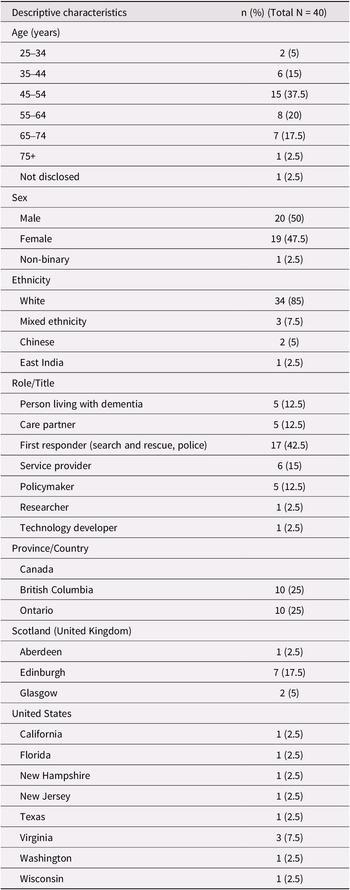
A total of 40 participants took part in the study: 20 from Canada (British Columbia and Ontario), 10 from Scotland (Edinburgh, Glasgow, and Aberdeen), and 10 from the United States (California, Florida, New Hampshire, New Jersey, Texas, Virginia, Washington, and Wisconsin). The group included 20 (50%) females, 19 (47.5%) males, and one non-binary individual (2.5%). Participants included people living with dementia (n = 5), care partners (n = 5), service providers (n = 6), first responders (search and rescue and police) (n = 17), policymakers (n = 5), a technology developer (n = 1), and a researcher with expertise in dementia care (n = 1). Age groups across all participants ranged from 25 to 75+ (mean age 45–54 years). One participant preferred not to disclose age. The majority were White (n = 34), with others identifying as East Indian, Chinese, or of mixed ethnicity (see Table 2).
Participant demographics

Findings from document review and interest holder engagement
The KTA framework provided a structured lens to examine the development and implementation of alert systems for missing persons with dementia, with only the applicable stages used. The framework guided the mapping of processes and activities, helped identify gaps such as variability in alert system implementation, potential barriers, and limited evaluation processes. This approach supported the generation of actionable recommendations to improve sustainability, interest holder engagement, and evidence-based practices in future implementation of alert systems.
Problem identification
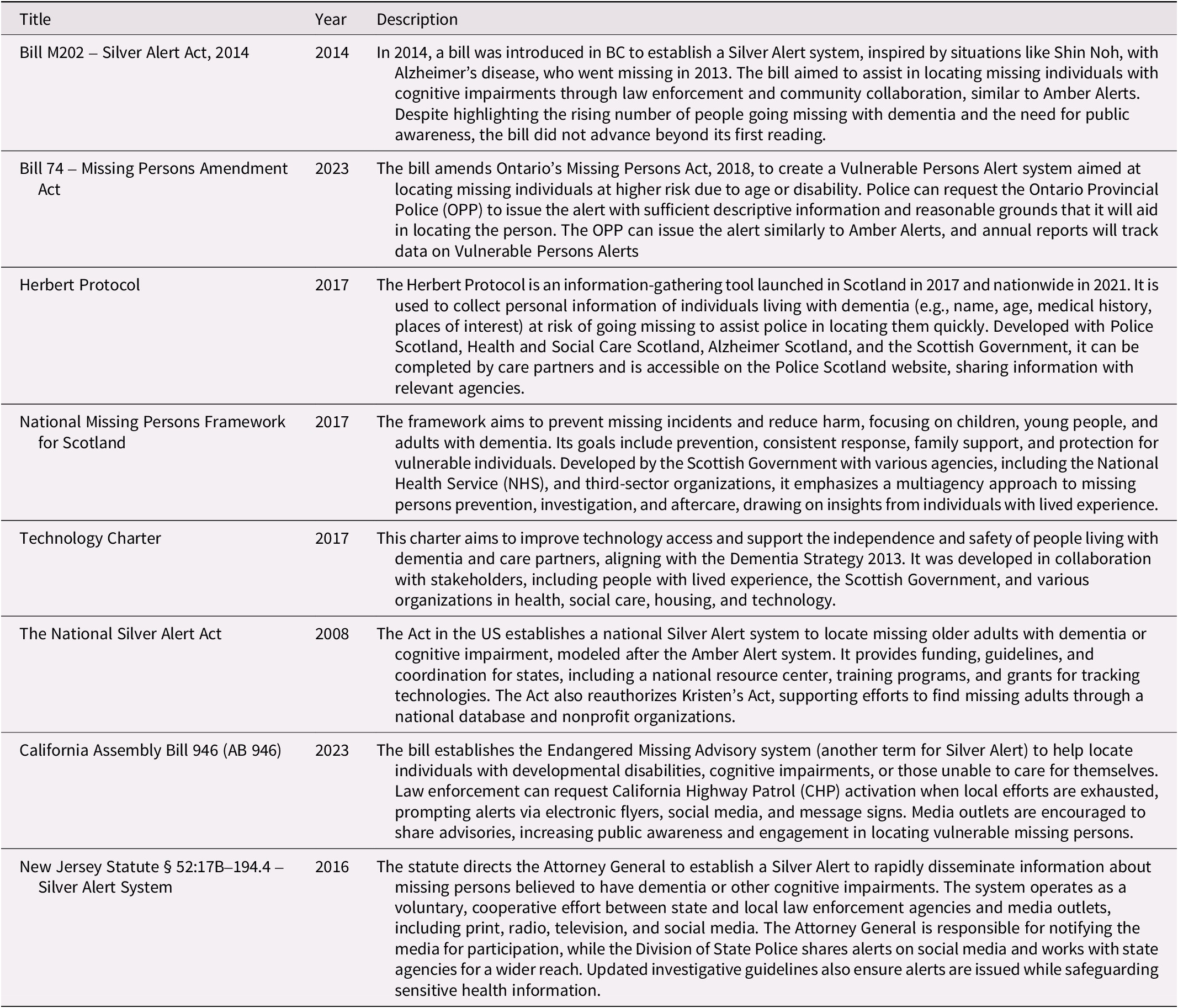
The Action Cycle of the KTA framework begins with the identification of the problem or knowledge-to-action gap (Graham et al., Reference Graham, Logan, Harrison, Straus, Tetroe, Caswell and Robinson2006). To identify the problem and understand the conditions surrounding the implementation and use of alert systems, we reviewed policy documents related to missing persons and alert systems, including legislation and procedures (see Table 3), and engaged relevant interest holders. The key gap identified was variability in alert system implementation, particularly differences in related policies and legislation. This section begins with a brief description of BC Silver Alert, Scotland’s Purple Alert, and the US Silver Alert.
Policies and legislation related to alert systems (Canada, Scotland, and the US)
A brief description of BC Silver Alert, Purple Alert, and US Silver Alert
BC Silver Alert, a community-based alert system in Canada, was developed by Sam Noh and Michael Coyle in 2014 after the disappearance of Shin Noh, a 64-year-old pastor with dementia (BC Silver Alert, n.d.). The system notifies subscribers about missing persons with dementia or autism within a 10-kilometer radius of the home or place of living using a preferred method, such as social media or a Short Message Service (BC Silver Alert, n.d.).
Purple Alert, a mobile alert app developed by Alzheimer Scotland in 2015 (Adekoya et al., Reference Adekoya, Daum, Neubauer, McLennan and Lili2021), allowed families to notify the community about missing relatives with dementia and connect directly with those who recognized them. Purple Alert operated for 7 years and was discontinued in 2024 (Alzheimer Scotland, n.d.), probably due to sustainability challenges.
The US Silver Alert, first launched in 2006 and modelled after Amber Alert (Gergerich & Davis, Reference Gergerich and Davis2017), enables police to notify the public about missing persons with dementia or cognitive impairment using media, wireless emergency alerts, or changeable highway signs. However, the system does not push notifications to mobile phone users in a geographic area, like Amber Alert does.
Variability in implementation of alert systems
This section will provide a detailed discussion of the key gap identified through document reviews and interest holder engagement, namely, the variability in alert system implementation, with particular attention to differences in related policies and legislation.
Authors reviewed policies, legislation, and procedures related to alert systems, their standardization, and practices and search approaches to support individuals at risk of going missing (see Table 3) (California Legislative Information, 2023; Legislative Assembly of British Columbia, 2014; Legislative Assembly of Ontario, 2023; New Jersey Legislature, 2016; Police Scotland, 2025; Scottish Government, 2017; The National Silver Alert Act, 2008). To further explore this gap, we engaged a range of interest holders (people with lived experience, first responders, service providers, and policymakers) (see Table 2). Insights from documents and interest holder engagement indicate that alert systems and related policies are implemented through coordinated lobbying by individuals (e.g. family members of missing persons), groups, or advocacy organizations (e.g. local Alzheimer’s Societies) in collaboration with legislators or policymakers, police, and health and social services. However, implementation varies across regions.
There was no indication of specific legislation on an alert system or Purple Alert in Scotland before its implementation. P2, a service provider, emphasized the need to develop Purple Alert to address dementia-related missing incidents despite the lack of specific legislation on alert systems. ‘We don’t have the policy but again we would have done it…because nothing is really stopping [us]. I mean, unless there is a policy or legislation that says you cannot possibly have a community alert system’. In BC, the Silver Alert Act was introduced in 2014 in response to dementia-related missing individuals. However, the bill did not progress beyond the first reading (Legislative Assembly of British Columbia, 2014).
Similarly, Ontario’s attempt to establish a provincial Silver Alert in 2011 was unsuccessful, though the term ‘Silver Alert’ was later included in the amended Missing Persons Act (Legislative Assembly of Ontario, 2023). However, the term ‘Silver Alert’ has different meanings depending on locations. For example, in Canada, Silver Alert is commonly understood as the use of public or social media by the police to broadcast information about a missing person with dementia. P20, an experienced search and rescue volunteer with policy expertise, described this concern further: ‘We had the corporations that provide Amber Alert, that was pushed back, because of how many times it would interrupt their broadcasts…they are paid to advertise. If the advertising gets cut back, that would create friction within the system’. In contrast, the US introduced the National Silver Alert Act in 2008, providing guidelines while allowing criteria to vary by state, considering factors such as age thresholds (e.g. 55, 60, or 65+), disability status, cognitive impairment, or being classified as ‘at risk.’ (Gergerich & Davis, Reference Gergerich and Davis2017).
Terminology for Silver Alert also differs across the US, including names such as Golden Alert, Senior Alert, and Endangered Missing Persons Alert. P12, a participant and researcher from the US, highlighted variability in Silver Alert implementation: ‘It is up to the local law enforcement agency to adapt search for missing individuals. So, there becomes great variability on how that occurs from community. It varies not only state by state but community by community’.
Perceived barriers to implementation and use of alert systems
This KTA phase identifies potential barriers that may limit the uptake of knowledge or an intervention into the ‘real world’ or practice setting (Graham et al., Reference Graham, Logan, Harrison, Straus, Tetroe, Caswell and Robinson2006). The barriers to implementation and use of alert systems, as identified by participants, are classified under individual-level (limited understanding of alert systems, privacy concerns, alert fatigue) and organizational or system-level barriers (sustainability, accessibility, privacy legislation). This section will also highlight opportunities or facilitators to support the implementation and use of alert systems.
Individual-level barriers
Individual-level barriers to the implementation and use of alert systems are identified as limited understanding of alert systems, privacy concerns, and alert fatigue.
Limited understanding of alert systems
Participants all highlighted the need for an alert system to locate missing persons with dementia, yet there is limited understanding of the system among the public. Participants lack clarity on the criteria and implementation process. Therefore, being knowledgeable about alert systems was perceived as a facilitator to the adoption and use of such systems. Participants noted that understanding and adoption of alert systems vary among police agencies, with some being quick to use them while others lack awareness or experience, leading to variability in their activation and perceived value.
One participant living with dementia (P36) acts as a Silver Alert advocate in Canada emphasized the need for education and public awareness about alert systems and how people can support their implementation in Canada: ‘Many people think there is one in place, and they say when someone has gone missing, why didn’t they use the Silver Alert, well, it’s not totally functional yet, so we have to make sure that people understand’. Similarly, a search and rescue expert from the US discussed the importance of public engagement with alert systems:
People that work within it and law enforcement and people on the systems understand it and utilize it as effectively as any other program and that’s going to vary, but the public engagement and sort of the laypersons understanding of Silver Alert, that’s where I think our system has the biggest need for improvement (P31).
Some participants expressed concerns about the adoption and effectiveness of community-based alert systems due to limited awareness of dementia and the system, highlighting the need for dementia education. An experienced service provider emphasized the need to raise awareness about dementia and community-based alert systems, such as Purple Alert, which enable family members to notify the community about their missing relatives:
In theory, I think having an app on your phone is a great idea. But for that to be effective, it needs to be marketed so that lots of the public know about the app, and how they can help people living with dementia, and how it can save lives because they absolutely could do. But not enough of the public knew about it or have the app on their phone… unless they work in this field, or they have had a relative who’s gone missing. So that’s about increasing people’s understanding and awareness of what dementia is (P3).
Privacy concerns
Participants identified privacy concerns as a barrier to implementing and using alert systems, stressing the need to balance privacy and safety. Stated privacy concerns are related to data protection, stigma of dementia, and risks of fraud, scams, or abuse. Individuals living with dementia and care partners may feel embarrassed about disclosing a cognitive impairment diagnosis, though some communities are more accepting of it. However, participants shared that, based on their experiences, a cognitive impairment diagnosis remains culturally unacceptable in many communities. A participant living with dementia and in support of developing and implementing alert systems, such as Silver Alert in Canada, expressed concerns about the stigma:
Dementia is a taboo word. Some communities keep that information close to their chest. They do not want other people to know because it’s embarrassing to them. So that’s the stigma, but it’s also the community at large (P16).
Participants expressed concerns regarding how the denial of a dementia diagnosis and distrust of police and technology can hinder the adoption or use of alert systems. Care partners may feel embarrassed about a cognitive impairment diagnosis and hesitate to report missing relatives and/or disclose the diagnosis, which delays search and rescue efforts. Privacy concerns can stem from a culture of self-reliance where care partners and service providers may hesitate to ask for help. This was highlighted by a search and rescue volunteer:
I think cultural barriers sometimes can be a little bit of a hindrance. Sometimes if people have gone missing again, I think you probably can have people that do not or maybe in denial, in some cultures, more so than others, or some beliefs that people just do not want to ask for help. You know, I can do it on my own type situations (P38).
Others noted how public disclosure of personal information could increase privacy risks and hinder program adoption. A care partner and lawyer, whose mother went missing in Canada, shared these concerns:
Balancing some of the concerns, which would be privacy and vulnerability, I do worry about that, and that would be exposing their medical background and also possibly exposing them…to vulnerable or bad people in the community when they are very vulnerable (P37).
Privacy concerns influence people’s perception and acceptance of alert systems. A participant living with dementia, P9, shared the experience with Scotland’s Purple Alert: ‘The device makes me even more paranoid than I am. But I’m also a tech geek. So, I understand and know too much about surveillance in general. And how the phone can track you. I’m a very private individual. And yeah, I take it too far’. While P9 acknowledged privacy concerns, he remained open to using alert systems due to their potential to quickly locate missing persons and reduce risk, highlighting the need to address these concerns.
Although privacy concerns were seen as a barrier to implementing and using alert systems, some participants noted that addressing these concerns during development and implementation encouraged adoption. A service provider (P2) involved in the implementation of Purple Alert shared the importance of addressing data protection early: ‘There was a lot of concerns about data protection…at some point, we involved our data protection officers, which were experts in data protection. Because obviously, we were handling sensitive data. So, we would have their input on that’. P2 and other participants emphasized that addressing privacy concerns is crucial in ensuring end users feel confident using alert systems, knowing safeguards are in place for data protection.
Alert fatigue
A last barrier to the implementation and use of alerts at the individual level is alert fatigue. Alert fatigue occurs when frequent missing persons alerts desensitize the public, leading to ignored notifications (Gier et al., Reference Gier, Kreiner and Lampinen2017). Participants expressed concerns that alert fatigue, commonly reported with Amber Alerts, may hinder the implementation, adoption, or use of alert systems, with some users feeling overwhelmed by constant alerts. Some participants, particularly from Canada, raised concerns about alert fatigue if alerts were sent out nationally. Others noted that police officers, like the public, could also experience fatigue from frequent missing person alerts. For example, an experienced police officer and search and rescue coordinator (P21) from Canada referenced Ontario Provincial Police (OPP) statistics, stating, ‘there would be over 600 [alerts] a year, so you’re gonna get two a day’. A policymaker from the US also elaborated on these concerns:
If there’s a particular area or region of a state in the country that has a high number of Silver Alerts, the biggest disadvantage is the community ignoring the alert. Because they get it so many times they just tune it out is sort of like hearing a car alarm that after a while you have just heard it for going off, you just kind of tune it out…which is precisely why the criteria are so important, so that there’s standardization in Silver Alerts, and that the public is not desensitized to them (P39).
Participants further emphasized the importance of addressing alert fatigue to make alert systems more relevant and meet end-user needs. A service provider (P1) questioned whether people downloaded Purple Alert app only if personally affected, noting that those without experience with dementia or missing persons might overlook it due to concerns about alert fatigue thinking: ‘We’re living in a world where we’re saturated with different apps to download’. A search and rescue volunteer and former police officer (P20) on a Silver Alert advisory group, stated: ‘We need to be very concerned about alert fatigue. And not only how the public perceives it, but with our partners who are implementing this system for us because it’s a public private partnership’. As noted by P20, implementing alert systems would require collaboration between the public and law enforcement. He suggested that alerts issued through police services or government agencies might be better accepted and adopted, especially if they are activated only when necessary, within a specific geographic area.
Some participants expressed that the risk of alert fatigue in community-based systems like BC Silver Alert, where subscribers can choose to receive alerts on mobile devices, is minimal. Having localized alerts was identified as important in addressing concerns related to alert fatigue. A care partner and health care provider, P14, involved with BC Silver Alert, noted that Amber Alerts, particularly in Ontario, often trigger complaints about nighttime disruptions, but this may not apply to Silver Alerts. She emphasized the need for a pilot program to test the system rather than assuming alert fatigue would be an issue: ‘Let’s try it out and do a trial system… but don’t already put it in people’s minds that they’re going to have alert fatigue’.
Overall, participants noted that concerns about alert fatigue may stem from assumptions or a limited understanding of alert systems. They emphasized the need to raise public awareness while ensuring alerts are targeted to specific geographic areas to minimize fatigue.
Organizational or system-level barriers
Under this theme, organizational or system-level barriers to the implementation and use of alert systems include sustainability, accessibility, and privacy legislation.
Sustainability
Funding, resources, staff training, and time commitment were all identified as barriers to the implementation of alert systems at the system level. The development and implementation of alert systems rely on government or nonprofit funding, which can be limited. A policymaker discussed the costs of implementing an alert system in the US:
There’s a cost to developing the legislation. The cost for the law enforcement agency that was responsible for managing the program. There’s a couple of cost pieces. One is the cost to maintain the platform upon which the alert goes out. Secondly, there’s a cost to an individual, personnel, a full-time employee, to manage the program. If a law enforcement agency is tasked with managing a program that becomes legislatively mandated, the cost really is deferred to the law enforcement agency. So, you are going to have to find it in your local budget to do that. It’s really in the implementation piece and then sustainability over time (P39).
Participants also raised concerns about securing initial funding for implementing alert systems. A care partner noted that time commitment also impacted BC Silver Alert’s progress:
I would just say that funding is a big thing. If we had either the funding to have even one of us to be running this full-time and get it going and getting the policies and regulations, all of that put together, that would be sufficient for one piece of it. And the other piece would be like we pay for subscriptions, etc., to different platforms. And that’s all coming out of what little money that we do have (P14).
While government or third-party funding helped in the development and implementation of alert systems, sustaining daily operations remains a challenge. A service provider elaborated on the challenges of maintaining Purple Alert:
The disadvantage of Purple Alert, I would say is that it costs money to run. We are looking for ways to make it more sustainable. But for us as being a third sector organization, sometimes it’s difficult to justify financial transactions. It’s always a bit tricky for us, but to date, we have managed to absorb the costs, because we would rather have it as a core service than not having it at all. The cost of development and once a year, probably you need to spend in the region of 20,000 pounds, just to update the back, the minimum, the backend and just to make it run nicely. So, it does become a bit of an expense (P2).
Participants highlighted sustainability as a challenge to implementing and adopting alert systems, as their operation requires long-term commitment and resource allocation – key factors in ensuring their long-term effectiveness.
Accessibility
Accessibility was an important consideration in adopting or using alert systems. Participants stressed the importance of multilingual support and ensuring systems meet user needs. P38, a search and rescue volunteer, shared challenges in communicating with individuals whose primary language was not English, which affected interactions and the use of alert systems: ‘In some cases, there might be a language barrier. That’d probably be the first thing that we run into, just by people, either non-speaking and non-English speaking folks, or something like that’. P40, another experienced search and rescue volunteer, emphasized the importance of making information shared in alert systems simple and clear to enhance their effectiveness and public engagement: ‘There’s probably room for enhancing Silver Alert, a little bit on the technology side. If people were interested in being alerted, what’s the one application to install on your phone that would do it, and not this hodgepodge of apps’. A technology developer further addressed accessibility concerns:
When I look at websites or mobile applications, some of them do not get good adoption technology-wise or download-wise, it’s mainly because their user experience is not as easy or clear. Do people know the importance of the information? I think this kind of education is lacking all around, especially with a lot of immigrants. I do not think people know what to do with different languages (P22).
In addition, participants raised concerns that cost, digital literacy, and privacy concerns could limit access to app-based alert systems, delaying their adoption or use. A service provider further elaborated on these challenges:
Purple Alert does depend on some critical factors for success, and one being that the carer or the family have a smartphone they can have apps on. And we know that with the demographic of people living with dementia, and not everybody has a smartphone, majority of the population do nowadays. But one thing I’m always mindful of is, what about however small that percentage is, who do not have the right technology? (P1).
While accessibility challenges were raised, some participants, particularly from Scotland, highlighted that Purple Alert was intentionally designed to be simple to enhance adoption and use. A service provider (P1) from Scotland further explained, ‘Purple Alert is free for our users. This doesn’t mean that it doesn’t cost anything. But it’s actually quite an expensive service to run. It’s been designed to be as simple as possible to use. So that it’s, again, accessible’. This reinforces the importance of user-friendly alert systems, as noted by participants, to improve accessibility and encourage widespread adoption.
Privacy legislation
Participants identified privacy legislation as one of the main barriers to implementing and using alert systems. In Canada, the Privacy Act (Government of Canada, 2021) governs how government institutions handle personal information, while the Personal Information Protection and Electronic Documents Act (PIPEDA) sets rules for organizations in commercial activities regarding personal information collection, use, and sharing (Government of Canada, 2021). Police must vet missing persons’ information provided by care partners or other sources before public release, which can delay issuing an alert and affect the adoption or use of alert systems (Adekoya et al., Reference Adekoya, Daum, Neubauer, Miguel-Cruz and Liu2025; Gergerich & Davis, Reference Gergerich and Davis2017). A police officer voiced concerns about these privacy restrictions in Canada:
Privacy is always an issue in Canada, it’s always going to be. We’ve created PIPEDA and other laws. Every investigation is based on privacy. I’m a huge supporter of the program. But is it a possible invasion of one’s individual’s rights to privacy versus they’ll say governmental interests? I think overall that the challenge may probably be privacy and the individual choice of the older adult if they wish to be part of the program or not (P27).
In the US, the Health Insurance Portability and Accountability Act (HIPAA) Privacy Rule protects medical records and personal health information, applying to health plans, clearinghouses, and certain health care providers (The United States Department of Health and Human Services, 2024). Participants noted that the use and activation of Silver Alert may be delayed due to privacy restrictions. In states like Virginia, an alert requires the missing individual to have cognitive impairment, including a diagnosis of Alzheimer’s or dementia, and the need for care partner assistance. However, if the person does not have a formal diagnosis of dementia, search and rescue may or may not issue an alert or begin a search right away. Further, a researcher, P12, stated that a ‘Major flaw was delaying search initiation or concerns about health privacy disclosures’. A search and rescue manager highlighted a potential HIPPAA violation:
We’re not really allowed to broadcast somebody’s health condition to the world. So that’s why we say that, hey, they are missing at risk and that’s all we are gonna say. We do not want to say missing with dementia because that is basically giving them healthcare information. It could be a HIPAA violation (P30).
Although privacy legislation differs in Scotland, where community alert systems may not require police vetting, participants emphasized the importance of addressing privacy and data protection in Purple Alert’s development and implementation. A policymaker, P6, involved in the implementation shared insights on this issue: ‘There was a lot around that as well about how do you keep people’s information secure enough that you don’t put them at risk, because they’re vulnerable in the community? Again, police were really good in supporting that as well’.
Privacy legislation poses a challenge in implementing and using alert systems. While it is essential for protecting individual privacy and ensuring fair information practices, participants emphasized the need to balance these regulations with the practical implications for alert system adoption and use.
Evaluating outcomes
An essential KTA phase involves evaluating the impact or outcomes of an intervention to track progress and confirm the value of implementation efforts.
Limited evidence on the effectiveness of alert systems
Evaluating the outcomes of alert systems is crucial to determine if they meet the goals of engaging the public to locate missing persons with dementia. However, the implementation of alert systems often lacks comprehensive impact evaluations, thereby limiting evidence of their effectiveness. Anecdotally, participants viewed alert systems as beneficial for addressing dementia-related incidents, enhancing community engagement, promoting independence, and providing peace of mind for care partners. Many shared success stories, including news reports of missing persons located through alert systems. A search and rescue director (P23) noted that: ‘The anecdotal evidence says that alerts like Silver Alerts and Amber Alerts work when used appropriately. If we can expand them to…even social media nowadays, because social media has geographical fencing available’. Another search and rescue volunteer identified the lack of statistics on alert system effectiveness:
There would be an added benefit if there’re the statistics on the effectiveness of all of these programs, how often is it used? How often does it result in viable leads? How often does it result in a preponderance of false alerts? All that sort of data that could help us as a nation or as a locality determine whether this is a good investment in our time and effort (P40).
Yet, there is limited research on the impact of alert systems and the measurement of their effectiveness. Participants acknowledged the weak evidence on the effectiveness of alert systems. A search and rescue volunteer shared this concern:
Some search managers have spoken to the RCMP [Royal Canadian Mounted Police] afterwards, and they have just been told they were found by a member of the public, but it’s unclear as to whether that the member of the public saw Silver Alert, or they just saw someone who looked lost or confused or something and attempted to assist. So, it’s weak evidence and I would hesitate to call it evidence, in fact (P13).
Participants advocated for rigorous research to assess the impact of alert systems and enhance the program. A service provider provided further details on this:
I think we do need that academic study to really look at it because without that, we cannot really improve it. We can improve the app a little bit, but to actually really take it to that level of the whole of Scotland knowing about it and using it. We’ve had 10,000 downloads but what I really want to know is how many people have actively sort of logged on? How many people have responded when there has been a Purple Alert? We need more behind it basically than just the anecdotal evidence of it (P4).
Evaluating outcomes of alert systems in engaging the public to locate missing persons with dementia was highlighted as a critical phase in the implementation of alert systems and the KTA process. However, limited research on their impact and methods for measuring success has posed challenges for their implementation, adoption, and use.
In summary, findings from document review and interest holder engagement were organized into three adapted KTA phases: identifying the problem, assessing barriers, and evaluating outcomes (Graham et al., Reference Graham, Logan, Harrison, Straus, Tetroe, Caswell and Robinson2006). There is variability in the implementation of alert systems, and the perceived challenges to implementation or use of alert systems were classified under individual-level (limited understanding of alert systems, privacy concerns, alert fatigue) and organizational or system-level barriers (sustainability, accessibility, privacy legislation). Despite these challenges, participants highlighted facilitators to support implementation and use of alert systems, such as designing simple, accessible systems, incorporating data protection safeguards, implementing community-based or localized alerts, and securing government or third-party funding.
Discussion
Guided by the KTA framework, this study aimed to understand the conditions surrounding the implementation and use of alert systems for missing persons with dementia. Three KTA phases were adapted: identifying the problem, assessing barriers to alert system implementation and use, and evaluating outcomes (Graham et al., Reference Graham, Logan, Harrison, Straus, Tetroe, Caswell and Robinson2006). We conducted a document review of policies, including legislation and procedures related to alert systems, and interviews with key interest holders from Canada, Scotland, and the US, including people with lived experience. Grounded in relativist epistemology and a constructivist lens (Yin, Reference Yin2018), this study acknowledges multiple interest holder perspectives as co-created realities. Rather than universal truths, findings reflect participants’ experiences and perspectives, offering a nuanced understanding of the conditions surrounding alert systems implementation and use.
In the first phase of the Action Cycle in the KTA framework, identification of the problem, findings highlight variability in the implementation of alert systems across Canada, Scotland, and the US, emphasizing the need for clear policies. In another important phase of the KTA process, assessing barriers, the perceived challenges to implementation or use of alert systems were classified under individual-level (limited understanding of alert systems, privacy concerns, alert fatigue) and organizational or system-level barriers (sustainability, accessibility, privacy legislation).
Alert systems vary in name and function across locations, contributing to limited public understanding. For example, the term ‘Silver Alert’ is used differently in Canada and the US. In the US, Silver Alerts broadcast information about missing persons through large-scale public channels like highway signs, radio, and TV (Carr et al., Reference Carr, Muschert, Kinney, Robbins, Petonito, Manning and Brown2010; Gergerich & Davis, Reference Gergerich and Davis2017). In Canada, there is no national or province-wide Silver Alert system, and ‘Silver Alert’ is often associated with police use of public or social media. BC Silver Alert is a community-led, localized system where subscribers receive notifications based on their preferred method and geographic area (BC Silver Alert, n.d.). Similarly, before its discontinuation, Purple Alert allowed families to notify community subscribers within a specified location (Adekoya et al., Reference Adekoya, Daum, Neubauer, McLennan and Lili2021).
Privacy concerns, including privacy legislation, were perceived as negatively impacting both the implementation and adoption or use of alert systems (Adekoya et al., Reference Adekoya, Daum, Neubauer, Miguel-Cruz and Liu2025; Gergerich & Davis, Reference Gergerich and Davis2017; Petonito et al., Reference Petonito, Muschert, Carr, Kinney, Robbins and Brown2013), particularly in Canada. While safety may outweigh privacy rights, it is essential to balance both by considering end-users’ perceptions and preferences regarding sharing their information with others (Adekoya et al., Reference Adekoya, Daum, Neubauer, Miguel-Cruz and Liu2025). Although collecting and publicly disclosing personal information is necessary for engaging the public in locating missing persons, individuals living with dementia still have the right to control how their data is shared (Liu et al., Reference Liu, Daum, Neubauer, Cruz and Rincón2022). To protect their privacy, alert systems need to be designed with transparency, strong security measures, and flexible data-sharing options (Neubauer, Daum, et al., Reference Neubauer, Daum, Miguel-Cruz and Liu2021).
Participants from Canada, Scotland, and the US, had different perceptions of alert fatigue. While concerns about alert fatigue were reported in all three countries, those not receiving mobile alerts, particularly in Canada and the US, perceived hypothetical fatigue. Research indicates that excessive alerts in alert systems, including Silver Alerts, can overwhelm recipients and reduce effectiveness (Gier et al., Reference Gier, Kreiner and Lampinen2017). Participants recommended a localized approach, which studies show may be more desirable, as most missing persons with dementia are found near their last known location (Miguel-Cruz et al., Reference Miguel-Cruz, Perez, Choi, Rutledge, Daum and Liu2024; Neubauer, Daum, et al., Reference Neubauer, Daum, Miguel-Cruz and Liu2021).
Sustainability and accessibility were listed as important considerations in implementing and adopting alert systems. Similar studies highlight sustainable funding and high cost of technology as barriers (Boyle et al., Reference Boyle, Husebo and Vislapuu2022; Gkiolnta et al., Reference Gkiolnta, Roy and Fragulis2025). Challenges related to discontinued sponsorship may have contributed to the discontinuation of Purple Alert (Alzheimer Scotland, n.d.).The long-term effectiveness of alert systems depends on sustained commitment and resource allocation. Assessing implementation costs and securing funding from government and non-governmental partners is crucial. Support from policymakers and community organizations is essential for sustainable operation.
Participants stressed the importance of designing user-friendly alert systems with multilingual support and accessible technology. Research supports this, highlighting that successful adoption requires simplicity, flexibility, clear instructions, and features like larger fonts (Boyle et al., Reference Boyle, Husebo and Vislapuu2022; Gkiolnta et al., Reference Gkiolnta, Roy and Fragulis2025; Guisado-Fernández et al., Reference Guisado-Fernández, Giunti, Mackey, Blake and Caulfield2019). Additionally, addressing cost concerns and promoting digital literacy are essential for effective implementation and use of technology (Boyle et al., Reference Boyle, Husebo and Vislapuu2022; Guisado-Fernández et al., Reference Guisado-Fernández, Giunti, Mackey, Blake and Caulfield2019), such as alert systems.
Another key phase in the KTA framework is evaluating the impact of knowledge or interventions to determine their effectiveness. Continuous evaluation, rather than a one-time assessment, is essential to measure success and ensure efforts are worthwhile (Graham et al., Reference Graham, Logan, Harrison, Straus, Tetroe, Caswell and Robinson2006). Several participants indicated that the lack of evidence on effectiveness hindered the implementation and adoption of alert systems. For alert systems to be effective, individuals must not only recognize missing persons but also verify their identity. This study highlights that most evidence is anecdotal, as impact evaluations and cost-effectiveness studies are rarely conducted (Gier et al., Reference Gier, Kreiner and Lampinen2017; Petonito et al., Reference Petonito, Muschert, Carr, Kinney, Robbins and Brown2013). The discontinuation of Purple Alert may also be related to little evidence of impact for its return on investment. Closing this evidence gap is necessary for the adoption and sustainability of alert systems.
Future directions
Successful implementation of alert systems requires clear policy, evidence-based design, strategic planning, and collaboration among interest holders, including policymakers, first responders, community organizations, researchers, and individuals with lived experience. Evaluation is essential for measuring impact, guiding development, and informing decisions on scaling and funding.
A localized, opt-in alert system would allow users – community members and service providers – to receive notifications within specified geographic areas. A standardized national platform with localized customization would allow for quick responses across jurisdictions while safeguarding privacy. Individuals at risk of going missing and their care partners need to be able to securely upload relevant information, which would be shared only with subscribers and removed once the case is resolved.
Ideally, alert systems raise community awareness, educate the public – including first responders, and social and health care providers – on dementia and missing person risks, and ensure accessibility across networks and devices while being tailored to end-users’ needs. Another consideration is that alert systems provide guidance to Good Samaritans on assisting missing individuals when found. Funding for alert systems would be justified if based on evidence of positive impact.
Strengths and limitations
This study’s strength lies in its use of the KTA framework and multiple participants’ input across different contexts, providing deeper insights into barriers to implementing and adopting alert systems for missing persons with dementia. By incorporating perspectives from diverse interest holders across three countries, it enhances generalizability beyond a single case study. Multiple case studies also allow for in-depth data collection, offering rich, real-world insights into implementation challenges. However, limitations include potential bias due to purposive sampling, which may have favoured participants with positive views on alert systems. Snowball sampling may have further contributed to an overrepresentation of individuals with shared interests, higher health or research literacy, and greater willingness to participate. Additionally, most participants were White, limiting the study’s ability to fully capture perspectives from racialized communities.
Conclusion
The study examined our gap in understanding the conditions surrounding the implementation and adoption or use of alert systems in Canada, Scotland, and the US, using the KTA framework to bridge research and practice for effective knowledge translation. Despite apparent public support for alert systems, there is variability in their implementation and related policies. Individual-level barriers include limited understanding of alert systems, privacy concerns, and alert fatigue, while organizational or system-level barriers involve sustainability, accessibility, and privacy legislation. Limited evidence on effectiveness stems from minimal evaluation. Effective implementation requires clear policy, evidence-based design, interest holder collaboration, and ongoing assessment. A localized, opt-in system with accessibility, privacy protections, public education, and sustainable funding can enhance responsiveness and long-term success.
Acknowledgements
Funding for this project was provided by the Alzheimer Society Research Program/AGE-WELL Doctoral Award and Canadian Nurses Foundation Kathleen Rowat Graduate Student Award, awarded to the first author, Adebusola Adekoya. We thank the study participants for contributing their time to this study.




 Open access

