




Introduction
Across Eurasia, the development of sophisticated cavalry had tremendous consequences for ancient societies. Beginning with the domestication of the horse and the subsequent invention of the chariot in the late third or early second millennium BC (Librado et al. Reference Librado2021), innovation in horsemanship meant that societies from the steppe and desert regions of Eurasia were elevated to positions of political and economic prominence. New forms of equipment, such as the bridle and bit, and new strategies, such as the shift to mounted riding, provided steppe groups with increased mobility and improved pastoral economies (Kuz'mina Reference Kuz'mina2007), and perhaps advantages in transport that contributed to major dispersal events (Narasimhan et al. Reference Narasimhan2019). Among the most significant developments in early equestrian warfare were the saddle and the stirrup, which are technological mainstays of present-day horse-riding but were absent during the early centuries of equestrian transport. These innovations ultimately stimulated major changes, including the emergence of mounted warfare and the role of cavalry, reshaping social hierarchies across much of the ancient world (White Reference White1964; Littauer et al. Reference Littauer, Crouwel and Raulwing2002). Due in part to the fragmentary nature of the archaeological record of early eastern and central Asian steppe societies, the origins of saddles and stirrups, and the timeline of their adoption remain poorly defined. Here, we outline the data available from East Asia (Figure 1), and present important new discoveries from the sites of Khukh Nuur and Urd Ulaan Uneet in northern and western Mongolia that clarify the timing of saddle and stirrup use in the Mongolian steppe and beyond.
Site locations and suggested chronology for the emergence and dispersal of the frame saddle and possibly stirrup in East Asia during the fourth–fifth centuries AD in relation to the approximate maximum extent of control of the Rouran Khaganate (figure by J. Conver).

Horse transport and early saddles
Mounted riding appears to have been rarely attempted as a regular form of transport until the late second or early first millennium BC (Drews Reference Drews2004), although some archaeological data suggest that horses could have been ridden as early as the first half of the second millennium BC in the Russian steppes (Chechushkov et al. Reference Chechushkov, Ovsyannikov and Usmanova2020). Early iconography, textual sources and archaeological finds show that in areas of western Eurasia these first riders often rode essentially bareback, with suspended legs and a simple blanket or soft pad separating rider from horse. The Greek writer and soldier Xenophon, writing in the fourth century BC, outlined best practices for cavalry riding and descibed a Greek tradition of riding bareback, gripping the horse only with the upper thighs, allowing the lower legs to dangle, and holding the mane for more security (Xenophon, Art of Horsemanship, 7.5; Morgan Reference Morgan1894). Across the Eurasian continent, early cavalry was heavily reliant on projectiles (e.g. bow and arrow) or missiles (e.g. javelin), which made use of the horse's speed for both attack and retreat (Anglim et al. Reference Anglim, Rice, Jestice, Rusch and Serrati2003).
Despite their nearly ubiquitous use among modern riders, neither stirrups nor true saddles were apparently used by early equestrians. The oldest direct evidence for mounted riding of equids comes from third-millennium BC contexts in Mesopotamia and the Levant, where riders mounted onagers (Equus hemionus) hybridised with donkeys (E. asinus) (Bennett et al. Reference Bennett, Weber, Bendhafer, Champlot, Peters, Schwartz, Grange and Geigl2022). These first ridden equids were controlled with a simple nose-ring tied to a rein line, and riders helped to stabilise themselves using a girth strap that encircled the animal's abdomen. When horse transport first appears in the archaeological record in the late third and early second millennium BC, early herders of the Pontic-Caspian steppes had devised a new type of control system: the bridle. This incorporated two reins, a noseband and a simple mouthpiece made of organic materials (Chechushkov et al. Reference Chechushkov, Epimakhov and Bersenev2018). The bridle provided a higher degree of control necessary to harness the early domestic horses (E. caballus), which were stronger than their asinine counterparts.
Long periods on horseback took their toll on both horse and rider. The evidence from burials of the emerging horse cultures of the Eurasian steppes shows that riders often developed skeletal deformities of the lower limbs, hips and lower back thought to be caused by horseback riding (Buzhilova Reference Buzhilova and Bochkarev2010). The consequences of the practice on the bodies of the horses were even more severe, with serious vertebral ossification, cracking and other serious damage to the spine often observed in early ridden horse assemblages from eastern and central Asia (Levine et al. Reference Levine, Whitwell and Jeffcott2005; Li et al. Reference Li2020).
By the middle of the first millennium BC, concurrent with the rise of mounted cavalry across Eurasia (Drews Reference Drews2004), soft pad saddles made of leather and stuffed with fur, fibres or other material and secured to the horse via a girth strap were employed across the Eurasian interior (Figure 2) (Stepanova Reference Stepanova and Senichenkova2015). These early saddles were occasionally reinforced with wooden or horn supports (Mylnikov Reference Mylnikov2015) and were sometimes secured to the chest or rear of the horse by a chest strap or crupper (Stepanova Reference Stepanova, Sitdikov, Makarov and Derevianko2014). Across Eurasia, by the start of the first century AD, simple saddles were adapted to provide a greater degree of security. In western Eurasia, Roman military saddles incorporated four large ‘horns’ and handholds to give the mounted soldier greater stability (de Camp Reference de Camp1960); rigid internal components may have also been included (Connolly & van Driel-Murray Reference Connolly and van Driel-Murray1991) but this is disputed (Stepanova Reference Stepanova, Pankova and Simpson2021). Early, semi-structured saddles probably gave greater comfort and security to rider and horse, enabling mounted and armoured soldiers to engage more directly with blunt weaponry and swords (Gawronski Reference Gawronski2004). Such innovations in saddle stability, which allowed riders to sustain collisions and ride while more heavily armed, helped heavy cavalry replace chariots on the battlefield by the end of the first millennium BC across Eurasia (Anglim et al. Reference Anglim, Rice, Jestice, Rusch and Serrati2003).
Early soft-pad saddle from Pazyryk in the collections of the Hermitage Museum, St Petersburg, probably dating to the fourth–third century BC (photograph by W. Taylor).

In East Asia, parallel developments towards structured saddles were also taking place. Excavations of tombs in Mongolia's first steppe empire, the Xiongnu (c. 200 BC–AD 100), have revealed that pad saddles were usually associated with a crupper and/or chest strap to secure the saddle in place (Figure 3), and that rigid pommel/cantle components were also often used (Minyaev & Sakharovskaya Reference Minyaev and Sakharovskaya2002). A saddle incorporating a two-piece wooden pommel and cantle (Figure 3) was recovered at Noyon Uul, perhaps the most influential Xiongnu royal cemetery, dated to the earliest part of the first century AD (Umehara Reference Umehara1960). By then, similar proto-saddles with pommels and cantles were also used by Chinese cavalry (Goodrich Reference Goodrich1984), and in many other cultures in Inner Asia (Stepanova Reference Stepanova, Pankova and Simpson2021). Although these proto-saddles are sometimes assumed to have internal structuring, no rigid internal components (aside from an exterior pommel and cantle) have been identified that confidently pre-date the sixth century AD (Stepanova Reference Stepanova, Pankova and Simpson2021).
Early saddle components from Xiongnu-era Mongolia (c. 200 BC–100 AD), Top) a pommel and cantle from burials at Noyon Uul; below) a depiction of a saddle using a chest strap and crupper but without stirrups carved onto an antler artefact (images from Umehara Reference Umehara1960 and Turbat et al. Reference Turbat, Batsukh and Bemmann2015b) (figure by T. Turbat).

By the sixth century AD in eastern and central Asia, proto-saddles were replaced by a sophisticated, composite frame saddle (Stepanova Reference Stepanova, Pankova and Simpson2021) paired with two metal stirrups (Figure 4E & 4F). The rigid saddle tree is a jointed wooden frame that elevated the rider off the animal's spine, likely to have mitigated the chronic damage to the horse observed in archaeological assemblages of the first millennium BC (Levine et al. Reference Levine, Whitwell and Jeffcott2005).
Development in saddlery and stirrups in eastern and central Asia. A) simple saddle pad and/or girth; B) soft proto-saddle with rigid endpieces; C) proto-saddle or frame saddle with creative solutions for leg stabilisation; D) proto-saddle or frame saddle with single mounting stirrup; E) early frame saddle with wooden or simple iron stirrups; F) frame saddle with flat-bottomed iron stirrups (figure by P. Lopez Calle).

The stirrup
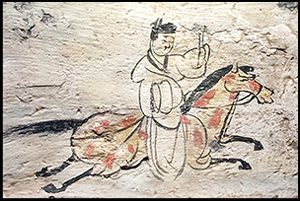
In tandem with increasing saddle complexity, early riders began to experiment with different footholds. Based on analysis of iconographic depictions, Littauer et al. (Reference Littauer, Crouwel and Raulwing2002) argue that some riders in central and southern Asia during the last century BC and first century AD appear to have employed toe loops and ‘hook stirrups’ involving a curved metal hook suspended from the saddle to support the foot. Iconography from a tomb mural in Gansu province in north-western China shows that, by the third/fourth century AD, riders in China used other kinds of foot supports—stabilising themselves inside cloth bags suspended from the saddle (Figures 4C & 5).
Murals depicting mounted horse messengers and hunters from the tombs at Jiayuguan, Gansu, c. AD 220–316 (Olsen Reference Olsen1988) in the collections at Gansu Provincial Museum, Lanzhou (figure by W. Taylor).

The earliest firm archaeological evidence for stirrups comes from East Asia. One candidate for the oldest known such artefact comes from a burial in Anyang in China's Henan province, dated typologically to the first half of the fourth century AD (Sun Reference Sun1983). The stirrup was recovered alongside parts of a saddle that included a pommel and cantle but which might not yet have used rigid internal structuring—saddles from other well-preserved central Asian burial assemblages of this date have also yielded only a pommel and cantle probably paired with a soft pad (Stepanova & Torgoev Reference Stepanova and Torgoev2022). While radiocarbon dating has rarely been applied to Chinese sites of this period, the oldest representation of a stirrup may be from a figurine in a tomb in Changsha city, Hunan province in southern-central China, dated to c. AD 302 based on regnal dates (Sun Reference Sun2013: 95). Recently, an even earlier potential example has been proposed, featured on a terracotta model in the tomb of a general of the Eastern Wu kingdom in the city of Nanjing and thought to date to around the time of his death c. AD 271, although a full report of this material is yet to be published (Zhou Reference Zhou2021). Such depictions of early stirrup-like objects are shown only on the left side of the saddle, rather than in pairs (Figure 4D; Dien Reference Dien1986); their initial function could therefore have been as mounting aids (Dien Reference Dien1986; Azbelev Reference Azbelev2014). Nonetheless, paired stirrups for riding soon emerged across much of East Asia, with depictions thought to date to c. AD 322 in southern-central China (Yuan Reference Yuan1972) and in Xinjiang during the Eastern Jin period c. AD 317–420 (Hou Reference Hou2014: 127).
Around this time, people of the former Xianbei confederacy (largely in present-day Inner Mongolia and Manchuria) began to assert political dominance in north-eastern China, culminating in a major expansion of the role of horses and cavalry in China during the rule of the Northern Wei dynasty (c. AD 386–535; Muller Reference Muller, Fragner, Kauz, Ptak and Schottenhammer2009). Many of the earliest actual stirrups come from north-eastern China and the Liao River basin (Muller Reference Muller, Fragner, Kauz, Ptak and Schottenhammer2009), and the Xianbei are likely to have played an important part in their early diffusion (Csiky Reference Csiky2020). By the middle of the fourth century AD, pairs of stirrups are found in burials throughout north-eastern China and Korea (Li Reference Li1984; Isahaya Reference Isahaya2012).
By the early fifth century, paired stirrups, often made of wood and covered with iron or gilded bronze plating, came into widespread use across much of East Asia, including Japan (Isahaya Reference Isahaya2012), until they were replaced by cast-iron versions in the sixth century AD and later. Csiky (Reference Csiky2020) divides this early history of the stirrup into three basic stages. During Stage I (fourth–fifth centuries AD), early stirrups were made of wood and sometimes augmented with metal; these are found mostly in East Asia. During Stage II (fifth–sixth centuries AD), early iron stirrups are found across a wider area, including Korea and Japan (Kidder Reference Kidder1985), the Kyzyl-Tash horizon of the Russian Altai (Seregin Reference Seregin2013; Seregin & Matrenin Reference Seregin and Matrenin2014), Siberia and Transbaikal (Azbelev Reference Azbelev2014) and Mongolia (Eregzen & Ishtseren Reference Eregzen and Ishtseren2014). In Stage III (sixth century AD and later), iron stirrups spread widely across much of Inner Asia, reaching Europe by c. AD 600 (Curta Reference Curta and Curta2008), playing a part in Islamic expansion into North Africa and Iberia during the seventh and eighth centuries AD (Law Reference Law2018). Ever since, stirrups have been a crucial element of cavalry equipment in cultures across the globe.
The record from the Eastern Steppe
From the first arrival of domestic horses in East Asia during the late second millennium BC, Mongolian horse cultures have acted as a catalyst for the innovation and spread of horse transport, equipment and management techniques (e.g. Taylor et al. Reference Taylor2018). But with few archaeological discoveries reliably associated to the early centuries AD, it has remained unclear what role, if any, the Eastern Steppe played in the development and spread of frame saddles and stirrups in East Asia and beyond.
The Khukh Nuur burial
New archaeological discoveries raise the possibility that early stirrups were also adopted in the Mongolian steppes. Recent excavations at the site of Khukh Nuur in northern Mongolia (Turbat et al. Reference Turbat, Erdene-Ochir, Batsukh and Enkhbayar2015a) have revealed a single, small iron stirrup (Figure 6). The burial had not been looted, although the tomb was disturbed to a degree by marmot burrowing that could have affected the assemblage, making it difficult to infer whether one or two stirrups were originally present (Turbat et al. Reference Turbat, Erdene-Ochir, Batsukh and Enkhbayar2015a).
Stirrup recently identified from the site of Khukh Nuur, northern Mongolia, radiocarbon-dated to the late third or early fourth century AD (figure by T. Turbat).

A similar pattern of single iron stirrups exists in the earliest contexts in the Russian Altai (fifth-century AD, Kyzyl-Tash phase), which Seregin (Reference Seregin2013) interprets as evidence of their use as a single mounting stirrup. The design and squashed-oval shape of the Khukh Nuur stirrup resembles early wooden exemplars found in East Asia but lacks a wide tread and also exhibits a different, T-shaped proximal attachment, a style that became popular across East Asia in the late fifth century (Isahaya Reference Isahaya2012). Radiocarbon dating of the human bone associated with this stirrup produced a date of 243–405 cal AD (details in online supplementary material (OSM) Table S1). If this date is not influenced by a freshwater reservoir effect (Svyatko et al. Reference Svyatko2022), it would place stirrup use in Mongolia alongside the earliest in East Asia, and significantly earlier than the first single iron stirrups from the Russian Altai (Seregin Reference Seregin2013).
The Urd Ulaan Uneet cave burial
In April 2015, archaeologists from the National Museum of Mongolia were notified by police that looters had destroyed a cave burial at Urd Ulaan Uneet in Myangad sum, Khovd province (Bayarsaikhan et al. Reference Bayarsaikhan, Tuvshinjargal, Bayandelger, Munkh and Sukhbaatar2017). The police confiscated several organic objects that had been well preserved in the dry environment of the cave. Along with grave goods, the mummified partial remains of a horse and an iron bit with wooden cheekpieces were also recovered (Figure 7). Bit-related damage to the teeth of this horse and remodelling of a section of exposed nasal bone show that it was used intensively for riding (Taylor et al. Reference Taylor2018). An intact wooden saddle was also recovered from this cave (Figure 8). Here, we present for the first time detailed archaeological and biomolecular analyses of this saddle and horse and explore their implications for our understanding of early horse equipment and social dynamics in ancient Asia.
Horse remains and bridle bit from Urd Ulaan Uneet (figure by W. Taylor and J. Bayarsaikhan).

Birch composite frame saddle from Urd Ulaan Uneet (top left) and artist's reconstruction (figure by P. Lopez Calle).

Results
Horse equipment
The saddle is a composite, frame saddle made of birch wood (Figure 8). It has been painted or stained a deep red, and trimmed with black, although some of the paint has worn off from the right side. Each half of the saddle tree is carved from a single piece of wood, while the pommel and cantle consist of two bevelled halves joined in the centre with wooden nails—five joining the halves of the pommel, and two joining the halves of the cantle (Figure S1). The pommel and cantle are joined to the saddle tree by strips of leather threaded through small holes in the wood. Additional holes near the rear and front of the saddle seem to have been areas for the attachment of a crupper and chest strap. The pommel is narrow (about 310mm wide) and high, while the cantle is low and wide (about 370mm). The saddle itself is 420mm long and 457mm wide with a maximum height of 305mm. Most significantly, emerging from the centre of the saddle tree on either side is a large leather strap roughly 12mm wide, which has broken off on both sides but appears to have dangled freely downwards from a wooden slit of similar size. The cheekpiece of the jointed iron bit consists of an antler tine, affixed to the bridle via a separate iron ring, a bridle style that became popular across East Asia after the mid-third century AD (Isahaya Reference Isahaya2012).
Bilateral straps attached to this saddle midway through each side of the saddle tree strongly suggest that early paired stirrups were present in the Urd Ulaan Uneet saddle, even though no physical stirrups were recovered. Identical holes used to secure stirrups have been recorded among early Turkic saddles of a later date (Batsukh & Batbayar Reference Batsukh, Batbayar, Turbat and Erdenebat2014). Because of the circumstances of discovery, it cannot be ascertained whether the original stirrups were removed prior to burial or later by looters (either in antiquity or recently). Given the presence of bilateral strap fragments, we speculate that stirrups of some form may have originally been present.
Radiocarbon dating
Radiocarbon dating of a human tooth from the burial of Urd Ulaan Uneet at the Laboratory of the Institute of Accelerator Analysis in Japan suggested that the burial and its contents, including the saddle, date to 1737±20 BP, or between 247–402 cal AD (95.4% probability; IAAA-170205). Quality control measures suggest good collagen preservation associated with this date (Table S1), but recent studies raise concerns over reservoir effects on radiocarbon dates from human bones in the region (Svyatko et al. Reference Svyatko2022). To date the saddle directly, we also sampled a portion of strap made of horse hide. Sample cleaning, carbon extraction and graphite preparation of this specimen was carried out at the Accelerator Mass Spectrometry Laboratory at the University of Arizona before radiocarbon values were analysed at the University of Georgia Center for Applied Isotope Studies. The strap is dated to 1646±22 BP, or 267–535 cal AD (95.4% probability). Because this measurement derives from material directly associated with the saddle, we are confident that it accurately dates its construction, implying a reservoir offset of just over a century for the human remains (Figure 10). All radiocarbon dates were calibrated using the IntCal20 calibration curve (Reimer et al. Reference Reimer2020).
ZooMS analysis of leather components
On the same sample, we conducted collagen peptide mass fingerprinting—also known as Zooarchaeology by Mass Spectrometry (ZooMS; Buckley et al. Reference Buckley, Collins, Thomas-Oates and Wilson2009)—to identify the taxonomic origin of the leather components of the saddle. We extracted collagen protein from approximately 10mg of leather following the acid insoluble protocol described in Brown et al. (Reference Brown, Hebestreit, Wang, Boivin, Douka and Richter2020). Samples were analysed using a Bruker Ultraflex MALDI-TOF/TOF mass spectrometer at the Harvard Center for Mass Spectrometry. Spectra were visually inspected using mMass (Strohalm et al. Reference Strohalm, Hassman, Kosata and Kodícek2008). Markers were compared with published marker lists (Buckley et al. Reference Buckley, Harvey and Chamberlain2017). Eight collagen marker peptides were successfully identified, allowing a confident identification of the leather as Equus (Figure 9, Table S2).
Collagen peptide mass fingerprint for the Urd Ulaan Uneet saddle leather components, showing diagnostic markers associated with Equus (figure by K. Richter).

DNA analysis
To assess the species and sex of the horse interred along with the Urd Ulaan Uneet saddle, DNA extractions were carried out at the ancient DNA (aDNA) research facilities of the Centre for Anthropobiology and Genomics of Toulouse, France (Université Paul Sabatier (see OSM: DNA analysis)). We successfully extracted sufficient aDNA from the sample to identify the sex and species and/or first-generation hybrid status of the specimen with maximal sensitivity and specificity (Schubert et al. Reference Schubert2017; Fages et al. Reference Fages, Seguin-Orlando, Germonpré and Orlando2020). The equid recovered in the Urd Ulaan Uneet cave burial is indeed a domestic horse (E. caballus; Table S3) rather than a domestic donkey, wild equid or a hybrid, and it was male (OSM Appendix 1).
Discussion
Direct radiocarbon measurements on human remains from the Urd Ulaan Uneet burial date them to 247–402 cal AD (95.4% probability). While human remains can be affected by a freshwater reservoir effect, radiocarbon dating of horse tissue from the saddle itself generally corroborates this result (267–535 cal AD, 95.4% probability); dietary offsets related to consumption of aquatic organisms are unlikely to have had an impact on this horse tissue. The median date for the saddle's construction falls during the early years of the fifth century AD, c. 420 cal AD (Figure 10), thus making Urd Ulaan Uneet the site with the oldest direct evidence for a true frame saddle being present in the Eastern Steppes by at least the fourth or early fifth century AD. Our aDNA analysis of the horse interred alongside the saddle indicates that the animal was a male domestic horse.
Calibrated radiocarbon dates from early saddles and stirrups from Mongolia, compared with cultural events and technological changes in saddlery. Dates calibrated using the IntCal20 calibration curve (figure by W. Taylor).

The choice of raw materials and design of the Urd Ulaan Uneet saddle point to its local production and link it with earlier horse tack traditions. The choice of birch is consistent with local manufacture in the Altai Mountain range, where it grows naturally and is commonly selected for saddle manufacture by present-day herders. Our ZooMS data indicate that horse hide was used in the production of the leather ties that joined the birch components, a choice of material consistent with production in the mountain-steppes of western Mongolia (where domestic horses have been present since the late second millennium BC). Although the high pommel and cantle reflect design principles seen in earlier treeless saddles from across East Asia, the method of pommel and cantle joining is the same as used earlier, in the Xiongnu period (Figure 3). The structural similarity between the Urd Ulaan Uneet saddle and frame saddles of the subsequent First Turkic Khaganate (AD 552–603), which ranged from the Caspian Sea to China (Khudyakov Reference Khudyakov, Soyenov and Oynoshev2006), may imply that this and other early saddle traditions derive from an Altai or Eastern Steppe antecedent. Future work from other areas of East Asia with exceptional organic preservation, such as desert cemeteries in China's Xinjiang province, may help clarify whether the saddle found at Urd Ulaan Uneet had precursors in adjacent areas as well, or whether the frame saddle was an innovation of the Eastern Steppes.
Riding equipment and first-millennium AD steppe cultures
Combined with other recent discoveries, our study raises the possibility that the Eastern Steppe played a key role in the early development and spread of the frame saddle and stirrup. While technological innovation is often characterised as a unique moment in time, most technological changes are in fact a process of recombination or modification of a ‘recipe’ of pre-existing materials and ideas that are culturally transmitted (O'Brien & Shennan Reference O'Brien, Shennan, O'Brien and Shennan2010). Recent work at Khukh Nuur indicates that stirrups were present in what is now Mongolia at a very early stage, concurrent with their spread among the Northern Wei in northern China. Our new finds from Ulaan Uneet suggest that during the late fourth or early fifth century AD, steppe riders using locally sourced materials modified earlier proto-saddles to incorporate a true saddle tree. With a solid frame, this new saddle could better support stirrups that held a rider's weight while mounted. The date of the Urd Ulaan Uneet frame saddle appears to be older than other early specimens, such as those dating to the late fifth century from Xinjiang (Wang Reference Wang1973) and other areas of East Asia dated to the fifth–sixth centuries (Datong Archaeological Research Institute 2008; Isahaya Reference Isahaya2012).
These improvements to equestrianism, and by inference to equestrian combat, may have contributed to the formation of early steppe polities. In addition to facilitating mounting while encumbered, stirrups gave stability to the rider's seat and freedom of movement for the upper body, meaning that they could be more effective in shock combat—sustaining and delivering heavy ‘hacking’ blows while mounted, using lances, swords, spears and other heavy weaponry (Dien Reference Dien1986). The stirrup also enabled riders to stand in their seat, making it more secure to trot, a gait that can jostle a stirrup-less rider (Stepanova Reference Stepanova, Pankova and Simpson2021). So equipped, steppe riders could ride to battle with heavier armour or weapons, or use existing weapons in new ways, giving early adopters an advantage in horse combat and transport. The fourth and fifth centuries AD corresponded to cooler, more favourable climate conditions in the Eastern Steppe that witnessed the political integration of the Rouran Khaganate (Struck et al. Reference Struck2021), an ‘imperial confederation’ uniting a broad region of Inner Asia, including the area of western Mongolia where the Urd Ulaan Uneet burial was discovered (Kradin Reference Kradin2005). While deeper contextual comparisons may be necessary to test this hypothesis, our findings raise the possibility that the rise of the Rouran was aided by technological supremacy linked to the early use of frame saddles and metal stirrups.
Conclusions
New archaeological discoveries from western and northern Mongolia show that, despite a fragmentary archaeological record, horse cultures of the eastern Eurasian steppe were early adopters of frame saddles and stirrups, by at least the turn of the fifth century AD. The saddle discovered at Urd Ulaan Uneet is one of the earliest known examples of a wooden frame saddle, showing evidence of both local production and connections with earlier saddle traditions. Recent finds from Khukh Nuur suggest that stirrups were in use on the Mongolian steppe concurrently with their earliest appearance elsewhere in East Asia. Together, these new data support the idea that Mongolian steppe cultures were closely tied to key innovations in equestrianism, an advance that had a major impact on the conduct of medieval warfare.
Funding statement
This project has received funding from the European Research Council (ERC) under the European Union's Horizon 2020 research and innovation programme (grant agreements 681605 and 804884). Gino Caspari was funded by the Swiss National Science Foundation, grant number P400PG_190982, and this research was also supported by JSPS KAKENHI Grant numbers JP17H00938 to Noriyuki Shiraishi, JP22H00722 to Manabu Uetsuki and JP18K01083 to Naoto Isahaya.
Data availability
The authors confirm that the data supporting the findings of this study are available within the article and its supplementary materials.
Supplementary material
To view supplementary material for this article, please visit https://doi.org/10.15184/aqy.2023.172.


 Open access

