


The 1910s and early 1920s saw both the sudden rise and surprising decline of guild socialism in Britain. As a reaction to the parliamentary activities of many English socialists, guild socialism attacked the rationale of representative democracy and instead advocated direct action, workers’ control of industry, and mass self-government. At the same time, it emerged as a radical challenger to the prevailing Fabian collectivism that exalted the state as the incarnation of the national community and the guardian of economic equality. If Fabianism was the leading indigenous socialist strand in late nineteenth-century England, guild socialism took on this mantle in the early twentieth century.
From the beginning, guild socialism was characterized by its “Englishness”. It dealt primarily with the industrial problems of England and aimed to provide remedies to England's economic and political problems. G.D.H. Cole (1889–1959), its leading theorist, made it clear that “none of us Guildsmen pretends, that Guild Socialism is the right way for all the peoples of the world to tackle their economic problems”, but “we believe it is the right expression for Socialism to take at this particular time in this particular country”.Footnote 1 Indeed, Cole was seen by his followers not only as a little Englander but even as a “little Southern Englander”.Footnote 2
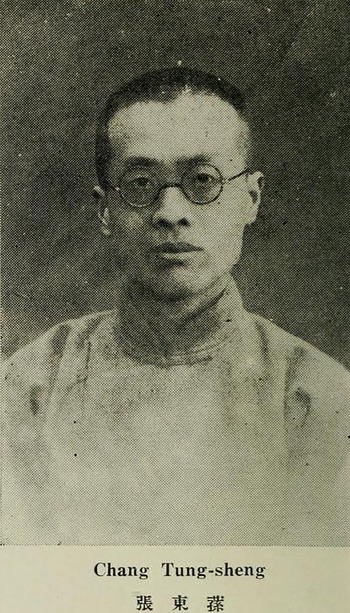
Understandably, the existing scholarship on the guild socialist movement pays close attention to Britain proper and examines the movement and its ideology through the prism of the history of English socialism. Guild socialism is therefore seen mainly as a radical ideology demanding industrial self-government for the organized working class in a highly industrialized country.Footnote 3 However, the fact that most guild socialists were seldom concerned with the world outside Britain does not prevent guild socialism from producing an impact elsewhere. The radical movements (including the guild socialist movement) that arose in areas located at the periphery of the global capitalist system, in particular, deserve as much attention as those in the metropolis do. As this article shows, in China some intellectuals claimed to be guild socialists, dedicated to the study and propagation of guild socialism.Footnote 4 Zhang Dongsun (1886–1973) (Figure 1), a prominent intellectual, led this group. The years between 1919 and 1922 saw them translate numerous books, pamphlets, and articles written by Cole and other guildsmen. Zhang and others praised this modern guild system as the most desirable form of society in the future, not only for Britain but also for non-Western countries such as China.
Portrait of Zhang Dongsun, c. 1933.
Who's Who in China, Suppl. to 4th ed, The China Weekly Review (Shanghai), 1933, p. 6. Public Domain.

On the other hand, students of early Chinese socialism seem to have largely neglected this socialist strand and concentrated instead on Marxism–Leninism and anarchism.Footnote 5 Indeed, anarchism had a lasting influence in China in the early twentieth century and served as an integral part of the anti-despotism and anti-Manchuism that led to the collapse of the Qing Empire in 1911–1912. The October Revolution and the communist movements after the Great War ignited the passion among radical Chinese intellectuals for mass revolution and bottom-up direct action. Anarchism, together with Marxism–Leninism, hit the headlines, though the latter received more attention and led directly to the founding of the Chinese Communist Party (CCP).
While the competition between anarchism and Marxism has occupied the centre stage of Chinese socialism, there has been barely any serious investigation of Zhang Dongsun's socialist agenda. Undoubtedly, there have been a number of works that explore Zhang's ideas, but many of them tend to emphasize Zhang as an outstanding and original philosopher who succeeded in establishing an epistemological framework that combines Western and Chinese thought.Footnote 6 When Zhang's socialist ideas have been examined by historians, they have seldom discussed in detail how he became interested in guild socialism and how he interpreted this particular socialist idea in the context of modern China.Footnote 7
In 1920–1921, Zhang was engaged in an inflammatory debate with the communists regarding which approach Chinese socialists should take, and he dismissed the Bolshevik revolution as an anachronism for early 1920s China. The debate is often described by official historians in mainland China as one between real Marxists and the “pseudo-socialists” led by Zhang.Footnote 8 Interestingly, some of these accounts claim that Zhang, as a guild socialist, was advocating capitalism. This description is puzzling, as guild socialism emerged in Britain as a strong anti-capitalist ideology. Little effort has been made, however, to explain this discrepancy, as people writing about modern Chinese radicalism have seldom investigated the history of English socialism.
It is therefore essential to build a bridge between the fields of early twentieth-century English and Chinese socialist movements, which until now have seldom been linked. This article connects the two fields and examines how the idea of guild socialism, designed in the first place to respond to the problems of British society, was accepted and reinterpreted in China. Through a transnational and comparative perspective, it discusses the localization of a travelling socialist idea and compares both the distinctions and continuities between Zhang Dongsun's guild socialism and its original form.
In this article, I argue that, while English guild socialists aimed to radicalize the English socialist movement with revolutionary rhetoric, such as workers’ control of industry and abolition of the wage system, their Chinese counterparts, armed with the same intellectual tools, attempted to cool down the insurrectionist passion prevalent among Chinese socialists. It was through guild socialism that Zhang Dongsun and his friends managed to strike a balance between elitism and mass democracy in pursuit of political modernity for China. On the one hand, this middle-of-the-road moderate socialism was, indeed, in line with the core spirit of English guild socialism, which explains why this ideology appealed to some Chinese intellectuals; on the other, Zhang actively re-understood this English idea in a new historical context and provided an elitist interpretation. Ironically, it was precisely this reinterpretation that deprived guild socialism of its revolutionary spirit of direct action and thus removed much of its glamour.
We will first take a look at Zhang Dongsun's early life, discussing how he hovered between mass democracy and political elitism before becoming interested in guild socialism. In the early Republican period (1913–1916), Zhang was in strong opposition to the dictatorship of Yuan Shikai (1859–1916) and highlighted mass democracy as a counterpower to autocracy. The rise of provincial warlordism and the failure of the state following Yuan's death, however, drove Zhang to embrace elitism, meritocracy, and technocracy. At this point, the works of some Fabian leaders, such as those written by H.G. Wells (1866–1946) and Graham Wallas (1858–1932), confirmed to Zhang that political elitism was a global trend in modern societies.
Yet, Zhang did not simply reject mass democracy when turning to elitism, as he was alert to the threat of autocracy and bureaucratization behind the elitist politics. It was this pursuit of a balance between the two forms of modern politics that led him to guild socialism. Here, Bertrand Russell (1872–1970) served as an important go-between, who made guild socialism relevant to Zhang and his friends, as Russell highlighted the perfect balance between the state and the working class and between consumers and producers in Cole's guild system. Zhang was so passionate about Russell's socialist idea that he invited the latter to visit China and give lectures on social and philosophical issues. To Zhang's surprise, after staying for a year, Russell recommended Bolshevism, rather than guild socialism, as a feasible path for China's modernization. Russell's changed attitude frustrated Zhang but, at the same time, also strengthened his determination to become a thinker critically examining Western ideas and actively developing a guild socialist theory adaptable to China.
In the third section, we examine Zhang's interpretation of guild socialism by comparing it with Cole's theory, followed by an analysis of Zhang's understanding of early twentieth-century Chinese society. To Zhang, the value of guild socialism did not lie so much in its fierce attack against industrial slavery or its anti-statist pluralism, as highlighted by the English guildsmen; rather, the guild idea was desirable because of its intricate design of political and social systems that could allegedly achieve the balance Zhang had long pursued. Zhang shared English guildsmen's emphasis on economic analysis, but he exploited it as a justification for his idea of elitist democracy. With this special view of guild socialism, Zhang disapproved of the communist call for revolutionary dictatorship and direct action in early 1920s China. Here, we will discuss the connections of his political ideas and socialist vision with his analysis of various social groups in Chinese society, which turned out to be closer to Marxian historical materialism than that of the founding members of the CCP.
This article has multiple implications. For a long time, communists and anarchists have been made heroes in the historiography of early twentieth-century Chinese radicalism, whereas guild socialists remain a group long ignored by academia. Revisiting Chinese guild socialism reminds us of both the existence and the significance of this moderate socialist group outside the well-researched communists and anarchists.
In the past, students of Anglo-Chinese history have long focused on diplomatic and economic relations more than on cultural communication between the two countries.Footnote 9 In recent years, the dimension of cross-cultural interactions has aroused much more interest from academia, yet the main theme is often the process of how Britons constructed and disseminated their colonialist knowledge of China.Footnote 10 How Chinese intellectuals, when forming their political views, actively interpreted and localized English ideas still leaves much room for further research. This article endeavours to deepen our understanding of this understudied topic.
The case study of Zhang Dongsun's guild socialist idea also contributes to the study of the global history of radicalism, which has emerged in recent years as an exciting new field. This article shows how a travelling socialist idea, when crossing borders and entering a new cultural system, could be given a new implication that became relevant to the new historical context through an active reading of the local intellectuals. This “cultural translation”, to borrow Peter Burke's term, shows the agency as well as the limitations of non-Western intellectuals.Footnote 11
Between Mass Democracy and Elitism: Zhang Dongsun's Dilemma before 1919
Zhang Dongsun was born into a literati family in 1886 and had received traditional Confucian training since childhood. This rigorous Confucian schooling, however, did not prevent him from reading extensively, and some works on Western philosophy aroused his interest. In 1905, Zhang was selected as a government-sponsored overseas student to study philosophy at the prestigious Tokyo Imperial University (Tōkyō Teikoku Daigaku). In Japan, he became fascinated not only with philosophy, but also with other subjects recently introduced from Europe, such as biology, psychology, sociology, politics, and law. Here, he established with his friends the “Society of Philosophy” (Aizhihui), hoping to modernize Chinese culture and politics with up-to-date European scholarship.
The 1911 Chinese Revolution kindled Zhang's passion for political reconstruction. By that time, Zhang had just graduated and returned to China. He soon joined the new republican government under the provisional president Sun Yat-sen (1866–1925) and served as a secretary. However, frustrated with the chaotic post-revolutionary politics in 1912–1913, Zhang resigned and embarked on a career as a political commentator. As Yuan Shikai took power from Sun Yat-sen, the situation was stabilized. Yet Yuan's government became increasingly centralized and autocratic in the years that followed. Zhang stood out with his acrimonious criticism of Yuan's dictatorship. Soon, his comments drew attention from Liang Qichao (1873–1929), a prominent statesman, thinker, and scholar, and they became close friends in the following years.Footnote 12
Facing Yuan's dictatorship and the expansion of coercive state power, Zhang responded by extolling the rule of law. He distinguished the “state under rule of law” (fazhi guo), or Rechtsstaat, from the “police state” (jingcha guo).Footnote 13 According to him, the former represented the direction of social evolution in the world, whereas the latter put absolute power in the hands of a single ruler and could easily produce political apathy among citizens and, if the dictator died, political instability.
But how to establish rule of law in a country where even the political leaders did not obey the law? Zhang hoped the citizens would rise up and supervise the government. Here, he recognized the political consciousness and active participation of the masses as a counterbalance to state power and a guarantee of republican democracy. To nurture this political consciousness, he thought it imperative to exalt “justice” (zhengyi) as the core of “national morality” (guomin daode). To Zhang, when the citizens of integrity and righteousness took action and stood up to the corrupt and arbitrary ruling elite, democracy could have a sound basis and autocracy could be defeated.Footnote 14 In this way, Zhang discovered the political significance of the masses’ will and morale.
However, a nation of justice was a distant ideal, and Yuan Shikai was not content with just being a dictator. In December 1915, Yuan crowned himself emperor. This incurred widespread objections and rebellions, which led to his abdication and death in June 1916. The sudden collapse of Yuan's absolutist state and the ensuing political chaos forced Zhang to rethink China's path towards modernity. A centralized government no longer existed and provincial military governors competed for spheres of influence. Provincial warlordism and state failure thus set the tone of post-1916 Chinese politics, and Zhang, accordingly, had to put aside his initial idea of counterbalancing state power with mass action. An oppressive state was no longer the main threat, displaced by a weak one unable to hold the whole country together.
The priority for Zhang's political agenda, therefore, was no longer resistance to autocracy, but a pursuit of the backbone of the republic that could bolster a strong modern state. Indeed, it would take a long time to cultivate the political consciousness of the uneducated masses, while assembling a group of competent politicians and experts in charge of national affairs was a more pressing task. In this vein, mass democracy (yongzhong zhuyi) had to give way, at least temporarily, to elitist meritocracy (xianneng zhuyi), though the two were not necessarily incompatible.
At this point, the widely circulated work of Robert Michels (1876–1936), Political Parties, confirmed to Zhang that professionalism, bureaucratization, and elitism were inevitable trends in modern societies. A student and a close friend of Max Weber (1864–1920), Michels was a dedicated sociologist studying modern elitism.Footnote 15 Michels was appalled by the fact that the German Social Democratic Party (SPD), a leading European revolutionary party, was becoming increasingly rigid and bureaucratic. Once a member of the SPD, who committed himself to the construction of an egalitarian socialist society, Michels was annoyed that his democratic ideal found no place in the organizational operation and practical policies of the SPD, despite its revolutionary phraseology on paper. Sharing the views of European syndicalists who attacked the German socialist leadership for its alienation from the radical rank and file, Michels bitterly concluded that “the socialists might conquer, but not socialism, which would perish in the moment of its adherents’ triumph”.Footnote 16 If Michels felt annoyed with his discovery of this iron law of oligarchy and tried to reiterate his democratic ideal,Footnote 17 Zhang Dongsun was ready to welcome it as a remedy to the current political crisis in China. In 1917, Zhang spoke highly of Political Parties as an elaborate and inspiring work and cited it as evidence of the prevalence of elitism in the Western world.Footnote 18
It was at this time that Zhang noticed socialism. For the first time, Zhang mentioned “socialism” (shehui zhuyi) and anarchism (wuzhengfu zhuyi) in his writings. If socialism (by which he meant “state socialism”) had its value in encouraging collective spirit and statism, anarchism (he referred to individual anarchism) was undesirable in that it advocated egoism and decentralization, which might neutralize the sense of national community and run the risk of splitting the nation state.
Zhang's interest in state socialism probably derived from the Fabian Society, for he cited works by Fabian leaders, such as Graham Wallas's Human Nature in Politics (1908) and H.G. Wells's Anticipations (1901) and A Modern Utopia (1905). Fabianism provided him with an elitist prescription that highlighted professionalism and technocracy. To Zhang, who received Confucian training from childhood, this professional elitism seemed to be quite natural, since Confucian “literati” (junzi) were constantly praised as a group superior to the masses and as the mainstay of an ideal political system.Footnote 19
All these Fabian books questioned the political system in England in the early 1900s and favoured the leadership of a professional, intelligent, vigorous, and competent elite group in public administration. Wells, in particular, attacked the flaws of existing representative politics, which, in his eyes, was not established by the alleged “sovereign people consciously and definitely assuming power” but “by the decline of the old ruling classes in the face of the quasi-natural growth of mechanism and industrialism”.Footnote 20 Political life in England was disappointingly characterized by a juxtaposition of “the irresponsible wealthy, and the manipulators of irresponsible wealth, on the one hand” and “a great, grey, politically indifferent community on the other”.Footnote 21 Wells believed that history would sooner or later put an end to this stalemate, and a group of professional technocrats and intellectuals would rise in the coming era. These “engineering, managing men, scientifically trained, and having common ideals and interests” would probably distinguish themselves “from our present confusion of aimless and ill-directed lives”.Footnote 22 This “scientifically trained middle-class of an unprecedented sort” would consciously control the state and reconstruct society.Footnote 23 In A Modern Utopia, Wells envisaged a group of “samurai” as the future ruling elite, the “voluntary nobility”.Footnote 24 This ruling group was not hereditary but open to all the educated who had a special “Technique”.Footnote 25 This was in keeping with the fascination Fabians had with Japan's supposed samurai traditions, especially after the signing of the Anglo–Japanese Alliance in 1902.Footnote 26
Fabianism had multiple dimensions. It refuted capitalism by surveying the abysmal working and living conditions of the working class. It advocated collectivism by recommending state ownership and social legislation. It tried to intervene in politics through socialist propaganda so that socialists could permeate into local government and liberal and radical circles. It believed in rationality and efficiency, and therefore supported gradual change and social evolution and rejected destructive bloodshed. Yet, what attracted Zhang Dongsun was the elitist temperament of the Fabians, who saw professionalism and expertise as the foundation of modern societies.
In addition, Zhang's transition from anti-authoritarianism to elitism did not simply stem from a change of mind; it was also a political declaration of the whole group led by Liang Qichao, Zhang Dongsun, and Zhang Junmai (1887–1969). Faced with a divided nation and corrupt politics, this group was eager to influence policymaking and reform the political system with their knowledge and expertise as modern intellectuals. For a time, their hope seemed to have some grounds. Liang took a position at the Department of Treasury (Caizhengbu) in July 1917, and Zhang Junmai became secretary to the president. They also had a number of followers who served as senators and representatives in parliament.
However, the Beijing government, controlled by warlords and their adherents, left little space for the meritocracy Zhang Dongsun envisaged. It was, indeed, a modern oligarchy, but one with little expertise and political competence. Without the support of politically conscious citizens, it seemed that those “professional” intellectuals were fighting alone and the elitist politics Zhang advocated was but a castle in the air. In late 1918, Zhang Dongsun and Liang Qichao reflected upon their political activities and had a long talk at the end of the year.Footnote 27 They returned to Zhang's initial stance that a modern political system could easily degenerate if the majority of the citizens were politically indifferent. Now, once again, they highlighted mass politics (quanmin zhengzhi) as the driving force that transformed Chinese politics into a modern one.Footnote 28 At this time, Liang and Zhang founded the “Society of New Scholarship” (Xinxuehui), which aimed to enlighten the political consciousness of the masses and make them real masters of the republic.
In sum, before encountering guild socialism, Zhang Dongsun observed two different faces of political modernity. These two faces often contradicted each other but were sometimes closely intertwined. One was what Max Weber identified as the tendencies of rationalization, professionalization, and bureaucratization. Direct democracy and the “administration of dilettantes” are seen by many as an anachronism in modern times, whereas specialized knowledge, gigantic and byzantine organizations, and the “administration by notables” become the new normality.Footnote 29 Though Weber never used the term “elitism”, his description of this bureaucratization process implied an elitist rule that rejected the political skill and agency of the masses. Weber's implication was made explicit in Michels's book on the SPD, which, in turn, had an impact on Zhang Dongsun's understanding of modern politics. In this regard, it was no coincidence that Zhang would be interested in the works of some Fabian leaders, for Fabianism was, as Eric Hobsbawm claimed, “the expression of a ‘new social stratum’”, a stratum of the “salaried professional, administrative, technological and intellectual cadres”.Footnote 30 In England, this new professional stratum gradually took the place of the old “men of letters”.Footnote 31 In China, Zhang Dongsun was expecting a similar trend.Footnote 32
On the other hand, the early twentieth-century world seemed to be witnessing a global revival of mass politics, especially after the Great War. Republicanism, suffragism, socialism, syndicalism, feminism, and anti-colonialism stirred up strikes, social movements, and even violent mass revolutions across the globe. The masses were rising and taking action against the established power. As Cole joyfully described, “under capitalist conditions, both economic and political organizations tend to assume colossal proportions […] It is already manifest, even within the British Empire, that democracy involves a reversal of this process.” The “vast spread of decentralization” and “the localizing tendency” were expecting the coming of “a free and democratic Society”.Footnote 33 In fact, Cole saw this high spirit of mass movement and direct action not only in Britain, but also in other parts of the world: “Everywhere we have before us a new group-psychology, group-ideal, and group-action […] the last estate is realizing that, in the words of Marx, ‘its liberation must be its own act’, and that it can find power to act only by the creation of its own institutions, its own corporate individualities.”Footnote 34
For Zhang, this global trend of decentralization and mass action signified a new form of politics that made the masses “the defining element of modernity” (xiandai weiyi de yaosu). Although Zhang was familiar with Gustave Le Bon's well-known critique of mass psychology and had been deeply doubtful about the political consciousness and judgement of the ordinary people (yongzhong), he deemed this new mass politics an unavoidable wave.Footnote 35 His friend Zhang Junmai, who was then visiting Weimar Germany, also observed that in post-war Europe “the general trend in nations is clearly toward direct democracy”.Footnote 36
How to strike a balance between the two waves and produce a perfect mixture of them in China? How to build a strong modern nation, based on robust mass democracy while led by professional experts? By 1919, Zhang seemed to have been vacillating between them and could not find an answer.
Bertrand Russell as a Filter: Zhang Dongsun's Interest in Guild Socialism
Then came guild socialism. Interestingly, Chinese intellectuals were aware of it not through the precursors of the English guild movement, such as Arthur Penty (1875–1937), Alfred Orage (1873–1934), and S.G. Hobson (1870–1940). Cole, the most notable theoretician of the movement, became a familiar name to the circle of radical intellectuals only after Zhang Dongsun and his friends began to read books on guild socialism. In fact, it was Bertrand Russell, a latecomer to guild socialism but a much more eminent intellectual, who played a key role in turning it into a popular idea in China.
Russell's fame as a great philosopher and thinker rapidly rose in China during the Great War. His works on philosophy and logic were translated and widely disseminated, together with those books discussing political and social reconstruction. Soon, Russell had a large following of Chinese “disciples”, though he himself knew little about them. When Russell accepted Zhang Dongsun and Liang Qichao's invitation and visited China in September 1920, he suddenly found himself surrounded by numerous earnest young students ready to listen carefully to every word that came from his mouth. When he got pneumonia and collapsed in Beijing, Chinese newspapers kept updating their detailed reports on his health condition until he recovered.
Frankly, it was because of this “Russell fever” that Chinese intellectuals began to pay attention to guild socialism, which Russell had been passionately preaching by this time. To those keen young Chinese, the aura of guild socialism was given by a world-renowned thinker. What guild socialism implied to China and how it could really be achieved in China were of secondary importance.
In Britain, Russell was neither a forerunner nor a major theorist of guild socialism. He seemed to have become interested in this radical idea during the Great War, when he was committing himself to the anti-war movement. At this stage, Cole's anti-statist pluralism was in line with his pacifist stance.Footnote 37 Russell abhorred the widespread worship of the state, seeing this “servile state” as a menace to individual freedom. Meanwhile, he was equally disillusioned with the anarchist and syndicalist ideal and wanted to avoid the violence and disorder a class war might bring about. Guild socialism, in this way, appealed to him as a perfect proposal that could avoid both the overexpansion of bureaucratic state power and frightening anarchy.
Before inviting Russell to visit China, Zhang Dongsun and his friends, such as Yu Songhua (1893–1947), Hu Shanheng (1897–1964), Guo Yushang (1891–1971), Wu Xianshu (1885–1944), and Shen Yanbing (1896–1981), carefully read Russell's Political Ideals (1917) and Proposed Roads to Freedom: Socialism, Anarchism, and Syndicalism (1918). They discussed with excitement Russell's evaluation of Western socialism and wrote several book reviews.Footnote 38 In these two books, Russell spoke highly of guild socialism as both a sublime ideal and “the best practical system”, while providing an even-handed critique of state socialism (including Marxism), anarchism, and syndicalism.Footnote 39 Russell wrote, “[g]uild Socialists aim at autonomy in industry, with consequent curtailment, but not abolition, of the power of the State”, and this socialist strand is “the best hitherto proposed, and the one most likely to secure liberty without the constant appeals to violence”.Footnote 40
The socialist state, according to Russell, would be as tyrannical and oppressive as a capitalist state if given too much power. State bureaucrats, he believed, had a “natural love of power” and a “rooted conviction” that “they alone know enough to be able to judge what is for the good of the community”.Footnote 41 Russell's visit to Soviet Russia in mid-1920 convinced him that this regime, led by Bolshevik cadres and bureaucrats, was a modern tyranny and a “continually increasing nightmare”. The “sense of utter horror” overwhelmed him, and he saw the so-called equality and comradeship after the October Revolution as merely hypocritical slogans.Footnote 42 Though the revolution had been widely praised as a bottom-up uprising led by worker councils, Russell retorted that there was no dictatorship of the proletariat but only that of the communist party.Footnote 43
Zhang Dongsun shared Russell's critique of Bolshevism and was impressed with his commendation of guild socialism. When numerous Chinese intellectuals paid tribute to Lenin's revolutionary ideal and leadership in the October Revolution, Zhang warned that behind the high-sounding slogan of Soviet democracy there existed the danger of autocracy. Bolshevism, according to Zhang, allowed revolutionary leaders to highly centralize the power, which would easily turn them into “demagogues” (huozhong zili zhe) and “dictators” (qiequan zhuanshan zhe).Footnote 44
Meanwhile, Zhang praised Russell as a moderate socialist and industrial self-government as a theory that disapproved of violent proletarian revolutions. He agreed that guild socialism was the most sensible and sound (tuoshan) one among various theories of social reconstruction.Footnote 45 The juxtaposition of industrial unions and the state, designed by the English guildsmen, could protect the freedom of labourers and encourage their political participation and initiative. At the same time, it put necessary constraints upon them. Zhang appreciated this intricate arrangement in that it “evenly distributed political power to trade unions, nation-states, and the world government”.Footnote 46
Through the lens of Russell, Zhang Dongsun as well as some other Chinese intellectuals complimented guild socialism as the embodiment of the “spirit of moderation” (tiaohe de jingshen).Footnote 47 However, when Russell praised guild socialism as the most balanced and practical socialist strand that was in accordance with the liberal, gradualist temperament of the English people, the radical, revolutionary elements of guild socialism, which called for the abolition of industrial serfdom and direct action by the working class, were downplayed. As a result, Zhang Dongsun interpreted the guild socialist Russell as a gradualist (jianjin) reformer who “called for a reconstruction but rejected a revolution”.Footnote 48
Guild socialism thus provided a perfect answer to the question that had long haunted Zhang: how to strike a balance between elitist rule and mass democracy in pursuit of political modernity for China. Given that guild socialism was seen as a perfect moderation of the expertise of the professional bureaucrats in governing bodies and the dynamic of the rank and file, Zhang's embrace of this particular socialist idea is understandable, if not natural.
However, to Zhang's surprise, after staying in China for a year, Russell abandoned hope of a national guild system being established in China, where, according to his observation, an industrial system and an organized working class parallel to those of Britain did not exist. In his farewell speech, Russell suggested instead that Bolshevik state socialism would be a feasible option, if not the only one, for Chinese socialists. A group of “good people” (haoren), like the Bolsheviks, could possibly lead the country to modernization.Footnote 49 The U-turn in Russell's attitude towards the Chinese socialist movement embarrassed Zhang Dongsun, who responded that Russell simply did not understand China and, given his previous condemnation of the Bolshevik revolution, he was recommending a dangerous dictatorship to the Chinese people.Footnote 50
Zhang's retort also showed his emancipation from Western cultural hegemony. During Russell's stay in China, Zhang gradually transformed himself from an uncritical follower of Western thinkers to a conscious theorist who sought to develop an independent socialist strategy in a non-Western country. He wanted to prove that guild socialism was not exclusive to Britons, but also relevant to the Chinese. But why should Bolshevism be firmly rejected in China and why should guild socialism be welcomed? How could one develop a particular form of guild socialism that could respond to the specific problems of this country? To answer these questions, Zhang sought to develop a coherent guild socialist theory adaptable to China, which will be discussed in the next section.
Liang Qichao, Zhang's close friend, shared his concern about emancipation from Western cultural hegemony. After the Great War, Liang withdrew his initial belief in Western civilization and highlighted thorough intellectual emancipation (sixiang jiefang) from both Confucian and Western ideologies, ridiculing those who canonized Western thinkers such as Karl Marx (1818–1883) and Henrik Ibsen (1828–1906).Footnote 51 History, to Liang and Zhang, was no longer a single linear track, with the West acting as a pedagogue and the non-Western world as obedient students, but largely an open-ended question without a definite answer. The Chinese people, in this vein, could actively play a part in making a new world culture that could integrate Western and Eastern wisdom into one and therefore transcend Western civilization.Footnote 52 It was this view of history that gave Zhang confidence to develop a new understanding of guild socialism in China.
G.D.H. Cole as an Object of Reference: Zhang Dongsun's Reinterpretation of Guild Socialism
Although Russell built the bridge between Zhang Dongsun and English guild socialism, Cole was no doubt the most important theorist of this socialist strand. To investigate how Zhang re-understood this idea in the context of early 1920s China, it is helpful to compare his theory with that of Cole.
Russell's books led Zhang Dongsun to Cole's works. Together with Hu Shanheng, Wu Xianshu, and Guo Mengliang (1898–1925), Zhang translated Cole's The World of Labour (1913), The Meaning of Industrial Freedom (1918, co-authored with William Mellor), Labour in the Commonwealth (1918), An Introduction to Trade Unionism (1918), Social Theory (1920), and Guild Socialism Re-stated (1920). They seemed to have omitted another major work by Cole written in this period, Self-Government in Industry (1917), but the translated books were sufficient to outline the basic framework of Cole's socialist ideas.
Taking a close look at Zhang's and Cole's intellectual developments, we can find similar paths from Fabianism to guild socialism. Although Zhang never systematically studied Fabian ideas, there is no doubt that the elitist element of Fabianism had an underlying impact on him. The influence of Fabianism on Cole was more evident. Inspired by the Minority Report on the Poor Laws (1909) and the dedication of the Fabian Society, the Webbs in particular, to the elimination of poverty, Cole became an active Fabian member when studying at Oxford University (1908–1912).Footnote 53 However, it appeared to Cole that between “the vision of the society of fellowship” he envisaged and the “prevailing Fabianism” there existed a gulf he could hardly bridge.Footnote 54 Soon, he found himself fascinated by guild socialism, which emerged in the early 1910s as a serious challenger to Fabianism.
On the other hand, we can find distinctions between Zhang and Cole. What Cole wanted, as Carole Pateman defines it, was a radical “participatory democracy” that invited the masses to express themselves, take action, and intervene directly in the decision-making process in industry and even politics.Footnote 55 If Cole wholeheartedly challenged the bureaucratic elitism behind Fabianism (though the Fabian leadership denied the charge) by advocating this radical industrial democracy, Zhang praised guild socialism as a moderate form of socialism to achieve a perfect balance between elitism and mass democracy and between political efficiency and accountability. In fact, on balance Zhang Dongsun was leaning towards elitism. Though he recognized mass politics and local self-government as an irresistible trend, he had always seen the people as a subsidiary force rather than a cornerstone of modern national politics. If Zhang reduced the role of the ordinary people to an ambiguous, intangible political force that was supposed to balance the power of the ruling elite, “mass politics” here was a term more metaphorical and mythical than specific and realistic.Footnote 56
Zhang's and Cole's differing visions of guild socialism had to do with the different environments of socialist movements in the two countries. English and Chinese guild socialism both emerged as challengers to the existing socialist mainstream, but their targets were different. In England, it was parliamentarism and Fabian collectivism that set the tone of fin-de-siècle socialist movements. Yet, in China, heated discussions of socialism were aroused by the Bolshevik revolution after late 1918. To be sure, Fabian collectivism shared with Russian communism a state socialist path, which aimed to transform economic and social systems with state power and state-owned enterprises (this partly explains why the Webbs, in their old age, praised Stalin's Soviet Union). However, the Fabians and the Bolsheviks have more differences than similarities.
For Fabianism, the primary social evil was poverty and the key remedy was public ownership and redistribution. They campaigned for gradual reform and anticipated an electoral victory at the local authority level and, eventually, at Westminster. At the core of their project were the competent professional intellectuals, engineers, and technicians. Revolutionaries had no position in this blueprint, for they were seen as those who knew little about social engineering and corporate management other than labour agitation and mobilization. The Fabian leaders downplayed or simply refuted class struggle, seeing it as a flawed theory threatening the coherence of the whole national community.
Lenin's Bolshevism, on the other hand, rejected parliament as an institution to achieve socialism and instead encouraged worker councils to rise up and seize political power under the guidance of a revolutionary vanguard party. Bottom-up initiatives were encouraged insofar as they were consistent with the objectives of revolutionary leaders. Class struggle was highly praised as an indispensable and integral part of the glorified proletarian revolution.
Therefore, when forming their theories, the guild socialists in Britain and China were debating with different adversaries. English guild socialism grew out of the collectivist tradition but became disillusioned with this tradition. Penty, Hobson, Orage, and Cole were all once adherents of the Fabian Society. The expansion of state power, particularly in the 1910s, disturbed them as a potential menace to industrial freedom and democracy. They began to see collectivism as an elitist, statist, bureaucratic, and distribution-oriented ideology. The life of industrial workers under this collectivist state, they believed, would be no better than that dominated by the capitalist, for it was simply a new form of slavery in place of capitalist serfdom.
The English guild socialists thus called for industrial self-government and workers’ direct control. The state, they argued, should withdraw to a considerable extent from the field of production and leave the power to local guilds and their national congress. Reviving the medievalist guild spirit of autonomy, this bottom-up mass democracy would emancipate workers from all kinds of serfdom and make them the real master of both the industry and their everyday life. Some leading guild socialists, among whom Cole was the most prominent, further demanded radical political changes. Cole denied state sovereignty and insisted that the state had no superior power over social associations such as the Church and trade unions. State–society relations should thus be reorganized under pluralist principles, with the autonomy of trade unions being certified and the influences of the state being largely confined within spheres such as public welfare and international politics. Elections would be carried out according to the new principle of functional representation instead of the constituency system that dominated British politics.
Compared to collectivism, guild socialism required social and political reforms that were more radical and probably more drastic. To guild socialists, collectivism had put too many responsibilities upon professional intellectuals and bureaucrats while regarding ordinary people only as passive recipients of public welfare. Some leading Fabians, such as George Bernard Shaw (1856–1950) and H.G. Wells, even claimed that the masses should be tutored, disciplined, and sterilized.Footnote 57 It was thus understandable when Cole complained that “the Collectivists never did trust people a bit”.Footnote 58 The industrial unrest in 1910s Britain gave these guildsmen high hope that workers could make history with their solidarity and militant spirit.
English guild socialism also drew inspiration from European syndicalism, which repudiated parliamentary reformism and called for workers’ direct action. Syndicalism was a radical theory developed by French and Italian thinkers, such as Georges Sorel (1847–1922) and Arturo Labriola (1873–1959). Tom Mann (1856–1941), an eminent socialist veteran, introduced this new theory to Britain in the early 1910s. Syndicalism soon became so popular that Beatrice Webb bitterly complained in December 1912 that “[s]yndicalism has taken the place of the old-fashioned Marxism” and “the glib young workman whose tongue runs away with him today mouths the phrases of French syndicalism instead of those of German social democracy”.Footnote 59 Though Cole approached syndicalism with reservations, he commended the syndicalist spirit as “an insurgence against tyranny and an aspiration towards industrial self-government”.Footnote 60
Understandably, the Webbs found the rebellious guildsmen, such as Cole and William Mellor (1888–1942), immersed in such a “defiant” mood that, except sex conventions, “all other conventions they break or ignore”.Footnote 61 Henry Massingham (1860–1924), the prestigious editor of the Nation, was said to have refused to talk to guild socialists “for the reason that they were such offensive critics”.Footnote 62 Behind this confrontational mood, according to Margaret Cole, Cole's wife and comrade, was “the sheer romantic excitement” of “action and agitation” of the rank and file, which guild socialism shared with syndicalism.Footnote 63
On the contrary, Chinese guild socialism rose not as a radicalized rebel of the existing socialist movement, but the opposite. To Zhang, the glamour of guild socialism was not found in its utopian portrait of manual work as a poetic lifestyle or its revolutionary call for the abolition of wages under the capitalist system, as Cole emphasized. Rather, it was of great significance for counterbalancing the extremist Bolshevik fervour prevailing in China, for what perturbed Zhang Dongsun was not a socialist idea too conservative and moderate but its insurrectionist radicalness.
Before 1918, the names of some of the leading figures of the European socialist movement, such as Karl Marx, Ferdinand Lassalle (1825–1864), and Mikhail Bakunin (1814–1876), had been introduced into China, but discussions of their ideas were sporadic and sketchy. Socialism really gained ground thanks to the destructive Great War and the October Revolution. Li Dazhao (1889–1927), “father of Chinese Marxism”, saw the revolution as the harbinger of a new era in human history.Footnote 64 Chen Duxiu (1879–1942), a prestigious cultural leader later elected the first general secretary of the CCP, echoed Li's remark. A young group of Li and Chen's followers, most of whom later became the founding members of the CCP, called for direct action and mass rebellions.Footnote 65 It was no exaggeration to say that Marx, Lenin, and Trotsky became household names overnight, and the social ethos of May Fourth China (1919–1922) was soon radicalized.
Zhang Dongsun once had a close relationship with the Chinese communists and saw them as socialist comrades. There is evidence that Zhang attended their meetings, which prepared for founding a communist party.Footnote 66 Yet, Zhang soon quit the group and never became a CCP member, for he realized that what was being established was not a socialist league but a Bolshevik revolutionary party.
After that, Zhang became one of the most prominent leaders of Chinese moderate socialism. He was then chief editor of The China Times (Shishi xinbao), the mouthpiece of the political faction led by Liang Qichao. Zhang successfully transformed it into a newspaper that enjoyed a nationwide reputation and propagated new ideas from abroad, and The China Times, in turn, earned him considerable prestige. In September 1919, he started a new magazine named Emancipation and Reconstruction (Jiefang yu gaizao), which was targeted at young intellectuals interested in socialism. Zhang and his friends published a great number of articles and book reviews in this magazine, and guild socialism soon stood out as an important socialist strand.
Zhang's socialist discourses ingrained the belief among intellectuals that guild socialism was a moderate ideology. Mao Zedong (1893–1976), for example, mentioned in 1921 two leading intellectual groups that had differing ideas of modernizing the nation: “The first group advocates a revolutionary reconstruction, and the second one prefers moderate reforms. Chen Duxiu is leading the former, while Liang Qichao and Zhang Dongsun are leaders of the latter.”Footnote 67 Zhang Junmai also recalled the competition between radical communism and moderate English socialism in May Fourth China, which apexed during the explosive debates between Zhang Dongsun and Chen Duxiu in December 1920.Footnote 68
As early as January 1919, Zhang expressed his concern about the spread of Bolshevism. Here, he advocated neither a wholehearted embrace of this revolutionary idea nor a ruthless suppression, but a “stabilization of this extremism” (guoji zhuyi zhi wenjianhua).Footnote 69 In the debate with the Chinese communists in December 1920, Zhang expanded his analysis of Chinese Bolshevism and guild socialism. To him, China was still at the preliminary stage of industrialization, and its social structure had not shown a clear demarcation between bourgeoisie and proletariat. The problem of this country rested more with a weak nation and widespread poverty than capital-labour class struggle and industrial slavery. Bolshevism would easily appeal to the desperate impoverished in China but could not itself produce a conscious and organized working class as in Russia. Not labour leaders and trade unions but mutinous soldiers, bandits, and lumpenproletariat would rise up in the name of Bolshevism to destroy the fragile economy. The result would be chaotic and destructive, plunging the tumbledown country further into an abyss. To Zhang, this “pseudo proletarian revolution” (wei laonong geming) was by no means a real mass democracy but a national catastrophe.Footnote 70
Interestingly, here, Zhang was adhering to Marxian historical materialism when rejecting the insurrectionist passion of the Chinese communists. He insisted that, given the economic underdevelopment and the destitute and ignorant masses, it was premature to launch a socialist movement in China, much less a communist revolution. More importantly, he attributed China's economic and political weakness to oppression and exploitation by the West, thus developing an anti-imperialist idea that predated Chinese communists’ comprehension of Lenin's theory on imperialism.Footnote 71
To get the country out of the woods, Zhang hoped to facilitate industrial development and nurture a “class of citizens” (shimin jieji), or a class of “bourgeois gentlemen” (shenshang jieji), as the backbone of a strong and industrialized modern nation in the future.Footnote 72 These bourgeois gentlemen, he hoped, would accelerate China's industrialization and form an elite group that provided strong leadership for the country and freed it from the control of Western imperialism. With factories being built, education more accessible to the poor, and socialist propaganda more widely received, the Chinese working class would gradually grow into a conscious class robust enough to balance the power of bourgeois gentlemen and thereafter demand socialism. At this later stage, history would see the political debut of Chinese guild socialists, who had a balanced socialist democracy to offer not only to the working class but also to society as a whole. The industry would be operated and managed largely by shop stewards and self-governing workers, while the state apparatus might be left to the political elite.
Zhang's proposal integrated all of the political ideas that he had held since 1913. Through the concept of “bourgeois gentlemen” and the idea of the inevitability of capitalism, he discovered a specific social group for the ruling elite he had long dreamed of. Though it looked somewhat odd for a socialist to advocate domination by the bourgeoisie in a certain period (hence Zhang has often been memorialized as a “pseudo-socialist”), this “gentlemen politics”, as has been analysed, was at the core of Zhang's political thought. Historical materialism, in this way, justified his preference for elitist politics and gave it a scientific mantle.
Zhang's proposal was reminiscent of the ideas of the Russian “legal Marxists” in the 1890s, such as Peter Struve (1870–1944) and Tugan-Baranovsky (1865–1919), who advocated the development of capitalism in Russia in place of the communal rural economy and at the same time rejected the Marxian communist revolution.Footnote 73 Indeed, whether capitalism is an inevitable phase in pursuit of economic and political modernity for a society located at the periphery of the global capitalist landscape has always haunted local intellectuals. In early twentieth-century Vietnam, for example, some patriotic intellectuals realized that, according to Marx's historical materialism, “major advances in the capitalist mode of production would need to occur in their country before a working class of sufficient size and self-consciousness could be generated to smash the imperialists”.Footnote 74 In this sense, what Zhang Dongsun addressed in his writings were typical questions faced by non-Western intellectuals.
Yet, Zhang's elitist, gradualist, and even reactionary (at least in the eyes of radical communists) socialist project was somewhat tempered by his attempt to give the masses a place. The operation of elitist rule required a democratic basis, and, to hold these gentlemen accountable and to make China a real modern state with its legitimacy based on popular sovereignty, the masses were needed. But how to organize the masses and lead them onto a modern political path? Here, Zhang developed an analysis of the various social groups in China.
The dominant agricultural economy in China meant that the majority of its population were landlords and peasants. Zhang Dongsun, like Marx and Engels, had never expected peasants to become a progressive force for the socialist cause, let alone the landlords. He acknowledged the cultural hegemony of the landlords in villages, which had turned the exploited peasants into loyal defenders of the existing power structure in rural areas. Peasants were characterized by their conservativeness and therefore could not be the pillar of a socialist country.Footnote 75
By contrast, factory workers, though small in number, could be turned into conscious, self-governed industrial armies in the future, as the long-lasting Chinese guilds could possibly be transformed into modern industrial unions through organizational and ideological reconstructions.Footnote 76 In 1918, the Chinese government promulgated the “Regulations on Industrial and Commercial Associations” (Gongshang tongye gonghui guize) and acknowledged the coexistence of old-fashioned guilds and new-style trade unions.Footnote 77 Given that the latter had been still quite primitive in China, Zhang's interest in reorganizing the self-regulated guilds into self-governed unions was understandable.
Nevertheless, for Zhang, these significant transformations in the industrial sphere could be achieved only through the development of capitalism, which created numerous jobs for workers, improved (though to a limited degree) their welfare, and provided institutional channels for them to negotiate with the capitalists and factory managers. The schools, financially supported by the rich, would also help improve the workers’ literacy. This, Zhang expected, would in the long run help turn the working class into an enthusiastic audience ready to accept socialism.
Despite Zhang's different expectations of the working class and poor peasants in the prospective socialist society, both groups, he insisted, were awaiting the enlightenment of the intellectuals, who delivered scientific knowledge about socialism, modern politics, productive skills, and social life. If the Chinese bourgeoisie provided an economic basis, it was the intellectuals who brought salvation for the uneducated masses and the whole country. He hoped that, while awaiting capitalist development, Chinese socialists would commit themselves to the study of socialist theories and mass enlightenment. Labour agitations were deemed dangerous and undesirable, but mass education was indispensable.Footnote 78 With this project of gradualist mass education, Zhang promised that the working class would have their day and that guild socialism and workers’ control of industry would be achieved eventually.
As for Zhang himself, he saw it as unnecessary to act as a socialist activist and accelerate this historical process, for history would function and do the work itself. He believed in historical forces so deeply that he claimed he would devote himself to philosophical studies in the following years and stop campaigning for socialism. When the socialist ideal came true, he would “take the responsibility of a citizen of the new society”.Footnote 79 It was therefore no surprise that Zhang's guild socialism played a much more significant role in shaping the new ethos of May Fourth China than in promoting the Chinese labour movement in practice.
One can easily discover the problems with Zhang's proposal. If Zhang recognized the value of historical materialism, he had to admit the inevitability of class struggle. But how can a state, controlled by bourgeois gentlemen, and an industry, operated by the working class, be reconciled and integrated into the harmonious national community that he envisaged? A corporatist system that integrated the two classes into a single fascist nation, as advocated by Benito Mussolini (1883–1945), might be an answer, but Zhang never elaborated on this issue. More importantly, by making this promise he got rid of the revolutionary fervour and the call for direct action that were integral to Cole's guild socialism. Telling his readers to abandon insurrectionism, hang back, and wait patiently for capitalist development, Zhang was turning guild activism into a wait-and-see theory that silently excluded the masses from current politics.
In essence, the ambiguous, if not embarrassing, role of ordinary labourers in Zhang's plan originated from his distrust of the judgement, spirit, and spontaneity of the masses and their political significance in history. The distrust was disguised by his interpretation of Marxist scientific socialism, which, he believed, highlighted the economic and social relations as forces stronger and more fundamental than people's actions.Footnote 80 If Cole had read any piece by Zhang, he might have categorized Zhang as a member of those Fabian collectivists that “never did trust people a bit”.
On the contrary, English guild socialism thrived on a strong ethical basis that rejected the superiority and domination of the bourgeoisie over the working class. It compared the capitalist “rack wage system” to “chattel slavery” that “was fundamentally contrary to the nature of man”.Footnote 81 Socialism, in Cole's opinion, was basically a profound change in power relations, which utterly disproved the relationship of dominance and submission. Poverty and material shortage were only symptoms of social evil, whereas slavery was the root.Footnote 82 Indeed, what inspired Cole and his followers was the pursuit of a just and fraternal social order, an order it sought to achieve through the revolutionary spirit of the masses. In this regard, the medievalism of Thomas Carlyle (1795–1881), John Ruskin (1819–1900), and William Morris (1834–1896), nostalgic for the old golden time of romance, craftsmanship, cooperation, and self-government, had a profound impact upon the guild socialist movement.Footnote 83
In this regard, it is tempting to presume that Zhang Dongsun's guild theory was closer to Fabianism than to guild socialism. The later development of his ideas confirms our presumption. In 1932, when imperial Japan became a menace to China's survival, Zhang advocated state socialism as a possible path to democracy and independence. By this time, Liang Qichao had passed away (in 1929) and Zhang Dongsun and Zhang Junmai became the backbones of Liang's group. They co-founded the Chinese State Socialist Party (Zhongguo guojia shehui dang) and prescribed “revised democratic politics” (xiuzheng de minzhu zhengzhi) and “gradualist socialism” (jianjin de shehui zhuyi) as remedies for the precarious situation. The party soon developed into the third largest party in China and represented a “third way” in addition to the dictatorship of Chiang Kai-shek (1887–1975) and the CCP's communism.
When drafting the party's founding declaration, Zhang Dongsun reiterated his proposition in 1917 about meritocracy and attempted to combine universal suffrage and mass politics with the expertise of the political elite.Footnote 84 Rejecting both fascist and communist dictatorship, his “revised democratic politics” and “gradualist socialism” continued the exploration for a balanced, moderate socialism, though by this stage he had abandoned the initial hope of a robust national bourgeoisie. Instead, Zhang hoped bureaucrats would direct industrial production, which was probably a new form of elitist rule to him. Behind his strong belief in elitism was the ultimate goal to make a strong nation state, a goal that became particularly imperative after the 1931 Manchurian Incident.
So, why did Zhang not just choose Fabianism as his faith, given his knowledge of the works of Wallas and Wells? His writings have provided little direct evidence, but it is clear that after Russell's criticism of state socialism had been published and circulated Zhang was fully alert to the flaws of this socialist school. Though modern elitism had been imprinted on his mind so deeply, he had always tried to prevent dictatorship and avoid political oppression by the political elite over citizens. A perfect balance between elitist politics and mass democracy must be achieved, though the political elite – be it the “bourgeois gentry” or state bureaucrats – was always the mainstay of the strong nation in which he had been in persistent pursuit. Even in 1932, when he spoke highly of state socialism, he still exalted the spirit of guild socialism and hoped the state would transfer some power to trade unions and social organizations.Footnote 85
Some historians have described Zhang as a reluctant guild socialist. Zhang subscribed to this particular socialist idea, according to them, simply because he had been looking for the most updated socialist theory and Russell's words about guild socialism inspired him.Footnote 86 Their observation of Zhang's reluctance can be justified if we define Zhang's active interpretation of Cole's guild socialism as a misrepresentation. However, if we look deeply into his vacillations between elitism and mass politics before 1919 and his effort to nicely integrate the two into a single political and social system, his embrace of guild socialism becomes comprehensible and logical. Despite the different temperaments between Cole's and Zhang's guild socialist ideas, both emphasized a spirit of eclecticism and moderation, which explains why guild socialism attracted Zhang in the first place.
Zhang's reflections on the two faces of political modernity – elitism and mass politics – remind us of both the limitations and initiatives of non-Western intellectuals. Western intellectual resources were a barrier as much as an engine to those intellectuals like Zhang, as “the space for intellectual innovation, and the resources available for it, were deeply structured by colonial patterns of power”.Footnote 87 We should admit that Chinese intellectuals’ understanding of socialism relied heavily on the original theory of Western socialists. The fact that Russell's admiration of guild socialism ignited the passion of some Chinese intellectuals was a good example. Zhang's dependence on the works of Michels, Wells, Cole, and Marx to understand modern politics and socialist movements was another. For a long time, Zhang had been following Western thinkers in order to find an answer to China's problems, for the West was often imagined as the incarnation of modernity. Indeed, a Western “discourse of domination” shaped and limited the development of Zhang's political ideas.Footnote 88
On the other hand, Zhang's deliberate re-understanding of guild socialism in a new historical context showed his agency and ambition. In his eyes, the West–East dichotomy and the boundary between the core and the periphery needed to be penetrated. Situated at the margin of the global capitalist system, Zhang shared the concerns of those intellectuals from the metropolis and actively intervened in the worldwide discussions of political and social reconstruction. When Russell, though with goodwill, excluded China from the guild socialist movement, Zhang strove to demonstrate that this movement, with some adaptations, was not only relevant but the most desirable and feasible one. Zhang invited guild socialism to China precisely because the country was underdeveloped and semi-colonial, and urgently needed political modernity to build a strong modern nation-state. Guild socialism, through his reinterpretation, provided the theoretical basis for a perfect modern political system that could balance professional elitism and mass politics and thus integrate the elite and the masses into a single polity. If Cole's guild socialism rejected elitism and welcomed mass democracy, Zhang wanted both. If Cole expected guild socialism to become an ideological weapon for the working class, Zhang adopted it as a path towards modernity for the Chinese nation.
Conclusion
Although English and Chinese guild socialism both claimed to fit the specific socio-economic and political circumstances of their home countries, neither succeeded in becoming the socialist mainstream. English guild socialism, reaching its pinnacle right after the Great War, suddenly collapsed after 1922, when many of its followers were absorbed into the newly established Communist Party of Great Britain (CPGB) and played key roles in the British communist movement. Yet, on the whole, both English guildsmen and communists failed to direct Britain, a country with strong liberalist and conservative cultures, to a radical path. The established powers in Britain proved to be stronger and their rule more consolidated than the English radicals had expected, while the militant spirit of the masses declined and, after the 1926 General Strike, finally vanished.
On the other hand, Zhang Dongsun and his fellows endeavoured to deradicalize the socialist movement. They strongly believed that, compared to guild socialism, communism was farther from the reality of Chinese society. Their effort, though in the opposite direction to that of their English counterparts, equally failed. Under the influence of Lenin's united front policy, Chinese communists retreated from their extremist position – an immediate, fierce communist revolution – to a more realistic one, that is, to launch a nationalist and anti-imperialist movement with Sun Yat-sen's Nationalist Party (Guomindang) with the assistance of the Soviet Union. The financial, organizational, and ideological support from the Comintern thus overshadowed the guild socialists in China.
Zhang Dongsun's moderate socialism accelerated this process of marginalization. English guild socialism was essentially a political idea about mass action, yet Zhang transformed it into a wait-and-see theory that precluded this action. Revolutionary socialism, as J.S. Mill (1806–1873) observed, “has great elements of popularity” because “what it professes to do it promises to do quickly, and holds out hope to the enthusiastic of seeing the whole of their aspirations realized in their own time and at a blow”.Footnote 89 Deprived of this glamour, guild socialism could hardly gain wide currency among radicals. As a political theory, Zhang's socialist vision can be defended in that the socio-economic condition was insufficient to produce a real class war and that paupers and hooligans, rather than the organized working class, would turn revolutionary agitation and insurrection into riot and pillage. As a political guideline, however, Zhang's insistence on capitalist development and his effort to confine the socialist movement to theoretical discussions and mass education frustrated and distanced potential sympathizers who were inspired by the anti-capitalist and militant rhetoric in the works of Cole and other guildsmen. It is indeed an irony that, when Zhang tempered Cole's emotional and radical expressions in the hope of a more balanced, moderate socialism, he was digging the grave of Chinese guild socialism.