




1. Introduction
In verbal irony, the literal meaning of the phrase and the intended meaning contradict each other (e.g. Attardo, Reference Attardo2000; Booth, Reference Booth1974).Footnote 1 For example, in the animated Disney movie Mulan (1998), Chi-Fu, General Li, and Lee Shang are talking in a tent (Bancroft & Cook, Reference Bancroft and Cook1998). The general promotes Lee Shang, and he brags about the new title: “Captain Lee Shang. Leader of China’s finest troops. No, the greatest troops of all time.” When they come out of the tent, chaos awaits them; the troops are fighting with each other while chickens are running around the yard. Chi-Fu says: “Most impressive.” Chi-Fu clearly does not mean what he says. He is being ironic. Although Mulan is an animated movie aimed primarily at children, understanding the intended meaning – that Chi-Fu did not find the troops impressive – requires making complex inferences about the speaker’s intent, which has been shown to be a challenge for children (e.g. Fuchs, Reference Fuchs2023). The ability to comprehend irony develops late and requires the development of skills beyond those needed to understand literal language. In this paper, we combined data of two previous eye-tracking experiments investigating 10-year-old children’s processing of written irony (Olkoniemi et al., Reference Olkoniemi, Halonen, Pexman and Häikiö2023, Reference Olkoniemi, Häikiö, Merinen, Manninen, Laine and Pexman2025). By doing so, we created the opportunity to explore individual differences in the processing and comprehension of written irony, using measures that were collected but not analysed in the two previous studies due to their limited sample sizes. Before discussing these measures in detail, we first review what is known about the development of irony comprehension and the individual differences that have been proposed to influence its development.
1.1. Development of irony comprehension
Theoretical views. Most theories of irony comprehension do not explicitly account for developmental changes, despite efforts to integrate into theories the existing empirical findings on the development of irony comprehension (Creusere, Reference Creusere1999; Wilson, Reference Wilson2013). However, some theories of irony do consider individual differences and thus identify factors that children may need to develop to support their understanding of irony (e.g. Fabry, Reference Fabry2021; Pexman, Reference Pexman2008). For example, the parallel-constraint-satisfaction framework (Pexman, Reference Pexman2008) suggests that interpreters consider likely interpretations of the phrase (e.g. literal, a lie, or ironic) in parallel. The probability of each interpretation is mediated by contextual cues and interpreter-related factors, such as executive functions, and by the ability to understand others’ emotions and mental states.
Another recent theory taking individual differences into account is the predictive processing account (Fabry, Reference Fabry2021). It is based on a broader assumption that living organisms make predictions about future states of the world to minimise surprise at their observations (predictive coding theory, Friston et al., Reference Friston, Kilner and Harrison2006). The theory views communication as a two-way exchange of signals (e.g. speech or text) that produces predictions in both the communicator and the interpreter (Friston & Frith, Reference Friston and Frith2015). In communication, irony use is often unexpected and is less frequent than literal language; thus, the priors are typically set to predict literal language (Fabry, Reference Fabry2021). When irony is encountered, a prediction error occurs, and a corrective process is required to comprehend the intended meaning. In addition, the priors may be adjusted to minimise prediction errors in future. This account also proposes that individual differences in perception, cognition, and emotional skills affect the ability to make predictions about the use of irony (Fabry, Reference Fabry2021). When the prediction fails, individual differences affect the ability to recover from the prediction error. As both theories suggest that cognitive and emotional abilities influence the ease of irony comprehension, the theories can be extended to predict that the development of these abilities in childhood should influence the development of irony comprehension.
Empirical evidence. For most children, irony comprehension starts to emerge around the age of 5–6 years (see Fuchs, Reference Fuchs2023, for a review). By this age, children have developed sufficient language and social perspective-taking skills to begin to understand some of the intended meanings of ironic phrases. Ironic compliments (negatively valenced statements intended to convey a positive nonliteral message) are not used as often in communication, and children’s comprehension of these remarks tends to develop later than that for ironic criticism (Fuchs, Reference Fuchs2023), which can even be difficult for some adults (e.g. Tiv et al., Reference Tiv, Deodato, Rouillard, Wiebe and Titone2020). In the early years, irony comprehension accuracy is low, and children tend to rely on literal interpretation (Ackerman, Reference Ackerman1983; Dews et al., Reference Dews, Winner, Kaplan, Rosenblatt, Hunt, Lim, McGovern, Qualter and Smarsh1996; Harris & Pexman, Reference Harris and Pexman2003; Loukusa & Leinonen, Reference Loukusa and Leinonen2008). Many studies have assessed children’s irony comprehension using forced-choice metalinguistic questions (e.g. Harris & Pexman, Reference Harris and Pexman2003). However, the results of the studies involving other methodologies suggest that implicit sensitivity to ironic meaning may precede explicit comprehension (Climie & Pexman, Reference Climie and Pexman2008; Köder & Falkum, Reference Köder and Falkum2021; Loukusa & Leinonen, Reference Loukusa and Leinonen2008). For example, Köder and Falkum (Reference Köder and Falkum2021) demonstrated in their eye-tracking study that although 3-to-5-year-olds tended to misinterpret ironic utterances as literal, they showed some awareness of the intended negative attitude in irony in their gaze patterns. In that study, children listened to stories while viewing accompanying pictures. During the target phrase, they were shown happy and angry face emoticons, and even the 3-to-5-year-old children were found to look more at angry than happy emoticons when hearing ironic criticism. Moreover, in a study by Loukusa and Leinonen (Reference Loukusa and Leinonen2008), short ironic stories were read to 3–9-year-old children, and two open comprehension questions (i.e. what the protagonist meant and how the children knew that) were asked after each story. They demonstrated that even some 3-year-olds were able to understand the intended meaning of some of the stories, although average comprehension accuracy for children younger than 6–7-years was at the chance level.
It has been argued that the ability to understand irony develops in a sequence of skills: first, children start to comprehend the ironic speaker’s belief (i.e. speaker does not believe what they literally say) and then the ironic speaker’s intent (i.e. speaker wants their true belief to be recognised; Winner & Gardner, Reference Winner, Gardner and Ortony1993). Early studies showed that younger children often misinterpreted irony as a lie (e.g. Demorest et al., Reference Demorest, Myer, Phelps, Gardner and Winner1984; Winner & Leekam, Reference Winner and Leekam1991). This was taken as evidence that children had developed the ability to understand the speaker’s belief, but not yet the speaker’s intent (Demorest et al., Reference Demorest, Myer, Phelps, Gardner and Winner1984; Winner & Leekam, Reference Winner and Leekam1991). Accumulating evidence, however, shows that even older children typically misinterpret irony literally, and not as a lie (e.g. Ackerman, Reference Ackerman1983; Capelli et al., Reference Capelli, Nakagawa and Madden1990; Dews et al., Reference Dews, Winner, Kaplan, Rosenblatt, Hunt, Lim, McGovern, Qualter and Smarsh1996; Garfinkel et al., Reference Garfinkel, Rowe, Bosacki and Banasik-Jemielniak2024; Harris & Pexman, Reference Harris and Pexman2003; Köder & Falkum, Reference Köder and Falkum2021; Loukusa & Leinonen, Reference Loukusa and Leinonen2008; Recchia et al., Reference Recchia, Howe, Ross and Alexander2010). Some studies have found that children tend to develop simultaneously the understanding of the ironic speaker’s belief and intent (e.g. Filippova & Astington, Reference Filippova and Astington2010; c.f., Pexman & Glenwright, Reference Pexman and Glenwright2007). Children have been shown to have above chance-level comprehension accuracy for judgements of both speaker belief and intent by the age of 7–9 for ironic criticism (Fuchs, Reference Fuchs2023), and some studies report near-perfect accuracy for both judgements at this age (e.g. Pexman et al., Reference Pexman, Glenwright, Hala, Kowbel and Jungen2006, Exp 2). Many of these studies have used separate forced-choice and/or open comprehension questions for the speaker’s belief and intent (e.g. Filippova & Astington, Reference Filippova and Astington2010; Pexman et al., Reference Pexman, Glenwright, Hala, Kowbel and Jungen2006). The findings of a further study by Köder and Falkum (Reference Köder and Falkum2021) also suggest that children may have some level of understanding of ironic speakers’ emotions prior to understanding speakers’ belief. However, additional socio-communicative aspects, like appreciation of the humour and teasing functions of irony, seem to develop later in adolescence (Glenwright et al., Reference Glenwright, Tapley, Rano and Pexman2017).
Although many studies have found that children reach near adult-level accuracy in irony comprehension by middle childhood (Fuchs, Reference Fuchs2023), there is evidence that this is not universally the case (Barich et al., Reference Barich, Kyriaki, Forndran, Williamson and Arciuli2025; Capelli et al., Reference Capelli, Nakagawa and Madden1990; Demorest et al., Reference Demorest, Myer, Phelps, Gardner and Winner1984; Olkoniemi et al., Reference Olkoniemi, Halonen, Pexman and Häikiö2023, Reference Olkoniemi, Häikiö, Merinen, Manninen, Laine and Pexman2025; Zajączkowska & Abbot-Smith, Reference Zajączkowska and Abbot-Smith2020). For example, eye-tracking studies examining written irony comprehension have consistently reported near chance-level accuracy for 10–12-year-olds (Barich et al., Reference Barich, Kyriaki, Forndran, Williamson and Arciuli2025; Olkoniemi et al., Reference Olkoniemi, Halonen, Pexman and Häikiö2023, Reference Olkoniemi, Häikiö, Merinen, Manninen, Laine and Pexman2025). In these studies, including those from which the present paper draws its data, irony comprehension was assessed using speaker-belief questions (e.g. in the Mulan example, “Did Chi-Fu think the troops were impressive?”). These findings contrast with previous research indicating that children of this age typically answer belief questions with high accuracy (Fuchs, Reference Fuchs2023). The cause of these mixed findings is unclear, but one possibility is that the difference in accuracy scores is due to task demands.
Previous studies have tested children’s irony comprehension using spoken stories (e.g. Ackerman, Reference Ackerman1983; Capelli et al., Reference Capelli, Nakagawa and Madden1990; Demorest et al., Reference Demorest, Myer, Phelps, Gardner and Winner1984; Loukusa & Leinonen, Reference Loukusa and Leinonen2008), spoken stories with illustrations (e.g. Agostino et al., Reference Agostino, Im-Bolter, Stefanatos and Dennis2017; Filippova & Astington, Reference Filippova and Astington2010; Garfinkel et al., Reference Garfinkel, Rowe, Bosacki and Banasik-Jemielniak2024; Winner & Leekam, Reference Winner and Leekam1991), puppet shows (Climie & Pexman, Reference Climie and Pexman2008; Harris & Pexman, Reference Harris and Pexman2003; Nicholson et al., Reference Nicholson, Whalen and Pexman2013; Pexman & Glenwright, Reference Pexman and Glenwright2007), and short age-appropriate videos (Dews et al., Reference Dews, Winner, Kaplan, Rosenblatt, Hunt, Lim, McGovern, Qualter and Smarsh1996; Glenwright et al., Reference Glenwright, Tapley, Rano and Pexman2017; Zajączkowska & Abbot-Smith, Reference Zajączkowska and Abbot-Smith2020) as materials. These methods likely include paralinguistic cues (e.g. tone of voice) that aid children’s comprehension (e.g. Ackerman, Reference Ackerman1983; Capelli et al., Reference Capelli, Nakagawa and Madden1990; Pexman, Reference Pexman2008). Moreover, in many studies, the experimenter asked comprehension questions and also presented possible interpretive options to choose from, which were sometimes pictures or objects (e.g. Ackerman, Reference Ackerman1983; Capelli et al., Reference Capelli, Nakagawa and Madden1990; Climie & Pexman, Reference Climie and Pexman2008; Demorest et al., Reference Demorest, Myer, Phelps, Gardner and Winner1984; Dews et al., Reference Dews, Winner, Kaplan, Rosenblatt, Hunt, Lim, McGovern, Qualter and Smarsh1996; Glenwright et al., Reference Glenwright, Tapley, Rano and Pexman2017; Loukusa & Leinonen, Reference Loukusa and Leinonen2008; Pexman & Glenwright, Reference Pexman and Glenwright2007; Zajączkowska & Abbot-Smith, Reference Zajączkowska and Abbot-Smith2020). This is obviously necessary especially with younger children who cannot read, but it may have provided additional support to children in the comprehension process.
In contrast, in eye-tracking studies of children’s comprehension of written irony, children read and answer questions without interaction with an experimenter or other people, and this may make comprehension more difficult. Further, reading may pose greater challenges for children than listening (e.g. Olkoniemi et al., Reference Olkoniemi, Halonen, Pexman and Häikiö2023). These methodological differences may explain why eye-tracking studies of reading have tended to find that children were still developing their irony comprehension skills at 10 years of age.
Regardless of methodology, previous studies (e.g. Olkoniemi et al., Reference Olkoniemi, Halonen, Pexman and Häikiö2023; Zajączkowska & Abbot-Smith, Reference Zajączkowska and Abbot-Smith2020) have demonstrated that there is considerable individual variability in the accuracy of children’s irony comprehension in middle childhood and into adolescence (e.g. Glenwright et al., Reference Glenwright, Tapley, Rano and Pexman2017). In other words, while irony remains challenging for many children, others exhibit near-ceiling levels of comprehension accuracy. Before describing the research on individual differences in irony comprehension, we first provide a more comprehensive overview of how children process written irony and engage with reading.
1.2. Processing of written irony
The advantage of using eye-tracking to study reading of verbal irony is that the method allows us to follow the processing of ironic meaning moment by moment at the millisecond level (Rayner, Reference Rayner2009). Previous studies have shown that it typically takes longer to read ironic phrases than literal phrases (e.g. Filik & Moxey, Reference Filik and Moxey2010; Olkoniemi & Kaakinen, Reference Olkoniemi and Kaakinen2021). When compared to reading of literal phrases, adults demonstrate increased subsequent rereading of ironic phrases (i.e. look-back to) and a higher likelihood of returning to the parts of the story context that make the phrase ironic (Olkoniemi & Kaakinen, Reference Olkoniemi and Kaakinen2021). This is thought to reflect time taken to attempt to integrate the ironic meaning with the context (which is considered an important step in irony comprehension; e.g. Grice, Reference Grice, Cole and Morgan1975). Indeed, later rereading has been shown to reflect conscious efforts to build a comprehensive representation of the text (Hyönä & Nurminen, Reference Hyönä and Nurminen2010). This slower processing for irony is not static but rather is attenuated over the course of an experiment. This is referred to as the trial effect (Olkoniemi & Kaakinen, Reference Olkoniemi and Kaakinen2021) or the early-late effect (Spotorno & Noveck, Reference Spotorno and Noveck2014). For example, Spotorno and Noveck (Reference Spotorno and Noveck2014) showed that adults spent more time reading ironic phrases and the immediately following sentences (i.e. the spillover regions, e.g. Rayner, Reference Rayner2009) than their literal counterparts, but this slower processing of irony vs literal phrases faded towards the end of the experiment. It seems that when irony is encountered repeatedly, readers start to predict the coming irony, which makes subsequent ironic phrases easier to process, with reading times more similar to those for literal phrases.
Studies of children’s processing of written irony have focused on children who are aged 10 or older. This is due to the fact that the reading performance of 10-year-olds is expected to be like that of adults for the reading of literal language (see Blythe & Joseph, Reference Blythe, Joseph, Liversedge, Gilchrist and Everling2011, for a review of eye-movement research in developing readers). Though similar, children’s reading is not yet fluent and is expected to be generally slower due to making more and longer fixations, shorter saccades, and more regressions (Blythe & Joseph, Reference Blythe, Joseph, Liversedge, Gilchrist and Everling2011).
Indeed, studies comparing children and adults in the processing of written irony have found surprisingly similar processing patterns (Barich et al., Reference Barich, Kyriaki, Forndran, Williamson and Arciuli2025; Olkoniemi et al., Reference Olkoniemi, Halonen, Pexman and Häikiö2023). Like adults, children show increased rereading of the target phrase and of the critical context for irony (i.e. the context that makes the target phrase ironic; Barich et al., Reference Barich, Kyriaki, Forndran, Williamson and Arciuli2025; Olkoniemi et al., Reference Olkoniemi, Halonen, Pexman and Häikiö2023, Reference Olkoniemi, Häikiö, Merinen, Manninen, Laine and Pexman2025), and children also show trial effects (Olkoniemi et al., Reference Olkoniemi, Halonen, Pexman and Häikiö2023, Reference Olkoniemi, Häikiö, Merinen, Manninen, Laine and Pexman2025). However, Olkoniemi et al. (Reference Olkoniemi, Halonen, Pexman and Häikiö2023) found three main differences between children and adults. First, children’s reading focused more on immediate reading (i.e. first-pass reading) and adults’ more on later rereading (i.e. look-backs and look-froms). This is in line with the findings that when reading for comprehension, younger readers tend to spend more time on first-pass reading than adults (Kaakinen et al., Reference Kaakinen, Lehtola and Paattilammi2015). Second, children with higher-than-average irony comprehension accuracy showed faster reading times, whereas the opposite was true for adults. Third, unlike adults, children’s comprehension of ironic meaning in stories was not reflected in their reading times. That is, unlike adults, children’s reading patterns were the same when the irony was correctly understood and when it was not. So far, individual differences in children’s processing and comprehension of written irony have not been investigated. However, eye-tracking studies with adults have shown that several variables of individual differences are related to the time-course of processing written irony.
1.3. Individual differences related to processing and comprehending irony
Social skills. Development of social skills has been shown to be important for children to be able to understand the intended meaning of irony (Fuchs, Reference Fuchs2023). In particular, socio-emotional skills are associated with irony comprehension: empathy (i.e. the ability to understand and share the feelings of others; Riess, Reference Riess2017) and/or the ability to recognise emotions have been associated with higher irony comprehension accuracy in children (Agostino et al., Reference Agostino, Im-Bolter, Stefanatos and Dennis2017; Nicholson et al., Reference Nicholson, Whalen and Pexman2013) and also with faster processing of irony in adults (Olkoniemi et al., Reference Olkoniemi, Johander and Kaakinen2019a, Reference Olkoniemi, Strömberg and Kaakinen2019b). Nicholson et al. (Reference Nicholson, Whalen and Pexman2013) found that 8- to 9-year-old children with strong empathy skills tended to make faster judgements of speakers’ ironic intent and had higher irony comprehension accuracy. Additionally, Agostino et al. (Reference Agostino, Im-Bolter, Stefanatos and Dennis2017) reported that children’s and adolescents’ (6- to 15-year-olds) irony comprehension was mediated by their ability to understand emotive communication (i.e. the ability to modulate emotional expression according to social display rules).
In eye-tracking studies on written irony, adults with better emotion recognition and emotion-naming skills had shorter reading times for ironic phrases (Olkoniemi et al., Reference Olkoniemi, Johander and Kaakinen2019a). Consistent with these findings, clinical studies have demonstrated that lesions in the ventromedial prefrontal cortex are associated with deficits in both empathy skills and irony comprehension (Zald & Andreotti, Reference Zald and Andreotti2010).
Socio-cognitive skills, and especially theory of mind (the ability to consider the thoughts of others; e.g. Perner & Wimmer, Reference Perner and Wimmer1985), have been linked to developing irony comprehension. However, empirical evidence for this link in typically developing children has been mixed (see Fuchs, Reference Fuchs2023, for a review). While several studies have highlighted the importance of a more complex theory of mind reasoning (e.g. the ability to consider what one person thinks about another person’s thoughts) for irony, other research has failed to find evidence for this relationship (Fuchs, Reference Fuchs2023). Taken together, these findings suggest that for typically developing children, the ability to take the emotional perspective of others may be more important than socio-cognitive reasoning for irony comprehension.
Working memory. In addition to socio-emotional skills, successful irony comprehension requires integration of the ironic phrase with the preceding context (e.g. Grice, Reference Grice, Cole and Morgan1975). To be able to do this successfully, the interpreter needs to suppress the salient literal meaning and keep the relevant contextual information in an accessible state (e.g. Giora, Reference Giora1999; Olkoniemi & Kaakinen, Reference Olkoniemi and Kaakinen2021). This puts a strain on the individual’s working memory. It is therefore not surprising that children’s irony comprehension is related to their working memory capacity (WMC; Godbee & Porter, Reference Godbee and Porter2013) and to their executive functioning in general (Caillies et al., Reference Caillies, Bertot, Motte, Raynaud and Abely2014; Zajączkowska & Abbot-Smith, Reference Zajączkowska and Abbot-Smith2020). For example, Godbee and Porter (Reference Godbee and Porter2013) studied sarcastic irony, metaphor, and simile comprehension in individuals with Williams syndrome between the ages of 5 and 43 years and compared their performance with that of age-matched controls. Williams syndrome is a neurodevelopmental disorder that causes, for example, mild to moderate intellectual impairment, yet relatively good general language skills and sociability (Godbee & Porter, Reference Godbee and Porter2013). For control participants, higher WMC was correlated with more accurate irony comprehension. However, this relationship was not found in the individuals with Williams syndrome, perhaps because their irony comprehension accuracy was at floor (Godbee & Porter, Reference Godbee and Porter2013).
Furthermore, studies with adults have shown that higher WMC is associated with earlier and faster processing of ironic meaning. First, people with higher WMC were found to make faster ironic interpretations after viewing dialogues containing an ironic comment (Antoniou & Milaki, Reference Antoniou and Milaki2021). Second, in eye-tracking studies of written irony, adults with higher WMC had longer first-pass reading times of ironic phrases (Kaakinen et al., Reference Kaakinen, Olkoniemi, Kinnari and Hyönä2014; Olkoniemi et al., Reference Olkoniemi, Ranta and Kaakinen2016) and faster reading times of the spillover region (Kaakinen et al., Reference Kaakinen, Olkoniemi, Kinnari and Hyönä2014). In contrast, readers with lower WMC had increased later rereading times (i.e. look-backs) of the ironic phrase (Olkoniemi et al., Reference Olkoniemi, Ranta and Kaakinen2016, Reference Olkoniemi, Johander and Kaakinen2019a). Additionally, high-WMC readers tend to be more selective in their reading of ironic texts than low-WMC readers, being more linear in their reading and focusing more on rereading interpretation-relevant parts of the text (i.e. only the context that makes the phrase ironic; Olkoniemi et al., Reference Olkoniemi, Mézière and Kaakinen2024). There are a few eye-tracking studies that have not found relationships between adults’ WMC and their processing of written irony (Olkoniemi et al., Reference Olkoniemi, Strömberg and Kaakinen2019b; Parola & Bosco, Reference Parola and Bosco2022). At least some of the studies that reported a null relationship had very short materials that may not have been sufficiently taxing on adults’ working memory (Olkoniemi et al., Reference Olkoniemi, Strömberg and Kaakinen2019b; Parola & Bosco, Reference Parola and Bosco2022). As children’s reading comprehension ability and working memory are still developing, it was expected that they would need the support of working memory to process written irony and thus that a relationship would be observed between WMC and measures of processing for written irony.
Gender. In addition to WMC and socio-emotional skills, child gender may be associated with the development of written irony comprehension. There is a robust female advantage in reading achievement from kindergarten age to early adulthood (Manu et al., Reference Manu, Torppa, Vasalampi, Lerkkanen, Poikkeus and Niemi2023). In addition, the findings of previous studies have suggested that girls have better social skills than boys (e.g. Hajovsky et al., Reference Hajovsky, Caemmerer and Mason2021; Proverbio, Reference Proverbio2023). Given these gender differences, it is possible that girls would outperform boys in irony comprehension, especially when irony is in written form. However, the results of studies directly examining gender differences in children’s irony comprehension are mixed (Garfinkel et al., Reference Garfinkel, Rowe, Bosacki and Banasik-Jemielniak2024; Harris & Pexman, Reference Harris and Pexman2003; Recchia et al., Reference Recchia, Howe, Ross and Alexander2010; Rothermich et al., Reference Rothermich, Caivano, Knoll and Talwar2020).
Rothermich et al. (Reference Rothermich, Caivano, Knoll and Talwar2020) investigated the relationships of age and gender to irony comprehension in 8–12-year-old children and found that girls were more accurate than boys at classifying ironic comments as insincere. Similarly, in their study on adults watching videorecorded conversations containing different kinds of indirect forms of speech, Rothermich and Pell (Reference Rothermich and Pell2015) showed that female participants performed better in recognising the speaker’s sarcastic intent than did male participants. In contrast, Harris and Pexman (Reference Harris and Pexman2003) did not find gender differences in their study of 5- to 8-year-old children’s ability to recognise and interpret the intent of ironic criticisms and compliments presented in puppet shows. In addition, Garfinkel et al. (Reference Garfinkel, Rowe, Bosacki and Banasik-Jemielniak2024) found no gender differences in the performance of 8-year-old children in an irony comprehension task, and this was also true for Recchia et al. (Reference Recchia, Howe, Ross and Alexander2010) who examined the use of irony in family conversations with 3–7-year-old children. Although studies reporting no gender differences in children’s irony comprehension outnumber those showing a gender difference, the use of written irony in the present study could add difficulty to the task and may create conditions to observe gender differences.
1.4. The present study
The aim of the present study was to investigate how individual differences in empathy, WMC, and gender are related to 10-year-old children’s processing and comprehension of written irony. To this end, we combined data from two previous eye-tracking studies. In addition to analysing individual differences, we controlled for children’s technical reading (i.e. word reading accuracy and fluency) and reading comprehension skills as well as their relative age. We controlled for relative age because there is evidence that children born earlier in the year have advantages over those born later in the year, for example in academic achievement (e.g. McPhillips & Jordan-Black, Reference McPhillips and Jordan-Black2009).
Based on the results of previous studies, we expected that children would find irony harder to comprehend and would be slower to process irony than literal language. Processing effects were expected to be observed as increased rereading of ironic target phrases and increased likelihood of returning to the context critical for ironic interpretation (e.g. Olkoniemi & Kaakinen, Reference Olkoniemi and Kaakinen2021). We also expected that children would show trial effects wherein their increased rereading of the ironic phrases (vs literal phrases) diminishes towards the end of the experimental session (Olkoniemi et al., Reference Olkoniemi, Halonen, Pexman and Häikiö2023). We also expected that processing and comprehension of irony would be moderated by individual differences in empathy (e.g. Nicholson et al., Reference Nicholson, Whalen and Pexman2013), WMC (e.g. Godbee & Porter, Reference Godbee and Porter2013), and gender (e.g. Rothermich et al., Reference Rothermich, Caivano, Knoll and Talwar2020). Specifically, we assumed that children with higher empathy, children with higher WMC, and children who were girls would tend to have more accurate and faster irony comprehension.
2. Methods
2.1. Participants
We combined data from two previous studies (Olkoniemi et al., Reference Olkoniemi, Halonen, Pexman and Häikiö2023, Reference Olkoniemi, Häikiö, Merinen, Manninen, Laine and Pexman2025). In both studies, the processing of written irony was examined in 10-year-old children. Olkoniemi et al. (Reference Olkoniemi, Halonen, Pexman and Häikiö2023) compared the processing and comprehension of irony in children (n = 33) and adults (n = 30). Olkoniemi et al. (Reference Olkoniemi, Häikiö, Merinen, Manninen, Laine and Pexman2025) conducted a training study testing only children (n = 72) in pre- and post-test phases. To optimise the compatibility of the combined datasets, only data from children in the Olkoniemi et al. (Reference Olkoniemi, Halonen, Pexman and Häikiö2023) study and only pre-test data from the Olkoniemi et al. (Reference Olkoniemi, Häikiö, Merinen, Manninen, Laine and Pexman2025) study were used in the present analyses. This resulted in a total of 105 participants. We removed two participants with missing data on some of the individual differences measures and excluded six participants originally included in the Olkoniemi et al. (Reference Olkoniemi, Häikiö, Merinen, Manninen, Laine and Pexman2025) study because they had only comprehended one ironic item in the pre-test. This resulted in a final sample of 97 10-year-old children (46 girls, 51 boys, MAge = 124 months, SDAge = 3.21 months). Children were in the fourth grade and came from three different schools in the Turku and Oulu areas. The children had received approximately three years and three months of formal reading instruction and were native Finnish speakers (the language used in both studies). The bilingual status of the children was not assessed in either study; however, the schools were situated in communities where over 90% of the population speaks Finnish. They had no known reading difficulties and had normal or corrected-to-normal vision.
Children’s parents signed a written informed consent form prior to the experiment, and verbal assent was asked from each child. Both studies were conducted in accordance with the Declaration of Helsinki and approved by the Ethics Committee for Human Sciences at the University of Turku, Finland.
2.2. Apparatus
Children’s eye movements were recorded using EyeLink Portable Duo (in both experiments, n = 57) and EyeLink 1000 Plus (SR Research Ltd. Ontario, Canada) eye-trackers (40 participants in Olkoniemi et al., Reference Olkoniemi, Häikiö, Merinen, Manninen, Laine and Pexman2025 study). The eye-trackers used are comparable in their data quality, including precision and accuracy (Lyu et al., Reference Lyu, Abel and Cheong2023; SR Research, 2025). With both eye-trackers, 500 Hz sampling frequency and 9-point calibration were used (successful calibration was determined by M error < 0.5° in visual angle, error at each point <1°). For the Portable Duo, the stimuli were presented on a 17.3” Asus ROG G752V laptop monitor, and participants were seated 60 cm from the screen. For the EyeLink 1000 Plus, the stimuli were presented on a 24” Asus VG248QE monitor, and participants were seated 90–92 cm from the screen. With both monitors, a refresh rate of 120 Hz and a resolution of 1920 x 1080 pixels were used. A chin-and-forehead rest stabilised the participant’s head.
2.3. Experimental stories
In the Olkoniemi et al. (Reference Olkoniemi, Halonen, Pexman and Häikiö2023) study, the materials consisted of 26 experimental stories. For the Olkoniemi et al. (Reference Olkoniemi, Häikiö, Merinen, Manninen, Laine and Pexman2025) study, this number was increased to 44 by adding 18 new, similar stories. In the latter study, the children first read half of the stories in the pre-test phase and then the other half in the post-test phase. Only the pre-test data were used in the present analyses. Each story had an ironic and a literal version, and each participant read only one of these versions. The presentation order of the story versions (literal versus ironic) was counterbalanced across participants, and the order of story presentation was randomised. An example story is shown in Table 1.
An example of an experimental story and inference and text memory questions translated from Finnish

In both experiments, the stories were 4–5 sentences long and similarly structured (please see the original studies for more details). The stories began with 1–2 sentences providing background information and were the same for both versions. Next, a context sentence introduced information that made the following phrase either ironic or literal (i.e. critical context). This was the only sentence that differed between the versions: the target phrase itself remained the same. After the target phrase, a spillover region described who had uttered the target phrase. Each story concluded with a neutral sentence describing the story resolution. For both experiments, each story was followed by two questions: a text memory question and an inference question designed to gauge how well participants understood the meaning of the target phrase. The proportion of correct answers was calculated for each participant.
2.4. Measures
Technical reading skill. Technical reading skill was measured using the word fluency subtest of Lukilasse II (Häyrinen et al., Reference Häyrinen, Serenius-Sirve and Korkman2013), in which the children read aloud as many words as possible from a list of 105 words within 120-second time limit. The test was scored for the total number of correctly read words (range 0–105 points). See Table 2 for descriptive statistics.
Descriptive statistics for individual difference and control measures and their intercorrelations
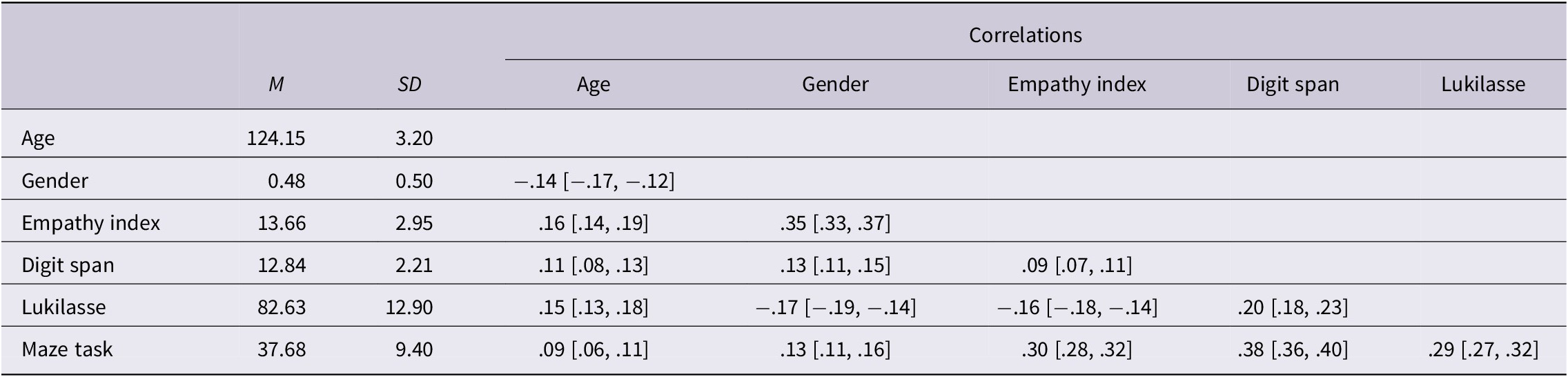
Note: Age is in months. Mean gender is reported as the proportion of girls (n = 97, 46 girls and 51 boys). Values in square brackets indicate the 95% confidence interval.
Reading comprehension. Reading comprehension was measured using the maze task (Ronimus et al., Reference Ronimus, Tolvanen and Hautala2022). The task is comprised of 16 texts, each with 4 words missing. Based on the textual cues, participants chose the missing word from four options. The task correlates strongly with a standardised paper-based reading comprehension test (see Ronimus et al., Reference Ronimus, Tolvanen and Hautala2022, for more details). The task was scored for the total number of correctly selected words (range 0–64 points). See Table 2 for descriptive statistics.
Empathy. Children’s empathy skill was assessed using the Index of Empathy for Children and Adolescents (Bryant, Reference Bryant1982), translated into Finnish (Olkoniemi et al., Reference Olkoniemi, Halonen, Pexman and Häikiö2023). This is a 22-item, paper-and-pencil self-report questionnaire, which was developed to assess affective empathy in children 6 years of age and older. The scale contains short claims (e.g. “It makes me sad to see a boy/girl who can’t find anyone to play with”), for which a binary answer (yes/no) is given. Each empathic answer (“yes” for the example claim) was awarded a point (equal number of items are positively and negatively keyed). The test was scored for the total number of empathic answers, yielding a range of 0–22. See Table 2 for descriptive statistics.
Working memory capacity. Children’s WMC was assessed with the Digit Span subtest of WISC-IV (Wechsler, Reference Wechsler2010). The Digit Span test consists of two different tasks. First, in Digits Forward, the child listens to and repeats a sequence of digits spoken aloud by the experimenter. Second, in Digits Backward, the child listens to a digit sequence and repeats it in reverse order. In both parts, the length of each digit sequence increases as the child responds correctly. The test was scored for the total number of correctly recalled digits (range 0–32 points). See Table 2 for descriptive statistics.
2.5. Procedure
Both experiments used the same procedure. All children were tested individually. Upon arrival, they were informed that the experiment assessed reading, and the specific nature of the experiment was explained to them after the experiment. Prior to the reading task, the eye-tracking system was introduced, and the procedure was explained. Children were instructed to read each story for comprehension at their own pace. Each story was presented on a screen, and children pressed the space bar on the keyboard when they finished reading. After each story, two questions were presented, one at a time. Children answered each question by pressing the “Yes” or “No” key on the keyboard. After answering the second question, the next story was presented. The presentation order of the stories was randomised. The reading task was followed by the Digit Span, Lukilasse, and the Index of Empathy for Children and Adolescents. The experimental sessions lasted approximately 30–50 minutes. The reading comprehension task (i.e. the maze task) was completed by the children in their class group after the experiment.
3. Results
3.1. Analyses
Sentence-level measures (Hyönä et al., Reference Hyönä, Lorch, Rinck, Hyönä, Radach and Deubel2003) were used for analysing the time-course of reading. Descriptive statistics of the measures, as well as their definitions, are presented in Table 3. Separate models were built for each eye-movement measure for the different text regions (see Table 1) and for inference question accuracy. All the measures were analysed for the target phrase, first-pass reading time was analysed for the spillover region, and the probability to look-back was analysed for the critical context. The data were analysed with linear or generalised linear mixed-effects models (Baayen et al., Reference Baayen, Davidson and Bates2008) using the lme4 package (version 1.1–37; Bates et al., Reference Bates, Mächler, Bolker and Walker2015) in R statistical software (version 4.4.2; R Core Team, 2024). The reading time measures were skewed and consequently log-transformed by selecting the best fitting transformation using the Box-Cox Power transform (Box & Cox, Reference Box and Cox1964). Due to the large number of zero values (31%), the number of first-pass rereading fixations was calculated using glmmTMB package (Version 1.1.10.; Brooks et al., Reference Brooks, Kristensen, van Benthem, Magnusson, Berg, Nielsen, Skaug, Mächler and Bolker2017), as was the case for probability measures with >50% of zero values (i.e. look-back to and look-from the target phrase, and look-back to critical context). The models were tested for zero inflation using testZeroinflation function from DHARMa package (version 0.4.7.; Hartig, Reference Hartig2024). None of the models showed issues with zero inflation (all p’s > .463), and consequently, the zero-inflation part was not fitted.
Descriptive statistics of the reading and comprehension measures for both story types
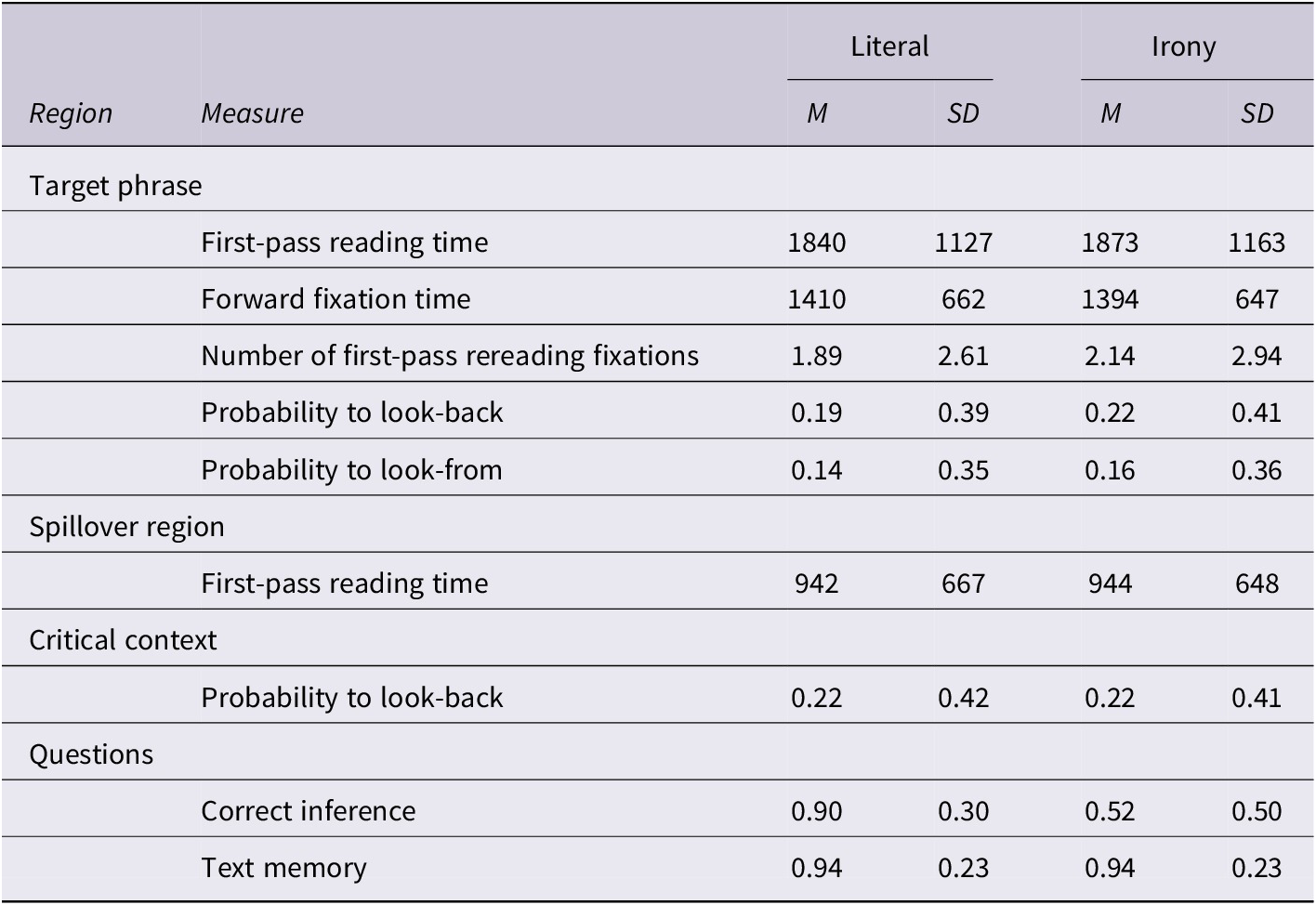
Note: First-pass reading time is the summed duration (ms) of fixations made within the sentence during first reading of the sentence. Forward fixation time is the summed duration (ms) of fixations landing on unread parts of the sentence during first-pass reading. Number of first-pass rereading fixations is the sum of fixations made reinspecting a sentence before moving on. Probability to look-back is the proportion of fixations returning to the sentence after the first-pass reading. Probability to look-from is the proportion of look-back fixations that were initiated from the sentence. Inference and text memory question accuracies reported are proportions of correct answers.
Story Type (literal versus irony), Trial Order (i.e. the order in which the items were presented), and individual difference measures (i.e. Empathy, WMC, and Gender) and their interactions were included in the models as fixed effects. Technical reading skill, reading comprehension, and relative age were controlled for in the models. In the models, Story Type and Gender were deviation-coded (see Schad et al., Reference Schad, Vasishth, Hohenstein and Kliegl2020). Trial Order, Empathy, WMC, and Age were fitted in the models as continuous centred fixed effects variables. Only those individual difference measures with a significant interaction with Story Type in the model for inference question accuracy were included in the models for the reading measures. To assess whether the correct comprehension of irony is reflected in children’s reading times, Comprehension (i.e. whether the meaning of the target phrase was understood correctly) was also included in the models as a treatment coded variable, with correct response as the baseline (as in Olkoniemi et al., Reference Olkoniemi, Halonen, Pexman and Häikiö2023). Thus, the model intercepts reflect reading where the intended meaning of the target phrase was correctly understood. All the possible three-way interactions including Story Type were included in the models for reading. Last, maximal random effects structure was fitted (see Barr et al., Reference Barr, Levy, Scheepers and Tily2013). If the model failed to converge, the random structure was trimmed top-down, starting with the correlations between the factors, and continuing by removing random effects with the lowest variance until the model converged.
For the sake of brevity, only significant effects (t and z > |1.96|) related to Story Type are reported. Significant main effects are reported in the text. Interactions and their 95% CIs are reported in the figures. All final models are reported in Supplementary Tables S1-S8. The data and analysis scripts are available via OSF at https://osf.io/dq8ku/
3.2. Inference and text memory questions
Children’s accuracy on the text memory questions was close to ceiling and did not differ between literal and ironic stories, t(96) = −0.16, p = .875, d = 0.02. This suggests that the children were attentive to the task and for both story types.
The model for the inference question accuracy (see Supplementary Table S1) showed a main effect of Story Type. The intended meaning of ironic phrases was harder to comprehend than that of literal phrases, for which accuracy was at ceiling, β = −3.85, 95% CI [−4.65, −3.04], z = −9.38. Moreover, the model revealed an interaction between Story Type and Trial Order, which was qualified by two three-way interactions. First, there was an interaction between Story Type, WMC, and Trial Order, β = −0.45, 95% CI [−0.66, −0.25], z = −4.31 (see Figure 1a), indicating that children with lower WMC showed a steeper increase in inference question accuracy for ironic phrases over the course of the experiment than children with higher WMC. Second, there was an interaction between Story Type, Empathy, and Trial Order, β = 0.36, 95% CI [0.15, 0.57], z = 3.39 (see Figure 1b). This interaction indicated that children with higher empathy scores showed a steeper increase in inference question accuracy for ironic phrases over the course of the experiment than children with lower empathy scores. There was no significant effect or interaction related to Gender, which was therefore not included in further analyses.
Model estimates for inference question accuracy. Note: Panel (a): Model estimates for the interaction between Story Type, WMC, and Trial Order. Panel (b): Model estimates for the interaction between Story Type, Empathy, and Trial Order. In all panels, Trial Order is centred (i.e. value of 0 indicates the middle of the experimental session, negative values indicate the beginning of the experiment, and positive values indicate the end of the experiment). For illustrative purposes, WMC and Empathy scores are divided into high and low groups (± 1 SD). The model values are log-back-transformed and shaded areas represent the 95% CI.

3.3. First-pass reading of the target phrase
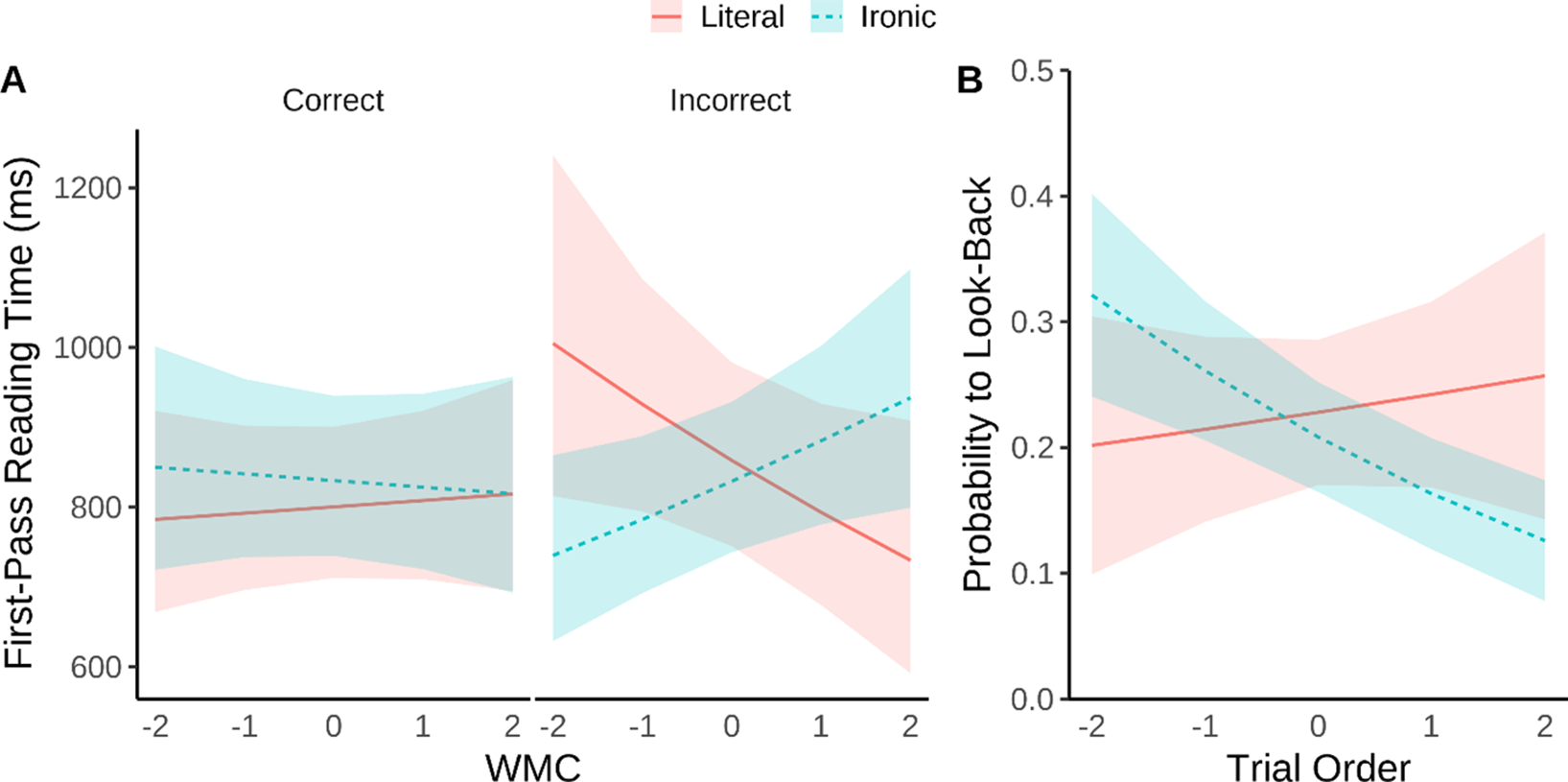
The model for first-pass reading time on the target phrase (see Supplementary Table S2) showed an interaction between Story Type and WMC, which was qualified by a three-way interaction between Story Type, Comprehension, and WMC, β = 0.09, 95% CI [0.01, 0.16], t = 2.30. This interaction indicates that when the intended meaning of the target phrase was correctly interpreted, children with lower WMC showed slower first-pass reading times for the ironic than for the literal target phrase, but this effect was diminished with higher WMC (see Figure 2a). The opposite was true when the intended meaning of the target phrase was interpreted incorrectly: children with higher WMC showed slower first-pass reading time for the ironic target than for the literal target phrase, whereas children with lower WMC showed virtually no difference between the story types. The model did not reveal any other effects related to Story Type.
Model estimates for first-pass reading measures on target phrase. Note: Panel (a): Model estimates for an interaction between Story Type, WMC (centred), and Comprehension from the model for first-pass reading time on the target phrase. Panel (b): Model estimates for an interaction between Story Type, WMC (centred), and Comprehension from the model for number of first-pass rereading fixations on the target phrase. The model values in panels are log-back-transformed and the shaded areas represent the 95% CI.

The model on forward fixation time on the target phrase showed no effects related to Story Type (see Supplementary Table S3).
The model on number of first-pass rereading fixations on the target phrase (see Supplementary Table S4) revealed an interaction between Story Type and WMC, which was qualified by a three-way interaction between Story Type, Comprehension, and WMC, β = 0.36, 95% CI [0.07, 0.66], z = 2.41. The interaction was similar to that observed for first-pass reading time; when the target phrase was correctly interpreted, children with lower WMC reread the ironic target phrase more than the literal target phrase on the first-pass. However, this effect was negligible for children with higher WMC (see Figure 2b). Conversely, when the meaning of the target phrase was interpreted incorrectly, children with higher WMC reread the ironic target phrase more than the literal one. In contrast, children with lower WMC showed no difference in rereading between the story types. The model did not show any other effects related to Story Type.
3.4. Returns to and from the target phrase
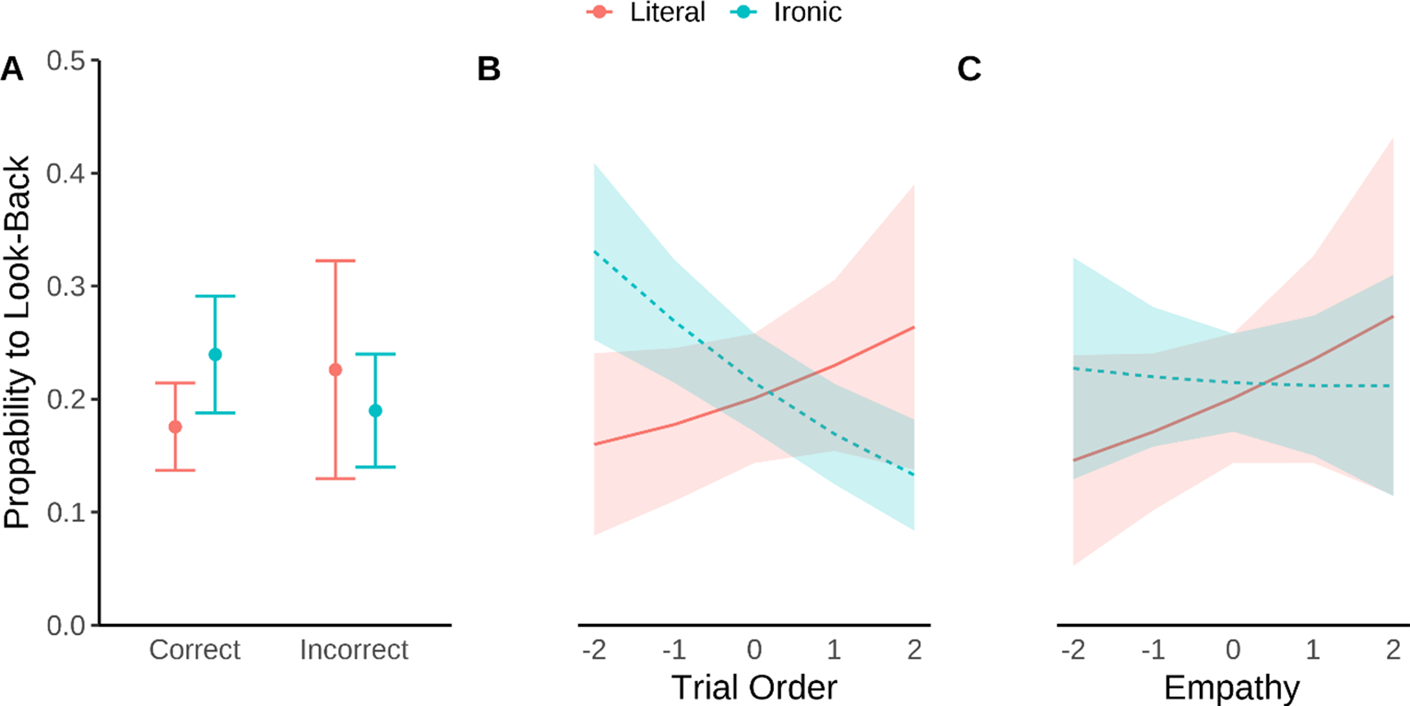
The model for the probability to look-back to the target phrase (see Supplementary Table S5) showed a main effect of Story Type, β = 0.46, 95% CI [0.16, 0.76], z = 3.00. Children were more likely to look-back to ironic than to literal target phrases. This main effect was qualified by three two-way interactions. First, there was an interaction between Story Type and Comprehension, β = −0.72, 95% CI [−1.42, −0.01], z = −1.99, indicating that children were more likely to look-back to the ironic than to the literal target phrase when they had correctly understood the intended meaning of the target phrase (see Figure 3a).
Model estimates for the probability to look-back to target phrase. Note: Panel (a): Model estimates for interaction between Story Type and Comprehension. Panel (b): Model estimates for interaction between Story Type and Trial Order (centred). Panel (c): Model estimates for interaction between Story Type and Empathy (centred). The model values in both panels are log-back-transformed; error bars in panel (a), and the shaded areas in panels (b) and (c) represent the 95% CI.

Second, there was an interaction between Story Type and Trial Order, β = −0.42, 95% CI [−0.72, −0.12], z = −2.79. The nature of this effect was that at the beginning of the experiment, children were more likely to look-back to ironic than to literal target phrases. Towards the end of the experiment, however, the effect reversed, with children being more likely to look-back to literal target phrases (see Figure 3b).
Last, there was an interaction between Story Type and Empathy, β = −0.30, 95% CI [−0.57, −0.02], z = −2.12. This effect indicates that children with lower empathy scores were more likely to look-back to ironic than to literal target phrases, but children with higher empathy scores were more likely to look-back to the literal than to the ironic target phrase (see Figure 3c).
The model on the probability to look-back from target phrase showed no effects related to Story Type (see Supplementary Table A6).
3.5. Processing of spillover region and critical context
The model for first-pass reading of the spillover region (see Supplementary Table S7) revealed an interaction between Story Type, WMC, and Comprehension, β = 0.16, 95% CI [0.07, 0.25], t = 3.45. The interaction indicates that when the target phrase was correctly interpreted, children with lower WMC had slightly longer first-pass reading times in the spillover region following the ironic target phrase than the literal target phrase, but this effect was negligible with higher WMC (see Figure 4a). However, when the intended meaning of the target phrase was understood incorrectly, children with lower WMC showed lower first-pass reading time on the ironic than on the literal target phrase, and the effect inverted with higher WMC. The model did not show any other effects related to Story Type.
Model estimates for the first-pass reading of the spillover region and probability to look-back to critical context. Note: Panel (a): Model estimates for interaction between Story Type, WMC (centred), and Comprehension. Panel (b): Model estimates for interaction between Story Type and Trial Order (centred). The model values in both panels are log-back-transformed, and the shaded areas represent the 95% CI.

The model for probability to look-back to critical context revealed an interaction between Story Type and Trial Order, β = −0.44, 95% CI [−0.73, −0.15], z = −2.97. The interaction indicates that in the beginning of the experiment, children were more likely to look back to critical context of ironic than literal stories, but the effect turned the other way around towards the end of the experiment (see Figure 4b). The model did not show any other effects related to Story Type.
4. Discussion
The aim of the present study was to investigate how individual differences in 10-year-old children’s empathy, WMC, and gender are related to their processing and comprehension of written irony. We expected that, in general, children would be slower and less accurate when processing irony than literal language and expected that these effects would be modulated by individual differences. Since the overall processing effects have already been reported in the two previous papers (Olkoniemi et al., Reference Olkoniemi, Halonen, Pexman and Häikiö2023, Reference Olkoniemi, Häikiö, Merinen, Manninen, Laine and Pexman2025), we only briefly summarise them here. The focus of the discussion will be on the individual differences results, presented after the overall results.
Children’s processing results confirmed the hypotheses, aligning with previous studies on children and adults (e.g. Barich et al., Reference Barich, Kyriaki, Forndran, Williamson and Arciuli2025; Olkoniemi & Kaakinen, Reference Olkoniemi and Kaakinen2021). As in the previous studies, increased processing was related to rereading of the ironic phrase (e.g. Barich et al., Reference Barich, Kyriaki, Forndran, Williamson and Arciuli2025; Olkoniemi et al., Reference Olkoniemi, Halonen, Pexman and Häikiö2023). Successful irony comprehension was particularly related to increased look-backs to the ironic phrase. This is consistent with theoretical assumptions that integrating an ironic interpretation with the context requires additional processing (e.g. Grice, Reference Grice, Cole and Morgan1975). Furthermore, it aligns with general findings on the role of later rereading, demonstrating that rereading is important for achieving a comprehensive representation of the text (e.g. Hyönä & Nurminen, Reference Hyönä and Nurminen2010).
Additionally, as expected, children showed trial effects for irony in late processing measures (i.e. spillover effect, probability to look-back to the target phrase and critical context). This replicates previous findings for children (Olkoniemi et al., Reference Olkoniemi, Halonen, Pexman and Häikiö2023, Reference Olkoniemi, Häikiö, Merinen, Manninen, Laine and Pexman2025) and adults (Olkoniemi & Kaakinen, Reference Olkoniemi and Kaakinen2021; Spotorno & Noveck, Reference Spotorno and Noveck2014). These results suggest that children require additional processing to integrate ironic phrases with context, but repeated exposure to irony creates a prediction of future irony, which allows children to improve their processing performance.
4.1. Individual differences in comprehending written irony
The results confirmed our hypothesis that children’s higher empathy skill is associated with higher irony comprehension accuracy, consistent with previous empirical findings demonstrating this relationship (Agostino et al., Reference Agostino, Im-Bolter, Stefanatos and Dennis2017; Nicholson et al., Reference Nicholson, Whalen and Pexman2013). This relationship was not, however, observed immediately at the beginning of the experiment. Instead, children with higher empathy skill were better able to improve their comprehension accuracy over the course of the experiment. It seems that better ability to recognise emotions supports irony comprehension and helps children to make more accurate prediction of the use of irony in the future. In addition, children with higher empathy skill were faster at processing ironic phrases throughout the experiment as indicated by a lower likelihood of initiating a look-back to the ironic target phrase. This aligns with eye-tracking studies with adults showing that a more advanced ability to name and recognise emotions is related to faster processing of ironic texts (see Olkoniemi & Kaakinen, Reference Olkoniemi and Kaakinen2021, for a review). Our findings demonstrate that, like adults, emotional perspective-taking skill helps children to recognise speakers’ emotions in irony, which facilitates processing. However, in our study, higher empathy skill had a relatively small effect on processing of irony per se, which was seen as a slight decrease in the likelihood of looking back to ironic target phrases. Instead, an increase in empathy skill seemed to increase the likelihood of later rereading of literal target phrases. This suggests that, among children with higher empathy, speakers’ emotions in literal contexts may require additional verification to confirm whether the nonliteral interpretation is appropriate. As the relationship between children’s empathy skill and processing of written irony was explored in this study for the first time, future studies are needed to confirm and further investigate the observed effects.
As expected, children’s processing and comprehension of irony were also related to their WMC. Similar to the effect of empathy skill, the effect of WMC on comprehension was not observed at the beginning of the experiment. However, unexpectedly, children with low WMC, and not high WMC, showed improvement in their irony comprehension over the course of the experiment. High-WMC children remained at the chance level throughout the experiment, showing only a slight increase in comprehension accuracy. This opposes previous findings with children (Godbee & Porter, Reference Godbee and Porter2013). Moreover, our processing time results revealed that low-WMC readers showed slower first-pass reading times of an ironic phrase and spillover region when it was correctly comprehended. The finding aligns with theoretical assumptions and experimental findings expecting longer reading times for ironic than for literal phrases. The effect of WMC that was observed for first-pass reading time was driven by first-pass rereading. Regressions made during first-pass reading have generally been shown to support reading comprehension (e.g. Schotter et al., Reference Schotter, Tran and Rayner2014). Moreover, the spillover effect is thought to indicate that the processing of the previous text region was not fully completed when the reader moved on (e.g. Findelsberger et al., Reference Findelsberger, Hutzler and Hawelka2019). The present result is different from eye-tracking results for adults, in which high-WMC readers show increase in first-pass rereading of the target phrase, and low-WMC readers show increased later rereading (e.g. Olkoniemi & Kaakinen, Reference Olkoniemi and Kaakinen2021). The difference is understandable as children generally do more first-pass rereading and less later rereading than adults (Kaakinen et al., Reference Kaakinen, Lehtola and Paattilammi2015). Nevertheless, although our results suggest that the processing strategy of the children with low WMC led to overall better performance, they were likely unaware of their incorrect interpretations. When they misinterpreted the intended meaning of irony, their reading times for ironic and literal items were similar. High-WMC readers showed an opposite pattern, suggesting that they had some awareness that a literal interpretation was not fitting to the context.
There are at least two possible explanations for why we did not observe the hypothesised higher comprehension accuracy for high-WMC readers. First, high-WMC adults have been found to sometimes rely on overly complex resolving strategies, which hampers their performance (Fischer & Holt, Reference Fischer and Holt2017; Wiley & Jarosz, Reference Wiley and Jarosz2012). In the context of irony and children with high WMC, this might result in uncertainty about what the correct interpretation is, eventually leading to comprehension failure. Second, it is possible that children with high WMC were able to consider more interpretive possibilities. At 10 years of age, most children still lack extensive knowledge of irony (Olkoniemi et al., Reference Olkoniemi, Häikiö, Merinen, Manninen, Laine and Pexman2025). As such, and in line with the parallel-constraint satisfaction model (Pexman, Reference Pexman2008), the interpretive options children activated (e.g. irony, literal statement, or white lie) might have all been equally likely. This might have made their reading slower and also affected their comprehension accuracy during the course of the experiment. This effect has not been observed in previous studies on adults (Olkoniemi & Kaakinen, Reference Olkoniemi and Kaakinen2021), possibly because adults have more effective mechanisms for resolving interpretive ambiguity. Future studies are also needed to further explore the role of WMC in children’s irony processing.
We found no relationship of child gender to irony comprehension. This is in line with the majority of previous studies that have tested for gender differences in irony comprehension (Garfinkel et al., Reference Garfinkel, Rowe, Bosacki and Banasik-Jemielniak2024; Harris & Pexman, Reference Harris and Pexman2003; Recchia et al., Reference Recchia, Howe, Ross and Alexander2010). This suggests that although previous studies have shown that there can be gender differences in many underlying skills needed for irony comprehension, those differences are not sufficiently strong to influence irony comprehension per se.
5. Conclusions
This study provides the first evidence of the individual differences that are important to children’s processing and comprehension of written irony. We showed that both processing and comprehension were modulated by children’s working memory and empathy. Working memory (e.g. Peverill et al., Reference Peverill, McLaughlin, Finn and Sheridan2016) and empathy (e.g. Ferguson et al., Reference Ferguson, De Lillo, Woodrow-Hill, Foley and Bradford2024) are skills that continue to develop into late adolescence. Our findings suggest that these factors are important to irony development and thus lead to the expectation that irony comprehension will continue to improve along with the improvement of these related abilities. Of course, our findings are correlational, and additional research, perhaps involving training paradigms (Lee et al., Reference Lee, Sidhu and Pexman2021; Olkoniemi et al., Reference Olkoniemi, Häikiö, Merinen, Manninen, Laine and Pexman2025), would be needed to help establish causation.
The results of the present study support theories of irony comprehension that consider individual differences (the parallel constraint-satisfaction framework, Pexman, Reference Pexman2008; the predictive coding theory of irony, Fabry, Reference Fabry2021). A useful addition to theoretical models of irony processing would be a detailed developmental component that would generate testable hypotheses about the acquisition of irony and how individual differences affect this process. Future studies should refine and test these theories to determine how perspective-taking and cognitive abilities are related to children’s irony processing and thus explain how children overcome the challenge of irony.
Supplementary material
The supplementary material for this article can be found at http://doi.org/10.1017/S0305000926100543.
Acknowledgements
This study was supported by Research Council of Finland grant #338712 awarded to Henri Olkoniemi. Portions of the data were presented at the 22nd European Conference on Eye Movements in Maynooth, Ireland, and at the 24th Conference of the European Society of Cognitive Psychology in Sheffield, UK.
Competing interests
The authors declare none.
Statement of ethical approval
The data were drawn from two previously conducted studies (Olkoniemi et al., Reference Olkoniemi, Halonen, Pexman and Häikiö2023, Reference Olkoniemi, Häikiö, Merinen, Manninen, Laine and Pexman2025). Ethical approval for data collection in those original studies was granted by the Ethics Committee for Human Sciences at the University of Turku, Finland.






 Open access

