

One might think it's terrible that scientists are always discovering new ways that they're wrong. But that's really where scientists’ superpowers come from.
—Nobel Prize-winner Saul Perlmutter (Issues in Science and Technology 40[4]:30–33, 2024).The Fallon Paiute-Shoshone Tribe (FPST) knows their ancestors have lived in the Lahontan Basin since the beginning of time. Oral history and spirituality define this ancestral homeland as a sacred place still requiring protection. More than 10,000 years ago, this was home to a man buried in Spirit Cave who Paiute descendants call “The Storyteller.”
Archaeologists excavated The Storyteller eight decades ago, and in 1997, Paiute-Shoshone leaders asked that his remains be returned home. The Bureau of Land Management (BLM) declined to do so because, like most archaeologists of the day, its staff interpreted the deep history of the Lahontan Basin as a sequence of independent sequential cultures lacking cultural and genetic continuity. Thus, they considered the Paiute people to be recent arrivals within the last several centuries.
During the ensuing two-decades-long legal struggle, the tribe spent considerable money and eventually made the difficult decision to permit DNA testing of the Spirit Cave remains. The genetic results upheld what the tribe already knew from their oral history: there was long-term continuity from the Paleoindian Storyteller through the Lovelock culture communities that likely extended to the Paiute-Shoshone people who live there today.
A curious incongruity resulted. Western science frequently urges Indigenous people to cooperate with genetic testing, but the unexpected continuities that are increasingly emerging from such DNA studies often conflict with standard-issue twentieth-century anthropological thinking. Although The Storyteller was returned and reburied, the Fallon Tribe is concerned that the deeper significance of the genetic results has been ignored and left unexplained. Science, it would seem, has a responsibility to explore the deeper significance of the Spirit Cave results with Indigenous and global communities at large. How did a century of Great Basin anthropological investigation misread this episode of Indigenous resilience and survivance spanning more than 10,000 years?
The Spirit Cave Dispute
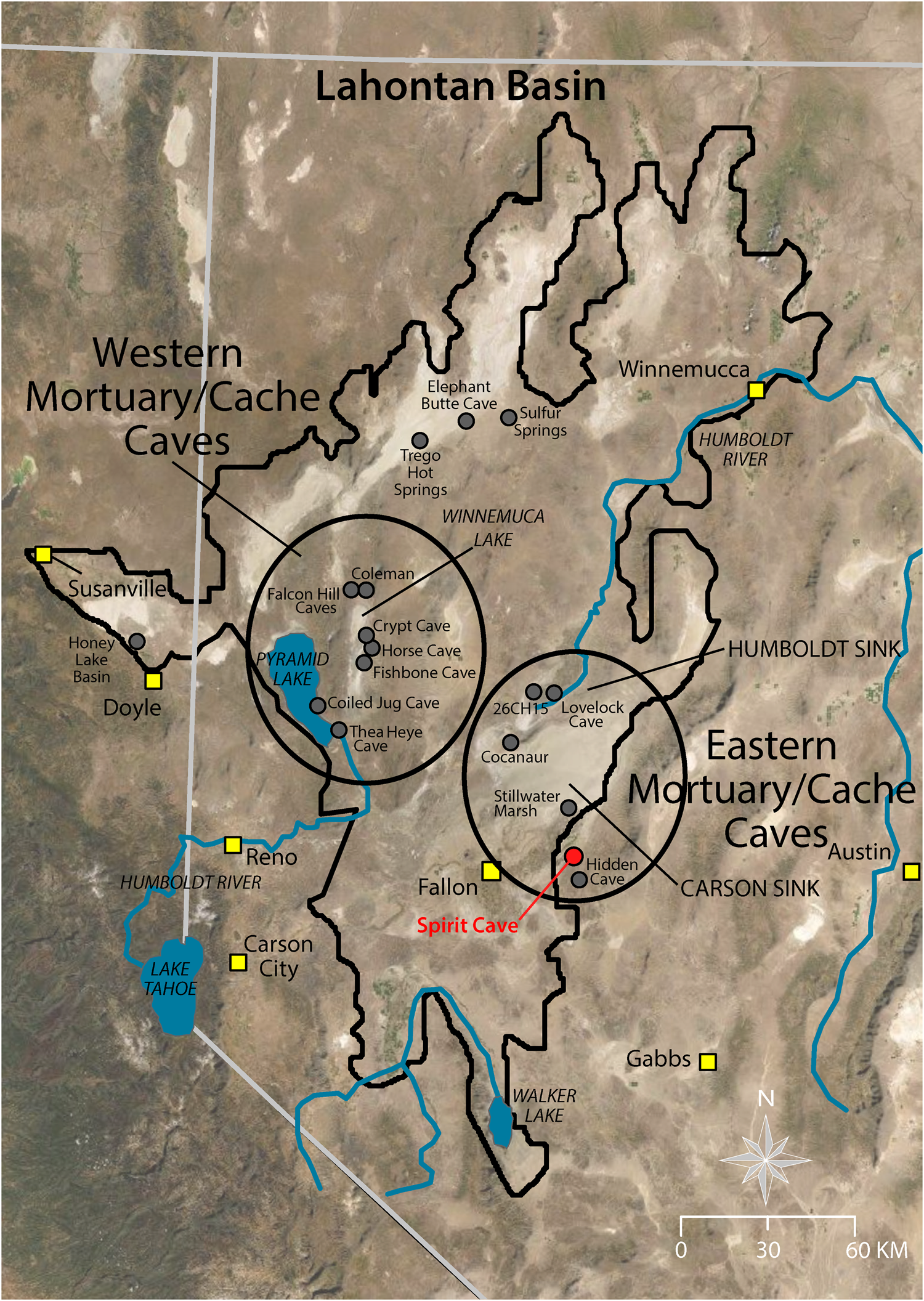
In 1940, S. M. and Georgia Wheeler from the Nevada State Parks Commission excavated a small overhang called Spirit Cave (Figure 1), uncovering ancestral remains of two people (one mummified) wrapped in tule matting and two later cremations (Wheeler and Wheeler Reference Wheeler and Wheeler1969). Later that summer, the Wheelers displayed the Spirit Cave burials at the Nevada State Fair (Hockett and Palus Reference Hockett and Palus2018:1), after which the remains were curated at the Nevada State Museum in Carson City.
Key localities in the Lahontan Basin (Nevada).
The Wheelers (Reference Wheeler and Wheeler1969:74) estimated the Spirit Cave mummy to be probably 1,500–2,000 years old, but when Ervin Taylor of the University of California, Riverside, radiocarbon dated the Spirit Cave burials, the stunning results indicated a date of 10,700 years ago (Tuohy and Dansie Reference Tuohy and Dansie1997:Table 1).Footnote 1 The popular press has since trumpeted the news that Nevada's Spirit Cave mummy is the oldest in the world—three times more ancient than Egypt's famed King Tut (e.g., Begley and Murr Reference Begley and Murr1999; Keenan Reference Keenan2021).
Paiute Perspectives on The Storyteller
According to Len George, chairman of the Fallon Paiute-Shoshone Tribe, “Thousands of years ago, the remains of several people were buried in their final resting place within Spirit Cave, Nevada. Spirit Cave is located on the aboriginal lands of the Fallon Paiute-Shoshone Tribe, and the Tribe's oral histories and spiritual beliefs provide that Spirit Cave is a sacred place containing the remains of the Tribe's ancient ancestors” (Len George, personal communication 2014).
Paiute people know that they have lived in their Lahontan Basin homeland since time immemorial. Their rich oral history documents a time when the pluvial lakes were full and ice sometimes blocked passage into the mountains.
Living fewer than 10 miles (16 km) from Spirit Cave, the Fallon Paiute-Shoshone Tribe also knows that archaeological excavations disturbed this ancestor's spiritual journey. Chairman Len George spoke for generations of his tribe in urging that the Spirit Cave ancestors be brought home under the Native American Graves Protection and Repatriation Act of 1990 (NAGPRA).
Paiute people have long maintained tribal, communal, and familial perspectives on the deceased and the afterlife. Ancient ancestors sometimes buried their deceased inside the wave-cut caves that ring their Lahontan homeland. Modern Paiutes avoid these nearby caves out of respect, knowing that an ancestor was likely buried inside. Only those with a higher purpose, such as a healer gifted with special medicine or a spiritual adviser, feel they can enter those places.
Paiutes also avoid the caves out of fear. If they enter—even just out of curiosity—they risk disturbing the deceased and conjuring the spirits back. This could accidentally trigger a ghost sickness that begins after a loved one passes, typically bringing lethargy and nightmares, sometimes with feelings of dread, impending doom, and suicidal thoughts (Putsch Reference Putsch1988).
Ghost sickness remains a reality of Paiute life; some say it is the second or third most common cause of illness among the Paiute today (Varner Reference Varner2010:14). When medicine men and women were buried, their powers were buried with them. Those passing into the next life must answer to these ancestors, some of whom were good people, but others could inflict ghost sickness. If those ancestors take you away, there is no coming back. Dug up and curated at the Nevada State Museum, the man from Spirit Cave could no longer continue his journey. He and others may someday ask why they were not good enough to come home.
Paiutes prefer not to speak of the deceased at all—even within their own family— fearing that the spirits might hear them and come back. Not knowing the name of the man buried almost 11,000 years ago in Spirit Cave, the Paiute generally use the generic term “Spirit Cave remains,” and some call him “The Storyteller.”
The FPST leadership knew their request to repatriate The Storyteller would cost them dearly and potentially become controversial within the tribe. Many tribal members see NAGPRA itself as an “unhealthy” process because speaking of the dead or handling repatriated remains carries great personal risk. Bringing ancestors home is delicate and dangerous because nobody knows what kind of people they were in life. Over a decade, FPST spent more than $300,000 on this single repatriation, and some in this small tribe thought perhaps this money should have been used instead to improve tribal healthcare and education. Yet, responsibilities to ancestors and the fear of ghost sickness underscored the urgency of returning The Storyteller home.
Repatriating the Spirit Cave Remains
In March 1997, the FPST, representing all Northern Paiute tribal governments, formally asserted a NAGPRA claim of cultural affiliation with the Spirit Cave remains and associated artifacts (Edgar et al. Reference Edgar, Jolie, Powell and Watkins2007). The BLM responded a year later, concluding that, although the Spirit Cave remains are unquestionably Native American, they could not be culturally affiliated with any living individual or contemporary human group (Barker et al. Reference Barker, Ellis and Damadio2000). The following year, FPST tribal attorneys sent a memorandum to BLM detailing the legal and substantive arguments supporting their affiliation to their Spirit Cave ancestor.
The BLM responded by reviewing all available evidence relevant to the Spirit Cave remains: geographical, kinship, biological, archaeological, anthropological, linguistic, folklore, oral tradition, historical, and opinion. NAGPRA regulations require that an earlier human group be defined for Native American skeletal remains, followed by an unbroken continuity from that ancient human group to a modern individual or tribe. Reflecting archaeological perspectives of the time, the BLM saw nothing in the evidence defining an unbroken continuity and once again concluded that the Spirit Cave remains could not be culturally affiliated with any living individual or contemporary human group.
FPST then submitted the Spirit Cave dispute to the NAGPRA Review Committee in 2001. By a 6–1 vote, the committee determined the BLM “had failed to fairly and objectively consider all the available and relevant information” and concluded that the Spirit Cave remains should be affiliated with the Northern Paiute (National Park Service Reference Service2001). The tribe then requested that BLM Nevada consider the Review Committee's findings, but the agency did not change its decision. FPST then asked the secretary of the interior and the BLM director in Washington, DC, to reverse this decision, but they did not (Hockett and Palus Reference Hockett and Palus2018).
The tribe sued the BLM in 2004, and two years later, the court found the BLM had been “arbitrary and capricious” in not considering the NAGPRA Review Committee's recommendation. While not reversing BLM's initial determination, the court ordered the BLM to adequately weigh all available evidence and justify why one theory or set of evidence should be chosen over another. The BLM did this over the next eight years, contracting and evaluating fresh reviews from several scientists.
Spirit Cave DNA
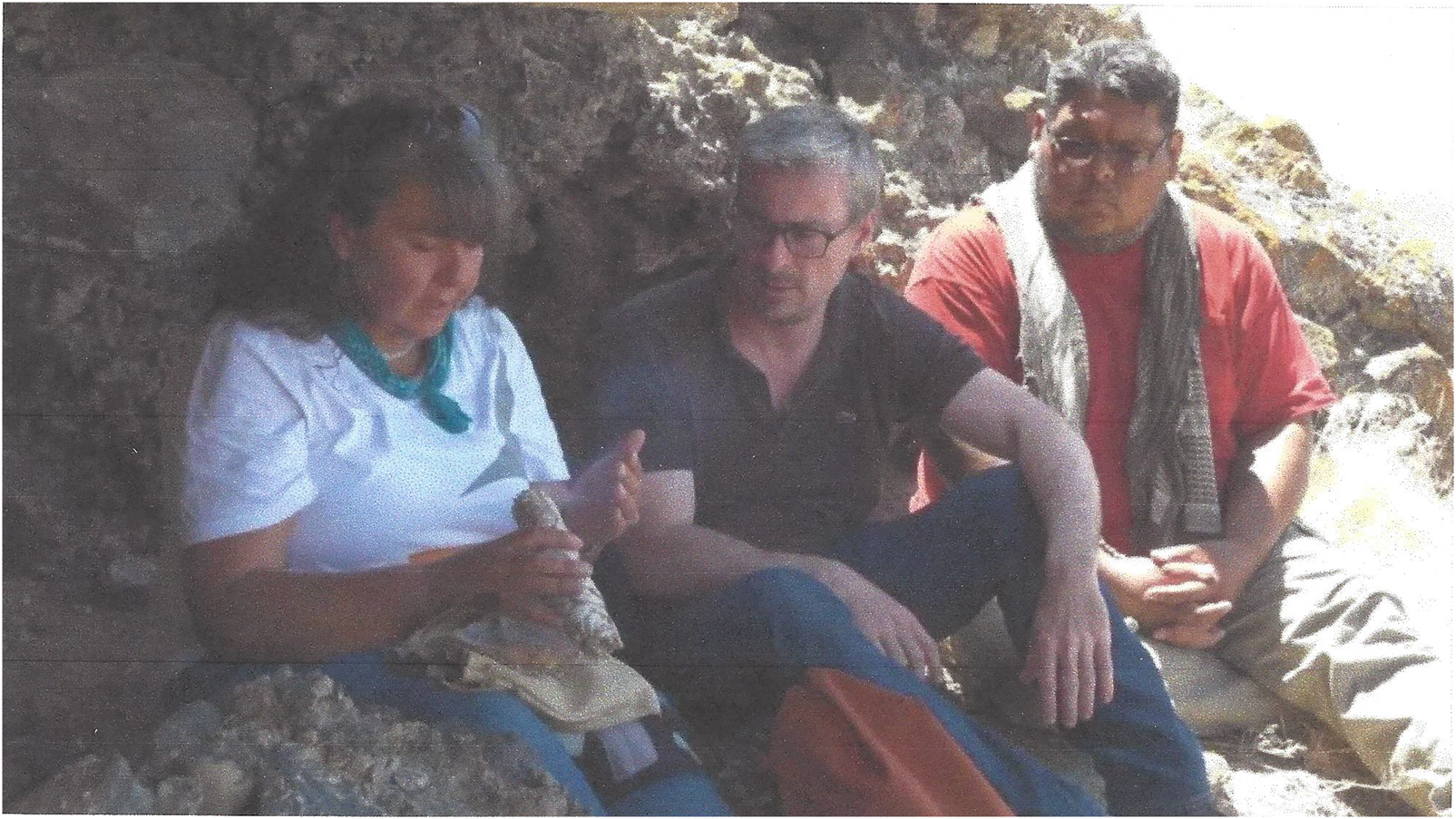
The Spirit Cave standoff shifted in 2014 when the BLM explored the possibility of DNA analysis. Independently, geneticist Eske Willerslev of the University of Copenhagen had requested permission from the BLM for DNA analysis of the Spirit Cave remains. When referred to the FPST, the tribe initially refused to grant Willerslev permission, prompting him to visit Fallon three times to confer (Figure 2).Footnote 2 He explained that his previous involvement in DNA research with the Confederated Tribes of the Colville Reservation in Washington State had facilitated the repatriation and reburial of Kennewick Man/The Ancient One (Rasmussen et al. Reference Rasmussen, Sikora, Albrechtsen, Korneliussen, Víctor Moreno-Mayar, David Poznik and Zollikofer2015). Offering to work with the Fallon Paiute in the same way, Willerslev suggested that respectful and limited DNA analysis could resolve the Spirit Cave controversy as well.
Donna Cossette, Eske Willerslev, and Joey Allen conferring about The Storyteller in the entrance to Spirit Cave (screenshot from Mørk Reference Mørk2023).
Donna Cossette (former tribal chair) and Yvonne Mori (vice chair of the Tribal Council) visited Willerslev's DNA facilities in Copenhagen.Footnote 3 These consultations convinced FPST to permit destructive DNA analysis on The Storyteller—an especially gut-wrenching decision because the Paiute believe that bodies must be intact to move to the other side. The Lovelock Paiute tribe also permitted genetic study of five interments from Lovelock Cave that both tribes believe house ancestors.
Science published the DNA results (with chairman Len George as a coauthor). Generating multiple Spirit Cave and Lovelock Cave genomes, Moreno-Mayar and colleagues (Reference Moreno-Mayar, Vinner, Damgaard, La Fuente, Chan, Spence and Allentoft2018) established a genetic continuity connecting The Storyteller to Lovelock descendants living 9,000 years later—a startling result given previous interpretations of Great Basin abandonments because of extreme climate change.
Using as a proxy the Mixe, a Mesoamerican population of Uto-Aztecan speakers related to a separate Numic language (Campbell Reference Campbell1997), Moreno-Mayar and colleagues (Reference Moreno-Mayar, Vinner, Damgaard, La Fuente, Chan, Spence and Allentoft2018) identified a genetic admixture absent in all earlier Lovelock Cave burials but present in Lovelock3 (AD 1289). They believe this reflects a Mesoamerican-related population(s) that expanded north and south, “possibly marking the movement of relatively small groups that did not necessarily swamp local populations genetically or culturally” (Moreno-Mayar et al. Reference Moreno-Mayar, Vinner, Damgaard, La Fuente, Chan, Spence and Allentoft2018). DNA evidence cannot, of course, determine the language involved, but most archaeologists agree it was likely Numic.
Some tribes still view DNA analysis as a scientific tool of colonialism imposed and enforced by the dominant non-Indigenous population. In the case of Spirit Cave, tribally sanctioned genetic research broke through the legal impasse, and The Storyteller was repatriated to FPST for respectful reburial within 31 days (Hockett and Palus Reference Hockett and Palus2018). But some Fallon tribal members feel that the deeper significance of Spirit Cave and Lovelock Cave genetics is still largely ignored and unexplained.
Resilience and The Storyteller
Two of us (Robinson and Thomas Reference Robinson, Thomas and Thomas2024) have hypothesized that foragers typically retain a long-term resilience often found lacking in agricultural-based economies (see also Byrd et al. Reference Byrd, Arellano, Engbring, Leventhal and Darcangelo2022). We further suggested that abrupt climatic change tends to create more significant impacts to farming populations, with hunter-gatherers being more vulnerable to “gradual” climate events. We believe the deep history of the Lahontan Basin reflects such processes, and we suggest resilience theory as an operational way to understand the unexpected 10,000-year legacy linking The Storyteller to the Lovelock culture and likely his modern Paiute descendants.
Redman (Reference Redman2005) introduced resilience theory to archaeology as a conceptual framework for exploring long-term continuities and change within socioecological domains (Fitzhugh et al. Reference Fitzhugh, Butler, Bovy and Etnier2019; Thomas Reference Thomas2024:Chapters 14 and 15). Developed within ecological systems theory, overarching resilience perspectives are remarkably straightforward (Van Meerbeek et al. Reference Van Meerbeek, Jucker and Svenning2021): resilience tends to decline as a system matures, effectively creating “an accident waiting to happen” (Holling Reference Holling, Clark and Munn1986). Should this system eventually collapse, it creates “a window of opportunity” for transformation (Davoudi Reference Davoudi2012:302). Resilience theory shifts the way some scientists view the world: rather than assuming an orderly, mechanical universe, resilience perspectives emphasize an inherently changing, chaotic, complex, uncertain, and unpredictable world.
Resilience theory also offers a toolbox of key concepts—including tipping points, early warning signals, sunk-cost effects, and loss-of-resilience hypotheses—that we find helpful in approaching the remarkable continuities now evident in the Lahontan Basin. Applying resilience perspectives to the Spirit Cave also helps identify some moribund concepts and assumptions that effectively blinded Great Basin archaeology to this notable record of continuity.
Historicizing the Phase Concept
Twentieth-century chronologies in the Great Basin were grounded in projectile-point, ceramic, and textile sequences, beginning and ending with clean breaks that defined horizons typologically with the layer cake of time; Meltzer (Reference Meltzer, McDonough, Rosencrance and Pratt2024:281) suggests that marble cakes might be a more appropriate analogy. These coarse-grained chronologies flattened out spatiotemporal variability into phase-level chunks that unintentionally overemphasized within-phase stasis, punctuated by sequential population replacements.
The recent historical turn in American archaeology questions the time-honored phase concept (Ethridge and Bowne Reference Ethridge and Bowne2020). Index-fossil chronologies fare poorly compared to finer-grained cultural and paleoenvironmental proxies that granularize the past with precision at times approaching the human lifespan. It has become increasingly clear that some of the most significant cultural and climatic shifts took place within—rather than between—typological phases (Thomas Reference Thomas2013:145). New proxies allow archaeologists to better appreciate records of change and stasis by seeking out multiple meanings of “abandonment” and “continuity.”
Testing the Radiocarbon Record
We previously compared two time-sensitive proxies of temporal change in the Great Basin, assembling 5,000 cultural radiocarbon ages and more than 47,000 time-sensitive projectile-point frequencies (Robinson and Thomas Reference Robinson, Thomas and Thomas2024; Thomas Reference Thomas2024). The highly statistically significant correlation between these independent indices (r = 0.988, p < 0.001) reinforces their overall value as proxies for monitoring past demographic change in the Intermountain West when measured at vastly different scales.
We concentrate here on a subsample of radiocarbon ages (n = 482) from well-known archaeological sites in the Lahontan Basin, including Lovelock Cave, Hidden Cave, the Falcon Hill Caves, Pyramid Lake, Stillwater Marsh, Elephant Butte Cave, and Spirit Cave (detailed in Supplemental Table 1; Figure 1). After applying appropriate chronological hygiene (discussed in Robinson and Thomas Reference Robinson, Thomas and Thomas2024), we developed summed probability distributions (SPDs) of these aggregated radiocarbon data. Two hypothesis-testing approaches addressed potential biases in SPDs caused by the nonlinearity of the radiocarbon calibration curve, as well as variability in radiocarbon sample preservation (taphonomic bias) and availability due to specific research histories of different times and places (collection biases). These approaches use Monte Carlo simulations to evaluate the statistical significance of an empirical radiocarbon SPD projected against theoretical or permuted models. We conducted these tests of the Lahontan Basin dataset using the “rcarbon” package (Crema and Bevan Reference Crema and Bevan2021) in RStudio (R Core Team Reference R2024).Footnote 3
Following Shennan and colleagues (Reference Shennan, Downey, Timpson, Edinborough, Colledge, Kerig, Manning and Thomas2013) and Timpson and colleagues (Reference Timpson, Colledge, Crema, Edinborough, Kerig, Manning, Thomas and Shennan2014), we aggregated and calibrated our sample of Lahontan Basin dates using the IntCal20 curve (Reimer et al. Reference Reimer, Austin, Bard, Bayliss, Blackwell, Ramsey and Butzin2020). This produced an SPD that can be compared to an exponential null model using a Monte Carlo simulation to generate confidence intervals using a 100-year running mean. Applying the exponential null model against the Lahontan-wide SPD generated by 1,000 simulations, Z-score transformations of the simulated and empirical SPDs removed any underlying biases caused by fluctuations in the calibration curve. Figure 3 details statistically significant peaks (pink) and troughs (blue) in the empirical Lahontan-wide SPD in which Z-scores exceeded the 95% confidence interval.
Distribution of 482 cultural 14C dates (Supplemental Table 1) from the Lahontan Basin. The 100-year running mean (black line) is projected against the Lahontan Basin-wide null model (gray band). The statistically significant negative deviations from the null model are highlighted in blue, and the statistically significant positive deviations are indicated in pink (exact crossing points provided in Supplemental Table 2).
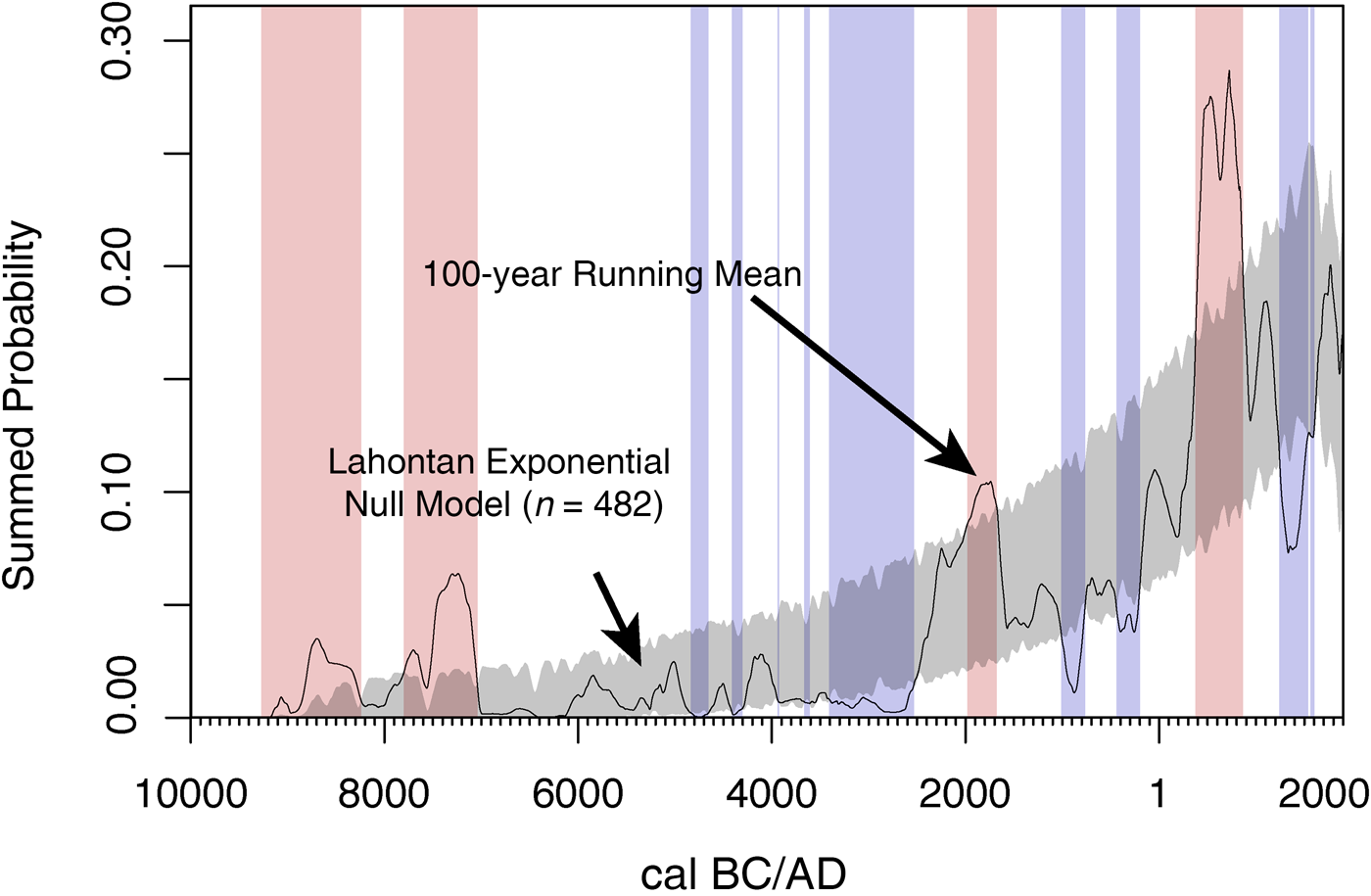
Figure 3 also reconstructs and compares radiocarbon-defined profiles at the millennial- to subcentennial-scale. Judging strictly from this empirical distribution, one might conclude that Indigenous Lahontan Basin populations experienced exponential population growth with multiple dramatic demographic peaks and troughs over the past 12,000 years. Figure 3 documents positive local deviations at 9277–8239 BC, 7794–7042 BC, 3434–2535 BC, 1985–1683 BC, and AD 374–868, often separated by lengthy statistically significant negative deviations (especially during the Late Holocene).
Minding the Time Traps
But what do these peaks and valleys mean? Do these Holocene peaks actually reflect changing human demography in the Lahontan Basin?
When interpreting such long-term radiocarbon proxies, archaeologists can ill afford to ignore potential distortions in SPDs caused by biases affecting sample collection, preservation, taphonomy, and calibration (Rick Reference Rick1987; Williams Reference Williams2012). Evaluating the large-scale 14C probability distributions shown in Figure 3 requires archaeologists to be wary of the significant time traps that lurk within.
We address these potential time traps through a second hypothesis-testing approach. Crema and colleagues (Reference Crema, Habu, Kobayashi and Madella2016) developed permutation testing by building on the null hypothesis modeling of Shennan and coworkers (Reference Shennan, Downey, Timpson, Edinborough, Colledge, Kerig, Manning and Thomas2013) and Timpson and coauthors (Reference Timpson, Colledge, Crema, Edinborough, Kerig, Manning, Thomas and Shennan2014). This strategy compares radiocarbon datasets by taking their respective sampling histories into account. Rather than comparing an empirical SPD to a theoretically derived null model to define statistically significant peaks and troughs, permutation testing determines statistical significance by comparing a specific empirical SPD to the 95% confidence interval of a null model produced by permuting all the empirical SPDs being considered (Crema et al. Reference Crema, Habu, Kobayashi and Madella2016). In this way, permutation testing seeks out the time traps involved in aggregated SPDs by comparing different types of radiocarbon samples, archaeological sites, or regions. As with the exponential null hypothesis comparison of the full Lahontan Basin dataset described earlier, we produced these permutation models with the rcarbon package (Crema and Bevan Reference Crema and Bevan2021) by calibrating ages with the IntCal20 calibration curve (Reimer et al. Reference Reimer, Austin, Bard, Bayliss, Blackwell, Ramsey and Butzin2020), using a running mean of 100 years with 1,000 Monte Carlo simulations.
We specifically addressed sample collection bias—an acute problem within the Lahontan Basin 14C dataset—by partitioning the pooled radiocarbon profile into three (mutually exclusive) subsets reflecting geographic/hydrological divisions and site functions: (1) western mortuary/cache caves (the Pyramid-Winnemucca Lake drainages), (2) eastern mortuary/cache caves (the Carson and Humboldt Sinks), and (3) residential sites from throughout the Lahontan Basin (Figure 1). Figure 4 compares the temporal distribution of 14C evidence within each context-specific subdivision against the Lahontan Basin-wide null model (detailed in Figure 3), also generating statistically significant peaks (pink) and troughs (blue).
Long-term distribution of cultural 14C dates, comparing mortuary/cache caves of (A) the Pyramid-Winnemucca Lakes and (B) the Carson and Humboldt Sinks with residential sites throughout (C) the Lahontan Basin. The 200-year moving mean (black line) for each subset is projected against the Lahontan Basin-wide null model (gray band, as defined by the 482 radiocarbon dates in Supplemental Table 1). The statistically significant negative deviations from the null model are highlighted in blue, and the statistically significant positive deviations are indicated in pink.
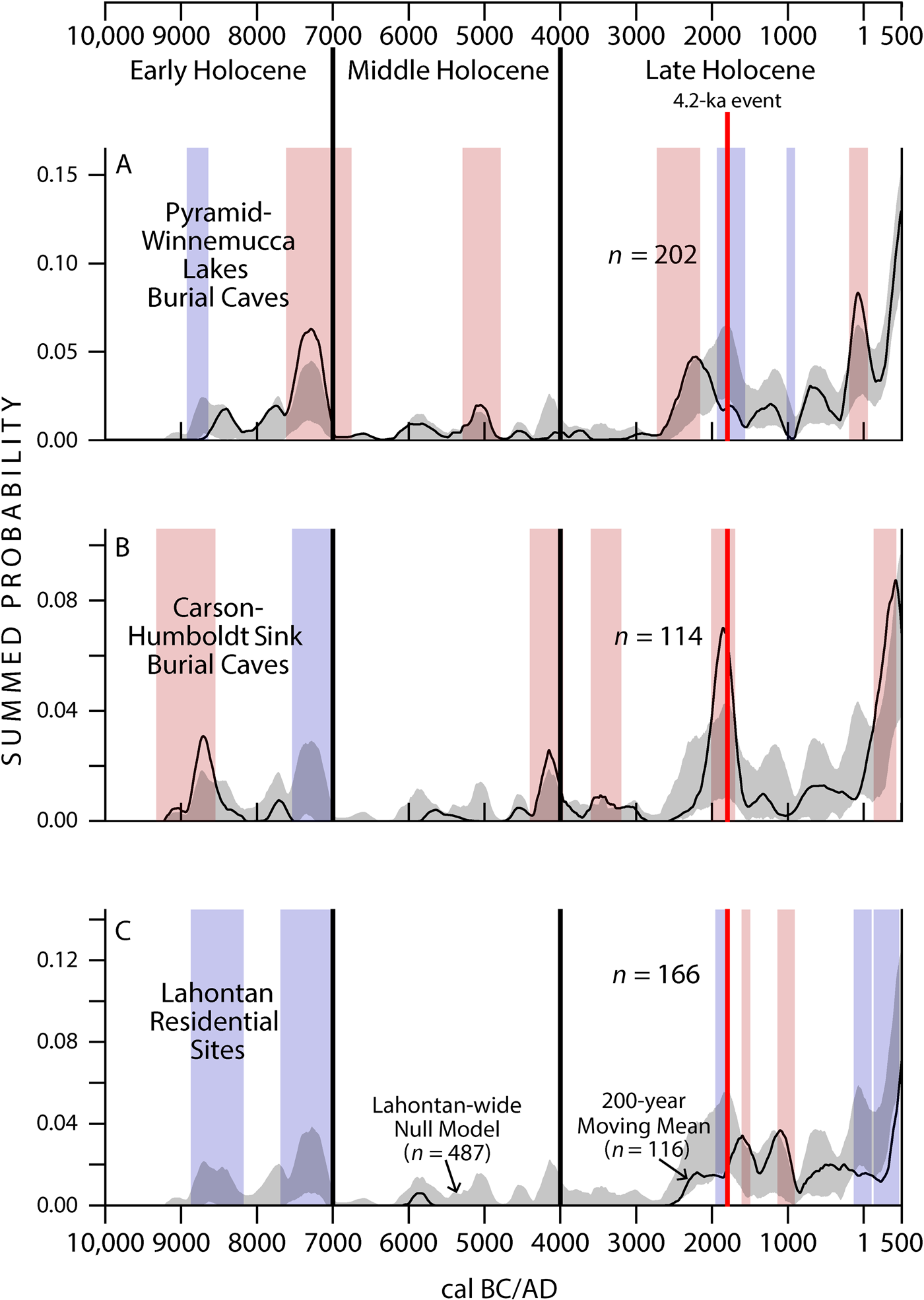
By separating mortuary from residential contexts, Figure 4 provides a far richer understanding of human demographic change within the Lahontan Basin over the last 12,000 years. Had we relied solely on the pooled SPD profile of these same dates (Figure 3), we would have arrived at a highly distorted and misleading picture of exponential population growth.
Syncopated First Americans
The Storyteller and his Paleoindian colleagues were among the earliest colonists of North America. Spirit Cave DNA is closely linked genetically to the Anzick child (around 10,900 BC; Montana), with both diverging from a common ancestor that moved south about 14,000 years ago (Moreno-Mayar et al. Reference Moreno-Mayar, Vinner, Damgaard, La Fuente, Chan, Spence and Allentoft2018). These linkages suggest a rapid early peopling of the Americas, with distance and geographic barriers leading to cultural drift and regional adaptations (Willerslev and Meltzer Reference Willerslev and Meltzer2021). The findings underscore the too-often ignored point that language, material culture, and genetics need not be congruent or causally linked (Beck and Jones Reference Beck, Jones, McDonough, Rosencrance and Pratt2024; Johannsen et al. Reference Johannsen, Larson, Meltzer and Linden2017; Meltzer Reference Meltzer, McDonough, Rosencrance and Pratt2024).
Paleoindian Mortuary Patterns
Paleoindians began burying their deceased inside Lahontan Basin caves at least 11,000 years ago.Footnote 4 This long-term trend is unique within the Intermountain West: Indigenous communities living elsewhere almost never buried ancestors in caves or rockshelters (Figure 1).Footnote 5 These distinctive Paleoindian mortuary practices defined the Lahontan Basin as a uniquely spiritual space, rather than just some place to live.Footnote 6
Archaeologists have long recorded extensive clusters of Paleoindian artifacts along the pluvial lake margins, and as elsewhere in the Great Basin, few such surface assemblages suggest long-term residential occupations (Smith and Barker Reference Smith and Barker2017; Smith et al. Reference Smith, Duke, Jenkins, Goebel, Davis, O'Grady and Stueber2020). Adams and colleagues (Reference Adams, Goebel, Graf, Smith, Camp, Briggs and Rhode2008:608) characterized the surface Paleoindian record of the Lahontan Basin as “isolated occurrences of humans in an otherwise empty landscape.”Footnote 7 This is why the Early Holocene 14C record of the Lahontan Basin derives almost exclusively from mortuary/cache contexts.
East–West Syncopation
For seven millennia, Indigenous communities in the Lahontan Basin syncopated between the western mortuary/cache caves of the Pyramid-Winnemucca Lake drainages and similar caves in the Carson and Humboldt Sinks to the east.Footnote 8 Figure 4 documents at least five such east–west shifts during the Early and Middle Holocene.
The earliest burials (interred at Spirit Cave and a dozen other mortuary/cache caves of Carson and Humboldt Sinks) define statistically significant peaks at 9096–8997 and 8863–8556 BC (Supplemental Tables 1 and 2). The contemporary Pyramid-Winnemucca Lake mortuary/cache complex to the west shows a corresponding gap at 8780–8608 BC.
After an almost 1,500-year radiocarbon hiatus, Paleoindians shifted burial practices westward, with twin positive pulses at 6066–5960 and 5247–4760 BC (and a corresponding gap to the east). Mortuary patterns reversed again when Carson and Humboldt Sinks reached a significant peak at 4366–4022 BC. A millennium later, the Lahontan Basin syncopated once again westward, with peaks at 2851–2769 BC, 2714–2278 BC, and 2228–2158 BC. Two centuries later, ritualized landscapes shifted back to the Carson-Humboldt mortuary/cache complex at 1984–1705 BC, with Pyramid-Winnemucca Lake dropping into troughs at 1925–1711 and 1633–1521 BC.
Such repeated east–west syncopation by groups sharing the same baseline material culture reflects a deliberate resilience strategy of Paleoindian and post-Paleoindian communities to even out the distinctively variable local hydrology. This is because the Pyramid and Winnemucca sub-basins get most of their water from the Lake Tahoe drainage via the Truckee River (Figure 1). But the Carson and Humboldt Sinks to the east are fed primarily by the Carson River and the vast Humboldt River drainage (Adams and Rhodes Reference Adams and Rhodes2019). Although the Pyramid-Winnemucca sub-basin and the Carson and Humboldt Sinks reflected the same overarching paleoclimatology, localized variability meant that sometimes the sub-basin was much better watered than the sinks to the east, and at other times, the reverse was true.
Such resilience perspectives emphasize an adaptive diversity driven by individual decision-making, small camp-group mobility, demographic fluidity, and the within-community “plasticity” of “residential cycling” (Upham Reference Upham1984). By highlighting regional syncopation, temporary site abandonments can be viewed as strategic behavioral practices that helped sustain regional occupational continuity (Nelson and Hegmon Reference Nelson and Hegmon2001). The finer-grained proxies and the tools of resilience theory also enable archaeologists to look “beyond the metaphors of ethnic groups acting in lockstep, with whole villages or entire ‘peoples’ packing up on moving day and going somewhere” (Simms Reference Simms and Beck1999:39). Phase-level archaeological chronologies have long obscured these short-term abandonments and reuse.
Building on the centennial-scale radiocarbon indices developed here, resilience theory suggests that decadal or even annual adjustments took place as well. These were evident among ethnohistoric Great Basin populations whose foraging itineraries were “usually the same each year [but] not always fixed. Seasonal variation in rainfall and consequently in crop growth frequently required that they alter their routine” (Steward Reference Steward1938:232). Rather than maintain a single, invariant settlement structure, Lahontan Basin communities existed in “several sets of roles and groups which appear and disappear according to the tasks at hand” (Gearing Reference Gearing1958:1149).
Transcending models grounded in strictly environmental change, economic crisis, or both, the concepts of resilience and syncopation reflect Indigenous responses to their changing world. Because such abrupt environmental shifts varied locally, the distinctive east–west syncopation now recognized in the Lahontan Basin was directly related to localized hydrological shifts that helped ensure regional community and sustainability without requiring internal structural changes (Scheffer et al. Reference Scheffer, van de Leemput, Weinans and Bollen2021:5).
Lovelock Culture Genesis
The 4.2 ka event (2200–1980 BC)—one of the most pronounced climatic intervals of the Holocene—shows up in paleoclimatic proxies across seven continents. Although sometimes billed as a “global mega-drought” (Railsback et al. Reference Railsback, Liang, Brook, Voarintsoa, Sletten, Marais and Hardt2018:87), Great Basin impacts were exactly the opposite, with three centuries of cooler, wetter weather triggering repeated flooding at higher elevations, tree lines moving downslope, springs rebounding, lakes refilling, rivers shifting course, and marshlands expanding.
The Lovelock culture emerged during this transformation, shifting the Lahontan Basin from a sparsely occupied sacred space into a homeland of nearly sedentary settlements, such as Stillwater Marsh and 26CH15. This lacustrine culture relied on marshland resources that required considerable time to collect and process, with these costs offset by their abundance, reliability, and close spacing (Madsen and Rhode Reference Madsen and Rhode1994:394; Simms Reference Simms2008:32–35). According to Raven (Reference Raven, Raven and Elston1993:8), “The sheer richness, diversity, and predictability of marshside productivity invited virtually continuous exploitation.”
Three dozen radiocarbon dates from several early Lovelock villages define peaks at 1598–1467 and 1118–913 BC. Still using their ancestral burial places in the nearby caves of the Carson and Humboldt Sinks, Lovelock communities augmented long-standing mortuary practices by burying the deceased near their marshland villages. They stayed away from the Pyramid-Winnemucca mortuary/cache caves (with gaps at 1925–1716, 1633–1511, and 1049–896 BC).
This newly historicized archaeological record allows us to explore how resilient Lovelock communities addressed the next four episodes of dramatic and abrupt climatic change: the Late Holocene Dry Period (1150 BC–AD 150) followed by droughts terminating at AD 750, AD 1150, and around AD 1350 (Mensing et al. Reference Mensing, Smith, Norman and Allan2008).
Late Holocene Dry Period (1150 BC–AD 150)
Indigenous communities across the Great Basin were challenged by the megadrought of the Late Holocene Dry Period (LHDP) that lasted longer than a millennium (Mensing et al. Reference Mensing, Wang, Rhode, Kennett, Csank, Thomas and Briem2023; Thomas et al. Reference Thomas, Rhode, Millar, Kennett, Harper and Mensing2023). New fine-grained proxies demonstrate that the LHDP was the driest Great Basin climate of the last six millennia and was more extreme than the better-known Medieval Climatic Anomaly (MCA; around AD 1000–1450; Stine Reference Stine1994).
The Tipping Point
In the parlance of resilience theory, the LHDP was a “tipping point”—a threshold with one or more perturbations capable of triggering large, abrupt, and sometimes irreversible transitions (Scheffer et al. Reference Scheffer, van de Leemput, Weinans and Bollen2021). When approaching such catastrophic thresholds in ecosystems and climate, societies sometimes experienced increasingly slow recoveries from even small perturbations (Dakos et al. Reference Dakos, Matthews, Hendry, Levine, Loeuille, Norberg, Nosil, Scheffer and De Meester2019:14308). Longer-term internal developments also caused some societies to lose resilience through time, effectively “setting them up for collapse” (Scheffer et al. Reference Scheffer, van de Leemput, Weinans and Bollen2021:1), recalling Holling's (Reference Holling, Clark and Munn1986) phrase, an “accident waiting to happen.”
The LHDP perturbation spanned 1,300 years and played out in three distinct intervals (Mensing et al. Reference Mensing, Wang, Rhode, Kennett, Csank, Thomas and Briem2023): an initial 900-year dry period (1150–2250 BC), followed by two centuries of wetter climate (250–50 BC), and terminating in two centuries of extreme drought (50 BC–AD 150). Indigenous Great Basin communities addressed the LHDP tipping point in multiple ways (Thomas et al. Reference Thomas, Rhode, Millar, Kennett, Harper and Mensing2023). Detailed site-by-site occupational histories and pooled radiocarbon trajectories in Figures 3–6 illustrate the complex patterning of LHDP abandonments and reoccupations within the Lahontan Basin.
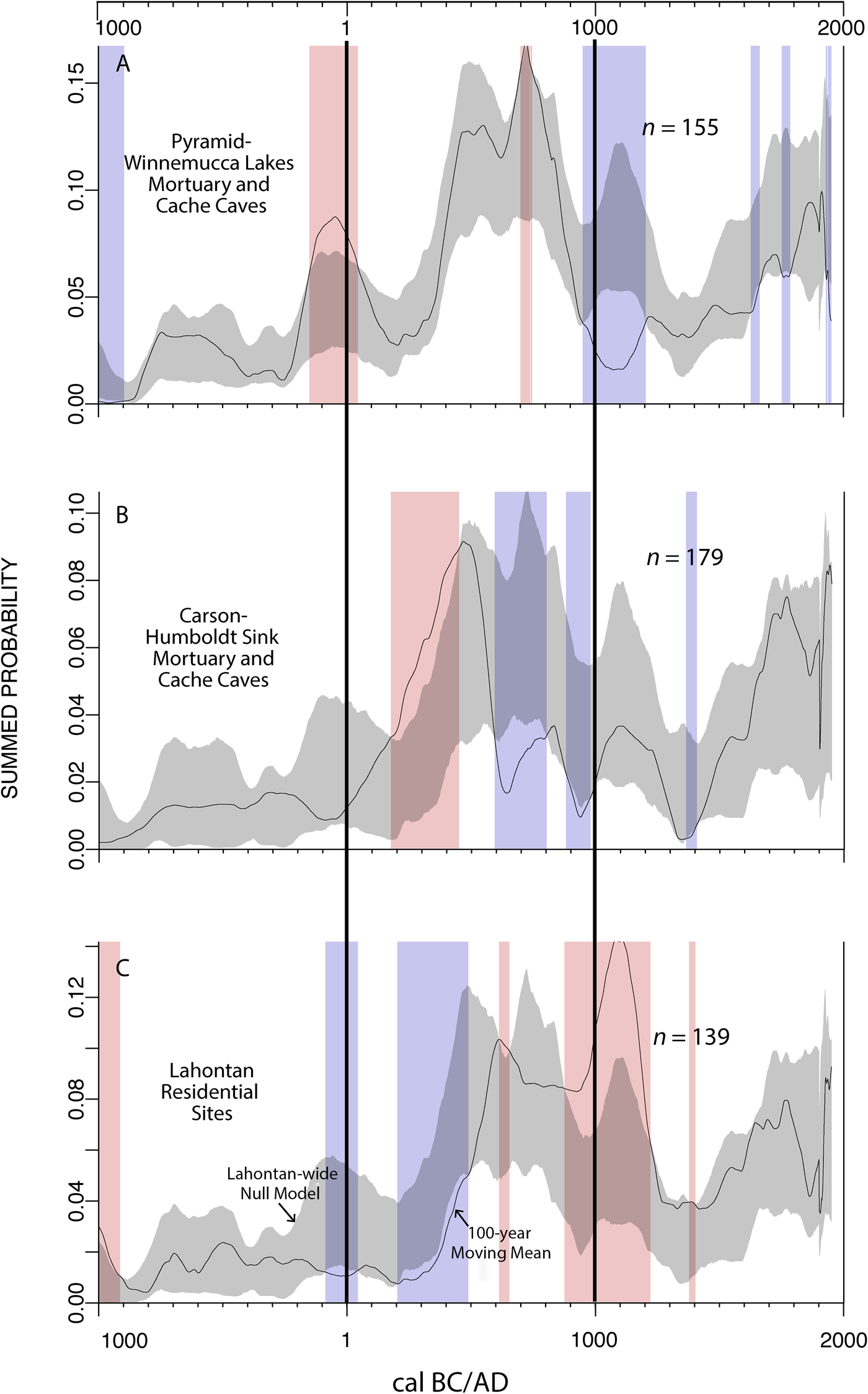
Long-term distribution of cultural 14C dates over the last 3,000 years (following the protocols in Figure 3).
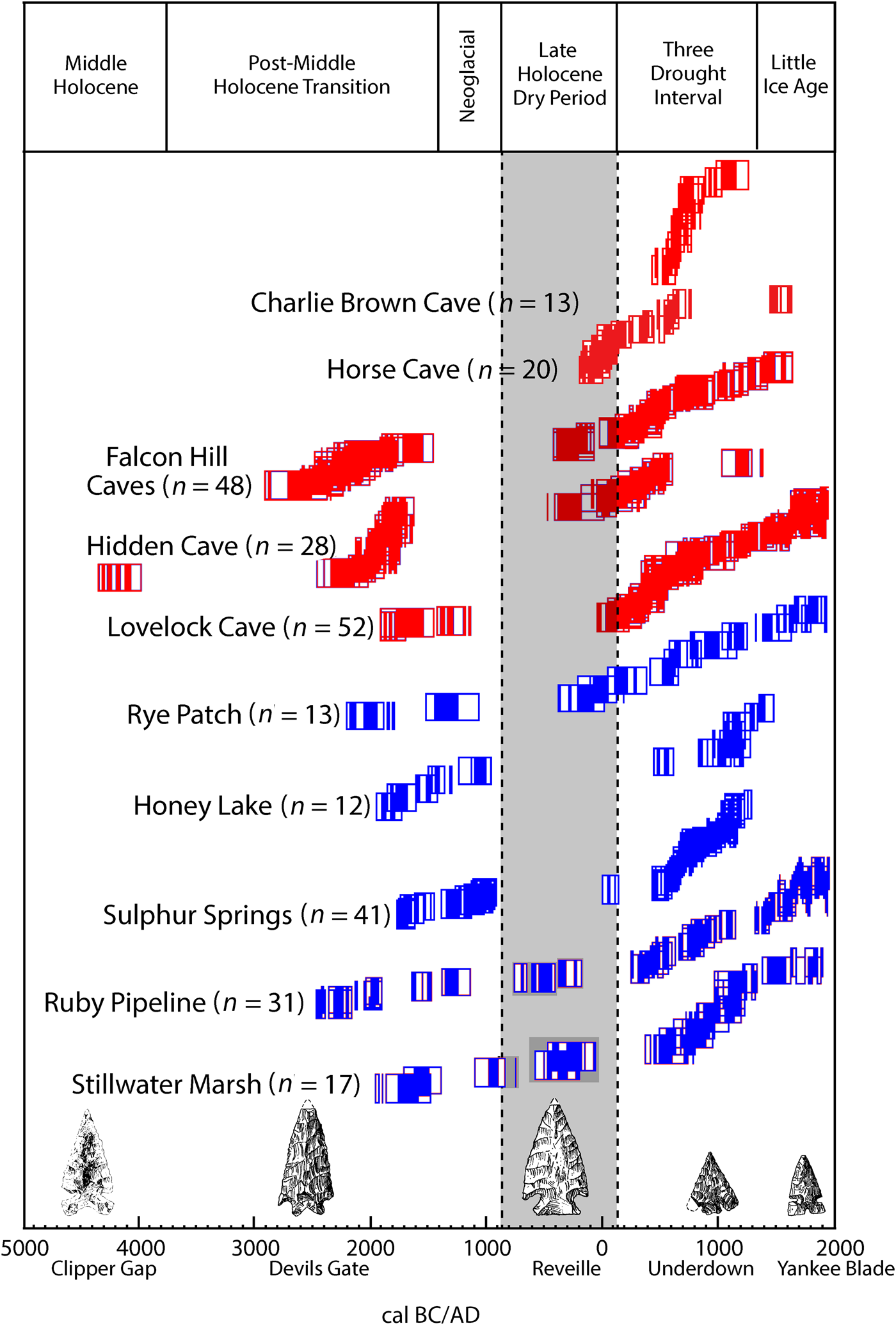
Distribution of site-specific radiocarbon dates from the Lahontan Basin, with time-diagnostic projectile points illustrated along the baseline. The dates in blue come from residential sites; those from mortuary/cache caves are shown in red.
Sunk Costs
The Storyteller was born into an embellished landscape where boulders could speak. More than 10,500 years ago, Paleoindians of the Winnemucca Lake sub-basin carved deep grooves and multiple cupules on a prominent tufa mound. Located within 50 miles (80 km) of Spirit Cave, these are the oldest petroglyphs known in North America (Benson et al. Reference Benson, Hattori, Southon and Aleck2013). The storied rocks of the Lahontan Basin held power (puha) before the birth of The Storyteller, and they remain sacred to the Pyramid Lake Paiute Tribe to this day. It is no small wonder that Lovelock communities could not simply walk away from the power places within their homeland.
Although consensus is sometimes heralded as a goal among small-scale societies, that is hardly what emerged during the LHDP tipping point. Most Great Basin localities south of 40° N latitude were abandoned during the initial dry phase; some were briefly reoccupied during the short mesic interval and abandoned again during the most extreme drought (50 BC–AD 150; Figure 5).
In the face of such massive and widespread aridity, sunk-cost investments must have encouraged some to stick with the status quo, even when the need for change was evident to others (Janssen et al. Reference Janssen, Kohler and Scheffer2003). Sunk costs heavily conditioned the nature of LHDP abandonments in the high mountains of the central Great Basin (Thomas et al. Reference Thomas, Rhode, Millar, Kennett, Harper and Mensing2023:411). The same was true of their Lovelock neighbors, rooted in the sacred marshland landscapes dating to their Paleoindian ancestors.
Leaving the Lahontan Homeland
The LHDP began in the Lahontan Basin with a radiocarbon peak in the eastern mortuary complex spanning 1118–913 BC (Figure 5), with the western mortuary/cache caves experiencing a concurrent trough (1049–896 BC). Lovelock villages in the Black Rock Desert were then abandoned between 850 BC and AD 450 when the LHDP archaeological record “essentially goes dark” (McGuire et al. Reference McGuire, Hildebrandt, Craig Young, Colligan and Harold2018:51, 197).
Where did they go?
The Lahontan Basin straddles an ENSO 42°–40° N dipole, remaining relatively stable through time, with southern lowlands drying out while the northwestern reaches stayed relatively mesic (Mensing et al. Reference Mensing, Wang, Rhode, Kennett, Csank, Thomas and Briem2023). Resilient Lovelock communities deliberately crossed this dipole, seeking to mitigate the persistent aridity desiccating their Lahontan Basin homeland by moving to upland refugia in the adjacent Sierran front. Figure 6 charts specific site histories for several Lovelock communities that temporarily left their marshland settlements during the height of the LHDP.
Despite the shift in settlement pattern, Lovelock foragers maintained long-distance ties to the virtually deserted Pyramid-Winnemucca Lake basin and Carson-Humboldt Sinks by burying ancestors and sometimes caching out-of-season belongings in the caves of their homeland. Genomics establishes an unmistakable continuity from Spirit Cave that continued through the LHDP and carried through at least AD 1347 (the Lovelock5 burial).Footnote 9
Coming Back Home
The Lahontan Basin experienced radiocarbon troughs during the LHDP at 86 BC–AD 43 and AD 203 (Figure 5), after which Lovelock communities left their highland refugia and came back home during the drought terminating at AD 750 (reflected in the positive 14C peak at AD 617–653). Returning to the Black Rock Desert, Sulphur Springs, Pyramid Lake, Humboldt Sink, and Stillwater Marsh, some Lovelock communities refurbished the same villages their ancestors had deserted a millennium earlier.
Despite the hiatus, the diehard Lovelock culture retained the same baseline material culture. Hunters still fashioned Elko spear points, and Lovelock weavers still crafted Catlow Twine textiles, adding the distinctive Lovelock Wickerware baskets to their repertoire (Camp Reference Camp2017; Connolly et al. Reference Connolly, Fowler and Cannon1998). Although they continued burying their deceased in the mortuary/cache caves of the Carson and Humboldt Sinks (with a positive peak at AD 175–499), Lovelock communities also interred many of their dead in villages at Stillwater Marsh (AD 100–750). Western Pyramid-Winnemucca mortuary/cache caves reflect similar continuities, with peaks at AD 699–738 and AD 740–746.
Buildup to the Drought Terminating in AD 1150
The drought terminating in AD 1150 was accompanied by the anomalously warm temperatures of the MCA (Mensing et al. Reference Mensing, Wang, Rhode, Kennett, Csank, Thomas and Briem2023). The drought-reduced inflow from the Carson, Truckee, and Humboldt Rivers, and the Lahontan Basin wetlands shrank. The water level in Pyramid Lake dropped, and the Carson-Humboldt Sinks likely dried up completely. Wetland plants shifted from lacustrine lowlands to stream floodplains, fisheries collapsed, and drinking water was hard to come by. Although some turned to freshwater springs, those springs in the Carson and Humboldt Sinks flowed relatively high above the basin floor and likely ceased flowing in the autumn months.
Despite these climatic impacts, the Late Lovelock continuity persisted with a positive demographic peak at AD 876–1221. These villages correlated with a Carson Sink high stand (AD 1040–1290) that was likely augmented by an “unearned” inflow from the Walker River through a paleochannel and perhaps input from the Humboldt River (Adams and Rhodes Reference Adams and Rhodes2019:Table 3, Figure 5, 165).
The Thirteenth-Century “Collapse”
After the moist pluvial (AD 1100 and AD 1200) that separated the two centennial-scale droughts of the MCA (Hatchett et al. Reference Hatchett, Boyle, Putnam and Bassett2015), the late thirteenth century signaled the so-called collapse of the Lovelock culture.
Benson and colleagues (Reference Benson, Berry, Jolie, Spangler, Stahle and Hattori2007:348) summarized conventional interpretations: the twin droughts of AD 1150 and the late thirteenth century “acted as a slow-motion, one-two punch with the first blow putting the [Lovelock] cultures on their knees and the second blow ending the fight.” According to this phase-level thinking, when the distinctive Lovelock Wickerware was no longer manufactured, the trait-list-defined Lovelock culture “collapsed” around AD 1250.
As during the LHDP, Lovelock communities still shared vested interests in the sacred marshland landscapes of their ancestors. Sunk costs must still have made it painful to walk away, but this time, most did just that. Watching their homeland turn unfriendly, many must have felt that their sunk-cost investments failed to compensate for a status quo that just was not working anymore.
So why did resilient Lovelock communities survive the Late Holocene Dry Period—the second-worst megadrought of the Holocene—yet “collapse” during the less severe Medieval Climatic Anomaly? Could the Lovelock communities have persisted once again by temporarily retreating into more mesic highland refugia until the droughts went away?
Loss-of-Resilience Hypothesis
Hypotheses connecting social “collapses” to abrupt climate change have long suffered from broadly dated paleoclimatic proxies with uncertain societal effects; such disconnects make it difficult to establish robust and nuanced causal interpretations linking human societies to their environments. Although climate extremes are often implicated in large-scale cultural transformations of ancient societies, rarely is climate the sole cause (Kintigh and Ingram Reference Kintigh and Ingram2018).
It seems possible that post-LHDP exponential growth had packed the peripheries around the Lahontan Basin, discouraging further (even temporary) relocations (Thomas and Millar Reference Thomas and Millar2024:92–94; Thomas et al. Reference Thomas, Rhode, Millar, Kennett, Harper and Mensing2023). But there is another possibility.
The loss-of-resilience hypothesis (Scheffer et al. Reference Scheffer, van de Leemput, Weinans and Bollen2021) holds that repeated and dramatic transformations were sometimes preceded by critical intervals of slowing down and fragility. That is, as societies became increasingly vulnerable through time, even relatively small perturbations could trigger large-scale transformations, including a radical rejection of the status quo and a search for alternative pathways.
Such loss-of-resilience processes may have come into play with the Lovelock culture. During the post-LHDP boom and bust/mesic-xeric cycling, the Lahontan Basin was buffered by hydrological windfalls bringing to the Carson Sink waters from the Sierra Nevada range that had previously been destined for Walker Lake. Could such “unearned water” have triggered subtle losses of resilience that fostered discontent with increasing social and economic inequalities, crowded conditions caused by renewed exponential growth, and possible escalating violence?
Perhaps later Lovelock communities behaved like their ancestors by resorting to temporary syncopated shifts to accommodate decadal-scale swings in temperature and hydrology. But when those swings metamorphosed into centennial-scale envelopes of variability, the less resilient Lovelock culture ran into trouble.
Those Who Stayed
The Numic Spread hypothesis holds that Late Lovelock survivors moved en masse westward over the Sierra Nevada, becoming ancestral to ethnohistoric Penutian-speaking groups (such as the Maidu, Klamath, and Modoc) and highlighting the Great Basin origins of these now-Plateau communities. Simultaneously, Numic-speaking Monache populations from the south arrived in the depopulated Lahontan Basin to become the Paviotso (Northern Paiute)—all within the past seven centuries or so. Considerable linguistic and archaeological evidence supports this hypothesis, with complete population replacement universally assumed (Bettinger and Baumhoff Reference Bettinger and Baumhoff1982; Camp Reference Camp2017; Hattori Reference Hattori1982; Lamb Reference Lamb1958:99).
Spirit Cave and Lovelock Cave genomes reflect a degree of continuity at odds or even contradictory to the Numic Spread hypothesis (Rhode and Madsen Reference Rhode, Madsen, Madsen and Rhode1994; Thomas Reference Thomas2019). Despite a “collapsing” Lovelock culture that largely depopulated the Lahontan Basin, genetic evidence suggests that some resilient Indigenous people decided to stick it out and stay behind. Lovelock ancestors buried toward the end of the LHDP (AD 12–212) show strong ties to the Spirit Cave ancestors that continued through Lovelock5 (AD 1347). But Lovelock3 (AD 1289) belongs to the B2a1 haplogroup that reflects Mesoamerican genetic ties that were absent earlier. Although DNA does not specifically identify the arriving group, it is highly likely that Numic speakers are responsible.
Long-Term Paiute Resilience and Survivance
That Lovelock5 lacks Mesoamerican ties and is three generations later than Lovelock3—a statistically significant difference—seriously brings into question the long-standing assumption of a complete Numic population replacement. Despite the Lovelock culture “collapse,” tribally supported DNA research suggests that Numic speakers mixed in with Lovelock survivors, consistent with the Indigenous oral history of a startling survivance spanning at least 10,000 years (and likely longer).
Rather than a total Numic replacement, Northern Paiute oral history embodies a long-dismissed (yet more plausible) scenario. Sarah Winnemucca (who lived around 1844 to 1891) related a tale told by her grandmother about the aftermath of defeating the infamous red-haired giants at Lovelock Cave. Although they were “barbarians” and “people-eaters,” the Paiutes sometimes took “these people into their own families” (Hopkins Reference Hopkins1883:73–75).
These findings are consistent with Freeman and colleagues’ (Reference Freeman, Robinson, Bird, Hard, Mauldin and Anderies2024) claim that many such “population collapses” (with their dramatic recessions in carrying capacity) have antecedents dating back decades or centuries, perhaps even reflecting transformations of human infrastructure systems across millennia. This is precisely what the fine-grained behavioral and paleoenvironmental chronologies from the Lahontan Basin show, underscoring the survivance of communities coping with both gradual and abrupt climate change since the Late Pleistocene. Through shifting land-use strategies that changed through time, resilient Indigenous populations chose when to stay, when to go, and when to return (if ever).
Moving On
American archaeology largely turned a cold shoulder toward Indigenous perspectives during the twentieth century: it is hardly coincidental that, although the Colville and Fallon Paiute-Shoshone tribes agreed to accept destructive DNA analysis, both opted for a Danish scientist to do the research (see also Willerslev and Meltzer Reference Willerslev and Meltzer2021:362–363). Despite considerable resistance from nearby tribes, the Colville Confederated tribes (Washington) elected to volunteer the DNA samples that would ultimately link them to Kennewick Man / The Ancient One: “Because of the way science has treated our people in the past, it was a tough decision to actually submit,” said James Boyd, board chairman of the Colville tribes. “We're happy for the outcome . . . but we knew what the outcome would be” (Rosenbaum Reference Rosenbaum2015). The Fallon tribe felt similarly, stressing that they did not mistrust science—it was American scientists they did not trust.
Peter Whiteley (Reference Whiteley2002:405) sensed “something of a thaw” emerging in the early twenty-first century between estranged American archaeology and Indigenous communities. The agonizing—and successful—Colville and Paiute collaborations have helped pave the way for similar alliances. Several California tribes, including the Chumash, actively participated in DNA studies to establish genomic continuities for at least 8,000 years (Byrd et al. Reference Byrd, Arellano, Engbring, Leventhal and Darcangelo2022; Nakatsuka et al. Reference Nakatsuka, Holguin, Sedig, Langenwalter, Carpenter, Culleton and García-Moreno2023; Severson et al. Reference Severson, Byrd, Mallott, Owings, DeGiorgio, de Flamingh and Nijmeh2022), genetic continuity has been established between Picuris Pueblo and ancient individuals from Ancestral Puebloan sites (Pinotti et al. Reference Pinotti, Adler, Mermejo, BitzThoren, McColl, Scorrano and Feizabadi2025), and DNA analysis recently upheld the persistence of Blackfoot peoples since glacial times (First Rider et al. Reference First Rider, Wolf, Murray, de Flamingh, Campelo Dos Santos, Lanoë, Zedeño, DeGiorgio, Lindo and Malhi2024).Footnote 10 Archaeological–Indigenous collaborations increasingly reinforce and amplify tribal objectives in the establishment of long-term genetic continuities—validating tribal oral history, furthering repatriation efforts, and underwriting legal claims for treaty rights—all while ensuring that Indigenous communities retain control of their genetic data.
The practice here is not to replace Western knowledge with Indigenous knowledge or even necessarily to meld the two but rather “to weave, braid, or bind them together so that both can be understood and appreciated” (Antoine et al. Reference Antoine, Mason, Mason, Palahicky and de France2018). In so doing, archaeologists need to remember that, as potential partners in consuming archaeological information, many Indigenous people still resent the degree to which their history has been defined by non-Natives (Zimmerman and Conkey Reference Zimmerman and Conkey2024). Archaeological terms such as “collapse” and “abandon” retain negative connotations for many Indigenous people (Colwell-Chanthaphonh and Ferguson Reference Colwell-Chanthaphonh and Ferguson2006). Despite their negative connotations, we use these terms here to emphasize the evolving linkages between established Western science and the Indigenous perspectives. This reflects the trend in recent DNA research that tends to shift the focus from abandonment/collapse to persistence (Laluk and Aguilar Reference Laluk and Aguilar2023).
We argue that resilience theory holds great promise for exploring the archaeological implications of demographic diversity and its social consequences (Hegmon et al. Reference Hegmon, Freeman, Kintigh, Nelson, Oas, Peeples and Torvinen2016; Leslie and McCabe Reference Leslie and McCabe2013; Nelson et al. Reference Nelson, Hegmon, Kulow, Peeples, Kintigh and Kinzig2011). Perspectives from resilience theory—specifically, tipping points, early warning signals, sunk-cost effects, and loss-of-resilience hypotheses—provide tools to help archaeologists unravel the processes that drove long-term Indigenous resilience and survival. That much is evident from The Storyteller across the past 10,000 years.
Acknowledgments
We gratefully acknowledge thoughtful reviews from Pat Barker, Bryan Hockett, David Meltzer, Lorann S. A. Pendleton, Edward A. Jolie (Lakota/Muscogee), Wilson Wewa (Northern Paiute), Maria Nieves Zedeño, and three anonymous reviewers. We also thank Diana Rosenthal Roberson, Anna Semon, Kayla Younkin, and Caitria O'Shaughnessy for helping prepare the manuscript. We appreciate Anibal Rodriguez translating the abstract into Spanish.
Funding Statement
This research was funded in part by the North American Archaeology Fund at the American Museum of Natural History.
Data Availability Statement
All data used as the basis for this analysis are included in Thomas (Reference Thomas2024) and the Supplemental Material.
Competing Interests
The authors declare none.
Supplemental Material
For supplemental material accompanying this article, visit https://doi.org/10.1017/aaq.2024.85.
Supplemental Table 1. Radiocarbon Dates.
Supplemental Table 2. Permutation Testing Results.
Supplemental Text 1. Great Basin Mortuary Caves outside the Lahontan Basin.


 Open access

