




1 Introduction
In spontaneous spoken English, which clauses can deviate from traditional syntactic schemas, which contain a gap. Such which clauses can contain a resumptive pronoun, as in (1) and (2), or a resumptive noun phrase, as in (3) and (4), where a gap would otherwise be.Footnote 1
(1) ‘Urinating on an electric fence could be the mistake of a lifetime’, which that's true. (This American Life host Ira Glass, 2018)
(2) He spikes the ball, and he deflates the ball, which I love that because I like, you know, the deflated ball. (Professional American football player Tom Brady on WEEI-AM, 2011)
(3) And he told the party to just ditch her plan, which her plan calls for a closer relationship with the EU. (NPR reporter Frank Langfit, 2018)
(4) And there's not very many botany jobs out there, let alone my dream job, which I have my dream job at the service. (Botanist Kristie Scarazzo on NPR, 2019)
Such utterances may at first glance appear to be performance errors, particularly since clauses with resumptive pronouns have been considered unacceptable, except in rare instances, in both theoretical and experimental research. But there is a history of researchers suggesting that such constructions are actually the result, at least in some cases, of a reanalysis of which as something other than a relative pronoun (Sells Reference Sells1985; Miller Reference James, Anderson and Macleod1988; Daalder Reference Daalder1989; Kuha Reference Kuha1994; Loock Reference Loock, Celle and Huart2007; Burke Reference Burke2017; Loss & Wicklund Reference Loss and Wicklund2020). Documentation of evidence for this reanalysis has been limited so far, but we argue that a careful reading of the literature across a variety of subfields offers a convincing set of clues.Footnote 2
Although a reanalysis is often posited, researchers who have explored the atypical function of which are not in agreement as to just how it is being reanalyzed. Collins & Radford (Reference Collins and Radford2015) suggest that it is being reanalyzed as a caseless relative pronoun, which introduces a relative clause but ‘ghosts’ a preposition and, in the uses considered in this article, a light predicate (e.g. I would say). Sells (Reference Sells1985) suggests that which is being reanalyzed as a subordinating conjunction; Daalder (Reference Daalder1989) posits a coordinating conjunction behavior; and Miller (Reference James, Anderson and Macleod1988: 116), Kuha (Reference Kuha1994), Loock (Reference Loock, Celle and Huart2007) and Burke (Reference Burke2017) note a conjunction-like behavior without specifying which kind. Notably, Kuha warns that ‘we should not expect it to be straightforward to characterize coordinate which as a coordinate or subordinate structure’ (Reference Kuha1994: 3). In order to arrive at this indeed challenging characterization, we endeavor to determine the syntactic category of this novel use of which by systematically exploring its behavior. We use novel naturally occurring audio data in this exploration, pulled from talk media to investigate whether such uses of which behave like relative pronoun which, subordinating conjunctions, coordinating conjunctions, or something else entirely. This entails two paths of investigation: first, we use the audio data to determine how such uses of which behave prosodically, as others (e.g. Loock Reference Loock, Celle and Huart2007; Burke Reference Burke2017) have suggested that this which may not have the typical comma-intonation prosody of relative pronoun which. Second, we use our improved understanding of this prosody to help us better judge the grammaticality of sentences specifically constructed to determine the syntactic category of this novel use.
2 Background
Scattered clues from theoretical, experimental and corpus studies on resumption indicate that the which constructions investigated in this article are systematic and long standing in English. Clues come from uses of which with what appear to be resumptive pronouns, from judgments about these constructions and from prosody studies of various connective words. Importantly, the line from the data to the claim that which is being reanalyzed is often indirect or not explicitly made in the works cited below.
2.1 Clues from research on resumption
Researchers in a variety of subfields have explored resumptive pronouns, which are pronouns that ‘appear in a position in which, under other circumstances, a gap would appear’ (McCloskey Reference McCloskey, Everaert and van Riemsdijk2006: 26). Consider the sentence in (5a), which includes a restrictive relative clause, and the sentence in (5b), which includes an appositive relative clause.
(5)
(a) I bought a house that I like {__ /it} very much.
(b) I bought a house, which I like {__ /it} very much.
Although resumptive pronouns are produced in spontaneous speech in English (e.g. Prince Reference Prince1990; Cann et al. Reference Cann, Kaplan and Kempson2005), speakers consistently report such sentences as ill formed in Likert-scale acceptability tasks, even in places where they are hypothesized to have an ameliorating or ‘saving’ effect, such as in islands or heavily embedded positions (e.g. McDaniel & Cowart Reference McDaniel and Cowart1999; Alexopoulou & Keller Reference Alexopoulou and Keller2007; Heestand et al. Reference Heestand, Xiang and Polinsky2011; Han et al. Reference Han, Elouazizi, Galeano, Görgulu, Hedberg, Hinnell, Jeffrey, Kim and Kirby2012, Keffala Reference Keffala2013; Polinsky et al. Reference Polinsky, Clemens, Morgan, Xiang, Heestand, Sprouse and Hornstein2013; Beltrama & Xiang Reference Beltrama and Xiang2016; Loss & Wicklund Reference Loss and Wicklund2020), as exemplified in sentences (6a, b).
(6)
(a) I bought a house that I wonder if my friends will like {__ /it} very much.
(b) I bought a house, which I wonder if my friends will like {__ /it} very much.
Asudeh (Reference Asudeh2012) suggests that resumptive pronouns do not come about due to poor planning; rather, they are a product of incremental production of locally well-formed structures, which may not lead to a structure that is globally well formed. For example, when there is an island in a relative clause, constraints prevent integration of a filler and therefore must include a resumptive pronoun in order to create a locally well-formed structure at each stage. The addition of the pronoun, however, results in a failed structure at the global level in languages that prohibit resumption, such as English.
Asudeh's model does predict that sentences with resumptive pronouns can be well formed, provided that the resumptive pronoun is in a position where the grammar licenses a gap and the complexity of structure exceeds memory capacity. Asudeh suggests that researchers (e.g. Alexopoulou & Keller Reference Alexopoulou and Keller2007) have not found evidence that resumption can improve acceptability of sentences with long-distance dependencies because stimulus sentences have not strained memory enough to do so. Ackerman et al.'s (Reference Ackerman, Frazier and Yoshida2018) recent work indicates that study design has also been a factor, as they found that resumptive pronouns are judged to ameliorate clauses with islands when participants are given forced-choice, not Likert-scale, acceptability tasks.
In short, Asudeh's model and Ackerman et al.'s experimental work offer explanations for the presence of resumption in English despite its perceived unacceptability, including a recipe for structures in which resumption can truly have an ameliorating effect: when they occur inside islands or heavily embedded structures.
This leads us to our first set of clues that some uses of which are used or interpreted as something other than a relative pronoun. Using corpora and personal collections of which tokens, researchers (Loock Reference Loock, Celle and Huart2007; Burke Reference Burke2017; Loss & Wicklund Reference Loss and Wicklund2020) have found that resumptive nominal expressions can occur exactly where theory does not predict them to occur – in sentences that feature no syntactic islands or embedding:
(7) And we went 'round the front the side and the back, which the back was like outside of the … villa walls. (Burke Reference Burke2017: 369)
(8) My nickname is ‘Pan’ which I don't like it so much. (Loock Reference Loock, Celle and Huart2007: 72)
(9) They teach you in outpatient treatment how to have more reasonable thoughts rather than catastrophic or hyperbolic thoughts. Which that's what Los Angeles runs on. (Loss & Wicklund Reference Loss and Wicklund2020: 44)
In addition to these documented instances of resumptive pronouns appearing in appositive clauses where there is no potential ameliorating effect or processing assistance to motivate them, there is evidence in the Corpus of Contemporary American English (COCA; Davies Reference Davies2008–) that such instances of resumption in subject position (as in (9)) increased significantly between 1990–9 and 2008–17 (Loss & Wicklund Reference Loss and Wicklund2020).Footnote 3 If gap-filled appositive relative clauses are indeed performance errors, such occurrences should be stable across decades.
The increasing tendency for which to introduce clauses containing unmotivated resumptive nominal expressions raises questions about its function as a relative pronoun. Traditionally, relative pronouns serve two functions: they connect a subordinate clause with the matrix clause, and they corefer with an antecedent in the matrix clause. It has been argued, however, that which can be used in a manner that performs its connective function but ignores its anaphoric role (Loock Reference Loock, Celle and Huart2007; Burke Reference Burke2017). Such a connective-only use would be consistent with some (far from all) syntacticians’ suggestion that, unlike restrictive relative clauses, appositive relative clauses have characteristics of independent clauses (e.g. Emonds Reference Emonds1979) or are at least interpreted as independent (Arnold Reference Arnold2007). If which can indeed be only connective in nature while other relative pronouns must be both connective and anaphoric, we should see differences in how speakers evaluate strings that begin with which and equivalent strings that begin with that. In fact, such a divergence is supported by the findings of a recent experimental study comparing the acceptability of resumption in the two clause forms (Loss & Wicklund Reference Loss and Wicklund2020).
Using a Likert scale, participants rated the naturalness of sentences with resumptive pronouns and syntactic islands in both appositive relative clauses and restrictive relative clauses. Sentences with resumptive pronouns in appositive clauses were rated as more natural than those with restrictive clauses. This is consistent with Prince's (Reference Prince1990) finding that resumptive pronouns in English occur more in appositive clauses than restrictive clauses, and, together, they offer evidence that some speakers may treat which as only connective, while that continues to be treated as both connective and anaphoric. This possibility is further supported by the finding that these same participants found sentences with islands in appositive clauses more natural than sentences with islands in restrictive clauses, with and without resumptive pronouns. If some of the participants have reanalyzed which to include a connective-only form in their lexicons, for them, there is no movement of which in these sentences – and thus there are no islands.
If the above findings do indeed reveal an increasingly common connective-only form of which, a noteworthy consequence is that some appositive relative clauses actually do not begin with a traditional relative pronoun, and thus they are not appositive relative clauses. If which can function like a conjunction, then the pronoun in those clauses is not truly resumptive, since which would not be the product of movement, and thus there could be no gap, filled or otherwise. Speakers who use which in this manner would presumably accept sentences that appear to feature appositive relative clauses with resumptive pronouns, but they would actually be accepting sentences with conjunctions followed by ordinary, non-resumptive pronouns and no relative clauses at all.
With the above in mind, we henceforth distinguish between relative pronoun which and ‘connective which’. In addition, we refer to the relevant pronouns in clauses introduced by connective which as ‘apparent resumptive pronouns’ as long as connective which's syntactic status is still undetermined.
2.2 Clues from historic use
A clue that which clauses have long co-occurred with filled gaps comes from historical uses in both literature and written letters (see Burke Reference Burke2017 for an additional discussion on historical uses). The Oxford English Dictionary (OED) has entries for ‘peculiar constructions’ of which clauses featuring which ‘serving to merely link the clauses together’ or acting as a ‘mere connective’. A number of the constructions cited in the dictionary include a resumptive pronoun,Footnote 4 which the authors suggest typically occur in highly embedded constructions or in what would be islands in present-day English, as in (10) and (11).
(10) Ye finde these words, penetrate, penetrable, indignitie, which I cannot see how we may spare them. (Puttenham's The Arte of English Poesie, 1589, as cited in OED)
(11) The history of myself, which, I could not die in peace unless I left it as a legacy to the world. (Sterne's Sentimental Journey II, 1768, as cited in OED)
Other OED examples, however, feature resumptive pronouns in constructions not predicted by the current theory of resumption explored above:
(12) Þis is he, which þat myn vncle swereth he mot be ded. (Chaucer's Troilus & Criseyde, c.1374, as cited in OED)
(13) Yowre wurschupfull astate, the whyche all myghte God mayntayne hyt. (Wenyngton's Paston Letter and Papers, 1449, as cited in OED)
Connective which is also found in the letters of early-twentieth-century American English speakers, as seen in Charles C. Fries’ American English Grammar (Reference Fries1940), which compares dialectal differences across social classes. (NB: Fries does not count the sentence in (18) as nonstandard, but we interpret it to be a gapless connective which construction.)
(14) We have two boys go to school one 14 and 10 years old which you see they need edycation.
(15) His father, being a man of 57 years and has Rupture in Both Sides which he is unable to do hard manuel labor.
(16) I am asking for your help for to locate my son which he is in the _____.
(17) _____ left Our home without Our Knowledge or consent and Joined the … at _____ witch he was only 18 Years old at time he ….
(18) He got in through a lawyer for $21.00 which he had $6.00 to pay yet.
Finally, moving into the present day, Burke (Reference Burke2017) notes in her account of the history of connective which, which she also calls ‘the linking relative’, that while Huddleston & Pullum et al. (Reference Huddleston and Pullum2002) do not include it in their Cambridge Grammar of the English Language, Kortmann et al. (Reference Kortmann, Lunkenheimer and Ehret2020) identify it as feature 197 in their Electronic World Atlas of Varieties of English, albeit a feature with infrequent use.
Thus we see that uses of which clauses that appear to have resumptive pronouns (i.e. connective which clauses) have been in use for several centuries, with a presence in American English for at least eighty years, possibly a good deal longer. The phenomenon we are exploring may not be as new as it seems.
2.3 Clues from prosody
The last clue that points to a unique behavior of connective which clauses comes from prosody studies. Which clauses are typically separated from root clauses by comma intonation (Emonds Reference Emonds1976; Demirdache Reference Demirdache1991: 113; Potts Reference Potts2005; Dehé Reference Dehé2009), and thus the commas in sentences like (19) indicate an obvious pause before which – and little-to-no pause at all after which.
(19) The syntax class, which is always taught by John, is only offered in the fall.
There is evidence of exceptions to the typical pattern, however. Loock (Reference Loock, Celle and Huart2007: 85) and Dehé (Reference Dehé2009: 588–9) both observe that a small number of the relative pronoun which clauses in their data exhibit a pause after which, rather than before it. Dehé notes that in 9.5 percent of such clauses in her spoken corpus (N = 53), which does not begin the intonation unit of the subordinate clause that follows it, but instead ends the unit comprising the words that precede it. Loock suggests that this unexpected pause pattern with relative pronoun which is likely to be present with connective which clauses, though he laments a lack of acoustic data to support his assertion. Burke (Reference Burke2017) narrows the investigation of which's pause pattern exclusively to uses of connective which (both gap-filled and gapless) in her analysis of their occurrence in the University of Western Australia's corpus of spoken Australian English. She confirms the presence of post-which pauses according to transcription comma placement and audio confirmation when available, though she does not offer measurements of the pauses and their distribution.
In short, we believe that the above research points to a unique prosody associated with connective which. Though Loock, Dehé and Burke do not offer hard data to confirm this suspicion, they do offer enough evidence to warrant a systematic comparison of the prosody of connective which to that of relative pronoun which and coordinating and subordinating conjunctions. And while relative pronoun which has a very predictable prosody – Dehé found that about 90 percent of the tokens in her spoken corpus follow a standard comma-intonation pattern, where which begins an intonation unit comprising the entire relative clause – it is worth taking a moment to discuss the ways in which the prosody of conjunctions is less predictable.
Coordinators exhibit a wide range of prosodic behaviors. In her analysis of a fifty-minute subcorpus of the Santa Barbara Corpus of Spoken American English, Barth-Weingarten (Reference Barth-Weingarten2007) found that coordinating conjunctions between clauses often begin an intonation unit with the second root clause, as may be expected given the syntactic structure of coordinators (see Halliday Reference Halliday1994). Barth-Weingarten added, however, that clause-coordinating conjunctions can also end an intonation unit with the first root clause and can even function as their own intonation units between root clauses.
Subordinators also vary in prosodic behaviors. Though and because are of particular interest here, as they may have a unique prosody when holding the floor, a function that Loock suggests connective which may share. Barth-Weingarten & Couper-Kuhlen (Reference Barth-Weingarten and Couper-Kuhlen2002) used the Santa Barbara Corpus to explore the prosodic behavior of though, and Schleppegrell (Reference Schleppegrell1991) used recorded interviews of students and teachers to do the same for because. Both researchers found that these subordinators can fall at the beginning, middle and end of intonation units.
It is perhaps not surprising that the prosodic behavior of subordinators can so closely mirror coordinators, as Schleppegrell notes that what we typically classify as subordinating conjunctions can exhibit more of a coordinating behavior in discourse. There is one unique behavior for each category worth emphasizing, however: only coordinators have been found to serve as their own intonation units, and only subordinators have been observed in the middle of a unit.
In light of what we know about the three comparison categories, the stability or variability observed in the prosody of connective which may reveal clues to its syntactic function. In addition, an understanding of its prosody will help us better judge the grammaticality of sentences constructed to test its syntactic behavior, as we do in section 5, below.
2.4 A reanalysis
Let us summarize the clues we have presented so far:
(i) Resumptive pronouns occur in which clauses where they are not motivated to occur; this may indicate that they are not resumptive pronouns at all.
(ii) Resumptive pronouns are increasing in occurrence where they are unmotivated in which clauses, suggesting that a reanalysis of which is being used by more speakers and/or in more situations.
(iii) Resumptive pronouns are rated as more acceptable in which clauses than in that clauses, which also may indicate that they are not resumptive pronouns.
(iv) Resumptive pronouns occur more in which clauses than in that clauses; this indicates that not all relative clauses have the same constraints.
(v) If this is a change in progress, its groundwork has a centuries-long history in English.
(vi) Connective which clauses may have a prosody distinct from relative pronoun which clauses; this may indicate that which has taken on a novel syntactic behavior.
We believe that these clues offer evidence beyond accounts of frequency based on anecdotes and tokens in corpora that a reanalysis of relative pronoun which to a solely connective form that is newly prominent is well underway. Connective which does not replace the relative pronoun, of course; the two forms reside together in the lexicons of speakers who have adopted the reanalysis.
As to the syntactic category of the reanalyzed form, researchers have taken various positions. Some have observed that which can behave like a coordinating conjunction (Greene Reference Greene1851: 128; Daalder Reference Daalder1989), while others have suggested that its conjunctive role is subordinating in nature (Sells Reference Sells1985; Kjellmer Reference Göran1988). And some researchers identify this conjunctive behavior without committing to a certain category, observing only that which can be replaced with either a subordinating or a coordinating conjunction (Kuha Reference Kuha1994; Loock Reference Loock, Celle and Huart2007; Burke Reference Burke2017; Loss & Wicklund Reference Loss and Wicklund2020). Finally, a recent contrasting position recognizes no solely connective syntactic form but instead posits that which can behave like a caseless relative pronoun (Collins & Radford Reference Collins and Radford2015).
Despite the lack of consensus in the above research, scholars who have looked at which since the 1980s would most likely agree that the use of what we call connective which constructions has extended across numerous social lines of distinction, perhaps most prominently in American English (Burke Reference Burke2017). We now turn to the data used in this study.
3 Data
Gathering audio examples of connective which has historically been challenging (Loock Reference Loock, Celle and Huart2007). Because it has not been tied to a region, social group, or even register (see Kuha Reference Kuha1994; Burke Reference Burke2017), connective which can occur seemingly in any place, at any time, from anyone. Fortunately, with the increase in the construction's frequency (Loss & Wicklund Reference Loss and Wicklund2020), we have started to hear it more and more in the unscripted television and radio shows we consume. That said, it is often difficult to go back and collect audio of tokens we hear in our daily lives.
Some genres of unscripted media do not have online repositories. For example, we heard uses of connective which on local sports talk radio shows, but we were unable to find these tokens online in audio or in a transcript. Other genres, such as a variety of popular podcasts, have audio recordings but no transcript. Nonetheless, media are becoming more accessible – in general and in order to comply with the Americans with Disabilities Act – and thus we find an increasing availability of online repositories featuring full audio and transcripts of unscripted media (e.g. National Public Radio (NPR) and the TV News Internet Archive). Such transcripts and recordings are a boon for linguists, as they effectively allow us access to a wider variety of ‘corpora’ of sorts. However, such a data source provides audio with lower quality than other methods traditionally used in linguistic research.
We took advantage of this novel resource by searching media transcripts for strings of ‘, which that’ in order to find uses of connective which collocated with that in subject position.Footnote 5 We also collected incidental occurrences that we heard while consuming various unscripted media (e.g. podcasts, news, YouTube). Between the searches and our observant ears, we have assembled a collection of over 250 audio examples of connective which. Some of these feature gapless which constructions (see footnote 1), while others feature apparent resumptive nominal expressions, both pronouns and full noun phrases. Some of these nominal expressions are heavily embedded and/or inside (apparent) syntactic islands, and some are not embedded at all. None of the examples features long pauses or resets, as these were judged to be false starts and thus were discarded.
In selecting data for this article, we chose only utterances that feature apparent resumptive pronouns with none of the traditionally identified motivators noted above in section 2.1; that is, they are not heavily embedded, nor are they in syntactic islands. This resulted in a subset of over sixty tokens collected via the searches described above and another thirty found through incidental consumption of media. The latter helped to balance our set with apparent resumptive pronouns in object position, since our searches targeted only uses with that in subject position. Below are examples of the roughly one hundred sentences in this article's data set.
(20) Once we got to Addis, she found a hospital, a Black Lion hospital, which that by itself is a miracle, right? (Chef Marcus Samuelsson on NPR, 2012)
(21) He wants the power plants to go clean fuel, which that's common sense to do. (Forensic entomologist Lee Goff on NPR, 2012)
(22) Well, your father was a pastor, Keith, which that's kind of a special category. (Talk of the Nation host Neil Conan, 2010)
(23) Hearing the news, Senator Schultz fired off a letter to the governor that very same day, actually, which I have a copy of it here. (This American Life reporter Ben Calhoun, 2013)
(24) He spikes the ball, and he deflates the ball, which I love that because I like, you know, the deflated ball.
We were more selective in our choice of sentences for prosodic analysis (see next section). We searched the transcripts and several of our audio recordings for uses of a relative pronoun which, a subordinating conjunction, and a conjunction coordinating two independent clauses from the same speaker (in the same interview/discourse) who used connective which. To select sentences with conjunctions, we returned to the original transcript where we found connective which tokens, searched (Control + F) for specific terms and used the first token that qualified syntactically. For coordinators, we searched first for and (N = 23) and then but (N = 11). For subordinators, we searched first for because (N = 20), as Kuha (Reference Kuha1994) explicitly compares the paratactic behavior of because to connective which. We followed this with searches for when (N = 4), which also uncovered a use of whenever (N = 1), and for if (N = 4). For the remainder, we read the transcript and chose the first qualifying tokens that we found – one of each of the following: as, except, once, unless, while. We note that such a diverse collection of subordinators may not make for ideal comparisons.
We felt that it was important to constrain each set to one speaker, one discourse in order to avoid finding differences across syntactic categories that are actually differences across speakers. Some speakers may use more pauses in their speech in general, and some discourses could generate more pauses due to complexity of topic or quality of setting. By restricting our data in this way, an individual's idiosyncratic speech habits, in theory, would be minimized across categories. In the end, we assembled thirty-four complete sets (136 tokens) for analysis, thirty-one from our searches and three from incidental findings (see online appendix).
It is not mere coincidence that most of the uses of connective which analyzed for prosody come from searches rather than incidental findings. Searches necessarily used transcripts, and these made it much simpler to determine if the same speaker also used the appropriate conjunctions and relative pronoun which. Perhaps more importantly, we were aware of the possibility that our ears were most adept at recognizing incidental uses when the utterances exhibited a prominent or unexpected prosody. If we were most likely to notice a use of connective which when there was something else drawing our attention to its use, we may have assembled a collection based on a confirmation bias of sorts. By relying almost exclusively on uses of connective which discovered via transcript searches, we have minimized this potential source of bias in our method.
4 Prosodic analysis
An improved understanding of the prosody of connective which will help us better judge the grammaticality of sentences constructed to test its syntactic behavior. In fact, prosodic analysis alone may point to the syntactic category of connective which, as it may behave prosodically more like a conjunction than a relative pronoun.
Our first step was to compare pause lengths before and after the target words. If the post-which pause observed in both types of which (Loock Reference Loock, Celle and Huart2007; Dehé Reference Dehé2009; Burke Reference Burke2017) is more prominent with connective which, it may be evidence of a systematic secondary behavior that sets it apart from relative pronoun which. We measured pause lengths before and after target words (which, conjunctions) in Praat (Boersma & Weenink Reference Boersma and Weenink2019). It was important to look at pauses separate from intonation units, as Loock's and Burke's claims are specific to a unique pause pattern and do not address intonation units or any other prosodic features. Table 1 summarizes these findings.
Means and standard deviations for pause lengths
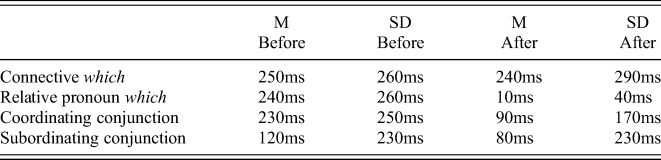
We performed Kruskal–Wallis tests for pause length before and after target words; while pause length before targets is not significant (H(3) = 7.23, p = 0.06), pause length after targets clearly is (H(3)= 36.58, p < 0.0001). A post-hoc Dunn–Bonferroni test revealed that pauses after connective which are different from all other target words: coordinators (p = 0.0002), subordinators (p < 0.0001) and relative pronoun which (p < 0.0001). Figure 1 illustrates the pause length after target words.
Pauses after target words
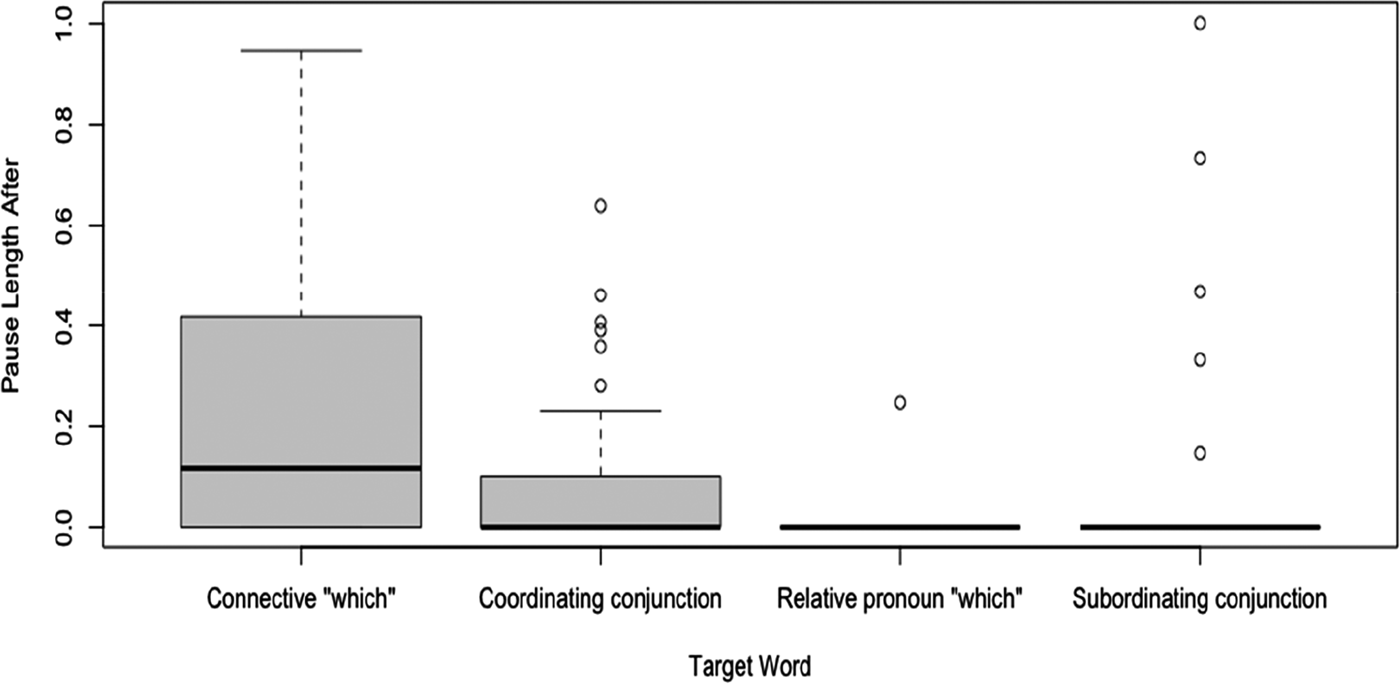
Our analysis provides answers and raises more questions. We see that, in general, the pause after connective which is longer than the pauses after relative pronoun which and conjunctions. The p-value of 0.06 from the before-target pause comparisons intrigued us, leading us to consider whether combining pause behavior before and after targets would reveal more nuance. This led us to analyze our data according to four categories, (i) tokens with a pause before the target word but not after, (ii) tokens with a pause both before and after the target word, (iii) tokens with a pause after the target word but not before and (iv) tokens with no pause on either side of the target word. We did not consider other prosodic cues in this analysis, as we were focused on a deeper exploration of the pause patterns observed by Loock (Reference Loock, Celle and Huart2007) and Burke (Reference Burke2017).
In coding by category, we considered only those breaks in speech measuring at least 0.1 ms to be pauses. Few breaks were shorter than this benchmark, and that small set was distributed across all categories. Table 2 summarizes the distribution of categories across the data set.
Categorical pause data
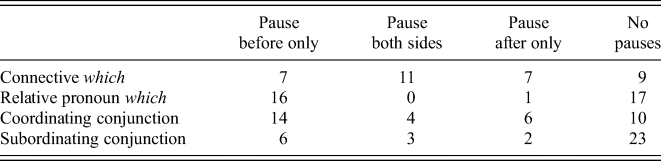
Unsurprisingly, a chi-squared test on the entire table revealed that the target words behave differently regarding pause patterns (χ2 (4) = 31.55, p = 0.0003). It is noteworthy, however, that a comparison of the pause patterns of connective which with those of coordinating conjunctions – the only targets with similar tallies in more than one pause category – revealed no difference (χ2 (2) = 5.73, p = 0.13). This similarity invites exploration of where the target words fall across intonation units, as pause patterns can be a strong clue of where an intonation unit begins and ends. Importantly, relative pronoun which and connective which pattern quite differently from one another, as connective which is most often bounded by pauses on both sides while this pause structure is nonexistent among relative pronoun which uses. This represents a strong suggestion that the two whiches belong to different categories.Footnote 6
Although Loock (Reference Loock, Celle and Huart2007) and Burke (Reference Burke2017) make observations about pauses, not intonation units, we know that pauses often co-occur with the closing of an intonation unit. Furthermore, the research detailed in section 2.3 highlights noteworthy contrasting intonation patterns: Relative pronoun which largely falls at the beginning of a new intonation unit that includes the clause it introduces (Dehé Reference Dehé2009); the coordinating conjunctions and and but can begin, end, or exclusively occupy an intonation unit (Barth-Weingarten Reference Barth-Weingarten2007; Mulder & Thompson Reference Mulder and Thompson2008); and subordinating conjunctions can begin, end, or fall in the middle of an intonation unit (Schleppegrell Reference Schleppegrell1991; Barth-Weingarten & Couper-Kuhlen Reference Barth-Weingarten and Couper-Kuhlen2002). Thus we concluded that investigating how the position of connective which within and across intonation units compares with the other target words would most likely reveal important clues as to its syntactic category. In order to make these comparisons, we followed Du Bois et al.'s (Reference Du Bois, Schuetze-Coburn, Paolino and Cummings1992) five prosodic cues for identifying intonation boundaries.
(a) A coherent intonation contour: a unified intonation contour, i.e. one displaying overall gestalt unity
(b) Reset: a resetting of baseline pitch level at the beginning of the unit
(c) Pause: a pause at the beginning of the unit
(d) Anacrusis: a sequence of accelerated syllables at the beginning of the unit
(e) Lengthening: a prosodic lengthening of syllables at the end of the unit
Prior to coding, we each listened to extended sections of audio to get a feel for the speaker's individual phrasing and speed; we then coded each sample individually. When we disagreed, which was infrequent, we listened to the sample together to come to a consensus. The strongest cues in our data set were pauses, pitch resets, and final lengthening. Table 3 summarizes our intonation unit (IU) findings.
Intonation units
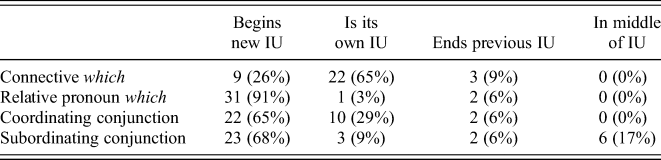
The data for relative pronoun which are in line with the expectations that we brought to the analysis. The overwhelming majority of relative pronoun which tokens begin a new intonation unit, with percentages that are nearly identical to what Dehé (Reference Dehé2009) found for British English.
We also see the expected wide range of prosodic behaviors for conjunctions in our data, similar to documented behaviors for and (Barth-Weingarten Reference Barth-Weingarten2007), though (Barth-Weingarten & Couper-Kuhlen Reference Barth-Weingarten and Couper-Kuhlen2002) and because (Schleppegrell Reference Schleppegrell1991). The coordinating conjunctions most often begin a new intonation unit that includes at least part of the second independent clause. They also occasionally end the unit including the preceding independent clause, and a sizable minority appear as their own intonation units. The subordinating conjunctions also most often begin a new intonation unit, and they also end a unit, albeit with greater frequency than coordinators. Unlike coordinators, a significant minority of the subordinators are in the middle of an intonation unit. In summary, our findings are consistent with previous research on conjunction prosody, including a noteworthy distinction: only coordinators serve as their own units, and only subordinators fall in the middle of a unit.
Turning to connective which, we expected to find two main patterns in our data: utterances with the primary intonation structure of relative pronoun which clauses, where which begins the intonation unit of the clause it introduces, and utterances with the secondary intonation structure that Dehé (Reference Dehé2009) observes in some relative pronoun which clauses, where which ends an intonation unit. This latter structure is consistent with Loock's (Reference Loock, Celle and Huart2007) and Burke's (Reference Burke2017) observations about a pause following connective which, and coupling their observations with our own anecdotal observations led us to suspect that this secondary intonation structure would be particularly prominent with connective which.
We did indeed observe the two expected patterns, but a third pattern was also evident: well over half of the connective which tokens in our data set serve as their own intonation units. In fact, this intonation structure is nearly twice as common as the IU-beginning structure and nearly three times as common as the IU-ending structure. This frequency of occurrence surprised us a good deal, though the structure itself was not entirely unexpected, as a handful of connective which uses are coded as their own intonation units in the Santa Barbara Corpus (Du Bois et al. Reference Du Bois, Chafe, Meyer, Thompson, Englebretson and Martey2000–5).
As noted above, this ability to serve as a one-word intonation unit is virtually nonexistent among relative pronoun which and subordinating conjunctions, but it is not uncommon in coordinating conjunctions. Given that connective which also shares its pause pattern only with coordinators, we found this similarity intriguing. A chi-squared analysis between connective which and coordinating conjunctions, however, did not suggest that these constructions share a prosodic pattern (χ2 (2) = 7, p = 0.006).
Thus our prosodic analysis offers us clues but not a clear answer as to the behavior of connective which. It is unique in that pauses that follow it tend to be considerably longer than those that follow relative pronoun which and conjunctions. Yet it also shares behavioral similarities with coordinating conjunctions: they are both more likely than the other target words to feature a pause only after them, and they are both less likely to occur without a pause on either side. Connective which is also more likely to occupy its own intonation unit than the other categories, but, once again, it appears to share this ability almost exclusively with coordinators.
Researchers have been justified in noting the presence of idiosyncratic post-which pauses (Loock Reference Loock, Celle and Huart2007; Dehé Reference Dehé2009; Burke Reference Burke2017), and we have seen that this is far more common with connective which in our data set than with relative pronoun which. And while prosodic patterns point to similarities between connective which and coordinating conjunctions, the clarity necessary for a firm conclusion is muddied by behaviors unique to connective which. Thus an analysis of prosody is not enough to understand how speakers use and interpret connective which; we must also examine its syntactic behavior.
5 Syntactic analysis
Let us now explore the syntactic behavior of connective which. Recall that the literature suggests that such uses of which may behave like conjunctions, either subordinate or coordinate, or like caseless relative pronouns. We will use our knowledge of connective which prosody to help us judge the grammaticality of various constructed sentences to determine what kind of clause follows connective which and thus point us to its likely syntactic category. If the clause that follows it behaves like a relative clause, we may conclude that connective which is similar to a relative pronoun; if the clause that follows it behaves like an adverb clause, we may conclude that connective which is similar to a subordinating conjunction; and if the clause that follows it behaves like an independent clause, we may conclude that connective which is similar to a coordinating conjunction. We test these in turn below.
All example sentences in this section feature commas before and after connective which in accordance with the suggestion in our data that its primary intonation pattern has it serving as its own intonation unit. The comma placement is meant to help readers create the prosody necessary to judge sentence acceptability, as it is nearly impossible to judge sentences with a nonstandard construction without the appropriate prosody (see prosody informing our understanding of the acceptability sentences with personal datives (Horn Reference Horn2008), emphatic reflexives (Ahn Reference Ahn2012) and non-clause bound reflexives (Loss Reference Loss, Zanuttini and Horn2014)). This is particularly critical in section 5.2, where we contrast the behavior of the two types of which. That said, not all connective which utterances in the data below were originally produced as their own unit.
5.1 Connective which vs subordinating conjunctions
To our knowledge, the earliest suggestions of a which reanalysis include the specific claim that it can behave like a subordinating conjunction in American English (Sells Reference Sells1985; Kjellmer Reference Göran1988). And while both Kuha (Reference Kuha1994) and Loock (Reference Loock, Celle and Huart2007) avoid categorizing it as a specific type of conjunction, they do both compare connective which's use to the floor-holding capacity of the adverbial conjunction because (see Schleppegrell Reference Schleppegrell1991).Footnote 7 Nonetheless, the connective which examples in our data set do not behave like subordinating conjunctions. This finding is unsurprising, as Collins & Radford (Reference Collins and Radford2015) offer a great deal of evidence against such an analysis. We largely reproduce this evidence in what follows, using examples from our data set.
First, we apply a replacement test. The sentences in (25) illustrate that some instances of connective which can be replaced with a subordinating conjunction, but the sentences in (26) show that others cannot.
(25)
(a) He wanted to meet the boy, {which, / though} that didn't happen, either. (Actress Denise Richards on Bravo interview, 2019)
(b) And he told the party to just ditch her plan, {which, / because} her plan calls for a closer relationship with the EU.
(26)
(a) He spikes the ball, and he deflates the ball, {which, / *since / *though} I love that because I like, you know, the deflated ball.
(b) There was a line about Bigfoot's air of possessed melancholy, {which, / *since / *though / *because} that says it all. (Filmmaker Paul Thomas Anderson on NPR, 2014)
(c) But I punch in seven on the calculator, and it says Sadie is 62.1 years old, {which, / ?though} that's kind of a bummer. (NPR reporter Peter Breslow, 2019)
(d) And then we come on to a decent amount of landings for our state, {which, / *since / *because / *although} that began a glut that we're dealing with now. (Lobsterman Jason Joyce on WBUR-FM, 2013)
(e) Roosevelt never felt the need to tell Truman about the atomic bomb and the development of the atomic bomb, {which, / *since / *although / *because} that became a huge shock to Truman once he became president… (Author James Hite on CSPAN, 2017)
Second, we apply a movement test. A subordinate adverbial clause can typically be positioned in front of the main clause, but connective which clauses cannot take this position.
(27)
(a) The DOT is looking at a proposal for rules that will define what is a ticket, {which, / though} that seems a little more of a French philosophy question (NPR correspondent Marilyn Geewax, 2014)
(b) {*Which, / Though} it seems a little more of a French philosophy question, the DOT is looking at a proposal for rules that will define what is a ticket.
(28)
(a) The best we can do with this is go out, serve them a cup of coffee, and give them a smile and a hug, {which, / though} that doesn't meet the need (Sonoma Salvation Army spokesperson on KTVU, 2018)
(b) {*Which, / Though} it doesn't meet the need, the best we can do with this is go out, serve them a cup of coffee, and give them a smile and a hug.
Collins & Radford also note that most subordinating conjunctions can be modified by the adverb even, but which cannot. Our data show the same contrast.
(29)
(a) *The DOT is looking at a proposal for rules that will define what is a ticket, even which, that seems a little more of a French philosophy question.
(b) *The best we can do with this is go out, serve them a cup of coffee, and give them a smile, even which, that doesn't meet the need.
(c) *But I punch in seven on the calculator, and it says Sadie is 62.1 years old, even which, that's kind of a bummer.
(d) *And then we come on to a decent amount of landings for our state, even which, that began a glut that we're dealing with now.
(e) *Roosevelt never felt the need to tell Truman about the atomic bomb and the development of the atomic bomb, even which, that became a huge shock to Truman once he became president.
Lastly, we add the additional evidence that, while like structures can be coordinated, we cannot coordinate a clause that begins with a subordinating conjunction with a clause that begins with connective which.
(30)
(a) *The DOT is looking at a proposal for rules that will define what is a ticket, [which, that seems a little more of a French philosophy question] and [because this is where consumers need protection].
(b) *The best we can do with this is go out, serve them a cup of coffee, and give them a smile, [which, that doesn't meet the need] but [because that's all we have].
(c) *But I punch in seven on the calculator, and it says Sadie is 62.1 years old, [which, that's kind of a bummer] and [because she's older].
(d) *And then we come on to a decent amount of landings for our state, [which, that began a glut that we're dealing with now] and [because there aren't enough buyers].
(e) *Roosevelt never felt the need to tell Truman about the atomic bomb and the development of the atomic bomb, [which, that became a huge shock to Truman once he became president] and [although, in hindsight, he should have said something].
In summary, we have shown that connective which does not behave like a subordinating conjunction: it cannot always be replaced with a subordinating conjunction; its clause cannot be pre-posed, as an adverbial clause can; it cannot be modified by even, as subordinating conjunctions can; and its clause cannot be coordinated with an adverbial clause.
5.2 Connective which vs. relative pronouns
Collins & Radford (Reference Collins and Radford2015) suggest that which can be a caseless relative pronoun with ‘ghosted’ (not deleted) content, which, in their data set, is usually a preposition but is sometimes a preposition plus a light predicate. Their analysis is based on gapless which constructions in British English,Footnote 8 but it can be extended to also account for gap-filled which clauses; since the appropriateness of its applicability to the sentences in our data set is important to this investigation, we now offer a summary of their analysis using sentences from our data set.
Collins & Radford begin their work by noting that the majority of which constructions in their data set (72 percent) can be paraphrased with the addition of a preposition.Footnote 9 We have similar examples in our data set, though significantly fewer (roughly 7 percent). Two of these tokens are included below, each with a preposition in parentheses to duplicate Collins & Radford's manner of paraphrase.
(31) The consumer protection bureau, (for) which Mr. Mulvaney was wearing his second hat, had the largest drop in morale of any government institution.
(32) You take the two, and you take the square root of two, and you get the negative two, (of) which you take the square, and it comes to two. (Santa Barbara Corpus: Zero equals zero, 1990s)
Let us use (32) from Du Bois et al. (Reference Du Bois, Chafe, Meyer, Thompson, Englebretson and Martey2000–5) to illustrate Collins & Radford's analysis. Their claim is that there are two types of appositive relative pronoun in English: one with case, which is used in both formal and informal English, and another without case, which is used only in informal English. Accordingly, all examples of gapless which constructions are examples of caseless which. In their analysis, the sentence begins with a structure wherein the relative pronoun is in a position to receive case from the preposition, as illustrated below.
(33) You take the two, and you take the square root of two, and you get the negative two, you take the square of which, and it comes to two.
Since which is caseless and therefore needs no case from of, it obligatorily moves to Spec-PP, outside the preposition's case domain. Collins & Radford call this Prepositional Inversion.
(34) [PP which [P of] <which>]
Which may continue to raise successive-cyclically to Spec-CP at this point, leaving the preposition behind.Footnote 10
(35) [CP which [C <that> you take the square root [PP <which> [P of] <which>]
The analysis in (35) gives us the following surface structure:
(36) Which you take the square root of
In addition to which raising alone to Spec-CP, Collins & Radford propose alternatively that the entire PP can raise to Spec-CP after preposition inversion.
(37) [CP [PP which [P <of>] <which>] [C <that>] you take the square root <[PP]>…]
At this point, there is a violation of a generalized version of the Doubly Filled COMP Filter (Chomsky & Lasnick Reference Chomsky and Lasnik1977), which Collins & Radford call the Edge Constraint (Reference Collins and Radford2015: 206).
(38) Edge Constraint The head and specifier of a phrase cannot both be spelled out overtly at PF
According to the Edge Constraint, which and of cannot both be spelled out overtly at PF in the sentence in (33). In order to prevent a violation, Collins & Radford posit that preposition ghosting of material not in the left periphery can occur (Reference Collins and Radford2015: 207).
(39) Preposition Ghosting At PF, ghost an overt Preposition with an overt specifier
Therefore, if a caseless relative pronoun pied-pipes the entire PP to the Spec-CP position, it also ghosts everything not in the left periphery – the preposition, the copy of which, and the C head that – to create the attested surface form in (40).
(40) Which you take the square root
It is important to recall at this point that the addition of a preposition does not produce a paraphrase for a significant minority (28 percent) of the sentences in Collins & Radford's data set. For that matter, preposition ghosting cannot account for any of the sentences examined in this article. To account for their problem sentences, Collins & Radford extend their analysis by positing that not just a preposition is ghosted – a light predicate (one with ‘relatively little semantic content’, e.g. I would say) can be ghosted, as well (Reference Collins and Radford2015: 216). Example (41) uses another sentence from our data set to illustrate Predicate Ghosting and to demonstrate that it can account for gap-filled which clauses in addition to Collins & Radford's gapless data.
(41) He wanted to meet the boy, which, that didn't happen, either.
A light predicate is ghosted along with the preposition, as the simplified structure illustrates below. About which raises and which raises alone to Spec-CP, ghosting the preposition and the light predicate.Footnote 11
(42) He wanted to meet the boy [CP [PP which [P <about>] <which>] [C ø] <I would say PP> that didn't happen, either].
By extending their ghosting analysis to include a light predicate, Collins & Radford are able to account for all their data – and all the data in this article, as well. If such an analysis is on the right track, connective which clauses are relative clauses and are thus c-commanded by the matrix clause. In that case, the following behaviors should hold:
(i) Negative Polarity Items should be licensed at the end of the entire sentence.
(ii) Pronouns that follow a quantificational element should have a variable interpretation.
(iii) A sloppy interpretation should be available in verb phrase ellipsis.
(iv) The noun antecedent and the relative clause should behave like a single unit.
On the other hand, if connective which behaves more like a coordinating conjunction, then the clauses following it are not c-commanded by the clauses preceding it, and none of the above behaviors should be evident. Let us start with Negative Polarity Items.
Relative clauses are c-commanded by lexical items in the matrix clause; consequently, lexical items in the antecedent of the relative clause can be in a binding relationship with lexical items in the relative clause. Therefore, when the antecedent of the relative clause is in the c-command domain of a negative quantifier in the matrix clause, Negative Polarity Items can be licensed in the relative clause, as in at all in (43a):
(43)
(a) I don't like pizza, which is everywhere these days, at all.
(b) *I like pizza, which is everywhere these days, at all.
In contrast, in a coordinated structure like that below, the Negative Polarity Item is not c-commanded by the negative word in the first clause, and therefore, it cannot be licensed:
(44) *I don't like pizza, and it's everywhere these days, at all.
Now, consider this same sentence with connective which and an apparent resumptive pronoun.
(45) *I don't like pizza, which, it's everywhere these days, at all.
The acceptability of the sentence in (45) is closer to that of the coordinated independent clauses in (44) than that of the sentence with the relative pronoun which clause in (43). This suggests that Negative Polarity Items are not licensed in connective which clauses, which, in turn, suggests that connective which clauses do not behave like relative clauses. Rather, they behave like independent clauses.
Similarly, pronouns that follow a quantificational element should have a variable reading if they are c-commanded by the quantificational element, as they would be if they were in a relative clause. Consider the sentence below, where the interpretation is that there are multiple lockers.
(46) [Every student]i is looking for the textbook, which is somewhere in hisi locker. = a multiple lockers
In the case of a coordinated construction, the pronoun is not c-commanded by the quantificational element, and thus we should not get a variable reading. The interpretation is that there is a single locker.
(47) [Every student]i is looking for the textbook, and it is somewhere in hisi locker. = single locker
Now, let us consider such a construction with connective which.
(48) [Every student]i is looking for the textbook, which, it is somewhere in hisi locker. = single locker
Here, we have the interpretation that there is a single locker, similar to the interpretation of the sentence in (47), which suggests that the quantificational item does not c-command the pronoun in the connective which clause. This, in turn, suggests that connective which clauses do not behave like relative clauses. Instead, as we saw with Negative Polarity Items, connective which clauses behave like independent clauses.
The third behavior we should see if the connective which clause is c-commanded by items in the matrix clause is that verb phrase ellipsis should allow for a sloppy identity interpretation (see Zwart 2005, who suggests that such an interpretation depends on a c-command relationship). We do, in fact, get both a strict and a sloppy interpretation when relative pronoun which introduces the clause, as in (49).
(49) John found the latest algebra textbook, which cites his work, and Bob did, too. = Bob found the latest algebra textbook which cites John's work (strict) = Bob found the latest algebra textbook which cites Bob's work (sloppy)
We can compare this to a sentence where there is no c-command relationship between the antecedent (John) and the pronoun (his); here, only a strict interpretation of the pronoun is allowed. The book must cite John's work.
(50) John found the latest algebra textbook, and it cites his work, and Bob did, too. = Bob found the latest algebra textbook which cites John's work (strict) ≠ Bob found the latest algebra textbook which cites Bob's work (sloppy)
Now let us consider the interpretations that are available in connective which constructions.
(51) John found the latest algebra textbook, which, it cites his work, and Bob did, too. = Bob found the latest algebra textbook which cites John's work (strict) ≠ Bob found the latest algebra textbook which cites Bob's work (sloppy)
Sentence (51) with connective which does not allow for a sloppy interpretation of the pronoun his – the work cited can only be John's work. This is similar to sentence (50) with the coordinating conjunction, where his is not c-commanded by the antecedent, which suggests that his in the connective which clause is also not c-commanded by the antecedent. Once again, the evidence suggests that connective which clauses behave like independent clauses, not relative clauses.
Finally, the fourth behavior we should see if connective which behaves like a relative pronoun is that the antecedent and relative clause should behave as a single unit, and thus the relative clause should modify the potential antecedent that immediately precedes it. Consider the following sentence from our collection:
(52) Once we got to Addis, she found a Black Lion hospital, which, that by itself is a miracle.
Here, finding a Black Lion hospital – not getting to Addis – is the miracle. We can compare this sentence to one with a relative pronoun which clause that has the same interpretation: finding a Black Lion hospital is the miracle, not getting to Addis.
(53) Once we got to Addis, she found a Black Lion hospital, which by itself was a miracle.
Interestingly, if we move the clause about finding a Black Lion hospital to the front of the sentence, leaving the which clause at the end of the sentence, the connective which clause can still declare that finding the hospital, not getting to Addis, was a miracle.
(54) She found a Black Lion hospital once we got to Addis, which, that by itself was a miracle.
In contrast, if we move the same clause to the front of the sentence, again leaving the which clause at the end of the sentence, the relative pronoun which clause now favors an interpretation where getting to Addis is the miracle, which is not the intended meaning.
(55) #She found a Black Lion hospital once we got to Addis, which by itself was a miracle.
A relative clause typically forms a single unit with an antecedent that directly precedes it. We have seen here that when preceded by a subordinate clause, relative pronoun which modifies the subordinate clause, while connective which is capable of modifying the entire matrix clause. This difference suggests that connective which may work with a larger string than relative pronoun which. This, in turn, suggests that connective which clauses do not behave like relative clauses, but rather, they behave like independent clauses, which can also modify larger strings, as illustrated in the sentences below, where which has been replaced with the coordinating conjunction and.
(56) Once we got to Addis, she found a Black Lion hospital, and that by itself is a miracle.
(57) She found Black Lion hospital once we got to Addis, and that by itself is a miracle.
Lastly, we again offer the additional evidence of a coordination test. Like structures can be coordinated, but we cannot coordinate a clause introduced by relative pronoun which with a clause introduced by connective which. This is further evidence that connective which clauses are not relative clauses.
(58) *I found the book, [which, it was in the garage] and [which had been lost for months].
In summary, we have demostrated that connective which does not behave like a (caseless) relative pronoun: Negative Polarity Items are not licensed inside a connective which clause; pronouns that follow quantificational elements do not have a variable interpretation; only a strict interpretation is available in verb phrase ellipsis; the antecedent and the which clause do not behave as a single unit; and we cannot coordinate a connective which clause with a relative clause.
5.3 Connective which vs coordinating conjunctions
The data in the above sections show that connective which does not behave like a subordinating conjunction or a caseless relative pronoun, and evidence that connective which clauses are not c-commanded by preceding clauses suggests that they behave like independent clauses. In this concluding section of our analysis, we present three final pieces of evidence that further support the claim that the clause after connective which is independent – and, therefore, connective which behaves like a coordinating conjunction.
In sections 5.1 and 5.2, we showed that connective which clauses cannot coordinate with adverb clauses or relative pronoun which clauses. In (59), we see that they do coordinate with independent clauses.
(59)
(a) He spikes the ball, and he deflates the ball, which, I love that because I like, you know, the deflated ball, and it gets better with each touchdown.
(b) There was a line about Bigfoot's air of possessed melancholy, which, that says it all, and what more do we need?
(c) But I punch in seven on the calculator, and it says Sadie is 62.1 years old, which, that's kind of a bummer and she's older than I thought.
Next, we apply a replacement test. Unlike the mixed results with subordinating conjunctions in (26), all instances of connective which can be replaced with a coordinating conjunction in the same sentences.
(60)
(a) He spikes the ball, and he deflates the ball, {which, / and} I love that because I like, you know, the deflated ball.
(b) There was a line about Bigfoot's air of possessed melancholy, {which, / and} that says it all.
(c) But I punch in seven on the calculator, and it says Sadie is 62.1 years old, {which, / and} that's kind of a bummer.
(d) And then we come on to a decent amount of landings for our state, {which, / and} that began a glut that we're dealing with now.
(e) Roosevelt never felt the need to tell Truman about the atomic bomb and the development of the atomic bomb, {which, / and} that became a huge shock to Truman once he became president.
The above tests are strong evidence that the material that follows connective which behaves like an independent clause, and, therefore, connective which behaves like a coordinating conjunction. We now offer one last piece of evidence, which involves a structure analyzed by Collins & Radford (Reference Collins and Radford2015) wherein which clauses include direct questions – where, in effect, which is used to introduce the question. Example (61) features two of such sentences from Collins & Radford and three from our own data set.
(61)
(a) The referee showed him a red card, which what else could he have done in the circumstances? (Alan Brazil, Talk Sport Radio in C&R 2015)
(b) Then you launched these podcasts, which how many times have these been downloaded? (Richard Bacon, BBC Radio 5 in C&R 2015)
(c) And I'm just wondering if you, you know, feel like this adds to that conversation in some way that you may not have anticipated at the time, which, how could you have? (NPR host Michel Martin, 2018)
(d) I'd heard also that you might have found minerals that could only be made in a crucible of heat, which, how do you find that out from deep space? (NPR host Ira Flatow, 2005)
(e) I think what I said was that there's nothing so satisfying as erasing your parents, which, how's that for an Oedipal moment? (Musician Teddy Thompson on NPR, 2014)
Collins & Radford note that subject–auxiliary inversion in questions only occurs in a root clause and that such inversion in these which clauses is evidence of a ghosted light predicate that introduces the direct speech quotation (Reference Collins and Radford2015: 217). Without the ghosting, they posit, there would be no inversion in the which clause. However, if connective which acts as a coordinating conjunction rather than a relative pronoun, subject–auxiliary inversion in the clause that follows which is perfectly unsurprising, as it would allow a root clause, not a subordinate clause, to follow it. Once again, the data support a conclusion that connective which behaves like a coordinating conjunction.
6 Conclusion and future research
We join others in suggesting that a reanalyzed, secondary form of which exists alongside its primary relative pronoun role. We brought together research from a variety of subfields to support the claim that uses of connective which are truly a systematic secondary form and not simply a performance error. We then offered new analyses that added empirical evidence to previous research suggesting that connective which has a unique prosody compared to relative pronoun which. We compared this prosody to conjunction prosodies and found no comprehensive match, though we did find two noteworthy similarities: (i) coordinators and connective which are followed by a pause more consistently than subordinators and relative pronoun which are, and (ii) the pause patterns surrounding coordinators and connective which are far more similar than any other combination of the target words. Finally, we then used this improved understanding of the prosodic behavior of connective which to investigate its syntactic behavior, concluding that it behaves more like a coordinating conjunction than a subordinating conjunction or a relative pronoun.
Perhaps it is not surprising that a secondary, coordinator-like form of which is increasing in use, as Haussamen (Reference Haussamen1994) has suggested that English speakers and writers have been producing shorter sentences with fewer embedded clauses since the 1600s. Stringing two independent clauses together rather than subordinating the second clause is certainly consistent with such a trend.
We are left with a number of questions for future research. If connective which behaves syntactically like a coordinating conjunction, why does its prosody not more precisely match the prosody of coordinating conjunctions in our data? Future work investigating prosodic clues as to how connective which is being used could help to answer this question, as we know that subordination and coordination can have different prosodic patterns (see Bolinger 1984; Couper-Kuhlen 1996; Mithun 2009). For example, Couper-Kuhlen (1996) notes that while because clauses usually behave prosodically like other subordinate clauses in that they are intonationally dependent on the first intonation phrase, some because clauses can be intonationally independent when the causal linkage to the preceding clause is indirect.
This article explored which clauses with apparent resumptive pronouns. However, as noted in footnote 1, there are other forms of connective which that do not feature an apparent gap at all. Should both surface forms of connective which be analyzed together? If so, how should we analyze those gapless clauses that can be paraphrased with a single added preposition (the structure that is the backbone of Collins & Radford's (Reference Collins and Radford2015) analysis)? Furthermore, is this a reanalysis of only relative pronoun which, or is it a reanalysis of all relative pronouns? Is there a connective who, as suggested in footnote 2, or is connective who truly a performance error? We also have sociolinguistic questions: Kuha (Reference Kuha1994) claimed that connective which is used by speakers from a wide variety of social backgrounds. Twenty-six years later, will we find that some groups use it more than others? Do certain settings or registers affect its use? As the use of connective which increases, how do speakers judge the acceptability of these sentences – and how do listeners judge users of this construction?
Supplementary material
The supplementary material for this article can be found at https://doi.org/10.1017/S1360674321000496


 Open access

