





Introduction
Understanding the interactions between parasites and their hosts is fundamental to elucidating the mechanisms of disease transmission and developing control strategies. The nematode Angiostrongylus cantonensis, the causative agent of eosinophilic meningitis in humans, has a complex life cycle involving molluscs as intermediate hosts and rats as definitive hosts (Wang et al., Reference Wang, Wu, Wei, Owen and Lun2012). Various slug and snail species can serve as intermediate hosts, supporting the development of first-stage larvae into infective third-stage larvae (Caldeira et al., Reference Caldeira, Mendonça, Goveia, Lenzi, Graeff-Teixeira, Lima and Mota2007; Chan et al., Reference Chan, Barratt, Roberts, Lee, Marriott, Harkness and Ellis2015).
Molluscs from the Veronicellidae family, such as Phyllocaulis spp., are known to be susceptible to A. cantonensis and are utilized for life cycle maintenance in laboratory settings (Graeff-Teixeira et al., Reference Graeff-Teixeira, Thiengo, Lee and Yoshimura1993; Morassutti et al., Reference Morassutti, Thiengo, Fernandez, Sawanyawisuth and Graeff-Teixeira2014). Molluscs secrete complex mucus rich in glycoproteins, enzymes and antimicrobial peptides, which play roles in locomotion, defence and environmental adaptation (Qvarnstrom et al., Reference Qvarnstrom, Xayavong, da Silva, Park, Whelen, Calimlim and da Silva2007). The biological potential of molluscan mucus has been explored for therapeutic and cosmetic applications because of its antimicrobial and anti-inflammatory properties (Tsvetanova et al., Reference Tsvetanova, Alexandrova, Georgieva and Miteva2020; Rizzi et al., Reference Rizzi, Gubitosa, Fini and Nuzzo2021).
Infection with A. cantonensis can modulate the immune response and metabolic pathways of molluscs, leading to alterations in protein expression and oxidative stress responses (Mendes et al., Reference Mendes, Araújo and Gomes2020). Investigating these proteomic changes could reveal biomarkers for infection and enhance our understanding of host–parasite dynamics.
This study aimed to analyse the proteomic alterations in the mucus of Phyllocaulis spp. experimentally infected with A. cantonensis, to identify potential biomarkers for infection and to contribute to the development of non-invasive diagnostic tools.
Materials and methods
Collection of molluscs and maintenance of the parasite lifecycle
Phyllocaulis spp. slugs were collected in Porto Alegre, Brazil, and reared in laboratory conditions at Pontifícia Universidade Católica do Rio Grande do Sul (PUCRS). The slugs were maintained in plastic containers with garden soil and fed fresh vegetables ad libitum.
Phyllocaulis spp. infection and collection of mucus
Ten slugs were divided into 2 groups: a control group (CG) and an infected group (IG). IG was exposed to approximately 6,000 first-stage larvae of A. cantonensis from the Vila Fátima isolate (Cognato et al., Reference Cognato, Morassutti, Garcia and Graeff-Teixeira2013). After a 30-day infection period, mucus samples were collected by gently scraping the slug bodies with a moistened swab. The samples were stored at −80 °C until analysis. Infection was confirmed by artificial digestion of slug tissues and microscopic examination of the larvae.
Proteomic experiment
Protein extraction from mucus samples was performed using a modified filter-aided sample preparation method (Potriquet et al., Reference Potriquet, Laohaviroj, Bethony and Mulvenna2017). Proteins were reduced, alkylated and digested with trypsin. The peptides were purified and concentrated using ZipTip C18 pipette tips.
Liquid chromatography–tandem mass spectrometry was conducted using a Shimadzu Prominence Nano High-Performance Liquid Chromatography coupled with a TripleTOF 5600+ mass spectrometer (AB SCIEX). Data acquisition was performed using Information Dependent Acquisition, and data analysis was performed using Analyst 2.0 software.
Protein identification was accomplished by searching spectral data with 2 independent software programmes: X! Tandem and ProteinPilot. Our workflow utilized X! Tandem to search gastropod protein sequences from GenBank and Angiostrongylus transcriptomic data, comparing experimental mass spectra with theoretical spectra generated from known protein sequences. A minimum of 2 unique peptides, each containing at least eight amino acids, was required to confidently confirm a protein’s identity (Nakayasu et al., Reference Nakayasu, Gritsenko and Piehowski2021). In parallel, ProteinPilot employed curated reference databases from UniProtKB and SwissProt, adding a further validation layer. This dual approach enhanced the robustness of protein identifications by cross-validating outputs from distinct data sources.
Quantification was performed using Sequential Window Acquisition of All Theoretical Fragment Ion Spectra (SWATH), enabling precise and reproducible measurements of protein abundance across samples (Messner et al., Reference Messner, Demichev, Bloomfield, Yu, White, Kreidl, Egger, Freiwald, Ivosev, Wasim, Zelezniak, Jürgens, Suttorp, Sander, Kurth, Lilley, Mülleder, Tate and Ralser2021). SWATH captures ion fragments in sequential mass windows, ensuring a comprehensive and unbiased acquisition of fragmentation data, even in complex mixtures. Stringent statistical thresholds were applied to validate our findings: only proteins with a false discovery rate of ≤2% and a P-value of ≤0·05 were considered significant. These rigorous filters ensure that only high-confidence, statistically robust protein identifications are reported.
Results
A total of 103 proteins were identified in the mucus samples of infected and non-infected Phyllocaulis sp. slugs. In the IG, five proteins matched the Angiostrongylus transcriptomic data: actin, ATP synthase subunit alpha, ATP synthase subunit beta, AAA family ATPase CDC48 subfamily and the ribosomal protein S11 domain. An additional 41 proteins were matched to the Biomphalaria glabrata reference sequences.
Our study demonstrated that A. cantonensis infection induces significant proteomic alterations in the mucus of Phyllocaulis sp. slugs. Similar proteomic modifications have also been observed in another mollusc, B. glabrata, supporting the notion of conserved host-response mechanisms across molluscan species (Mendes et al., Reference Mendes, Araújo and Gomes2020). Among the proteins highlighted in our study, an F-BAR (Fes/CIP4 Homology–Bin/Amphiphysin/Rvs) domain–containing protein was particularly notable. Using NCBI (National Center for Biotechnology Information) BLASTp (E‐value threshold of 10−20), we identified homologous sequences bearing the F-BAR domain in multiple B. glabrata proteins, suggesting the presence of this domain in the B. glabrata proteome. F-BAR proteins have been implicated in active cellular responses, including membrane remodelling and reparative processes (Itoh et al., Reference Itoh, Erdmann, Roux, Habermann, Werner and De Camilli2005; Frost et al., Reference Frost, Unger and De Camilli2009), hinting at a possible mechanism by which these gastropod hosts adapt to A. cantonensis infection.
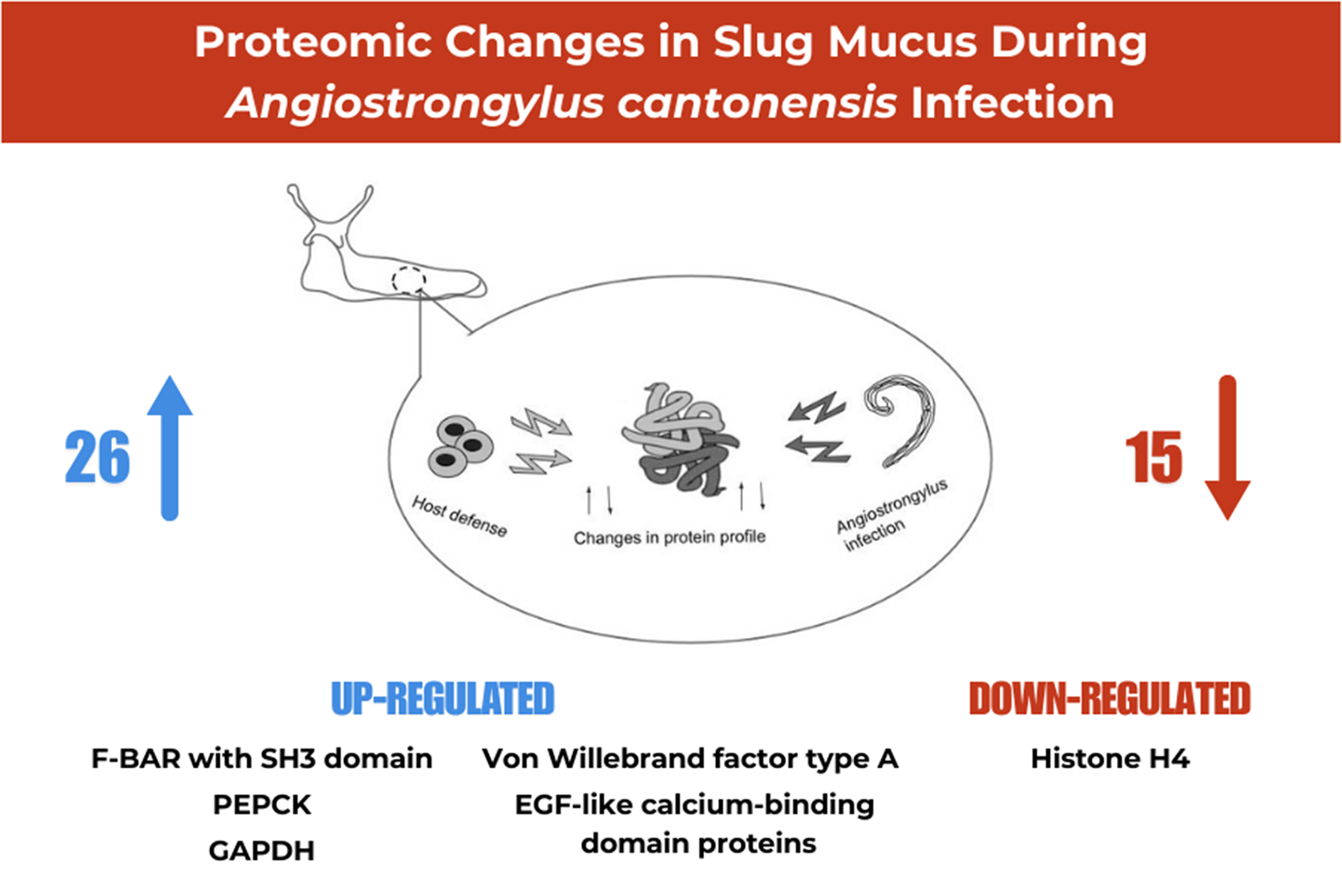
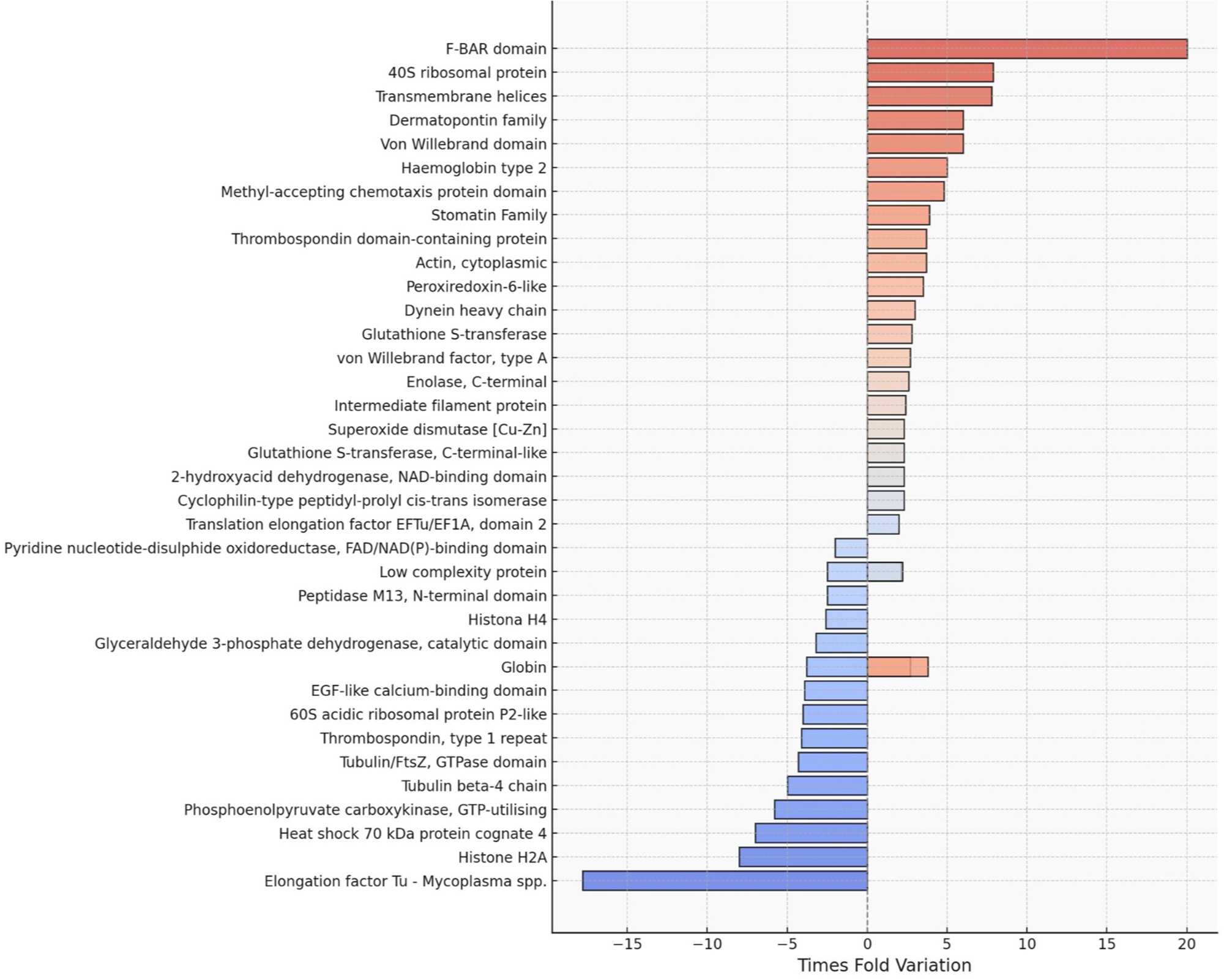
Key up-regulated proteins included glycolytic enzymes such as phosphoenolpyruvate carboxykinase (PEPCK) and glyceraldehyde-3-phosphate dehydrogenase (GAPDH), as well as proteins involved in immune responses, such as von Willebrand factor type A and epidermal growth factor (EGF)-like calcium-binding domain proteins. Down-regulated proteins include histone H4, indicating potential changes in gene expression. Additionally, 2 proteins, the low-complexity protein and globin, were found to be both up- and down-regulated simultaneously (Figure 1). This observation may indicate the presence of distinct isoforms. We recommend further molecular sequence analyses of these proteins to clarify these findings.
Protein expression in the mucus of Phyllocaulis spp. slugs infected with Angiostrongylus cantonensis.
Discussion
Our study demonstrated that A. cantonensis infection induced significant proteomic alterations in the mucus of Phyllocaulis sp. slugs. The up-regulation of the F-BAR domain-containing protein suggests an active cellular response involving membrane remodelling and repair processes (Itoh et al., Reference Itoh, Erdmann, Roux, Habermann, Werner and De Camilli2005; Frost et al., Reference Frost, Unger and De Camilli2009). Similar findings in B. glabrata infected with A. cantonensis support the notion of conserved immune response mechanisms across mollusc species (Mendes et al., Reference Mendes, Araújo and Gomes2020).
The down-regulation of histone H4 indicates possible epigenetic modifications that affect gene expression in response to infection (Kornberg and Lorch, Reference Kornberg and Lorch1999; Saha et al., Reference Saha, Wittmeyer and Cairns2006). This aligns with previous observations in B. glabrata, suggesting that histone modifications may play a role in molluscan defence against parasites.
The up-regulation of glycolytic enzymes, such as PEPCK and GAPDH, reflects metabolic adjustments to meet increased energy demands during infection (Hanson and Garber, Reference Hanson and Garber1972; Sirover, Reference Sirover1999). Enhanced glycolysis may provide the necessary ATP for immune response and tissue repair.
Identifying proteins such as von Willebrand factor type A and EGF-like calcium-binding domain proteins underscores their potential as biomarkers for A. cantonensis infection. These proteins are involved in coagulation and cell signalling pathways, which are critical for immune functions (Ober and Litingtung, Reference Ober and Litingtung2001; Ruggeri, Reference Ruggeri2003).
The significant down-regulation of elongation factor Tu from Mycoplasma sp. suggests a functional interplay between helminth infection and the mollusc microbiota. Mycoplasma sp. has been detected in the microbiota of both A. cantonensis‐infected and non-infected molluscs (Osório et al., Reference Osório, de Mattos Pereira and Giongo2020). This observation may be explained by immune-mediated processes that influence bacterial adhesion (Jonák, Reference Jonák2007).
Detecting Angiostrongylus-derived proteins in slug mucus, such as actin and ATP synthase subunits, may result from larval degradation or immune responses, leading to larval death (Bonetti and Graeff-Teixeira, Reference Bonetti and Graeff-Teixeira1998; Lange et al., Reference Lange, Penagos-Tabares, Muñoz-Caro, Gärtner and Hermosilla2017). Thus, these proteins may serve as direct indicators of infection.
The presence of lipopolysaccharide-binding proteins, such as BgLBP/BPI1 and LBP/BPI1.2, exclusively in infected mucus samples, indicates an activated innate immune response against gram-negative bacteria (Bingle and Craven, Reference Bingle and Craven2004; Baron et al., Reference Baron, Gouvêa, Do Nascimento and Barbosa2013). This may reflect a broader immune activation in response to parasitic infections.
The proteomic changes observed in the mucus of Phyllocaulis sp. infected with A. cantonensis highlight potential biomarkers for infection and provide insights into host immune and metabolic responses. The identification of up-regulated proteins involved in membrane remodelling, energy metabolism and immune function suggests active host defence mechanisms.
Future studies should focus on validating these biomarkers in larger populations and diverse mollusc species, studying possible changes among species from the same genus. Investigating the molecular pathways underlying these proteomic shifts could enhance our understanding of host–parasite interactions and support the development of non-invasive diagnostic tools for monitoring A. cantonensis transmission.
Acknowledgements
We thank the High-Performance Computing Laboratory (Laboratório de Alto Desempenho, LAD/PUCRS) for providing access to computational resources for the high-throughput sequence analyses.
Financial support
This work was supported by the Conselho Nacional de Pesquisa e Desenvolvimento Tecnológico do Brasil (CNPq, grant number 401904/2013-0) and Coordenação de Aperfeiçoamento de Pessoal de Nível Superior ‘Edital 32/2010’. C.G.-T. received a CNPq PQ 1D fellowship (grant number 307005/2014-3).
Competing interests
The authors declare none.
Ethical standards
Experiments were conducted following ethical guidelines approved by the Animal Ethics Committee of the PUCRS (Brazil; registration number 14/00399) and the Animal Ethics Committee of the QIMR Berghofer Medical Research Institute (Australia; project number P1468).
Use of artificial intelligence tools
During the preparation of this work, the authors used artificial intelligence tools in order to review the manuscript and improve grammar and clarity. After using this tool/service, the authors reviewed and edited the content as needed and took full responsibility for the content of the publication.


 Open access

