




Introduction
Numerous Early Iron Age settlements (c. 800–450 BC) in present-day Poland show evidence of metalworking, yet comprehensive studies of metallurgical production and metal supply remain scarce. This gap limits broader archaeological insights and interregional comparisons on a pan-European scale.
The research project presented here is called ‘The casting production technology and the origin of the metallic raw materials in the Late Bronze Age and the Early Iron Age: characteristics of selected metallurgical regions in Poland’. It aims to fill this void through four investigative avenues: 1) determining production patterns for metalwork and assessing the existence of standardised production practices for casting moulds, tuyeres and crucibles; 2) analysing surface residues from technical ceramics to understand their specific use and function; 3) tracing the provenance of metals to assess the direction of metal inflow into the Polish territory in the Early Iron Age; 4) indicating the role of metallurgically active settlements in wider areas of human occupation.
In pursuit of these aims, we employ a suite of multidisciplinary analytical methods that have not previously been used together to explore issues related to metallurgy in Early Iron Age settlements in Poland and beyond.
Materials
This study focuses on five key sites from two distinct regions in Poland (Figure 1). Wicina is a fortified settlement on elevated marshlands featuring a casting workshop with hundreds of mould fragments and well-preserved wooden structures that have enabled dendrochronological dating (754–571 BC; Jaszewska & Kałagate Reference Jaszewska and Kałagate2013). Grzybiany is a lakeside peninsula settlement (800–500 BC) with a central casting workshop containing approximately 2000 pieces of casting debris. Remnants of a casting workshop with numerous mould fragments at Kamieniec, a short-term open settlement on a natural elevation (750–550 BC), were disrupted by the later medieval activity (Abłamowicz Reference Abłamowicz1990). At Mołtajny, an Early Iron Age site on an artificial island, evidence of metalworking includes semi-finished products and casting-mould fragments (Gackowski Reference Gackowski and Kola2000), while two casting workshops—one from 550–400 BC and another from 400–200 BC—are apparent within the defensive settlement of Tarławki, indicating long-term metallurgical activity.
Sites under study as part of this project with excavated areas marked black (figure by authors).

Methods
Our research integrates artefact documentation, GIS-based archaeological landscape analysis and archaeometry, including elemental composition analysis (inductively coupled plasma mass spectrometry), lead isotope analysis (multi-collector inductively coupled plasma mass spectrometry) and thermal analysis (differential scanning calorimetry–thermogravimetry), alongside observations using both optical and scanning electron microscopes, to investigate metallurgical practices and material composition.
Results
Tracing production technology and metal residues
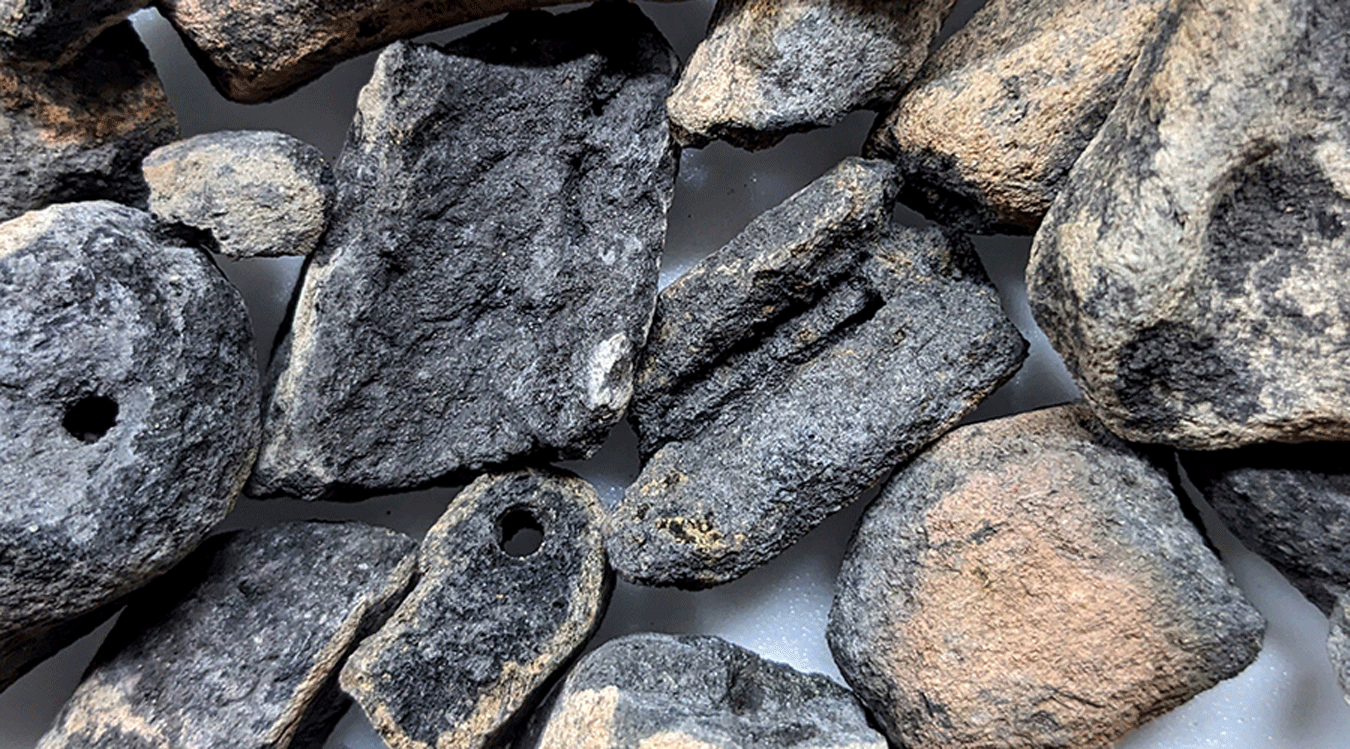
Production of detailed inventories identified the main categories of metal artefacts produced in each settlement. These were primarily ring-shaped items of small diameter, but our results reveal a broader range of produced artefacts, including various ornaments and ingots (Figure 2). Petrographic analyses helped identify the components of ceramic masses and the origins of the raw clay materials used to produce the technical ceramics. Organic and mineral tempers, such as quartz, feldspar and granitoids, and their relative proportions, are recognisable (Figure 3A–C), allowing the determination of differences between settlements and regions. Technical ceramics from Grzybiany, for example, contained substantially more organic temper than those from other sites (Figure 3B).
Metallurgy-related ceramics from Wicina (figure by authors).

Microphotographs of metallurgy-related ceramics from Tarławki (A), Grzybiany (B) and Wicina (C) in cross-polarised light, with representative thermogram from the Wicina sample (D) (figure by authors).

Analysis of the firing regimes for ceramic fragments that lacked a discernible use suggests that many were exposed to extremely high temperatures for an extended time (Figure 3D). Identification of tin and copper residues on the outer vitrified surface of the analysed ceramics (through energy dispersive x-ray spectroscopy; Figure 4) suggests their direct use in bronze processing as a tuyere (air nozzle).
Analysis of tuyere fragments from Wicina (A). Backscatter electron microscopy images of the inner part (B) and outer surface (C). Results of point energy dispersive x-ray spectroscopy analysis indicate quartz (1), feldspar (2), tin (3) and copper (4) (figure by authors).

Provenance of metal
Three tin-bronze bracelets from the hoard discovered in Mołtajny (Figure 5; Wilke Reference Wilke1988) show varying lead content, indicating that lead was deliberately added to the copper (Table 1). Lead isotope ratios align with results from medieval lead-silver mines in southern France (Figure 5B), specifically in the Mount Lozère region of the Massif Central (Baron et al. Reference Baron, Carigna, Laurent and Ploquin2006). Compared to earlier periods, when metal was imported to the territory of Poland from the Alpine region, among others (Nowak et al. Reference Nowak2023), our results suggest new directions of metal flow were established at the end of the Early Iron Age.
A) Bronze bracelets from Mołtajny; B) comparison of the results of lead isotope analysis of the bracelets with European ores and artefacts (figure by authors).

Results from Mołtajny lead isotope and elemental composition analyses.

Metallurgy-related settlements and the archaeological landscape
The role of the studied settlements in the landscape differs. Wicina controlled a strategic, marshy area, while Grzybiany was situated in a densely populated region, serving as an important, though not dominant, site (Figure 6). Kamieniec’s defensive role remains uncertain, as it was in an area of less intensive human occupation, but Tarławki and Mołtajny represent a settlement type associated with regional security strategies (Przybyła Reference Przybyła and Bugaj2017). This shows that there was no single model for a ‘production centre’; each was part of unique natural conditions and cultural traditions.
The archaeological landscape near Grzybiany and Tarławki showing the density of human occupation. KDE: Kernel Density Estimation (figure by authors).

Conclusions
Our research addresses various aspects of metallurgy at settlements that played different roles in the landscape during the Early Iron Age. By examining metallurgy-related utensils in detail, we traced their production technology and identified their functions in metalworking processes. Since these settlements lacked their own metal sources, raw materials had to be imported, sometimes from remarkably distant regions. Our findings offer valuable insights into Early Iron Age metallurgy in Poland, opening new research directions and perspectives. The multidisciplinary approach we employed highlights the effectiveness of combining various analytical methods. Their continued application in future studies, both in Poland and beyond, will advance our understanding of prehistoric metalworking practices.
Funding statement
This research is supported by the National Science Centre, Poland (2021/40/C/HS3/00097).


 Open access

