

Introduction
The landmass of Appalachia was created when the Western Interior Seaway flooded the interior of North America and separated the eastern portion of the continent from the west midway through the Cretaceous (Roberts and Kirschbaum, Reference Roberts and Kirschbaum1995; Russell, Reference Russell1995; Schwimmer, Reference Schwimmer1997, Reference Schwimmer2002; Sampson et al., Reference Sampson, Loewen, Farke, Roberts, Forster, Smith and Titus2010). The fossil record of dinosaurs from the portion of eastern North America that corresponds to Appalachia is poor (e.g., Weishampel and Young, Reference Weishampel and Young1996; Schwimmer, Reference Schwimmer1997; Weishampel, Reference Weishampel2006), but the publication of several new taxa (e.g., Carr et al., Reference Carr, Williamson and Schwimmer2005; Prieto-Márquez et al., Reference Prieto-Márquez, Erickson and Ebersole2016a, Reference Prieto-Márquez, Erickson and Ebersole2016b) and the first reports of some clades of dinosaur (e.g., ceratopsians) from this landmass (Longrich, Reference Longrich2016; Farke and Phillips, Reference Farke and Phillips2017) in the past several years have greatly increased our knowledge of the obscure fauna of the landmass.
The discovery of several new sites in the eastern United States has also illuminated the vertebrate faunas of Appalachia (e.g., Weishampel, Reference Weishampel2006; Denton et al., Reference Denton, O’Neill, Grandstaff and Parris2011; Schwimmer et al., Reference Schwimmer, Sanders, Erickson and Weems2015). Study of these faunas has had broad implications for modeling the evolution of several clades of dinosaurs, generally suggesting that Appalachia harbored relict forms isolated from more derived relatives on other landmasses and continents by the Western Interior Seaway (e.g., Weishampel and Young, Reference Weishampel and Young1996; Schwimmer, Reference Schwimmer1997; Carr et al., Reference Carr, Williamson and Schwimmer2005; Brusatte et al., Reference Brusatte, Benson and Norell2011; Denton et al., Reference Denton, O’Neill, Grandstaff and Parris2011; Schwimmer et al., Reference Schwimmer, Sanders, Erickson and Weems2015; Prieto-Márquez et al., Reference Prieto-Márquez, Erickson and Ebersole2016a, Reference Prieto-Márquez, Erickson and Ebersole2016b). Examples include the Stokes Quarry site of South Carolina, from which teeth and other elements attributed to the tyrannosauroid Appalachiosaurus montgomeriensis Carr, Williamson, and Schwimmer, Reference Carr, Williamson and Schwimmer2005, the dromaeosaurid Saurornitholestes langstoni (Sues, Reference Sues1978), and one or two other dromaeosaurid morphotypes have been described (Schwimmer et al., Reference Schwimmer, Sanders, Erickson and Weems2015). Other important sites include Phoebus Landing in North Carolina, which has preserved teeth and postcranial elements comparable to Dryptosaurus aquilunguis (Cope, Reference Cope1866) and other tyrannosauroids, Lophorhothon, and Hadrosaurus, as well as the bones of ornithomimosaurs and the holotype of the gigantic hadrosauroid Hypsibema crassicauda (Cope, Reference Cope1869) (e.g., Miller, Reference Miller1967; Baird and Horner, Reference Baird and Horner1979; Weishampel and Young, Reference Weishampel and Young1996; Schwimmer, Reference Schwimmer2016), and the Hannahatchee site of Georgia, which has preserved teeth and postcranial remains assigned to Appalachiosaurus montgomeriensis, indeterminate ornithomimosaurs, and indeterminate hadrosaurids (e.g., Schwimmer et al., Reference Schwimmer, Williams, Dobie and Siesser1993). These sites have also been noted for their microvertebrate remains, including those of mammals, small squamates, and amphibians, making such localities extremely significant to research regarding faunal changes in North America during the Late Cretaceous (e.g., Grandstaff et al., Reference Grandstaff, Parris, Denton and Gallagher1992; Gallagher, Reference Gallagher1993, Reference Gallagher1997; Weishampel and Young, Reference Weishampel and Young1996; Denton et al., Reference Denton, O’Neill and Grandstaff2004, Reference Denton, O’Neill, Grandstaff and Parris2011).
One of the most important Late Cretaceous fossil sites from the eastern United States, an outcrop of the middle to late Campanian Marshalltown Formation (which is equivalent in age to the upper Tar Heel and Donoho Creek formations of the Carolinas; e.g., Miller et al., Reference Miller, Sugarman, Browning, Kominz, Olsson, Feigenson and Hernandez2004; Harris and Self-Trail, Reference Harris and Self-Trail2006), is the Ellisdale site of New Jersey, discovered in 1980 by Robert C. O’Neill and Robert K. Denton Jr. (e.g., Weishampel and Young, Reference Weishampel and Young1996). Since then, tens of thousands of fossil specimens have been recovered from Ellisdale pertaining to a menagerie of vertebrate and invertebrate clades (e.g., Weishampel and Young, Reference Weishampel and Young1996; Denton et al., Reference Denton, O’Neill and Grandstaff2004, Reference Denton, O’Neill, Grandstaff and Parris2011). The site has yielded an extremely important record of microvertebrates, with finds including some of the best specimens of mammals from the Late Cretaceous of eastern North America (Grandstaff et al., Reference Grandstaff, Parris, Denton and Gallagher1992; Gallagher, Reference Gallagher1993; Denton et al., Reference Denton, O’Neill, Grandstaff and Parris2011), a species of batrachosauroidid salamander (Parrisia neocaesariensis Denton and O’Neill, Reference Denton and O’Neill1998), and a species of teiid lizard (Prototeius stageri Denton and O’Neill, Reference Denton and O’Neill1995). Indeed, the site has been noted for its importance in understanding the biodiversity of coastal Appalachian ecosystems (e.g., Grandstaff et al., Reference Grandstaff, Parris, Denton and Gallagher1992; Denton and O’Neill, Reference Denton and O’Neill1995, Reference Denton and O’Neill1998; Denton et al., Reference Denton, O’Neill and Grandstaff2004, Reference Denton, O’Neill, Grandstaff and Parris2011; Weishampel, Reference Weishampel2006). Dinosaur remains from Ellisdale, particularly those of ornithopods, have been recovered in the hundreds (Denton et al., Reference Denton, O’Neill, Grandstaff and Parris2011; personal observation, 2017). These fossils preserve both skull and appendicular elements from several species, with the taxa Dryptosaurus, Hadrosaurus, and Hypsibema reported from the site along with the remains of indeterminate theropods and hadrosaurids (e.g., Grandstaff et al., Reference Grandstaff, Parris, Denton and Gallagher1992; Gallagher, Reference Gallagher1993). However, the sheer number of dinosaur specimens collected from Ellisdale warrants further study of specimens identifiable past such general ranks as “Theropoda indet.” in order to better characterize dinosaur diversity at this site and on Appalachia generally.
Here, theropod specimens from Ellisdale referable to more inclusive clades within that group are described. Several recent studies have noted that theropod teeth may not be diagnostic to the species level (e.g., Longrich, Reference Longrich2008a; Sankey, Reference Sankey2008; Williamson and Brusatte, Reference Williamson and Brusatte2014). Nevertheless, some studies have quantified differences in apparently distinct theropod tooth morphotypes (e.g., Larson and Currie, Reference Larson and Currie2013; Williamson and Brusatte, Reference Williamson and Brusatte2014). Caution was taken with assigning any of the specimens to particular genera. The Ellisdale site theropod specimens, which represent a diverse assemblage of theropod dinosaur clades, are important for further illuminating the diversity of theropod dinosaurs in the Atlantic Coastal Plain and on Appalachia generally, for their biogeographic implications for dinosaur provincialism on Appalachia, and for understanding the differences between Appalachian and Laramidian faunas.
Geological setting
The Englishtown Formation, made up of slightly glauconitic lignitic cross-bedded sands (e.g., Owens and Sohl, Reference Owens and Sohl1969; Owens et al., Reference Owens, Sugarman, Sohl, Parker, Houghton, Volkert, Drake and Orndorff1998), crops out at the base of the exposed deposit at Ellisdale and is uncomfortably overlain by a series of highly lignitic bedded clays, flaser sands, and thin layers of cross-bedded sands (e.g., Grandstaff et al., Reference Grandstaff, Parris, Denton and Gallagher1992). These latter three sand layers are overlain by marine sands and glauconitic sediments, and all have been identified as the Marshalltown Formation (e.g., Grandstaff et al., Reference Grandstaff, Parris, Denton and Gallagher1992; Denton and O’Neill, Reference Denton and O’Neill1995; Denton et al., 1998, Reference Denton, O’Neill and Grandstaff2004, Reference Denton, O’Neill, Grandstaff and Parris2011). The Marshalltown Formation was dated at ca. 75.7–71.2 Ma by Miller et al. (Reference Miller, Sugarman, Browning, Kominz, Olsson, Feigenson and Hernandez2004). More recently, palynological study of the bedded clays that straddle the main fossiliferous layer of siderite clay pebble-filled sand (Grandstaff et al., Reference Grandstaff, Parris, Denton and Gallagher1992) has revealed their age as between 76.4–79.6 Ma (e.g., Denton and Tashjian, Reference Denton and Tashjian2012), placing the Marshalltown Formation in the middle to late Campanian and thus making the unit closely comparable temporally with well-documented western deposits such as the Kaiparowits, Dinosaur Park, Judith River, and Two Medicine formations (e.g., Gates et al., Reference Gates, Sampson, Zanno, Roberts, Eaton, Nydam, Hutchison, Smith, Loewen and Getty2010), as well as the upper Tar Heel and Coachman formations of the Carolinas (e.g., Harris and Self-Trail, Reference Harris and Self-Trail2006; Schwimmer et al., Reference Schwimmer, Sanders, Erickson and Weems2015). At least four different paleoenvironments are represented at Ellisdale based on the fauna and geology of the site: lagoonal/backbay, estuarine, marine, and terrestrial (e.g., Grandstaff et al., Reference Grandstaff, Parris, Denton and Gallagher1992; Denton and O’Neill, Reference Denton and O’Neill1995; Denton et al., Reference Denton, O’Neill and Grandstaff2004, Reference Denton, O’Neill, Grandstaff and Parris2011; Denton and Tashjian, Reference Denton and Tashjian2012), and several models have been proposed to account for the apparent pre-burial transport and disarticulation of species from these several environments at the Ellisdale site. For example, the site has been interpreted as a storm deposit (e.g., Gallagher et al., Reference Gallagher, Parris and Spamer1986; Tajishan, Reference Tashjian1990; Grandstaff et al., Reference Grandstaff, Parris, Denton and Gallagher1992). Denton et al. (Reference Denton, O’Neill and Grandstaff2004) proposed that the fossiliferous deposits at Ellisdale were formed when coastal storms flooded a barrier island and washed, churned, and disarticulated the bodies of dead marine and island-inhabiting organisms trapped in the storm surge and washed them into an inlet, where they mixed with the eroded, river-deposited remains of species from environments further upland. More recently, Denton and Tashjian (Reference Denton and Tashjian2012) suggested that formation of the layers at the Ellisdale site occurred in several steps in a backbay/estuarine setting. The first step, deposition and regression of sediments from the Englishtown Formation, was followed by transgressions that rapidly changed environments surrounding the backbay and thus changed the type of flora and fauna being deposited (Denton and Tashjian, Reference Denton and Tashjian2012). The deposition of species from different terrestrial and coastal environments, in this model, would have been interspersed by storm events that mixed together already deposited fossil beds and dead biological matter from greater distances (Denton and Tashjian, Reference Denton and Tashjian2012). The hypotheses of Denton et al. (Reference Denton, O’Neill and Grandstaff2004) and Denton and Tashjian (Reference Denton and Tashjian2012) are supported by the presence of heavy erosion on some of the theropod remains and only very slight signs of abrasion on others. The Marshalltown Formation at Ellisdale is overlain by the early Maastrichtian Mount Laurel Formation and Pleistocene gravel deposits (e.g., Grandstaff et al., Reference Grandstaff, Parris, Denton and Gallagher1992; Miller et al., Reference Miller, Sugarman, Browning, Kominz, Olsson, Feigenson and Hernandez2004).
Materials and methods
Referral of teeth to specific dinosaur clades
In order to support referral of the teeth described to particular clades, they were carefully inspected for phylogenetically informative characters included in the matrices of Carr et al. (Reference Carr, Varricchio, Sedlmayr, Roberts and Moore2017) (for the tyrannosauroid teeth) and Turner et al. (Reference Turner, Makovicky and Norell2012) (for the dromaeosaurid teeth). Principle component and discriminant function analyses (PCA and DFA) were not undertaken on the Ellisdale theropod teeth due to the fragmentary or eroded nature of many of the specimens. Nevertheless, the teeth are informative enough to be assigned to specific clades, and possibly genera, of theropod dinosaurs.
Measurement and anatomical methodology
The proposed standardized nomenclature for theropod teeth described by Hendrickx et al. (Reference Hendrickx, Mateus and Araújo2015) was followed. Tooth dimensions are described using: (1) crown height (CH), measured from the middle of the base of the tooth to the apex; (2) crown base length (CBL), measured from the middle of the mesial to the middle of the distal faces of the tooth; and (3) crown base width (CBW), measured at the greatest labiolingual width of the base of the tooth. Because many of the Ellisdale specimens are fractured and all are very fragile, measurements of small teeth and their denticles were taken using digital calipers and rounded to the nearest tenth of a millimeter.
Institutional abbreviation
NJSM, collections of the New Jersey State Museum, New Jersey, USA.
Systematic paleontology
Theropoda Marsh, Reference Marsh1881
Tetanurae Gauthier, Reference Gauthier1986
Coelurosauria von Huene, Reference von Huene1914
Tyrannosauroidea Osborn, Reference Osborn1905
Tyrannosauroidea indet.
Tyrannosauroid pedal phalanx NJSM 14682 in lateral (1), medial (2), dorsal (3), ventral (4), proximal (5), and distal (6) views. Scale bar=50 mm.

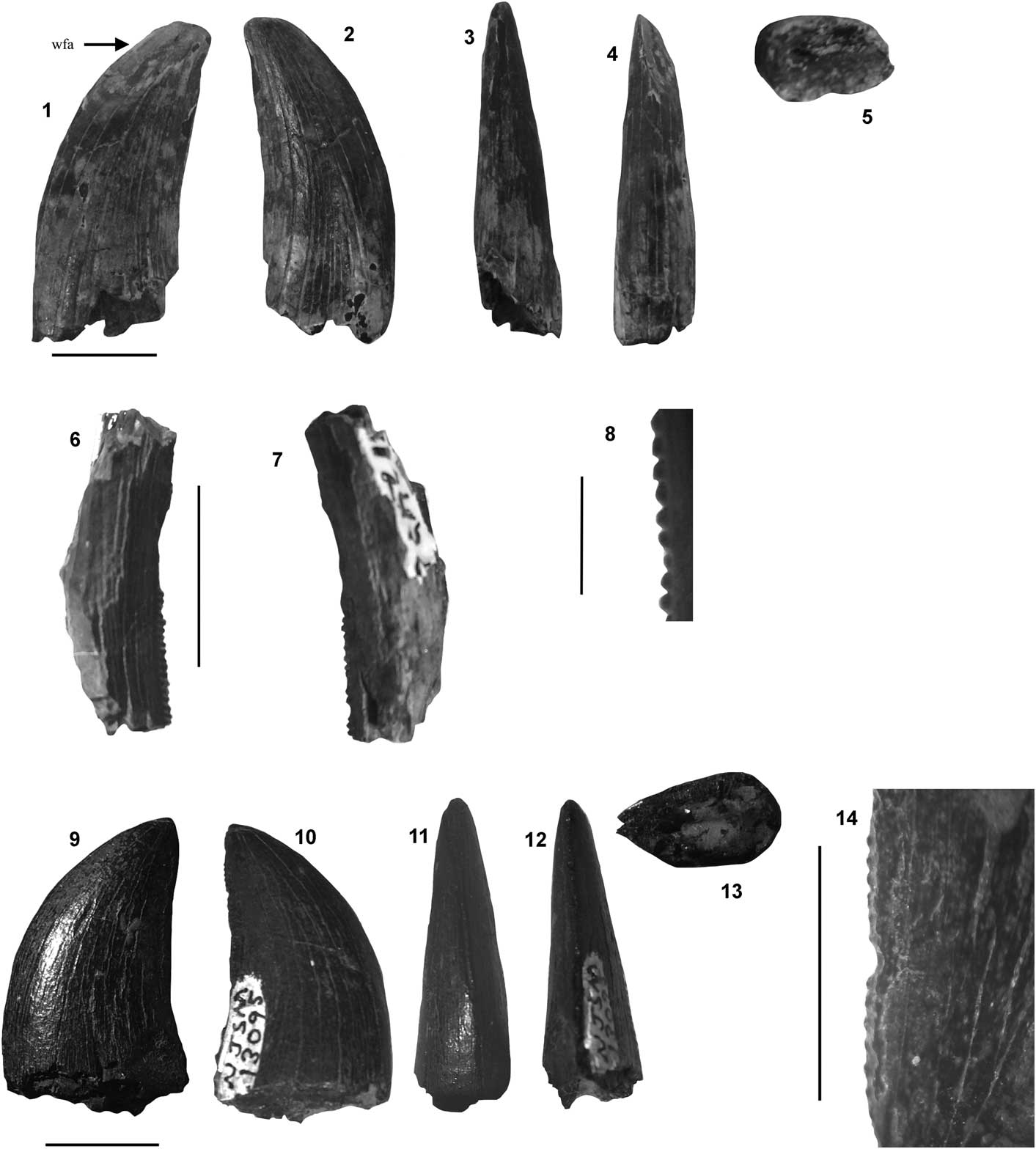
cf. Dryptosaurus maxillary or dentary teeth NJSM 16601 (1–5), NJSM 12436 (partial tooth) (6–8), and NJSM 13095 (9–12) in labial (1, 6, 9), lingual (2, 7, 10), mesial (3, 11), distal (4, 12), and basal (5, 14) views, with magnified views of NJSM 12436 and NJSM 13095 (H, N); wfa=wear facet. Scale bar=10 mm (1–7, 9–13),=5 mm (8, 14).
Description
NJSM 14682 is a slightly eroded pedal phalanx of a tyrannosauroid dinosaur measuring 113 mm proximodistally and has a circumference of 123 mm at its diaphysis. This bone is identified as a phalanx III-1 or III-2 because it is not proximodistally elongate and mediolaterally compressed (conditions in the pedal phalanges of digit II) or proximodistally compressed (as in the pedal phalanges of digit IV or III-3). The phalanx is robustly built, with a strongly arched ventral surface in medial and lateral view. The collateral ligament pits are both deep and teardrop-shaped, both reaching their deepest point proximally. The lateral collateral ligament pit is better preserved than the medial. The proximal and distal surfaces are moderately worn, yet the preserved bone indicates that only a very slight sulcus separated the distal hemicondyles. On the dorsal surface, a deepened, teardrop-shaped fossa sits just proximal to the distal hemicondyle, identified as the extensor fossa for the insertion of the M. extensor digitorum longus (Carrano and Hutchinson, Reference Carrano and Hutchinson2002). The shaft of the bone is arched dorsoventrally and pinched mediolaterally between the mediolaterally expanded proximal and distal ends of the bone. The middle portion of the bone is slightly less abraded than the proximal and distal ends, the former semi-rectangular in proximal view due in part to erosion. In medial and lateral views, the dorsal surface of the shaft is flattened. In lateral and medial views, the shaft expands dorsoventrally towards the proximal end, unlike the pinched morphology seen in dorsal view. The shaft is slightly rounded dorsally, ventrally, medially, and laterally. Towards the ventral part of the proximal most portion of the lateral and medial surfaces of the bone, there are slight depressions. The proximal surface, like the distal, is eroded. However, enough bone is preserved to show the presence of a lip around the proximal articular surface with its most distally outstretched point at the dorsal apex of the bone. The proximal surface is semi-rectangular in shape, and there is no vertical inflection on the proximal articular facet. Measurements of this bone may be found in Table 1.
Measurements for Ellisdale theropod specimens (in mm).

Measurements for Ellisdale theropod teeth (in mm).

NJSM 14682 is most parsimoniously placed within Tyrannosauroidea based on several features of the bone. First, the bone’s dimensions are much larger than those of definite ornithomimosaur phalanges known from the Late Cretaceous of the Atlantic Coastal Plain (e.g., AMNH FARB 2553, NJSM 14686) (Table 2). NJSM 14682, at 113 mm proximodistally, is also longer than the largest of any of the pedal phalanges of Gallimimus by more than 10 mm (e.g., Osmólska et al., Reference Osmólska, Roniewicz and Barsbold1972, table 2). Thus, the bone is appreciably larger than the corresponding element in any Cretaceous ornithomimid (e.g., Makovicky et al., Reference Makovicky, Kobayashi and Currie2004; Kobayashi and Barsbold, Reference Kobayashi and Barsbold2005a, table 6.3; Longrich, Reference Longrich2008b, fig. 13) excluding Deinocheirus and Beishanlong, which have pedal phalanges of similar length (e.g., Makovicky et al., Reference Makovicky, Li, Gao, Lewin, Erickson and Norell2009, fig. 3; Lee et al., Reference Lee, Barsbold, Currie, Kobayashi, Lee, Godefroit, Escuillié and Chinzorig2014, extended data fig. 5). However, the author regards it as unlikely that NJSM 14682 comes from a deinocheirid, given that the group is currently only represented by Cretaceous genera from Asia (e.g., Lee et al., Reference Lee, Barsbold, Currie, Kobayashi, Lee, Godefroit, Escuillié and Chinzorig2014). NJSM 14682 may further be distinguished from those of ornithomimids by the lack of proximally projecting ridges that extend past the proximal end of the bone and form a concavity on the ventral surface, a robust distal end that has approximately the same mediolateral width as the proximal (Table 1), having a deeper flexor fossa relative to the pedal phalanx III-1 of ornithomimosaurs, having a deeply concave proximal surface, and having a mediolaterally “pinched,” as opposed to gently arched, diaphysis (e.g., Osborn, Reference Osborn1921, fig. 3a; Osmólska et al., Reference Osmólska, Roniewicz and Barsbold1972, fig. 17; Kobayashi and Barsbold, Reference Kobayashi and Barsbold2005a, fig. 6.10G, 6.10H, Reference Kobayashi and Barsbold2005b, fig. 17B; Choiniere et al., Reference Choiniere, Forster and de Klerk2012, fig. 14; Cullen et al., Reference Cullen, Ryan, Schröder-Adams, Currie and Kobayashi2013, figs. 2, 3; McFeeters et al., Reference McFeeters, Ryan, Schröder-Adams and Cullen2016, fig. 11; Tsogtbaatar et al., Reference Tsogtbaatar, Kobayashi, Khishigjav, Currie, Watabe and Barsbold2017, fig. 4). NJSM 14682 is also more mediolaterally widened than the pedal phalanges of dromaeosaurids and troodontids and comes from an animal of much greater size than any known from the former group known from eastern North America or from the latter group entirely (e.g., Kiernan and Schwimmer, Reference Kiernan and Schwimmer2004; Makovicky and Norell, Reference Makovicky and Norell2004; Norell and Makovicky, Reference Norell and Makovicky2004; Schwimmer et al., Reference Schwimmer, Sanders, Erickson and Weems2015). NJSM 14682 may additionally be distinguished from dromaeosaurids, troodontids, and therizinosauroids on the basis of the lack of a deepened sulcus separating the distal hemicondyles (e.g., Clark et al., Reference Clark, Maryańska and Barsbold2004; Makovicky and Norell, Reference Makovicky and Norell2004; Norell and Makovicky, Reference Norell and Makovicky2004). NJSM 14682 is also considerably more elongate than the extremely proximodistally shortened pedal phalanges of some therizinosauroids (e.g., Clark et al., Reference Clark, Maryańska and Barsbold2004). However, large size, a mediolaterally “pinched diaphysis” on III-2, robust morphology, a deepened proximal articular facet, a subtle sulcus separating the distal hemicondyles, and deepened collateral ligament pits are also found in tyrannosauroids, especially the larger species of the Late Cretaceous (e.g., Table 2; Lambe, Reference Lambe1917, fig. 49; Carr and Williamson, Reference Carr and Williamson2000, figs. 3, 4, 8, 15; Holtz, Reference Holtz2004; Farlow et al., Reference Farlow, Holtz, Worthy and Chapman2013). Indeed, the deep hyperextensor pit on NJSM 14682 unites the bone with the corresponding element in Appalachiosaurus montgomeriensis (Red Mountain Museum specimen 6770; personal communication, R.K. Denton, 2017). Thus, it may be confidently referred to Tyrannosauroidea based on the aforementioned presence of features.
Several morphologies on the bone, however, suggest against it being a tyrannosaurid. The ratio of the mediolateral width of the diaphysis to the proximodistal length of NJSM 14682 is greater than 3.0 (=3.3) (Table 2) (e.g., Brusatte et al., Reference Brusatte, Norell, Carr, Erickson, Hutchinson, Balanoff, Bever, Choiniere, Makovicky and Xu2010; Brusatte and Carr, Reference Brusatte and Carr2016), the hyperextensor pit is deepened, unlike tyrannosaurids, where it is shallow, but as in Appalachiosaurus montgomeriensis (e.g., Lambe, Reference Lambe1917, fig. 49; Carr and Williamson, Reference Carr and Williamson2000, figs. 3, 4, 8, 15; Holtz, Reference Holtz2004; Farlow et al., Reference Farlow, Holtz, Worthy and Chapman2013; personal communication, R.K. Denton, 2017). The phalanx could only be coded for one character in the Theropod Working Group Matrix (Brusatte et al., Reference Brusatte, Lloyd, Wang and Norell2014), and thus was not included in a phylogenetic analysis. However, the morphology of the specimen makes it confidently assignable to Tyrannosauroidea.
NJSM 16601(Fig. 1.7–1.11) is the eroded tooth of a large theropod dinosaur. The tooth measures 13 mm long mesiodistally and 4 mm wide labiolingually at its base. The tooth’s CH is 33 mm, and the specimen does not preserve denticles. The tooth is worn, with several vertical cracks in the enamel visible in labial and lingual views. The specimen bears a striation-filled elliptical wear facet, 10 mm long and 4 mm wide, on its lingual surface. The wear facet follows the long axis of the crown in orientation, contains homogeneously oriented striations offset from the major axis of the facet by ~15˚, and has worn away edges, matching the facets on tyrannosaurid teeth described by Schubert and Ungar (Reference Schubert and Ungar2005). Though barely visible due to the presence of vertical cracks in the specimen, the tooth bears a ridge that curves toward the apex, suggesting the tooth to be from a tyrannosaur more derived than basal taxa like Eotyrannus (e.g., Zanno and Mackovicky, 2011; Krumenacker et al., Reference Krumenacker, Simon, Scofield and Varricchio2017). NJSM 16601 is nearly symmetrical labiolingually in mesial and distal views. This tooth is eroded basally on its mesial and distal ends, but nevertheless has a CBW/CBL ratio of 0.53, just under the cutoff (0.60) for the incrassate condition (Brusatte et al., Reference Brusatte, Norell, Carr, Erickson, Hutchinson, Balanoff, Bever, Choiniere, Makovicky and Xu2010, Reference Brusatte, Lloyd, Wang and Norell2014). Nevertheless, the ziphodont nature of this specimen suggests it may belong to Dryptosaurus or a close relative because Dryptosaurus is unusual among derived tyrannosauroids in having ziphodont dentition (Brusatte et al., Reference Brusatte, Benson and Norell2011).
Materials
NJSM 14682, a pedal phalanx III-2 (Fig. 1.1–1.6), NJSM 16601, maxillary or dentary tooth crown (Fig. 2.1–2.5).
Remarks
NJSM 14682 is referred to Tyrannosauroidea based on the following combination of features: massive size, mediolateral width of phalanx at the distal hemicondyles equal to that at the proximal articular facet leading to a robust, proximodistally shortened morphology, a mediolaterally “pinched” diaphysis in dorsal and ventral views, a deeply concave proximal articular facet, and a deepened extensor fossa on the dorsal surface just proximal to distal hemicondyles (see below). NJSM 16601 is referred to Tyrannosauroidea based on the following combination of features: size, rectangular-ovoid cross-section in labial-lingual view, gentle curvature towards the apex, and labial-lingual width that is tapered distally.
cf. Dryptosaurus sp. (morphotype A) Cope, Reference Cope1866
Description
The partial tooth included in NJSM 12436 is the incomplete tooth of a large theropod dinosaur, measuring 27.5 mm high. This specimen is interpreted as a shed maxillary or dentary tooth based on its size and because it lacks a root. This tooth is distinct from NJSM 13734 in having a denticle count of 12 d/5 mm basally (see below), which matches the condition in Dryptosaurus aquilunguis (Schwimmer, Reference Schwimmer2016). These denticles are peg-like and rectangular, strongly oriented apically. The smaller tooth included in NJSM 12436 bears interdenticular sulci on its distal carina (e.g., Currie et al., Reference Currie, Rigby and Sloan1990; Smith, Reference Smith2007; Hendrickx et al., Reference Hendrickx, Mateus and Araújo2015) that extend slightly onto the tooth and are, like the denticles, oriented parallel to the base of the tooth. These denticles are approximately twice as long mesiodistally than apicobasally. The mesial surface of NJSM 12436 is slightly recurved apically, matching the condition of NJSM 16601 and the teeth of Dryptosaurus aquilunguis more than that of NJSM 13734. The preserved portion of the basal end of NJSM 13734 is elliptical and suggests a labiolingually compressed, teardrop-shaped morphology consistent with the ziphodont condition. However, because of the fragmentary nature of the specimen, ziphodonty on NJSM 13734 cannot be confirmed. The mesial portion of the tooth is absent. However, NJSM 13734 is relatively well preserved compared to other specimens, suggesting the tooth was shed close to the site of its deposition (e.g., Denton et al., Reference Denton, O’Neill, Grandstaff and Parris2011).
NJSM 13095 is another large theropod maxillary or dentary tooth, measuring 27 mm in CH. This tooth, which is ziphodont in morphology (CBW/CBL=0.53), has been abraded to a greater extent than NJSM 13734, but still preserves distal denticles that have a density of 9.5 denticles/5mm. This denticle count corresponds closely to the denticle density reported for the apical distal carina of the maxillary teeth of Dryptosaurus by Schwimmer (Reference Schwimmer2016). NJSM 13095 is straightened distally, with a gently curved mesial outline.
Materials
NJSM 12436, partial maxillary or dentary tooth (Fig. 2.6–2.8), NJSM 13095, partial maxillary or dentary tooth (Fig. 2.9–2.14).
Remarks
NJSM 12346 and NJSM 13095 are assigned to Tyrannosauroidea based on the presence of the following combination of features: size, distally tapered labio-lingual depth, gentle curvature, and widely spaced, peg-like denticles. NJSM 12346 and NJSM 13095 are assigned to cf. Dryptosaurus due to having a similar basal distal carina denticle count of 12 denticles/5 mm and apical distal carina denticle count of 9.5 denticles/5 mm, respectively (Schwimmer, Reference Schwimmer2016). NJSM 13095 is also ziphodont in morphology, further allying the specimen with Dryptosaurus. Although NJSM 12346 may be ziphodont in morphology, which would further unite the tooth with Dryptosaurus (e.g., Brusatte et al., Reference Brusatte, Benson and Norell2011), the presence of this morphology on NJSM 12346 is uncertain.
Tyrannosauroidea indet. (morphotype B)
Partial tyrannosauroid maxillary or dentary tooth NJSM 13734 in labial (1), lingual (2) , and basal (3) views, with magnified view of denticles (4). Scale bar=10 mm (1–3),=2 mm (4).

Description
NJSM 13734 is the partial maxillary or dentary tooth of a large theropod dinosaur. This tooth is slightly recurved and labiolingually narrow basally. The partial tooth preserves the mesial carina and approximately one quarter of its the denticles, which are small (16 denticles/5 mm), widely spaced, peg-like, and strongly oriented mesially. The distal denticles of NJSM 13734 are much smaller than those of NJSM 12436, with 17 denticles/5mm basally. This denticle density is similar to but exceeds that of the teeth of Appalachiosaurus (e.g., Carr et al., Reference Carr, Williamson and Schwimmer2005; Schwimmer et al., Reference Schwimmer, Sanders, Erickson and Weems2015; Schwimmer, Reference Schwimmer2016). The denticles in NJSM 13734 are ~2.5 times longer mesiodistally than apicobasally. Interdenticular sulci that extend slightly onto the tooth surface are also present on NJSM 13734 and are about the same dimensions as the denticles themselves. The tooth, though only partially preserved, is labiolingually compressed basally (Fig. 2.11). The estimated mesiodistal length of the base of the tooth when complete is 12–15 mm, and the preserved labiolingual width of the base is 6 mm. Thus, the tooth may have been ziphodont when complete, allying the large tyrannosauroid taxon to which it belonged with Dryptosaurus aquilunguis (e.g., Brusatte et al., Reference Brusatte, Benson and Norell2011).
Remarks
NJSM 13734 is referred to Tyrannosauroidea on the basis of the following combination of features: size, having a D-shaped cross-section basally, being gently curved towards its apex and distally tapered in its labiolingual width, and possessing peg-like denticles that increase in density towards its base. NJSM 13734 is referred to a second morphotype of tyrannosauroid based on having denser denticles than the other Ellisdale tyrannosauroid teeth for which distal denticles are preserved (NJSM 12436).
Ornithomimosauria Barsbold, Reference Barsbold1976
Ornithomimosauria indet.
Ornithomimosaur pedal phalanx NJSM 14686 in lateral (1), medial (2), dorsal (3), ventral (4), proximal (5), and distal (6) views. Arrows point to ventral spurs. Scale bar=50 mm.

Description
NJSM 14686 is smaller than NJSM 14682 in all dimensions (Table 1), measuring 67 mm long proximodistally. The bone is slightly eroded, though most of the bone surface is well preserved and not noticeably abraded. Distally, the hemicondyles are separated by a very slight sulcus, which transitions to a shallow, proximally extending hyperextensor pit dorsally. The collateral ligament pits are subovoid and deep. Ventrally, the two distal hemicondyles form a concavity just proximal to the distal articular surface. In lateral and medial views, the dorsal surface is flattened and the ventral surface is gently arched. In dorsal and ventral views, the lateral and medial surfaces are also gently arched and gently curved outward towards the proximal end in expansion. The proximal end is appreciably wider than the distal (Table 1), and the proximal end bears pointed processes on its ventral corners that form a shallow concavity ventrally. The proximal end, though not noticeably eroded, lacks a vertically oriented projection, and there is no rim surrounding the proximal articular facet.
NJSM 14686 is assignable to Ornithomimosauria based on the proximally projecting ventral processes on the bone, a morphology found in both basal and derived ornithomimosaurs (e.g., Osborn, Reference Osborn1921, fig. 3a; Osmólska et al., Reference Osmólska, Roniewicz and Barsbold1972, fig. 17, pl. 49; Kobayashi and Barsbold, Reference Kobayashi and Barsbold2005a, fig. 6.10G, 6.10H, Reference Kobayashi and Barsbold2005b, fig. 17B; Choiniere et al., Reference Choiniere, Forster and de Klerk2012, fig. 14; Cullen et al., Reference Cullen, Ryan, Schröder-Adams, Currie and Kobayashi2013, figs. 2, 3; McFeeters et al., Reference McFeeters, Ryan, Schröder-Adams and Cullen2016, fig. 11; Tsogtbaatar et al., Reference Tsogtbaatar, Kobayashi, Khishigjav, Currie, Watabe and Barsbold2017, fig. 4). The specimen’s gently arched medial and lateral surfaces, flattened dorsal surface, smaller size when compared to the known pedal phalanges of eastern Tyrannosauroids, and shallow hyperextensor pit are also consistent with this assignment (e.g., Lambe, Reference Lambe1917, fig. 49; Osborn, Reference Osborn1921, fig. 3a; Osmólska et al., Reference Osmólska, Roniewicz and Barsbold1972, fig. 17, pl. 49; Carr and Williamson, Reference Carr and Williamson2000, figs. 3, 4, 8, 15; Holtz, Reference Holtz2004; Carr et al., Reference Carr, Williamson and Schwimmer2005, supplemental information; Kobayashi and Barsbold, Reference Kobayashi and Barsbold2005a, fig. 6.10G, 6.10H, Reference Kobayashi and Barsbold2005b, fig. 17B; Choiniere et al., Reference Choiniere, Forster and de Klerk2012, fig. 14; Cullen et al., Reference Cullen, Ryan, Schröder-Adams, Currie and Kobayashi2013, figs. 2, 3; Farlow et al., Reference Farlow, Holtz, Worthy and Chapman2013; McFeeters et al., Reference McFeeters, Ryan, Schröder-Adams and Cullen2016, fig. 11; Tsogtbaatar et al., Reference Tsogtbaatar, Kobayashi, Khishigjav, Currie, Watabe and Barsbold2017, fig. 4). In form, the proximally projecting processes on NJSM 14686 are not as well developed as in ornithomimids (e.g., Osborn, Reference Osborn1921, fig. 3a; Osmólska et al., Reference Osmólska, Roniewicz and Barsbold1972, fig. 17, pl. 49; Kobayashi and Lü, Reference Kobayashi and Lü2003, fig. 24; Cullen et al., Reference Cullen, Ryan, Schröder-Adams, Currie and Kobayashi2013, figs. 2, 3; McFeeters et al., Reference McFeeters, Ryan, Schröder-Adams and Cullen2016, fig. 11; Tsogtbaatar et al., Reference Tsogtbaatar, Kobayashi, Khishigjav, Currie, Watabe and Barsbold2017, fig. 4). Rather, the specimen is more similar to the pedal phalanges III of Harpymimus, Nedcolbertia, an ornithomimosaur from the Aptian–Albian of China, and of ornithomimosaurs from the Arundel Clay of Maryland in the extent of its proximally oriented ventral processes and the ratio between its dorsoventral height and mediolateral width proximally (e.g., Table 1; Gilmore, Reference Gilmore1920; Kirkland et al., Reference Kirkland, Whittle, Britt, Madsen and Burge1998; Shapiro et al., Reference Shapiro, You, Shubin, Luo and Downs2003; Kobayashi and Barsbold, Reference Kobayashi and Barsbold2005a). Thus, it may be that the specimen represents an ornithomimosaur species basal to those found in the west during the Campanian, a condition that has been found with other dinosaur groups on Appalachia (e.g., Schwimmer, Reference Schwimmer1997; Carr et al., Reference Carr, Williamson and Schwimmer2005; Brusatte et al., Reference Brusatte, Norell, Carr, Erickson, Hutchinson, Balanoff, Bever, Choiniere, Makovicky and Xu2010; Prieto-Márquez et al., Reference Prieto-Márquez, Erickson and Ebersole2016a, 2016b). Further research into Appalachian ornithomimosaurs from the time of the Western Interior Seaway will be needed to test this hypothesis.
Remarks
NJSM 14686 is referred to Ornithomimosauria based on the following combination of features: proximally projecting ventral spurs (Fig. 4.1, 4.2), shallow hyper-extensor pit, and long form with gently proximodistally arched lateral and medial surfaces.
Maniraptora Gauthier, Reference Gauthier1986
Dromaeosauridae Matthew and Brown, Reference Matthew and Brown1922
Dromaeosauridae indet. morphotype A.
Dromaeosaurid maxillary or dentary teeth NJSM 14158 (larger tooth) (1–6), NJSM 12436 (complete crown) (7–10), NJSM 16611 (11, 12), and NJSM 14158 (smaller tooth) (13, 14) assigned to morphotype A in labial (1, 7, 11, 13), lingual (2, 8, 12, 14), mesial (3, 9), distal (4), and basal (5) views with magnified view of NJSM 14158 (larger tooth) (6). Scale bar=10 mm (1–5, 7–10, 13, 14),=5 mm (6, 11, 12).

Description
NJSM 14158 is the partial large tooth of a theropod dinosaur, measuring 25 mm in CH. The mesial and distal carinae are both preserved, though middle portion of the crown is only partially present. The tooth is clearly dromaeosaurid based on the apically recurved distal denticles on the distal carina and the extremely small size of the mesial denticles, which are rectangular. The distal denticles in NJSM 14158 differ from those in other dromaeosaurid specimens from Ellisdale in being twice as long mesiodistally than apicobasally, rectangular, and slightly (≥50º) rather than heavily (≤40º) inclined towards the crown apex. Small interdenticular sulci separate each distal denticle and do not extend onto the crown. The mesial denticles are very small and mesiodistally flattened, separated by shallow interdenticular sulci. Importantly, this tooth is very large for a dromaeosaurid, falling just above the upper end of the crown height range for the giant dromaeosaurid taxon Dakotaraptor steini DePalma et al., Reference DePalma, Burnham, Martin, Larson and Bakker2015 and far exceeding the crown height ranges for other Late Cretaceous dromaeosaurid taxa (e.g., DePalma et al., Reference DePalma, Burnham, Martin, Larson and Bakker2015). The CHs of the Ellisdale tooth crowns are most similar to those of the teeth of Utahraptor, the largest known dromaeosaurid (Kirkland et al., Reference Kirkland, Burge and Gaston1993), suggesting NJSM 14158, NJSM 12436, and NJSM 16611 represent a truly gigantic dromaeosaurid taxon. The outlines of the mesial and distal faces of the tooth are recurved apically, and the specimen is laterally compressed and nearly symmetrical in distal and mesial views. In basal view, the tooth is rectangular.
The other tooth included in NJSM 14158 is heavily worn, preserving no denticles. However, the tooth is large (CH=25 mm), ziphodont, and recurved, and is thus referred to the dromaeosaurid morphotype A. The complete tooth included in NJSM 12436 is gracile, heavily recurved, ziphodont, and large (CH=26+ mm), representing the largest of the dromaeosaurid tooth crowns from the Ellisdale site. This latter tooth also does not preserve denticles and is D-shaped in cross-section basally.
NJSM 16611 is a dromaeosaurid tooth based on its labiolingual compression and curvature apically. Though it has been smoothed by abrasion during water transport, the size of the specimen is most similar to the large dromaeosaurid teeth included in morphotype A of the dromaeosaurid specimens of Ellisdale.
Materials
NJSM 14158, partial tooth crowns (Fig. 5.1–5.6, 5.13, 5.14); NJSM 16611, complete tooth crown (Fig. 5.11, 5.12).
Remarks
The tooth with preserved denticles included in NJSM 14158 is referred to Dromaeosauridae based on the following combination of features: being appreciably recurved towards the crown apex, possessing the ziphodont condition, having much larger distal than mesial denticles, and having distal denticles that curve towards the apex of the crown. The other tooth included in NJSM 14158, the eroded complete tooth crown included in NJSM 12436, and NJSM 16611 share all these features except those relevant to the denticles because none of these teeth preserves them. The morphotype represented by the tooth included in NJSM 14158 preserving denticles is characterized by large size, and peg-like denticles that are approximately twice as long as are wide and are deflected apically. The other tooth included in NJSM 14158, the complete crown included in NJSM 12436, and NJSM 16611 are tentatively referred to this morphotype on the basis of size.
Dromaeosauridae indet. morphotype B.
Dromaeosaurid maxillary or dentary teeth NJSM 14404 (1) assigned to morphotype B in ?labial/lateral views. Scale bar=5 mm.

Description
NJSM 14404 includes two tooth fragments. The larger fragment is darker in color, bearing numerous holes, which are inferred to be invertebrate borings, and enamel spalling damage on its apical end. The smaller fragment is less eroded and preserves six denticles. Each of the denticles of the smaller fragment is angled at ~45º angle with the crown towards the apex of the tooth, differentiating this specimen from the dromaeosaurid tooth morphotype that includes NJSM 14158. These denticles are approximately as mesiodistally long as apicodistally wide and are shaped like blunt hooks. The denticle density of this tooth is 3/mm. Both tooth fragments in NJSM 14404 are labiolingually compressed, although apicobasal curvature and the ziphodont condition cannot be confirmed in either.
Material
NJSM 14404, tooth fragments (Figure 6.1).
Remarks
NJSM 14404 is referred to Dromaeosauridae based on the following features: recurved, ziphodont tooth with apically oriented distal denticles.
Theropoda indet.
Indeterminate theropod specimens NJSM 16623 (1–3), NJSM 15319 (4, 5), and NJSM 13096 (6) in labial/lateral (1, 4, 6), lingual (2, 5), and basal (3) views. Scale bar=5 mm (1–5),=50 mm (6).

Description
NJSM 15319 is the very small tooth of a theropod dinosaur, measuring 5 mm apicobasally. The specimen is very recurved, more so than the tyrannosauroid but less so than the dromaeosaurid teeth from Ellisdale. NJSM 15319 preserves small, square, tightly packed denticles on its distal surface, unlike the apically recurved denticles of the dromaeosaurid or the peg-like, widely separated denticles of the tyrannosauroid teeth from Ellisdale. Mesially, the tooth is damaged and no denticles are preserved. The tooth is ziphodont, measuring 0.5 mm (CBL) and 0.24 mm (CBW) along the base. NJSM 16623 is much larger than NJSM 15319, measuring 16 mm apicobasally and representing a medium-sized theropod dinosaur. In this dimension, the tooth is slightly smaller than the smallest tooth included in the large dromaeosaurid morphotype and significantly smaller than the tyrannosauroid teeth of the Ellisdale site. The tooth is recurved apically, preserving no denticles. In basal view, the tooth is elliptical in form and ziphodont (CBW/CBL=0.286).
NJSM 13087, NJSM 13096, and NJSM 16607 are all partial limb shafts of theropod dinosaurs, identified as such due to their hollow interiors. NJSM 13087 and NJSM 16607 are very poorly preserved and not identifiable past large Theropoda indet. NJSM 13096, the likely partial metatarsal of a tyrannosauroid similar to Dryptosaurus, bears dozens of puncture marks, scrapes, and deformations from the teeth of the large crocodylian Deinosuchus (e.g., Schwimmer, Reference Schwimmer2002, Reference Schwimmer2010).
Materials
NJSM 16623 (Fig. 7.1–7.3), NJSM 15319 (Figure 7.4, 7.5), maxillary or dentary teeth. NJSM 13096 (Fig. 7.6), NJSM 16607, NJSM 13087, partial limb shafts.
Remarks
NJSM 15319 and NJSM 16623 are referred to Theropoda based on their curvature and laterally compressed state. NJSM 13096, NJSM 16607, and NJSM 13087 are referred to Theropoda based on their hollow interiors.
Discussion
Taphonomic implications of the Ellisdale theropod specimens
The theropod specimens described vary heavily in the state of their preservation. Several specimens, including the larger tooth in NJSM 14158, the teeth NJSM 14404, NJSM 13734, and NJSM 12346, and the limb elements NJSM 16651 and NJSM 14686, are fairly well preserved, with intact denticles and other small morphological features and lacking wear from erosion. The other specimens described show much more significant wearing, such as that observed on the pedal phalanx NJSM 14682 or the smaller tooth included in NJSM 14158. These two states of preservation among the Ellisdale specimens suggest that portions of the assemblage traveled from sites varying in proximity to the final area of deposition of the bones and teeth, a model consistent with that proposed by Denton and Tashjian (Reference Denton and Tashjian2012). Indeed, the possibility remains that the Ellisdale theropod specimens represent taxa from multiple different biomes that existed progressively inland from the coastline.
Comparison of the Ellisdale and western North American theropod tooth morphotypes
An extensive catalogue of literature has documented theropod tooth faunas from western North America, often in order to better account for dinosaur diversity and extinction during the Late Cretaceous (e.g., Currie et al., Reference Currie, Rigby and Sloan1990; Baszio, Reference Baszio1997; Fiorillo and Gangloff, Reference Fiorillo and Gangloff2000; Sankey, Reference Sankey2001; Sankey et al., Reference Sankey, Brinkman, Guenther and Currie2002, Reference Sankey, Standhardt and Schiebout2005; Weishampel et al., Reference Weishampel, Barrett, Coria, Loeuff, Xing, Xijin, Sahni, Gomani and Noto2004; Fanti and Miyashita, Reference Fanti and Miyashita2009; Larson and Currie, Reference Larson and Currie2013; Williamson and Brusatte, Reference Williamson and Brusatte2014). Recently, Larson and Currie (Reference Larson and Currie2013) quantitatively established distinct morphotypes of small theropod teeth among the specimens known from the western interior. These morphotypes include saurornitholestine, dromaeosaurine, Paronychodon, Zapsalis, cf. Pectinodon, cf. Troodon, Richardoestesia gilmorei, and R. isosceles teeth (Larson and Currie, Reference Larson and Currie2013). The latter five morphotypes are importantly distinguishable from all smallish theropod teeth collected from the Ellisdale site. None of the Ellisdale teeth have the isosceles-triangle shape characteristic of Richardoestesia isosceles, the very large, apically oriented denticles characteristic of troodontid teeth, the prominent longitudinal ridges or blade-like mesial denticles characteristic of Zapsalis teeth, or the prominent enamel wrinkles found on teeth assigned to Paronychodon (e.g., Larson and Currie, Reference Larson and Currie2013; Williamson and Brusatte, Reference Williamson and Brusatte2014). Thus, none of the Ellisdale specimens can be referred to troodontids or R. isosceles. However, some of the Ellisdale teeth are somewhat similar to the saurornitholestine, dromaeosaurine, and Richardoestesia morphotypes described by Larson and Currie (Reference Larson and Currie2013). As such, more explicit identification of differences between those morphotypes and the Ellisdale specimens was warranted.
The denticles of the Ellisdale theropod teeth assigned to dromaeosaurid morphotype A differ from those of saurornitholestine teeth from western North America (e.g., Larson and Currie, Reference Larson and Currie2013; Williamson and Brusatte, Reference Williamson and Brusatte2014) in lacking interdenticular sulci that project onto the crown. Furthermore, the dromaeosaurid morphotype A teeth of Ellisdale are significantly larger than any of the saurornitholestine, dromaeosaurine, or Richardoestesia gilmorei Currie, Rigby, and Sloan, Reference Currie, Rigby and Sloan1990 teeth described by Larson and Currie (Reference Larson and Currie2013), their CHs are comparable to or larger than those of the teeth of the very large Maastrichtian dromaeosaurid Dakotaraptor steini (e.g., DePalma et al., Reference DePalma, Burnham, Martin, Larson and Bakker2015). However, the saurornitholestine teeth of western North America are similar to the Ellisdale dromaeosaurid morphotype A teeth in having apically projecting, peg-like distal denticles, a trait distinguishing both morphotypes from dromaeosaurine teeth (e.g., Sankey et al., Reference Sankey, Brinkman, Guenther and Currie2002; Larson and Currie, Reference Larson and Currie2013; Williamson and Brusatte, Reference Williamson and Brusatte2014). Furthermore, dromaeosaurid teeth from Ellisdale assigned to morphotype A lack the twisting mesial carina indicative of the teeth of Dromaeosaurus or closely related taxa (Currie et al., Reference Currie, Rigby and Sloan1990; Currie, Reference Currie1995; Sankey et al., Reference Sankey, Brinkman, Guenther and Currie2002; Turner et al., Reference Turner, Makovicky and Norell2012; Larson and Currie, Reference Larson and Currie2013; Williamson and Brusatte, Reference Williamson and Brusatte2014). The Ellisdale dromaeosaurid morphotype A teeth are further distinguished from R. gilmorei in having relatively large, visible denticles compared to the small, minute ones of that taxon (e.g., Larson and Currie, Reference Larson and Currie2013; Williamson and Brusatte, Reference Williamson and Brusatte2014).
The dromaeosaurid morphotype B teeth of the Ellisdale site are, like the teeth included in morphotype A, distinguishable from dromaeosaurine teeth in having stronger apically projecting distal denticles (forming an ~60° angle with the carina) and from saurornitholestines in not having interdenticular sulci that extend onto the tooth crown to create a “peg-like” outline for each denticle (e.g., Larson and Currie, Reference Larson and Currie2013; Williamson and Brusatte, Reference Williamson and Brusatte2014). Rather, the dromaeosaurid morphotype B teeth from Ellisdale possess wave-like, “hooked” distal denticles that are most similar to those of Paronychodon, although teeth assigned to the latter taxon are wider labiolingually at their bases and have prominent enamel wrinkles (e.g., Larson and Currie, Reference Larson and Currie2013; Williamson and Brusatte, Reference Williamson and Brusatte2014). Indeed, the distal denticles of the dromaeosaurid teeth from Ellisdale included in morphotype B are arguably more apically recurved than those of western saurornitholestine teeth and certainly more so than those of R. gilmorei (e.g., Larson and Currie, Reference Larson and Currie2013).
As noted previously in the literature, differences in tooth morphology among tyrannosauroids are harder to quantify due to the morphological similarity of the teeth of different tyrannosauroid taxa (e.g., Samman et al., Reference Samman, Powell, Currie and Hills2005; Williamson and Brusatte, Reference Williamson and Brusatte2014). However, several key differences distinguish the Ellisdale tyrannosauroid teeth from those of western tyrannosaurids. The ziphodont condition in some western tyrannosauroid teeth has been discussed as an indicator of the juvenile nature of the individuals from which such teeth came rather than an indicator of the position of such tyrannosauroids outside Tyrannosauridae (e.g., Carr, Reference Carr1999; Currie, Reference Currie2003; Samman et al., Reference Samman, Powell, Currie and Hills2005; Williamson and Brusatte, Reference Williamson and Brusatte2014). However, the CHs of the Ellisdale tyrannosauroid teeth are comparable to or exceed those of subadult or adult western tyrannosaurid teeth (e.g., Carr et al., Reference Carr, Williamson and Schwimmer2005, supplemental information). Thus, the presence of the ziphodont condition in likely all the tyrannosauroid teeth from Ellisdale is considered indicative that all these teeth are from large non-tyrannosaurid tyrannosauroids (e.g., Holtz, Reference Holtz2004; Carr et al., Reference Carr, Williamson and Schwimmer2005; Brusatte et al., Reference Brusatte, Norell, Carr, Erickson, Hutchinson, Balanoff, Bever, Choiniere, Makovicky and Xu2010, Reference Brusatte, Benson and Norell2011, Reference Brusatte, Lloyd, Wang and Norell2014; Loewen et al., Reference Loewen, Irmis, Sertich, Currie and Sampson2013; Williamson and Brusatte, Reference Williamson and Brusatte2014; Brusatte and Carr, Reference Brusatte and Carr2016; Carr et al., Reference Carr, Varricchio, Sedlmayr, Roberts and Moore2017). This referral is supported by the assignability of several of the Ellisdale teeth to Dryptosaurus or a closely related taxon and the similarity of the tyrannosauroid morphotype B teeth described to A. montgomeriensis (e.g., Carr et al., Reference Carr, Williamson and Schwimmer2005; Brusatte et al., Reference Brusatte, Benson and Norell2011; Schwimmer et al., Reference Schwimmer, Sanders, Erickson and Weems2015).
Appalachia was at least partially isolated from Laramidia since the Albian–Cenomanian (e.g., Roberts and Kirschbaum, Reference Roberts and Kirschbaum1995; Russell, Reference Russell1995; Schwimmer, Reference Schwimmer2002). However, it is notable that the theropod assemblage from Ellisdale does not resemble that of the Cenomanian Wayan Formation of the northern Rockies, the latter including incrassate-toothed small- and medium-sized tyrannosauroids, small dromaeosaurids, Richardoestesia isosceles-like theropods represented by teeth, neovenatorids, and oviraptorosaurs (Krumenacker et al., Reference Krumenacker, Simon, Scofield and Varricchio2017). The Ellisdale theropod assemblage also differs from that of the Albian–Cenomanian Mussentuchit Member of the Cedar Mountain Formation, which includes a large neovenatorid, small tyrannosauroids, theropods with teeth similar to Richardoestesia and Paronychodon, troodontids, and dromaeosaurids (e.g., Kirkland et al., Reference Kirkland, Cifelli, Britt, Burge, DeCourten, Eaton and Parrish1999; Zanno and Makovicky, Reference Zanno and Makovicky2011, Reference Zanno and Makovicky2013). The theropod assemblage of the Albian Cloverly Formation is somewhat more similar to that of Ellisdale, containing tyrannosauroids of similar phylogenetic grade to Xionguanlong, the dromaeosaurid Deinonychus, and ornithomimosaurs (e.g., Ostrom, Reference Ostrom1969, Reference Ostrom1970; Zanno and Makovicky, Reference Zanno and Makovicky2011). Unlike the Cloverly, the Ellisdale theropod fauna lacks oviraptorosaurs (Makovicky and Sues, Reference Makovicky and Sues1998) and large carcharodontosaurid dinosaurs (e.g., Kirkland et al., Reference Kirkland, Cifelli, Britt, Burge, DeCourten, Eaton and Parrish1999; Weishampel et al., Reference Weishampel, Barrett, Coria, Loeuff, Xing, Xijin, Sahni, Gomani and Noto2004; D’Emic et al., Reference D’Emic, Melstrom and Eddy2012). Because carcharodontosaurids seem to have gone extinct in the northern hemisphere sometime during the middle of the Late Cretaceous (e.g., D’Emic et al., Reference D’Emic, Melstrom and Eddy2012; Zanno and Makovicky, Reference Zanno and Makovicky2013) and none are known in the Campanian of the Atlantic or Gulf coastal plains (e.g., Gallagher, Reference Gallagher1993, Reference Gallagher1997; Ebersole and King, Reference Ebersole and King2011; Schwimmer et al., Reference Schwimmer, Sanders, Erickson and Weems2015), the absence of that group in the Ellisdale fauna is unsurprising. Regardless, the Ellisdale assemblage and other Appalachian theropod faunas from the Campanian lack troodontids or oviraptorosaurs (e.g., Gallagher, Reference Gallagher1993; Schwimmer et al., Reference Schwimmer, Sanders, Erickson and Weems2015; Schwimmer, Reference Schwimmer2016), which are fairly widespread among Campanian Laramidian formations (e.g., Weishampel et al., Reference Weishampel, Barrett, Coria, Loeuff, Xing, Xijin, Sahni, Gomani and Noto2004; Gates et al., Reference Gates, Sampson, Zanno, Roberts, Eaton, Nydam, Hutchison, Smith, Loewen and Getty2010, supplemental information; Larson and Currie, Reference Larson and Currie2013; Longrich et al., Reference Longrich, Barnes, Clark and Millar2013; Sampson et al., Reference Sampson, Loewen, Roberts and Getty2013a; Williamson and Brusatte, Reference Williamson and Brusatte2014; Funston and Currie, Reference Funston and Currie2016; van der Reest and Currie, Reference van der Reest and Currie2017). This absence may be due to preservation bias, because fossils of both of these groups in Laramidia are comparatively uncommon (e.g., Weishampel et al., Reference Weishampel, Barrett, Coria, Loeuff, Xing, Xijin, Sahni, Gomani and Noto2004; Gates et al., Reference Gates, Sampson, Zanno, Roberts, Eaton, Nydam, Hutchison, Smith, Loewen and Getty2010, supplemental information; Larson and Currie, Reference Larson and Currie2013; Longrich et al., Reference Longrich, Barnes, Clark and Millar2013; Sampson et al., Reference Sampson, Lund, Loewen, Farke and Clayton2013b; Williamson and Brusatte, Reference Williamson and Brusatte2014; Funston and Currie, Reference Funston and Currie2016; van der Reest and Currie, Reference van der Reest and Currie2017). Nevertheless, differences between taxa of groups present in western North America and at Ellisdale indicate that Appalachia harbored a distinct theropod fauna from Laramidia, a biogeographic phenomenon previously recognized in the literature (especially for tyrannosauroids; e.g., Carr et al., Reference Carr, Williamson and Schwimmer2005; Weishampel, Reference Weishampel2006; Brusatte et al., Reference Brusatte, Benson and Norell2011; Schwimmer et al., Reference Schwimmer, Sanders, Erickson and Weems2015; Schwimmer, Reference Schwimmer2016).
Comparison of the Ellisdale and southeastern North American theropod tooth morphotypes
Faunal provincialism, though discussed extensively for Laramidian assemblages (e.g., Lehman, Reference Lehman1997, Reference Lehman2001; Gates et al., Reference Gates, Sampson, Zanno, Roberts, Eaton, Nydam, Hutchison, Smith, Loewen and Getty2010, Reference Gates, Prieto-Márquez and Zanno2012; Sampson et al., Reference Sampson, Loewen, Farke, Roberts, Forster, Smith and Titus2010; Vavrek and Larsson, Reference Vavrek and Larsson2010; Loewen et al., Reference Loewen, Irmis, Sertich, Currie and Sampson2013; Sampson et al., Reference Sampson, Loewen, Roberts and Getty2013a, Reference Sampson, Lund, Loewen, Farke and Clayton2013b; Thomson et al., Reference Thomson, Irmis and Loewen2013; Lucas et al., Reference Lucas, Sullivan, Lichtig, Dalman and Jasinski2016), has only recently been investigated in the eastern North American fossil record of the Cretaceous (e.g., Schwimmer, Reference Schwimmer2016). As noted in the case of Laramidian assemblages, microfossil sites have the potential to inform studies of such biogeographic patterns among vertebrates (e.g., Sankey, Reference Sankey2008; Gates et al., Reference Gates, Sampson, Zanno, Roberts, Eaton, Nydam, Hutchison, Smith, Loewen and Getty2010; Williamson and Brusatte, Reference Williamson and Brusatte2014), and the Ellisdale site is certainly of importance in testing for the presence of this phenomenon on Appalachia in revealing a northern Appalachian theropod fauna.
In the southeastern United States, the remains of at least three theropod dinosaur genera representing three different clades have been recovered from deposits of similar age as the Marshalltown Formation (75.7–71.2 Ma; Miller et al., Reference Miller, Sugarman, Browning, Kominz, Olsson, Feigenson and Hernandez2004) at Ellisdale (Campanian, palynological data indicates an age range of 76.4–79.6 Ma; Denton and Tashjian, Reference Denton and Tashjian2012): Appalachiosaurus montgomeriensis from the Demopolis Chalk (Middle Campanian; e.g., Ebersole and King, Reference Ebersole and King2011) and, along with cf. Saurornitholestes langstoni, an additional indeterminate dromaeosaurid, and ornithomimosaurs, from the Coachman Formation of northern South Carolina and Dryptosaurus, ornithomimosaurs, and other small theropods from the temporally equivalent and geographically nearby Tar Heel Formation of southern North Carolina (78.7–74.5 Ma; e.g., Self-Trail et al., Reference Self-Trail, Christopher, Prowell and Weems2004; Harris and Self-Trail, Reference Harris and Self-Trail2006; Schwimmer et al., Reference Schwimmer, Sanders, Erickson and Weems2015). The close proximity and equivalent age of the Tar Heel and Coachman show that the dinosaur fauna of the Carolinas during the Campanian represented a mixing of northern (e.g., Dryptosaurus) and southern (e.g., cf. Sauronitholestes langstoni, Appalachiosaurus montogomeriensis) forms in the formations (e.g., Schwimmer, Reference Schwimmer2016).
The Tar Heel and Coachman formations’ theropod assemblage share the presence of two tyrannosauroids, one Dryptosaurus-like and one Appalachiosaurus-like, and ornithomimosaurs with Ellisdale. However, the teeth from the Coachman Formation assigned to cf. Saurornitholestes langstoni are significantly smaller than the Ellisdale dromaeosaurid teeth included in morphotype A and, unlike the Ellisdale teeth included in morphotype B, have peg-like distal denticles with interdenticular sulci that project onto the crown surface (Schwimmer et al., Reference Schwimmer, Sanders, Erickson and Weems2015). Furthermore, teeth of possible dromaeosaurine origin (based on their curvature and large mesial denticles) reported from the Coachman Formation by Schwimmer et al. (Reference Schwimmer, Sanders, Erickson and Weems2015) further distinguish that theropod fauna from that of Ellisdale. Overall, the differences between the theropod faunas of southeastern North America and Ellisdale, especially among the maniraptoran taxa, support the hypothesis that faunal provincialism existed on Appalachia (e.g., Schwimmer, Reference Schwimmer2016).
Conclusions
The Ellisdale theropod fauna includes tyrannosauroids represented by at least two tooth morphotypes, small and large dromaeosaurids, ornithomimosaurs, and indeterminate theropods, and is distinct from Campanian western North American theropod faunas, much more so resembling mid-Cretaceous theropod faunas from western North America and thus supporting the hypothesis that Appalachia was a refugium for relict dinosaur clades. Furthermore, the distinction of the Ellisdale assemblage from southeastern North American theropod faunas may support the presence of dinosaur provinces on Appalachia, a biogeographic phenomenon seen in Laramidian vertebrates.
Acknowledgments
I thank D. Parris for allowing me to access the collections of the NJSM and R. Denton for providing information on the Ellisdale site and for our discussions on Appalachian faunas generally.


 Open access

