


Introduction
The term ‘polycrisis’ is not new. Lawrence and colleagues (Reference Lawrence2024) describe, for example, how complexity theorists Morin and Kern coined the term more than 25 years ago, arguing that the most vital problem of the day was not any single threat but the “complex intersolidarity of problems, antagonisms, crises, uncontrollable processes, and the general crisis of the planet” (Morin & Kern Reference Morin and Kern1999: 74). More recently, Swilling (Reference Swilling2020) uses polycrisis to capture the complex interactions between crises in the global political economy that multiply those crises’ overall impact.
The concept has been criticised, however, including by Sial (Reference Sial2023), who highlights its “disregard for the long and sustained crisis of the capitalist world order”, and its “brute empiricism” in conceptualising things “as they appear to be, rather than questioning what is occurring beneath those appearances”. To address some of these criticisms, Lawrence and colleagues (Reference Lawrence2024) provide what they consider a clear definition, to reflect their belief that, in spite of the critique, polycrisis is a useful concept to help better understand and address the world’s most complex problems. They define a ‘global polycrisis’ as “the causal entanglement of crises in multiple global systems in ways that significantly degrade humanity’s prospects” (Lawrence et al. Reference Lawrence2022: 9) (Figure 1).
An example of the entanglement of various domains that contribute to the current polycrisis (after Lawrence et al. Reference Lawrence2024: fig. 1 by Jacob Buurma, Vibrant Content; reproduced under CC-BY licence).

As stated in my book Wicked problems for archaeologists: heritage as transformative practice (Schofield Reference Schofield2024), it is this entanglement that makes the world’s most complex problems wicked and elusive, rendering them difficult if not impossible to resolve. As Lawrence and colleagues state:
the conjoined harms of multiple crises are different from, and generally worse than, the harms each crisis would produce in isolation, were their host systems not so deeply interconnected … What may appear to be separate crises in different systems in fact exacerbate and reshape one another to form a conjoined polycrisis that must be understood and addressed as a whole (Lawrence et al. Reference Lawrence2024: 3).
This is also why the term ‘global challenges’ should be avoided (e.g. Davies & Lunn-Rockliffe Reference Davies and Lunn-Rockliffe2026) when referring to what are, in reality and by definition, ‘wicked problems’ (after Rittel & Webber Reference Rittel and Webber1973; Schofield Reference Schofield2024). As Ludwig and colleagues (Reference Ludwig2022: 6) state: “Global challenges are ‘wicked problems’ that often become misframed as ‘tame problems’ in governance practice and thereby legitimise dominant responses.” Many global issues, such as climate change or poverty, are ‘wicked problems’ because they are multifaceted, lack clear definitions and have no single, easy solution or, indeed, any realistic solution. Framing them as mere ‘challenges’ can imply that they are solvable with enough effort or expertise, downplaying their inherent complexity and the urgency required to address them.
In this provocation, building on my earlier arguments (Schofield Reference Schofield2024, Reference Schofield2025), I suggest that a future- and (wicked) problem-oriented archaeology is essential, given the existential threats of the polycrisis towards planetary health and therefore to all human and non-human life. Further, we have a responsibility, or a duty of care, as archaeologists and as citizens, to do what we can to help try to resolve these problems and mitigate their impacts.
To achieve this goal, and following reactions to my book (e.g. Bradley et al. Reference Bradley2025; Holtorf Reference Holtorf2025), I am suggesting that, to be both relevant and useful as a discipline, archaeology must:
-
1) prioritise its capacity to help address and give context to wicked problems, highlighting the time depth that our work provides in understanding those problems and how this deep-time perspective allows us to identify and contribute to possible solutions;
-
2) emphasise its focus on people, without discrimination, including their relationships with non-human beings;
-
3) be more activist in its approach and bolder in its ambition. Archaeologists should explore new ways to communicate with policy-makers and involve the public, to demonstrate how the evidence that we generate is vital in highlighting the extent and the urgency of the problems we face and the opportunities that exist to help resolve them, even if those opportunities are locally based and seemingly insignificant on a wider global scale. Small wins matter, as I will explain below.
These three aims align with a further issue: pedagogy. Archaeology education is too narrow in at least two ways. First, archaeology graduates will be better equipped to help address wicked problems if they have learnt how to align their research and practice with real-world issues, and how to develop ways to effectively communicate with those who have policy-making influence and authority. Second, graduates need to operate more often and more effectively beyond disciplinary boundaries, exploring the opportunities that can link archaeology with other research fields. In other words, students (not only in archaeology but all students) need to be better prepared for a wicked future. In his book, Creating wicked students: designing courses for a complex world, Hanstedt describes this aspiration, which:
begins with the assumption that what we all want for our students is for them to be capable of changing the world. The changes they make may be big, or they may be small. They may be political or spiritual or procedural or pedagogical. They may involve a chemical formula or a reading of Shakespeare, the evolution of Weber’s thinking, or a development of evolutionary theory. The point is, in the end, when students leave college, we want them to enter the world not as drones participating mindlessly in activities they’ve been assigned but as thinking deliberative beings who add something to society (Hanstedt Reference Hanstedt2018: 1).
Systems thinking
Systems thinking is one of the core concepts that can support archaeology’s engagement with the polycrisis. It is interesting therefore, and relevant, that some archaeologists have been using systems theory since at least the 1960s (after von Bertalanffy Reference von Bertalanffy1962). Plog (Reference Plog1975: 208), for example, describes its archaeological application as concerning the “relationship between artifacts and patterns in artifact distributions on the one hand and the behavioral context in which these artifacts were made and used on the other”.
Systems thinking has three main characteristics: it is a view of the world; it is interdisciplinary; and it conceives real-world phenomena as systems and stresses, inter-relationships and interactions. As Kefalas (Reference Kefalas2011: 345) has suggested, on the first of these characteristics: “Systems Thinking represents a view of the world and a human being’s role within it: in other words, it is the conceptual scheme by which one organizes one’s thoughts and actions with respect to reality.” Archaeologists study human beings’ role in the world as a matter of course; we use archaeological evidence to both identify and interpret that role through material traces surviving from the past. Contemporary archaeologies provide that same critique on the supposedly familiar world that we ourselves inhabit, challenging its “taken for granteds” (Buchli & Lucas Reference Buchli and Lucas2001: 1) and often rendering it unfamiliar (Graves-Brown Reference Graves-Brown2000: 1). Archaeologists are less experienced in using understandings of the past to look into the future but are starting to develop these skills, not least through the lens of heritage studies (e.g. Harrison et al. Reference Harrison2020).
The second characteristic of systems thinking is that it is interdisciplinary. As Kefalas states, the interdisciplinary approach:
attempts to build a general viewpoint by borrowing from many seemingly diverse disciplines. This is a departure from conventional thinking, which emphasizes division and isolation, and is a move toward a synthesis spreading from the life sciences (biology) into the social sciences. … Traditional academic environments are not conducive to this “weird stuff.” Actually, I think they are rather hostile toward it (Kefalas Reference Kefalas2011: 345).
This statement was written 15 years ago, but it remains relevant, not least within pedagogy. As is widely stated across wicked-problems literature, mitigating the impacts of climate change, for example, will require creative and interdisciplinary solutions. Therefore, if archaeology is to contribute to these solutions, it must take on these characteristics. That should not be difficult given how archaeology already embraces historical research methodologies, as well as collaborating across the social, natural and physical sciences. But this begins with education: students of archaeology need to be interdisciplinary thinkers from the outset and to view archaeology as part of a network of inter-related disciplines that together provide insight on the past, present and future. Archaeologists can specialise, of course, but the need for them to also work collaboratively across disciplines is not a luxury in the polycrisis; it is essential.
The third characteristic of systems thinking, according to Kefalas (Reference Kefalas2011: 345) is that it “conceives of the empirical world as configurations of interrelated activities. It focuses attention on the interactions, or interfaces among the entities generating these activities rather than on the entities themselves.” In this way, a systems-oriented investigator (an archaeologist, let us say):
conceives of real-world phenomena as systems, that is, as sets of objects together with the relationships between the objects and their attributes. Each system is connected to another one in a serial, random or feedback fashion. In this image of the world, systems do not exist in isolation but are parts of a whole, namely, of the universe. Thus, one studies systems-within-systems-within-systems (Kefalas Reference Kefalas2011: 345).
As stated above, this is an approach that is familiar to archaeologists whether they study the deeper past or the contemporary world—recognising that activities that leave a material trace (farming, craft production, feasting, burial, cooking) do not exist in isolation from one another, but are deeply interconnected within ‘systems’. We also recognise from studying past worlds how actions have consequences, whether those consequences are social, political or environmental.
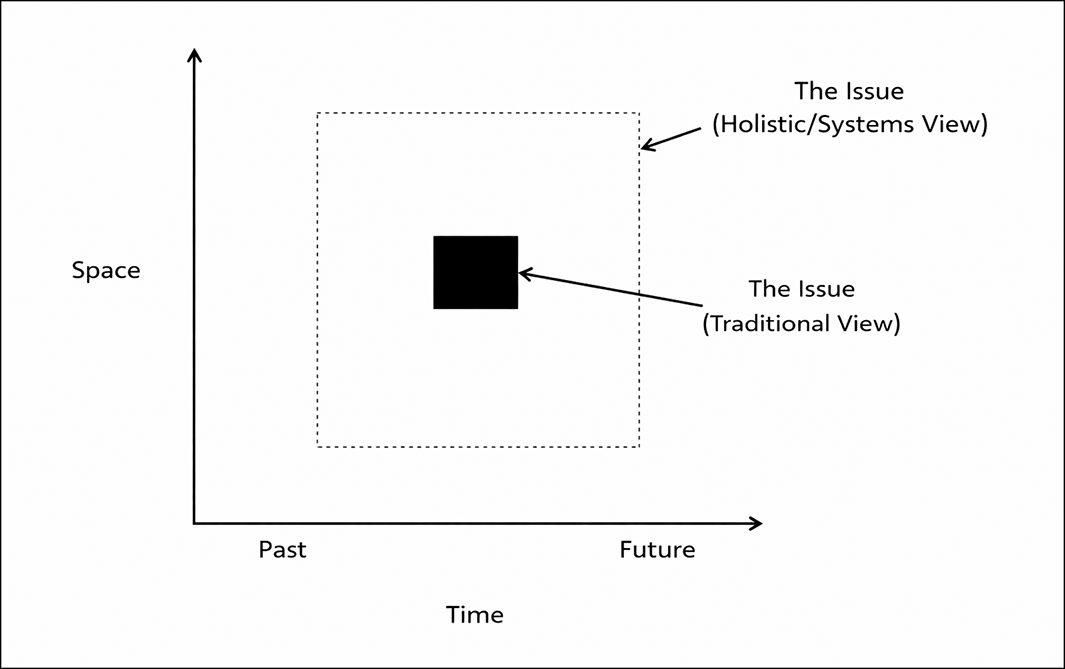
The traditional view of problems is to position them in a specific location at a specific time. This makes those problems easier to understand and simpler to resolve, in theory at least. However, wicked problems defy such localisation. They are often universal; they also have causes rooted in past behaviours and actions, and they have consequences, potentially extending into the distant future. These characteristics are shown in Figure 2. As the original authors of this figure suggest:
The space element is often easier to grasp than the time element. But Systems Thinking requires that we ask: What circumstances and attitudes led to this point? What actions and behavior patterns led to this point? What are the likely attitudes, actions, and patterns going forward? What are the probable reactions of my: allies, enemies, competitors, neutral 3 rd parties, and the environment? Systems Thinking thus requires a vision of the future as well as an understanding of the past (Monat & Gannon Reference Monat and Gannon2015: 17).
Systems thinking: the traditional view of problems compared to a holistic or systems view (after Monat & Gannon Reference Monat and Gannon2015: fig. 2, reproduced with permission).

Small-wins psychology
To summarise, the polycrisis comprises numerous interconnected wicked problems. Systems thinking provides a helpful framework within which to address them, and it is a framework with which many archaeologists are familiar. Archaeologists have been using systems theory for many years and have a unique deep-time perspective on many (if not all) of those problems, with climate change being a well-known example. However, using that perspective to help mitigate the impacts of such complex problems in the present and the future is not something archaeologists can manage alone or even necessarily by conventional practice. Wicked problems require interdisciplinary approaches and creativity. Researchers also need to be realistic about what constitutes success when dealing with wicked problems, given that these complex problems are likely to be irresolvable. Small-wins psychology provides an answer to this wicked dilemma.
Building on Lindblom’s (Reference Lindblom1959: 81) incremental method, defined as “continually building out from the current situations, step by step and by small degrees”, Weick (Reference Weick1984) defines a notion of small wins, which he applies to complex societal problems. Specifically, Weick defines a small win as a:
concrete, complete, implemented outcome of moderate importance. By itself, one small win may seem unimportant. A series of wins at small but significant tasks, however, reveals a pattern that may attract allies, deter opponents, and lower resistance to subsequent proposals. Small wins are controllable opportunities that produce visible results (Weick Reference Weick1984: 43).
Building on Weick’s argument, Termeer and Dewulf (Reference Termeer and Dewulf2019: 302) describe how the massive scale on which social problems are conceived will often diminish the quality of thought and preclude innovative action, because dysfunctional levels of arousal, frustration and helplessness are activated. An example is food security: framing hunger as a problem of producing “more food, which requires greater use of energy for farm equipment, fertilizers, and transportation, adding to the price of energy, which raises the cost of food, putting it out of the price range of the needy” reduces the perceived ability to do something about it (Weick Reference Weick1984: 40). Small wins, they suggest, can have the opposite effect.
In addition to the examples listed in Wicked problems for archaeologists (Schofield Reference Schofield2024), small wins have been used across a diversity of other cultural, research and policy settings. For example (and specifically framed relative to wicked problems), to address gender bias in the workplace (Correll Reference Correll2017), creating a more integrative approach to working with prisoners (Burns et al. Reference Burns2017) and developing regional innovation policy (Bours et al. Reference Bours2022). Archaeologically derived small wins can also be meaningful relative to the wicked problem of food security.
Food security
Food security means having consistent physical and economic access to enough safe, nutritious food that meets dietary needs and preferences for an active, healthy life. It encompasses the availability of food, the ability for people to access it, its quality and safety, and the stability of these factors over time, protecting against disruptions from weather or economic issues. The absence of these conditions leads to food insecurity, which can range from hunger to malnutrition and famine.
From an anthropological perspective, and emphasising systems thinking, Boyd recently stated that:
Food security is a pressing contemporary issue that intersects with social and environmental issues such as inequality, poverty, acculturation, and climate change. In general, when individuals, households or communities fail to secure adequate food, or food of sufficient quality or cultural-appropriateness, profound impacts on health, wellbeing, and social/cultural reproduction can accrue … In a modern context, food insecurity is also closely linked to material deprivation as low-income households struggle to afford adequate shelter, clothing, and other necessities (Boyd Reference Boyd2025: 1).
Additionally, Logan (Reference Logan2016: 508) argued that, from an archaeological perspective: “Material remains provide a from-the-hearth-up view of changing foodways and political economy and can be used to trace the shape of processes that led to modern-day patterns of food insecurity” (see also Reed & Ryan Reference Reed and Ryan2019).
By comparison, the wicked problem of food security has been discussed by transdisciplinary scholar and philosopher David Ludwig, and others, by asking the following questions:
is the challenge of global food production at the core a challenge of addressing current hunger and malnutrition, of keeping up with the growing world population, of conserving diverse global food cultures, of conserving biodiversity, or of responding to climate change? And if the challenge of global food production relates to all of these issues at the same time, how are they negotiated when their corresponding priorities inevitably come in conflict with each other? As a result, the challenge of global food production will look very different for actors such as environmental NGOs, national governments, large agricultural producers, peasant communities, or consumer groups (Ludwig et al. Reference Ludwig2022: 8).
Here, the first two statements are more about the impacts of food security on people; the third is more about policy. But throughout is the need for understanding which different disciplines can help contribute (and notable here is the work of the Stockholm Resilience Centre and its practice-based experiences across multiple human and ecological systems, e.g. Queiroz et al. Reference Queirozn.d.). Archaeology is one of those disciplines and a vital one for the deep-time perspective that it provides. For example, archaeology often involves analysing past farming methods, crop choices and societal responses to food shortages, offering insights into sustainable practices, crop diversity and resilience to climate change. Archaeological research can also help to identify strategies to inform more equitable, sustainable and resilient food futures for a growing global population. This extends to researching ‘forgotten’ crops such as millet (e.g. Martin et al. Reference Martin2021), which shows the potential of diverse, resilient crops to provide food security in a changing climate when modern agriculture focuses on just a few high-yield species. Archaeologists also have the unique capacity to track the availability, access, utilisation and stability of food resources over long periods, revealing the causes of past food insecurity and how different societies adapted. And, importantly, archaeology goes beyond environmental causes, using evidence to determine the social and political aspects of food production and consumption, which are crucial for understanding how power relations, inequality and resource stress have historically contributed to food insecurity.
These are some of the broad areas in which archaeological research projects can generate data and new understandings comprising the small wins that help to address the wicked problem of food insecurity. In some situations, as in Australia, this might also involve archaeologists working with traditional owners and their Traditional Ecological Knowledge (e.g. Rose Reference Rose2024). But to maximise impact, these archaeology-focused contributions also need a contextual framing of both the problem and of potential solutions. This requires an interdisciplinary approach (e.g. Doherty et al. Reference Doherty2023) within which archaeology sits alongside (and engaged with) a diversity of other disciplines, while also being transdisciplinary in its active relations and engagement with key areas of policy, governance and practice.
Conclusion
Mitigating the impact of wicked problems and addressing the polycrisis requires approaches that are creative in scope and bold in ambition. This also means that these approaches will likely be interdisciplinary and probably also transdisciplinary in outlook and in execution. Archaeology is well placed for such interventions, not least through its deep-time perspective and its focus upon humanity. The example of food security reinforces the view that small wins are a helpful and impactful way of addressing wicked problems. In fact, as many scholars have already stated (and which I have summarised in Schofield Reference Schofield2024), they will likely be the only way, given that wicked problems are, by definition, irresolvable. Ultimately, however, meaningful contributions to addressing the polycrisis requires archaeology to engage with systems thinking. Examples might include changing curricula to help students prepare for ‘wicked futures’; creating a heritage sector that prioritises closer alignment with the polycrisis, for example through problem-oriented and transdisciplinary practice; and creating more funding opportunities for novel, interdisciplinary projects aligned directly to wicked problems.
As archaeologists, we have an invaluable and unique perspective on the polycrisis. For the sake of planetary health, we also have a responsibility, a duty of care, to use that perspective in addressing it. This duty of care should form the basis of all archaeological work, wherever and however it occurs.
Funding statement
This research received no specific grant from any funding agency or from commercial and not-for-profit sectors.


 Open access

