


Homeostatic and non-homeostatic influences on eating behaviour
Fulfilling basic human needs such as breathing, sleeping or eating ensures survival. Regarding the latter, in its simplest form, food intake is initiated in states of hunger and energy deficit and terminated upon satiation, thus representing a homeostatic balance of energy intake and expenditure. However, human subjects regularly consume more food than needed and such overeating can lead to negative physiological and psychological health outcomes(Reference Guh, Zhang and Bansback1,Reference Tuthill, Slawik and O'rahilly2) . In extreme forms, such overeating is referred to as binge eating, defined as the consumption of an unusual large amount of food in a short time alongside the loss of control (DSM-5(3)). Frequent and regular binge eating episodes are a defining criterion for eating disorders such as bulimia nervosa, binge eating disorder, but also the binge–purge subtype of anorexia nervosa.
The prominence of non-homeostatic influences on food intake might be related to the high availability and affordability of palatable and high-energetic foods in nowadays' prosperous societies. A range of factors influence deviations from homeostatic eating, such as social norms, availability of foods, cultural traditions, eating styles/food cravings/food addiction and eating habits(Reference Renner, Sproesser and Strohbach4). The present review will focus on the role of emotions for initiating or modulating eating, as negative emotions have been shown to be one of the most important non-homeostatic reasons for overconsumption(Reference Cleobury and Tapper5,Reference Verhoeven, Adriaanse and de Vet6) .
Emotional eating: definition, scope and significance for science and practice
Ice cream after a breakup, potato chips while watching television after a stressful day, chocolates while preparing for an exam; additional food intake in response to sadness and worry (i.e. emotions) is well reflected in folk psychology. In German, the term ‘Kummerspeck’ (‘grief bacon’) relates to the consequences of these phenomena, namely an increase in weight and body fat. Scientifically, emotional eating can be defined as eating in response to negative emotions. This seemingly simple concept has kept research across several disciplines busy in the past four decades. Emotional eating theories have been discussed in social psychology(Reference Stroebe, Van Koningsbruggen and Papies7), clinical psychology and psychotherapy (patients with an eating disorder(Reference Vögele, Lutz, Gibson, Stewart Agras and Robinson8)), nutrition sciences (emotional eating and dieting(Reference Appelhans9)), health psychology, public health (snacking and physical health(Reference O'Connor, Jones and Conner10)) and metabolic sciences(Reference Berthoud11), among others. Interest in emotional eating is further fuelled because of its clinical significance in binge eating: patients with eating disorders regularly attribute their binge eating episodes to negative affect(Reference Alpers and Tuschen-Caffier12) and correspondingly, negative affect resembles the most widely reported antecedent of binge eating episodes(Reference Wolfe, Baker and Smith13). Due to this high clinical significance, emotional eating research has developed several rivalling families of theories to explain such phenomena.
Theories of emotional eating
The most widespread emotional eating theories differ in their focus and emphasis on (a) interoception, (b) cognitive processes and (c) learning processes. In the following section, we will briefly introduce one prominent exemplar of each of these theory families.
Psychosomatic theory, exemplifying an interoception-based theory was introduced by Hilde Bruch in 1955(Reference Bruch14) to explain psychological factors causal to obesity. Accordingly, individuals with obesity overeat in response to negative emotions because of a lack of interoceptive awareness (e.g. an internal sensation of hunger). Thus, individuals with obesity might confuse physiological arousal related to the emotions with hunger and therefore respond with eating instead of engaging in more functional emotion regulatory strategies. The psychosomatic theory is largely disconfirmed as an account of obesity, while interoception continues to be a fruitful concept in eating behaviour and dieting in particular(Reference Tylka and Wilcox15).
Illustrating one of the more cognitive theories, and in opposition to psychosomatic theory, restraint theory was developed(Reference Herman, Polivy and Stunkard16). The theory states that some individuals who want to lose weight are prone to develop rigid dieting rules (e.g. ‘never eat chocolate’). As a result, even minor violations of such rules can lead to cognitive abandonment of the rule and to overeating (‘what the heck’ effect). Importantly, in the present context, emotions might interfere with the cognitive control needed to uphold such strict diet rules. Restraint eating theory remains central to current emotional eating theorising, as it is pivotal in weight loss dieting.
Regarding learning-based emotional eating theories, the affect regulation model(Reference Booth17) proposes that the rewarding aspects of palatable food intake counter the negative emotions and make such behaviour more likely in the future through the principles of operant conditioning (negative reinforcement). Repeated pairing of negative emotions and eating can further lead to classical conditioning which results in increased motivation to eat in the presence of negative emotions(Reference Macht, Simons, Nyklícek, Vingerhoets and Zeelenberg18).
Several physiological theories have been articulated, owing to the observation that many physiological effects of stress and negative emotions affect key hormones such as cortisol, insulin or glucose but are beyond the scope of this review. Similarly, several nutritional components have been linked with the precursors of neurotransmitters, potentially explaining the mood-alleviating and stress-reducing effects of food intake and the reader is referred to respective review papers(Reference Bose, Oliván and Laferrère19,Reference Gibson20) .
The scope of the present review and the role of the type of emotions
Irrespective of the underlying theory, the empirical evidence for emotional eating is surprisingly mixed. Hence, we will review the literature from psychometric, experimental and naturalistic studies, focusing on the effect of negative emotions on food intake (see Fig. 1) with particular emphasis on methodological factors that might give rise to this heterogeneity of empirical evidence. We will exclude studies that study the effect of eating or food components on subsequent mood or emotions (instead of the effect of emotions on subsequent eating) as these tap into a different set of theories and are likely less helpful for explaining binge eating and non-homeostatic overeating. We will further exclude studies that explicitly focused on the effect of stress on subsequent eating, due to the unclear relationship of this literature with emotional eating. In addition, we will give particular emphasis to the type and valence of the emotions in question, as this might be an important moderator of how eating is affected (increased or decreased food intake).
Main effect model of emotional eating.

Different types of emotions and individual differences
The idea that specific discrete emotions might differ in their effect on subsequent eating has led to intense research efforts. Macht(Reference Macht21), for example, proposed that negative emotions can both increase or decrease food intake depending on their intensity: high arousal negative emotions such as fear or anger might decrease intake, owing to the physiological influence on metabolism, whereas medium-level negative emotions might increase intake. Relatedly, research started to acknowledge the role of positive emotions for increased food intake(Reference Cardi, Leppanen and Treasure22–Reference Bongers, Jansen and Houben24), but the mechanisms involved might be different and will therefore not be covered here in detail.
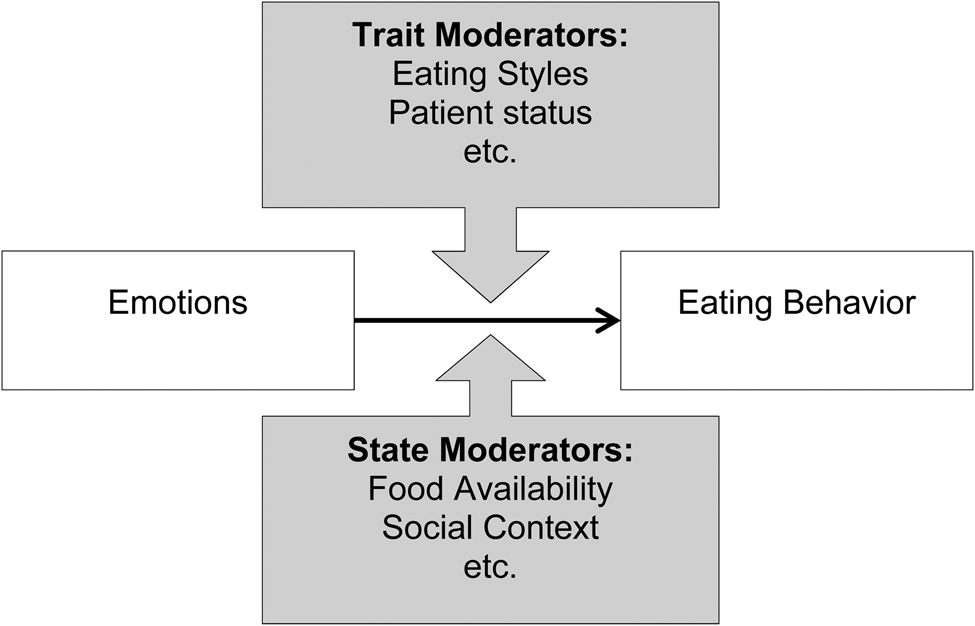
So far we have conceptualised the relationship between negative emotions and eating as a general and fundamental phenomenon (i.e. main effect model), but there are actually marked individual differences (i.e. moderation model). As can be seen in Fig. 2, several trait and state factors moderate the emotional eating relationship, indicative of inter- and intra-individual differences. To illustrate, previous research reported that trait eating styles such as restrained eating, i.e. a tendency to restrict food intake in order to maintain or lose weight, and emotional eating, i.e. an individual's habitual tendency to eat in response to negative emotions, as well as pathological forms reflected by eating disorders (e.g. bulimia nervosa, binge eating disorder) are likely to show different patterns of emotional eating compared to those scoring low on these eating styles and those without an eating disorder diagnosis. To tap into such inter-individual differences, several psychometric questionnaires have been developed which we will review in the next section. Other factors to consider are contextual or state factors. Easier food availability might make emotional eating more likely, e.g. Zenk et al.(Reference Zenk, Horoi and McDonald25) found that the positive relationship between more daily hassles and more snack-food intake was stronger when foods were easily available. Furthermore, social context might influence emotional eating as the social context might alter emotional experiences and determine whether someone overeats or not(Reference Herman26,Reference Higgs and Thomas27) . Similarly, other consummatory behaviour might play a role, in that smoking or excessive alcohol consumption (i.e. unhealthy habits) might be used instead of eating behaviour. To illustrate, we found that in times of high perceived stress, non-smokers report increased food intake whereas smokers decrease their food intake, potentially because they rather rely on smoking instead of eating as a way to cope with the stress(Reference Meule, Reichenberger and Blechert28). Also, emotion regulation might play a role and might affect the emotion–eating link both as trait or state level (thus not displayed in Fig. 2) in that making use of adaptive emotion regulation strategies such as reappraisal or acceptance might dampen the effect of emotions on eating behaviour. To illustrate, Svaldi et al.(Reference Svaldi, Werle and Naumann29) demonstrated that in daily life, the impact of emotions on eating behaviour depends on various emotion regulation strategies.
Moderation model of emotional eating.
Evidence from psychometric research
A range of questionnaires have been developed to measure emotional eating as a trait, personality-like disposition. Questionnaires differ on the types of emotions assessed and the wording of actual eating, desire to eat and eating increase v. decrease. One of the most frequently used measures is the Dutch eating behaviour questionnaire(Reference Van Strien, Frijters and Bergers30) measuring the effect of emotions and emotion-related states (including, e.g. boredom) on desire to eat. The three factors eating questionnaire uses emotional eating items on the ‘disinhibition’ subscale(Reference Stunkard and Messick31). Other scales are the emotional eating scale(Reference Arnow, Kenardy and Agras32), the emotional overeating questionnaire(Reference Masheb and Grilo33), the emotional appetite questionnaire(Reference Geliebter and Aversa34) or the positive–negative emotional eating scale(Reference Sultson, Kukk and Akkermann35). The properties of these scales have been reviewed before, e.g. in Bongers and Jansen(Reference Bongers and Jansen36). One of the newer questionnaires is the Salzburg emotional eating scale(Reference Meule, Reichenberger and Blechert37), developed in our workgroup and we will thus briefly review its measurement concept and initial validation data.
The Salzburg emotional eating scale expands the concept of negative emotional eating in mapping the effects of different basic negative and positive emotions on both over- and undereating to more fully represent the relationship between emotions and eating. It includes subscales for happiness, sadness, anger and anxiety and assesses their effects on increased or decreased food intake. Results revealed that participants reported increased eating when experiencing sadness, unchanged eating when being happy and decreased eating when experiencing anger or anxiety(Reference Meule, Reichenberger and Blechert37). This is generally in line with the model by Macht(Reference Macht21) that postulated differences between the basic emotions. Moreover, we found that patients with bulimia nervosa reported increased food intake in response to all three negative emotional subscales, whereas patients with anorexia nervosa reported increased food intake in response to happiness, and decreased food intake to the negative emotional subscales(Reference Meule, Richard and Schnepper38), validating the clinical usefulness of the scale and documenting the role of psychopathology as a moderator of the interaction between emotion and eating.
Yet, several researchers have questioned the validity of emotional eating questionnaires in their prediction of actual food intake, both in the laboratory and in daily life(Reference Bongers and Jansen36,Reference Adriaanse, de Ridder and Evers39) . Evers et al.(Reference Evers, de Ridder and Adriaanse40) coined the term ‘triple recall bias’ to describe the sources of error in self-reported emotional eating: in order to validly complete such questionnaires, first, a negative emotional state has to be accurately recalled, secondly the respective eating behaviour and thirdly the connection between both. Lastly, respondents ideally aggregate over several such instances to determine a response that is representative to the gross of such situations. Clearly, multiple sources of error are likely to bias the questionnaire scores and might lead to inconsistent effects when actual food intake is assessed as a function of such questionnaire scores. To illustrate, Bongers and Jansen(Reference Bongers and Jansen36) reviewed studies on differences between high and low trait emotional eaters in the laboratory (i.e. food intake in response to a negative compared to a neutral mood condition) and in daily life settings (i.e. food intake in response to daily negative emotions). They found that higher emotional eating questionnaire scores did not consistently predict more eating in the laboratory and daily life. Bongers and Jansen(Reference Bongers and Jansen36) offered several alternative accounts about why some individuals experience their emotions and eating as related. First, self-reported emotional eating might more adequately be interpreted as a more general concept of low self-control and concerns about (over-)eating. Secondly, emotional eating might rather be a retrospective attribution of overeating to negative affect(Reference Adriaanse, Prinsen and de Witt Huberts41), i.e. emotion not being causal for the increased eating but retrospectively ‘constructed’ as a possible reason, or even an excuse for overeating. Thirdly, emotional eaters, when under stress, might overestimate their food intake, despite normal actual intake(Reference Royal and Kurtz42). Thus, individuals with normal consumption misidentify themselves as emotional eaters. Fourthly, self-reported high emotional eaters might be characterised by a generalised learned cue-reactivity in which a variety of cues such as negative and positive emotional states but also the sight and smell of food, the environment one is in or time of day can elicit eating behaviour(Reference Bongers, de Graaff and Jansen43).
Summary and suggestions for future research: psychometric studies
To summarise, measures for assessing emotional eating vary with regard to the emotions included in the questionnaire (e.g. negative v. positive, generic v. specific) and the resultant eating behaviour (e.g. tendency to eat v. actual food intake), potentially contributing to inconsistent results. In addition, self-reported emotional eating suffers from biases (e.g. recall bias) similar to other subjective assessments(Reference Gorin, Stone, Baum, Revenson and Singer44). Future research might thus profit from comparing various self-report scales (as done in e.g.(Reference Braden, Emley and Watford45)) and explicitly testing their ecological validity (as done in e.g.(Reference Mason, Pacanowski and Lavender46)) in addition to doing experimental research under controlled conditions to minimise such biases and enable causal conclusions.
Experimental studies on emotional eating
Laboratory-based studies provide high control over potentially confounding contextual factors and allow for an objective measure of food intake. Causal effects of emotional state are investigated by using induction of emotions in the laboratory and by assessing subsequent food intake. Mood/emotion induction methods vary from more standardised methods such as exposure to movie excerpts, music or vignettes to more idiosyncratic approaches in which participants recount and imagine recent individual emotional experiences or are exposed to stressful evaluated speech tasks such as in the Trier social stress test (see(Reference Allen, Kennedy and Dockray47) for more details). Various approaches have been followed also for assessing food intake. The gold standard method is the so-called bogus ‘taste’ test, where participants are asked to give taste ratings of various foods while actual food intake is unobtrusively measured(Reference Robinson, Haynes and Hardman48). Various factors in the design of a food intake measure need to be considered such as the range and taste quality of offered foods. For example, actual food intake can be assessed in total energy or grams of certain foods offering sweet (e.g. cookies, ice cream, etc.), savoury (e.g. crisps, pretzels, etc.) or both types of foods. In the following, we will review a few exemplar experimental studies to illustrate the laboratory approach to emotional eating.
Experimental research supporting the validity of emotional eating
Providing support for emotional eating in a laboratory setting, Van Strien et al.(Reference Van Strien, Herman and Anschutz49) exposed participants to a negative (via a sad movie in study 1 and a stress task in study 2) and a neutral (via a neutral movie in study 1 and a control task in study 2) mood condition and assessed their subsequent food intake. Trait emotional eating moderated the emotional eating relationship in that high emotional eaters consumed more food on a taste test following the sad movie and the stress task compared to the neutral conditions, whereas low emotional eaters showed the opposite pattern. In contrast to the standardised stressors/induction methods in Van Strien et al.(Reference Van Strien, Herman and Anschutz49), in our study, we opted for an idiosyncratic approach to approximate participants' actual real-life stressors(Reference Blechert, Goltsche and Herbert50). To do so, an idiosyncratic interview first explored a recent situation that triggered emotions such as sadness or frustration(Reference Hilbert, Vögele and Tuschen-Caffier51). In the task, participants were then presented with sentences describing this situation, intending to trigger the respective memories and emotions. Interleaved with the sentences, food and object pictures were presented. This setup allowed for the assessment of ratings of momentary desire to eat for each food image instead of actual food intake, alongside recordings of electroencephalography, and other psychophysiological markers of emotion-related food cue reactivity. The key finding was that trait emotional eating moderated the emotional eating relationship in that high emotional eaters increased whereas low emotional eaters decreased their food craving ratings in the negative compared to the neutral mood condition. This was paralleled by a specific pattern of neural activity that indicated that also more implicit response levels were engaged by the task. Note that we opted against a taste test as a dependent variable and measured desire to eat and psychophysiological responses to food cues instead. These responses are sometimes termed ‘food cue reactivity’, and might be less sensitive to the social desirability effects that impact actual food intake in the laboratory.
Experimental research questioning the validity of emotional eating
Contradicting these results, Braden et al.(Reference Braden, Emley and Watford45) conducted two laboratory-based studies. Study 1 used a mood induction via a sad clip from a drama series and a neutral clip from a nature documentary. Study 2 used a mood induction by a guided imagery exercise to identify and re-experience a recent memory associated with a negative emotion or a neutral route typically taken and assessed food intake in a bogus taste test. The authors revealed that in both studies self-reported emotional eating did not relate to emotional eating in the laboratory. Similarly, Evers et al.(Reference Evers, de Ridder and Adriaanse40) conducted four studies using different mood induction methods, namely vignettes (study 1), film excerpts (study 2), recall (study 3) and providing false feedback (study 4), to induce negative or neutral/positive emotions. They found no increase in food intake in a bogus taste test after the induction of negative emotions compared to the control conditions in self-described emotional eaters regardless of induction method. Such inconsistencies call for systematic reviews that could try to identify boundary conditions within which current theories make valid predictions (e.g. emotional eating only in certain contexts such as being at home or being alone, or only in certain individuals such as patients with an eating disorder). In addition, the meta-analytic investigation could look at quantitative evidence aggregated across studies while also considering the variation of the studies in moderator analyses.
Cardi et al.(Reference Cardi, Leppanen and Treasure22) conducted a meta-analysis on emotional eating in the laboratory which included thirty-three studies with a total of 2491 participants ranging from healthy controls to patients diagnosed with an eating disorder and participants with obesity. They found that overall participants consumed more food under the negative compared to the neutral mood condition (i.e. the main effect). In addition, participant group, mood induction (method as well as the type of mood) and offered food types influenced the strength of the relationship: more food consumption in the negative mood condition was found for participants with pathological eating behaviour (binge eating disorder, subthreshold binge eating disorder and restrained eaters) compared to mentally healthy participants with obesity and healthy controls without obesity. Similarly, Evers et al.(Reference Evers, Dingemans and Junghans23) reported on a meta-analysis including fifty-six studies (twenty-seven of those included in the aforementioned meta-analysis) with a total of 3670 participants ranging from healthy controls to individuals with pathological eating behaviour (i.e. emotional eaters, patients with an eating disorder or participants with obesity). In contrast to Cardi et al.(Reference Cardi, Leppanen and Treasure22), Evers et al.(Reference Evers, Dingemans and Junghans23) found no significant overall effect of negative emotion condition on food intake. Again, mood induction method significantly influenced the results in that participants in the social feedback method consumed less food than participants confronted with aversive social materials (movie clips, vignettes, sad stories). The level of restrained eating was again a significant moderator. Restrained eaters consumed a larger amount of food in the negative compared to the neutral mood condition. However, unexpectedly, trait emotional eating did not exhibit a significant moderation effect nor did eating- or weight-related pathology moderate the emotion–food intake relationship as found by Cardi et al.(Reference Cardi, Leppanen and Treasure22). Evers et al.(Reference Evers, Dingemans and Junghans23) explained the discrepancy to Cardi et al.(Reference Cardi, Leppanen and Treasure22) by (a) additional, new studies, and (b) broader search terms which resulted in a higher number of included studies and (c) by only including studies with a reliable mood induction.
Summary and suggestions for future research: experimental studies
To summarise, findings from experimental settings are markedly inconsistent, but, in line with the individual differences approach outlined earlier, the investigated sample seems to play an important role (e.g. restrained eaters, patients). The two available meta-analyses agree on the influence of the emotion type/mood induction method, consistent with the idea elaborated earlier that specific emotions differ in their effect on eating. More recently, research has shifted towards more naturalistic assessment methods to circumvent the limitations of laboratory food intake assessment which might be problematic as individuals might alter their eating behaviour because of the heightened self-awareness(Reference Robinson, Hardman and Halford52). Furthermore, the highly standardised setting limits possible types of emotions and possible food choices which may not be matched to individual preferences.
Conducting naturalistic research with regard to emotional eating
To remedy these limitations, research has turned to the assessment of emotional eating in naturalistic, daily life settings using ecological momentary assessment (EMA). EMA is the assessment of daily experiences, behaviour, physiological and psychological status as individuals engage in their natural environment(Reference Shiffman, Stone and Hufford53). As an advantage, recall biases can be minimised, whereas ecological validity and generalisability can be maximised. Additionally, apart from between-person relationships, EMA studies allow for assessing within-person relationships. This method of assessment seems especially important with regard to eating behaviours as it helps to sample highly dynamic states such as affect and to determine relationships with other dynamic variables such as eating(Reference Smyth, Wonderlich and Crosby54,Reference Engel, Crosby and Thomas55) . EMA studies afford various sampling schemes: signal-contingent sampling involves prompting participants at specific time points whereas in event-contingent sampling participants self-initiate a survey upon the occurrence of specific behaviour (e.g. eating) or situations (e.g. stress). The frequency of daily assessment on signal-contingent sampling balances participant load with the rate at which the phenomena of interest change (mood, eating or hunger). The naturalistic context allows EMA assessment schemes to measure eating behaviour more broadly (see also(Reference Schembre, Liao and O'Connor56)): information can be obtained on desire to eat ratings(Reference Reichenberger, Richard and Smyth57), snacking(Reference Zenk, Horoi and McDonald25), specific food item intake(Reference Richard, Meule and Reichenberger58), energy density of meals(Reference Kikuchi, Yoshiuchi and Inada59–Reference Burd, Mitchell and Crosby61) but also loss of control over eating(Reference Goldschmidt, Engel and Wonderlich62) or clinical binge eating episodes(Reference Smith, Mason and Schaefer63).
Evidence from naturalistic research
Healthy individuals
Haedt-Matt et al.(Reference Haedt-Matt, Keel and Racine64) asked 239 female twins from a community-based sample about their affect and emotional eating urges once daily for 45 consecutive days and showed that higher negative affect was concurrently associated with higher emotional eating urges, providing support for emotional eating in naturalistic EMA settings. Other studies in mostly healthy individuals showed that negative affect related to greater binge eating(Reference Mason, Heron and Braitman65,Reference Keating, Mills and Rawana66) , more consumption of comfort food(Reference Rodgers, Fuller-Tyszkiewicz and Holmes67) and more consumption of meat/protein(Reference Ashurst, van Woerden and Dunton68). While these studies support the main effect model where emotions are linked with eating regardless of another person-level moderator, we recently found support for an individual difference (i.e. moderation) model: our EMA study in fifty-nine participants involved five daily signals for 10 days on current negative emotional state and eating behaviour(Reference Reichenberger, Kuppens and Liedlgruber69). We aimed at the hedonic component of eating, thus we asked participants to report on the extent to which they ate their last meals out of taste (as opposed to hunger). Results revealed that trait emotional eating moderated the emotional eating relationship in daily life in that low emotional eaters decreased their taste-eating with increasing negative emotions, whereas high emotional eaters increased their taste-eating with increasing negative emotions.
Contradicting these findings, Adriaanse et al.(Reference Adriaanse, de Ridder and Evers39) conducted two studies asking 151 and 184 participants once daily for 7 days to report the amount of their healthy and unhealthy snacks. Whereas trait emotional eating status did not explain unhealthy snacking, self-reported habitual snacking and dietary restraint did explain unhealthy snacking. Various other studies showed that negative affect did not relate to subsequent unhealthy eating(Reference Schultchen, Reichenberger and Mittl70), snack intake(Reference Zenk, Horoi and McDonald25) or subclinical pathological eating behaviour such as eating large amounts of food(Reference Heron, Scott and Sliwinski71), or even related to decreased subsequent energy consumption(Reference Wouters, Jacobs and Duif72) in healthy individuals.
Individuals with an eating disorder
Reviewing thirty-six previous naturalistic studies in a total of 968 individuals with an eating disorder, Haedt-Matt and Keel(Reference Haedt-Matt and Keel73) showed that negative affect precedes binge eating, although post-binge negative affect was even increased. In more detail, negative affect was greater prior to binge eating compared to general levels of negative affect or prior to other regular eating episodes. Diagnosis (bulimia nervosa v. binge eating disorder) accounted for a significant amount of variability in that the relationships were smaller in individuals with bulimia nervosa compared to those with binge eating disorder. Moreover, assessment parameters such as the sampling scheme (signal- or event-based sampling), length and frequency of EMA assessment as well as provisions of binge eating definitions influenced the magnitude of the relationship between affect and binge eating. The majority of EMA studies in patients with an eating disorder demonstrated a positive relationship between negative emotions and binge eating episodes, including also subcomponents such as over- or loss of control eating(Reference Svaldi, Werle and Naumann29,Reference Goldschmidt, Engel and Wonderlich62,Reference Ambwani, Roche and Minnick74–Reference Stevenson, Dvorak and Wonderlich80) . EMA research also investigated the types of negative emotions that precede binge eating: Becker et al.(Reference Becker, Jostmann and Holland81) showed that emotions high on negative valence, arousal and avoidance-relation precede a binge eating episode. In contrast, Berg et al.(Reference Berg, Crosby and Cao82,Reference Berg, Crosby and Cao83) emphasised the role of distinct emotions such as fear, hostility, sadness, but especially guilt in preceding binge eating episodes.
Summary and suggestions for future research: naturalistic studies
To summarise, in healthy individuals, large variability arises, potentially driven by the various assessment strategies for measuring eating behaviour in naturalistic studies. Additionally, lack of standardisation and methodological gold standards in naturalistic studies hinder consensus. Also in children and adolescents, the influence of negative emotions on eating behaviour and dietary intake in daily life remains inconclusive and revealed mixed results (for review see(Reference Mason, Do and Wang84)). However, a systematic review of the evidence regarding emotional eating in healthy adults in daily life remains a worthwhile future direction. In contrast to findings in healthy individuals, results in individuals with an eating disorder seem quite consistent.
Given the complex relationship between emotion and eating behaviour variables as well as their moderators, new statistical avenues (e.g. machine learning approach) are needed that do not assume the linearity of tested variables. Also, as emotions might impact eating with some delay (e.g. next meal or within the whole day), statistical methods with variable time lags might be needed. In the same vein, contextual and situational factors (e.g. eating alone v. in company, food availability) might influence daily emotional eating because of their broader variability in naturalistic settings. Furthermore, subjective and objective data not always correspond so that the integration of objective methods that more accurately characterise participant's emotions and eating behaviour in daily life might be a fruitful future direction (e.g.(Reference Smith, Mason and Juarascio85)). To illustrate, there are attempts to sense emotional states from heart rate variability readouts(Reference Wilhelm and Grossman86) or voice audio recordings(Reference Koolagudi and Rao87). Similarly, objective food intake can be assisted by obtaining the pictures of the food eaten, food lists(Reference Lieffers and Hanning88) or barcode scanning(Reference Illner, Freisling and Boeing89), or can be approached by electromyography of swallowing or chewing behaviour(Reference Blechert, Liedlgruber and Lender90) or bite counters(Reference Dong, Hoover and Scisco91,Reference Thomaz, Essa and Abowd92) .
General discussion/future directions
To conclude, several controversies characterise the literature reviewed earlier. Open questions relate to the type and intensity of emotions that are assumed to cause changes in eating behaviour (see Fig. 3). A general negative affect model would assume that all negative emotions employ similar mechanisms in driving the need for relief and hedonic improvement. A specific emotion model, by contrast would have to distinguish several specific emotion–eating relationships, one for each specific emotion. In addition, it would be worthwhile to consider the inclusion of positive emotions (e.g. see(Reference Bongers, Jansen and Houben24,Reference Evers, Adriaanse and de Ridder93) ) into a broader definition of emotional eating. Another open question is a clearer separation of emotions and stress in their impact on eating behaviour (see(Reference Meule, Reichenberger and Blechert94) for a reasoning on that aspect). Similarly, one has to be aware that eating behaviour can be measured via food craving (i.e. a desire to eat) v. actual food and energy intake likely resulting in different results.
Current controversies and future directions.
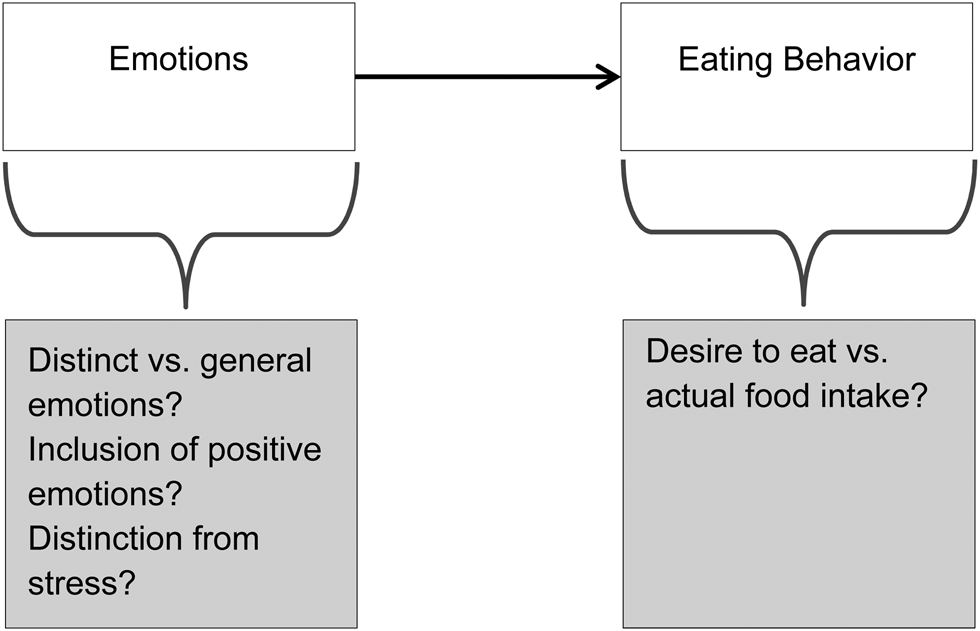
A bundle of potential trait and state moderators have been outlined earlier resulting in a complex emotional eating relationship. Consolidation on a theoretical and practical ground might be helpful to further specify the emotional eating construct and aid in testing different theories or mechanisms (outlined earlier) against each other (e.g. for clarifying the role of trait emotional eating v. trait restrained eating and related affect regulation theory v. restraint theory).
Fruitful future directions show that the combination of various study types might be especially helpful. To illustrate, Smith et al.(Reference Smith, Mason and Crosby95) examined laboratory-assessed impulsivity in combination with daily life relationships of negative affect and binge eating and revealed that greater delay discounting strengthened the relationship between negative affect and binge eating. Similarly, Wonderlich et al.(Reference Wonderlich, Breithaupt and Thompson96) showed that neural responses to food cues moderate the relationship between negative affect and binge eating in daily life. By combining psychometric, experimental and naturalistic settings, the respective design strengths (experimental research, internal validity; naturalistic setting, external validity) can be combined.
Clinical implications
Based on the literature reviewed earlier, interventions using cognitive-behaviour therapy, especially emotion regulation interventions might be fruitful in reducing negative affect, which might in turn reduce the likelihood of overconsumption or bingeing. Recently, research started to use the induction of positive emotions as the method to decrease the likelihood of binge eating and promising results have been obtained. To illustrate, Cardi et al.(Reference Cardi, Leppanen and Leslie97) induced positive emotions in individuals with bulimia nervosa and binge eating disorder and found that these individuals exhibited less negative emotions and consumed less food in a subsequent taste test compared to a neutral condition (similar results obtained by Sproesser et al.(Reference Sproesser, Schupp and Renner98) in stress eating).
Progress in basic research is currently not paralleled by a corresponding progress in intervention development. Thus, while established guidelines for treating emotional eating in eating and weight disorders exist, hardly any innovative non-face-to-face interventions exist. Only recently have researchers proposed to use online interventions or smartphone-based interventions in daily life, lowering the threshold for treatment engagement. To illustrate, the so-called just-in-time adaptive interventions(Reference Juarascio, Parker and Lagacey99) use subjectively and objectively derived data from several state variables (e.g. current emotions, social context) to detect an optimal time point for sending brief therapeutic text messages, potentially adapted to the participant (e.g. with or without eating disorder). Hence, future research on the construct of emotional eating might pave the way towards personalised treatments for eating and weight disorders.
Financial Support
J. B., R. S., A.-K. A. and J. R. were supported by the European Research Council (ERC) under the European Union's Horizon 2020 research and innovation programme (ERC-StG-2014 639445 NewEat).
Conflict of Interest
None.
Authorship
The authors had joint responsibility for all aspects of preparation of this paper.



 Open access

