




Looking for difference amongst a sea of similarity is a recurring theme in Vakutan thinking.Footnote 1
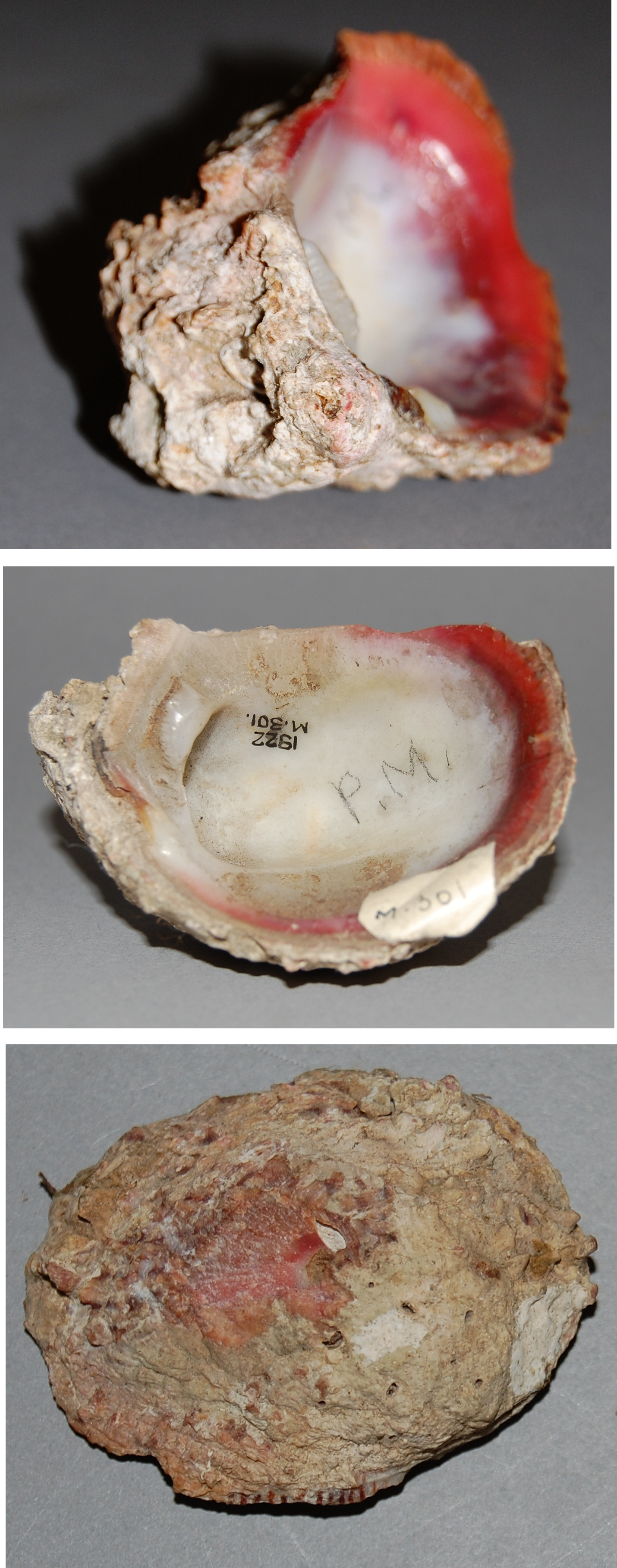
Here is a Spondylus shell that entered the British Museum in the nineteenth century, originally collected by the Valparaiso sailmaker Hugh Cuming somewhere in the Pacific.Footnote 2 And here are three more Spondylus shells from the same museum that Bronisław Malinowski collected in Melanesia during the First World War (Figures 1–5).Footnote 3 Now, in 2021, they are clearly not duplicates of each other: they perform different functions even if they may well have been considered mutually interchangeable with each other when they were first found in the Pacific. Cuming's shell is in the Natural History Museum, an institution that became legally independent of the British Museum only in 1963, and the shells in its collections help malacologists develop taxonomies of molluscs. The animal remains collected by Malinowski are preserved, in turn, in the Department of Africa, Oceania, and the Americas of the British Museum, where they ‘represent the cultures of indigenous peoples’.Footnote 4 They are unique objects whose identity hinges on their intricate connections to the kula, the complex, reciprocal gift exchange of Trobriand Islanders that Malinowski described. Sitting in London, one of the most important centres of twenty-first-century finance and capital, the Spondylus shells of the Natural History Museum and the British Museum are part of a public collection that cannot be sold. They are just as removed from commercial society as Malinowski claimed they were when circulating in Melanesia.Footnote 5
As this special issue reveals, museums are commonly understood to be repositories of unique objects that have been removed from commercial circulation, an exceptional institution in Western capitalist societies. While museums are allowed to buy objects on the market, their ability to dispose of objects is often limited to exchanges for other objects in other public institutions. Among very few exceptions to this rule are duplicates.Footnote 6 If an institution makes the difficult political decision that one of its objects is a duplicate, the object then loses its special status. It can be disposed of through sale, and the museum can become an actor in a free market. As long as Malinowski's three shells are not classified as duplicates, they will retain a status that prevents them from being deaccessioned from the British Museum's collections. My article asks when and how these and other Spondylus shells gained such a symbolic value that prevents them from entering the world of commerce now, and when and how similar Spondylus shells failed to have this value. I use a double conchological and anthropological history to reflect on how Pacific and European societies sometimes turned and sometimes did not turn highly similar shells into unique, inalienable objects that could become part of personal or public collections of high symbolic value.
Two views of the same Spondylus regius specimen, Linnaeus, 1758, registration number NHMUK 1837.12.1.3751. Locality: Sooloo Sea. Ex-Broderip collection number 3751, ex-Tankerville collection number 622. London, Museum of Natural History. Photograph by Kevin Webb, NHMUK Photographic Unit, © Natural History Museum of London.

Three different specimens of shells, Spondylus or Chama. Collected by Bronisław Malinowski near Port Moresby. London, British Museum, Inv. Oc, M. 300–302. © The Trustees of the British Museum, released under a CC-B-NC-SA 4.0 licence.
As the introductory article has explained, the making of duplicates requires much of political effort, given that each and every object in a museum is unique and different.Footnote 7 Yet, arguably, one can also make the claim, as Bruno Latour's actor-network theory did, that things in the world are highly similar to each other (they are duplicates, so to speak), and that it requires extensive work to make them individual.Footnote 8 As Shirley Campbell has argued in a book on the art of Vakuta, part of the region where Malinowski's shells come from, Vakutan artists create unique art objects from a ‘sea of similarities’ with the help of extensive technical and social craftsmanship.Footnote 9 My article therefore uncovers the complex work of a variety of commercial and non-commercial actors that lies behind decisions to make seashells remain either common or unique.
In anthropology, museum studies and the history of science, the dichotomy between gift exchange and commodity exchange is often used to explain how collections and museums come into being. To explore how things enter into and are removed from financial transactions, I therefore follow the circulation of Spondylus shells in the nineteenth- and early twentieth-century Pacific, as well as amongst eighteenth- to twentieth-century European shell collectors and museums of natural history. By examining the multiple valences that these shells accrued in different contexts, I engage with debates that have been at the heart of anthropology at least since Malinowski about the relationship between the financial and moral economies of collecting and exchange. Throughout the past century, the history of anthropology has been one long argument about the difference between gift giving and trade, or, to put it in different terms, about the relationship between the symbolic and financial values that people attribute to things. Anthropologists have debated extensively whether the exchanges of non-Western societies should be discussed as gift economies that could be considered as precursors of capitalism, as gift economies that offer a radical alternative to the travails of Western capitalism, or as actual capitalist economies that just do things a bit differently.Footnote 10 Others have instead argued that a simple binary opposition between Western and non-Western ways of exchange cannot be upheld in light of the actual evidence, which seems to suggest that most societies simultaneously operate with multiple systems of exchange, and develop complex strategies to engage in both financial and symbolic transactions at the same time.Footnote 11 Shells, and especially Spondylus shells, have long been one of the most frequently exchanged objects across the globe. A focus on them therefore offers the opportunity to explore the nineteenth-century prehistory of these important debates, and to see how not only social theorists, but also sailors, shell traders and Pacific islander rulers discussed amongst each other the exchange systems of European and Pacific societies.Footnote 12 The preoccupations and practical entanglements of these actors ensured that they did not all come to the same conclusion: what we find instead is a wide array of perspectives that rivals those mustered by the anthropologists in the century that followed.
In the period under consideration, Pacific islanders and Europeans were both aware of, and interpreted in their own ways, the systems of exchange and collection practised by each other. The practices of exchange and collecting both in Europe and in Melanesia pre-dated the Euro-Pacific encounter, which began to take form in the sixteenth century.Footnote 13 Yet the period of the nineteenth and early twentieth centuries was arguably the crucial moment when contact between Europe and the Pacific intensified, in no small part through the collecting practices of natural history and anthropology.Footnote 14 This contact forced all participants to reimagine in comparative terms the societal organization of their own culture and that of the other, and they all explored, if in highly divergent fashions, the dichotomy of utilitarian commerce and symbolic gifts in these reimaginations. Pacific islanders and Europeans engaged in and theorized practices of exchange that were more analogous than has been acknowledged by earlier generations of anthropologists. As I argue, Pacific islanders did not exist in a pure gift economy and European collectors were not operating within a purely capitalist system of exchange either. The question instead was how one could profitably manipulate the connections between these two semi-autonomous, but connected, systems as the situation needed it. At the same time, I also argue that the way European anthropologists came to theorize the exchange systems of the Pacific was heavily influenced by the distinctions that collectors of natural history employed to distinguish between gifts and commodities.
As this special issue has revealed, making some things unique and turning others into duplicates were a key strategy for those involved in reconfiguring the boundaries between commercial and symbolic systems of exchange. As Catherine Nichols's article in this issue explains, the definition of what counts as a duplicate has always been driven by both political and epistemological concerns, often changing with the twists and turns of history.Footnote 15 In turn, Anaïs Mauuarin and Anne Greenwood MacKinney have shown that duplicates have been just one of the many tools that connect museums to the world of commerce. Throughout history, museums have turned to auctions, to the production and sale of postcards and other photo-reproductions, and to the establishment of museum shops to survive financially and to complement their public funding, and Mauuarin and MacKinney remind us that we need to consider duplicates in the context of these other practices.Footnote 16 Moreover, as Katja Kaiser and Rainer Buschmann argue, we should not simply consider duplicates as purely commercial objects.Footnote 17 Throughout history, they could also be exchanged as gifts on occasion, and they have also been strategically used for a variety of political purposes. In addition, as Buschmann points out, it was not only Europeans who used duplicates for the purposes of doing politics and commerce. When European collectors arrived in New Guinea and created a demand for large numbers of culturally valuable objects, the locals quickly turned to techniques of mass reproduction to cater to the buyers’ needs, producing objects that Western museums then would consider duplicates.
In this synthetic contribution, I provide a broader overview of the larger theoretical and practical contexts of the exchanges in which shells were sometimes made unique, and sometimes a duplicate, offering a somewhat simplistic summary of global events across the time span of more than a century. As I argue, to understand how things stopped being the same, we need to understand how societies reflected on and reimagined systems of exchange at a global level. To understand why the exhibits of European museums have come to occupy a peculiar status, we need to understand the historical relation of those museums to the value systems of societies in Europe and beyond. The first section explains Malinowski's theory of gift exchange in Melanesia and how it emerged in conversation with the influential theories of Ferdinand Tönnies and Emile Durkheim. Moving away from tracing the nineteenth-century intellectual origins of Malinowski, the second section shows how European merchants of natural history in the nineteenth century were deeply interested in acquiring shells in the Pacific to satisfy the demands of European collectors for these objects. Returning to the 1910s, when Malinowski arrived in Melanesia, the third section demonstrates how these nineteenth-century shell exchanges between Pacific islanders and European traders came to shape the performance of kula, the European practices of natural history, and Malinowski's studies. The conclusion reiterates how these divergent practices in the Pacific and in Europe all relied on judgements of differentiating between unique shells and duplicates, and how, as a result, the collecting practices of European museums came to be connected to exchanges in the Pacific, and anthropologists’ theorizations of them.
Malinowski and the progress of civilization
Bronisław Malinowski's groundbreaking Argonauts of the Western Pacific (1922) was one of the most prominent early twentieth-century attempts to understand how cultures that Europeans deemed vastly different from their own world could nonetheless have complex, rational systems of thought and exchange.Footnote 18 Having spent several years in New Guinea and the Trobriand Islands, Malinowski painstakingly reconstructed the circular kula exchange of decorative and polished shells, such as the Spondylus specimens featured in this article, amongst inhabitants of the islands. As Malinowski recounted, when individuals embarked on the kula, they exchanged such ornamental necklaces for similarly impressive armbands, with the necklaces always travelling clockwise and the armbands travelling counterclockwise. Malinowski argued vehemently that this system of exchange was not testament to the irrationality of Trobriand Islanders. The kula was a complex system, enacted by rational actors, whose function was to foster social relations through giving and receiving gifts.Footnote 19
As anthropologists and historians have pointed out since, Malinowski's focus on the kula exchange was as much a reflection of the European academic debates that shaped his intellectual development as an account of how Trobriand Islanders thought about social organization.Footnote 20 Viewed from this European perspective, Malinowski's fascination with the kula could be traced to scholarly debates within economic anthropology on the role of exchange in society. In the wake of Adam Smith, all major nineteenth-century Western social thinkers engaged in debate on how different systems of exchange indicated different levels of civilizational progress, arguing that the emergence of the division of labour was the most significant historic shift. In its simplistic form, often associated with the influential Marxist writer Ferdinand Tönnies, the argument went that, in the Gemeinschaft of early, putatively ‘primitive’ societies, households were self-sustaining units where reciprocal gifts were the most frequent form of exchange, and they served the purpose of maintaining social cohesion. In contrast, the modern, capitalist Gesellschaft was based on the idea that people and households specialized in the production of particular goods, and they needed to acquire all the other necessities of life in an increasingly alienated, money-dominated market economy.Footnote 21 According to this dichotomy, the gifts of a Gemeinschaft were unique objects produced by the free, individual creativity of an artisan, whereas the commodities of the Gesellschaft were mostly soulless, factory-produced objects that were always available in identical multiples. The uniqueness of objects depended on the type of exchange they participated in.
Tönnies's argument was not the only available explanation of how the division of labour affected social organization. For Malinowski, the French sociologist Emile Durkheim's The Division of Labour in Society (1893) was probably more influential.Footnote 22 In his work, Durkheim claimed that modern society was not alienated. On the contrary, it developed a new form of organic solidarity that was a more advanced social structure than the earlier, mechanical solidarity.Footnote 23 Early societies shared a group identity that made them subsume their individuality in the collective. This changed with modernity thanks to the emergence of the division of labour, which made people realize that they did not need to be the same in order to form a social group. Modern civilization, with its specialized roles for everyone, made it possible for people to become individuals while remaining highly dependent on each other nonetheless. Each individual was like an organ in the body, performing a specialized task but unable to function without the cooperation of the other organs. The division of labour therefore performed both economic and social roles at once: commercial exchange did not need to destroy societal ties.
It was against such Durkheimian concepts of the division of labour that Malinowski formulated his conceptualization of exchanges in societies in the Pacific. Malinowski agreed with Durkheim that exchange and the division of labour could perform both economic and social roles at once, but posited the emergence of the division of labour at a much earlier stage in civilization than the French theorist.Footnote 24 Even before embarking on his extensive empirical fieldwork, Malinowski had already been convinced that the ‘totemic division of labour’ amongst the indigenous people of central Australia was the ‘same organization of labour’ as that observed in agricultural societies.Footnote 25 Malinowski acknowledged that the religious nature of this division of labour did not fulfil the locals’ highly rational desire to achieve increased agricultural production, but the lack of success was the only difference. Once this already existing division of labour was channelled towards agricultural development through technological means, it could result in the progress of Australian indigenous peoples, or so Malinowski thought. Argonauts of the Western Pacific was an extension of this argument, buttressed by much evidential detail, showing how the Trobriand Islanders’ exchange of gifts was based on rational expectations of reciprocity. Malinowski argued that this exchange was already an intricate economic system that worked on principles that were comparable to those of modern society, even if it was fundamentally premodern.Footnote 26 Yet even a rational exchange of gifts was based on the idea that the gifted objects were unique. Malinowski described in detail how Trobriand Islanders carefully ranked Spondylus shells based on the intensity of their redness and their size, how they then polished these objects and how they imbued them with ceremonial magic. Since the publication of Argonauts of the Western Pacific, anthropologists have documented in detail how Pacific islanders differentiate and rank Spondylus and other shells based on their colour, size, patina and lustre, and how local craftspeople decorate them through the means of grinding, rubbing, bevelling, polishing and perforating them with cords, drills, adzes and other tools. It is in this highly complex process that the shells turn into highly unique ornamental specimens.Footnote 27
Malinowski's travels thus served to show the universality of the division of labour by proving its presence in premodern societies that were completely different from and, at the deepest level of their functioning, as yet untainted by Western capitalism. This did not mean that Malinowski abandoned a belief in the evolutionary ladder that separated putatively primitive societies from modern civilization. While important segments of the fin de siècle social sciences served to critique modern Western society, comparisons like Malinowski's could still support the idea that there existed clear civilizational hierarchies between different cultures. The argument was only that the division of labour could not be the yardstick of cultural evolution.Footnote 28 And, as anthropologist Annette Weiner pointed out, Malinowski failed to realize that the matrilineal accumulation of inalienable possessions, like European collections of family heirlooms, served a social purpose similar to gift exchange.Footnote 29 Weiner explained that in societies without established, hereditary social hierarchies, whether in Europe or in the Pacific, one could achieve social distinction either by offering particularly impressive gifts or by removing such unique objects from circulation to accumulate them.Footnote 30 The idea of public museums, which preserve the intangible heritage, natures and cultures of the world by accumulating unique and particularly valuable objects, certainly belongs to this type of collection that confers social distinction through accumulation.Footnote 31
In Weiner's account, the activities of Trobriand Islanders were no longer conceived as happening in complete isolation from Western activities, and she discussed in detail how European traders transformed Melanesian culture. The work of Marshall Sahlins and Nicholas Thomas made it even clearer how strongly Pacific societies have interacted with the commercial and colonial networks of Western imperialism ever since the voyages of James Cook.Footnote 32 While Sahlins used these encounters primarily to reveal how indigenous insights can provide alternative, and more complete, interpretations of the processes of economic globalization and modernity, Thomas focused explicitly on how Pacific islander societies operated with multiple systems of exchange, relying on barter and trade for some purposes, and systems of gifting for others, picking one over the other according to local conditions.Footnote 33
A focus on Spondylus shells, the objects exchanged in the kula, confirms Thomas's and Sahlins's claims that intricate ties had developed between Europeans and Pacific islanders by the late nineteenth century. As the next section reveals, these shells were not only used by Trobriand Islanders in this period. They were also intensely discussed and exchanged amongst conchologists in Europe and the Pacific before and at the same time as Malinowski was conducting his anthropological research. The widespread circulation of these shells thus shows that Malinowski's depiction of Melanesia as a place outside Western capitalism's spheres of influence was a rhetorical tool partly to prove the existence of the division of labour in societies firmly outside the West, and partly to emphasize his rejection of diffusionist theories in favour of functionalism, which focused on the internal organization of a society, and not on the effects of external influences.Footnote 34 The Polish anthropologist himself would come to bemoan in his later works that he had neglected the Australian colonial government and trans-imperial networks that influenced life on the Trobriand Islands.Footnote 35 He had painted Melanesia as Europe's double: two societies that were organized on highly similar principles that could nonetheless be posited as completely different. For the early Malinowski, Spondylus shells were the key evidence that honorific, regulated gift exchanges were a rational way of organizing exchange. They also showed that the rules of these gift exchanges precluded the possibility that these shells could become objects of commerce that Melanesians could sell to Westerners. Yet a simple look at the drawers of museums of natural history today reveals that Spondylus shells from Melanesia and the Pacific left local exchanges in large numbers and also circulated in the West. But when these shells entered Western circles, they did not simply enter a free marketplace: gift systems, inalienable possessions and the other relics of ostensibly pre- and proto-capitalist societies were everywhere in Victorian and early twentieth-century Britain, and especially in the world of museums of natural history. As the next section reveals, commercial markets and gift exchange were intimately tied to each other and evolved together throughout history.
Shells in trade
If historians of anthropology have now challenged the idea that gift exchange can be treated separately from trade and commercial transactions in late nineteenth- and early twentieth-century Pacific societies, it is equally important to emphasize that commercialization also had its limits in the Euro-American societies of this and of earlier periods.Footnote 36 Throughout the modern period, even the most successful Western commercial actors realized the importance of symbolic exchanges and the gift economy. As historians have long argued, nineteenth-century English science was distinguished by its amateur status, even if the period also saw the growing participation of artisans and workers in the pursuit of scientific knowledge.Footnote 37 Politeness and gift exchanges were essential to draw boundaries between the higher and lower classes who interacted with each other more intensively than ever before.Footnote 38 Similarly, Lukas Rieppel has argued recently that American oil barons supported palaeontological work and the excavation and collection of fossils precisely to show that they could now ascend above the fray of commerce.Footnote 39 Their support of museums helped them claim that they were cultivated and cultured, and not simply rich. Rieppel's claims echo the turn-of-the-century sociologist Thorstein Veblen's influential Theory of the Leisure Class (1899), which argued that, in an age of crass commercialization, there were good, rational reasons for those in the highest echelons of society to distinguish themselves from the masses by displaying signs of non-commercial interests.Footnote 40 Unlike Durkheim, Veblen did not think that organic solidarity could sufficiently explain how social hierarchies were formed in modern society. If the division of labour explained how most people needed to exchange common commodities in a free market, there was another division between the lower and the upper classes, which could be upheld only by the higher classes’ ostentatious self-removal from commercial society. To retain their hierarchical organization of political power, modern societies had to combine the systems of commercial and gift exchange to accomplish these goals. For Veblen, as for Rieppel, the nineteenth-century cultivation of museums and universities was part and parcel of an overarching strategy by the wealthy to use culture to distinguish themselves from the lower classes, often under the pretext of supporting them through public education.Footnote 41 In a period of mass production, the accumulation of unique and individualized objects, and the support of institutions that held them, allowed wealthy people and museums to rise above the fray and to acquire individual status.
If there was one object that could serve as a symbol of no utility to Westerners, it was seashells.Footnote 42 By the late nineteenth century, a whole industry of naturalist dealers developed to cater for the needs of cultivated gentlemen, aristocrats and the women in their families.Footnote 43 It was the business of these dealers, who handled thousands and thousands of specimens of natural history, to craft these shells as unique objects that could satisfy the collectors’ desire for novelty at the right price. In this moral economy of conspicuous consumption, duplicates posed an opportunity for dealers to cut a profit. When it came to buying, dealers could acquire at a good price what locals considered common and what collectors considered duplicates. When it came to selling, dealers could then always claim that such similar-looking objects nonetheless exhibited some important, individuating variation. Yet, to convince wealthy buyers that their value judgements were right, dealers had to present their judgements of duplicates as scientifically and socially credible. They had to be both financially astute and honest, a combination that required much effort to maintain, as the rest of this section reveals.
The European origins of shell collecting go back at least to the early modern period.Footnote 44 By the nineteenth century, seashells had become such a big business that specialist dealers could make a living from selling them to collectors. In polite circles, the Spondylus shell reigned supreme. There were rumours circulating that some collectors were willing to pay more than three thousand francs (roughly £120) for a specimen of the Spondylus regius, although the actual evidence suggests that most specimens sold for a price between one and two pounds.Footnote 45 As a result, adventurous entrepreneurs began to organize voyages across the Pacific with the primary aim of acquiring shells. One such entrepreneur was Hugh Cuming, whose Spondylus shell now resides in the South Kensington Natural History Museum.Footnote 46 In the 1820s, Cuming built himself a yacht to travel from Chile to Easter Island, Tahiti, the Pitcairns and the Tuamotus to collect whatever seashells he could lay his hands on. During these travels, Cuming made frequent observations of the locals and their customs, exhibiting an eagerness to understand their systems of exchange in detail. This was a mercantile necessity: Cuming could trade efficiently only when he understood the strategies of his partners.
Cuming's understanding of Polynesian political economy differed significantly from Malinowski's interpretation of Melanesian exchange systems.Footnote 47 Eager to present himself as an honourable merchant dealing with similar partners in the Pacific, Cuming used his diary to explore how polite society and market sensibilities were both present in the regions of the Pacific he had visited. He never ceased to express his astonishment how quickly this area had left its ‘cannibal’ past behind, quickly adopting Christianity, Western values and Western commodities.Footnote 48 On most islands, Cuming already found resident missionaries or traders, and he noted how closely Pacific islanders followed developments in French, English and American politics, thanks to their access to news from whalers.Footnote 49 He also recognized that many Pacific islanders were expert travellers themselves, criss-crossing the ocean either on their own canoes or on Western vessels.Footnote 50 Cuming himself voyaged together with hired pearl divers from the atoll of Anaa and received requests from locals who wanted to travel with him to Chile.Footnote 51
In such a modern world, it was obvious to Cuming that the only reason why markets were absent on some islands was political interference from local rulers. As he noted, the ruling classes of Tahiti consisted of a hereditary aristocracy and the sovereign, just like in his native England. Cuming was highly critical of the rule of Queen Regent Teri‘ito‘oterai Tere-moe-moe during the reign of the young Queen Pomare IV. According to Cuming, the queen regent's trade policy was badly influenced by a Bengalese interpreter, who appointed himself mandatory intermediary in the trade between locals and Western visitors, monopolizing business to earn profits for himself and the queen regent. Tahiti was not an imperfect market because it was uncivilized. Instead, foreigners and bad rulers were the reason behind the lack of free commercial exchange, which had functioned well at an earlier point.Footnote 52
If Tahiti showed Cuming how markets did not work, Anaa revealed how the polite and prudent behaviour of a ruler could create market situations that benefited everyone. The local ruler Ari‘ipaea exhibited a ‘great sense of politeness’, a key term for Cuming, whose career was based on providing shells for nineteenth-century English polite society.Footnote 53 As Cuming explained, Ari‘ipaea offered him ten large pearls as a present to reciprocate for Cuming's earlier gifts of cigars.Footnote 54 This was a highly impressive act of generosity in a society where pearls were a key commodity: Ari‘ipaea himself paid pearls in tribute to the sovereigns Pomare III and Pomare IV on a regular basis.Footnote 55 Ari‘ipaea's polite gift of a financially valuable commodity was the act that, according to Cuming, made him not unlike refined British aristocrats.
While pearls, like tobacco, were well-acknowledged items of exchange, Cuming's interest in shells was much less transparent for Anaa society. Seeing Cuming's fascination with these specimens, Ari‘ipaea just smiled and questioned why the English sailor ‘had spent so much time and expence to procure what he thought was entirely useless’.Footnote 56 In Cuming's interpretation of the ruler's words and actions, it was Pacific islanders who were utilitarian, rational actors in exchanges, while Westerners like Cuming fetishized objects that had no immediate use value. Yet Cuming's non-utilitarian interests did not make trade irrelevant. Just as Cuming was happy to profit from marketing collectibles to English aristocrats, so was Ari‘ipaea willing to cater to Cuming's irrational desire to collect in order to make a profit himself. As Cuming recounted, Ari‘ipaea set up an official market for shells in a grove of coconut trees, and even appointed a superintendent to ensure that each local was able to sell their shells in an orderly manner to Cuming, who paid them in tobacco. This market was highly efficient and appeared to profit the locals: Cuming was compelled to buy all the shells, including a large number of common specimens, because, as he realized, the locals would not go off collecting novel specimens until they had sold every single shell they had in stock.Footnote 57
Cuming's own dredging of the sea, his reliance on pearl divers, and his exchanges with Pacific islanders resulted in his accumulation of a magnificent collection of pearls and seashells, including Spondylus shells from a variety of locations. His travel diary emphasizes the large quantity of his acquisitions, listing them either at the genus level or without any identification, with descriptions such as ‘a Trochus, a Nerite, an Arca, two Tellina's and some the genera I did not know and several others’.Footnote 58 While on voyage, Cuming did not worry if his collection included shells that were common, similar or unknown, because the actual status and unique identity of these shells was to be determined later, with the help of scientific experts. As Peter Dance has shown, the nineteenth century saw shell traders work in close collaboration with academic authorities to identify what specimens were especially valuable, both financially and scientifically, because they represented a new species, and which specimens were less valuable because they were variants of already known species.Footnote 59 Thanks to these collaborations, the traders could gain additional profit while scientific authorities could gain access to new specimens that they could publish articles about.
Jim Endersby and Christophe Bonneuil have argued that metropolitan natural historians, especially those working in large institutions, tended to lump together species to reduce their numbers, turning a large number of specimens into duplicates.Footnote 60 As Kaiser shows in this issue, these large museums then also carefully controlled how such duplicates were handled, exchanged and disposed of.Footnote 61 Yet even in the metropolis, there were many entrepreneurial naturalists who hoped to boost their credit by claiming to have discovered as many new species as possible. This is precisely what happened when Cuming finally arrived in London. His trade and credibility were supported by the publication of numerous articles penned by leading natural historians of the era. In 1832, articles about his collection exploded in the Proceedings of the Zoological Society. The Proceedings used Cuming's specimens to fill its pages with material, while Cuming could now claim that his shells and other specimens had been studied by scientific experts such as Richard Owen, William John Broderip, George Brettingham Sowerby I or the British Museum curator John E. Gray, whose activities are also discussed in this issue by Anne Greenwood MacKinney.Footnote 62 An emphasis on individuation was omnipresent in the journal. On 28 February, for instance, when the Zoological Society of London began to have a look at Cuming's shells, they immediately announced the discovery of ‘upwards of four hundred new species’.Footnote 63 And even when they belonged to the same species, Cuming's specimens could still serve the purpose of highlighting variation. When Cuming presented a number of shells that were determined to all belong to the new species Chiton subfuscus, Broderip explained that these duplicates helped establish that the shells could vary in colour from ‘a dark rusty colour with a tinge of lead gray’ to a ‘very dark chestnut brown’.Footnote 64 The shells that Cuming acquired in masses in exchange for tobacco were now novel and unique. They were definitely not common duplicates.
Spondylus shells were no strangers to this collaborative effort at individuation between scientists and traders. In 1847, George Brettingham Sowerby II defined eight new Spondylus species in the Proceedings of the Zoological Society, including the Spondylus cumingii. Nowadays, zoologists agree that the Spondylus cumingii is simply a synonym for Spondylus regius, but Sowerby II was convinced that, while the new species was ‘in some degree resembling S. regius and S. imperialis’, it was nonetheless ‘most remarkable for the beautiful manner in which the arched palmated scales are frilled and fluted at the sides’.Footnote 65 Specimens that zoologists today would consider duplicates became unique: Spondylus regius (the royal Spondylus) was now the Spondylus named after a voyaging sailmaker. Cuming, who kept the type specimen in his own collection (possibly the specimen depicted in Figure 1), received a symbolic honour, which also resulted in boosting the financial value of his holdings. When Cuming died, his most valuable shells were sold to the British Museum for £6,000, which certified their special scientific worth. At the same time, the less valuable and less unique specimens were sold in bulk at a public, commercial auction of ‘duplicate shells’, in lots that were often described simply as ‘trays of shells, various’. For instance, lot 168 contained a ‘Spondylus spectrum, imperialis, gaederopus, and 10 others’, reminding us that even scientists had not managed to make all of Cuming's shells distinctive and special.Footnote 66
Throughout the nineteenth century, the growth of commerce went hand in hand with the growth of non-commercial exchanges in British conchology.Footnote 67 At least within Britain, the natural-history museum and shops of natural history emerged together, as shown by the case of Sowerby I, a friend of Cuming's. The three generations of the Sowerby family ran one of the most important shell shops of the period.Footnote 68 Yet Sowerby I also authored and illustrated groundbreaking works in conchology, edited the Zoological Journal, and would even attempt to gain a professorship and museum directorship in Dublin in the 1830s when his business foundered. His successors, Sowerby II and Sowerby III, relied on similar strategies to maintain a scientific and gentlemanly persona while profiting from the trade. It is no accident that, from the mid-nineteenth century onwards, the Sowerby Natural History Offices were located at 45 Great Russell Street, right in front of the entrance to the British Museum, serving as the commercial doubles of the venerable scientific institution. Sowerby II explicitly played on this theme by advertising his shop with the phrase ‘museums arranged’, meaning that one could buy a whole collection, expertly curated, and not just single specimens. He offered to create for buyers ‘an illustrative Collection of 1000 Species, £50’.Footnote 69 Physical proximity to the British Museum also allowed Sowerby II prime access to scientific expertise. When he received a new shell from Swan river in Western Australia, for example, he was immediately convinced that it was a new species: a Voluta elliotti. Nonetheless, he still went in to the museum to consult Gray to get confirmation from a scientific authority.Footnote 70 While Gray first said that the specimen was ‘quite distinct’, he disappointingly came to the conclusion that it was a variant of Amoria jamrachii.Footnote 71 This did not deter Sowerby, who went on with promoting it as a Voluta elliotti in a short article in order to boost his claim to novelty, using specimens from the British Museum to point out that his specimens could not be considered duplicates of Amoria jamrachii. Characteristically, his article ended with an advertisement that claimed that he had ‘many thousand species’, including ‘volutes’, on sale.Footnote 72 In the nineteenth century, no one would call into doubt that the British Museum was a public institution, and no one would have any doubt that Sowerby's offices were a shop, but there was a revolving door between the two institutions, and it was through this revolving door that decisions about the status of new species, variants and duplicates were made.
Thanks to their able handling of the porous boundaries between commerce and science, the Sowerby family became the go-to figure of wealthy businessmen who wanted to speedily acquire an extra layer of respectability by showing an amateur interest in the workings of science. The Southwark businessman William Sloane Fisher asked Sowerby I how much it would cost to acquire a shell collection that would make him a respectable gentleman:
I am engaged very much in business consequently do not expect that I shall have opportunities to make an advanced progress but I do not feel inclined on that account, to relinquish the desire that I possess of knowing something of objects so varied & beautiful … If able to advance … then shall I have the gratification of knowing that I am better acquainted with subjects which have occupied the greatest minds & am more fit to associate with men who have won the admiration and esteem of their fellow creatures.Footnote 73
The secret of the Sowerbys’ shop was to turn tradesmen into gentlemen at once, or so Sloane Fisher hoped.Footnote 74
Back to Malinowski
By the early twentieth century, when Malinowski did his research, the intricate relationship between conchology and the shell trade had already begun to impact exchanges with shells in Australasia and the Melanesian archipelago.Footnote 75 In the 1910s, the Sowerby family shop was taken over by Hugh Coomber Fulton, trading under the name Sowerby & Fulton and selling Spondylus shells for the price of one to five shillings.Footnote 76 Like Sowerby, Fulton was highly adept at mixing commercial and gift exchanges. As his obituary noted, ‘his interest in shells was a real enthusiasm … On occasion, an intending purchaser might leave with no purchases but gifts of specimens that Fulton knew would interest him. Nevertheless he was a good business man.’Footnote 77
In 1915, as Malinowski was exploring the Melanesian archipelago, Fulton was busy preparing an article that dealt with summarizing all eighty-seven Spondylus species known to him, establishing synonymies in the existing literature, and claiming the discovery of several new species to the list, including a shell that Fulton named Spondylus sowerbyi in honour of his former partner. This was a heroic task because, as Fulton himself acknowledged, ‘the variation in species of this genus in form, colouration, number of ridges and spines is very great’.Footnote 78 After over a hundred years of research, it was still a highly political decision to determine whether Spondylus specimens were unique representatives of a new species or whether they were duplicates. And there were good commercial reasons, at least for dealers, to multiply species as much as possible. Curiously, within a day of the publication of Fulton's article, another new Spondylus species was identified on the other side of the globe, in New Zealand, by the naturalist William Reginald Brook Oliver. Unlike Fulton's publication, Oliver's The Mollusca of the Kermadec Islands (1915) aimed to provide an extensive description of all the shell groups of a particular region.Footnote 79 Oliver identified two species of Spondylus shells on Sunday Island, and claimed novelty for one of them, which he named Spondylus raouliensis. In a world that prized novelty above all, it took a good fifty years for conchologists to finally come to an agreement that Spondylus raouliensis was actually identical to one of Fulton's new species, the Spondylus iredalei. Footnote 80
By 1915, the British Commonwealth's Australian colonial administration was well established across the Trobriand Islands, and Trobriand Islanders actively participated in shell exchanges with colonial agents.Footnote 81 On Kiriwina, the colonial government focused primarily on coconut production, while Woodlark Island, also part of the kula ring, was experiencing a gold rush.Footnote 82 In 1914, the assistant resident magistrate R.G. Bellamy reported that he had imprisoned over 4 per cent of the local population of Kiriwina in the course of the previous year for a variety of infractions, suggesting a high level of aggressive intervention in the lives of the locals.Footnote 83 As Martha Macintyre has argued, such encounters with colonialism thoroughly transformed the way kula was practised in the area.Footnote 84 In turn, the colonial administrators understood well that Trobriand Islanders participated in exchanges that were more complex than pure commerce. In 1914, as Malinowski was travelling to Australia and just before Fulton began his work on classifying Spondylus, the resident magistrate C.B. Higginson described kula in the following terms:
Native trade is, in most instances, confusing, and the manner in which certain articles are sent in the eastern portion of the Territory many miles away, with a desire expressed to the man they are sent to that the sender would like a certain article in exchange, would not, I am afraid, appeal to our commercial tastes.Footnote 85
Unlike Malinowski, however, Higginson did not think that kula operated outside the colonial administration or that it was a purely ritual exchange. His comments were occasioned because kula exchanges had broken down between Tubetube and Woodlark Island, and, significantly, the local plaintiffs decided to turn to the colonial administrators to find a legal solution to this problem. As Higginson recounted, ‘a man of Tubitubi sent two armshells on a trading canoe to a man of Murua [Woodlark] Island asking in return a sailing canoe’, in what appears to be a clear case of proposed barter.Footnote 86 The man on Murua sent a canoe back to Tubetube, but those transporting the vessel delivered it to the wrong person. When the Tubetube person complained, he was sent in recompense a bagi, i.e. the shell necklace exchanged in kula, but as the carriers travelled with the bagi through the island of Dobu, three other people came forward to claim that it actually belonged to them. It was at this point that the bagi was taken by a patrol officer and brought to Higginson, who was saddled with the task of deciding who needed to be recompensed and how. In Higginson's account, some locals attempted to use armshells to engage in barter, and not in gift exchanges. The Murua Islander's return gift of a bagi simply performed the role of compensation by a person who had failed to deliver the promised commodity of a canoe. From Higginson's admittedly highly limited perspective, Trobriand Islanders could use shells both for practical commerce and for symbolic purposes, and the problem was that they themselves could not always come to an agreement on how such a complex system worked, at which point colonial law needed to intervene.
If the agents of empire were deeply fascinated by the exchange systems of the Pacific, the equally intricate Western system of exchanging shells was also well known to the inhabitants of Melanesia by the 1910s. After all, this was a region of the world that was frequently visited by European collectors in search of shells and other objects of natural history and ethnography, as detailed by Buschmann in this issue.Footnote 87 In German New Guinea, the Hamburg South Pacific Expedition of 1908–10 extensively documented the land, freshwater and marine shells present in the region.Footnote 88 Dutch and British New Guinea were similarly explored by a number of collectors, and their shells were described for English audiences in the 1910s by Fulton himself.Footnote 89 Conchologists also visited the Trobriand Islands: the British entomologist William Doherty had already assembled an extensive collection of land shells there in the early 1890s.Footnote 90 Importantly, the interest in shells was not limited to a few naturalists. The Australian colonial administration's major income in Melanesia, on occasion over 90 per cent of all revenue, came from selling licenses to pearl traders, who had a strong interest in shells other than pearls. In 1914 in the Milne Bay area, exports of shells other than the pearl shell amounted to £1,390, some 15 per cent of the pearling exports.Footnote 91 On Kiriwina in 1916, the trader Edward Auerbach also engaged in purchasing Trochus shells from the locals because of the high demand for them in Europe.Footnote 92
Malinowski himself must have been intimately aware of the strong connections between pearl traders and the locals involved in kula. He travelled with Auerbach across the Trobriand Islands in 1916, and he was also friends with the pearl merchant Billy Hancock. His closest associate was probably the French pearl trader Raphael Brudo, with whom the kept in touch for decades after his departure. Brudo was an expert at exploiting the opportunities offered by the commercial exchange of symbolic goods. He acquired and publicly displayed valuable armshells to boost his own status. As a newspaper article later recounted, Brudo purchased a pair of armshells for seven pounds early on, and that pair was still decoratively hanging in his store in 1939, when his son had already taken over the business.Footnote 93 Malinowski himself was alert to Brudo's ability to handle the objects of kula to make a profit. In Argonauts of the Western Pacific, Malinowski argued that Trobriand Islanders never mixed barter and kula together, because the kula was a self-standing system of gift exchange that functioned on its own. Such a separation of barter and kula was necessary for the functionalist anthropologist to claim that exchange and the division of labour on the Trobriands were premodern, and not the result of interaction with Western capitalist commerce. Yet, as his later Coral Gardens came to admit, there were actually strong connections between pearl trade and the symbolic exchange of shells, blurring the strong opposition between commodities and gifts.Footnote 94 Malinowski explained that European pearl traders often employed locals to work Spondylus shells into small discs, which they would then sell to the Trobriand Islanders in exchange for pearls. Symbolic gifts and commerce were just as intimately connected on the Trobriand Islands as in Victorian England, and it required much creative work on Malinowski's part to separate the two. In London and in Melanesia, dealers sold individualized shells to discerning collectors who wanted to increase their social status by accumulating and gifting these. The continuous variance in Spondylus shells was so great that specimens could always be taken to be duplicates of the same species. Yet the craftsmanship of polishing, the art of carving and the judgement of the naturalist made each of these unique. Social theorists have long argued that capitalism led to the mass production of identical objects in an age of mechanical reproduction, a phenomenon they associate with Western society. But there is an equally plausible argument that, both in the West and in the Pacific, the natural world was filled with identical objects everywhere. Uniqueness was something that commercially oriented dealers produced, turning objects into individual collectibles for the sake of status-seeking collectors and of participants in gift exchange.
Conclusion
As the previous sections have shown, the Spondylus shell performed various functions both in Pacific and Western societies, and in both places they played a crucial role in the formation of collections of inalienable gifts. And, as we have seen, the shell exchanges and collections of other cultures were carefully scrutinized by figures such as Ari‘ipaea, Cuming, Higginson and Malinowski, with each coming up with their own interpretation of how symbolic and commercial systems could (or could not) interact to make shells into collectibles. This article therefore reiterates an important point of this special issue: during an age of imperial expansion, Western naturalists, shell collectors and anthropologists often occupied the same colonial spaces and competed with each other for the attention of locals.Footnote 95 The practices of ethnography and natural history were closely related, as Mauuarin and Nichols have also emphasized in this issue.Footnote 96 Arguably, European naturalists and shell collectors began to develop interpretations of Pacific systems of exchange before the arrival of anthropologists on the scene, and their interpretations posited Pacific Islanders as commercial agents and not the relics of a protocapitalist past. Here, my aim was not to prove Malinowski wrong and colonial traders right; instead, the point was to show the division of labour between merchants and anthropologists. Shell traders saw markets wherever they went, in the hopes of exploiting these to their own profit, while anthropologists decided to ignore the effects of Western markets on the societies that they believed to exist outside time.Footnote 97
Shells circulated across the globe between societies that relied on a combination of commercial and gift exchanges everywhere, and they were removed from circulation for similar, symbolic purposes everywhere. Some Pacific islanders saw an amazing opportunity in trading useless shells with travellers such as Cuming. They insisted that Cuming take every single specimen of even the most common seashell, even if these would prove to be duplicates in European parlance. In London, shell dealers like the Sowerbys relied on the strategy of individuation to turn as many of these common shells into unique collectibles to sell them at a profit. The scientific authorities of public museums sometimes went along with such judgements, resulting in the explosion of shell species by the early twentieth century. Yet, in other cases, when the finances of their museums became tightened, they were equally willing to reconsider the status of their collections to find duplicates that one could sell. Throughout the process, the decision to treat an object as unique or as a duplicate was determined by the relevant sociopolitical context.
We started with Durkheim and it is time to return to him. It was arguably Durkheim's take on Adam Smith's concept of the division of labour that spurred Malinowski to begin his explorations of different systems of exchange across the world. For the early Durkheim and for Malinowski, these systems of exchange needed to be kept separate to see how the capitalist division of labour was the key marker of modern society. Yet, as we have seen through the circulation of the Spondylus, commercial and gift exchanges actually co-evolved in Western and Pacific societies, supporting each other's development.Footnote 98 Such an argument about the connections of these two systems makes it very difficult to maintain the proposition that free markets are the distinctive characteristic of Western modernity.
As Cuming argued in his diaries, not necessarily correctly, free markets had actually pre-dated the arrival of Westerners on the islands of Tahiti and Anaa, and the breakdown of commerce was in fact the result of interventions from corrupt political rulers. Economics was always dependent on politics. As Veblen would point out, the division of labour was of limited use when explaining the organization of societal hierarchies. The division of labour was dependent on the larger issue of how society was divided between those who needed to engage in commercial exchange to earn a living and those who could engage in exchanges of gifts, on how some had to end up as dealers of shells and others ended up as collectors of them, on how some shells ended up in a shop and others in a museum, and on how people came to an agreement about what counted as a species and what counted as a variant. The problem of classification was a problem of class.
Acknowledgments
I wish to thank the editors and contributors to this issue, as well as Marisa Bass, Mario Biagioli, Jenny Bulstrode, Freddy Foks, Lukas Rieppel, Edwin Rose, Cristela Garcia-Spitz, Simon Schaffer, Jim Secord, Richard Staley, Claudia Swan, John Tresch and Harriet Wood.


 Open access

