

1. Introduction
Across emerging and developing economies, the energy transition must deliver significant reductions in emissions without jeopardising development gains, energy security or affordability. Recent global assessments emphasise the need for much faster growth in clean energy investment and demand-side efficiency, and stress that institutions, governance and equity are key to ensuring the durability of emissions reductions (IEA, 2023; IPCC, 2023; IRENA, 2023, 2024; REN21, 2024). Europe's “Fit for 55” package demonstrates that market design, infrastructure policy and social measures must be aligned to achieve economy-wide reductions (European Commission, 2021). For environment and development economics, this raises a familiar question: what institutional arrangements allow decarbonisation to proceed without derailing growth, fiscal stability or distributional objectives?
Governments from the Southern and Eastern Mediterranean (SEMed) region are confronted with this issue in a context where decarbonisation, energy security and affordability are closely intertwined. SEMed economies combine exceptional solar and wind resources with heterogeneous grids, limited fiscal capacity and regulatory obstacles, meaning that the quality of rules is as important as technology costs in determining outcomes. Studies of individual countries, including Turkey, Greece, Jordan, Algeria, Morocco, Lebanon, Palestine and Egypt, show how the design of subsidies, tariff reform, licensing, auction practices, rules for prosumers and regional interconnection influence investment, integration costs and distributional outcomes (Frisari and Stadelmann, Reference Frisari and Stadelmann2015; Carafa et al., Reference Carafa, Frisari and Vidican2016; Harajli et al., Reference Harajli, Kabakian, El-Baba, Diab and Nassab2020; Yu and van Son, Reference Yu and van Son2023; Rabhi et al., Reference Rabhi, Regue, Benchatti and Benchatti2024; Abouaiana and Battisti, Reference Abouaiana and Battisti2025; Akiner, Reference Akiner2025; Al-Oun et al., Reference Al-Oun, AlMaaitah and Al-Azamat2025; Georgopoulos et al., Reference Georgopoulos, Papadopoulos, Mitkidis and Giannissi2025; Melikoglu, Reference Melikoglu2025; Terkes et al., Reference Terkes, Toprak, Demirci, Gökalp and Cali2025). More extensive institutional research emphasises the importance of credible commitment and regulatory capacity for private investment and illustrates how price formation and flexibility provision facilitate cost-effective integration within tight fiscal and social constraints (Hirth and Ziegenhagen, Reference Hirth and Ziegenhagen2015; Andrews-Speed, Reference Andrews-Speed2016; Ben Youssef et al., Reference Ben Youssef, Dahmani, Mabrouki, Arouri and Gomes2024; Khaled et al., Reference Khaled, Dahmani and Ben Youssef2024).
Adopting a neo-institutional perspective and using the Just and Sustainable Energy Transition (JSET) framework as an evaluative lens, this article brings these strands together. Laws, regulatory decisions and programme rules are treated as data, with a focus on how they stabilise expectations, reveal scarcity and allocate rights to infrastructure and participation through concrete mechanisms. In particular, we examine how support schemes such as feed-in tariffs (FiT), feed-in premiums (FiP) and contracts for difference (CfD), power purchase agreements (PPAs), tariff and market design, network access and permitting, market openness and prosumer regimes govern cash flow stability, price signals, access to the grid and the participation of households and firms. When read as mechanisms, these choices influence investment, operational and coordination risks, and can be mapped onto JSET's three dimensions: systems performance, collaborative governance and equity.
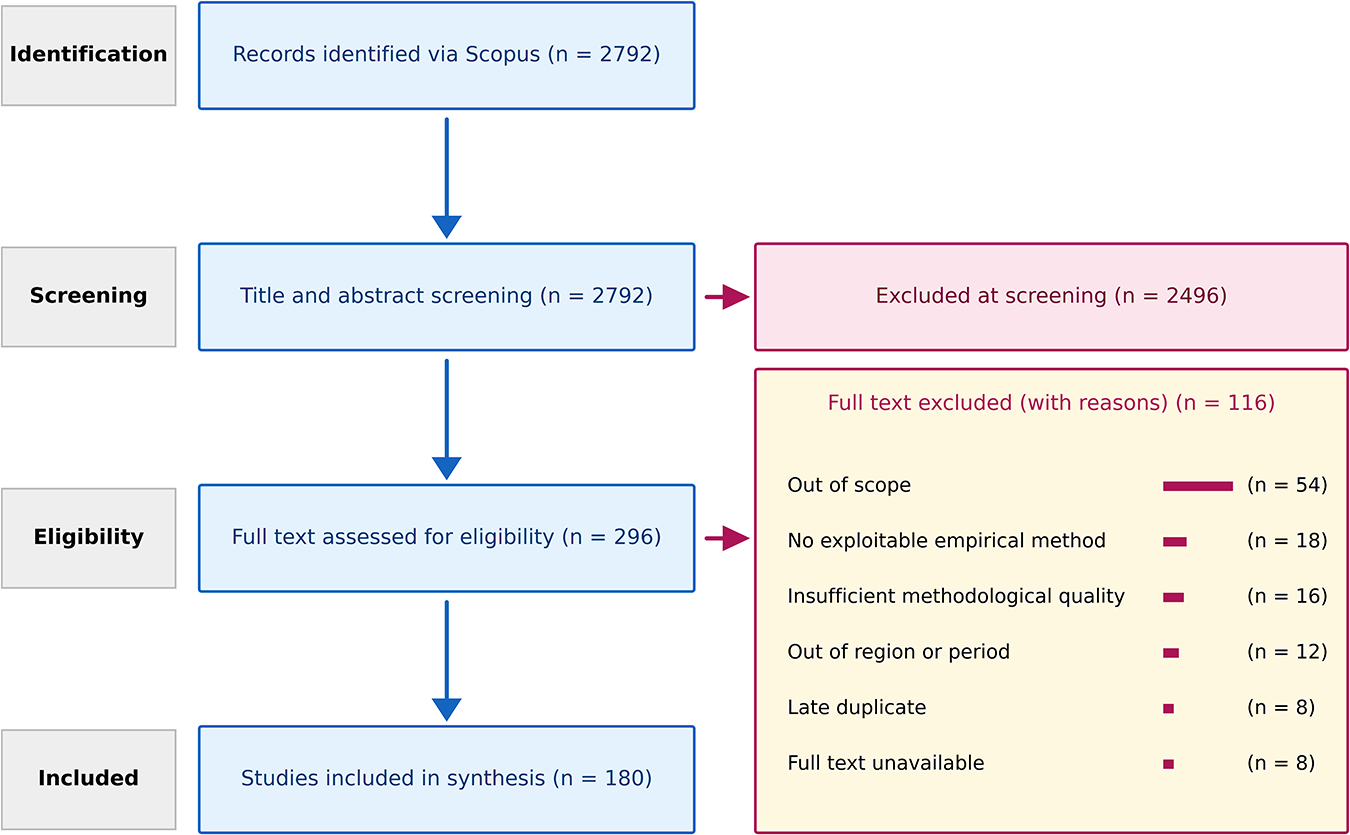
To systematise evidence that would otherwise be fragmented across country case studies and institutional reports, we have built a comparative documentary base for 11 SEMed jurisdictions. After screening 2792 records and assessing 296 full texts, we included 180 studies, yielding 470 unique study-country-family observations between 2000 and 2025. The policies were classified into seven recurring instrument families: competitive procurement, revenue stabilisation (FiT, FiP and CfD), PPAs, tariff and market design, network access and permitting, market openness and wheeling and prosumer compensation. Each instrument family is mapped onto a small set of observable indicators, such as auction calendars, realisation clauses, tariff granularity, balancing products, queue milestones, curtailment compensation and compensation methods and settlement windows for prosumers. This process transforms diffuse legal and regulatory documents into comparable observations, providing a foundation for understanding how institutional choices influence transition pathways.
Conceptually, the paper puts forward a neo-institutional account of energy transitions. It does this by shifting the unit of analysis from instrument labels to risk-related clauses identified in the literature. These clauses include calendars, milestones, indexation rules, queue governance and reconciliation procedures. The paper also maps each instrument family to a single core mechanism and primary JSET pillar. This provides a stable bridge between institutional design and evaluative claims. Additionally, the paper reframes equity as a property of settlements and administrative details. These include metering standards, reconciliation windows, fixed charge treatment and aggregation. It does this rather than viewing equity as a nominal attribute of retail schemes. In terms of its empirical approach, the paper assembles an institutional map of low-carbon power instruments at the clause level across 11 SEMed jurisdictions. It demonstrates where specific combinations of mechanisms have been adopted and how they co-occur across risk environments, as well as how they activate different JSET dimensions. This descriptive, mechanism-based analysis is intended as a structured reading of institutional configurations rather than an impact evaluation.
The remainder of the paper is organised as follows. Section 2 presents the institutional background and the JSET evaluation framework. Section 3 outlines the scope, data, and coding strategy for converting legal and regulatory texts into comparable indicators. Section 4 reports the results, providing a cross-country synthesis of JSET activation across the seven instrument families. Section 5 discusses design principles, complementarities and sequencing in the context of different risk environments. Section 6 concludes by presenting policy implications for SEMed countries and outlining a research agenda for linking institutional change at the clause level to project and market outcomes.
2. Theoretical and evaluative framework
2.1. Institutional foundations
In institutions, how long-lived and asset-specific investments handle uncertainty is determined. They influence expectations regarding future regulations and prices and organise access to shared infrastructures. In the SEMed power sector, three strands of institutional theory are particularly useful: credible commitment and transaction costs; field legitimacy and regulatory capacity; and access and use rights in polycentric settings.
Credible commitment addresses the risk that rules or contracts are changed once investments are sunk. When assets are specific and time horizons are long, predictable and enforceable rules can reduce concerns about renegotiation, discretionary intervention and non-payment by lowering the required premium and the costs of negotiation and monitoring (Joskow, Reference Joskow1987; North, Reference North1990; Levy and Spiller, Reference Levy and Spiller1994; Williamson, Reference Williamson1996, Reference Joskow2008). Commitment is an attribute of the overall institutional setup rather than of any individual clause; consistent rule trajectories, clear mandates, enforceable agreements and reliable payment discipline all restrict ex post discretion.
Field legitimacy and regulatory capacity relate to the application of formal provisions in practice. Organisational neo-institutionalism emphasises how regulatory, normative and cultural cognitive pillars stabilise sectoral designs and confer the authority to impose and apply rules (DiMaggio and Powell, Reference DiMaggio and Powell1983; Scott, Reference Scott2014). In this sense, capacity goes beyond de jure independence and includes analytical competence, monitoring powers, access to information and reasoning practices that make the consistent application of rules more likely.
Access and use rights focus on the rules governing shared infrastructures. In commons governance, Ostrom (Reference Ostrom1990) highlights the importance of clearly specified entitlements and duties, feasible monitoring, graduated sanctions and polycentric coordination rather than a single hierarchy. In power system operation, rivalry over connection, queues, curtailment and balancing responsibilities makes this perspective directly relevant. Observable features include clear access rights and obligations, transparent queue governance with milestones, proportionate sanctioning schemes, and routines that enable regulators, system operators and regional platforms to coordinate.
This three-part analysis considers commitment over time, capacity and legitimacy in the field, as well as the rules in use for shared infrastructures. Key terms and acronyms used throughout the paper are defined briefly in the online appendix.
2.2. JSET as an evaluative framework
The JSET framework links institutional structures with broader transition objectives. It identifies several important dimensions for energy systems, including performance, collaborative governance, equity, well-being, circularity and innovative technological and social regimes (Mebratu and Swilling, Reference Mebratu and Swilling2019). Figure 1 illustrates these dimensions and shows how they are adapted to the SEMed context.
The JSET model for the SEMed region.

In this paper, JSET is employed as an evaluative lens rather than as a composite index. No single score is assigned to countries or policies. Instead, institutional mechanisms are examined through the lens of the JSET dimensions, and statements are made about which aspects of performance, governance, and equity a given configuration appears to support. This maintains focus on mechanisms while connecting institutional detail to environmental and developmental concerns. The energy justice, capability-based and SDG indicator approaches remain relevant; JSET is chosen because it brings together systems performance, governance and equity in a compact structure that matches the questions asked here. Institutional mechanisms are first characterised on their own terms using the above foundations and are then associated with JSET dimensions. Operational details are set out in the ‘Methods’ section.
2.3. Literature positioning and empirical anchors
Policies are organised into seven recurring instrument families and read through these constructs. Empirical work for SEMed and comparator countries documents how these families operate in practice and which risk channels they influence, including evidence on renewable‐energy finance in developing and transition economies (Brunnschweiler, Reference Brunnschweiler2010).
Regarding competitive procurement, studies emphasise the use of auctions as commitment devices when specific design elements such as calendars, eligibility thresholds, price caps or floors and realisation clauses are clearly defined. This is illustrated through the experiences of Morocco, Turkey and Egypt, and through comparative reviews (Carafa et al., Reference Carafa, Frisari and Vidican2016; Yalılı et al., Reference Yalılı, Tiryaki and Gözen2020; Alanzi, Reference Alanzi2021; Sirin and Sevindik, Reference Sirin and Sevindik2021; Ciarreta et al., Reference Ciarreta, Damoun and Espinosa2024; Climatescope, 2024; IRENA, 2025; MIME, 2025; Mathieu and Valenzuela, Reference Mathieu and Valenzuela2025a, Reference Mathieu and Valenzuela2025b). For revenue stabilisation schemes and PPAs, the work carried out in Jordan, Morocco, Egypt and Greece focuses on supporting levels, tenors, indexation, settlement and payment security, and considers these factors in relation to project viability and lender acceptance. The work also involves synthesising clauses accepted by lenders in standardised contracts (OJAR, 2013, 2017a, 2017b; World Bank, 2020; IRENA, 2021, 2021; Abdelrahman et al., Reference Abdelrahman, Abdel-Hamid, Abo Adma and Daowd2022; Đukan and Kitzing, Reference Đukan and Kitzing2023; ALN, 2024; Alrbai et al., Reference Alrbai, Al-Ghussain, Al-Dahidi, Ayadi and Al-naser2025; Bennouna, Reference Bennouna2025; Georgopoulos et al., Reference Georgopoulos, Papadopoulos, Mitkidis and Giannissi2025).
In terms of tariff and market design, case studies and modelling for Egypt, Jordan, Greece and Morocco link integration costs to temporal pricing and the definition, settlement and treatment of balancing and ancillary products, and the management of aggregators and demand response. This is consistent with previous contributions on temporal pricing and flexibility remuneration (Borenstein, Reference Borenstein2005; Joskow, Reference Joskow2008; Hirth and Ziegenhagen, Reference Hirth and Ziegenhagen2015; Zaki and Hamdy, Reference Zaki and Hamdy2022; EgyptERA, 2023; ANRE, 2024; Mahir et al., Reference Mahir, Rochd, Benazzouz and Ghennioui2024; Ioannidis et al., Reference Ioannidis, Georgitsioti, Kosmidou, Zopounidis and Andriosopoulos2025; Petitet et al., Reference Petitet, Ricaud, Felder and Elshurafa2025). For network access and permitting, contributions underline the importance of having rules in place to make connection and interconnection processes more predictable. This includes connection procedures, lead times, queue management, curtailment and compensation regimes and harmonised codes and procedures (OJAR, 2017a, 2017b; JORT, 2020; Karystianos et al., Reference Karystianos, Pitas, Efstathiou, Tsili, Mantzaris, Leonidaki, Voumvoulakis and Sakellaridis2021, 2021; EgyptERA, 2023; EBRD, 2023; Yu and van Son, Reference Yu and van Son2023; Lahmer et al., Reference Lahmer, Chaker and Nedjar2024).
Market openness and wheeling are supported by regional roadmaps and national documents, which demonstrate how third-party access rights, posted wheeling charges, unbundling status and tracking systems can expand the range of counterparties and promote cross-border trade (Karystianos et al., Reference Karystianos, Pitas, Efstathiou, Tsili, Mantzaris, Leonidaki, Voumvoulakis and Sakellaridis2021; Yu and van Son, Reference Yu and van Son2023; ALN, 2024; ANRE, 2024; Zedan et al., Reference Zedan, Nour, Shabib, Ali, Alharbi and Mohamed2024; Hamza et al., Reference Hamza, Brownill, Wilson and Mbiba2025). Evidence from Egypt, Greece and Palestine links prosumer compensation methods, settlement windows, fixed charges and integration fees to adoption, payback times and perceived fairness. Regulator notices specify the clauses on which these outcomes hinge (Biancardi et al., Reference Biancardi, D'Adamo, D'Amore and Moretti2024; EgyptERA, 2024; Zedan et al., Reference Zedan, Nour, Shabib, Ali, Alharbi and Mohamed2024; Abouaiana and Battisti, Reference Abouaiana and Battisti2025; Omar, Reference Omar2025; Simoglou et al., Reference Simoglou, Vagropoulos and Biskas2025).
This body of research informs the definition of instrument families and the risk channels they are expected to influence. It also informs the documentary indicators used in the empirical analysis, which are summarised by family in Table 2 in the ‘Methods’ section.
2.4. Propositions and observable implications
The institutional foundations and empirical anchors result in four operational claims that connect theory to observable features in the legal and regulatory record.
The first of these is credible commitment, which is characterised by predictable and enforceable rules and counterparty behaviour. The documentary record should show a coherent sequence of formal rules, clear allocation of authority, timely settlement or dispute resolution routines, and credible buyer payment discipline. In SEMed power systems, this construct underpins policies that stabilise long-term cash flows and limit discretionary revision.
Secondly, there is price completeness and flexibility. When price formation reveals scarcity at relevant timescales and flexibility is remunerated on both sides of the meter, one would expect to see granular, time-varying tariffs and settlement rules; provisions for demand response and aggregation; and clear definitions and settlement procedures for balancing, ancillary and capacity products. In the SEMed context, expected signs include the presence and granularity of time-of-use or real-time pricing, explicit rules for aggregators, and transparent imbalance treatment.
Thirdly, access and use rights: when the rules governing shared infrastructures specify entitlements and duties, and are supported by feasible monitoring and proportionate sanctions, the formal documents should define connection lead times, queue governance with milestones and criteria, curtailment principles with compensation and dated grid codes and interconnection standards. In SEMed power systems, this translates into observable connection procedures, queue management rules and explicit curtailment regimes.
Fourthly, openness and interoperability: when interfaces are coherently specified, one would expect to see formal third-party access conditions, published access charges with non-discriminatory terms, clear role separation, information-sharing routines and credible tracking frameworks for energy attributes. In the SEMed setting, this includes wheeling arrangements, guarantees of origin, and similar tracking and, where relevant, synchronisation and market coupling procedures.
Table 1 summarises these constructs and their observable implications, providing the conceptual link between institutional theory and the seven instrument families, which structure the empirical analysis.
Constructs, mechanisms, linked instruments, indicators, indicative channels in SEMed and primary JSET dimension

Notes: CG = collaborative governance; SP = systems performance; EQ = equity; FiT = feed in tariff; FiP = feed in premium; CfD = contract for difference; TOU = time of use; RTP = real time pricing.
3. Data and methods
3.1. Scope and corpus
The evidence base covers 11 SEMed jurisdictions: Algeria, Cyprus, Egypt, Greece, Jordan, Lebanon, Libya, Morocco, Palestine, Tunisia and Turkey. Cyprus, Greece and Turkey are included as EU proximate comparators because interaction with the EU acquis and ENTSO-E has influenced the design of markets and network governance in the south of the region. The period 2000–2025 captures the rollout of support schemes, the emergence of prosumer regulations, and the introduction of the first regional market integration instruments.
Eligible sources are peer-reviewed journal articles and reviews in English. In a small number of cases where peer-reviewed work documented the existence of a specific policy instrument without reproducing its design, institutional reports from regulators, ministries or organisations such as IRENA or the World Bank were used, but only if they reproduced or cited primary legal or regulatory texts and met the same evidentiary standards as the academic literature.
The unit of observation is a documented instance of a country-instrument with verifiable information on its existence, design or parameters. Therefore, a single publication may yield several cases if it covers multiple countries or several instrument families. Regional or supranational discussions are attributed to a SEMed jurisdiction only if the instrument can be clearly located in that country. Matrix counts are based on unique study-country-family triplets, meaning each study can contribute to a given cell at most once, while qualitative detail remains available in the narrative. To improve interpretability, the main text uses a classification of instruments into seven families that recurs across the SEMed record. The initial Scopus query returned 2,792 records. Title-abstract screening retained 296 for full-text assessment. Following extraction and a small number of targeted institutional additions, the final set comprises 180 sources and 470 unique study-country-family observations.
3.2. PRISMA workflow and search strategy
The identification and selection of studies followed the PRISMA 2020 guidance for the transparent reporting of review processes (Page et al., Reference Page, McKenzie, Bossuyt, Boutron, Hoffmann, Mulrow, Shamseer, Tetzlaff, Akl, Brennan, Chou, Glanville, Grimshaw, Hróbjartsson, Lalu, Li, Loder, Mayo-Wilson, McDonald and Moher2021). Scopus-led searches are applied to titles, abstracts and author keywords. Query strings require the joint presence of at least one instrument term, one governance or regulatory marker, and the name of at least one of the 11 jurisdictions. The instrument terms cover competitive procurement and revenue support (e.g., auctions, tenders, FiT, FiP and CfD), prosumer compensation (e.g., net metering, net billing and self-consumption), bilateral contracting through PPAs, market design and flexibility arrangements (e.g., time-of-use and real-time pricing, demand response, aggregators, balancing, ancillary services and capacity products), and network access and permitting (e.g., grid codes, interconnection, connection lead times, curtailment and licensing). Openness markers include third-party access, unbundling, wheeling and guarantees of origin. Governance markers include policy, regulation, law, decree, regulator or regulatory authority, tariff or pricing and terms that signal regulatory capacity or independence. Backward and forward citation tracking complement the keyword searches.
The screening process has two stages. In the title-abstract screening stage, the combined instrument and governance rule are applied and studies focusing solely on engineering without an institutional lever are excluded, as are macro commentaries without an operational mechanism, editorials and items outside the scope of the 11 countries. The full-text assessment then checks for verifiable institutional content, coding the country, instrument family, authority or scheme label and at least one concise indicator, where reported. Duplicates are removed using standard checks on the Digital Object Identifier or DOI, title and reference information, and then cases are aggregated. When a publication covers several jurisdictions or instrument families, the coding is expanded accordingly, but the matrix still treats each study–country–family combination as a single observation. Figure 2 summarises the PRISMA stages and associated counts.
PRISMA flow of the review process.
3.3. Mapping instruments to mechanisms and JSET
For each case, the coded corpus records the country, the instrument family, and a small set of documentary indicators that reveal the underlying institutional mechanism. Policies are classified into seven recurring instrument families: competitive procurement; revenue stabilisation through FiT, FiP and CfD; PPAs; tariff and market design; network access and permitting, including interconnection; market openness and wheeling; and prosumer compensation. This taxonomy reflects the empirical foundations in the literature and the constructs in Table 1, providing a consistent framework for interpreting diverse sources.
The documentary record is interpreted based on the core institutional mechanism and primary JSET dimension associated with each family. Competitive procurement, revenue stabilisation schemes and PPAs are read as commitment devices that stabilise cash flows and limit discretion and are therefore linked to collaborative governance. Tariff and market design are interpreted in terms of price completeness and flexibility and are linked to systems performance. Network access and permitting are read through access and use rights and are also linked to systems performance. Market openness and wheeling are understood in terms of interoperability and are linked to collaborative governance. Prosumer compensation is considered a form of participation and distributional design and is therefore linked to equity. These pairings, as defined in Table 1, remain consistent across countries and over time.
Once a publication is retained at the full-text stage, we identify the relevant country–family instances and extract indicators such as multi-year auction calendars, price caps or floors, realisation milestones and penalties, support levels and tenors, indexation and settlement rules, connection lead times and queue milestones, curtailment regimes and compensation provisions, time-of-use or real-time pricing granularity, definitions and settlement of balancing, ancillary and capacity products and prosumer compensation. We also consider metering and reconciliation rules, including the treatment of fixed charges. When journal articles refer to legal or regulatory acts without reproducing the text, then dated decrees, regulatory decisions, grid codes and official manuals are used to anchor these indicators. This means that the same indicators can be applied consistently across countries and families, even when primary sources summarise rather than quote operative clauses.
Table 2 gathers, by instrument family, the core mechanism, the primary JSET pillar, the main indicators used in coding and the typical types of sources from which these indicators are drawn. It complements Table 1 by showing how abstract constructs translate into concrete variables and by making the evidentiary basis for each family explicit.
Mechanisms, indicators and sources by instrument family

3.4. Coding process and quality assurance
Screening and coding follow a structured procedure designed to make institutional mapping transparent and reproducible. The author team carries out title–abstract screening and full-text assessment using a shared protocol and templates that specify the inclusion and exclusion criteria, the seven instrument families, the indicators associated with each family, and the mechanism-pillar pairings in Tables 1 and 2. Prior to coding the entire corpus, a pilot subset of studies spanning multiple countries and families was jointly coded to refine indicator definitions and standardise the interpretation of family boundaries and mechanisms. The resulting codebook describes the indicators to be recorded for each family, the types of sources from which they can be reliably extracted, and examples of borderline cases.
During the main coding phase, each included study is read in full and coded according to the country or countries it covers, the instrument families it documents, the relevant authority or scheme label, the presence or absence of family-specific indicators, and any provisions relating to equity, affordability or inclusion. To ensure consistency, a subset of cases is double coded independently by two team members, paying particular attention to agreement on family assignment, the presence of key indicators, and identification of the primary JSET pillar. Any discrepancies are discussed until consensus is reached, and the codebook is updated with clarifications and examples where recurring sources of disagreement arise. This iterative process aligns coding practices and limits idiosyncratic interpretation. Although formal inter-coder reliability statistics are not reported, this process still ensures consistency.
This database is designed for interpretive analysis. It documents the presence of institutional mechanisms and clause types in different countries and instrument families, as well as the patterns of co-occurrence across risk environments. However, the coded data alone are not used to estimate the effects on investment volumes, prices, emissions or distributional outcomes. When later sections state that specific mechanisms reduce or address particular risks, these statements refer to channels documented in the empirical literature on institutional design and energy transitions. They also consider the associations suggested by the patterns in our mapping. This approach is used instead of making new causal estimates.
4. Results
4.1. Evidence coverage and patterns
The 2000–2025 corpus comprises 470 unique study–country–family observations across 11 SEMed jurisdictions. Coverage is uneven and reflects both reform trajectories and publication intensity. Together, Egypt and Turkey account for close to two-fifths of all observations, followed by Morocco, Algeria, Greece and Jordan. Tunisia, Lebanon, Cyprus, Palestine and Libya are documented less frequently. These figures describe documentary visibility rather than policy performance.
Similarly, instrument coverage is concentrated. Tariff and market design accounts for just over a third of observations, followed by revenue stabilisation schemes, network access and permitting. Prosumer compensation, competitive procurement, market openness and PPAs are less common, but present in most jurisdictions. The leading country-family clusters follow this pattern: tariff and market design in Egypt, Turkey and Morocco; network access and permitting in Egypt, Turkey and Morocco again; prosumer regimes in Egypt, Jordan and Morocco; auctions in Morocco, Algeria and Turkey; and openness and wheeling in Egypt, Morocco and Tunisia mainly. Figure 3 summarises these patterns across country–family cells, while the indicators in Table 2 show how each family is observed in practice.
Evidence coverage by country and instrument family, 2000–2025.

4.2. Mechanisms across instrument families and risk pathways
Rather than ranking countries by performance, the institutional constructs and JSET dimensions indicate where specific mechanisms have been deployed and how they relate to the risk channels identified in the empirical literature.
The first pattern concerns commitment at the award and contract levels. Revenue stabilisation schemes, competitive procurement and PPAs represent a total of 136 observations, primarily in Turkey, Algeria, Greece, Morocco, Egypt and Jordan. Case studies show that clearly specified calendars, screening thresholds, calibrated caps or floors, realisation milestones and penalties, and explicit clauses on tenor, indexation, settlement and payment security are associated with lower perceived risk and smoother project delivery. The mapping shows where such clause combinations appear in the SEMed institutional record and how often they co-occur within country-family cells.
A second pattern relates to price completeness and flexibility. Tariff and market design is the largest category in the corpus and is particularly prevalent in Egypt, Turkey and Morocco. Indicators such as time-of-use pricing and real-time pricing, demand response and aggregation rules, and the definition and settlement of balancing, ancillary and capacity products correspond to channels through which temporal price formation and flexibility remuneration reduce integration costs. SEMed applications, such as hourly market coupling simulations, aggregator models and peer-to-peer trading studies, illustrate how these tariff and product features influence bids, imbalance exposure and the viability of new business models. The mapping shows where such designs have been codified and how far they extend beyond pilot schemes.
A third cluster relates to access and usage rights for networks. Network access and permits appear in 81 cases, primarily in Egypt, Turkey and Morocco. Relevant indicators include connection timelines, queue governance with milestones and sanctions, explicit curtailment principles and compensation, and dated grid codes and interconnection procedures. These mirror the conditions under which the existing rules are expected to reduce queuing and uncertainty surrounding curtailment. These rules are made citable in regulatory documents and official journals, and the coding records where such provisions are in place and how they coexist with other families.
Market openness and wheeling form a smaller, yet distinctive, group of 27 observations. These cases promote interoperability through formal third-party access, non-discriminatory wheeling charges, unbundling status and guarantees of origin or related tracking systems. Sometimes, these are complemented by synchronisation and market coupling procedures. Legal and regulatory syntheses for Morocco, and regional reviews for the Mediterranean, highlight how such arrangements can broaden the set of counterparties and support cross-border trade. The mapping shows where openness provisions have moved from policy statements to operational rules.
Prosumer compensation regimes offer an alternative perspective on how equity and participation are encoded. The 53 observations in this category are concentrated in Egypt, Jordan and Morocco. The indicators cover the compensation method, export ratios or caps, metering and reconciliation windows, fixed charges, integration fees and any explicit affordability safeguards. Studies of households and small businesses document how these parameters influence payback times, adoption decisions and perceived fairness. Within the institutional map, these elements appear as the equity-facing side of settlement and participation design, rather than as standalone social measures.
A final observation concerns how instrument families co-occur within countries. Egypt combines dense tariff and market design signals with documented grid access rules, PPAs and openness. Turkey couples an extensive revenue stabilisation record with tariff and market design and access provisions. Morocco exhibits a cluster of auctions, tariff design, network access and openness. In these cases, the mapping reveals configurations in which commitment devices, system rules, access provisions and, in some instances, prosumer regimes coexist within the same institutional environment. These configurations are important for debates on the environment and development because they address financing, integration and participation risks that would otherwise result in higher tariffs, fiscal pressure or delayed access.
4.3. Cross-country synthesis and JSET linkages
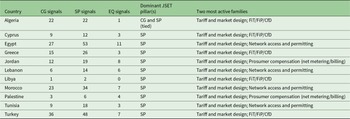
The JSET lens enables the institutional map to be interpreted in terms of system performance, collaborative governance and equity. Figure 4 illustrates JSET activation by country and family, while Table 3 summarises the number of signals associated with each pillar and the two most active families for each jurisdiction.
JSET activation by family and country.

Country-level JSET synthesis

In nine of the 11 countries, systems performance signals dominate, typically where tariff and market design are paired with network access and permitting. Egypt is an example of this pattern, with most of its documentary signals falling under systems performance. Time-differentiated pricing, settlement rules and grid access provisions are documented in regulatory texts and applied studies. Similar configurations can be seen in Turkey, Morocco, Greece and Tunisia, albeit with different balances between tariff design and access rules.
Collaborative governance signals are most visible where commitment devices and openness measures sit alongside system rules. Turkey combines a substantial record of feed-in tariffs, premiums and contracts for difference with evidence on operating rules. Morocco aligns auctions and PPAs with product design and emerging openness provisions. In such cases, the coding reflects governance arrangements that stabilise expectations, clarify roles and encourage participation among counterparties.
Although there are fewer equity-related signals overall, they stand out in specific contexts. Most equity-coded observations originate from prosumer regimes in Egypt and Jordan, as well as from designs in Palestine and Lebanon. The underlying clauses address issues such as enrolment criteria, the valuation and reconciliation of excess generation, the handling of fixed charges and the existence of any affordability safeguards. Case studies of rural Egypt and of Palestinian and Greek consumers demonstrate how such design choices influence the distribution of benefits, costs and perceived fairness.
Across jurisdictions, the JSET synthesis therefore highlights different emphases. Some countries exhibit dense systems performance signals alongside more limited collaborative governance or equity elements. Others, such as Morocco and Turkey, combine systems and governance mechanisms more evenly. A smaller group, including Jordan and Palestine, displays relatively higher equity shares because prosumer design occupies a larger part of the documented institutional space. These patterns reflect how rules have been written and adopted. Read alongside the constructs and empirical work discussed earlier, they suggest that transition pathways in the SEMed region primarily rely on system-oriented reforms and that governance and commitment have also been brought to the fore, with distributional and participation concerns beginning to be addressed through concrete settlement design.
5. Discussion
The mapping illustrates the distribution of institutional mechanisms linked to specific risk channels in the empirical literature across SEMed jurisdictions and their co-occurrence. In debates on the environment and development, three themes are central: policies operate through concrete risk channels rather than labels; clauses that stabilise commitments and rules that govern system operation frequently appear together; and equity at the retail interface largely takes the form of settlement and reconciliation design.
5.1. Mechanism-first policy design
Consistently, arrangements that specify calendars, eligibility thresholds, realisation milestones and penalties, support levels and tenors and indexation rules and disciplined settlement are associated with lower premia, smoother project delivery and fewer disputes. The constructs in Table 1 and the indicators in Table 2 organise these clauses into five mechanisms: credible commitment; price completeness with flexibility; access and use rights; interoperability; and prosumer participation. The mapping shows where these mechanisms are present in the SEMed record and in which instrument families they appear.
From this perspective, instrument labels are secondary. For example, evidence from auctions emphasises that risk premia and commissioning rates respond to public calendars, calibrated caps or floors, and enforceable realisation clauses, rather than the name of the scheme. Similar arguments apply to feed-in schemes, contracts for difference and standardised PPAs, where tenor, indexation and payment security are central, as well as to tariff design, where the granularity of time-of-use or real-time pricing, and the definition of balancing products, condition integration costs. For environment and development debates, this mechanism-first view matters because it links decarbonisation, capital costs and fiscal risk to a small number of clause types that can be observed and revised, in line with recent work on low-carbon transitions and fiscal instruments in developing economies (Adom et al., Reference Adom, Amuakwa-Mensah and Karimu2025; Kayongo and Knedlik, Reference Kayongo and Knedlik2025).
5.2. Complementarity of commitment and system rules
A second theme is how commitment-oriented instruments and system operation rules come together. Countries that make extensive use of revenue-stabilising schemes and competitive tenders, such as Turkey and Morocco, tend to have more extensive provisions relating to tariffs, market design and grid access. Egypt combines a sizeable tariff and market design footprint with codified access rules and documented PPA practices. In these jurisdictions, the indicators associated with credible commitment, price completeness and access rights are active simultaneously, suggesting that reforms have been conceived as packages that address several risk channels at once, rather than as isolated interventions.
This co-distribution is consistent with the mechanisms documented in the literature. Studies of bankability emphasise that risk reduction instruments deliver lower premiums when settlement, tenor and indexation are clearly specified. Meanwhile, work on market design highlights that temporal pricing and flexibility products reduce integration risks when investors can rely on stable, long-term arrangements. Similarly, auction studies point to the interaction between rule clarity at award and credible follow-through during implementation. In development terms, such packages are important because they address financing, integration and reliability risks jointly, which would otherwise result in higher tariffs, fiscal pressures or delayed access for firms and households.
5.3. Equity as settlement design
A third theme concerns the encoding of equity and participation. Although there are fewer equity-coded signals than systems performance or collaborative governance signals, they have a clear profile. They mainly arise in prosumer compensation regimes and a subset of retail and access rules. The underlying clauses specify who can enrol, how exports are valued, which metering and reconciliation windows apply, how fixed charges and integration fees are handled, and whether safeguards address affordability or the protection of vulnerable users. In Egypt, for instance, regulatory notices define integration fees and net metering amendments in a citable and enforceable manner. Case studies in Jordan, Greece and Palestine document how compensation methods, export accounting and settlement windows influence adoption, payback times and perceived fairness.
These findings resonate with broader discussions of energy justice, giving them concrete institutional meaning. In the settings covered here, equity in the power sector emerges less from the labels of schemes than from the design of settlements. The combination of metering standards, reconciliation periods, export valuation and the treatment of fixed charges determines how costs and benefits are shared between prosumers and non-prosumers, as well as whether aggregation can transform distributed resources into a flexibility asset. This is where the equity pillar of JSET comes into play: the same institution that allocates rights and duties over shared infrastructure or defines tariff structures can either facilitate or hinder inclusive participation, depending on how its settlement rules are written. Equity thus becomes something that can be observed, compared and adjusted through changes at the clause level, rather than only being invoked at the level of high-level objectives.
6. Conclusions, policy implications and research agenda
6.1. Conclusions
The analysis clarifies how policies for low-carbon power in the SEMed region are encoded in laws, regulatory decisions and programme rules, and how particular combinations of clauses align with the risk channels highlighted in the empirical literature. The institutional map focuses on the design of instruments rather than their realised impacts: it shows where specific features are present and how they are combined across 7 instrument families and 11 jurisdictions.
Three regularities stand out. Firstly, the content of rules is more important than their labels. Across competitive procurement, revenue stabilisation schemes and PPAs, country studies repeatedly emphasise multi-year calendars, pre-qualification thresholds, realisation milestones and penalties, support levels and tenors, and indexation and disciplined settlement rules as the clauses that shape perceived risk and delivery. Secondly, commitment-oriented instruments and system rules tend to occur together; jurisdictions with extensive auctions, feed-in schemes or long-term contracts also tend to have more fully specified tariff structures, balancing arrangements and grid access rules. Thirdly, equity appears in the fine structure of settlement and participation; equity-coded observations mainly arise in prosumer compensation regimes and a subset of retail and access provisions, which define who can enrol, how exports are valued, how fixed charges and integration fees are handled, and whether there are affordability safeguards.
For environment and development economics, these regularities demonstrate how institutional design choices in SEMed power systems can influence investment risk, integration costs and distributional outcomes. These are patterns in institutional design and documentation rather than new impact estimates on investment, prices, emissions or poverty.
6.2. Policy implications
The patterns documented in the institutional map and the associated literature suggest a policy approach that starts from binding constraints and the range of existing mechanisms, rather than instrument labels alone. The resulting implications are indicative: they combine observed configurations in SEMed countries with channels of effectiveness identified in previous empirical studies.
Where queues, connection delays and curtailment repeatedly arise, the rules in use for network access provide the most immediate solution. Jurisdictions that specify connection timelines, queue milestones with proportionate sanctions, curtailment principles, compensation methods and versioned grid code procedures provide clearer signals than those where such provisions remain implicit. Consolidating access and curtailment rules is a natural first step, with time-differentiated pricing and flexible products being introduced once access becomes predictable.
In settings where bankability is the main concern, experiences in Turkey, Morocco and Egypt highlight the role of revenue-stabilising instruments combined with clear settlement clauses. Programmes that pair tenders or long-term contracts with explicit realisation milestones, calibrated penalties, indexation rules and payment-security provisions resemble schemes associated with lower risk premia in the literature. This suggests that adapting these clause combinations matters more than introducing new labels.
As integration and balancing costs rise, tariff and market design arrangements become more relevant. Countries that have implemented meaningful time-of-use or real-time pricing, clearly defined and settled balancing and ancillary products, enabled aggregation and demand response, and clarified imbalance treatment have a richer set of tools with which to manage variability than countries that rely on flat tariffs and ad hoc curtailment.
In systems where counterparties remain limited and participation is largely restricted to incumbents, openness and wheeling provisions become essential. Posted non-discriminatory access terms, credible tracking of attributes and, where relevant, synchronisation or coupling procedures, widen the scope for bilateral contracting and cross-border trade. As the mapping shows, such frameworks are more advanced in some jurisdictions than in others, with openness measures tending to appear where basic system rules are already in place.
For countries where distributional and participation aims are important, prosumer and retail design offer a concrete way to implement changes. Equity-relevant cases emphasise compensation methods, export accounting, metering and reconciliation windows, fixed charges, and safeguards for vulnerable users in some instances. Treating equity as a property of settlement design helps to identify clauses that can be revised to balance affordability, participation and cost recovery, which is a central concern from an environment-and-development perspective.
6.3. Limitations and future research agenda
The analysis is limited by the available evidence. As it relies on the documentary coding of statutes, regulatory decisions, programme rules and peer-reviewed case studies, we can observe the existence of specific clauses and how they are combined. Quantitative effects on investment, prices, emissions and distributional outcomes, however, are not considered. Differences in enforcement, grid conditions, demand structure and political economy also mean that similar wording can have different outcomes across countries. The next logical step is to link changes to specific clauses to project-level realisation, financing conditions and dispatch outcomes. It would also be beneficial to combine household- and firm-level data with detailed prosumer and retail rules in order to quantify distributional effects. Comparative qualitative work on enforcement and regulatory capacity would help to explain the circumstances in which formal rules translate into credible commitments.
Supplementary material
The supplementary material for this article can be found at https://doi.org/10.1017/S1355770X26100448.
Competing interest
The author declares none.






 Open access

