

The Mountain Sacrifice theme is well-known in Moche iconography (AD 200s–800) as one of its core rituals. A figural vessel featuring a seated lord (sometimes called the Platform Deity / Dios A / the solar divinity) with figures sitting between five peaks provides one of the best-known examples. On the central peak, a sacrifice (the Bent Person) commonly leans face down with long hair. A blood trail flows from the loose locks of hair to the vessel’s base, where the same or a different individual (the Dead Person) lies. These core elements inform most interpretations of this scene. Less-studied variations include a deity seated in a cave (the Cave Deity) with a pair of flanking figures known as Wrinkle Face / Dios F and the Iguana (Benson Reference Benson1972; Berezkin Reference Berezkin1980; Golte Reference Golte2016; Larco Hoyle Reference Larco Hoyle2001; Zighelboim Reference Zighelboim1995).
Although important in Moche ideology, mountainside sacrifices are exclusive to figural vessels, and each features only a single moment. In contrast, the better understood narrative scenes in iconography come from fineline paintings. These painted scenes on the surfaces of pots often have a standardized canon of characters and fuller sequences of actions. Fully painted narratives provide a ready didactic aid for audiences. One pot representing a specific act requires a specialized interpreter or a tradition so well-known that a single action is enough to communicate its meaning.
Scholars have examined these vessels both in isolation and vis-à-vis possible archaeological analogs (Bourget Reference Bourget2016; De Bock Reference De Bock2005; Franco Jordán Reference Franco Jordán2012, Reference Franco Jordán2015; Franco Jordán et al. Reference Franco Jordán, Quiroz Moreno, Huamanchumo and Gutterez2013; Golte Reference Golte1994, Reference Golte2016; Makowski Reference Makowski, Giersz, Makowski and Przadka2005, Reference Makowski2022; Tufinio Reference Tufinio, Uceda, Mujica and Morales2004; Valladares Huamanchumo Reference Valladares Huamanchumo2012; Wiersema Reference Wiersema2012; Zighelboim Reference Zighelboim1995). However, there is no precise sequence for the different actions depicted. In this article, I contend that these vessels encoded a particular mythological narrative comparable to the major themes identified in fineline ceramics (Donnan and McClelland Reference Donnan and McClelland1999; McClelland et al. Reference McClelland, McClelland and Donnan2007; Quilter Reference Quilter1997). I argue that patterned variations in gestures and actions across extant mountain vessels permit a reconstruction of this specific narrative and its prescribed rituals. Furthermore, I propose that while some depict mythological and cosmogonic events, others depict their ritual reenactments.
I support my interpretation of the narrative sequence with ethnohistorical and archaeological interpretations of mountains and caves across the Andes. Furthermore, my examination of the Mountain Sacrifice can inform research on mountains and caves in Latin America and, particularly, the extensive literature from Mesoamerica (see below). Archaeological surveys and limited excavations reveal the importance and distinct meanings of mountainside rituals compared to Moche pyramids (see Swenson Reference Swenson2004, Reference Swenson2024). While comparisons with field data are essential, the scope here focuses on iconography, and future work will better relate these datasets. Indeed, it currently proves impossible to identify a single mountain as “the” mountain depicted, and perhaps it is a mythic place.
Background
The Moche period witnessed the rise of a shared ideology and artistic style that spread across north coastal Peru from the Piura to the Nepeña valleys (Figure 1). Drawing from Chavin, Cupisnique, Salinar, and Gallinazo religious traditions, Moche communities created a new style and politico-religious institutions. Imagery in this new tradition emphasized a central narrative of ritual battles leading to sacrifices on adobe huacas, a pantheon of fanged deities and feasting events. These rituals appear to relate to the management of society’s cosmic and social order, as well as the possible regulation of agricultural and environmental cycles (Benson Reference Benson2012; Hocquenghem Reference Hocquenghem1987; Uceda et al. Reference Uceda, Morales and Mujica2016).
Map of major Moche ceremonial centers. (Color online)

The spread of this style and its ideological narratives of elite power led scholars (Bourget Reference Bourget2016; Donnan Reference Donnan1978; Larco Hoyle Reference Larco Hoyle2001) to propose that the Moche formed a single state centered at the site of Huacas de Moche in the Moche Valley. It seems more likely now that different north coast polities adopted Moche ideology at their elite centers, with significant variation in ritual practice across the larger region (Castillo Butters and Uceda Castillo Reference Butters, Jaime, Castillo, Silverman and Isbell2008; Quilter and Koons Reference Quilter and Koons2012). Two major spheres of interaction included the northern and southern Moche, divided geographically by the Paijan Desert between the Jequetepeque and Chicama valleys. While the northern Moche contained multiple major centers in each valley, the southern Moche appears to have been more politically and ritually subject to Huacas de Moche. Two general chronological systems emerged for each sphere, with much greater temporal overlap than previously thought based on recent Bayesian analysis (Koons et al. Reference Koons, Rizzuto, Trever, Boswell, Bazán Pérez, Ynoñán and Prieto2024). The northern Moche chronology consists of three stylistic phases: Early Moche (AD ∼400s–600s), Middle Moche (AD 350–650, not sampled in the latest analysis), and Late Moche (AD ∼600s–800s). For the southern Moche, there are five stylistic phases: Moche I/II (AD 400s–500s), Moche II/III (AD 200s–800s), Moche III (AD 300s–700s), Moche IV (AD 500s–700s), and Moche V (AD 600s–800s).
As mentioned, Moche ideology centers around a pantheon of deities and cosmogonic narratives of ritual combat to gather warrior sacrifices (Donnan Reference Donnan1978; Larco Hoyle Reference Larco Hoyle2001). However, whether such pots refer to multiple historical events or just one remains unclear. Ritual implements and costumes in tombs match key deities, while generations of elites became their incarnate extensions and dedicated their huacas to reenacting these scenes (Alva and Donnan Reference Alva and Donnan1993; Benson Reference Benson2012). Even more, clay Wrinkle Face masks also exist with eyeholes and string holes for living actors to wear (for an in situ example from Huaca Colorada, see Donnan Reference Donnan, Bourget and Jones2008; Swenson Reference Swenson and Eeckhout2020).
The ceramics also depict clear hierarchies between elites and attendants or deities associated with mountains or the sea. It thus deserves mention that most Moche iconography was dedicated not to everyday life but to mythic stories and the ritual programs that sustained them. As such, these ceramics depict relations between deities, elite imitators, humans, and a landscape alive with wak’as or apus, animated ancestral mountains, rivers, and stones. Polities adopting the Moche ideology made local pots featuring this iconography. Artistic representations of Moche mythology and ritual signified a shared regional identity.
Methods
Moche researchers have developed two main approaches, leaning heavily on structuralist, art-historical, direct historical, and cultural-historical perspectives. The Thematic Approach, developed by Donnan (Reference Donnan1975), emphasized grouping similar scenes and characters. However, these groupings did not explain the exact actions or the interconnections between scenes. Quilter (Reference Quilter1997) subsequently developed the Narrative Approach to link different stories into a single thematic narrative. Inspired by Weitzmann’s (Reference Weitzmann1947) analysis of Classical Mediterranean art, Quilter recognized that each theme reflected a larger narrative and sometimes condensed multiple events into one image, conflating their order. For example, in the cases below, the pots often show the same sacrifice at the top and bottom of the vessel. The first indicates the initial sacrifice, and the second the subsequent fall from the mountain.
Others, like Weismantel (Reference Weismantel2021), Trever (Reference Trever2022, Reference Trever, Watts and Knappett2023), and Swenson (Reference Swenson2024), have adopted more phenomenological, semiotic, ontological, and anthropological approaches based on their fieldwork and broader discussions on Andean history and society. While citing the Moche-specific art historical approaches, these readings have emphasized contributions to broader theoretical discussions.
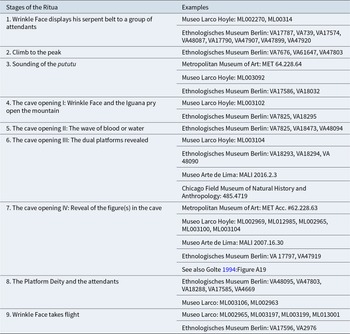
Interpretations of mythic themes from Moche iconography have relied heavily on fineline paintings rather than the figural ceramics. In the following, I will attempt a combined approach focused on a loosely structuralist reading of a corpus of figural pots. My sample comprises 60 vessels from the Museo Larco Hoyle, the Museo Arte de Lima, the Ethnologisches Museum Berlin, the Metropolitan Museum of Art, and the the Field Museum of Chicago (Table 1). Most existing examples come from poorly documented or early excavation contexts from the nineteenth to the mid-twentieth centuries (Donnan and McClelland Reference Donnan and McClelland1999; McClelland et al. Reference McClelland, McClelland and Donnan2007). The earliest examples date to the Moche III, and they become more common by the Late Moche or Moche IV/V phases (AD ∼500–850; see Bourget Reference Bourget2016). Geographically, most originate from the southern Moche sphere (Benson Reference Benson2012; Golte Reference Golte2016).
Mountain Scenes Sampled.

Building on Berezkin (Reference Berezkin1980), Zighelboim (Reference Zighelboim1995) offers one of the most comprehensive studies of these vessels, which he divides into two clusters:
1. Single-peaked mountains
a. Wrinkle Face and the Iguana occupy different positions on the mountain, holding sticks above or below one another.
b. The Cave Deity alone or with Wrinkle Face and the Iguana: a figure sits inside a cave while Wrinkle Face and the Iguana hang on the side of the cave’s exterior.
2. Multipeaked mountains (three to seven peaks)
a. Dual Platform Deity: two figures sit on platforms beside the Bent Person sacrifice.
b. Platform Deity: a figure sits on a platform surrounded by attendants.
c. No deity: only a mountain with the Bent Person sacrifice and attendants.
d. Fauna and flora: only plants and animals on a mountain.
Zighelboim’s (Reference Zighelboim1995) analysis interpreted a sequence beginning with a ritual battle, followed by a race by the captives up a mountain, where some sacrifices occurred. The ritual continues with a race of captives to the plaza at Huaca de la Luna and their sacrifice, as shown in the Presentation Theme (or Sacrifice Ceremony). While influential, his interpretation may conflate two separate rituals, a mountain sacrifice and a huaca sacrifice, and the latter may have involved different deities.
De Bock (Reference De Bock2005:41) grouped mountain scenes into three categories:
1. The Mountain God is engaged in assorted activities on top of a mountain.
2. The Mountain God and the Iguana flank the sides of the peak.
3. Scenes of a seated Mountain God surrounded by other human figures and a sacrificial victim on one of the peaks.
He presents a limited sequence where a Mountain God (Wrinkle Face) (1) conducts activities on top of a mountain, (2) scales down the mountain, and (3) attends the sacrifice event. This sequence appears plausible. However, it does not account for many variations of the above scenes.
Beyond these typologies, scholars have attempted to identify the figures in these scenes by their outfits (e.g., Berezkin Reference Berezkin1980; Golte Reference Golte2016; Lieske Reference Lieske1992; Makowski Reference Makowski2022). Most notably, Golte (Reference Golte1994:59) attempted to fit the mountain scene within his broader reconstruction of Moche iconography. He creates a grand mythology wherein the divinities of the night or the moon (Dios B, C / Moon Goddess) overtake the solar or day divinity (Dios A). The former imprisons the solar divinity and unleashes supernatural monsters and animated objects to attack humans and consume sacrificial victims. Dios F, or Wrinkle Face, fights these supernatural monsters and frees Dios A from a hidden cave through the medium of human sacrifice. The two allied deities restore the cosmic balance by capturing and making peace with the opposing divinities. Dios A then ascends back up to the sky on a ladder. Makowski (Reference Makowski, Giersz, Makowski and Przadka2005, Reference Makowski2022) alternately suggests that the Cave Deity and the Platform Deity embody a character he calls the Owl Warrior or lord of the earth. Furthermore, he suggests that another character called the Marine Twin occupies the cave with him, unseen, and that they reveal themselves to sit on a mountain throne.
The various mountain sacrifice scenes often lack standardization of clothing and accessories. While important, the debate over the exact identities of these figures falls beyond the scope here. Despite variations in the appearance of some of these actors, patterned gestures and the similar positioning of figures can still clarify underlying narratives and sequences of mythic events.
I draw inspiration from Quilter’s (Reference Quilter1997) Narrative Approach and Zighelboim’s (Reference Zighelboim1995) foundational work to interpret this set of imagery. Golte’s (Reference Golte1994, Reference Golte2016) and Makowski’s (Reference Makowski, Giersz, Makowski and Przadka2005, Reference Makowski2022) grand mythical cycles are also an influence. However, their interpretations rely on contrasting assumptions and would require extensive contextualization. While I will reference them, they require another contribution to discuss adequately. Furthermore, I emphasize greater incorporation of the archaeological and ethnohistorical record, following Bourget (Reference Bourget2016) and Trever (Reference Trever2022, Reference Trever, Watts and Knappett2023).
The Moche Mountain Sacrifice and Cave Emergence Sequence
In reexamining the major variations, I have grouped this sample of 60 pots into 10 core clusters of actions by the recurrent actors:
1. Wrinkle Face displays his serpent belt to a group of attendants.
2. Climb to the peak: Wrinkle Face and the Iguana climb the mountain with attendants.
3. Sounding of the pututu: Wrinkle Face sounds his pututu next to a depiction of a human sacrifice (referred to as the Bent Person by Zighelboim Reference Zighelboim1995).
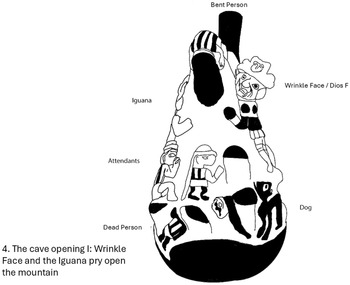
4. The cave opening I: Wrinkle Face and the Iguana pry open the mountain.
5. The cave opening II: The wave of blood or water: the Bent Person sacrifice bleeds a wave of blood.
6. The cave opening III: The dual platforms revealed: the emergence of steps and platforms on the mountain.
7. The cave opening IV: Reveal of the figure(s) in the cave: the flow recedes, and a Cave Deity emerges.
8. The Platform Deity and the attendants: a seated deity, with hands clasped, looks up to the sky. While the Bent Person continues to bleed, a second figure or the same figure falls to the bottom (referred to as the Dead Person by Zighelboim Reference Zighelboim1995).
9. Wrinkle Face takes flight: Wrinkle Face either rides a bird or transforms into one before he takes flight from the mountainside.
10. The cycle continues: The human reenactment of this story.
Before describing this sequence, it is important to clarify the possible parable behind this mythic event. Golte (Reference Golte2016) provides a persuasive interpretation based on several rare fineline images. In his interpretation, the night divinity (Dios B) and his allies take over the universe, plunging it into darkness and imprisoning or forcing the solar or day divinity (Dios A) into hiding. Whatever the circumstances, the mountain scene begins with a figure hidden in the mountain. Meanwhile, Wrinkle Face, the Iguana, his dog, and attendants arrive.
Wrinkle Face Displays His Serpent Belt to a Group of Attendants
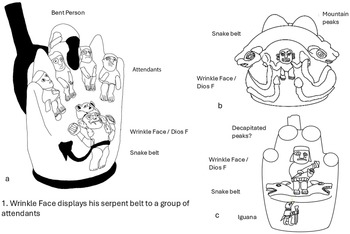
The clearest examples depict “Wrinkle Face” surrounded by attendants, with his bicephalous snake belt stretched out in each hand (Figure 2). In one example, the Iguana also arrives holding a walking staff. He almost always wears a feline headdress, not his half-disc headdress, which he acquires later in his series of mythical battles (Golte Reference Golte1994, Reference Golte2016; Hocquenghem Reference Hocquenghem1987).
Part 1. Wrinkle Face displays his serpent belt to a group of attendants: (a) Museo Larco ML002270; (b) Museo Larco ML00314; (c) Ethnologisches Museum Berlin VA17787 (illustration by Christopher Wai).

In presenting his bicephalous snake belt, it grows to encircle the mountain and helps him climb it. The prostrate image of the Bent Person (sometimes several) leans over the central peak. Though this figure could depict a woman, their exact identity remains unclear. Iconographically, defeated male warriors, as Bourget (Reference Bourget2016) has noted, have short and long haircuts, whereas women often have long braids. Only long-haired sacrifices are in mountain sacrifice scenes, suggesting a specific differentiation from most male warrior sacrifices. Gender attribution fundamentally changes the interpretation, especially given the profoundly gendered associations of Andean cosmology and social organization (Bourget Reference Bourget2010; Weismantel Reference Weismantel2021). Weismantel (Reference Weismantel2021:148) more broadly suggests that they are an “earth being of ambiguous gender.”
In some variations, the sacrifice is missing, or Wrinkle Face undertakes a different action, such as holding weapons or crops in their hand. Nevertheless, the presence of a mountain is constant, and the overall ceramic often takes a mountain-shaped form. These images should not be confused with another category of similar images where a fanged figure holds up the night sky instead of a mountain (see Golte Reference Golte2016).
Climb to the Peak
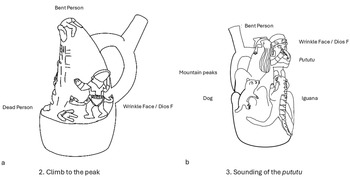
Wrinkle Face and the Iguana then ascend the mountain and pray to the Bent Person or the mountain itself (Figure 3). In many cases, the snake belt, now enlarged, supports Wrinkle Face’s and the Iguana’s feet on the side of the mountain. Here, it appears that the Bent Person, now decapitated, has a stream of blood spreading from the neck. Sometimes, there is a head below the mountain, and the Iguana holds a tumi knife.
(a) Part 2. Climb to the peak, and (b) Part 3. Sounding of the pututu. Ethnologisches Museum Berlin VA7676, and MET Acc. #64.228.64 (illustration by Christopher Wai).

The Iguana is thus responsible for the decapitation rather than Wrinkle Face, suggesting that while often an attendant figure (e.g., Benson Reference Benson2012), he assumes a primary role here. Furthermore, there is no actual image of the sacrificial act. Perhaps the Moche did not show this due to taboo. While important, some scenes may have been too sacred or dangerous to represent. For example, the murder of Osiris, the Egyptian god of the underworld, is absent from iconography despite the imagery of events preceding and following his violent death (Fowles Reference Fowles and Fogelin2008).
Sounding of the Pututu
Once at the summit, at least two examples show each figure engaged in prayer or supplication. Wrinkle Face blows on a pututu or shell horn, while the Iguana, in turn, prostrates before the sacrifice with palms clasped in a prayer gesture (Figure 3).
Wrinkle Face playing the pututu highlights an important instrument with great cultural continuity, particularly with depictions in earlier Chavin/Cupisnique (∼1200–430 BC) iconography and artifact assemblages (Herrera-Wassilowsky Reference Herrera-Wassilowsky2010; Kolar Reference Kolar2019). However, the pututu differs from the panpipes he often plays in other iconographic instances (most notably shown in vessels celebrating his heroic acts or dancing with the dead). As such, the pututu and the panpipes may signify different events. The panpipes, a terrestrial instrument made of wood or clay, may have played an important role in rituals related to death and the underworld (see Benson Reference Benson2012; Bourget Reference Bourget2016; Golte Reference Golte1994). Meanwhile, the pututu, a marine instrument made from a large Strombus shell, may have sounded into being the river-like blood that flows from the sacrifice in the following scenes.
Golte (Reference Golte1994) hypothesizes that Wrinkle Face defeats the Strombus monster, a large bicephalous feline or snake with a Strombus shell body, before ascending the mountain (Supplementary Figure 1). This order of events presents the intriguing possibility that Wrinkle Face defeats and transforms the shell of this monster into the pututu. Wrinkle Face (and his snake belt), after all, could shape-shift into everything from plants to birds of all sizes and is partnered with an iguana. He is sometimes even depicted sitting inside a Strombus shell in surviving ceramic sculptures or presenting piles of hand-sized shells as offerings in the burial theme (e.g., Bourget Reference Bourget2016:Figures 5.33–5.39). Strombus snails also have a transformative quality in their size variation, and only the largest shells were suitable as trumpets.
The Cave Opening I: Wrinkle Face and the Iguana Pry Open the Mountain
Following these gestures of prayer, the sounding of the pututu, and the unseen sacrificial act of decapitation, Wrinkle Face and the Iguana stand astride the mountain (Figure 4). Meanwhile, one attendant holds or continues to play the pututu, and another interacts with the decapitated head of the Bent Person or clasps their hands in front of another peak.
Part 4. The cave opening I: Wrinkle Face and the Iguana pry open the mountain. Museo Larco ML003102 (illustration by Christopher Wai).

The Cave Opening II: The Wave of Blood or Water
The sacrifice appears to bleed and transforms into a wave of blood alongside the emergence of steps underneath (Figure 5). Perhaps this transformation into a rolling wave represents the sacrifice falling from the mountain. Wrinkle Face and Iguana often stand astride or pull apart the mountainside to reveal this flow of blood or water and the steps.
Part 5. The cave opening II: The wave of blood or water. Ethnologisches Museum Berlin VA7825 (illustration by Christopher Wai).

The Cave Opening III: The Dual Platforms Revealed
The gushing wave then reveals a series of dual-facing steps and a stepped platform. Occasionally, a rectangular enclosure also emerges (Figure 6). Wiersema (Reference Wiersema2012), following Tufinio (Reference Tufinio, Uceda, Mujica and Morales2004), suggests that this represents Huaca de La Luna’s Plaza 3C. It is possible that this platform replaced the figure in the cave to establish Huaca de la Luna as a simulation of the original mountain opening (see next step). These vessels with the enclosure also clearly and consistently depict the tumi knife used to decapitate the Bent Person in the hands of the Iguana.
Part 6. The cave opening III: The dual platforms revealed: (a) Chicago Field Museum of History 485.4719; (b) Museo Larco ML003104 (illustration by Christopher Wai).

The Cave Opening IV: Reveal of the Figure(s) in the Cave
Alternatively, the flow recedes and reveals a fanged figure in a cave. He is distinct from Wrinkle Face, depicted again on the mountain alongside the Iguana. At least one vessel features an exaggerated sculpture of the sacrifice overhanging face to face with this Cave Deity (Figure 7). Several instances present the Cave Deity chewing coca and holding a spatula and lime container. In contrast, others have clubs painted next to him, though he is never armed.
Part 7. The cave opening IV: Reveal of the figure(s) in the cave: (a) Museo Larco ML003104; (b) MET Acc. #62.228.63; (c) Museo Larco ML012985 (illustration by Christopher Wai).

Some rare variations also characterize the corpus of mountain vessels. In one example, snails cover the mountain peak, thus combining this scene with other isolated representations of snails on a mountain. In others, the snake belt rings around the top of the seated figure, creating a cave-like opening.
The Cave Deity’s identity has been subject to debate, in particular, between Golte’s (Reference Golte2016) Dios A / solar divinity and Makowski’s (Reference Makowski2022) Owl Warrior or lord of the earth. It is difficult to resolve this question, but it is worth noting that this figure exhibits the most variation. The figure variably resembles a fanged figure with a half-disc headdress, a man with a mustache and beard, or an amorphous zoomorph.
The Platform Deity and the Attendants
A fanged figure with a half-disc headdress sits on a dais with the figure of the Bent Person high on a peak above him (Golte Reference Golte2016; Makowski Reference Makowski2022). This Platform Deity could represent Wrinkle Face, donning the headdress of Dios A as a testament to his freeing the divinity (Golte Reference Golte2016). However, besides the headdress, there is little connection between this seated Platform Deity and Wrinkle Face. This figure wears thicker clothing than Wrinkle Face’s tunic with inverted pyramids and lacks his snake belt (Figure 8). More likely, it may be the Cave Deity, perhaps Dios A (Golte Reference Golte2016), looking up to the sky in prayer, or blessing Wrinkle Face as the latter departs from the mountain on a bird (see below). This gesture parallels the initial clasped hands of the Iguana as it greeted the Bent Person sacrifice. As with many mythologies worldwide, the inconsistency between clothing may reflect a combination of the original myth and its reenactments (Bell Reference Bell2009; Eliade Reference Eliade1961).
Part 8. The Platform Deity and the attendants. Ethnologisches Museum Berlin VA48095 (illustration by Christopher Wai).

Regardless, an attendant often stands next to the Platform Deity, one arm folded and another gesturing to his left toward another figure holding a four-legged animal. This animal may represent a young llama (see discussion), a deer, a fox, or Wrinkle Face’s dog, who appears throughout the sequence. Most attendants sit between the peaks with their arms at their sides, though some figures have their arms crossed.
A sequel may also exist in that some variations show the same five individuals on top of the five peaks rather than seated in between. However, some depictions show them bent over the peak but alive and facing the Platform Deity, whose head is turned upward in these variations. Perhaps they, too, were sacrificed, but this remains uncertain. Two other rare variations show the Iguana or the dog/deer at the bottom of the mountain like the Dead Person (Zighelboim Reference Zighelboim1995). Perhaps the entire cast was sacrificed at the end of this story. Alternatively, they may be the result of artists playing with the story. Moche artisans could remix or subvert existing canons and add humor (Bourget Reference Bourget2010; Donnan and McClelland Reference Donnan and McClelland1999). As the Iguana is the sacrificer, there is a certain irony in becoming the sacrificed.
Some unusual variations show the same moulded pot painted with snails between the attendants and a mass grave of skeletons at the pot’s base (Bourget Reference Bourget2016:263, Figure 5.112). Bourget (Reference Bourget2016) notes that other pots have snails as mountain peaks, suggesting that snail hunting was akin to human combat and sacrifice.
Wrinkle Face Takes Flight
Following Golte (Reference Golte2016), Wrinkle Face departs on a bird, leaving behind the Iguana, his dog, an unidentified bird-headed attendant, and the Bent Person (Figure 9). This scene features a fanged figure with a half-disc headdress on the back of a bird (perhaps a condor) surrounded by mountain peaks. Occasionally, the aforementioned characters are also shown watching him. Alternatively, a bird stands alone, though the snake belt wraps around the mountain. Again, despite the debate over the half-disc headdress, the presence of the dog and the Iguana would support the Wrinkle Face identification, who is also associated with birds (Donnan and McClelland Reference Donnan and McClelland1999; Golte Reference Golte2016; Trever Reference Trever2022). Many vessels depict the bird’s head overhanging the peak, comparable to the position of the Bent Person sacrifice. Golte (Reference Golte2016) interprets the bird as his mount, and occasionally Wrinkle Face transforms into a bird instead.
Part 9. Wrinkle Face takes flight. Museo Larco ML003197 (illustration by Christopher Wai).

The Cycle Continues: The Human Reenactment
Finally, some vessels depict similar scenes, but the figures appear more human and lack fangs, seemingly to acknowledge the human reproductions of these rituals. As Zighelboim (Reference Zighelboim1995) points out, there is a rare example of a deer sacrificed instead of a person. Perhaps a deer or even a young llama could substitute for the human in some cases. Similarly, the great variation in clothing, the change from one peak to multiple peaks, or from one sacrifice to multiple sacrifices, may be the result of different reenactments or retellings. Moche rituals were cyclical and originated from their cosmology and mythology, which are subject to reinterpretation from an oral tradition alongside this iconography (Hocquenghem Reference Hocquenghem1987; Trever Reference Trever2022, Reference Trever, Watts and Knappett2023). Some of the variations noted above may even represent different cycles themselves.
Discussion
While it is impossible to comprehensively interpret the mountain myth, the above narrative provides a foundation for archaeological and ethnohistorical comparisons. While excavations of adobe temples reveal extensive mortuary evidence (e.g., Castillo Butters Reference Castillo Butters, Landázuri and Astete2005; Klaus and Toyne Reference Klaus and Toyne2016), there are few bioarchaeological analyses of mountainside data. Iconographic sources suggest sacrifices on mountains, boats, islands, and the sea (Golte Reference Golte2016; Swenson Reference Swenson2004).
Furthermore, while they depict a mountain sacrifice, they are also cave scenes (Golte Reference Golte2016; Makowski Reference Makowski2022). Curiously, caves are mostly absent from Moche research despite their importance in the Andes and the ancient Americas. Again, mountainsides and caves personify wak’as or apus, animate ancestral beings. These living places could eat, procreate, and communicate, and they inspired the construction of Moche pyramids that often referenced a nearby sacred mountain. Many different mountains were ancestors to different communities rather than any single dominant one in the region (Arriaga Reference Arriaga1968 [1621]; see Bray Reference Bray2015; Calancha Reference Calancha1974 [1638]; Jackson Reference Jackson2008; Swenson Reference Swenson2024).
Andean communities also associated caves and mountains with the birth, death, and abode of deities, elites, and ethnic communities. In the Inka origin myth (Paqariq tampu), the founding lineage or ayllu members of the Inka emerged from three mountain caves (see Bauer Reference Bauer1991; Montesinos Reference Montesinos1920 [1644]; Sarmiento de Gamboa Reference Sarmiento de Gamboa2009 [1572]). Similarly, at Chavin de Huantar (∼1200–430 BC), while not a natural cave, pilgrims encountered the stele of the fanged deity within its underground passages. In this transformative encounter, they were also surrounded by the sound of rushing water, pututus, and in altered states (Rick Reference Rick, Conklin and Quilter2008). It was also a key inspiration for the fanged Moche deities (e.g., Benson Reference Benson2012; Burger Reference Burger1992).
Investigations of coastal Peruvian caves or rock shelters often reveal preceramic (∼9500–1800 BC) occupations (e.g., Lynch Reference Lynch2014). However, they lack intensive activity in later periods. While highland and particularly Inka caves did include architectural and burial deposits (Bingham Reference Bingham1922; Craig Reference Craig and Moyes2012; Gullberg Reference Gullberg2020), this pattern is absent for the Moche. Unlike Mesoamerican caves (e.g., Moyes Reference Moyes and Fogelin2008; Moyes et al. Reference Moyes, Awe, Brook and Webster2009), the lack of use-intensity suggests rare rituals or regular cleaning. Nonetheless, caves are sometimes associated with daises and platforms in the Moche, Lambayeque, and Chimu periods (Heyerdahl et al. Reference Heyerdahl, Sandweiss and Narvaez1995; Swenson Reference Swenson2004).
As mentioned, several scholars contend that these pots directly reference Huacas de Moche, the largest polity of the southern Moche sphere (e.g., Bourget Reference Bourget, Benson and Cook2001, Reference Bourget2016; Bourget and Millaire Reference Bourget, Millaire, Uceda, Mujica and Morales2000; Uceda Reference Uceda, Bourget and Jones2008; Wiersema Reference Wiersema2012). Huacas de Moche consisted of two major pyramids, Huaca de la Luna and Huaca del Sol, and an intervening urban zone. Huaca de la Luna, constructed at the base of Cerro Blanco, constitutes a likely candidate for hypothesized mountain sacrifices, with the pyramid substituting for the hill.
Indeed, Cerro Blanco served as the sacred mountain of the ceremonial complex (Supplementary Figure 2). It has a single peak and lacks the dramatic multiple peaks of the iconography. Uhle (Reference Uhle1903, Reference Uhle1913) documented a shrine at the summit. These ruins included clay relief fragments, which Menzel (Reference Menzel1977) argued are comparable to the Chimu period Huaca El Dragon. Similarly, there were fragments of Spondylus and Conus shells, five red-painted skulls, and five wooden figures. Although not described in detail by Uhle, Menzel (Reference Menzel1977) elaborates that Thomas McCown identified the remains as subadults aged 6–14 and one adult woman. The findings indicate past mountain worship, and the decapitated skull and sacrifice of an adult woman would resonate with the mountain sacrifice. However, the remains appear to postdate the Moche, as the figures resemble Chimu (AD ∼900–1470) styles. Bourget (Reference Bourget, Uceda, Mujica and Morales1997), on revisiting the now destroyed space, found scatters of several hundred subadults, young women, and camelids. Though there were Moche sherds, he suggests that they were part of construction fill for Chimu-phase architecture. Nonetheless, this construction covers 1,500 m2, and its poor preservation may have obscured Moche period components. Possibly contemporaneous Chimu sacrifices have been found more recently at Pampa la Cruz in Huanchaco (Prieto Reference Prieto2024; Prieto et al. Reference Prieto, Druc, Arrelucea, Chavarria, Asencio, Oliva, Castillo, Tokanai and Reyna2022).
Bourget’s (Reference Bourget1994, Reference Bourget2016) survey of Cerro Blanco identified a rock formation on its west flank, below this peak but just above Huaca de la Luna and underneath two large andesite bands (elaborated below). This space contained four niches, cleaned to the bedrock, where individuals could have sat, much like the attendants sitting between the peaks in the mountain scenes. However, there was a lack of material or fallen sacrifices from this prominence, suggesting no sacrifices or subsequent relocation of bodies. Furthermore, Bourget (Reference Bourget2016) notes that these geological features face the Moche River. As such, this alignment provides an analog for the mountain sacrifice transforming into a stream and then a wave.
The presence of four to five as a recurring pattern of features may prove relevant. Again, Uhle (Reference Uhle1903, Reference Uhle1913) uncovered a cache of five carved wooden figures, four subadults and one adult woman. Bourget (Reference Bourget1994, Reference Bourget2016) found four stone niches on Cerro Blanco. Mountain pots depict four to five peaks (though sometimes as many as seven) when attendants are present, with a central peak draped with the sacrifice. Four principal figures preside over the Presentation Theme, which depicts the presentation of a goblet of blood to Dios A (Benson Reference Benson2012; Bourget Reference Bourget2016; Donnan and McClelland Reference Donnan and McClelland1999). There are also usually three to four coca chewers behind Wrinkle Face in the Coca Ceremony Theme (see below). Much like the Paqariq tampu, these may refer to the community’s founding lineages and the mountain’s sacrality as a place of sociocosmic origins.
Other fieldwork on Cerro Blanco shows that there are understudied mountainside constructions spanning the earlier Salinar period (400–200 BC) and into the Chimu period, underscoring its venerable status before and after Moche times (Bourget Reference Bourget, Uceda, Mujica and Morales1997; Castillo et al. Reference Castillo, Mejía, Arancibia, Ávalos, Uceda, Morales and Rengifo2016; Rengifo et al. Reference Rengifo, Gayoso-Rullier and Castillo2022). Though no exact cave is associated with these pots, a local folktale refers to one (see below) that may yet be documented.
However, the most influential interpretations linking the mountain scene to Huaca de la Luna focus on Plazas 3A and 3C (100 BC– AD 782; Bourget Reference Bourget2016; Bourget and Millaire Reference Bourget, Millaire, Uceda, Mujica and Morales2000; Figure 10; Supplementary Figures 3 and 4). Excavations at Plaza 3A, dating to Moche IV, revealed 70 young male warrior sacrifices exhibiting healed fractures and who died from blunt force trauma. The sacrificers then threw them from a rocky outcrop embedded in a platform (Platform 2) into a burial deposit. This act resulted in three layers of sediment, alongside figural pots of sacrifices with nooses around their necks. Bourget (Reference Bourget, Benson and Cook2001, Reference Bourget2016; Bourget and Millaire Reference Bourget, Millaire, Uceda, Mujica and Morales2000) argues that this space relates to these mountain pots. However, the iconography does not show a rocky outcrop at the base of a mountain or bound warrior sacrifices. Warrior captives are often depicted in ropes and bindings or completely nude. The mountain sacrifice has long hair, is often fully clothed, and lacks bindings, unlike the Plaza 3A sacrifices. Furthermore, there is no cave associated with this rocky outcrop.
Map of Huaca de la Luna with key areas mentioned in the text (map by Christopher Wai based on versions in Bourget Reference Bourget2016:15, Figure 2.10; Castillo et al. Reference Castillo, Rodríguez, Pérez, Villanueva, Samaniego and Chávez2020:4, Figure 2; Uceda et al. Reference Uceda, Morales and Mujica2016).

Tufinio (Reference Tufinio, Uceda, Mujica and Morales2004), Wiersema (Reference Wiersema2012), and Bourget (Reference Bourget2016) have connected one variation featuring a rectangular enclosure at the center of the mountain. This enclosure resembles a building in Plaza 3C, an adjacent space dating to the earlier Moche III phase. The imagery of a feline attacking a woman decorates this building’s exterior walls. Sacrifices found in pits here consisted of male sacrifices aged 15–35, showing evidence of throat slitting. Tendons left intact suggest defleshing to acquire articulated skeletons (Verano Reference Verano and Pillsbury2001). As such, Uceda and others (Reference Uceda, Morales and Mujica2016) indicate that this space relates more to rituals involving the world of the dead and the parading of these skeletons. Articulated skeletons better fit a different scene wherein Wrinkle Face enters the land of the dead (Golte Reference Golte2016; Hocquenghem Reference Hocquenghem1987). While similar in their U-shaped plan, decapitation, and the suggested feline attack on a woman, mountain pots do not indicate this act of defleshing or parading of skeletons.
More generally, Uceda Castillo (Reference Uceda Castillo2001; Uceda et al. Reference Uceda, Morales and Mujica2016) and Trever (Reference Trever2022, Reference Trever, Watts and Knappett2023) have argued that the repeated motif of a fanged figure on the walls of “the courtyard with the rhombuses” represents a mountain god. Campana and Morales (Reference Campana and Ricardo1997) suggest that it refers to an earlier Cupisnique (1500–500 BC) fanged deity. This face repeats across several Moche phases in the Old Temple of Huaca de la Luna (AD ∼200–700). Later, the construction of the New Temple (AD ∼700–850) partly supplanted worship at the older building and lacked the repeated face of the Mountain God. Instead, it featured an owl god, the Moon Priestess, and the Revolt of the Objects (Rengifo et al. Reference Rengifo, Gayoso-Rullier and Castillo2022). As such, if the mountain ritual referred to Huaca de la Luna, it may be specific to the Old Temple. Nonetheless, the Old Temple stayed in use after the final occupation of the New Temple in the later Santa Catalina to the Chimu-Inka phases (AD 850–1534, Rengifo et al. Reference Rengifo, Gayoso-Rullier and Castillo2022).
Ethnohistorically, there is a local tale (Gayoso-Rullier Reference Gayoso-Rullier2014a, Reference Gayoso-Rullier2014b; Trever Reference Trever2022, Reference Trever, Watts and Knappett2023; Uceda et al. Reference Uceda, Morales and Mujica2016) of twin brothers who brought a bicephalous snake to their village. It grew, becoming a monster that threatened the entire community. The local inhabitants sought help from Cerro Blanco, which opened itself to provide refuge. Dark patches, likely the andesite lines, remain from the original opening, and the community built Huacas de Moche’s temples to honor the cerro. Scholars have attempted to ascribe iconographic depictions of Moche figures to these legendary twins. However, the iconography of the mountain scene encodes a much more complex sequence of events than the ethnohistoric account (Gayoso-Rullier Reference Gayoso-Rullier2014a, Reference Gayoso-Rullier2014b; Makowski Reference Makowski2022; Trever Reference Trever2022, Reference Trever, Watts and Knappett2023).
Two protagonists, Wrinkle Face and the Iguana, perform the rite with a bicephalous snake belt, though they do not appear to have been twins. The snake is also not malevolent but aids Wrinkle Face in climbing the mountain and liberating the solar divinity. Nevertheless, Wrinkle Face is known to fight the bicephalous Strombus monster (Donnan and McClelland Reference Donnan and McClelland1999; Supplementary Figure 1). The mountain reveals a cave in both, but the circumstances differ. The Cerro Blanco tale gives agency to the mountain, opening to provide refuge. Meanwhile, the Moche version required a sacrifice to reveal a cave figure within. In Golte’s (Reference Golte1994, Reference Golte2016) influential reconstruction, Wrinkle Face duels with the Strombus monster and completes this mountain ritual to free the solar divinity (Dios A) back to the sky.
The Cerro Blanco tale suggests that the andesite lines are where the cave opened. For Bourget (Reference Bourget1994, Reference Bourget, Benson and Cook2001, Reference Bourget2016; Bourget and Millaire Reference Bourget, Millaire, Uceda, Mujica and Morales2000), the andesite bands referred to a large snake band seen across some mountain pots or the bicephalous arch of the coca ceremony (Supplementary Figure 5). In the latter scene, coca consumers sit under this arch, variously interpreted as a rainbow, the Milky Way, or the andesite bands (Benson Reference Benson2012; Uceda Reference Uceda, Bourget and Jones2008). The coca takers often sit on mountains with crossed arms, like the mountain sacrifice attendants. Some examples show Wrinkle Face under the arch. Seeds, snake murals, and costumes demonstrate that such ceremonies occurred in the Old Temple (Castillo et al. Reference Castillo, Rodríguez, Pérez, Villanueva, Samaniego and Chávez2020; Uceda and Tufinio Reference Uceda, Tufinio, Uceda and Mujica2003; Uceda et al. Reference Uceda, Gayoso-Rullier, Tello, Uceda and Morales2010). Given the mountain connections, I would argue that the andesite lines/bicephalous arch was originally the imprint of the snake belt encircling the mountain. Perhaps the coca ceremony indexed this mountain ritual where a Cave Deity consumes coca while Wrinkle Face envelops the mountain with his snake belt.
Unsurprisingly, the elements missing from the Cerro Blanco tale, such as the sacrifice, the deities, the snake belt, and the ritual coca consumption, conform to Andean values and institutions before Spanish colonization. As De Bock (Reference De Bock2005) notes, local communities often renamed traditional characters as Jesus and his apostles to evade Spanish persecution (see also Gayoso-Rullier Reference Gayoso-Rullier2014a, Reference Gayoso-Rullier2014b; Gillin Reference Gillin1947; Hocquenghem Reference Hocquenghem1987).
Franco Jordán (Reference Franco Jordán2012, Reference Franco Jordán2015), Franco Jordán and others (Reference Franco Jordán, Quiroz Moreno, Huamanchumo and Gutterez2013), and Valladares Huamanchumo (Reference Valladares Huamanchumo2012) suggest that Cerro Campana, north of Huacas de Moche, also served as the legendary mountain. It is a multipeaked mountain equidistant from Huaca de la Luna and Huaca Cao Viejo, which share many architectural and iconographic commonalities. Cerro Campana contains a rock formation cut like the steps, which a wave-like fog occasionally envelops. Franco Jordán and others (Reference Franco Jordán, Quiroz Moreno, Huamanchumo and Gutterez2013) also identified a small cave with an older Sechin (∼3600–200 BC) style painting of a fanged deity, though it is impossible to date conclusively. Sechin refers to a vast time scale and different sites. As such, it is unclear if they meant to compare it to the style of Sechin Alto, Bajo, Cerro Sechin or their specific phases (see Maldonado et al. Reference Maldonado, Cárdenas and Román1992; Pozorski and Pozorski Reference Pozorski and Pozorski2002). Furthermore, multiple petroglyphs in human forms possibly represent the Dead Person, and a worked rectangular stone resembled the stone seat of the Platform Deity (Echevarría López and Corcuera Cueva Reference Echevarría López and Corcuera Cueva2011; Franco Jordán et al. Reference Franco Jordán, Quiroz Moreno, Huamanchumo and Gutterez2013).
However, Cerro Campana lacks evidence of human sacrifice, even though human remains are present on the surface. Furthermore, not all structures date to the Moche period, and occupation continued into the colonial era. Despite the discovery of the stepped platform, the lack of chronological resolution at Cerro Campana hinders the comparison of the features of the mountainous site with the Mountain Theme.
At the same time, we must consider that the mountain depicted in the iconographic series was never intended to reference an actual, known locale. Rather, the summit may have embodied an abstract ideal, an intangible sacred space made manifest through ritual across the north coast region. Despite Huacas de Moche’s unquestionable prominence, it was one of many temples where elites dressed as powerful cosmic actors celebrated in iconography (Alva and Donnan Reference Alva and Donnan1993; Castillo Butters Reference Castillo Butters, Landázuri and Astete2005; Franco Jordán Reference Franco Jordán2023). In Andean terms, independent but linked Moche polities possibly created something akin to the later Inka Ceque shrine system or the “New Cuscos” (Farrington Reference Farrington1998; Morris Reference Morris, Feinman and Marcus1998; Swenson Reference Swenson, Lambek and Boddy2013). In this way, communities syncretized local and “Moche” ideologies, and non-Moche mountains became a version of the Moche mountain in the ritual act.
Mesoamerican mountains and caves also provide a ready analogy for the materialization of one powerful place of origin in many locales. For instance, monumental architecture across Mesoamerica simulated the dwelling of the god Tlaloc/Chaak or entrances to Xibalba, the Maya underworld (Chládek Reference Chládek2011; see Brady and Prufer Reference Brady and Prufer2013). Nahua communities also conceptualized their origins from seven caves (Chicomoztoc), and communities venerated natural and artificial caves to approximate these legendary caves at different sites (Aguilar et al. Reference Aguilar, Jaen, Tucker, Brady, Brady and Prufer2013).
Conclusion
An intensive comparative study of figural vessels reveals a more coherent sequence of events in the mountain sacrifice ritual and how communities encoded iconographic narratives beyond fineline iconography. The Moche Sacrifice and Cave Opening narrative holds its own among the better-known themes of Moche mythology and cosmology, such as the Presentation Theme / Sacrifice Ceremony (e.g., Benson Reference Benson2012; Bourget Reference Bourget2016). However, the mountain sacrifice constitutes a separate and equally complicated event, and future archaeological research could aid in distinguishing between these two ritual narratives.
Acknowledgments
Many thanks for the support of Edward Swenson and the Cañoncillo team. Ideas, omissions, or errors expressed do not necessarily reflect any of the above parties.
Funding Statement
This work was supported by the University of Toronto’s Archaeology Centre Graduate Student Grant and the John W. Wintemberg Fieldwork Award, the Social Sciences and Humanities Research Council of Canada’s Doctoral Fellowship (752-2022-2721); the Society for American Archaeology’s Matthew Tobin Cappetta Scholarship, the Explorers Club’s Exploration Fund Grant, and the Rust Family Foundation Archaeology Grant (RFF-2023-219).
Data Availability Statement
For further inquiries on the archaeological data, please contact the author. The other data is drawn from publicly available collections websites and publications of the institutions cited.
Competing Interests
The author declares none.
Supplementary Material
The supplementary material for this article can be found at https://doi.org/10.1017/laq.2026.10185.
Supplementary Figure 1. Wrinkle Face fights the Strombus monster. Moche archive fineline drawing number 0121. CC BY-NC-SA 4.0.
Supplementary Figure 2. Didactic image of Huacas de Moche.
Supplementary Figure 3. Plaza 3A / Platform II with the rocky outcrop, Huaca de la Luna.
Supplementary Figure 4. Plaza 3C enclosure, Huaca de la Luna.
Supplementary Figure 5. Coca ceremony. Modified from Moche archive fineline drawing 0157. CC BY-NC-SA 4.0.



 Open access

