


There is accumulating evidence to support the association between unhealthy food marketing and childhood obesity, with food advertising found to have a modest impact on children's food knowledge, preferences and consumption(Reference Cairns, Angus and Hastings1). Sport sponsorship is a significant component of the marketing environment to which children are exposed(2); where sponsorship refers to the provision of financial or in-kind assistance to sport in exchange for promotional opportunities(Reference Meenaghan3, Reference Gardner and Shuman4). Compared with other forms of advertising such as on television, in print media and on the Internet, sponsorship could potentially be a more compelling form of marketing as this can allow brands to become embedded within cultures and children's experiences with entertainment, enjoyment and socialisation(Reference Rowley and Williams5).
As well as child-oriented sponsorship promotions, elite sport sponsorship is also highly visible and potentially influential(Reference Cairns, Angus and Hastings1). While there has been little research to demonstrate the effect of food and beverage sponsorship on children, empirical evidence from consumer studies relating to tobacco and alcohol sponsorship have demonstrated that sponsorship has an impact on product recall and product-related attitudes and behavioural intentions(Reference Kelly, Baur and Bauman6). This body of research has identified that sponsorship increases brand recall(Reference Charlton, While and Kelly7), favourable attitudes to brands(Reference Chebat and Daoud8, Reference Vaidya, Naik and Vaidya9), purchasing behaviours(Reference Shannon and Turley10) and ultimately product consumption(Reference Charlton, While and Kelly7). Evidence that alcohol sponsorship can create positive associations between alcohol and sport has led to calls to also limit this form of sponsorship(11). In particular, in a study of 1279 adults who competed in sport in Australia, half of these sportspeople received sponsorship from alcohol-related businesses and companies(Reference O'Brien and Kypri12). Those sportspeople personally receiving alcohol sponsorship had significantly higher scores on the Alcohol Use Disorders Identification Test, with higher scores related to hazardous levels of drinking(Reference O'Brien and Kypri12).
Theoretically, the relationship between food and beverage sponsorship and individuals’ consumption behaviours may follow a similar pathway to that established for tobacco and alcohol(Reference O'Brien and Kypri12, Reference Rehm and Kanteres13). Furthermore, in one small study with 103 children attending Australian sports clubs, children had a high recall of food and beverage sponsors of their clubs(Reference Kelly, Baur and Bauman14). The effects of this marketing on children are also likely to be more pronounced than for adults given that children are more likely to be unaware of its commercial and persuasive purpose(Reference Aitken, Leathar and O'Hagan15).
The present paper reports on a survey aimed to determine parents’ and children's awareness of, and attitudes towards, food, beverage and alcohol sponsorship of elite and children's sports, and the acceptability of regulatory mechanisms to limit this sponsorship. The survey extends earlier interviews with parents and children at sports clubs(Reference Kelly, Baur and Bauman14, Reference Kelly, Baur and Bauman16), by determining if the findings are more broadly applicable.
Methods
Sampling
Households in New South Wales (NSW), Australia were randomly sampled from an electronic database of the 2009 White Pages directory, which represents a reliable, comprehensive and contemporary listing of residential numbers(Reference Kelly, Baur and Bauman16). Sample numbers were cross-checked with postcodes to ensure these were drawn from NSW, with representation of all area health service regions (as at 2010). Numbers were then randomised using a computer-based randomiser and an every nth selection method was used to select the sample of numbers. Additional numbers, as required, were again selected using this method from the randomised list of sample numbers, after excluding those numbers that had already been sampled. Eligible parents/guardians included those with a child aged 5–16 years who participated in organised sport. Eligible children/adolescents included those aged 10–16 years who played organised sport. In 2009, 60 % of children aged 5–14 years participated in organised sport in NSW(17). Study approval was granted by The University of Sydney Human Ethics Committee.
Measures
Two questionnaires were developed, based on studies measuring awareness of sponsorship(Reference Kelly, Baur and Bauman6) and support of regulations to limit unhealthy sponsorship(Reference Kelly, Baur and Bauman16, 18). The parent questionnaire addressed: (i) demographic characteristics; (ii) support of policies to restrict unhealthy food, beverage and alcohol sponsorship of both elite and children's sports; (iii) who they thought should be responsible for implementing such policies; and (iv) their support for a funding system that allowed these companies to continue to give money to sport as long as they were not allowed to promote their brand at individual sports clubs. Parents who indicated they would be supportive of policies to limit unhealthy food and beverage and/or alcohol sponsorship of children's sport were provided with the statement ‘Restricting unhealthy food and drink sponsorship might mean less funding for sport’, and asked if they would still support these restrictions if it meant that fees for children's sport increased. Examples of elite sporting teams were provided to assist parents in answering questions. The child questionnaire addressed: (i) demographic characteristics, including interest in sport as a participant and/or spectator; (ii) perceptions of sponsorship, including recall of elite sport (favourite sporting team/person) and sporting event sponsors (attended or watched in the past year); and (iii) perceived sponsor-brand image, using 5-point semantic differential scales of cool–uncool, exciting–unexciting and fun–boring, with lower scores representing more positive ratings (‘very cool/exciting/fun’). Children were prompted to consider companies that had their logos on players’ uniforms when recalling sport sponsors.
Parents’ residential postcode was used to determine socio-economic status, according to the Socio-Economic Indexes for Areas (SEIFA) Index of Advantage/Disadvantage(19). SEIFA scores were stratified as high (>1100), medium (1000–1100) and low (<1000) socio-economic areas.
Procedures
Surveys were conducted between February and May 2011. Only households with a child/children aged 5–16 years were included in the study. This was established during the introductory survey script. The interview was terminated and the household deemed ineligible if this criterion was not met. One parent/guardian from each household was asked to participate in the telephone survey (mean length = 14 min). In households where an eligible child was resident, parents were asked if their child would participate in an online survey. Where more than one eligible child was present, the child with the most recent birthday was selected. Upon consent, a family email address was obtained and a link sent for the child to complete an online survey (mean length = 12 min). Participating children were offered two movie vouchers. Recalled sponsors were cross-checked against sports teams/athletes/events websites. Questionnaires were piloted among parents (n 25) and children (n 8).
Analyses
Data were entered into the SPSS for Windows statistical software package version 17·0. Between-group comparisons were made according to demographic characteristics and children's interest in sport, using Pearson's χ 2 tests. ANOVA with Scheffé post hoc testing was used to determine differences in children's recall of sponsors by interest in sport and frequency of watching teams/athletes compete, and to compare responses to semantic differential scales based on age, sex and sponsor type. P values < 0·05 were considered significant.
Results
Sample characteristics
Parental response rate was 36 % (n 825). The greater proportion of parents was female (68 %) and in their 40s (55 %). The majority of the sample was tertiary educated, having completed technical and further education/college (26 %) or university (43 %). However, 48 % of parents lived in areas of the greatest social disadvantage. The completion rate for the child survey was 53 % (n 243). The sample comprised equal numbers of boys and girls, with a mean age of 13 (sd 1·8) years. Most children were either ‘very interested’ (55 %) or ‘interested’ (42 %) in sport.
Parent survey
Most parents were supportive of policies to restrict unhealthy food and beverage sponsorship of elite (71 %) and children's sport (76 %). Support for policies to restrict alcohol companies from sponsoring sport was higher (76 % for elite and 86 % for children's sport). Of parents who supported policies to restrict unhealthy food and beverage (n 624) and/or alcohol sponsorship of children's sport (n 669), the majority would continue to support these restrictions if it resulted in increased sport fees (87 % and 91 %, respectively). There was no difference by parents’ socio-economic status.
Most parents were ‘likely’ (39 %) or ‘very likely’ (42 %) to support an alternative funding model for children's sport, to allow unhealthy food, beverage and alcohol companies to sponsor sport if there was no visible branding at sports clubs. Of parents who did not support policies to limit unhealthy food and beverage sponsorship (n 195) or alcohol sponsorship (n 156) for children's sport, most supported this alternative funding model (71 % and 72 %, respectively).
Child survey
Awareness of sponsors
Overall, 95 % of children had a favourite elite sports team/athlete and 65 % of children could correctly recall at least one sponsor of this team/athlete. Of correctly recalled sponsors (n 428), 86 % were non-food companies, 11 % were food/beverage companies and 3 % were alcohol manufacturers/alcohol-related businesses. Children who watched this team/athlete compete in ‘all’ games during a season recalled more sponsors than those watching ‘some’ or ‘none’ of these games (mean = 2·5 v. 1·3 and 0·1; F(3,239) = 7·37, P < 0·001). Children who were ‘very interested’ in sport recalled more sponsors than those that were ‘interested’ or ‘uninterested’ (mean = 2·1 v. 1·3 and 0·1; F(2,240) = 5·61, P < 0·01).
More than half of children (53 %) could recall at least one sporting event from the past year that had a food/beverage sponsor. For the 227 named events, 201 food/beverage sponsors were correctly recalled. The greatest proportion was companies that made sports drinks and soft drinks (49 %), fast-food restaurants (23 %) and alcohol manufacturers (10 %).
Perceptions of sponsors
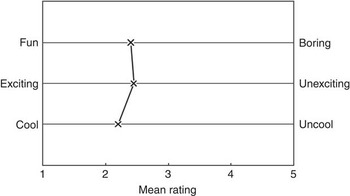
Questions on perceptions of sponsors were asked for up to the first six sponsors recalled (n 494). For sponsors of elite sports teams/athletes, the mean rating on the semantic differential scales of cool–uncool, exciting–unexciting and fun–boring was 2, indicating that children rated these sponsors positively in regard to each attribute (Fig. 1), with no differences by age, sex or sponsor type.
Mean ratings on semantic differential scales (fun–boring, exciting–unexciting and cool–uncool) for recalled sponsors (n 494) of elite sports teams/athletes by children aged 10–16 years (n 243) from randomly sampled households in New South Wales, Australia, February–May 2011
For 39 % of recalled sponsors, children reported ‘feeling better’ about this company after it had sponsored this team/athlete. For companies from which children had previously purchased products (n 282), this sponsorship encouraged them to buy the product more in 41 % of cases. Boys were more likely to report buying companies’ products more following this sponsorship than girls (48 % v. 33 %;  $$-->$<>\chi _{2}^{2} <$><!--$$ = 8·06, P = 0·02). There was no difference in reported purchases by age. For sporting events sponsors, children felt better about 26 % of companies after this sponsorship, and were encouraged to buy sponsors’ products more in 27 % of cases.
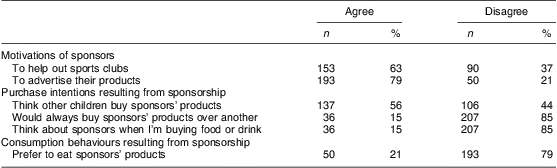
While most children thought food and beverage companies only sponsored sport as a way of advertising, they also believed that sponsors wanted to help out sports clubs (Table 1). A minority of children considered the companies that sponsored their favourite sport when purchasing or consuming food, while more than half perceived that other children thought about sport sponsors when purchasing food.
Perceptions of sponsors and purchase and consumption behaviours as a result of sponsorship by children aged 10–16 years (n 243) from randomly sampled households in New South Wales, Australia, February–May 2011
Discussion
Parents indicated strong support for policies to restrict unhealthy food, beverage and alcohol companies from sponsoring both elite sporting teams/athletes and children's own sports. There was particularly high support for restricting sponsorship of children's sport as well as alcohol sponsorship across all sporting levels. Currently in Australia, industry self-regulations on unhealthy food, beverage and alcohol sponsorship of children's sport are limited, while government regulations are non-existent. While industry regulations limit alcohol promotion at children's sporting events, this precludes businesses that sell alcohol, such as bars and hotels(20). The two main industry codes for food marketing to children do not include sponsorship in their definition of media(21, 22).
Parental support for restricting unhealthy sponsors of children's sport was further demonstrated by their willingness to bear the cost for such a policy to be introduced through increased sports fees. Parents’ judgements about the relative benefits of sponsorship restrictions for children's sport, given the potential cost increase, are important considering that cost is a barrier to sports participation(Reference Hardy, Kelly and Chapman23).
The suggestion of an alternative funding model for children's sport, which could separate sponsors and sports clubs and potentially reduce the effect of this marketing on children, was also supported by parents. This could be established through the introduction of a brokerage system, or sport sponsorship fund, to manage the collection and distribution of corporate funding for sports clubs. While the fund model does not allow companies to derive direct public relations benefits by being associated with specific sports, it can provide potentially larger public relations reach through being associated with the fund itself. This model was particularly attractive to parents who did not support sponsorship policy interventions, and thus provides a compromise solution between community, sport, industry and health groups. Other examples of industry and community partnerships exist, such as the Stephanie Alexander Kitchen Garden Foundation(24). This not-for-profit organisation is jointly funded by government and corporate contributions and supports primary schools in Australia to establish and maintain kitchen gardens, with links to the school curriculum, allowing students to grow, prepare and eat fresh fruit and vegetables.
Children had a high level of recall of sponsors of their favourite elite sporting teams or athletes in general, and about one-fifth were able to name a food or beverage sponsor. Recall of these elite sport sponsors was associated with children's interest in sport and frequency of watching the team/athlete compete. Similarly, surveys on children's awareness of tobacco brands and sponsorship have found an association between interest in sports and recall of sponsors(Reference Sparks25). Potentially, emotional involvement with an event may act as a modifying variable, impacting on brand recall(Reference Turner26).
Children mainly regarded elite sport sponsors as being ‘cool’, ‘fun’ and ‘exciting’. These positive brand-image associations influence brand preferences and usage, helping to form stronger emotional ties and trust of a brand(Reference Pecheux and Derbaix27). Indeed, children reported feeling better about many companies after they had sponsored their favourite elite sports team/athlete and were encouraged to buy the sponsor's product. This influence of sponsorship on brand perceptions and purchase intentions did not differ by age group, suggesting that both children and adolescents are influenced by this marketing. Half of children could also recall a food or beverage sponsor of a sporting event that they had seen or attended in the past year, and these were primarily manufacturers of sports drinks, soft drinks, fast food and alcohol. Similarly, children reported feeling better about these companies and were encouraged to buy sponsors’ products following this event sponsorship.
The sampling and survey methods used were strengths of the present study. The large sample size and random sampling of participants extend earlier surveys on attitudes and awareness of sponsorship(Reference Kelly, Baur and Bauman14, Reference Kelly, Baur and Bauman16). Use of the Electronic White Pages has been found to produce very similar demographic profiles to random digit dialling methods, with fewer calls required to achieve the sample size(Reference Wilson, Starr and Taylor28). Limitations of this method include the exclusion of silent/unlisted numbers and the restriction to households without landlines. However, approximately 90 % of Australian residential dwellings have a landline telephone(29). Therefore, this sampling method is a cost-effective and valid sampling method for telephone surveys. The use of an online survey was effective in reaching children as 79 % of Australian children use the Internet, it is mostly accessed at home and its use increases to 96 % for 12–14-year-old children(17). However, there may be some implications of using an online survey on the recruitment of children from more socially disadvantaged households, as Internet usage is lower among children with unemployed parents(17).
It is possible that response rates may have introduced some selection bias and affected the internal validity of the research findings, as there could be a bias towards those most interested in the survey topic. In particular, 69 % of parents were tertiary educated. However, 54 % of 15–64-year-olds hold a bachelor degree or diploma in NSW(30). As well, the response rate was similar to or higher than in other telephone surveys(Reference O'Toole, Sinclair and Leder31). The use of the SEIFA Index of Advantage/Disadvantage to classify households and individuals according to socio-economic status should be interpreted with caution due to the heterogeneity of households within areas(32). In fact, while one-third of parents with a university degree lived in high socio-economic areas compared with only 11 % of those who did not complete high school, two-thirds of university educated parents also lived in low and medium socio-economic areas.
Further research is needed to quantify how much parents are willing to pay to restrict unhealthy sponsorship and if this would offset predicted sponsorship revenue losses. Further examination of children's perceived sponsor-brand attributes is also required. To this end, there are available measures, such as the Aaker scale, comprising forty-two brand-related traits(Reference Azoulay and Kapferer33), or modified versions of this scale(Reference Musante, Milne and McDonald34). Finally, research should compare children's brand perceptions of sponsors and non-sponsors to better attribute brand image to sponsorship.
Conclusions
Australian parents support the restriction of unhealthy food, beverage and alcohol sponsorship of elite and children's sports. Restrictions could be arranged as either policies to guide appropriate sponsorship or alternative funding models to reduce promotions at sports clubs. Children's recall and positive associations of sponsors are important as these are linked to brand preferences and usage. This is concerning as the most frequently recalled food and beverage sponsors were manufacturers of sports drinks, soft drinks, fast food and alcohol.
Acknowledgements
This work was supported by Cancer Council NSW and the Australian Research Council (ARC Linkage Project: LP0989387). The authors declare no conflicts of interest. B.K. managed the data collection and analysis and drafted the manuscript. L.A.B., A.E.B., L.K., K.C. and B.J.S. provided strategic guidance for the study and the acquisition of funding. All authors were involved in the conception of the study, development of the surveys, and read and approved the final manuscript. The authors wish to thank participating parents and children for their contribution to this research. They also thank McNair Ingenuity Research, particularly Brianna Wallace and Matt Balogh for their diligent work in data collection.



