


The steady increase in obesity rates among young people (i.e. children and adolescents) in many developed countries has been a priority issue for health authorities. According to the Global Burden of Disease Study, the prevalence of overweight and obese young people in developed countries was approximately 23·8 % for males and 22·6 % for females in 2013(Reference Ng, Fleming and Robinson1). Among the Singapore population, the obesity rate has risen consistently from 5·1 % in 1992 to 8·7 % in 2017, with projections of further growth to 15·0 % by 2024(2,3) . Childhood obesity has been associated with a range of health issues such as type 2 diabetes and CVD(Reference McMahon, Haynes and Ratnam4,Reference Roberts and Pettigrew5) , in addition to mental health concerns such as decreased self-esteem and depression(Reference Roberts and Pettigrew5,Reference Backman, Haddad and Lee6) . Unhealthy weight gain in adolescent years is likely to be carried into adulthood, leading to enhanced risks of certain kinds of cancer and premature death(Reference Mossberg7,Reference Must, Jacques and Dallal8) .
Dietary intake has been acknowledged as a major factor contributing to obesity. Obesity primarily occurs from energy imbalance whereby energy consumption exceeds energy expenditure by the individual, a situation exacerbated by unhealthy eating habits and poor food choices(Reference Roberts and Pettigrew5,Reference Backman, Haddad and Lee6,Reference Livingstone and Helsper9) . For young people, food consumption habits have been identified to be a crucial component of regulating this energy balance, which in turn is key to managing the likelihood and severity of obesity both during childhood and into adulthood(Reference Backman, Haddad and Lee6). Building a habit of consuming fruits and vegetables (F&V) has also been identified as a potential way to reduce obesity(Reference Bel-Rastrollo, Martinez-Gonzalez and Sanchez-Villegas10–Reference Tohill, Seymour and Serdula12). The recommended daily intake of F&V tends to differ between countries. In the USA, for instance, the United States Department of Agriculture recommends adolescents to consume approximately two cups each of vegetables and fruits daily(13), while in Singapore, the daily recommendation is two servings (approximately one-and-a-half cups) each of vegetables and fruits(14). Nonetheless, both adults and young people commonly fail to meet the recommended daily F&V intake(Reference Guenther, Reedy and Krebs-Smith15,16) . For example, it was noted that nine out of ten Singaporeans were not consuming adequate servings of F&V(17). Identifying the drivers of consumption behaviour for healthy foods, especially F&V, is therefore an area of substantial importance in the interest of developing better health promotion and intervention programmes for young people at risk, due largely to the physiological benefits of adequate F&V consumption, including decreased risks of life-threatening diseases such as stroke, heart disease and various forms of cancer(Reference Dauchet, Amouyel and Dallongeville18,Reference Kothe, Mullan and Butow19) . In addition, consistent F&V consumption has been linked to benefits that persist throughout the lifespan, including slower rates of cognitive decline due to the ageing process(Reference Emanuel, McCully and Gallagher20).
Notably, scholars have observed how psychosocial and environmental factors could differentially affect young people’s motivation to eat healthily. Young people’s behaviour is not exclusively volitional but also affected by other social and environmental factors. In particular, food availability and accessibility have been found to be regular determinants in influencing healthy food consumption among children(Reference Blanchette and Brug21). In this vein, we plan to assess how the availability of F&V in home environments will impact the psychosocial drivers, as outlined by the theory of planned behaviour (TPB)(Reference Ajzen22), of F&V consumption of young people aged 9–16 years old. While extant research has argued that theoretically grounded interventions have generally been more effective in contributing to the understanding and engagement of the problem of child obesity, research on associated factors such as food availability remains scarce(Reference Painter, Borba and Hynes23–Reference Webb, Joseph and Yardley25). In light of the benefits accrued from the establishment of healthful F&V consumption habits and the urgency underscored by rising child obesity rates, it is crucial for researchers and health authorities to carefully examine the motivating factors that drive F&V intake among young people. The present study is unique in that while past studies have mainly relied on self-reports of child or parent respondents to determine the level of food availability, our research draws upon an open inventory method where food availability is measured by directly observing the amount of F&V available in the respondents’ home. This method mitigates the potential bias from self-reporting especially as studies have shown that there is a low agreement between young people’s and parents’ perceived F&V availability at home(Reference Reinaerts, de Nooijer and de Vries26–Reference van Assema, Glanz and Martens28) and social desirability bias from parents’ self-report(Reference Pinard, Yaroch and Hart29).
Theory of planned behaviour and consumption of fruits and vegetables
The TPB has successfully been utilised in a number of earlier studies examining determinants of food choice intentions and healthful dietary behaviour among children and adolescents(Reference Hewitt and Stephens30–Reference Masalu and Åstrøm33). The TPB consists of three antecedent constructs (attitude, subjective norm and perceived behavioural control (PBC)), intention and actual behaviour. The theory posits that intention and PBC are direct predictors of actual behaviour. Intention is, in turn, predicted by individuals’ attitude towards the behaviour, subjective norm as well as PBC. Attitude is commonly defined as the beliefs held by individuals on the possible consequences of executing the target behaviour as well as the consideration of each consequence’s outcome(Reference Backman, Haddad and Lee6,Reference Ajzen22) . Subjective norm is defined as individuals’ beliefs about the degree to which significant others would approve or disapprove of the target behaviour and the individual’s likelihood of compliance with these others’ views(Reference Ajzen22). PBC refers to the degree to which individuals believe the target behaviour is within their control(Reference Kothe, Mullan and Butow19,Reference Ajzen22) . There is considerable support for the TPB as a prediction model(Reference Armitage and Conner34,Reference Berg, Jonsson and Conner35) ; within the present context of food consumption, meta-analyses by Guillaumie et al. (Reference Guillaumie, Godin and Vezina-Im36) and Riebl et al. (Reference Riebl, Estabrooks and Dunsmore24) have found that the TPB could significantly account for intention and food consumption behaviour in both child and adult samples.
Nonetheless, there have been mixed findings on the influence of each TPB construct on predicting individuals’ intention towards consuming F&V. A number of studies among youth posit that attitude is the most significant antecedent-driving intention and food consumption behaviour for F&V(Reference Backman, Haddad and Lee6,Reference Lautenschlager and Smith37) . For example, a meta-analysis of how the TPB has been utilised to examine young people’s dietary behaviours by Riebl et al. (Reference Riebl, Estabrooks and Dunsmore24) found that while all three antecedent constructs were significant contributors to intention, attitude remained the strongest predictor. Similarly, a systematic review and meta-analysis of the relationship between TPB and diet patterns by McDermott et al. (Reference McDermott, Oliver and Simnadis38) suggested that intention was most significantly associated with attitude, followed by PBC and subjective norm. Some of these differences can probably be explained by the age of the respondents. McDermott et al. (Reference McDermott, Oliver and Simnadis38) noted that PBC was more significantly associated with consumption behaviour for younger (17 years or less) rather than older individuals (aged 18–29 years and over 30 years, respectively) in the included studies. However, even among young people, literature studying the influence of TPB constructs on the food consumption of children and adolescents has produced mixed findings. Although most studies agree that attitude tends to be the strongest predictor, there is a lack of consensus on the significance of other TPB constructs. While a handful of studies have proposed PBC as the next strongest determinant of intention(Reference Chan and Tsang39,Reference Grønhøj, Bech-Larsen and Chan40) , others disagree(Reference Branscum and Sharma41,Reference Hewitt and Stephens42) . The relationship between F&V dietary intention and behaviour has not been consistent, either; while some studies found significant associations(Reference Blanchard, Fisher and Sparling43,Reference Brug, de Vet and de Nooijer44) , others did not show such relationship(Reference Lautenschlager and Smith37,Reference Bogers, Brug and van Assema45) . This lack of consensus across the literature suggests the influence of other factors in how TPB constructs drive food consumption behaviour(Reference Lautenschlager and Smith37,Reference Reinaerts, de Nooijer and Candel46) .
The Environmental Research framework for weight Gain prevention and the role of home food availability
In addition to intrapersonal factors, environmental factors have been considered as important determinants of food consumption behaviours(Reference Brug47,Reference Giskes, van Lenthe and Kamphuis48) . One conceptual model that attempts to integrate the influence of environmental factors on individuals’ energy balance-related behaviours (e.g. food consumption) is the Environmental Research framework for weight Gain prevention (EnRG). Under EnRG, the environment (e.g. physical, socioeconomic) is posited to have both a direct effect and an indirect effect – through the mediation of intrapersonal constructs from theories of behaviour change such as the TPB – on the target behaviour. The EnRG has been widely used to study a variety of relationships pertaining to energy balance-related behaviours, including the influence of the food/exercise environment on adults’ weight-regulation activities, and associations between the school food environment and adolescents’ unhealthy food consumption behaviours(Reference van der Horst, Timperio and Crawford49,Reference Gorin, Phelan and Raynor50) .
EnRG has also been used as a model to conceptualise the various components of a young person’s home food environment within the context of healthy eating(Reference Rosenkranz and Dzewaltowski51). Among these, availability and accessibility of F&V have consistently been suggested to be an important environmental factor that is significantly associated with young people’s F&V consumption behaviour(Reference Blanchette and Brug21,Reference Ong, Ullah and Magarey52–Reference Hearn, Baranowski and Baranowski55) . In view of the lack of uniformity among researchers with regard to the construct of food availability(Reference Gebremariam, Vaque-Crusellas and Andersen56), the present study defines availability as food that is physically present within the household(Reference Boles, Scharf and Filigno57). Prior research has shown that availability to healthy foods at home is positively associated with intake of these foods among young people and adults(Reference Reinaerts, de Nooijer and Candel46,Reference Trapp, Hickling and Christian58) , although other research has found limited evidence in the association between household food environment and F&V intake(Reference Giskes, van Lenthe and Kamphuis48,Reference Kamphuis, Giskes and de Bruijn59) . Nonetheless this relationship is complex. For example, Kratt et al. (Reference Kratt, Reynolds and Shewchuk60) found that households with more F&V available tended to have significant stronger psychosocial motivating factors (such as outcome expectations, behavioural capability and knowledge) for both parents’ and young people’s consumption of healthy food than in families with low F&V availability. Tak et al. (Reference Tak, te Velde and Kamphuis61), on the other hand, found that neither home nor neighbourhood F&V availability was directly or indirectly associated with adults’ F&V consumption behaviours, although the authors suggested that a lack of variation in environments between participants may have influenced these outcomes. Furthermore, food availability at home has been put forth as a possible driver of outcome of school-based healthful eating interventions for young people(Reference Kratt, Reynolds and Shewchuk60,Reference Domel, Baranowski and Davis62) ; Bere & Klepp(Reference Bere and Klepp63) showed that changes in children’s accessibility to F&V both at home and in school were linked with general F&V intake. These findings have been echoed in Blanchette & Brug’s structured review of factors that determine F&V intake among children(Reference Blanchette and Brug21). While evidence suggested that factors such as parent’s F&V intake, knowledge of healthful consumption and television viewing had an influence on child F&V consumption, availability and accessibility remained the most consistent determinants(Reference Blanchette and Brug21,Reference Yee, Lwin and Ho64) .
While studies have examined F&V availability and accessibility as an environmental influence on food consumption behaviours of both adults and young people, much of extant work has been atheoretical(Reference Blanchette and Brug21,Reference van der Horst, Timperio and Crawford49,Reference Gorin, Phelan and Raynor50,Reference Hearn, Baranowski and Baranowski55) . Also relatively unknown are the mechanisms by which F&V availability at home influences F&V intake among young people. The present study therefore attempts to build on existing research by exploring the associations (i) between home F&V availability and F&V consumption among young people (the EnRG direct effect), (ii) between the TPB constructs and F&V consumption and (iii) whether the association of home F&V availability with F&V consumption is mediated by any of the TPB constructs (the EnRG indirect effect). Figure 1 shows the conceptual framework. Following the EnRG model, we hypothesise that home F&V availability (the environmental factor) will be directly as well as indirectly linked to F&V consumption (the energy balance-related behaviour) through one or more of the TPB constructs (the intrapersonal mediators).
Conceptual framework of the mediated effect of theory of planned behaviour constructs in the association between HFI and food consumption behaviour. HFI, home fruits and vegetables inventory; F&V, fruits and vegetables; PBC, perceived behavioural control

Method
Participants
A total of 210 households consisting of young people (the child participant; n 210) with their parents (the parent participant; n 210) were recruited using stratified cluster sampling in Singapore. Household eligibility was based on two factors. Parent participants had to be either a Singaporean citizen or permanent resident, while the child participants were required to be from grades 4 to 9. Each household was provided with a $S30 participation incentive (approximately equivalent to $US23).
Procedure
From a list of all government schools in Singapore, we split the schools into the thirty-four urban residential planning regions demarcated by the Urban Redevelopment Authority(65). Schools were randomly stratified and selected from within each of these regions. The data collection process began by identifying the housing apartment block with the smallest property number adjacent to the selected school premises. Researchers then proceeded to the top floor of the apartment block and started from the household with the smallest unit number. If they faced an unsuccessful attempt, the researchers skipped one unit. At the end of every floor, the researchers descended one level and the process was repeated.
For each participating household, the researcher first surveyed the child participant and then the home food inventory. The child surveys were conducted in a common area of the household such as the living room, with the parent participant allowed to be present during the process for reassurance. Parent participants were requested to refrain from influencing their child’s survey responses.
The home food inventory was catalogued by providing the parent participant with a set of five size-standardised zip-lock bags. Parent participants were then instructed by the researcher to examine each food item in their pantry and select the bag size that would best fit the total amount of said item. The researcher assisted with the recording of the bag sizes selected, and the unpacking and repacking of each food item to-and-from storage areas where necessary within each household.
Materials
Child survey
The child questionnaire examined food consumption behaviour and intention with regard to F&V, and TPB constructs including attitude, subjective norm and PBC towards healthy food. The food consumption behaviour and intention scales consisted of four items adapted from food intake studies(Reference Brown and Ogden66–Reference Thompson, Subar and Krebs-Smith68), with two items (one for fruits and the other for vegetables) in each category (consumption and intention). Food consumption behaviour items were worded with the following: ‘How often do you eat the following items during a typical week?’ to which participants responded on a nine-point scale ranging from ‘more than or equal to five servings per day’ (1) to ‘never’ (9). These items were reverse coded in the analysis so that higher scores represented higher levels of consumption and then recoded into approximate servings per day based on the National Cancer Institute’s All-Day Screener for F&V consumption(69,Reference Subar, Thompson and Kipnis70) . Intention items were worded as ‘I intend to consume the following items next week’, with response categories ranging from strongly disagree (1) to strongly agree (5). Participants’ attitude towards healthy food were measured using four items on positive affect adapted from Aikman et al. (Reference Aikman, Crites and Fabrigar71). The items were presented immediately below four full colour pictures of F&V items. Each item was typically worded as such: ‘I feel happy when I eat the above food’. Subjective norm towards F&V were examined using six items adapted from Fishbein & Ajzen(Reference Fishbein and Ajzen72). Sample items include ‘Many people like me eat the above food every week’ and ‘Many people like me think that I should eat the above food every week’. Lastly, the PBC scale towards F&V consisted of four items (e.g. ‘It is mostly up to me whether or not I eat the above food every week’), also adapted from Fishbein & Ajzen(Reference Fishbein and Ajzen72). For the attitude, subjective norm and PBC measures, participants responded using a five-point scale ranging from strongly disagree (1) to strongly agree (5).
Home fruits and vegetables inventory
With the assistance of the researchers as detailed above, parent participants undertook an inventory count of food in their pantry. The food inventory was developed from checklists used in prior nutrition and obesity studies and consisted of fifty-eight pre-defined food items(Reference Bryant and Stevens73,Reference Kremer, Bell and Swinburn74) . Amounts were determined using a seven-point scale by selecting a ‘best fit’ size for the total volume of each food type present, with reference taken from a set of five standardised zip-lock bags (320, 760, 1290, 3330 and 4800 ml). The two other options were for sizes ‘smaller than 320 ml’ (1) and ‘larger than 4800 ml’ (7). In order to be able to quantify and create one measure of home F&V inventory (HFI), we considered the size ‘smaller than 320 ml’ to be on average half the size of the smallest bag (320 ml), and hence, it was recoded into ‘160 ml’. Likewise, the size ‘larger than 4800 ml’ was approximated to be on average twice the size of the largest bag (4800 ml), and hence, recoded as ‘9600 ml’. For the purposes of the present research, only two categories (‘Vegetables’ and ‘Fruits’) were used for analysis.
Statistical analyses
Data entry and analyses were performed using IBM SPSS Statistics for Windows, version 22.0(75). Exploratory factor analysis was performed using maximum likelihood extraction with promax rotation for the attitude towards healthy food, subjective norm and PBC scales, followed by reliability analysis of these constructs. The items from each of the TPB constructs were found to group into their respective factors, and hence, they were averaged to create the TPB measures. The four attitude items formed one composite variable (Cronbach’s α = 0·87), with higher scores representing more positive attitude towards healthy food. The six subjective norm items were composited into a single variable (Cronbach’s α = 0·86). One out of the four items on the PBC scale had a low factor loading and, hence, was excluded from further analysis. The remaining three items were composited into one PBC variable (Cronbach’s α = 0·80). The two F&V items each for behavioural consumption were summed to create a composite measure for F&V consumption (r 0·477, P < 0·001). The two items for intention were averaged to derive the F&V consumption intention measure (r 0·458, P < 0·001). The HFI scores for F&V were then summed to derive the composite measure of HFI (M = 9455·3 ml, sd = 6504·3 ml, median = 8865·0 ml, min = 0 ml, max = 19 200 ml). As HFI was measured based on the ‘best fit’ size of standardised zip-lock bags, which was an ordinal scale, we divided the composite HFI measure into two groups based on median split following the method used in prior nutrition studies(Reference Thompson, Subar and Krebs-Smith68,Reference Jaramillo, Yang and Hughes76,Reference Di Noia and Cullen77) and to allow for parsimony in the analysis, that is, low HFI (M = 3933·2 ml, sd = 2898, 4 ml, min = 0 ml, max = 8130 ml) and high HFI (M = 14 977·4 ml, sd = 3878, 7 ml, min = 9600 ml, max = 19 200 ml).
Multiple regression was performed to assess the direct association between F&V availability at home and F&V consumption behaviour. Structural equation modelling was conducted using the AMOS module version 24.0 to examine the mediating effect of the TPB constructs on the relationship between home F&V availability and F&V consumption behaviour. In order to perform mediation analyses with multiple mediators, we followed the bootstrapping method as recommended by Preacher & Hayes(Reference Preacher and Hayes78). The bootstrap estimates in this study were based on 2000 samples. The existence of mediation was determined based on whether the indirect effects were statistically significant at 95 % CI. Age and gender were included in the above analyses as control. Statistical significance for all analyses was defined at P < 0·05.
Results
Participants’ characteristics
As can be seen in Table 1, of the 210 household units, the household sample comprised 73·0 % Chinese, 10·0 % Malay, 13·5 % Indian and 3·5 % other races, which closely resembled that of Singapore’s national ethnic distribution(65). The child sample consisted of 45·7 % female and 54·3 % male, aged 9–16 years old (M age of child participant = 13·08 years). As shown in Table 2, the mean consumption of F&V was 3·20 servings per day (sd 2·13), while the mean score for intention to consume F&V was 4·10 (sd 0·84).
Description of demographics of the study sample (N 210)

F&V, fruits and vegetables.
Mean scores and sd for the theory of planned behaviour constructs (n 210)
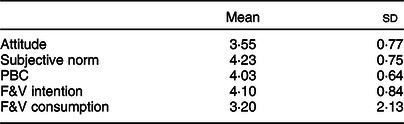
PBC, perceived behavioural control; F&V, fruits and vegetables.
Item response categories for all constructs (except F&V Consumption) were presented using Likert-type scales ranging from ‘strongly disagree’ (1) to ‘strongly agree’ (5). Responses for F&V consumption items were converted to servings consumed per day (ranging from 0 to 5 servings).
Correlations and regression
Table 3 shows the Pearson’s correlation results between the TPB constructs and F&V consumption intention and behaviour. HFI was significantly associated only with F&V consumption intention (P < 0·001), but not with F&V consumption behaviour nor any of the TPB constructs. As expected, attitude, subjective norm and PBC were highly correlated to each other and to F&V consumption intention (P < 0·001). In turn, intention was associated with F&V consumption behaviour (r 0·332, P < 0·001). While there were significant associations between attitude and PBC and F&V consumption behaviour (r = 0·292, P < 0·001), subjective norm was not significantly associated with F&V consumption behaviour. The multiple regression analysis to examine the direct association between F&V availability at home and F&V consumption behaviour with age and gender entered as control variables revealed no significant association.
Correlations between variables

F&V, fruits and vegetables; HFI, home fruits and vegetables inventory; PBC, perceived behavioural control.
*** P < 0·001.
Path analysis
To assess the mediating effect of the TPB constructs on the relationship between HFI and F&V consumption intention and behaviour, structural equation modelling analysis was performed based on the conceptual framework illustrated in Fig. 1. Gender and age were included in the path analysis as control variables. The measures for the model fit of the conceptual framework (as shown in Fig. 2) suggest an acceptable fit (χ 2(111) = 167·23, P < 0·001; RMSEA (root mean square error of approximation) = 0·049; CFI (comparative fit index) = 0·961; TLI (Tucker–Lewis Index) = 0·947; GFI (goodness of fit index) = 0·922; SRMR (standardised root mean square residual) = 0·051).
The path analysis for the relationship between HFI, theory of planned behaviour constructs and food consumption behaviour. Values reported are unstandardised path coefficients. Age and gender were included in the analysis while they were not displayed in the figure. Solid lines show significant associations (*P < 0·05, **P < 0·01, ***P < 0·001), and dotted lines show non-significant associations. B (unstandardised) regression estimates. HFI, home fruits and vegetables inventory; F&V, fruits and vegetables; PBC, perceived behavioural control
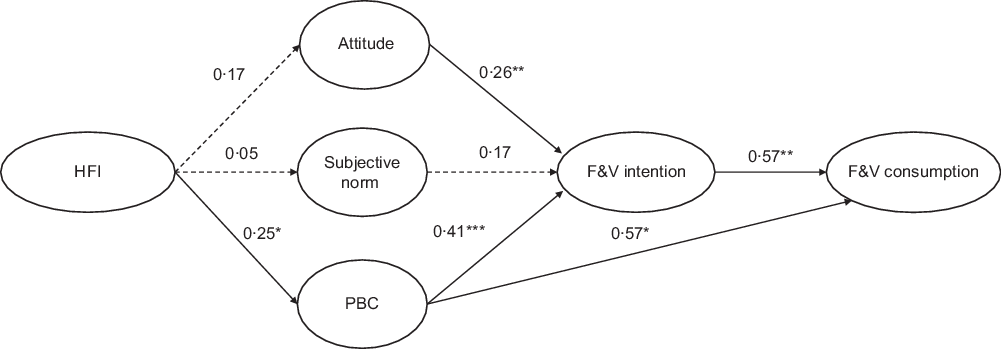
The path analysis revealed that taken as a set, attitude, subjective norm, PBC and intention mediated the effect of HFI on F&V consumption behaviour as the total indirect effect through the four mediators is different from zero (total indirect effect = 0·354, bootstrap CI 0.124, 0·643, P = 0·001). The directions from the independent variable to the mediators and then to the dependent variable are consistent in that greater HFI led to more positive attitude towards F&V, subjective norm and PBC, which in turn were linked to greater intention to consume F&V and greater F&V consumption behaviour.
Examination of the specific indirect effects showed that the relationship between HFI and F&V consumption behaviour was mediated through two mediators of PBC, and then intention (B = 0·06, 95 % CI 0.007, 0·194, P < 0·05). TPB also posits that PBC directly predicts behaviour; however, we did not find significant indirect effects from HFI to F&V consumption behaviour through only PBC. These findings suggest that high level of HFI was linked to higher PBC (B = 0·25, P < 0·05), and in turn higher intention to consume F&V (B = 0·41, P < 0·001), and subsequently higher F&V consumption (B = 0·57, P < 0·01).
The specific indirect effects from HFI to F&V consumption behaviour through two mediators of attitude and intention were significant (B = 0·03, 95 % CI 0.000, 0·115, P < 0·05). This indicates that higher level of HFI was associated with more positive attitude towards F&V (B = 0·17, P = 0·10), and in turn greater intention (B = 0·26, P < 0·01), and then greater consumption of F&V (B = 0·57, P < 0·01). Even though the path from HFI to attitude was NS, the mediation effect was possible because as noted by Preacher & Hayes(Reference Preacher and Hayes78), the interpretation of the mediation analysis was determined by the direction and size of the indirect effects, rather than the statistical significance of the paths between the independent variable to mediator and between the mediator to the dependent variable as usually requisite by the causal step method(Reference Baron and Kenny79).
The specific indirect effects from HFI to F&V consumption behaviour through subjective norm and intention as mediators were not found to be significant, and hence, subjective norm did not mediate the relationship between HFI and F&V consumption behaviour.
Discussion
The present research aimed to examine the relationship between F&V availability at home and F&V intake among young people, and how this relationship could potentially be mediated by individual-level cognitive factors, as outlined in our study framework by the TPB. The findings revealed that home F&V availability and F&V consumption behaviour did not show a significant direct association but demonstrated significant indirect links through the routes of PBC and intention as well as via attitude and intention. Specifically, higher levels of F&V availability at home were related to greater attitude and PBC, and subsequently greater intention to consume F&V and higher consumption of F&V.
Unlike past studies which indicate that food availability is a determinant for F&V consumption(Reference Reinaerts, de Nooijer and Candel46,Reference Trapp, Hickling and Christian58) , the present study did not find a significant direct association as hypothesised. The method in which home F&V availability was measured and analysed in different studies may have contributed to the disparity in the results. For instance, in a few studies where direct association was found(Reference Reinaerts, de Nooijer and Candel46,Reference Giskes, van Lenthe and Kamphuis48) , home F&V availability was self-reported based only on one or two items, while our study relied on an objective measurement of home F&V availability. The self-report measure can thus be subjected to social desirability bias(Reference Pinard, Yaroch and Hart29). Additionally, past research has shown low disagreement between young people’s and parents’ responses on food availability at home(Reference Reinaerts, de Nooijer and de Vries26–Reference van Assema, Glanz and Martens28).
Of interest is the significant indirect effect between home F&V availability and F&V consumption behaviour. Attitude, operationalised as positive affect towards F&V in this study, was found to mediate the relationship between home F&V availability and F&V behaviour among young people through intention. Out of all of the TPB constructs, attitude has been most often discovered to be the strongest predictor of dietary intention(Reference Riebl, Estabrooks and Dunsmore24,Reference McDermott, Oliver and Simnadis38) , suggesting its critical role in enhancing intention and the necessity to continue the emphasis on building up positive affect towards F&V. When the availability of F&V at home is high, it is likely that children and adolescents are exposed more to these foods, and the experience of F&V being available at home may enable young people to familiarise with these food items and improve their liking towards F&V(Reference Cooke and Gibson67,Reference Capaldi80,Reference Birch and Fisher81) .
Our study found that the relationship of home F&V availability with F&V behaviour was mediated by PBC and intention, but PBC alone did not significantly mediate this relationship. The pattern of results is in line with meta-analyses which have shown intention to be the strongest predictor of behaviour, stronger than the relationship between PBC and behaviour(Reference Riebl, Estabrooks and Dunsmore24,Reference McDermott, Oliver and Simnadis38) . Ajzen(Reference Ajzen22) has also postulated that intention would act as the strongest determinant of F&V dietary behaviour when an individual perceives that achieving that behaviour is under his/her volitional control. In the same vein, PBC has been found to be a strong predictor of dietary intention(Reference Riebl, Estabrooks and Dunsmore24,Reference McDermott, Oliver and Simnadis38) , although findings have admittedly been mixed among young people(Reference Chan and Tsang39–Reference Hewitt and Stephens42). These findings imply that in homes where F&V tends to be readily available, young people may have a higher sense of control about obtaining F&V on demand, and this may be linked to greater intention to consume F&V, and subsequently higher intake of F&V. Indeed, food availability has been cited as one of the important control issues with regard to healthy eating and food choice especially among young people(Reference Backman, Haddad and Lee6).
Perceived norms have generally been considered to be a weaker predictor of healthy eating(Reference Louis, Chan and Greenbaum82–Reference Shaikh, Yaroch and Nebeling84), and this was also the case for our findings where subjective norm did not significantly mediate the relationship between HFI and F&V consumption behaviour. It is difficult to measure social pressure as social norms can be operationalised in multiple facets such as descriptive norms and injunctive norms(Reference Armitage and Conner85). In addition, the degree to which individuals in the home environment (e.g. father, mother, siblings and other relatives) exert influences may also be different. Hence, future research could attempt to differentiate the types of norms and influencers involved when assessing the effect of the subjective norm construct.
Theoretical implications
The present study contributes to existing literature by integrating the influence of environmental factors with individual-level cognitive factors on F&V consumption. Specifically, we examined how the TPB constructs could mediate the relationship between home F&V availability and young people’s F&V consumption.
This research undertook a recording of home food inventory by direct observation at home instead of respondents’ self-report. Our approach provided more reliable and accurate home food inventory data, overcoming the social desirability bias issue commonly occurring with parents’ self-report method(Reference Pinard, Yaroch and Hart29). The study also determined the quantity of F&V found in the home inventory, instead of merely indicating the presence and non-presence of certain food items and, hence, allowing for the examination of how different levels of F&V inventory at homes could differentially influence F&V consumption. Nonetheless, direct observation in participants’ homes to record their home food inventory was a laborious and potentially intrusive process for both participants and researchers, resulting in a fairly limited sample size for the present study which has prevented the inclusion of various other potential mediators.
Practical implications
We can derive a number of practical implications from the present study’s findings. Firstly, as shown in existing literature, a higher level of F&V consumption has been associated with lower susceptibility to obesity(Reference Backman, Haddad and Lee6), heart disease(Reference Hu86) and certain forms of cancer(Reference Steinmetz and Potter87). Childhood consumption of F&V has also been found in prior studies to predict F&V consumption during adulthood(Reference Edwards and Hartwell88). In view of these, it is important that young people are encouraged to consume sufficient servings of F&V every day. Making F&V readily available at homes could therefore be one of the strategies that parents should implement as another form of encouragement to their children towards consistent consumption of F&V, as doing so could enhance young people’s sense of control, positive attitude towards F&V and intention to consume F&V.
Limitations of the study
This study is not without several limitations. First, with the exception of the HFI, all other measures were self-reported. This may have resulted in information biases such as overestimation of typical F&V consumption behaviour from the child survey. Social desirability may have influenced these self-reported measures, especially since young people in Singapore are relatively exposed to the benefits of consuming sufficient F&V as part of a healthy diet through health promotion initiatives such as My Healthy Plate(89). Second, participants were asked for their intention to consume F&V in the upcoming week whereas the consumption behaviour items asked participants for their F&V consumption in a typical week. While participant intention was statistically associated with F&V consumption (as posited by the TPB), the nature of these items and the cross-sectional design of the present study should be taken into consideration in any extrapolation of our findings. Last, we examined associations among F&V availability in the household, young peoples’ intrapersonal mediators based on the TPB and F&V consumption behaviour based on the EnRG model. While our findings support the literature on the important role of F&V availability(Reference Rosenkranz and Dzewaltowski51), we recognise that the food environment is complex, and our findings do not account for other environmental factors that may have influenced these observed associations.
Conclusion
Our study examined how environmental factor could have an impact on young people’s consumption behaviour through the mediation of individual-level cognitive factors as outlined by TPB. We found that F&V availability at home was indirectly associated with young people’s F&V consumption behaviour through the PBC and intention path as well as the attitude and intention path. Our findings provide a foundational contribution towards unravelling the environmental processes involved in influencing young people’s healthy food intake.
Acknowledgements
Acknowledgements: None. Financial support: This study was supported by the National Medical Research Council, Singapore (grant no. NMRC/HSRG/0046/2013). Conflict of interest: There are no conflicts of interest. Authorship: M.O.L. and S.M. conceptualised the present work; S.M. and J.L. performed article search and data analysis and drafted the initial version of the manuscript; J.L. coordinated the data collection; all authors contributed towards further revisions of the paper and approved the final version of the manuscript before submission. Ethics of human subject participation: This study was conducted according to the guidelines laid down in the Declaration of Helsinki and all procedures involving human subjects were approved by the Nanyang Technological University Institutional Review Board. Written informed consent was obtained from all subjects.



