

Part I of this book introduced key frameworks developed to conceptualize sustainability transitions. In contrast, Part II dives deeper into the dimensions that shape how transition processes unfold. This section is divided into four subsections, where each subsection comprises three to five chapters, coming to a total of sixteen chapters in Part II.
Part II.A, the Dynamics of Transitions subsection, explores the temporality of transitions, niche–regime interactions and the interplay between multiple systems. This subsection is followed by the subsection on Power and Politics in Transitions, where the role of power, expectations and visions, political processes, political economy perspectives and the concept of just transitions are examined. Further, the Actors and Agency in Transitions subsection investigates actor roles, intermediaries, individual behaviour and the role of coalitions in driving transitions. Finally, the Geographies of Transitions subsection focuses on how transitions unfold across different national, regional and local contexts. It addresses the influence of place and scale, looks at urban transitions and analyses the distinct dynamics of transitions in the Global South compared to the Global North.
This part of the book aims to provide a comprehensive exploration of the diverse and interconnected factors that influence sustainability transitions, offering a deeper understanding of their complexities.
8.1 Introduction
Accelerating sustainability transitions is crucial for tackling wicked sustainability challenges. The urgency is underscored by the 2015 Paris Agreement to the United Nations Framework Convention on Climate Change, which set ambitious targets to reduce global greenhouse gas emissions and limit temperature rise. Specifically, it called for emissions to peak by 2020 – a deadline that has already passed – and for a reduction to zero emissions by 2050. These goals highlight the need for immediate action across energy systems, agriculture and manufacturing to address the climate crisis and achieve global sustainability effectively.
The benefits of accelerating sustainability transitions extend beyond climate action. They foster innovation in sustainable development, promote social equity and improve public health. Rapid shifts to cleaner energy, sustainable materials and efficient technologies are essential. Additionally, these transitions can enhance air quality, reduce environmental degradation and improve overall well-being. They can also stimulate economic growth by creating new jobs and opportunities in sustainable industries, thereby promoting economic resilience. Investments in renewable energy and green technologies can lead to long-term environmental and financial gains while encouraging global cooperation.
The concept of time in sustainability transitions – characterised by pace, speed and acceleration – requires careful consideration. While it serves as a benchmark for measuring success (Sovacool et al., Reference Sovacool, Hess, Amir, Geels, Hirsh, Medina and Yearley2020; Marquardt & Delina, Reference Marquardt and Delina2021), there is limited reflection on the implications of these timeframes (Marquardt & Delina, Reference Marquardt and Delina2021), including resource allocation and legitimacy, which can create winners and losers (Newell et al., Reference Newell, Geels and Sovacool2022; van Bommel & Höffken, Reference van Bommel and Höffken2023). Critical discussions about how to meet these time-bound targets, who will be responsible, and the impact on public engagement (Skjølsvold & Coenen, Reference Skjølsvold and Coenen2021) – particularly for vulnerable populations (van Bommel & Höffken, Reference van Bommel and Höffken2023) – are often overlooked (Ciplet & Harrison, Reference Ciplet and Harrison2020).
This chapter aims to explore these complexities, examining the relationship between time and socio-technical change in sustainability transitions. Time is a social construct (Stehr & Von Storch, Reference Stehr and Von Storch1995; cf. Marquardt and Delina, Reference Marquardt and Delina2021) that shapes how we organise our lives (Elder, Reference Elder1994; Kreitzmnan & Foster, Reference Kreitzman and Foster2011), and its meanings can vary widely (cf. Marquardt and Delina, Reference Marquardt and Delina2021). From the perspective of Science and Technology Studies (STS), time is co-produced with advancements in science and technology (Jasanoff, Reference Jasanoff and S. Jasanoff2004a; cf. Wyborn et al., Reference Wyborn, Datta, Montana, Ryan, Leith, Chaffin and Van Kerkhoff2019; Marquardt & Delina, Reference Marquardt and Delina2021) and influenced by social and political dynamics (Jasanoff, Reference Jasanoff and S. Jasanoff2004a, Reference Jasanoff and S. Jasanoff (Ed.)2004b). Making, remaking and unmaking time is intertwined with politics, technological advancements and epistemologies or knowledge-making (Jasanoff & Kim, Reference Jasanoff and Kim2015) in that this co-production could lead to the displacement of certain members of society (Jasanoff & Simmett, Reference Jasanoff and Simmet2021). This understanding allows for a critical examination of the often neutral framing of sustainability transitions, particularly in decarbonisation efforts.
When discussing accelerated sustainability transitions, it becomes clear that envisioning sustainable futures involves more than just setting deadlines. Achieving these transitions is inherently political and contested, involving various local and national stakeholders (Delina & Janetos, Reference Delina and Janetos2018). Different actors will advocate for their own timescales and technologies based on their interests and visions of sustainability (Delina & Janetos, Reference Delina and Janetos2018; Newell et al., Reference Newell, Geels and Sovacool2022). Therefore, a nuanced understanding of time in sustainability transitions is essential for fostering transparency, equity and justice (Delina & Janetos, Reference Delina and Janetos2018; Delina & Sovacool, Reference Delina and Sovacool2018; van Bommel & Höffken, Reference van Bommel and Höffken2023).
To further this discussion, Section 8.2 revisits the temporal dimensions in sustainability transition research and practice. Section 8.3 reviews past research on time construction and its political implications, emphasising the need for critical assessments of speed and acceleration. Finally, Section 8.4 concludes by raising guiding questions for future research.
8.2 Temporalities of Sustainability Transitions
Sustainability transition studies have explored how technological and societal changes occur at multiple scales – local, national and regional – over time, whether relatively quickly or gradually (Sovacool, Reference Sovacool2016). These studies also focus on the various technological disruptions accompanying these changes and their impacts on societies. In this context, the concept of time emerges as a crucial and multifaceted dimension, encompassing aspects such as speed, duration and acceleration. Speed refers to the rate at which societies and environments adopt sustainable practices and systems. The concepts of substitution and diffusion illustrate this, as discussed in Section 8.2.1. Duration, conversely, pertains to the length of time required for these transitions to become embedded in societal norms and structures. Acceleration signifies the increasing pace of change toward sustainability goals over time. Understanding these temporal aspects is essential, as they shape the dynamics, challenges and opportunities in transitioning towards sustainability. By examining the speed, duration and acceleration, researchers can identify bottlenecks, leverage points and critical junctures that influence the success or failure of sustainability transitions. This nuanced analysis allows for developing strategies and policies that facilitate smoother and more effective transitions towards a sustainable future.
8.2.1 Insights from Energy Transition Studies
Energy transition studies provide insights into how sequential events lead to shifts in energy generation and consumption patterns. Energy transitions involve changes in fuels and their associated technologies and systems (Hirsh & Jones, Reference Hirsh and Jones2014), including economic systems (Fouquet & Pearson, Reference Fouquet and Pearson2012) and their rise to claim substantial market shares (Smil, Reference Smil2010a,Reference Smilb). On average, energy transitions have been observed to progress from an initial share of 1%–10% of the energy consumption for a particular service in a specific sector, eventually reaching 50%, 90% and even 99% (Grubler et al., Reference Grubler, Wilson and Nemet2016). The duration from the invention of a critical technology to an 80% share of energy consumption averages around 95 years (Fouquet, Reference Fouquet2016), indicating a relatively slow pace. However, it is important to note that such state changes proceed non-linearly compared to typical technological diffusion and substitution (Grubler, Reference Grubler1996).
Historical energy transitions further illustrate the concepts of speed, duration and acceleration. The Netherlands’ transition to fossil gas, Ontario’s coal retirements and Denmark’s shift to heat and power systems occurred relatively quickly, demonstrating that rapid transitions are possible (Sovacool, Reference Sovacool, Hess, Amir, Geels, Hirsh, Medina and Yearley2020). Similarly, Indonesia’s shift from kerosene to gas for cooking was achieved in just 10 years (Thoday et al., Reference Thoday, Benjamin, Gan and Puzzolo2018). Additionally, the rapid transition from incandescent bulbs to LED lighting exemplifies swift changes in consumption patterns (International Energy Agency, 2020; Zissis et al., Reference Zissis, Bertoldi and Serrenho2021). The transportation sector also showcases accelerated sustainability transitions. The shift from horse-drawn transportation to railways in the 1850s occurred within a few decades (Geels, Reference Geels2005). More recently, the transition from internal combustion engines to electric vehicles is gaining momentum (Bloomberg NEF, 2021; Muratori et al., Reference Muratori, Alexander, Arent, Bazilian, Cazzola, Dede and Ward2021), driven by advances in battery technology, declining costs and increasing consumer demand for sustainable transportation (Muratori et al., Reference Muratori, Alexander, Arent, Bazilian, Cazzola, Dede and Ward2021).
8.2.2 Critiques and Considerations
Despite these examples of rapid transitions, some scholars argue that complex technological and economic factors can slow down rapid changes. For instance, Smil (Reference Smil2016) notes that historical global energy transitions have often taken considerable time, citing that coal took 60 years to provide half of the world’s energy supply. The global energy system remains heavily reliant on fossil fuels, with little evidence that the transition away from coal is accelerating. In response to scepticism about rapid transitions, Grubler et al. (Reference Grubler, Wilson and Nemet2016) offer a nuanced critique, suggesting that the speed of past transitions should be understood in light of factors such as the complexity of the technology, the length of the formative phases in technology development, spatial diffusion and market size. They argue that future sustainability transitions will differ significantly from historical ones. Rapid transitions are often characterised by substituting older technologies with established alternatives without significant disruption or the need for integration with existing infrastructures. Successful transitions also benefit from knowledge spillovers, smaller markets (e.g. Ontario’s transition to hydropower (Sovacool, Reference Sovacool2016; Rosenbloom et al., Reference Rosenbloom, Haley and Meadowcroft2018)) and tangible advantages for end-users, such as improved health outcomes (e.g. Indonesia’s switch to LPG cooking (Sovacool, Reference Sovacool2016; Thoday et al., Reference Thoday, Benjamin, Gan and Puzzolo2018)), convenience and well-coordinated public policies (e.g. France’s adoption of nuclear energy (Jasper, Reference Jasper2014)).
8.2.3 The Concept of Timescapes
While speed, duration and acceleration are key aspects of temporalities in sustainability transitions, another important dimension is timescapes, a concept that integrates various temporal dynamics. Derived from Appadurai’s (Reference Appadurai1996) notion of scapes, timescapes reflect the complex interplay of temporal rhythms and structures (Bornemann & Strassheim, Reference Bornemann and Strassheim2019). Scapes are dynamic constructs that encompass various dimensions of global cultural flows, interactions and imaginaries (Appadurai, Reference Appadurai1996). A timescape, therefore, refers to the intricate interplay of temporal dimensions within sustainability transitions, including the rhythms, sequencing and temporal structures that influence speed, duration and acceleration. Timescapes are not static; they are interconnected and constantly evolving networks shaped by global cultural processes, such as the Paris Agreement and visions of sustainable futures (cf. Bornemann & Strassheim, Reference Bornemann and Strassheim2019). This concept suggests the complexities and interconnections inherent in contemporary global dynamics, emphasising the role of culture, communication and power – akin to ‘landscape pressures’ in the Multilevel Perspective (see Chapter 2) – in shaping the trajectories of sustainability transitions in the modern world.
8.3 Intersections Between Temporality and the Multiple Dimensions of Sustainability Transitions
The analysis of the speed, duration and acceleration of sustainability transitions, coupled with the exploration of timescapes, has enriched the integration of temporal dimensions across the various aspects of sustainability transitions. This section delves into six critical elements: (1) technological choices and innovations, (2) income and consumption, (3) markets, (4) politics, institutions and policy, (5) end-users and the public and (6) just transitions. This chapter emphasises these factors and their pivotal roles in influencing and shaping the complex interactions within sustainability transitions.
8.3.1 Temporality, Technological Choices and Innovation
The field of sustainability transition research emphasises the importance of considering the timeline of socio-technical developments, which can range from long-term social and cultural shifts to short-term changes in practices and project implementations (Geels & Schot, Reference Geels and Schot2007). For example, Grubler et al. (Reference Grubler, Wilson and Nemet2016) highlight the relationship between the speed of transitions and the complexity of technological systems. They argue that complex transitions are slower because new, intricate socio-technical combinations require significant time to emerge (cf. Loorbach et al., Reference Loorbach, Rotmans, Kemp, de Roo and Hillier2016). The longevity of large-scale energy infrastructures and industries (Smil, Reference Smil2016) has resulted in significant carbon lock-ins and path-dependent futures within established socio-technical systems (Unruh, Reference Unruh2000).
Within the timescapes of sustainability transitions, it is crucial to distinguish between a ‘grand’ transition – characterised by pervasive changes in a socio-technical system that affect resources, carriers and end-use applications – and the concepts of substitution and diffusion (Grubler et al., Reference Grubler, Wilson and Nemet2016). Substitution involves replacing one technology with another without disrupting or needing to integrate existing institutions and infrastructures. In contrast, diffusion refers to the gradual adoption of technology over time. While substitution can occur rapidly, Grubler et al. (Reference Grubler, Wilson and Nemet2016) suggest that both diffusion and a ‘grand’ transition are inherently lengthy processes involving interrelated technologies, infrastructures and institutions. Consequently, these lengthy processes may contribute to a slower transition.
8.3.2 Temporality, Income and Consumption
Historical evidence indicates a strong correlation between the speed of sustainability transitions and shifts in resource consumption from one energy source to another. For example, the transition from biomass to coal in the late nineteenth century, followed by the shift from coal to oil after World War II (Fouquet, Reference Fouquet2016; Pearson, Reference Pearson, Webb, Wade and Tingey2021), highlights the close relationship between resource consumption patterns and sustainability transitions. As more individuals transition from fossil fuel-powered cars to electric vehicles (Sioshansi & Webb, Reference Sioshansi and Webb2019), a projected increase in energy demand is anticipated (Bogdanov et al., Reference Bogdanov, Ram, Aghahosseini, Gulagi, Oyewo, Child and Breyer2021). This rise in the adoption of new technologies, particularly as their costs decrease, can stimulate demand for sustainable alternatives and further accelerate the sustainability transition. Additionally, the growing utilisation of AI computing power and servers, expected to contribute to an uptick in electricity consumption, may also impact overall energy demand (Koot & Wijnhoven, Reference Koot and Wijnhoven2021).
Historically, rising incomes have led to increased energy demand, as seen in the UK (Fouquet, Reference Fouquet2016). This trend suggests that sustainability transitions can accelerate as energy consumption increases in industrialising economies, particularly in developing countries now and in the future (Delina, Reference Delina2017; Kober et al., Reference Kober, Schiffer, Densing and Panos2020). While heightened energy demand may incentivise continued reliance on fossil infrastructure, it also signals a growing market for sustainable energy alternatives. As energy demand rises, a critical opportunity exists to redirect investments and innovations towards sustainable energy solutions, thereby driving the acceleration and scaling up of energy transitions.
8.3.3 Temporality and Markets
Time and cost reductions are other critical factors for accelerating sustainability transitions. Prices are crucial in these rapid shifts, particularly regarding the willingness to invest in niche technologies (Geels et al., Reference Geels, Kern and Clark2023). A historical example is the transition from gas to electric lighting in the late nineteenth century, where theatres and restaurants adopted electric lighting despite the higher costs (Fouquet, Reference Fouquet2016). Although renewable technologies have proven their affordability and market readiness (IRENA, 2019; Timilsina, Reference Timilsina2021; Luderer et al., Reference Luderer, Madeddu, Merfort, Ueckerdt, Pehl, Pietzcker and Kriegler2022), many developing countries still need prices to decrease further to compete with fossil fuels (Delina, Reference Delina2017). Lowering these costs could facilitate a faster transition (Fouquet, Reference Fouquet2016). An illustrative example of a tipping point is the significant drop in solar and wind power costs over the past decade, making them increasingly competitive with conventional fossil fuels (IRENA, 2019; Luderer et al., Reference Luderer, Madeddu, Merfort, Ueckerdt, Pehl, Pietzcker and Kriegler2022). Furthermore, projections from the International Renewable Energy Agency (2020) indicate that these cost declines are expected to continue, further expediting the transition to renewable energy sources.
In addition to cost reductions, the time required to construct renewable energy infrastructure has also decreased (Luderer et al., Reference Luderer, Madeddu, Merfort, Ueckerdt, Pehl, Pietzcker and Kriegler2022). This reduction in both temporal and financial investments for establishing renewable energy systems enhances the feasibility of transitioning to sustainable energy sources, thereby fostering a swifter adoption of renewables (Bloomberg NEF, 2021; Luderer et al., Reference Luderer, Madeddu, Merfort, Ueckerdt, Pehl, Pietzcker and Kriegler2022). However, factors such as the stage of diffusion, the sequence of spatial diffusion and market size influence changes in market shares (Grubler et al., Reference Grubler, Wilson and Nemet2016). To accelerate sustainability transitions, sustainable technologies and systems must be implemented simultaneously, supported by appropriate policies and deployed across multiple market sizes (Way et al., Reference Way, Ives, Mealy and Farmer2022).
Policymakers must collaborate with influential actors, such as investors, to drive this change. However, partnering with established players can create tensions, especially when they control the technologies and intellectual property essential for rapid transitions (Ciplet and Harrison, Reference Ciplet and Harrison2020). This dynamic may result in large-scale transition pathways that neglect local and small-scale initiatives, which are crucial for ensuring just transitions (Newell et al., Reference Newell, Geels and Sovacool2022; van Bommel & Höffken, Reference van Bommel and Höffken2023). As a result, financial actors with the capital needed to accelerate transitions often prioritise large-scale investments, further sidelining smaller efforts.
8.3.4 Temporality, Politics, Institutions and Policy
Sustainability transitions involve various actors and institutions, including policymakers, government and the market (Sanderink & Nasiritousi, Reference Sanderink and Nasiritousi2020; Delina, Reference Delina2017; also see Chapters 3 and 14 in this book). Understanding the pace of these transitions requires considering factors like temporality, politics, institutions and policies. Supportive measures, such as subsidies, equitable market conditions and effective institutional arrangements, are crucial in facilitating sustainability transitions (Delina, Reference Delina2017).
Subsidies and other supportive policies can help bridge the cost gap between sustainable and traditional technologies, especially in developing countries where sustainable options remain expensive (Rentschler & Bazilian, Reference Rentschler and Bazilian2017; BNEF, 2020). Additionally, fostering a fair market landscape through policies that promote competition and prevent market distortions is integral to successful sustainability transitions (Rentschler & Bazilian, Reference Rentschler and Bazilian2017). Supportive institutional arrangements, including regulatory frameworks and development support, also create an enabling environment for accelerating sustainability transitions (IEA, 2020; Delina, Reference Delina2017; also see Chapters 5 and 14). However, political and institutional factors can significantly influence sustainability transitions. For instance, a concentrated nuclear industry with substantial political influence in France has likely slowed the country’s shift to renewables (Jasper, Reference Jasper2014). Similarly, in the United States, heavy lobbying by fossil fuel companies has likely obstructed climate policy and energy transition efforts (Downie, Reference Downie2019). Thus, the pace and timescapes of sustainability transitions are contingent upon evolving political dynamics and interests.
8.3.5 Temporality, End-Users and the Public
Sustainability transitions are socially complex, making it essential to understand the public’s role and the passage of time (Skjølsvold & Coenen, Reference Skjølsvold and Coenen2021; Küpers & Batel, Reference Küpers and Batel2023). The public significantly influences processes that ensure a just transition. Social movements, such as the climate action movement, have raised awareness and pressured governments to shift towards renewable energy sources (IPCC, 2018; Komendantova, Reference Komendantova2021). Community energy projects empower local communities to develop and own renewable energy sources, fostering public support for the transition (Bauwens, Reference Bauwens2019). Germany’s Energiewende, supported by public backing, has successfully increased the share of renewable energy in its energy mix (Heinrich, Reference Heinrich2018). Additionally, in-my-backyard movements focus on developing renewable energy sources locally while addressing community concerns (Sovacool, Reference Sovacool2019).
Understanding the diverse interests of the public (Skjølsvold & Coenen, Reference Skjølsvold and Coenen2021) is crucial for policymakers and researchers aiming to accelerate sustainability transitions. Policymakers must consider this diversity (see Chapter 12) when designing effective and just policies, while researchers should incorporate these factors in their analyses. The ability of end-users to adapt to their changing needs and desires (Grubler et al., Reference Grubler, Wilson and Nemet2016; Süsser et al., Reference Süsser, Gaschnig, Ceglarz, Stavrakas, Flamos and Lilliestam2022) also influences the speed of sustainability transitions. These varied end-user experiences inform technology development and promote broader sustainability innovations, including knowledge spillovers, entrepreneurialism and niche applications for pilots and demonstrations (Blanco et al., Reference Blanco, de Coninck, Agbemabiese, Anadon, Lim, Pengue and Winkler2022). However, addressing the tension between inclusive participation and the pace of sustainability transitions is vital, broadening the debate on transition speed. This is especially crucial for including often-excluded actors, groups and regions, recognising and analysing polycentric governance (Newell et al., Reference Newell, Geels and Sovacool2022; Skjølsvold & Coenen, Reference Skjølsvold and Coenen2021; see Chapters 9, 15 and 21 in this book), and considering justice issues, particularly human rights and environmental impacts, in sustainability transition policies (van Bommel & Höffken, Reference van Bommel and Höffken2023).
8.3.6 Temporality and Just Transitions
Accelerated sustainability transitions can negatively impact vulnerable populations facing resource access challenges and marginalisation. For instance, studies indicate that rural communities may be left behind in the energy transition if policymakers do not prioritise energy access (Clausen & Rudolph, Reference Clausen and Rudolph2020; Chan & Delina, Reference Chan and Delina2023). A historical example is the introduction of steam engines during the Industrial Revolution, which led to rapid urbanisation and increased urban consumption (Allen, Reference Allen2009), leaving rural areas underdeveloped and exacerbating poverty in remote areas (Acheampong et al., Reference Acheampong, Nghiem, Dzator and Rajaguru2023; see Chapter 23; cf. Chapter 22). Today, the most energy-poor members of society, often living in remote areas without electricity grid access, are also the poorest (Hanke et al., Reference Hanke, Grossmann and Sandmann2023; see Chapter 23). Although renewable energy projects in rural areas have the potential to provide electricity and create employment opportunities for those living in poverty, challenges such as lack of financing, technical expertise and supportive policies hinder these benefits (Sergi et al., Reference Sergi, Babcock, Williams, Thornburg, Loew and Ciez2018; Fathoni et al., Reference Fathoni, Setyowati and Prest2021; see Chapter 15). Furthermore, large-scale renewable energy projects in countries like Ghana and Mexico seem to have only minimally benefited rural communities (Bukhari et al., Reference Bukari, Kemausuor, Quansah and Adaramola2021; de Jesus Fernandez & Watson, Reference de Jesus Fernandez and Watson2022).
To prevent the marginalisation of rural populations in sustainability transitions, policymakers are well advised to prioritise resource access and design projects that consider the needs of local communities (Clausen & Rudolph, Reference Clausen and Rudolph2020). Successful community-led sustainability initiatives, such as the First Nations-led renewable energy projects in Canada (Stefanelli et al., Reference Stefanelli, Walker, Kornelsen, Lewis, Martin, Masuda and Castleden2019), highlight the importance of prioritising resource access for marginalised communities, potentially through subsidies for off-grid renewable energy systems (Gebreslassie et al., Reference Gebreslassie, Cuvilas, Zalengera, To, Baptista, Robin and Castán Broto2022). However, it is crucial to recognise that enhanced stakeholder engagement, such as through ‘energy democracy’, which aims to empower local communities in energy decision-making, may lead to uneven opportunities for participation when certain groups dominate the dialogue or when resources for engagement are inequitably distributed, perpetuating inequalities in access and representation (Newell et al., Reference Newell, Geels and Sovacool2022). This may result in place-related injustices, such as the exclusion of rural voices in decision-making processes, the prioritisation of urban over rural needs and the unequal distribution of environmental benefits and burdens (Skjølsvold & Coenen, Reference Skjølsvold and Coenen2021) (also see Chapter 16 in this book).
8.4 Future Research
Understanding the connection between time and the various aspects of sustainability transitions requires an interdisciplinary approach that incorporates diverse research methods and reflexivity (Delina & Janetos, Reference Delina and Janetos2018; see Chapter 27). It is essential to consider the interactions among different factors and actors, as fostering public participation is vital for ensuring just transitions (Newell et al., Reference Newell, Geels and Sovacool2022). Scholars can collaboratively and critically explore temporalities and their implications for pressing sustainability transition targets through interdisciplinary, multidisciplinary and transdisciplinary approaches. Additionally, multi- and mixed-methods research approaches serve as valuable tools for comprehensively understanding the timescapes of sustainability transitions.
8.4.1 Inter, Multi- and Trans-Disciplinary Research
Examining the temporal dimensions within sustainability transitions represents a significant area of research that warrants greater attention. Diverse temporal understandings and their connections to various aspects of sustainability transitions exist across different societies and contexts. Therefore, it is key for future research to explore the heterogeneous and global interpretations of competing timeframes (Delina & Janetos, Reference Delina2017). Furthermore, recognising that these temporalities are intertwined with power dynamics and politics is vital, similar to the role of technologies in transitions (Jasanoff, Reference Jasanoff, Jasanoff and Kim2015; Delina & Janetos, Reference Delina2017).
To investigate the political underpinnings of temporalities in sustainability transition research, future studies could examine broader conceptions of political and social structures encapsulated within temporal frameworks. It is also vital to consider whose voices are amplified and who is marginalised, as well as how temporal structures in sustainability transitions may exacerbate vulnerability or enhance resilience. By probing these issues, researchers can critically assess the political dimensions of pressing sustainability transition targets, such as deadlines for achieving net-zero economies (Marquardt & Delina, Reference Marquardt and Delina2021).
Interdisciplinary, multidisciplinary and transdisciplinary research approaches offer valuable avenues for comprehensively exploring temporalities within sustainability transition research (Kleinman, Reference Kleinman2018; Sovacool et al., Reference Sovacool, Hess, Amir, Geels, Hirsh, Medina and Yearley2020). By collaborating with scholars from diverse fields, researchers can better understand the intricate and evolving processes involved in sustainability transitions. Interdisciplinary research integrates insights and methodologies from various disciplines to address temporal research inquiries (Thompson Klein et al., Reference Thompson Klein2001). In contrast, multidisciplinary research employs different perspectives to tackle a shared research question. For instance, interdisciplinary studies on the temporal aspects of sustainability transitions may involve partnerships between economists, sociologists and environmental scientists to comprehend the economic, social and ecological ramifications of various sustainability transition scenarios. Transdisciplinary research combines knowledge and methodologies from multiple disciplines while actively engaging non-academic actors to address temporal issues in sustainability transition studies (Thompson Klein et al., Reference Thompson Klein2001).
8.4.2 Multi- and Mixed-Methods Research Approaches
Multi-method research approaches provide a valuable means to examine and study the temporalities of sustainability transitions (Shove & Walker, Reference Shove and Walker2014; Geels, Reference Geels2018; Sovacool et al., Reference Sovacool, Hess, Amir, Geels, Hirsh, Medina and Yearley2020). By combining qualitative and quantitative methods, researchers can better understand the complex and dynamic processes involved. Relying on a single method may fail to capture the full range of factors influencing sustainability transitions, as it can overlook critical perspectives and nuances that a multi-faceted approach can reveal.
Qualitative methods, such as interviews and focus groups, offer insights into the experiences, perspectives (see Chapter 19) and values of sustainability transition actors (see Chapters 12 and 17). Conversely, quantitative methods, including statistical analysis and modelling, help identify patterns and trends in resource use, technology acceptance and sustainability transitions over time. Moreover, multi- and mixed-methods research can help overcome the limitations of individual approaches (Sovacool et al., Reference Sovacool, Hess, Amir, Geels, Hirsh, Medina and Yearley2020). For instance, while small sample sizes may restrict qualitative methods, quantitative methods may only partially capture the nuances of social and cultural factors influencing sustainability transitions. By integrating different research methods, researchers can provide a more holistic view of the intricate processes involved in energy transitions, ultimately informing policy and practice (Strengers, Reference Strengers2018).
9.1 Introduction
Niches provide ‘protective space’ for people and organisations to innovate more radically compared to incremental innovation typical in socio-technical regimes (Chapter 5; see also Kemp, Schot, & Hoogma, Reference Kemp, Schot and Hoogma1998; Smith & Raven, Reference Smith and Raven2012). Niches foster experiments using diverse organisational forms and novel technological arrangements that typically seek to be path-breaking. Indeed, experiments often pursue alternative norms or rules for what it means to be sustainable. Sustainability in regimes, for example, is seen synonymously with green growth to be pursued through ecological modernisation and eco-efficiency. Path-breaking innovations in niches can be informed by radically different visions for sustainability. Experiments might, for example, emphasise post-growth ideas for human well-being and ecological flourishing instead of endlessly increasing production and consumption (Fitzpatrick, Reference Fitzpatrick2022; Pansera & Fressoli, Reference Pansera and Fressoli2021).
Niche–regime interactions are a key process in sustainability transitions: interactions lead to a reconfigured structure and operations in the regime (Chapter 2). In this chapter, niche–regime interaction is defined as those processes by which enduring relationships are built between path-breaking niche spaces and incumbent socio-technical regimes. Interactions can include alignments, exchanges and conflicts between niches and regimes and can result in changes to one or the other or both. Differences between conceptions of sustainability in niches and regimes will affect the way they interact. Differences can build tensions as well as synergies into the kinds of interaction that arise as a result. Research into niche–regime interaction is vital for understanding reconfiguration processes and the kinds of sustainability realised (Smith, Reference Smith2007).
Niche–regime interactions are illustrated in this chapter with an example that contrasts sustainability strategies in the automation regime of the Fourth Industrial Revolution (4IR), with a niche space that we call post-automation. The latter subverts ostensibly automating technologies for purposes radically different to the rules of the regime. Where sustainability under the automation regime follows green growth rules for renewing capital accumulation, boosting labour productivity, and enhancing managerial control in production and consumption, experiments in the post-automation niche spaces practice diverse kinds of sustainability through technological activity based in creativity, care and conviviality.
Section 9.2 provides a short review of key themes in niche–regime interaction. Interactions are illustrated for the post-automation case in section three. Section four considers debates about appropriate analytical perspectives and policy approaches towards niche–regime interactions. Section five concludes with observations relevant for further research.
9.2 Historical and Thematic Development
The multi-level perspective on sustainability transitions conceives potentially path-breaking innovation originating in niche spaces (Chapter 5). Opportunities open for niche innovations to scale-up and exert wider influence whenever and wherever regimes find themselves under concerted pressure to become more sustainable. Pressure arises through a combination of the regime’s own ecological and social contradictions and developments in the wider landscape. Under such circumstances, niche innovations become more prominent and contribute to a socio-technical reconfiguration of the technologies, actors and institutions that constitute the structure and operation of regimes: a sustainability transition (see Chapter 2). Research into niche regime interaction tries to understand this reconfiguration process and improve strategies for niche development and influence (Smith, Reference Smith2007).
In thinking about interaction, it is important to keep in mind the reason why the niche concept developed. It was intended to push the attention of innovation studies and policy beyond the economic diffusion of cleaner technologies in conventional innovation systems, and move analysis into real-world experiments already exploring fundamentally different approaches to sustainability (Hoogma, Kemp, Schot, & Truffer, Reference Hoogma, Kemp, Schot and Truffer2002). Niches were conceived as protective spaces where experimentation for sustainability could be both radical and diverse. The idea was to reframe analysis beyond the economic diffusion of cleaner technologies and study instead the development of path-breaking socio-technical configurations across an expanding network of experimentation (Rip & Kemp, Reference Rip, Kemp, Rayner and Malone1998). The aim was that sociologically richer research would help unlock fundamentally genuinely transformative sustainability transitions (cf. incremental eco-efficiency in regimes) (Kemp et al., Reference Kemp, Schot and Hoogma1998).
Emphasising protective niche spaces was important for transitions because promising ecological and social initiatives tend to perform poorly relative to economic criteria institutionalised in regimes (Smith & Raven, Reference Smith and Raven2012). Regimes consist of criteria for technological success whose historical evolution has had little concern for environmental sustainability and social justice. Regimes tend to lock out sustainability and instead lock in unsustainability. Today, as more regimes integrate environmental considerations into their operations, the challenge shifts to the form and depth of sustainability at stake (Section 9.3 and 9.4).
In strategic niche management, a degree of niche compatibility with regimes is recommended. Niche developments need to make sense and appear promising for those entrepreneurs, businesses, investors and policymakers in the regime open to green reforms. Niches must offer reasonable, sustainable solutions and be easy to interact with (Schot & Geels, Reference Schot and Geels2008; Weber, Hoogman, Lane, & Schot, Reference Weber, Hoogman, Lane and Schot1999). This poses a paradox for niche–regime interactions (Smith, Reference Smith2006). Interaction will be easiest when there is already good alignment between niche and regime, but such alignment will by definition not demand very great changes in the regime. Conversely, more radical sustainability alternatives cannot develop beyond the protective niche space when their configurations place too many demands upon powerfully institutionalised regimes.
A key research question arises: how can niche spaces at radical odds with incumbent regimes interact with them productively and help induce deeper sustainability transitions? Empirical research into niche–regime interactions identifies four broad types of interaction that permit a more dynamic and nuanced way of understanding the reconfigurations involved in transitions (Meijer, Schipper, & Huijben, Reference Meijer, Schipper and Huijben2019; Mylan, Morris, Beech, & Geels, Reference Mylan, Morris, Beech and Geels2019; Smith, Reference Smith2007; van Summeren, Wieczorek, Verbong, & Bombaerts, Reference van Summeren, Wieczorek, Verbong and Bombaerts2023). These four interactions help answer the key question above and are summarised below.
9.2.1 Interaction 1: Differentiation
Niches protect, nurture and empower experimentation in sustainability in ways that regimes either ignore or address only superficially. In other words, a founding interaction between niche and regime is one of opposition and differentiation. Niches try to do things in profoundly different ways and there is a clear aspiration to stretch and transform regimes in fundamental ways. Niches reject the regime ways of innovating and seek alternatives. Niche spaces contain antagonistic features in relation to regimes.
9.2.2 Interaction 2: Appropriation
Whilst niches are defined through differentiation, it is often the case that specific elements of their socio-technical configuring activities offer readily appropriable innovations for regimes. Those elements can be specific technological or organisational innovations that can be inserted into regimes without too much disruption. This involves processes for diffusing that innovation out of the supportive context of the niche and adapting and embedding it within the regime. A fit-and-conform dynamic dominates this interaction (Smith & Raven, Reference Smith and Raven2012). The regime is more eco-efficient as a result, but is not fundamentally changed.
9.2.3 Interaction 3: Hybridisation
Hybridisation involves interactions that generate stretch-and-transform reconfiguration processes in the regime. Elements of the novel technologies, organisational forms and norms experimented with in niches are not simply appropriated into regimes but retain the capacity to alter some broader dimension of the regime in a quite fundamental way. A new technology design becomes dominant, for example, or the organisation of actors in the regime becomes more decentralised, say, or some regime rules are rewritten. Policy advocacy and intermediary support are important enablers of hybridisation (Chapter 20). Both serve as bridges between, on the one hand, adaptations to niche practices so that these can influence the regime which, and on the other hand, supports accommodating changes in the regime that makes it receptive to the niche innovation.
9.2.4 Interaction 4: Criticism
Even when hybridisation leads to regime transformation, the results can be disappointing when compared to niche aspirations. More radical experiments remain stuck in the niche space. However, this does not necessarily equate to a lack of interaction. Niche experiments can embody radical ideas, values and practices that are vital to the deeper politics of sustainability transitions (Smith, Hargreaves, Hielscher, Martiskainen, & Seyfang, Reference Smith, Hargreaves, Hielscher, Martiskainen and Seyfang2016). Radical alternatives in niche spaces confront the compromises of hybridisation by maintaining radical difference and resisting co-option. Experiments are seen as demonstrative of the political and economic power relations that need changing (e.g. the way capital is invested, the ideology of the state, the quality of democracy), and thus experiments are emblematic anticipations of deeper sustainability transformations. Critical niches are important for keeping political and economic transformations in view and in debate.
Even this simple list of four interactions makes it difficult to talk about reconfiguration as a single process originating in niches and transforming regimes. Interactions take different forms, work in both directions simultaneously, and they are likely to have varying consequences.
9.3 Empirical Application
We illustrate niche–regime interactions in the case of regime of automation and its role simultaneously as a key technology, organisational form and rule in the Fourth Industrial Revolution. Automation is also central to sustainability in this so-called revolution. After describing the automation regime and its contradictory approach to sustainability, the post-automation niche space is introduced, and four niche–regime interactions are illustrated. We refer readers to Smith and Fressoli (Reference Smith and Fressoli2021) for full analysis and references.
9.3.1 Automating Sustainability
The automation regime is an important enabler of sustainability in the Fourth Industrial Revolution. As Klaus Schwab, Executive Chairman of the World Economic Forum puts it:
The fourth industrial revolution creates a world in which physical and virtual systems of manufacturing globally co-operate with each other in a flexible way. This enables the absolute customization of products and the creation of new operating models. The fourth industrial revolution, however, is not only about smart and connected machines and systems. Its scope is much wider. Occurring simultaneously are waves of further breakthroughs in areas ranging from gene sequencing to nanotechnology, from renewables to quantum computing. It is the fusion of these technologies and their interaction across physical, digital and biological domains that make the fourth industrial revolution fundamentally different from previous revolutions.
Management consultants, research institutes, governments, investors, industrialists and politicians argue that advanced deployments of cloud computing, the Internet of Things, robotics, 3D printing, big data, machine learning, synthetic biology, and smart materials will enable the automated control over sustainable systems of production and consumption. This activity constitutes the automation regime and its sustainability. A proponent of an earlier wave of automation provided a useful definition that is still relevant:
A concept through which a machine-system is caused to operate with maximum efficiency by means of adequate measurement, observation, and control of its behaviour. It involves a detailed and continuous knowledge of the functioning of the system, so that the best corrective actions can be applied immediately when they become necessary. Automation in this true sense is brought to full fruition only through a thorough exploitation of its three major elements, communication, computation, and control – the three ‘C’s.
The automation regime today encompasses vastly more complex systems. The kinds of feedback and interactions are more sophisticated, and the scope of application is more ambitious. Automation spreads beyond established workplace and household settings and is applied to the control of urban systems, farming and food, health services, energy grids, policing and warfare, mobility and logistics, social welfare and public affairs.
Sustainability will be achieved through the automated engineering insertion of the environment into cyber-physical systems of production and consumption. The integration of computation into physical processes in real time is being developed through the widespread use of embedded sensors and control exerted over digital platforms and data centres. Environmental sustainability is seen in terms of an automation regime that uses natural resources, controls waste sinks and manages ecosystem services efficiently and productively within these systems (Dauvergne, Reference Dauvergne2020).
Political leadership, institutional power and economic investment is committed to the automation regime. Everyone and everything are expected to integrate and conform to the new cyber-physical systems. The way the technologies of automation are deployed and actors organised is framed by the promise and drivers of the Fourth Industrial Revolution, which is capitalism’s fundamental need for renewed capital accumulation, increased labour productivity and enhanced managerial control for green growth. And yet, empirical analysis of the automation regime questions the wisdom of this pathway to sustainability.
9.3.2 Automated Unsustainability
There are deep uncertainties and widely debated concerns about the social impact of automation – notably its consequences for employment, equality and inclusion. Automation has already taken jobs, stoked divisions and undermined communities. However, the precise picture is much more complicated. Empirical analysis finds firms can, for example, find it easier and more profitable to deploy the 3Cs for micro-managing workers and intensifying human tasks. Labour becomes controlled like robots rather than being replaced by robots. Even within automated systems, their smooth operation requires human operatives undertaking ‘ghost work’ (usually exploitative), such as cleaning data, training algorithms, overseeing platforms, and tending to uncertain interfaces with society. In contrast to the workerless factories, fields, infrastructures and even cities promoted by management consultants, automation has historically led to the emergence of new classes of human tasks and occupations. However, even the higher-skilled jobs can be alienating, undignified and increasingly precarious (cf. Sustainable Development Goal Eight).
In terms of environmental sustainability, it is questionable whether and how the improved efficiency and controls afforded by cyber-physical systems will offset the resources and contamination required to build the automation regime and its seemingly limitless expansion of production. Observations of the rebound effect in cleaner technologies beg questions about whether and how aggregate increases in production and consumption risks outstripping the relative eco-efficiencies of individual system components. Moreover, escalating upgrades typical in digital systems can draw into ever faster cycles of obsolescence the material components of cyber-physical systems. Green growth, upon which the automation regime is founded, shows few signs globally of decoupling economic growth from ecological collapse (Hickel & Kallis, Reference Hickel and Kallis2020).
Faced with sustainability questions, advocates and investors of the Fourth Industrial Revolution redouble their automation strategies by extending controls further and deeper into ecological and social systems. Environments continue to be perceived instrumentally, as mixtures of raw materials, waste sinks, and ecosystem services. Complex and uncertain environments appear as objects within cyber-physical systems and over which managers have synoptic control. Similarly, people and societies are presumed to comply with the system behaviours envisaged by designers. Empirical research problematises these assumptions. Feminist research reminds us how automation’s objectification of natures and people must eventually confront realities in which systems are only ever partially comprehensive of the situations in which they are entangled. The automation regime tries to objectify into its operations a diversity of sometimes troublesome and lively subjects. The automated race into the Fourth Industrial Revolution overwhelms reasonable questions about repair, care and sufficiency of systems towards these subjects. Why do sustainability transitions have to follow this path? Just how essential is automation for our futures?
9.3.3 A Post-Automation Niche Space
The post-automation niche is constituted globally by very different protagonists compared to the research organisations, venture capitalists, management consultancies, governments and businesses promoting the Fourth Industrial Revolution. Post-automation experiments are cultivated by hackers, citizen scientists, coders, free culture activists and artists, grassroots innovators, social entrepreneurs, and informal petty-producers occupying what sociologist Adam Arvidsson calls an industrious (cf. industrial) space (Allen & Potts, Reference Allen and Potts2016; Arvidsson, Reference Arvidsson2019; Benkler, Reference Benkler2016; Smith, Fressoli, Abrol, Arond, & Ely, Reference Smith, Fressoli, Abrol, Arond and Ely2017). This space provides our example for niche–regime interactions. The niche uses ostensibly automating technologies in radically different organisational arrangements, and based on very different norms, compared to the regime.
9.3.3.1 Subverting the Foundations of Automation
In the post-automation niche, digital design and fabrication technologies (and other tools), arising originally in industrial automation, are used in pursuit of informal economic livelihoods, social activism, artistic work, community building, popular education, and simply for fun and recreation. Design software, digital fabrication, social marketing tools, code, online repositories and guides, video, computer numerical controlled machine tools, 3D printing, and so on, are all put to collaborative work by entrepreneurs, activists and artists. A commons of skills, know-how, tools, creativity, instructions, code, activism, designs and experiments is shared globally through online platforms. The creativity in this diverse activity is astonishing, but marginalised by industrial power. The label post-automation is applied in an attempt to make visible the collective significance of diverse experimentation in this niche space. Post-automation is used in a social theoretical sense of phenomena that unsettle foundational assumptions and grand historical narratives, such as the Fourth Industrial Revolution and the automation regime.
An emblematic post-automation phenomenon is the proliferation globally of hackerspaces, makerspaces and fablabs since the turn of the century. These community-based workshops open popular access to digital design and fabrication technologies, as well as traditional tools, and provide inclusive spaces for training and skills acquisition, as well as facilitating whatever creative initiatives participants wish to pursue. Emphasis rests in learning-by-doing and learning-through-collaboration. Workshops combine, for example, small-scale prototyping and manufacturing with wood-working facilities, spaces for ceramics and machines for sewing and fabrics, and in some cases, even studios for video and music production and labs for biohacking and citizen science. There is an ethos of peer-to-peer collaboration, sharing ideas, openness, design and knowledge as a common good. Whilst rooted in neighbourhoods and cities around the world, these workshops also network and collaborate internationally in shared online projects. Design global, manufacture local has become a guiding aspiration.
In some cases, workshops receive institutional support. Some libraries are reinventing themselves through the provision of makerspaces, enabling popular participation in twenty-first-century material culture in ways analogous to their historical role in mass participation in literary culture. Business development agencies invest in workshops as part of their commitments to cultivating entrepreneurship and start-ups. Schools and universities adopt workshops as new forms of pedagogy, research and training. Even large corporations have opened workshops as part of their strategies for open innovation.
However, it is important to remember that underlying all this activity are radically different norms for organising ostensibly automating technologies. A striking difference with the automation regime, for example, is the commitment to commons-based approaches to technology in direct confrontation with the intellectual property that remains central to the Fourth Industrial Revolution. Another contrast is the emphasis upon creative openness and widespread participation. Post-automation is driven by human creativity, collaboration, and care for a people-centred material culture.
9.3.3.2 Post-Automation and Sustainability
Whilst sustainability is not inherent to the post-automation, it nevertheless is of considerable interest to many niche participants. Examples include:
Prototyping sustainable designs and systems for a wide variety of goods and services from cargo bikes to urban food
Popularising issues of sustainable energy through hacking solar panels and building DIY smart energy systems
Incubating upcycling businesses, for example in furniture and clothing, and creating local hubs for closed loop materials use
Hosting Repair Cafés and Restart Parties that empower people to fix and maintain their devices and explore what a less wasteful, more caring material culture could mean in practice
Critical making projects whose activities reveal the political and economic issues behind the artefacts they consume, such as product tear downs or speculative prototyping that explores alternative futures
Citizen science initiatives using open hardware and operated by communities
Hosting workshops and events that make visible a global commons of sustainable design know-how and the sustainability possibilities of local production and technological sufficiency
Running technology outreach activities locally that connect with sustainability groups, and encounters that mobilise new thinking and action about innovation, sustainability and people
Cultivating post-consumer subjectivities, social innovations and new material cultures through tool libraries and the above activities.
Different kinds of sustainability possibilities open up through such experiments. Technology and sustainability are seen differently compared to sustainability in the automation regime. Where the automation regime emphasises computation, communication and control as techniques for controlling and exploiting environments for green growth, post-automation innovations rest in well-being and care that put is values closer to those in post-growth (Pansera & Fressoli, Reference Pansera and Fressoli2021).
9.3.4 Niche–Regime Interactions
How can a marginal post-automation niche space, radically different to automation in conception and practice, interact with such a powerful regime? What kinds of transformations might emerge, and with what implications for sustainability transitions?
9.3.4.1 Differentiation
Participants in the post-automation niche feel less compelled to follow the rules of the automation regime, and are less compelled to use technology to accumulate, control and produce. Niche participants are freer to build innovations on a radically different basis, including for sustainability. This is most pronounced amongst hacking and free culture activists in the niche space, but even informal entrepreneurs and petty producers follow a technological ethic based in norms of collaboration, creativity and care that is self-consciously not the automation regime. Participants make use of hacks shared online and open discussion fora; they collaborate and contribute to a vast technological commons. One must not romanticise this situation. Niche participation and niche initiatives are often precarious and involve struggle. Differentiation (and exclusion) from the regime rules out access to even a fraction of the economic investment and political will committed to the automation regime.
9.3.4.2 Appropriation
Despite these differences, some niche innovations arising from difference are appropriable by the regime (notably prototype designs and organisational innovations). The popularisation of entry-level 3D printers is one example. An initiative started amongst commons-based peer-producers in 2005 is RepRap. A global network of participants has developed open-source 3D printers and their uses in prototyping and decentralised manufacture. A fundamental idea is that each RepRap printer can manufacture (and adapt) further printers (RepRap is a contraction of self-replicating rapid prototyping machine). Consistent with principles of commons-based peer-production (in free software and open hardware), users are free to make use of designs so long as they similarly share their own modifications. As a result, the RepRap has evolved quickly in terms of versatility and application.
Participants in RepRap began selling kits. The MakerBot 3D printer was an example, with developers contributing designs to the RepRap community. However, the founders decided to commercialise MakerBot as an affordable entry-level 3D printer by introducing (controversially) innovations protected as intellectual property. They attracted over $11 million in venture capital funding in 2011. By 2013, over 40,000 MakerBots had been sold. Useful aspects of the RepRap ethos were retained – starting and running the ‘Thingiverse’ online community for share printing projects and file repositories – but the contradictions became stark as the MakerBot became increasingly commodified. The business was sold to industrial 3D printer manufacturers Stratasys for $403 million in 2015. They merged the business with competitors at Ultimaker, and MakerBot is now marketed to the education sector.
One aspect of this appropriation example is the organisational innovations through which the printer developed. Hackathons and other collaborative practices pioneered in the niche are being appropriated by open innovation business strategies. Organisational processes similar to commons-based peer-production are orchestrated by firms as a means of gathering design ideas and creative inputs, but in open innovation the firm retains rights for their eventual enclosure and appropriation as intellectual property. Whilst some participants gain – hackathon winners are compensated or even hired, for example – there is little investment in the wider niche community generating the original ideas and, specifically, the social reproduction of the commons that enabled such innovation originally.
9.3.4.3 Hybridisation
Whilst appropriation reinvests little into the niche conditions that nurture post-automation, differences between post-automation ideals and regime realities can sometimes open to hybridisation. The ‘design global, manufacture local’ ethos pioneered amongst makerspaces is illustrative. In the manufacture of furniture, for example, industrial businesses are investing in commercial platforms that connect international designers with local manufacturing workshops close to customers. Inspired by commons-based peer-production, this innovation allows customers to buy their favourite designs on the platform, which sends production files to a local digital fabrication workshop contracted to manufacture it in a locality close to the customer. In time, local maintenance and repair could be integrated into this furniture product-service model, or designs adapted so that local and reclaimed materials can be included and upcycled. The platform owner profits and the designers and manufacturers take a share in this hybrid arrangement. Added value circulates more widely. Employment is distributed. Shipping is reduced. Technical and organisational knowledge pioneered in the post-automation niche attracts venture capital – although now interested in the asset-based possibilities for profit of a centralised platform for controlling distributed furniture making. Even mass retailers of flat-pack furniture have shown interest in hybrids that convert some of their network of retail warehouses into local (re)manufacturing facilities.
Given the continuing dominance of the automation regime, these hybridisations could easily morph into a cyber-physical system of global design and local (re)manufacture that concentrates ownership and automates processes. As Klaus Schwab noted in his advocacy for the Fourth Industrial Revolution, the ‘great beneficiaries … are the providers of intellectual or physical capital – the innovators, the investors, and the shareholders, which explains the rising gap in wealth between those who depend on their labour and those who own capital’ (Schwab, Reference Schwab2017, p. 251). The risk is that power and wealth will be further concentrated to even less socially sustainable degrees than today.
9.3.4.4 Criticism
The final interaction involves a critical reiteration of niche–regime difference. Critical niches challenge the constraints on transformative sustainability transitions. Such critique is an essential ingredient in change because it holds open alternative problem framings and challenging experiments in sustainability. A practical illustration of this are environmental digital sensing initiatives in the post-automation niche space. Digital sensing involves citizens, artists, activists and technologists in collaborative explorations of the environments they care about. Sensors, code, communication and platform technologies are used to make data about local environments sensible, visible and measurable to communities. Co-designed activity brings people together in workshops and through in person and online events. The activity makes use of open designs, software, hardware, and collaborative methods shared online. The data and experiences are also shared through online platforms. These platforms circulate information and support local capacity building for making sensible that which is otherwise overlooked, invisible or under-appreciated.
Educational and science policies have caught on to these participatory sensing practices and begun supporting hybrid initiatives. However, what imbues post-automation with its critical edge is the way sensing activities seek not only to popularise awareness of environmental phenomena but also to re-signify these phenomena, by building caring relationships and mobilising activism. Citizen sensing generates data and awareness of situations that official monitoring ignores, fails to reach, or approaches quite differently: from noise and pollution, through to animal species and radiation; from mapping cycle routes, to sensors for food growing; and from overlooked histories of places, to imaginative augmentations that envision those places from the perspective of other species. There is a critical politics to mobilising activity around these matters of concern and to seek transformative social relations with what is being sensed. More caring and less exploitative connections are made compared to the controlling resource imperatives typical of sensors in the automation regime. Digital sensing technologies in the niche criticise the objectification of natures in the regime.
In sum, enabling the exploration of alternative material cultures and different political and economic arrangements, post-automation makes subversive use of ostensibly automating technologies. Critical interactions insist upon reconceiving (and redistributing) the capacities these technologies bring for experimenting radically with what sustainability means in society and democratising social choices over how this technology is deployed. Niche interactions with the regime become agonistic and confrontational.
9.4 Ongoing Debates
Researchers are increasingly recognising how important it is to analyse the interdependent relationships between these varied interactions and their consequences in sustainability transitions (e.g. Meijer, Schipper, & Huijben, Reference Meijer, Schipper and Huijben2019; Mylan et al., Reference Mylan, Morris, Beech and Geels2019; Smith, Reference Smith2007; van Summeren et al., Reference van Summeren, Wieczorek, Verbong and Bombaerts2023). Often niche–regime interactions result in reconfigurations in which narrowed-down innovations are appropriated into regimes. Disappointment in the thinner and shallower sustainability that results can frustrate some, but it can also reinvigorate radical niche alternatives. Critical reflection about initial differentiation and subsequent hybridisation opens debates about building more transformative strategies. Debates can mobilise strategic action for more promising hybridisations in future.
Ongoing debates turn on the analytical perspective one adopts towards these interactions and hence recommendations for policy (Smith et al., Reference Smith, Hargreaves, Hielscher, Martiskainen and Seyfang2016). A strategic niche management perspective emphasises appropriation interactions. In the absence of analysis and strategies for addressing niche–regime power imbalances (Shove & Walker, Reference Shove and Walker2007), a fit-and-conform strategy prevails that pragmatically aligns niche experiments to given regime possibilities. Interaction policies recommend improving the performance of technological and organisational innovations in the niche in ways that make them compelling and appropriable to a wider constituency of regime actors and the mix of conventional market criteria and sustainability reforms to which they are committed.
A niche policy advocacy perspective emphasises stretch-and-transform strategies. The most significant interaction is considered to be hybridisations that help institutionalise in regimes some of the norms demonstrated in niche innovations. Policies that reset the regime context for interaction are recommended. Improving technical and organisational innovations remains important, but it is the task of transforming the criteria through which performance is understood and innovation develops that is decisive for this perspective. Niche policy advocacy emphasises the political work needed to build alliances, gather evidence and construct persuasive narratives for realigning regime institutions with niche norms. Whether interactions lead to stretch-and-transform reconfiguration depends upon the success of niche advocacy negotiating favourable institutional changes.
Ultimately, only if power relations shift radically and permanently in ways favourable to niche norms will the latter unsettle incumbent regimes fundamentally (Smith & Raven, Reference Smith and Raven2012). A critical niche perspective emphasises this political reality. Hands-on experimentation can raise awareness about the concrete ways that wider social structures inhibit the full flourishing of niche alternatives. A critical niche perspective addresses directly and practically the distribution of power that favours regimes over niches, and which constrains transformational hybridisations. For example: Why must scaling-up always be market-based? Why not scale-down and decentralise institutions and empower local innovation capabilities instead? Why should historic access to capital privilege some positions over others? Niche experiments address in very material ways the reasonableness of political and economic questions like these. The interactions that matter for critical niches are differentiation and criticism.
We see in the post-automation example appropriation and hybridisation interactions of interest to the above perspectives. But post-automation should not be reduced to a curious generator of commercially promising innovations or entrepreneurial policy ideas. Critical interactions exist that anticipate and insist upon more radical transformations (e.g. political and economic institutions that prioritise co-operative work and the democratisation of technology). There is a dialectical relationship here through which niches are formed as the antithesis of problematic regimes and later become sources of innovation for appropriation or selective hybridisation (synthesis). A dynamic is created which generates a renewed round of differentiation and critical transformative effort (Smith, Reference Smith2007). In practice, niche–regime interactions are far more complex and dynamic than this dialectic suggests, and debate turns on how to simplify matters and where to focus policy attention.
9.5 Emerging Research and Further Needs
In sustainability transitions research, niche spaces are conceived as being fundamentally different to regimes but needing to provide valuable innovations amenable to mainstream reforms. Given power asymmetries between niches and regimes, hybridisations are likely to be partial and skewed towards regime. Only when counter-veiling pressures arise, for example when niches become emblematic for social movements demanding political and economic transformation, can the really radical sustainabilities in niches break through and exert wider influence (Chapter 20). Which niche–regime interactions count and prove influential depends upon wider social movement dynamics and the ability of niches to exploit those dynamics favourably.
Sustainability transitions research is (after considerable effort) beginning to inform innovation policymaking (Chapter 3). However, experience to date suggests policy supports appropriable alignments with regimes more than policy simultaneously empowers critical niches. Democratic public policy is an especially important counter to power relations in hybridisation. Organised progressively, policies can provide recognition and resources for niche alternatives that help push hybridisations further, and policies can use regulatory pressures to push the regime further than would otherwise happen.
The experience of post-automation reminds us that it is not only policymakers and business leaders who are interested in technological futures. Social activists are too, but in deliberately different ways. However, building institutions that align with activist norms in the post-automation niche requires much more ambitious and concerted political programmes. Dismantling intellectual property arrangements and creating commons-based technology policies, for example, or inserting the right to repair into manufacturing requires powerful political programmes and alliances (Lloveras, Pansera, & Smith, Reference Lloveras, Pansera and Smith2024; Chapter 12).
In becoming more attentive to niche–regime interactions in terms of contexts, consequences and perspectives, the politics of technology and sustainability becomes more evident. Future research engagement needs to help turn technological innovation from an easily dismissed fix and distraction for social movements and into a vital stage for conducting their genuinely transformative sustainability politics.
10.1 Introduction
For many years, scholarship in transition studies has primarily focused on the emergence of innovations and the associated transformation of a socio-technical system such as electricity, transport or agri-food. This is reflected in key conceptual frameworks such as the multi-level perspective (Geels, Reference Geels2019) and technological innovation systems (Markard, Reference Markard2020) that typically portray transitions as unfolding around a specific set of technologies in a focal socio-technical system. Influences from outside the focal system were treated as landscape developments, or context factors.
However, many real-world transitions are increasingly characterised by change processes that span across multiple systems. The net-zero energy transition, for example, involves transitions in heating, industry and transport, which again rely on low-carbon electricity and the transition of the electricity system (Andersen, Geels, Coenen, et al., Reference Andersen, Geels, Coenen, Hanson, Korsnes, Linnerud, Makitie, Nordholm, Ryghaug, Skjolsvold, Steen and Wiebe2023; Markard & Rosenbloom, Reference Markard, Rosenbloom, Rogge, Kern and Meadowcroft2022). Similarly, multi-purpose technologies such as ICT, batteries or carbon capture affect many different socio-technical systems (creating new interdependencies), and the circular economy transition could transform entire value chains across different sectors (Decourt, Reference Decourt2019; Finstad & Andersen, Reference Finstad and Andersen2023; John et al., Reference John, Wesseling, Worrell and Hekkert2022; Kern et al., Reference Kern, Sharp and Hachmann2020).
Transition scholars have worked on multi-system interactions in the past (Konrad et al., Reference Konrad, Truffer and Voß2008; Papachristos et al., Reference Papachristos, Sofianos and Adamides2013; Raven & Verbong, Reference Raven and Verbong2007; Sutherland et al., Reference Sutherland, Peter and Zagata2015). This early wave of multi-system interaction analysis generated first ideas about how to approach the topic but also left many questions open (Andersen & Geels, Reference Andersen and Geels2023; Bakhuis et al., Reference Bakhuis, Kamp, Barbour and Chappin2024; Rosenbloom, Reference Rosenbloom2020). Our existing knowledge about multi-system phenomenaFootnote 1 thus needs to be widened in a new wave of conceptual developments and empirical studies to meaningfully grasp currently unfolding multi-system dynamics (Andersen et al., Reference Andersen, Steen, Mäkitie, Hanson, Thune and Soppe2020; Kanger et al., Reference Kanger, Schot, Sovacool, van der Vleuten, Ghosh, Keller, Kivimaa, Pahker and Steinmueller2021; Rosenbloom, Reference Rosenbloom2020).
To provide an overview and orientation, we review existing work on multi-system interactions in transition studies. We look into three strands of the transitions literature: technological innovation systems (TIS), multi-level perspective (MLP) and deep transitions (DT). We discuss phenomena of interest, types of systems and interactions analysed, and main insights from each framework, see Table 10.1. Subsequently, we discuss differences, similarities and open issues across the frameworks to articulate a research agenda, see Table 10.2.
| Multi-system dynamics phenomena of interest | |
|---|---|
| TIS |
|
| MLP |
|
| DT |
|
| Main types of systems considered in multi-system dynamics | |
| TIS |
|
| MLP |
|
| DT |
|
| Types of interactions studied | |
| TIS |
|
| MLP |
|
| DT |
|
| Main insights | |
| TIS |
|
| MLP |
|
| DT |
|
| Observation | Key learnings | Research needs | |
|---|---|---|---|
| Systems | Many types | Different types of systems and boundaries required for different research questions |
|
| Interactions | High diversity of concepts Analysis often descriptive and abstract | Couplings as a shared concept but more synthesis work required Better understanding of coupling processes needed |
|
| Phenomena | Most focus on ‘bilateral’ multi-system dynamics | Exploration of processes of change in multi-system settings is central, especially when studying complexes of systems |
|
We focus on interactions between socio-technical systems in different domains (e.g. energy, transport), whereas we mention interactions between systems in different places (e.g. national, global), or between socio-technical and e.g. political, financial or educational systems only in passing. Socio-technical systems include interrelated actors, institutions and technologies (Rip & Kemp, Reference Rip, Kemp, Rayner and Malone1998) and they typically provide key societal functions such as energy, transport or food (Konrad et al., Reference Konrad, Truffer and Voß2008). Note that readers should have a good understanding of transition studies, and the individual frameworks discussed in this chapter to fully comprehend the text. An obvious starting point would be chapters on MLP, DT and innovation systems in this book (Davies & Schot, Reference Davies, Schot, Wesche and Hendriks2024; Geels, Reference Geels and Hendriks2024; van der Loos, Reference van der Loos, Wesche and Hendriks2024). Also note that multi-system dynamics as a research topic and related concepts are rapidly evolving which implies that our review and discussions merely reflect how we currently perceive the topic.
10.2 Brief Literature Review
We distinguish four generic settings of increasing complexity for multi-system interactions to occur, see Figure 10.1. The first Figure 10.1(a) is about interactions between two or more stable systems, e.g. through the exchange of resources (input–output relations). For instance, the supply of gasoline (oil and gas system) and conventional cars (vehicle manufacturing system) in the past to the transport system (focal system on the left). This reminds us that multi-system interactions are ubiquitous in modern economies because systems exchange resources all the time. Second Figure 10.1(b), a focal system is in transition (circular arrow) with interactions to one or more stable systems. For example, the electrification of car-based personal transport in Norway (left) by connecting to an electricity system that was already fully renewable.
Different settings for multi-system interactions. Interactions of two systems in transition. An example is the electrification of road transport in places where both the electricity and the transport system were originally based on fossil fuels. Fourth (Figure 1(d)), interactions of several socio-technical systems in transition that together make up a complex of systems. For example, net-zero, digital or circular economy transitions affecting multiple systems through a shared directionality and interdependent resource exchanges. While multi-system analysis in the second and third setting typically has a focal system as the main unit of analysis, the fourth setting may also come with a shift in the unit of analysis from a focal system towards sets or complexes of interdependent systems
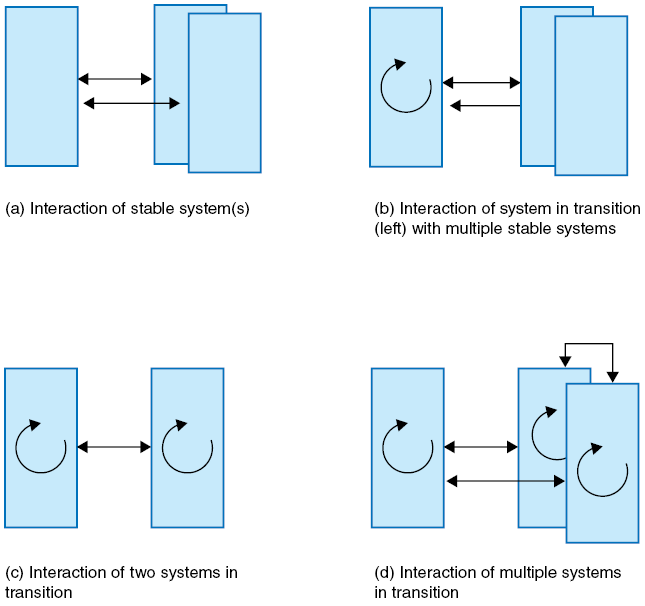
We further distinguish between multi-system interactions, referring to different types of couplings and resource flows between systems, and multi-system dynamics, which refer to socio-technical change processes (of varying depth) significantly influenced by other systems (i.e. Figure 10.1(b)–(d)). Although interactions and dynamics obviously are closely related, we make the distinction to emphasise that zooming in on the interactions and couplings (e.g. how to design or create them) is only one part of the broader research topic of multi-system dynamics. The distinction also highlights that different multi-system dynamics phenomena may involve similar types of multi-system interactions.
10.2.1 Technological Innovation System Perspective
The technological innovation system (TIS) perspective places a selected technology center stage with the idea to analyse its prospects, often including drivers and barriers (Bergek et al., Reference Bergek, Jacobsson, Carlsson, Lindmark and Rickne2008; Hekkert et al., Reference Hekkert, Suurs, Negro, Kuhlmann and Smits2007). The focus is typically not only on early stages of innovation but also diffusion of innovations from small to mass markets as well as mature technologies and those in decline have been studied (Andersen & Gulbrandsen, Reference Andersen and Gulbrandsen2020; Carlsson & Jacobsson, Reference Carlsson and Jacobsson1994; Markard et al., Reference Markard2020).
Types of systems: From the outset, it was acknowledged that TIS necessarily interact with other systems in its context (Carlsson & Stankiewicz, Reference Carlsson and Stankiewicz1991; Edquist, Reference Edquist and Edquist1997; Markard & Truffer, Reference Markard and Truffer2008). These systems include other technological innovation systems (Bergek, Hekkert, Jacobsson, Markard, Sanden, & Truffer, Reference Bergek, Hekkert, Jacobsson, Markard, Sandén and Truffer2015), established socio-technical systems (Markard et al., Reference Markard, Wirth and Truffer2016) different systems in a technology value chain (Andersen & Markard, Reference Andersen and Markard2020; Mäkitie et al., Reference Mäkitie, Hanson, Steen, Hansen and Andersen2022; Stephan et al., Reference Stephan, Schmidt, Bening and Hoffmann2017) and systems at other spatial scales (Binz & Truffer, Reference Binz and Truffer2017). This shows that there is a broad range of systems whose interactions we can study. We will get back to this in Section 10.3.
Types of interactions: Bergek et al. (Reference Bergek, Hekkert, Jacobsson, Markard, Sandén and Truffer2015) distinguished two types of interactions between a focal TIS with systems in its context: links and structural couplings (Bergek, Hekkert, Jacobsson, Markard, Sanden, & Truffer, Reference Bergek, Hekkert, Jacobsson, Markard, Sandén and Truffer2015). The former capture uni-lateral influences (i.e. context systems affecting the TIS but not vice versa), whereas the latter capture bi-lateral interdependencies. Structural couplings are understood as elements (e.g. actors, networks, institutions, technologies) shared by the focal TIS and context systems. The same actors, for instance, may operate in multiple systems, technologies may be used in multiple systems and systems may also have similar institutions (e.g. mass production logic) (Bergek, Hekkert, Jacobsson, Markard, Sandén, & Truffer, Reference Bergek, Hekkert, Jacobsson, Markard, Sandén and Truffer2015). For example, some oil companies diversified into offshore wind creating new structural couplings between the oil and gas system and the offshore wind TIS (Mäkitie et al., Reference Mäkitie, Andersen, Hanson, Normann and Thune2018). Scholars have also referred to functional couplings (see below) between the systems involved in a TIS value chain to describe the flows of material resources between them (Gong & Andersen, Reference Gong and Andersen2024). A TIS may also have linkages to context systems as finance, education or science (Fontes et al., Reference Fontes, Bento and Andersen2021; Malhotra et al., Reference Malhotra, Schmidt and Huenteler2019).
Main insights: In our reading, TIS studies have made at least three contributions to multi-system dynamics. First, novel technologies need to be embedded into a wider context of existing systems and structures: to obtain resources, to benefit from complementary innovations, to attract firms, to receive policy support or to create legitimacy (Binz et al., Reference Binz, Harris-Lovett, Kiparsky, Sedlak and Truffer2016; Binz & Truffer, Reference Binz and Truffer2017; Karltorp et al., Reference Karltorp, Guo and Sandén2017; Wirth & Markard, Reference Wirth and Markard2011). For this embedding, an emerging TIS must adapt (to a certain extent) to the structures of existing systems in its context, e.g. by addressing context problems. For our review, it is important to note that there can be a wide range of different systems to interact with, plus a wide range of interactions.
Second, the interactions between systems change over time. As a technology matures and the associated TIS grows, it starts to increasingly influence context systems, potentially also creating conflicts (Markard, Reference Markard2020; Markard et al., Reference Markard, Wirth and Truffer2016). The result is a shift from dependence to interdependence (or integration) between focal TIS and context systems. Also, resource flows change. While knowledge flows across systems might dominate in early stages of TIS development (Malhotra et al., Reference Malhotra, Schmidt and Huenteler2019), later stages increasingly demand additional flows of resources such as materials (e.g. minerals for batteries), skilled labor and capital for upscaling (Jacobsson & Karltorp, Reference Jacobsson and Karltorp2013). The new demand for resources might be a source of competition and conflict with other systems (Wirth & Markard, Reference Wirth and Markard2011). For our review, we note that system interactions and interdependencies may change as systems transform.
Third, TIS studies have highlighted the relevance of a technology value chain perspective, which widens the focus from a selected part of an innovation to broader up- and down-stream developments (Andersen & Markard, Reference Andersen and Markard2020; Sandén & Hillman, Reference Sandén and Hillman2011; Stephan et al., Reference Stephan, Schmidt, Bening and Hoffmann2017). The value chain approach therefore divides a TIS into various subsystems corresponding to different parts of the value chain including upstream (produce important materials and components of the technology), midstream (integration of components and manufacturing of technology units) and downstream (where technology is used). Each subsystem is embedded in different institutional environments and actor-networks. For example, for electric vehicles, the subsystem related to raw materials (e.g. lithium or graphite) is embedded in the mining system, the subsystem related to integration and manufacturing is embedded in the automotive industrial system, the utilisation subsystem is embedded in the wider transportation system and subsystem related to recycling is embedded in the waste management system (Gong & Andersen, Reference Gong and Andersen2024). A key issue for TIS value chain performance is to achieve sufficient institutional alignment and actor coordination across the heterogeneous systems involved to avoid bottlenecks (Malhotra et al., Reference Malhotra, Schmidt and Huenteler2019; Stephan et al., Reference Stephan, Schmidt, Bening and Hoffmann2017). This perspective is particularly helpful for grasping widespread diffusion of a focal technology where establishing and upscaling a value chain is important (Markard, Reference Markard2020). For multi-system dynamics, we note that heterogeneity of sectoral systems in the value chain can complicate actor collaborations and lead to bottlenecks in resource flows in the TIS.
10.2.2 Multi-level Perspective
The multi-level perspective (MLP) was developed to study transitions of socio-technical systems, juxtaposing the emergence of novelty in niches and the persistence of existing structures in regimes, both affected by exogenous developments at the so-called landscape level (Geels, Reference Geels2002, Reference Geels2006, Reference Geels and Hendriks2024).
Multi-system interactions in the MLP have played some role early on. Examples include niche innovations such as combined heat and power plants or biorefineries: they affect, interact with and potentially bridge different socio-technical systems (Raven & Verbong, Reference Raven and Verbong2007; Sutherland et al., Reference Sutherland, Peter and Zagata2015). Similarly, landscape developments such as market liberalisation affect multiple socio-technical systems, creating similarities across systems (Konrad et al., Reference Konrad, Truffer and Voß2008).
Types of systems: The MLP literature focuses on socio-technical systems. Recent MLP split up socio-technical systems into production, distribution and consumption subsystems, which means that also the relationships between these subsystems can be studied as multi-system interactions (Bauknecht et al., Reference Bauknecht, Andersen and Dunne2020; McMeekin et al., Reference McMeekin, Geels and Hodson2019). Others differentiate subsystems according to technologies (e.g. car, train and airplane regimes and car-sharing, mobility as a service and electric vehicle niches within the whole system of transportation) and study interactions between these (Geels, Reference Geels2018; van Welie et al., Reference van Welie, Cherunya, Truffer and Murphy2018). The most common approach is to study regime–regime interaction (e.g. oil and gas with internal combustion engine vehicles), regime–niche interactions (e.g. hydropower regime and electric vehicle niche) and niche–niche interactions (e.g. electric vehicles and roof-top solar), for niches and regimes located in different socio-technical systems (Haley, Reference Haley2015; Papachristos et al., Reference Papachristos, Sofianos and Adamides2013; Raven & Verbong, Reference Raven and Verbong2007).
Types of interactions: Konrad et al. (Reference Konrad, Truffer and Voß2008) distinguishes between functional and structural couplings as main types of multi-system interactions. Functional couplings refer to flows of resources across systems (e.g. materials, energy, financial resources) that create functional interdependencies. Structural couplings refer to overlaps in the elements of two or more socio-technical systems, i.e. actors, technology or institutions (Konrad et al., Reference Konrad, Truffer and Voß2008; Sutherland et al., Reference Sutherland, Peter and Zagata2015; van der Vleuten, Reference van der Vleuten2019). Another distinction is about modes of system interactions where scholars have suggested various types: (1) competition, (2) symbiosis, where systems develop functional relationships (Nykamp et al., Reference Nykamp, Andersen and Geels2023), (3) integration, where separate systems become integrated via a new innovation (Bakhuis et al., Reference Bakhuis, Kamp, Barbour and Chappin2024), (4) spillover, where elements from one systems are taken up within another (Konrad et al., Reference Konrad, Truffer and Voß2008; Mäkitie et al., Reference Mäkitie, Hanson, Steen, Hansen and Andersen2022) and (5) niche interference, in which niche-innovations in different systems interact and co-evolve (Papachristos et al., Reference Papachristos, Sofianos and Adamides2013; Verbong et al., Reference Verbong, Geels and Raven2007).
Main insights: The MLP holds three main insights for understanding multi-system dynamics. First, transitions in one system can be constrained by inertia in other systems, thereby making transition processes more complex (Bakhuis et al., Reference Bakhuis, Kamp, Barbour and Chappin2024). Required changes in other systems may be a mix of minor (e.g. expanding biomass production in agriculture) or major changes (e.g. shifting to renewables in electricity supply for low-carbon electric vehicles) that can result in coupled transitions across multiple systems (Nykamp et al., Reference Nykamp, Andersen and Geels2023).
A second insight is that inherent differences between socio-technical systems (e.g. system architecture, regulations, culture, business models, user practices) may complicate creating new interactions and halt unfolding multi-system dynamics. Even when new interactions could benefit both systems, we might see disagreements, misunderstanding and conflicts between central actors (Andersen, Geels, Steen, & Bugge, Reference Andersen, Geels, Steen and Bugge2023; Ertelt & Kask, Reference Ertelt and Kask2024; Raven & Verbong, Reference Raven and Verbong2007; Sutherland et al., Reference Sutherland, Peter and Zagata2015).
Third, multi-system interactions may be uneven or asymmetric. For example, systems may differ in terms of resources and power, or exposure to external pressure to change. Such asymmetries can result in one-sided solutions, or disruptions (e.g. new electrifying sectoral systems critical depend on grid access but grid actors are not dependent on new users reflecting markedly different incentive structures) (Nykamp et al., Reference Nykamp, Andersen and Geels2023; Rosenbloom, Reference Rosenbloom2019). The challenges from system differences often surface once a focal innovation starts to diffuse widely and incumbent actors rather than pioneers need to change (Andersen, Geels, Steen, & Bugge, Reference Andersen, Geels, Steen and Bugge2023; Geels, Reference Geels2021). Multi-system interactions are thus also about power and politics.
10.2.3 Deep Transitions Perspective
The DT perspective looks at large-scale, fundamental and long-term socio-economic transformations (Schot & Kanger, Reference Schot and Kanger2018). A central concept is surges of development which refers to major transformations such as the age of Steel, Electricity and Heavy Engineering (Perez, Reference Perez2009). Each surge involves transitions in individual socio-technical systems and the emergence of a new ‘multi-system complex’ (i.e. a novel configuration of multiple systems that interact in a coordinated manner). DT suggests that surges typically share common directionality because they are guided by a macro-level selection environment creating between-surges continuity (Davies & Schot, Reference Davies, Schot, Wesche and Hendriks2024).
A deep transition is viewed as a series of connected and fundamental transitions in multiple socio-technical systems in a similar direction that involves discontinuity in the macro-level selection environment (Schot & Kanger, Reference Schot and Kanger2018). The DT framework builds on the multi-level perspective and on the techno-economic paradigm framework (Davies & Schot, Reference Davies, Schot, Wesche and Hendriks2024; Perez, Reference Perez2009). The idea is to better understand the larger context (or landscape), in which contemporary transitions unfold, and how this context changes. The perspective is particularly interested in the emergence of overarching structures (e.g. production and consumption practices) that guide and affect multiple socio-technical systems (Kanger & Schot, Reference Kanger and Schot2019). Key concepts include meta-rules (norms and institutions that span multiple systems) and meta-regimes (sets of rules that span multiple systems) (Kanger, Reference Kanger2022).
The process of DT involves several steps. New rules emerge in niches in individual socio-technical systems in response to (meta-)regime problems. The new rules compete with incumbent rules, and eventually, they replace existing rules and create a new regime. New rules increasingly cross system boundaries, thereby turning into meta-rules. They might lead to cross-system alignments although variety and contestations may still occur. Subsequently, new meta-rules combine in a new meta-regime which spreads across different socio-technical systems. Finally, the new meta-regime acts as a selection environment for new niches and diffuses to more and more systems, ultimately changing the landscape (Kanger & Schot, Reference Kanger and Schot2019; Schot & Kanger, Reference Schot and Kanger2018). Industrial mass-production, digitalisation or servitisation can serve as examples here.
Types of systems: The DT perspective looks at socio-technical systems. Its primary interest is in the diffusion of meta-rules and meta-regimes across different socio-technical systems and how these systems become aligned and connected in a complex of systems as a consequence.
Types of interactions: A key form of interaction in the DT perspective is that socio-technical systems develop common features over time through the presence and workings of meta-rules and meta-regimes – similar to the idea of isomorphism in institutional theory (DiMaggio & Powell, Reference DiMaggio and Powell1983). As underlying mechanisms, DT also mentions functional and structural couplings. They are regarded both as transmission channels of and as means for consolidating meta-rules. DT also discusses the role of organisations (e.g. consultancies, international organisations) in creating and shaping couplings between meta-regimes (Schot & Kanger, Reference Schot and Kanger2018; van der Vleuten, Reference van der Vleuten2019). To emphasise flows of ideas or legitimacy, the notion of rhetorical couplings is used. It refers to cross-system discourses, i.e. referring to an activity/rule in one system to legitimise an activity in another system (Kanger & Sillak, Reference Kanger and Sillak2020).
Main Insights: First, the DT perspective broadens the scope of analysis to a broad range of interconnected socio-technical systems. In fact, the framework theorises the interplay of transition processes at the level of individual socio-technical systems and larger complexes of systems (Kanger & Schot, Reference Kanger and Schot2019; Schot & Kanger, Reference Schot and Kanger2018). In MLP terms, it can be viewed as a theory of landscape changes, which is mindful about the directionality of multi-system dynamics.
Second, DT is concerned with similarities across systems and how they emerge. It shows how transformations of individual systems may generate new meta-rules (or change existing ones) and how these may combine into meta-regimes and diffuse across multiple systems (Kanger, Reference Kanger2022).
Third, the framework points to agency and the role different kinds of actors play in the creation and diffusion of meta-rules (Kanger et al., Reference Kanger, Schot, Sovacool, van der Vleuten, Ghosh, Keller, Kivimaa, Pahker and Steinmueller2021; van der Vleuten, Reference van der Vleuten2019). However, this aspect has not been elaborated systematically yet and empirical studies are required here.
Finally, the DT perspective highlights the importance of directionality (and potential lock-ins) created by meta-rules. As such the perspective enables transition scholars to examine issues around deep-rooted societal values, conventions and practices associated with capitalism, equality, our relationship with nature or the exploitation of resources (Kanger et al., Reference Kanger2022).
10.3 Discussion and Outlook
A general feature of multi-system perspectives is that elements, which were treated as context or landscape before, are now integrated into the analysis (endogenised). This allows for more encompassing analyses of (new) multi-system phenomena, but it also makes the conceptual frameworks more complex. Our review shows that there is so far not one dominant approach to study multi-system interaction phenomena. Instead, multi-system dynamics have been analysed with different frameworks and at different levels of aggregation. Multiple systems are at the core of the DT framework and have also gained more attention recently for TIS and MLP. There are some conceptual overlaps among the frameworks but also many differences. In this section, we share reflections and discuss future research needs that can aid cross-framework synthesis and advance our knowledge about multi-system dynamics. We focus on three topics: (i) systems, (ii) interactions and (iii) phenomena, see Table 10.2.
10.3.1 Systems
Our review revealed that scholars have analysed interactions between a broad range of different systems. So, a key task for future studies will be to be explicit about the type of systems studied, about which analytical boundaries were set and why, and what multi-system phenomena are in the focus. On this basis, we can start to analyse why, how, when and where interactions take place or change.
In the review, we observed four ways of delineating a socio-technical system: (a) complexes of systems comprised of various socio-technical systems that are functionally interdependent, exchange resources and may be coordinated by shared (meta) rules such as the complex made up by oil and gas, oil-based transport, fossil-based energy and petrochemical systems emerging in the early twentieth century, (b) socio-technical systems in the traditional sense, providing societal services such as energy, water or transport and covering production, distribution and consumption domains. (c) sub-systems of socio-technical systems or sectors (e.g. power supply, distribution systems, chemicals or mining) and (d) systems associated with specific technologies e.g. windmills or electric vehicles which are applied in yet other systems/sectors to generate their key service.Footnote 2 Reminiscent of this, we note a tendency to narrow system boundaries for analysing multi-system dynamics, e.g. focusing on production, distribution or consumption sub-systems rather than the larger socio-technical system as one. Splitting up ‘whole systems’ to better characterise subsystems and technologies as well as how they differ and interact is one way of handling the growing complexity of multi-system dynamics and real-world transitions. Regardless of these different system delineations, it is worthwhile to remember that some flexibility in boundary setting remains and that different research questions require different system boundaries.
We also observe that multi-system dynamics may unfold ‘horizontally’ or ‘vertically’ (also see Bergek et al., Reference Bergek, Hekkert, Jacobsson, Markard, Sandén and Truffer2015 for similar observation). Horizontal multi-system dynamics may refer to relationships between production, distribution and consumption domains in the provision of a societal service or between distinct systems of provision (e.g. water, energy, transport) (McMeekin et al., Reference McMeekin, Geels and Hodson2019). Vertical multi-system dynamics may refer to the systems connected via value chains covering mining, materials, manufacturing and use of a particular technology or product (Andersen et al., Reference Andersen, Steen, Mäkitie, Hanson, Thune and Soppe2020; Stephan et al., Reference Stephan, Schmidt, Bening and Hoffmann2017). These types of multi-system dynamics are rarely considered in an integrated way which arguably obscures some aspects of transitions. Think of how limited critical minerals and underwhelming manufacturing capacity in Europe influence further developments in production (renewable energy diffusion), distribution (power cables, transformers and battery systems) and consumption (batteries and electric vehicles) (Andersen et al., Reference Andersen, Mäkitie, Steen and Wanzenböck2024; Edler et al., Reference Edler, Blind, Kroll and Schubert2023).
In addition, there is so far limited attention to describing and analysing system differences (e.g. structures or business cultures) and how these influence system interactions (Miörner et al., Reference Miörner, Binz and Fuenfschilling2021; Nykamp et al., Reference Nykamp, Andersen and Geels2023). Indeed, understanding the combination of cross-system (inter)dependencies and system differences is a basic rationale for multi-system analysis.
We also observe that although interacting systems can be spatially delineated (e.g. local vs. global) and multi-system interactions unfold across different places (e.g. electricity systems in Germany and Denmark), that area of multi-system analysis merits more attention to connect the geography of transitions (Binz et al., Reference Binz, Coenen, Murphy and Truffer2020).
10.3.2 Interactions
In terms of types of interactions, we noted a significant variety in the literature (modes and types), but also that the concept of structural couplings has received attention in all three perspectives, and it might be promising to study and develop further.
As also noted by Rosenbloom (Reference Rosenbloom2020), interaction concepts are, across the three frameworks, mostly applied descriptively and in an abstract and macroscopic manner which leads to a limited understanding of local, micro-level accounts of how system interactions are created and changed in practice (Andersen & Geels, Reference Andersen and Geels2023; Breitschopf et al., Reference Breitschopf, Grimm, Billerbeck, Wydra and Köhler2023; Rosenbloom, Reference Rosenbloom2020). This is important because the emergence and scaling of new low-carbon value chains, sustainable transitions of systems and of complexes of systems all involve the creation of many new interactions.
We acknowledged that transition scholars have recently made efforts to address this issue by identifying structural coupling mechanisms related to the dimensions of technology (technological complementarities such as the need for particular inputs or complementary innovations), actors (e.g. company diversification across systems creates organisational couplings and capability or value changes in multi-system consumers can transmit these across systems) and institutions (e.g. actors can build cross-system institutional couplings to overcome system differences, and similar changes in cultural conventions in distinct systems can lead to new institutional couplings) (Andersen & Geels, Reference Andersen and Geels2023; Andersen, Geels, Steen, & Bugge, Reference Andersen, Geels, Steen and Bugge2023; Ertelt & Kask, Reference Ertelt and Kask2024; Käsbohrer et al., Reference Käsbohrer, Hansen and Zademach2024; Löhr & Chlebna, Reference Löhr and Chlebna2023; van der Vleuten, Reference van der Vleuten2019).Footnote 3 A related proposal is to shift analytical focus from individual couplings to multi-system sites or interfaces that encompass multiple different couplings and their interrelations (Andersen, Geels, Steen, & Bugge, Reference Andersen, Geels, Steen and Bugge2023; Löhr & Chlebna, Reference Löhr and Chlebna2023; Rosenbloom, Reference Rosenbloom2020). An interface approach draws attention to how inter-system domains are created and associated tensions and conflicts. Despite these suggestions, the analysis of multi-system interactions and multi-system dynamics more broadly would benefit from more attention to the role of actor strategies and of politics, i.e. how actors and coalitions work to influence the pace and directionality of multi-system dynamics (see Löhr et al., Reference Löhr, Markard and Ohlendorf2024; Ohlendorf et al., Reference Ohlendorf, Löhr and Markard2023).
In terms of the content of interactions, we note that for TIS and MLP, multi-system interactions are often about flows of (tangible and intangible) resources across system boundaries (e.g. electricity, fuels, data, materials, finances). DT, however, focus on diffusion of rules, ideas and principles which often is a precursor to tangible resource flows that, in turn, require new structural couplings to consolidate. While resource flows are facilitated by specific structural couplings (Andersen & Geels, Reference Andersen and Geels2023), our understanding of how meta-rules travel across systems is less clear. DT suggests rhetorical couplings as transmission mechanism, but this concept remains rather unexplored, e.g. how are they created and how do they relate to structural couplings.
Lastly, we note that multi-system interactions are almost exclusively studied in relation to the emergence or diffusion of new technologies or practices. However, as highlighted by DT, existing, unsustainable systems are already connected via bundles of functional and structural couplings. Such couplings may imply greater resilience to external pressures for change and suggest that incumbency is inherently a multi-system phenomenon (Andersen & Gulbrandsen, Reference Andersen and Gulbrandsen2020; Johnstone et al., Reference Johnstone, Stirling and Sovacool2017). It is therefore important for future studies to explore the role of multi-system interactions in destabilisation and decline of systems or complexes of systems.
10.3.3 New Multi-system Dynamics Phenomena
From our review, we note that TIS and MLP studies largely focus on ‘bilateral’ multi-system dynamics, i.e. between a focal technology or system, and context systems (Figure 10.1(b) or (c)). DT, however, considers deep transitions across most if not all socio-technical systems in the economy (Figure 10.1(d)). DT does apply the notion of a complex of systems which is used to describe clusters of co-evolving systems (or surges) around particular impactful technologies or energy carriers which is seen as a mechanism for bringing about DT. However, from a sustainability transitions perspective, the emergence of complexes is an important phenomenon in its own right. While DT does provide an abstract account of how such complexes emerge and transform, it remains quite ’broad-brushed’ and insufficient with respect to e.g. diffusion and coupling mechanisms, actor strategies, system properties, tensions and conflicts as well as governance issues (Kemp et al., Reference Kemp, Pel, Scholl and Boons2022).
Many currently unfolding multi-system transition processes such as net-zero, circular economy or digitalisation resemble multi-system complexes ‘in the making’. To better grasp such multi-system dynamics, we need more conceptual exploration of the emergence and transformation of system complexes as this currently escapes existing frameworks.
Contemplating the example of low-carbon electrification reveals some of the limitation of existing frameworks. While there are several studies of low-carbon electrification, these tend to focus on a focal innovation and/or bi-lateral multi-system dynamics (see e.g. Andersen, Geels, Steen, & Bugge, Reference Andersen, Geels, Steen and Bugge2023; Käsbohrer et al., Reference Käsbohrer, Hansen and Zademach2024; Löhr & Chlebna, Reference Löhr and Chlebna2023). However, low-carbon electrification as phenomenon exhibits dynamics that merit a multi-system complex approach (see e.g. Markard & Rosenbloom, Reference Markard, Rosenbloom, Rogge, Kern and Meadowcroft2022; Nykamp et al., Reference Nykamp, Andersen and Geels2023; Ryghaug & Skjølsvold, Reference Ryghaug and Skjølsvold2023), see Text Box 10.1.
Low-carbon electrification involves interdependent changes in production (decarbonise electricity generation), consumption (use clean electricity where possible) and distribution domains (adapt the grid system to facilitate generation and consumption changes). Some also include the production, distribution and consumption of green hydrogen in (indirect) low-carbon electrification which further expands the complex of involved systems (BNEF, 2020; ETC, 2021).
Systems: In Norway, for example, low-carbon electrification is established in the electricity production system which is fully decarbonised. In terms of consumption, low-carbon electrification is already well-established in personal car transportation (EVs). Driven by climate policy, direct electrification has in recent years continued to spread to maritime transport, buses, heavy transport, construction, industry and oil and gas systems. Indirect electrification via green hydrogen, ammonia and other e-fuels is also receiving increasing interest in systems as chemicals and shipping (Hansen et al., Reference Hansen, Andersson, Finstad, Hanson, Hellsmark, Mäkitie, Nordholm and Steen2024). To stimulate economic development around the electrification efforts, policymakers and companies try to build new upstream sectors within strategic technology value chains including battery manufacturing, low-carbon mining for critical materials, electric vessels, smartgrid systems and manufacturing electrolysers (Bugge et al., Reference Bugge, Andersen and Steen2021; Ryghaug & Skjølsvold, Reference Ryghaug and Skjølsvold2023). The scope of the complex thus covers an array of different systems and sectors, and thus include both horizontal and vertical multi-system dynamics.
Interactions: Key resource flows between these systems include electricity, fuels, materials and technology components. However, the success of electrification in personal transport spurred electrification of other systems – legitimacy around the idea of ‘electrify everything’ diffused across multiple systems and applications (Mäkitie et al., Reference Mäkitie, Hanson, Steen, Hansen and Andersen2022; Ryghaug & Skjølsvold, Reference Ryghaug and Skjølsvold2023). In the process, several new interface actors and roles emerged to connect these new systems and sectors via structural couplings and help mitigate inherent institutional differences and outlooks. For example, electric utilities developed new electrification divisions, start-ups provided mobile battery systems for temporary use in construction, port organisations did intermediation between maritime and land-based transport as well as energy and industrial systems, and environmental NGOs created new cross-system meeting places (Andersen, Geels, Steen, & Bugge, Reference Andersen, Geels, Steen and Bugge2023; Bjerkan et al., Reference Bjerkan, Ryghaug and Skjølsvold2021).
Several tensions and bottlenecks in the complex were also observed. For example, growing new consumption requires that generation capacity must expand significantly which, especially for wind power, is challenged by low social acceptance (Korsnes et al., Reference Korsnes, Loewen, Dale, Steen and Skjølsvold2023). Also, the speed and scale of planned new electricity production and consumption (e.g. energy-intensive processing sectors, oil and gas, hydrogen and data centers) overwhelmed actors in the electricity grid system resulting in major interconnection queues (Nykamp et al., Reference Nykamp, Andersen and Geels2024). In this context, new tensions emerge about who should get priority access to low-carbon electricity (oil and gas or green hydrogen projects?). Tensions and delays also created new uncertainty about the boundary between electrification versus other options such as carbon capture and storage in industry, blue hydrogen or even bioenergy (Inderberg et al., Reference Inderberg, Nykamp, Olkkonen, Rosenberg and Taranger2024).
Our general understanding of the processual aspects of how multi-system complexes change (emerge, contract/expand or decline) is still limited. More knowledge is needed e.g. about how new systems become included, whether and how complexes can build momentum (e.g. successful electrification in one system creates resources and support for electrification in other systems), the relation between horizontal and vertical multi-system dynamics within complexes, to what extent new meta-rules and -regimes are critical to complex development (in the electrification example it was not immediate clear) or which strategies actors pursue to navigate or expand complexes.
The questions raised above, will also be relevant for related phenomena. One example is about transitions from linear technology value chains to a circular economy, which depends on institutional alignments across interdependent actors and systems that often lead to tensions and conflicts (Kuhlmann et al., Reference Kuhlmann, Meuer and Bening2023), as well as changes in functional and structural couplings (Gong & Andersen, Reference Gong and Andersen2024; Magnusson et al., Reference Magnusson, Zanatta, Larsson, Kanda and Hjelm2022). The complex of systems perspective can also be useful for thinking about the challenges of multi-purpose technologies such as mobile phones, carbon capture or batteries. Such technologies take part in the transitions of multiple systems at the same time and connect them in a complex (see e.g. Decourt, Reference Decourt2019; Finstad & Andersen, Reference Finstad and Andersen2023). Next to these, phenomena as digitalisation (Andersen et al., Reference Andersen, Frenken, Galaz, Kern, Klerkx, Mouthaan, Piscicelli, Schor and Vaskelainen2021; John et al., Reference John, Wesseling, Worrell and Hekkert2022) or the bio-economy (Wirth & Markard, Reference Wirth and Markard2011) also seem to exhibit multi-system complex dynamics. Surely each of these evolving complexes have their own particularities that are waiting to be explored.
10.4 Conclusions
In this chapter, we have reviewed how three central transition studies frameworks conceptualise and analyse multi-system interactions and dynamics in transitions and discussed similarities and differences. We also outlined a research agenda for multi-system dynamics in transition studies building on opportunities for synthesising insights across the reviewed frameworks to better address new and emerging empirical multi-system dynamics phenomena.
An important omission from our chapter is methods for studying multi-system dynamics. It is easy to be fascinated by the interconnectedness a multi-system perspective reveals, but one should always critically ask what value-added to answering a specific question or understanding transition phenomena such a perspective brings. We noted the need to be careful about system boundaries but also the discussion about methods is still immature. Another omission from our review is policy and governance in relation to multi-system dynamics. Despite recent advances (Kanger et al., Reference Kanger, Sovacool and Noorkõiv2020; Rogge & Goedeking, Reference Rogge and Goedeking2024), the topic is rather novel, and we hope that our discussion of systems, interactions and phenomena can support future work on policy and governance (Rogge et al., Reference Rogge, Goedeking, Girones, Wesche and Hendriks2024).
Despite its limitations, our review aims to provide a starting point and an introduction to multi-system analysis in transition studies that we hope will inspire more scholars to engage with this rapidly emerging topic.
11.1 Introduction
This chapter examines how the concept of disruption has been used and defined in the context of sustainability transition studies. Sustainability transitions have often been described to involve ‘disruptions’. However, many writings in this field have been rather imprecise about what disruption means in the context of transitions, beyond the disruption of status quo. In the literature, references to disruptions have ranged from a discourse on disruptive niche innovations (Wilson & Tyfield Reference Wilson and Tyfield2018) to disruptive landscape influences (Geels & Schot Reference Geels and Schot2007). A systematic literature review conducted in 2020 revealed that the conceptualisation of disruption was often imprecise and empirical studies were oriented to the energy sector (Kivimaa et al. Reference Kivimaa, Laakso, Lonkila and Kaljonen2021). In the review, we defined disruption as a ‘high-intensity effect in the structure of the socio-technical system(s), demonstrated as long-term change in more than one dimension or element, unlocking the stability and operation of incumbent technology and infrastructure, markets and business models, regulations and policy, actors, networks and ownership structures, and/or practices, behaviour and cultural models’ (Kivimaa et al. Reference Kivimaa, Laakso, Lonkila and Kaljonen2021: p. 119).
In this chapter, we build on this definition of disruption and complement the understanding by reviewing the most recent literature on disruption, adding to the initial review comprising 47 articles. While disruption as a concept originates from the literature on disruptive innovation, we can see its recent expansion in transitions studies encompassing whole socio-technical systems. This chapter provides much-needed clarity on the conceptual confusion that has ensued and evaluates the links between the concept of disruption, and the ways in which mainstream technologies, practices and business models in socio-technical regimes need to be phased-out (Johnstone & Hielscher Reference Johnstone and Hielscher2017; Koretsky & van Lente Reference Koretsky and van Lente2020), destabilised (Karltorp & Sandén Reference Karltorp and Sandén2012; Turnheim & Geels Reference Turnheim and Geels2013; Turnheim Reference Turnheim, Koretsky, Stegmaier, Turnheim and van Lente2022) or decline (Koretsky et al. Reference Koretsky, Stegmaier, Turnheim and Lente2022; Novalia et al. Reference Novalia, McGrail, Rogers, Raven, Brown and Loorbach2022; Rosenbloom and Rinscheid Reference Rosenbloom and Rinscheid2020). We end by examining the relevance of the concept of disruption to emerging scholarly and societal debate on just transitions.
11.2 Conceptualising Disruption in Transition Studies
Disruptive innovation emerged in the 1980s and 1990s innovation management literature, which described it as innovation which has industry-changing effects (Christensen Reference Christensen1997; Tushman & Anderson Reference Tushman and Anderson1986). Early definitions also described disruptive innovations to constitute products and services which may perform worse than mainstream products but result in other benefits to customers (Christensen Reference Christensen1997; Christensen & Rayner Reference Christensen and Rayner2003). These were described to contrast sustaining innovations which incrementally improved existing products or processes (Christensen & Rayner Reference Christensen and Rayner2003). Later literature has critiqued early literature of too simplistic arguments but agreed with the interpretation that disruption is related to the activities of incumbent actors (Markides Reference Markides2006) in a way that may force them to change their actions. Disruption, therefore, also connects to how incumbency has often been framed in the transitions literature as something that needs changing (Stirling Reference Stirling2019).
The literature on disruptive innovation has developed since then to a more nuanced direction. For example, more recent argumentation increasingly emphasised that disruption does not mean the loss of all competencies for incumbent firms (Ho & Chen Reference Ho and Chen2018) – as indicated by Abernathy and Clark (Reference Abernathy and Clark1985). Instead, incumbent actors are diverse and are not only passive targets of disruption, destabilisation or regime decline. Therefore, disruptive innovation and broader disruptive influences alike rather create a reason for incumbents to change. This can occur, for instance, in the form of repurposing assets, reconfiguring products or reskilling workforce (Kivimaa & Sivonen Reference Kivimaa and Sivonen2023; Lonkila & Kaljonen Reference Lonkila and Kaljonen2021; Mäkitie Reference Mäkitie2020). Disruption can, in effect, lead to more substantial shifts in the practices of incumbents than more incremental change processes.
Figure 11.1 shows development in the use of the concept of disruption in innovation and transition studies from the 1980s until 2019. In both fields, one can see branching out to different uses and understandings.
Illustration of the evolution of the concept of disruption in innovation management and transition literatures.

One of the core arguments in the literature on disruption in sustainability transitions is that disruption can happen regarding different system dimensions (Johnstone et al. Reference Johnstone, Rogge, Kivimaa, Fratini, Primmer and Stirling2020). In the Kivimaa et al. (Reference Kivimaa, Laakso, Lonkila and Kaljonen2021) literature review, in addition to (1) technology, we identified four other dimensions regarding where disruptions may take place: (2) markets and business models, (3) regulations, policies and formal institutions, (4) actors and networks, as well as (5) behaviour, practices and cultural models. Table 11.1 provides some explanations regarding what disruption can mean in each of these categories.
| Dimension of disruption | Explanation |
|---|---|
| Technology |
|
| Markets and business models |
|
| Regulations, policies and formal institutions |
|
| Actors and networks |
|
| Practices, behaviour and cultural models |
|
A second argument is that disruption can be characterised in terms of magnitude and speed of change. The most typical association of disruption, perhaps, is an initially small magnitude of change in the form of disruptive innovation. Examples include e-bikes and solar thermal water tanks and potentially electric vehicles (Wilson Reference Wilson2018). Introduction of plant-based proteins into food systems (Bulah et al. Reference Bulah, Negro, Beumer and Hekkert2023) is an example of gradual small magnitude of change that has not changed the power structures in the food chain. A larger magnitude of change would require major shifts in the relations between farmers, food industry and retail (Lonkila & Kaljonen Reference Lonkila and Kaljonen2021). In a transitions context, large magnitude of change covers multiple elements of systems (see Table 11.2). Such change can be gradual or rapid, the latter more frequently associated with discontinuity, breakdown and replacement. For instance, a large magnitude gradual change can be exemplified by the ways in which the diffusion of wind and solar power have substantially altered the electricity system in many countries (Johnstone et al. Reference Johnstone, Rogge, Kivimaa, Fratini, Primmer and Stirling2020). In turn, more rapid large changes can result from ‘landscape shocks’, such as the COVID-19 pandemic and wars (see Chapter 7). Examples include the rapid and persistent change to telework and hybrid work (Newbold et al. Reference Newbold, Rudnicka, Cook, Cecchinato, Gould and Cox2022; Verma et al. Reference Verma, Venkatesan, Kumar and Verma2022). Harnessing such disruptive landscape events for large changes has also been called for (Markard & Rosenbloom Reference Markard and Rosenbloom2020). The Kivimaa et al. (Reference Kivimaa, Laakso, Lonkila and Kaljonen2021) review argued that it is not only rapid changes which should be accounted for as disruption but also gradual changes of large magnitude that result in whole system reconfigurations.
| Gradual change | Rapid change | |
|---|---|---|
| Large magnitude of change, covering multiple system elements or dimensions of disruption | Disruption associated with gradual transformation and subtle reconfiguration of the whole system | Disruption characterised by discontinuity, breakdown and replacement, stretch-and-transform of the whole system |
| Small magnitude of change, covering a single system element or dimension of disruption | Non-disruptive incremental change, sustaining existing system configurations | Disruption associated with disruptive innovation, fit-and-conform, survival and return |
Overall, in Kivimaa et al. (Reference Kivimaa, Laakso, Lonkila and Kaljonen2021), we emphasised that a multi-dimensional understanding of disruption is important, and it needs to go beyond technological change and high-tech innovation. Moreover, disruption in one system dimension can lead to a cascade of disruptions where, for instance, a technological disruption leads to business model disruption and a disruption in practices. For instance, technological advances in data sharing and programming created new business models around mobility-as-a-service with potential for broader transport transitions (Carbonara et al. Reference Carbonara, Messeni Petruzzelli, Panniello and De Vita2024; Kivimaa & Rogge Reference Kivimaa and Rogge2022). Or, alternatively, a disruption in actor-networks can create a regulatory or technological disruption. This is not, however, always the case. A technological disruption can also support established practices, such as in the case of biofuels or electric vehicles that maintain established private car-based mobility practices. There are many ways in which disruption in transitions unfold. In essence, disruption as a phenomenon is unpredictable and unruly, and, for instance, technological disruption can lead to changes to more unsustainable practices (Kivimaa et al. Reference Kivimaa, Laakso, Lonkila and Kaljonen2021).
11.3 New Understandings and Specifications
The research on disruption in transitions has expanded since late 2020, when the Kivimaa et al. (Reference Kivimaa, Laakso, Lonkila and Kaljonen2021) review was conducted. In 2020, a search of terms ‘disrupt*’ AND ‘sustainability transition*’ OR ‘socio-technical transition*’ OR ‘socio-technical transition*’ OR ‘societal transition*’ resulted in 47 relevant articles (Kivimaa et al. Reference Kivimaa, Laakso, Lonkila and Kaljonen2021: p. 112). In September 2023, the same search on Web of Science, for the years 2021–2023 resulted in 36 articles published as scientific articles (excluding our review article). The articles were published in a wide variety of sources, in 30 academic journals and over a dozen empirical contexts. The energy sector dominated with about a quarter of articles, followed by agriculture and food, COVID-19, urban development and circular economy. About a third did not have a specific country focus, while Germany was most often mentioned.
As an overview, it can be stated that no coherent interpretation of disruption still exists in the sustainability transitions’ literature. In general, the term ‘disruption’ or ‘disruptive’ are often used as regular descriptive words. In our updated light review, 20 articles out of the 36 articles found were discarded due to only using disruptive as descriptive term. A few discussed disruptions as transition phenomena but did not delve deeper into it empirically or conceptually. We analysed the remaining 13 articles more closely for the purposes of this book chapter to update the insights derived from the Kivimaa et al. (Reference Kivimaa, Laakso, Lonkila and Kaljonen2021) literature review. We identified how recent uses of the concept of disruption link to our previous categorisation in terms of technology, markets and business models, regulations, policies and formal institutions, actors and networks and practices, behaviour and cultural models (Table 11.1). The new articles especially addressed disruption in relation to niche or incumbent actors, the COVID-19 pandemic as a landscape disruption and the nature of disruption. We will sum up these insights below.
11.3.1 Actors and Disruption
Several of the new articles strengthen the understanding of niche actors in altering and disrupting existing practices and cultural models. For example, analysing institutional work related to plant-based protein innovations, Bulah et al. (Reference Bulah, Negro, Beumer and Hekkert2023) show that niche actors actively work to disrupt cultural norms and values upholding the meat regime. Disruptive actors also work to undermine the institutions upholding the regime and work to disrupt, for example, policy or monetary support to dominant regime technologies and practices. Also, Bobbins et al. (Reference Bobbins, Caprotti, de Groot, Pailman, Moorlach, Schloemann and Siwali2023) highlight the role of practices, community dynamics and lived experience of actors in enabling the disruptiveness of innovations, underlining that disrupting innovations never exist beyond and ‘apart from’ existing socio-technical systems and cultural dynamics but as integral parts of them.
Looking at the role of prosumers in the energy transition, Weigelt et al. (Reference Weigelt, Lu and Verhaal2021) show the active role of disruptive actors by illustrating that disruption emerges not only from disruptive technologies but also their application by actors. They found that prosumers applied niche innovations in a novel and disruptive manner, especially in relation to incumbent actors’ business models, showcasing an example of a ‘stretch-and-transform’ process (see Smith & Raven Reference Smith and Raven2012). Thus, recent research using the concept of disruption strengthens the understanding of disruptions as forces undermining regime institutions and their practices, and potentially accelerating transition to more sustainable practices. This is in accordance with the understanding of transition strategies by Smith and Raven (Reference Smith and Raven2012) and shows that niche actors can deploy innovations in disruptive or conforming ways in relation to the existing socio-technical regime.
In contrast to our earlier review of disruption (Kivimaa et al. Reference Kivimaa, Laakso, Lonkila and Kaljonen2021), recent work has paid more attention to the increasingly complex role of incumbents as agents in both promoting and resisting transition. While the traditional take on disruption regarding incumbent actors has been the reduced value of (i.e. a disruption to) existing skills and resources held by the incumbents (e.g. Abernathy & Clark Reference Abernathy and Clark1985; Turnheim & Geels Reference Turnheim and Geels2013), new research has revealed the opportunities for incumbents to repurpose their skills and resources in response to disruptions (Mäkitie Reference Mäkitie2020; Nemes et al. Reference Nemes, Chiffoleau, Zollet, Collison, Benedek, Colantuono and Dulsrud2021). Kivimaa and Sivonen (Reference Kivimaa and Sivonen2023) have interpreted this as a process of ‘disruption to and repurposing skills and assets’ in the context of regime decline (see chapter 11.4 on decline). While facing disruption of skills and assets, incumbents are in a rather passive position, repurposing them shows a more active reaction to the ongoing transition.
There are other possible actions too. In this vein, two papers highlight the multifaceted role of disruptive incumbent actors. Interestingly, Galvan et al. (Reference Galvan, Cuppen and Taanman2020) show, by analysing grid operators, that incumbent regime actors can engage in both disruptive and maintaining practices simultaneously. Incumbents’ work in disrupting institutions that create barriers for their interests may also open space for the growth of niches. In turn, Loehr et al. (Reference Loehr, Chlebna and Mattes2022) foreground that along disruptive actions of incumbents, it is also crucial to analyse defensive institutional work that aims to resist and prevent transition. Defensive work resists disruptions and is geared at maintaining existing practices of the regime. It can take the shape of delegitimising novel practices, rules and technologies (Lehmann et al. Reference Lehmann, Graf-Vlachy and Koenig2019; Loehr et al. Reference Loehr, Chlebna and Mattes2022). Defensive work may in its turn have a disruptive effect towards the transition process (Loehr et al. Reference Loehr, Chlebna and Mattes2022), in other words a disruption of disruption. This understanding of disruption as impeding ongoing developments towards sustainability offers a novel perspective on the dimensions of disruptive actors and disruptive behaviour and practices. We suggest that a more nuanced understanding of disruptive incumbency can open avenues for harnessing the role of incumbency in accelerating transition, while also offering conceptual tools for navigating the various forms of regime resistance as well as disruption.
11.3.2 The COVID-19 Pandemic and Disruption
Recent articles on disruptive landscape events, especially on the COVID-19 pandemic, highlight the usefulness of categorising different dimensions of disruption and a detailed analysis of what is being disrupted and by whom. While landscape-level shocks open an opportunity for rapid change on a large scale, recent research underlines the complexities and resistances faced by such disruptive processes. Nemes et al. (Reference Nemes, Chiffoleau, Zollet, Collison, Benedek, Colantuono and Dulsrud2021) emphasise how the COVID-19 pandemic is exceptional in its large-scale influence on all-encompassing disruption on supply chains, so essentially a substantial landscape shock (see Kanda & Kivimaa Reference Kanda and Kivimaa2020). They note that the pandemic revealed the need to develop more resilient socio-technical systems against future disruptions.
Markard and Rosenbloom (Reference Markard and Rosenbloom2020) argue that the disruptive power of landscape-level shocks, such as the COVID-19 pandemic, must be actively harnessed to accelerate the decline of carbon-intensive technologies, industries and practices. Disruptive landscape events have potential to break ‘carbon lock-ins’ and open and accelerate low-carbon pathways, but this must be coupled with long-term processes of destabilisation and phase-out, to prevent a return to the preceding status quo once the initial landscape disruption has passed. This indicates that disruption on the level of institutions and regulations is needed to realise the disruptive potential of landscape shocks, again pointing out the interrelatedness of different spheres of disruption and the limits of one dimension alone. Indeed, Hirth et al. (Reference Hirth, Oncini, Boons and Doherty2022) have criticised the expectation that disruptive events kick-start systemic change towards sustainability. They showed that the COVID-19 pandemic did not disrupt regime practices in the context of different food provision sectors, because routinised and non-deliberative practices hindered transformation. This underlines that, other disruptions, influencing practices and behaviour, are needed to realise the disruptive potential of landscape shocks. Landscape disruption alone seems insufficient to stimulate sustainability transitions.
11.3.3 Nature of Disruption: Outcome Versus Process
Novel work on disruption continues to address the debate on whether disruption should be understood as a transition process or its outcome. For instance, Lazarevic et al. (Reference Lazarevic, Salo and Kautto2022: p.5) present dealignment and destabilisation as processes within the sustainability transition that facilitate “the development of disruptive policy frameworks and governance arrangements that challenge existing systems”. Hence, they indicate, too, that destabilisation is the process and disruption the outcome and the means to achieve transitions. This matches the definition presented above (and in Kivimaa et al. Reference Kivimaa, Laakso, Lonkila and Kaljonen2021) that portrays disruption as transition-related change. Also, Simoens et al. (Reference Simoens, Fuenfschilling and Leipold2022) associate disruption as an outcome, describing disruptive discursive change that can unlock previously unchallenged values and beliefs, creating openings for alternative discourse.
Contrary to this understanding, Blomsma et al. (Reference Blomsma, Bauwens, Weissbrod and Kirchherr2023) regard disruption as a process with three phases: release, reorganisation and eruption. They associate ‘circular disruption’ to a formation of a new paradigm which differs from the linear model of innovation and economy and which refers to systemic, widespread and fast change. This understanding is in partial contradiction to our previous proposal (Table 11.2), where certain types of disruptions are also associated with gradual transformative change and reconfiguration. Blomsma et al. (Reference Blomsma, Bauwens, Weissbrod and Kirchherr2023) also call for increased reflexivity among the transition studies community, to move from describing historic disruptions to outlining the conditions necessary for accelerating systemic change in close collaboration with other actors. On the other hand, Heiges and O’Neill (Reference Heiges and O’Neill2022) highlight the value of descriptive policy analysis when evaluating the impacts of past and existing disruptive or destabilising policies. They show that in the case of plastics recycling in the US, existing niches were not mature enough to become dominant regime actors when a major policy event took place. This opened space for the emergence of multiple co-existing regimes as a novel transition pathway, which can create further understanding for transition dynamics and governance. In other words, examining past and ongoing policy developments can reveal unexpected transition dynamics and add to existing understanding of potential transition pathways (Heiges & O’Neill Reference Heiges and O’Neill2022).
11.4 Disruption in Relation to Destablisation, Decline, Phase-out and Just Transition
Destabilisation, decline and phase-out are closely linked concepts to that of disruption in sustainability transition studies. In this literature, the concepts of disruption and destabilisation share some similar characteristics but differ in their origin (Kivimaa et al. Reference Kivimaa, Laakso, Lonkila and Kaljonen2021). While the concept of disruption originates from innovation and management studies as something contrary to incremental innovation (see Christensen Reference Christensen1997), the concept of destabilisation originates from the changes affected by or initiating from the socio-technical regime (see Turnheim & Geels Reference Turnheim and Geels2012, Reference Turnheim and Geels2013). Therefore, destabilisation is an original concept of transition studies, whereas disruption is an ‘imported’ one. Moreover, destabilisation is mostly used in the context of the Multi-level perspective (MLP) (see Chapter 2), while disruption is used more broadly in transition studies (Kivimaa et al. Reference Kivimaa, Laakso, Lonkila and Kaljonen2021). As the understanding of disruption has expanded from radical niche innovations to landscape events and regime changes in different dimensions, the two concepts have clearly moved closer to one another. Their intertwining is needed to understand the broader societal processes linked to disruptions.
Turnheim (Reference Turnheim, Koretsky, Stegmaier, Turnheim and van Lente2022: p. 45) defines destabilisation as “a longitudinal process by which otherwise relatively stable and coherent socio-technical forms (systems, regimes, institutional arrangements, sets of practices and networks) become exposed to challenges significant enough to threaten their continued existence and their “normal” functioning, triggering strategic responses of core actors within the frame of existing commitments (preservation) and in some circumstances away from such commitments (transformation).” Also, Ghosh et al. (Reference Ghosh, Kivimaa, Ramirez, Schot and Torrens2021: p. 17) define destabilisation as reducing alignment between the different system elements “resulting in a process in which regime actors abandon behaviors, beliefs and values constituting the [socio-technical] regime”. Destabilisation is hence mostly understood as a process (Martínez Arranz Reference Martínez Arranz2017; Turnheim & Geels Reference Turnheim and Geels2013), which is caused by rapid or gradual disruption(s). One could argue that the process of destabilisation that creates disalignment between system elements may then be followed by disruptive changes within these system elements, leading to disruptive outcomes.
Decline, in contrast, relates to often a more objectifiable or quantifiable degradation of system performance (e.g. size, economic viability, population, hegemonic power, legitimacy), which can (but rarely does) lead to total decline (Turnheim Reference Turnheim, Koretsky, Stegmaier, Turnheim and van Lente2022: p. 45). In this sense, it comes closer to understanding of disruption as an outcome. Deliberate decline (Rosenbloom & Rinscheid Reference Rosenbloom and Rinscheid2020) and phase-out (Johnstone & Hielscher Reference Johnstone and Hielscher2017; Koretsky & van Lente Reference Koretsky and van Lente2020), in turn, relate to deliberate interventions seeking partial or total discontinuation of a socio-technical form that is deemed undesirable (Turnheim Reference Turnheim, Koretsky, Stegmaier, Turnheim and van Lente2022). This perspective also relates to disruption in terms of regulations, policies and institutions. Deliberate decline and phase-out, hence, are best understood as governance objectives, forms of intervention and as processes including several temporal phases. Lonkila et al. (Reference Lonkila, Lukkarinen, van Oers, Feola and Kaljonen2024) talk also of deliberate destabilisation (see also Kivimaa & Kern Reference Kivimaa and Kern2016; van Oers et al. Reference van Oers, Feola, Moors and Runhaar2021). However, similarly to how the concept of disruption is understood, there are also different interpretations of decline and phase out. For instance, Koretsky & van Lente (Reference Koretsky and van Lente2020) describe phase-out as a disruption, or unravelling, of the linkages between materials, competencies and meaning (see Shove et al. Reference Shove, Pantzar and Watson2012). Since phasing out implies the disruption of links between the materials-meanings-competences triad, they underline that losing one of them would not be enough (Koretsky & van Lente Reference Koretsky and van Lente2020). Most often, however, phaseout has been a narrower concept than disruption, destabilisation or decline. It has mainly focused on technology (Andersen & Gulbrandsen Reference Andersen and Gulbrandsen2020; Koretsky & van Lente Reference Koretsky and van Lente2020) or discourses (Rosenbloom Reference Rosenbloom2018; Trencher et al. Reference Trencher, Healy, Hasegawa and Asuka2019).
Turnheim (Reference Turnheim, Koretsky, Stegmaier, Turnheim and van Lente2022) underlines destabilisation as a dynamic context of action, involving pressures, strategic responses, varying commitments to prevailing commitments and for navigating the changing opportunities. In this way, the concept of destabilisation aims to capture the political dynamics related to transitions in a much more thorough way than the literature concerning disruptions. As also van Oers et al. (Reference van Oers, Feola, Moors and Runhaar2021) and Lonkila et al. (Reference Lonkila, Lukkarinen, van Oers, Feola and Kaljonen2024) highlight the way in which destabilisation challenges the positions of those in power; the political nature of destabilisation cannot be escaped. Incumbent responses to destabilisation may focus on resisting, hindering and slowing down phase-out policies because they not only pose a threat for their vested interests (van der Ploeg Reference van der Ploeg2020) but also more change-oriented responses are possible as illustrated by empirical studies (e.g. Mäkitie Reference Mäkitie2020). Furthermore, the strategic defensive work of incumbents can in turn be disruptive in a negative manner (Lehmann et al. Reference Lehmann, Graf-Vlachy and Koenig2019; Loehr et al. Reference Loehr, Chlebna and Mattes2022), as noted above. Resistance-oriented responses have been shown to emerge within the processes that unsettle technical competency, but are likely to be even more poignant when they touch upon regionally embedded livelihoods, practices, behaviours and cultural models of people (Cha Reference Cha2020; Janssen et al. Reference Janssen, Beers and van Mierlo2022; Lonkila et al. Reference Lonkila, Lukkarinen, van Oers, Feola and Kaljonen2024).
Recent research on destabilisation has called attention to a more plural understanding of incumbency beyond the focus on the most powerful (Andersen & Gulbrandsen Reference Andersen and Gulbrandsen2020; Stirling Reference Stirling2019; Turnheim & Sovacool Reference Turnheim and Sovacool2020). Local communities, workers and civil society organisations also embody attributes of incumbency with strong cultural, material and financial ties to existing regimes. Deliberate destabilisation and disruption should recognise such plurality and complexity of the incumbent ties, from which the different incumbent groups benefit. Addressing the existing injustices within the regime can assist in finding alternative pathways forward (Kuhmonen & Siltaoja Reference Kuhmonen and Siltaoja2022; Lonkila et al. Reference Lonkila, Lukkarinen, van Oers, Feola and Kaljonen2024). Andersen & Gulbrandsen (Reference Andersen and Gulbrandsen2020) show how realising the potential of recombinations and diversification of diverse incumbent firms and actors may dampen the possible negative effects of transitions such as loss of jobs and bankruptcy of firms.
The recent political and academic discussion on just transition also aims to capture and navigate the repercussions caused by destabilisation, decline, phase out or disruption (Kaljonen et al. Reference Kaljonen, Kortetmäki, Tribaldos, Huttunen, Karttunen, Maluf and Niemi2021; Newell et al. Reference Newell, Geels and Sovacool2022; Williams & Doyon Reference Williams and Doyon2019). In this literature, however, disruption as a concept is seldom referred to. The recent developments within this realm are nevertheless helpful for capturing and navigating the broader societal effects and tensions arising from disruption and/or destabilisation (Turnheim Reference Turnheim, Koretsky, Stegmaier, Turnheim and van Lente2022). We want to especially highlight two lines of conceptual development, where the first concerns navigating the inherent tensions between rapid and just transitions (Newell et al. Reference Newell, Geels and Sovacool2022) and environmentally and socially just transitions (Ciplet & Harrison Reference Ciplet and Harrison2020; Heffron & McCauley Reference Heffron and McCauley2022; Huttunen et al. Reference Huttunen, Tykkyläinen, Kaljonen, Kortetmäki and Paloviita2024; Stevis & Felli Reference Stevis and Felli2020). The second line of development aims to bring together the recent understanding on deliberate destabilisation and transformative policy mixes (see Chapter 14) together for finding ways forward, towards more active and emancipatory just transition policies, in contrast to policy measures focusing solely on distributive outcomes (Kaljonen et al. Reference Kaljonen, Paloviita, Huttunen and Kortetmäki2024). This debate emphasises issues of interest for managing disruptive outcomes: as transitions embody winners and losers, how should the effects of disruption be lessened or compensated and to whom and how should the resulting benefits and disadvantages be assessed and valued, across different scales (from local to global) and between different socio-economic and cultural groups of societies.
As the discussion on disruption moves gradually closer to the debates on regime destabilisation, decline and phaseout, a more nuanced understanding of incumbents, niche actors and just transitions are important for broadening the discussion. Importantly, it can open novel avenues for addressing the existing injustices and power relations within the regime. Here the perspective on restorative justice can be helpful as a counterforce for disruption. Restorative justice gives attention to the management of severe injustices that have already occurred and examines avenues for mitigating those harms, both on individual and communal levels (McCauley & Heffron Reference McCauley and Heffron2018). Restorative justice introduces a historical and anticipatory temporal dimension to destabilisation and assists in moving away from sole reactive approaches to more emancipatory approaches in addressing existing injustices and creating just alternative future pathways (Hazrati & Heffron Reference Hazrati and Heffron2021; Kuhmonen & Siltaoja Reference Kuhmonen and Siltaoja2022; Lonkila et al. Reference Lonkila, Lukkarinen, van Oers, Feola and Kaljonen2024).
11.5 Conclusions and Future Research Needs
Disruption is a term often used in sustainability transition studies but with differing meanings from a more descriptive approach to an analytical concept increasingly related to conceptualisations of regime decline, destabilisation and phaseout. Whereas the concept originated from studies of disruptive innovation, it has broadened its use in transition studies covering niche innovations, regime dynamics and a descriptor of landscape influence. This chapter highlighted the definition and dimensions of disruption presented in an earlier review (Kivimaa et al. Reference Kivimaa, Laakso, Lonkila and Kaljonen2021) and added new discussion from more recent literature and in relation destabilisation, decline and just transitions.
Disruption can be defined as a high-intensity outcome in the structure of the socio-technical system, which includes more than one system dimension. These dimensions include technology; actors and networks; markets and business models; regulations, policies and formal institutions; behaviour, practices and cultural models. Whereas the first studies addressed mainly technological disruption, more research has oriented to disruption in the context of actors (niche actors and incumbency) and in policy and institutional interventions as well as the role of the COVID-19 pandemic as a landscape-level disruption. As noted above, when the disruption concept has expanded from disruptive innovation to deal with system-level transitions, it has become more closely associated with other concepts oriented to socio-technical regime transformation: destabilisation, decline and phase out. This perhaps means that the added value of the concept of disruption is becoming reduced. However, whereas, for instance, phaseout has oriented mainly to technologies and discourses, disruption is attempting a broader coverage of different system dimensions affecting whole socio-technical systems. In addition, whereas destabilisation places focus on process, disruption is often oriented to the magnitude of change as an outcome of transition-related processes.
The definition of disruption provided in Kivimaa et al. (Reference Kivimaa, Laakso, Lonkila and Kaljonen2021), hence, still holds its place. In the future, the processual, and political, understanding of destabilisation can strengthen the understanding of large and small magnitude of disruptions further. Here, especially the more nuanced understanding of incumbents is critical in understanding their varying roles in disruptions, which may also be positive. Moreover, as the urgency of achieving a system-wide sustainability transition increases, it is critical to link the concept of disruptions to the understanding of the ‘flipside’ transitions and its strategic resistances in order to accelerate the needed just transitions. Likewise, the ability to survive and quickly recover from extreme and unexpected disruptions deserves further attention in transitions studies. Although resilience is closely related to disruptions, in particular in the current era of large landscape disruptions, resilience as a concept did not feature prominently in our literature review. Hence, connections between disruptions and resilience in transition processes should be a focus of future research (Jasiūnas et al. Reference Jasiūnas, Lund and Mikkola2021). Paying deliberate attention to restorative justice (Hazrati & Heffron Reference Hazrati and Heffron2021) can also provide a counterforce to disruptions. In a turbulent world, with many overlapping disruptive developments, transition studies should start to analyse more carefully what are the technologies, actors and networks, business models, regulations and policies, practices and cultural models that we want to save from disruption – and what require rapid disruption to address the increasing environmental sustainability challenges.
12.1 Introduction
Sustainability transitions are about societal transformation and involve structural changes in existing structures and regimes. If transitions require – by definition – regime change, as much of the state-of-the-art would argue, then it follows that transitions inherently involve changes in power relations. Hence, understanding power – what it means, how it works and how it changes – is an important prerequisite for understanding transitions. However, the field of sustainability transitions has been elaborately critiqued for ignoring or downplaying the role of power in processes of innovation and transition, and how this relates to an underdeveloped understanding of the role of politics, actors and decision-making (e.g. Hendriks, Reference Hendriks2009; Scoones et al., Reference Scoones, Leach and Newell2015; Smith and Stirling, Reference Smith and Stirling2010; Shove and Walker, Reference Shove and Walker2007; Meadowcroft, Reference Meadowcroft2009; Voß et al., Reference Voß, Smith and Grin2009; Kern, Reference Kern2011; Hess, Reference Hess2013). Some of these critiques are accompanied by attempts to conceptualise power in relation to innovation and transitions, often in the energy context (e.g. Ahlborg, Reference Ahlborg2017; Avelino, Reference Avelino2017; Brisbois, Reference Brisbois2019; Geels, Reference Geels2014; Hoffman, Reference Hoffman2013; Sovacool and Brisbois, Reference Sovacool and Brisbois2019).
Notwithstanding this increasing attention to notions of power, research that empirically analyses transitions in explicit power terms has remained scarce. This is problematic because much research about transitions tends to revolve around issues of power, that is individuals, organisations and systems’ (in)capacity to mobilise various types of resources to achieve a certain goal. A more systematic use of power concepts could provide insights into the socio-political dynamics of transitions. In this chapter, we will shortly discuss the state of the art of power discussions and propose two conceptual frameworks to analyse different dimensions of power. We illustrate these power frameworks with case studies of Community Supported Agriculture. Last but not least, we discuss challenges for future research on power in transitions.
12.2 A Short History of the Power Concept
Amongst debates about the meaning of power and the best ways to study it, most scholars tend to agree that power is relationally constituted and that it ‘resides in the social context’ (Barnes, Reference Barnes and Haugaard2002, p. 127). As Clegg puts it, people ‘possess power only insofar as they are relationally constituted as doing so’ (Reference Clegg and Haugaard1989, p. 257). This means that when the social context changes, power relations are bound to change as well, and that as such, changing power relations form an inevitable dimension of social change and innovation. While most power scholars agree that power is inherently relational, they fiercely disagree on how such power relations should be understood and studied.
Providing a state-of-the-art overview of power theories is a challenging task, because power is one of the most contested concepts in social and political theory. Power definitions range from actor-specific resources used in the pursuit of self-interest (Weber, Reference Weber1946) to the capacity of social systems to mobilise resources for collective goals (Parsons, Reference Parsons and Haugaard1967). There are many debates about how we should define and understand power. For instance, political theorists like Foucault (Reference Foucault1980, Reference Foucault1982) [A1] have focused on structural power over, that is how structures exercise power ‘over’ actors, while others like sociologist Parsons (Reference Parsons and Haugaard1967[A2]) and political philosopher Arendt (Reference Arendt and Haugaard1979)[A3] have focused more on power ‘to’ as a capacity of actors and collectives. Another considerable contestation in the history of power debates in political science is the question of how and to what extent power is centred or diffused. Dahl[A4] (Reference Dahl and Haugaard1968) argued that centralised power as a king or monarch had it in the past has become decentralised in modern democracies. Bachrach and Baratz (Reference Bachrach and Baratz1962) [A5] on the other hand pointed out that also in democracies, there is still the power of agenda-setting and of agenda-setting elites. Moreover, Lukes (Reference Lukes and Haugaard1974) [A6] argued that there is also the more invisible power of preference shaping, a process in which preferences and choices can be manipulated. There are many more debates about power, whether it is consensual or conflictual, constraining or enabling and the extent to which power preceding knowledge or shapes knowledge (see Avelino Reference Avelino2021). Within these many contestations about power, we argue that rather than ‘choosing sides’ within these power debates or attempting to ‘solve’ them, we need to acknowledge these power contestations as different dimensions of power (ibid.). When we do this, we can define power in a broader and open way as the (in)capacity of actors to mobilise means to achieve ends (ibid.). Here, the use of the double meaning ‘(in)capacity’ serves to recognise that capacity by one actor at one level can imply incapacity elsewhere, and that power is both enabling and constraining (cf. Follet, Reference Follett1998; Foucault, Reference Foucault and Haugaard1977). More relevant than such a generic definition, however, is to then further enriches this broad notion of power with a more context sensitive, complex set of dimensions and to operationalise different dimensions of power into a research design.
There are a broad range of multi-dimensional power frameworks in power studies, which aim to synthesise different perspectives on power. Two notable examples include the three circuits of power by Clegg (Reference Clegg and Haugaard1989), distinguishing between relational, dispositional and structural power, and the four dimensions of power by Haugaard (Reference Haugaard2012, Reference Haugaard2020), which distinguishes between (1) power as violence, coercion and authority, (2) power conflicts over structures and dominant ideology, (3) the social construction of norms, knowledge and consciousness and (4) the ‘making of the social subject’ that is processes of subjectification. In the field of sustainability transitions, several authors have built on these and other power frameworks to explore different dimensions of power in transition processes. For instance, Grin et al. (Reference Grin, Rotmans and Schot2010) relates Clegg’s concepts of power to the multi-level perspective on transitions, arguing that ‘niches’ exercise relational power, while dispositional power is exercised at the level ‘regimes’ and structural power at the level of the so-called landscape. In turn, Geels (Reference Geels2014) builds on Grin et al. (Reference Grin, Rotmans and Schot2010) and several others, to distinguish instrumental, discursive, material and institutional forms of power exercised specifically by regime actors to resist transformative change.
Insightful as these frameworks may be, one of the challenges in existing concepts and framework of power is that they tend to focus on (the interaction with) regime structures and power elites. Therefore, in this chapter, we focus on sharing two power frameworks that take a more relational and complex perspective on different dimensions of power. Both frameworks draw on debates on power within political sciences and sociology and have been applied to the field of sustainability transitions, as we explain in Sections 12.2 and 12.3. Specifically, both frameworks deviate from the understanding of power as a resource, something owned and exercised by agents independently of their embedded context, which implies a static manifestation of power that is incompatible with the changing dynamics inherent to sustainability transitions. However, they offer two different approaches to the concept, illuminating different power dimensions that shape the winners and losers of sustainability transitions, and configure structural barriers or opportunities for change. By applying these two frameworks, we show the diversity of power analyses possible in sustainability transitions research.
First, we introduce the distinction between power to, power over and power with. This framework is exclusively related to the realm of human agency and analyses how power relations between actors (can) change over time and influence the process and outcomes of sustainability transitions. Then, we introduce a typology of power that includes three distinct and interrelated types of relational power: (1) The power of intentional actions and abilities of human actors (i.e. action-theoretical power), (2) the co-constitution of power during interactions between human and non-human actors (i.e. constitutive power) and (3) the influence of historical and situated processes on all forms of agency and power relations (i.e. systemic power). This typology decentralises the analysis from human exercise of power to also examine how human and non-human interactions and historical processes configure power relations that enable or constrain sustainability transitions.
12.2.1 Power to, Over and With
We propose to focus on the distinction between power to, over and with, following the work of authors such as Partzsch (Reference Partzsch2017), Pansardi and Bindi (Reference Pansardi and Bindi2021) and Avelino et al. (Reference Avelino, Hielscher, Strumińska-Kutra, de Geus, Widdel, Wittmayer and Crudi2023). While power over refers to an asymmetrical relation between two or more actors or groups of actors, power to consists of the ability of the actor herself to carry out certain specific outcomes, and power with refers to the ability of a group to act together in view of collective outcomes or goals (Pansardi and Bindi, Reference Pansardi and Bindi2021).
Power is derived from the Latin word potere – ‘to be able’. Some argue that power ‘is always a concept referring to an ability, capacity or dispositional property’ (Morriss, Reference Morriss2002, p. 283). Such understandings of power as capacity are referred to as power to perspectives. Power to refers to the capacity to intentionally mobilise resources and/or to achieve specific goals, that is ‘getting things done’, which includes intentionally affecting outcomes. Theories that focus on power to as a capacity include definitions of power as the capacity of humans to act in concert (e.g. Arendt, Reference Arendt and Haugaard1979) or the capacity of systems to achieve collective goals (Parsons, Reference Parsons and Haugaard1967). These theories are criticised for ignoring the relational or oppressive aspects of power ‘over’ others (Lukes, Reference Lukes and Haugaard1974). Understandings of power to are also criticised for ‘fail[ing] to account for individuals or groups in the community who, though they do not exercise power, nonetheless have power, in the sense that many people try assiduously to anticipate their reactions’ (Dahl and Stinebrickner, Reference Dahl and Stinebrickner2003 in reference to Bachrach and Baratz, Reference Bachrach and Baratz1962). Or in other words, even when actors are not intentionally exercising ‘power to’ achieve a goal, they can still be involved in the exercise of structural power, also referred to as ‘power over’.
Such power over perspectives have a more structuralist focus on coercion, force and domination, which includes forcing others to do things they would not do otherwise, or the constraining of agency by impeding structures. Power over includes processes of coercion, domination, dependency, oppression and exploitation, and it can manifest in different, more or less transparent ways, including visible, hidden and invisible as well as unconscious ways. Structural power can be both centred and authoritative as well as more subtle and diffused. While authoritative power ‘comprises definite commands and conscious obedience’, diffused power ‘spreads in more spontaneous, unconscious, decentred ways throughout a population, resulting in similar social practices that embody power relations but are not explicitly commanded’ (Mann in: Stewart, Reference Stewart2001, p. 25). An essential trait of diffused power is ‘normalisation’, that is the belief that certain practices are ‘moral’ or in the ‘common interest’, which relates to Luke’s (Reference Lukes and Haugaard1974) idea of power as preference-shaping, and to various discursive interpretations of power as found in Foucauldian analysis. The ability of oppressing without blunt violence is regarded by some as the essential characteristic of power over. According to Foucault ‘power is a form of pacification which works by codifying and taming war through the imposition of particular knowledge as truth’ (Foucault, Reference Foucault and Haugaard2002, p. 185). Here, it is relevant to acknowledge that power over is not necessarily a negative or undesirable phenomenon. As argued by Haugaard when discussing what he calls the second dimension of power: ‘Contrary to common sense perception, the exclusion of certain forms of decisions through structural constraint is not inherently normatively reprehensible, and two-dimensional power does not necessarily entail domination. In fact, as an empirical process, the second dimension of power constitutes one of the conditions of possibility for justice’ (Reference Haugaard2012, p. 40).
Power with is a third dimension (cf. Partzsch, Reference Partzsch2015; Pansardi and Bindi, Reference Pansardi and Bindi2021). Power with is about the collective capacity to collaborate to achieve collective goals, and includes co-action and empowerment as a goal in itself. From a power with perspective, actors can enhance their joint power, as is the case in Parsons’ definition of power as the capacity of a societal system to achieve collective goals (Reference Parsons and Haugaard1967, p. 93). This notion of power with builds on Arendt’s interpretation of power as ‘the human ability not just to act but to act in concert’ (Reference Parsons and Haugaard2002, p. 137). With this definition, Arendt emphasises that: ‘Power is never the property of an individual; it belongs to a group and remains in existence only so long as the group keeps together. When we say of somebody that he is ‘in power’ we actually refer to his being empowered by a certain number of people to act in their name’ (ibid.). As such, an important difference between power to and power with is that in power with, the aspect of coaction and empowerment are both conditions and goals of power in and of themselves. As such, in power with, the sharing of power, as a goal, supersedes more individual goals aspired to in the exercise of power to. As emphasised by Partzsch, in reference to Arendt: ‘Finding agreement becomes an end in itself and does not (only) serve the assertion of particular interests’ and ‘the actions of individuals (and their self-interests) are not irrelevant in processes of power with; however, individuals only unfold their power when acting together with others’ (Partzsch Reference Partzsch2015, p. 195).
Taken together, power to, over and with can be used to explain persistence of the status quo as well as change when studying innovation and transitions. While they are distinct, they are not exercised independently from one another. In analysing how these different types of power are intertwined (Partzsch and Fuchs, Reference Partzsch and Fuchs2012), we gain deeper insights into the dynamic interplay between different kinds of actors and initiatives, representing diverse interests, values and agendas.
We see the interplay of power to/over/with as a conceptual tool that can be used across disciplines and beyond academia to increase inter- and transdisciplinary understanding of power dynamics in transitions. As such, we conclude with a conceptual framework that uses the three dimensions of power. The purpose of Figure 12.1 is to synthesise debates about power, as discussed above, in three accessible and recognisable notions of power. The point of this conceptual framework, as visible in Table 12.1, is not to treat power to/over/with as separate or static characterisations of power exercises at one point in time. Rather, the aim is to also acknowledge how these different dimensions of power relate to each other and to gain understanding of how power relations (can) change over time, including power to/over/with relations.
Visual conceptualisation of power to, power over and power with

| Concepts of power | Foci of empirical inquiry > operationalised empirical questions to ask about transition initiatives |
|---|---|
| Power to: ‘getting things done’ | How are which actors mobilising which resources to intentionally affect which outcomes? |
| Power over: ‘forcing & dominating’ | How are actors impeded/coerced to do what thing that they would otherwise (not) have done? |
| Power with: ‘acting in concert’ | How and which actors are collaborating to achieve common goals (and to what extent is empowerment a goal in itself)? |
| Power relations | How were power relations between which actors challenged and/or reproduced? |
In addition, these three notions of power were applied to formulate empirical questions to study initiatives that aim to contribute to sustainability transitions, hereafter referred to as transition initiatives. Section 12.2.2 will illustrate how these questions were answered for a transition initiative.
12.2.2 Three Relations of Power
Another framework that captures different dimensions of relational power is suggested by Allen (Reference Allen and Zalta2021). This framework is based on a thorough review of political and social sciences debates on power and suggests that one’s power is defined through her/his/their position in a system of social and material relations and during interactions with other actors and social structures. A typology of three relations of power emerge from this approach and distinguishes power as the intentional actions and abilities of one person in relation to another (i.e. action-theoretical power) and to nonhuman agents (i.e. constitutive power) and the influence of contextual factors conditioning these relationships (i.e. systemic power). Following different applications of this typology of power in sustainability transitions (Ahlborg, Reference Ahlborg2017; Raj et al., Reference Raj, Feola, Hajer and Runhaar2022, Reference Raj, Feola and Runhaar2024), we discuss each relation of power below.
Action-theoretical power is exclusively related to the power of human agents, and its focus is two-fold: their intentional actions or personal abilities. First, the focus on actions invites us to analyse the intentions behind one’s exercise of power towards others and the surrounding environment. This approach is linked to the ‘power to, over and with’ framework presented earlier. For example, in the context of conflict, someone may intend to act or refrain from action (power to), which can take form as dominance (power over) or joining forces to resist domination (power with). Second, the focus on personal abilities highlights the attributes of human agents that may be exercised depending on the situation. For example, elite actors have decision-making abilities that can be more easily exercised in political disputes. Within the context of sustainability transitions, examples of action-theoretical power include collaborative actions exercised by grassroots initiatives to resist government’s decisions and push forward their bottom-up agenda on agri-food transitions (Laforge et al., Reference Laforge, Anderson and McLachlan2017). Also, the strategies and tactics of grassroots initiatives to align the interests of internal members, to mobilise crucial resources and seize opportunities to achieve their goals are also examples (Gregg et al., Reference Gregg, Nyborg, Hansen, Schwanitz, Wierling, Zeiss and Gilcrease2020).
Constitutive powercorresponds to the ‘fundamentally transindividual and relational ways in which individuals and the social worlds they inhabit are themselves constituted by power relations’ (Allen, Reference Allen and Zalta2021, p. 3). This approach to power highlights how various elements interact within a system, shifting focus from just human agents and expanding the constitution of power to emerge also during interactions between human and non-human agents. Put simply, constitutive power refers to nonhuman elements that can co-constitute human’s capabilities (e.g. the hammer in the hand of a worker) or constrain them (e.g. complex technical devices that unskilled people cannot use). Analysing constitutive power is important for sustainability transitions studies as it enables us to examine how the relationship between human agents and sustainability infrastructure and technology may lead to success, or failure of, socio-technical interventions. These dynamics have been illustrated in the case of energy and water infrastructure influencing sustainability transitions in Spain (Castan Broto, Reference CastanBroto2016) and gender and class inequalities entrenched in technology access in energy transitions in Tanzania (Ahlborg, Reference Ahlborg2017).
Lastly, systemic power refers to ‘the ways in which broad historical, political, economic, cultural and social forces enable some individuals to exercise power over others, or inculcate certain abilities and dispositions in some actors but not in others’ (Allen, Reference Allen and Zalta2021, p. 3). This perspective of power draws our attention to contextual forces that condition power relations within a given system. For example, systemic power is manifested through culturally institutionalised practices, legal frameworks and discourses that condition power relations. The historical development of these apparatuses, and their geographical situatedness, has reflected and reinforced structures of oppression within our societies. As such, systemic power refers to hierarchical relations among different genders, classes, races, sexualities and other social markers of difference that produce unequal distribution of abilities and opportunities among agents. Like other frameworks of power in sustainability transitions, systemic power is aligned with a systems thinking approach and unveils how agency in innovation processes is empowered or hindered by social conditions historically constituted and geographically situated (Grin et al., Reference Grin, Rotmans and Schot2010; Castan Broto, Reference CastanBroto2016; Swilling et al., Reference Swilling, Musango and Wakeford2016; Ahlborg, Reference Ahlborg2017).
The analytical purpose of the three relations of power framework lays in shifting attention to the emerging and productive nature of power relations and how they are configured according to the social, cultural, economic and political context within which they are embedded (Allen, Reference Allen and Zalta2021). This framework, as visible in Table 12.2, provides a nuanced and critical examination of the contextual circumstances under which power relations emerge and provide the conditions for societal change to unfold (i.e. power enabling sustainability transitions) or create barriers for societal change, or to some aspects of it (i.e. power constraining sustainability transitions).
| Concepts of power | Foci of empirical inquiry > operationalised empirical questions to ask about transition initiatives |
|---|---|
| Action-theoretical: intentional actions & abilities of human agents | What are the intentions behind power exercises and how are they being framed by the involved actors? Whose abilities are exercised and for the benefit of whom? |
| Constitutive: Co-constitution of power in interactions between human and non-human agents | Which non-human agents influence power relations and how do they enable or disable human agents to achieve their goals? |
| Systemic: Contextual forces conditioning power relations between human agents and human and non-human agents | How and which abilities are distributed among the involved actors and when can they exercise these abilities? |
| Power that enables or constrains change | How do power relations enable or constrain sustainability transitions? |
12.3 Empirical Illustrations of Power Dimensions in Community Supported Agriculture
We explore power in sustainability transitions by using the case of community-supported agriculture (CSA) in the pursuit of socially just and ecologically sound agri-food systems.Footnote 1 We first introduce the case and then we apply the two power frameworks to (i) uncover the various issues of power shaping the process and outcomes of agri-food transitions and (ii) examine the role of power in sustainability transitions. Additionally, the analysis highlights the partial, tentative and ambiguous nature of shifting power relations that is key to understanding real-life sustainability transitions not as a silver bullet for ongoing socio-ecological problems; instead, it is a process of continuous negotiation between different actors with contrasting interests and positions for or against change.
Community-supported agriculture is an agri-food grassroots initiative where local consumers support the farmer by providing upfront financing for a harvest season in exchange for a weekly supply of fresh produce. This way, CSA shields food producers from the pressures of the food market and creates a space favourable for experimenting with agri-food operations that are closely aligned to the values and objectives of the members involved. CSA Guadiana, located in rural Alentejo, South Portugal, showcases the role that CSA can play in agri-food transitions as a space for politicisation and community action. It serves as a platform for agri-food collaborations and has the potential to address social and environmental injustices in agri-food systems. The initiative, a partner of the Portuguese CSA Network, aligns with the network’s goal of promoting food sovereignty, food as a commons and agroecology. CSA Guadiana is one of the few active agri-food initiatives that pursue an alternative to the dominant industrial agri-food system in rural Alentejo.
Established in 2019, CSA Guadiana consisted of six farmers and fluctuates between 20 and 30 consumer-members each harvest season. The initiative primarily comprised immigrant neo-rurals, who are often individuals migrating from urban centres to rural regions in search of a lifestyle change and proximity to the natural environment. A significant aspect of CSA Guadiana was the diversity of gender and sexual identities among its farmers and consumer-members, which starkly contrasted with rural Alentejo’s mainstream heteronormative socio-cultural context. Members self-identified their sexual orientation as bisexual, gay, fluid, trans fluid, undefined and heterosexual, while their gender identities include cis-women, cis-men,Footnote 2 creative and non-binary. However, the initiative has never discussed gender and sexuality collectively and issues of inclusivity and diversification were not included in their agenda.
Particularly for queerFootnote 3 individuals, participating in CSA Guadiana provided a heightened sense of dignity compared to other interactions with conventional farmers and local agri-food actors unrelated to the CSA. One queer cis-woman farmer supplying artisanal cheese for CSA Guadiana mentioned ‘I am grateful for the CSA because it allows me to exist. It is a place where I can express myself, where I can be creative and where I am respected for the work I do. CSA members trust and appreciate my work. When selling outside the CSA, I am viewed as unprofessional, and my cheese production is viewed only as a hobby’. Besides, queer members encountered discrimination against their gender and sexuality when searching for land, selling or purchasing food in local agri-food venues, or integrating into the rural community. However, the same farmer highlighted that she received recognition and valorisation for both their farming work and queer identities within the CSA Guadiana, ‘the CSA members treat us as a couple, not as friends. They not only accept it but also respect it. This is very important for me’.
The farmers and consumer-members met weekly to assemble and distribute the vegetable baskets, fostering conviviality, community-building and collective work. These gatherings also provided a space for discussing local politics and exploring ways for the CSA to act as a political agent. For example, CSA Guadiana has partnered with the local government to organise a farmers’ market featuring small-scale producers from the region that are often excluded from the conventional agri-food circuit for not complying with industrial and commercial requirements.
An interesting case concerns the involvement of CSA members with a local social movement that opposed the construction of a photovoltaic power plant spanning 816 hectares in their region. Several CSA members found support within the CSA to join the social movement due to concerns about the plant’s adverse effects on health, economy, society and the environment. Of particular concern was the lack of concrete information about the plant’s effects on the ecosystem and landscape, which could directly affect the quality and diversity of local food production. The decision to build the plant had been unilaterally made by regional government representatives and an international engineering company without sufficiently consulting civil society representatives. The actors behind the plant’s construction saw it as an opportunity to foster the energy transition in Portugal by supplying renewable energy to an important nearby harbour and the country’s capital, Lisbon.
The social movement took action with the support of many CSA members who participated at different levels, including distributing informative posters, creating audio-visual content for awareness campaigns and engaging with the press to report on the movement’s objectives. Two immigrant queer cis-women farmers assumed prominent roles on the movement’s board, organising meetings at their farm, conducting awareness campaigns and hosting public events to inform the local population about their concerns and mobilise a critical mass. In October 2021, the social movement presented a precautionary measure to halt the plant’s construction, targeting the regional government and the German company.
However, the interactions between CSA members, the local political system and other native residents were marked by discrimination and heightened self-awareness of socio-economic privileges. Some segments of the local population resisted joining forces with the social movement. Local politicians and members of affluent families questioned the credibility and legitimacy of social movement leaders as they were immigrants, women and lacked affiliation with wealthy local families. Working-class residents showed a lack of alignment with their arguments elucidating ecological and social benefits over the economic gains promised by the local government. Based on this experience, CSA members acknowledged their limited understanding of the local culture and politics, realising that the CSA formed a bubble of socio-economically and intellectually privileged rural residents that cultivated values and practices that were not representative of the native population in their region.
12.3.1 Power to, Over and With
Power to: In the context of CSA Guadiana, multiple actors strategically mobilise resources to achieve their desired outcomes. For instance, CSA Guadiana created a community platform that provided an economic opportunity for small-scale farmers to exist and develop their farming careers by deploying agroecological methods on their envisioned production scale. The platform also provided recognition and valorisation for queer farmers, allowing them to combine their professional and queer identities without risking access to important farming resources due to gender and sexuality discrimination. Moreover, CSA members found support from the local government to expand their assistance for small-scale farming, as exemplified in the creation of a local farmers’ market.
Power over: Instances of external pressures restricting or coercing members’ agency are evident in the case of CSA Guadiana. Two examples of dominating forces stand out. First, queer members encountered discrimination against their sexuality and gender when engaging in various activities tied to the mainstream industrial agri-food system in their region. This discrimination hindered their ability to access land, conduct commercial transactions and other agri-food operations, thereby relegating them to a marginalised position. Second, the conventional values embodied by the native working class, affluent families and political system of rural Alentejo acted as coercive forces. These conventional values emphasised notions of family status and localism which, in turn, undermined the legitimacy of the propositions made from CSA members and the social movement. The issue at stake was not the content of their propositions, but mainly the identities and affiliations of CSA members. The resulting clash between these disparate positions limited the empowering potential of CSA Guadiana across various class and political divisions within the native population, preventing the CSA from fully realising its goals and objectives among different segments of the community.
Power with: A range of actors engaged in collaborative efforts to achieve common objectives within and through CSA Guadiana. Notably, the three pillars of food sovereignty, food as a commons and agroecology facilitated the empowerment of members to (a) align their interests and desires for the agri-food system and (b) streamline operations accordingly. Also, queer and cisgendered and heterosexual residents of rural Alentejo converged around the principles of food sovereignty, food as a commons and agroecology. This alignment allowed them to embody and act upon their values and objectives, and to experiment with practices that were at odds with prevailing market pressures. The collaboration enabled them to work together based on their abilities, and not on their gender and sexual identities; however, this was mainly the case in CSA operations, and less so during interactions between queer folks and other local actors unrelated to the CSA, which suggests a limitation of empowerment. Moreover, CSA members extended their collaborative efforts by joining forces with the social movement to protect the diversity and quality of local food production. Through collective action, actors gained the power to uphold their chosen way of life and resist external pressures that would otherwise impede their pursuits.
The role of power in sustainability transitions: With the power to/over/with framework, we are able to analyse how power relations between which actors were challenged and/or reproduced and shaped sustainability transitions. In the case of CSA Guadiana, we observed various power relations being challenged or reproduced. Notably, the CSA challenged the unsustainable conditions for small-scale farming imposed by the dominant industrial agri-food system in rural Alentejo. It provided a shield against market pressures for small-scale producers while creating a safe space for queer members to pursue their preferred agri-food activities. Subsequently, it empowered small-scale farmers and consumer-members across and beyond gender and sexual identities originally marginalised by the conventional agri-food system. Moreover, the involvement of CSA members in the social movement confronted the top-down approach to sustainability transitions. By mobilising resources from internal members, this initiative adopted a bottom-up approach to contest the formal decision to construct a power plant. This strategic move reconfigured the power balance between the regional government, engineering corporations and civil society.
12.3.2 Three Relations of Power
Action-theoretical power: CSA Guadiana served as a platform for farmers and consumer-members to exercise their ability to negotiate and align their interests and mobilise resources to prefigure an alternative to the dominant industrial agri-food system in rural Alentejo. Additionally, the involvement of CSA members in the social movement reinforced the movement’s intention to protect the quality and diversity of local food production, which resulted in confrontational interactions with the regional government and different segments of the local population.
Constitutive power: The significance and influence of the power plant were co-constituted through the interplay between the energy infrastructure and the diverse interpretations attributed to it by the CSA, local government and different segments of the native population. These different perspectives resulted in tensions among these actors. Through their involvement in the social movement, CSA members gained awareness of these different positions. Therefore, it was primarily the framings about the power plant and whom they benefited, instead of the power plant in itself, that led CSA members to align their interests and assert their position against it. Doing so, they created a critical understanding of structural issues and power imbalances in the region and how they could articulate their actions accordingly.
Systemic power: Social structures of gender, class and sexuality conditioned the transformative potential of CSA Guadiana to different extents. CSA Guadiana created a safe space for a gender and sexually underrepresented group to flourish and pursue their agri-food interests and objectives by participating in the CSA operations. However, the same group was mainly neo-rural and enjoyed a degree of socio-economic and intellectual privilege that allowed them to comply with the principles and prices reproduced in the CSA that, in turn, were not representative of the worldviews and practices of most of the native population. Thus suggesting a limitation of the empowerment potential of CSA Guadiana.
The role of power in sustainability transitions: The three relations of power framework allow us to examine how power emerges from human agency, human and non-human interactions and historical processes and enable or constrain sustainability transitions. Several examples are found in the case study. CSA Guadiana constituted community relationships that enabled its members to enact their farming and political abilities that were otherwise constrained when acting individually. The initiative also created a politicisation space that enabled its members to critically analyse the local food politics, articulate their needs, demands and intentions when collaborating with the local government and social movements, and become aware of socio-economic disparities in their region. Because of the strengthened or newly acquired abilities that emerged from these politicised community relationships, CSA members contested the conflicting meanings local authorities attributed to the power plant planning. This human and non-human interaction enabled CSA members to contest who were the winners and losers of the energy transition and reclaim recognition of their interests in the planning. Lastly, while CSA guadiana enabled the empowerment of a historically gender and sexually marginalised community, it promoted values, prices and activities that constrained the participation of another historically socially economic marginalised community. This highlights how systemic power may challenge the balancing of inclusivity and accessibility within transition initiatives.
12.4 On-going Debates and Emerging Research on Power in Transition
Research on power in transitions is rapidly expanding. New empirical applications are regularly explored (e.g. Raj et al., Reference Raj, Feola, Hajer and Runhaar2022; Schägg et al., Reference Schägg, Becker and Pradhan2022), and new approaches and theories are being developed (e.g. Brisbois et al., Reference Brisbois, Torres Contreras, Loe, Balest, Smith, Sareen and Sovacool2024; Thombs, Reference Thombs2019; Haas, Reference Haas2019). There is a healthy academic community, especially amongst doctoral candidates, who are engaging deeply with questions of power. This is helping to create perspectives and tools that are suitable for pursuing a wide range of power-related aims in different contexts. In this respect, research on power in transitions is active and thriving.
Despite this, attention to power in transitions research remains insufficient. This is clearly not because of a dearth of research on power, but rather because wider research on transitions often fails to account for the implications of power in developing theory or causal explanations of empirical outcomes. As a result, power un-aware theories and explanations are often inadequate and fail to effectively identify and address important drivers for, and barriers to, sustainability transitions.
This pattern may be partly due to the interdisciplinary nature of transitions studies. Rooted in innovation studies and organisational management, transition studies attract scholars with a wide range of epistemological foundations and from diverse disciplinary backgrounds. For those trained in fields like sociology or critical geography, attention to power and its implications is often second nature. For those from more positivist fields, it may not be immediately obvious how, for example, power inherently shapes technological innovation system (TIS) functions and their outcomes. The answer to calls for more attention to power in transitions is thus not (only) for more direct research on power, but for researchers who do not study power as a focus to improve their understanding of this core social concept and work to integrate this expanded understanding into their project conceptualisation, design and analysis, regardless of the empirical focus of their work.
One of the key strengths of power-aware research is that it moves often-hidden issues, dynamics and structures from the black box of ‘context’ into the analytical frame. In doing so, it can both reveal what needs to change for transitions to progress, and provide insight into how change can be supported and actioned. The empirical analysis in this chapter illustrates two power-aware frameworks that can support sustainability transitions researchers to (i) uncover the various issues of power shaping the process and outcomes of transitions and (ii) examine the role of power in sustainability transitions, for example, shifting power relations (power to/over/with framework) or power enabling or constraining transition (three relations of power framework).
These, and other power frameworks, provide insights that are necessary to accurately represent and support transition processes. However, examination of power often inevitably ends up politicising analysis as the power structures that define transitions are themselves inherently political. Transition studies are increasingly embracing the political nature of change processes (e.g. Feola, Reference Feola2020; Loewen, Reference Loewen2022) but, again, this is not reflected in all scholarship. The challenge is thus to determine ways to advance power-aware perspectives on transitions research, even in situations when they might raise uncomfortable questions about deeply entrenched values, beliefs and structures.
Within power-focused transitions research, there is still much to be done. One promising area of research is the exploration of theories and perspectives on power from non-Western cultures, and from more diverse authors. Most of the classical power theorists upon which (often female) contemporary transitions scholars (e.g. Avelino, Brisbois, Partzsch and Ahlborg) are building are white, male and from Western backgrounds (e.g. Dahl, Lukes, Parsons, Mann, Foucault and Giddens). Other traditions have perspectives on power but these are often articulated as responses to oppression and colonialism, rather than as explicit contributions to Western power theory. Indeed, these perspectives on resistance and emancipation are increasingly relevant as global contexts become more conflicted and destabilised. There is thus significant potential for broadening and deepening perspectives on power in transitions by working with diverse perspectives.
There is a vast body of non-Western scholarship to build upon, although it is not always available through Western publication systems as a result of inequalities in access and representation. Potential perspectives include, but are certainly not limited to, Latin American theorists such as Paulo Friere’s pedagogy of the oppressed (Reference Freire1996), or Orlando Fals Borda’s ‘positive subversion’ (Reference Fals-Borda1969). From the African diaspora, Achilles Mbembe has articulated ‘necropolitics’ (Reference Mbembe, Morton and Bygrave2008), which discusses how power relations, and specifically racism, create systems where the lives of some are considered more valuable than others. Indian-Ugandan Mamdani (Reference Mamdani1996) examines post-colonial states and how systems of ongoing oppression are created and maintained. Indigenous ontologies and epistemologies present fundamentally new ways of understanding power relations and our relation to the natural world and others (e.g. Kimmerer, Reference Kimmerer2013). Other perspectives, drawn from all parts of the world, have much to say about how power and its implications can be understood and shaped through transitions research.
Using perspectives on power that have emerged from lived experiences of struggle tends to foreground wider structural conditions that shape transition pathways. For example, work that explicitly examines or responds to coloniality as a key power-related dynamic has much to say about how colonial logics pervade the business models, development strategies and governance systems that shape sustainability transitions, even in places like Europe (Arora and Stirling, Reference Arora and Stirling2023). Likewise, Indigenous philosophies that understand relationships between humans and the natural world, and all its animate and inanimate component parts, as two-way and actively relational creates a fundamentally different perspective on who comprises relevant ‘actors’ in a given socio-technical system.
Other emerging research areas include the exploration of post-marxist perspectives that focus on building and expanding more equitable, and often deliberative, democratic practices and societies, and understanding the role of conflict and struggle therein. There are wider moves to integrate these perspectives into broad sustainability transformations literature. For example, Kalt (Reference Kalt2024), Harry et al. (Reference Harry, Maltby and Szulecki2024), Patterson et al. (Reference Patterson, Feola and Kim2024)[A7] and Wanvick and Haarstad (Reference Wanvik and Haarstad2021) all examine the ways that conflict manifests and creates outcomes in sustainability transformations, often with a focus on populist or popular movements. Kalt (Reference Kalt2024) takes up this line of research specifically from a sustainability transitions perspective.
Also using post-marxist perspectives is related sustainability research that explores how power dynamics shape transition potential and pathways. For example, Keil and Steinberger (Reference Keil and Steinberger2024[A8]) examine how structural constraints introduced by capitalist profit logics in the automobile sector are impeding mobility transitions, while Machin (Reference Machin2020)[A9] takes up these questions in the context of nuclear expansion. These framings, ideas and perspectives are clearly applicable to transitions in socio-technical systems and can be fruitfully explored and integrated with transition framings and perspectives.
There is no ultimate end game for the study of power in transitions. As the fundamental concept in the social sciences (Russell, Reference Russell1938), power relations will exist no matter where transitions take us. There will thus be an ongoing need to develop, adapt and apply research on power to whatever futures we transition towards. However, at present, there is a pressing need for research on resisting and shifting unsustainable structures, building solidarities and prefiguring systems where power relations are better at facilitating socially and environmentally sustainable transitions. This includes both through direct research on power, and by ensuring that all transitions research reflects an understanding of how power is shaping transitions.
13.1 Introduction
Questions of socio-technical sustainability transitions, and of sustainability in general, are deeply rooted in ideas of temporality and relations to the future. Notions such as expectations, visions or imaginaries may appear as rather ephemeral phenomena in shaping socio-technical change, in contrast to more tangible forms of exerting power such as law, regulation, financial power, technological path dependencies and the like. However, expectations and visions, not least those that become shared and widely acknowledged in innovation and policy circles and in public media, constitute a subtle, but influential and often forceful element in mobilising, legitimising and guiding transition processes. Expectations and visions have been shown to be a key element in innovation processes in general (Borup et al., Reference Borup, Brown, Konrad and van Lente2006). Arguably, their role is particularly relevant for radical niche technologies and transition processes, as for these it is all the more important to imagine futures that differ from current socio-technical regimes and established technologies. Widely shared expectations and visions may even function as ‘prospective structures’ that actors treat as structures of the future, and by coordinating activities towards these imagined structures, may actually create them (Van Lente, Reference Van Lente1993; Van Lente & Rip, Reference Van Lente, Rip, Disco and Van der Meulen1998).
In the field of transition studies, early work on niche formation and Strategic Niche Management has quickly identified the importance of expectations on the future performance of novel technologies, their future environment and potential to address societal problems, in contrast to theories that mainly consider the current performance and system environment (Kemp et al., Reference Kemp, Schot and Hoogma1998; Schot, Reference Schot1998). Governance-oriented work has turned this insight into an instrumental approach with transition visions being a core element in Transition Management, which are supposed to align and guide diverse stakeholders in the governance of transition processes (Kemp & Loorbach, Reference Kemp, Loorbach, Voß, Bauknecht and Kemp2006; Rotmans et al., Reference Rotmans, Kemp and Van Asselt2001). Similarly, the approach of technological innovation systems (TIS) highlights visions and expectations as an important element in influencing the direction of search (Bergek et al., Reference Bergek, Jacobsson, Carlsson, Lindmark and Rickne2008). A more explorative use of future visions can be found in work on socio-technical scenarios that taps into the expanding understanding of transition dynamics for investigating possible future transition pathways. More recently, we see a turn to less visible elements in anticipatory dynamics around transition processes, namely in the burgeoning field of studies that reveal the different socio-technical imaginaries that structure future-oriented discourses and that shape what is considered as desirable and possible directions for transition processes and niche developments (Jasanoff & Simmet, Reference Jasanoff and Simmet2021; Mutter & Rohracher, Reference Mutter and Rohracher2022). Questions of visions and expectations have also found renewed interest in recent discussions about transformative and mission-oriented innovation policies and the challenge of directionality (Bergek et al., Reference Bergek, Hellsmark and Karltorp2023; Weber & Rohracher, Reference Weber and Rohracher2012). Broadly spoken, visions and expectations are part of a range of anticipatory practices (Berten & Kranke, Reference Berten and Kranke2022) where discourses can be strategically framed (Lempiälä et al., Reference Lempiälä, Apajalahti, Haukkala and Lovio2019) as a means to perform authority and power (Beck & Mahony, Reference Beck and Mahony2018; Berten & Kranke, Reference Berten and Kranke2022), but at the same time are shaped by historically grown cultural repertoires (Lempiälä et al., Reference Lempiälä, Apajalahti, Haukkala and Lovio2019).
In the following, we explicate in more detail how the role of expectations, visions, scenarios and imaginaries has been discussed throughout the unfolding sustainability transitions research (Markard et al., Reference Markard, Raven and Truffer2012; Truffer et al., Reference Truffer, Rohracher, Kivimaa, Raven, Alkemade, Carvalho and Feola2022) with a focus on the main conceptual perspectives and on how different forms of socio-technical futures feature in the dynamics and governance of transitions. We illustrate these more general dynamics by pointing to studies on transitions in the energy domain and by discussing in more depth the case of hydrogen technologies. In a concluding section, we highlight current debates and emerging research.
13.2 Historical and Thematic Development
13.2.1 Key Concepts: Visions, Expectations and Imaginaries
Though sometimes used almost interchangeably, visions, expectations and socio-technical imaginaries highlight different dimensions of how we relate to the future. While collective expectations can be understood as ‘statements about future conditions or developments that imply assumptions about how likely these are supposed to be and that travel in a community or public space’ (Konrad et al., Reference Konrad, Van Lente, Groves and Selin2017), visions refer to more or less coherent packages of potential future states sketching out a future ‘world’ (Berkhout, Reference Berkhout2006; Eames et al., Reference Eames, McDowall, Hodson and Marvin2006), while not necessarily including assessments of likelihood or plausibility. Socio-technical imaginaries in turn are defined as ‘collectively held, institutionally stabilized, and publicly performed visions of desirable futures, animated by shared understandings of forms of social life and social order attainable through, and supportive of, advances in science and technology.’ (Jasanoff & Kim, Reference Jasanoff and Kim2015: 4) Socio-technical imaginaries and expectations share the collective nature, while visions and imaginaries the holistic character.
The performative role of expectations as an element in the discursive and real-world construction and shaping of technologies has been studied in some detail. In particular, it has been shown how collective expectations that have become part of a social repertoire and shared discourse mobilise and legitimate support, be it financial or otherwise, and serve as a coordinating element for heterogeneous actors, such as innovation, policy or societal actors. Expectations guide the direction of innovation activities, and in the case of still ill-defined emerging technologies feature in the sense-making process of gradually defining the ‘identity’ of a certain technology or innovation field (van Lente & Rip, Reference Van Lente, Rip, Disco and Van der Meulen1998). Despite its value for governing innovations or transitions, the sociology of expectations also takes a critical stance with regard to expectations that turn out overly optimistic with time, often resulting in hype-disappointment cycles, or close off the consideration of alternatives (Brown, Reference Brown2003).
In contrast to the often highly dynamic development of expectations in socio-technical change, visions and particularly imaginaries are often part of the explanation of durability and of the development of broad ‘directionalities’ of change. Particularly in the context of transition management, visions are ‘seen as devices for specifying a desired end-state in the form of a particular socio-technical regime’ (Berkhout, Reference Berkhout2006: 300) and are associated with a range of governance tools such as scenario development, backcasting or technology roadmaps. At the same time one needs to ‘recognise that the development of a coherent vision for future regime transformation is far from unproblematic, and that there are likely to be multiple visions’ (Smith et al., Reference Smith, Stirling and Berkhout2005: 1500). Accordingly, storylines and frames articulating different visions are often contested and actors trying to enact particular pathways of change engage in ‘framing struggles’ (Kriechbaum et al., Reference Kriechbaum, Terler, Stürmer and Stern2023; Rosenbloom et al., Reference Rosenbloom, Berton and Meadowcroft2016).
13.2.2 Expectations and the Shaping of Strategic Niches
By definition, niche technologies do not easily fit into established socio-technical regimes and their performance, especially with regard to commonly valued criteria, is typically low, while the future development is still uncertain. Niche technologies would generally stand a difficult chance against more established technologies, if they were evaluated on the basis of current performances and current selection environments only. Thus, expectations and promises about future prospects are extremely important, as technologies are also evaluated against their expected future potential. Furthermore, it matters how the future context is envisaged, for instance, the future regulatory environment, and thus, which criteria a technology is supposed to measure up with in the more or less distant future (Schot et al., Reference Schot, Hoogma and Elzen1994).
Strategic Niche Management (SNM) as an early field in transition research has studied the processes how radical technologies that do not fit into established regime structures unfold (Hoogma et al., Reference Hoogma, Kemp, Schot and Truffer2002; Kemp et al., Reference Kemp, Schot and Hoogma1998; Schot & Geels, Reference Schot and Geels2008; Smith & Raven, Reference Smith and Raven2012). As a key feature, niches have been defined as protected spaces that shield such still emerging technologies from regular selection pressures. Expectations and promises on the potential of niche technologies to perform well in the future are one of the forms of creating such protected spaces. Expectations about the future are an important reason why actors are willing to support and invest in niches (Geels, Reference Geels2004: 912).
SNM has identified three interrelated processes on which the development of such niches depends: alongside the formation of actor networks and the articulation of learning processes, the negotiation and alignment of expectations is one of them. Changes in expectations may thus be important for understanding how technology trajectories unfold, either due to learning processes or shifting actor constellations in a niche, or due to niche-external developments, such as newly emerging regime problems. For instance, Geels and Raven (Reference Geels and Raven2006) have related the ups and downs in the developments of Dutch biogas plants to these dynamics. In addition, it has been highlighted that negotiation and alignment (and contestation) are political processes that depend on power relationships between actors that are more or less influential in shaping expectations (Raven et al., Reference Raven, Heiskanen, Lovio, Hodson and Brohmann2008).
In understanding the concrete processes of how expectations influence niche innovations, transition research has drawn on work in the sociology of expectations (Borup et al., Reference Borup, Brown, Konrad and van Lente2006). In particular, the concept of hype-disappointment cycles had an important impact on studying niche and transition dynamics. While some studies focused on the implications of hype and disappointment for strategies of innovation actors (Budde et al., Reference Budde, Alkemade and Weber2012; Konrad et al., Reference Konrad, Markard, Ruef and Truffer2012), others compared the expectation patterns of multiple niche innovations or innovations entering regime structures (Alkemade & Suurs, Reference Alkemade and Suurs2012; Kriechbaum et al., Reference Kriechbaum, Posch and Hauswiesner2021), or studied how expectations on multiple niche technologies (Bakker et al., Reference Bakker, van Lente and Engels2012; Melton et al., Reference Melton, Axsen and Sperling2016; Verbong et al., Reference Verbong, Geels and Raven2008) or networks of expectations spanning niche, regime and landscape levels (Budde et al., Reference Budde, Alkemade and Weber2012; Budde & Konrad, Reference Budde and Konrad2019) compete or support each other. Expectations and discursive frames can go through different phases along technological lifecycles and the unfolding of transitions, from a phase of large frame variation to the emergence of more coherent collective expectations linked to dominant designs, or phases of discontinuity where established frames and expectations are replaced by new ones (Kaplan & Tripsas, Reference Kaplan and Tripsas2008; Kriechbaum et al., Reference Kriechbaum, Terler, Stürmer and Stern2023). Expectations and visions are thus not only important during the emergence of new socio-technical configurations, but also play a crucial role in the stabilisation and destabilisation of incumbent regimes.
With a view on competition between expectations, the role of expectations as a strategic element in the politics of technologies becomes apparent. Expectations are communicated strategically by niche and regime actors to support or undermine particular technologies. A specific interest has been on how policy contributes to the formation and dynamics of expectations and how policy actors deal with the dynamics of expectations, for example by either following successive hype dynamics of different technologies, such as different alternative fuel technologies (Melton et al., Reference Melton, Axsen and Sperling2016), or rather as going against these cycles and introducing a stabilising element in the support for certain technologies, such as hydrogen or smart meters (Budde & Konrad, Reference Budde and Konrad2019; Hielscher & Kivimaa, Reference Hielscher and Kivimaa2019), which may, however, also be seen as a form of lock-in, if the supported technologies lose legitimacy, as in the case of biofuels in the UK (Berti & Levidow, Reference Berti and Levidow2014).
13.2.3 Visions and Imaginaries in Transition Processes
Guiding visions and processes of ‘envisioning’ have been an important element in Transition Management, a governance approach building on insights from transition theory that aims at fostering sustainable transitions in concrete empirical domains, such as energy, agriculture or health (Loorbach, Reference Loorbach2007, Reference Loorbach2022; Loorbach & Rotmans, Reference Loorbach and Rotmans2010). Here the motivating, guiding and coordinating role of shared expectations and visions is actively mobilised as a governance tool. Transition visions are developed by a heterogenous group of social actors assembled in a transition arena, need to be supported broadly and serve as a reference point to develop more specific transition images and pathways that provide guidance on different ways how such a long-term vision of a sustainable energy, agriculture or health sector may be realised. Typically, visions are ‘moralised’ as advocates attempt to attach them to widely shared values, or contrast them with undesired outcomes (Berkhout, Reference Berkhout2006: 309). Wesche et al. (Reference Wesche, Negro, Brugger, Eichhammer and Hekkert2024) show how similarities in visions are crucial for the ‘cooperation among actors from different niches and the emergence of strong coalitions in socio-technical transitions’ (p.2). In this way, the possible contribution of, for instance, different niche innovations can be explored, as part of an envisioning process and in practical transition experiments, while keeping the long-term goal in view.
However, creating coherent visions of the future is far from unproblematic as these visions may be multiple, contested and potentially competing (Geels et al., Reference Geels, Turnheim, Asquith, Kern and Kivimaa2019; Smith et al., Reference Smith, Stirling and Berkhout2005). Depending on the learning experiences in the unfolding transition experiments, the transition pathways may be adjusted over time. As Elzen et al. (Reference Elzen, Geels and Green2004) put it in an early text of transition research, such a ‘learning-by-doing’ related to vision building is an important element of the steering philosophy in transition management: the ‘articulation of future visions, setting up experiments to learn about the feasibility of visions, and the evaluation and adjustments of visions.’ (p.12) Transitions can be understood as a participatory goal-seeking process where both transition goals and visions change over time (Rotmans et al., Reference Rotmans, Kemp and Van Asselt2001: 23). The convergence of visions through the alignment of expectations and activities of different actor groups is thus rather an achievement that emerges during transitions, than something that can be planned from the outset. (Geels & Schot, Reference Geels and Schot2007: 402)
Smith et al. (Reference Smith, Stirling and Berkhout2005: 1506) point out how visions about future system innovations can fulfil a number of important functions in transition processes, even if the end-point of these developments is contested: Visions can map a possibility space and identify a realm of plausible alternatives; they can act as a problem-defining tool; they can provide a stable frame for target-setting and monitoring progress; they can specify relevant actors and bind together communities of practice or interest; and they can be crucial for mobilising capital and other resources. Guiding visions play an important role in the strategies of actors attempting to influence socio-technical change and to discursively stabilise and institutionalise desired future developments.
Visions play an important role at all levels of governance, from local and regional to national and global. As Späth and Rohracher (Reference Späth and Rohracher2010) show with the case of ‘energy regions’ in Austria, discourses about visions can connect different levels of governance and geographical scales and can become part of an emergent agenda for transformational change. However, creating, re-framing or contesting visions is but one element in this much more complex, conflict-ridden and dynamic process, which involves the creation and negotiation of societal and material structures as well. And even if broad visions, such as carbon neutrality, seem to converge, the governance consequences drawn by different groups or governance levels may still deviate from each other (Karhunmaa, Reference Karhunmaa2019).
An increasingly used framework to map and analyse visions that are not only explicitly politically expressed but also implicitly enacted in socio-material practices and institutional structures, is the concept of socio-technical imaginaries. As Jasanoff and Kim (Reference Jasanoff and Kim2015: 322) put it, the concept of imaginaries provides ‘a powerful new angle on world making’ with a ‘focus on where transformative ideas come from, how they acquire mass and solidity, and how imaginations, objects and social norms (…) become fused in practice’. Typically such imaginaries have been analysed in relation to specific realms of science and technology policy at a national level, such as in the work of Jasanoff and Kim (Reference Jasanoff and Kim2009) comparing imaginaries of nuclear power in the US and South Korea. Cross-national comparisons can be helpful to identify and shed light on the particularities of imaginaries which in contrast to policy agendas are less explicit, less issue-specific, less goal-directed, less politically accountable and less instrumental; they reside in the reservoir of norms and discourses, metaphors and cultural meanings out of which actors build their policy preferences.
Mutter and Rohracher (Reference Mutter and Rohracher2022: 89) identify four characteristics which are important for analysing the dynamics of imaginaries in transition processes: the potential boundedness of imaginaries to different spatial scales, not only the national level; the contested nature and varying internal coherence of imaginaries; the entanglement of imaginaries with the materiality of the technologies they refer to; and temporalities in the development of imaginaries. Trencher and van der Heijden (Reference Trencher and van der Heijden2019) show, for example, how national hydrogen imaginaries in Japan can create frictions as well as complementarities with regional visions of renewable energy futures, while Mutter and Rohracher (Reference Mutter and Rohracher2022) analyse the contestations between regionally entrenched biogas imaginaries and powerful globalised future visions of electrification which shape the transition dynamics towards sustainable transport systems. Studying the energy transition requires a better understanding of the ‘processes by which the futures of energy are imagined and produced, by whom, under what goals and circumstances, instrumentalities and mechanisms, and the moments at which they are contradicted and negotiated, and erased from or embedded within public discourse’, Delina and Janetos (Reference Delina and Janetos2018: 1) argue. Contestations and frictions between different imaginaries open spaces for politics and power dynamics which need to be navigated in transition processes. Not least, imaginaries are not just created at will but are deeply embedded in socio-material structures which in turn condition how we can think about the future. Mitchell’s (Reference Mitchell2011) study of ‘Carbon Democracy’ and the way material qualities of oil, including its geographical concentration and socio-technical arrangements required for its extraction and distribution, enable and shape a political apparatus for its governance and in extension our way to perceive democracy, is a foremost example of this. A critical analysis of socio-technical imaginaries helps reveal how material and normative dimensions of future-making are bound together and how, for example, certain ideas of progress also animate visions of sustainable energy and thereby ‘promote and foreground certain economic and social virtues and, reciprocally, background or demote others.’ (Jasanoff & Simmet, Reference Jasanoff and Simmet2021) The other way round, unpacking the stable socio-technical imaginary of coal-futures in Poland (Kuchler & Bridge, Reference Kuchler and Bridge2018) and the way it selectively draws on imaginaries of coal-fuelled national modernisation, can help understand the resistance to a sustainable energy transition even in the face of contradictory evidence.
13.2.4 Scenario-Building, Roadmapping and Other Anticipatory Practices Exploring and Shaping Transition Dynamics
The active and systematic work with visions and expectations as an element of transition governance has given rise to a broad range of ‘futuring methods’ such as scenario development, technology foresight and roadmapping, or modelling. Such methods also support an explorative and reflexive deliberation with stakeholders and societal actors as, for instance, suggested in Constructive Technology Assessment (Schot, Reference Schot1992). A conceptual understanding of typical dynamics in transition processes helps to explore possible future transition pathways in a systematic manner. Typical patterns of multi-level dynamics, such as niche–regime interactions, impact of landscape developments or different types of transition pathways (Fraedrich et al., Reference Fraedrich, Beiker and Lenz2015; Geels & Schot, Reference Geels and Schot2007) can be used to explore how a certain socio-technical system or particular niches may develop in different directions, depending on different conditions or strategies chosen.
Socio-technical scenarios are usually of a qualitative nature developing a narrative how a transition process may unfold. As Selin (Reference Selin2006: 1) puts it, ‘scenarios are not intended to be truthful, but rather provocative and helpful in strategy formulation and decision-making.’ The scope of the scenarios may typically be a sector or domain (Elzen et al., Reference Elzen, Geels and Green2004; Hofman & Elzen, Reference Hofman and Elzen2010), niche, or multiple regimes (Konrad et al., Reference Konrad, Truffer and Voß2008). The collaborative development of scenarios can be a useful strategy to manage conflicting agendas and engage key stakeholders, for example, at local level, in dialogues on transition pathways (Magnusson et al., Reference Magnusson, Anderberg, Dahlgren and Svensson2020).
Scenario techniques have also been combined with other future methods, for example modelling (Geels, Reference Geels2020; McDowall, Reference McDowall2014) or Delphi methods (Szabó, Reference Szabó2020). Concepts for modelling transition pathways have significantly evolved during the past years. As Holtz et al. (Reference Holtz, Alkemade, de Haan, Köhler, Trutnevyte, Luthe, Halbe, Papachristos, Chappin, Kwakkel and Ruutu2015: 55) point out, models can serve multiple purposes, from providing explicit, clear and systematic system representations to inferences about underlying factors of system dynamics or the facilitation of system experiments. Particularly when dealing with sustainability transitions, it is important that sectoral models, for example, of the energy system, are combined with qualitative scenarios of long-term policy and societal context development. Such an approach has been operationalised with the method of ‘cross-impact analysis’ for socio-technical energy scenarios (Weimer-Jehle et al., Reference Weimer-Jehle, Vögele, Hauser, Kosow, Poganietz and Prehofer2020) or as Formative Scenario Analysis which builds on storylines of broader societal developments (Burger et al., Reference Burger, Emmenegger and Sohre2022). Also, Rogge et al. (Reference Rogge, Pfluger and Geels2020) combine model-based analysis with insights from socio-technical transition analysis to develop socio-technical storylines that show how low-carbon transitions can be implemented and how specific transformative policy mixes can be applied to achieve these goals.
A scenario method which has frequently been applied in the context of sustainability transitions is the method of ‘backcasting’. Here, the participative creation of a desirable (sustainable) future vision or normative scenario is followed by a reconstruction of steps and pathways leading towards that future (Quist & Vergragt, Reference Quist and Vergragt2006). During the past years this method has been further refined and applied to different contexts, such as strategic planning and urban heat transitions (Pereverza et al., Reference Pereverza, Pasichnyi and Kordas2019).
Rooted in traditions of innovation policy, various methods of foresight exercises have been developed to articulate possible futures (van Lente, Reference van Lente2012). A diversity of foresight methods can be applied at different levels, as exemplified in Weber and Schaper-Rinkel’s (Reference Weber and Schaper-Rinkel2017) study on European sectoral foresight exercises. Other techniques such as technology roadmapping have been developed in the context of strategic decision-making in large companies, but have also been applied in the form of policy roadmaps to evoke future visions and plan long-term policies fostering sustainability transitions (Miedzinski et al., Reference Miedzinski, McDowall, Fahnestock, Rataj and Papachristos2022). As a combination of envisioning processes, experimentation and design thinking involving a diversity of actors, methods such as urban living labs (Bulkeley et al., Reference Bulkeley, Marvin, Palgan, McCormick, Breitfuss-Loidl, Mai, von Wirth and Frantzeskaki2019) or policy labs (Trei et al., Reference Trei, Hornung, Rychlik and Bandelow2021) have increasingly gained traction in sustainability transition contexts. Hajer and Pelzer (Reference Hajer and Pelzer2018) and Oomen et al. (Reference Oomen, Hoffman and Hajer2022) have suggested the concept of ‘Techniques of Futuring’ to highlight the practice-based, material and dramaturgical features of specific futuring practices and the conditions that enable them to become performative.
Increasingly, the role of institutionally embedded anticipatory practices, for example, supported by international organisations such as the IPCC, for authoritatively delineating visions has been highlighted, specifying their core features and thereby exercising ‘world-making’ power by defining political problems and devising solutions (Beck & Mahony, Reference Beck and Mahony2018; Berten & Kranke, Reference Berten and Kranke2022). For instance, different forms of climate modelling that generate the climate scenarios and pathways discussed in the Intergovernmental Panel on Climate Change (IPCC) have been forceful in prestructuring the imaginative and political space for climate governance. Beck and Mahoney (Reference Beck and Mahony2018) have argued that changes in the modelling practices have created new performative effects. While climate scenarios initially projected the development of emissions based on societal trends, they now model pathways that explore the technical feasibility of ambitious emission targets. As a result, the initially merely explorative pathways turned into widely considered policy options, and with this also the speculative technologies the modelled pathways involve, such as negative emissions technologies. Such a ‘politics of anticipation’ (Beck & Mahony, Reference Beck and Mahony2018) is however not limited to public actors, but often pursued by multinational companies, for example, by providing global energy scenarios (Blondeel et al., Reference Blondeel, Price, Bradshaw, Pye, Dodds, Kuzemko and Bridge2024). The more general point here is that such institutionally embedded anticipatory practices, be they modelling-based approaches, structured qualitative scenario processes or negotiated strategic agenda documents and roadmaps have a special role in catalysing, solidifying and justifying expectations and visions that circulate in wider societal discourses (see Textbox 13.1).
The developments around hydrogen across the last decades are an illustrative example to showcase the subtle force of expectations, visions and imaginaries in transition processes.
Current hydrogen visions: Hydrogen is a central element in many of the current visions and related governmental and industrial strategies aimed at decarbonising different sectors such as the chemical and steel industry. The pressures on governments and current energy and industrial regimes to limit global warming, not the least due to international treaties such as the ‘Paris Agreement’, have created a space for renewed hydrogen visions and expectations. High hopes rest on so-called green hydrogen produced via electrolysis from large-scale deployment of renewables such as solar and wind, distributed via global supply chains connecting promising places of production with places of expected high consumption. These visions do not only imply radical transitions in energy systems and supply chains, but also in the envisaged use sectors as the highly emitting steel and chemical sectors. While these are mainly visions (only about 1% of hydrogen is currently produced from renewablesFootnote 1), the mobilising, guiding and coordinating role of expectations and visions is exemplified by the globally proliferating, often large-scale projects and mushrooming policy programmes.
Hype-disappointment cycles: The strong hopes in the potential of hydrogen for achieving decarbonisation goals are all the more remarkable when compared to the relative disinterest prevailing in the years before the Paris Agreement. This period was characterised by disappointment with former hydrogen and fuel cell hopes that had risen high around the early 2000s. Many countries and societal actors had stopped or reduced innovation efforts, with some exceptions such as Japan or Germany, which continued hydrogen and fuel cell support programmes throughout these years (Budde& Konrad, Reference Budde and Konrad2019; Trencher & van der Heijden, Reference Trencher and van der Heijden2019).
Changing visions over time: It is important to note that expectations and ‘pre-Paris’ visions had a different focus: attention was centred on the transport and building sector and the role of fuel cells, be it in the form of fuel cell cars, buses, other vehicles or heat and power appliances for households (Bakker & Budde, Reference Bakker and Budde2012; Konrad et al., Reference Konrad, Markard, Ruef and Truffer2012). Fully renewables-based hydrogen was mostly not considered a feasible option. The currently favoured industry sectors were not part of common visions at the time, while today the use of hydrogen for the once central sectors has moved at best to the background of visions, testimony to the more general finding that transition visions are not static, but tend to be adapted over time (Kriechbaum et al., Reference Kriechbaum, Terler, Stürmer and Stern2023). As shown for German policy, changes in hydrogen and fuel cell expectations and visions have been influenced by developments in the wider networks of expectations, including other niche technologies, as well as expectations relating to future landscape and regime developments in related sectors (Budde & Konrad, Reference Budde and Konrad2019), pointing to the importance of multi-system dynamics (see chapter 10 of this volume).
Differences in socio-technical imaginaries: Besides changes over time, a key question is whether visions and imaginaries across societal actors align or are contested and whose visions may prevail. With the resurgence of interest in hydrogen, also studies into hydrogen imaginaries are emerging, showing that underneath the widely shared expectations on hydrogen as a fuel of the future, concrete visions, priorities and envisaged transition pathways diverge (Brauner et al., Reference Brauner, Lahnaoui, Agbo, Böschen and Kuckshinrichs2023; Dorn, Reference Dorn2024; Virens, Reference Virens2024).
Institutionally embedded anticipatory practices: As indicated, an important driver for the emergence of the renewed hydrogen hype has been the Paris Agreement. Specific anticipatory practices played an important role in underpinning this process, including forms of climate modelling that generate the climate scenarios and pathways discussed in the Intergovernmental Panel on Climate Change (IPCC), as explained above. While Beck and Mahony (Reference Beck and Mahony2018) discussed how these practices helped to put negative emissions technologies on global policy agendas, arguably a similar point can be made for hydrogen technologies. While low-carbon hydrogen plays a minor role in the 5th IPCC report as a longer-term option (IPCC, 2014), hydrogen-based technologies feature way more prominently in the 6th IPCC report (IPCC, 2023).
Exploratory scenarios building on transition theory: Beyond these highly politicised circles, scholars have drawn on transition theory for creating qualitative socio-technical scenarios as a means to openly explore and assess possible hydrogen futures, partly combining those with modelling approaches (Eames & McDowall, Reference Eames and McDowall2010; Espegren et al., Reference Espegren, Damman, Pisciella, Graabak and Tomasgard2021; McDowall, Reference McDowall2014).
13.3 Ongoing Debates and Emerging Research
As our previous sections have shown, many of the approaches within the sociology of expectations, socio-technical imaginaries or methods of futuring such as scenarios, foresight exercises or policy labs have a long tradition (sometimes in other contexts than sustainability transition studies), but are still further developed, refined and operationalised. In discussing these themes, we have tried to show the continuum from early developments to ongoing debates. In this concluding section, we want to complement these topics by touching on some emerging themes in a rather eclectic fashion without pretending to cover the whole range of new developments.
A transition-related discourse which received a lot of public attention in recent years is the discussion about mission-oriented innovation policies. Schot and Steinmueller (Reference Schot and Steinmueller2018) speak of a 3rd generation of transformative innovation policies, and Mazzucato (Reference Mazzucato2018) has introduced these mission-policy concepts at the European Union level. Defining, operationalising and implementing long-term visions and goals in such missions (Geels et al., Reference Geels, Turnheim, Asquith, Kern and Kivimaa2019) and creating directionality of transformative change (Weber & Rohracher, Reference Weber and Rohracher2012) is one of the big questions related to the theme of visions and expectations. Attempts to create directionality in addressing societal challenges have been empirically studied at urban and regional levels (Parks, Reference Parks2022; Tödtling et al., Reference Tödtling, Trippl and Desch2022), but also in national mission-oriented innovation programmes (Grillitsch et al., Reference Grillitsch, Hansen, Coenen, Miörner and Moodysson2019), at sectoral levels such as transport (Schippl & Truffer, Reference Schippl and Truffer2020), or in relation to the challenge of ‘deep transitions’ (Johnstone & McLeish, Reference Johnstone and McLeish2020; Kemp et al., Reference Kemp, Pel, Scholl and Boons2022). Bergek et al. (Reference Bergek, Hellsmark and Karltorp2023) identified eight challenges which need to be dealt with in this respect: ‘handling goal conflicts, defining system boundaries, identifying realistic pathways, formulating strategies, realising destabilisation, mobilising relevant policy domains, identifying target groups, and accessing intervention points.’
A further research strand drawing on studies of expectations and visions in sustainability transitions is the study of narratives of change and the storytelling as a strategy in fostering transitions. Narratives are different from expectations or imaginaries in that they fill the gap between imaginaries and the present course of action, but they also guide our access to the past and align some elements of the past with the imagined future (Bazzani, Reference Bazzani2022). Stories in energy and climate research can both serve as artefacts to be investigated in terms of content, relationships and power, or they can be used to communicate with and engage audiences (Moezzi et al., Reference Moezzi, Janda and Rotmann2017). While storytelling is used in scenario development and design practices, its use remains undertheorised (Raven & Elahi, Reference Raven and Elahi2015). Also ‘fictional representations’ can have an important role in future studies, whether by providing a diversity of ‘ways of knowing’ and alternative ways the future can be understood, or by tapping into unconsciously held assumptions and implicit understandings (Bina et al., Reference Bina, Inch and Pereira2020). Fiction, art and performances can be mobilised as a participatory form of world-building ‘that allows for new ways of knowing, and new ways of being, in relation to post-fossil transitions’ (Stripple et al., Reference Stripple, Nikoleris and Hildingsson2021: 87).
Last, we want to name the role of visions and imaginaries as an element of conflict, contestation and power which have gained increased analytical attention in transition studies (e.g. Avelino, Reference Avelino2017; Madsen et al., Reference Madsen, Miörner and Hansen2022; Yuana et al., Reference Yuana, Sengers, Boon, Hajer and Raven2020). While Avelino (Reference Avelino2017) asks to analyse power relations implied in sustainability visions, Madsen et al. (Reference Madsen, Miörner and Hansen2022) point to the way visions and discourses are mobilised along various ‘axes of contestation’ in transition processes. Questions of power, conflict and justice in sustainability transitions are deeply entangled with the way they are represented in and mobilised through visions and imaginaries of the actor groups involved in these processes. Along with the other current debates highlighted in this section, this underlines how concepts of visions, imaginaries and expectations are cutting across different themes and dimensions of sustainability transitions research and can be of great analytical value for gaining a more nuanced understanding of transformative change and strategies to make the governance of sustainability transitions more effective.
14.1 Introduction
Recognising that societal challenges, such as climate change and social inequality, are systemic in nature, transition studies have called for public policies that promote socio-technical systems innovation (Schot and Steinmueller Reference Schot and Steinmueller2018). As synthesised by Weber and Rohracher (Reference Weber and Rohracher2012), the rationales for such transformational policy interventions are multi-faceted market failures (derived from economics), structural system failures (derived from innovation studies) and transformational system failures (derived from transition studies). At the same time, transition scholarship has recognised the contested political nature of transition processes (Meadowcroft Reference Meadowcroft2011) which can impede the adoption of transformative policy mixes (Kern and Howlett Reference Kern and Howlett2009, Rogge et al. Reference Rogge, Kern and Howlett2017). Investigating the policies and politics of transitions has therefore been a key line of research in transition studies (Markard et al. Reference Markard, Raven and Truffer2012), reflected for instance in the research agenda of both the Sustainability Transitions Research Network (STRN) and the annual conference on International Sustainability Transitions (IST). Correspondingly, transition scholars have investigated how to deliberately steer and accelerate systemic changes towards sustainability (Geels Reference Geels2014, Kern Reference Kern2015, Robert et al. Reference Roberts, Geels, Lockwood, Newell, Schmitz, Turnheim and Jordan2018). They have also pointed to the dual politics of transitions arising from, on the one hand, resistance from incumbent actors entrenched in the declining trajectory and, on the other hand, contestations around designing the new ‘rules of the game’ in the emerging, potentially more sustainable trajectory (Rogge and Goedeking Reference Rogge and Goedeking2024). This line of research on the policies and politics of sustainability transitions is sometimes summarised under the umbrella of governing transitions and consists of multiple and evolving fields of investigation on when and how to intervene in transition processes (Koehler et al. Reference Köhler, Geels, Markard, Onsongo and Wieczorek2019).
Early work suggested a rather discrete albeit important role of interventions in transition processes, focused on industrial policy, procurement and regulation (Kemp, Reference Kemp1994). This view expanded to interventions in the different stages of a transition process and the role of governmental authorities within each stage, for which two key approaches were developed. One of them is Strategic Niche Management (see Chapter 5), which focuses on early transition stages (Kemp et al. Reference Kemp, Schot and Hoogma1998). The other concern is transition management (see Chapter 3) which proposes a long-term view on interventions in each transition stage (Rotmans et al. Reference Rotmans, Kemp and van Asselt2001). These developments were further nurtured by considerations of reflexive governance (Voss et al. Reference Voss, Bauknecht and Kemp2006).
Later research has delved into the notion of policy mixes, that is, the combination of policy strategies and instrument mixes for steering and accelerating sustainability transitions (Rogge and Reichardt Reference Rogge and Reichardt2016). Two key insights from this policy mix literature (Rogge Reference Rogge2019) include the importance of adopting policy mixes for creative destruction which are simultaneously supporting sustainability innovations and destabilising unsustainable regimes (Kivimaa and Kern Reference Kivimaa and Kern2016) and the importance of the credibility and consistency of policy mixes for driving transformative change (Rogge and Schleich Reference Rogge and Schleich2018, Rogge and Duetschke Reference Rogge and Dütschke2018). In addition, policy mix scholarship has increasingly pointed out the importance of investigating policy-making processes and has called for drawing on the policy studies literature to better investigate the politics of policy mixes (Kern et al. Reference Kern, Rogge and Howlett2019, Kern and Rogge Reference Kern and Rogge2018). This has led to new interdisciplinary developments, including a greater focus on policy feedbacks (Edmonson et al. Reference Edmondson, Kern and Rogge2019, Reference Edmondson, Rogge and Kern2020), investigations of the role of advocacy coalitions for policy change (Markard et al. Reference Markard, Suter and Ingold2016, Schmid et al. Reference Schmid, Sewerin and Schmidt2020, Gomel and Rogge Reference Gomel and Rogge2020) and analyses of the multiple streams of problem, policy and politics to unpack the politics of transitions (Norman Reference Normann2015).
In this chapter, we follow this call for better bridging transition studies and policy studies for investigating how public authorities can accelerate transitions towards more sustainable systems of production and consumption through transformative policy interventions – and refer to Chapter 12 for a deep-dive on the politics of and power in sustainability transitions (Avelino and Wittmayer Reference Avelino and Wittmayer2016, Avelino et al. Reference Avelino, Grin, Pel and Jhagroe2016, Avelino Reference Avelino2017).
Transition studies share with policy studies a sense of urgency to understand and inform public policy in response to societal challenges. To address these challenges, scholars in transition studies have called for policy interventions promoting socio-technical change through addressing different intervention points (Kanger et al. Reference Kanger, Sovacool and Noorkõiv2020), whereas those in policy studies have similarly called for policies with transformational aims (Derwort et al. Reference Derwort, Jager and Newig2021). These calls are reflected in policies such as the European Green Deal, which seeks to tackle the climate crisis through low-carbon innovation (European Commission 2021). We argue that investigating how public policy can help achieve such transformational aims can best be addressed by bridging insights from both transition studies and policy studies: while the former has explored interventions for transformations towards sustainability, the latter has studied policy change – including its mechanisms and causes. Yet, despite calls to bridge both fields (Kern and Rogge Reference Kern and Rogge2018, Roberts et al. Reference Roberts, Geels, Lockwood, Newell, Schmitz, Turnheim and Jordan2018), with a few exceptions, transition and policy studies remain largely unconnected.
On the one hand, transition studies with its fundamentally systemic perspective offer insights on how to steer system transformations while recognising the complex and uncertain nature of socio-technical change (see the various contributions in this handbook). The field has experienced tremendous growth over the past two decades (Zolfagharion et al. Reference Zolfagharian, Walrave, Raven and Romme2019; Hansmeier et al. Reference Hansmeier, Schiller and Rogge2021). It emerged from innovation studies to investigate the occurrence and dynamics of change associated with socio-technical transitions (Geels Reference Geels2004), broadly defined as major shifts in systems fulfilling societal functions, such as energy or mobility. Such shifts require deliberate steering towards societally desirable outcomes (Grin et al. Reference Grin, Rotmans and Schot2010; Weber and Rohracher Reference Weber and Rohracher2012). Research has studied ‘the preconditions, driving mechanisms, broad patterns and possibilities for accelerating radical transformations’ (Kanger et al. Reference Kanger, Sovacool and Noorkõiv2020); developed several analytical frameworks for analysing these conditions, mechanisms and patterns (Markard et al.Reference Markard, Raven and Truffer2012); and has formulated policy recommendations on how to advance sustainability transitions (Geels et al. Reference Geels, Turnheim, Asquith, Kern and Kivimaa2019; EEA 2019; Kern et al. Reference Kern, Rogge and Howlett2019).
On the other hand, policy studies have researched policy change. For a long time it differentiated between two basic kinds of change: (small) incremental (Lindblom Reference Lindblom1959) versus (major) paradigmatic policy change (Hall Reference Hall1989, Reference Hall1993). This basic differentiation suggested that policymaking is often characterised by long periods of relative stability followed by short periods of significant shifts triggered by exogenous shocks (Baumgartner and Jones Reference Baumgartner and Jones1991, Reference Baumgartner and Jones1993). This orthodoxy was later challenged by Howlett and Cashore (Reference Howlett and Cashore2009), who argued that paradigmatic policy change can also come about endogenously: many incremental changes in the ‘same direction’ can over time culminate in paradigmatic shifts. These conceptual frameworks have significantly refined our understanding of policy change. However, they do not capture or explain system transformations to sustainability more generally, in part because they typically do not address how these transformations could be deliberately steered (Berglund et al. Reference Berglund, Dunlop, Koebele and Weible2022).
Given the significant potential for interdisciplinary collaboration between transition studies and policy studies, our guiding question for this chapter is: Which policy interventions help accelerate sustainability transitions, and under what conditions do they work? Following the realist synthesis (Pawson et al., Reference Pawson, Greenhalgh, Harvey and Walshe2005), we structure our chapter in four theory areas for which empirical insights are widely available: (1) directionality, (2) niche support, (3) regime destabilisation and (4) coordination. We selected these areas because they are comparatively mature, building on extensive empirical and conceptual work in transition studies (for further details on our methodological approach, see the online supplementary material).Footnote 1 By presenting transition studies insights on key policy interventions for these four theory areas and by offering potential connections to policy studies, we ultimately aim to spark new interdisciplinary research bridging both fields.
14.2 Bridging Four Theory Areas from Transition Studies with Policy Studies
In the following, we introduce four key theory areas in transition studies, together with their relevance for transformational policy interventions, and reflect upon conceptual overlaps with policy studies (for an overview, see Table 14.1): (1) providing direction to transformations (directionality); (2) creating and protecting novelty (niche support); (3) destabilising the status quo (regime destabilisation); and (4) coordinating such processes (coordination).
| Theories areas | Mechanisms | Explanation |
|---|---|---|
| Directionality |
| Transitions follow certain directions and not others. Thus, they result in different outcomes. Policy interventions in this theory area intend to guide a transformation towards particular ends. Society is expected to be actively engaged. |
| Niche support |
| Innovations in early phases are likely to fail due to their incompatibility with existing systems. Interventions in this theory area intend to strengthen innovations so that they can compete with dominant practices. |
| Regime destabilisation |
| The status-quo demonstrates path-dependence, has embedded internal logics, and is supported by configurations of elements that are difficult to change (e.g. regulations, organisations, etc.). Transition scholars advocate for policy interventions that weaken these configurations. |
| Coordination |
| Transformations are long term and multi-dimensional. Thus, policy consistency is necessary in different policy domains over time. This harnesses synergies and increases the chances of policy success. |
14.2.1 Directionality
The first theory area refers to how transitions can be directed towards particular ends (Andersson et al. Reference Andersson, Hellsmark and Sandén2021). This focus in transition studies is being picked up by innovation studies scholars who until recently were primarily concerned with rates of technological change – as a driver of economic growth and competitiveness – rather than its direction. The direction of innovation processes was long assumed exogenous to the processes themselves or – more precisely – was left to be determined by market forces and/or scientific paradigms. This inattention to the direction of technological progress, however, did not guarantee its alignment with collective societal goals (Rotmans et al., Reference Rotmans, Kemp and van Asselt2001, Loorbach et al., Reference Loorbach, Frantzeskaki and Avelino2017). For this reason, transition studies scholars have stressed the need to define the most societally desirable routes for innovation, indicated, for example, by the Sustainable Development Goals (SDGs). Defining such directions has been referred to as transformation directionality (Weber and Rohracher Reference Weber and Rohracher2012).
By extension, the governance of directionality refers to the deliberate selection of societal priorities and the active steering of system transformations towards these desirable outcomes (Garud and Gehman Reference Garud and Gehman2012). One prominent example of low-carbon directionality is the societal prioritisation of renewable energies over fossil fuels. Defining the direction of a transition is a deeply political process, as any change generates winners and losers. For instance, when policymakers prioritise urban low-carbon mobility solutions, they do not only favour green innovators and new low-carbon business models, but thereby equally challenge incumbents centred around private vehicle ownership. These benefits and costs extend to inter-connected industries, such as infrastructure providers, manufacturers, traffic managers and users.
Given the contested nature of transformational change, transition studies has proposed mechanisms to deliberate and provide such direction, for instance, by creating shared visions and expectations. Transition management has proposed setting up networks in which actors can deliberately define transformation pathways (van der Brugge et al. Reference Van der Brugge, Rotmans and Loorbach2005). Pathways can be defined in broad terms, as the societal challenges that policies ought to address (Weber and Rohracher Reference Weber and Rohracher2012) or as missions to be supported by policies (Kattel and Mazzucato Reference Kattel and Mazzucato2018). By establishing sustainability as a desired direction of transitions – and breaking this overarching objective down into more concrete goals – policymakers can enable a common vision for actors that can serve as a guidepost for consistent policy mixes (Rogge and Reichardt Reference Rogge and Reichardt2016). Such policy mixes, in turn, can provide strong signals of policymakers’ commitment to a specific direction (Rogge et al. Reference Rogge, Kern and Howlett2017).
Policy studies frameworks, bar exceptions (Howlett and Cashore Reference Howlett and Cashore2009), do not explicitly deal with or account for directionality. The Advocacy Coalition Framework (ACF), for instance, principally provides a conceptual toolkit for capturing, describing and explaining how policy change comes about. The ACF does not grapple with questions pertaining to whether certain policy outputs and outcomes are somehow ‘better’ or ‘more desirable’ than others (Pierce et al. Reference Pierce, Peterson, Jones, Garrard and Vu2017; Weible et al. Reference Weible, Sabatier, Jenkins-Smith, Nohrstedt, Henry and deLeon2011). The attention given to directionality by transition studies could therefore be a valuable contribution to the field. For example, directionality could serve as a heuristic to uncover the societal course underpinning specific policy changes and impacts. By making explicit the question of what pathways of societal change should or should not be chosen, directionality could prove to be a useful conceptual addition to research on agenda setting and questions around how and under what conditions societally desirable issues remain on the agenda. Likewise, directionality could serve as an additional evaluative criterion for classical policy impact analyses, alongside traditional metrics such as effectiveness, efficiency and political feasibility.
Policy studies, in turn, can offer transition studies an analytical toolbox for capturing, describing and explaining the contested nature of policy processes underlying and giving rise to directionality. Alongside insights from classical policy models, such as the ACF (Markard et al. Reference Markard, Suter and Ingold2016), the investigation of directionality has already started to benefit from research on policy feedback (Edmondson et al.Reference Edmondson, Kern and Rogge2019, Schmid et al. Reference Schmid, Sewerin and Schmidt2020) and strategic sequencing of policy (Meckling et al. Reference Meckling, Sterner and Wagner2010; Pahle et al. Reference Pahle, Burtraw, Flachsland, Kelsey, Biber, Meckling, Edenhofer and Zysman2018). Policy studies might also ask how and under what conditions the direction of a societal transformation can be deliberately steered in the first place, drawing on lessons from non-rational policy models that emphasise the messiness and chaotic nature of policymaking, such as the garbage can model.
14.2.2 Supporting Novelty Creation
The second key theory area of transition studies relates to novelty creation and the origins of transformative innovations in niches. Examples of protected spaces include industrial niches, niche markets and confined communities such as eco-villages. Experimentation in such niches can be a major driver for novelty and learning (Sengers et al., Reference Sengers, Wieczorek and Raven2019). However, transformative innovations emerging within these niches often follow logics incompatible with the status-quo that sets ‘the rules of the game’ and is referred to as ‘the regime’ by transition scholars (Smith and Raven Reference Smith2012). Put differently, radical niche innovations are typically not well aligned with the practices, institutions and rules that characterise the existing socio-technical system (Geels Reference Geels2004). Such misalignment is particularly visible in the early stages of an innovation. For instance, electric vehicles were originally incompatible with fossil fuel-based private vehicle transportation because of limited charging infrastructure and distortionary fuel taxing. Similarly, autonomous vehicles operate under legal loopholes and fully automated driving may be considered illegal based on international road conventions (Salas-Gironés et al., Reference Salas Gironés, van Est and Verbong2019). Thus, transformative innovations often do not easily align with existing systems. Together with limited resources and resistance from vested interests, radical innovations are therefore likely to fail (Kemp et al. Reference Kemp, Schot and Hoogma1998).
Drawing on evolutionary economics, transition studies scholars have advocated for transformational policy interventions that protect niches, suggesting that niches are ‘variation environments’ but unfit for selection pressures (Kemp et al. Reference Kemp, Schot and Hoogma1998). Protection occurs through mechanisms of ‘shielding’, protecting novelty from external pressures; ‘nurturing’, improving its performance; and ‘empowering’, facilitating its diffusion (Smith and Raven Reference Smith2012). Interventions aimed at novelty creation allow the building of networks and shared expectations (Kivimaa Reference Kivimaa2014), provide the sufficient conditions for cumulative causation (Jacobsson Reference Jacobsson2004), and facilitate learning, for example, in terms of price performance or user preferences (Schot et al. Reference Schot, Hoogma and Elzen1994).
Policy interventions supporting radically different ideas that break with the status quo invite interdisciplinary research on what might be termed ‘novelty policymaking’: research which combines novelty conceptualisations and interventions from transition studies with policy analysis approaches from policy studies. While transition studies could thus open a new research avenue for policy studies (Raven et al. Reference Raven, Kern, Smith, Jacobsson and Verhees2016), policy studies could offer transition studies a suite of concepts to further unpack the politics of novelty creation (Ruggiero et al., Reference Ruggiero, Martiskainen and Onkila2018). Moreover, policy studies could present a canon of research on how and under what conditions novelty spreads across jurisdictions, for instance, through policy diffusion (Trachtman Reference Trachtman2021).
14.2.3 Destabilising the Status Quo
At their core, socio-technical systems are characterised by stable configurations of industrial complexes, economic arrangements, political structures, technologies, infrastructures, knowledge, markets, user practices and institutions (Smith and Raven Reference Smith2012), which are reinforced by cognitive, normative and regulative rules (Geels Reference Geels2004). Since transformative niche innovations are often incompatible with these existing systems, their wider diffusion and associated system transformations are typically hampered. Without policy interventions or external shocks or trends, such as war or digitisation, transformative niche innovations often only unfold slowly, if at all (see Chapter 11). For example, it has taken renewable energy several decades to take off, despite persistent policy support. This relatively slow speed can be partially explained by the different logics underpinning clean energy technologies and the status quo (decentralised, renewable, small-scale versus centralised, fossil fuel-based, large-scale energy systems). Some rapid transformations have taken place, however, particularly triggered by external shocks (Johnstone and Schot, Reference Johnstone and Schot2023), demonstrating that transformative societal change is achievable in short time periods.
Based on this insight, the transitions literature suggests a third area of policy interventions to accelerate transitions, namely to weaken dominant (and often unsustainable) regime technologies and practices. Weakening dominant systems creates space for the diffusion of promising niche innovations (Kivimaa and Kern Reference Kivimaa and Kern2016, Rogge and Johnstone Reference Rogge and Johnstone2017). The main purpose of policy interventions in this area is to reduce the inertia, path-dependency and lock-in of existing systems (Rotmans et al. Reference Rotmans, Kemp and van Asselt2001; Kern and Howlett, Reference Kern and Howlett2009). Following Kivimaa and Kern (Reference Kivimaa and Kern2016) who have emphasised the need for ‘creative destruction’ and Kivimaa et al. (Reference Kivimaa, Kangas and Lazarevic2017) this destabilisation can be achieved with policies targeting five functions: putting checks on unsustainable regimes through control policies such as carbon pricing; adjusting the playing field against existing dominant practices; reducing support for dominant regime technologies; changing social networks and replacing key actors; and changing practices leading to greater policy coherence.Footnote 2
Policy interventions destabilising the regime predictably trigger fierce resistance from powerful vested interests. This explains why many real-world policy mixes are biased towards promoting ‘creation of the new’ over ‘destabilisation of the old’. Transition research has already started to benefit from policy studies approaches to better understand the contestation of regime destabilisation (Markard et al., Reference Markard, Rinscheid and Widdel2021). Ongoing debates in policy studies of relevance for transition studies include, for instance, the politics of phase-out policies (Meckling and Nahm Reference Meckling and Nahm2019), such as moving away from fossil fuels subsidies, coal and internal combustion engine vehicles. Moreover, transition debates on inertia, path-dependency and lock-in raise questions about regulatory capture and the strategic behaviour of powerful business actors influencing or coopting regulatory processes (Meckling Reference Meckling2015), thereby potentially jeopardising the adoption of stringent regime destabilisation policies. Policy studies scholarship could equally ask what the institutional limitations of destabilisation are, drawing on classical political science work on institutional checks and balances and the institutional foundations of regulatory commitment (Levy and Spiller Reference Levy and Spiller1994; Henisz and Zelner Reference Henisz and Zelner2006).
14.2.4 Providing Coordination
A final key theory area of relevance for transformational policy interventions acknowledges that transitions are multi-dimensional processes (Weber and Rohracher Reference Weber and Rohracher2012): they encompass diverse policy fields, call for cooperation between and among organisations and benefit from policy coordination. For instance, low-carbon mobility depends on developments not only in the transport sectors but also in energy, health and information and communications technology. Without orchestrated policy interventions, conflicting policy signals can lead to delays and inefficiencies in transition processes. Transition scholars have thus argued that policy interventions should be consistent over time, in line with requirements of corresponding transition phases, and well aligned with overarching policy mixes (Rotmans et al. Reference Rotmans, Kemp and van Asselt2001; Reichardt et al., Reference Rogge and Reichardt2016; Meadowcroft and Rosenbloom, Reference Meadowcroft and Rosenbloom2023).
For this reason, calls have been made to harness greater consistency of policy interventions by increasing coordination efforts while acknowledging the limitations of such coordination (Flanagan et al. Reference Flanagan, Uyarra and Laranja2011; Rogge and Reichardt Reference Rogge and Reichardt2016). Multi-dimensional socio-technical transitions can be guided by overarching long-term policy strategies, targets and roadmaps. Such long-term guidance is particularly effective when policymakers highlight their credibility by implementing consistent policy interventions to achieve long-term targets (Rogge and Dütschke Reference Rogge and Dütschke2018). Weber and Rohracher (Reference Weber and Rohracher2012) suggest three dimensions of policy coordination: coordination across different systems, across institutions and regarding the timing of policy interventions (see also Kanger et al. Reference Kanger, Sovacool and Noorkõiv2020).
Here too we see fruitful avenues for bridging policy and transition studies. For instance, policy studies might draw on conceptualisations of multi-system transitions in its research on policy coordination (Rosenbloom Reference Rosenbloom2020, Kanger et al. Reference Kanger, Schot, Sovacool, van der Vleuten, Ghosh, Keller and Steinmueller2021) and investigate coordination requirements at different transition phases, such as early versus mature stages (Kivimaa et al. Reference Kivimaa, Hyysalo, Boon, Klerkx, Martiskainen and Schot2019a). Transition studies, in turn, could leverage insights from policy studies on policy sequencing and how to strategically grow coordination capacity over time (Meckling et al. Reference Meckling, Sterner and Wagner2010), as well as on the administration of policy mixes through various governing entities (Song et al. Reference Song, Rogge and Ely2023). Transition scholars will also benefit from existing research on how different governance approaches can help overcome coordination challenges. Most notably, this includes work on collaborative governance (Scott and Thomas Reference Scott and Thomas2017; Florini and Pauli Reference Florini and Pauli2018), deliberative governance (Elstub et al. Reference Elstub, Ercan and Mendonça2016) and institutional collective action (Kim et al. Reference Kim, Swann, Weible, Bolognesi, Krause, Park, Tang, Maletsky and Feiock2022). Likewise, policy studies research on experimental governance might offer valuable insights on how to generate cooperation around contested policy objectives. Since transition studies already offer a burgeoning literature on experimentation (Sengers et al. Reference Sengers, Wieczorek and Raven2019; Kivimaa and Rogge, Reference Kivimaa and Rogge2022), a first step would be to systematically contrast and compare both fields’ approaches regarding experimentation.
14.3 Synthesising Insights on Transformational Policy Interventions from Empirical Transitions Research
In this section, for each of the four theory areas, we summarise and assess the policy interventions proposed by the transitions literature on how to accelerate system transformations (see Figure 14.1). To facilitate readability, references are cited as [JOURNAL ABBREVIATION#].Footnote 3
Overview of transformational policy interventions suggested by transition studies
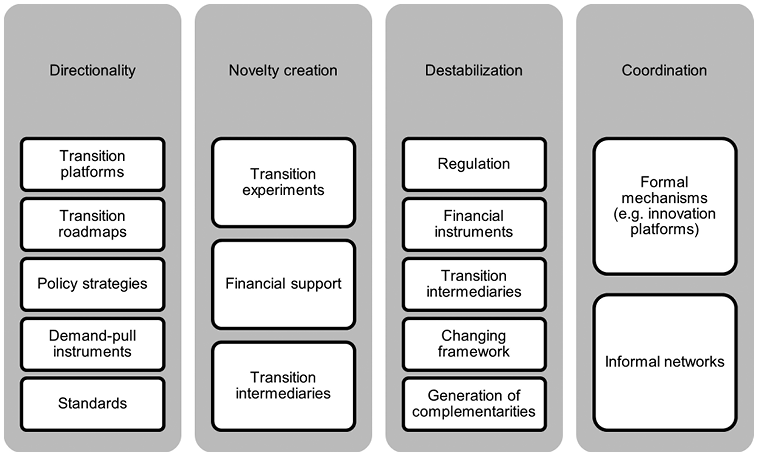
14.3.1 Insights on Directionality
To provide directionality for system innovations, transition studies primarily propose the following interventions: transition platforms, transition roadmaps, policy strategies, demand-pull instruments and standards.
First, transition platforms are consultation arenas in which actors are brought together to develop common visions for transformations, with one of the intended outcomes being their acceleration. Such platforms are typically organised around specific topics. For instance, in the Dutch energy and mobility transitions, platforms were set up on topics such as interoperability, safety and electromobility. Experts were invited to offer their insights on specific topical areas. For example, IT companies supplied expertise on interoperability whereas insurance companies provided insights on liability [SPP4, EIST37]. However, such platforms run the risk of excluding relevant stakeholders [TFSC6] and being coopted by vested interests [PS1], which raises issues around accountability [SPP3].
Second, transition roadmaps are generally the outcomes of transition platforms. Roadmaps are tools that couple expected changes for system innovation with certain technologies, milestones and timeframes. For instance, roadmapping the electrification of the mobility system calls for selecting technologies, standards and goals, such as a percentage of sales of electric vehicles by a given date [TFSC1]. Such roadmaps outline the expertise, visions, needs and industrial capacities of invited stakeholders of a given innovation system [EIST10, EIST19]. For example, Dutch roadmaps have placed major attention to IT developments because the IT sector is a strong domestic industry in the Netherlands [SPP4]. While developing roadmaps, policy actors face the risk of choosing underperforming technologies or those based on vested interests and thus defining inadequate pathways and devoting resources to less urgent problems [EIST6].
Third, the design and pursuit of such socio-technical transition roadmaps should be aligned with and supported by overarching as well as context-specific policy strategies that provide direction. They can be seen as blueprints or ‘master plans’ for a transformation’s expected goals and pathways. For instance, the UK’s ‘Zero Carbon Homes’ strategy provided guidance for the UK’s housing transformation [EIST39], and the Transition Management Project provided direction for the Dutch energy transition [PS1]. Such strategies are generally accompanied by task forces that facilitate increased operational capacities [SPP4, EIST39]. On their own, however, such strategies are insufficient to substantially accelerate transformative change, as they require the design and adoption of suitable instruments to achieve agreed upon targets. That is, they can fail due to a range of feedback effects arising from policy implementation difficulties and contestations, as well as unexpected exogenous conditions, such as financial crises [EIST39].
Fourth, a key type of instrument which can support the achievement of policy objectives and targets laid out in policy strategies demand-pull instruments can tilt the direction of a system innovation towards desired outcomes. This has occurred, for instance, when public authorities require electric vehicles in tenders for public transport [SPP1, SPP4, TFSC11] and in vehicle automation [SPP4, TFSC2]. Tilting demand generates incentives for actors to align their business models in certain directions. Actors may not be capable of achieving such alignment (for example, due to technical reasons or knowledge), which could negatively affect industrial capabilities [EIST1].
Finally, standardisation can also provide direction. Standards accelerate market developments by defining a common set of rules and procedures. Standards can be voluntarily agreed between market parties, but they can also be the result of public action. The adoption of electric vehicles has been stimulated by standardised charging points [TFSC3, TFSC4]. Furthermore, European standards have been developed around autonomous vehicles to favour their fast diffusion. The history of technology has shown the central role of technological standards in fields such as electricity markets, digitalisation and mobile communications [RP3].
In light of this evidence, providing directionality to transitions seems to demand strong state-led support. This can be a demanding task for policymakers. Directions must be clearly defined yet also be open to discussion and debate. Also, given inherent uncertainties of transitions, they must remain amenable to change. Studies call for a facilitating role of public actors to define visions and roadmaps necessary for achieving transformations [SPP3, SPP4]. Finally, major shocks, such as nuclear accidents, can facilitate transitions [RP1].
In providing directionality, policy actors need to deal with constant tensions between normative transformation goals and traditional policy goals such as economic growth. Thus, a transition may be ‘de-routed’ in favour of market-based solutions incompatible with societal needs. Additionally, selecting directions may lead to early lock-in and path-dependence [TFSC4]. This may have negative effects in the long term, for example, when selected innovations outperform non-selected ones in the long run. Important questions of relevance for policy studies include how and by whom visions underlying transformations are crafted, influenced and contested. Here, we see a potential connection with policy studies frameworks, such as on procedural instruments, policy formulation and coalition politics. Theories from policy studies can also enrich our understanding of how and by what means political actors attempt to define directions. For instance, the advocacy coalition framework (ACF, Sabatier and Weible, Reference Sabatier, Weible, Weible and Sabatier2019) has been used to explore how networks of actors’ shape policy developments in areas such as energy [EIST33] and the multiple streams framework (MSF, Zahariadis, Reference Zahariadis, Weible and Sabatier2019) has been utilised to explore how institutional entrepreneurs shape policy directions [TFSC9].
14.3.2 Insights on Novelty Creation
To support novelty creation, we identify transition experiments, financial support and transition intermediaries as particularly well-studied transformational policy interventions.
First, transition experiments are initiatives to explore new ways in which societal functions can be fulfilled. Examples of these experiments include energy communities [ERSS2] or low carbon mobility projects [RP9]. While experiments have generally local scales (such as neighbourhoods), they are carried out with the expectation, if successful, to be replicated and/or diffused at a larger scale. Experiments are generally carried out in portfolios rather than in isolation [RP4]. This occurs because the outcomes of innovation processes, by definition, are uncertain. Successful experiments can be used as footprints for replication, adopted by incumbent players, or converted into spin-offs [EIST29]. In contrast, failures offer opportunities for learning. Institutional barriers and social contexts are major barriers for replicating experiments [EIST8]. Actors commonly opt for experiments with short-term returns, although results may take a long time [PS1, SPP5]. This is disadvantageous as societal challenges require both short-term as well as long-term improvements [SPP5].
Second, financial support offering economic incentives are major drivers of novelty creation but are not always present. Financial support allows public authorities to incentivise novelty creation through rewards. Transition studies literature distinguishes between entrepreneurial actors who generally require financial support to kick-start their own ideas, and those joining at later stages, seeking tangible economic benefits [EIST3, EIST18]. Financial incentives are important because returns on investment may occur only in the long-term [RP7], such as in carbon-capture technologies [EIST29]. For public authorities, two main challenges associated with financial incentives include budget constraints and limited experience on how to assess experiments’ performance [EIST3].
Finally, novelty creation is fostered by transition intermediaries, and thus policy support for such intermediaries is another policy intervention. Intermediaries’ activities include connecting actors (e.g. producers, users, entrepreneurs and funding bodies), mobilising skills, knowledge, and resources, and supporting specific technologies or goals (Kivimaa et al., Reference Kivimaa, Bergek, Matschoss and Van Lente2020). In addition, intermediaries’ activities are also intended to have policy and political effects beyond novelty creation (see Kivimaa et al., Reference Kivimaa, Boon, Hyysalo and Klerkx2019b). Empirical research suggests that intermediaries’ activities enable knowledge exchange [RP5]. This occurs, for example, through the aggregation of learnings from different initiatives [EIST32]. They are relevant for novelty creation because actors may otherwise be unaware of initiatives with similar goals and because the actor network from whom support and knowledge could be drawn is not necessarily visible [EIST16]. The role of such intermediary actors is not to create initiatives but rather to facilitate cooperation amongst existing stakeholders [EIST8]. Cooperation can be facilitated if intermediaries focus their support for projects on knowledge diffusion activities, such as networking [SPP6]. A main difficulty for these organisations, however, is the lack of long-term financial support and shifting policy priorities [EIST8]. Lack of user involvement tends to have a significant negative impact on their effectiveness [EIST28]. Transition intermediaries also generate important visibility and awareness for a transformation [EIST3], which can motivate new actors to join promising developments [EIST16, EIST6].
Policy interventions for novelty creation also face several difficulties. They have limited effects if beneficiaries lack skills or (human) capital to benefit from them [EIST15]. Experiments can be difficult to replicate in the presence of policy failures, particularly if they come with high political costs to policymakers [EIST22]. Another difficulty is that new policy interventions may be hindered by existing arrangements, as actors sometimes have limited ‘room for action’ due to regulations [EIST2, EIST3]. Furthermore, simplicity is a key factor of success. If requirements for policy interventions are too complicated, actors may opt to drop out or never engage [EIST25]. Actors may also refuse to participate in projects if they demand too radical changes in their organisations [EIST9], if benefits are unclear [EIST3], or if returns are limited [EIST4]. The absence of formal evaluations and assessments seems to limit the capacity for learning and diffusion [EIST8].
A key question raised within transition studies concerns the role of incumbent actors in novelty creation. For instance, in the case of low-carbon mobility, what should be the role of the automotive industry? While there is no clear-cut answer to this question, research has shown mixed effects, in which incumbents may both accelerate or undermine the speed and direction of transitions [EIST19, SPP4].
14.3.3 Insights on Destabilising the Status Quo
For facilitating the destabilisation of the status quo, the transitions literature suggests a variety of transformational policy interventions (Kivimaa and Kern, Reference Kivimaa and Kern2016). More specifically, regulation, financial instruments, transition intermediaries, changing framework conditions and generation of complementarities play important roles.
First, regulation can accelerate transitions by destabilising the status quo. Regulations – or their amendment – create new or changed ‘rules of the game’ to which actors need to adapt (Unruh Reference Unruh2000). Such regulations can put pressure on the system, for example, with legal mandates, such as requiring the housing sector to adopt new technologies in the construction process [EIST7]. Such provisions can be negotiated with incumbent players to improve their buy-in, although this also increases the risk of less stringent regulations. As demonstrated by the German nuclear phase-out, regulations providing a phase-out trajectory for societally undesirable technologies can increase the credibility of policy mixes and thereby be highly influential for creating a market space for innovations and their diffusion, such as renewables [ERSS1].
Regulations alone, however, tend to be insufficient for destabilising existing systems. Transition studies therefore also calls for changes in the incentives faced by investors, including incumbent actors, through financial instruments. For example, policy actors can accelerate the phasing out of an existing technology or practice by cutting back preferential loans or tax credits given to producers or consumers [EIST1, RP5, EIST27]. Such instruments induce market parties to shift their existing practices, product portfolios and business models [EP1].
Third, transition intermediaries do not only facilitate novelty creation, but also help destabilise the status quo [EIST37], and as such are considered as potential policy intervention. Intermediary activities facilitate interaction between incumbent and emergent actors to support innovative processes [EIST14]. They are also used to create advocacy coalitions for change [RP5]. They can work better when radical views are incorporated into decision-making mechanisms, such as innovation councils [EP2]. Such policy intermediaries address both new entrants to generate radical innovations with transformative potential and incumbents [EIST14], as without gaining incumbent support these innovations are more likely to fail due to system incompatibility [EIST13]. An example of this is the integration of new mobility solutions into well-established systems, such as public transportation.
Fourth, destabilising the status quo can also be achieved through changing framework conditions defining how socio-technical systems operate. In recent years, strong attention has been given to environmental concerns, thereby replacing previous approaches that prioritised modernisation and industrialisation. Such shifts affect how systems operate and change. For instance, the promotion of a European green agenda has forced emission reductions in industry. Such changes have effects on transitions that are similar to external shocks, like the 1970s oil crisis. Changing conditions can also be achieved by new institutional arrangements, such as the responsibility of ministries being modified. For instance, this occurred when the United Kingdom’s Ministry of Agriculture took on new functions of environment and food policy [RP2] or when the Dutch Ministry of Infrastructure took over environmental functions [SPP4].
Finally, systems can be gradually changed through the generation of complementarities between existing systems and novelty. This can be seen in ‘last mile’ mobility options, such as public bicycle schemes near public transport. They do not represent a direct confrontation with existing mobility systems but rather allow coexistence of old and new features. Such complementarities can be in terms of infrastructure [EIST6], capital [EIST20], or user practices [EIST18]. Complementarities can be seen as ‘windows of opportunities’ for existing industries. For instance, many Dutch high-tech companies supported mobility changes because they observed a window of opportunity for new markets [SPP4]. The transition speed seems to be associated with such perceived benefits [EIST36]. Incumbents’ acceptance increases when tangible benefits are present [EIST30, SPP5], whereas transformations are less likely to occur if changes are too radical for users, producers and consumers [EIST6, EIST28].
Policy interventions aimed at destabilising regimes face several challenges. For example, political tensions arise when societal and economic goals are incompatible [EIST15]. This may result in contradictory objectives and thus inconsistent policy mixes aimed at, for example, ensuring competitiveness of existing fossil-fuel-based industries while expanding the share of renewables. Intentional regime destabilisation can come to a halt due to sudden political changes [EIST12], unsuccessful experiments [EIST22], and lack of positive feedback for system change [RP8].
To date, there are several pressing questions to be answered by transition studies scholars that would benefit from collaboration with policy studies. First, How, when and why are destabilisation policies politically feasible in democratic political systems, especially when elected officials must fear backlash against too radical policy change? Second, How can regime destabilisation policies complement approaches that favour the emergence of a new socio-technical regime? Public acceptance of a regime change likely depends on the widespread expectation that new regimes are beneficial to society (Lennon et al., Reference Lennon, Dunphy and Sanvicente2019).
14.3.4 Insights on Coordination
Transition studies suggest both formal mechanisms and informal networks are relevant for accelerating sustainability transitions.
First, formal mechanisms include innovation platforms. They can support transitions, particularly by enabling networks of actors, activities and portfolios of projects. Most such organisations are (to various degrees) public. For instance, in the Dutch energy and mobility transitions, organisations were set up by public actors to bring private actors and their expertise together and arrange coherent interventions. Within such organisations, actors are expected to participate in their own capacity and not represent their organisation’s interests [PS1, SPP4]. They are used for negotiating and finding common interests among actors [EIST11]. Such organisations can, however, be coopted by incumbent players, as shown in the Dutch [PS1, SPP4] and Norwegian cases [EIST15].
Second, coordination can also occur through informal networks, like interdepartmental communication among public actors. Informal mechanisms are widely present in historic transition case studies, particularly because innovations at early stages tend to have no formal institutional arrangements (Kemp et al., Reference Kemp, Schot and Hoogma1998). At early stages of a transition, actors have limited capacities for institutionalised channels of coordination, which explains why informal exchanges are more likely to occur. Coordination is particularly beneficial for innovation processes when it facilitates communication and knowledge sharing [SPP3, SPP5]. Yet, unless such informal collaboration becomes institutionalised, like through the establishment of an organisation [EIST28, EIST31], it only has a marginal effect on a transition’s speed.
Both formal and informal coordination mechanisms facilitate dialogues between actors from different sectors or governance levels. They allow collaboration at interfaces that otherwise would not be connected, such as between users and producers, science and policy, or different economic sectors. They are also relevant for transitions that span multiple sectors. For instance, facilitating transitions towards carbon-free mobility calls for changes in infrastructure, which generally falls under the regulatory responsibility of various jurisdictions. This can be seen in vehicle electrification: regulating energy and transport under two different departments is the norm rather than the exception, thus demanding cross-ministerial dialogue.
Like all other policy interventions, policies directed at coordination face multiple difficulties. Here we focus on difficulties encountered by platform organisations (both informing and organising transitions). Such organisations often rely on limited and temporary funding and tend to be bound to governmental terms [EIST28]. They are thus likely to eventually dissolve. Platform organisations are also likely to fail when they cannot generate shared expectations around a transition [TFSC38]. Additionally, multi-level governance settings (as those present in the EU) generate challenges in coordination. Incentives between different levels of government may be misaligned, as the experience of renewables at a national level in Europe shows [RP2]. Overall, since transitions increasingly span multiple domains, policy interventions supporting the coordination of multi-system transitions will become more important. Policy studies scholars can contribute to this area by offering approaches such as ‘policy regimes’ (Jochim and May Reference Jochim and May2010).
14.4 Conclusion
In this chapter, we introduced four theory areas of relevance for interventions for sustainability transitions – directionality, novelty creation, destabilisation and coordination – and synthesised empirical evidence from transition studies. The empirics allowed us to take stock of how and under what conditions interventions work. In addition, by linking the theoretical and empirical transitions literature with insights from the policy studies literature, we demonstrated ample complementarity that supports earlier calls for a stronger interdisciplinary exchange between the two fields (Kern and Rogge Reference Kern and Rogge2018, Kern et al. Reference Kern, Rogge and Howlett2019).
We posit that there are several ways in which transition studies can leverage policy studies. Particularly, transition studies have not yet sufficiently engaged in discussions concerning the policy processes occurring as part of transitions. For this, policy studies offer an established canon of scholarship on how to open the black box of policymaking (Kern and Rogge Reference Kern and Rogge2018). This includes concepts on how to define, operationalise and measure policy change, as well as frameworks and theories on how to explain this change over time. Since policy change is key for accelerating transitions, transition scholars are advised to better leverage these concepts, frameworks and theories from policy studies. In addition, policy studies can help transition scholars more thoroughly analyse the politics of transitions. While there has been a political turn in transition studies, many transition frameworks continue to either downplay or overlook the role of politics. Policy studies can help address this omission by bringing upfront the contested and messy nature of political decision-making.
We recognise that there will be challenges in bridging both fields. Confusion and tension might arise, for instance, from different conceptualisations around how to capture and explain change. While policy studies have tended to employ variable-based approaches, whereby change is assessed vis-à-vis the effects of explanatory factors on dependent variables, transition studies often emphasises complex causality, co-evolutionary processes and the endogeneity of dependent and independent variables. Moreover, we predict that the normativity of transition studies could strike policy studies scholars as problematic. Many transition studies scholars tend to take a normative stand on how societal transformations ought to occur, which could be a point of controversy for policy scholars. We posit that if these and related challenges can be addressed constructively, the potential for interdisciplinary fertilisation is significant.
In closing, we reiterate the urgent need to make policies and policy mixes more transformational, and to this end argue for stronger interdisciplinary dialogue between transition and policy studies. Ultimately, we hope this chapter will spark an increased interest in future research that bridges both fields and thereby provides sharper insights into how to deliberately accelerate sustainability transitions.
15.1 Introduction: The Political Economies of Transition
In the study of socio-technical transitions and of pathways to sustainability more broadly, there has been increasing attention to questions of politics and governance (Meadowcroft Reference Meadowcroft2009; Scoones et al. Reference Scoones, Leach and Newell2015). Studies have highlighted, for example, the important role of institutions, ideas and political interests in shaping transition pathways (Kern Reference Kern2011). There is also growing interest in applying theoretical insights from different approaches to political economy as discussed in Section 15.2. However, significant scope remains to strengthen accounts which centre relations of power in seeking to understand who wins, who loses, how and why from prevailing governance arrangements and social-technical configurations (Newell Reference Newell2018). One of the benefits of political economy research on transitions is that it relates the underlying causes of problems that transitions are said to address to the structures within which they will be governed (Newell Reference Newell2018). This can lead to an overly pessimistic account of why change does not occur because of its focus on how incumbent or hegemonic power gets reproduced by dominant social and economic actors charged with addressing the problems they helped to create. On the other hand, it provides invaluable resources for critically assessing current landscapes of power in order to then explore the prospects of change and from whence openings for change might come. Concretely, this more practical application of political economy analysis can take the form of analysis of the potential for coalitions and broader alliances for change, for example (Meckling et al. Reference Meckling, Kelsey, Biber and Zysman2015; Hess Reference Hess2018, Reference Hess2019).
Classic political economists such as Adam Smith, David Ricardo and John Maynard Keynes sought to understand the processes of wealth creation and exchange in society, while critical political economists, most notably Karl Marx, explored the injustices and exploitation that these relations rely upon to generate wealth for the few at the expense of the many. It is important to note, firstly, that there are many political economies and ways of understanding power, therefore, production and reproduction of order in society. The starting point is often the relationship between states and markets (Strange Reference Strange1988) and the different forms that this relationship can take more liberal, coordinated and regulated, for example (Hall and Soskice Reference Hall and Soskice2001): the different ways in which they are governed and their distributional impacts. Political economy accounts tend to place centrally control over key areas of the economy from production and trade, to finance and technology as a means of understanding the material basis of uneven distributions of power. This provides a basis for understanding the ways in which governance arrangements seek simultaneously to expand the economy and manage the social and ecological conflicts which arise from that expansion. We will suggest here that political economy approaches can be refined and adapted to shed important light on the ways in which dominant socio-technical configurations reflect broader social and economic relations in society, just as disruptions associated with transitions can shift the power relations that political economy accounts seek to explain.
15.2 Historical and Thematic Development: From Governance and Politics to Political Economy
Early critiques of the neglect of questions of governance, politics and power in transition studies (Meadowcroft Reference Meadowcroft2009; Shove and Walker Reference Shove and Walker2007), led to leading authors in the field attempting to ‘bring politics in’ (Geels Reference Geels2014, Reference Geels2019). Transition scholars have incorporated insights from political science in a number of different ways. Some scholars have developed historical accounts of key institutions involved in the governance of transitions (Lockwood et al. Reference Lockwood, Kuzemko, Mitchell and Hoggett2016) or focused on ‘feedback effects’ (Lockwood Reference Lockwood and Scoones2015): the generation of benefits from transitions for key actors that help to secure their support for them and the role of ‘political coalitions’ in supporting and resisting change (Hess Reference Hess2018). Other research has focused on questions of incumbency and elite power (Sovacool and Brisbois Reference Sovacool and Brisbois2019) which is often exercised to resist or slow transitions threatening to status quo interests. This is sometimes organised around particular regimes of finance and production (Baker et al. Reference Baker, Newell and Phillips2014) and increasingly tied to questions of hegemony (Ford and Newell Reference Newell2021a). In turn, this has solicited growing interest in the role and nature of the state: not just its ‘entrepreneurial’ role in supporting innovation (Mazzucato Reference Mazzucato2011), but also adopting a relational view of tensions and complexities which arise from the multiple roles that states are expected to play in relation to transitions (Silvester & Fisker Reference Silvester and Fisker2023; Johnstone and Newell Reference Newell2018). Rather than adopt a monolithic view of the state, scholarship on varieties of state-market relations and forms of capitalism has explored the different approaches of coordinated (more social democratic) versus liberal market economies in how and by whom transitions are organised (Ćetković & Buzogány Reference Ćetković and Buzogány2016).
Alongside growing attention to governance and the state, there has been growing interest in the global governance of key issue areas such as energy, water and food; systems that are of interest to transition scholars (Van de Graaf Reference Van de Graaf2013; Goldthau and Witte Reference Goldthau and Witte2010), though the global governance and global political economy (GPE) of transitions per se remains a neglected area (Newell Reference Newell and Simms2020, Reference Newell2021). In terms of the conceptualisation of the global governance of transitions, critical GPE helps to inform an understanding of ‘the broader political and economic landscapes which shape transition pathways, the global interrelationships between national level transitions and to an appreciation of the shifting role of the state in a context of globalisation’. This helps’ not just to account for existing distributions of power and wealth in society, but to explore and engage with the potential for transformation beyond existing systems’ (Newell Reference Newell2020a: 344). In particular, such accounts can help (i) situate sustainability transitions within particular historical conjunctures, thereby contributing to work on ‘deep transitions’(Kanger and Schot, Reference Kanger and Schot2018). This body of work locates a series of connected and sustained fundamental transformations of a wide range of socio-technical systems in a similar direction such as moves towards increased labour productivity, mechanisation, reliance on fossil fuels, resource-intensity, energy-intensity and reliance on global value chains. A GPE account would relate these transformations to shifts in the stages of capitalism from Fordist models of production, for example, to a more financialised stage of late capitalism. Such an account can also provide rich historical accounts of technological, social and political lock in over time (Malm Reference Malm2016): how incumbent pathways are often supported and reinforced while alternatives are marginalised (Unruh Reference Unruh2000) (ii) provide an account of the inter-relationships between transitions in different parts of the world. These reflect the uneven distribution of power in the international system and the ways in which both benefits are captured by wealthier groups and costs passed on to the poorer ones through spatial and temporal fixes (Newell Reference Newell2021a,Reference Newellb) (iii) appreciate how the state’s insertion into the GPE shapes the degree of policy space and autonomy that states have to chart their own transition pathways. This space is affected by the nature of the trade, investment and aid relationships they have with other states and regions.
Going further still in this direction, there is increasing attention in political economy accounts to capitalism (Feola Reference Feola2020) and extractivism (Gudynas Reference Gudynas2021); the ways in which transitions are organised (and on whose behalf) in capitalist economies (Newell and Phillips Reference Newell and Phillips2016) and scope for transitions within and beyond capitalism (Newell and Paterson Reference Newell and Paterson2010) including deeper transformations. Given the emphasis on distributional questions in political economy, it is unsurprising that there has been increasing attention to questions of justice which inevitably foreground questions of power, politics and social relations. These have been applied to questions of just transition (Swilling and Annecke Reference Swilling and Annecke2012; Newell and Mulvaney Reference Newell and Mulvaney2013) in relation to specific sectors such as energy (Healy et al. Reference Healy, Stephens and Malin2019), but also explored in relation to the role of global governance institutions in frustrating and enabling just transitions (Newell et al. Reference Newell, Daley, Mikheeva and Pesa2023).
15.3 Empirical Application: The Political Economy of Energy Transitions in India
This section provides an empirical illustration of the political economy of energy transitions using India as a case study of a country that operates as a globally significant ‘rising power’ shaping energy transitions elsewhere in the world (Power et al. Reference Power2016), while also embroiled in its own national and state level transition politics.
15.3.1 The Indian State’s Material Lock-in to Coal
This sub-section discusses the various fossil fuel lock-ins that underpin India’s energy sector, focusing primarily on the material interests of the Indian state. The Indian state has historically played a disproportionately large role in India’s energy sector through its monopoly over coal resources, its direct ownership of the majority of thermal power plants, and as the primary source of credit for energy infrastructure through publicly owned banks. State-controlled actors such as Coal India Limited and NTPC (formerly National Thermal Power Corporation) have dominated India’s energy system. These quasi-state entities have played an important developmental role, spending significant parts of their revenues on local health and educational services in the areas where they operate, thereby securing their social licence and creating a social lock-in for their largesse. Enterprises such as Coal India have become deeply embedded in India’s coal districts in multiple ways by creating and maintaining infrastructure, creating jobs and contributing key revenues crucial for the operation of local governments (Chandra Reference Chandra2018).
The Indian state has a substantial economic interest in fossil fuel infrastructures at the union and regional levels, in at least three ways. Firstly, state-owned fossil enterprises contribute significantly to public finances through taxes, duties and royalties. One estimate suggests that the union government depends on coal, petroleum and gas for ~25% of its total revenue receipts (Gambhir et al. Reference Gambhir, Sreenivas and Ketkar2021). Secondly, through the direct and indirect ownership of fossil assets, state-owned banks have substantially financed India’s thermal fleet. The average age of India’s thermal fleet is just 12 years. Hence, according to some models, a rapid transition consistent with a well-below 2°C scenario could result in capacity stranding of the order of 133–237 GW (Malik et al. Reference Malik, Bertram, Despres, Emmerling, Fujimori, Garg and Kriegler2020), leaving powerful asset owners and their ultimate backers – publicly owned banks – exposed. Thirdly, coal revenues effectively cross-subsidise passenger railway fares, accounting for approximately 44% of Indian Railways’ freight revenues in 2017 (Kamboj and Tongia Reference Kamboj and Tongia2018).
Beyond these clear dependencies, there are also more obfuscated ways in which the Indian state colludes with private capital as part of the coal regime. For instance, state actors in coastal regions are building new port infrastructure to make viable imported coal-fired power plants, thus benefiting a nexus of interests including coal exporting nations and some of India’s largest conglomerates (Oskarsson et al. Reference Oskarsson, Nielsen, Lahiri-Dutt and Roy2021). Most existing literature typically elides over the most direct forms of collusion, but links between the rights to privately mine coal and political funding have been alleged in the media. Indeed, India’s union government in 2014 was brought down by allegations of corruption in the discretionary allocation of coal blocks. Some scholars have argued that these dependencies and entanglements are deepening, that India’s lock-in to coal is intensifying over time (Roy and Schaffartzik Reference Roy and Schaffartzik2021).
But the material interests of the Indian state only partly account for the resilience of fossil fuels in India. Fossil energy is also discursively and ideologically intertwined with the project of India’s development and state-building, a phenomenon that has been variously labelled as ‘resource nationalism’ (Lahiri-Dutt Reference Lahiri-Dutt2016) or ‘fossil developmentalism’ (Chatterjee Reference Chatterjee2020). An estimated 3.6 million people are directly or indirectly employed in coal mining and thermal power generation, with an additional half-a-million coal pensioners (Pai Reference Pai2021). In addition, an illegal economy and criminality have developed around pilfering and theft of coal, sustained by the complicity of local political elites the (Lecavalier and Harrington Reference Lecavalier and Harrington2017). The socio-politics of labour in coal belts are also substantially co-determined by gendered and caste-based oppressions (Nayak Reference Nayak2022). Economic and social forces resulting from these complex entanglements are strongly reflected in the electoral politics of coal-producing regions, and in India’s stance against a full coal phase-out on the international stage.
15.3.2 Governance Lock-ins Related to Indian Federalism and Electricity Governance
Despite progress towards clean energy supply in recent years, roughly three-quarters of India’s electricity in 2022 was generated from coal-fuelled thermal power plants (Bhatia Reference Bhatia2023). Thus, the governance of India’s energy transition is intricately tied to the governance of its electricity sector. The Constitution prescribes that the electricity sector’s governance be shared between the national and subnational governments, with the former in a direction-setting and the latter in an operational role. However, there is a misalignment of incentives between these levels regarding how to govern the energy transition.
First, the union and state governments have different goals in governing the power sector. In its direction-setting role, the union government espouses greater ambition towards decarbonisation than sub-national governments, who tend to resist top-down renewable energy (RE) targets and instead, prefer to govern in a manner that secures low-cost power for their constituents and the stability of a financially and technically strained system.
Second, not all sub-national governments will benefit equally from the transition. Given the different spatial distribution of coal and renewable resources, the transition could exacerbate inter-regional inequities within India’s federal polity (Newell et al. Reference Newell, Phillips and Purohit2011): the potentially adverse impacts of transitions – loss of employment and energy-intensive industries – are likely to be strongly concentrated in less-wealthy coal mining states in Eastern India, whereas green employment is likely to be dispersed across richer Western and Central states (Ordonez et al. Reference Ordonez, Jakob, Steckel and Ward2023). Unless the governance challenge of equitably distributing the gains from a just transition is addressed, pro-transition forces are liable to be trumped by concerns for federal cohesion.
Third, the transition risks upending the existing political economy of electricity distribution, which rests on a delicately balanced form of welfarism. Electricity tariffs are highly politically sensitive. India’s welfarist historical institutions have bred a ‘cross-subsidisation’ model whereby electricity tariffs are set in a manner such that industrial and commercial consumers overpay to enable subsidised consumption by the poorest residential and agricultural consumers. Interventionist sub-national governments have found ways to influence ostensibly independent electricity regulators – most often by appointing politically aligned members – to ensure tariffs remain artificially low for key constituencies, and these are carefully managed by sub-national governments (Dubash et al., Reference Dubash, Kale and Bharvirkar2018). The combination of decentralised solar and storage provides a pathway to upend this delicate balance by allowing high-paying customers to ‘migrate’ away from the grid, potentially causing a breakdown in the business model for a major welfare service (Dubash et al., Reference Dubash, Swain and Bhatia2019) and its underpinning social contract. Publicly owned utilities face the downside risks of the breakdown of this business model. The Indian state is thus implicated in ensuring that the energy transition is orderly and the utilities are protected, even if that implies a slower transition.
15.3.3 Winners and Losers in the Renewable Energy Sector
Political economic forces are as instrumental in shaping the contours of India’s emerging green energy system as the fossil system. In line with India’s broader move towards greater liberalisation and privatisation, its RE capacity is predominantly owned and operated by private rather than governmental enterprises. Latest cost and ownership trends suggest that most future greenfield capacity will be privately owned solar and wind projects. These politics have also fostered scalar biases towards mega-scale ‘solar parks’ over distributed energy in India’s RE rollout, which could enable the capture of the benefits of the energy transition by well-capitalised energy-asset-owning firms and elites (Sharma and Bhatia Reference Sharma, Bhatia and Kashwan2022). Simultaneously, large-scale RE projects have been found to unjustly allocate most costs to the most vulnerable, for instance by enclosing common lands or ‘wastelands’, which disproportionately affects pastoral communities (Yenneti and Day Reference Yenneti and Day2016). Thus, moves towards diversification and decarbonisation of the energy mix may well fall short of a just transition.
Furthermore, the politics of green energy are shaped by the politics of trade and national competitiveness. While India’s energy policy framework has de jure promoted both deployment and manufacturing, in practice it has successfully driven RE deployment without developing a thriving green manufacturing base. Key dynamics driving this outcome are illustrated by a battle between a transnational, deployment-focused coalition and a domestic, manufacturing-focused coalition. As a late industrialiser, India sought to support its budding solar manufacturers through a domestic content requirements clause in its flagship National Solar Mission. A challenge by the US at the World Trade Organisation (WTO) forced India to retreat from these policies, slowing the momentum of solar manufacturers and driving them to seek additional and alternate protections (Tagotra Reference Tagotra2017). However, a coalition of solar PV exporting nations, their lead manufacturing firms, and domestic project developers seeking to deliver low-cost power using imported panels emerged as a strong countervailing force (Behuria Reference Behuria2020). The latter’s success in influencing policy has contributed to India’s RE capacity additions far outpacing its green manufacturing capacities.
Post-COVID, the prospect of India’s energy security becoming dependent on technology imports has induced a renewed policy push for self-reliance (‘aatmanirbharta’) through manufacturing, which will likely become a central part of the political economy of India’s energy transition in the coming years. It is not yet clear who would benefit from this shift and how, but the initial signs suggest that the Indian state is poised to direct substantial fiscal resources towards the large energy-industrial corporations. It has put in place a spate of production-linked incentive (PLI) policiesFootnote 1 aimed at stimulating high-tech manufacturing segments across 14 key sectors, which are accessible primarily to established energy-industrial incumbents (dubbed ‘national manufacturing champions’). This also suggests that India’s energy transition could be tilted towards large energy and industrial incumbents rather than towards disruptive green energy players emerging from protected niches.
15.4 Ongoing Debates & Further Needs on the Political Economy of Transitions
Firstly, we can see ongoing debates in transition studies about how best to understand the power relations which most scholars now accept are critical to understand and engage with as both an academic enterprise and in order to effect real-world change. Different approaches emphasise discursive power, institutional power as well as more material expressions of power (Isoaho & Karhunmaa, Reference Isoaho and Karhunmaa2019; Kuzemko et al. Reference Kuzemko, Lockwood, Mitchell and Hoggett2016). In reality these are not mutually exclusive and often overlap and combine to both enable and frustrate different transition pathways. Despite recent advances, we still lack a deeper and more holistic understanding of the state and how its different dimensions of power and arenas of function interrelate and the implications of this for transitions. This includes, across different state agencies and levels of sub-national decision-making as the Indian case makes clear. But also how military, welfare, foreign policy and entrepreneurial functions of the state impact the pursuit and nature of sustainability transitions. Related to this is the need for a more nuanced understanding of industry in (Newell 2025) the ‘business’ of transition (Newell Reference Newell2020a). Not just the lobbying and financial and political ties which bind the state and capital in different ways across diverse governance systems, but also the everyday politics of industrial organisation and re-ordering along complex power-laden value chains and through global production networks which shape transition pathways (Baker and Sovacool Reference Baker and Sovacool2017). It is here that opportunities for challenging incumbent power and de-stabilising dominant regimes can become more visible (Leipprand & Flachsland Reference Leipprand and Flachsland2018).
Secondly, questions of justice are central to any political economy account of transition processes. These centre on the politics of who is included and excluded from decision-making over pathways to sustainability and what this means in terms of the winners and losers from transitions and deeper transformations. Scholars and practitioners have started to analyse the inevitable trade-offs and tensions between procedural and distributional dimensions (Ciplet and Harrison Reference Ciplet and Harrison2020) including debates about how to reconcile speed and inclusivity (Roberts et al. Reference Roberts, Geels, Lockwood, Newell, Schmitz, Turnheim and Jordan2018; Newell and Simms Reference Newell and Simms2020; Sovacool Reference Sovacool2016; Kumar et al. Reference Kumar, Höffken and Pols2021). For example, does the ‘need for speed’ mean that slower and more inclusive forms of deliberation are not viable or is deepening democracy a prerequisite to more progressive transformations? (Stirling Reference Stirling2014). Political economy accounts that emphasise the ways in which the state and dominant systems of governance both reflect and are embedded in broader social relations of class, caste, race, gender and coloniality help to broaden and deepen the analytical frame of transitions research (Lennon Reference Lennon2017; Newell Reference Newell2021a). Attention to coloniality in particular underscores the need to attend to restorative justice in transition debates, something indigenous communities know only too well (Gilio-Whitaker Reference Gilio-Whitaker2019). But such accounts need to be grounded in concrete struggles for just transitions which seek to challenge and overcome the multiple hierarchies, gendered and racialised assumptions and biases which structure and delimit the scope for more inclusive and progressive transitions (Bell et al. Reference Bell, Daggett and Labuski2020)
Thirdly, a key challenge is how to conceptually connect global, national and local political economies as our analysis above shows they must. Global dynamics still need to be located in specific political economies to make sense of the peculiarities and situated nature of national and sectoral transitions (Baker et al. Reference Baker, Newell and Phillips2014) and to draw on ‘local’ research traditions and trajectories to make sense of them (Broto et al. Reference Broto, Baptista, Kirshner, Smith and Alves2018). The nature of this global terrain is, of course, shifting amid major realignments in geopolitics with huge implications for the prospects of energy transitions. The pace of transition away from gas, for example, has been sharply affected by Russia’s invasion of Ukraine sparking conflicting demands: both to exploit more fossil fuels locally and to chart a path away from fossil fuels to avoid such dependencies in future. Refining accounts of the geopolitics of transitions building on existing strands of work (Shen and Power Reference Shen and Power2017; Power et al. Reference Power2016; Blondeel et al. Reference Blondeel, Bradshaw, Bridge and Kuzemko2021) will clearly be increasingly important in transitions research.
Fourthly, intersections with ecology and more than human transitions means broadening and challenging political economy by bringing in insights from political ecology (Lawhon and Murphy Reference Lawhon and Murphy2012) to understand the ‘ecologies of transition’ (Newell Reference Newell2021a): how demands for water, energy and land combine and solutions to one problem often exacerbate others. In turn, this requires an appreciation of how transitions ‘travel’ as costs and benefits are allocated unevenly between and within societies along temporal and spatial lines. Concrete contemporary examples might be how transitions in transport towards the use of biofuels produce conflicts over land and food security elsewhere in the world (Smith Reference Smith2000) or how the drive to electrification in richer parts of the world intensifies struggles over mining for critical minerals in places like the ‘lithium triangle’ in Latin America (Hernandez and Newell Reference Hernandez and Newell2022). Normatively, this gives rise to strategic questions of how to challenge dominant modes of extractivism and the political economies that give rise to them.
Finally, though we started the chapter by emphasising how political economy accounts of transitions are often grounded in analysis of economic structures, there is growing attention to cultural political economy which draws attention to norms, behaviours and practices in the production of energy and food cultures, for example (Strauss et al. Reference Strauss, Rupp and Love2013), such as work on petro-masculinities (Daggett Reference Daggett2018). Political economy accounts which are more attentive to the power of discourse, ideology, knowledge politics and the everyday cultural reproduction of patterns of production and consumption through social practice (Shove et al. Reference Shove, Pantzar and Watson2012) will be better placed to capture the mutually reinforcing nature of material, institutional, discursive and social and cultural power as they are expressed in sustainability transitions.
As power relations reconfigure and the political systems within which transitions are organised and contested evolve in relation to shifting ‘landscape’ pressures, the diverse set of tools and approaches introduced in this chapter provide a rich set of conceptual and empirical resources to draw on in making sense of contemporary sustainability transitions.
16.1 Introduction
This chapter focuses on issues of justice in sustainability transitions, highlighting why there is an increased focus, and need, to develop sustainability transitions that are fair for all. Imagine a housing retrofit scheme being designed for your local area. Would you like to know who is planning that scheme and expect to hear from them? Would you want them to outline the process that is planned for the scheme? Would you expect that they would ask your opinion on it, listen to you and take your views on board? Would you want to know how decisions about the scheme are made, and by whom? Finally, would you care who benefits, or may even become worse off, because of that new retrofit scheme? Questions such as these are increasingly being asked about developments and initiatives that are the building blocks of sustainability transitions as we move towards net-zero societies. The concept of energy justice, in particular, has gained attention as a growing topic (e.g. Qian et al. Reference Qian, Xu, Gou and Škare2023) that has been used as an approach to unpack the justice implications that are related to whole energy systems, all the way from the materials that are needed, for example, for energy technologies, to end-use practices and waste (Sovacool et al. Reference Sovacool, Bell, Daggett, Labuski, Lennon, Naylor, Klinger, Leonard and Firestone2023). However, justice concerns spanning social and environmental justice (e.g. Fitzgerald Reference Fitzgerald2022) are also increasingly addressed in the context of other socio-technical systems of relevance for sustainability transitions, such as mobility justice (e.g. Sheller Reference Sheller, Cook and Butz2019), food system justice (including issues such as biodiversity loss) (e.g. Tribaldos and Kortetmäki Reference Tribaldos and Kortetmäki2022), labour justice (e.g. Kaizuka Reference Kaizuka2024) and social justice related to fast fashion (e.g. Buchel et al. Reference Buchel, Hebinck, Lavanga and Loorbach2022).
The issue of justice is an important concern for sustainability transitions as without due consideration for it, sustainability transitions may disproportionally benefit some people whilst causing harm to others. This risks sustainability transitions affecting people unevenly and casting a shadow on the end goal of sustainability transitions being core to addressing climate change. For example, in the United Kingdom (UK), Low Traffic Neighbourhoods (LTN) (RAC 2022) is a concept that has become hotly debated. Similar schemes have been introduced in other countries too, including, for example, car-free city centres in Norway (Haugland Reference Haugland2023; Remme et al. Reference Remme, Sareen and Haarstad2022). LTNs and car-free city centres aim to reduce travel-related emissions and air pollution in local streets by limiting car use and increasing active travel like walking and cycling. While LTNs’ objectives are to improve health, reduce emissions and make streets safer, they have become hotly contested in public, political and media debates as potentially impending on people’s right to choose how and when they use cars, for instance (The Guardian 2023). Another example of sustainability transitions being contested is the Fosen Vind project in Mid-Norway, one of Europe’s largest onshore wind farms, which has been developed despite being in conflict with the rights of the indigenous Southern Sami people to maintain reindeer herding practices as a basis of their culture and lifestyle (Fjellheim Reference Fjellheim2023). This has led to massive protests against wind power, involving prominent figures such as Greta Thunberg (Milne Reference Milne2023). Fosen Vind is only one of several wind developments in Norway that have been termed ‘green colonialism’, emphasising that sustainability transitions can have negative consequences and exacerbate existing injustices for marginalised groups (Fjellheim Reference Fjellheim2023). Such debates are a good example of the reasons why sustainability transitions need to not only consider but also integrate principles of justice, so that transitions can be truly inclusive and equitable. Addressing climate change requires a considerable effort in sustainability transitions, meaning that the issues of justice need careful consideration and debate, to avoid downplaying the core need for transitions.
This chapter first elaborates on the roots of the current research on justice in sustainability transitions and introduces relevant frameworks and their relevance to sustainability transitions research. It then illustrates via case studies of the digitalisation of transport and mobility and of double energy vulnerability how justice issues come to surface in sustainability transitions. Following the case studies, the chapter further outlines some of the ongoing debates and further research needs in justice research related to sustainability transitions, concluding with a summary of the chapter.
16.2 Historical and Thematic Development
The research addressing justice issues in sustainability transitions is a growing and increasingly multifaceted interdisciplinary field which focuses on different sustainability transition-related areas, such as energy, transport, agriculture and fashion and encompasses various conceptual approaches (for recent reviews, see, e.g. Jenkins et al. Reference Jenkins, Sovacool, Mouter, Hacking, Burns and McCauley2021; Qian et al. Reference Qian, Xu, Gou and Škare2023; Stark et al. Reference Stark, Gale and Murphy-Gregory2023; Wang and Lo Reference Wang and Lo2021). In this section, we outline the historical development of the field along two key linesFootnote 1: (1) the ‘just transition’ concept and its roots in labour rights struggles and (2) the environmental justice movement, before elaborating on energy justice frameworks and briefly introducing relevant strands of justice literature related to other socio-technical systems, such as mobility and food systems.
The ‘just transition’ concept became prominent in the US labour movement in the 1970s when labour unions advocated for justice for workers in existing fossil fuel industries whose jobs were threatened by new environmental regulations (Wilgosh et al. Reference Wilgosh, Sorman and Barcena2022, Newell and Mulvaney Reference Newell and Mulvaney2013). The term has later been adopted by international organisations, such as the International Labour Organisation (ILO) and the International Trade Union Confederation (ITUC), who shifted its focus from polluting industries to climate change and green industries while maintaining workers’ rights as key priority (Wilgosh et al. Reference Wilgosh, Sorman and Barcena2022, Stark et al. Reference Stark, Gale and Murphy-Gregory2023). Today, the concept also figures prominently in EU Green Deal policy and the vision of ‘leaving no one behind’ (European Commission 2019). The increasing popularity of the ‘just transition’ concept has led to the development of various interpretations of the concept (Healy and Barry 2017). McCauley and Heffron, for example, have introduced ‘just transition’ as an umbrella term encompassing perspectives from energy, environmental and climate justice, defining just transition as ‘a fair and equitable process of moving towards a post-carbon society’ (McCauley and Heffron Reference McCauley and Heffron2018: 2).
The research on justice issues in transitions also builds on the environmental justice movement and literature, which emerged in the US in the 1970s – parallel to the just transition concept – to investigate environmental injustices in relation to the siting of polluting infrastructure, such as hazardous landfills, in areas mostly inhabited by socio-economically disadvantaged groups (Knoble and Yu Reference Knoble and Yu2023). A range of studies show that impacts from environmental pollution are unequally distributed and that ‘ethnic minorities, indigenous persons, people of colour and low-income communities confront a higher burden of environmental exposure from air, water and soil pollution from industrialisation, militarisation and consumer practices’ (Mohai et al. Reference Mohai, Pellow and Timmons Robert2009: 406). The ‘jobs versus environment dilemma’ (Räthzel and Uzzell Reference Räthzel and Uzzell2011) becomes evident when environmentalists point out the injustices caused by polluting industries (environmental justice), while labour unions protest the loss of fossil fuel industry jobs due to new environmental regulation (just transition).
In the beginning, the concept of environmental justice focused mostly on questions of equity and the distribution of environmental risk and environmental ‘goods’ and ‘bads’, thus linking environmental questions to social differences along dimensions such as race/ethnic identity, gender and social class (Fuller and McCauley Reference Fuller and McCauley2016; Schlosberg Reference Schlosberg2013). Later, the environmental justice literature became increasingly pluralistic; however, the most common framework – which the energy justice literature also adopted – is to distinguish between three dimensions of justice: distributional, recognition and procedural justice (Schlosberg Reference Schlosberg2013).
The energy justice literature, which features prominently in current research on justice in sustainability transitions, applies the same way of conceptual, analytical and normative thinking to a slightly narrower range of topics than environmental justice, that is, energy policy and energy systems encompassing both supply and demand and the entire lifecycle of energy systems (Jenkins Reference Jenkins2018). Socio-technical energy systems and changes of both energy supply and demand are at the center of sustainability transitions. McCauley et al. (Reference McCauley, Ramasar, Heffron, Sovacool, Mebratu and Mundaca2019: 920) argue that ‘addressing the transition towards sustainable low carbon energy systems means recognising and addressing energy justice’. As transitions entail radical changes of how we organise society and live our everyday lives, justice-related questions regarding energy transition processes and outcomes should be at the centre of attention. A popular definition of the energy justice concept has been introduced by Sovacool and Dworkin (Reference Sovacool and Dworkin2015: 436) who define it ‘as a global energy system that fairly disseminates both the benefits and costs of energy services, and one that has representative and impartial energy decision-making’.
There are two main energy justice frameworks. The first framework (see Table 16.1) represents the first systematic conceptualisation of the energy justice concept and is still among the most utilised frameworks today. It was introduced by McCauley et al. (Reference McCauley, Heffron, Stephan and Jenkins2013) as the three tenets of energy justice which mirror the three abovementioned environmental justice dimensions. The first tenet, distributional justice, focuses on how benefits and burdens are distributed. It investigates the outcomes of energy projects and policies, where injustices happen, what the positive and negative effects are, and who is affected how. The second tenet, recognition justice, addresses social inequities, diversity and representation with a specific focus on vulnerable and marginalised groups. It emphasises the recognition of the diverse voices, perspectives, needs, experiences and knowledges and pays attention to which societal groups are represented and who is ignored. Finally, the third tenet, procedural justice, focuses on participation and decision-making processes. It explores how different actors are invited and included in these processes and how to design and implement fair processes that enable just outcomes (Jenkins et al. Reference Jenkins, McCauley, Heffron, Stephan and Rehner2016).
| Justice dimension | Definition |
|---|---|
| Distributional | Focuses on how benefits and burdens are distributed. |
| Recognition | Addresses social inequities, diversity and representation. |
| Procedural | Focuses on fairness of participation and decision-making processes. |
| Restorative | Emphasises the importance of compensating existing injustices and repairing damages. |
| Cosmopolitan | Highlights that justice principles apply equally to every individual on this earth. |
| Spatial | Focuses on how justice plays out in different spaces and scales. |
| Postcolonial | Acknowledges power inequities due to colonisation and addresses injustices related to the exclusion of non-western knowledges and perspectives. |
| Intergenerational | Emphasises equity for future generations. |
| Multispecies | Emphasises equity for non-human species, biodiversity and nature. |
Later, other dimensions have been added to these three tenets. Restorative justice emphasises the importance of compensating injustices that already happened and of repairing damages caused by energy-related activities and restoration to the original state (Heffron and McCauley Reference Heffron and McCauley2017). Cosmopolitan justice highlights that justice principles apply equally to every individual on this earth. It emphasises the importance of having a global perspective when investigating energy justice and considering the impacts of people’s actions in one country on people’s lives in other countries (McCauley et al. Reference McCauley, Ramasar, Heffron, Sovacool, Mebratu and Mundaca2019). Linked to that, the concept of spatial justice pays attention to how justice plays out in different spaces and scales (regional, national, supranational) (Gürtler Reference Gürtler2023), whereas postcolonial justice acknowledges the continued power inequities due to colonisation and challenges white western hegemony. It addresses injustices related to the exclusion of non-western knowledges and perspectives and focuses on land justice and the need for rectifying injustices through ‘reparation, restoration, compensation and apology’ (Sovacool et al. Reference Sovacool, Bell, Daggett, Labuski, Lennon, Naylor, Klinger, Leonard and Firestone2023: 4).
Other justice dimensions go beyond the dominant focus on currently living human beings and emphasise equity for future generations, intergenerational justice (Eames and Hunt Reference Eames, Hunt, Bickerstaff, Walker and Bulkeley2013) and for non-human species, multispecies justice, focusing on the inherent value of biodiversity and nature (Winter, Reference Winter2022). The latter two dimensions reflect the breadth of sustainability as not only addressing relations between people who currently populate the earth but also relations with future generations and with the environment (Stumpf et al. Reference Stumpf, Baumgärtner, Becker and Sievers-Glotzbach2015).
The second widely used energy justice framework was introduced by Sovacool and colleagues (Reference Sovacool, Burke, Baker, Kotikalapudi and Wlokas2017) and incorporates the different justice dimensions into ten principles for decision-making. These are (1) availability, (2) affordability, (3) due process, (4) transparency and accountability, (5) sustainability, (6) intragenerational equity, (7) intergenerational equity, (8) responsibility, (9) resistance and (10) intersectionality (Sovacool et al. Reference Sovacool, Burke, Baker, Kotikalapudi and Wlokas2017).
While research on energy justice still dominates the field of justice in sustainability transitions, justice considerations related to other socio-technical systems are increasingly addressed as well. One example is the integration of justice considerations in transitions of food systems. Tribaldos and Kortetmäki (Reference Tribaldos and Kortetmäki2022), for example, introduce a framework that identifies principles for just transitions in food systems based on the following justice dimensions: distributive justice, cosmopolitan justice, ecology and non-human beings, procedural justice, recognition justice and capacities. They also note the importance of biodiversity and preventing biodiversity loss.
Another example is research on justice issues in transport and mobility systems which has grown significantly over the last years (Verlinghieri and Schwanen Reference Verlinghieri and Schwanen2020). Sheller (Reference Sheller, Cook and Butz2019:23) describes mobility justice as ‘overarching concept for thinking about how power and inequality inform the governance and control of movement, shaping the patterns of unequal mobility and immobility in the circulation of people, resources and information’. Research in this field has focused on a large diversity of issues, ranging from personal mobility and the accessibility and affordability of transport systems, the interlinkages of gender, race, class and age and how they affect (im)mobility to spatial injustices at different scales from urban inequities to issues of migration (Cook and Butz Reference Cook and Butz2019; Verlinghieri and Schwanen Reference Verlinghieri and Schwanen2020). Section 16.3 will illustrate some of the justice aspects to consider in transitions to sustainable mobility and energy systems.
16.3 Empirical Application
In this section, we illustrate the importance of considering justice issues in sustainability transitions through introducing two empirical examples: (1) Digitalisation of transport and (2) double energy vulnerability (DEV).
16.3.1 Digitalisation of Transport and Mobility
Our first justice example is digitalisation in transport and mobility, which is claimed to have both positive and negative impacts on just transitions. On the one hand, it can enable the development of new mobility services, such as ride-sharing and micro mobility, which can provide affordable and accessible transportation options for low-income communities and marginalised groups, improving the distributional aspects of who benefits from such systems. On the other hand, digitalisation in transport and mobility may exacerbate existing inequalities and create new ones (Ryghaug et al. Reference Ryghaug, Subotički, Smeds, von Wirth, Scherrer, Foulds and Wentland2023; Verlinghieri and Schwanen Reference Verlinghieri and Schwanen2020). The shift towards automation and digital technologies may, for example, lead to job losses in some sectors, particularly in low-skilled jobs, which could result in increased inequality and social exclusion, particularly for those who are already marginalised or living in poverty. Again, this would have both distributional and recognition justice impacts, if certain groups are affected more than others, and they have little say on the outcomes. Furthermore, there is a risk that the benefits of digitalisation will not be equally distributed, with some groups having better access to new technologies and services than others.
One example of this we find when it comes to electric vehicles and concepts such as Mobility as a Service (MaaS), which refers to ‘integrative approaches for accessing transport services […] via mobile applications (apps)’ (Pangbourne et al. Reference Pangbourne, Mladenović, Stead and Milakis2020: 35–36) and is envisioned to support the transition away from the private car. Many variants of MaaS are currently being developed; most of which tend to offer door-to-door multi-modal mobility services, brokered via digital platforms connecting users and service operators (Pangbourne et al. Reference Pangbourne, Mladenović, Stead and Milakis2020). From the perspective of sustainability transitions, MaaS offers potential for significantly altering mobility systems, if it replaces private car ownership and travel with more sustainable solutions (Kivimaa and Rogge Reference Kivimaa and Rogge2022). So far, there is, however, limited evidence that MaaS will have such effects, and it may be just as likely that consequences will be more cars and a deepening of car-based mobility systems (Butler et al. Reference Butler, Yigitcanlar and Paz2021; Milakis and Seibert Reference Milakis and Seibert2024). For instance, this may be the case if these systems are predominantly tailored to and utilised by younger middle-class residents living in cities. They typically have several mobility options available to them, and if they were to benefit from MaaS disproportionally, it could mean that other demographic groups are left out to some degree (Lange et al. Reference Lange2022). Also, research has shown that MaaS may adversely affect equity of access as it relies upon registration and digitalisation for service access and that its reliance on smartphone access also prevents MaaS from offering ‘access for all’ (Pangbourne et al. Reference Pangbourne, Stead, Mladenović, Milakis, Marsden and Reardon2018). Other studies have shown that regulatory measures are required to ensure equal access to transportation for all in a MaaS environment, because, ‘multi-worker households in outlying areas bear most of the cost burden because they lack the variety of mobility alternatives of areas around the CBD [central business district] and must purchase additional cars to make commuting trips to, potentially, dispersed work locations’ (Hawkins and Habib Reference Hawkins2019: 3106). Thus, there is the chance that MaaS and similar digital transport innovations may be co-opted by entrenched interests and elites (Verlinghieri and Schwanen Reference Verlinghieri and Schwanen2020). Moreover, digitalisation may require significant investments in new infrastructure and equipment, which could further exacerbate inequalities, especially if the costs are borne by people from vulnerable communities or those with limited resources. Different geographies have different economic capabilities to invest in infrastructures and communication technologies needed for digitalisation of transport systems and new innovations such as autonomous vehicles (Ryghaug et al. Reference Ryghaug, Haugland, Søraa and Skjølsvold2022). Different places may also have other qualities making them unfit, or unlikely, sites for the development, implementation and/or maintenance of infrastructures, for example, for the reasons of a lack of access to public transport infrastructure, or due to lack of skills, knowledge and resources.
There is also a risk that digital technologies could be controlled by a small number of powerful actors, (for instance, within big tech industries) further concentrating economic power and exacerbating inequality. Well-configured and governed mobility platforms, utilising open-source data and algorithms, can advance environmental and social sustainability. Success, however, depends on customer support for transport workers and fair pricing, and that governments protect commoning mobility platforms from hyper-capitalist rivals focused on profit and monopolies (Lange et al. Reference Lange2022).
16.3.2 Double Energy Vulnerability
A second example presented in this chapter on justice concerns focuses on energy and transport services and vulnerabilities related to those. Energy poverty is one area of research that is closely related to issues of justice. This form of injustice can be defined as the lack of access to sufficient domestic energy services such as space heating and cooling, lighting and the use of appliances (Bouzarovski and Petrova Reference Bouzarovski and Petrova2015). Increasingly, research is recognising the concept of ‘DEV’, which also factors in transport (Robinson and Mattioli Reference Robinson and Mattioli2020; Martiskainen et al. Reference Martiskainen, Sovacool, Lacey-Barnacle, Hopkins, Jenkins, Simcock, Mattioli and Bouzarovski2021). Simcock et al. define energy and transport poverty as the ‘inability to attain a socially and materially necessitated level of domestic energy and/or transport services’ (Reference Simcock, Jenkins, Lacey-Barnacle, Martiskainen, Mattioli and Hopkins2021: 2). This means that a person or household struggles with both energy and transport poverty. Living in DEV means that people must choose between different services of energy or transport, often juggling day-to-day activities such as balancing a high cost of using energy at home for heating with high transport costs (Martiskainen et al. Reference Martiskainen, Hopkins, Torres Contreras, Jenkins, Mattioli, Simcock and Lacey-Barnacle2023; Solbu et al. Reference Solbu, Ryghaug, Skjølsvold, Heidenreich and Næss2024). While DEV can easily be seen to be associated with costs and affordability of energy and transport services, it also links to infrastructural inequalities such as poor housing conditions and access to adequate transport services (Martiskainen et al. Reference Martiskainen, Hopkins, Torres Contreras, Jenkins, Mattioli, Simcock and Lacey-Barnacle2023), having clear links to distributional justice implications. For example, someone could have a bus network nearby but struggles to use it due to costs, mobility requirements or the fact that the buses do not go to where needed. Another may live in a rural location with limited public transport links, thus having to rely on a ‘forced ownership’ of personal cars which can be costly (Martiskainen et al. Reference Martiskainen, Hopkins, Torres Contreras, Jenkins, Mattioli, Simcock and Lacey-Barnacle2023). If those people then also live in poor housing conditions with high energy bills, DEV becomes an issue. This reduces quality of life, and the impact of DEV have been shown to affect certain people more, for example those with children, disabilities and health conditions are particularly at risk, as are women and people from ethnic minorities (Simcock et al. Reference Simcock, Jenkins, Lacey-Barnacle, Martiskainen, Mattioli and Hopkins2021). This not only has distributional and recognition justice implications, but also links to intergenerational justice as growing up in poverty can influence children’s later life, for example (e.g. Tilahun et al. Reference Tilahun, Persky, Shin and Zellner2021). Facing DEV means missing out on what people themselves deem to make a good quality of life, for example having to forgo leisure trips, buying favourite food, or keeping the home at a comfortable temperature (Martiskainen et al. Reference Martiskainen, Hopkins, Torres Contreras, Jenkins, Mattioli, Simcock and Lacey-Barnacle2023; Woods et al. Reference Woods, Heidenreich, Korsnes and Solbu2024). Given the prevalence of energy poverty globally and its dire implications on health, wellbeing, education and life chances (Simcock et al. Reference Simcock, Thomson, Petrova and Bouzarovski2018) it is important to recognise its connections to, and how it can be further worsened by, transport poverty.
Household DEV is closely linked to digitalisation which are increasingly seen as entangled in energy social science (Sareen et al. Reference Sareen, Waage, Smirnova, Boakye Botah and Loe2022). For example, the concept of flexibility within household energy consumption, whereby people have the ability to adjust the timing of their energy use in response to changes in energy prices or the availability of renewable energy sources, requires further examination from a justice angle (Fjellså et al. Reference Fjellså, Silvast and Skjølsvold2021a). For instance, providing information and activating people through technology such as apps or automated demand side management (DSM) solutions may have serious implications for justice, especially on distributional impacts (who benefits), recognition (who has a say on how those systems are designed) and procedural aspects (how are such systems designed and governed). Flexibility capital has been introduced as a concept to capture the way flexibility depends on specific resources and capabilities within the households (Powells and Fell Reference Powells and Fell2019: 57). Households that lack the resources to invest in smart grid technology or who have inflexible schedules may be unable to take advantage of flexible pricing schemes or real-time energy consumption data or avoid expensive peak hours for their commute to work. This could create distributional justice implications where more affluent households benefit from reduced energy bills or transport costs, while less affluent households continue to pay higher prices and experience ‘flexibility poverty’ (Fjellså et al. Reference Fjellså, Ryghaug and Skjølsvold2021b; Solbu et al. Reference Solbu, Ryghaug, Skjølsvold, Heidenreich and Næss2024). Thus, the intersection of energy poverty and transport poverty due to the twin transition of decarbonisation and digitalisation seems to exacerbate existing inequalities and create new ones (Sareen et al. Reference Sareen, Waage, Smirnova, Boakye Botah and Loe2022), with the risk of further cementing distributional and recognition justice implications. As we move towards more digitalised and interconnected energy and transport systems, it is important to apply the principles of recognition justice, that many people are excluded and vulnerable within these systems, and how those issues could be addressed. For example, when schemes such as housing retrofits and developments, LTNs, car free city centres and MaaS are designed, these need to take into consideration justice issues such as DEV and flexibility poverty, so that sustainability transitions provide an opportunity to address rather than worsen them (Dossett Reference Dossett2022).
16.4 Ongoing Debates and Future Research Needs
As the field of research on justice issues related to sustainability transitions is growing and getting increasingly pluralistic as well as getting increasingly recognised as relevant by other academic fields and by policymakers and practitioners within sustainability transitions, many important debates have recently emerged in the field pointing towards new directions and research needs. In this section, we will briefly introduce four topics representing important debates and directions for the field (knowingly excluding many other important topicsFootnote 2): (1) acceleration and justice, (2) geographies and justice, (3) epistemic justice and (4) linking justice and sustainability transitions theories and education.
16.4.1 Acceleration and Justice
The first topic for future research is how the issues of justice will be addressed in the debates surrounding the need to accelerate sustainability transitions (see Chapter 8). As governments, cities and companies are adopting net-zero emissions goals by mid-century to combat global warming, the world requires an unprecedented but purposeful speeding up of change in all significant systems. As a result, research on sustainability transitions should prioritise studying how we can accelerate these transitions and quickly spread new technological and social advancements needed to reach these goals (Andersen et al. Reference Andersen, Geels, Coenen, Hanson, Korsnes, Linnerud and Wiebe2023). However, the speed at which for example the energy transition occurs can impact social and environmental justice in a number of ways. For instance: (1) Employment: A rapid transition could result in the displacement of workers in industries that are being phased out, such as coal mining or oil and gas extraction, while a slower transition could delay the creation of new jobs in the clean energy sector. (2) Energy affordability: A rapid transition may lead to higher energy costs in the short-term, due to initial capital investment for example, which could disproportionately impact low-income households, while a slower transition could result in prolonged exposure to the harms of fossil fuels, such as air pollution. (3) Community participation: A rapid transition could limit opportunities for community input and participation in decision-making, especially for marginalised groups, while a slower transition could provide more time for community engagement and collaboration. (4) Timing of benefits and harms: A rapid transition could bring about positive impacts quickly, such as reduced emissions and improved air quality, but may also lead to short-term negative impacts, such as job losses or higher energy costs. A slower transition may delay these positive impacts but could also avoid some of the negative impacts associated with a rapid transition. (5) Environmental impacts: A rapid transition without due process for environmental impacts of development, for example, in sensitive locations and regions, could lead to land use concerns and impacts on biodiversity, while a slower transition would increase the negative impacts on biodiversity caused by climate change.
Thus, lately the temporal aspects of transitions have spurred debate within the transitions community, especially relating to the way the need for accelerating the speed of the transition impact the ability to enact such change in just and inclusive ways (Skjølsvold and Coenen Reference Skjølsvold and Coenen2021).
16.4.2 Geographies and Justice
The second topic for further investigation centres on geographies and justice. While the temporal dimension of transition has received more traction lately in relation to justice, also spatial or geographical perspectives (see also Chapter 21) have been highlighted more (Skjølsvold and Coenen Reference Skjølsvold and Coenen2021). As both the urgency and scale of the energy transition may be perceived differently in different regions, sustainability transitions must take into account the unique needs and vulnerabilities of different places and communities. The abovementioned ‘spatial justice’ dimension also emphasises the importance of recognising the interrelations between regional, national and international scales (Gürtler Reference Gürtler2023). This also relates to the speed of transitions. For example, regions in the Global South may be more severely affected if transitions are accelerated due to, for example, poor working condition in extractive industries that produce materials needed for new green technologies. On the other hand, many regions in the Global South are among the most vulnerable to the effects of climate change and will thus be more severely hit if the transition does not happen fast enough (Kumar et al. Reference Kumar, Höffken and Pols2021). Transitions can lead to social unrest, such as when dominant areas become even more powerful than less dominant ones, or when they reinforce the authority and progress of existing centres, leaving other areas at a disadvantage (Skjølsvold and Coenen Reference Skjølsvold and Coenen2021). Spatial justice considerations are also highly relevant in the context of biodiversity loss and environmental degradation.
16.4.3 Epistemic Justice
The third area for further research focuses on epistemic justice or ‘knowledge justice’ highlighting the need to include a broad set of societal actors and their different knowledges into decision-making in sustainability transitions (Schwanen Reference Schwanen2021). Rather than only relying on and valuing expert knowledge, important decisions should also be based on the participation and knowledge of citizens (Foulds et al. Reference Foulds, Valkenburg, Ryghaug, Suboticki, Skjølsvold, Korsnes and Heidenreich2023). This is important as, for example, transportation and energy researchers working on making transportation more sustainable should not automatically assume that they fully understand how people and groups affected by these changes think and feel (Schwanen Reference Schwanen2021) as such understanding can be limited and influenced by their own backgrounds and the idea that expert knowledge is more important than knowledge specific to a certain place or social group. When developing renewable energy projects, for example, the participation of local communities, who may represent different values of nature than the developers, and their context-specific knowledge of nature and their environment is essential for understanding the local impacts of the proposed development. Thus, there is a need to make sure that not only the same expertise, and the same type of knowledge get the possibility to set the agenda and contribute to important decisions concerning sustainability transitions.
On a more fundamental level, epistemic justice also relates to what perspectives are used when studying sustainability transitions and justice. For instance, non-Western and feminist perspectives on justice have been underprivileged compared to justice literature dominated by Western, male ideas. Hence, there is a need to broaden the scope of the justice field itself and give attention and space to ideas, philosophies and perspectives from the Global South, indigenous groups, women and other under-represented groups (Sovacool et al. Reference Sovacool, Bell, Daggett, Labuski, Lennon, Naylor, Klinger, Leonard and Firestone2023).
16.4.4 Linking Justice and Sustainability Transitions Theories and Education
Finally, it has been pointed out that sustainability transitions and justice often are treated separately by two different strands of literature without many points of contact and calls for more comprehensive approaches encompassing both the socio-technical transition dimension and the justice dimension have been voiced (Sareen and Haarstad Reference Sareen and Haarstad2018). In line with that, we argue that the sustainability transitions field must focus more on social organisation and social innovation in addition to its current dominant focus on technology and technological innovation. This includes incorporating the issue of justice in the dominant sustainability transition theories. One example of this is Williams and Doyon’s (Reference Williams and Doyon2019) analytical framework for justice and system transition which identifies (1) key questions, (2) risks of not incorporating justice and (3) mitigation strategies to overcome risks, for each of the three justice tenets (distributive, procedural and recognition). Another example is the integration of energy justice and the Multi-level perspective (MLP) (see also Chapter 2) to a framework addressing the connections between injustices and transition dynamics (Kanger and Sovacool Reference Kanger and Sovacool2022). Thus, while it is important to study how transitions unfold and how to support transitions as is commonly done in the field of sustainability transition, it is as important to study the implications of transition processes and how they impact social and environmental justice.
Moreover, justice perspectives should also be included into the education of sustainability transitions in a range of fields and professions. Tomorrow’s teachers, planners, engineers, politicians, craftsmen, nurses, social workers and chefs will be part of forming the sustainability transitions in our societies and should therefore be made aware of the inherently socio-technical nature and the social and environmental justice implications of transition processes.
16.5 Conclusion
This chapter focused on the issue of justice in sustainability transitions. Although there is an increasing focus in academia, policymaking and practice on the importance of making transitions not only environmentally and economically sustainable, but also just and fair – so that costs and benefits are shared equally (European Commmission 2019) – this chapter has illustrated that social inequities can often be exacerbated rather than alleviated in the context of transitions. Indeed, people who are vulnerable and marginalised do not often benefit from sustainability transitions: they may have, for example, limited opportunities to actively participate as citizens, and suffer from negative consequences of climate and energy policies and projects. Such injustices are often the reason for contestations of developments, projects, policies and initiatives that are part of sustainability transitions. This underlines the importance of considering questions of distributional, recognition, procedural, restorative, cosmopolitan, spatial, postcolonial, intergenerational and multispecies justice when designing, developing and implementing sustainability transition policies and projects across all socio-technical systems, while keeping the injustices of existing fossil fuel systems in mind (Newell and Mulvaney Reference Newell and Mulvaney2013).
17.1 Introduction
Sustainability transitions are processes of structural and long-term societal change involving multiple actors in different roles, relations and interactions with one another (Geels, Reference Geels2004; Loorbach et al., Reference Loorbach, Frantzeskaki and Avelino2017). These actors are embedded in societal structures, and those structures both shape their activities and are shaped and enabled by those activities in turn. This is also referred to as the ‘duality of structure’ (Giddens, Reference Giddens1984) and is one of the underlying assumptions of transition thinking and its notion of ‘the regime’ (Fuenfschilling, Reference Fuenfschilling2019; Geels, Reference Geels2004). The regime as a structural environment is understood as both an outcome and a medium for the activities of actors. One concept that offers a bridge across this agency-structure-debate is the concept of ‘roles’, which has long been considered a ‘simple but useful means for explaining self-society relationship’ (Callero, Reference Callero1994, p. 228 cf. Arditi, Reference Arditi1987). It is not only a multi-facetted concept with a long history in different social science traditions, it also is a concept-in-use, used in everyday language (Simpson and Carroll, Reference Simpson and Carroll2008).
Based in a socio-institutional perspective on transitions (Loorbach et al., Reference Loorbach, Frantzeskaki and Avelino2017),Footnote 1 this chapter takes a role-based perspective onto examining agency in sustainability transitions. There are at least two interesting entry points to interrogate roles in and for sustainability transitions research: social roles and transition roles (Wittmayer et al., Reference Wittmayer, Avelino, van Steenbergen and Loorbach2017). For example, in aiming to decarbonise their local municipality, policymakers (as a social role) might engage in connecting different citizen initiatives around decentralised energy production and thus act as intermediary (transition role). In doing so, they might also challenge the current conception of the social role of policymaker and what can be expected from them, while establishing an understanding of what transition intermediation looks like. Transition roles and social roles are thus different entry points into understanding changes in the social fabric as well as actors and their agency in transitions – both use the same language of roles but come with a different analytical understanding.
Taking social roles as an entry point considers roles as institutions to refer to broader societal positions, categories or groupings (e.g. policymaker or citizen) and how our understanding of these changes over time. Drawing on institutional theory, Geels and Schot (Reference Geels and Schot2007) consider roles and role relationships as normative institution. As an institution, roles are part of the ‘dominant rules of the game’ (Fuenfschilling, Reference Fuenfschilling2019) or the ‘standard operating procedures’ of a society (Hall Reference Hall1986 in Lowndes and Roberts, Reference Lowndes and Roberts2013, p. 47). They therewith both constrain and enable human activity. Since institutions are in essence social constructions,Footnote 2 these are not fixed and change over time. This can occur, for example, when due to changes in values and societal priorities earlier role constructions become untenable or dysfunctional (Fuenfschilling, Reference Fuenfschilling2019 drawing on Berger and Luckmann Reference Berger and Luckman1966; Lowndes and Roberts, Reference Lowndes and Roberts2013; specifically for roles, see Turner, Reference Turner1990). Roles can be institutionalised to different degrees and thus be considered ‘dominant’ or ‘constraining’ to different degrees – for example, roles can be formalised and explicated, or informal, emergent and tacit. Roles are thus also susceptible to institutional work, that is to attempts to create, maintain or transform them (Lawrence and Suddaby, Reference Lawrence, Suddaby, Clegg, Hardy, Lawrence and Nord2006). A focus on social roles takes a sociological perspective onto transitions to understand how social roles as shared social constructions are shaping and enabling activities of actors but are also shaped by them, and therefore how these roles change over time. This then allows us to understand institutional change by probing into how social roles change over time.
Taking transition roles as an entry point moves away from this sociological basis, taking it more as a concept-in-use to label activities of diverse actors and/or their stances in relation to transition dynamics and directions. It comes from an explicit transition perspective, often making use of categories from different bodies of transition theory as an entry point to differentiate between roles actors take in engaging with transition dynamics (e.g. regime actors, transition intermediaries). As such the starting point for one’s research comes from an understanding of transition dynamics and from there moves towards understanding the positions of actors therein. Transition roles are primarily analytical categories, which are used to analyse and describe transition dynamics. However, transition roles may also be used as resources upon which actors can draw strategically to arrive at certain ends (e.g. Callero, Reference Callero1994). For example, positioning or framing oneself as transition intermediary provides with a different standing and possibly access to resources for furthering certain transition directions and dynamics (c.f. van Lente et al., Reference van Lente, Boon and Klerkx2020).
While this chapter separates out these two entry points of a role-based perspective for clarity of presentation, these are also often used together, for example to analyse civil society as niche actor (Seyfang et al., Reference Seyfang, Hielscher, Hargreaves, Martiskainen and Smith2014) or farmers as incumbent actors (Friedrich et al., Reference Friedrich, Faust and Zscheischler2023). In the following, this chapter first outlines the origins and empirical applications of the concept of roles in sustainability transitions research. In doing so, it elaborates on the distinction between social roles and transition roles. Second, it provides an overview into ongoing research and current trends based on a review of relevant articles in the journal Environmental Innovation and Societal Transition.Footnote 3 Third, the chapter concludes with ideas for future research.
17.2 Origins and Empirical Applications of the Concept of Roles in Sustainability Transitions Research
This section introduces the origins and empirical applications of the concept of roles in sustainability transitions research using the distinction between social roles and transition roles.
17.2.1 Social Roles
Broadly speaking, sociologists refer to social roles as sets of activities and attitudes that an actor uses in recurring situations. In return, these activities and attitudes are expected from an actor acting out that role (Biddle, Reference Biddle1986). While roles do not exist ‘out there’, they are assumed to be ‘real’ and constrain or enable activities of actors – as such they can be considered as social constructions and are subject to change. For example, the social role of grandparents changed from an authoritative one to a companion role (Turner, Reference Turner1990), while citizens are expected to take on an active, rather than passive, attitude in relation to societal issues (Marinetto, Reference Marinetto2003; Newman and Tonkens, Reference Newman and Tonkens2011). Most often, social roles are evoked in transition research to analyse how certain categories of actors engage in sustainability transitions. There is a body of work looking into the roles of social movements (e.g. Hess, Reference Hess2018, see also Chapter 20) and community-based initiatives (Seyfang et al., Reference Seyfang, Hielscher, Hargreaves, Martiskainen and Smith2014). Examining the ways that civil society engages, Frantzeskaki et al (Reference Frantzeskaki, Dumitru, Anguelovski, Avelino, Bach, Best, Binder, Barnes, Carrus, Egermann, Haxeltine, Moore, Mira, Loorbach, Uzzell, Omman, Olsson, Silvestri, Stedman, Wittmayer, Durrant and Rauschmayer2016) for example differentiate between civil society as pioneering new practices, as providing services unmet by governments and as a disconnected innovator. Others have researched the roles of municipalities and local governments, for example as enablers of experimentation (Mukhtar-Landgren et al., Reference Mukhtar-Landgren, Kronsell, Voytenko Palgan and von Wirth2019).
As social constructions, roles are recognised and legitimate within a particular group at specific times (Collier and Callero, Reference Collier and Callero2005; Simpson and Carroll, Reference Simpson and Carroll2008). In acting out roles, actors can reproduce and strengthen the shared construction, or they can deviate from expectations and thereby start negotiating new role conceptions (Simpson and Carroll, Reference Simpson and Carroll2008; Turner, Reference Turner1990). Overall, a change in how actors fulfil a certain role includes negotiations between the actor and their surroundings on whether the role remains recognisable. For example, the move towards a more decentralised and renewable based energy production includes discussions and new arrangements for the role of citizens in energy production and consumption. Citizens are expected to produce energy as energy citizens (Ryghaug et al., Reference Ryghaug, Skjølsvold and Heidenreich2018) or as prosumers (Horstink et al., Reference Horstink, Wittmayer and Ng2021) – rather than as passive consumers. This new role becomes formalised through the European Union’s Renewable Energies directive asking member states to create the legal form of the renewable energy communities to act as market actors in the energy market (ibid.).
Roles are also relational, which means that they are dependent on one another (Fischer and Newig, Reference Fischer and Newig2016) and co-evolve with one another (Wittmayer et al., Reference Wittmayer, Avelino, van Steenbergen and Loorbach2017). For example, at a time of major budgetary constraints due to the 2007–2008 financial-economic crisis, discourses around ‘participation society’ in the Netherlands (Putters, Reference Putters2014; Tonkens, Reference Tonkens2015) or ‘Big Society’ in the UK (Kisby, Reference Kisby2010; Ransome, Reference Ransome2011) emerged. These revalued the relations between state and citizens where a retreating (welfare) state became more facilitative, of citizens, who were considered to become more ‘active’. This means that a change in one role (e.g. state) has consequences for other roles (e.g. citizen). When these changing social relations come with new ways of doing, thinking and organising, they may also be referred to as social innovations (Pel et al., Reference Pel, Haxeltine, Avelino, Dumitru, Kemp, Bauler, Kunze, Dorland, Wittmayer and Jørgensen2020).
In sum, a perspective on social roles provides insights into institutional change and the extent to which it is transformative, by zooming in onto roles as institutions, and the ways these are being maintained, but also created and transformed (cf. Lawrence et al., Reference Lawrence, Suddaby and Leca2009). It allows to explore how role constellations are subject to change and to link it to social innovations as changes in social relations.
17.2.2 Transition Roles
Refining an earlier definition of transition roles (Wittmayer et al., Reference Wittmayer, Avelino, van Steenbergen and Loorbach2017), we suggest to consider transition roles as roles, which are defined by their stance towards specific transition dynamics and directions. Transition roles thus take the stance of actors towards transition dynamics and their directions (opposing, following, intermediating, etc.) as a starting point for analysis. Analysis may ask which actor group is taking on a certain transition role or inquire into the activities actors engage in when acting out their transition roles. Transition roles thus position actors in relation to transition dynamics around certain directions of social change.
Considering the relative dominance of the multi-level perspective in transitions research, it is not surprising that scholars often investigate the roles of niche or regime actors (Fischer and Newig, Reference Fischer and Newig2016). ‘Niche actors’ are those advocating and working towards alternative futures, while ‘regime actors’ are conserving the status quo. With a slightly different connotation, also the role of ‘incumbent actors’ is referred to often in relation to those in power (Geels, Reference Geels2014). A similar dichotomous role categorisation is the one between ‘supporting actors’ (e.g. new market entrants) and ‘opposing actors’ (e.g. civil society, existing firms), where actors in both roles make use of similar strategies in their efforts to enhance or hinder certain future directions or transition dynamics (Fischer and Newig, Reference Fischer and Newig2016). Adding granularity to the debate, de Haan and Rotmans (Reference de Haan and Rotmans2018) have proposed ‘transformative actors roles’ including the more well-known ‘frontrunner’ (providing alternative solutions), along with ‘connectors’ (connecting solutions and actors), ‘topplers’ (working institutions) and ‘supporters’ (providing legitimacy through adoption). The role of connecting different parties involved in sustainability transitions is more prominently referred to as transition intermediary (Kivimaa et al., Reference Kivimaa, Boon, Hyysalo and Klerkx2019; Chapter 18 this volume).
In sum, a perspective on transition roles is taken to gain insights into how transition dynamics are being influenced and orchestrated by different actors, and who is taking up which roles at which pace and order of magnitude. It also allows us to consider individuals and actors in their broadest sense, not by pre-conceiving of them along certain social groups they identify with or are categorised along due to certain social markers (i.e. their social roles) but by focusing on their stances and activities in relation to certain transition dynamics and directions (cf. Pesch, Reference Pesch2015).
17.3 Ongoing Research on Social and Transition Roles in Sustainability Transitions
This section provides an overview of the ongoing research around social and transition roles, based on a review of selected articles in the journal Environmental Innovation and Societal Transition.Footnote 4
17.3.1 Social Roles
Ongoing research on social roles focuses mainly on the enactment of specific social roles in certain sustainability transition dynamics. There remains a steady body of work focusing on the public sector, including public sector organisations (Borrás et al., Reference Borrás, Haakonsson, Hendriksen, Gerli, Poulsen, Pallesen, Somavilla Croxatto, Kugelberg and Larsen2024) as well as local and national governments and more broadly at the role of the state (Silvester and Fisker, Reference Silvester and Fisker2023, see also Chapter 14 this volume), This research shows how these actors – when facing new challenges and contexts – are struggling with old and new expectations towards their social role as well as with missing action repertoires. Similarly, there continues to be a steady body of research around community-based initiatives, their transformative potential and role in shaping transitions and their selection environments (e.g. Barnes et al., Reference Barnes, Durrant, Kern and MacKerron2018; Grandin and Sareen, Reference Grandin and Sareen2020; Morais Mourato and Bussler, Reference Morais Mourato and Bussler2019). Only at times, do these studies dig deeper into a changing understanding of social roles in certain societal groupings over time, as indicative of institutional change. For example, Pflitsch et al. (Reference Pflitsch, Hendriks, Coenen and Radinger-Peer2024) have examined the organisational context for civil society actors in the city of Augsburg over time, changing from a more advisory function to a more proactive role driving urban transitions.
Current work also takes up individual level professional roles such as workers (Moilanen and Alasoini, Reference Moilanen and Alasoini2023) or livestock farmers (Friedrich et al., Reference Friedrich, Faust and Zscheischler2023) and how these shape or are being shaped by transition dynamics. Focusing on consulting engineers, Sørensen et al. (Reference Sørensen, Lagesen and Hojem2018) outline how these influence environmental decisions through advice, calculations and design in ambivalent spaces thereby combining different kinds of transition work including work of persuasion and mediation, but also concrete technological problem solving and broader institutional work. Likewise, collective roles within the market sector (e.g. firms) are becoming a point of attention. This extends to the potential of investors (Dordi et al., Reference Dordi, Gehricke, Naef and Weber2022) for supporting sustainability transitions, or the overall finance sector, if it manages to overcome its inertia and risk-averseness (Nykvist and Maltais, Reference Nykvist and Maltais2022). Other work is on roles of collective actors within the third sector logic, including a focus on transnational or international actors (Kranke and Quitsch, Reference Kranke and Quitsch2021), such as development agencies (Bhamidipati et al., Reference Bhamidipati, Elmer Hansen and Haselip2019), the world bank (Lesch et al., Reference Lesch, Miörner and Binz2023) or the ways that religious organisations engage through experimentation, upscaling and regime support (Koehrsen, Reference Koehrsen2018). This work into a more diverse set of established social roles of professions and organisations shows two things. First, it shows their potential meaning for and their action repertoire in influencing transitions. Second, it shows the necessary changes in those role understandings for these potentials to become true.
The reviewed articles, while not taking an explicit sociological role perspective, do provide insights into struggles with current role understandings and demands for changes in those, while they provide less insights into the dependency and interrelations between different social roles or into changes of role understandings over time. This might partly be due to the chosen review approach, such work may be published in different journals, and partly due to the use of other theoretical concepts as entry points such as networks, strategic action fields (Kungl and Hess, Reference Kungl and Hess2021) or ecosystems (Vernay and Sebi, Reference Vernay and Sebi2020). As such, the potential of understanding institutional change through taking a roles perspective remains largely untapped.
17.3.2 Transition Roles
In the ongoing work on transition roles, one can observe a move away from a focus on niche actors and frontrunners, towards carving out other roles including prominently work around intermediaries, incumbents and followers. In doing so, this work opens up the underlying dichotomy between niche and regime actors that has directed much transition research (cf. Sovacool et al., Reference Sovacool, Turnheim, Martiskainen, Brown and Kivimaa2020).
The role of the transition intermediary (see also Chapter 18 in this volume) is a case in point. The last years has seen more and more work addressing intermediary activities in transition dynamics, leading Kivimaa et al. (Reference Kivimaa, Boon, Hyysalo and Klerkx2019) to consolidate and propose five types of transition intermediaries, namely system intermediary, regime-based transition intermediary, niche intermediary, process intermediary and user intermediary. These focus on intermediating activities such as linking actors and activities or connecting alternatives and visions to existing regimes by engaging in knowledge sharing, networking, brokering, innovating, diffusing innovation, visioning and other institutional work (Sovacool et al., Reference Sovacool, Turnheim, Martiskainen, Brown and Kivimaa2020). The transition intermediary role can be taken up by many different actors, including foundations, funding agencies, government agencies, networks, industry associations, or companies. It might not be by chance that an increasing focus on intermediaries comes along with an increasing focus on networks and collectives (Fischer and Newig, Reference Fischer and Newig2016; Koistinen and Teerikangas, Reference Koistinen and Teerikangas2021; see also Chapter 20) in sustainability transitions research. Lately, intermediaries have not only been studied in relation to their work in disrupting the status quo, but also how organisations acting as intermediaries might be created by or work with incumbents allowing these to shape changes (Sovacool et al., Reference Sovacool, Turnheim, Martiskainen, Brown and Kivimaa2020).
A second transition role receiving increasingly nuanced treatment is the role of incumbent. Actors with an established position in certain sectors or markets are considered as incumbents. In this role, they are usually considered to have a vested interest in stabilising the status quo and not in enabling any form of radical change or transition. The role of incumbent is thus equated with the role of regime actor (e.g. Novalia et al., Reference Novalia, Rogers and Bos2021). The incumbent role is often ascribed to firms and (subsections of) governments, but is equally relevant for trade unions, knowledge organisations or NGOs (Turnheim and Sovacool, Reference Turnheim and Sovacool2020). More recently there have been calls for a re-evaluation and diversification of our understanding around the interests and activities of actors in incumbent roles (e.g. Kump, Reference Kump2023; Turnheim and Sovacool, Reference Turnheim and Sovacool2020). These aim to show that actors with established positions can relate in different ways to transition dynamics, where one way is the urge to maintain the status quo, while others are to bring about or contribute to regime change making use of this strong position as a starting point. Sovacool et al. (Reference Sovacool, Turnheim, Martiskainen, Brown and Kivimaa2020) relate this also to a different understanding of how transitions unfold, juxtaposing radical transformations and reconfigurational transformations, where the latter might hold a broader variety of activities for actors in incumbent roles.
A final transition role is the follower, around which research is only emerging. As part of EIST’s next decade research agenda, Geels (Reference Geels2021) argued that more attention needs to go to the ways in which ‘the mainstream’ which includes wider publics, firms, policymakers, consumers, follows transition dynamics. Actors taking up or being categorised in a follower role are those that are not frontrunners or pioneers of alternatives, but those that need to ‘reorient’ from the status quo to niches.
None of these transition roles is ‘fixed’ or ‘set’, but we see transition researchers trying to understand and establish certain transition roles as analytical categories across different empirical contexts.
17.4 Concluding thoughts and Future Research
This chapter took a role-based perspective on actors and agency in sustainability transitions research. In doing so it made use of the distinction between social roles and transition roles. Social roles as that set of activities and attitudes expected from individual or collective actors are social constructions and an element of the institutional context. Changes in institutional contexts, including social roles and relations, are a vital element of any transition (Fuenfschilling and Truffer, Reference Fuenfschilling and Truffer2014). Social roles therefore provide an interesting entry point to study institutional change in sustainability transitions. Transition roles are defined by their stance towards specific transition dynamics and directions. As analytical categories they can be used to better describe transition dynamics, as resources actors can draw upon them to position themselves in transition dynamics. While this chapter introduces a role-based perspective, it also wants to caution that working with the concept of roles, means resisting the impulse of reifying roles and considering them as steady and stable. More productive is to consider them as temporary stabilisations, subject to negotiations and change, and as a heuristic to analyse how individual or collective actors engage in transition dynamics as well as a proxy for researching institutional change.
While early transition research has included historical or longitudinal research, ongoing research mainly focuses on understanding transitions-in-the-making. Taking a more historical and longitudinal approach again would be an interesting way forward to uncover some of the depth that the classic sociological understanding of social roles can bring to understand the institutional changes that efforts towards making our world more just and sustainable have brought. This would entail charting how social roles change over the course of transitions to understand changing cultural meanings, societal values and social orders. As a link between society and self (Callero, Reference Callero1994), social roles can also be linked fruitfully to the concept of identity – which is interesting to consider especially in the context of phase-out and decline. Where social roles have a stronger structural element and are culturally negotiated, identity can be seen as experiential understanding of who one is (cf. Janssen et al., Reference Janssen, Beers and van Mierlo2022). Questions that are interesting to consider taking social roles as an entry point, include: How are certain roles understood in society and how are these positioned vis-à-vis sustainability transitions? How do these roles change over time and how does this relate to transition dynamics? How does one role relate to other roles?
In terms of transition roles, the field has moved beyond the dichotomous roles of regime and niche actors and lately focused on consolidating the role of transition intermediary, opening up the understanding of the role of incumbent and started exploring the role of follower. Questions that are interesting to consider taking transition roles as an entry point, include: Taking a specific future direction and transition dynamic as a starting point of a transition role, which individual or collective actors take or create this role? How are these roles constituted? Which social groups are taking on this role in which contexts and how? How do these differ across contexts? Next to its analytical use, its promise as a resource for actors engaging in sustainability transitions makes it a useful boundary object for action-oriented, transdisciplinary sustainability transitions research. Here it can open up dialogues about how individual or collective actors position themselves vis-à-vis ongoing transition dynamics.
Taking a role-based perspective appreciates thus how the concept of roles can be an entry point to investigating institutional change and to understanding how different actors engage in transition dynamics and relate to directions of transitions. It thus offers a fruitful perspective on how to study actors and their agency in sustainability transitions.
18.1 Introduction
Intermediaries have received research attention in the field of innovation management since the 1990s (e.g. Bessant and Rush, Reference Bessant and Rush1995). However, it is only in the last decade that intermediaries have begun to receive scholarly attention in the sustainability transitions literature (Kivimaa et al., Reference Kivimaa, Boon, Hyysalo and Klerkx2019a). Howells (Reference Howells2006) defines an innovation intermediary as ‘an organisation or body that acts as an agent or broker in any aspect of the innovation process between two or more parties’ (p. 720). Intermediaries have been identified as key catalysts that can facilitate sustainability transitions by connecting actors – both new entrants and incumbents – and their related activities, skills and resources to create momentum for change and disrupt unsustainable socio-technical systems (Kivimaa et al., Reference Kivimaa, Boon, Hyysalo and Klerkx2019a). Thus, previous studies on intermediaries in sustainability transitions have among others focused on defining what intermediaries are, the activities they undertake, their different types, interactions between them, and their potential influence on transition processes (Kanda et al., Reference Kanda, Kuisma, Kivimaa and Hjelm2020).
In the sustainability transitions literature, a variety of private, public and non-profit entities have been studied as intermediaries. These include, for example, cities, technology transfer offices, internet platforms, architects, clusters, innovation agencies, ports, charities and industry associations. These entities have different characteristics for example, ownership and governance structure, source of funding, mandate, scope of impact and capacity to catalyse change (Bjerkan et al., Reference Bjerkan, Hansen and Steen2021; Mignon and Kanda, Reference Mignon and Kanda2018). Some intermediaries seek neutrality and carry out their activities without altering the knowledge or goods being transferred, a notion particularly prominent in the innovation management literature (Klerkx and Leeuwis, Reference Klerkx and Leeuwis2009). The position of being impartial and neutral to suppliers, network partners, or preferred development strategies is particularly important in innovation management for intermediaries to be considered trustworthy by third parties. Other intermediary types work actively to shape the entities being transferred. Furthermore, some intermediaries have a normative orientation and champion the course of certain technologies and actors, a discourse which has emerged strongly in the transitions literature given the urgency and limited time to facilitate sustainability transitions (Kivimaa, Reference Kivimaa2014).
Intermediaries can be a specific actor category, either an individual or an organisation. They can also be group of individuals or organisations with a complex set of interrelationships (Hyysalo et al., Reference Hyysalo, Heiskanen, Lukkarinen, Matschoss, Jalas, Kivimaa, Juntunen, Moilanen, Murto and Primmer2022) essentially forming an ecology of intermediation (Stewart and Hyysalo, Reference Stewart and Hyysalo2008). Within an ecology of intermediaries, entities have different remits (e.g. scope of responsibility, authority or tasks), opinions, visions, competencies and operational mechanisms. Thus, they cooperate and sometimes compete to facilitate transition processes by going in-between other actors and their related activities, skills and resources (Soberón et al., Reference Soberón, Sánchez-Chaparro, Smith, Moreno-Serna, Oquendo-Di Cosola and Mataix2022). While intermediaries can be strategically established with a given mandate, the literature suggests most entities evolve to undertake intermediary activities during a transition. Other actors might engage in intermediary activities without acknowledging it. Intermediaries range from short-term, project-based entities which can be terminated after their mandate period, to more long-term and established entities that take on new roles as the transition evolves. As a result, intermediaries span a spectrum from formal, self-recognised and defined forms to informal and emergent forms of intermediation (Kivimaa et al., Reference Kivimaa, Boon, Hyysalo and Klerkx2019a).
The concept of intermediaries can also be related to actor roles and agency (see Chapter 17) in the broader sustainability transitions literature (Hodson and Marvin, Reference Hodson and Marvin2010; Köhler et al., Reference Köhler, Geels, Kern, Markard, Onsongo, Wieczorek, Alkemade, Avelino, Bergek and Boons2019; Rohracher, Reference Rohracher2009). In this regard, studies using notions such as ‘middle actors’ (Parag and Janda, Reference Parag and Janda2014), ‘hybrid actors’ (Elzen et al., Reference Elzen, Van Mierlo and Leeuwis2012), ‘boundary spanners’ (Smink et al., Reference Smink, Negro, Niesten and Hekkert2015), ‘user assemblages’ (Nielsen, Reference Nielsen2016), ‘interaction arenas’ (Hyysalo and Usenyuk, Reference Hyysalo and Usenyuk2015), ‘orchestrators’ (de Vasconcelos Gomes and da Silva Barros, Reference de Vasconcelos Gomes and da Silva Barros2022) and ‘system entanglers’ (Löhr and Chlebna, Reference Löhr and Chlebna2023) have also analysed intermediary-like activities sometimes without explicitly mentioning intermediaries.
The concept of an intermediary is essentially contested. The literature lacks consensus regarding where intermediation begins and ends, when an interaction between actors in general becomes intermediation and how to define it (Kivimaa et al., Reference Kivimaa, Boon, Hyysalo and Klerkx2019a). To differentiate intermediaries from other actors such as middle actors, hybrid actors, orchestrators and boundary spanners which undertake intermediary-like activities, there is a growing consensus in the literature that intermediaries should be defined by what they do (i.e. intermediation), rather than by who they are (Bergek, Reference Bergek2020). Thus, Kanda et al., (Reference Kanda, Kuisma, Kivimaa and Hjelm2020 p. 453) argue that intermediaries can be identified and differentiated from other intermediary-like actors based on a combination of three criteria: (i) their position in-between two or more parties, (ii) the activities they undertake and (iii) the scope of impact of their activities. In contrast to other actors, intermediaries have generally a facilitative role in a transition by going in-between two or more actors enabling, supporting and assisting other actors in achieving their goals (Soberón et al., Reference Soberón, Sánchez-Chaparro, Smith, Moreno-Serna, Oquendo-Di Cosola and Mataix2022). On the contrary, other intermediary-like actors such as orchestrators can have more directive roles which involves leading, managing and making decisions to guide the actions of other actors (de Vasconcelos Gomes and da Silva Barros, Reference de Vasconcelos Gomes and da Silva Barros2022). System entanglers on the other hand connect different socio-technical systems (Löhr and Chlebna, Reference Löhr and Chlebna2023) while champions are individuals who actively and enthusiastically promote innovations to overcome the social and political pressures imposed by an organisation and convert them to its advantage (Howell et al., Reference Howell, Shea and Higgins2005).
The literature on intermediaries in sustainability transitions has expanded rapidly. Thus, this chapter seeks to provide the reader with a brief overview of intermediaries and intermediation in sustainability transitions (Section 18.1). This overview is then followed by a brief historical account of the development of the concept (Section 18.2). Thereafter, we provide some empirical examples of intermediaries in Section 18.3, followed by a problematisation of the literature specifically with regards to its lack of a clearly articulated theory on why intermediaries exist in transition processes (Section 18.4). Finally, we identify future research opportunities in Section 18.5.
18.2 Foundations of the Intermediary Concept in Transitions
The literature on intermediaries in sustainability transitions builds upon four earlier streams of literature – technological regimes, techno-economic networks, systems of innovations and innovation management (Kivimaa et al., Reference Kivimaa, Boon, Hyysalo and Klerkx2019a).
The literature on technological regimes by scholars such as Nelson and Winter inspired the work of Geels and Deuten (Reference Geels and Deuten2006) on the dedicated aggregation activities of intermediary actors to facilitate knowledge flows between local and global levels for niche development. This later inspired other contributions on intermediary activities in niche development from scholars such as Hargreaves and colleagues (Hargreaves et al., Reference Hargreaves, Hielscher, Seyfang and Smith2013) who analysed the role of community energy projects as intermediaries in niche development. A second stream of intermediary literature (e.g. Hodson and Marvin, Reference Hodson and Marvin2010) took inspiration from techno-economic networks with contributions from Callon and Latour to make empirical contributions on the activities of intermediaries in shaping urban infrastructure with a specific interest in the governance of socio-technical networks.
Starting with the systems of innovation literature with key contributions from Lundvall, Nelson and Edquist, van Lente et al., (Reference van Lente, Hekkert, Smits and Van Waveren2003) introduced the concept of systemic intermediaries which operate at the system or network level. Their contribution inspired several other contributions on systemic intermediaries in the agricultural and renewable energy transition context (e.g. Kivimaa, Reference Kivimaa2014; Klerkx and Leeuwis, Reference Klerkx and Leeuwis2009). Finally, the literature on intermediaries in innovation management in particular the work of Howells in 2006 had substantial influence on the discourse on intermediaries in sustainability transitions. This literature inspired several contributions on the roles of intermediaries in system level transitions (e.g. Kivimaa, Reference Kivimaa2014).
More recently, the intermediary concept has also been used in relation to the core theoretical frameworks in sustainability transitions such as the multi-level perspective, technological innovation systems, strategic niche management and transitions management. In the multi-level perspective, it is argued that intermediary actors can aggregate and transform knowledge and experiences from local niches to a shared global development trajectory (Geels and Deuten, Reference Geels and Deuten2006). In this context, intermediaries circulate, aggregate lessons and transfer knowledge across local experiments, potentially contributing to the upscaling of experiments beyond niches and challenging the status quo (Matschoss and Heiskanen, Reference Matschoss and Heiskanen2017). Intermediaries fulfil brokerage roles in technological innovation systems (see Section 18.3) by addressing the flow of knowledge and the formation of networks to tackle system failures related to the in-effective collaborations and resource mobilisation which stifle innovation (Célia and Marie-Benoît, Reference Célia and Marie-Benoît2023; Kanda et al., Reference Kanda, del Río, Hjelm and Bienkowska2019). Intermediaries can contribute to several of the niche internal processes in strategic niche management such as the articulation of expectations and visions (e.g. articulation of needs, expectations and requirements; acceleration of the application and commercialisation of new technologies), building of social networks (e.g. creating and facilitation of new networks; configuring and aligning interests) and learning and exploration processes (e.g. knowledge gathering, processing, generation and combination; technology assessment and evaluation; prototyping and piloting) (Kivimaa, Reference Kivimaa2014).
The concept of intermediaries is often used in relation to actor roles and agency in sustainability transitions. Transition processes require the governance of interactions between multiple actors, networks and institutions which can exceed the capabilities of any single actor. In this regard, intermediaries are needed to go in-between diverse groups of actors with the ambition to catalyse multi-actors’ interactions for systemic change. The contribution of van Lente et al., (Reference van Lente, Hekkert, Smits and Van Waveren2003), on systemic intermediaries largely kicked-off the interest in intermediary actors among transition scholars. Following this, a dominant focus in the sustainability transitions literature has been on the activities intermediaries undertake in different transition processes. The activities of intermediaries also change during the course of a transition in a co-evolutionary manner with the intermediary characteristics and context (Kivimaa et al., Reference Kivimaa, Hyysalo, Boon, Klerkx, Martiskainen and Schot2019b). Besides sustainability transitions, the concept of intermediaries has been used in other related literature. In eco-innovation, intermediaries perform activities to validate environmental benefits associated with eco-innovations and to internalise positive externalities in their development and diffusion (Kanda et al., Reference Kanda, Hjelm, Clausen and Bienkowska2018). Intermediaries influence the rate of innovation diffusion by gathering and disseminating information and mobilising and distributing resources that facilitate the adoption of innovations between suppliers and adopters (Lichtenthaler, Reference Lichtenthaler2013).
Moving on, several typologies of intermediaries have been proposed in the literature. For example, van Lente et al. (Reference van Lente, Hekkert, Smits and Van Waveren2003 p. 257), adopting a systems approach, distinguished between three types of intermediaries – hard, soft and systemic – based on their activities in innovation systems. Klerkx and Leeuwis (Reference Klerkx and Leeuwis2009) made a similar contribution of seven types of intermediaries empirically operating in the Dutch agricultural innovation systems based on their activities. More recently, Kivimaa et al. (Reference Kivimaa, Boon, Hyysalo and Klerkx2019a p. 1068) introduced the concept of transition intermediaries. They define transition intermediaries as actors or platforms that facilitate transitions by connecting different groups of actors and their skills and resources. Transition intermediaries also bring together different ideas and technologies to create new collaborations and challenge un-sustainable socio-technical systems. Kivimaa et al. (Reference Kivimaa, Boon, Hyysalo and Klerkx2019a) present five types of transition intermediaries based on their emergence, neutrality, intermediation goals and their level of action. These characteristics essentially capture the level (i.e. actor vs. system level) of operation of intermediaries and their ambitions. The typology of transition intermediaries proposed by Kivimaa et al (2019) are:
1) A systemic intermediary – operating on the niche, regime, landscape levels with an explicit transition agenda for whole system transformation. Systemic intermediaries operate on the system level between multiple actors and are typically established to intermediate.
2) A regime-based transition intermediary – associated with the prevailing regime but with a specific ambition to promote transition. Thus regime-based intermediaries interact with a range of niches or the whole system.
3) A niche intermediary – working to experiment and advance the activities and development of a particular niche. In doing so, niche intermediaries strive to influence the prevailing socio-technical system for the niche’s benefit.
4) A process intermediary – facilitates change in a niche project without an explicit system transformation agenda of their own. Often, they support context-specific (e.g. project based or spatially located) agendas and priorities set by other actors to facilitate change.
5) A user intermediary – connects users to new technology and communicates user preferences to technology developers. User intermediaries also translate new niche technologies to users, altogether qualifying the value of technology offers available between users, developers and regime actors.
In extending the discourse on the typology of transition intermediaries, a particular gap remained in the literature on how to conceptualise and demonstrate the contribution of intermediaries beyond the actor-level (often in bilateral one-to-one intermediation) to the broader system (often including multiple actors, their networks and related institutions). Furthermore, the strategic activities of intermediaries as operating across multiple system-levels had received limited scholarly attention. Kanda et al., (Reference Kanda, Kuisma, Kivimaa and Hjelm2020) defined three systemic levels of aggregation (see Figure 18.1) within which intermediation occurs. These are: (i) system level 1 – in-between entities in a network, (ii) system level 2 – in-between networks of entities and (iii) system level 3 – in-between actors, networks and institutions. This classification was based on: (i) the intermediation activities, (ii) in-between which third parties it occurs and (iii) the scope of intermediation impact.
Different system-levels within which intermediaries operate

A non-systemic level is included as a benchmark and is characterised by ‘one-to-one’ interactions. Intermediaries at this level are typically private organisations, such as consultants, who assist their clients in achieving innovation objectives for a fee. This level of intermediation is not considered a systemic since it does not explicitly seek to generate intermediation benefits beyond the third parties. However, intermediaries at this level can learn and build competence from different cases, which can be applied in their subsequent intermediation activities.
In system level 1, intermediation occurs between different entities within a network, such as a technology cluster or a niche coalition. The intermediaries facilitate learning and knowledge transfer between the network’s members through various physical arenas such as conferences, seminars and workshops. The intermediary helps to build a brand and legitimacy for the network’s activities and its members work towards a common interest. In system level 2, intermediation occurs between networks of different entities, where the intermediary facilitates interactions and collaborations in a ‘many-to-many-to-many’ form also referred to as a network of networks. These networks can represent different technological fields, such as solar or wind power networks, where members come together to facilitate low-carbon energy transitions. Intermediaries may create interaction spaces, disseminate information and provide brokerage support to address market or innovation system failures that result in sub-optimal connectivity between different actors and their networks.
In system level 3, intermediation activities go beyond the interactions between different types of networks to include interactions between actors, networks and relevant institutions. Institutions can be either informal (e.g. norms, values and culture) or formal (e.g. laws, regulation and technical standards) that shape the activities and decisions of actors. When intermediaries see an opportunity to realise interests, they highly value, they engage in different types of purposive and strategic actions to create, maintain, or disrupt institutions sometimes acting as institutional entrepreneurs (DiMaggio, Reference DiMaggio1988). Overall, intermediation at system level 3 involves shaping the institutional environment to enable the achievement of collective interests across different actor-networks.
Finally, while intermediaries are more likely to be conceptualised and profiled as one type (i.e. systemic, regime-based, niche, process or user intermediary) rather than portraying characteristics of several, in practice, intermediaries are strategic actors who can change their profile and operate on multiple system levels undertaking different activities to facilitate transitions. Altogether, this contribution from Kanda et al., Reference Kanda, Kuisma, Kivimaa and Hjelm2020 challenged the notion that intermediaries are homogenous entities (e.g. with regards to their roles and activities) and operate at a particular system level. The contribution opened several opportunities for further studies on the strategic actions of intermediaries which move across system levels leading to cooperation and competition, role adaptation, differentiation and power struggles among ecologies of intermediaries. This revealed a darker side of intermediaries beyond their facilitate role which at worse could even hinder transitions. The contribution also laid an essential foundation to explore the question about intermediary impact on system levels, that is, specifically by analysing how intermediary activities contribute to overall structure and functions in the system levels identified during a transition.
18.3 Empirical Examples of Intermediary Activities
In Table 18.1, we provide illustrative examples of the activities of the different types of transitions intermediaries in relation to different system levels of intermediation. The activities mainly come from the activities of intermediaries identified in Kivimaa et al., (Reference Kivimaa, Boon, Hyysalo and Klerkx2019a) and Kanda et al., (Reference Kanda, Kuisma, Kivimaa and Hjelm2020). These activities are then placed on different system levels depending on the entities in-between which they take place and the scope of their potential impact, that is, within a network, between different networks, towards institutions or a fee-paying client.
| Transition intermediaries | System levels within which intermediaries operate | |||
|---|---|---|---|---|
| Non-systemic intermediation (Level 0) | Intermediation in-between actors in a network (System level 1) | Intermediation in-between networks of different entities (System level 2) | Intermediation in between actors and their networks and institutions (System level 3) | |
| Systemic intermediaries | N/A | Mobilise government, knowledge institutions, other societal organisations and companies to innovate for sustainable development – Innovation Network Rural Areas and Agricultural Systems in the Netherlands | Creating a forum to mobilise actors from different renewable energy niches to develop innovations for sustainable development – The Finnish Clean Energy Association | Aggregating and aligning the views of multiple renewable energy networks to lobby for policy change beyond the reach of the individual networks – The Finnish Clean Energy Association |
| Regime-based transition intermediary | Rarely | Facilitating low-carbon transitions through diverse funding streams, developing capacity for behavioural change work, supporting businesses and developed critical infrastructure – The Greater Manchester Climate Change Agency | Facilitating collaboration between bioenergy advisors, heat entrepreneurs and renewable energy associations for low-carbon energy transitions – Motiva, a Finnish government-owned energy and resource efficiency company | Translate new forms of regulation into practise and make sense of complex and changing policy environments for innovators and entrepreneurs – Motiva, a Finnish government-owned energy and resource efficiency company |
| Niche intermediary | The agency offers SMEs customised support for improving energy efficiency in production processes through information, technical consulting, education, networking and financial assistance – The Energy Agency, NRW, Germany | Coordinating community energy projects in protected spaces, promoting learning activities and articulation of expectations – Grassroots intermediaries UK | The agency facilitates networking between companies and research institutions for renewable energy technologies, accelerating innovation and commercialisation, including export – The Energy Agency, NRW, Germany | Developing a voice, facilitating vision and formalising the wave energy niche – WAVEC, a Portuguese wave energy association established in 2003, and the European Ocean Energy Association established in 2006 |
| Process intermediary | Process intermediaries facilitate projects within a niche or transition processes, collaborating with project managers and champions. They handle day-to-day management responsibilities – e.g. Project manager | Employed to facilitate the realisation of a specific project through arenas of networking and information exchange, for example, intermediaries, such as eco open homes events or sustainability integrators in building projects, can facilitate progress towards zero-carbon buildings – e.g. Sustainability manager | Process intermediaries enable the realisation of visions and expectations by turning them into actions, facilitate vertical and horizontal cooperation and handle external relations of the projects – e.g. Architects | They often lack an explicit institutional change agenda |
| User intermediary | Intermediary role in translating building energy efficiency requirements to their clients – e.g. Architects | Creating knowledge-sharing networks that can grow into significant information infrastructures through virtual communities, potentially enhancing the size and stability of the accelerating niche – e.g. internet discussion forums for electric vehicles | Rarely | They often lack an explicit institutional change agenda |
Essentially, Table 18.1 depicts the potential scope of impact of different transition intermediary types and their related activities. Some intermediary types, for example, systemic intermediaries dominantly operate at higher system levels in-between actors, their networks and institutions. On the other end of the spectrum, the activities of user intermediaries are dominated by bilateral one-to-one intermediation activities in-between third parties. Thus, the potential impact of different intermediary activities can be system-wide generating benefits for numerous actors and their networks or limited to the third parties in-between which the intermediation takes places. Due to the potential spillover of benefits from higher system level intermediation, intermediaries operating at such levels (e.g. systemic intermediaries) are often publicly affiliated through funding, ownership and mandate to generate public good that can facilitate a transition beneficial for many actors (e.g. Sitra and Motiva in Finland; Vinnova in Sweden). On the other hand, in bilateral one-to-one intermediation as often practiced by user intermediaries, one of the parties could be a paying client and can seek to capture all the benefits from the intermediation process limiting the (positive) system-wide spillovers. Nonetheless, intermediaries accumulate benefits (e.g. knowledge and legitimacy) which can be transferred to other system levels. Similarly, the entities in-between which intermediaries operate can benefit differently (even in the same network) from the intermediation activities which can be at the expense of competing niches not part of the network.
18.4 Theoretical Problematisation: Why Do Intermediaries Exist in Transitions?
A research gap we dedicate particular attention to is the lack of a clearly articulated theory on why intermediaries exist in transition processes. Research shows that intermediaries have important facilitating roles in transitions. Still, there is no congruent theory which explains why intermediaries exist in transition processes. Considering the eclectic nature of transition studies as a research field, this is hardly surprising. Theoretical explanations are important since they provide justifications for the establishment of intermediaries. In search of answers to the question why intermediaries exist in transitions, we return to the definition of transitions as major changes of socio-technical systems (Köhler et al., Reference Köhler, Geels, Kern, Markard, Onsongo, Wieczorek, Alkemade, Avelino, Bergek and Boons2019). Such systemic changes will likely display gaps, glitches and tensions between different actors, their individual strategies and the activities they engage in. By bridging organisational boundaries, intermediaries can help fil out such gaps and glitches and work to resolve tensions. The characteristics of boundaries are central topics in many theories on organisation. Santos and Eisenhardt (Reference Santos and Eisenhardt2005) present four different conceptions of organisational boundaries with different theoretical foundations. These conceptions are useful to explain why intermediary organisations exist in transition processes.
The first conception, which is denoted efficiency is based on institutional economics, considering the organisation a legal entity with a prime motive to minimise costs and maximise return on investments. Derived from the seminal paper by Coase (Reference Coase1937) on the nature of business firms, transaction costs are central in the reasoning. Coase built his argumentation on a dichotomy between markets and firms, arguing that firms exist when the costs of market-based transactions are higher than the costs of hierarchical control. In their systematic review of literature on intermediaries, Kivimaa et al., (Reference Kivimaa, Boon, Hyysalo and Klerkx2019a) argue that transaction costs is a common explanation for the existence of intermediaries in innovation studies and science and technology studies. In cases when the costs of market-based transactions are high, intermediaries can absorb risks and reduce transaction costs for the organisations involved. The intermediary thus acts as a broker to facilitate exchanges in cases when neither market-based transactions, nor strict hierarchical control are feasible options.
The second conception is denoted competence. Building on evolutionary economics (Nelson, Reference Nelson1985) and the resource-based view of the firm (Penrose and Penrose, Reference Penrose and Penrose2009) this conception posit that organisations are bundles of resources that co-evolve with the environments that they operate in. The competence conception is congruent with transition research that shows how intermediaries help facilitating knowledge flows between organisations (Geels and Deuten, Reference Geels and Deuten2006). To facilitate such flows, intermediaries aggregate local experiences into knowledge that is accessible for a variety of actors. Being more dynamic than the efficiency conception, the competence conception draws attention to the strategic development of resource portfolios that can result in long-term competitive advantages. Being located in-between different organisations and their resources, intermediaries undertake important activities to mobilise resources to facilitate synergies that can support transition processes.
The third conception power further elaborates on the competitive strategies of individual actors. Following theories on industrial organisation and resource dependence (Porter, Reference Porter1990), the conception is based on the assumption that organisations strive to reduce their exposure to uncertainties due to external contingencies. Important strategies for such uncertainty reduction are to gain influence and control through alliances and network engagement and though lobbying activities. As transitions involve a large variety of actors who strive to maximise their own influence and control, intermediaries are often needed to establish trust between different parties. Moreover, studies have shown how intermediaries are instrumental to influence regulatory processes in favour of transitions (Hyysalo et al., Reference Hyysalo, Juntunen and Martiskainen2018). Gathering a variety of actors, intermediaries can gain a stronger influence than the actors do individually.
The final conception identity conceptualises organisations as social entities for sensemaking (Weick, Reference Weick1995). The conception is based on literature on organisational behaviour and managerial cognition, which draw attention to the cognitive frames that shape interpretations and actions. Once accepted, such frames constitute a strong mechanism for coordination. Transition studies have often referred to cognitive frames and routines as explanations to the persistence of regimes. However, studies also show that cognitive processes are important for niche development. These studies suggest that socially constructed narratives can enrol support for transitions and help shaping markets (Ottosson et al., 2020). Through their socio-political work, intermediaries can assist the construction of narratives that link actors together.
In summary, the four conceptions provide complementary answers to the question why intermediaries exist in transitions. Table 18.2 summarises the conceptions in terms of their theoretical foundations, as well as the related functions and roles of the intermediary. For intermediaries, activities refer to tangible, specific actions, or tasks they undertake to facilitate sustainability transitions while roles refer to the positions or responsibilities intermediaries hold such as brokers, translators and mediators. Functions on the other hand refers to the broad and strategic areas of responsibility that intermediaries have. In the efficiency conception the intermediary acts as a broker to absorb risks and reduce transactions costs. This conception is useful when analysing intermediation between sellers and buyers, or more broadly stated: between a supply-side and a demand side actors. However, transitions processes tend to involve a multitude of actors and modes of interaction. In this respect, the competence conception may be more useful, describing the intermediary as a translator that enable synergies and interorganisational knowledge flows. Still the competence conception tends to underplay critical issues of conflict and contestation. By contrast, these issues are central for the power conception. This conception describes the intermediary as a mediator, whose central function is to establish trust through arbitration and negotiation in inter-organisational networks. The conception is also useful to explain the role of intermediaries in advocacy activities and lobbying. While the power conception is based on the premise of disparate interests among actors, the identity conception adds another dimension by claiming that transition processes will depend on a shared meaning and a common purpose among a multitude of actors. To help building such a purpose, intermediaries take the role of a sense-maker, engaging of actors in the construction of narratives and visions to make sense of the transition. Adopting and further developing this conceptualisation will enable to explore questions such as power relations, the politics at play, the normative positioning of intermediary actors and the battle between different intermediaries (Kivimaa et al., Reference Kivimaa, Boon, Hyysalo and Klerkx2019a).
| Conception of boundaries | Theoretical foundation | Functions of intermediary | Role of intermediary |
|---|---|---|---|
| Efficiency | Institutional economics | Facilitate exchanges by absorbing risks and reducing transaction costs | Broker |
| Competence | Evolutionary economics, Resource-based view | Enable synergies through knowledge transfer and aggregation | Translator |
| Power | Industrial organisation, resource dependence theory | Establishing trust by arbitrating and negotiating | Mediator |
| Identity | Organisational behaviour, managerial cognition | Sense-making through the construction of narratives and visions | Sense-maker |
18.5 Emerging Research and Further Needs
Although the facilitating role of intermediaries in sustainability transitions is widely recognised, a critical analysis of the literature reveals diverse meanings and approaches to the concept. Thus, the concept of intermediaries remains essentially contested. It has multiple and diverse meanings, and its proper use may not be definitively settled by reference to empirical evidence, logical demonstration, or formal criteria alone. Thus, we expect persistent disagreement among scholars on the meaning, scope and normative implications of the concept of intermediaries which cannot be easily resolved. Furthermore, in the literature, an extensive number of activities are attributed to intermediaries which raises questions about the credibility and capacity of intermediaries to undertake such numerous tasks effectively. Thus, there is a need to position intermediaries in transitions in relation to other actors and their agency in transitions, delineating which activities can (or cannot) be undertaken by intermediaries and their interplay with the activities of other transition actors such as orchestrators, system entanglers and champions (see Figure 18.2).
Positioning intermediary actors in relation to other actors in transitions

Second, the impact of intermediaries on the actor level (e.g. projects and firms) are relatively tangible and easier to capture. However, it is particularly challenging how the impact of intermediaries is aggregated unto the system level. This stems from the difficulty in attributing cause and effects in long-term transition processes where multiple actors (e.g. intermediaries, orchestrators, champions, and system entanglers), processes and influences are involved. Attempts have been made to conceptually link the actor level activities to system level impact via different theoretical perspectives such as the Technological Innovation Systems (TIS) (e.g. Kanda et al., Reference Kanda, del Río, Hjelm and Bienkowska2019) and Strategic Niche Management (SNM) (e.g. Kanda et al., Reference Kanda, Hjelm, Johansson and Karlkvist2022; Kivimaa, Reference Kivimaa2014). These previous attempts essentially map the tangible and specific actions, or tasks intermediaries undertake to facilitate transitions onto the TIS functions or SNM processes as a proxy for system level impact. However, for system level impact of intermediaries to be explored effectively, there is a need for further conceptualisation of the system levels as started in (Kanda et al., Reference Kanda, Kuisma, Kivimaa and Hjelm2020), robust empirical evidence and in particular new methodological developments on causality and explanation in the broader transitions literature (see e.g. Geels, Reference Geels2022).
Third, the scholarly discourse needs to move beyond the dominant focus on the role of intermediaries in facilitating niche innovations and to explore their role in other contexts such as in the destabilisation of regimes. An important question in this respect is to investigate how intermediaries can actively work to destabilise unsustainable socio-technical systems and by doing so create windows of opportunities for niche innovations. This is particularly important given the urgency of sustainability transitions and the need for transformative intermediation. This will also require investigating how intermediaries adapt to different contexts and tasks, as well as examining the different types of intermediaries and capabilities needed to destabilise regimes. Intermediation with the purpose to destabilising regimes might also reveal the strategic struggles of intermediaries to make an impact giving a more nuanced understanding of intermediation in practise.
The literature has also been very positive towards intermediaries as facilitating transitions. However, future research could explore the role of power struggles and conflicts in the work of intermediaries, as their contribution to sustainability transitions can be contested. Research in this area could examine how intermediaries negotiate conflicting interests, manage power dynamics and navigate complex stakeholder environments. This research trajectory is important to provide more nuance to the idealistic picture of intermediaries presented in the literature as always seeking to facilitate transitions. Already on the actor level, there is empirical evidence to the effect that intermediaries sometimes prioritise their own survival and interests over broader system goals (Kant and Kanda, Reference Kant and Kanda2019). Thus, contributions on the complexity of intermediation and dilemmas will be welcome.
Furthermore, studies of intermediaries acting in isolation dominate the literature. However, as innovations diffuse from niches into mainstream markets, multiple transitions pathways emerge, accelerate and interact as argued in recent scholarship on multi-system transitions (Andersen and Geels, Reference Andersen and Geels2023). Thus, intermediation is no longer an activity undertaken by single actors in isolation but instead, ecologies of intermediation are needed in which intermediaries with different mandates, competencies, goals and interests, operate at different system levels scale and time (Barrie and Kanda, Reference Barrie and Kanda2020; Hyysalo et al., Reference Hyysalo, Heiskanen, Lukkarinen, Matschoss, Jalas, Kivimaa, Juntunen, Moilanen, Murto and Primmer2022). In such ecologies of intermediaries, entities collaborate; but also compete for dominance, may struggle to fit the context and can lack relevant capabilities (Soberón et al., Reference Soberón, Sánchez-Chaparro, Smith, Moreno-Serna, Oquendo-Di Cosola and Mataix2022). This demand delving into conflicts that can arise among intermediaries and how to address them. Thus, research needs to explore the dynamics in ecologies of intermediation, including their emergence, development and governance mechanisms. This provides an opportunity to explore the similarities and differences between intermediaries and other transition actors, for example, system entanglers, orchestrators, and champions who might emerge equally important in multi-system transitions (see Figure 18.2).
Furthermore, in multi-system transitions, intermediation can bridge actors from different socio-technical systems and create spaces for them to act (e.g. co-develop new knowledge and technology, align strategy and share resources) (Löhr & Chlebna, Reference Löhr and Chlebna2023). There is a need for new insights about how intermediaries can shape multi-system transitions, for example, by breaking couplings between unsustainable systems and bridging sustainable systems (Kanger et al., Reference Kanger, Schot, Sovacool, van der Vleuten, Ghosh, Keller and Steinmueller2021), visioning new cross-system configurations (Löhr & Chlebna, Reference Löhr and Chlebna2023), enabling learning and facilitating the flow of resources across multiple systems for example in cross sectoral transitions such as the circular economy (cf. Kanda et al., Reference Kanda, Geissdoerfer and Hjelm2021). Essentially, multi-system transitions demands an ecology of intermediaries (Barrie & Kanda, Reference Barrie and Kanda2020) particularly active at the intersection between regimes and niches (Geels & Deuten, Reference Geels and Deuten2006; Klerkx & Leeuwis, Reference Klerkx and Leeuwis2008). Thus, it will be naive to expect only facilitative intermediaries as part of transitions. There are intermediaries with an open (or hidden) agenda to defend the existing regime, for example, lobby organisations. Research about these types of obstructive intermediaries is crucial, to counteract their active work to hinder and create barriers to transitions.
In sustainability transitions, various actors play crucial roles based on their scope and approach of action (see Figure 18.2). Intermediaries, often with a starting position on the local actor level are facilitative and bridge actors and their related activities, skills, resources to create momentum for systemic change (Kivimaa et al., Reference Kivimaa2014). System entanglers, connect socio-technical systems and are facilitative, working across systems to align and integrate efforts, facilitating coherence among diverse actors (Hodson & Marvin, Reference Hodson and Marvin2010). Finally, Champions can be directive at the actor level, spearhead initiatives and build networks, mobilising support and fostering collaboration across sectors. Orchestrators are systemic and more directive, making strategic decisions to guide multi-actor processes. Essentially, the primary difference between facilitative and directive actors lies in their mechanism of operation. Facilitative roles focus on enabling others to act, while directive roles focus on leading and managing actions of others. Both are crucial for successful sustainability transitions operating at complementary system and actor levels to drive change. However, transition actors are strategic actors and can change their attributes across space and time to maintain relevance and longevity.
Thus, positioning intermediary actors in relation to other actors in transitions (as depicted in Figure 18.2) has implications for the discourse on actors and agency in transitions. First, for intermediaries, the focus of this book chapter, the literature has seen a broadening of the concept, its meaning and scope of operation from the actor level (e.g. Howells, Reference Howells2006) to a system level (e.g. van Lente et al., Reference van Lente, Hekkert, Smits and Van Waveren2003) in recent years which reflects the increasing complexity of innovation and sustainability transitions in the real world. Nonetheless moving from the actor level to the system level conceptually blurs the boundaries between intermediaries and other actors, for example, system entanglers and orchestrators. Empirically, intermediaries are expected to assume characteristics of other types of actors depending on their scope (i.e. actor vs. system level) and mechanism (i.e. directive vs. facilitative) of operation which demands different capabilities, resources and legitimacy. Thus, scholars need to carefully define and motivate the concept they choose to study actors and agency in transitions and reflect on the potential implication including benefits of their choices for example, which characteristics of actors and agency in transitions are highlighted vs. downplayed.
Overall, this chapter proposes several areas for future research on intermediaries in sustainability transitions, highlighting the need to move beyond the current focus on facilitating innovations to explore their role in destabilising regimes, as well as investigating their impact, power dynamics and complex reality in an ecology of intermediaries. Such research will deepen our understanding of intermediaries and their contribution to sustainability transitions, enabling policymakers, practitioners and scholars to better support and facilitate transitions towards a more sustainable future.
19.1 Introduction
Individual behaviour is a cornerstone of sustainability transitions: while systemic changes in technology and policy are vital, the role of individuals and small groups, such as families, initiatives or teams at work, in adopting sustainable practices and technologies, shaping and following social norms and supporting or opposing policy measures is equally critical. For sustainability transitions to be successful, it is necessary to address both macro-level changes and the micro-level behaviours and choices that play a role in both driving and hindering change. This applies whether individuals are organised in civil society groups (Smith, Reference Smith, Verbong and Loorbach2012) or acting separately as consumers or electorates with practical consequences nonetheless (Jackson, Reference Jackson2004).
The study of sustainability transitions, their evolution and emergence, has been an interdisciplinary field from the very beginning. Transition processes have always been characterized as fundamental changes in socio-technical systems. Thus, the ‘social’ side of transitions and the interaction of (technological) innovations with governance processes but also wider society has been a constitutive part of transition research. This in turn means that what people do, how individuals act on their own or in collectives, what they think and what influences their thoughts and actions are in principle an inherent part of transitions research. Individuals also play an important role in the collection of data on transitions, with interviews as a central research method in this field of research (Hansmeier et al., Reference Hansmeier, Schiller and Rogge2021). Thus, the perspective of the individual strongly shapes our view and knowledge on transitions.
In practice, however, the socio-technical sustainability transitions literature has had difficulty accommodating especially individual-level perspectives, principally because the field focuses on what may be thought of as meso- and macro-level processes, rather than the micro-level of individual psychology (Upham et al., Reference Upham, Bögel and Dütschke2019; Upham et al., Reference Upham, Bögel and Johansen2020). At the same time, failure to account for individual behaviour and leaving this behaviour ‘black-boxed’ as ‘emergent’, means that key processes are potentially neglected. Hence while connecting levels of analysis is challenging (Köhler et al., Reference Köhler, Geels, Kern, Markard, Onsongo, Wieczorek, Alkemade, Avelino, Bergek, Boons, Fünfschilling, Hess, Holtz, Hyysalo, Jenkins, Kivimaa, Martiskainen, McMeekin, Mühlemeier and Wells2019), it is nonetheless of value to do so. In this chapter we explain why individual behaviour matters for transitions.
The APA Dictionary of Psychology (American Psychological Association, n.d.) defines behaviour as ‘an organism’s activities in response to external or internal stimuli, including objectively observable activities‘, but also ‘introspectively observable activities (…), and nonconscious processes‘. When transition scholars refer to behaviours, they tend to adopt partly similar definitions. Kaufman et al. (Reference Kaufman, Saeri, Raven, Malekpour and Smith2021, p.587), for example, use a definition from the Cambridge English Dictionary: ‘The way a person acts in a particular way in a particular situation or under particular conditions.’ Both definitions link behaviour with certain conditions (‘external or internal stimuli’, ‘particular situations or (…) conditions’). However, while the first explicitly states that behaviours also include internal processes such as forming an opinion, this is not the case for the second. This difference is an important distinction between transition studies and behavioural studies, such as psychology, which place more emphasis on these internal behaviours.
The repeated pointers to activities in both definitions show that the study of individual behaviour is closely linked to the study of actors and agency. Other than referring to individuals, the concept of actors is generally broader and more closely linked to the concept of roles. Roles describe distinctive sets of behaviours associated with an actor (Wittmayer et al., Reference Wittmayer, Avelino, van Steenbergen and Loorbach2017 and cf. Chapter 17 in this handbook). Similarly, in contrast to behaviour, agency is a broader concept defined as the capacity to act intentionally (de Haan & Rotmans, Reference de Haan and Rotmans2018). Thus, agency has a component of direction and combines the acts themselves as well as the potential for acting by referring to capacity. Behaviours, however, are not necessarily intentional, but also include habitual or conditional reactions in certain situations.
Often, psychological approaches on behaviours differentiate between types of behaviour on a continuum, with routines and habits at one end and deliberative behaviour at the other end (Defila et al., Reference Defila, Di Giulio and Ruesch Schweizer2018; Verplanken & Aarts, Reference Verplanken and Aarts1999; Whitmarsh et al., Reference Whitmarsh, Poortinga and Capstick2021). Routinized or habitual behaviours are typically triggered by (external or internal) stimuli and occur repeatedly, often regularly. These types of behaviours are to some extent automated and often following routines, such as a morning shower – triggered by getting up and always using a specific water temperature and a certain soap. For example, they usually cycle, but take the bus in case of bad weather. At the other end of the continuum lie behaviours that are once-off and deliberative such as decision-making, especially where there is an investment of significant resources or where there are significant impacts. Such behaviours are often the result of longer processes that involve other behaviours, such as gathering information or considering costs and benefits. This type of behaviour is, for example, relevant for the decision to switch from a conventional vehicle to an electric one, or to adopt a car-free lifestyle.
All types of behaviour along this continuum are relevant to sustainability transitions because the establishment of the new system relies on decisions by a variety of individuals in different roles: policymakers need to adapt regulations, managers in firms need to invest in new products and households need to adopt these products. The new system is then likely to lead to new routines, which, in turn, influence all individuals in the changed system. This leads us to the standing acknowledgement that behaviours are embedded in contexts. They are influenced, supported or challenged by the current system. While this is more obvious for habitual behaviour as stimuli-driven, this also applies to more deliberative behaviours which are influenced by social norms, personal attitudes and available resources. The deliberative behaviour of, for example, buying an electric car ten years ago required a lot of resources and motivation, is much easier now, but still innovative in 2024 (at least in some countries) and is likely to be the ‘normal’ decision in 20 years’ time.Footnote 1
However, transitions research has not frequently investigated the role of individuals and behaviour. According to Hansmeier et al. (Reference Hansmeier, Schiller and Rogge2021), the focus on actors and agency has increased significantly in transitions research in the past years, however, theory development in sustainability transitions on the role of behaviour and individuals is still ongoing and an emerging field. Hansmeier et al. (Reference Hansmeier, Schiller and Rogge2021) found that as of 2016, only 20% of papers from transitions research targeted actors (and their networks), while the share was nearly 50% in the period 2016–2019. Important contributions have been made recently by a review by Kaufman et al. (Reference Kaufman, Saeri, Raven, Malekpour and Smith2021) and by several papers involving Upham and Bögel (Bögel & Upham, Reference Bögel and Upham2018; Upham et al., Reference Upham, Bögel and Dütschke2019; Upham et al., Reference Upham, Bögel, Klapper, Kašperová, Teerikangas, Onkila, Koistinen and Mäkelä2021), building on earlier work by Upham et al. (Reference Upham, Lis, Riesch and Stankiewicz2015). The review by Kaufman et al. (Reference Kaufman, Saeri, Raven, Malekpour and Smith2021) provides a classification of behaviour types that we make use of below. The work by Upham and Bögel reviews the use of psychology and social practice theory in the transitions literature (Bögel & Upham, Reference Bögel and Upham2018, updated as Upham et al., Reference Upham, Bögel, Klapper, Kašperová, Teerikangas, Onkila, Koistinen and Mäkelä2021) and explores different ways of conceptually and methodologically connecting micro-level social psychological processes with larger scale transitions concepts.
Here, the focus will correspondingly lie on individuals and behaviour, extending previous accounts on actors and agency with additional perspectives and regularly drawing on neighbouring fields of research – psychology in particular.
19.2 Historical and Thematic Development
Studying the social or societal side of socio-technical systems has typically implied analysing social forms of action (Bögel & Upham, Reference Bögel and Upham2018). Individual behaviour, as a separate and smaller research focus, has been mainly discussed in relation to consumption behaviour and everyday life, described below, building close links with the increased interest on the role of the individual as a ‘consumer’ or ‘user’ in the broader field of science and technology studies (STS) (Köhler et al., Reference Köhler, Geels, Kern, Markard, Onsongo, Wieczorek, Alkemade, Avelino, Bergek, Boons, Fünfschilling, Hess, Holtz, Hyysalo, Jenkins, Kivimaa, Martiskainen, McMeekin, Mühlemeier and Wells2019). An introduction to work in the latter vein can be found in the nine-fold co-design typology of Hyysalo and Johnson (Reference Hyysalo and Johnson2024).
A focus on users and consumers links with research on sustainable consumption, which is a field of research in its own. One of the prominent approaches has been to build on ‘practice theory’ (Warde, Reference Warde2005), which has also regularly been applied in transition studies (Kaufman et al., Reference Kaufman, Saeri, Raven, Malekpour and Smith2021 and also Chapter 6 in this book). Practice theory takes practices, that is, usually certain classes or groups of repeated or routinized behaviour, as a starting point, for example meal preparation and eating. It then moves on to identifying the factors that shape, uphold or potentially change these practices, typically including three types of factors such as material, image and skill. Material refers to existing structures, available equipment or objects, while image captures symbolic and communicative meanings and implications; finally, skills relate to individual competences involved in the practice (cf. Shove, Reference Shove2010 for exemplifying). A focus on practices is typically related to a focus on daily behaviours and how they are embedded in (social) context and structures and may extend to changes in these behaviours. The acting subjects are usually individuals in their roles as consumers or users and less often individuals involved in practices of changing or shaping the system itself.
The role of users and consumers has received significant attention in the last one to two decades also in other streams of research such as in innovation studies or studies on technology adoption.Footnote 2 There has been a shift away from viewing consumers and users in a passive role of ‘adopting innovation’ or ‘accepting technologies’ into a more active one. In this active role, consumers are seen as individuals that shape or trigger developments in technological innovation by stating needs and driving, or at least refining, technological or sectoral developments (cf. Chadwick et al., Reference Chadwick, Russell-Bennett and Biddle2022). Examples here are the early phases of the German energy transition where many early investors came from fields outside the energy industry, such as farmers setting up windfarms or solar PV fields, or even earlier developments in Denmark where electricity users, including individuals and collectives, pushed forward windfarm installations (Schot et al., Reference Schot, Kanger and Verbong2016). This related field of research suggests that, in sustainability transitions, roles of individuals are changing from using and consuming to being entrepreneurs or suppliers within newly emerging niches or even regimes (Wesche & Dütschke, Reference Wesche and Dütschke2021).
Building on this line of thought and developing it further for the study of sustainability transitions, a paper by Schot et al. (Reference Schot, Kanger and Verbong2016) describes several roles of users and consumers in transitions and the corresponding relevant behaviours.Footnote 3 These behaviours are categorized according to roles of groups of individuals and differ according to the phase of a transition. In the early niche-focused phase, typical actors and behaviours driving the transition include
1. user-producers who are involved in inventing and experimenting with technological or social innovations and enabling new routines to emerge and
2. user-legitimators who shape the meaning, purpose and rationale of niche innovations by building and sharing narratives.
In the following acceleration phase, in which the interaction between niche and regime starts to change the current regime, they identify
3. user-intermediaries who are involved in networking between niche actors and actors outside the niche for scaling up innovations and
4. user-citizens who engage in changing the current regime to enable niches to grow.
Finally, in the stabilization phase of the new regime, there exist
5. user-consumers who embed innovations in their lifestyle and adopt their lifestyle to the innovations and thus support their diffusion.
All five roles are associated with specific behaviours, such as designing technological applications, generating ideas or concepts, communicating with others or using and applying innovations. The behaviours identified by Schot et al. (Reference Schot, Kanger and Verbong2016) allude to the differentiation between more habitual and more conscious behaviour as defined above.
This continuum between routinized and deliberative behaviour also influenced the work of Kaufman et al. (Reference Kaufman, Saeri, Raven, Malekpour and Smith2021) who conducted a review on the transitions literature through a behaviour lens. The authors differentiate between four types of behaviours: reflective, automatic, strategic and everyday behaviour. Their categorization takes up conceptualizations found in the literature rather than observed phenomena in transitions. The first two types of behaviour were identified based on papers with a stronger focus on micro-meso perspectives. Reflective behaviour connects with conscious implementation – on the deliberative side of the behaviour continuum. Kaufman et al. (Reference Kaufman, Saeri, Raven, Malekpour and Smith2021) find that studies on reflective behaviour are typically engaged with changing behaviour and acknowledge bounded rationality and the drivers and barriers to behavioural change. A relatively high number of papers was identified in this field by Kaufman et al. (Reference Kaufman, Saeri, Raven, Malekpour and Smith2021), but many of them not highly cited.
Automatic behaviour covers both habits and embedded behaviour triggered by situational cues, matching the routinized or habitual side of the behaviour continuum in psychological approaches. Beyond habits, Kaufman et al (ibid) found this literature to also emphasize the role of heuristics and biases in relation to behavioural choices. The reviewed studies suggest that interruptions are necessary to change these types of behaviours. Research advocating for nudges to foster transitions, that is, designing situations in a way that the probability of the desired behaviour increases, was also grouped under this approach. While fewer papers were identified than on reflective behaviour, they were more frequently cited. The other two types of behaviour, strategic and everyday, refer more to the meso-level and thus are less attached to the micro level and the individual. Strategic behaviour is seen as intentional action by collective actors, such as companies or agencies, niche actors or incumbents, to achieve a benefit for their innovation or retaining current technologies, usually in a competitive context. Thus, this perspective addresses interactions within networks of (collective) actors. Everyday behaviour covers what was described as practices earlier. Kaufman et al. (Reference Kaufman, Saeri, Raven, Malekpour and Smith2021) emphasize that from the literature it is not clear whether purposeful or directed change of practices by external actors is possible given the complexity of conditions shaping practices.
Additional streams in the transition literature that partially focus on behaviour but have a greater focus on collectives and the meso-level includes the research on social movements and civil society organizations (Köhler et al., Reference Köhler, Geels, Kern, Markard, Onsongo, Wieczorek, Alkemade, Avelino, Bergek, Boons, Fünfschilling, Hess, Holtz, Hyysalo, Jenkins, Kivimaa, Martiskainen, McMeekin, Mühlemeier and Wells2019). Research on social movements looks for instance into grassroot innovations and how they create consumer demand or drive innovations from outside the traditional sector or branch as citizens (Köhler et al., Reference Köhler, Geels, Kern, Markard, Onsongo, Wieczorek, Alkemade, Avelino, Bergek, Boons, Fünfschilling, Hess, Holtz, Hyysalo, Jenkins, Kivimaa, Martiskainen, McMeekin, Mühlemeier and Wells2019). While individual behaviour is usually not the starting point of the analysis, its importance is acknowledged (e.g. Hossain, Reference Hossain2016). Another part of literature on social movements analyses the role of individuals in challenging or providing legitimation to transitions, that is, resisting or promoting change. In line with what Kaufman et al. (Reference Kaufman, Saeri, Raven, Malekpour and Smith2021) categorized as strategic behaviour, this research does not only investigate individuals and collectives as drivers of transitions, but also as showing resistance. Examples are citizen-driven initiatives supporting wind farms and owning them through cooperatives versus local action groups opposing windfarms.
Furthermore, a stream of research which has been established in the literature is the one on the role of intermediaries in transitions, mainly building on Kivimaa et al. (Reference Kivimaa, Boon, Hyysalo and Klerkx2019). Intermediaries are defined as ‘actors and platforms that positively influence sustainability transition’ (Kivimaa et al., Reference Kivimaa, Boon, Hyysalo and Klerkx2019, p.1072) through a variety of behaviours such as ‘linking actors and activities (…) or by connecting transition visions and demands of networks of actors (…)‘. Intermediaries are discussed in more detail in Chapter 18 of this handbook.
A recent stream of literature, not only in the field of transition studies but also related to it, conceptualises energy citizenship to capture engagement with an energy system in transition. It typically refers to different types of engagement, such as citizens as consumers, prosumers, prosumers, political activists, members of energy communities, and thus also points to the diversity of relevant behaviours of individuals in transitions (Schlindwein & Montalvo, Reference Schlindwein and Montalvo2023) and the emergence of new practices (Ryghaug et al., Reference Ryghaug, Skjølsvold and Heidenreich2018). Although the topic of energy citizenship is inherently related to a transition, it has not yet become a major topic of transition research; no paper applying the concept could be found in the main journal ‘Environmental Innovation and Societal Transitions’ until summer 2024. Nevertheless, this literature seems promising for theorising individual behaviour in a transition context.
Finally, classic disciplines that focus on behaviour and the individual have extended their scope. For instance, in environmental psychology, claims have been made to link research more strongly to transformative approaches (Wullenkord & Hamann, Reference Wullenkord and Hamann2021). In her influential book on ‘The Great Mindshift’ also Göpel (Reference Göpel2016), self-identifying as a political economist, makes the case for the role of individuals and their behaviour by stating ‘(…) the source of intentional change is human thinking, feeling and acting. Socio-ecological systems are created, ordered and stabilized through human decision making (…)’ (p. 50f). She draws on the Multi-level perspective from transitions research (cf. Chapter 2 in this handbook) and adds a ‘mini level’ representing the individual level to the usual MLP-structure (p. 47). This matches with the development that researchers from environmental psychology have extended their understanding of environmental behaviour as sustainable consumption to including so called ‘other directed behaviour’ or ‘public-sphere behaviour’ such as taking part in protests or other voluntary work on environmental issues (Capstick et al., Reference Capstick, Nash, Whitmarsh, Poortinga, Haggar and Brügger2022).
19.3 Empirical Application: The Individual and Its Behaviour in the Energy Transition
Sustainability transitions have commonly been studied with a focus on one or several sectors in which society is organized. These range from energy and transport to medicine and food production. The greatest empirical focus, both for overarching transition processes as well as for the individual and behaviour in transitions, has been on the energy sector (Upham et al., Reference Upham, Bögel and Johansen2020). In the following, we hence focus on examples applying a behavioural perspective to the energy transition as a large-scale change in one socio-technical system in which individuals and their behaviour have played a crucial role.
Looking at energy transition processes provides several opportunities to further illustrate the role of individuals and behaviour. The energy transition refers to the transformation of the energy system of a community, region, country or association of states (such as the EU) in such a way that it produces little or no greenhouse gas emissions. There are three basic approaches to achieving this, which can complement each other: consistency, efficiency and sufficiency. They involve replacing fossil fuel-based energy production with renewable energy (the consistency approach), achieving the same results with less energy (the efficiency approach) or reducing overall demand (the sufficiency approach) and they all affect and are affected by individuals and their behaviour.
Superficially, the consistency approach has little impact on the consumer side, as the required energy is still provided, only by different generation mechanisms. However, the fact that energy production from wind and PV has been able to achieve large impacts and develop to a stage where it is economically competitive has been driven by individuals and organisations outside the established energy sector (Schot et al., Reference Schot, Kanger and Verbong2016). Moreover, consistency approaches have serious implications for the supply system, changing business models and triggering new industries. This requires a wide range of individuals to change their current behaviour by investing differently, developing offerings along newly developed supply chains, or changing production patterns of energy generation technologies (see Fricaudet et al., Reference Fricaudet, Parker and Rehmatulla2023 as an exemplary study). Furthermore, moving on to generating electricity from wind or sun instead of coal and gas implies adapting to a fluctuating electricity production due to the weather. While this can be done technically by improving the interconnectedness with other geographical areas, or by providing energy storage, it can also be achieved through behavioural change which is known as demand side management. Demand side management means that demand for energy is adapted to the supply side, that is, increasing production in industrial processes or starting energy intensive household processes when ample energy is available (e.g. Wesche & Dütschke, Reference Wesche and Dütschke2021 on the different roles for organisations). Thus, demand side management is strongly connected to changing practices or – through a more individual lens – to adapting routines and habits (e.g. Solbu et al., Reference Solbu, Ryghaug, Skjølsvold, Heidenreich and Næss2024 on low-income households).
Efficiency as a strategy is mainly technology-oriented and refers to increasing the output without increasing inputs, for example, by using more efficient appliances, insulating buildings, moving to more efficient heating systems or changing patterns of consumption to less resource intensive products. Thus, this field of research is much about technology acceptance, but also includes broader transition-related topics such as studying the networking behaviours of actors in the heating transition (Wesche et al., Reference Wesche, Negro, Brugger, Eichhammer and Hekkert2024) or the discourse of households as users and installers around metering systems which are supposed to enable more efficient resource use (Rohracher & Köhler, Reference Rohracher and Köhler2019).
In addition to consistency and efficiency, sufficiency is increasingly discussed as a pathway to reach the goals of the energy transition. Sufficiency refers to systematically changing structures and behaviours in a way that leads to lower levels of resource and energy use will keeping levels of well-being (Sandberg, Reference Sandberg2021). In terms of electricity use, this could mean using fewer devices; in terms of energy more broadly, it could mean reducing the amount of space heated or switching heating systems to lower temperatures and cooling systems to higher temperatures, thus, finding other ways to achieve thermal comfort levels. Thus, as can be seen from the examples, the sufficiency approach has a strong behavioural component in changing habits and routines, but also broader practices and the use of different decision-making strategies. Systematic research on sufficiency is still in its infancy and therefore a rare topic also in terms of individuals and their behaviour in transition studies (see Solbu et al., Reference Solbu, Ryghaug, Skjølsvold, Heidenreich and Næss2024 as a rare example).
Other specific areas of interest linking individuals and their behaviour to the energy transition concern processes within organisations and the individuals embedded within them. This includes differences in strategic behaviour and motivations in transitions (Scherrer & Rogge, Reference Scherrer and Rogge2025), decisions between multiple technologies (Scherrer, Reference Scherrer2023) and the behaviour of individuals as employees or managers in companies (Upham et al., Reference Upham, Bögel and Dütschke2019). Scherrer and Rogge (Reference Scherrer and Rogge2025) presented a first analysis of the former for the decarbonisation of heavy-duty vehicles and Upham et al. (Reference Upham, Dütschke, Schneider, Oltra, Sala, Lores, Klapper and Bögel2018) exemplified the latter for the case of hydrogen fuel cell applications.
In addition, the study of behaviours that slow down the transition is also highly relevant – phenomena include, for example, what is referred to in the literature as rebound effects (Galvin et al., Reference Galvin, Dütschke and Weiß2021; Sorrell, Reference Sorrell2015), that is, when the use of more efficient technologies does not lead to the expected reduction in demand or when the increased share of green electricity leads to higher consumption levels. Unlike the case of technology diffusion, this is a behavioural effect that is usually not purposeful or rooted in resistance to the transition, but nevertheless undermines achieving the sustainability goals. For instance, Dütschke et al. (Reference Dütschke, Galvin and Brunzema2021) portray the variety of individual engagements with roof-top PVs in households and the heterogeneous outcomes related to it.
19.4 Ongoing Debates: Connecting Macro and Micro Analysis in Transitions Research
In this section we discuss debates relating to how to address the behaviour of individuals within or alongside the analytic frames used in sustainability transitions. This is one instance of structure versus agency and macro-micro debates that have accompanied the history of modern social and behavioural sciences. While we have shown that micro, individual-level processes have been relatively under-studied in sustainability transitions frameworks, the broader field of sociology has long recognised the importance of understanding macro-micro linkages, to understand (and particularly model) social phenomena (Berk, Reference Berk2006; Raub et al., Reference Raub, Buskens and van Assen2011; Schillo et al., Reference Schillo, Fischer, Klein, Goos, Hartmanis, van Leeuwen, Moss and Davidsson2001). Researching this linkage raises questions of how particular micro and macro level processes and conditions influence one another, of the directionality in cause and effect and of the ways in which these linkages can be studied. For transitions, it also raises the issue of where the research focus of the field both lies and should lie. These questions go to the heart of what the transitions field is and what transitions researchers want that field to be – what research questions, approaches, theories, frameworks, epistemologies and ontologies are viewed as constituting the field.
A key question that this requires scholars to negotiate is thus the extent to which, and how, agency, individual and collective behaviour, is and are determined or influenced by macro-level structures – including social norms and culture, technologies and infrastructures and economic and political systems (Gibbs, Reference Gibbs2017). Arguably, the transitions literature has implicitly taken a rather radical, pro-structural position on this question, by focusing mainly on structural change, to the neglect of the micro-level processes, choices and behaviours involved. As said, in social studies more generally, there is recognition of the roles of both macro structures and individual agents in relationship with one another. Indeed the structuration theory (Giddens, Reference Giddens1984) that Geels (Reference Geels2002) used to explain the differing degrees of societal embeddedness of the niche, regime and landscape in his multi-level perspective is an explicit attempt to reconcile macro- and micro-level phenomena (agents reproduce external structures by following internalised rules, a version of Bourdieu’s (Reference Bourdieu1977) theory of habitus). For further detail on micro-macro linkages in the social sciences generally, see Raub et al. (Reference Raub, Buskens and van Assen2011), who provide a short review of the work of the many authors who have sought to connect levels of analysis to understand social phenomena.
Social practice theory (Warde, Reference Warde2005), as mentioned above and drawing heavily on Bourdieu (Reference Bourdieu1977), is one of the approaches that contributes to delineating these relationships in depth, though again more leaning towards the structural side (see also Chapter 6 in this book). Instead, in psychology and behavioural economics, there has been a strong presumption that behaviour change research should aim to identify the decisive factors operating principally at the individual level, and that understanding these factors will support an anticipatory, predictive and interventionist approach to social change. These different positions are partly related to academic traditions: while sociologists and political scientists tend to emphasise structures, psychologists and behavioural economists tend to emphasise individual autonomy in decision-making and behavioural choices, even if those choices might be considered flawed from some external perspective. Moreover – and this is where the main problem lies in this context – much of the most popular social psychological or behavioural research in recent decades has focused on intra-individual processes. This is epitomised in theories such as the theory of planned behaviour (TPB) (Fishbein & Ajzen, Reference Fishbein and Ajzen1980) and the norm activation model (Schwartz, Reference Schwartz1977), which recognise factors external to individuals but nonetheless focus on individual, subjective experience to explain behaviour.Footnote 4 Bosnjak et al. (Reference Bosnjak, Ajzen and Schmidt2020) report that as of April 2020, the TPB had been investigated in more than 4200 papers referenced in the Web of Science, which means it is one of the most frequently applied theories in the social and behavioural sciences. It is not surprising that some sustainability transitions theorists want to keep a clear emphasis on structures external to individuals, and on collective, social phenomena rather than on the individual. At the same time, structure-focused research faces greater challenges in producing (seemingly) precise quantitative results, which has led to a lower societal impact compared to behavioural economics (Fuchs et al., Reference Fuchs, Debourdeau, Dütschke, Fahy, Garzon, Kirchler, Klöckner and Sahakian2025).
Kaufman et al. (Reference Kaufman, Saeri, Raven, Malekpour and Smith2021) call for a combination of perspectives instead to advance transitions and to ensure that relevant dynamics at different levels are not underestimated. This means recognising, considering and above all addressing the role of structures as well as the complexity of factors influencing socio-technical change, as in practice-driven approaches to everyday behaviour, by also considering strategic behaviour. At the same time, however, they take the view that the individual level should not be neglected – in its habitual constraints, but also with its capacity for reflective behaviour to adapt habits and routines and to support or resist to system change (ibid.).
Of other authors working in this space, Göpel (Reference Göpel2016) emphasises the role of individual mindsets for sustainability transformations; Huttunen et al. (Reference Huttunen, Kaljonen, Lonkila, Rantala, Rekola and Paloniemi2021) call for a pluralistic understanding of agency; and Upham et al. (Reference Upham, Bögel and Dütschke2019) set out ways in which micro-macro connections may be made in research practice: via nested or connected studies at different scales, using different methods; use of bridging concepts that have both individual and social dimensions (e.g. narratives or social representations); and study of individuals within collectives, such as organisations or movements.
Geels (Reference Geels2020, p. 3) strongly questions the endeavour to bring individual-level processes into transitions analysis, saying: ‘(…) methodological individualists suggest that only individual human beings should be considered as actors with the capacity to act (…) Such a conceptualisation is practically unworkable, however, for socio-technical transitions.’ Geels (Reference Geels2020) argues that too many individuals are involved in transitions and that collective actors are thus a key focus. Yet those seeking to bring social psychological insights into transitions perspectives are not arguing for methodological individualism, nor are they arguing against the importance of studying collective actors. The matter of there being too many individuals to account for is again not a very convincing argument: rarely does social psychology reason from the experience of single individuals alone, and transitions analysts themselves deal with a plethora of technologies, companies and contexts. In fact, the transitions literature often reasons from individual cases or a small number of these, which entails its own issues of generalizability. What matters in all of this is correspondence between the purposes of a study, its research questions, methods, theories or frameworks and the claims being made. What we have sought to explain above is that bridging macro-micro schisms is a longstanding tradition in the social sciences (Ritzer, Reference Ritzer2008), and that studying the role of individual behaviour in transitions is just one instance of this endeavour – but a worthwhile one.
19.5 Summary & Conclusions
Summing up, the perspective on individuals and behaviours has not been a core topic of transitions research, which has traditionally focused on mid-range theories. However, as the field becomes increasingly differentiated and with rising interest in details and complexities and the increasing awareness that actual sustainability transitions have not moved forward at the pace and the impact level needed, interest in the individual level is increasing. This also leads to a higher interest in building bridges to other disciplines with a longer history on these topics, first of all (social) psychology, but also other fields such as behavioural economics.
In the future, further conceptual development, especially to making links with already more established concepts and streams of research in transitions research is needed, as continued by authors such as Kaufman et al. (Reference Kaufman, Saeri, Raven, Malekpour and Smith2021) or Göpel (Reference Göpel2016). This could also contribute to overcoming some of the debates around the field or to move further by creating more detailed knowledge. More specifically, potential avenues for future research include:
Future research should enhance our understanding of individuals and their behaviours by adopting a multi-actor approach, recognizing people not just as consumers, but also as decision-makers, public activists and policymakers (Upham et al., Reference Upham, Bögel and Dütschke2019).
Studying the interrelation between individual and collective behaviour is crucial to understanding how individual actions influence collective strategies at micro, meso and macro levels.
Analysing the diverse behaviours within multi-actor systems during different phases of transitions is important, including the roles of advocates, intermediaries, incumbents and those impacted by transitions, while also exploring how transitions become normalized and their effects on individual behaviour.
Research should further explore how social disparities, inclusiveness and diversity impact individual behaviour in transitions, with a particular focus on underexplored factors such as gender influences.
This chapter ends on a reflexive note, as research on sustainability transitions is often, at least implicitly, normative in terms of the goals transitions seek to achieve; however, this context also raises a potential pitfall: a tendency towards an instrumental interpretation of behaviour and its transformation, which the field needs to be cautious about.
20.1 Introduction to Coalitions in Transitions Research
Sustainability transitions can be understood as the transformation of socio-technical systems towards the sustainable provision of societal functions (see the introduction of the book). Socio-technical systems are held together by formal and informal rules, also called institutions. These rules include shared beliefs and values, routines, laws, policies, institutionalised practices and capabilities (Fuenfschilling & Truffer, Reference Fuenfschilling and Truffer2014; Geels, Reference Geels2004). For sustainability transitions to materialise, the formal and informal rules of socio-technical systems need to change. In democratic societies, individuals acting alone rarely have the power needed to bring about institutional change that can eventually lead to system-level change. Rather, individuals need to collaborate and coordinate their actions, often in the form of coalitions, to collectively change and shape these rules. For example, Smith, Stirling und Berkhout (Reference Smith, Stirling and Berkhout2005, 1492) state that: ‘system-level change is, by definition, enacted through the coordination and steering of many actors and resources’. In sustainability transition studies, we define coalitions as groups of actors who share the same goal and coordinate strategies and actions over time to shape the socio-technical systems they operate in. As a result of these coalition-driven actions, selection environments are created in which sustainable innovations can thrive, and unsustainable socio-technical configurations are destabilised and phased out.
The concept of coalitions is often used in transition theory to represent coordination and steering efforts. Diverse empirical examples of coalitions advocating for change can be found throughout the sustainability transitions literature, including those related to the deployment of renewable electricity technologies in Germany (Geels et al., Reference Geels, Kern, Fuchs, Hinderer, Kungl and Mylan2016; Jacobsson & Bergek, Reference Jacobsson and Bergek2004; Jacobsson & Lauber, Reference Jacobsson and Lauber2006; Lauber & Mez, Reference Lauber and Mez2004; Negro & Hekkert, Reference Negro and Hekkert2008); the deployment of renewable electricity technology in Sweden and the Netherlands (Ulmanen, Verbong & Raven, Reference Ulmanen, Verbong and Raven2009); hydrogen in Germany (Löhr, Markard & Ohlendorf, Reference Löhr, Markard and Ohlendorf2024); Swiss energy policy (Markard, Suter & Ingold, Reference Markard, Suter and Ingold2016); the green transition in Finland (Haukkala (Reference Haukkala2018); with a focus on European energy transitions (Lindberg & Kammermann, Reference Lindberg and Kammermann2021); and with a more conceptual lens Roberts et al. (Reference Roberts and Geels2018) and Hess (Reference Hess2019b). In these contributions, coordination is often described as taking place in niche-support coalitions that collectively pressure regime actors to change institutions, thereby adapting the selection environment to favour niche innovations.
Although the concept of coalitions is frequently used in sustainability transitions, it is often applied in various ways and is not well conceptualised. To improve the conceptualisation of coalitions and their role in sustainability transitions research, the goals of this chapter are to:
define coalitions and related concepts (Section 20.2),
show how coalitions have been used in sustainability transitions studies (Section 20.3),
introduce theoretical strands that use different types of coalition concepts and discuss how they can be applied to sustainability transitions (Section 20.4) and
highlight valuable avenues for future coalition-related research (Section 20.5).
20.2 Defining Coalitions and Adjacent Collective Action Concepts
The terminology used for coalitions and adjacent concepts is inconsistent and researchers both in the sustainability transitions field and in related social science fields (e.g. sociology, political science and organisational studies) describe similar topics with different terms. The term ‘collective action’ is used here and in the background literature as an umbrella category for political action beyond the individual level with a shared goal or goals for change (Diani & Bison, Reference Diani and Bison2004). Hence, although the focus of this chapter is on coalitions, we also define related concepts, such as social networks, alliances and social movements, to delineate their distinct boundaries and differences.
We suggest using these in the following sense:
Social Network: A social network is a dynamic, interconnected system of individuals, groups, organisations, or other entities that share relationships, values, or interests. These social actors (nodes) are linked by ties (edges) that define their interactions, collaborations and dynamics (McLevey, Scott & Carrington, Reference McLevey, Scott and Carrington2024). Network nodes can also include non-actor entities, such as ideas, frames, or events. The ties can be formal or informal and direct or indirect and for actors, they involve various forms of interaction, such as communication, exchange of resources, or mutual support. The nature of these ties shapes the network’s structure, which influences the flow of information, the distribution of power and the overall dynamics of the network changes.
Alliance: An alliance is understood here as an agreement between two or more actors with a common goal. In the context of politics, an alliance often refers to a formal relationship between government units (such as countries that form a league or confederation) or between political parties that form an alliance prior to elections. The term ‘alliance’ can also refer to companies that have a formal relationship, such as two airlines that coordinate and share routes (Oxford English Dictionary).
Coalition: The term ‘coalition’ is sometimes used synonymously with ‘alliance’; however, the term ‘coalition’ is understood here as a broader concept. In general, a coalition involves different types of actors who share a goal (e.g. beliefs in the Advocacy Coalition Framework) and have some coordination of strategy (Weible & Ingold, Reference Weible and Ingold2018). Coalition action may also involve multiple episodes or events over time. Coalitions can be ephemeral and short-lived or become more established (Weible, Ingold, Nohrstedt, Henry & Jenkins‐Smith, Reference Weible, Ingold, Nohrstedt, Henry and Jenkins-Smith2020). In politics, a common use of the term occurs when two or more political parties form a coalition government. In contrast in sustainability transitions studies, the main coalitions are those engaged in the governance of socio-technical systems. These coalitions can be in favour of or in opposition to efforts that support niche configurations or the phase-out of unsustainable configurations. Like social movements, coalitions emerge from diverse conditions, including institutional opportunities, mobilisation capacity and resources and political conflicts and grievances (M. Fischer, Reference Fischer2015; van Dyke & Amos, Reference Van Dyke and Amos2017).
Social Movement: The term ‘social movement’ often refers to a long-term mobilisation of actors across diverse campaigns that challenge authorities and seek change. Examples include the environmentalist, anti- or decolonial, feminist, labour and conservative movements (van Dyke & Amos, Reference Van Dyke and Amos2017). The understanding of a social movement often includes the idea of protest or extra-institutional action, such as the following: ‘A social movement is a collective, organised, sustained and non-institutional challenge to authorities, powerholders, or cultural beliefs and practices’ (Goodwin & Jasper, Reference Goodwin and Jasper2003). Depending on the temporal and spatial scale on which an analysis is based, social movements can comprise multiple coalitions over diverse campaigns. Whereas the term ‘coalition’ is generally used in the context of state-oriented action with an institutional repertoire of action, the term ‘social movement’ can have non-state actors as targets and can include extra-institutional repertoires of action, such as street protest and civil disobedience (Della Porta & Diani, Reference Della Porta and Diani2017).
20.3 The Role of Coalitions in Established Transition Research Frameworks
Coalitions have been described and used in several of the main sustainability transitions frameworks. In the following section, four major sustainability transitions frameworks will be briefly introduced, with an emphasis on how, if at all, they conceptualise coalitions. These frameworks were selected as foundational approaches in transition studies (Markard, Raven & Truffer, Reference Markard, Raven and Truffer2012). When introducing the use of coalitions in these four key frameworks, we will also briefly discuss coalition frameworks developed outside the Sustainability Transitions Research field, such as the Advocacy Coalitions Framework and the Discourse Coalition approach. These frameworks will be explored in greater detail in Section 20.4, alongside the concepts of Policy Networks and Strategic Action Fields.
20.3.1 Multi-level Perspective
The Multi-level perspective (MLP) is a processual framework that suggests that socio-technical transitions come about ‘through alignment of trajectories and ongoing processes with and between three analytical levels’ (Geels, Reference Geels2020): the niche, the regime and the landscape (see Chapter 2). Original versions of the MLP referred to conflicts between actors and also mentioned coalitions of different types. For example, ‘broad political coalitions’ (Geels, Reference Geels2002, 1260) were seen as one of several heterogeneous factors that populate the socio-technical landscapes and influence socio-technical change. Although coalitions are mentioned in the MLP, detailed conceptualisations of coalitions have not been developed so far in the MLP literature. When references are made, these in most cases point to the Advocacy Coalition Framework (Geels, Reference Geels2019; Haukkala, Reference Haukkala2018; Lindberg & Kammermann, Reference Lindberg and Kammermann2021; Roberts & Geels, Reference Roberts and Geels2019) or the Discourse Coalitions concept (Geels, Reference Geels2014b; Roberts & Geels, Reference Roberts and Geels2018; Späth & Rohracher, Reference Späth and Rohracher2010). Nevertheless, although coalitions continue to be sparsely mentioned in MLP contributions and are not conceptualised in further detail, in more recent work, ‘actors and social networks’ have been included as a fundamental category in each phase of a transition (Geels & Turnheim, Reference Geels and Turnheim2022). This development could suggest that actors and social networks in general and potentially coalitions as a type of network will receive more scholarly attention in the future of MLP research.
20.3.2 Technological System Perspectives
Technological Innovation Systems (TIS) perspectives analyse ‘the emergence of novel technologies and the institutional and organisational changes that have to go hand in hand with technology development’ (Markard et al., Reference Markard, Raven and Truffer2012, 959). Scholars who investigate the emergence of novel technologies through TIS focus on understanding the building up of a TIS (looking at TIS structures) and the core processes in these systems (called functions) (Bergek, Jacobsson, Carlsson, Lindmark & Rickne, Reference Bergek, Jacobsson, Carlsson, Lindmark and Rickne2008; Hekkert, Suurs, Negro, Kuhlmann & Smits, Reference Hekkert, Suurs, Negro, Kuhlmann and Smits2007). Although politics and collective action are not at the core of the analytical scope of TIS, networks and coalitions are, together with actors and institutions, key conceptual elements of a TIS (Bergek et al., Reference Bergek, Hekkert, Jacobsson, Markard, Sandén and Truffer2015; B. Carlsson & Stankiewicz, Reference Carlsson, Stankiewicz and Carlsson1995; Markard & Truffer, Reference Markard and Truffer2008). For example, Bergek et al. (Reference Bergek, Hekkert, Jacobsson, Markard, Sandén and Truffer2015, S. 61) suggest that ‘TIS actors forge political networks or coalitions that work towards policy changes in favour of the focal technology.’ Likewise, Hekkert et al. (Reference Hekkert, Suurs, Negro, Kuhlmann and Smits2007, S. 425) suggest that advocacy coalitions ‘can function as a catalyst’ in innovation systems because they ‘put a new technology on the agenda, lobby for resources and favourable tax regimes and by doing so create legitimacy for a new technological trajectory.’ These conceptualisations also appear in empirical papers, such as TIS studies on solar PV (Dewald & Truffer, Reference Dewald and Truffer2011) or renewable energy more broadly (Jacobsson & Bergek, Reference Jacobsson and Bergek2004). Although innovation systems scholars acknowledge coalitions as drivers of change that can accelerate innovation systems development, similarly to the MLP, the TIS approach does not specifically conceptualise coalitions and it instead points to the Advocacy Coalition Framework as an example of how to proceed with the analysis of coalitions in innovation systems studies e.g. Hekkert et al., 2007; Bergek et al., 2008).
20.3.3 Strategic Niche Management
Strategic niche management (SNM) has been defined as the deliberate ‘creation, development and controlled phase-out of protected spaces for the development and use of promising technologies by means of experimentation’ (Kemp, Schot & Hoogma, Reference Kemp, Schot and Hoogma1998, S. 186). These protected spaces are called niches and are often intentionally established. In these niches, radical innovations are shielded, nurtured and empowered before they can compete with other established technologies (Smith & Raven, Reference Smith and Raven2012) (see also Chapter 5). In the SNM literature, coalitions are mentioned, but as in the MLP and TIS literature, they are not central in the analytical framework. Among the few SNM researchers who examine coalition building are Pesch, Vernay, van Bueren und Pandis Iverot (Reference Pesch, Vernay, van Bueren and Pandis Iverot2017, S. 1938), who suggest that niche entrepreneurs adopt strategies of ‘creating and maintaining a coalition of actors’ to form niches. Concerning who may build coalitions to support niches, Caniëls und Romijn (Reference Caniëls and Romijn2008, S. 258) suggest the concept of niche champions: as they have ‘informal organisational power and influence that help him/her to build effective support coalitions.’ As with other foundational transitions frameworks, empirical research on coalitions in the SNM substrand is very limited. One example is by Raven (Reference Raven, Verbong and Loorbach2012) who showcased empirical cases on sustainable housing in the UK and biofuels in the Netherlands.
20.3.4 Transition Management
Transition management (TM) is a method of governance that is designed to promote and accelerate sustainability transitions (Loorbach, Reference Loorbach2010; Rotmans, Kemp & van Asselt, Reference Rotmans, Kemp and van Asselt2001). It involves collaborative processes where participants engage in envisioning, learning and experimenting. The approach encourages the incorporation of diverse perspectives and methods within a ‘transition arena’. Here, stakeholders collaboratively identify issues in the existing system and create common visions and objectives. For an advanced introduction, please see Chapter 3 in this book. In contrast with SNM, the concept of coalitions is quite central in TM. In fact, ‘the very idea behind TM is to create new coalitions, partnerships and newly formed networks that allow for building up continuous pressure on the political and market arena to safeguard the long-term orientation and goals of the transition process’ (Loorbach, Frantzeskaki & Huffenreuter, Reference Loorbach, Frantzeskaki and Huffenreuter2015, S. 56). TM suggests that coalition building is a core task in the previously mentioned transitions arena. Here, the coalition ‘identifies and reframes a persistent problem; articulates and commits to a vision of sustainable development and to a shared agenda for moving in this direction’ (Frantzeskaki, Loorbach & Meadowcroft, Reference Frantzeskaki, Loorbach and Meadowcroft2012, S. 28). Building coalitions is understood as a tactical act that incorporates ‘specific organisations and actors that share a similar sense of urgency and are willing and able to further the ambition of realising a (desirable) transition’ (Jhagroe & Loorbach, Reference Jhagroe and Loorbach2015, S. 67). Although coalitions are conceptualised as important elements in TM processes, their composition, strategies and dynamics have not yet been conceptualised in greater detail.
This brief review of four transitions research frameworks shows that coalitions are influential, though their importance varies. They are most emphasised in the TM approach and less so in the others. Despite this, coalitions remain underdeveloped conceptually. Some authors reference the Advocacy Coalitions Framework or Discourse Coalition approach, but a comprehensive understanding of coalitions in transitions is lacking.
20.4 Introduction of Four Theoretical Strands to Understanding Coalitions
In this section, we will introduce four theoretical strands, the Advocacy Coalition Framework, Discourse Coalitions, Policy Networks and Strategic Action Fields, that use different types of coalition concepts. We will discuss how these can be harnessed for sustainability transitions studies. The number of concepts could easily be expanded. However, we have chosen those that most closely deal with coalitions. For a general discussion of policy process theories in particular and how to utilise them for sustainability transitions research, see also Kern und Rogge (Reference Kern and Rogge2018).Footnote 1
20.4.1 Advocacy Coalition Framework
The Advocacy Coalition Framework (ACF) is an actor-centred policy process theory for analysing policy change and stability (P.A. Sabatier, Reference Sabatier1998; Weible et al., Reference Weible, Ingold, Nohrstedt, Henry and Jenkins-Smith2020). Its key conceptual elements are advocacy coalitions, which share a common set of beliefs (shared values and problem perceptions) and participate in a policy subsystem (P. A. Sabatier, Reference Sabatier1998). A policy subsystem is defined by a functional focus and geographical scope (P. A. Sabatier & Jenkins-Smith, Reference Sabatier and Jenkins-Smith1993). Belief systems consist of deep core beliefs, policy core beliefs and secondary aspects. Subsystem-specific policy core beliefs can change over a few years and are used to identify coalitions (Weible & Ingold, Reference Weible and Ingold2018).
Advocacy coalitions include individual and collective actors, such as interest groups, policymakers, or researchers, who share policy core beliefs and coordinate within the same subsystem (P. A. Sabatier & Jenkins-Smith, Reference Sabatier and Jenkins-Smith1993; P. A. Sabatier, Reference Sabatier1998). Typically, two or more advocacy coalitions compete over policy issues and try to influence policy through their beliefs. The dominant coalition can translate its beliefs into policy.
In contrast to transition studies, the ACF distinguishes different coalition types. The theoretical ideal is an adversarial coalition (no cross-coalition coordination) (Weible et al., Reference Weible, Ingold, Nohrstedt, Henry and Jenkins-Smith2020). Other types include disconnected coalitions, coalitions of convenience, or dominant coalitions without opposition. Cross-coalition coordination leads to cooperative coalitions (Weible et al., Reference Weible, Ingold, Nohrstedt, Henry and Jenkins-Smith2020).
The ACF and transition research both analyse change and pursue a system perspective (socio-technical system versus policy subsystem). The key difference is a policy focus in the ACF and a broader understanding of change in multiple dimensions in transition studies (see Markard et al., Reference Markard, Suter and Ingold2016). A key element of transition studies, technological change, has been linked with the ACF by several authors (Jacobsson & Lauber, Reference Jacobsson and Lauber2006; Markard et al., Reference Markard, Suter and Ingold2016; Schmid, Sewerin & Schmidt, Reference Schmid, Sewerin and Schmidt2020). Research mostly focused on energy-related advocacy coalitions (Haukkala, Reference Haukkala2018; Lindberg & Kammermann, Reference Lindberg and Kammermann2021; Markard et al., Reference Markard, Suter and Ingold2016). Conceptual contributions integrating the ACF with transition studies include Markard et al. (Reference Markard, Suter and Ingold2016), who compare key concepts – for example, policy versus systemic change. Löhr et al. (Reference Löhr, Markard and Ohlendorf2024) conceptualise policy core beliefs in a nascent hydrogen policy subsystem, linking conceptual ideas from the ACF’s policy perspective with socio-technical ones in transition studies. Gomel und Rogge (Reference Gomel and Rogge2020) bridge the ACF with policy mixes in Argentinian energy policy. Data for ACF analysis includes surveys, interviews, content analysis of policy documents, and media analysis to identify belief and policy changes (see Table 20.1).
| Understanding of knowledge acquisition | Scope of analysis | Source of actor cohesion | Type of actors in coalitions | Typical data and methods used | |
|---|---|---|---|---|---|
| Advocacy Coalition Framework | Positivist tradition | Advocacy coalitions in policy sub-systems | Shared policy core beliefs | Individual and collective actors, typically policy actors | Interviews, documents (articles, position papers), network data, qualitative and quantitative analysis, cluster analysis |
| Discourse Coalitions | Constructivist tradition | Discourse coalitions in a political realm | Shared understanding of a phenomenon that is constructed via discourse | Individuals and organisations | Interviews, documents (media articles, policy and government documents) |
| Policy Networks | Both dialectical approaches, based on a critical realist epistemology, as well as, for example, rational choice approaches based on positivist epistemology | Policy networks in policy domains | Shared set policy preferences and ideology | Only organisations (individuals are only part of coalitions as agents of organisations) | Questionnaire data, policy documents, individual case studies, graphical presentations |
| Strategic Action Fields | Both positivist and constructivist | Includes non-state fields of action and extra-institutional tactics | Coordination of action toward a shared goal or goals | Individuals and organisations | Interviews, frame analysis, network data, quantitative models, comparative analysis, case studies |
20.4.2 Discourse Coalitions
The Discourse Coalition approach examines how problems are framed through discourse, which Hajer defines as ‘a specific ensemble of ideas, concepts and categorisations (…) through which meaning is given to physical and social realities’ (Hajer, Reference Hajer and Hajer1997, p 264). It suggests that the manner in which a situation is understood varies and that the way an issues is discussed determines whether it is perceived as a problem (Hajer, Reference Hajer1995). These different ways of understanding and constructing a phenomenon can lead to different perceptions of whether the phenomenon in question is a political problem and hence if action is needed. Like the ACF, the Discourse Coalitions approach suggests that, in any policy field, there are different coalitions competing for policy influence, of which one is normally dominant. What binds coalitions together is a shared understanding of phenomena and the discourses, storylines and narratives that evolve around them, which eventually leads to political action and practices (Hajer, Reference Hajer1995). The DA approach includes individuals (Bulkeley, Reference Bulkeley2000) and organisations (Di Gregorio, Reference Di Gregorio2012) as coalition members. Data collection for DA studies can use sources from public hearings (Vieira, Reference Vieira2019), electronic and print news media (Fergie, Leifeld, Hawkins & Hilton, Reference Fergie, Leifeld, Hawkins and Hilton2019), interviews (Ortega Alvarado, Sutcliffe, Berker & Pettersen, Reference Ortega Alvarado, Sutcliffe, Berker and Pettersen2021) and social media (Muller, Reference Muller2015).
Discourse coalitions have repeatedly been used to refine the conceptual understanding of socio-technical transitions. For example, in a community energy case study in Austria, Späth und Rohracher (Reference Späth and Rohracher2012, S. 461) suggested that ‘local and non-local discourses’ can provide ‘specific opportunities for the legitimisation and entrenchment of alternative socio-technical configurations.’ Geels (Reference Geels2014b) also used discourse coalitions to conceptualise how regime incumbents can resist challenges by social movements and Rosenbloom, Berton und Meadowcroft (Reference Rosenbloom, Berton and Meadowcroft2016) developed a discursive approach to examine how actors use language to shape the legitimacy of socio-technical innovations. In addition to these conceptual contributions, the volume of empirical studies has steadily increased over the past 15 years. Contributions include, for example, Kern (Reference Kern2011), who explained policy divergence regarding a more sustainable energy system in the UK and the Netherlands; Hess (Reference Hess2019a), who analysed the actor relationships, the composition of coalitions and the choices of frames in an electricity case study in California; Lowes, Woodman und Speirs (Reference Lowes, Woodman and Speirs2020), who documented an incumbent discourse coalition resisting electric heating in the UK; and Markard, Rinscheid und Widdel (Reference Markard, Rinscheid and Widdel2021), who analysed discourse networks concurrent with the progression of the German phase-out of coal.
20.4.3 Policy Network Analysis
Policy Network Analysis (PNA) identifies key actors in policy-making to (1) describe and explain the structure of their interactions and (2) predict collective policy decisions and outcomes (Kenis & Schneider, Reference Kenis, Schneider, Marin and Mayntz1991; Knoke, Reference Knoke, Scott and Carrington2011). The primary unit of analysis is the network of ties connecting members (usually organisations) of policy networks. Individuals act on behalf of their organisations, representing organisational interests (Knoke & Kostiuchenko, Reference Knoke, Kostiuchenko, Victor, Montgomery and Lubell2017). PNA examines the roles, interactions and influences of actors in the policy-making arena, using both qualitative (Ahrens, Reference Ahrens2018) and quantitative approaches (Shearer, Dion & Lavis, Reference Shearer, Dion and Lavis2014), recognising that these elements are socially constructed and evolve based on interactions.
In PNA, lobbying coalitions are understood as one type of interorganisational relation that may help to explain a policy domain’s social structure (Knoke, Reference Knoke2001, Reference Knoke, Scott and Carrington2011). These coalitions ‘form around a specific policy event, a pending decision on a proposed legislative bill, regulatory order, or court case ruling’ (Knoke, Reference Knoke, Scott and Carrington2011, S. 212). They are held together by shared ideology (Henry, Reference Henry2011), policy preferences and the belief that pooling resources increases the likelihood of a successful outcome (Knoke, Reference Knoke, Scott and Carrington2011). Coalitions are conceptualised as short-lived activities that aim to affect the outcome of a specific, narrowly defined policy event. After public officials render a decision, the coalition partners routinely disband to pursue their separate agenda items To analyse policy networks, researchers gather and analyse empirical data which depending on the analyst can, for example, be interpreted based on positivist epistemology (Fawcett & Daugbjerg, Reference Fawcett and Daugbjerg2012, S. 200) or based on a critical realist epistemology (Bevir & Richards, Reference Bevir and Richards2009; Fawcett & Daugbjerg, Reference Fawcett and Daugbjerg2012). Data that is used for PNA include survey and questionnaire results (Robins, Lewis & Wang, Reference Robins, Lewis and Wang2012), policy documents (McGregor, Reference McGregor2004), individual case studies (McGregor, Reference McGregor2004) and graphical presentations (Brandes, Kenis & Wagner, Reference Brandes, Kenis and Wagner2003).
While the conceptualisation of coalitions is well developed in PNA (see Knoke Reference Knoke, Scott and Carrington2011) there are also some concerns regarding the explanatory value of the framework (Rhodes, Reference Rhodes1990) and some have suggested that the theoretical grounding in analysing policy networks has not kept pace with the growing sophistication of its data analysis methods (Adam & Kriesi, Reference Adam, Kriesi and Sabatier2007; L. Carlsson, Reference Carlsson2000; Raab & Kenis, Reference Raab, Kenis, Fischer, Miller and Sidney2007; Siegel, Reference Siegel2007).
In sustainability transitions, PNA is rarely applied, with only three peer-reviewed studies so far. These examine regime-destabilising tendencies in the US and Netherlands (Normann, Reference Normann2019), carbon capture and storage policy in Norway (Normann, Reference Normann2017) and the low-carbon transition in the US (Jiusto & McCauley, Reference Jiusto and McCauley2010).
20.4.4 Strategic Action Fields
The strategic action field perspective is one of several perspectives that utilise the concept of fields, and it has become the dominant field perspective in sustainability transition studies. Examples of field perspectives include the analysis of community wind energy in Denmark (Mey & Diesendorf, Reference Mey and Diesendorf2018), grassroots governance of electricity in Germany (Fuchs & Hinderer, Reference Fuchs and Hinderer2016), and distribution systems in the United States (Lenhart, Chan, Forsberg, Grimley & Wilson, Reference Lenhart, Chan, Forsberg, Grimley and Wilson2020). Other studies and theoretical concepts are reviewed in Kungl und Hess (Reference Kungl and Hess2021).
Strategic action field theory draws on Bourdieu’s analysis of fields (Bourdieu & Wacquant, Reference Bourdieu and Wacquant1992) and brings it together with concepts from institutional and social movement theory (Fligstein & McAdam, Reference Fligstein and McAdam2011). Fields are demarcated social spaces that have some degree of autonomy; actors with varying levels of capital or resources that are utilised as part of the actors’ strategy; relations of cooperation and competition between the actors; rules that govern those relationships; and unique products such as policies, regulations, or goods and services. For example, a government legislature or regulatory agency can be treated as a field that generates rules that govern transitions. However, a field approach views social change and transitions from a more diverse perspective that often considers interactions across political fields (legislative, regulatory and judicial), at multiple levels of spatial scale and between political fields and industrial and civil society fields.
For sustainability transitions research, a field perspective tends to shift attention from the niche–regime relationship of technological systems to the relations between coalitions of challengers and incumbents. Empirical studies often move beyond a dyadic, intra-industry conflict with associated policy coalitions to multiple coalitions that can include societal change conflicts over justice and democracy in addition to policies that govern socio-technical system change (Hess, Reference Hess2018). Because actors can operate across multiple fields, a field perspective can show how actors in one field with relatively lower power can leverage countervailing power from other fields to their favour.
There are several other contributions to the broader conversation on coalitions in sustainability transition studies. These contributions include the analysis of and different types of power and strategic action, the construction of new fields and definitions of field rules (see Kungl & Hess, Reference Kungl and Hess2021). Data used for strategic action fields analysis include quantitative modelling and network data, frame analysis and more qualitative approaches such as frame analysis, controlled comparisons and case studies (see also Table 20.1).
20.4.5 Comparison
The introduction of the four approaches shows that two – specifically, the ACF and the DC framework or approach – centre on coalitions as key players capable of collectively influencing and shaping their (institutional) environment. Conversely, the PNA approach views coalitions more peripherally, as merely one form of interorganisational relationship. In contrast, the strategic actions field perceives actors and interactions as organised not by different levels of structuration, where challengers interact with incumbents as described in the MLP (Geels, Reference Geels2004), but rather as occurring across various spatial scales with evolving coalitions competing for dominance in a range of political and industrial fields.
When examining the potential of the four approaches to complement sustainability transitions research, it becomes evident that they are quite different in terms of their ontologies and epistemologies in comparison with the foundational frameworks of sustainability transitions theory (see Table 20.1, see also F. Fischer (Reference Fischer, Stehr and Grundmann2005) for a comparison between discourse and advocacy coalitions). Furthermore, the four approaches have been employed with varying degrees of intensity to inform sustainability transitions research. The AFC and DC approaches have been adopted more than the others over the past decade to deepen the understanding of transitions. Meanwhile, the SAF perspective has only recently begun to gain some recognition, albeit limited. Although these three frameworks are gradually becoming more prominent, the adoption of PNA by transition scholars remains minimal. This could be due to its theoretical basis, which is described as relatively underdeveloped and may offer restricted conceptual contributions to transition studies.
In Section 20.5, avenues for future research on coalitions in transitions research in general and in regard to the presented four frameworks will be presented and discussed.
20.5 Future Research Needs and Conclusion
Here, we identify and discuss several key areas for future research related to coalitions based on the previous findings. These areas are categorised into three themes: linking coalition theories to transition theory, characteristics and internal dynamics of coalitions and the activities and strategies of coalitions to accelerate socio-technical change.
20.5.1 Linking Coalitions Theories to Transition Theory
As discussed in Section 20.4, the four coalition approaches were developed with different goals and epistemic traditions. For example, the ACF follows a positivist policy process tradition, while the DC approach is rooted in social constructionism, embracing the complexity of environmental policy (Hajer & Versteeg, Reference Gomel and Rogge2005). These differences may make them less directly compatible with transitions frameworks like the MLP, which draws from evolutionary economics, innovation sociology and institutional theory (Köhler et al., Reference Köhler, Geels, Kern, Markard, Onsongo and Wieczorek2019). Some efforts have been made to combine the ACF with transitions theory (Gomel & Rogge, Reference Gomel and Rogge2020; Löhr et al., Reference Löhr, Markard and Ohlendorf2024; Markard et al., Reference Markard, Suter and Ingold2016) and SAF theory has been applied to sustainability transitions (Kungl & Hess, Reference Kungl and Hess2021). However, further conceptual work is needed to integrate policy analysis frameworks with transitions theory where appropriate. For instance, PNA has been underused in transition studies but could improve our understanding of policy-making arenas in socio-technical systems. Additionally, the discussion of coalitions in transition theory in Section 20.3 was limited to the four main perspectives. Other emerging transition theories, like policy mixes (Kern, Rogge & Howlett, Reference Kern, Rogge and Howlett2019), intermediaries (Kivimaa, Boon, Hyysalo & Klerkx, Reference Kivimaa, Boon, Hyysalo and Klerkx2019), the triple embeddedness framework (Geels, Reference Geels2014a) and geography-focused approaches such as global innovation systems (Binz & Truffer, Reference Binz and Truffer2017), were not covered. Future research could benefit from cross-fertilisation between coalition concepts and these newer transition theories.
20.5.2 Characteristics and Internal Dynamics of Coalitions
A more comprehensive understanding of coalition composition and its evolution over time is needed, particularly regarding how members are bound together in transition settings. Are these ties based on shared beliefs, as in the ACF, shared discourse as in DC, mutual interests seen in policy networks, or other factors? Examining the organisational structures and power dynamics within coalitions could reveal what frameworks foster robust or ephemeral coalitions, offering valuable insights for socio-technical transition strategies.
There is also a need to explore how coalition composition impacts internal dynamics, including how member diversity influences interactions and decision-making. Understanding how coalition members coordinate, negotiate goals and allocate resources is key. Additionally, investigating the factors that contribute to coalition longevity and internal stability could shed light on what drives their rise or decline and their effects on the niches or regime configurations they support.
20.5.3 Activities and Strategies of Coalitions
There is a need to better understand the strategies coalitions use to shape their institutional environment and how these evolve over time, particularly with the maturity of supported configurations and the level of contestation in systems. Future research could explore how coalitions agree on visions, develop socio-technical imaginaries and manage expectations with policymakers and other stakeholders. It would also be useful to examine how they engage in discursive struggles, framing problems and solutions to resonate with their constituents.
Additionally, it’s important to understand interactions among coalitions within the same systems and across system boundaries. This could shed light on when interactions are collaborative, indifferent, or competitive and how these dynamics unfold. Exploring how coalition activities differ when major policy decisions are imminent or when governments have committed to action would also be valuable.
As coalition and transition research advances, it may increasingly address outcomes beyond policy conflict, such as institutional and technological change, impacts on multiple systems, private-sector strategy, governance and broader shifts in culture and public opinion.
20.5.4 Conclusion
This chapter has shown that the role of coalitions is consistently highlighted in the socio-technical transitions literature. Their role is quite encompassing and includes shaping the selection environments for innovations as well as changing institutions and policies that help in the phasing out of outdated regime configurations (Geels & Schot, Reference Geels and Schot2007; Geels & Turnheim, Reference Geels and Turnheim2022; Kern & Rogge, Reference Kern and Rogge2018; Markard et al., Reference Markard, Suter and Ingold2016; Rosenbloom et al., Reference Rosenbloom, Berton and Meadowcroft2016; Smith et al., Reference Siegel2005). Hence, the question posed in the title if they are only interested in changing policy can be answered with a ‘no’ as coalitions in sustainability transitions research are not solely conceptualised to aim at policy change but also at broader institutional change.
The understanding of coalitions has gradually increased in the past decade in response to calls for a deeper understanding of policy change and collective action (e.g. Farla, Markard, Raven and Coenen (Reference Farla, Markard, Raven and Coenen2012); Köhler et al. (Reference Köhler, Geels, Kern, Markard, Onsongo and Wieczorek2019)). However, collective action, and especially the role of coalitions, has so far been under-conceptualised in sustainability transitions research, and the role of coalitions in transition processes is yet to be comprehensively understood. This is surprising, as sustainability transitions can be understood as ‘an inherently political enterprise’ (Rosenbloom et al., Reference Rosenbloom, Berton and Meadowcroft2016, S. 1276) in which coalitions as bodies of collective action are likely key to socio-technical change. In an effort to enrich theory and empirical research in this area, this chapter has delineated coalitions and related concepts of collective action. Furthermore, it has scrutinised the application of coalitions in existing sustainability transitions studies and introduced four theoretical perspectives, primarily derived from policy research, that may be harnessed to develop the conceptualisation of coalitions in transitions research. The chapter also concludes with several promising research directions, which, if pursued, are anticipated to deepen the understanding of coalitions and amplify their significance in the study of sustainability transitions.
21.1 Introduction & Brief History of the Geography of Transitions
Over the past two decades, studies on sustainability transitions have developed into a thriving field of research that deals with long-term, systemic and fundamental transformation processes towards more sustainable modes of production and consumption through socio-technical innovation. Initial theory-building of sustainability transitions was structured around several ‘foundational’ frameworks – MLP (Chapter 2), SNM (Chapter 5), TM (Chapter 3) and TIS (Chapter 4) – which emerged in the early 2000s based on cross-overs between evolutionary economics, social constructivist accounts of technology development, reflexive modernisation and research on innovation systems (Grin et al., Reference Grin, Rotmans and Schot2010). Foundational research on sustainability transitions originated in the Netherlands but grew quickly into an international, if not global, scholarly community.
At its onset, questions concerning how sustainability transitions emerge across places and scales were largely off the radar with the focus instead on the development of universal, a-geographical explanations and singular scales of analysis (typically national-level case studies). In spite of the obvious relevance and importance of the profound impacts that globalisation and urbanisation were having on socioeconomic development and environmental change, early transition theorising showed little interest in its spatial dimensions and multi-scalar processes and provided limited analytical purchase to deal with them (Coenen et al. Reference Coenen, Benneworth and Truffer2012). The field’s often implicit methodological nationalism led many early transition studies to draw ex-ante national boundaries around sectors, technologies and systems in transition (Markard et al., Reference Markard, Raven and Truffer2012). This national bias has weakened substantially over time but still remains present. For example, Geels and Turnheim (Reference Geels and Turnheim2022, page 49) recently argued that:
the national scale has been the predominant scale at which transitions dynamics have been analysed in the literature. Reasons for this include the importance of national boundaries for technical infrastructure, institutions and policies, strategic innovation programmes, or user attitudes.
To further add to geographical misperceptions in transition theory, pioneering work on, especially, MLP and SNM made allusions to scales that by-and-large failed to disrupt the singular focus on the national. Geels and Raven (Reference Geels and Raven2006), for example, placed niche development trajectories into a ‘local–global’ perspective. Here, local niche experiments are considered to evolve to the global level as local outcomes are aggregated into more universal lessons and rules. Similarly, Geels and Deuten (Reference Geels and Deuten2006) argued that transitions depend on localised innovation networks evolving into inter-local, trans-local and finally global networks, paralleled by the emergence of higher-level epistemic communities shaping those technologies and innovations’ evolution. Both cases reflect an overly simplistic and containerised means of understanding scales; as aggregated products of lower-level processes (e.g. niche-to-landscape) rather than recognising the multi-scalar nature of the MLP’s three analytical levels. That is, landscapes can be localised in micro-social behaviours, practices and norms, while niches can be shaped by global forces and factors and multi-locational networks. In sum, transition scholars have often empirically equated (or, rather, conflated) landscape, regime and niche levels in MLP with spatial scales. Such allusions have been problematic when seeking to understand and explain geographical dimensions and aspects of transitions. Also, the complex translation and re-scaling processes that necessarily accompany the spatial diffusion of transformative ‘niche’ solutions have remained suspiciously absent from transition studies’ key conceptual frameworks (Miörner and Binz, Reference Miörner and Binz2021; Sengers and Raven, Reference Sengers and Raven2015).
The initial methodological nationalism (Heiberg et al., Reference Heiberg, Binz and Truffer2020; Fuenfschilling and Binz, Reference Fuenfschilling and Binz2018) and spatial/scalar naivety of transition studies has been readily met and criticised by geographers and scholars in other spatial sciences such as urban and regional studies (Bulkeley et al., Reference Bulkeley, Broto, Hodson and Marvin2010; Coenen et al., Reference Coenen, Benneworth and Truffer2012; Hansen and Coenen, Reference Hansen and Coenen2015; Hodson and Marvin, Reference Hodson and Marvin2010; Murphy, Reference Murphy2015; Truffer, Reference Truffer2008). These studies voiced a concern that transition theories were insufficiently equipped to assess the advantages, unevenness, conflicts and tensions that are constituted by the economical, institutional, social and cultural contexts in which transitions dynamics and pathways are embedded. Central to these criticisms was the notion that transition theories had failed to recognise why and for what reason transformative instances of institutional, entrepreneurial and innovation occur where they do and how factors and forces at multiple scales shape these processes. This blind spot could very easily lead to the naïve assumption that sustainability transitions can take place anywhere through generalised processes rather than place-specific, contingent and multi-scalar dynamics.
In response to these shortcomings, work on the ‘geography of sustainability transitions’ (GeoST) has been a relatively recent addition to transition theorising, addressing the need for greater sensitivity and attention to the scales, spatialities and context-specific factors that shape transitions. Interest and engagement with the geographical dimensions of sustainability transitions quickly grew into a prominent sub-field, characterised by a fruitful trading zone that is populated by geographers, transition scholars and other social scientists seeking to better account for place specificity, multi-scalarity and spatial unevenness in their studies of socio-technical change. In fact, the GeoST subfield now has its own thematic group within the STRN network, and it has become a core theme at the International Transition Conference series, as well as in major international conferences in (human/economic) geography. Nonetheless, however, misconceptions on the aims and scope of GeoST research prevail in human geography and the transitions community as exemplified by Köhler et al.’s (Reference Köhler, Geels, Kern, Markard, Onsongo, Wieczorek, Alkemade, Avelino, Bergek and Boons2019: 14) claim that the geography of transitions is ‘primarily concerned with understanding how and why transitions are similar or different across locations.’ Moreover, their (Köhler et al., Reference Köhler, Geels, Kern, Markard, Onsongo, Wieczorek, Alkemade, Avelino, Bergek and Boons2019) subsequent discussion on transitions in cities and the Global South further reifies the notion that empirical location is the only geography that matters (for a critique, see Binz et al. Reference Binz, Coenen, Murphy and Truffer2020). Such overly simplistic, descriptive and outcome-focused geographical understandings ignore the contributions that GeoST scholars are making with regard to the multi-scalar, context-specific mechanisms, processes and relationalities shaping transitions and their uneven outcomes within and between places and regions (North and South).
In the remainder of this chapter, we aim to transcend an empirical concern with the geography of transitions and, instead, outline the contours of the GeoST’s wider theoretical research agenda and ongoing debates, framing these specifically around conceptualisations of place and the scales in/through which transitions unfold. While many books and papers have been devoted to discussing these concepts, we need to limit ourselves to the following definitions. To start with the former, place refers to a location or a site in space where an activity or object is located and which relates to other sites or locations because of interactions, movements and diffusions between them (Agnew, Reference Agnew1987). Places are thus relationally constituted – that is they are (re)produced through socio-material, multi-scalar and power-laden relations that interconnect and situate actors, materials, histories, identities, markets and built environments within particular space-time contexts that condition the pathways and prospects for transitions, and which create a sense of place (Pierce et al., Reference Pierce, Martin and Murphy2011). Scale, on the other hand, refers to the socio-material size and areal extent of phenomena (Bridge et al., Reference Bridge, Bouzarovski, Bradshaw and Eyre2013). Human geography generally assumes that the scales at which social structures and dynamics (like transitions) unfold are not pre-set, but socially constructed and fluid. Key decisions on whether and how a given sector transforms may then not be allocated to one distinct scale, but rather depend on interactions between local, regional, national and global scales or be consciously ‘rescaled’, e.g. from being a ‘local’ to a ‘national’ problem.
Why do transitions occur in one place and not in another? How do transitions unfold across different geographical contexts? How do spatial features and scalar dimensions shape transition dynamics? These questions typically characterise a geographer’s perspective and provide highly relevant theoretical inroads to explore the spaces and spatiality of transition processes. Current research is relatively strong in explaining past transitions, focusing predominantly on qualitative case studies that draw on historical insights (Zolfagharian et al., Reference Zolfagharian, Walrave, Raven and Romme2019). Even though there is growing interest by transition scholars into the role played by geographical difference in shaping the co-evolution of technologies, actors and institutions (Bergek et al., Reference Bergek, Hekkert, Jacobsson, Markard, Sandén and Truffer2015), place and scale are all too often treated at best as a passive background variable providing little causal explanation or theoretical purchase.
21.2 Place
A review of studies on the geography of transitions (Hansen and Coenen, Reference Hansen and Coenen2015) found that the majority of the geographical analyses have zoomed in on the importance of spatial context for transition processes. Here they adopt a relational and evolutionary view of space, one that views it as a socially produced phenomenon that is the outcome of interactions between actors, institutions, practices, materials and routines that are historically and culturally situated in places and times. For example, an energy (socio-technical) regime where coal is the primary source (material) of (for) electricity will have associated with it relations, institutions and practices that reinforce interdependencies between mining communities, companies and workers, power utilities and generation facilities, state actors and consumers, among others. Importantly, each of these features, materials and actors is embedded in particular spatial (and multi-scalar) relations that shape regime-specific path dependencies, lock-ins and the prospects for realising a sustainability transition. Ignoring such geographies risks developing overly deterministic, and/or (universal) thin understandings of the drivers of, and strategies to achieve, transitions.
The greater spatial resolution adopted in geographical analyses of sustainability transitions has helped to specify that niche formation and formation processes in emergent technologies are contingent on place-dependent factors such as technological and industrial specialisation, natural resource endowments, market formation dynamics, urban and regional visions and policies and localised informal institutions (Hansen and Coenen, Reference Hansen and Coenen2015). While a higher level of sensitivity concerning the importance of locality is gained in these studies, it may have come with a bias towards emphasising particularities found in single case studies of distinct places, typically nation-states. As a result, the consensus is still that place matters while there is little generalisable knowledge about how spatial specificities matter for transitions. There is a risk that such analyses simply observe spatial specificity and establish differences in transition dynamics as an empirical matter-of-fact without seeking to typologise, explain or theorise the observed differences. This in turn may limit the contribution of geographical analysis to sustainability transitions to that of topical contrivance: of interest to geographers but with limited reach beyond this discipline (Bridge, Reference Bridge2008). This suggests that there are yet un-theorised sources of spatial difference in transition dynamics observed as place specificity.
One particularly prominent perspective afforded by adopting a geographical vantage point with regard to place is through the notion of territorial and spatial embeddedness. Here, economic geographers have drawn extensively on institutional analysis to successfully explain geographically uneven technology development, diffusion and innovation (Asheim and Gertler, Reference Asheim and Gertler2005). The basic tenet in these analyses is that institutions enable and constrain innovation in spatially differentiated, place-specific ways. However, geography of transitions requires an expanded understanding of institutional conditions beyond technological innovation, taking into account more diverse, non-technological forms of innovation and social adaption and configuration processes (Hansmeier and Kroll, Reference Hansmeier and Kroll2024). Importantly, it entails a focus on the institutional factors that shape emergent, ‘sustainability’ directionalities or transitions, and which help to contextualise the heterogeneity of societal challenges, problems and solutions such as those related to public health, security, basic services and the environment (Wanzenböck et al., Reference Wanzenböck, Wesseling, Frenken, Hekkert and Weber2020). Such an approach is essential for transitions studies to identify and conceptualise mechanisms that can account for contexts beyond the archetypical settings of Western Europe and conventional sectors such as energy and transport. In other words, to diversify the geographies, places, and socio-technical configurations that form the empirical basis for transitions frameworks and theories.
Instead, theorising institutional difference across locations will allow scholars to generalise the institutional contingencies and particularities of the various contexts where transitions take place. A well-known empirical example is provided by the comparison between the evolution of the Danish and US wind turbine industries as described by Garud and Karnøe (Reference Garud and Karnøe2003). The example demonstrates that the Danish success with developing wind turbines is not just a matter of picking the right strategy by firms and entrepreneurs but that these strategies are conditioned by specific territorial institutional advantages in terms of e.g. public-private co-ordination, collaboration practice and informal sharing of information in Denmark’s coordinated Variety of Capitalism (VoC). For a more extensive review of the VoC literature, in a context of sustainability transitions, we refer to Loewen (Reference Loewen2022). This study highlights that key concepts from VoC could enrich transitions’ political, economic, social and, ultimately geographical, perspectives which include a more analytically granular treatment of coordination, strategic interactions and comparative institutional advantage.
Beyond comparative analyses such as this, there is also a need for transitions researchers to critically rethink the ‘wheres’ with regard to the places from which transformative changes may originate. Here we take inspiration from recent work on peripheries that argues that their spatial isolation, distance and disconnection from so-called ‘cores’ creates opportunities for radical, novel experiments, niches and socio-technical configurations to emerge in sectors such as mobility, sanitation and agriculture (Feola and Nunes, Reference Feola and Nunes2014; Hautala and Ibert, Reference Hautala and Ibert2018; Zuev et al., Reference Zuev, Tyfield and Urry2019; Glückler et al., Reference Glückler, Shearmur and Martinus2023; Wainaina et al., Reference Wainaina, Truffer and Murphy2023). Despite the potential, such innovations are rarely able to diffuse widely thus raising critical questions regarding how and why ‘peripheralised’ transition configurations might diffuse or become rescaled into global regimes, best practices and strategic actions (Grabher, Reference Grabher2018; Miörner and Binz, Reference Miörner and Binz2021). Moreover, diversifying and expanding the ‘wheres’ of transitions research to include more studies of non-Western, developing/emerging and/or peripheralised places/regions offers a critical means for rethinking, contrasting and/or replacing the euro-centric, linear spatial diffusion models that underlie many pioneering transitions studies. A key concern here is to develop more varied models of transition pathways, ones that explicitly take more granular, place-based spatial perspectives that avoid methodological nationalism and account for innovation processes within cities, regions and contexts that differ significantly from the Anglo-European experience (Hansen, 2019; Van Welie et al., Reference Van Welie, Cherunya, Truffer and Murphy2018).
Concerns about place are also very much about context-specificity and, particularly, the kinds of localised institutional, social, cultural and political conditions that can foster sustainability transitions. Here we argue that an engagement with evolutionary economic geography offers a powerful approach through which to understand how place or region-specific combinations or varieties (related and unrelated) of skills, capabilities, institutions, industries and markets can facilitate structural, socio-technical transformations that lead to new industries and service (sectoral) provisioning regimes (Boschma et al., Reference Boschma, Coenen, Frenken and Truffer2017; Hidalgo et al., Reference Hidalgo, Balland, Boschma, Delgado, Feldman, Frenken, Glaeser, He, Kogler and Morrison2018). Results reported by van den Berge et al. (Reference van den Berge, Weterings and Alkemade2020) in their analysis using patent data for 201 European regions confirmed the assumption in evolutionary economic geography that technological relatedness enhances regional diversification potentials into cleantech industries. Qualitative studies have also drawn on the notion of relatedness to explain the emergence of green industries in space. For example, Simmie (Reference Simmie2012) shows how Danish agricultural machinery manufacturers, such as Vestas – a leading Danish manufacturer of mobile cranes and agricultural equipment at that time, saw a market opportunity to diversify their product ranges into wind turbines exploiting technological relatedness. Unrelated diversification, that is, leaps into development pathways that are not technologically or institutionally similar, may also be associated with sustainability transitions and is an area of place-based scholarships that demand further exploration by economic geographers and transitions researchers (Binz and Diaz Anadon, Reference Binz and Diaz Anadon2018; Grillitsch and Hansen, Reference Grillitsch and Hansen2019).
Place and its influence on transitions can also be understood relationally, namely as networks and other interconnections between actors, institutions and innovations that serve as socio-spatial contexts within and through which transition dynamics play out. Such relational contexts can facilitate learning processes (van Mierlo and Beers, Reference Van Mierlo and Beers2020), empower ‘green’ entrepreneurs (Yu and Gibbs, Reference Yu and Gibbs2018) and enable legitimisation and trust-building processes to occur such that niche and regime alignments come into being (Murphy, Reference Murphy2015). Gibbs and O’Neill (Reference Gibbs and O’Neill2014), for example, show how evolving networks of actors, institutions, innovations and entrepreneurs in the Boston metro region challenged the dominant regime in support of a green economy transition. Such processes are inherently power-laden and political, with relational places serving as contexts where state-society-economy struggles over development pathways play out, albeit often in exclusionary ways that can constrain the prospects for sustainability transitions (Pierce et al., Reference Pierce, Martin and Murphy2011; Johnstone and Newell, Reference Johnstone and Newell2018).
GeoST scholars have recently also engaged with relational views as a means to understand if and how sustainability concerns become integrated into place frames and to what degree these are mobilised in development policies and strategies (Murphy, Reference Murphy2015; Frantzeskaki et al., Reference Frantzeskaki, Van Steenbergen and Stedman2018). Here, especially place-making theories, which have a long tradition in human geography, primarily in the political, social and urban sub-fields, could add important insights (Massey, Reference Massey2005). Frames serve as views of, or visions for, a place’s past, present and future that provide a ‘gaze’ for local actors in how they frame a given place’s past and future development (Hommels, Reference Hommels2005). Most places have a diversity of frames associated with them that are held together by differing actor coalitions and associated institutions who may seek to mobilise them through social movements, politics, socio-technical innovations and initiatives that strive to ensure a particular status quo or transition. Place frames are thus key contributors to directionality (Parks, Reference Parks2022) and the development of transition pathways. They can also obstruct transitions, particularly in cases where deeply embedded place frames create cognitive, institutional, technological and/or political lock-ins that stifle change (Newey and Coenen, Reference Newey and Coenen2022), lead to watered-down, unambitious transformations (Westman and Castan Broto, Reference Westman and Castan Broto2022; Torrens and von Wirth, Reference Torrens and von Wirth2021) and/or even strategically prevent sustainability transitions.
Finally, place frames – and consequently place-based sustainability transitions – are fundamentally about identity and shaped by identity politics (Pierce et al., Reference Pierce, Martin and Murphy2011). That is, successful regime reconfigurations can occur when transition promoters, innovators, state actors and activists are able to align new technologies, institutions, markets, rules and routines with the (evolving) place frames and ‘selves’ of the users, firms and practitioners who will need to absorb them into their everyday actions (Murphy, Reference Murphy2015). Achieving such alignments is inevitably a contested, power-laden and contingent process that will vary significantly from place to place depending on whether the innovations and institutions associated with an emerging transition can be seen as legitimate and trusted; embedded in new, alternative place frames that reflect new identities or ‘senses’ of place. The geographically variegated outcomes of these processes ultimately produce uneven transition landscapes within and between communities, regions, cities and nation-states. Paying closer conceptual and empirical attention to their dynamics will thus generate critical insights to inform transition frameworks and policies.
21.3 Scale
Another general, oft criticised, tendency in transition studies, concerns an implicit assumption that transition processes play out (and can be analysed) within the boundaries of pre-given geographical scales such as ‘regions’ and ‘nations’ or seemingly fixed spatial categories such as ‘the global South’ or ‘the city’. Such an approach is problematic in that it fails to consider the fluidity, permeability and multi-scalarity of transitions processes.
Empirical research by GeoST scholarship has early on problematised these implicit spatial connotations. Adopting a relational and constructivist understanding of scale, economic geographers and transition scholars have explored the multi-scalarity of niche and regime structures (Fuenfschilling and Binz, Reference Fuenfschilling and Binz2018) with standards, rules and regulations institutionalised at supranational scales conditioning the variations of innovation processes at (sub-)national scales, noting at the same time that the configuration of ‘global’ structures often have an antecedent or formation at the local level (Binz and Truffer, Reference Binz and Truffer2017). Multi-scalar formations such as these can influence the direction and significance of transition processes by producing opportunity spaces for innovation and transformative change (Yap and Truffer, Reference Yap and Truffer2019; Chlebna et al., Reference Chlebna, Martin and Mattes2023) At the same time, overlooking essential cross-country relationships may lead to misinterpretations of actual transition dynamics. Quitzow (Reference Quitzow2015) for instance showed how the global shift of the photovoltaic industry around 2010 from Germany to China was less a consequence of Chinese government protection, but rather resulted from the strategies of German machine tool manufacturing to build up an export market for PV manufacturing equipment in China.
Central to a relational approach to scale is recognising that understanding actors’ behaviour requires understanding the influence of all of those scales (and relationships). This suggests to start from a network perspective and ‘following the network wherever it leads’ throughout its development over time (Coenen et al., Reference Coenen, Benneworth and Truffer2012) and using the relational properties of the actors to identify relevant places and scales of a TIS or regime a posteriori. Based on social network analysis of a co-publication dataset on innovative water reuse technology, Binz et al. (Reference Binz, Truffer and Coenen2014) illustrate that the spatial characteristics of collaborations in knowledge creation may vary greatly over relatively short periods of time. While the local scale may sometimes empirically be the most determining, this need not be the case a priori. Globally active actors develop particular dependencies on places with which they have key relationships (to which they are ‘structurally coupled’) to achieve their goals, yet they may also develop distinct strategies at supra-regional and -national scales, which largely diverge from any concrete territorial contexts.
Similarly, a constructivist notion of scale implies that scale is not something that exists ‘out there’, waiting to be discovered by objective researchers, but something that is constructed by social actors pursuing their goals through their relationships. A multinational electrical engineering company may have a renewable energy laboratory conducting R&D geared to global solutions while lobbying national governments around market regulation and price setting. Actors construct scales as they seek to look after their own interests within the networks most salient to them. The geographies of these networks are those that fit these actors – such as corporate structures – and not those convenient to either policy objectives or researchers studying those phenomena.
In sum, transition studies have started to develop concepts and methods that better account for the manifold ways in which apparently territory-specific processes are influenced by ‘distanciated’ policy interventions, narratives or institutional arrangements. Examples include works that examine the influence of multi-scalar ties on localised niches (Wieczorek et al., Reference Wieczorek, Raven and Berkhout2015; van den Heiligenberg et al. Reference van den Heiligenberg, Heimeriks, Hekkert and Raven2022), cross-scalar knowledge and legitimacy flows (Heiberg et al., Reference Heiberg, Binz and Truffer2020) or policy mobilities (Sengers and Raven, Reference Sengers and Raven2015). Moreover, multi-scalar approaches have been applied to studies of global innovation systems, regime-level dynamics, legitimation processes and the role that intermediary structures play in shaping transitions, (e.g. see Binz and Truffer, Reference Binz and Truffer2017; Heiberg et al., Reference Heiberg, Binz and Truffer2020; Bauer and Fuenfschilling, Reference Bauer and Fuenfschilling2019; Fuenfschilling and Binz, Reference Fuenfschilling and Binz2018; Späth and Rohracher, Reference Späth and Rohracher2012).
21.4 Final Reflections
The review above shows that GeoST constitutes a thriving and diverse field of study that promises key improvements and specifications to both human geography’s and transition studies’ conceptual and theoretical apparatus. A general tendency that can be observed in GeoST studies is that they layer geographic perspectives on scales and place ‘on top’ of existing theory in the transition literature, relying largely on concepts and frameworks related to MLP, TIS or SNM, while adding spatial and scalar sensitivity (Hansen and Coenen, Reference Hansen and Coenen2015; Sengers and Raven, Reference Sengers and Raven2015; Loorbach et al. Reference Loorbach, Wittmayer, Avelino, von Wirth and Frantzeskaki2020). This is problematic in that it may limit the scope of conceptual innovation, which could be achieved by more deeply engaging with related literature’s theorisations. Beyond the field of sustainability transitions, we find a growing literature grounded in alternative frameworks to study sustainability transitions that may challenge current theorisations of transitions geographies in more profound ways (Coenen et al., Reference Coenen, Hansen, Glasmeier and Hassink2021).
For example, Bridge et al. (Reference Bridge, Bouzarovski, Bradshaw and Eyre2013) suggest a conceptual language based on fairly traditional and well-known geographic terminology to explain and understand the spaces and places of energy transitions. Similarly, there is a burgeoning literature on urban sustainability transitions (Bulkeley et al., Reference Bulkeley, Broto, Hodson and Marvin2010; Frantzeskaki et al., Reference Frantzeskaki, Coenen, Castán Broto and Loorbach2017), see Chapter 22 for a more elaborate discussion. Such analyses often deal more explicitly and vigorously with aspects of power, governance and agency in instances of innovation and experimentation to produce particular transition outcomes and foreclose others in particular places (Bulkeley et al., Reference Bulkeley, Coenen, Frantzeskaki, Hartmann, Kronsell, Mai, Marvin, McCormick, van Steenbergen and Palgan2016; Grandin and Haarstad, Reference Grandin and Haarstad2021). This literature has also addressed a methodological limitation in (spatial) transition research geared to leveraging societal impact (Zolfagharian et al., Reference Zolfagharian, Walrave, Raven and Romme2019) by engaging directly with designing practical interventions, for example, through its focus on urban living labs (Bulkeley et al., Reference Bulkeley, Coenen, Frantzeskaki, Hartmann, Kronsell, Mai, Marvin, McCormick, van Steenbergen and Palgan2016). Last but not least, neo-institutional sociology provides a highly generative conceptual vocabulary to think through the multi-scalarity of transition processes and the manifold ways in which historically grown cultural-cognitive structures inhibit or support transformative socio-technical change (Fuenfschilling and Truffer Reference Fuenfschilling and Truffer2014; Miörner and Binz 2020).
Given these (and many other) highly promising conceptual trading zones with neighbouring social science disciplines, we would argue that our understanding and conceptualisation of the geography of transitions still stands at an early stage. Deepened and intensified dialogue between transitions and spatial scholarship will be highly relevant not only for scholarly advancements but also for improving the policy advice derived from transition studies conceived more broadly. In today’s world of increasing spatial inequalities, geopolitical tensions and shifts in value chains, having a solid grasp of the spatial and multi-scalar dynamics that condition transition dynamics is of ever more importance.
22.1 Societal Relevance of Urban Sustainability Transitions Research
Urban sustainability transition research has become a major field of study since the early 2000s. A rapidly growing number of scholars from a wide range of disciplinary strands engaging with urban change contributed to its emergence (cf. Frantzeskaki et al. Reference Frantzeskaki, Castán Broto, Coenen and Loorbach2017). Their shared concern for the urgent necessity to better understand and navigate transformative urban dynamics builds on the empirical observation that:
§ Urbanisation represents a global megatrend of the twenty-first century, fostering the expansion and sprawl of urban areas and proliferation of urban lifestyles in all societies (Brenner and Schmid Reference Brenner and Schmid2015),
§ Multiple sustainability problems and crises converge in urban areas (climate change, resource depletion, pollution, biodiversity loss, inequality, migration, etc.), creating massive pressure for change and investment in urban infrastructures and fabrics (Wolfram and Frantzeskaki Reference Wolfram and Frantzeskaki2016),
§ Urban areas form hotspots creativity and innovation (Florida Reference Florida2002) that concentrate knowledge diversity with great potential to initiate and accelerate systemic change,
§ Urban areas are characterised by institutional thickness (Amin and Thrift Reference Amin and Thrift1994), i.e. a high degree of the density, diversity, proximity and accessibility of their actors, institutions and networks, providing specific conditions that may in turn constrain or enable sustainability transitions.
This chapter summarises the historic development of the recent debates in this research field. In Section 22.2, we present the emergence of the field and provide basic definitions, epistemological entry points and methodological implications to study urban sustainability transitions. In Section 22.3, we outline very recent discussions and controversies in the field, while Section 22.4 gives an example of how urban sustainability transition research could be applied. Section 22.5 concludes with an outlook on further research topics and methodological prospects.
22.2 Introduction to Urban Sustainability Transitions Research
Since the formation of the field, sustainability transition research has largely overlooked spatial aspects, relegating them to the background. It was only in the late 2000s and early 2010s that a spatial perspective emerged within this community (Coenen et al. Reference Coenen, Benneworth and Truffer2012; cf. Chapter 21 on place and scale). Early critics argued that foundational frameworks like the Multi-level perspective (MLP) and Technological Innovation Systems (TIS) neglected the spatial configuration of institutional arrangements and niche–regime interactions, asserting that sustainability transitions play out differently in different locations. Later, other authors emphasised that cities would serve as geographical hubs where transitions across multiple sectors (e.g. mobility, energy, food) and dimensions (e.g. social, institutional, cultural, technological, ecological) intersect and influence one another (Frantzeskaki et al. Reference Frantzeskaki, Castán Broto, Coenen and Loorbach2017; Hoelscher and Frantzeskaki Reference Hölscher and Frantzeskaki2021). In this context, urban sustainability transitions are understood as place-based shifts within urban areas, emphasising the interplay between sustainability transitions and urban change to foreground the patterns and dynamics of local action in urban contexts (Bulkeley et al. Reference Bulkeley, Castán Broto, Hodson and Marvin2011; Torrens et al. Reference Torrens, Westman, Wolfram, Castán Broto, Barnes, Egermann, Ehnert, Frantzeskaki, Fratini, Håkansson, Hölscher, Huang, Raven, Sattlegger, Schmidt-Thomé, Smeds, Vogel, Wangel and von Wirth2021).
Pioneering work on urban sustainability transitions focused on single case studies, such as Berlin (Monstadt Reference Monstadt2007) and London (Hodson and Marvin Reference Hodson and Marvin2009), and specifically on low carbon transitions in cities (Bulkeley et al. Reference Bulkeley, Castán Broto, Hodson and Marvin2011). Some researchers drew on strategic niche management (Coenen et al. Reference Coenen, Raven and Verbong2010) or place-based experimentation (Nevens et al. Reference Nevens, Frantzeskaki, Gorissen and Loorbach2013) to underscore the significance of the urban dimension. Others explored the embedding of urban transitions in regional discourses (Späth and Rohracher Reference Späth and Rohracher2010) and multi-level governance systems (Späth and Rohracher Reference Späth and Rohracher2012). Some authors proposed a ‘second generation’ multi-scalar MLP explicitly incorporating spatial scale (Raven et al. Reference Raven, Schot and Berkhout2012), while Hansen and Coenen (Reference Hansen and Coenen2015) conducted the first systematic review of spatial aspects in sustainability transitions.
This foundational work on urban perspectives in sustainability transition research fuelled a growing number of empirical studies, especially in Europe. Examples include comparative studies on mechanisms to accelerate urban sustainability transitions (Ehnert et al. Reference Ehnert, Frantzeskaki, Barnes, Borgström, Gorissen, Kern, Strenchock and Egermann2018a and Reference Ehnert, Kern, Borgström, Gorissen, Maschmeyer and Egermann2018b) or the efficiency of local sustainability initiatives to address climate change (Celata et al. Reference Celata, Dinnie and Holsten2019), but also international single case studies that applied urban transition frameworks (Frantzeskaki et al. Reference Frantzeskaki, Castán Broto, Coenen and Loorbach2017). Reflecting on these and further studies, Hoelscher and Frantzeskaki (Reference Hölscher and Frantzeskaki2021) suggested three analytical lenses as a structuring approach for integrating knowledge about urban transitions: systemic change dynamics within cities (transformations in cities), systemic change outcomes for cities (transformations of cities) and systemic change driven by cities on global and regional levels (transformations by cities).
By 2019, a decade of research on urban sustainability transitions informed the Sustainability Transitions Research Network (STRN) agenda, emphasising the importance of urban and regional visions and related politics (Köhler et al. Reference Köhler, Geels, Kern, Markard, Wieczorek, Alkemade, Avelino, Bergek, Boons, Fünfschilling, Hess, Holtz, Hyysalo, Jenkins, Kivimaa, Martiskainen, McMeekin, Mühlemeier, Nykvist, Onsongo, Pel, Raven, Rohracher, Sandén, Schot, Sovacool, Turnheim, Welch and Wells2019). Torrens et al. (Reference Torrens, Westman, Wolfram, Castán Broto, Barnes, Egermann, Ehnert, Frantzeskaki, Fratini, Håkansson, Hölscher, Huang, Raven, Sattlegger, Schmidt-Thomé, Smeds, Vogel, Wangel and von Wirth2021) outlined a more specific agenda for the coming decade, advocating for a focus on urban ecology, urban change politics and the roles of urban planning and governance while also calling for a less Eurocentric perspective on urban sustainability transitions.
Theoretical and conceptual contributions in urban sustainability transition research draw from multiple scientific fields concerned with spatial development and sustainability dynamics. Some of these fields have long conceptualised ‘transformation’ as whole-system change (esp. in social-ecological research), which is why both ‘transition’ and ‘transformation’ remain relevant in the literature (cf. Hölscher et al. Reference Hölscher, Wittmayer and Loorbach2017). However, for consistency, this chapter will use the term ‘transition’. Within the broad range of urban sustainability transition studies, at least four interconnected perspectives on urban spaces can be identified, each explicitly or implicitly guiding the research.
§ First, a biophysical view emphasises the complex interplay of built environments and ecosystems in urban settings shaping options and constraints for deep structural change (Pickett et al. Reference Pickett, Cadenasso, Grove, Boone, Groffman, Irwin, Kaushal, Marshall, McGrath, Nilon, Pouyat, Szlavecz, Troy and Warren2011). The particular geology and topography and green, blue and grey infrastructures, (e.g. green corridors, rivers, settlement patterns) establish systemic conditions for domains like mobility, energy, water and construction transitions (Schiller and Roscher Reference Schiller and Roscher2023). Such factors create synergies and trade-offs, with feedback loops that influence multiple sectors and systems within specific locations.
§ Second, following a social constructionist perspective, space and place are seen as co-constructed through discourses, institutions, policies and everyday practices (Lefebvre Reference Lefebvre1974). This view highlights the critical role of social networks, democracy, community building and belonging in urban governance (Healey Reference Healey2015). When rethinking socio-technical aspects like values, identities, justice or power, this approach underscores urban agglomeration and diversity as key drivers for technological and social innovations, through mechanisms like place-based experimentation and participatory co-design and empowerment (Avelino Reference Avelino2021, cf. Chapter 12 on power).
§ Third, a relational geography approach focuses on social interactions within broader social contexts beyond the historical formation and identity of places, emphasising political-administrative territories, interdependent spatial scales (local, regional, national, etc.) and network relations (e.g. trade, political alliances) (Jessop et al. Reference Jessop, Brenner and Jones2008). This is reflected in research on multi-level urban transition governance, where agency, institutions and networks play a pivotal role (Hodson and Marvin Reference Hodson and Marvin2010). Studies on emerging territorial innovation systems (Fastenrath et al. Reference Fastenrath, Tavassoli, Sharp, Raven, Coenen, Wilson and Schraven2023) explore the mutual influence of urban characteristics – infrastructures, connectivity, knowledge and resource flows – on transition dynamics (Binz and Castaldi Reference Binz and Castaldi2024; Castaldi Reference Castaldi2024). Urban areas are interpreted in terms of actors, groups, organisations, institutions and processes that imply strong path dependencies and incumbent patterns for forming powerful urban regimes (Stoker and Mossberger Reference Stoker and Mossberger1994) but can also create a breeding ground for developing transformative capacity (Wolfram Reference Wolfram2016).
§ Fourth, drawing their sociomaterial perspective from social-ecological and socio-technical systems theory, assemblage thinking, actor-network theory and feminist neo materialism (cf. Deleuze and Guattari Reference Deleuze and Guattari2004; Farias and Bender Reference Farías and Bender2011; Barad Reference Barad2007), some urban transition scholars focus on the continuous mutual shaping of human, natural and technological systems, sometimes attributing agency to ecosystems or materials. It has led to studies on urban resilience within multi-scalar urban social–ecological systems (Ernstson et al. Reference Ernstson, van der Leeuw and Redman2010) and the enduring nature of urban infrastructures as socio-technical systems (Hommels Reference Hommels2005). It includes work on and biophilia (love of life) place attachment and sense of place (Stedman Reference Stedman2003), human-nature resonance in urban policies and practices (Artmann Reference Artmann2023), and the emotional dimensions of urban transitions (Raymond et al. Reference Raymond, Stedman and Frantzeskaki2023).
Given the complexity, urban sustainability transition research demands and has established inter- and transdisciplinary methodologies (see Section 22.4) that incorporate one or more of these spatial perspectives, extending beyond changes in socio-technical systems. Furthermore, this field embraces transformative research, which carries far-reaching methodological implications, sparking a fundamental debate on the role of science and scientists as societal actors (Wittmayer and Schäpke Reference Wittmayer and Schäpke2014). While opponents of transformative research argue for scientific neutrality, contending that science should observe realities without normative or pre-established assumptions (Strohschneider Reference Strohschneider, Brodocz, Herrmann, Schmidt, Schulz and Schulze Wessel2014), proponents assert that science has never been entirely neutral and advocate for a transparent approach that acknowledges and clarifies the normative perspectives and assumptions that shape research (Schneidewind and Singer-Brodowski Reference Schneidewind and Singer-Brodowski2014).
22.3 Unpacking Recent and Emerging Debates in Urban Sustainability Transitions Research
Urban sustainability transitions research has been implemented in many policy fields (energy, food, transport, etc.) and has addressed a large number of topics (e.g. climate change, nature-based solutions, circularity in cities). While each such study offers domain and topic specific insights, many share three key aspects informed by transition thinking. These include, first, an actor and agency perspective to understand the role of different actors (e.g. civil society, public officials, policymakers, entrepreneurs, scientists) and their interactions (e.g. intermediation, partnerships, conflicts) in urban change. Second, urban governance approaches to specifically address systemic change (e.g. Transition Governance, Transition Management, Strategic Niche Management). Third and most recently, a debate on urban transformative capacities that societies must develop to be able to adequately address urban transitions. This section gives additional insights into these three debates.
22.3.1 Urban Change Makers, Intermediary Actors and Urban Partnerships
There is consensus in literature that actors and agency are important aspects in sustainability transitions (cf. Chapters 17–20 on actors and agency in transitions). As demonstrated by studies on urban sustainability transitions, specific changemakers, communities of practices and intermediary actors play vital roles in driving systemic change towards sustainability in urban areas. Since 2000, a variety of global movements – such as Transition Towns, urban gardening, repair workshops, impact hubs, energy and food cooperatives and community supported agriculture – along with numerous single and place-specific initiatives have developed in urban contexts, all striving for sustainability transitions (Ehnert et al. Reference Ehnert, Frantzeskaki, Barnes, Borgström, Gorissen, Kern, Strenchock and Egermann2018a). Emerging primarily from civil society (Frantzeskaki et al. Reference Frantzeskaki, Dumitru, Anguelovski, Avelino, Bach, Best, Binder, Barnes, Carrus, Egermann, Haxeltine, Moore, Mira, Loorbach, Uzzell, Omman, Olsson, Silvestri, Stedman, Wittmayer, Durrant and Rauschmeyer2016; Gorissen et al. Reference Gorissen, Spira, Meyers, Velkering and Frantzeskaki2018), these communities address patterns of urban unsustainability – such as challenging the paradigm of the car-centric city – and seek urban specific solutions, like reconnecting urban lifestyles with nature (cf. Artmann Reference Artmann2023; Pereira et al. Reference Pereira, Frantzeskaki, Hebinck, Charli-Joseph, Drimiel, Dyer, Eakin, Galafassi, Karpouzoglou, Marshall, Moore, Olsson, Siqueiros-Garcia, van Zwanenberg and Vervoort2019; Pereira et al. Reference Pereira, Karpouzoglou, Frantzeskaki and Olsson2018). While these solutions have often demonstrated their potential to promote sustainable lifestyles and behaviour, their overall impact on changing urban spaces and society remains opaque. This has raised questions about the amplification of such solutions within scientific discourse, including the processes of scaling, replicating or embedding sustainability initiatives within broader urban contexts (Lam et al. Reference Lam, Martin-Lopez, Bennett, Frantzeskaki, Milcu-Horcea, Wiek and Lang2020). Additionally, there is a focus on empowering the actors and communities of practice engaged with these alternatives. The present research highlights the potential to foster such amplification (Ehnert et al. Reference Ehnert, Frantzeskaki, Barnes, Borgström, Gorissen, Kern, Strenchock and Egermann2018a) and to empower civil society, especially through place-based approaches (Baatz Reference Baatz2024; Baatz et al. Reference Baatz2024; Horlings et al. Reference Horlings, Roep and Mathijs2020; Frantzeskaki et al. Reference Frantzeskaki, van Steenbergen and Stedman2018), while also revealing certain limitations (Augenstein et al. Reference Augenstein, Bachmann, Egermann, Hermelingmeier, Hilger, Jaeger-Erben, Kessler, Lam, Palzkill, Suski and von Wirth2020; Ehnert et al. Reference Ehnert, Frantzeskaki, Barnes, Borgström, Gorissen, Kern, Strenchock and Egermann2018a). Notably, embedding these solutions in the wider urban physical, political and societal context – leading to a reconfiguration of systems – remains unproven, since longitudinal studies assessing the long-term impact of urban experimentation with sustainability solutions are still lacking.
In this context, intermediation has become a critical area of study in urban sustainability transitions (cf. Chapter 18 on intermediaries; Kivimaa Reference Kivimaa, Boon, Hyysalo and Klerkx2019). Similar to different economic sectors and specific systems, intermediation between urban change agents and communities of practice, on one hand, and system actors in public administration, policy, business and science, on the other, has been examined in terms of fostering new cross-sectoral partnerships and highlighting the diverse roles of intermediaries in enabling local transitions (Ehnert Reference Ehnert2023a; Ehnert et al. Reference Ehnert, Egermann and Betsch2022). Findings indicate that intermediaries can play a catalytic role in advancing transformative agendas, translating insights from place-based experiments into urban policies and programs to extend their impact outreach. For example, the Resilient Melbourne intermediary for the Urban Forestry strategy has facilitated transformative actions across metropolitan Melbourne area, demonstrating the potential of such outreach (Frantzeskaki and Bush Reference Frantzeskaki and Bush2022).
22.3.2 Governing Urban Sustainability Transitions
Considering the unique conditions, patterns, dynamics and the array of actors, institutions and networks within urban settings, the governance of urban sustainability transitions has garnered substantial research interest (cf. Chapter 3 on transition governance; Frantzeskaki et al. Reference Frantzeskaki, Castán Broto, Coenen and Loorbach2017). This focus includes understanding how specific conditions influence system change at the local level, which is embedded within a multi-level governance system that extends from regional and national structures to European and international frameworks. Research indicates that this embeddedness clearly impacts the limitations and opportunities for initiating systemic change at the local level (Ehnert et al. Reference Ehnert, Kern, Borgström, Gorissen, Maschmeyer and Egermann2018b), shaped by general capacities and formal authority to act (e.g. the strong local autonomy of federalism vs. centralism) and by national policy frameworks within which local actors operate (Kern et al. Reference Kern, Rogge and Howlett2019).
Empirical studies, however, reveal considerable differences in the progress toward urban sustainability, reflecting varying capacities to address transformative change at the urban level (see Section 22.3.3). Existing urban governance structures and instruments, shaped since World War II with the goal of growing and stabilising urban systems, still lack the capacity to fundamentally change these systems. As a result, transition scholars have proposed new governance approaches, such as Strategic Niche Management (Kemp et al. Reference Kemp, Schot and Hoogma1998; cf. Chapter 5 on strategic niche management) and Transition Management (Loorbach et al. Reference Loorbach, Wittmayer, Shiroyama, Fujino and Mizuguchi2016; cf. Chapter 3 on transitions governance), to address these gaps. The latter, in particular, has become a prominent framework to scientifically underpin the governance of sustainability transitions (Loorbach et al. Reference Loorbach, Rotmans and Kemp2012). Beyond theoretical developments, Transition Management provides practical tools to direct change in strategic orientations, practices and institutions, with variations being applied at the urban level (Hartl et al. Reference Hartl, Harms and Egermann2024; Hölscher Reference Hölscher, Frantzeskaki, Hölscher, Bach and Avelino2018; Roorda and Wittmayer Reference Roorda and Wittmayer2014). Its key components – system analysis, vision building, pathway development, experimentation and learning – have become integral to governing urban sustainability transitions more broadly.
However, emerging approaches to urban sustainability governance emphasise the need to move from hierarchical to horizontal, networked governance (Loorbach Reference Loorbach2022). This shift aims to forge new cross-sectoral partnerships among public, private and civil society actors, facilitating new processes and instruments for co-producing knowledge as part of transition governance. While transdisciplinary research has a long history dating back to the mid twenty-first century, urban transition studies have established urban experimentation (e.g. real-world labs, urban labs) as an instrument that promotes learning through action extending transdisciplinary research to more transformative methodologies (Schneidewind and Singer-Brodowski Reference Schneidewind and Singer-Brodowski2014) that purposefully shape the field of study and recognises the role of science and scientists as agents of societal change. It views research not as an isolated body of knowledge but as an integral component of the urban ecosystem itself.
Globally, urban experimentations in sustainability transitions have proliferated as components of urban governance systems (for a systematic overview, cf. Ehnert Reference Ehnert2023b). Although longitudinal studies on their impacts remain missing, initial empirical evidence points to outcomes of learning and actor empowerment (Baatz and Ehnert Reference Baatz and Ehnert2023) as well as potential disempowerment, resistance activation and the episodic nature of real-world interventions, which might reinforce ‘projectified’ urban governance (Torrens and von Wirth Reference Torrens and von Wirth2021).
22.3.3 Urban Transformative Capacities
Acknowledging both the specific challenges of urban settings and society’s limited capacity to address transformative change, urban and transition scholars have worked to identify the foundational capacities needed to govern urban sustainability transitions, extending beyond specific approaches and instruments. To this end, Wolfram (Reference Wolfram2016) introduced a framework to assess ‘urban transformative capacities’. Drawing on a broad multi-disciplinary systematic review of studies related to ‘capacity’ notions and development processes, it identifies ten components that critically influence the ability of cities and their stakeholders to initiate and navigate transformative change. This includes transformative leadership, governance modes and empowered communities of practice as key agency components. It also highlights the processes that contribute to capacity building, namely creating system awareness, sustainability foresight, urban experimentation, innovation embedding and social learning. Additionally, all these components are seen as interrelated through different levels of agency and spatial scales.
In turn, also Hölscher et al. (Reference Hölscher, Frantzeskaki, McPhearson and Loorbach2019) developed a framework for ‘transformative climate governance’ that identifies four types of capacities: Stewarding capacity to anticipate, protect and recover from uncertainty and risk; unlocking capacity to recognise and reduce drivers of unsustainability and mal-adaptation; transformative capacity to create and embed innovative alternatives; and orchestrating capacity to foster synergies and minimise trade-offs between multi-actor processes across scales, sectors and time. Both frameworks also address the need to move beyond the niche–regime dichotomy for explaining transition dynamics, looking instead at the more diverse relationships among actors, institutions and governance processes in urban transitions.
Subsequent studies have used the framework by Wolfram (Reference Wolfram2016) for empirical work, illustrating for instance a flagrant deficit in transformative capacity development through sustainability initiatives overall, especially due to the lack of social learning practices (Castán Broto et al. Reference Castán Broto, Trencher, Iwaszuk and Westman2019). Some have also further refined capacity aspects, primarily within transformation research and resilience studies (Sousa et al. Reference Sousa, Cruz and Breda-Vázquez2024). Recent research has also applied the framework to assess transformative design characteristics in urban experiments, further operationalising it through design thinking (Shahani et al. Reference Shahani, Pineda-Pinto and Frantzeskaki2022).
22.4 Transition Governance in Practice: Experimentation and Exploration in Dresden
Insights from the above three main topics of urban sustainability transition studies – agency, governance and capacities – have informed numerous transdisciplinary research projects, including the ‘City of the Future’project (2015–2022) in Dresden (Germany). This section provides an illustration of governing urban sustainability transitions in Dresden (Germany), a city in the Global North that is shifting from a post-socialist framework towards a socio-ecological transformation. ‘Dresden – City of the Future: Empowering Citizens, Transforming Cities!’ (DCF) was a transdisciplinary research project that built on the co-creation of knowledge from multiple stakeholders in science and society. Funded by the Federal Ministry of Research and Education’s ‘City of the Future’ programme, the project encouraged local public officials to explore participatory governance and co-creation, in contrast to traditional top-down governance. DCF was structured around three phases: Visioning (2015–2016), Planning (2017–2018) and Experimenting (2019–2022) (see Figure 22.1).
In this transdisciplinary research process based on co-creation, citizens developed transformative urban visions and designed and implemented urban experiments as part of ‘Dresden – City of the Future 2030+’
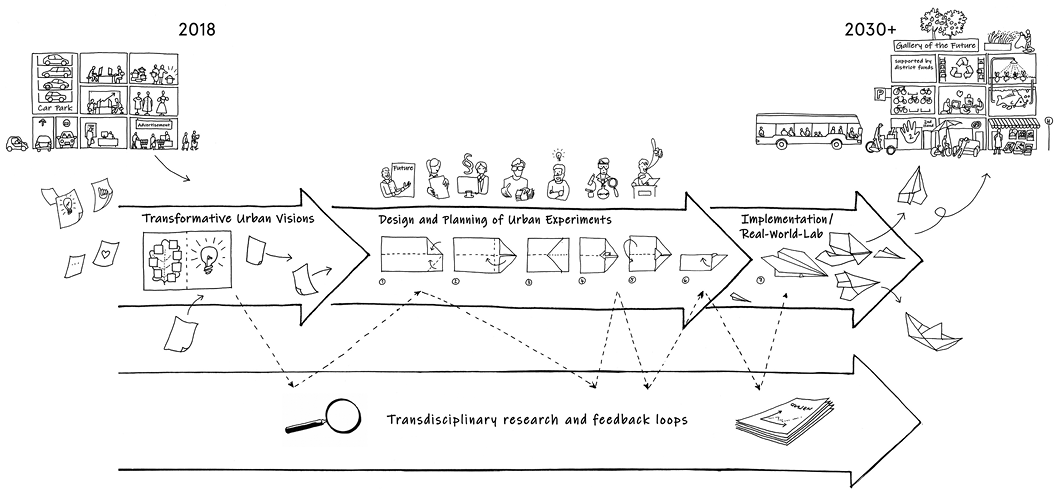
In the first phase, citizens envisioned the Dresden’s future for 2030 and beyond. Over 800 citizens participated in barcamps, where they developed urban sustainability visions (see Figure 22.1, up), hosted in collaboration with local institutions such as the public energy provider, the public transport company and a housing association. To broaden engagement, two city trams were repurposed for a day, allowing citizens to post their wishes and ideas for a sustainable city in over 700 notes on the windows of the trams (see Figure 22.2, down). These visions were synthesised into a unified vision, ‘Dresden – City of the Future 2030+’,Footnote 1 emphasising themes such as local action, global responsibility (though the Sustainable Development Goals), resilience, a local action framework, local cycles of production and consumption, community building and participation.
Impressions from the 25 barcamps (up) and the re-designed city trams (down), which gathered ideas and wishes from citizens who might not usually engage in city-led participatory formats
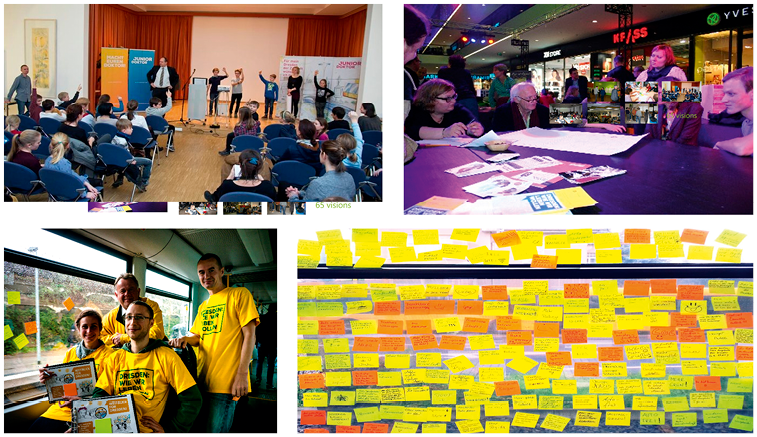
Building on this vision, citizens proposed transition experiments in the planning phase, which were finally implemented in the experimenting phase, covering a broad range of social innovations such as edible cities, car-free districts, sustainable business models, nature education, participatory governance within districts and the circular economy. An ‘Office of City of the Future’ was established in the Mayor’s Office to coordinate the overall project, acting as a mediator between the citizen-led initiatives and the municipal bodies.
The DCF project demonstrates the potential of bottom-up governance to cultivate alternative visions of sustainability, moving away from economic growth-centred paradigms and ecological modernisation towards sufficiency and the common good. However, this often competed with Dresden’s dominant political focus on economic development. DCF also provided a space to experiment with different forms of intermediation in transformative governance. ‘Transition intermediaries’ play critical roles by bridging innovative niches and dismantling entrenched regimes (Kivimaa et al. Reference Kivimaa, Boon, Hyysalo and Klerkx2019), fostering cross-sectoral cooperation and partnerships. Whereas ‘regime intermediaries’ are connected to the established regime through institutional ties, ‘niche intermediaries’ advocate for grassroots innovations (Kivimaa et al. Reference Kivimaa, Boon, Hyysalo and Klerkx2019; Sovacool et al. Reference Sovacool, Turnheim, Martiskainen, Brown and Kivimaa2020). Adopting an exploratory approach, the project studied both types of transition intermediaries to examine niche–regime interactions and their distinct roles in urban experimentation processes.
Empirical findings reveal that the DCF office, e.g. along with the ‘Material Mediation’ and the ‘Food Bin’ experiments, played a prominent role in mediation and translation. Project teams advancing these transition experiments functioned as niche intermediaries, acting as visionaries, knowledge brokers and advocates of change. By contrast, the DCF office operated as a regime intermediary, guiding and facilitating the process, establishing an institutional infrastructure and coordinating local activities (Ehnert Reference Ehnert2023a). The office fostered networks, resolved conflicts and mediated between the municipality, project teams and broader urban society, promoting new cross-sectoral collaboration. It had to bridge the gap between the hierarchical, rule-based culture of the administration and the open-ended, experimental and exploratory nature of the projects. Given its limited strategic connections and the lack of sustainability as a mandatory municipal responsibility (per the Saxon Municipal Code), the office had to actively mobilise support for the project and advocate for an administrative culture more open to co-creation and institutionalisation of sustainability initiatives within the city structures (Frantzeskaki and Bush Reference Frantzeskaki and Bush2022), posing the risk that real-world experimentation could remain fragmented and episodic (Evans Reference Evans2016; Karvonen et al. Reference Karvonen, Evans and van Heur2014; Torrens and von Wirth Reference Torrens and von Wirth2021).
In contrast, niche intermediaries like ‘Material Mediation’ and ‘The Food Bin’ played stronger roles in envisioning and advocating for sustainability, facilitating learning and mobilising support for change. Envisioning change, ‘Material Mediation’, for example, critiqued consumer culture, promoted resource cycles within a circular economy framework and also advocated for the common good, with resources and knowledge being shared rather than privatised. Through workshops on resource cycles and re-using materials (see Figure 22.3), it sought to redefine waste as a valuable resource and foster a do-it-yourself ethos, empowering consumers as opposed to established industry actors. The initiative also helped establish a national network of similar initiatives to support knowledge transfer and local innovation. However, it struggled and failed to secure municipal support for a civic–public partnership for a shared communal waste management infrastructure.
(left): ‘Material Mediation’ storage place
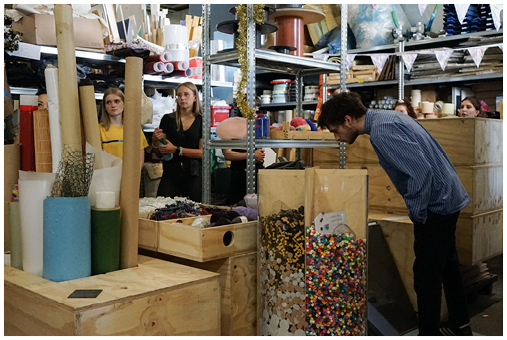
Similarly, the ‘Food Bin’ experiment aimed to raise awareness around food waste and to encourage regional, seasonal food consumption. Through educational workshops and cooking events, the ‘Food Bin’ engaged participants in both cognitive and emotional learning processes (see Figure 22.4), creating a space for shared emotional experiences around foods, including the senses of optics, taste and haptics. Like ‘Material Mediation’, it sought to empower individuals to become independent of the food industry, teaching them to cook with leftover and regional foods. The Food Bin cultivated a network of diverse community members, shifting from indoor events to novel forms of outreach including mobile formats involving a cargo bike, cooperation with neighbourhood cafés and churches and events held in public spaces to reach broader audiences.
(right): ‘Food Bin’ neighbourhood cooking event

In conclusion, DCF created a valuable space for experimenting with governance innovations such as participatory co-creation formats, intermediary actors and structures, and the social innovations generated by the transition experiments. However, it also revealed how the culture of experimentation, entailing openness and learning-by-failing, clashed with the accountability and rule-based orientation of public administration (Bulkeley et al. Reference Bulkeley, Marvin, Palgan, McCormick, Breitfuss-Loidl, Mai, von Wirth and Frantzeskaki2019; Farrelly and Brown Reference Farrelly and Brown2011; Nevens et al. Reference Nevens, Frantzeskaki, Gorissen and Loorbach2013). Mediation is thus essential to reconcile traditional governance structures with experimental approaches, facilitating the integration of change agents into urban governance processes.
22.5 Conclusions and Outlook
A spatial perspective, and particularly the focus on urban environments, has become a critical corner stone in sustainability transitions research in the last decade. While the full ontological and epistemological potential of a spatial, urban lens is yet to be fully developed, existing studies have already made significant contributions. Reflecting on the current state of the art of urban sustainability transition research, several promising directions may help advance both the scientific field and the practical implementation of urban sustainability transitions.
Firstly, scientific discourse on urban sustainability transitions could benefit significantly from viewing urban spaces not only as contexts but as levers for transformation, leveraging various ontological and epistemological understandings of space (see Section 22.2). This dual perspective could strengthen collaboration between urban and transition scholars, fostering new and robust heuristics for comparative studies on urban sustainability transitions. It would also offer urban practitioners new entry points to initiate and accelerate transformative change on the ground, potentially enhancing existing urban development strategies, processes and instruments.
Secondly, typifying urban experiments beyond sectoral categories could clarify the relationship between experiment design (purposeful objectives) and the way they influence their context, driving urban transitions. There is still limited understanding of how experiment-based innovations are embedded within urban governance structures (Hodson et al. Reference Hodson, Evans and Schliwa2018), how they facilitate learning at individual, collective and institutional levels, how they interact with and impact power dynamics, either enabling or obstructing empowerment, leading to a reconfiguration of urban systems.
Thirdly, urban sustainability transition research could further explore how urban transitions are affected by recent societal trends, including societal polarisation, post-factual narratives and opposition to liberal democratic systems. Questions of legitimacy and governance decision-making in urban transition are critical, particularly as transition governance approaches such as transition management are sometimes perceived as bypassing local democratic processes (de Geus et al. Reference de Geus, Wittmayer and Vogelzang2022). While this is seen positively when existing mechanisms are deemed inadequate for urgent transitions to sustainability, it also raises concerns about societal stability and the legitimacy of democratic institutions, particularly given opposition from both right- and left-wing extremists. Therefore, research is needed on how urban transition governance can better align with democratic frameworks without losing its effectiveness in promoting urban sustainability transitions.
Fourthly, there is significant potential in bridging socio-technical systems (STS) and socio-ecological systems (SES) research within urban contexts. As local governments work to improve urban ecosystems to address climate, biodiversity and pollution challenges, research could investigate how people-nature connections and investments in ecological infrastructure (such as nature-based solutions) facilitate urban sustainability transition. Further investigation is also warranted into how urban ecosystem investments and nature-driven place transformations may either stall or accelerate various urban transitions. This aligns with calls for integrated social–ecological–technological systems (SETS) frameworks (Andersson et al. Reference Andersson, Lennerfors and Fornstedt2024; McPhearson et al. Reference McPhearson, Cook, Berbés-Blázquez, Cheng, Grimm, Andersson, Barbosa, Chandler, Chang, Chester, Childers, Elser, Frantzeskaki, Grabowski, Groffman, Hale, Iwaniec, Kabisch, Kennedy and Troxler2022), well-suited to the complexity of urban sustainability transitions.
Fifthly, incorporating decolonial perspectives could enhance future research on urban transitions by guiding the design, evaluation and objectives of urban governance for more equitable futures. Decolonial thinking can help identify key actors outside traditional sectoral categories, scrutinise narratives and frames guiding urban transitions and propose alternative interventions for transformative change through a decolonial lens. This perspective is also critical for urban regeneration initiatives, ensuring they do not inadvertently reinforce neo-colonial narratives or path dependencies that undermine sustainability.
Sixthly, current impact evaluation frameworks often focus on short-term impacts of experimentation due to project design and funding (Torrens and von Wirth Reference Torrens and von Wirth2021). To capture the medium- (15–25 years) and long-term impacts of urban sustainability efforts, research should investigate the lasting institutional integration of lessons learnt. This points to a need for fundamentally rethinking research project design and funding models. Urban real-world laboratories should be envisioned as long-term social research infrastructures (Schneidewind et al. Reference Schneidewind, Augenstein, Stelzer and Wanner2018) fostering sustained partnershipsFootnote 2 between science, administration, policy, business, civil society and citizens to collectively experiment with and learn how to navigate transformative changes across multiple systems simultaneously.
23.1 Introduction
Sustainability transitions (ST), as an interdisciplinary field for studying societal change, has popularised globally since the early 2000s. The theory appeals to scholars and practitioners alike, as a systematic way of understanding shifts in technologies, policies, markets and culture, as well as provides useful heuristics for mobilising a variety of societal actors for taking action on climate change mitigation (IPCC, 2023) and just transitions (Swilling, Reference Swilling2020; Avelino et al., Reference Avelino, Wijsman, van Steenbergen, Jhagroe, Wittmayer, Akerboom and Kalfagianni2024). Although in recent years, it has impressively become a globally known research field, the conceptual origins and dominant focus in empirical study remain confined in the European context. Even when other parts of the globe are visited, the theories and frameworks continue to have what is called a ‘Western bias’ (Köhler et al., Reference Köhler, Geels, Kern, Markard, Onsongo, Wieczorek and Wells2019, Ramos-Mejia et al., Reference Ramos-Mejía, Franco-Garcia and Jauregui-Becker2018; Ghosh and Schot, Reference Ghosh and Schot2019). When studying transitions in contexts outside of Europe, especially in the so-called ‘Global South’, it is argued that ‘many of frameworks’ implicit theoretical assumptions do not hold’ (Feola, Reference Feola2020). A useful starting point is therefore to understand why and how contexts differ between Global South and Global North and in what ways ST theories could be sensitive and meaningful as a theory of change in Global South contexts.
Historically, the term ‘Global South’ has been popular as an alternative to the notions of ‘third world’, ‘poor nations’, ‘least developed countries’ or ‘developing countries’ (UNCTAD, 2022). Each of these terms are problematic as they carry a misplaced value judgement of a countries’ core versus peripheral position in a world dominated by neoliberal developmental ideas (e.g. GDP growth is a major indicator of development), ignoring the vast social diversity, environmental and cultural values and practises (Chant and Mcllwaine, Reference Chant and McIlwaine2009). In regions such as Latin America, South Asia and sub-Saharan Africa, decades of colonial rule have shaped the local infrastructures, institutions and aspirations in line with the ‘rules’ of capitalism and industrial modernity, such as encouraging growth through mass production, maintaining supplies at the cost of extraction and overconsumption, and disconnecting from nature as a symbol of progress and modernity (Kanger et al., Reference Kanger, Tinits, Pahker, Orru, Tiwari, Sillak and Vaik2022).
History books tell us how countries that are currently seen as developing and poor were attacked and plundered by colonising nations, drawing out treasures and natural resources (which fuelled their growth) at the cost of the colonised nations left as a ‘corpse’ even after independence [See ‘The Anarchy’ for a harrowing history of the British colonising India (Dalrymple, Reference Dalrymple2019)]. Such histories invite reflection on how development has been done, should be done, by whom, at whose cost and what it means to develop in the first place. In the current context of climate crisis, inequality, migration and wars, development often becomes a burden for the previously colonised nations (Kothari, Reference Kothari2005; Arora and Stirling, Reference Arora and Stirling2023). In order to counter such colonial developmental agendas, Global South as a category enables a fairer appraisal of socio-economic marginalisation and ‘resistance against global hegemonic power’, recognising and repairing the historic injustices and colonial oppressions experienced by the majority of countries in the Southern Hemisphere [see Haug et al., (Reference Haug, Braveboy-Wagner and Maihold2021); Menon (Reference Menon2018); Kloß, (Reference Kloß2017) for recent insights on Global South as a category].
At present, there are high levels of persistent inequalities in the Global South owing to institutional and economic privileges of the few, relying on exclusive provision systems that reproduce social exclusion (Ramos-Mejía et al., Reference Ramos-Mejía, Franco-Garcia and Jauregui-Becker2018). Exclusions are structural causes of poverty, which is a major issue in these contexts owing to (capitalist) structures that maintain and regularise the ‘anti-social’ exploitative economic processes (Baulch and Hoddinott, Reference Baulch and Hoddinott2000; Mitchell, Reference Mitchell2024). There are diverse ‘patterns of poverty reproduction’ (Ramos-Mejía et al., Reference Ramos-Mejía, Franco-Garcia and Jauregui-Becker2018). Limited statehood, especially in conflict or post-conflict areas (Risse, Reference Risse, Leibfried, Huber, Lange, Levy, Nullmeier and Stephens2015), and a lack of political freedom and capabilities for development on their own accord (Sen, Reference Sen1999) entrench socio-economic marginalisation. Democratic struggles in ensuring justice for all, in highly unequal contexts, obstruct people’s visions and capabilities to forge new and common directionality of change and lock them into pursuing ‘development’ (Escobar, Reference Escobar1995) in a way that often leads to a dead end. Transitions in the Global South are therefore a pursuit to rethink development trajectories and understand and appreciate local challenges and opportunities in a way that is sensitive to local cultural histories and diverse social realities (Ghosh et al., Reference Ghosh, Ramos-Mejía, Machado, Yuana and Schiller2021; Preuß et al., Reference Preuß, Galvin, Ghosh and Dütschke2021).
Transitions in the Global South are inherently linked to ST in the Global North (Wieczorek, Reference Wieczorek2018). As the impacts of global environmental change are increasingly manifested, the agendas to transition to sustainability currently pursued by the Global North, for example, decarbonisation, serve as impetus for careful attention to the impacts these have on Global South contexts, for example, the creation of sacrifice zones (Sovacool et al., Reference Sovacool2021; Almeida et al., 2021). For example, the decarbonisation agenda may lead to green extractivism, which perpetuates underdevelopment in the South while reinforcing injustice, that is, decarbonisation by dispossession (Andreucci et al. 2021) and delay ST in the Global South. Given these continuing colonial impulses, it is therefore essential for studies of transitions in the Global South to be accompanied by decolonial sensibilities (Avelino et al. Reference Avelino, Wijsman, van Steenbergen, Jhagroe, Wittmayer, Akerboom and Kalfagianni2024; Ghosh et al., Reference Ghosh, Ramos-Mejía, Machado, Yuana and Schiller2021) and imaginaries of just sustainable futures for all (Mguni et al., Reference Mguni, Herslund and Abrams2025).
Reimagining Global South as a relational category (Berger, Reference Berger2021) further implies that it is more than just a ‘geographic imaginary’ (Haug, Reference Haug, Braveboy-Wagner and Maihold2021), but a relational ‘subversive practise’, that is ‘created, imagined, invented, maintained, and recreated by the ever-changing and never fixed status positions of social actors and institutions’ (Kloß, Reference Kloß2017). Such practises and relationality can exist in the geographical Global North, implying ‘Global South’ to be a much more nuanced epistemological category than simply constituting countries in Asia, Africa and Latin America. Given the socio-economic heterogeneities in these countries, relationality representing the Global North can be found in some Southern geographies, for instance in the megacities (Ghosh and Schot, Reference Ghosh and Schot2019). Therefore, Global South within Global North and Global North within Global South should be understood as a yin and yang relation, and not as two separate geographical frames.
A key research question addressed in this chapter is: how could we analyse and enact ST in the Global South contexts, in a way that transcends the historical challenges of colonial modernity and undesired modes and forms of development while pursuing just futures? By revisiting key transitions, concepts such as innovation, regimes and change, the aim of this chapter is to illustrate complex and multiple dynamics of transitions in the Global South.
23.2 Sustainability Transitions in the Global South: A Brief Account
Since the late 1990s, a scientific community started to emerge around the topic of ST (Vellinga and Wieczorek, Reference Wieczorek and Vellinga2004; Rip and Kemp, Reference Rip and Kemp1998). Broadly speaking, sustainability transition literature suggests that due to their unstructured, complex and global character, current problems such as climate change or loss of biodiversity can effectively be addressed by means of a radical change in interconnected socio-technical systems providing for human needs such as energy, water or shelter (Elzen et al., Reference Elzen, Geels and Green2004; Elzen and Wieczorek, Reference Elzen and Wieczorek2005). Every aspect of life, from technology, institutions and the economy to the socio-cultural sphere, must transform for a system change to be effective (Wieczorek and Berkhout, Reference Wieczorek and Berkhout2009, Grin et al., Reference Grin, Rotmans and Schot2010). Incremental, technical changes based on the end-of-pipe solutions such as cleaner products or eco-efficiency failed to address the new type of unstructured, complex and wicked problems that a socio-technical approach has the potential to address (Elzen & Wieczorek, Reference Elzen and Wieczorek2005; Geels et al., Reference Geels, Sovacool, Schwanen and Sorrell2017; Ghosh et al., Reference Ghosh and Schot2019; Bhatia, Reference Bhatia2023).
Major transition frameworks such as multi-level perspective (MLP) (Geels, Reference Geels2005), strategic niche management (SNM) (Raven, Reference Raven2005), transition management (TM), (Loorbach, Reference Loorbach2007) and technological innovation systems (TIS) (Bergek et al., Reference Bergek, Jacobsson, Carlsson, Lindmark and Rickne2008; Hekkert et al., Reference Hekkert, Suurs, Negro, Kuhlmann and Smits2007; Wieczorek and Hekkert, Reference Wieczorek and Hekkert2012) have originally been used to clarify and motivate socio-technical transitions in mainly Global North contexts. However, many scholars started using these frameworks in the Global South in the 2000s, especially in Africa (e.g. van Eijck and Romijn, Reference Van Eijck and Romijn2009; Byrne, Reference Byrne2011; Swilling & Annecke, Reference Swilling and Annecke2012) and in Asia (e.g. Berkhout et al., Reference Berkhout, Angel and Wieczorek2009, Reference Berkhout, Verbong, Wieczorek, Raven, Lebel and Bai2010, Reference Berkhout, Wieczorek and Raven2011; Hansen and Nygaard, Reference Hansen and Nygaard2013; Amankwah et al., Reference Amankwah, Klerkx, Oosting, Sakyi-Dawson, Van der Zijpp and Millar2012). In the past decade, the geographical and conceptual breadth of ST has remarkably expanded, for example, in Asia (Yang et al., Reference Yang, Schot and Truffer2022; Yuana et al., Reference Yuana, Sengers, Boon, Hajer and Raven2020; Ghosh et al., Reference Ghosh and Schot2019; Raven et al., Reference Raven, Ghosh, Wieczorek, Stirling, Ghosh, Jolly and Sengers2017; Jolly et al., Reference Jolly, Raven and Romijn2012), Africa (Ting and Byrne, Reference Ting and Byrne2020; Mguni et al., Reference Mguni2015; Swilling & Annecke, Reference Swilling and Annecke2012) and Latin America. Various aspects of transitions, beyond the transitional MLP analysis, are now increasingly discussed, for example, conflicts (Yuana et al., Reference Yuana, Sengers, Boon, Hajer and Raven2020), regime resistance (Ting and Byrne, Reference Ting and Byrne2020), informal occupations (Dutt, Reference Dutt2022) and relationality (Nagarajah, Reference Nagarajah2023).
Lately, the literature has also taken a ‘decolonial turn’, underlining the risks of ‘failing to challenge the reproduction of colonially accumulated power and privilege’ and the consequences of further deepening cultures of domination, toxic extraction and controlling imaginations that constitute key tenets of colonial modernity (for a detailed account, see Arora and Stirling, Reference Arora and Stirling2023). Ghosh et al. (Reference Ghosh, Ramos-Mejía, Machado, Yuana and Schiller2021) argue that there are at least three pragmatic ways in which transitions studies can be decolonised: by recognising everyday struggles as sources of enhanced capacity for resilience and change; by recognising local nuanced dynamics of inequality-induced power asymmetries; and through participatory research that is empowering and non-extractive. Decolonial perspectives are observed in studies highlighting ‘disempowerment effects in empowerment initiatives’ (Jayaweera et al., Reference Jayaweera, Rohracher, Becker, Nop and Waibel2023); ‘hybrid co-existence’ of socio-technical regimes that embodies conflicts (Balanzó-Guzmán and Ramos-Mejía, Reference Balanzó-Guzmán and Ramos-Mejía2023); ‘religious repertoires approach’ to ST (Stacey, Reference Stacey2024) and ‘multiplicity of pasts that lead to diverse presents and futures’ (Terry et al., Reference Terry, Castro, Chibwe, Karuri-Sebina, Savu and Pereira2024). Such perspectives are woven into this chapter, as we have tried to build our arguments based on (and therefore cite) as many Global South scholars as possible as a way to recognise their valuable contributions to ST literature.
In Section 23.3, we aim to take the reader through a journey of discovering the unique characteristics, dynamics of transitions and methodological diversities found in the literature of pursuing transition-oriented research and action in all these contexts.
23.3 Key Characteristics of Transitions in the Global South: Five Themes
In a systematic literature review, Wieczorek et al. (Reference Wieczorek2018) discussed major insights for ‘sustainability transitions in developing countries’, namely: niche formation, experiments and upscaling, change agents and factors, transnational linkages, regime uniformity, stability and change, power, path dependence, normative orientation and system framing. Research on each of these areas has advanced, resulting in integrated framings and newer topics emerging from further empirical studies. For instance, research on niches has evolved into unpacking the variety of innovations, including experimentation and learning (Raven et al., Reference Raven, Lindsay, Lane and Reynolds2024; Dutt, Reference Dutt2023; Schiller et al., Reference Schiller, Klerkx, Centeno and Poortvliet2023). Understandings of regimes have evolved through differentiated understanding of the stability of systems, the role of regime actors as change agents, power asymmetries and path dependencies (Ghosh et al., Reference Ghosh and Schot2019; van Welie, Reference Van Welie, Cherunya, Truffer and Murphy2018; Guma, Reference Guma2021). These distinctive characteristics and dynamics of niches and regimes have implications for the theory of socio-technical change (transitions) in the Global South through the plurality of pathways. Normative orientations of transitions are now extensively considered through justice and decolonising debates (Avelino et al., Reference Avelino, Wijsman, van Steenbergen, Jhagroe, Wittmayer, Akerboom and Kalfagianni2024; Kumar et al., Reference Kumar, Höffken and Pols2021; Ghosh et al., Reference Ghosh, Ramos-Mejía, Machado, Yuana and Schiller2021). The methods of transitions have also evolved from identifying and analysing socio-technical systems into considerations of plural knowledges, co-design and empowering storylines (Velasco et al., Reference Velasco, Ghosh, Boni, Schiller and Winkler2024; Rusca et al., Reference Rusca, Sverdlik, Acharya, Basel, Boyd, Comelli and Messori2024). Extending from Wieczorek (Reference Wieczorek2018)’s insights and incorporating the new directions of transitions in the Global South research, we suggest organising this review around five key themes, namely niches, regimes, change, justice and knowledge diversity (methods) (see Figure 23.1).
Key themes of research in sustainability transitions in the Global South

23.3.1 Niches and Varieties of Innovations
Within transitions studies, niches are conceptualised as spaces that protect emergent innovations. Source and form of protection or shielding niches may vary (Raven et al. Reference Raven2005; Smith and Raven, Reference Smith and Raven2012). There might be subsidies or certifications that incentivise innovation uptake such as for specialised coffee in Colombia (Ghosh et al., Reference Ghosh, Ramos-Mejía, Machado, Yuana and Schiller2021) or renewable energy in Nepal (Bhattarai et al., Reference Bhattarai, Maraseni, Apan and Devkota2023). Protection is also offered by new attractive business models and banks’ innovative funding schemes such as ‘carbon finance’ (Bolton and Foxon, Reference Bolton and Foxon2015). There can be local actor-networks and discourses that provide passive, informal protection to the alternative technologies and institutions, such as in the case for electric rickshaws in Delhi (Dutt, Reference Dutt2023), which highlights the importance of socio-political networks in niches, beyond financial and policy instruments (Raven, this volume: Chapter 5; Butt et al., Reference Butt, Roy and Some2024). The key argument for the ongoing debates on strategic niche management rests on the mechanisms and politics of protecting niche alternatives, as change agents may not be able to compete with mainstream and incumbent actors, technologies and institutions (i.e. the regime).
In the Global South, niches often emerge as sites of resistance, refusal and countervailing in light of the service provision deficiencies in the shadows of hegemonic incumbent ways (Shove and Walker, Reference Shove and Walker2010; Mguni et al., Reference Mguni2015). The usual niche processes still apply – emerging new actor-networks that can support the resistance against the hegemony of regimes and learning in South–South networks challenging assumptions about the efficiency and marketisation of ‘the normal’ exclusionary regimes.
Niches, conceptually, can be considered as spaces of experimentation by creative, innovative actors, tinkering with technological and social arrangements that are, by necessity, frugal and inclusive. Examples of such experiments are affordable refrigerators in India built of clay (Radjou et al., Reference Radjou, Prabhu and Ahuja2012); Zimbabwe’s Bush Pump (De Laet and Mol, Reference De Laet and Mol2000); speciality coffee production in Colombia (Ghosh et al., Reference Ghosh and Schot2019); multi-stakeholder processes of protecting ecological infrastructure and mutual learning for water governance in South Africa (Boni et al., Reference Boni, Belda-Miquel and Velasco2023); and circular economy practises in the informal sector owing to lack of affordability (Korsuna et al., Reference Korsuna, Halme, Kourula, Levanen and Lima-Toivanen2022). Circularity in everyday slum dwelling through waste-based informal micro-enterprises, training and awareness on ‘keeping products alive’, thereby the culture of repairing and maintaining could be considered innovative niche-level efforts towards just transitions (Abunyewah et al., Reference Abunyewah, Erdiaw-Kwasie, Okyere and Boateng2023).
Experiments in niches in the Global South need to prioritise innovation that embodies diverse imaginaries (Kumar et al., Reference Kumar, Höffken and Pols2021), providing prominence often embodied in to ways knowing and doing innovation that are ‘subaltern’ or rooted in practises that are historically marginalised under imperial and colonial power structures (Arora & Stirling, Reference Arora and Stirling2023; Mavhunga, Reference Mavhunga and Mavhunga2017). Scaling of these innovations is often constrained by ‘livelihood opportunities, assets and strategies’ (Singh et al., Reference Singh, Dell’Angelo, Oguge and Odote2024). Subaltern scholars further suggest the undesirabilities of scaling innovations beyond their ‘ecological boundaries’ (Roysen et al., Reference Roysen, Bruehwiler, Kos, Boyer and Koehrsen2024) to avoid the ‘mounting pile of ruins that scalability leaves behind’ (Tsing, Reference Tsing2012) as scaling innovations may reproduce or trigger further injustices, as in the case of patriarchy and child labour in artisanal Congolese cobalt mining (Sovacool, Reference Sovacool2021).
A decolonial interpretation of the niche literature should invite reflexivity on where, how and by whom do niche innovations emerge, privileging a relational worldview. In the Global South, it is often a community of practice (CoP), acting as innovators by constantly modifying strategies, visions, approaches and materiality, to reconfigure and adapt systems that do not work for everyone, into fluid, heterogenous configurations that are fit for purpose (de Laet & Mol, Reference De Laet and Mol2000; Lawhon et al., Reference Lawhon, Nilsson, Silver, Ernstson and Lwasa2018; Guma, Reference Guma2021). In order to be a ‘niche actor’, agency for change can therefore be embedded in unexpected places of established systems, such as with households, religious actors, public officials and unions of informal workers, who might also work against or parallel to the State (Raven et al., Reference Raven, Lindsay, Lane and Reynolds2024; Koehrsen, Reference Koehrsen and Ives2025; Dutt, Reference Dutt2022; Yuana et al., Reference Yuana, Boon, Raven, Hajer, Sengers and Ghosh2023; Misleh et al., Reference Misleh, Dziumla, De La Garza and Guenther2024; Ghosh and Schot, Reference Ghosh and Schot2019). Such actor-networks are created bottom up, as people with common and complementary interests form communities and unions to reinforce each other’s visions and actions for the alternative technologies or business models. Dutt (Reference Dutt2023) proposes that these networks might constitute both the status quo and the alternative, niche and regime actors, thereby questioning the binary opposition between the niche and regime, conventionally present in transitions literature. An important set of actors who, in fact, bridge this binary are called the intermediary actors, who play a bridging role in facilitating exchange and mobilising resources between CoPs, as they ‘broker between niche-internal and niche-external actors’ aiding in niche acceleration (Schiller et al., Reference Schiller, Klerkx, Centeno and Poortvliet2023; Kanda et al., this volume: Chapter 18; Kivimaa et al., Reference Kivimaa, Bergek, Matschoss and Van Lente2020). As such, such a nuanced understanding of niche configurations, possibilities and identifying actor-networks at the interface between niche and regimes (including intermediaries) in the Global South is incomplete without aids in elaborating a similarly nuanced conceptualisation of the regime as reflected in Section 23.3.2.
23.3.2 Regimes
Socio-technical regimes are defined as ‘dominant and stable configuration of rules’ in transitions theory (Misleh et al., Reference Misleh, Dziumla, De La Garza and Guenther2024; Schot and Geels, Reference Schot and Geels2007). This definition is however critically examined, especially the degree and nature of stability and dominance of the regime configurations are questioned in the Global South. This vibrant debate in the recent decade has resulted in many adjectives being used to describe global south regimes, such as ‘unstable (and highly dynamic)’ (Verbong et al., Reference Verbong, Christiaens, Raven and Balkema2010), ‘fluid’ (Berkhout et al., Reference Berkhout, Verbong, Wieczorek, Raven, Lebel and Bai2010), ‘undemocratic and non-egalitarian’ (Hansen et al., Reference Hansen, Nygaard, Romijn, Wieczorek, Kamp and Klerkx2018), ‘fragmented and splintered’ (van Welie, Reference Van Welie, Cherunya, Truffer and Murphy2018), and ‘unregulated’ (Ramos-Mejia et al., Reference Ramos-Mejía, Franco-Garcia and Jauregui-Becker2018) or encompassing a dynamic combination of institutional logics (Ghosh, Reference Ghosh, Ramos-Mejía, Machado, Yuana and Schiller2021). Regimes are ‘semi-coherent configuration of rules such as laws, standards, beliefs, routines and norms’ (Geels, Reference Geels2005). These rules are driven by current and historical societal roles and relationships, such as the relationship between people and nature, that historically encompassed a complex, non-extractivist and often spiritual web of interrelations (Escobar, Reference Escobar1995; Ives, Reference Ives, Abson, von Wehrden, Dorninger, Klaniecki and Fischer2018; Ahlborg et al., Reference Ahlborg, Ruiz-Mercado, Molander and Masera2019).
Guma (Reference Guma2021) highlighted how the conventional characterisation of regimes disqualifies alternative forms of urban development, that is, shacks, shanties and micro-stalls in Kibera, Nairobi or temporary use of urban spaces (Agheyisi, Reference Almeida, Kolinjivadi, Ferrando, Roy, Herrera, Gonçalves and Van Hecken2023). These analyses stem from the definition of regime as (dynamically) stable and (semi-)coherent, while modified definitions such as regimes as ‘shaped and maintained through the mutual adaptation and co-evolution of its actors and elements’ (Holtz, Reference Holtz, Brugnach and Pahl-Wostl2008) are more congruent with diverse contextual specificities. Still, the concept of regime is a useful heuristic to analyse systemic change, as mobilised in multiple recent studies (see Dutt, Reference Dutt2022; Ghosh and Sharmeen, Reference Ghosh and Sharmeen2021; Khatoon et al., Reference Khatoon, Kivimaa, Brisbois and Saadi2024). These informal and transient structures offer viable alternatives amidst the exclusionary nature of neoliberal and market-oriented interventions featured in the dominant ways of being-in-the-world.
Scholars have observed that in the Global South contexts of poverty and deprivations, people try different strategies and ‘experiment’ with new ways of making ends meet, which in turn strengthens their tolerance and acceptance of volatility and change (Lawhon et al., Reference Lawhon, Nilsson, Silver, Ernstson and Lwasa2018; Mguni et al., Reference Mguni, van Vliet, Spaargaren, Nakirya, Osuret, Isunju, Ssekamatte and Mugambe2020; Ramos-Mejía et al., Reference Ramos-Mejía, Franco-Garcia and Jauregui-Becker2018; Baulch and Hoddinott, Reference Baulch and Hoddinott2000). The idea of stability or a constant state of things is largely absent, as societies deal with dysfunctional or absent basic systems of provision by navigating precarity. Instead, van Welie (Reference Van Welie, Cherunya, Truffer and Murphy2018) conceptualised the notion of ‘service regimes’ that are characterised by infrastructures, organisational capabilities or competencies, spatial and temporal locations, meaning, expectations and social interactions. Using Nairobi’s sanitation regime, they show that most basic service regimes in the Global South are ‘splintered’ as multiple co-existing service regimes, which are internally misaligned, cause further misalignment and dysfunctionality at the sectoral level. Cherunya et al. (Reference Cherunya, Ahlborg and Truffer2020) shows that innovations are usually anchored in this ‘oscillating domestic space’ where ‘people are faced with constant fluctuations – expected and unexpected [and] … are forced to respond to precarious situations by adopting a multiplicity of complementary and partial solutions’.
These internal tensions, precarity and ‘ongoing adjustments’ are constitutive of what Madsen et al. (Reference Madsen, Miörner and Hansen2021) call ‘intra-regime dynamics’. Regimes are not always tied to one specific dominant technological configuration but embed a great diversity of modes. Power differentials and contestations are prominent in co-existing regimes, for instance, in Global South smart cities initiatives (Madsen et al., Reference Madsen, Miörner and Hansen2022; Datta and Odendaal, Reference Datta and Odendaal2019). The high degree of non-uniformity of regimes in the Global South is further manifested in a diverse portfolio of needs, preferences and visions, for instance, in the co-existing regimes of the urban mobility system of Kolkata (Roy et al., Reference Roy, Bailey and van Noorloos2024; Ghosh and Schot, Reference Ghosh and Schot2019), systems considered old and less efficient, such as trams and rickshaws, co-existed with newer systems like metro and low-emission buses. The reliance on diverse systems of mobility in a densely populated city shows the need for protecting plurality, beyond mainstreaming a few dominant innovations, in circumstances where people live with infrastructures in a constant state of disrepair (Wieczorek, Reference Wieczorek2018). Such co-existing diversity can also be explained by communities with heterogenous and strong traditional values, emotions, nostalgia and interests in preserving the old while incorporating the new. This discussion leads us to reflect on the issue of ST as a theory of socio-technical change in Section 23.3.3.
23.3.3 The Theory of Change – Plurality of Pathways
Highly dynamic regimes in the Global South contexts pose unique challenges for ST. The MLP as a generic theory of change has been often criticised for falling short of capturing the nuances of agency, practises and ontologies in the Global South contexts (Shove and Walker, Reference Shove and Walker2010; Geels, Reference Geels2011; Ghosh et al., Reference Ghosh, Ramos-Mejía, Machado, Yuana and Schiller2021). Propositions of radical regime shift, one where a regime is replaced or substituted by another as a whole, ignore the messy realities of change in the Global South contexts, where regimes are realistically renewed, repaired or (re)configured at best, instead of phased out and substituted (Khatoon, Reference Khatoon, Kivimaa, Brisbois and Saadi2024; Ghosh and Schot, Reference Ghosh and Schot2019). The alternative development trajectories of Global South regimes, especially under conditions of enduring poverty and inequalities, and uneven sources and extents of lock-in and stability, are an important area of research (Goldstein, Reference Goldstein, Neimark, Garvey and Phelps2023). As such, the key implication is that different change pathways and strategies may be needed to enact transitions in the Global South.
A key question is then: how is change characterised in the literature on transitions in the Global South? To this end, Khatoon et al. (Reference Khatoon, Kivimaa, Brisbois and Saadi2024) argue that mobility transitions in the Global South are dominated by a variety of public transportation systems, where ‘regime-based transformative change’ would entail policies that not only support low-emission mass transport facilities but also improve and reconfigure the existing technologies and practises. With a ‘novel regime change framework’, Ghosh and Schot (Reference Ghosh and Schot2019) showed various sets of rules along different system dimensions, forming multiple trajectories of change. Actors in established ‘regimes’ such as officials in the public transport systems heavily invest in expanding, modernising and reconfiguring the systems, tackling the uncertainties, associated lock-ins and difficulties in changing the regimes. They further highlighted ‘a plurality of possible pathways’ of change in co-existing regimes in the urban mobility space (Ghosh and Schot, Reference Ghosh and Schot2019). Miörner et al. (Reference Miörner, Binz and Fuenfschilling2021) called this ‘recombinatory transition trajectories’, which provides a nuanced approach to mapping pathways of change, beyond the typology of four transition pathways (Geels and Schot, Reference Geels and Schot2007).
Acknowledging the ‘relational materiality’ (how place-specific social and natural material requirements influence technological change, as in the case of solar PV in Sri Lanka) can be considered a decolonial approach to understanding socio-technical change (Nagarajah, Reference Nagarajah2023). Relationality is also evident in Ghana and Ethiopia’s improved ranking in the industrial modernity index due to increased material extraction, given their historically low material and energy consumption as a starting point (Pahker et al., Reference Pahker, Kanger and Tinits2024). Changes in natural infrastructure, which include ecosystem services, engineered infrastructure and distant and proximate institutions, are important markers of rural-to-urban transition in the Global South (Hutchings et al., Reference Hutchings, Willcock, Lynch, Bundhoo, Brewer, Cooper and Welivita2022). In explaining change in the Global South, the role of State and governmental institutions is highlighted by many scholars (Bhatia, Reference Bhatia2023; Misleh et al., Reference Misleh, Dziumla, De La Garza and Guenther2024), along with the role of conflicts in change processes. Conflicts are shown in semi-formal mobility in Indonesia (Yuana et al., Reference Yuana, Sengers, Boon, Hajer and Raven2020) as to happen in ‘critical moments’ in the socio-political change processes. Conflicts may also be a result of patriarchal systems of dominance. Wiedmann et al. (Reference Wiedmann, Lenzen, Keyßer and Steinberger2020: 5) share that ‘eco-feminist approaches highlight the role of patriarchal social relations and the parallels between the oppression of women and exploitation of nature, while post-development approaches stress the manifold and heterogeneous visions of achieving such socio-ecological transformations’.
Actors configure their institutional settings differently across the world and thus drive change in dissimilar ways. In many regions in the Global South, traditional practises and cultures come directly into conflict with formal institutions. For example, forest dwellers, indigenous people and pastoralists are forcefully evicted through and as a consequence of ‘fortress conservation projects’ in Tanzania, Thailand, Kenya and Cambodia (Mantz, Reference Mantz2024). Contestations and negotiations between the incumbent and niche actors, as well as between actors with ‘different degrees of incumbency’ (Yang et al., Reference Yang, Schot and Truffer2022) as part of the change process, embody power differences and hierarchies (Avelino, Reference Avelino2017). Thus, a relational view of power is said to offer a better perspective on how power relations emerge, persist and change over time (Ghosh and Arora, Reference Ghosh and Sharmeen2021; Datta and Odendaal, Reference Datta and Odendaal2019; Avelino, Reference Avelino2017).
An opposite pattern is also visible in aspirations to catch up with western models of modernity. Pahker (Reference Pahker, Kanger and Tinits2024) observes that countries like Peru are showing an increased positive attitude and value assigned to science and technology’s role in creating positive societal impact and an instrumental view of nature (e.g. economic growth and job creation, even if the environment suffers) in spite of overwhelming evidence of the unsustainability of such growth and development models (Escobar, Reference Escobar1995). While transition is deemed necessary, setting the directionality of transition remains crucial and consequential.
23.3.4 Justice as Normative Directionality for Transitions
Innovations that support societal change with directionality are pivotal for addressing the sustainable development goals (SDGs) (Boni et al., Reference Boni, Velasco and Tau2021; Parks, Reference Parks2022). An emphasis on economic growth often leads to innovation that is unjust for the climate and future generations (Perkins, Reference Perkins2019). Oriented by the SDGs, the dominant discourse of innovation-led growth has now shifted towards a more holistic governance of sustainability and reflexivity in innovation processes (Susur and Karakaya, Reference Susur and Karakaya2021; Schot and Kanger, Reference Schot and Kanger2018; Boni et al., Reference Boni, Velasco and Tau2021). A decolonisation agenda aligns with this new discourse: It allows ‘an exchange between a diverse of political, ethical and epistemological positions (also known as “multi-epistemic literacy” (Jazeel, Reference Jazeel2019: 227)) and “to open up the ‘possibility to think reality differently’”’ (Pieterse, Reference Pieterse2000, p. 180) (Kumar et al., Reference Kumar, Höffken and Pols2021; Ranta, Reference Ranta2020; Chassagne, Reference Chassagne2019), therefore inform and modify transition pathways towards plural and just futures (Yuana et al., Reference Yuana, Boon, Raven, Hajer, Sengers and Ghosh2023).
Decolonising transitions in and for the Global South is normative by its own merit. Here, addressing the ‘dark sides of sustainability transitions’ (McGowan and Antadze, Reference McGowan and Antadze2023; Sovacool, Reference Sovacool2021) requires more than technological change and a serious engagement with alternative framings and narratives originating from the South (Mguni et al., Reference Mguni, Herslund and Abrams2025). Deeply philosophical concepts and worldviews such as Buen Vivir (translates as ‘Good Life’, originating in Ecuador), Ecological Swaraj (translated as ‘self-reliance’, originating in India) and Ubuntu emphasising relationality (Mabele, Reference Mabele, Krauss and Kiwango2022) have penetrated the literature in English on sustainable development (Jimenez et al., Reference Jimenez, Delgado, Merino and Argumedo2022; Ranta, Reference Ranta2020; Chassagne, Reference Chassagne2019; Vanhulst and Beling, Reference Vanhulst and Beling2014; Kothari et al., Reference Kothari, Demaria and Acosta2014; Walsh, Reference Walsh2010). These concepts embody justice in their framing of the well-being of humans as intertwined with nature, other humans and ‘strong democratic and egalitarian impulse’. Justice as desired directionality of transition helps resist the colonial pressures of development and progress at the cost of ecological destruction and expanding the gap between rich and poor in the Global South economies (Chassagne, Reference Chassagne2019; Mohanty, Reference Mohanty2018; Datta and Odendaal, Reference Datta and Odendaal2019).
It is important to shape directionalities of innovation policies to not only direct innovations or best technological solutions but also perceive innovation as negotiation of diverse demands, perspectives and multi-directional (Raven et al., Reference Raven, Ghosh, Wieczorek, Stirling, Ghosh, Jolly and Sengers2017; Dierecks et al., Reference Diercks, Larsen and Steward2019; Yang et al., Reference Yang, Schot and Truffer2022). Directionality of change, in principle, is less determined by selected actors and more navigated through multi-actor negotiation processes of deliberative democratic arrangements (Boni et al., Reference Boni, Belda-Miquel and Velasco2023). It is about acknowledging many possibilities and choices of innovation and democratising the process of innovation, by recognising diverse communities in the innovation ecosystem (Boni et al., Reference Boni, Belda-Miquel and Velasco2023; Mavhunga, Reference Mavhunga2018). It is also about making space for resistance and refusal by marginalised communities of hegemonic frames about development, innovation and what constitutes desirable futures (Yuana et al., Reference Yuana, Boon, Raven, Hajer, Sengers and Ghosh2023; Tuck & Yang, Reference Tuck, Yang, Paris and Winn2014; Mguni et al., Reference Mguni, Herslund and Abrams2025).
Comparing the development pathways of 34 countries, Pahker et al. (Reference Pahker, Kanger and Tinits2024) shows that most Global South countries like Brazil, India and Thailand have not performed well in recent years in assigning directionality to their growth and innovation trajectories (the exception is between Ghana and Ethiopia), which show more directionality in their use of resources to bypass the adverse consequences of industrial modernity and have better potential for sustainable deep transitions (Schot and Kanger, Reference Schot and Kanger2018; Davies and Schot, Reference Davies and Schotthis volume: Chapter 7). Often, change is in directions dictated by the affluent or the ‘super-affluent’ across the globe (Wiedmann et al., Reference Wiedmann, Lenzen, Keyßer and Steinberger2020), causing further injustices. Illustrations of injustice include how megaprojects such as the Moroccan Solar Plan can be co-opted by the elites in the form of ‘marginalising the Moroccan people, while benefiting the palace’ (Okpanachi et al., Reference Okpanachi, Ambe-Uva and Fassih2022).
‘Just transitions’ is therefore an important agenda providing normative directionality in the transitions literature (Truffer et al., Reference Truffer, Rohracher, Kivimaa, Raven, Alkemade, Carvalho and Feola2022; Swilling, Reference Swilling2020; Avelino et al., Reference Avelino, Wijsman, van Steenbergen, Jhagroe, Wittmayer, Akerboom and Kalfagianni2024). Justice can be multi-faceted, such as distributive, procedural, deliberative, recognitional, preparative and epistemic (Avelino et al., Reference Avelino, Wijsman, van Steenbergen, Jhagroe, Wittmayer, Akerboom and Kalfagianni2024; Späth et al., Reference Späth, Castán Broto, Bawakyillenuo and Pregernig2022; Sultana et al., Reference Sultana2022; William and Doyon, Reference Williams and Doyon2019). Haswell et al. (Reference Haswell, Edelenbosch, Piscicelli and Van Vuuren2023) show how, for circular economy missions, ‘global South policy choices frequently replicate the Global North developmental path’. Such top-down replication, overlooking historically circular and sustainable practises such as waste-picking (Randhawa et al., Reference Randhawa, Marshall, Kushwaha and Desai2020), car-sharing and zero-waste habits, not only creates local procedural and recognitional injustices but also makes transitions less appealing locally. For recognitional justice, it is crucial to value communities’ resilience to ‘everyday local struggles’ in the Global South (Ghosh et al., Reference Ghosh, Ramos-Mejía, Machado, Yuana and Schiller2021). Procedural and restorative justice is about ensuring local systems are managed by local communities, ‘in ways that are culturally relevant and ecologically sustainable’ (Laldjebaev et al., Reference Laldjebaev2017: 98; Okpanachi et al., Reference Okpanachi, Ambe-Uva and Fassih2022). Agroecological niches are good examples of enacting restorative justice (Schiller et al., Reference Schiller, Klerkx, Centeno and Poortvliet2023; Jimenez et al., Reference Jimenez, Delgado, Merino and Argumedo2022).
23.3.5 Embracing Diverse Knowledges
A final key element of ST in the Global South is the discussion on knowledges and methodologies of studying and enacting transitions. How knowledge(s) is produced, which knowledges are prioritised and whose knowledge is recognised and to what end – are important questions of epistemic justice, resolved through embracing transdisciplinary knowledge co-production (Mauser et al., Reference Mauser, Klepper, Rice, Schmalzbauer, Hackmann, Leemans and Moore2013). Scholars have highlighted the importance of ‘learning from the South’ on sustainable practises, resilience, climate mitigation strategies and grassroots innovation initiatives (Mukhopadhyay et al., Reference Mukhopadhyay, Hammami and Watson2021). Schiller et al. (Reference Schiller, Klerkx, Centeno and Poortvliet2023) observe that ‘knowledge from the Nicaraguan niche has been particularly influential concerning the development of the global farmer-to-farmer movement, transnational peasant organising and standard setting at a regional scale’.
The historic amnesia of Indigenous knowledges and assumed superiority of western science are key concerns in many interdisciplinary fields, including ST (Balanzó-Guzmán and Ramos-Mejía, Reference Balanzó-Guzmán and Ramos-Mejía2023). Ghosh et al. (Reference Ghosh, Ramos-Mejía, Machado, Yuana and Schiller2021) observed transition scholars need to confront ‘epistemic colonisation’ by recognising other ways of knowing and doing (Arora and Stirling, Reference Arora and Stirling2023). This includes endogenous appraisal by the local communities on what they need to survive and thrive, using ‘plural approaches’, without outsiders advice and guidance on transition processes and outcomes (Chassagne, Reference Chassagne2019). A number of scholars have now highlighted the important role of Indigenous people and their ‘traditional ecological knowledges’ as key drivers of ST (Doyon et al., Reference Doyon, Boron and Williams2021; Nirmal and Rocheleau, Reference Nirmal and Rocheleau2019; Ndlovu-Gatsheni, Reference Ndlovu-Gatsheni2020). An important method of exploring such local contextual ‘wealth of experience and exchanges’ could be through storytelling (Spath et al., Reference Späth, Castán Broto, Bawakyillenuo and Pregernig2022), where people’s experiential knowledge and deep-seated beliefs are made explicit. Through storytelling, ideas from the Global South such as ‘Ubuntu’ that centre the importance of mutual relationality between all species, nature and the spiritual (Mabele et al., Reference Mabele, Krauss and Kiwango2022) can be made to guide change processes, to consider nature as not just a stock of resources, but as an interacting environment, where the relationship between humans and nature is that of unity and reciprocity. Nurturing such epistemic plurality, through connecting with and building on knowledge domains, previously perceived as peripheral to transitions (such as indigenous cultures, political and urban ecology, critical and intersectional feminism, gender, queer theory and development theory), is fundamental to just transitions (Cannon and Chu, Reference Cannon and Chu2021; Swilling et al., Reference Swilling, Musango and Wakeford2016; Truffer et al., Reference Truffer, Rohracher, Kivimaa, Raven, Alkemade, Carvalho and Feola2022).
Developing infrastructures for transdisciplinary knowledge co-production is key to transcending epistemological superiority (Doyon et al., Reference Doyon, Boron and Williams2021). Schiller et al. (Reference Schiller, Klerkx, Centeno and Poortvliet2023) highlight multiple ‘knowledge processes’, such as knowledge production, circulation, aggregation and translation, that constitute knowledge flows, which transdisciplinary knowledge infrastructures can support (Velasco et al., Reference Velasco, Ghosh, Boni, Schiller and Winkler2024). Methods such as co-designing plural climate storylines (Rusca et al., Reference Rusca, Sverdlik, Acharya, Basel, Boyd, Comelli and Messori2024) are less extractive (Ghosh et al., Reference Ghosh, Kivimaa, Ramirez, Schot and Torrens2021) as they respect and preserve ‘historical, socioeconomic and psychological context;.[and] reciprocity in considering the benefits for participating Indigenou/marginalised communities’ (Markiewicz, Reference Markiewicz2012; Mguni et al., Reference Mguni, Herslund and Abrams2025). Co-production techniques also help avoid the ‘streetlight effect’ (metaphorically flaring light on selective data and information as evidence, therefore ignoring other evidences such as narratives and experiences) (Hendrix, Reference Hendrix2017) and preserve heterogeneity of knowledges (Okpanachi et al., Reference Okpanachi, Ambe-Uva and Fassih2022). Refocusing the transitions knowledge field from heuristic understanding of socio-technical change, towards recognition and mobilisation of diverse forms of knowledges about just forms of change, that is, feminist, decolonial, inclusive and anti-capitalistic directions should be prioritised by Global South transition scholars.
23.4 Conclusion and Ways Forward
Ahmed (Reference Ahmed2023)’s provocative title ‘The Future of Human Civilization is African’ highlights the urgency and importance of engaging with transition dynamics in the Global South. In the beginning of this chapter, we explained what we mean by the Global South and its interconnectedness with the Global North, inviting the reader to think deeply about these concepts beyond mere geographical categories. In this section, we underline several reasons why looking closely at the ST dynamics in the Global South bears some merit, given the histories of coloniality, challenges as well as opportunities of confronting the climate and social crisis, and legacies of colonial modernity. On one hand, the Global South is disproportionately disadvantaged by the impacts of climate change (Batista-Pritchard, Reference Batista-Pritchard2024), yet on the other hand, innovative solutions for sustainable living, heterogenous ideas of sufficiency and coexistence of natures and cultures constitute important epistemologies in the Global South, which are worth unpacking.
The research question posed in the beginning of the chapter is how could we analyse and enact ST in the Global South contexts, in a way that transcends the historical challenges of colonial modernity and current undesirable modes and forms of development while pursuing just futures? We answer this question along five themes or topics that we argue encompass the key debates in Transitions in Global South literature. These are understandings of niches, regimes, change, justice and knowledge diversity. We found that considerations of varieties of innovation, experimentation, dynamic stability of regimes and relational materiality in change processes are promising avenues to transcend ill impacts of colonial modernity such as concentration of privileges, degraded nature, a changing climate, cultural hierarchies and comprehensive superiorities. In our view, justice as directionality and plurality of knowledges are prominent ways to avoid unjust and singular (thereby undesired) modes and forms of development.
Research on transition in the Global South could go deeper along these five themes, combine and extend beyond them, to materialise decolonial pathways for transitions that pressures of colonial modernity have suppressed for decades. For instance:
(1) In order for niches to develop and accelerate for just futures in the Global South, one could ask what kind of socio-political, economic and cultural conditions are required? How could we recognise and integrate diverse emotions, future visions and storylines in experimentation? What are the current logics of niche formation and survival in GS contexts?
(2) For regimes, key questions could be: what are the logics configuring current socio-technical regimes in the Global South, what are the institutional barriers for addressing inequality and historic injustices, and what new methods can be developed to overcome these barriers through policy, investments and prefigurative politics?
(3) For mapping, managing and monitoring change through plural pathways in the Global South, transition scholars could look beyond substitution and replacement of whole systems and more into adaptation, resilience and coping strategies in response to crises, such as heat extremes, flooding and so on, already experienced in these contexts. What can be learnt from these experiences for better anticipatory policies?
(4) Understandings of justice as directionality could be deepened through analysing heterogenous choices, expectations and conditionalities that accompany socio-ecological and socio-technical change in the Global South.
(5) Finally, to acknowledge the diversity of knowledges that abound, future transition research methods could combine data science and social science, qualitative and quantitative, ‘western-scientific’ and indigenous methods of producing and implementing actionable knowledges.
Researching socio-technical change, innovation and justice, in and with Global South communities with such explicit intention of co-producing a ‘more pluralistic body of knowledge’ (Zolfagharian et al., Reference Zolfagharian, Walrave, Raven and Romme2019) could enrich ST literature as a whole.
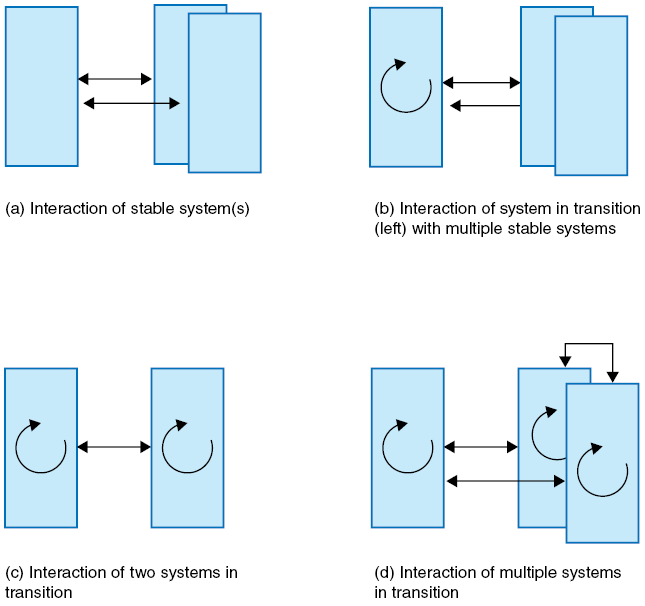
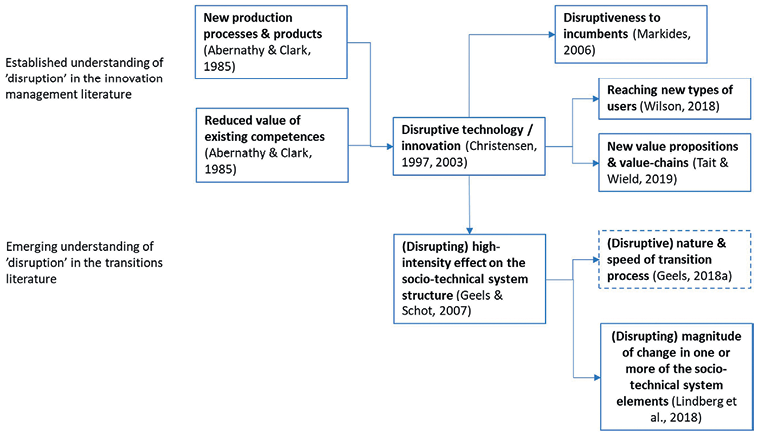
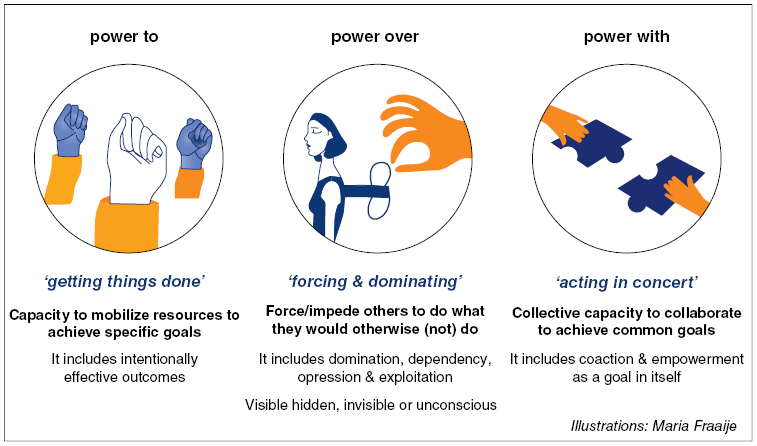
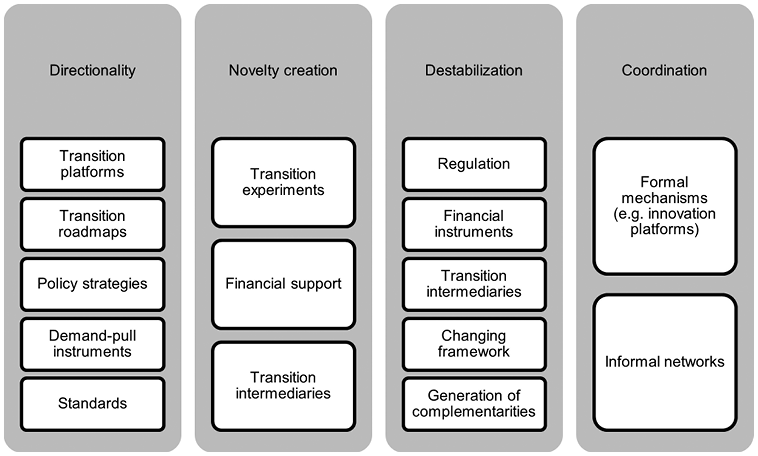


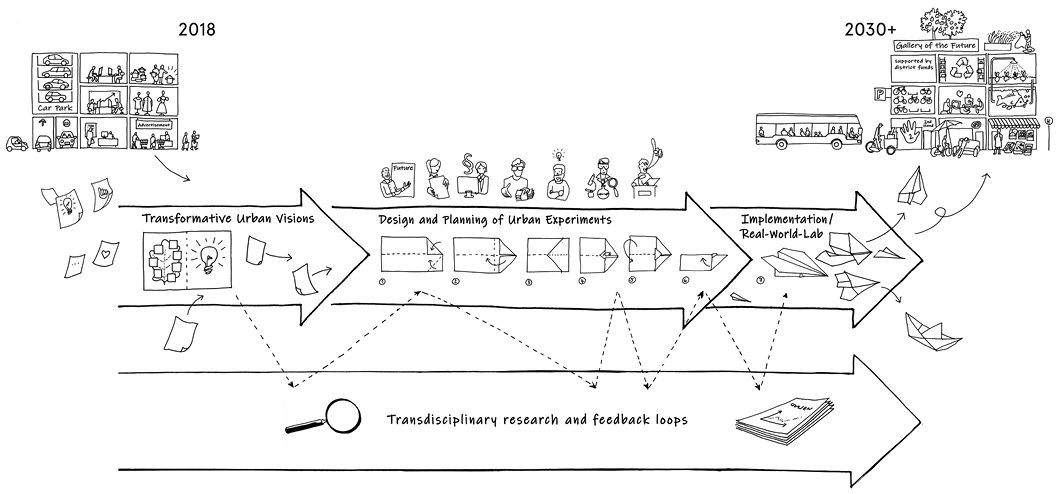
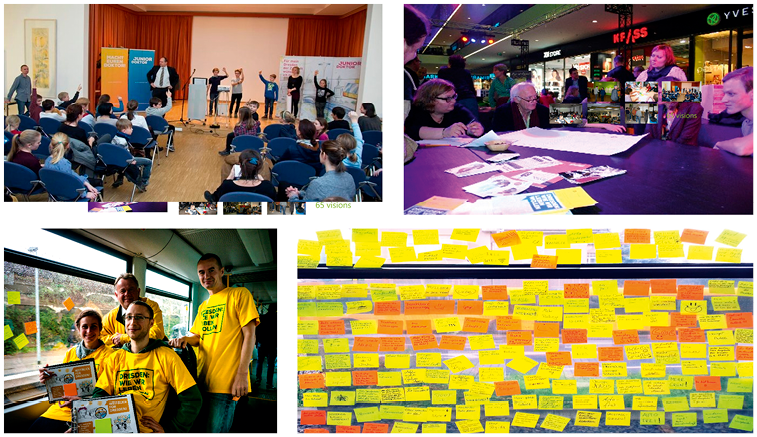
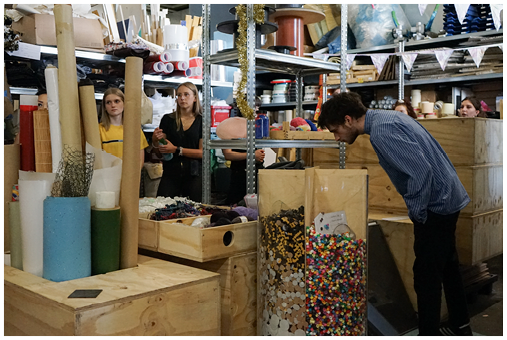



 Open access