




Introduction
Adolescence (10–19 years) is a critical phase of life, and it is a time when growth is faster than at any other stage of life. At this stage, inadequate nutrition is the major contributing factor towards stunting and compromised growth(1,Reference Soliman, Alaaraj, Hamed, Alyafei, Ahmed and Shaat2) . Focusing on adolescent girls’ nutrition is crucial for the mothers of future generations. It provides an opportunity to prepare for a healthy reproductive life, and to avert the origin of nutrition-related chronic diseases in adult life.
In a number of countries, nearly half of the adolescent population are vulnerable to malnutrition and are stunted(3,Reference Asim and Nawaz4) . Childbearing in teenagers could be risky because of undernutrition and can result into obstetric complications. Thinness in adolescent girls is associated with adverse pregnancy outcomes and intra-uterine growth retardation(Reference Estecha Querol, Gill, Iqbal, Kletter, Ozdemir and Al-Khudairy5). Malnourished adolescent girls experience more mortalities and morbidities than older mothers during childbirth. Their babies are also more likely to have nutritional deficiencies. Moreover, stillbirths and neonatal deaths are 50% higher amongst newborns born to undernourished, adolescent mothers(Reference Maheshwari, Khalid, Patel, Alghareeb and Hussain6).
Social determinants of health are particularly influential during adolescence and also affect the nutritional status of future generations(Reference Elder and Ransom7). The strongest determinants of adolescent’s nutrition and health are structural factors, including socioeconomic status and access to education, as well as families, peers and schools affecting their well-being(Reference Shin, Lee, Choi, Nam, Chae and Park8). Discriminatory behaviours regarding nutrition are evident in many South Asian countries. Moreover, macronutrient intake of adolescents has been found to be significantly lower in Africa and South Asia, particularly for protein and fat(Reference Keats, Rappaport, Shah, Oh, Jain and Bhutta9). Prioritising the nutritional requirements of this vulnerable group could be a productive approach in limiting the vicious cycle of malnutrition among subsequent generations. Around 20% face disparities in health, education and nutrition(10,Reference Stevens, Beal, Mbuya, Luo and Neufeld11) .
Adequate nutrition is crucial to overcome childhood nutritional deficiencies(Reference Poudel, Razee, Dobbins and Akombi-Inyang12). Nutritional deficiencies at this stage affect developmental parameters and result in stunting, anaemia and micronutrient deficiencies. These deficiencies have deleterious effects on pregnancies and pregnancy outcomes.
This state of affairs calls for a systems thinking and a systems approach. The present paper attempts to explain nutrition-specific and nutrition-sensitive interventions and has used the Health Systems Pathways framework from the World Bank’s Poverty Reduction Strategy Sourcebook to analyse issues and determinants of adolescent girls’ malnutrition in Pakistan(13).
Methods
This review paper was developed on the basis of a literature search, which was conducted using Google Scholar, PubMed/Medline, Scopus and Web of Science for articles published during 2015–2024. MeSH terms used for search were as follows: adolescent, youth, health, malnutrition, nutrition interventions, systems approach. In addition, reports from the WHO, the UN, the World Bank, the Government of Pakistan and other organisations were also critically reviewed to identify the determinants of malnutrition among adolescent girls, and for understanding the interventions to improve their health and nutritional status. In conjunction with this, a PRIMSA flow diagram was developed for the identification, screening and final inclusion of the relevant studies (Fig. 1).
PRISMA flow diagram for the identification of studies for the scoping review.

Scoping review and synthesis
State of malnutrition in Pakistan
Pakistan, the sixth-largest country in the world, has a growing adolescent population, a large majority of which faces malnutrition, mainly due to poverty(14). Low birth weight and childhood stunting are the outcomes of maternal undernutrition and short stature(Reference Javid and Pu15). Pakistan is facing a malnutrition crisis, with insufficient progress to improve reproductive, maternal, newborn, child health and especially adolescent health and nutrition(16). Nutritional challenges differ with various phases of life. In adolescence, the challenge is to impede ill-timed mortality or morbidity from nutritional disorders and to progress into healthy adults and mothers of forthcoming generations. Adequate nutrition for young children is essential for growth, as well as healthy physical and mental development. This intergenerational malnutrition cycle needs to be disrupted by translating evidence into effective programs and policies considering the social determinants of health, particularly poverty and female literacy(Reference Welch, Wong, Lelijveld, Kerac and Wrottesley17).
Health system’s response
Health systems play a crucial role in the implementation of policies. A multipronged approach is the prerequisite to improve the nutritional and health status of future generations(18). The underlying cause behind the unsatisfactory progress is the weak health system in Pakistan, in addition to the social determinants of health. Significant deficiencies exist in planning, financing, human resources, infrastructure, supply systems and governance(Reference Abdullah, Shaikh, Sikander and Sarwar19). If nutritional intake and dietary habits are not improved during this life stage, it could have serious long-term effects on overall health, wellbeing and the capacity of future generations to tackle inevitable challenges(Reference Moore Heslin and McNulty20). Extensive efforts are required for the prevention of malnutrition and its consequences by transforming health systems through effective leadership. Improved nutrition serves as a platform for progress in health, education, employment and women’s empowerment. Integrating adolescents’ nutrition interventions into maternal and child health programs should be a priority for the health sector. Focusing on adolescents’ nutrition will accelerate progress in countries including Pakistan, which has the highest burden of maternal and child mortality and morbidity due to malnutrition(Reference Soliman, Alaaraj, Hamed, Alyafei, Ahmed and Shaat2,Reference Estecha Querol, Gill, Iqbal, Kletter, Ozdemir and Al-Khudairy5,Reference Shin, Lee, Choi, Nam, Chae and Park8,10) . The Government’s commitment is manifested through its national vision for coordinated priority actions to address challenges of reproductive, maternal, newborn, child and adolescent health and nutrition(21). However, this should be translated into actions to improve adolescents’ health and their nutritional status through effective interventions, which will help in reducing the burden on the health system of Pakistan.
What needs to be done?
As a way forward, evidence-based nutrition-specific and nutrition-sensitive interventions can address adolescent undernutrition, overnutrition and micronutrient deficiencies(Reference Escher, Andrade, Ghosh-Jerath, Millett and Seferidi22).
Nutrition-specific interventions
Nutrition-specific interventions refer to those which are directly addressing the immediate causes of malnutrition, either insufficient nutrition or ailment. These interventions are provided primarily through the health sector(23,Reference Sharma24) . A number of studies and systematic reviews have been conducted to highlight nutrition-specific interventions in low- and middle-income countries (LMICs) and high-income countries (HICs), but only a few addressing adolescents’ nutrition. Studies in various countries of iron and folic acid (IFA) supplementation improved anaemia and haemoglobin concentrations in adolescent girls(Reference Handiso, Belachew, Abuye, Workicho and Baye25,Reference Singh, Rajoura and Honnakamble26) . Zinc supplementation in pregnant adolescents revealed considerable improvement in low birth weights and preterm deliveries(Reference Carducci, Keats and Bhutta27,Reference Iqbal and Ali28) . Studies on Vitamin D and calcium supplementation in adolescents are scarce, but in pregnant women this research shows significant improvement in eclampsia and pre-eclampsia(Reference Purswani, Gala, Dwarkanath, Larkin, Kurpad and Mehta29,Reference Giourga, Papadopoulou, Voulgaridou, Karastogiannidou, Giaginis and Pritsa30) . Therefore, the same may possibly be true for this age group as well. Other specific interventions include behaviour change, nutritional counselling and improving lifestyle and physical activity by involving families, communities and schools(Reference Dyke, Pénicaud, Hatchard, Dawson, Munishi and Jalal31,32) .
Nutrition-sensitive interventions
Nutrition-sensitive interventions refer to sector-specific interventions that address indirect causes of malnutrition, and these actions are delivered through other sectors(Reference Abdullah, Shaikh, Sikander and Sarwar19,Reference Moore Heslin and McNulty20) . A few systematic reviews have been published on nutrition-specific approaches but there has been dearth of studies on nutrition-sensitive interventions, which are ultimately related to malnutrition. These interventions address poverty; an effluent environment; satisfactory caregiving resources at the maternal, household and community levels; access to health services; food security; water sanitation; infections, including worm infestations; tobacco control; quality education; lack of health literacy; schooling; and gender disparities(21,Reference Escher, Andrade, Ghosh-Jerath, Millett and Seferidi22,Reference Salam, Hooda, Das, Arshad, Lassi and Middleton33) . It is imperative to design nutritional interventions vis-à-vis gender equity, education and health, keeping in view a country’s contextual factors to curtail the high burden of malnutrition(34).
Discussion
The World Bank’s Health Systems Pathways framework has been adapted to identify the interventions at different levels after literature review and then adjusted in this framework(13).
Individual, household and community level
Interventions involving individuals, families, and communities can surmount the nutritional challenges for adolescent girls through awareness, education and empowerment. Addressing eating behaviours among young girls is essential to prevent long-term consequences of undernutrition. Involving people from the neighbourhood, the community, religious leaders, elders and other places can be effective in promoting healthy nutritional behaviours(Reference Setiawan, Budiarto and Indriyanti35). Functioning through community delivery platforms, empowering young people can improve outreach to vulnerable people and the equitable provision of services(Reference Efevbera, Bhabha, Farmer and Fink36–38). Women’s empowerment and education champion the involvement of girls in decision-making in the delay of marriage and first pregnancy. Education also enables girls to follow improved nutritional choices for their households and their health-seeking behaviours(Reference Raikar, Thakur, Mangal, Vaghela, Banerjee and Gupta39). Behaviour change communication and community mobilisation for planned nutritional activities enable girls to improve their health outcomes(Reference Capitão, Martins, Feteira-Santos, Virgolino, Graça and Gregório40). Information, education and counselling play an important role in addressing preconception care. Promoting healthy dietary habits and physical activity through awareness programmes and campaigns brings a transformation of individual, household and community behaviours(41).
Health sector
In the universal health coverage agenda, improved access to essential services should include adolescent health care and nutrition with systems planning. Integration of health and nutrition services could curtail adolescent malnutrition through pertinent and recognised interventions. The role of healthcare providers is crucial in promoting preventive interventions, screening of malnutrition and providing information to support adolescents(Reference Neri, Guglielmetti, Fiorini, Quintiero, Tagliabue and Ferraris42). To strengthen service delivery, there is a dire need for capacity building, improving cadres and deploying sufficient and skilled human resources. This will lead to progress in dietary behaviours, pregnancy, prenatal care and breastfeeding practices(43). There are certain financial implications regarding burgeoning requirements of adolescent nutrition and health, and the integration of services. Mobilising financial resources and establishing monitoring and evaluation practices can maximise the gains in maternal, child and adolescent health(44). Augmented efforts and investments for integrated service delivery programmes for maternal, neonatal and child health (MNCH) and nutrition have provided enough evidence for improving health outcomes(45). The health and nutritional status of future mothers is a significant predictor of the health of the upcoming generation. There is requirement for balanced energy and protein supplementation in malnourished girls before, during and after pregnancy. Micronutrient supplementation, including iron, folic acid, vitamin D and calcium, is an evidence-based intervention proven to be effective(Reference Iqbal and Ali28). Deworming of children and adolescent girls and providing facilities and community-based services for the management of malnutrition have been ascertained to be prolific interventions(34). Community-based health interventions must focus on adolescent health and nutritional requirements. Cash support or food baskets may be required to ensure a nutrient-rich diet.
Other sectors
The role of mass media and social media is imperative for communication to develop cognizance about the importance of nutrition, education and gender equity. Utilising social media to reach adolescents is a special approach to promote healthy behaviours(13). Using multiple channels, electronic media augments health and nutrition promotion activities. Nutrition education can be included in curricula to create awareness in teenagers about lifestyles and dietary choices. These education strategies can be integrated with reproductive health education. Moreover, these initiatives also address gender disparities(Reference Schmitt, Bryant, Korucu, Kirkham, Katare and Benjamin46). Investing in the education of girls is a system intervention that has long-term consequences on the health status of adolescent girls(Reference Giourga, Papadopoulou, Voulgaridou, Karastogiannidou, Giaginis and Pritsa30,Reference Salam, Hooda, Das, Arshad, Lassi and Middleton33,Reference Setiawan, Budiarto and Indriyanti35,Reference Remme, Vassall, Fernando and Bloom47) . Other nutrition-sensitive approaches include improvements in safe water and sanitation. Civil society organisations have been putting in concerted efforts to address issues of water and sanitation(Reference Moore Heslin and McNulty20,Reference Iqbal and Ali28) . Besides the health services, the food and agriculture industries, schools and universities, and community leaders, along with many other stakeholders, must work together in a coordinated and coherent way(Reference Branca, Piwoz, Schultink and Sullivan48).
State/Government involvement and policies
National platforms and partnerships are required to ensure political commitment for leverage on existing programs for MNCH and nutrition. Governments should endorse policies to make primary education absolutely free to increase the enrolment of children, especially girls, from low socio-economic groups(Reference Elder and Ransom7,Reference Nitsche and Brückner49) . Gender equity and the right to education and health must be reflected in national policies. Law enforcement for deterring early marriages should be prioritised. School health programmes should be initiated by harnessing the private sector. Social protection and safety nets play key roles. The Government must collaborate with other sectors to formulate implementation strategies to support the health and nutrition of adolescents(21). It is important to continue generating evidence and implementing research to evaluate the existing programmes. The Government must take concrete actions to improve adolescent health and nutrition status(Reference Mozaffarian, Angell, Lang and Rivera50). Action plans and guidelines have been developed that need to be implemented and translated into long-term programmes with adequate resource allocation(13,Reference Purswani, Gala, Dwarkanath, Larkin, Kurpad and Mehta29,Reference Efevbera, Bhabha, Farmer and Fink36) . There is a need to develop a multi-sectoral adolescent nutrition strategy and costed plan, with a focus on school enrolment and literacy; reducing child marriage and early pregnancy; improving access to health services; water, sanitation and hygiene (WASH); and livelihood interventions, prioritising rural, low-income and poorly educated households(51,52) .
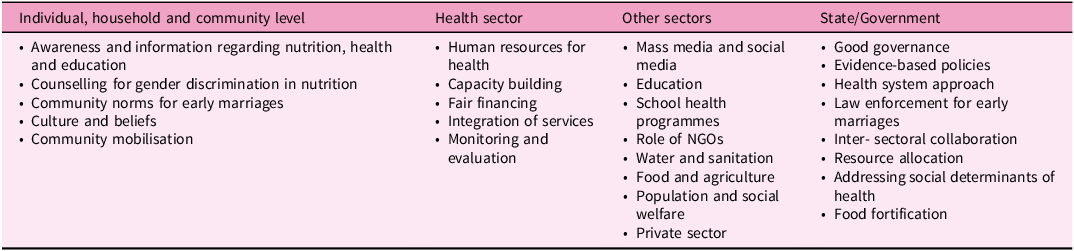
The potential roles and interventions at different levels and different institutions are summarised in Table 1.
Pathways framework to illustrate the role of various sectors in improving the nutrition and health status of adolescent girls

The anticipated results using the Pathways framework could be:
-
1. Community involvement and mobilisation to prioritise the health of vulnerable adolescent girls.
-
2. Health system strengthening by effective governance, monitoring and evaluation, human resource development and efficient management, integration of services, responsiveness and fair financial contribution.
-
3. Intersectoral coordination involving electronic and social media, education, civil society, the private sector, water and sanitation, the environment and food and agriculture.
-
4. Addressing social determinants of adolescent nutrition, particularly girls’ education and safety nets for poverty.
-
5. The Government’s stewardship role in prioritisation and implementation of nutrition-specific and nutrition-sensitive interventions, with an allocation of budget.
Conclusions
Addressing the nutrition of adolescent girls is the prerequisite to save future generations from malnutrition. In spite of the Government’s commitment, the pace of progress is slow in improving the nutrition status of adolescent girls. There is a dire need to focus on the health sector, as well as the engagement of other sectors, for poverty alleviation and addressing gender disparities in education and health. Inter-sectoral coordination and the participation of civil society is a prerequisite because they have been contributing in silos, but interventions focusing on adolescent nutrition need a determined and concerted effort. Proper nutrition for adolescent girls is crucial for overall health, growth and development, supporting their wellbeing during this critical life stage. In regard to health system and policy implications, the Government’s prime concern should be the adequate allocation of resources for health and nutrition, as well as instituting robust monitoring and evaluation procedures for the effective implementation of the programmes.
Data availability
The data that support the findings of this study are available on request from the corresponding author.
Acknowledgements
The authors have no funding to report.
Authorship
S.Z. conceptualised the manuscript and reviewed the literature; B.T.S. critically reviewed the manuscript drafts and contributed to the synthesis and interpretation of the published literature. All the authors read and approved the final manuscript.
Competing interests
The authors declare no conflict of interest.


 Open access

