


There is clear evidence that inadequate vegetable and fruit intake is associated with higher risk of a range of chronic diseases, including CHD, obesity and some forms of cancer(Reference Block, Patterson and Subar1). Converting such awareness of into practice presents a major public health challenge, since mean consumption rates for vegetables and fruits across all age groups in many countries are inferior to current recommendations, and in decline(Reference Kristjansdottir, Thorsdottir, De Bourdeaudhuij, Due, Wind and Klepp2–Reference Vereecken and Maes4). It is well established that early intervention is an integral step in the prevention of such diseases(Reference Caballero5), with major international initiatives focusing on enhancing vegetable and fruit intake in children(Reference Anderson, Porteous, Foster, Higgins, Stead, Hetherington, Ha and Adamson6). Recent attention has focused on how the seemingly diverse conceptual frameworks of planned behaviour and ecological influences converge to affect food choice(Reference Reinaerts, de Nooijer, Candel and de Vries7). Decisions that determine food choice, including those pertaining to vegetable and fruit consumption, precipitate from a complex range of factors related to the knowledge, beliefs, attitudes, skills, preferences of and access by individuals. Issues such as taste, convenience, cost and health concerns have been identified as significant influences on dietary intake in adults, adolescents and children(Reference Glanz, Basil, Malback, Goldberg and Snyder8, Reference O’Dea9), although the relative importance of each is less apparent(Reference Reinaerts, de Nooijer, Candel and de Vries7). Notwithstanding this, solutions to enhance vegetable and fruit intake are often tailored to specific settings, demographics(Reference Anderson, Porteous, Foster, Higgins, Stead, Hetherington, Ha and Adamson6, Reference Cockroft, Durkin, Masding and Cade10, Reference Newell, Huddy, Adams, Miller, Holden and Dietrich11), health issues(Reference Lake, Speed, Brookes, Heaven, Adamson, Moynihan, Corbett and McColl12) and technologies(Reference Beaudoin, Fernandez, Wall and Farley13, Reference Borzekowski and Robinson14).
Determinant factors of an individual’s vegetable and fruit intake do not operate in isolation, but are expressed in the context of external physical and social environments(Reference Kristjansdottir, Thorsdottir, De Bourdeaudhuij, Due, Wind and Klepp2). For example, television viewing and its associated exposure to junk food advertising compromises the intake of more wholesome foods such as fresh vegetables and fruit(Reference Borzekowski and Robinson14, Reference Salmon, Campbell and Crawford15). The exact relationship between television viewing and fruit and vegetable intake is unclear, but sustainable solutions involve more than simply denying individuals access to television. The socio-cultural environment centred largely on passive interaction with ‘virtual’ peers (e.g. television, Internet, etc.) requires innovations in health promotion that influence factors determining individual choice and the broader public nutrition environment. Community-centred food-based interventions such as collective kitchens(Reference Fano, Tyminski and Flynn16) and community gardens(Reference Armstrong17) provide examples of potential directions for innovation.
There is compelling evidence that vegetable and fruit consumption is driven by knowledge of and attitudes towards such foods, and that instituting changes to these factors in children can influence subsequent consumption(Reference Bere and Klepp18). This relationship is also implied in many school-based interventions to influence awareness by exposure to a wider range of vegetables and fruits(Reference Cockroft, Durkin, Masding and Cade10), self-efficacy and availability(Reference Kristjansdottir, Thorsdottir, De Bourdeaudhuij, Due, Wind and Klepp2) to enhance vegetable and fruit consumption. There is growing evidence that community gardening has the potential to positively influence dietary intake, as well as physical activity and socially productive activity(Reference Graham, Beall, Lussier, McLaughlin and Zidenberg-Cherr19, Reference Somerset, Ball, Flett and Geissman20).
Recent evidence supports the potential for school-based food gardens as a useful nutrition education tool, and general agreement exists that gardens can be a beneficial addition to school resources(Reference Graham, Beall, Lussier, McLaughlin and Zidenberg-Cherr19). Evidence of a more empirical nature is emerging which supports this general premise, identifying their potential for affecting dietary behaviour change. McAleese and Rankin(Reference McAleese and Rankin21) have demonstrated recently that integration of school garden activities into a short-term nutrition education programme can enhance self-reported vegetable and fruit consumption in children aged 10 to 13 years. In an expanded age range of 8 to 15 years, Lautenschlager and Smith(Reference Lautenschlager and Smith22) showed that a 10-week garden programme (which incorporated a nutrition curriculum) enhanced vegetable and fruit intake, at least in boys. In a longer (6-month) intervention, school gardens were reported to enhance nutrition knowledge and skills in Indigenous schools in a remote region of Australia(Reference Viola23). Nutrition knowledge also improved after a 6-month combined nutrition and garden intervention in US fourth-grade students(Reference Morris and Zidenberg-Cherr24). That study also showed enhanced preferences for certain vegetables post-intervention. After-school gardening can have a positive impact on self-reported vegetable intake and physical activity(Reference Hermann, Parker, Brown, Siewe, Denney and Walker25).
The present intervention study was initiated to determine if the installation of a garden within a primary school could influence children’s ability to identify specific vegetables and fruits, and attitudes that may affect long-term vegetable and fruit consumption.
Methods
Participants and recruitment
All students from a single primary (elementary) school in grades 4 to 7 (corresponding approximately to ages 8 to 13 years), in each of two consecutive data collection years, were included in this study. The school was located in a northern Brisbane suburb (eastern Australia), designated as a socio-economically disadvantaged area characterised by high unemployment rates and high Indigenous and migrant populations.
Intervention
The intervention comprised the funding (11 h/week) of a qualified teacher with extensive experience in the establishment and maintenance of permaculture gardens for a period of 12 months. The garden-based teacher was employed by the project (not by the school) to liaise with teachers of all grades within the school, to facilitate the incorporation of garden activities into their curricula (rather than conduct teaching sessions, although this did occur from time to time).
The garden-based teacher had overall responsibility for the maintenance of the garden. This teacher was also responsible for the scheduling of class access to the garden, coordinating weekly activities in the garden, promotion of the garden throughout the school, conducting sessions on specialised aspects of garden maintenance for classes (e.g. composting, propagation, planting, harvesting, cooking), and identification and development of garden-related curriculum resources which could be used by teachers.
The garden was established near the edge of the school boundary to facilitate involvement of the local community in garden maintenance activities. Over the course of the intervention, the garden plot developed into a site approximately 20 m × 20 m in size. One corner of this block was set up as an outdoor classroom. Facilities such as garden beds, composting bays, a garden pond and a greenhouse were located on the plot. Over the course of the year, all classes within the school engaged in weekly activities centred round the garden. Classes across the school shared responsibilities for planting, tending and harvesting in the garden. Experience varied, but specific examples of interaction are consistent with those previously reported for school gardens(Reference Somerset, Ball, Flett and Geissman20). The garden also became a focal point for whole-of-school activities such as fund-raising, media promotion and meal sharing occasions. A list of activities with which students were engaged emerged from an independent process evaluation, as outlined in Table 1.
Garden-related activities with which students engaged during the course of the school year, as determined by a separate process evaluation: 12-month intervention trial of a school-based food garden, Brisbane, Australia. Classification framework adapted from Anderson et al.(Reference Anderson, Porteous, Foster, Higgins, Stead, Hetherington, Ha and Adamson6)

From a process perspective, a number of factors were integral to the successful development of the current intervention. Effective relationship building with the school’s principal and key teachers was important to facilitate engagement by the school community. The conduct of baseline data collection within the school formed an important part of communication about the project, and consequent relationship building. A part-time coordinator with education training was a useful conduit between the garden and curricular activities. This also enabled teachers to use the garden for teaching without the burden of garden maintenance. Relationships with a local adult permaculture education facility (landscape design), a community garden (horticultural expertise) and a Police–Citizens Youth Club (security) were seen as particularly important for the development and consolidation of the garden.
Instruments
Two questionnaires were developed specifically for evaluation of the project. The attitudes questionnaire was based largely on the format of a survey tool previously validated and used by Miller and co-workers in Australian primary-school children(Reference Newell, Huddy, Adams, Miller, Holden and Dietrich11, Reference Miller, Newell, Huddy, Adams, Holden and Dietrich26). The questionnaire involved a series of thirty-eight items (see Table 2) to which responses via a 3-point Likert scale were required. A vegetable and fruit identification survey, requiring a one-word answer, also was developed to test the ability to identity the following thirty-one foods: broccoli, capsicum, potato, cucumber, tomato, aubergine, pumpkin, mushroom, chilli, shallot, garlic, onion, beetroot, radish, sweet corn, carrot, courgette, avocado, strawberry, banana, grape, apple, orange, coconut, starfruit, nectarine, pineapple, cherry, mandarin, watermelon and kiwifruit. The surveys were evaluated by a trained primary-school teacher for content validity, then pilot-tested in a group of six children aged 8 years to determine the appropriateness of the questions for this age group and modified accordingly. A test–retest assessment of reliability of the questionnaire (1 week apart) using χ 2 analysis in a sub-sample (n 20) of the control group showed no difference in responses (P < 0·05).
Determinant questionnaire items and associated constructs: 12-month intervention trial of a school-based food garden, Brisbane, Australia. Response categories comprised a 3-point scale (‘yes’, ‘sort of’ and ‘no’). Numbers in square brackets indicate the grade in which significant differences occurred between control and intervention groups. Items and constructs adapted from De Bourdeaudhuij et al.(Reference De Bourdeaudhuij, Klepp, Due, Rodrigo, de Almeida, Wind, Krolner, Sandvik and Brug27)

Procedure
A historical control design(Reference Piantadosi28) was employed, where students completed questionnaires in early autumn of the first data collection year, within 1 month prior to the start of the intervention. These data were used as a control for subsequent data collection, in early autumn of the second data collection year (approximately one year after the introduction of the garden to the school). Thus, data from grades 4, 5, 6 and 7 in the school year just prior to the intervention (i.e. introduction of the garden) were used as control for grades 4, 5, 6 and 7 during the school year which experienced the intervention. The data collection design is summarised in Fig. 1.
Summary of experimental (historical control) design used in the present study. Arrows indicate the comparisons made in χ 2 analysis

Data collection was conducted as a series of class exercises by the teacher of each class, with each teacher supervising completion of questionnaires. Teachers were given a standard instruction sheet on administering each of the survey tools. Data were collected from all grade 4 to 7 students within the school for both the control (n 132) and intervention (n 120) groups, as outlined above. Information explaining the nature of the study was forwarded to all parents/guardians of the students. An opportunity was given to all parents/guardians to request further information and, if desired, opt out of the data analysis phase. Similarly, all students were given the same opportunity. No incentives were provided for participation. All procedures were reviewed and approved by the Human Research Ethics Committee of Griffith University.
Data analysis
Survey data were analysed using the Statistical Package for the Social Sciences statistical software package version 12·0 (SPSS Inc., Chicago, IL, USA). In the intervention group, responses from two students in grade 7 who had been attending the school for less than 6 months were excluded from the analysis. Frequency distributions for each item were generated and χ 2 analyses were used to determine the statistical significance of differences between the control and intervention groups (which were treated as independent samples for the purposes of statistical analysis).
Results
The control group (data collection year 1) comprised thirty, thirty-seven, thirty-eight and twenty-two subjects, and the intervention group (data collection year 2) comprised twenty-five, twenty-one, thirty-four and forty subjects in grades 4, 5, 6 and 7, respectively. Grades 4 to 7 represented approximately 60 % of the total school population (comprising grades 1 to 7) in each data collection year. There were no significant differences in gender distributions between the control and intervention groups (P < 0·05).
Awareness: ability to identify specific vegetables and fruits
There were significant improvements following the intervention in recognition of the following vegetables and fruit by children: capsicum (P < 0·05), potato (P < 0·05), cucumber (P < 0·001), aubergine (P < 0·001), chilli (P < 0·001), shallot (P < 0·001), garlic (P < 0·001), onion (P < 0·001), beetroot (P = 0·05), radish (P < 0·001), courgette (P < 0·001), avocado (P = 0·05), grape (P < 0·05), coconut (P < 0·001), starfruit (P < 0·001), peach (P < 0·05), cherry (P < 0·001), mandarin (P < 0·001), watermelon (P < 0·001) and kiwifruit (P < 0·001).
Determinant questionnaire
Items to which statistically significant differences between control and intervention responses were observed are outlined in Table 3. The major trends for each of these changes are also noted in Table 3. The significant changes according to recognised determinants (constructs) of vegetable and fruit consumption are noted in Table 2. Exploratory factor analysis of control data yielded no significant results for any of the individual school years, and was not pursued further.
Patterns of changes of responses to items between control and intervention groups, according to grade: 12-month intervention trial of a school-based food garden, Brisbane, Australia
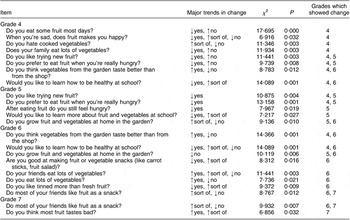
There was a shift towards more children from grade 7 rating fruit as tasting bad (P < 0·05). Although not statistically significant, fewer students responded ‘no’ to the question ‘Do vegetables taste bad?’ More children in grades 4, 5 and 6 appeared to feel vegetables tasted good following the intervention (36 % to 74 %, 64 % to 68 %, and 30 % to 42 %, respectively). Grade 7 responses decreased from 36 % to 31 %.
More children also said they liked to eat vegetables every day in grades 4, 5 and 6, from 33 % to 50 %, 47 % to 65 % and 26 % to 35 %, respectively. Grade 7 decreased from 23 % to 18 % in ‘yes’ responses, but also decreased in ‘no’ responses from 46 % to 35 %. The majority of responses were ‘sort of’ (47 %) following the intervention.
Grades 5 and 6 scored slightly higher post-intervention for answering affirmatively that they would like to taste fruit and vegetables in class (67 % to 76 % and 45 % to 47 %, respectively). Grades 4 and 7 decreased (70 % to 59 % and 55 % to 41 %, respectively) post-intervention.
There was some evidence of discernment in the term ‘freshness’ post-intervention, with more children in grade 6 preferring fresh fruit to tinned fruit (P < 0·01). In terms of preferences specifically towards vegetables, following the intervention students in grades 4 and 6 thought vegetables from the garden tasted better than from the shop (P < 0·05), although changes in the proportions of responses varied according to grade (see Table 4). Despite more children in grade 4 feeling vegetables tasted good following the intervention, there was a shift towards more children reporting they hated cooked vegetables (P < 0·01). For hating cooked vegetables, grades 5 and 6 had a large amount of respondents agreeing with the question following the intervention, with 40 % and 38 %, respectively. Grade 7 maintained its response rate of 28 % responding ‘yes’ to this question.
Responses to the question ‘Do you think vegetables from the garden taste better than from the shop?’ according to grade: 12-month intervention trial of a school-based food garden, Brisbane, Australia
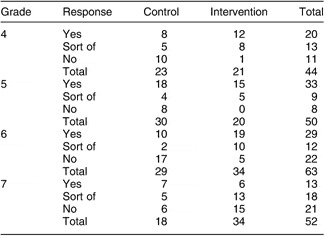
There was an increase in respondents answering ‘yes’ when asked if their friends ate lots of vegetables after the intervention. Grade 6 increased from 11 % to 32 % (P < 0·01), grade 5 from 24 % to 70 %, and grade 7 from 19 % to 23 %.
Discussion
There was a clear improvement in the ability of students of all ages to identify specific vegetables and fruits associated with the current intervention. This ability is only one means by which food awareness can be expressed. However, these results raise the possibility that other aspects of food awareness may also be affected through garden-based activities. This may potentially contribute to enhancing accessibility of children to vegetables and fruits, which is an important determinant of consumption by children in this age group(Reference Heritier, Gebski and Keech29). However, the relationship between knowledge and consumption is complex, with knowledge about intake recommendations being associated with increased intake(Reference Heritier, Gebski and Keech29) but nutrition knowledge alone being only weakly associated with dietary behaviour(Reference Story, Neumark-Sztainer and French30).
A major effect associated with the presence of the garden in the study school was the attribution of added value towards vegetables and fruits that are ‘garden-grown’, an effect that was observed in grades 4 to 6. Previous evidence suggests that the application of biography and geography to food can contribute to augmentation of the consumption of such foods(Reference Cook, Crang and Thorpe31). There is also evidence that some degree of closer personal involvement in the production and preparation of food can influence planned behaviour, especially regarding foods that are often difficult to change behaviour towards(Reference Juhl and Poulsen32, Reference Verbeke and Vackier33). These changes in attitude to garden-grown vegetables were observed in conjunction with a substantial increase in the ability of children to identify specific vegetables and fruits.
The garden-based teacher in the present study was blinded to the evaluation tool, implying that this skill developed as a general consequence of enhanced awareness of vegetables and fruits resulting from contact with the garden. Cockroft et al.(Reference Cockroft, Durkin, Masding and Cade10) have proposed that increasing awareness is a viable strategy for enhanced consumption of vegetables and fruits. The significant increase in appreciation for garden-grown (v. store-bought) and fresh (v. tinned; as noted for grade 6 students) may represent a theme for further development in future interventions of this type. The notion of garden-grown seemed to have expanded with age to a broader view of ‘freshness’ v. processed or ‘tinned’.
In grades 6 and 7, an awareness of peer preferences and consumption emerged (i.e. perceived social environment), whereas changes in grades 4 and 5 were more centred on individual (first-person) considerations. Self-efficacy in terms of ability to prepare vegetables and fruits, and changes in awareness of personal (first-person) consumption of vegetables, also were apparent in grade 6 responses. The present data showed more extensive change in responses about perceived intake than about attention to health-related issues by students. An interesting reluctance to learn more about vegetables and fruits, and how to be healthy, emerged across grades 4, 5 and 6.
There was a substantial variation in effects on responses between age groups (see Table 3). Of particular note was the lower number of significant changes in responses to questions by grade 7 students. This difference may in part be explained by the autonomy in food choice and other behaviour expanding as children grow up(Reference Reinaerts, de Nooijer, Candel and de Vries7). This may also be a factor in the observation that changes noted in grades 4 and 5 were much more focused on personal (first-person) perspectives, compared with awareness of their social environment. Longitudinal(Reference Larson, Neumark-Sztainer, Hannan and Story3) and secular(Reference Vereecken, Inchley, Subramanian, Hublet and Maes34) declines in vegetable and fruit consumption according to age have been reported previously. The utility of school gardens to enhance vegetable and fruit consumption may be more effective for use in younger age groups, preparing them for a seemingly inevitable decrease in intake during adolescence.
There was also no apparent consistency in responses to items regarding fruit v. vegetables. Reinaerts et al. have proposed that the mechanisms driving vegetable and fruit consumption are quite different, based on their observation that fruit consumption is affected far more by habit and availability than is vegetable consumption(Reference Reinaerts, de Nooijer, Candel and de Vries7). This challenges some quite fundamental concepts in nutrition promotion, such as including vegetables and fruits in the same food group for the purposes of dietary advice and promotion.
There was some dissonance in the effects associated with the present intervention which require further analysis. The move away from children in grade 7 answering ‘no’ to fruit as tasting bad towards ‘sort of’ is difficult to interpret without further information. It may reflect a consolidation of views; whereas before they were unsure of preferences, after regular exposure to the garden they may be more certain of their dislikes. This is clearly an issue which warrants further investigation, since neophobia is an important barrier to adequate vegetable and fruit consumption(Reference Cooke, Wardle, Gibson, Sapochnik, Sheiham and Lawson35). Further, there was less enthusiasm for activities centred around vegetables and fruits after this intervention, with a general move from the ‘yes’ response to the more ambivalent ‘sort of’ response. This may have arisen in part because increased exposure to the garden turned what was initially considered by children a novel experience into a mainstream activity. This also may explain the similar trend of a decrease in interest to try new fruits. As with any attitudinal change, it is important to understand the influence of this attitude on dietary behaviour and intake.
Perceptions of consumption showed a complex mix of trends. More children in grade 4 reported eating fruit most days and more grade 6 students indicated that they ate ‘lots of vegetables’. However, there was a decrease in the proportion of children in grade 4 reporting that their family ate a lot of fruit. This may reflect a higher degree of contemplation about the vegetable and fruit intake of family members in response to garden-centred activities. There is some evidence that parental vegetable and fruit intake is a strong predictor of intake for their children(Reference Cooke, Wardle, Gibson, Sapochnik, Sheiham and Lawson35), but although perceptions of availability of these foods have been reported for this age group(Reference Sandvik, De Bourdeaudhuij and Due36), the significance of these beliefs is not well understood.
An important issue in the interpretation of the present trial is defining the nature of the intervention. We have taken the position similar to an ‘intention to treat’ trial(Reference Heritier, Gebski and Keech29), in that resources and assistance for the establishment and maintenance of the garden were provided, but beyond this no specific instructions about how the garden might be integrated into school activities were prescribed. In fact, the nature of the intervention emerged prospectively through an independent process evaluation of the project. An important limitation of this approach is that the apparent complexity of the intervention makes it difficult to pinpoint the specific key factor(s) which generated the observed effects.
In addition to the difficulty in defining the precise nature of the intervention, some other limitations of the present study are worth noting. The study was restricted to relatively small numbers of students in a single school, which limits generalisability of the results. Immediate dietary intake data (in the form of 24 h recall) are not included in the present analysis. McAleese and Rankin(Reference McAleese and Rankin21) have previously pointed out the weaknesses inherent in using such data to predict long-term dietary behaviour, in a study which used three consecutive 24 h recalls to collect data. Lautenschlager and Smith(Reference Lautenschlager and Smith22) relied on a single 24 h recall for data collection, further weakening relevance to long-term consumption. The range of important psychosocial determinants of long-term vegetable and fruit intake outlined by Reinaerts et al.(Reference Reinaerts, de Nooijer, Candel and de Vries7) provides a framework for the emphasis on such determinants in the present study. The often ambiguous relationships between changes in upstream determinant factors, downstream dietary behaviours and, ultimately, health outcomes are not unique to the present study and pose significant challenges to public nutrition research in general.
The use of a historical control, rather than a control group from another school, presented some advantages for the present community-based intervention study. The ideal control in this type of intervention trial would have been a school with identical sociodemographic characteristics, the only difference being the presence of a food garden. In essence, the use of a historical control enabled such control, in contrast to the non-equivalent control groups design used by McAleese and Rankin(Reference McAleese and Rankin21), where such characteristics could not be controlled for. This mechanism also avoids issues associated with the quality of participation of a control school, which would likely have been inferior to a school which was receiving the benefits of the installation of an education facility such as a garden, thus affecting the quality of data collected.
Effective use of a historical control design depends on minimal temporal shifts in factors affecting outcomes of interest across the general population over the study period(Reference Piantadosi28). The relative absence of coordinated national and regional promotion of vegetable and fruit consumption in Australia during the period of data collection would have contributed to the experimental stability required for this study design.
The present study showed that the introduction of a vegetable garden within a school can enhance a range of personal determinant factors of vegetable and fruit consumption, as well as perceived social and physical environments. These findings support the inclusion of school gardens as a useful component of experiential learning strategies for nutrition education. A better understanding of the observed effects according to factors such as socio-economic status and dietary intake would enhance the utility of school garden-related activity in targeting those at highest risk of poor nutrition. Since many schools do not have appropriate resources for the establishment of food gardens, identification and evaluation of other settings conducive to experiential learning about food and nutrition are warranted.
Acknowledgements
The contributions of Northey Street City Farm workers and Education Queensland staff are gratefully acknowledged. This school garden project was supported in part by a grant from Health Promotion Queensland. We are aware of no conflict of interest. S.S. designed and implemented the study, collected the data and wrote the first draft of the paper. K.M. worked on statistical analysis of the data. Both authors provided critical revision of the paper, and read and approved the final manuscript.



