

Introduction
It was once asked, “Is there such a thing as a Republican vegan?” (Mosier & Rimal, Reference Mosier and Rimal2020). The answer turned out to be yes, but those who identify as both Republican and adopting a vegan diet are a rare occurrence at <0.1% of the total population. For these individuals, their labeled identities may be considered an oxymoron. Meat and cheese are often considered inherent symbols of the American diet and one that is particularly ingrained among conservatives. To avoid the consumption of meat and cheese may be perceived as un-American and leave these individuals to be scrutinized and potentially ostracized from groups that cannot reconcile the value conflicts between the two identities (Beardsworth & Keil, Reference Beardsworth and Keil1992; Kellman, Reference Kellman2000; Sparks, Reference Sparks, Terry and Hogg2000). The rare occurrence of Republican vegans coupled with the known challenges in having two divergent and potentially conflicting identities highlights an opportunity to examine if and how those identities, in combination, shape individual behavior.
This study seeks to expand existing research on the diet–partisan connection by further exploring and confirming the diet and partisanship connection initially reported by Mosier and Rimal (Reference Mosier and Rimal2020). The results presented in this article are based on the data from the Natural Marketing Institute’s (NMI) 2019 Lifestyles of Health and Sustainability database. To be clear, this is a replication study, and this study specifically replicates the methods and models used in Mosier and Rimal’s (Reference Mosier and Rimal2020) initial analysis of the 2016 data collected by the NMI. This study also provides a comparative benchmark for how partisanship and dietary choice may have shifted over a critical political period after the election of Donald Trump as President of the United States, but before the coronavirus disease 2019 (COVID-19) pandemic.
Two specific questions guide this study, including “What is the connection between diet and partisanship?” and “How has Donald Trump Republicanism potentially impacted the connection between diet and partisanship?” The first question is identical to the one initially proposed by Mosier and Rimal (Reference Mosier and Rimal2020). The second question seeks to build upon the existing research base by accounting for shifting political tides. In the past decade, many Western democracies have seen the pendulum swing back to a more nationalist, conservative approach to governing. In the United States, the election of Donald Trump in 2016 marks a notable shift in the politics of the Republican Party that has led to further fracturing. The 2019 data utilized in this study can shed some light on how the 2016 US Presidential and 2018 midterm election cycles potentially shifted partisan affiliations among the US population, and thus altered the existing diet–partisan connections.
Background
There is an increasing number of studies on how dietary decisions are related to personality traits and characteristics. Diets may vary among different populations with variation in consumption of certain types of meat (e.g., red meat, poultry, and fish), animal byproducts (e.g., dairy milk, eggs, and butter), and fruits and vegetables. Identifying the potential causal factors associated with particular dietary habits can shape how food is marketed (e.g., Kerslake et al., Reference Kerslake, Kemper and Conroy2022; Meixner et al., Reference Meixner, Riefler and Schanes2021), how eating disorders are managed (e.g., Heiss et al., Reference Heiss, Hormes, Timko and Mariotti2017; Sergentanis et al., Reference Sergentanis, Chelmi, Liampas, Yfanti, Panagouli, Vlachopapadopoulou and Tsitsika2020), and provide a better cultural understanding of identity and certain populations’ cultural norms (e.g., Bisogni et al., Reference Bisogni, Connors, Devine and Sobal2002; Connors et al., Reference Connors, Bisogni, Sobal and Devine2001; Greenebaum, Reference Greenebaum2012; Lupton, Reference Lupton1996; Rosenfeld & Burrow, Reference Rosenfeld and Burrow2017; Rozin, Reference Rozin1976). To date, research on dietary behavior has predominantly focused on vegan and vegetarian diets, in which it is estimated that <5–10% of the US population has adopted vegan and vegetarian diets (Mosier & Rimal, Reference Mosier and Rimal2020; Reinhart, Reference Reinhart2018).
Previous research on American vegans and vegetarians indicates these individuals are more likely to be younger, White, women, and those who are ideologically left-leaning, which includes those who often affiliate more with the US Democratic Party (Dwyer et al., Reference Dwyer, Mayer, Kandel and Mayer1973; Jabs et al., Reference Jabs, Sobal and Devine2000; Lusk, Reference Lusk2014; Mosier & Rimal, Reference Mosier and Rimal2020; Reinhart, Reference Reinhart2018; Ruby, Reference Ruby2012). Research on omnivores that have a higher red meat intake indicates these individuals are more likely to be from less affluent households, identify as male, and are politically more conservative (Clonan et al., Reference Clonan, Roberts and Holdsworth2016; Mosier & Rimal, Reference Mosier and Rimal2020; Teufel-Shone et al., Reference Teufel-Shone, Jiang, Beals, Henderson, Zhang and Action2015; Willits-Smith et al., Reference Willits-Smith, Odinga, O’Malley and Rose2023). Collectively, this body of work suggests that there are noteworthy demographic differences among those who choose to omit meat and animal byproducts from their diet and those who do not.
One dimension that has only received more recent attention in explaining dietary behavior, or at least evaluating the relationship between the factors, is the role of political ideology and partisan identification (e.g., Mosier & Rimal, Reference Mosier and Rimal2020; Wrenn, Reference Wrenn2017). The interest in the politics–diet connection largely stems from how these two identities may interact and shape individual behavior and group identity. Dietary decisions can be based on several factors, including nutrition and health benefits, environmental considerations, cultural norms, and political and ethical considerations.
An individual’s decision to include or not include meat and animal proteins in one’s diet can be motivated by the same causal considerations and can also lead to a heightened sense of awareness of self-identity and how diet changes interactions with others, including those that are omnivores (e.g., Chuck et al., Reference Chuck, Fernandes and Hyers2016; Greenebaum, Reference Greenebaum2012; Jabs et al., Reference Jabs, Sobal and Devine2000; Rosenfeld & Burrow, Reference Rosenfeld and Burrow2017; Rosenfeld, Reference Rosenfeld2019). Perhaps, not too surprising as a result, research has demonstrated that those who adopt plant-based diets (i.e., vegans and vegetarians) are more likely to have their diet be a form of political expression that may intersect with a number of other political causes, including environmentalism, feminism, animal rights, and racial injustice (Christopher et al., Reference Christopher, Bartkowski and Haverda2018; Micheletti & Stolle, Reference Micheletti and Stolle2012a, Reference Micheletti, Stolle, Micheletti and McFarland2012b; Navarro, Reference Navarro and Wright2021).
Within the American context, the politicization of the diet is complex. The American diet is omnivore-based, with meat and dairy consumption as centerpieces. As noted by Kittler et al. (Reference Kittler, Sucher and Nahikian-Nelms2012), the paradox of the American diet is complex, given the diversity of cuisine options from around the globe that have been adopted to the American preference for meat and cheese. For vegan or vegetarian individuals, their existence may be considered an oxymoron. Meat and cheese are often considered inherent symbols of the American diet. To avoid the consumption of meat and cheese may be perceived as un-American and leave these individuals scrutinized and potentially ostracized from groups that cannot reconcile the value conflict between the two identities (Beardsworth & Keil, Reference Beardsworth and Keil1992; Kellman, Reference Kellman2000; Sparks, Reference Sparks, Terry and Hogg2000). As a result, some evidence finds vegan collective action behavior may focus more on promoting individual change rather than political activism activities (e.g., Thomas et al., Reference Thomas, Bury, Louis, Amiot, Molenberghs, Crane and Decety2019; Judge et al., Reference Judge, Fernando and Begeny2022). However, succinctly claiming that all adherents to a particular diet do not focus on systemic, societal changes may be a bit preemptive and ignore the deeper complexity of how diet shapes political behavior, mobilization, and outcomes. Recent shifts in research have also begun to explore the dynamics of omnivores’ identities and how this shapes behavior, including how omnivores interact with messaging to eat less meat and connections to dark personality traits (Hopwood & Bleidorn, Reference Hopwood and Bleidorn2019; Thürmer et al., Reference Thürmer, Stadler and McCrea2022).
With the rise of a more extreme and divisive political environment (Abramowitz, Reference Abramowitz2018; DiMaggio, Reference DiMaggio2021; Hopkins et al., Reference Hopkins, Schickler and Azizi2022; Jones, Reference Jones2022; Kingzette et al., Reference Kingzette, Druckman, Klar, Krupnikov, Levendusky and Ryan2021), it is important to remember that diet–politics discourses do happen at both the individual and societal levels and can influence the behavior of elected officials who are charged with determining our food and agricultural policies. Failure to account for the range of diet–partisan interactions may shortchange our ability to understand the politicization of diet and the resulting effects.
Diet–partisanship study expectations: replication and expansion of understanding
This study seeks to answer two questions: (1) What is the connection between diet and partisanship? and (2) How has Donald Trump potentially impacted the connection between diet and partisanship? We generally expect this replication study to find similar patterns of dietary–partisan behavior as the Mosier and Rimal (Reference Mosier and Rimal2020) study, which was informed by broader research considerations related to food studies, psychology, and American political behavior.
First, it is expected that the distribution of diets will remain stable, with an overwhelming percentage of Americans adopting an omnivorous diet. It is expected that only a small percentage of Americans will identify as having a plant-based-only diet (e.g., vegan or vegetarian). However, of those Americans who identify as vegan or vegetarian, it is expected that plant-based diets are most often pursued by those who are other/unaffiliated or Democrat. Mosier and Rimal (Reference Mosier and Rimal2020) found the dietary distribution across all political affiliations to be notably different between Republicans compared to Democrats and those individuals who choose to be unaffiliated from either major party. There are several possible explanations for this finding, including unaffiliated individuals being representative of dealignment trends, but there is no evidence to suggest any drastic shifts from 2016 to 2019 that would significantly alter diet–partisan distribution patterns.
Second, it is also expected that gender and education will continue to be robust explanatory factors for diet. Previous research has confirmed that women and those with higher educational achievement are more likely to be vegetarian or vegan no matter the political affiliation (Clonan et al., Reference Clonan, Roberts and Holdsworth2016; Dwyer et al., Reference Dwyer, Mayer, Kandel and Mayer1973; Jabs et al., Reference Jabs, Sobal and Devine2000; Lusk, Reference Lusk2014; Mosier & Rimal, Reference Mosier and Rimal2020; Reinhart, Reference Reinhart2018; Rosenfeld, Reference Rosenfeld2020; Ruby, Reference Ruby2012; Teufel-Shone et al., Reference Teufel-Shone, Jiang, Beals, Henderson, Zhang and Action2015). Therefore, it is anticipated that this study will further confirm that women and higher educational levels are key predictors of who is more likely to adopt a plant-based diet. The effect will be noteworthy across different partisan affiliations, even accounting for the fact that women and those who are better educated are more likely to identify and vote as Democrats historically (Cox, Reference Cox2022; Igielnik, Reference Igielnik2020).
A third set of expectations is solely based on previous findings of Mosier and Rimal (Reference Mosier and Rimal2020) and is grounded in broader evaluations of diet related to relationship status, child-rearing responsibilities, and employment status. The evaluation of the 2016 revealed that married Republicans were more likely to adopt diets that were more plant-based or at least less red-meat intensive. A similar effect was present for Democrats who are employed. However, the effect of children creates a slight increase in the probability of adopting a more meat-based diet. The observations tied to these outcomes are associated with the time restraints of modern life, the effect of cohabitation on making healthier choices, the perceived value of healthy diets (i.e., those with fruits and vegetables), and the impact of income and wealth on dietary choices (e.g., Devine et al., Reference Devine, Connors, Sobal and Bisogni2003; Golan et al., Reference Golan, Stewart, Kuchler and Dong2008; Kant & Graubard, Reference Kant and Graubard2007; Lê et al., Reference Lê, Dallongeville, Wagner, Arveiler, Haas, Cottel, Simon and Dauchet2013; McCabe-Sellers et al., Reference McCabe-Sellers, Bowman, Stuff, Champagne, Simpson and Bogle2007; Pelletier & Laska, Reference Pelletier and Laska2013; Teufel-Shone et al., Reference Teufel-Shone, Jiang, Beals, Henderson, Zhang and Action2015; Welch et al., Reference Welch, McNaughton, Hunter and Hume2009). Given established research findings, it is expected that individuals who are married, employed Democrats, and childfree are more likely to adopt plant-based diets.
Research significance
The significance of this study is twofold. First, further evaluation of the US context provides the ability to longitudinally assess and confirm dietary patterns and diet–partisan connections. This specific evaluation is another comprehensive dietary assessment of the US population and is not limited to fringe diets, such as vegan or plant-based. While not easily translatable to every global context, the use of a US-based evaluation can serve as a comparative benchmark to other countries observing shifts in dietary patterns, including those to meat-intensive diets (Yang & Rathi, Reference Yang and Rathi2022). Second, there is still a limited understanding of diet–partisan interaction and the impact it may have on behavioral decisions and outcomes. This is particularly significant given the changing nature of politics in many democratic countries in recent years. Shifting politics and partisan identification mark a noteworthy challenge to fully understanding the intersectionality of dietary and political identities. Realignment of partisan identification is not a rare occurrence, but the recent rise of extremism globally and within the United States has increased party factions, increased dealignment, and strengthened ideological consistency within groups (Abramowitz, Reference Abramowitz2018, Reference Abramowitz2022; Iyengar & Krupenkin, Reference Iyengar and Krupenkin2018; Iyengar et al., Reference Iyengar, Sood and Lelkes2012; Stonecash et al., Reference Stonecash, Brewer and Mariani2018; Sundquist, Reference Sundquist1973). As such, future studies focusing on how political identities and diet intersect will need to manage how the changing political landscape impacts individual- and group-level behavior and power dynamics. The ripple effects may alter how markets respond to consumer demands, but also how food, nutrition, and agricultural policies are debated and ultimately determined.
Data and methods
This study is structured and modeled after Mosier and Rimal’s (Reference Mosier and Rimal2020) previous evaluation of the diet–partisanship connection that used data from the 2016 Lifestyles of Health and Sustainability (LOHAS) database survey by NMI. NMI is a health and wellness marketing research company that works with major industry clients, including Nestle, S.C. Johnson, and Walmart, among others. The techniques and variables included within the analysis are identical to those previously studied. The replication of the models with a different data collection year provides the ability to compare how the diet–partisanship connection changed over a 3-year period marked by the election of Donald Trump as the US president.
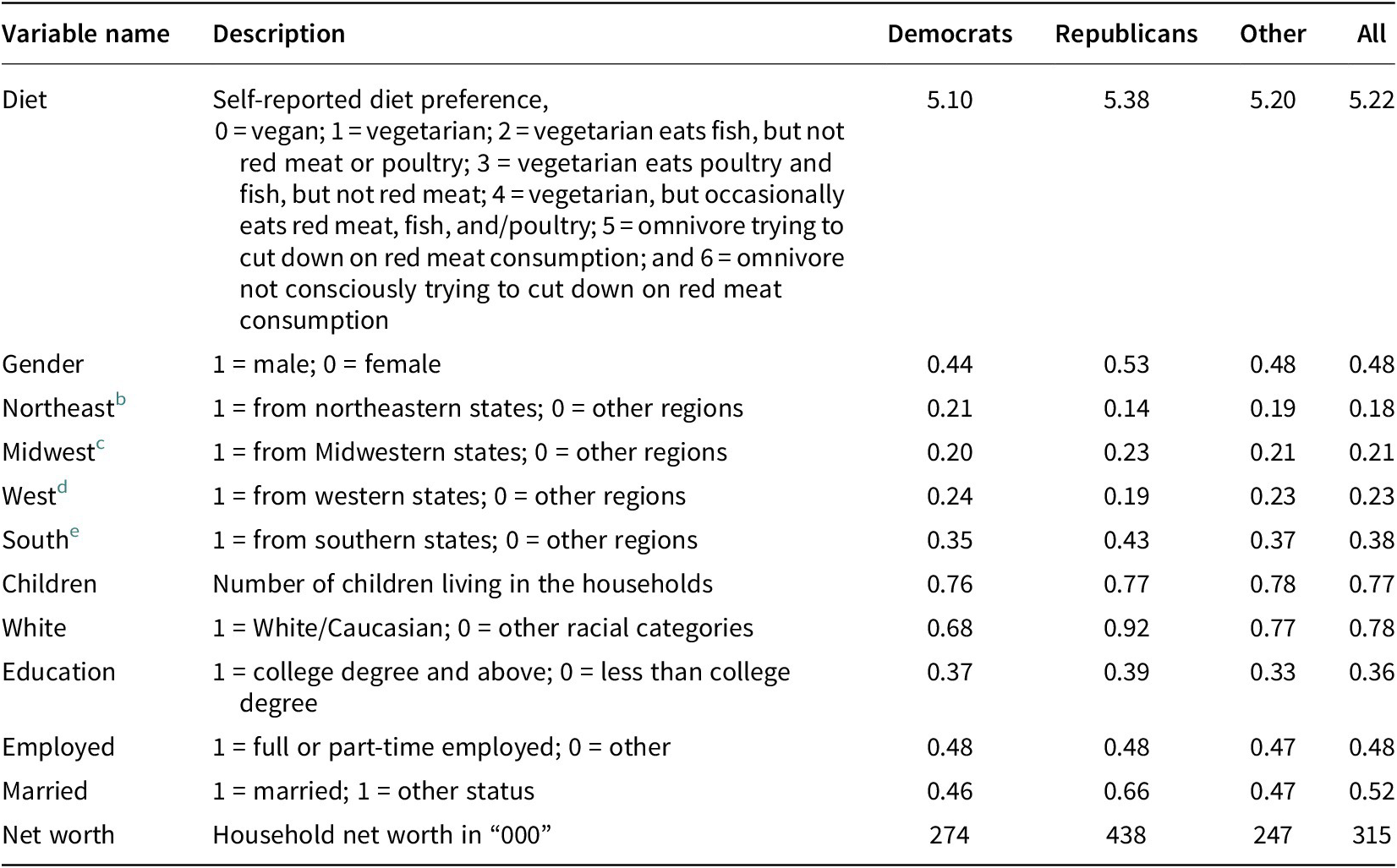
Table 1 reports the description of dependent and explanatory variables used in the statistical models. The variables are constructed from 2019 LOHAS data that were collected online by surveying more than 3,000 individuals from over 60,000-person US consumer panel in September 2019. The data is a representative snapshot of the US population demographics with a relative accuracy to a 95% confidence level. For example, according to the 2020 United States Census (2023), 50.5% of the population is female. Our survey respondents are similarly distributed with 52% female and 48% male. Racial distribution is also similar to the Census reported figures. The sample population is 78% White/Caucasian, 11% Black/African American, 6% Asian, 8% Latino/a, 2% Native American, and 1% other. Census reports 75.3% White (with 58.4% as White alone, not Hispanic or Latino), 13.7% Black, 19.5% Hispanic or Latino, 1.3% American Indian and Native Alaskan, and 6.4% Asian. Sample distribution across US geographic regions is also nearly identical to the reported Census distribution for the Midwest (20.8%), Northeast (17.3%), South (38.1%), and West (23.7%) regions. As for party, respondents self-identified as those voting Democrat (N = 1,119), Republican (N = 882), and unaffiliated/others (N = 999), which represents all individuals not identifying with either of the two major parties. The percentage of households leaning Democrat (37.3%) is highest, followed by those leaning other (33.3%) and those leaning Republican (29.4%). This generally aligns with more recent trends for self-reported party affiliation (Gallup, 2023; Pew Research Center, 2024).
Description of variables, 2019a
a Please refer to Mosier and Rimal (Reference Mosier and Rimal2020) to review the descriptive statistics for the 2016 survey data.
b Northeast states include CT, ME, MA, NH, NJ, NY, PA, RI, and VT.
c Midwest states include IA, IL, IN, KS, MI, MN, MO, NE, ND, OH, SD, and WI.
d Western states include AK, AZ, CA, OR, HI, MT, NV, NM, UT, WA, and WY.
e Southern states include AL, AR, DE, DC, FL, GA, KY, LA, MA, MS, NC, OK, SC, TN, TX, VA, and WV.
The dependent variable is self-reported diet preference with values ranging from 0 (vegan), the complete omission of animal and animal byproducts from their diet, to 6 (not consciously trying to cut down on red meat consumption), where the individual does not self-report a conscious effort to reduce red-meat intake. The scaled dietary measurement permits a more nuanced evaluation of the range of dietary adoptions among the general population. However, it requires respondents to select only one diet. This scale was developed and utilized by NMI and not the authors of this article, thus providing some limitations in fully exploring dietary choices.
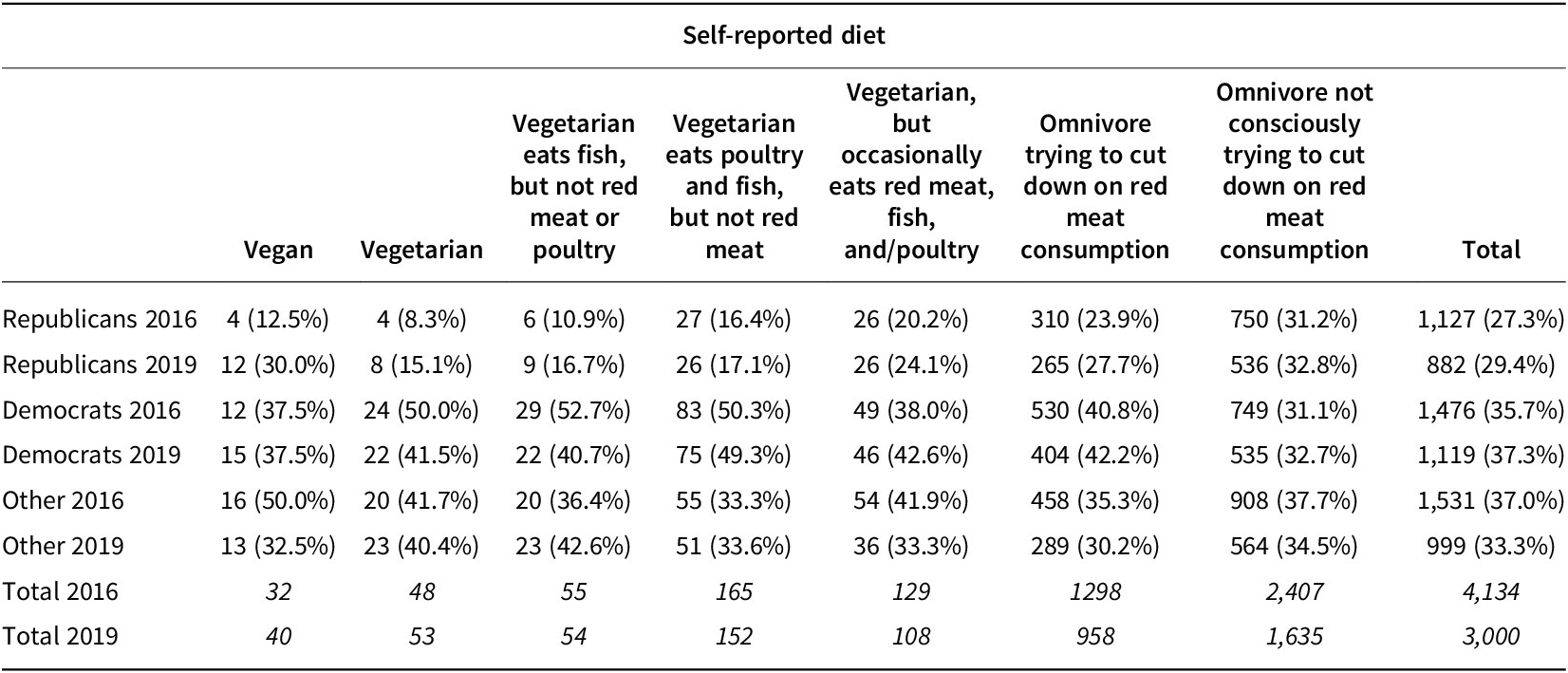
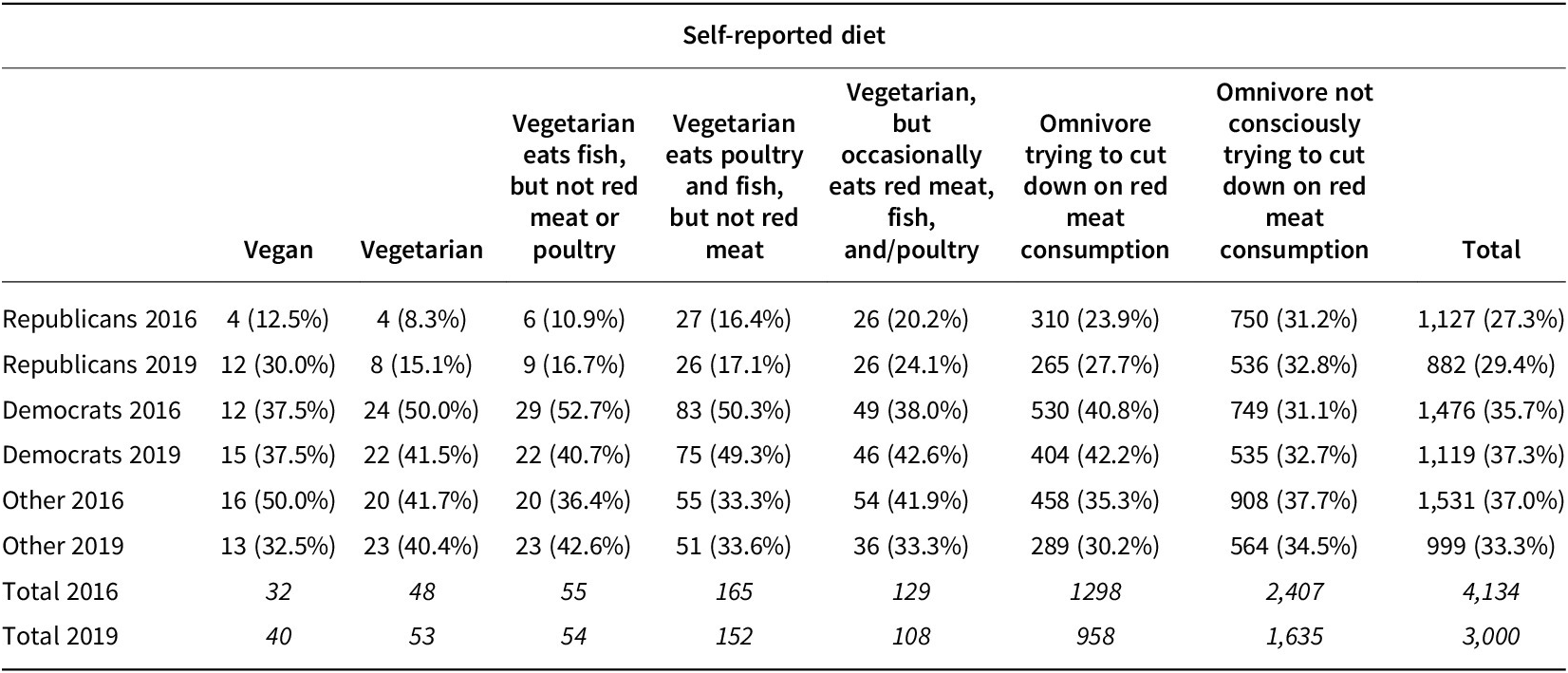
The explanatory variables included partisanship, gender of the respondents, four geographic regions with South being the benchmark region, number of children living in the household, education level, race/ethnicity, employment, marital status, and household net worth. For partisanship, a key explanatory variable evaluated within the study, the dietary distribution varied across political partisan affiliation (Table 2). Democrat respondents, constituting over 37% of the sample, were more likely to be vegan compared to respondents voting for Republicans and others. Those voting for Republicans constituted <30% of the sample but were more likely to prefer a meat-based diet.
Reported dietary preferences by various political affiliations, 20161 and 20192 comparison
Note: Figures in (−) are total percentage of respondents reported for that dietary category.
a χ 2 = 88.25; p < 0.001.
b χ2 = 51.86; p < 0.001.
The association of dietary preferences and sociodemographic characteristics of survey respondents was analyzed using three separate censored Tobit regression models, one each for the three political partisanship subgroups. An overall model that included all the respondents irrespective of political partisanship was also estimated. The choice of censored models was driven by the nature of the dependent variable, with values ranging from 0 to 6 representing diet preference of respondents. A value of 0 (vegan) represented a diet without any animal products, and a value of 6 represented a preponderance of animal products in the diet, including red meat. However, a value of 6 did not mean an all-red-meat diet. Since the respondents could not select values higher than 6 to represent a higher intensity of red meat in the diet, a censored Tobit model with the upper limit at 6 was the appropriate model to analyze the behavior of the respondents. A Chow test was conducted to test the null hypothesis that parameters for the overall model and models for the three subsamples were the same. Global as well as local hypotheses were tested at a 0.05 significance level, but 0.10 significance values were also identified.
Results of the 2019 data
Meat continues to be an important part of the American diet. As the 2019 survey data suggest, more than 50% of individuals reporting their diet preference are not actively working to reduce red meat consumption, irrespective of political affiliation (Tables 1 and 2). The findings are consistent with global trends, including those found within the United States. Between 1990 and 2020, the world’s total meat consumption nearly doubled from 150 billion kg to more than 300 billion kg (Blaustein-Rejto & Smith, Reference Blaustein-Rejto and Smith2021).
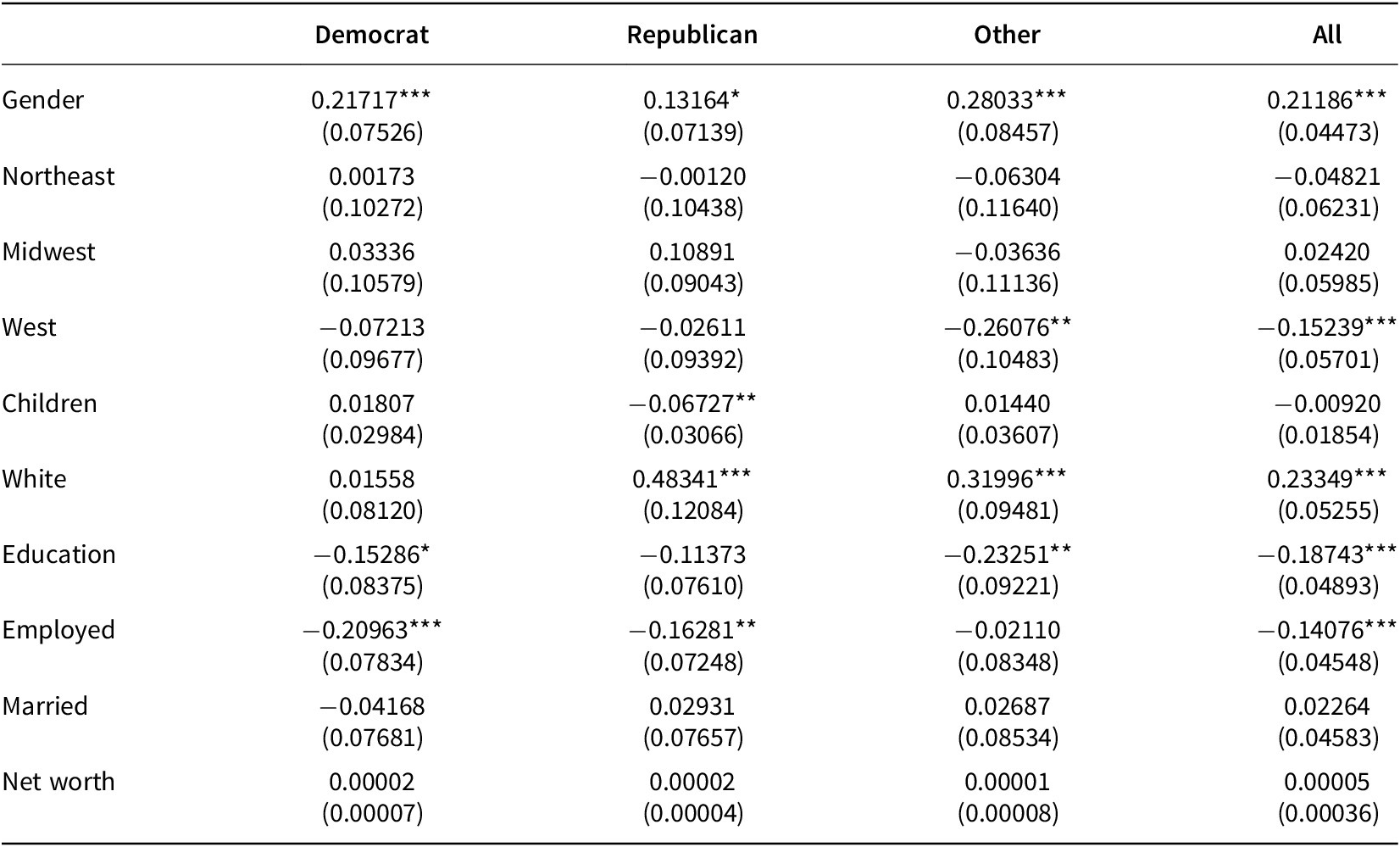
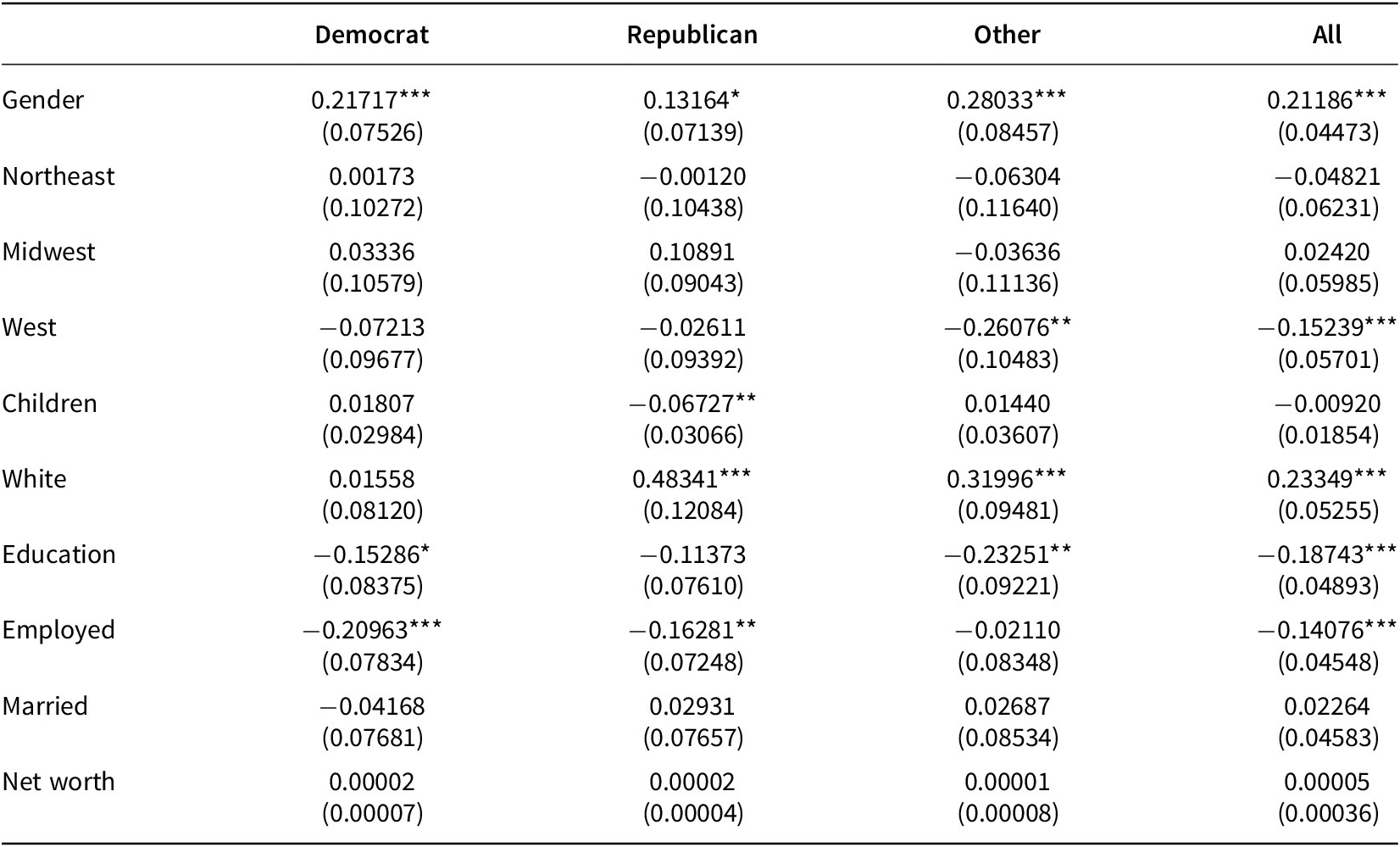
Diets at the extremes (i.e., vegan or not cutting down on red meat) were not evenly distributed across party lines. While those leaning toward the Democratic party were more likely to prefer a vegan diet, those identifying as other or not identifying with either major political party were more likely to report not actively seeking to reduce red meat consumption. Among those identifying as politically unaffiliated, half are vegan compared to 37.5% of Democrats and 12.5% of Republicans. The difference is not numerically significant across parties for those reporting vegan or no interest in cutting down the amount of red meat in their diet. However, the marginal effects analysis using a Tobit regression model revealed statistically significant differences compared to those identifying as a Democrat or Republican (Table 3). Being a Republican voter increased the expected preference for more meat in the diet by 0.12 points compared to the others or unaffiliated voters. Being a Democrat decreased the expected preference for more meat in diet by 0.11 points.
Marginal effects of explanatory variables on diet by party, 2019
Note: Marginal effects are represented by partial derivatives of expected values with respect to the vector of characteristics computed at the means.
***p < 0.01; **p < 0.05; *p < 0.10 (two-tailed). Standard errors in parentheses.
To further evaluate the significance of party, a model focusing just on the partisanship and diet connection, which controls the independent variables, is presented in Table 4. The results show that such relationships were statistically robust, with the variables representing Democrats and Republicans as statistically significant at <0.01 threshold value. The binary variables are used to represent partisanship affiliations, with the variable representing unaffiliated dropped. Marginal effects are included to demonstrate how much a Democrat- or Republican-leaning person is likely to have a meat-heavy diet compared to those who are unaffiliated/others. As shown, Republicans are 16% more likely to report a meat-heavy diet than those who are unaffiliated/other. Comparatively, Democrats are 14.7% less likely to report a meat-intensive diet than those who are unaffiliated/other. Models are also estimated with a single independent variable representing partisanship (not reported). The results show that Republicans are 24.1% more likely to prefer a meat-heavy diet than the rest, and Democrats are 22.2% less likely to prefer a meat-heavy diet than the rest.
Effects of partisan variables alone on diet (controlling for rest of the independent variables), 2019

***p < 0.01; **p < 0.05; *p < 0.10 (two-tailed). Standard errors in parentheses.
Aside from party affiliation, there are a number of statistically significant demographic characteristics that account for the variability of dietary preference among various partisan inclinations (Table 3). Gender was the only variable significant across all partisan groups and in the broader population. Race, education, and employment status were other significant variables across partisan groups and in the broader population. Men, on average, are more likely than women to report as omnivores with no conscious efforts to reduce red-meat consumption. Unaffiliated men had the highest reported effects in claiming an omnivorous diet (0.634), and Republican men had the lowest (0.332). Being an unaffiliated man increases the expected preference for meat in the diet by 0.28 points compared to an unaffiliated woman; however, for a Republican man, the difference compared to a woman was only 0.13 points, and for a Democrat man, it was only 0.22 points. Respondents identifying as White Republicans were 0.48 points more likely to report a preference for a meat-inclusive diet compared to non-White Republicans. Similarly, White unaffiliated individuals were 0.32 points more likely to report a preference for a meat-inclusive diet than non-White unaffiliated individuals. Education level was negatively associated with meat-inclusive diet preference across all partisan groups and in the broader population. The impact was strongest among the other unaffiliated group and weakest among the Republican respondents. An unaffiliated respondent with a college degree was 0.23 points less likely to prefer a meat-inclusive diet than those without a college degree. The difference was only 0.15 points among the Democrats and 0.19 points among the broader population.
There were some regional disparities among the groups. For others, being in the western US states increased the expected preference for plant-based diets by 0.261 points as compared to those respondents in the southern states. Similar regional differences were also identified among the broader population. Regardless of partisanship, those living in the western states were 0.15 points more likely to prefer a plant-based diet than those living in the southern states.
Employment and the presence of children at home also have a demonstrated effect. Specifically, an employed Democrat is expected to report a preference for a plant-based diet by 0.21 points more compared to an unemployed Democrat. The difference among Republicans was 0.16 points. Similarly, having children at home decreased the expectation for reporting a meat-centric diet, particularly among Republicans. Each additional child living in the home decreased the preference for a meat-based diet by 0.07 points. It is interesting that while Republican-leaning respondents are generally inclined to prefer more meat in their diet, having children in the household moderated their diet choices. Children, however, did not play any role in diet preference among other partisan groups and in the broader population. It is worth noting that several variables, including marital status and household net worth, did not have a statistically significant impact on diet preference.
Comparison of 2019 to 2016 results
There has been a slight shift toward the plant-based diet in 2019 compared to 2016. An independent t-test comparing mean values of the variable representing diet choices between 2016 and 2019 showed a statistically significant mean difference at <1% p-value. Nevertheless, the dietary distribution of respondents between 2016 and 2019 suggests that Americans continue to prefer meat-based diets no matter their partisan affiliation (Table 5). Those that incorporate fish, poultry, or red meat constitute ~97% of all respondents in 2019, up nearly 1.9% from 2016. Vegan respondents continued to be a minority group in 2019, with only 1.33% of total respondents claiming this dietary preference. This represents an increase from 2016 (0.77% total), with the increase predominantly occurring among Republican respondents. The balance of vegans distributed across various partisan affiliations is more even in 2019 compared to 2016. However, the distribution of vegetarians remains largely among Democrats and those who identify as other.
Marginal effects of explanatory variables effect on diet by party comparison, 2016 and 2019 survey years

Note: Marginal effects are represented by partial derivatives of expected values with respect to the vector of characteristics computed at the means.
***p < 0.01; **p < 0.05; *p < 0.10 (two-tailed). Standard errors in parentheses.
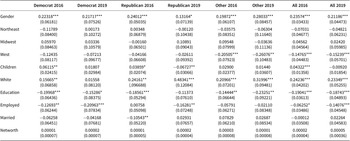
As outlined in Table 5, causal explanations for dietary behavior and partisan identification remain consistent between the 2019 results and 2016 results that were initially reported and analyzed by Mosier and Rimal (Reference Mosier and Rimal2020). Six of the 10 total model variables were significant in both the 2016 and 2019 models. Net worth and the regional locations of the Northeast and Midwest were not consistent in either year. The effect of being a married respondent was only significant in the Republican model for 2016, with the effect lost in the 2019 analysis. Of those six variables that were significant across model years, gender remained the most robust and consistent explanatory variable across all partisanship categories. Women continue to have a positive effect on a less meat-intensive diet. The effect between the 2016 and 2019 models suggests generally similar effects for Democrats and all-partisan models. The gender within the Republican model decreased while the effect increased within the unaffiliated category. Likewise, respondents living in the American West continue to enjoy a less meat-intensive diet, with the significance remaining constant for the all-partisan and other models in both the 2016 and 2019 models, with the effects remaining comparatively similar.
Education, employment status, children in the household, and race also provide some continued explanation, albeit with notable changes across certain partisan categories. Specifically, those with lower levels of educational achievement are still more likely to prefer a more meat-intensive diet in all models except for the Republican designation. The effect slightly decreased for Democrats but increased for others. Similarly, respondents who report having children in their household and those who identify as White were not consistently significant across the models from 2016 to 2019. The significance of children remained only for those identifying as a Republican, with the effect reversing from positive in 2016 to negative in 2019. The variability in significance also extends to employment status, with those reporting being employed full- or part-time more likely to adopt a plant-based diet. The effect strengthened for Democrats and in the all-partisan model, with the new significance found in the Republican affiliated group. As for race, White respondents were more likely to prefer meat-based diets, but the effect was no longer significant among those identifying as Democrats. However, the effect increased for both the unaffiliated and Republican models, with the effect doubling for Republicans from 0.241 in the 2016 model to 0.483 in the 2019 model.
The collective comparison between the 2016 and 2019 models suggests the variables included within the models are fairly consistent, with notable changes in the Democratic and Republican models compared to the other and all-partisan models. Such changes in significance are further explored and explained in the next section.
Analysis and implications
The primary contribution of this study is to confirm and extend the understanding of the partisan-diet connection in the United States. The 2019 data analyzed in this article replicate a previous effort by Mosier and Rimal (Reference Mosier and Rimal2020) to document how partisanship is connected to and potentially explains dietary behavior. This study demonstrates there are some consistent explanatory factors for dietary behavior while also highlighting how partisanship and diet have changed in just a 3-year period. Gender remains the most consistent and robust explanatory variable for dietary choice, no matter the partisan affiliation. While it is acknowledged that this study has some of the same challenges (e.g., structure of survey and language choice) as the 2016 study conducted by Mosier and Rimal (Reference Mosier and Rimal2020), it is confirmed that there is a continued preference for meat-based diets. Furthermore, there are continued complexities and challenges for understanding the diet–partisanship connection, including how vegans and vegetarians navigate their political identity amidst a changing political landscape.
One potential explanation for the changes between the 2016 and 2019 results stems from less stigma surrounding vegan and vegetarian diets. In general, it was surprising to see an increase in self-reported Republican vegans, even if it was a small increase. Research suggests that individuals who adopt a vegetarian or, more often, vegan diet may face more scrutiny and pressure from family, friends, or others within their networks (Beardsworth & Keil, Reference Beardsworth and Keil1992; Hodson & Earle, Reference Hodson and Earle2018; Kellman, Reference Kellman2000). To this extent, even those who are considering, but have not adopted, a vegan or plant-based diet have perceived potential stigmatization from others (Markowski & Roxburgh, Reference Markowski and Roxburgh2019; Williams et al., Reference Williams, Vardavoulia, Lally and Gardner2023). There may be more of a concern given that conservatives are more likely to report meat-intensive diets.
Shifts in the market signal a potential change in attitude towards meatless diets. The availability of plant-based and meatless options increased dramatically around the time of the NMI 2019 data collection period. For example, 2018 and 2019 were peak consumer sales years for alternative meat items (Kinder, Reference Kinder2024). Such popularity of products in 2018 and 2019 can explain the mainstreaming of alternative meat products in the past decade, with such options permitting more inclusive gatherings of meat eaters and nonmeat eaters (Kerslake et al., Reference Kerslake, Kemper and Conroy2022). Not only have some celebrities announced their joy about adopting a vegan diet, often touting its health and ethical benefits, but fast-food restaurants also began exploring and offering meatless and vegan-friendly options, including Burger King in 2019, Kentucky Fried Chicken in 2022, McDonalds in 2020, and Taco Bell in 2021.
In a similar trend to what has occurred with organic foods in the 1980s and 1990s (Guthman, Reference Guthman2004; author(s)), vegan and vegetarian diets may have finally reached a status as less fringe of a behavior and practice and something that has marketability and acceptance among the general public. According to a 2019 Gallup Poll, 41% of Americans had tried plant-based or meatless products, with the survey results suggesting age, race, and gender are comparatively similar (McCarthy & DeKoster, Reference McCarthy and DeKoster2020a). This shift in behavior is not surprising given that a number of respondents also indicated a preference to reduce meat consumption, with health being the foremost cited reason (McCarthy & DeKoster, Reference McCarthy and DeKoster2020b). The environment, food safety, and animal welfare were other major causes for a signaled reduction or avoidance of meat. Since 2019, a 2021 poll by the International Food Information Council suggests that ~65% of Americans have tried plant-based meat alternatives, with significant investments made into meatless and cultivated meat development (IFIC, 2021; Zulkosy, Reference Zulkosy2022). The decline of stigma and rise of mainstream investment and interest in meatless or meat-alternative diets highlights potential shifts in collective dietary norms.
Yet, despite potential shifts in stigma and the market for meatless products, we are cautious in suggesting that decreasing stigma is the only potential cause for observed results. There are two reasons why. First, there is more recent research that demonstrates a clear preference for meat among conservatives or Republicans in the United States (e.g., Kershaw et al., Reference Kershaw, Nolden, Brown, Hites and Jefferies2023; Rooney & Muller, Reference Rooney and Muller2023). Although plant-based options rose to the mainstream, there are clear indications that serving meat alternatives in the wrong social setting can result in conservative backlash (Rooney & Muller, Reference Rooney and Muller2023). Second, the observed results are also likely shaped by shifts in partisan identification. Results of the 2018 and, more recently, 2024 US presidential elections highlight noteworthy changes in the cohesiveness of political parties and how voters perceive and identify with the two main political parties.
Since 2009, the Republican Party has undergone tremendous shifts as factions emerged and fundamentally fractured the party. The Tea Party movement led to an insurgent faction within the Republican Party that eventually captured the party, thereby laying the groundwork for an anti-establishment US presidential candidate like Donald Trump to emerge (Blum, Reference Blum2020). Polarization within the electorate has contributed to general party dealignment, leading to stronger ideological consistency within the party and also stronger in-group versus out-group perceptions (Abramowitz, Reference Abramowitz2018, Reference Abramowitz2022; Iyengar & Krupenkin, Reference Iyengar and Krupenkin2018; Iyengar et al., Reference Iyengar, Sood and Lelkes2012). The shifts occurring within the Republican Party mean that it has become one of the older White men with a strong base support from those with lower levels of educational achievement and, because of the Tea Party movement, one of more grounded anti-establishment and fringe or extreme ideological assumptions.
Looking at the results of the 2019 data indicates that race, and specifically identifying as White, was a significant predictor and one strengthened for Republicans but disappeared for Democrats since 2016. In addition, the reversal of effect for children in the home for Republicans and the omission of significance for Democrats in 2019 also highlights, among other changes in significance, shifts in who chooses to identify with each main party. It is possible that with the rise and 2016 election of Donald Trump as the President, the event has altered who chose to remain within the Republican Party and reshaped how many Americans viewed the Democratic Party. Historical data demonstrate a clear racial divide along party alignments, with White voters identifying more with the Republican Party and non-White voters identifying more with Democrats (Pew Research Center, 2024). It is only in the 2024 election that there were notable shifts in non-White voters moving away from the Democratic Party. Such shifts could explain the changes in significance among both political parties by highlighting how in-group identities within a party may have become more consistent, including that of dietary behavior.
To be clear, we are strictly speculating why changes that occurred between 2016 and 2019 are analyzed in this article. We acknowledge that it is possible that something not only shifted between each sampled population year but also who self-identifies as a particular party. The Republican Party has experienced a dramatic shift in identity and direction in the past 15 years, thus opening the potential for more fringe and extremist beliefs. This includes those that may overlap or simply circle around to what has historically been seen as more leftist ideological behaviors and norms. For example, organic and natural foods were once seen as liberal hippie endeavors, but it is worthwhile to acknowledge that even extreme right political factions, including the Nazi party of Germany and the January 6th insurrection, also have been known to support and pursue organic diets (Billeaud, Reference Billeaud2021; Brüggemeier et al., Reference Brüggemeier, Cioc and Zeller2005). In addition, during the 2024 election cycle, Robert F. Kennedy’s Make America Healthy Again movement was seen as a key move to bring moms concerned about a safe food supply and other alternative wellness advocates (e.g., anti-vaccine) into Trump’s base of supporters (Bottemiller Evich, Reference Bottemiller Evich2024; Landman, Reference Landman2024). While partisanship may be seen as dichotomous, the reality is that political ideological beliefs are more akin to circularity, whereby it is possible for unlikely bedfellows to suddenly meet in a common interest.
The radical shifts in politics and the noteworthy changes in market behavior lead to challenges in specifically declaring one cause or another for the change. As such, we reiterate that we are strictly speculating about the changes that occurred between the 2026 and 2019 models. In addition, we opt to decline further analysis in this paper of in-party dynamics or what has occurred since 2019 without additional, non-industry surveys, focus groups, and interviews that can tap further into the personal and political identities of respondents.
Outside of the US context, the results of this study highlight that diet and partisanship do have a clear yet complex connection. Two-party systems such as the United States may continue to struggle with how to incorporate fringe or perceived out-group dietary choices into mainstream consideration. Despite the mainstreaming of plant-based products and diets, there is no guarantee that all members of a political party, including those in power, will be receptive. Comparatively, and as Mosier and Rimal (Reference Mosier and Rimal2020) highlighted previously, multiparty systems will continue to be a better opportunity for a range of dietary views to be expressed and not marginalized. Looking toward the future, the context of our work should be taken as one of comparison and as of caution for how it potentially impacts individual behavior, as well as food and agricultural policy choices made by elected or government officials. The rise of extreme and conservative ideological beliefs globally may contribute to distortions of desired dietary choices or at least those that are self-reported.
Conclusion
Dietary choices are a complex decision to fully understand. Evaluating dietary choice in connection to political party affiliation leads to additional complexity, as different identities may intersect and ultimately influence decisions. This study replicated and extended evidence of the diet–partisanship connection in the United States, including the identification of factors that influence both identities. Most Americans continue to eat meat, but the 2019 data analyzed in this article highlight shifts at the margins for more willingness to consider less meat-intensive and more plant-based diets. Dietary norms changed slightly within the 3 years of data collected by the NMI survey instrument, with more Republicans reporting vegan and vegetarian diets. However, it is important to remember that meat-based diets remain a predominant fixture for all Americans.
Casual explanations for results continue to highlight the changing nature of intersectionality influencing dietary choice. Gender continued to be a robust explanatory factor for dietary choice across political party affiliations. The effect highlights that women continue to prefer less meat-intensive and more plant-based diets. Aside from gender, most previously identified causal explanations continued to remain significant, although with some noteworthy departures compared to the 2016 results. Changes among Democrat and Republican respondents suggest the effects of race, education level, marriage status, and having children in the household have changed and perhaps shifted dietary norms and expectations.
In conclusion, this study provided further exploration and confirmation of the diet–partisanship connection. Dietary choice represents one of many potential individual identities and may conflict with other identities, including partisanship, if a value conflict arises. By its very nature, politics and partisan identity are ones that are grounded in and permit the expression of a particular set of ideological values and power structures. The intersection of diet–partisanship has the potential to shape how communities, markets, and governments function to help support a healthy society and a resilient food and agricultural sector. It is possible that the mainstreaming of plant-based and meatless alternatives aided in the mainstream acceptance and general destigmatizing for some Americans. It is hoped that further research into the connection between political party and dietary choice will shape political and market-based choices, including those occurring after the COVID-19 pandemic, where food prices increased, scarcity may have contributed to further shifts in dietary decisions, and partisan alignments shifted.
Data availability statement
Data access is subject to third-party restrictions by the Natural Marketing Institute (NMI). Access can be requested with approval determined by an agreement with NMI.
Financial support
This research received no specific grant or financial support from any funding agency.
Competing interests
The authors certify that they have no conflict of interest related to this study.
Ethical standard
This study utilizes third-party anonymous survey data. The results reflect the authors’ own research, provide proper credit, and adhere to ethical research conduct.



 Open access

