


Introduction
Salinity is one of the most severe environmental stresses and the responses given by plants are diverse. These are reflected in physiological variables (stomach conductance, rate of perspiration and photosynthesis) (Freire et al., Reference Freire, Dias, Cavalcante, Fernandes and Lima Neto2014), biometrics (height, leaf area, biomass production) (Guimarães et al., Reference Guimarães, Simões, Oliveira, Araújo, Silva and Willadino2019), biochemistry (antioxidant enzymes) (Barbosa et al., Reference Barbosa, Silva, Willadino, Ulisses and Camara2014). Sorghum bicolor (L.) Moench is a crop species that presents C4 mechanism, and is one of the most versatile and efficient species in terms of photosynthetic mechanism (Berenguer & Faci, Reference Berenguer and Faci2001). This contributes to its greater resistance to adverse conditions. The tolerance of plants to salinity is associated with the development of mechanisms that contribute to minimize salt stress. Theses mechanisms have different energy costs for the plants, which negatively affect plant gas exchange, and consequently plant growth and development (Hassanein et al., Reference Hassanein, Ahmed and Zaki2010).
Objective
The objective of the present study was to evaluate the influence of saline water irrigation on the transpiration of sorghum (Sorghum bicolor (L.) Moench) plants under semi-arid conditions.
Methods
The study was conducted in a controlled environment in the semi-arid region of Brazil. During the experiment period the average relative humidity was 48.72% and the temperature around 26.86 °C. The maximum evapotranspiration observed was 7.28, with an average of 6.03 mm day−1. Sorghum seeds (Sorghum bicolor (L.) Moench), Ponta Negra variety, were seeded in 25 plastic pots of 20 dm3, filled with medium-textured soil, totalizing five repetitions per treatment. The plants were submitted to irrigation with the following salinity levels: 0.0; 1.5; 3.0; 6.0 and 12.0 dS m−1. For irrigation management, weight lysimeters were installed with an electronic data collection system that recorded the weight of the pots every 15 minutes. Irrigation was performed by applying a leaching fraction of 15% to prevent the accumulation of salts in the soil. At 60 days after seeding the total leaf area of the plants was determined. Transpiration was determined from the weight differences recorded in the weight lysimeters.
Results
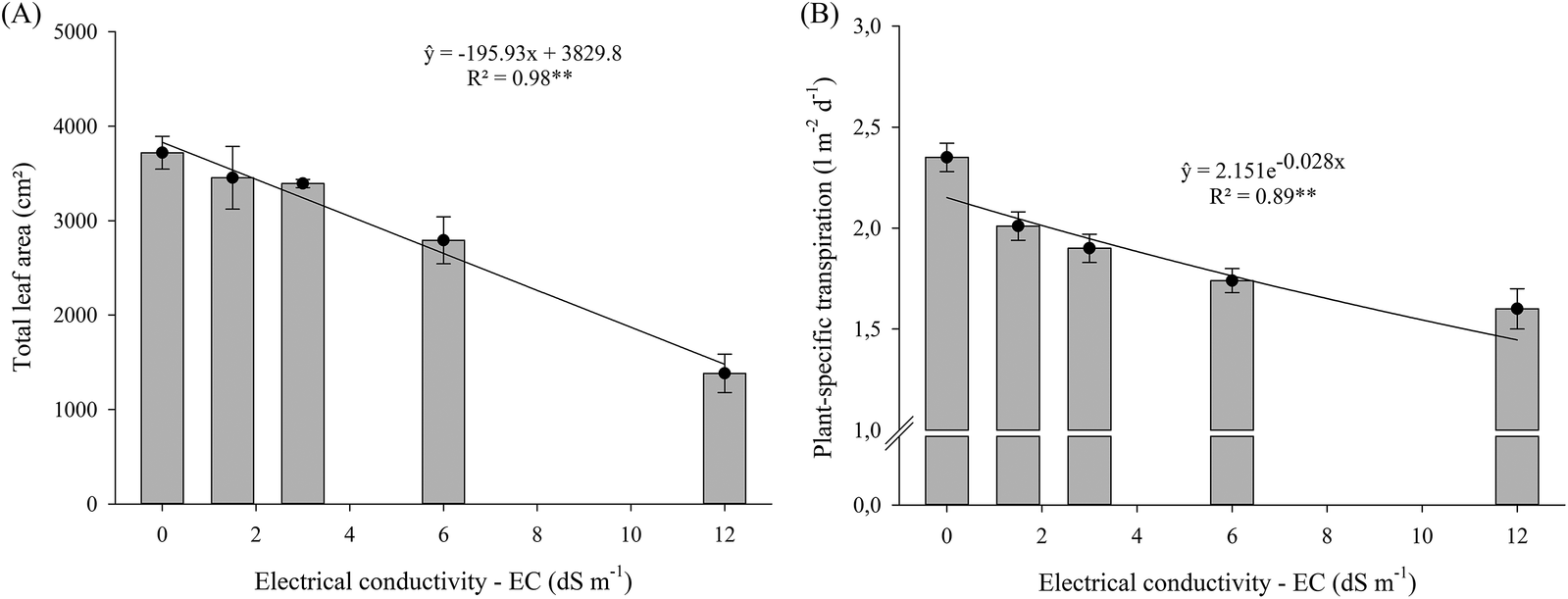
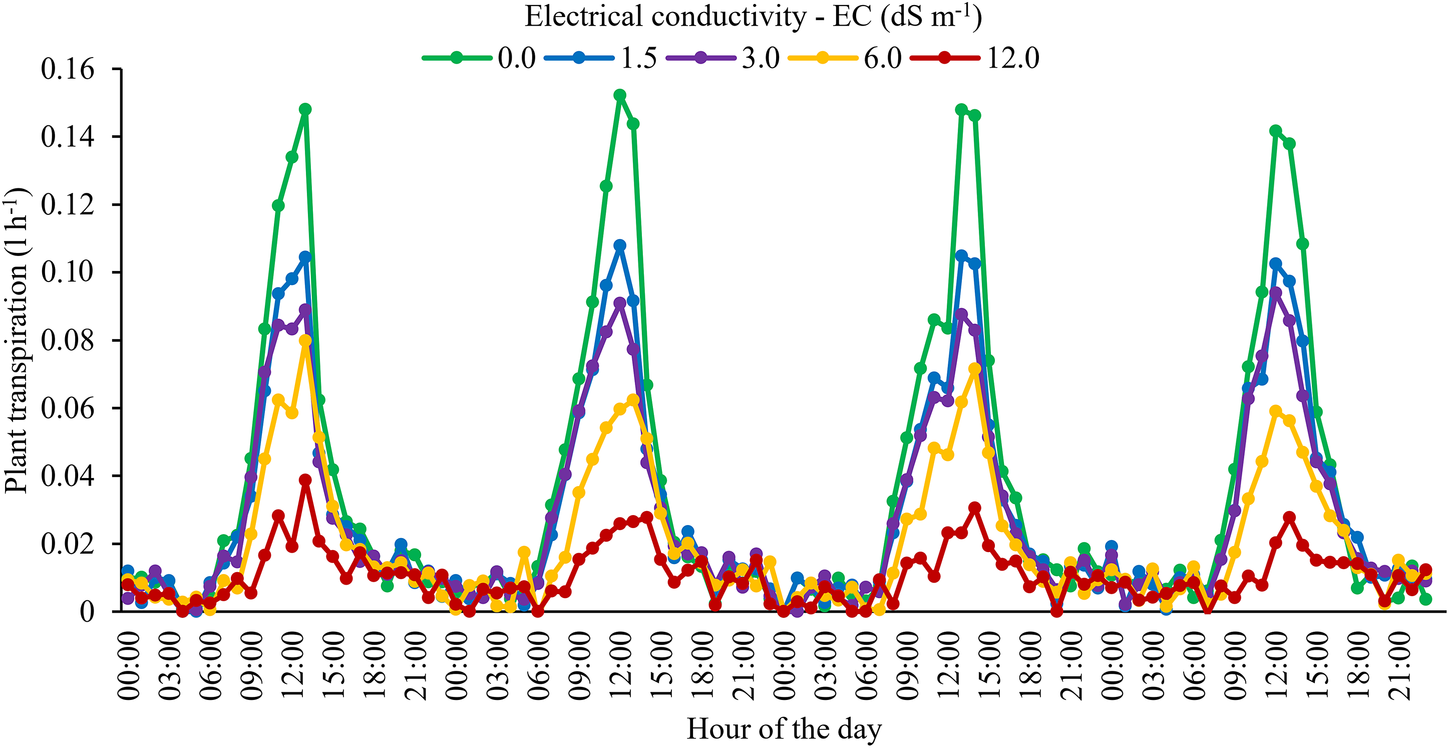
There was a linear reduction of the total leaf area of the plants with an increase in the salinity of the water used for irrigation, which contributed to lower perspiration values of the plants submitted to the higher salinity levels. It was observed that specific transpiration (represented by the ratio of transpired water volume per square meter of leaf area) decreased with the increase in salinity (Fig. 1), evidencing the effect of salts on the gas exchange of sorghum plants. Plants submitted to higher salinity levels generally presented lower transpiration values at all times evaluated. The highest values of transpiration were observed in the range of 10 a.m. to 3 p.m. (Fig. 2), being in accordance with the climatic data of the region, which presents higher temperatures in the range that the highest transpiration was registered, considering that one of the main functions of transpiration is the regulation of plant temperature.
Total leaf area (A) and plant-specific transpiration (B) of sorghum submitted to salinity levels. Error bars with standard deviation. (**) Significant regression coefficient with p < 0.01.
Daily variation of transpiration of sorghum submitted to salinity levels.
Discussions
Reductions in gas exchange of plants subjected to saline environments are associated with the osmotic effect on plant metabolism (Silva et al., Reference Silva, Lacerda, Neves, Sousa, Sousa and Feerira2013). Studies with fodder sorghum have shown that the continuous use of water with salinity above the threshold of the crop reduces the rate of transpiration due to partial closure of the stomata (Coelho et al., Reference Coelho, Simões, Salviano, Mesquita and Alberto2018). Liu et al. (Reference Liu, Yin, Wang, Zhang, Deng, Zhang and Tanaka2015) reported a direct influence of salinity on the water and photosynthetic relationships of sorghum leaves. Heidari (Reference Heidari2009) reported that the potential for negative water in sorghum leaves affected by salt resulted in reduced transpiration of the evaluated plants, corroborating with the data presented in this study.
Conclusions
The present results indicate that the salinity of irrigation water has strong interference with transpiration of sorghum plants. The reductions in transpiration observed in this work may reflect in reductions in plant growth and development, since transpiration is a physiological process that encompasses the passage of water through the entire body of the plant, from its absorption at the roots to evaporation at the surface of the leaves through the stomata, having a direct relationship with the absorption and distribution of nutrients in the plant.
Acknowledgements
The authors would like to thank Embrapa Semiárido for their technical assistance.
Author Contributions
WLS and LGW conceived the study. MJMG conducted data collection, performed statistical analyses. MJMG and JRAB wrote the article.
Funding Information
This work was funded by the Foundation for the Support of Science and Technology of the State of Pernambuco – FACEPE on a scholarship (IBPG-1556-5.03/13), and National Council for Scientific and Technological Development (CNPq) with the financial support.
Conflicts of Interest
All authors declare no conflicts of interest.
Data availability
The authors confirm that the data supporting the findings of this study are available within the article and/or its supplementary materials. If additional data is required, is available from the corresponding author, [MJMG], upon reasonable request.
Supplementary Materials
To view supplementary material for this article, please visit http://dx.doi.org/10.1017/exp.2020.22.


 Open access


Comments
Comments to the Author: Dear all The text is clearly written and well-designed. Also the the data is valid, presented clearly and ready to be published. I would like to offer just some simple suggestions:1. Figure 1: Insert identification (e.g. A and B).2. References with three or more authors should be quoted with the first author followed by et al. in italic.