




1. Introduction
The language situation of higher education institutions (HEIs) in non-English speaking countries is often complex, with local languages co-existing with English as an academic lingua franca, sometimes in an uneasy relationship (e.g. Soler & Rozenvalde Reference Soler and Rozenvalde2024). In Norway, language policies and practices are characterized by a tension between the societal need for higher education in Norwegian, the importance of Norwegian for HEIs as societal actors, and the desire for language maintenance on the one hand, and ambitions for internationalization and high international mobility necessitating a central role for English on the other (Gujord et al. Reference Gujord, Molde, Olsen and Wunderlich2022b). International staff at Norwegian HEIs find themselves at the centre of this tension. While there is a requirement that teaching be given in Norwegian (or Sámi) unless academically justified (Universities and University Colleges Act 2024) and language guidelines at Norwegian HEIs emphasize appropriate language choice depending on task and situation (Universities Norway n.d.), lack of Norwegian proficiency is not disqualifying in the hiring process; rather, provisions are in place that Norwegian must be acquired upon being hired in a permanent position (Universitets- og høyskoleforskriften 2024). This leads to a situation where a substantial group of employees in Norwegian HEIs at any given time do not yet have the Norwegian proficiency to have a realistic choice to use Norwegian for work tasks, making the intended parallel language use difficult (see Gregersen et al. Reference Gregersen, Josephson, Kristoffersen, Londen Östman and Holmen2018).
The issue of language usage and proficiency has a number of implications. On the one hand, there are concerns that if English is chosen in contexts where an employee with low Norwegian proficiency is present, it could lead to a reduction in the use of Norwegian in academic contexts (Gujord et al. Reference Gujord, Molde, Olsen and Wunderlich2022b). On the other hand, maintaining Norwegian as the working language of HEIs means a sizeable group of employees may not be fully able to participate or contribute at the workplace. This may negatively impact job satisfaction and career prospects for the employees in question (Bordia & Bordia Reference Bordia and Bordia2015) but may also have repercussions for the overall performance of Norwegian HEIs (Li et al. Reference Li, Connie Yuan, Bazarova and Bell2019). As naturally international and multilingual spaces, where language proficiency may be a limiting factor for contributions and completion of tasks (Holmes & Salö Reference Holmes and Salö2025), HEIs must strive for an environment where all employees attain the language proficiency required to carry out their duties and fully participate in the workplace. As outlined in Gregersen et al. (Reference Gregersen, Josephson, Kristoffersen, Londen Östman and Holmen2018), linguistically inclusive environments are paramount in order for HEIs to be able to fulfil their democratic duty of scientific knowledge production and dissemination. An important component to achieve such an environment is each employee’s own experienced proficiency and confidence in their language competence. In the current study, we focus on individual and external factors that may impact international employees’ confidence in using Norwegian for work. Analysing the reported experiences of international staff within the framework of second language acquisition theories highlighting how language learning is at once a cognitive and a social endeavour, our aim is to contribute to a knowledge-based discussion of how best to support the necessary functional bi-/multilingualism of this specific group.
2. Background
2.1 The linguistic context of Norwegian HEIs
Academia in the Nordic countries is characterized by ongoing negotiations in policies and practices regarding language use, specifically centred around English and local languages (see e.g. contributions in Kuteeva et al. Reference Kuteeva, Kaufhold and Hynninen2020, Salö Reference Salö2022, Solin & Pienimäki Reference Solin, Pienimäki and Bonacina-Pugh2024). The context for this study is Norway, where the majority language is Norwegian – a North Germanic language closely related to Danish and Swedish. Norwegian has two written standards (Bokmål and Nynorsk) and there is no official spoken standard. Use of regional dialects is widespread and regarded as prestigious (Vikør Reference Vikør1989, Heide Reference Heide2017). Additionally, HEIs are obligated to consider language competence in the other mainland Scandinavian languages (Danish and Swedish) as equivalent to Norwegian (Universitets- og høyskoleforskriften 2024:§3–9). The diversity in language use means that learners of Norwegian are exposed to significant language variation, which could impact the learning process (Trudgill Reference Trudgill2002, Heide Reference Heide2017, Røyneland & Lanza Reference Røyneland, Lanza, Brunn and Kehrein2023). Additionally, the Norwegian linguistic situation is characterized by the presence of English. English is taught as a second language (L2) in Norwegian schools from first grade, following its own curriculum separate from (other) foreign languages (The Norwegian Directorate for Education and Training 2025, Rindal Reference Rindal and Bolton2025), and English exposure is massive in most Norwegians’ everyday lives via various media (Language Council of Norway 2017, 2021). Consequently, Norwegians are generally reported to be among the most proficient L2 English speakers worldwide (Education First Reference First2025) and non-Norwegian speakers can generally manage everyday life in Norway by relying on English.
Since 2024, international staff employed in permanent positions in Norwegian HEIs are required to learn Norwegian to CEFR level B2 within three years (Universitets- og høyskoleforskriften 2024). HEIs support international staff by offering language courses, and language training at the institution investigated in this study consists of three courses each worth 15 ECTS credits, requiring regular attendance during work hours (normally 6 hours per week), the completion of homework assignments, and assessment of receptive and productive competence. B2 level represents a relatively high level of proficiency, including understanding ‘main ideas of complex text on both concrete and abstract topics, including technical discussions in his/her field of specialisation’ and interacting ‘with a degree of fluency and spontaneity that makes regular interaction with native speakers quite possible without strain for either party’ (Council of Europe 2001: Table 1). Although this is a high expectation, it does not necessarily represent the full proficiency needed for an academic job. For example, expressing complex ideas in research and teaching requires going beyond ‘main ideas’ (Gregersen et al. Reference Gregersen, Josephson, Kristoffersen, Londen Östman and Holmen2018). The requirement of B2 sets a high goal to reach within three years but is nevertheless unlikely to be sufficient for international academics to be able to carry out all aspects of their work in Norwegian (Gujord et al. Reference Gujord, Molde, Olsen and Wunderlich2022b).
Mean age and median number of years in Norway (LoR) for permanent and temporary employees

a Median rather than mean is shown because some participants reported LoRs of less than one or more than 20 years.
The Norwegian context represents a specific set of beneficial factors and challenges for achieving the necessary proficiency. On the one hand, insofar as all international staff have already mastered functional English, the new target language is relatively similar to one they already know, given that both languages are Germanic and share features both in grammar and lexis. Yet, English and Norwegian are not mutually intelligible, and differ significantly in both morphosyntax and vocabulary as well as in phonology. Importantly, the facts of the Norwegian linguistic context necessitate complex proficiency, especially in terms of comprehension, as one needs to be able to understand two written varieties and a multitude of spoken dialects as well as Swedish and Danish. Such issues are not necessarily extensively covered in teaching materials and formal language training (Heide Reference Heide2017), and this problem is not unique to the HEI context (see e.g. Gujord Reference Gujord2017).
Furthermore, the generally high level of L2 English in Norway may mean that it is easy to get by in English, with corresponding limited opportunities for practising Norwegian. In particular, there may be a certain division of labour between Norwegian and English in Norwegian HEIs that can to some extent be described as a parallel monolingual context. Language choices may vary by both work task and individual (and their setting) among academic staff in Norwegian HEIs (Greek & Jonsmoen Reference Greek and Mari Jonsmoen2021), and although practices were found to vary between departments, Busby et al. (Reference Busby, Dahl, Listhaug, Nygård and Angelsen2026) found tasks like higher-level meetings more often taking place in Norwegian and research-related activities being more commonly performed in English. This means that many recent arrivals in this particular context may participate mostly in activities that take place entirely in English, while monolingual Norwegian activities remain out of reach beyond the required B2 level of proficiency (Busby et al. Reference Busby, Dahl, Listhaug, Nygård and Angelsen2026; see also Kuteeva Reference Kuteeva2014, Holmes Reference Holmes, Kuteeva, Kaufhold and Hynninen2020). The specific tasks that academic staff are expected to perform require different language skills, not only in terms of a choice between Norwegian or English, but also because administrative tasks require different language skills and vocabulary from teaching or supervision tasks, for example. Academic staff need multifaceted and complex language proficiency in order to fully carry out their jobs (Gujord et al. Reference Gujord, Molde, Olsen and Wunderlich2022b).
2.2 Academic migration and language learning
While the empirical evidence demonstrates that learning a new language as an adult typically results in lower levels of ultimate proficiency compared to childhood acquisition (Wei Reference Wei, Bhatia and Ritchie2012, DeKeyser Reference DeKeyser, Gass and Mackey2013a, Christianson & Deshaies Reference Christianson, Deshaies, Dressman and William Sadler2019), possibly partly because of maturational constraints (Hyltenstam & Abrahamsson Reference Hyltenstam, Abrahamsson, Doughty and Long2003), successful acquisition as an adult is certainly possible. However, such success depends on contextual factors and, crucially, language input and interaction may be limited for adults learning a new language. Depending on learning context, L2 input may be limited to a few hours per week spent in the language classroom, with a focus on standardized and formal language and a predominance of written language input, while the linguistic situation outside the classroom may be much more diverse; this may result in underdeveloped real-life communicative competence (Montrul Reference Montrul, Dressman and William Sadler2019). Even in an immigration context, immersion in the target language may be limited, with reduced opportunities for informal language learning, which may be important for learners’ ability to communicate in the new language (Dressman & Sadler Reference Dressman and William Sadler2020). While target language exposure is often framed as one of first language (L1) vs. target language use (see e.g. DeKeyser Reference DeKeyser2013b), the presence of another L2 with lingua franca status, specifically English, may also play a role in contexts like Norway. There is indeed evidence that such informal learning opportunities are limited in Norwegian HEI settings (Gujord et al. Reference Gujord, Molde, Olsen and Wunderlich2022b).
Language environments in immigration settings vary (Arum Reference Arum2024b) depending on, for example, the language(s) used with partners and children, language(s) used at work, and the degree to which one engages in social networks in the target language outside of the workplace. Such factors contribute to the individual differences in learning outcomes that typically characterize adult language acquisition, along with other individual factors such as cognitive factors (often described as language learning aptitude), personality traits, motivation, prior language learning experience, and learning strategies (see e.g. Dewaele Reference Dewaele, Ritchie and Bhatia2009). Importantly, adult learners are cognitively mature and have responsibilities beyond language learning, contributing to what an adult learner of Norwegian in Gujord (Reference Gujord2017:13) describes as having their mind ‘completely full of lots of things’ (our translation).
The issue of other responsibilities is certainly relevant for newly arrived international academics, who need to learn the new language while also setting up a new life, learning a new job with new (formal and informal) rules, and as they are committed to their academic career. Given the global role of English as an academic lingua franca (Alastrué Reference Alastrué, Alastrué and Pérez-Llantada2015), they typically already have high competence in English, either as a first or second language. It may be an advantage when the local language is similar to English, as in the case of Norwegian, as L2 acquisition may be influenced by prior language knowledge and L1 background due to opportunities for facilitative transfer and ease of processing (Odlin Reference Odlin1989, Hirosh & Degani Reference Hirosh and Degani2018). Gujord (Reference Gujord2023) found that for adult immigrants with diverse backgrounds, having a Germanic language background and knowing English was associated with better outcomes for a Norwegian language test, in addition to length of residency and education level.
On the other hand, academic mobility entails that academics may move between several different countries in their careers and may not always be planning to stay permanently in their current country of residence. Furthermore, given the ubiquitousness of English, a large part of academics’ careers may not take place in the new language. If they feel that English is in fact sufficient for workplace and/or social contexts, it may impact their investment in learning the local language (Gearing & Roger Reference Gearing and Roger2018, Soler & Rozenvalde Reference Soler and Rozenvalde2024). Previous studies have shown that sociocultural integration is one of the best predictors of language acquisition among people moving to a new environment (Hammer & Dewaele Reference Hammer, Dewaele, Lundell and Bartning2015, Hammer Reference Hammer, Beacco, Krumm, Little and Thalgott2017).
Another issue is the specific L2 proficiency needed in order to fully carry out the responsibilities of an academic position. As pointed out by Gregersen et al. (Reference Gregersen, Josephson, Kristoffersen, Londen Östman and Holmen2018:34), such proficiency must be multifaceted, encompassing colloquial language for interaction with students and colleagues, the administrative language used both internally at the HEI and by national agencies, and the subject-specific language of their field. Given these complexities, defining the language proficiency needed for an academic position is not straightforward. McCroskey & McCroskey (Reference McCroskey and McCroskey1988:110) point out that ‘many of the most important decisions people make concerning communication are made on the basis of self-perceived competence rather than actual competence’ and introduce the term self-perceived communication competence (SPCC). McCroskey & McCroskey (Reference McCroskey and McCroskey1988) developed an SPCC scale to measure perceptions of communication competence among university students in the US. The measurement has been extensively used in research in the field of communication since 1995, although it has recently received some criticism concerning the validity in cross-cultural settings (Croucher et al. Reference Croucher, Kelly, Rahmani, Burkey, Subanaliev, Flora Galy-Badenas, Chibita, Nyiransabimana and Turdubaeva2020). SPCC is strongly linked to other traits of communication competence such as communication apprehension and willingness to communicate (Croucher et al. Reference Croucher, Kelly, Nguyen, Rocker, Yotes and Cullinane2024).
Drawing on central ideas from the concept of SPCC (but not the SPCC scale) (see also Croucher et al. Reference Croucher, Kelly, Rahmani, Burkey, Subanaliev, Flora Galy-Badenas, Chibita, Nyiransabimana and Turdubaeva2020), this study focuses on participants’ Self-Perceived Communication Competence for the Workplace (SPCCW) so that it is adapted to specifically investigate the communication competence of international academic staff, and thereby their possibilities for using Norwegian in the workplace.
2.3 Current study
The current study investigates individual and contextual factors that may influence international employees’ SPCCW in order to gain a better understanding of the circumstances which may predict the degree to which an international academic employee is able to carry out their work in the local language. This is operationalized as participants’ responses to the question ‘Do you feel that you know enough Norwegian to be able to do your job well?’. Many factors are likely to contribute to SPCCW, including aspects of actual language proficiency and confidence in using the language, as well as characteristics of the workplace and the language skills required for work tasks required in a given role. Given the complexity of this construct, we base our investigation on participants’ responses to the above question rather than an objective proficiency test. Our rationale is that it is not necessarily clear what aspects of linguistic competence are most crucial for carrying out the full range of academic work and therefore how relevant proficiency should be measured (see Gregersen et al. Reference Gregersen, Josephson, Kristoffersen, Londen Östman and Holmen2018).
Consequently, this study is concerned with individual and contextual factors that contribute to the lived language needs of our participants, who all live and work in Norway. As such, the study contributes to understanding predictors of language confidence in workplace settings, and aims to address the following research questions:
-
1. To what extent do international academic staff report having sufficient SPCCW?
-
2. How do self-perceived L2 proficiency, length of residence, and L1 relate to SPCCW?
-
3. What activities or practices (inside or outside the workplace) do participants report as contributing to SPCCW?
3. Method
This study used an online questionnaire to collect qualitative and quantitative data from international employees at a Norwegian university. Our questions focused on the one hand on those factors in learner backgrounds that we expected to vary in important ways in our participant group of highly educated academics, in particular L1 background, length of residence in Norway, and the activities inside and outside the workplace which they themselves felt had contributed to their learning, and on the other hand on the participants’ experiences and perceptions of language practices at work. The questionnaire consisted of multiple-choice questions and open-ended questions where participants could provide comments. The questionnaire was adaptive, where the appearance of certain questions depended on answers to previous questions. The study was registered with SIKT (the Norwegian Agency for Shared Services in Education and Research). This study is part of a larger project investigating experiences of international staff in Norwegian academia (see Busby et al. Reference Busby, Angelsen, Nygård, Dahl and Faldet Listhaug2024), although only data relevant to the abovementioned research questions are presented here.
3.1 Participants
Data were collected from 363 international staff working in Norway’s largest university, which has campuses in one of Norway’s major cities and two smaller cities. It has a main profile in science and technology and a strong professional profile, in addition to being highly academically diverse. Based on the best available statistics from the institution, the number of respondents can be expected to correspond to roughly 10% of its international staff. At this institution, a B2 requirement for permanent positions was practised for more than a decade before the 2024 regulation. Data were gathered in the autumn of 2023 using an online survey. The survey was distributed via a message on the university’s intranet to all employees inviting international staff (defined as ‘those who did not grow up in Norway’ and ‘did not grow up speaking Norwegian at home when [they] were a child’) to participate. This study presents results from 313 employees (146 female) in academic positions with a non-mainland-Scandinavian language as their L1, given that Swedish and Danish have the same status as Norwegian in Norwegian HEIs. Of these, 114 (43 female) reported they had a permanent role at the university (meaning they are likely to be involved in teaching, research, and administrative and leadership tasks) and 199 (103 female) participants reported they had a temporary role (mostly PhD candidates or postdocs, whose jobs mainly focus on research). Both categories of employees were included given that they may have different work tasks and expectations of language learning yet form parts of the same working environments. Participants came from all faculties at the university, thus representing fields ranging from natural sciences and technology to the humanities and social sciences. The number of participants from each faculty varied, which may reflect both the size of the faculty and the proportion of international staff, but there were no fewer than ten participants from any faculty. The participants in the study were between 23 and 70 years old and had lived in Norway for different amounts of time, from less than a year to more than 20 years. Table 1 shows the mean age and median length of residence (LoR) in Norway for permanent and temporary employees.
The participants had a variety of language backgrounds: 27% reported having English as an L1 (and 12 of these reported another L1 in addition), 27% reported another Germanic language (German, Dutch, or Icelandic), 28% reported another European language, and 14% reported a non-European language as their L1. The remaining 4% did not report their L1.
A total of 92% of respondents in permanent positions and 69% of those in temporary positions reported having undertaken formal training in Norwegian as a second language. The highest reported level of training, corresponding to the CEFR levels, can be seen in Figure 1 for permanent and temporary staff. As permanent staff had lived in Norway longer, on average, than temporary staff, it is not surprising that the percentage of permanent staff reporting having taken advanced courses (B2/C1 and C1/C2 level) was higher than for temporary staff. Moreover, only permanent staff have contractual requirements to complete Norwegian training (up to B2 level). Participants’ language proficiency could be higher than reported, as it may have improved since their last formal assessment or language course.
Reported highest level of Norwegian courses completed, mapped onto the CEFR levels which were the described goals for the courses. Participants who reported having completed training without specifying the level are categorized as ‘no level specified’.

3.2 Analysis
The study combined quantitative and qualitative data from survey responses to examine factors associated with participants’ SPCCW as measured by the response to the question ‘Do you feel that you know enough Norwegian to do your job well?’ Linear regression analyses (using lm() in R (R Core Team 2026)) were used to investigate the relationship between SPCCW and self-perceived Norwegian proficiency, L1, and length of residence. The same software was used for data visualization.
Qualitative content analysis, modelled on Mayring (Reference Mayring2000), was applied to the qualitative data collected from open questions, allowing the identification of common themes and insights into participants’ experiences. Using an inductive analysis and open coding approach, the initial codes of one author were subsequently checked by multiple authors with both Norwegian and international backgrounds to ensure validity. In second and third cycles of the iterative coding process, codes were organized in their emerging themes by the same author, which were again checked by multiple authors to ensure agreement. The higher-order categories and themes were guided by the research questions, and categories and themes of special relevance to the research questions were included. For our qualitative data, illustrative quotes are provided; they are given as they appeared in the responses. Spelling errors have been corrected, and clarifications added in brackets where necessary. Participant IDs are given in the quotes.
4. Results
4.1 SPCCW among international academic staff
Participants’ responses to the question ‘Do you feel that you know enough Norwegian to be able to do your job well?’ were given via five possible response options, as seen in Table 2: a scale from ‘yes, definitely’ to ‘not at all’ or reporting that they did not feel that they needed to use Norwegian in their work. Responses from permanent and temporary staff are shown in Table 2. Among staff in permanent positions, 54% reported they knew enough Norwegian, 35% reported they did not, and 11% reported they did not need Norwegian for work. For temporary staff, there was a higher percentage reporting they did not need Norwegian (34%), a lower percentage that say they knew enough Norwegian (36%), and a comparable percentage that say they did not (31%).
Responses to the question ‘Do you feel that you know enough Norwegian to be able to do your job well?’

Some reported in the open-ended comments that they worked in environments where English was the main or only language used, but even in these cases, some reported feeling like they lacked necessary skills; for example, one participant wrote that ‘I feel incompetent in Norwegian in my workplace daily [even though] my job requires working in English’ (ID105). Among those who reported that they did not feel that they needed Norwegian in their job, most nevertheless reported engaging in intentional language learning activities such as taking courses or finding opportunities to practise.
4.2 Language proficiency and SPCCW
Figure 2 shows the highest reported language-training level (using the CEFR scale) in relation to SPCCW. Although the proportion of participants who felt confident about their Norwegian was higher among those who had completed more Norwegian courses, there were nevertheless some who had completed courses equivalent to B2 or even C2 level who still did not feel that they knew enough Norwegian to do their job well.
Stacked bar plot with bars representing the highest level of Norwegian training reported (CEFR scale) and colours representing responses to the question ‘do you feel that you know enough Norwegian to do your job well?’ for permanent and temporary staff. Participants who reported having completed training without specifying the level are categorized as ‘unspecified’.

Of participants who perceived Norwegian to be relevant for their work (n = 232), only 55.5% (n = 61) of permanent staff and 35.7% (n = 71) of temporary staff reported feeling that they ‘generally’ or ‘definitely’ knew enough Norwegian to do their jobs well. Of these, 67.2% (n = 41) of permanent staff reported that developing sufficient SPCCW had taken three years or more and 29.6% (n = 21) of temporary staff said it had taken three years or more (which probably reflects this group’s shorter average time in Norway; see Table 1).
When asked to comment on the type of work tasks they found difficult to do in Norwegian, respondents mentioned factors relating to all four language skills, but listening and speaking were reported most often. Understanding native speakers in meetings was often reported as difficult, especially when they had unfamiliar dialects, and when several challenging factors coincided, for example ‘long meetings with a larger group of people that use dialects and strong accents as well as other Scandinavian languages in the meetings’ (ID208). Expressing ideas in meetings was reported as challenging because of fear of being judged (e.g. ‘I am afraid of speaking poor Norwegian in a large group’ (ID150)). Many respondents mentioned teaching in Norwegian as a task they found difficult, for example because the students ‘have different dialects and I am worried I don’t understand their questions’ (ID004). Another challenge mentioned was understanding and expressing nuance and politeness (e.g. ‘Politeness is communicated differently than in English, and I still struggle with how to do that without sounding overly submissive’ (ID207)), particularly in cases where these were important like ‘discussions around salary’ (ID144) or expressing disagreement.
Figure 3 shows responses given when temporary and permanent staff were asked to report how comfortable they felt in reading, writing, listening, and speaking in L2 Norwegian on a 5-point scale (‘Not at all’ – ‘Completely’). As seen in Figure 3, participants reported that they were most comfortable with receptive Norwegian skills (reading then listening) followed by productive skills (speaking then writing). In general, permanent staff reported being more comfortable than temporary staff in all four language skills, which may reflect the longer time that this group had spent in Norway.
Responses to the question ‘To what extent do you feel comfortable doing the following activities in Norwegian?’ for temporary and permanent staff.

Linear regression analysis was performed to investigate the extent to which SPCCWFootnote 1 (responses to the question ‘do you feel that you have enough Norwegian to do your job well?’, as visualized in Figure 2) related to self-reported comfort in listening, reading, speaking, and writing in Norwegian (as visualized in Figure 3). The predictor variable ‘self-reported receptive’ Norwegian proficiency was calculated from the mean score of participants’ reported comfort with listening and reading, and ‘self-reported productive’ was calculated from the mean score of speaking and writing. Since average age and LoR differed for the temporary and permanent staff (see Table 1), and work tasks, and thus also language requirements, likely differ by contract type (as evidenced in Figure 3, and also in Table 2 where fewer temporary staff reported perceiving Norwegian to be necessary for their job), we conducted separate multiple regression models for the two groups.
As shown in Table 3, the regression model for permanent staff (n = 95) with self-reported receptive competence and productive competence as the predictor variables and SPCCW as the outcome variable was statistically significant, F(2, 97) = 54.36, p < .001. The R2 for the model for permanent staff was 0.51, indicating that self-reported proficiency explained 51% of the variance in SPCCW for the permanent staff. Both receptive and productive (self-reported) skills were significant predictors, but the productive skills were a stronger predictor.
Multiple linear regression model of permanent staff (n = 95: participants who reported that they did not need Norwegian for work were excluded) with self-reported receptive and productive Norwegian language skills as the predictor variables and SPCCW as the outcome variable

As shown in Table 4, the regression model for temporary staff (n = 131) with self-reported receptive and productive competence as the predictor variables and SPCCW as the outcome variable was statistically significant, F(2, 128) = 29.51, p < .001. The R2 for the model for temporary staff was 0.30, indicating that self-reported proficiency explained 30% of the variance in SPCCW for the temporary staff. In this model, only self-reported receptive skills contributed significantly to the model (p < .001).
Multiple linear regression model of temporary staff (n = 131: participants who reported that they didn’t need Norwegian for work were excluded) with self-reported receptive and productive Norwegian language skills as the predictor variables and SPCCW as the outcome variable

Overall, it appears that self-reported language proficiency was a significant predictor of SPCCW for both groups, but still only explained 51% and 30% of the variance for permanent and temporary staff respectively, indicating that perceptions of language skills do not completely align with perceptions of SPCCW (i.e. what is actually needed for the workplace). Self-reported receptive skills were a better predictor of SPCCW for temporary staff and self-reported productive skills were a better predictor for permanent staff. This likely reflects the different expectations of work tasks, where permanent staff are expected to take an active role in using Norwegian for writing documents and speaking in meetings and teaching contexts, compared to temporary staff whose main interactions with Norwegian may involve mostly receiving information.
4.3 SPCCW in relation to length of residence and L1
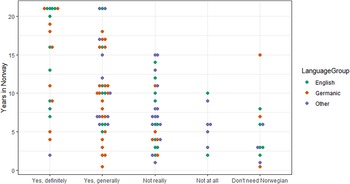
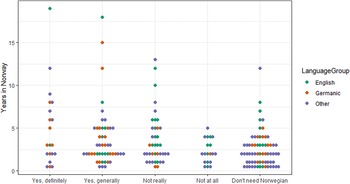
We investigated the extent to which length of residence (LoR) in Norway and L1 relate to SPCCW. The variable ‘L1’ was based on responses to an open-ended question asking participants to report on their native language(s). We grouped L1s according to general similarity with Norwegian: English (same language family but with marked differences compared to other Germanic languages), non-English Germanic (assumed to be more similar), or Other (assumed to be more different). This grouping also ensured more comparable group sizes. The relationship is visualized for permanent staff in Figure 4 and temporary staff in Figure 5.
Swarm plot showing relationship between permanent staff members’ LoR in Norway, L1, and responses to the question ‘Do you feel that you know enough Norwegian to be able to do your job well?’ (SPCCW).

Swarm plot showing relationship between temporary staff members’ LoR in Norway, L1, and responses to the question ‘Do you feel that you know enough Norwegian to be able to do your job well?’ (SPCCW).

A multiple linear regression analysis was conducted to investigate the relationship between the outcome variable SPCCWFootnote 2 and predictor variables LoR and L1 (analysed as a categorical variable with the levels English, non-English Germanic, or Other). Since English can be argued to represent the middle ground regarding potentially facilitative similarity to Norwegian, as it is Germanic but shows notable differences from the other Germanic languages in grammar and vocabulary, L1 English was set as the reference variable for the categorical variable (see Winter Reference Winter2019). Participants who did not report their L1 and those who reported that they did not need Norwegian for work were excluded from the analysis.
As shown in Table 5, the regression model investigating L1 language group and LoR as predictors for SPCCW was statistically significant, F(3, 219) = 16.48, p < .001. The R2 was 0.17, indicating that this model explained 17% of the variance. There was significant main effect of LoR, and of having a Germanic L1 other than English (p < .001). There was no significant effect of having a non-Germanic L1 compared to having L1 English (p = .969). A likelihood ratio test comparing this model to a reduced model with only LoR as a predictor variable showed that adding L1 significantly improved the model fit, χ2(2), p < .001. The regression estimates are visualized in Figure 6.
Multiple linear regression model of all participants (n = 223) with SPCCW as the dependent variable and L1 category and LoR as the independent variables

Predicted values of SPCCW by LoR and L1 group.

4.4 Activities and practices perceived as contributing to SPCCW
Participants were asked to comment on activities that helped or would help them with learning Norwegian. Through a qualitative analysis of the responses across the two groups, several themes and new codes emerged in every coding phase, and these were eventually grouped into two main themes, both of which are discussed below. Initial codes and themes, like ‘doing sports’, ‘reading novels’, and ‘listening to podcasts’ contributed to the overall theme Input and opportunities for practice, while codes like ‘people speaking slowly’, ‘people being patient’ and their negative counterparts like ‘lack of patience’ contributed to the theme Patience and accommodation from others.
4.4.1 Input and opportunities for practice
Participants who had confidence in their Norwegian skills for work (high SPCCW) tended to report activities that allowed for informal receptive language input, for example watching television and films, reading (e.g. news, novels, comics), as well as listening to the radio and to podcasts. Activities requiring productive skills were also mentioned, particularly engaging in conversation and practising speaking in everyday contexts like shopping, in organized contexts like language cafés, in leisure activities, in work settings, and in settings involving friends and family. Some respondents reported that getting involved in community-based activities through having children in the school system was beneficial for language learning. Interestingly, the vast majority of those who highlighted social activities (e.g. sports, choir, etc.) as valuable for learning were L1 speakers of Dutch and German.
Intentional language learning strategies were mentioned by some with high SPCCW as being valuable to their Norwegian learning process, with formal courses being only one of these approaches, and other tools (e.g. language apps) and methods (e.g. using subtitles when watching TV) were frequently mentioned. Two respondents referred to using a mixture of Norwegian and English in interactions, one in relation to doing fieldwork in rural Norway and one in a teaching context where there was ‘a soft transition from where [students] asked in Norwegian and I answered in English the first year to all the conversations being in Norwegian [which] was super helpful and a blast that everyone was open to this approach’ (ID221).
Participants with high SPCCW tended to report that they had opportunities to practise using Norwegian in the workplace, both in casual (e.g. lunchroom conversations) and more structured (e.g. teaching in Norwegian, using Norwegian at university meetings and with external partners) settings. Many of those with lower SPCCW reported that they wished for more opportunities to practise Norwegian in the workplace. Some mentioned that very few of their colleagues spoke Norwegian, leaving few opportunities to practise. The fear of pressure or judgement when using Norwegian in the workplace was also mentioned by several, with one person reporting a desire for ‘opportunities to try to speak Norwegian without pressure from the workplace and native speakers speaking fast in various dialects’ (ID275).
There was a contrast between what participants with high or low SPCCW reported as helpful learning activities. People with low SPCCW often had a greater focus on formal language training as a potential support for learning, particularly in the form of targeted Norwegian courses (e.g. ‘language courses designed for our purposes: work-related speaking and listening, academic vocabulary, with appropriate workloads … [and] focus on listening abilities, particularly the diverse dialects that our colleagues speak’ (ID044)) or study materials (e.g. ‘already prepared study guides for different domains like medicine, oil and gas, geology’ (ID003)). Participants in this group mentioned fewer informal activities than the participants with high SPCCW, but many reported experiencing insufficient time for language learning, with many expressing a wish for a reduced workload to compensate for time spent taking classes and more time for language learning at work.
4.4.2 Patience and accommodation from others
The benefits of accommodation and patience from others was a common theme, especially among people with high SPCCW. Many respondents commented on the importance of having patient friends or colleagues who were willing to speak Norwegian with them even when English might have been the more efficient or comfortable option for both parties. Several mentioned that they had to be quite insistent on keeping the conversation going in Norwegian: ‘I was stubborn and switched to Norwegian again and again if they answered in English’ (ID231). However, it appeared crucial that the language learner themselves initiated the use of Norwegian in interactions, as many participants reported negative experiences and reduced motivation when colleagues imposed the use of the language: ‘It can be frustrating for me when people know I struggle but insist on talking Norwegian at me when I clearly don’t understand’ (ID159).
Many respondents with low SPCCW expressed frustration about what they perceived as lack of patience and of exclusionary practices in interactions with colleagues. The majority of these comments named use of dialects as the biggest obstacle to being able to use Norwegian as workplace language. Participants commented on the ‘asymmetry of rights’ (ID249) when it comes to language use, for example: ‘little effort is made to accommodate a non-Norwegian speaker … by speaking more clearly or with less slang. Yet, I am always simplifying my words and speak more slowly to Norwegians to make it easier to communicate’ (ID181). One explained that there are two options for interaction: ‘talking in English, or if they talk Norwegian their dialect or language level is difficult and high as much as conversion between me and them cannot happen’ (ID119). Many wished for a middle-ground experience where Norwegian colleagues could be ‘more willing to practice speaking Norwegian with you and speaking more clearly and slowly’ (ID053).
Some comments reflected experiencing that their native Norwegian-speaking colleagues did not seem to demonstrate an understanding of the challenges they were facing or how they could help. For example: ‘My general observation is that native Norwegian speakers expect our English speaking colleagues to learn the language “over night”, so switching to English is a common occurrence if somebody is still learning the language, so there is little help and places where people can improve their language skills’ (ID174). Although many expressed a desire to use Norwegian with colleagues in the workplace, they explained that ‘few have the patience to talk to you’ (ID203) and that some made ‘comments like “I have to do real/proper work now” after practicing Norwegian’ (ID109). Comments from participants with high SPCCW mentioned the benefit of having helpful and patient friends or colleagues to practise with (e.g. ‘friends [who] were willing to patiently put up with me using bad Norwegian, despite their English being impeccable’ (ID207)).
5. Discussion
This study aimed to explore individual and contextual factors and practices that are associated with self-perceived communication competence for the workplace (SPCCW) in a HEI context. We found that SPCCW is connected both to aspects of language proficiency and workplace practices. The vast majority of our participants reported having undergone Norwegian language training, including temporary staff for whom there is no mandatory language training requirement. Among permanent staff, for whom certification of B2 proficiency level is required within three years, participation in formal training was almost universal, with most reporting completion of courses at B2 level or higher. It is therefore interesting in itself that 36% of permanent and 31% of temporary staff responded that they did not know enough Norwegian to do their jobs effectively. Furthermore, 25% of those who had completed courses at B2 level or higher still did not feel that they knew enough Norwegian for their work context. This likely reflects the fact that a B2 level of proficiency is not sufficient for the language demands of a HEI environment, where both academic discourse and involvement in administrative and leadership responsibilities require a high level of fluency (see e.g. Gujord et al. Reference Gujord, Molde, Olsen and Wunderlich2022b). Language proficiency, both actual and perceived, has been shown to be a limiting factor in contributions to meetings, competence perception, and completion of tasks (Li et al. Reference Li, Connie Yuan, Bazarova and Bell2019, Holmes & Salö Reference Holmes and Salö2025), and is important for career development and inclusion (Busby et al. Reference Busby, Dahl, Listhaug, Nygård and Angelsen2026). Ensuring that all members of a team feel able to contribute in a work environment is essential for the success of the workplace overall (Li et al. Reference Li, Connie Yuan, Bazarova and Bell2019), and understanding factors that contribute to promoting the use of Norwegian in academic settings is important for meeting the goals of language policies (e.g. Ministry of Education and Research & Ministry of Culture and Equality 2023). Therefore, we will discuss factors that emerged from our data as important for reported SPCCW.
5.1 Relationship between SPCCW and language proficiency
The concept of ‘knowing enough’ of an L2 for a particular purpose is complicated but important. As illustrated in Figure 2, there seems to be a relationship between reported formal language training and SPCCW, yet we also saw that some respondents reported having high confidence despite little training and some having low confidence after even C1/C2 level training. Although there was a significant relationship between specific self-reported skills in L2 Norwegian and overall SPCCW, the regression model showed that it only explained around half of the variance for permanent and only 30% for temporary staff, which indicates that feeling linguistically competent for work cannot be explained by language proficiency alone. Previous research has also found a complex relationship between language proficiency and confidence (Ghafar Reference Ghafar2023). Some participants reported feeling high SPCCW despite limited formal training, which may reflect the demands of their specific workplace since some reported that few of their colleagues spoke Norwegian. It could also reflect an adaptation of their professional responsibilities to align with their language skills; it is possible that without language barriers, they may have chosen or been asked to take on different or more linguistically demanding tasks (see discussion in Busby et al. Reference Busby, Dahl, Listhaug, Nygård and Angelsen2026, and Holmes & Salö Reference Holmes and Salö2025).
Furthermore, the analysis for permanent staff indicated that self-reported productive skills were a significant predictor of feeling one’s Norwegian skills were sufficient. For temporary staff, self-reported receptive skills emerged as a significant predictor for whether participants felt they had sufficient Norwegian skills to do their jobs well. A likely explanation for these findings is that there is a difference in language needs between the two groups. English tends to be an option for everyday academic practice, such as research, teaching, and supervision, while Norwegian is the default for higher-level meetings and institutional business of an administrative nature (Gujord et al. Reference Gujord, Molde, Olsen and Wunderlich2022a, Jeong & Lindemann Reference Jeong and Lindemann2024, Busby et al. Reference Busby, Dahl, Listhaug, Nygård and Angelsen2026). Temporary staff are likely to need Norwegian for attending staff meetings or reading written information and so get by well with receptive skills. This is also reflected by the fact that as many as 34% of temporary staff report that they do not feel they need Norwegian for their job. Permanent staff, on the other hand, are usually expected to use Norwegian to actively participate in meetings, conduct teaching-related activities, and write emails, reports, and applications. Furthermore, it is not unlikely that productive skills are more connected to language anxiety (Christianson & Deshaies Reference Christianson, Deshaies, Dressman and William Sadler2019), particularly for academic staff for whom success is connected to clear, precise, and eloquent language, and where perceived demand for proficiency is high. For instance, Arum (Reference Arum2024a) explains that one of her interviewees’ avoidance of writing in Norwegian stemmed from a fear of losing professional prestige. Comments about a desire for opportunities to practise without pressure and judgement in our data indicate that language anxiety may hinder the development of productive skills in particular.
5.2 The impact of language background and opportunities for practice
This study found that having a (non-English) Germanic first language (Dutch, German, or Icelandic) was a significant predictor of feeling professionally competent in Norwegian, whereas having English or a non-Germanic language as L1 was not. Only one Germanic L1 speaker selected the lowest SPCCW option (‘not at all’), which likely reflects the facilitative effect of the similarity between these languages (Odlin Reference Odlin1989, Hirosh & Degani Reference Hirosh and Degani2018). While English is structurally quite similar to Norwegian, differences in grammar and in its highly Latinized vocabulary may limit positive transfer. However, it is likely that language learning experiences also play a role. Firstly, L1 English speakers often have less prior L2 learning experience compared to others who have learned, at least, English, which may affect both their confidence and communicative strategies (e.g. Cenoz Reference Cenoz2013). This limited previous L2 experience may also mean that L1 English speakers are less used to having to express themselves in a language which they have not completely mastered compared to those who are already used to doing this in L2 English, which may lead to lower confidence in L2 Norwegian for L1 English speakers regardless of objective proficiency levels. Additionally, in most interactions, L1 English speakers can choose between using their native language or a language they may struggle with, whereas L2 English speakers must choose between two L2s and are not necessarily more comfortable in English than in Norwegian. Thus, L1 English speakers’ interactions may more often take place in English, consequently limiting opportunities for practising Norwegian.
The regression analysis also found that length of residence in Norway was a significant predictor for SPCCW; participants with longer LoR were more likely to report high SPCCW. This relationship is probably largely explained by having had more opportunities for input and practice in L2 Norwegian, but comments from the open questions also suggested that sociocultural integration (see Hammer Reference Hammer, Beacco, Krumm, Little and Thalgott2017), for example being involved in community-based activities like sports clubs or choirs, and feeling a sense of stability and connection to the local community also played an important role and helped with investment in the language (see Gearing & Roger Reference Gearing and Roger2018). Participation in social activities in Norwegian and having community or family connections were often reported as having been important in contributing to language acquisition among those who reported high SPCCW. This fits with previous research showing that informal activities play an important role in language acquisition (e.g. Dressman & Sadler Reference Dressman and William Sadler2020). However, it is interesting to note that these comments came almost exclusively from L1 speakers of German or Dutch. Given that these languages’ backgrounds were found in our analysis to be beneficial for SPCCW (Table 5), it is possible that potential advantages in terms of facilitative transfer and intercomprehension could lead to something like a Matthew effect (Stanovich Reference Stanovich1986) where higher proficiency leads to access to more opportunities for improving proficiency. Similarities in culture between Germanic language speaking countries could also play a role in reducing culture shock and helping with sociocultural integration (Hammer & Dewaele Reference Hammer, Dewaele, Lundell and Bartning2015). Conversely, the opportunity to use Norwegian in social settings may be limited when language barriers are greater, especially for newly arrived staff who do not yet have a (Norwegian-speaking) social network (Arum Reference Arum2024a).
Given the importance of interaction for the development of second-language competence via specific processes such as negotiation for meaning, clarification requests, feedback, and recasts (Lantolf Reference Lantolf, Gass and Mackey2013, Mackey et al. Reference Mackey, Abbuhl, Gass, Gass and Mackey2013), language switches to English as a common strategy in the face of communication breakdown necessarily limits opportunities for the development of proficiency in Norwegian. Participants’ reports of having to insist on speaking Norwegian also reflect the ‘circular paradox’ (Gearing & Roger Reference Gearing and Roger2018:166) of acceptance into a language community, whereby learners need opportunities to practise in order to learn, but these opportunities only arise once a certain proficiency level is reached. As one participant noted, ‘use of Norwegian is generally eschewed in favour of English for expedience… [which] means many employees are not acquiring Norwegian as they might in other workplaces’ (ID100). These findings are also in line with those of Gujord et al. (Reference Gujord, Molde, Olsen and Wunderlich2022b), and reflect the same issues that have been discussed regarding language practices in other Nordic countries (Kuteeva et al. Reference Kuteeva, Kaufhold and Hynninen2020, Salö Reference Salö2022, Solin & Pienimäki Reference Solin, Pienimäki and Bonacina-Pugh2024).
Choosing to use a language with which one has limited proficiency or confidence can be a difficult choice in a professional context, especially since the primary objective of workplace interactions is typically task completion rather than language learning (Firth Reference Firth2009, Kurhila et al. Reference Kurhila, Kotilainen and Lehtimaja2023, Arum Reference Arum2024a). The high level of language precision required in academic settings could also impact language choices, as participants reported a fear of being judged by colleagues or not being able to fully express themselves, which is likely linked to a fear of losing professional and social prestige and power (Arum Reference Arum2024a). The potential for using English, especially given its high status in HEI contexts, could limit opportunities for informal language learning in the workplace, at least until proficiency is quite high, meaning that opportunities to practise Norwegian may have to be found in settings other than the workplace (Arum Reference Arum2024a). Our findings thus call for HEIs to systematically provide informal learning arenas in the workplace to supplement formal language courses.
In addition to taking Norwegian language classes, most participants mentioned working actively with language learning activities in their own time, indicating that they feel that learning Norwegian is important to them, and that they understand the importance of practice and informal language learning (Dressman & Sadler Reference Dressman and William Sadler2020). This motivation is an interesting contrast to studies in other settings such as Estonia (Soler & Rozenvalde Reference Soler and Rozenvalde2024) and South Korea (Gearing & Roger Reference Gearing and Roger2018), where people expressed being unmotivated or uninterested in learning the local language since they believed (or had experienced) that English was sufficient for daily life. While adult language learning often takes place largely in an instructed setting, learning to use the language proficiently depends on using the language in everyday life situations (Arum Reference Arum2024a). Those who reported lacking confidence in their language skills were more likely to report that they would need more formal language training to gain the skills they need for the workplace. In many cases, this likely reflects a (perceived) need to learn the basics as a prerequisite for participation in other activities; the percentage of participants with low SPCCW was, after all, higher among those with little formal training compared to those with more formal training. This could imply that those with lower Norwegian proficiency did not fully realize the importance and usefulness of informal language learning. However, it could also reflect that those who had a good foundation for Norwegian learning (e.g. from formal training or a similar L1) were more able to take advantage of opportunities to develop language skills further through activities that led to informal language learning.
5.3 Limitations and suggestions for future research
Although the goal of this study was to investigate individual and contextual factors related to self-perceived L2 competence in an HEI setting, our understanding of this topic could be deepened by future studies which investigate aspects of measured L2 proficiency or performance in the workplace for comparison. Our analysis is mainly based on responses to a single question as a measure of SPCCW which, as illustrated by our findings, is a complex topic which could be investigated in more detail by the use of a scale consisting of multiple items to tap into SPCCW for different workplace tasks or situations. It should also be noted that our sample consisting mainly of participants with a European language (and presumably cultural) background is not necessarily representative of all international staff, either at this HEI or more broadly, so the findings have limited generalizability in a broader context and should be interpreted with appropriate caution. Given that all prior languages, and language learning experiences, not only L1, are likely to influence acquisition, future research should also include this as a factor.
6. Conclusion
Overall, our findings highlight how SPCCW in a Norwegian HEI context depends partly on factors more or less outside of the individual learner’s control, including L1, length of residence, the language required for work tasks, and accommodation from colleagues. In line with previous research, we see that language learning takes time and is affected by linguistic (and possibly cultural) background, and possibly also prior L2 learning experience. Social activities that led to opportunities for practice with patient interlocutors were reported as beneficial. The fact that these activities were reported most often by those with a linguistically and culturally similar background suggests that familiarity with and sense of belonging in a place might play a role in the desire to seek out these types of activities and/or acceptance from locals. In workplace settings, many mentioned the willingness or ability of their colleagues to use and adapt to a more learner-friendly communication style (even when English may have been more efficient) as a key factor in feeling comfortable (or otherwise) with using Norwegian in the workplace. Overall, our findings add to previous research suggesting that the language skills needed for a workplace are most likely to be acquired when people feel comfortable and connected to a community, which seems to be more strongly associated with factors related to inclusion in community than with formal training alone. Although a focus on formal language training is often raised in discussions relating to ensuring the continued use of Norwegian as a language of HEIs, increasing awareness of the importance of patience, accommodation, and individual differences in language learning is likely to be more beneficial overall, both for language use and sociocultural integration. This underlines how language learning in the workplace is a responsibility not only of the learner, but of the entire community. As such, our findings may inform the operationalization of language policies in HEIs, particularly in the Nordic context.
Author contributions
All authors were involved in the conceptualization and design of the study, data collection, and discussion of findings. NB, AD, and GN were responsible for writing the introduction, methods, and discussion. NB conducted the quantitative analysis and data visualization, and AA and NB had the main responsibility for the qualitative analysis. All authors were involved in revising the final manuscript.
Competing interests
The authors declare none.




 Open access

