





Introduction
Developmental language disorder (DLD) is typically diagnosed in children with major language impairments, despite having typical nonverbal intelligence and no apparent neurological or sensory dysfunction (Bishop et al., Reference Bishop, Snowling, Thompson and Greenhalgh2017). These language impairments often have negative and long-lasting effects on education, work experience, and independent living skills (Dubois et al., Reference Dubois, St-Pierre, Desmarais and Guay2020). According to a meta-analysis, children with DLD have poorer theory of mind (ToM) capabilities relative to their age-matched counterparts with typical language development (TLD; Nilsson & de López, Reference Nilsson and De López2016). Multiple studies have explored concepts related to ToM in children with DLD during their early childhood because early childhood is regarded as a key period for the rapid development of ToM (Eggum et al., Reference Eggum, Eisenberg, Kao, Spinrad, Bolnick, Hofer, Kupfer and Fabricius2011). Research has also indicated a strong correlation between ToM capabilities and key social competencies, including social skills, peer acceptance, and cooperativeness (Slaughter et al., Reference Slaughter, Imuta, Peterson and Henry2015). Therefore, examining the mechanisms underlying ToM impairments in children with DLD may facilitate the establishment of effective interventions for these children.
Proposed by Baron-Cohen et al. (Reference Baron-Cohen, Leslie and Frith1985), ToM refers to the cognitive ability to conceptualize and comprehend mental states, including emotions, motivations, and beliefs. ToM is about having an understanding that other people have cognitive (cognitive ToM, including beliefs, intentions, desires, and knowledge) and affective (affective ToM, including emotional understanding) (Schwartz Offek & Segal, Reference Schwartz Offek and Segal2022) states that are different from one’s own. Additionally, the use and comprehension of emotional-state language, specifically the understanding of emotional terms (UET), refers to emotional-state terms primarily related to interpersonal processes, the relationship between oneself and others, and the understanding of the social world (Ornaghi & Grazzani, Reference Ornaghi and Grazzani2013). ToM gradually develops throughout childhood. It begins with milestones such as joint attention during infancy and progresses with intentionality and pretend play during toddlerhood (Shaw et al., Reference Shaw, Bryant, Malle, Povinelli and Pruett2017). Concepts such as false beliefs and emotional comprehension, acquired during preschool age, continue to develop into later childhood and adolescence (Lonigro et al., Reference Lonigro, Laghi, Baiocco and Baumgartner2014). Therefore, ToM is a complex developmental phenomenon (Dvash & Shamay-Tsoory, Reference Dvash and Shamay-Tsoory2014; Fu et al., Reference Fu, Chen, Liu, Jiang, Hsieh and Lee2023).
ToM development is influenced by biological factors such as maturation (Nijssens et al., Reference Nijssens, Luyten, Malcorps, Vliegen and Mayes2021) and neural development (Nilsson & de López, Reference Nilsson and De López2016). Furthermore, girls and women tend to have stronger ToM abilities relative to their boys and male counterparts (Greenberg et al., Reference Greenberg, Warrier, Abu-Akel, Allison, Gajos, Reinecke, Rentfrow, Radecki and Baron-Cohen2023). This developmental process where a child comes to have ToM primarily relies on early sensitive and coregulatory interactions with caregivers; this influence is determined by factors such as attachment quality, mental state talk, parental sensitivity to children’s mental states, parental expressions of emotion, parenting style, and experiences of abuse and neglect (Pavarini et al., Reference Pavarini, De Hollanda Souza and Hawk2013). Higher socioeconomic status is associated with stronger ToM development in relation to these factors (SES; Ebert et al., Reference Ebert, Peterson, Slaughter and Weinert2017). In this study, we examined how the development of ToM varies across multiple dimensions in children with DLD. We also explored how environmental factors, such as social learning, influence the development of ToM.
Children’s ToM and parental reflective functioning
Multiple studies have examined the positive effect of parental mentalisation on the development of children’s ToM (Ensink & Mayes, Reference Ensink and Mayes2010). Parental mentalisation is a umbrella concept that includes relevant mentalising components such as mind-mindedness, parental mental state talk, and parental reflective functioning (PRF; Schiborr et al., Reference Schiborr, Lotzin, Romer, Schulte-Markwort and Ramsauer2013). We focused on PRF in this study. PRF refers to the ability of parents to reflect on their own internal mental experiences and those of their children (Luyten et al., Reference Luyten, Campbell, Allison and Fonagy2020). This capacity for reflection involves understanding that the behavior of one’s children is driven by their underlying mental states, including their thoughts, feelings, desires, and intentions; this understanding allows the parent to represent their child’s mental state in everyday scenarios (Luyten et al., Reference Luyten, Campbell, Allison and Fonagy2020), which is a prerequisite for sensitive parenting (Pajulo et al., Reference Pajulo, Pyykkönen, Kalland, Sinkkonen, Helenius, Punamäki and Suchman2012).
Are there differences in the reflective functioning of parents of children with DLD and TLD? Children with developmental disabilities often struggle to express their thoughts and emotions, which in turn affects their ability to articulate their cognitive (e.g., wanting something) and affective (e.g., feeling sad) mental states (Gur et al., Reference Gur, Hindi, Mashiach, Roth and Keren2023). Parents of children with DLD often report conflicts with their child around a variety of noncompliant behaviors, potentially arising from their child’s inability to vocalize their thoughts and emotions (Spiliotopoulou, Reference Spiliotopoulou2005). Because of their child’s developmental limitations, parents of children with DLD cannot gather sufficient information from their child’s behavior and language over an extended period to engage in reflective functioning, which in turn makes them less interested in their child’s inner world (Flores-Buils & Andrés-Roqueta, Reference Flores-Buils and Andrés-Roqueta2022; Klatte et al., Reference Klatte, Harding and Roulstone2019; Ordway et al., Reference Ordway, Webb, Sadler and Slade2015). Moll and Krishnan (Reference Moll and Krishnan2025) also propose that the characteristics of the child can affect how parents react (through evocative gene-environment interactions), which can in turn shape the trajectory of the child’s development. In addition, parents of children with disabilities often face difficulties in adjusting their perceptions after receiving their child’s diagnosis (Feniger-Schaal & Oppenheim, Reference Feniger-Schaal and Oppenheim2013). These difficulties may make the parent less sensitive to their child’s mental state, resulting in the parent interpreting behavioral signals incorrectly and responding inappropriately. This lack of information affects their sensitivity and responsiveness to their child, thereby posing major challenges in fostering a supportive environment for the development of ToM.
Proposed by Luyten et al. (Reference Luyten, Mayes, Nijssens and Fonagy2017), the Parental Reflective Functioning Questionnaire (PRFQ) is a tool for measuring PRF across three key dimensions. The first dimension is prementalisation (PM). This involves the parent’s thought patterns and involves formation of maladaptive attributions regarding their child or an inability to mentalise their child’s inner world. The second dimension is termed certainty of mental state (CM), which refers to the parent’s varying levels of certainty regarding their child’s mental states. This dimension ranges from a tendency for parents to be overly confident regarding their child’s mental states (i.e., failing to recognize the opacity of mental states), which reflects intrusive mentalising or hypermentalising, to hypomentalising, which is characterized by an almost complete lack of certainty among parents regarding their child’s mental states. The third dimension is interest and curiosity (IC), which refers to the parent’s interest in understanding their child’s internal experiences and perspectives, reflecting their willingness to understand their child “from the inside out.” A lack of genuine IC in a child’s mental state may be linked to either hypomentalisation or hypermentalisation.
Parental stress as a mediator between PRF and children’s ToM
According to the PS model of Abidin (Reference Abidin2012), PS factors can be divided into three main domains by whether they involve 1) the child, 2) the parent, or 3) life events or the family’s situation. Stressors in the child domain include temperament and behavior (difficult child [DC]) and how parents perceive and interact with their children (parent–child dysfunctional interaction [P-CDI]). The parent domain, which includes parental distress (PD), involves parental functioning and emotions such as guilt and depression. This domain also includes situational stressors such as spousal health, isolation, and role restriction.
In parents of children with health conditions, stress may arise from one of multiple factors, including the characteristics of the child, the parental perceptions of the child’s health problems, the characteristics of the parents, and the family’s situation (Golfenshtein et al., Reference Golfenshtein, Srulovici and Medoff-Cooper2015). Parents of children with DLD often report higher levels of parental stress (PS) compared with those of children with TLD (Craig et al., Reference Craig, Operto, De Giacomo, Margari, Frolli, Conson, Ivagnes, Monaco and Margari2016). This stress is linked to the characteristics of children with DLD, such as their behavioral or communication problems (Spiliotopoulou, Reference Spiliotopoulou2005; Vermeij et al., Reference Vermeij, Wiefferink, Knoors and Scholte2019), and difficulties in parent–child interactions. In other words, parents of children with DLD often experience anxiety, discomfort, and a sense of parental incompetence in relation to their children.
Few studies have examined the correlation between PS, PRF, and ToM in children with DLD, in children with TLD, and in children within this spectrum. According to the literature, PS negatively affects a parent’s ability to adapt to developmental delays (DDs) in their children, which in turn adversely affects the well-being of these children (Chan & Neece, Reference Chan and Neece2018). Interventions targeting PS in parents of children with DDs are designed to effectively reduce PS and mitigate emotional and behavioral problems in children (Dennis et al., Reference Dennis, Neece and Fenning2018; Kakhki et al., Reference Kakhki, Mashhadi, Yazdi and Saleh2022). In children of preschool to early elementary school age, PS mediates the negative association between PRF and socioemotional development (Krink et al., Reference Krink, Muehlhan, Luyten, Romer and Ramsauer2018; Malcorps et al., Reference Malcorps, Vliegen, Fonagy and Luyten2022). Nevertheless, studies have yet to examine PS as a mediator between PRF and children’s ToM while accounting for the language skills of children.
The present study
This study had three objectives. The first objective was to examine concepts related to ToM in children with DLD from multiple dimensions, including cognitive ToM, affective ToM, and UET. ToM performance may be influenced by maturation (Nijssens et al., Reference Nijssens, Luyten, Malcorps, Vliegen and Mayes2021), the sex of the child (Greenberg et al., Reference Greenberg, Warrier, Abu-Akel, Allison, Gajos, Reinecke, Rentfrow, Radecki and Baron-Cohen2023), and the SES of the family (Ebert et al., Reference Ebert, Peterson, Slaughter and Weinert2017). Therefore, we hypothesized that cognitive ToM, affective ToM, and UET would be lower in children with DLD than in those with TLD, even with age, sex, and family SES adjusted for.
The second objective was to examine PRF and PS among children with DLD. Parents of children with DLD often struggle to understand their child’s mental states because of the challenges that DLD brings (Gur et al., Reference Gur, Hindi, Mashiach, Roth and Keren2023). Additionally, an inability to adjust to one’s child’s diagnosis of DLD can hinder the parent’s ability to engage in PRF (Feniger-Schaal & Oppenheim, Reference Feniger-Schaal and Oppenheim2013). In this study, we hypothesized that parents of children with DLD would not be able to accurately understand their children’s thoughts and feelings, often interpreting them negatively (increased PM). Furthermore, these parents would have lower IC and greater certainty regarding their children’s mental states compared with parents of children with TLD, even with age, sex, and family SES controlled for. In addition, consistent with previous PS studies (Craig et al., Reference Craig, Operto, De Giacomo, Margari, Frolli, Conson, Ivagnes, Monaco and Margari2016; Spiliotopoulou, Reference Spiliotopoulou2005; Vermeij et al., Reference Vermeij, Wiefferink, Knoors and Scholte2019), we hypothesized that parents of children with DLD would report higher PS compared with those of children with TLD because of the unique characteristics of their children, even with age, sex, and family SES adjusted for.
The third objective was to explore the correlations between the dimensions of PRF and children’s ToM and to determine whether these correlations are mediated by PS, specifically PD, P-CDI, and DC characteristics. We hypothesized that low levels of PRF, particularly low CM and IC or high PM, would be negatively correlated with high levels of children’s ToM. In addition, when PS is the mediator, we hypothesized that PS would mediate the relationship between PRF and children’s ToM.
Methods
Participants
A total of 80 children aged 4–7 years and their parents participated in this study. All children attended preschools and primary schools in northern and central Taiwan and were native Mandarin Chinese speakers, as were their parents. The sample comprised 40 children with DLD (27 boys, mean age = 6.01 years, standard deviation [SD] = 0.06) and their parents (33 mothers, mean age = 40.00 years, SD = 5.61) and 40 children with TLD (22 boys, mean age = 6.70 years, SD = 0.24) and their parents (34 mothers, mean age = 37.35 years, SD = 4.34). Children with DLD were on average younger than those with TLD (t(78) = 6.72, p < .001), whereas the parents of children with DLD were older than those of children with TLD (t(78) = 2.35, p = .021). No significant differences were observed between the two groups in terms of their sex distribution, whether for the children or parents (χ2(1) = 1.32 and .092 for children and parents, respectively, p > .05). In the following sections, we outline the inclusion and exclusion criteria for children with DLD and TLD.
DLD group
Children with DLD were recruited from parenting websites, child psychotherapy clinics, speech and language pathology clinics, and an early intervention center. Diagnoses of DLD were established by child psychiatrists at the Interdisciplinary Assessment Center for Children Development, Ministry of Health and Welfare of Taiwan, following relevant Diagnostic and Statistical Manual of Mental Disorders, Fifth Edition (DSM-5) (American Psychiatric Association, 2013) criteria. This center is the official institution responsible for evaluating and identifying developmental disorders in children younger than 7 years.
In Taiwan, DLD is diagnosed in an interdisciplinary manner by child psychiatrists, pediatrician, child physiatrist, speech and language pathologists, clinical psychologists, occupational therapists, and physical therapists. Each clinician or therapist bases their evaluations and judgements on parental reports, behavioral observations, and standardized tests that are administered with reference to the child’s age. DLD is diagnosed according to the DSM-5 criteria, which define the condition as one of persistent difficulties in the use of language stemming from deficits in receptive or expressive language. These difficulties must not be attributable to auditory or other sensory impairments, motor developmental disorders, neurological problems, intellectual disabilities, or global DDs.
Of all children with DLD, 17 (42.50%) had comorbidities (2 with developmental coordination disorder and attention deficit hyperactivity disorder, 4 with attention deficit hyperactivity disorder alone, 8 with developmental coordination disorder alone, 1 with a learning disorder, and 2 with social and emotional problems). None of the children had any hearing impairments. In terms of early interventions, 13 children (32.50%) had received services from physical therapists, 37 children (92.50%) had received services from occupational therapists, 37 children (92.50%) had received services from speech and language pathologists, and 9 children (22.50%) had received services from clinical psychologists, all from a young age. None of the parents had any clinical problems, such as cognitive disorders, mood disorders, or physical diseases.
TLD group
Children with TLD were recruited from parenting websites. These children exhibited typical development with respect to cognition, language, fine motor skills, and gross motor skills, with no apparent neurodevelopmental or neurological disorders or hearing impairments. None of the parents had any clinical problems, such as cognitive disorders, mood disorders, or physical diseases, either.
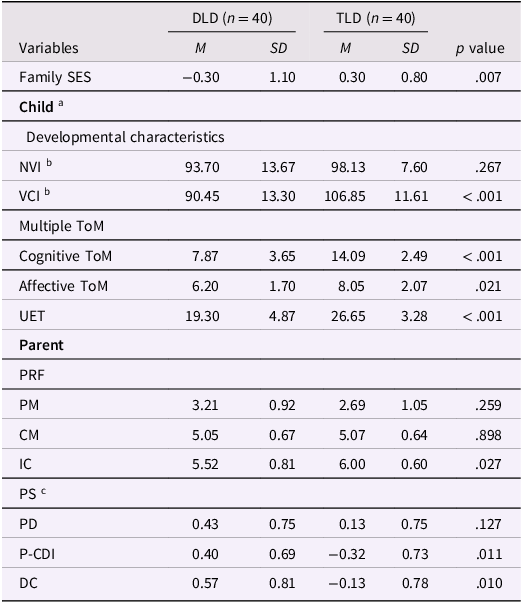
Family SES was indicated by educational attainment and monthly income; data on these two attributes were self-reported by the parent. A combined family SES indicator, with higher scores representing higher SES, was derived from a principal component analysis, following the method of Caro and Cortés (Reference Caro and Cortés2012). Family SES was lower in the DLD group than in the TLD group (t(78) = 2.79, p = .007; DLD: mean family SES = −0.30, SD = 1.10; TLD: mean family SES = 0.30, SD = 0.80). Parental educational levels and monthly income levels in the sample are outlined in Appendix 1. One-way analysis of covariance (ANCOVA) was conducted with family SES as a covariate for the Nonverbal Index (NVI) and Verbal Comprehension Index (VCI). Both groups did not differ significantly in the NVI (p > .05; DLD: mean NVI = 93.70, SD = 13.67; TLD: mean NVI = 98.13, SD = 7.60), but children with DLD had lower VCI performance relative to children with TLD (F(1, 77) = 25.88, p < .001, η p 2 = 0.26; DLD: mean VCI = 90.45, SD = 13.30; TLD: mean VCI = 106.85, SD = 11.61).
The two groups were compared in subsequent analyses, with only age and family SES controlled for. Sex was not controlled for because of the lack of any significant sex difference between the groups, whether for children or parents. Correlations and the mediating effect of parenting stress were also analyzed with age, sex, and family SES controlled for.
Measures
Children’s nonverbal and verbal capabilities
The nonverbal and verbal comprehension capabilities of the children were evaluated using the Mandarin Chinese versions of the NVI and VCI, respectively, of the Wechsler Preschool and Primary Scale of Intelligence, Fourth Edition (WPPSI-IV; Chen & Chen, Reference Chen and Chen2013). The internal consistency reliability of each subscale ranges from .80 to .96, and the test-retest reliability ranges from .92 to .98. This scale is designed to evaluate children aged 2 years and 6 months to 7 years and 11 months.
Children’s ToM
The children’s cognitive ToM, affective ToM, and UET were investigated.
Cognitive ToM. We used the verbal task of the ToM subtest from the NEPSY-II battery (Korkman et al., Reference Korkman, Kirk and Kemp2007) to evaluate cognitive ToM. The ToM subtest has adequate to high internal consistency (0.76–0.84; Davis & Matthews, Reference Davis and Matthews2010 ). In this task, children are presented with a series of images and asked to listen to a series of stories about the experiences of others. Subsequently, they are asked to provide responses indicating their understanding of the main character’s point of view. This task has primary false belief as one of its items. It comprises 15 items: 1 item worth 0–3 points, 5 items worth 0–2 points each, and 9 items worth 1 point each. Thus, the total raw scores range from 0 to 22.
Affective ToM. We used the contextual task of the ToM subtest from the NEPSY-II battery (Korkman et al., Reference Korkman, Kirk and Kemp2007) and the Test of Emotion Comprehension (TEC; Pons et al., Reference Pons, Harris and De Rosnay2004) to evaluate affective ToM. The TEC was demonstrated in a previous study to have adequate to high internal consistency (0.62–0.77; Cavioni et al., Reference Cavioni, Grazzani, Ornaghi, Pepe and Pons2020). This contextual task comprises six items, with each correct choice assigned a score of 1 point. In this task, children are presented with pictures of social situations and asked to select the image (out of four choices) that best represents the affective state of the protagonist. An example is the protagonist sitting next to a fallen bicycle, with the children asked to choose the most suitable emotion for the protagonist as represented by four faces depicting one of four emotions (i.e., happy, angry, sad, and scared). The TEC has nine components, with a maximum of 1 point awarded for each component. For instance, for the hidden emotion component, children are asked to look at an image and listen to the following phrase: “This is Xiaoqiang, and this is Ming. Xiaoqiang is teasing Ming because Xiaoqiang has lots of marbles and Ming does not have any. Ming is smiling because he doesn’t want to show Xiaoqiang how he is feeling inside.” Subsequently, the experimenter asks the children how Ming actually feels inside. For a comprehensive description of this test and its scoring rules for each component, please refer to Pons et al. (Reference Pons, Harris and De Rosnay2004). In the present study, we used the Mandarin Chinese version of the TEC (Chou & Huang, Reference Chou and Huang2010; Lin, Reference Lin2018). Affective ToM was calculated by summing the raw scores from the contextual task of the ToM subtest and the TEC, resulting in a total score ranging from 0 to 15.
UET. The Emotional Lexicon Test (ELT) is used to evaluate the UET and was demonstrated in a previous study to be valid (Ornaghi & Grazzani, Reference Ornaghi and Grazzani2013). It consists of a series of brief scenarios that are used to evaluate the ability of the child to express emotions linguistically (i.e., their emotional lexicon). This test has adequate to high internal consistency (0.70–0.71) for complex emotional terms (Grazzani et al., Reference Grazzani, Ornaghi and Crugnola2015). Its criterion-related validity scores with the Metacognitive Vocabulary Test and Peabody Picture Vocabulary Test-Revised were reported to be 0.80 and 0.74, respectively (Grazzani et al., Reference Grazzani, Ornaghi and Piralli2011). In each scenario, an event causes the character in a story to have an emotional experience. After the story is read (e.g., “Lingling is in the park. She is on a swing. An older girl goes up to her and says, “Get up! I want to go on it!” She pushes Lingling off and sits on the swing”) and cards with short illustrated stories are presented to the participants, the participants are asked to choose which of two emotional terms best describes the protagonist’s emotional state (e.g., ‘Is Lingling angry or is she happy?’), and they earn 1 point for selecting the correct term (e.g., “Lingling is angry”). Participants who choose the correct term are asked to provide a further explanation for their choice, which is then given a score of 0 (e.g., “I don’t know”), 1 (e.g., “She doesn’t want to play anymore”), or 2 (e.g., “Someone took her swing”) depending on the appropriateness of the explanation. The raw scores for each item range from 0 to 3. This test comprises 14 items, with total raw scores ranging from 0 to 42. In this study, the ELT was translated into traditional Chinese with the permission of the original author, following the guidelines established by the International Test Commission’s International Committee of Psychologists (van de Vijver & Hambleton, Reference Van De Vijver and Hambleton1996).
PRF
In this study, we used the PRFQ (Luyten et al., Reference Luyten, Mayes, Nijssens and Fonagy2017) to measure PRF. This questionnaire comprises 18 items divided into a PM dimension, a CM dimension, and an IC dimension. The PM dimension comprises six items. These items capture prementalising or nonmentalising methods of thinking (e.g., “The only time I’m certain my child loves me is when they smile at me”). A higher score indicates that the participant has greater difficulty in accurately understanding and interpreting their child’s mental state. The CM dimension comprises six items. These items indicate whether a parent is capable of understanding the fact that mental states are not always clear; the presence and absence of such understanding is regarded as indicative of favorable and distorted PRF, respectively (e.g., “I always know why my child acts the way he or she does”). The IC dimension comprises six items. These items measure how interested the parent is in understanding their child’s internal experiences and perspective (e.g., “I try to understand the reasons why my child misbehaves”). High levels of IC indicate excessive interest, whereas low levels of IC indicate a lack of interest in the child’s mental state. Responses are scored on a 7-point Likert scale, with endpoints ranging from 1 (strongly disagree) to 7 (strongly agree). In this study, we used the traditional Chinese version of the PRFQ (PRFQ-TC), which has adequate to high internal consistency (0.70–0.81) and is suitable for Taiwanese individuals (Appendix 2; Lu & Shieh, Reference Lu and Shieh2024).
PS
In this study, we used the Parenting Stress Index–Short Form–Traditional Chinese (PSI-4-SF-TC; Weng, Reference Weng2019) to evaluate caregiver PS and identify problematic areas in the parent–child relationship from birth until the age of 12 years. This 36-item screening tool is designed to capture PD in relation to various aspects of parenting. These aspects include (1) the lack of social support, partner conflict, and manifestations of depression (PD, 12 items, e.g., “I don’t enjoy things as I used to”); (2) feelings of disappointment with and detachment from one’s own child (P-CDI, 12 items, e.g., “My child rarely does things for me that make me feel good”); and (3) challenges encountered while managing the child’s behavior (DC, 12 items, e.g., “My child is very emotional and gets upset easily”). In this study, after the raw scores of these three subscales were converted into percentiles (i.e., into a nominal scale) in accordance with the norms of the Taiwan version., these percentiles were transformed into z-scores (i.e., standardized scores) for PD, P-CDI, and DC by using the cumulative probability of the standard normal distribution. These z-scores were subsequently used in all analyses because they were on an interval scale. The PSI-4-SF-TC subscales had a test–retest reliability score of 0.78–0.85 and an internal consistency score of 0.92–0.95. They were also strongly correlated with the PSI Long Form (Weng, Reference Weng2019).
Procedures
All tests for children in this study were conducted in a quiet room. Before testing, we explained the research procedures to the parents, and we administered the tests after obtaining their written informed consent. These tests typically lasted 1.5–2 hours. In addition, a licensed child clinical psychologist and multiple trained students with a master’s degree in clinical psychology administered the VCI and NVI subscales from the WPPSI-IV and ToM tests. Meanwhile, the parents completed the PRFQ-TC and PSI-4-SF-TC in a separate quiet room. This study was approved by the Research Ethics Committee of XXXX Medical University Hospital, Taiwan.
Data analysis
All statistical analyses were conducted using IBM SPSS Statistics version 26 (IBM, Armonk, NY, USA). We conducted a one-way ANCOVA to examine differences in the scores for cognitive ToM, affective ToM, and UET between children with DLD versus children with TLD while controlling for age and family SES. Subsequently, we conducted another one-way ANCOVA to examine differences in the scores of PRF, including in PM, CM, and IC, and the subcomponents of PS (i.e., PD, P-CDI, and DC), between the parents of children with DLD versus the parents of children TLD while controlling for children’s age and family SES.
PS was examined as a mediator of the relationship between PRF and children’s ToM. To control for potential covariates, age, sex, and family SES were used as covariates in the mediation analyses. The purpose of these mediation analyses was to determine how the PRF and PS dimensions, which differ between parents of children with DLD and those with TLD, contribute to a child’s ToM, which also differs between children with DLD and TLD. Thus, Bonferroni’s correction was applied to mitigate Type I error by adjusting for multiple tests of mediators, with the corrected p value based on the number of PS dimensions being used as the threshold for significance (Armstrong, Reference Armstrong2014; Chen et al., Reference Chen, Wang, Lee and Gardner2023).
In this study, we used the PROCESS macro in IBM SPSS software (version 4.2; Hayes, Reference Hayes2022) given this macro’s advantages over traditional regression techniques (Hayes, Reference Hayes2013). Specifically, this macro can calculate mediator paths while controlling for the variance associated with confounding variables as covariates, allowing it to ensure greater independence among the variables. In our analysis, we used Model 4 (Hayes, Reference Hayes2013) to identify the mediating role of PS in the effect of PRF on children’s ToM. Because of our moderately sized sample, to ensure adherence to assumptions of normality in the analysis, we conducted bootstrapping with a default setting of 5000 resamples (Hair Jr et al., Reference Hair, Ringle, Hult, Ringle and Sarstedt2021) to generate reliable estimates of direct and indirect effects. Bootstrapping is an effective remedial strategy for determining the standard errors and confidence intervals (CIs) of conditional indirect effects (Brown, Reference Brown2015). Bootstrapping does not rely on assumptions regarding the sampling distribution for the indirect effect (Hayes, Reference Hayes2012). In scenarios involving Type I error and power, bootstrapping is suitable for moderately sized samples (N = 50–200) and simple mediation analyses (Schoemann et al., Reference Schoemann, Boulton and Short2017). Compared with Sobel’s test, bootstrapping is more appropriate for evaluating the significance of indirect effects (e.g., path ab) in mediation models (Preacher & Hayes, Reference Preacher and Hayes2004). This technique yields a 95% CI for each indirect effect, with mediation deemed significant if the 95% CI does not include zero (Preacher & Hayes, Reference Preacher and Hayes2008).
We examined whether the data satisfied the assumptions of normality and absence of heteroskedasticity underlying the aforementioned analyses. The results are presented in Appendix 3. The F-test is a relatively robust statistical method that can be used even if these assumptions (e.g. normality and absence of heteroskedasticity) for ANOVA are violated (Blanca Mena et al., Reference Blanca Mena, Alarcón Postigo, Arnau Gras, Bono Cabré and Bendayan2017). In this study, we another provided the results of the Kruskal–Wallis test for the variables that violated these assumptions (Verma, Reference Verma and Verma2019). In addition, for nonnormally distributed variables, we used Spearman’s rank correlation, which is universally robust to nonnormality (Bishara & Hittner, Reference Bishara and Hittner2012, Reference Bishara and Hittner2017), for correlation analyses.
Results
ToM in children with DLD
Table 1 presents the descriptive statistics for cognitive ToM, affective ToM, and UET. Our first hypothesis posits that, compared with children with TLD, those with DLD have lower performance across these multiple dimensions of ToM even with their age and family SES accounted for. The one-way ANCOVA results revealed that children with DLD scored lower than those with TLD did for cognitive ToM, affective ToM, and UET (F(1, 76) = 39.76, 5.52, and 26.47, respectively; p < .001, p = .021, and p < .001, respectively; η p 2 = 0.34, 0.07, and 0.26, respectively). In addition, Kruskal–Wallis tests for cognitive ToM and UET revealed that children with DLD scored lower relative to those with TLD (H(1) = 44.39 and 38.00, respectively, with p < .001 for both).
Descriptive statistics of variables analyzed in this study (N = 80)

a ANCOVA, child age and family SES as covariate variables;
b CS: composite scores, from WPPSI-IV norm;
c standard score (z-score) from PSI-4-SF-TC norm.
PRF and PS in parents of children with DLD
Our second hypothesis posits that parents of children with DLD have lower PRF and higher PS compared with parents of children with TLD even with children’s age and family SES controlled for. Table 1 presents the descriptive statistics of PRF (PM, CM, and IC) and PS (PD, P-CDI, and DC). One-way ANCOVA results indicated the following. With regard to PRF, parents of children with DLD reported lower IC compared with those of children with TLD (F(1, 76) = 5.12, p = .025, η p 2 = 0.06). With regard to PS, parents of children with DLD reported higher P-CDI and DC compared with those of children with TLD (F(1, 76) = 6.85 and 7.07, respectively; p = .011 and .010, respectively; η p 2 = 0.08 and 0.09, respectively). Kruskal–Wallis tests for P-CDI revealed that parents of children with DLD reported higher scores than those reported by parents of children with TLD (H(1) = 16.54, p < .001).
Correlation between PRF and children’s ToM, with PS as a mediator
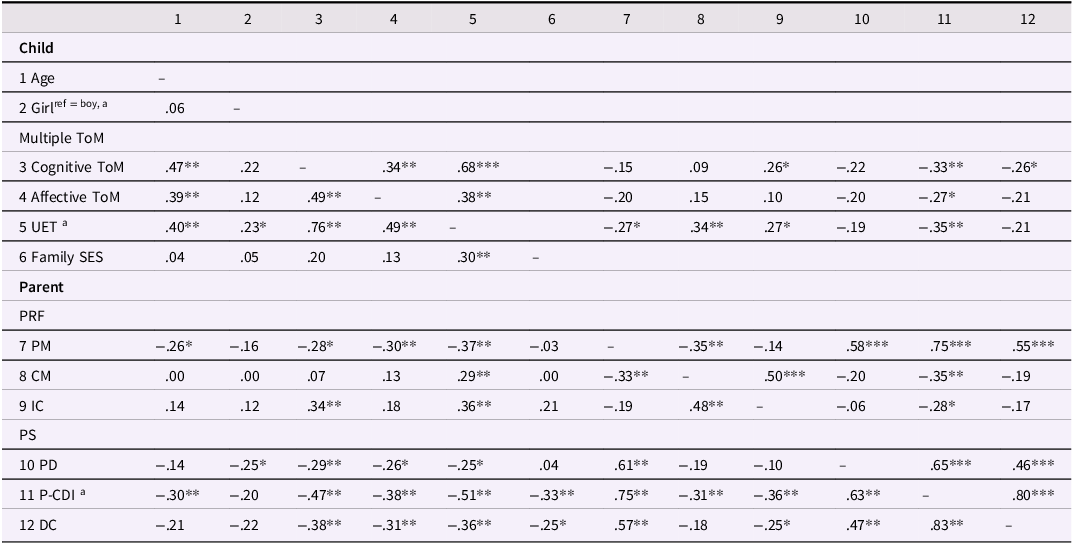
Our third hypothesis posits that PS mediates the relationship between PRF and children’s ToM. Before testing this hypothesis, we explored the correlations between the dimensions of PRF, PS, and children’s ToM. Table 2 lists the partial correlation coefficients of children’s ToM, PRF, and PS, with age, sex, and family SES controlled for. According to the partial correlation coefficients, UET was negatively correlated with parental PM and positively correlated with parental CM and IC (p < .05), whereas cognitive ToM was positively correlated with parental IC (p < .05). Furthermore, P-CDI was negatively correlated with parental CM and IC and with cognitive ToM, affective ToM, and UET (p < .05) and was positively correlated with parental PM (p < .05). In addition, P-CDI, PD, and DC were positively correlated with PM (p < .001), whereas DC was negatively correlated with cognitive ToM (p < .05). Among the three dimensions of PS, P-CDI had the strongest negative correlations with PRF and children’s ToM (all p < .05).
Correlations among the study variables (N = 80)

Note. The results for partial correlation are shown above the diagonal; child age, child sex, and family SES as covariate variables. The results for zero-order correlation are shown below the diagonal. ToM, theory of mind; UET, understanding of emotional terms; SES, socioeconomic status; RF, reflective function; PM, pre-mentalising modes; CM, certainty about mental states; IC, interest and curiosity in mental states; PD, parental distress; P-CDI, parent-child dysfunctional interaction; DC, difficult child.
*p < .05,
**p < .01,
***p < .001.
a Spearman rank correlation.
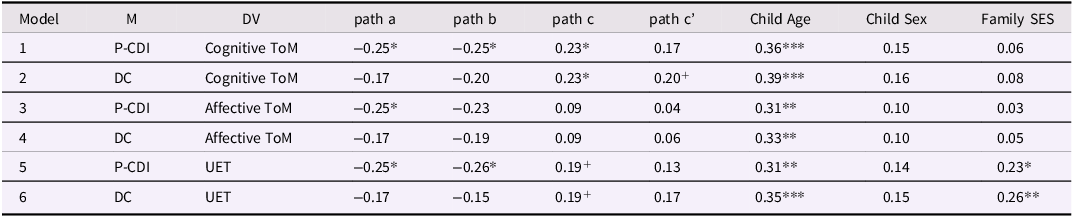
To determine whether the correlation between PRF and children’s ToM, with children’s age, sex, and family SES controlled for, was mediated by PS, a mediation analysis with bootstrapping was conducted. In this mediation analysis, IC was PRF dimension; P-CDI and DC were PS dimensions; and cognitive ToM, affective ToM, and UET were children’s ToM dimensions. Six mediation models were used to examine whether P-CDI and DC mediated the relationship between IC and children’s ToM. The significance threshold was set at p < .025 (.05/2). A p-value between .05 and .025 was considered nominally or marginally significant (Table 3). Models 1 and 5 revealed that P-CDI served as a mediator for the relationships between IC and cognitive ToM and between IC and UET, respectively.
Summary of mediation analysis effects with IC as the predictor: Models 1-6 (N = 80)

M: Mediator, P-CDI: parent-child dysfunctional interaction, DC: Difficult child, DV: Dependent variable, ToM: Theory of mind, UET: Understanding of emotional terms, SES, socioeconomic status. Presented with β. A Bonferroni correction was applied to adjust for multiple testing, setting the significance threshold at p < .025 (*), with additional thresholds at + p < .05, ** p < .01 and *** p < .001.
As shown in Fig. 1(a), Model 1 included IC, P-CDI, and cognitive ToM. After age, sex, and family SES were adjusted for, this model revealed a significant total effect for IC and P-CDI (path a: B = −0.27, 95% CI: [ − 0.49, −0.04], p = .019), P-CDI and cognitive ToM (path b: B = −1.38, 95% CI: [ − 2.54, −0.21], p = .021), and IC and cognitive ToM (path c: B = 1.36, 95% CI: [0.21, 2.51], p = .021). By contrast, the direct effect of IC on cognitive ToM was not significant (path c′: B = 0.99, 95% CI: [ − 0.17, 2.15], p > .05). Hence, P-CDI significantly mediated the relationship between IC and cognitive ToM, as evidenced by a significant indirect effect (path ab: B = 0.37, 95% CI: [0.01, 1.00]).
Mediation analysis for Models 1 and 5 (N = 80). (a) Model 1. (b) Model 5. + p < .05; *p < .025; **p < .01; ***p < .001.

As shown in Fig. 1(b), Model 5 included IC, P-CDI, and UET. After age, sex, and family SES were adjusted for, this model revealed a significant total effect for IC and P-CDI (path a: B = −0.27, 95% CI: [ − 0.49, −0.04], p = .019), P-CDI and UET (path b: B = −1.84, 95% CI: [ − 3.26, −0.42], p = .012), and IC and UET (path c: B = 1.44, 95% CI: [0.03, 2.86], p = .046). By contrast, the direct effect of IC on UET was not significant (path c′: B = 0.96, 95% CI: [ − 0.46, 2.37], p > .05). Hence, P-CDI significantly mediated the relationship between IC and UET, as evidenced by a significant indirect effect (path ab: B = 0.49, 95% CI: [0.04, 1.28]).
Discussion
To the best of our knowledge, this is the first cross-sectional study to examine PRF, PS, and ToM in children with DLD aged 4–7 years. Given that ToM is a key sociocognitive ability linked to effective social adaptation and behavioral regulation, this study explored the development of ToM in children with DLD and examined the correlations between PRF and PS. Overall, this study has several strengths. First, it focuses on how parental abilities (PRF) and states (PS) jointly contribute to a child’s ToM, a crucial component of how the child interacts with others and develop socially. Second, it examines an understudied group, namely children with DLD, elucidating how language impairments may affect basic developmental mechanisms related to ToM. Third, the findings are based on data gathered from multiple instruments and sources, thereby being less at risk of interrater inflation. Overall, three key findings emerged: (a) children with DLD experience impaired development on multiple dimensions of ToM, (b) the parents of children with DLD experience poor PRF and higher PS, and (c) PS mediates the correlations between PRF and ToM in children within the spectrum ranging from language impairments to TLD. In the following subsections, we discuss these findings.
ToM in children with DLD
According to the literature, language abilities are closely associated with the early development of ToM, and inadequate ToM skills are often observed in children with DLD from a young age (Nilsson & de López, Reference Nilsson and De López2016). These findings are consistent with those of our study. Because ToM is a multidimensional construct (Dvash & Shamay-Tsoory, Reference Dvash and Shamay-Tsoory2014; Fu et al., Reference Fu, Chen, Liu, Jiang, Hsieh and Lee2023), we expanded our analysis to include cognitive ToM, affective ToM, and UET. Even after controlling for age and family SES, children with DLD showed lower performance across all three aspects of ToM compared to those with TLD. These findings jointly indicate that children with DLD face difficulties in processing social cues or information to infer others’ mental states, such as their beliefs, thoughts, and motivations, in both emotional and nonemotional contexts. They also indicate that the UET and related concepts among children with DLD are poorer than those of children with TLD.
PRF in children with DLD and its correlation with children’s ToM
In this study, we discovered that parents of children with DLD tended to exhibit low IC in understanding their children’s thought process. Active IC in a child’s mental state is regarded as the most crucial PRF dimension because it reflects high levels of PRF through a desire to understand and acknowledge the complexity of children’s mental states, which are key indicators of healthy PRF (Luyten et al., Reference Luyten, Mayes, Nijssens and Fonagy2017). Why do parents of children with DLD demonstrate less IC in their children’s mental states compared with those of children with TLD? Parents’ interest in their children’s mental states is linked to how satisfied they feel with their involvement and communication with their children (Rostad & Whitaker, Reference Rostad and Whitaker2016). Children with DLD often struggle with language, which prevents them from expressing their own emotions and understanding their parents’ verbal and emotional cues (Bruinsma et al., Reference Bruinsma, Wijnen and Gerrits2024). Additionally, a parent’s inability to adjust to their child’s diagnosis of DLD can hinder their ability to engage in PRF (Feniger-Schaal & Oppenheim, Reference Feniger-Schaal and Oppenheim2013). This limitation may prevent parents from viewing their children as individuals with their own thoughts and emotions (Gur et al., Reference Gur, Hindi, Mashiach, Roth and Keren2023), which may sometimes lead to a lack of IC in how children with DLD process mental states. Nevertheless, further research is required to determine why parents of children with DLD are less interested in or curious about their children’s mental states compared with parents of children with TLD.
Additionally, it is fortunate that parents of children with DLD did not exhibit a non-mentalizing stance, as evidenced by their lack of biased assumptions regarding their children’s internal world. This fact did not lead to less attuned parenting, in which parents’ responses are not instinctive or based on their own emotions or assumptions but rather involve a thoughtful understanding of their children’s internal experiences (Leroux et al., Reference Leroux, Terradas and Grenier2017). Therefore, parents of children with DLD are not prone to prementalising psychic functioning, and they do not struggle while identifying their children’s inner mental state experiences due to alienation from their own mental states.
In the present study, among the three dimensions of ToM, UET exhibited the strongest correlation with PRF. It also exhibited a negative correlation with PM and positive correlations with CM and IC. Parents with higher levels of reflective functioning, who demonstrated IC towards their children’s mental states rather than adopting a nonmentalisation stance, tended to have children who understood emotional terms more extensively and accurately. A positive correlation was observed between cognitive ToM and IC. Overall, parents who were interested in understanding their children’s mental states would be associated not only with their children’s understanding of emotional terms but also with their children’s ability to understand others’ beliefs, thoughts, and motivations in non-emotional contexts. Multiple studies have also supported the mechanism underlying the positive correlation between PRF and children’s ToM (Dinzinger et al., Reference Dinzinger, Ismair, Brisch, Sperl, Deneault, Nolte, Hitzl and Priewasser2023; Kungl et al., Reference Kungl, Gabler, White, Spangler and Vrticka2022; Nijssens et al., Reference Nijssens, Luyten, Malcorps, Vliegen and Mayes2021). For example, higher PRF enables parents to provide more mental state talk to their children during parent–child interactions, thereby enhancing the child’s theory of mind and emotional understanding abilities (Devine & Hughes, Reference Devine and Hughes2019; Nijssens et al., Reference Nijssens, Luyten, Malcorps, Vliegen and Mayes2021).
PS in children with DLD and the correlation between PRF and children’s ToM, with PS as a mediator
As expected, parents of children with DLD reported higher levels of P-CDI and DC compared with those of children with TLD, even with age and family SES controlled for. Specifically, parents of children with DLD expressed dissatisfaction with their children and their interactions, exhibited high levels of disappointment and alienation from their children (P-CDI), and experienced difficulties in caring for their children and managing their behavior (DC). Even with age, sex, and family SES controlled for, P-CDI exhibited the strongest negative correlations with PRF and children’s ToM. Parents who experienced higher levels of stress as a result of dysfunctional interactions with their children reported lower PRF. They also either tended to adopt a nonmentalisation stance towards their children, which hindered their identification of their children’s mental states, or exhibited low IC in understanding their children’s mental states. In addition, the children of parents who experienced high levels of PS due to dysfunctional parent–child interactions exhibited low ToM performance, including difficulties in understanding others’ beliefs, thoughts, and motivations and in acquiring and understanding emotional terms.
We discovered that low PRF was associated with high PS, particularly as a result of P-CDI, leading to diminished ToM in children. Two complete mediation pathways were identified in the present study. We observed that the mediating role of parents’ negative perceived experiences in parent–child interactions fully mediated the effect of parents’ lack of IC on children’s mental states, resulting in a decline in children’s learning and comprehension of others’ thought processes and emotional terms. Low IC may cause parents of children with DLD to engage in negative interactions with their children, leading to low parental satisfaction, low responsiveness, and poor communication (Gordo et al., Reference Gordo, Martínez-Pampliega, Iriarte Elejalde and Luyten2020). This dysfunctional parent–child interaction may also limit the ability of parents of children with DLD to reflect upon their children’s mental states, leading to a reduced use of mental state terms during parent–child interactions. Lee and Rescorla (Reference Lee and Rescorla2008) reported that mothers of preschool-aged children with a history of late talking used fewer cognitive mental state verbs (e.g., ‘think’ and ‘know’) during parent–child play compared with mothers of age- and language-matched children with TLD. Overall, when parents of children with DLD aged 5–7 years have reduced IC in their children’s action-based mental states, they may face increased difficulties in establishing a positive and fulfilling relationship with their children, and they may also develop feelings of disappointment and frustration. Consequently, these parents may face difficulties in providing rich mental state–related verbal or nonverbal stimuli during parent–child interactions, thereby decreasing their children’s opportunities to learn about mental states through social learning, such as mental state talk with parents (Devine & Hughes, Reference Devine and Hughes2019; Nijssens et al., Reference Nijssens, Luyten, Malcorps, Vliegen and Mayes2021).
Vermeij et al. (Reference Vermeij, Wiefferink, Knoors and Scholte2019) observed that PS in parents of children with DLD was associated with behavioral problems, but not language problems, in these children. Furthermore, multiple studies have indicated that inadequate ToM capabilities are associated with behavioral problems in children with DLD (Korkmaz, Reference Korkmaz2011; Slaughter et al., Reference Slaughter, Imuta, Peterson and Henry2015). These findings indicate that the social cognition and behavioral problems of children with DLD are related to PRF and PS. Therefore, interventions targeting this population should focus not only on enhancing these children’s language skills but also on promoting their social cognitive development, which requires addressing the PRF (i.e., IC in their children’s mental states) and PS (i.e., dysfunctional parent–child interactions) of parents of children with DLD.
Overall, our findings underscore the complex relationship between children’s ToM, PRF, and PS among children with DLD and their parents. Our cross-sectional research design, however, precluded causal analysis. Children with poor ToM may face difficulties while interacting with their parents, which can in turn affect their parents’ ability to consider their mental states. Alternatively, parents with low interest in others’ mental states may be unable to reflect upon their children’s mental states, affecting their ability to establish linguistic or nonlinguistic scaffolding, which in turn affects their children’s ToM development. High PS directly reduces PRF and children’s ToM (Cowes & Santelices, Reference Cowes and Santelices2022). These dynamic changes in the effects of various variables on ToM development in children with DLD may differ across the toddlerhood, preschool, school-going, and adolescent stages of development (Rakoczy, Reference Rakoczy2022). Therefore, longitudinal or experimental findings can elucidate the still unknown directionality and temporal evolution of these relationships as part of a transactional model (Sameroff, Reference Sameroff and Sameroff2009).
Gene–environment interactions in early development, such as rs11131149, interfere with maternal cognitive sensitivity to ToM (Wade et al., Reference Wade, Hoffmann and Jenkins2015). Children with a larger number of major allele copies tend to have higher ToM scores when their mothers demonstrate greater cognitive sensitivity. This interaction explains 26% of the variability in ToM, emphasizing the role of gene–environment interactions in early development. Children’s ToM development is influenced not only by maternal speech and mind-mindedness but also by other environmental factors, such as sibling interactions and peer influences (Hughes et al., Reference Hughes, Jaffee, Happé, Taylor, Caspi and Moffitt2005; Hughes & Devine, Reference Hughes and Devine2015). Therefore, exploring the development of ToM in children with DLD through a bio-psycho-social approach in a bioecological context is crucial in the examination of shared genetic factors and environmental influences.
Aival-Naveh et al. (Reference Aival-Naveh, Rothschild-Yakar and Kurman2019) argued that although mentalisation capabilities are basic psychological processes that people have regardless of culture, the expression of such capabilities is highly influenced by culture. For example, cultural norms can shape parental attitudes towards sharing mental states. In Chinese culture, the presence of mental state terms indicates that parents can use these terms to represent their children’s mental states and support their ToM development (Lee et al., Reference Lee, Olson and Torrance1999). By contrast, children in the United States are frequently encouraged to discuss their own feelings and those of others to enhance their emotional understanding and regulation. Ethnic Chinese families tend to emphasize attunement to others’ feelings while encouraging restraint in expressing one’s own emotions as a means to maintain group harmony (Bornstein, Reference Bornstein2013). This approach likely leads to a more frequent use of mental state terms in relational contexts. Future studies should explore how cultural and contextual factors affect parental attitudes towards mental states and the development of ToM in children, particularly children with DLD.
In this study, although our participants were from northern and central Taiwan, most of them were from urban areas, which limited the diversity of our sample. According to the literature, families residing in rural communities often face additional stressors such as poverty, unemployment, and limited educational opportunities, which have a negative effect on their children (Corralejo & Domenech Rodríguez, Reference Corralejo and Domenech Rodríguez2018). In addition, rural communities typically have fewer specialized service providers and are less likely to seek treatment compared with urban communities, which in turn increases the disparity between the care levels provided in rural and urban areas. Consequently, parents of children with DLD residing in rural areas may face parenting stressors different from those observed in urban settings. Notably, our findings regarding ToM, PRF, and PS in children with DLD may not be fully applicable to children with DLD and their parents in rural areas or to the mechanisms of ToM development in children with DLD. Therefore, future studies should include participants from rural areas to better understand these differences.
We conducted a mediation analysis on a sample of 80 participants (N = 80), which is regarded as medium-sized (N = 50–200; Schoemann et al., Reference Schoemann, Boulton and Short2017). We used mediation models with bootstrapping to explore the mediating role of PS in the relationship between PRF and children’s ToM. This approach enables the examination of indirect effects while controlling for covariates (age, sex, and family SES), thereby enhancing the robustness of the mediation analyses (Preacher & Hayes, Reference Preacher and Hayes2004). Nevertheless, our sample size may limit the generalisability of our findings. This limitation is particularly relevant in complex mediation models (e.g., X → M1 → M2 → M3 → Y), which typically require larger samples (N≥200) to detect subtle effects and ensure the stability of estimates (Schoemann et al., Reference Schoemann, Boulton and Short2017). In this study, we conducted a simple mediation analysis, which is suitable for medium-sized samples. Future studies should consider increasing their sample size to improve the statistical power and generalisability of these results.
Conclusion
To the best of our knowledge, this is the first study to explore the correlations between ToM, PRF, and PS in children with DLD. Our findings indicate that children with DLD struggle more with cognitive ToM, affective ToM, and UET compared with those with TLD. Compared with parents of children with TLD, those of children with DLD exhibit lower levels of IC towards their children’s mental states and report higher levels of stress while interacting with and managing their children’s behavior. When parents lack IC in understanding their children’s mental states, they tend to experience additional stress from negative interactions, limiting their ability to help their children understand ToM and emotional terms. These findings have major clinical implications, underscoring the importance of children developing mentalising abilities within their parents’ emotionally attuned interactions under the influence of PRF. These findings also emphasize the need for parent–child interaction programs to address PRF in such interventions. Early intervention is crucial for enhancing children’s ToM development by increasing parents’ interest in their children’s mental states, improving parent–child interactions, and altering parents’ perceptions of their children. Overall, this study supports the complex interplay between child characteristics and parental responses. As noted by Moll and Krishnan (Reference Moll and Krishnan2025), parenting is not a one-way process but rather a dynamic, bidirectional interaction. This approach is also consistent with the bioecological model’s perspective on developmental psychopathology in ToM development among children with DLD (Xia et al., Reference Xia, Li and Tudge2020), emphasizing the importance of early intervention in improving parental emotional functioning (Huber et al., Reference Huber, McMahon and Sweller2016).
Supplementary material
The supplementary material for this article can be found at https://doi.org/10.1017/S0954579425000215.
Data availability statement
The datasets used or analyzed during this study are available from the corresponding author on reasonable request.
Acknowledgements
We thank the participating families and children. We also thank all the research study staff and Chung Shan Medical University for assisting in the research. Additionally, we express our gratitude to the National Science and Technology Council for supporting this study and the publication of this paper.
Author contributions
HHL generated hypotheses and conceptualization, recruited participants, data collection, conducted the analyses, supervised the study, applied the funding, writing – original draft, writing – review & editing. HSH conducted the analyses and prepared tables and figures.
Funding statement
The authors disclosed receipt of the following financial support for the research, authorship, and publication of this article: this work has been funded with a grant to H.-H. Lu from the National Science and Technology Council, Taiwan (NSTC 108-2410-H-040-010-MY3; NSTC 111-2410-H-182-036-MY4).
Competing interests
No potential conflict of interest was reported by the authors.
Ethical standards
The Research Ethics Committee of Chung Shan Medical University Hospital, Taiwan, approved this study (CS2-19046). Informed consent was obtained from all individual participants.


 Open access

