

1 Introduction
The starting point of this study is the well-known agreement asymmetry in Russian quantifier phrases (QPs) involving numerals. With numerals greater than four, the noun appears in Genitive plural form, and if there is an accompanying adjective, the latter agrees with the noun in the relevant features. With numerals dva ‘two’, tri ‘three’ and četyre ‘four’, however, the noun appears in Genitive singular, but the adjective nevertheless receives Genitive plural, resulting in a ‘broken’ noun–adjective agreement pattern.Footnote [2]

In oblique Cases, all elements of the NumP follow a ‘homogeneous’ Case pattern (regardless of the value of the numeral itself):

These data present non-trivial puzzles, set out in (4).
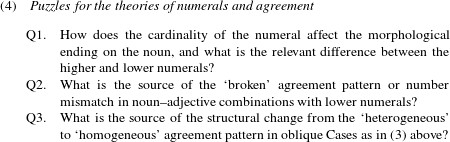
Below we review some of the major accounts of Q1–Q3 proposed in the generative transformational literature to this day and point out their strengths and weaknesses. We argue that although these accounts make a good progress in understanding the morpho-syntactic aspects of numerosity, they cannot be considered fully complete and satisfactory.
In this work, we advance the thesis that a proper understanding of the agreement pattern in Russian numeral phrases must take into consideration two important factors, or dimensions. One, synchronic, factor emphasizes the fundamental role of countability whose syntactic realization may affect computation of syntactic agreement in numeral phrases. The second, diachronic, factor connects the above agreement puzzles with the loss of the dual number value in Old Church Slavonic. The ensuing grammatical change in this area led to a profound reorganization of the numeral phrase into the shape we see in present-day Russian. This reorganization was associated with a morpho-syntactic process of numeralization, that is, changing the syntactic status of numerosity words from nominal or adjectival in Old Russian to proper numeral in Modern Russian (Section 5.2). This process resulted in splitting a (composite) number feature into two separate syntactic heads, with corresponding changes in their lexical entries. One of these newly emerged syntactic heads became responsible for atomization and countability. This change, accompanied by morpho-phonological changes in the numerals themselves, led to the development of a (pseudo-)classifier system in Russian, akin to those featured in East Asian languages such as Japanese or Chinese.
Our goal in this work is thus threefold: (a) to place the Russian higher/lower numeral distinction in agreement and the ‘broken’ agreement phenomenon in a larger synchronic and diachronic context; (b) to suggest a likely syntactic mechanism behind the ‘broken’ agreement pattern with the ‘lower’ numerals, as well as a possible path of syntactic changes that led to it; and (c) to better understand the role and relevant syntactic and semantic aspects of countability in numeral-based QPs. To reinforce our claims, we also report results from a psycholinguistic sentence-completion study that tests the key role of countability and its syntactic realizations. The puzzles in Q1–Q3 will be central to our discussion below from the perspective of a particular syntactic structure that emerged as a result of a grammatical change at the level of featural makeup. Ultimately, we see our proposals as part of a larger theory in which the observed syntactic and semantic properties of numeral-based QPs follow from the way countability manifests itself in the synchronic and diachronic aspects at the syntax–semantics interface.
2 A selective overview of the previous accounts $^{4}$

2.1 The ‘paucal’ line of thought (Q1)
Typologically, paucal is a member of the set of values for number, along with singular, plural and dual. It typically denotes small quantities in languages such as Bayso, e.g. lubántiti ‘a/the particular lion’, lubanjaa ‘a few lions’ (2 ${\leqslant}$
Num
${\leqslant}$
Num ${\leqslant}$
6); lubanjool ‘lions’ (Corbett Reference Corbett2000: 11). Given that in Russian the switch to singular happens with ‘lower’ numerals from 2 to 4, it seems appealing to view the Genitive singular in Russian as a phenomenon related in some sense to the paucal form. Many researchers acknowledge the superficial similarity and use the term ‘paucal’ in the descriptive sense only, to refer to the form assigned by the lower numerals. Some authors, e.g. Bailyn & Nevins (Reference Bailyn, Nevins, Bachrach and Nevins2008), Pereltsvaig (Reference Pereltsvaig2010) and Despić (Reference Despić2013), go further to claim that what looks like Genitive singular with the lower numerals is actually a paucal number in the above or similar sense. In a similar vein, Rappaport (Reference Rappaport2002) argues that the lower numerals assign paucal Case. An argument often put forth in support of this view is based on the well-known sub-class of masculine, mostly monosyllabic, nouns in the modern language that, when used with the numeral dva ‘two’, tri ‘three’ and četyre ‘four’, appear Genitive singular, but change the stress pattern from the penultimate (as would be typical for Genitive singular) to the final syllable:
${\leqslant}$
6); lubanjool ‘lions’ (Corbett Reference Corbett2000: 11). Given that in Russian the switch to singular happens with ‘lower’ numerals from 2 to 4, it seems appealing to view the Genitive singular in Russian as a phenomenon related in some sense to the paucal form. Many researchers acknowledge the superficial similarity and use the term ‘paucal’ in the descriptive sense only, to refer to the form assigned by the lower numerals. Some authors, e.g. Bailyn & Nevins (Reference Bailyn, Nevins, Bachrach and Nevins2008), Pereltsvaig (Reference Pereltsvaig2010) and Despić (Reference Despić2013), go further to claim that what looks like Genitive singular with the lower numerals is actually a paucal number in the above or similar sense. In a similar vein, Rappaport (Reference Rappaport2002) argues that the lower numerals assign paucal Case. An argument often put forth in support of this view is based on the well-known sub-class of masculine, mostly monosyllabic, nouns in the modern language that, when used with the numeral dva ‘two’, tri ‘three’ and četyre ‘four’, appear Genitive singular, but change the stress pattern from the penultimate (as would be typical for Genitive singular) to the final syllable:

The rest of the morphological exponence for this special ‘paucal’ number, presumably, coincides with Genitive singular.
While this argument goes some way towards explaining the special agreement form on the noun with the lower numerals, in its present form, it eventually leads to an ontological problem. The alleged paucal cannot be a number value, simply because it is not part of the number system of Russian or generally Slavic (see also Corbett Reference Corbett2000). For instance, čas-á does not mean ‘a few hours’ in a manner similar to (5) above, nor does it trigger clause-level (e.g. subject–verb) agreement. We are led, then, to conclude that this particular number feature shows up only in the presence of a lower numeral, thus in an extremely local context, in a drastic contrast with the singular and plural markings. This looks like a case of missing a generalization, which raises doubts about treating the paucal ending as an instance of the category number.
2.2 Halle Reference Halle1990 (Q2)
Halle (Reference Halle1990) proposes an explicit readjustment rule that converts the plural number on the noun in cases like (2) above to singular in the context of a lower numeral, and applies only in numeral phrases (see also Halle & Marantz Reference Halle, Marantz, Hale and Keyser1993). The rule implies that the number value on the noun is underlyingly plural. Its structural description does not include the modifying adjective; the adjective thus remains in the plural form.
The descriptive and explanatory potential of this rule is limited, as Halle himself notes. The rule does not explain the ‘homogeneous’ agreement in cases like (3) above, where plural is retained. It also predicts non-existing forms, e.g. with collective numerals *dvoe mužčiny ‘two man.gen.sg’; compare dvoe mužčin ‘two men.gen.pl’. In addition, it does not explain why the conversion is limited to the lower numerals, as well as why it happens in the first place. Nevertheless, it serves as a good starting point for investigating the morpho-syntax of these constructions.
2.3 Babby Reference Babby1987 (Q3)
Babby (Reference Babby1987) offers an account of the switch from the heterogeneous to the homogeneous Case agreement pattern based on a particular timing of assigning certain kinds of Case over others: in particular, lexical/oblique Cases are assigned prior to configurational Cases. The latter include clause-level Cases such as nominative or accusative, as well as Genitive of quantification assigned to the head noun. There is also a sub-hierarchy of assignment among the configurational Cases. If the entire phrase is in the syntactic position of Nominative (e.g. subject) or Accusative (e.g. object), the numeral receives that Case from ‘outside’ the NP but, before that, it assigns Genitive of quantification to its sister, a projection of the head noun. If the outside Case assigner is lexical (e.g. a preposition or a verb), then that Case is distributed down to all constituents of the NP, and Genitive of quantification is not assigned. This is because, for Babby, Genitive of quantification in NumPs is a configurational Case. In the oblique Case contexts, its application is suspended because the lexical/oblique Case assignment takes over.
Babby’s implementation of this proposal requires some non-trivial complications. For instance, he assumes a version of the X-bar theory which implies that a maximal projection of the numerical quantifier assigns Case to an intermediate projection of the head noun. Another non-trivial assumption is assigning Case by percolation: for Babby, Case is assigned to the head noun’s maximal projection and then percolated down to all the available lexical and phrasal categories in the phrase. In addition, Babby’s postulated hierarchy in timing of assignment of lexical and configurational Cases is claimed to follow from the representational distinction between D-structure and S-structure, no longer maintained in the current versions of the theory. Nevertheless, Babby’s account contains several important insights. One such insight is in the fact that the numeral does not head the phrase, despite the appearances. Another important idea is that the lexical Case causes a structural change in the numeral phrase.
2.4 Rappaport Reference Rappaport2002 (Q3)
Rappaport (Reference Rappaport2002) is essentially a Minimalist version of Babby’s (Reference Babby1987) account (see also Franks Reference Franks1994). A strong point of Rappaport’s account is that it derives the hierarchy of timing of application of different types of Case, largely stipulated in Babby’s system, from the Minimalist architectural considerations. In particular, the ‘quantificational’ Case is valued on the noun prior to assigning a clause-level Case to the NumP itself, simply because, on Minimalist assumptions, by the time ‘quantificational’ Case is assigned, the higher context does not exist yet (e.g. if the NumP is an object of the Accusative-assigning verb, that verb has not been Merged yet). In other words, the sub-hierarchy of Genitive of quantification and clause-level configurational Cases follows automatically from the cyclic nature of Merge operating bottom up (see this work for details). The priority of application of lexical/oblique Case over configurational Case is similarly encoded in the presence vs. absence of the valued Case feature in the way outlined above. At the same time, additional stipulations are still required in Rappaport’s account in order to rule out unwanted combinations of numerals with valued (or unvalued) Case features and different structural Case positions. For instance, the mechanism of ‘veering off’ the configurational Case (nominative, accusative) in NumPs is left at the level of descriptive analogy with Genitive of Negation, without providing specific details that lead to testable predictions in this area. In addition, postulation of the separate ‘quantificational’ Case only seems to serve a specific purpose of the numeral not being assigned Genitive itself, along with its NP complement. In Section 5.7 below we discuss an alternative way of ordering the applications of different kinds of Case in numeral-based QPs.
2.5 The ‘hybrid’ accounts (Q3)
Some researchers attribute the switch from the heterogeneous to the homogeneous patterns to some hybrid, or dual categorical status to the numerals themselves. For instance, Franks (Reference Franks1995), argues that numerals are QPs (or Qs) in the Genitive-assigning environments and adjectivals in oblique Case environments. Similarly, Bailyn (Reference Bailyn2012) assumes that the numeral may be generated either in Q or in Spec–Q. The idea is that in the homogeneous, but not in the heterogeneous pattern, the numeral generated in Q naturally ‘absorbs’ the Genitive-assigning property of Q. Among other things, this solution seems to predict that in oblique Cases the numeral cannot be phrasal, whereas in direct Cases (nominative, accusative) it can. This may potentially be problematic because of grammaticality of expressions like the following:

2.6 Pesetsky 2013 (Q2, Q3)
The account in Pesetsky (Reference Pesetsky2013) employs an intricate set of assumptions that can be summarized (with certain simplifications) as follows:

Dékány (Reference Dékány2015) presents a concise summary of the major derivations utilizing these assumptions in Pesetsky’s framework, which we largely follow here. With higher numerals (five and beyond), the noun bearing $\text{N}_{\text{GEN}}$
first Merges with the non-projecting head NBR specified [–singular]. Then the adjective and QUANT are Merged, successively, each receiving Genitive by Feature Assignment (see (ii) above). NBR raises to QUANT (this ensures the correct word order numeral–adjective–noun). Next D is Merged probing for QUANT and triggering the movement of the QUANT+NBR complex, as a result of which D assigns Nominative to QUANT on top of Genitive. The One-suffix rule (see (iv) above) deletes the Genitive and leaves Nominative. These steps are illustrated in (7).
$\text{N}_{\text{GEN}}$
first Merges with the non-projecting head NBR specified [–singular]. Then the adjective and QUANT are Merged, successively, each receiving Genitive by Feature Assignment (see (ii) above). NBR raises to QUANT (this ensures the correct word order numeral–adjective–noun). Next D is Merged probing for QUANT and triggering the movement of the QUANT+NBR complex, as a result of which D assigns Nominative to QUANT on top of Genitive. The One-suffix rule (see (iv) above) deletes the Genitive and leaves Nominative. These steps are illustrated in (7).
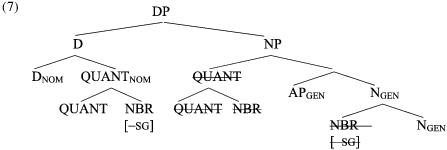
The ‘broken’ pattern with the lower numerals (Q2 in (4)) is derived similarly with one notable difference. The lower numerals dva, tri and četyre are morphologically free exponents of NBR which by hypothesis are instances of [–singular] (see (vi) above), whereas the N is/remains numberless. The derivation proceeds as before, except that QUANT in this case is morphologically null.
The homogeneous Case pattern observed in oblique Cases (Q3) is explained as follows. Pesetsky assumes that oblique Case environments are associated with a P head, either explicit or implicit. When the DP merges with P, the oblique Case is uniformly assigned via Feature assignment to all of the DP’s constituents. By the One-suffix rule, Oblique will override the Nominative assigned by D, and default Genitive of the N and A. The fact that there is no number mismatch even in the case of lower numerals, as (3) shows, is accounted for by postulating that P has an unvalued $u$
NBR feature that gets its value [–singular] from the (moved copy of) NBR and later transmits it to all members of the DP via Feature assignment.
$u$
NBR feature that gets its value [–singular] from the (moved copy of) NBR and later transmits it to all members of the DP via Feature assignment.
Our approach outlined below shares a number of ideas and concepts with Pesetsky (Reference Pesetsky2013). We believe that separating number from the noun, on the one hand, and from the numeral itself, on the other, is a step in the right direction, as it highlights different structural layers of a numeral-based QP that can be shown to interact in non-trivial ways. We also agree that principles such as Feature assignment and ‘one suffix rule’ may be relevant to these QPs (see also below). However, in our view, Pesetsky’s mechanism of agreement computation may be overly complicated. Pesetsky uses the Russian QPs as a case study for a novel theoretical approach dispensing with Case theory as a module of grammar altogether. In this approach, morphological case markers are primarily realizations of the parts of speech or syntactic categories, and the notion of Case (with a capital letter) as a syntactic licensing mechanism used in traditional syntactic theory can be seen as redundant. This approach also raises some non-trivial concerns regarding the nature of morpho-syntactic markers of numerosity in Russian. For instance, treating low numerals as number markers of dual, trial and quadral puts Russian alongside languages that are typologically very rare (Corbett Reference Corbett2000: 26) and suggests that Russian may have no lexical means to express the respective numbers, a seemingly strange state of affairs cross-linguistically. Another non-trivial issue lies in the conjecture that singular marking is some kind of default marking. There are reasons to believe that if there is a default number marking in Russian denoting ‘one or more’, it is actually plural (see e.g. Sauerland, Anderssen & Yatsushiro Reference Sauerland, Anderssen, Yatsushiro, Kepser and Reis2005, Spector Reference Spector, Sauerland and Stateva2007). For instance, when the context emphasizes the kind, not the token, of countable entities, the plural is chosen:

Despite their intricate character, we believe the set of facts in (1)–(3) can be accounted for without the need to reevaluate the Case theory. In the present work we therefore adopt a more conservative stance, compared to the perspective in Pesetsky (Reference Pesetsky2013).
3 The ‘dual’ diachronic connection
Consider again the ‘broken’ agreement pattern observed with the lower numerals 2, 3, and 4, exemplified in (2) above, repeated here:

To reiterate the solutions offered in the literature, the Genitive singular on the noun can be regarded as one of the following: (a) a misleading homophony for the special nominative ‘paucal’ ending reserved for nouns selected by lower numerals; (b) an output of a morphological rule that operates on the underlying Genitive plural (in that case the underlying morphology on the nouns occurring with lower and higher numerals is consistent); or (c) an indicator of numberlessness. Each solution is potentially problematic for various empirical and conceptual reasons. We would like here to explore an alternative, diachronic, route that traces the Genitive singular ending to the dual markings in the older stages of Russian.
The view that Genitive singular on the nouns diachronically stems from the older dual morphology is adopted by the vast majority of researchers investigating the structure of Russian and Slavic numeral phrases, although some exceptions exist (see below). However, to the best of our knowledge, this diachronic connection has not so far been made formally explicit in terms of common mechanisms underlying the two endings, as well as their limited application with the lower numerals. We are thus interested in exploring the following questions related to the change from the dual to Genitive singular: (a) How did the change take place? (b) How did it spread to numerals for 3 and 4 (and not others)? (c) Why did the change not spread to adjectives?
3.1 Dual in the numeral system of Old Russian
The rise and fall of the dual number in Russian is documented in the historical Russian texts and discussed in the descriptive and theoretical literature (e.g. Shahmatov Reference Shahmatov1957, Ivanov Reference Ivanov1983, Mel’chuk Reference Mel’chuk1985, among others). Old Russian has inherited the dual from Old Church Slavonic, which itself preserved it from the early Indo-European stage. The recorded instances of dual can be traced back to the written texts dated as early as the 10th century. The loss of the dual number is a paramount phenomenon in the transfer from the Old Church Slavonic to the common Slavic varieties, on the way to the modern Slavic languages. Aside from Russian, the dual number is retained in the number systems of Slovenian and Sorbian, and lost in other Slavic languages, although some residues of the dual paradigm still remain throughout (see Corbett Reference Corbett2000 and Section 5.1). As seen in (9) below, the dual was part of the number system of Old Russian, as it did not require an explicit numeral and triggered clause-level agreement with the verb (Ivanov Reference Ivanov1983):

From about the turn of the 13th century, the dual begins to decline and be gradually replaced by the plural, as evidenced by instances such as those in (10) and (11):
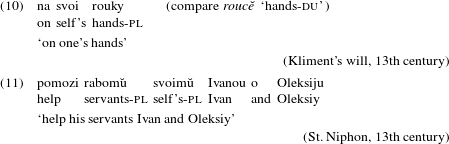
The gradual loss of the dual first targeted the forms in oblique Cases (Old Russian has inherited the seven-case system from the Old Church Slavonic, with subsequent loss of the vocative), leaving out the nominative. This was because the morphological case distinctions available in the plural were neutralized in the dual, possibly due to a markedness-triggered impoverishment process (Nevins Reference Nevins2011). According to Ivanov (Reference Ivanov1983), some of the pressure for the loss of dual came from the speakers’ motivation to distinguish different oblique Case forms, something that the plural system could furnish much more efficiently than the dual one. It is believed that the loss of the dual number has started around the 13th century with nouns with inherent duality in their lexical entries, such as ‘hands’ that could be used without the overt quantity word (compare (10) and (11) above) and consequently spread to other nouns, with parallel emergence of dva ‘two’ as a full blown numeral. The nominative dual ending was the last one to disappear, being retained at that stage in the numeral phrases using the overt numeral dva ‘two’. After the disappearance of the dual from the number system of Russian, that ending ‘naturally lost the dual meaning and was naturally merged with the morphologically identical Genitive singular forms’ (Shahmatov Reference Shahmatov1957: 213 – our translation, S&S). This merger has started from the masculine gender paradigm, extending to neuter, and finally, to feminine genders. Table 1, showing partial declination paradigms, illustrates the homophony in all three genders.
Old Russian number inflection in Nominative and Genitive.
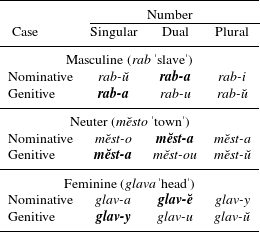
Some evidence for this transition comes from the change of the stress pattern in certain monosyllabic masculine nouns, as shown in (5), repeated here:

A similar change of stress is also observed for feminine nouns, e.g. réki ‘rivers.pl’ vs. rekí ‘river.du’. This change in the stress pattern is hard to explain if both instances involve the same grammatical form. But recognizing that a different, though closely related, form is used in the numeral phrase, resolves this tension. We consider the shifted stress form a ‘frozen’ dual ending that for some reason has resisted the overall transition to Genitive singular. Another piece of evidence comes from a series of regular plurals deriving from masculine nouns that are historically duals, more specifically, anatomical and natural duals, and thus have retained the original dual ending: rogá ‘horns’, boká ‘body flanks’, glazá ‘eyes’, rukavá ‘sleeves’, beregá ‘shores’ (the regular nominative plural ending for masculine nouns is -i/-y).
The final loss of the dual in the grammatical system of Russian is thought to have taken place in the 14th–15th century, when three separate East Slavic language varieties (Russian, Ukrainian and Byelo-Russian) were formed.
3.2 Changes in the agreement patterns for lower and higher numerals
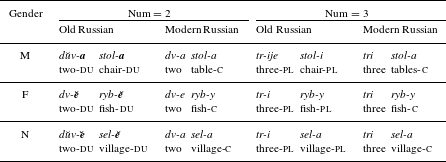
An important fact about Old Russian numerals is their cross-categorical nature. There was no separate category for numerals in the old language. Words dva ‘two’, tri ‘three’ and četyre ‘four’ (as well as jedin- ‘one’ which we put aside for the moment) are historically adjectives and as such, agree with the noun in Case, gender and number: thus, with dva, the noun shows up in dual, and with tri and četyre the noun is in plural, as Table 2 illustrates.
Old and Modern Russian agreement patterns (masculine, feminine, neuter) with lower/adjectival numerals (c $=$
count, du
$=$
count, du $=$
dual, pl
$=$
dual, pl $=$
plural).
$=$
plural).
The numerals greater than four (e.g. pjatj ‘five’) are feminine singular nouns featuring the -j/ĭ stem (similar to e.g. bolj ‘pain’ or branj ‘fight’) which could inflect in Case and number, and agree with the determiner. These nouns always induced Genitive plural on their complements, similarly to other complement-taking nouns, as well as clause-level agreement with the predicate.

Later development of the numeral system led to gradual loss of the adjectival and nominal properties of the lower and higher numerals, respectively, and their subsequent numeralization or settlement as a separate quantificational category (see Section 1). The numeralization of dva ‘two’ was accompanied by a number of phonological and morphological changes, among which was, in particular, neutralization of the masculine–neuter gender distinction, which affected corresponding agreement patterns. Nevertheless, numeralization of dva apparently was not absolute: some overt residues of the adjectival-like agreement still remain in Modern Russian, as seen in Table 2.Footnote [6]
According to the traditional accounts, two factors contributed to spreading the former dual agreement pattern to numerals tri ‘three’ and četyre ‘four’: (a) the loss of the dual number, and (b) homophony between the Genitive singular and the dual on the nouns with the numeral dva ‘two’. Similarly to dva, the numerals tri and četyre themselves underwent a similar numeralization process (partially) losing the adjectival properties (see also Section 5.2 below). In turn, numerals greater than 4 eventually lost their nominal properties, such as gender and number morphology, as well as modification by demonstratives (as in (12) above). Genitive Case, however, remained as a marker of quantity and partitivity; its assigning property has been retained in the newly formed numeral as an important part of its internal syntax. Altogether, the loss of the dual number, morpho-phonological changes in number words themselves, loss of gender distinctions for 2 (partially), 3 and 4, and, finally, loss of typical noun distinctions for the former nouns for 5–9 were factors that, according to the traditional views, led to an eventual establishment of the category Numeral, with the corresponding lexical items showing typical properties of this category, namely lack of agreement, in the modern language (see Ivanov Reference Ivanov1983).
It is interesting to note that although the traditional historical grammars almost uniformly trace the settlement of Genitive singular marker in Modern Russian to the former dual, they do not explain why it only targeted the numeral phrases with an otherwise plural agreement pattern (refer to the agreement patterns with ‘three’ in Table 2) but did not spread to numerals higher than 4. The question is: does the loss of the dual necessarily correlate with the spread of the Genitive singular agreement to 3 and 4? Below we sketch an account that may possibly shed light to this and related issues.
4 Theoretical components of the proposal
Previous research on the syntax and semantics of numeral phrases has identified three major factors that play a key role in determining an agreement pattern between the numeral and the respective noun: quantification, number and countability. Our principal guiding idea in the present work is that each of these factors represents a respective structural layer in the numeral-based QP, that is, a piece of structure responsible for the computation of the respective property in syntax and semantics. Below we discuss these structural layers in more detail paying a special attention to the intricacies underlying their featural makeup.
4.1 The quantificational layer
The quantificational aspect of nominal expressions in Russian and Slavic is well known in the literature on Slavic morphosyntax (Franks Reference Franks1995, Brown Reference Brown1999, among many others) via Genitive of quantification that shows up in various guises. The classic case is regular Genitive of negation:

Genitive of quantification also shows up with (null) existential quantifiers and partitives:
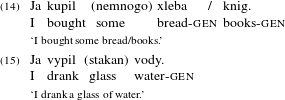
We adopt the traditional view that the Genitive in numeral-based QPs has a quantificational source (but see Pesetsky Reference Pesetsky2013 and Section 2.6). Syntactically, quantification is encoded in a functional head Q, and the QP layer hosts the numeral itself. Thus, there exists a one-to-one correspondence between the presence of the numeral and the Genitive Case (though its actual morphological realization is a different matter; see below).
4.2 The number layer
The bulk of the contemporary syntactic literature maintains that number is an inherent (formal) property of the noun that has a semantic interpretation. Syntactically, it participates in the computation of agreement in the DP. For instance, number agreement between an adjective and a noun is often expressed as valuation of the (unvalued) number feature on the adjective by the (intrinsically valued) number feature of the noun. An alternative view, pursued in semantically-oriented research, is that number is a property not of the noun, but of the entire DP, and, as such, it may be represented by a separate syntactic head (see Sauerland Reference Sauerland2003, Reference Sauerland, Harbour, Adger and Béjar2008 and Harbour Reference Harbour2011a, Reference Harbourb for arguments and evidence). Following Sauerland (Reference Sauerland2003), we annotate this functional head as $\unicode[STIX]{x1D711}$
. This view amounts to the claim that morphological number is not an actual expression of semantic plurality of the noun. Evidence for this view comes, for instance, from examples like the following (from Chierchia Reference Chierchia1998: fn.7, credited to Manfred Krifka; see also Krifka Reference Krifka, Carlson and Pelletier1995):
$\unicode[STIX]{x1D711}$
. This view amounts to the claim that morphological number is not an actual expression of semantic plurality of the noun. Evidence for this view comes, for instance, from examples like the following (from Chierchia Reference Chierchia1998: fn.7, credited to Manfred Krifka; see also Krifka Reference Krifka, Carlson and Pelletier1995):

The claim is also directly corroborated by languages like Chinese that do not have the (Indo-European) system of morphological number, as well as by languages like Turkish which use singular, rather than plural, ending on the noun in numeral phrases (example from Watanabe Reference Watanabe2010):

In line with this alternative view, we take $\unicode[STIX]{x1D711}$
P to be a representation of the corresponding structural layer. The number layer is responsible for the overall plural marking on the numeral-based QP. In order to account for the three-valued, singular–dual–plural number system in Old Russian, we adopt the view whereby the number category is not seen as a primitive feature, but can be decomposed into two binary features [±singular] and [±augmented] (Noyer Reference Noyer1997, Harbour Reference Harbour2011a, Reference Harbourb, Nevins Reference Nevins2011, Despić Reference Despić2013). Roughly, the [±augmented] sub-feature expresses the degree of satisfaction of some other feature, ranging from minimal to non-minimal (i.e. augmented). Following the view on features as semantic properties along the lines of Harbour (Reference Harbour2011a, Reference Harbourb), we adopt here the following definitions:
$\unicode[STIX]{x1D711}$
P to be a representation of the corresponding structural layer. The number layer is responsible for the overall plural marking on the numeral-based QP. In order to account for the three-valued, singular–dual–plural number system in Old Russian, we adopt the view whereby the number category is not seen as a primitive feature, but can be decomposed into two binary features [±singular] and [±augmented] (Noyer Reference Noyer1997, Harbour Reference Harbour2011a, Reference Harbourb, Nevins Reference Nevins2011, Despić Reference Despić2013). Roughly, the [±augmented] sub-feature expresses the degree of satisfaction of some other feature, ranging from minimal to non-minimal (i.e. augmented). Following the view on features as semantic properties along the lines of Harbour (Reference Harbour2011a, Reference Harbourb), we adopt here the following definitions:

The definition in (18a) implies that the function denoted by $[[\text{+}\text{singular}]]$
applies to some predicate
$[[\text{+}\text{singular}]]$
applies to some predicate $P$
and an individual
$P$
and an individual $x$
to be mapped to True when that x is
$x$
to be mapped to True when that x is $P$
and
$P$
and $x$
is a singular individual. According to (19),
$x$
is a singular individual. According to (19), $[[\text{+}\text{augmented}]]$
, too, is a property modifier: it applies to a predicate
$[[\text{+}\text{augmented}]]$
, too, is a property modifier: it applies to a predicate $P$
and is then mapped to the set of those individuals x in the extension of
$P$
and is then mapped to the set of those individuals x in the extension of $P$
which are non-minimal and have sub-elements. That is,
$P$
which are non-minimal and have sub-elements. That is, $[[\text{+}\text{augmented}]]$
checks for non-atomic elements inside non-atoms. The opposite value of features is regulated by the equation in (18b). The three-way number system is then represented as follows:
$[[\text{+}\text{augmented}]]$
checks for non-atomic elements inside non-atoms. The opposite value of features is regulated by the equation in (18b). The three-way number system is then represented as follows:

Numerals interact with the number system in non-trivial ways, adding the dimension of numerosity to atomic and non-atomic entities. This interaction is best understood via the notion of countability to which we turn next.
4.3 The countability layer
It is a straightforward, though sometimes overlooked, fact that using a numeral with a noun is only possible if the referent of the noun is a set of individuated and, therefore, countable elements. Conversely, we cannot attribute numerosity to something that cannot be counted. This observation seems to be robust and cross-linguistically invariant. Consequently, countability is a property of the noun that makes it possible to count the objects denoted by it. Languages reflect this property in distinguishing nouns denoting mass and count objects (e.g. Acquaviva Reference Acquaviva2017, Borer Reference Borer2005). The impossibility of combining numerals with mass nouns suggests that we need to individuate a structural level on which the objects can be counted (Kratzer Reference Kratzer1989). The semantic research on mass/count distinction suggests that what is countable is a set of atoms (see e.g. Carlson Reference Carlson1977, Krifka Reference Krifka, Carlson and Pelletier1995, Chierchia Reference Chierchia1998). Following Chierchia (Reference Chierchia1998), we adopt the following fundamental restriction:

In order for the object to become countable, therefore, a suitable atomizing criterion must be applied. Good candidates for an appropriate atomizer are classifier phrases. An atomizing function maps the denotation of a noun, i.e. a kind into a set of atoms, as argued by Chierchia (Reference Chierchia1998). In particular, both plural nouns like dogs, as well as mass nouns like furniture may be seen as different expressions of the notion kind. That is, the denotation of each of these nouns comes from the lexicon as an entity closed under a group forming operation, and can be further atomized into a semantically singular predicate.
There are at least two major views in the literature as to when and how this atomization procedure takes place. Krifka (Reference Krifka, Carlson and Pelletier1995) takes the Chinese classifier system as a prototypical case for the respective structural mechanism. For Krifka, nouns come from the lexicon as kinds, unspecified for atomicity. Then an operation takes a kind and yields a predicate applying to ‘specimens or subspecies of this kind’, i.e. essentially, a set of atoms. For Chinese, a relevant operator may be associated with a (overt) classifier and therefore integrated into whatever syntactic structure one may assume for classifiers. For languages like English with no overt classifier system, Krifka argues that the same atomizing operator is ‘built-in’ the lexical meaning of the respective noun, so that English nouns come into syntax already atomized. The parametric variation (and the ensuing distinction in the use of NPs) therefore lies at the respective level of representation.
An alternative mode of deriving atomic interpretations stems from the influential view on pluralities as complete atomic join semilattices in the sense of Link (Reference Link, Bauerle, Schwarze and von Stechow1983), adopted in Chierchia (Reference Chierchia1998) (see also Landman Reference Landman1989). In this view, the interpretation of a plural noun like dogs forms a join semilattice consisting of the atomic entities themselves (e.g. Fido, Barky, Tom, etc.) as well as various combinations thereof (e.g. plural individuals $\unicode[STIX]{x27E6}\text{Fido}\unicode[STIX]{x27E7}\oplus \unicode[STIX]{x27E6}\text{Barky}\unicode[STIX]{x27E7}$
,
$\unicode[STIX]{x27E6}\text{Fido}\unicode[STIX]{x27E7}\oplus \unicode[STIX]{x27E6}\text{Barky}\unicode[STIX]{x27E7}$
, $\unicode[STIX]{x27E6}\text{Fido}\unicode[STIX]{x27E7}\oplus \unicode[STIX]{x27E6}\text{Tom}\unicode[STIX]{x27E7}$
, etc.). Thus, the specification of atomicity is hard-wired in the lexical entries. There is no specific structural mechanism that identifies individual atoms: those are already identified before forming a semilattice. Under Chierchia’s parallelism view, mass nouns may involve a similar structure. Furthermore, there is a straightforward translation algorithm between properties (e.g. ‘being a dog’) and corresponding kinds. Languages differ in how they structure NPs in terms of reference to kinds as defined via a set of operations that are sensitive to their argument and/or predicate status.
$\unicode[STIX]{x27E6}\text{Fido}\unicode[STIX]{x27E7}\oplus \unicode[STIX]{x27E6}\text{Tom}\unicode[STIX]{x27E7}$
, etc.). Thus, the specification of atomicity is hard-wired in the lexical entries. There is no specific structural mechanism that identifies individual atoms: those are already identified before forming a semilattice. Under Chierchia’s parallelism view, mass nouns may involve a similar structure. Furthermore, there is a straightforward translation algorithm between properties (e.g. ‘being a dog’) and corresponding kinds. Languages differ in how they structure NPs in terms of reference to kinds as defined via a set of operations that are sensitive to their argument and/or predicate status.
We step on the shoulders of Chierchia (Reference Chierchia1998) and Krifka (Reference Krifka, Carlson and Pelletier1995) with respect to the possibility to shift a kind interpretation to a predicative interpretation. However, unlike Krifka (Reference Krifka, Carlson and Pelletier1995), we distinguish between the procedures for atomization and countability and do not associate these with a single structural position of the classifier. For the present purposes, in the spirit of Link (Reference Link, Bauerle, Schwarze and von Stechow1983) and Chierchia (Reference Chierchia1998), we posit an atomizing operator $\cup$
, as in (22), which may in principle be encoded either in the lexicon or in the syntax, along with related definitions:Footnote
[7]
$\cup$
, as in (22), which may in principle be encoded either in the lexicon or in the syntax, along with related definitions:Footnote
[7]
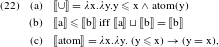
where ${\leqslant}$
is essentially Link’s ‘individual part relation’ denoting ‘part of’ or ‘equal to’ in the case of singularities. The symbol
${\leqslant}$
is essentially Link’s ‘individual part relation’ denoting ‘part of’ or ‘equal to’ in the case of singularities. The symbol $\sqcup$
denotes a join operation on a semilattice. The function expressed by
$\sqcup$
denotes a join operation on a semilattice. The function expressed by $\cup$
is to be differentiated from that of [
$\cup$
is to be differentiated from that of [ $\pm$
singular]. More specifically, the contribution of
$\pm$
singular]. More specifically, the contribution of $\unicode[STIX]{x27E6}-\text{singular}\unicode[STIX]{x27E7}$
is to only verify the non-singular atomic nature of the argument to which it applies. We further assume that an atomization operator such as
$\unicode[STIX]{x27E6}-\text{singular}\unicode[STIX]{x27E7}$
is to only verify the non-singular atomic nature of the argument to which it applies. We further assume that an atomization operator such as $\cup$
exists in Modern Russian, the details of which are discussed below.
$\cup$
exists in Modern Russian, the details of which are discussed below.
In order to get a better idea about the syntactic shape of the countability layer, we will make use of two important ideas explored in Watanabe’s (Reference Watanabe2010) syntactic account of Japanese numeral phrases and some related works. First, Watanabe argues that the countability structure may be universally available. Syntactically, it is based on a head category #. Numerals or measure phrases (e.g. four liters) are base-generated in Spec–#P. Furthermore, Watanabe proposes that numerals are licensed only when the # head is marked for [ $\pm$
augmented], understood along the lines of the definition in (19).Footnote
[8]
$\pm$
augmented], understood along the lines of the definition in (19).Footnote
[8]
Watanabe’s second idea, also following Harbour’s work, is that the basic features [ $\pm$
singular] and [
$\pm$
singular] and [ $\pm$
augmented] constituting the number system (recall (20) above) may be separated or ‘divorced’. According to Watanabe, in Turkish and Japanese, counted nouns in numeral phrases are marked singular or not marked for number at all (recall (17)) because the # head in these languages is not specified for [
$\pm$
augmented] constituting the number system (recall (20) above) may be separated or ‘divorced’. According to Watanabe, in Turkish and Japanese, counted nouns in numeral phrases are marked singular or not marked for number at all (recall (17)) because the # head in these languages is not specified for [ $\pm$
singular], but only for [
$\pm$
singular], but only for [ $\pm$
augmented]. In contrast, in English the # head may be specified for both [
$\pm$
augmented]. In contrast, in English the # head may be specified for both [ $\pm$
singular] and [
$\pm$
singular] and [ $\pm$
augmented], so the plural marker on English nouns is a result of the [–singular] specification on #.Footnote
[9]
For Watanabe, it is the feature [
$\pm$
augmented], so the plural marker on English nouns is a result of the [–singular] specification on #.Footnote
[9]
For Watanabe, it is the feature [ $\pm$
augmented] that is associated with the classifier(-like) structure responsible for countability. Recall, however, that in order for a definition of [
$\pm$
augmented] that is associated with the classifier(-like) structure responsible for countability. Recall, however, that in order for a definition of [ $\pm$
augmented] like that in (19) above to work, atomization, the procedure different from countability, must take place in the lexicon and the predicate # realizing the [
$\pm$
augmented] like that in (19) above to work, atomization, the procedure different from countability, must take place in the lexicon and the predicate # realizing the [ $\pm$
augmented] function operates on already atomized units (see above). This must also be the case in Watanabe’s system.
$\pm$
augmented] function operates on already atomized units (see above). This must also be the case in Watanabe’s system.
The following section lays out derivations of examples in Old and Modern Russian involving the [–singular] counterpart of $\unicode[STIX]{x1D711}$
, in which the cardinality of the counted set is greater than 1, although we return to the [+singular] setting briefly in footnote 15 below. In the course of this outline, syntactic and semantic properties of # are elaborated in greater detail. This will provide a theoretical backdrop for addressing the original puzzles Q1–Q3 in (4) above later in the discussion.
$\unicode[STIX]{x1D711}$
, in which the cardinality of the counted set is greater than 1, although we return to the [+singular] setting briefly in footnote 15 below. In the course of this outline, syntactic and semantic properties of # are elaborated in greater detail. This will provide a theoretical backdrop for addressing the original puzzles Q1–Q3 in (4) above later in the discussion.
5 The proposal and derivations
5.1 Old Russian
As noted in Section 3.2, higher numerals in Old Russian are categorically nouns, and lower numerals are adjectives. We assume the following structures for the Old Russian $\unicode[STIX]{x1D711}$
P:
$\unicode[STIX]{x1D711}$
P:
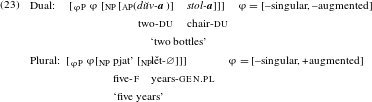
In this ‘simpler’ architecture, atomization of the noun, possibly along the lines of (22), must have taken place in the lexicon, or alternatively, at the NP level if Old Russian quantity words are understood as classifiers of sorts (see Sections 4.3 and 5.2). Counting takes place at the $\unicode[STIX]{x1D711}$
level. The computation of the meaning of the
$\unicode[STIX]{x1D711}$
level. The computation of the meaning of the $\unicode[STIX]{x1D711}$
P proceeds along the lines of Harbour (Reference Harbour2011b; see his (14)): the function denoted by [–singular] applies to the denotation of NP first, yielding non-atomic entities; the denotation of [–augmented] or [+augmented] then applies to the denotation of the respective entities, testing for sub-groups, yielding plural in the case of their presence, and dual in the case of their absence (we omit here further details for reasons of space).
$\unicode[STIX]{x1D711}$
P proceeds along the lines of Harbour (Reference Harbour2011b; see his (14)): the function denoted by [–singular] applies to the denotation of NP first, yielding non-atomic entities; the denotation of [–augmented] or [+augmented] then applies to the denotation of the respective entities, testing for sub-groups, yielding plural in the case of their presence, and dual in the case of their absence (we omit here further details for reasons of space).
5.2 The emergence of the countability layer
The gist of the diachronic part of our proposal is that the countability-related feature [ $\pm$
augmented], packaged together with [
$\pm$
augmented], packaged together with [ $\pm$
singular] within the number layer in Old Russian, has changed its meaning from the non-atomic property checker in the sense of (19) above to a classifier-type atomization operator
$\pm$
singular] within the number layer in Old Russian, has changed its meaning from the non-atomic property checker in the sense of (19) above to a classifier-type atomization operator $\cup$
, in Modern Russian.
$\cup$
, in Modern Russian. $\cup$
, of semantic type
$\cup$
, of semantic type ${<}$
e,
${<}$
e, ${<}$
e,t
${<}$
e,t ${>}$
${>}$ ${>}$
, applies to a kind meaning of a noun
${>}$
, applies to a kind meaning of a noun $k_{{<}\text{e}>}$
, and maps it to a predicative meaning of that noun whose characterized set is a join semilattice, along the lines of the semantic proposals reviewed in Section 4.2 (example (22)). Syntactically, this new operator is realized as a separate head category akin to Watanabe’s # (see Section 4.3). The head of the new number layer
$k_{{<}\text{e}>}$
, and maps it to a predicative meaning of that noun whose characterized set is a join semilattice, along the lines of the semantic proposals reviewed in Section 4.2 (example (22)). Syntactically, this new operator is realized as a separate head category akin to Watanabe’s # (see Section 4.3). The head of the new number layer $\unicode[STIX]{x1D711}$
continues to host the feature [
$\unicode[STIX]{x1D711}$
continues to host the feature [ $\pm$
singular] only. The Q head is still responsible for the quantificational properties and Genitive Case (Section 4.1). We further assume that the Q head hosts a null determiner whose meaning is close to ‘some’. Combining these theoretical components into a coherent whole results in the following structural template for Modern Russian (to be elaborated below):
$\pm$
singular] only. The Q head is still responsible for the quantificational properties and Genitive Case (Section 4.1). We further assume that the Q head hosts a null determiner whose meaning is close to ‘some’. Combining these theoretical components into a coherent whole results in the following structural template for Modern Russian (to be elaborated below):

In this structure, object atomization and counting takes place at the #P level.Footnote
[10]
The traditional singular and plural agreement endings are computed at the $\unicode[STIX]{x1D711}$
level. (Recall that, according to the definition in (18a), the predicate
$\unicode[STIX]{x1D711}$
level. (Recall that, according to the definition in (18a), the predicate $\unicode[STIX]{x27E6}\text{+}\text{singular}\unicode[STIX]{x27E7}$
applied to some other predicate
$\unicode[STIX]{x27E6}\text{+}\text{singular}\unicode[STIX]{x27E7}$
applied to some other predicate $P$
returns an atomic entity that satisfies
$P$
returns an atomic entity that satisfies $P$
, corresponds to the traditional singular morphology. This also induces a singular clause-level agreement of QP.) The final representation of QP is a generalized quantifier of atomized individual(s) in the form of either a singularity or a plurality (that is, atomic or non-atomic), counted by virtue of a restrictive modifier assigning particular cardinality
$P$
, corresponds to the traditional singular morphology. This also induces a singular clause-level agreement of QP.) The final representation of QP is a generalized quantifier of atomized individual(s) in the form of either a singularity or a plurality (that is, atomic or non-atomic), counted by virtue of a restrictive modifier assigning particular cardinality $n$
to the atoms that have the property denoted by NP.
$n$
to the atoms that have the property denoted by NP.
Thus, the two features originally constituting the number layer in the older language were split, or ‘divorced’, in the syntactic sense, in the new language, whereby one of these split features, now designated as #, gave rise to the new countability layer. We believe that at least part of what triggered the splitting, or divorcing, reanalysis was precisely the process of numeralization, transformation of formerly adjectival (lower) and nominal (higher) quantity words into a new functional category Numeral (A ${>}$
${>}$ ${>}$
Num
${>}$
Num $_{\text{A}}$
and N
$_{\text{A}}$
and N ${>}$
${>}$ ${>}$
Num
${>}$
Num $_{\text{N}}$
), in the sense of Sections 1 and 3.2 above. In the course of this reorganization, the grammatical gender and number features, as well as clause-level agreement between the newly establshed numeral and the predicate, typical for the old language (see (12) above), got lost, whereas features typical for numerals became prominent.
$_{\text{N}}$
), in the sense of Sections 1 and 3.2 above. In the course of this reorganization, the grammatical gender and number features, as well as clause-level agreement between the newly establshed numeral and the predicate, typical for the old language (see (12) above), got lost, whereas features typical for numerals became prominent.
In other words, we propose that the former quantity words in Old Russian functioned similarly to overt numerical classifiers of the Chinese type, with numerosity lexically encoded in them. The postulated syntactic change associated with numeralization resulted in splitting these quantity words into an atomization operator, on the one hand, and the numeral proper, on the other, thus largely retaining the function typically associated with numerical classifiers. Also as part of the numeralization process, features typical for numeral categories have become prominent, in particular, the cardinality-assigning property.
Assuming that the atomization procedure is still in place, the new language needs to distinguish only singular and plural. As noted above, the feature [ $\pm$
augmented] used to differentiate the dual, gradually got obsolete in this new system. It is worth noting that, in the older language, the quantity word for 2 is marked [–augmented], whereas those for 3 and 4 are [+augmented]. As the dual distinction was gradually getting lost, the mismatch between the former syntactic category of the newly emerging lower (that is, adjective-sourced) numerals and their inconsistent status with respect to [
$\pm$
augmented] used to differentiate the dual, gradually got obsolete in this new system. It is worth noting that, in the older language, the quantity word for 2 is marked [–augmented], whereas those for 3 and 4 are [+augmented]. As the dual distinction was gradually getting lost, the mismatch between the former syntactic category of the newly emerging lower (that is, adjective-sourced) numerals and their inconsistent status with respect to [ $\pm$
augmented] might have also contributed to abolishing the original meaning of the [
$\pm$
augmented] might have also contributed to abolishing the original meaning of the [ $\pm$
augmented] feature altogether.
$\pm$
augmented] feature altogether.
In sum, as long as the featural makeup underlying the morphological exponents of dual had collapsed, so did the connection between their sound and meaning. Consequently, the morphological resources of the former dual had been reallocated to the meaning of the new head # expressing countability. Therefore, it is the morphological expression of countability, rather than number per se, that we observe on the nouns under lower numerals in Modern Russian.
A number of authors linked the availability of classifiers in a language with the absence of morphological means for the mass/count distinction and grammatical number (Greenberg Reference Greenberg1963, Chierchia Reference Chierchia1998, Borer Reference Borer2005, among others). Conversely, it is sometimes implied in the literature that languages with grammatical number should not have a classifier structure (see Ionin & Matushansky Reference Ionin and Matushansky2006). Since Modern Russian does not have overt quantity-denoting classifiers of the kind observed in East Asian languages, a potential objection may arise as to the feasibility of such classifier structure in Russian. However, we have three reasons to doubt that a strict connection of this kind exists. First, Cheng & Sybesma (Reference Cheng and Sybesma1999), on the basis of more fine-grained Chinese data, show that this language does, in fact, make a mass/count distinction, despite the presence of classifiers. Second, classifier phrases may arguably exist in languages like English, as important work on pseudo-partitives shows (e.g. Selkirk Reference Selkirk, Culicover, Wasow and Akmajian1977). Third, we side with Doetjes (Reference Doetjes1997) which suggests that both grammatical number and classifiers can be viewed as two different means serving to make semantic partitioning of the NP syntactically visible. Our interpretation of Doetjes’ proposal is that it is the countability itself that has to be morpho-syntactically visible, and the above two means constitute values of a corresponding (morpho-)lexical parameter that serves the visibility purpose. Crucially, this parametric choice does not directly bear on the presence of syntactic structure for countability, or the countability layer.
The proposal divorcing [ $\pm$
singular] and [
$\pm$
singular] and [ $\pm$
augmented] into different morpho-syntactic entities is consistent with Watanabe’s (Reference Watanabe2010) account, in which plurality is distributed over # and Q. Note that with respect to #, we essentially follow Watanabe’s syntactic proposal, as far as Old Russian is concerned, but depart from this work regarding the semantic content of this head for Modern Russian (recall that for Watanabe, atomization must take place in the lexicon, and the # head hosts the [
$\pm$
augmented] into different morpho-syntactic entities is consistent with Watanabe’s (Reference Watanabe2010) account, in which plurality is distributed over # and Q. Note that with respect to #, we essentially follow Watanabe’s syntactic proposal, as far as Old Russian is concerned, but depart from this work regarding the semantic content of this head for Modern Russian (recall that for Watanabe, atomization must take place in the lexicon, and the # head hosts the [ $\pm$
augmented] feature checking non-atomic entities). The proposal also recalls some previous feature-splitting accounts in the literature. In the split C system of the clausal left-periphery, Rizzi (Reference Rizzi and Haegeman1997) proposes that Force and Fin are often realized in a single bundle (C), if the intermediate topic/focus projections are not activated. In the spirit of Rizzi (Reference Rizzi and Haegeman1997), Giusti (Reference Giusti, Bianchi and Chesi2012) proposes that the structure of nominal expressions includes functional features Case and Num (as well as a designated left-peripheral feature projecting a phrase termed KonP; see also Giusti & Iovino Reference Giusti and Iovino2014). Exploring a diachronic line of changes in Italo-Romance nominal expressions, Giusti (Reference Giusti, Bianchi and Chesi2012) argues that in Latin, Case and Num were bundled with N. In contrast, in Old and Modern Italian, Case remains separate from N, the former being realized (together with) the article. Similar proposals were made in the domain of Tense and Agreement, as well as Cause and Voice features, where respective realizations are envisioned in parametric terms (Bobaljik & Thráinsson Reference Bobaljik and Thráinsson1998, Pylkkänen Reference Pylkkänen2008). Yet another parallel may be drawn with morphological fission in the sense of Distributed Morphology (DM). In DM, morphological manipulations may take place over syntactic terminal nodes prior to vocabulary insertion. Fission is one such process whereby a single terminal node splits into two nodes prior to lexical insertion, allowing two or more features to be realized via separate syntactic terminals (the opposite process, fusion, effectively joins two separate terminal nodes into one). Some of the relevant cases discussed in the literature include split clitics in Catalan (Bonet Reference Bonet1991), split Arabic Infl morphology (Noyer Reference Noyer1997) and split pronominal clitics in Georgian (Halle & Marantz Reference Halle, Marantz, Hale and Keyser1993). In DM, fission applies in Morphological Structure, an intermediate level between syntactic spell-out and phonological form. In our case, we might be dealing, rather, with a syntactic homologue of fission, grammaticalized in the course of the language change.Footnote
[11]
It remains for further research to determine whether there exist more general constraints on such separation of features in diachronic terms, and what relevant conditions at the morphology–syntax interface beyond those discussed here might be at work.
$\pm$
augmented] feature checking non-atomic entities). The proposal also recalls some previous feature-splitting accounts in the literature. In the split C system of the clausal left-periphery, Rizzi (Reference Rizzi and Haegeman1997) proposes that Force and Fin are often realized in a single bundle (C), if the intermediate topic/focus projections are not activated. In the spirit of Rizzi (Reference Rizzi and Haegeman1997), Giusti (Reference Giusti, Bianchi and Chesi2012) proposes that the structure of nominal expressions includes functional features Case and Num (as well as a designated left-peripheral feature projecting a phrase termed KonP; see also Giusti & Iovino Reference Giusti and Iovino2014). Exploring a diachronic line of changes in Italo-Romance nominal expressions, Giusti (Reference Giusti, Bianchi and Chesi2012) argues that in Latin, Case and Num were bundled with N. In contrast, in Old and Modern Italian, Case remains separate from N, the former being realized (together with) the article. Similar proposals were made in the domain of Tense and Agreement, as well as Cause and Voice features, where respective realizations are envisioned in parametric terms (Bobaljik & Thráinsson Reference Bobaljik and Thráinsson1998, Pylkkänen Reference Pylkkänen2008). Yet another parallel may be drawn with morphological fission in the sense of Distributed Morphology (DM). In DM, morphological manipulations may take place over syntactic terminal nodes prior to vocabulary insertion. Fission is one such process whereby a single terminal node splits into two nodes prior to lexical insertion, allowing two or more features to be realized via separate syntactic terminals (the opposite process, fusion, effectively joins two separate terminal nodes into one). Some of the relevant cases discussed in the literature include split clitics in Catalan (Bonet Reference Bonet1991), split Arabic Infl morphology (Noyer Reference Noyer1997) and split pronominal clitics in Georgian (Halle & Marantz Reference Halle, Marantz, Hale and Keyser1993). In DM, fission applies in Morphological Structure, an intermediate level between syntactic spell-out and phonological form. In our case, we might be dealing, rather, with a syntactic homologue of fission, grammaticalized in the course of the language change.Footnote
[11]
It remains for further research to determine whether there exist more general constraints on such separation of features in diachronic terms, and what relevant conditions at the morphology–syntax interface beyond those discussed here might be at work.
The proposed two-step scenario takes into account major historical changes documented and discussed by the traditional grammarians of Russian with respect to numerosity, but also views them in the context of a particular templatic structure of the numeral-based QP, various parts of which were argued for independently. Already at this more or less sketchy level, the scenario suggests a direction for a particular solution to the puzzle of ‘broken’ agreement in Russian with the lower numerals (Q2): the plural morphology on the adjective is a manifestation of the [ $\pm$
singular] feature, while the apparently ‘Genitive singular’ morphology on the noun is a morphological expression of countability. One question that naturally arises under this scenario is why we see the result of this process only with lower numerals. In order to shed light on this and other important questions, we now look at the splitting process in slightly greater detail.
$\pm$
singular] feature, while the apparently ‘Genitive singular’ morphology on the noun is a morphological expression of countability. One question that naturally arises under this scenario is why we see the result of this process only with lower numerals. In order to shed light on this and other important questions, we now look at the splitting process in slightly greater detail.
5.3 The resulting structural disposition
Consider a structure of a numeral-based QP in Modern Russian, including modifying adjective(s), as in X bol’shix stola/stolov ‘X(num) big tables’. We assume that adjectives are located in a specialized phrasal projection FP in the extended nominal domain (Grimshaw Reference Grimshaw1990, Cinque Reference Cinque2010). A somewhat simplified schema of the syntactic template is illustrated in (25):
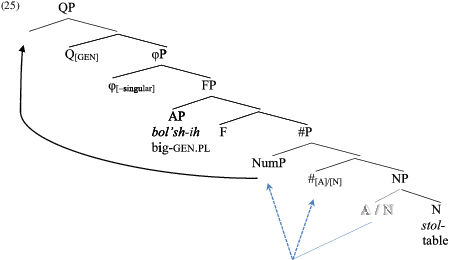
The dashed arrows in (25) indicate the diachronic process of numeralization. We propose that the # head inherited the information about the categorical status of the former count word, adjectival in the case of low numerals and nominal in the case of high numerals, which for the present purposes we designate as the [A] and [N] specifications of #, respectively. The importance of this step will become clear below.Footnote [12] The NP itself is now marked for countability via assignment by #, in a head-complement configuration. We also assume that the newly emerged numeral checks its quantificational Q feature by overt movement to Spec–QP (that is, Q’s respective feature has an ‘EPP property’), thus deriving the surface word order.
In essence, then, we postulate that there are two historically motivated versions of the countability head # in the lexicon of Modern Russian, roughly #[A] and # $_{\text{[N]}}$
. Each version is defined by the categorical type of the appropriate number word undergoing historical reanalysis as a numeral.Footnote
[13]
$_{\text{[N]}}$
. Each version is defined by the categorical type of the appropriate number word undergoing historical reanalysis as a numeral.Footnote
[13]
5.4 The computational particulars
We assume the Minimalist approach to syntactic computation (Chomsky Reference Chomsky, Martin, Michaels and Uriagereka2000, Reference Chomsky, Freidin, Otero and Zubizarretta2008). We further assume, without discussion, that the QP in (25) above is either a strong phase or a fragment of it, entailing that agreement-triggering heads have access to the entirety of their respective c-command domains (Abels Reference Abels2003, Svenonius Reference Svenonius, Adger, de Cat and Tsoulas2004, Chomsky Reference Chomsky, Freidin, Otero and Zubizarretta2008). Consequently, there are no Relativized Minimality type of restrictions on the respective agreement and movement processes within the QP. We also put aside the DP-level modification at this point. Following Franks (Reference Franks1995), we assume that both higher and lower numerals in their quantificational capacity are Caseless, that is, not subject to Nominative and Accusative Case assignment. Supporting evidence comes from adjectival quantifiers that appear to be restricted only to oblique forms, while lacking Nominative and Accusative forms, e.g. skol’kih/*skol’kie ‘how many-gen/nom’, neskol’kih/*neskol’kie ‘several-gen/nom’ (more discussion of oblique forms is in Section 5.7 below).Footnote [14]
In the case of higher numerals, # $=$
#
$=$
# $_{[\text{N}]}$
. As noted above, the entire QP is marked for a [–singular] feature of
$_{[\text{N}]}$
. As noted above, the entire QP is marked for a [–singular] feature of $\unicode[STIX]{x1D711}$
, which determines its clause-level agreement. But
$\unicode[STIX]{x1D711}$
, which determines its clause-level agreement. But $\unicode[STIX]{x1D711}$
also transmits this value to its complement domain via Feature assignment or via Agree, whereby nouns and adjectives marked for number within FP receive the respective valuation. In (25) above, both the noun and adjective are marked plural. In a similar vein, Q
$\unicode[STIX]{x1D711}$
also transmits this value to its complement domain via Feature assignment or via Agree, whereby nouns and adjectives marked for number within FP receive the respective valuation. In (25) above, both the noun and adjective are marked plural. In a similar vein, Q $_{\text{[GEN]}}$
assigns Genitive to the suitable (nominal) elements of its complement domain. Put in the Minimalist terms, both
$_{\text{[GEN]}}$
assigns Genitive to the suitable (nominal) elements of its complement domain. Put in the Minimalist terms, both $\unicode[STIX]{x1D711}$
and Q are probes endowed with features ([–singular] and [gen], respectively), and the noun and adjectives, but not the numeral, are goals that have respective unvalued features. The noun–adjective agreement is a morpho-syntactic output of this mechanism. Furthermore, in the case of the higher numerals, the respective #
$\unicode[STIX]{x1D711}$
and Q are probes endowed with features ([–singular] and [gen], respectively), and the noun and adjectives, but not the numeral, are goals that have respective unvalued features. The noun–adjective agreement is a morpho-syntactic output of this mechanism. Furthermore, in the case of the higher numerals, the respective # $_{\text{[N]}}$
head has zero morphological realization.
$_{\text{[N]}}$
head has zero morphological realization.
Consider now the lower numeral scenario, where # $=$
#
$=$
# $_{\text{[A]}}$
. Each step outlined above applies here as well. In particular, in this case, the noun receives a [–singular] valuation from
$_{\text{[A]}}$
. Each step outlined above applies here as well. In particular, in this case, the noun receives a [–singular] valuation from $\unicode[STIX]{x1D711}$
and a Genitive Case valuation from Q. The main difference is that #
$\unicode[STIX]{x1D711}$
and a Genitive Case valuation from Q. The main difference is that # $_{\text{[A]}}$
is morphologically realized as what is usually thought as Genitive singular on the complement N (itself a morphological descendant of the dual, as discussed above). The realization of the sub-features of
$_{\text{[A]}}$
is morphologically realized as what is usually thought as Genitive singular on the complement N (itself a morphological descendant of the dual, as discussed above). The realization of the sub-features of $\unicode[STIX]{x1D711}$
and # is illustrated in Table 3.Footnote
[15]
$\unicode[STIX]{x1D711}$
and # is illustrated in Table 3.Footnote
[15]
Morphological realization of $\unicode[STIX]{x1D711}$
and # in Modern Russian.
$\unicode[STIX]{x1D711}$
and # in Modern Russian.
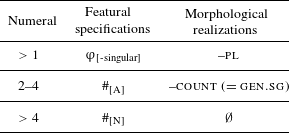
In terms of syntax–morphology mapping, and assuming the basic tenets of DM (see above), we may posit separate morphological exponents for the # head and for the $\unicode[STIX]{x1D711}$
+ Q conglomerate, the former realized as in Table 3, and the latter as a regular Genitive plural marking. The
$\unicode[STIX]{x1D711}$
+ Q conglomerate, the former realized as in Table 3, and the latter as a regular Genitive plural marking. The $\unicode[STIX]{x1D711}$
+ Q realization is not specific to numeral phrases: it is the usual marking in non-numeral quantificational phrases (e.g. mnogo stolov ‘many tables, gen.pl’). We suggest that the ‘gen.sg’ (or, rather, count) ending of #
$\unicode[STIX]{x1D711}$
+ Q realization is not specific to numeral phrases: it is the usual marking in non-numeral quantificational phrases (e.g. mnogo stolov ‘many tables, gen.pl’). We suggest that the ‘gen.sg’ (or, rather, count) ending of # $_{\text{[A]}}$
, e.g. -
$_{\text{[A]}}$
, e.g. - $a$
in the masculine form, is morphologically realized on the (counted) noun by a version of the ‘affix hopping’ rule in the post-syntactic component, perhaps in the form of morphological Merger or a similar operation under the condition of strict adjacency (see Chomsky Reference Chomsky1957; Bobaljik Reference Bobaljik1995, Reference Bobaljik2002; Lasnik et al. Reference Lasnik, Depiante and Stepanov2000).Footnote
[16]
In contrast, with higher numerals, since #
$a$
in the masculine form, is morphologically realized on the (counted) noun by a version of the ‘affix hopping’ rule in the post-syntactic component, perhaps in the form of morphological Merger or a similar operation under the condition of strict adjacency (see Chomsky Reference Chomsky1957; Bobaljik Reference Bobaljik1995, Reference Bobaljik2002; Lasnik et al. Reference Lasnik, Depiante and Stepanov2000).Footnote
[16]
In contrast, with higher numerals, since # $_{\text{[N]}}$
is not morphologically realized, the noun only receives the gen.pl realization of the
$_{\text{[N]}}$
is not morphologically realized, the noun only receives the gen.pl realization of the $\unicode[STIX]{x1D711}$
+ Q bundle.
$\unicode[STIX]{x1D711}$
+ Q bundle.
Thus, in the case of the lower numerals, but not in the case of higher numerals, the noun is marked with two morphologically overt exponents, those corresponding to # $_{\text{[A]}}$
and
$_{\text{[A]}}$
and $\unicode[STIX]{x1D711}_{[-\text{singular}]}$
+Q. However, it is known that Russian nouns generally do not allow more than one inflectional suffix, resorting to syncretism otherwise (for instance, plural inflection neutralizes gender distinction in Russian). We may capture this intuition with a DM-style impoverishment rule which deletes features from a fully specified feature matrix prior to Vocabulary insertion, yielding systematic neutralization in surface forms (see Bonet Reference Bonet1991, Nevins Reference Nevins2011):
$\unicode[STIX]{x1D711}_{[-\text{singular}]}$
+Q. However, it is known that Russian nouns generally do not allow more than one inflectional suffix, resorting to syncretism otherwise (for instance, plural inflection neutralizes gender distinction in Russian). We may capture this intuition with a DM-style impoverishment rule which deletes features from a fully specified feature matrix prior to Vocabulary insertion, yielding systematic neutralization in surface forms (see Bonet Reference Bonet1991, Nevins Reference Nevins2011):

Alternatively, we may assume a version Pesetsky’s (Reference Pesetsky2013) ‘one-suffix’ redundancy rule that deletes all inflectional suffixes except one (Section 2.6). For Pesetsky, it is the last suffix that gets deleted by the ‘one-suffix’ rule. However, since in our model # is located below $\unicode[STIX]{x1D711}$
(and Q), it is the first suffix that gets retained, rather than the last. We therefore adopt a modified version of the rule as follows:
$\unicode[STIX]{x1D711}$
(and Q), it is the first suffix that gets retained, rather than the last. We therefore adopt a modified version of the rule as follows:

Thus, in the case the lower numerals, the rule in (27) will leave only the # suffix. In the case of higher numerals, the noun will be marked only for $\unicode[STIX]{x1D711}$
+Q in the first place, and this marker gets retained.
$\unicode[STIX]{x1D711}$
+Q in the first place, and this marker gets retained.
5.5 Further evidence for #
To reiterate, it follows from our proposal that the alleged ‘Genitive singular’ with lower numerals is not an expression of any particular number and/or Case at all, but, rather, a morphological exponent of # which is semantically related to atomization and countability.
This view is not entirely novel. The existence of a special ‘count form’ or SCHËTNAJA FORMA , has been previously recognized in the Russian linguistic literature (e.g. Zaliznjak Reference Zaliznjak1967: 46–48; Mel’chuk Reference Mel’chuk1985: 430–438) as a special ‘adnumerative’ form used for countable elements occurring with numerals. According to these authors, the ‘count form’ may reveal itself at various levels of linguistic description. The stress-changing pattern with an otherwise Genitive singular forms in masculine and feminine genders, which we have seen in (5) above, is one manifestation of it at the phonological level. The ‘count form’ can also be distinguished lexically, e.g. ‘people’: ljudej (gen.pl) – čelovek (count), or morphologically, e.g. ‘flowers’: cvetov (gen.pl) – cvetkov (count), ‘kilogram’: kilogrammov (gen.pl) – kilogram (count), and similarly for other measurement units such as angstrem, mikron, etc. The first element in each of these pairs may appear with quantifiers that do not require obligatory atomization but prefer and/or require an interpretation as a group or conglomeration. In contrast, the second element is used when the object is countable, i.e. has an atomic structure:

Of course, not all Russian nouns are subject to this lexical variation. The traditional view therefore restricted the count form only to morphological and/or lexical deviations of the kind observed above. Our proposal is to generalize this view to all nouns occurring with the numerals. In essence, we are proposing that Russian utilizes a pseudo-classifier structure, with respective noun endings appearing as ‘affixal classifiers’ realizing the count form. Theoretically, this move is justified as the entire inflection paradigm for nouns comes from the separate functional head # responsible for countability. As we will see below, this generalized view on the count form is also justified from the broader Slavic perspective.
Watanabe (Reference Watanabe2010) discusses similar countability-related lexical distinctions using the distribution of ‘vague’ quantifiers that are compatible with either an atomic or group interpretation of the noun (note that the group interpretation does not imply that there is no atomization; rather it implies some sort of shift of focus from the atomic elements to their collective character in the interpretation procedure). For instance, number is only compatible with atomic/countable nouns, whereas amount is not:

Watanabe encodes this contrast in terms of placement of the respective quantifiers: numerals, measure phrases and other quantificational elements expressing overt cardinality are placed in Spec–#P, whereas ‘vague’ ones not directly expressing cardinality but nevertheless carrying a quantificational meaning (e.g. many, a lot, etc.) are placed in Spec–QP. We believe this step can be easily integrated in our analysis as well.
5.6 Q1 and Q2 revisited
The structural and (partially) diachronic perspective outlined so far allow us to approach the first two of the original three puzzles formulated in (4) above, repeated here:

The answer to Q1 follows from our perspective on the underlying morpho-syntactic interaction of the structural layers headed by #, Q and $\unicode[STIX]{x1D711}$
. What matters is the value of the categorical feature of the # head that can be specified either as [A], for lower numerals, or as [N], for higher numerals. The former, but not the latter, has overt morphological realization (see Table 2) and it is this morphology that we see in the case of lower numerals. Thus, we claim that there are no particular semantic factors such as those related to ‘paucity’ or other semantically-relevant notions that affect the agreement pattern on the noun. This view is welcome on the modularity approach to grammar where (morpho-)syntactic agreement distinction is triggered by factors at the same, syntactic, level avoiding unnecessary complications involving different levels of representation.
$\unicode[STIX]{x1D711}$
. What matters is the value of the categorical feature of the # head that can be specified either as [A], for lower numerals, or as [N], for higher numerals. The former, but not the latter, has overt morphological realization (see Table 2) and it is this morphology that we see in the case of lower numerals. Thus, we claim that there are no particular semantic factors such as those related to ‘paucity’ or other semantically-relevant notions that affect the agreement pattern on the noun. This view is welcome on the modularity approach to grammar where (morpho-)syntactic agreement distinction is triggered by factors at the same, syntactic, level avoiding unnecessary complications involving different levels of representation.
Our solution also implies that the ‘lower/higher’ cut among the numerals does not correlate with the number features per se. This seems intuitively correct. The fact that the lower numerals occur with what appears to be singular morphology on the noun is an artifact of the diachronic process of restructuring of the former adjectival paradigm to the new numeral category. This view is in line also with the cross-linguistic evidence, which suggests that there is no a priori agreement with a particular number morphology in numeral phrases. If our account is correct, then the plural number morphology in numeral phrases in English, as well as the singular number morphology in Turkish, alongside with classifiers in East Asian languages, are simply different manifestations of the countability/atomization property, or, more generally, the semantic partitioning in Doetjes’ (Reference Doetjes1997) sense.
We now turn to the second puzzle, repeated here from (4) above:

It should be clear from our discussion above that there is no number mismatch per se. What appears to be a number mismatch between the noun and the adjective is in fact a surface reflection of different valuating mechanisms, those of #, $\unicode[STIX]{x1D711}$
, and Q, on the noun and on the adjective. As discussed in Section 5.4, the noun receives morphological marking from the
$\unicode[STIX]{x1D711}$
, and Q, on the noun and on the adjective. As discussed in Section 5.4, the noun receives morphological marking from the $\unicode[STIX]{x1D711}$
+ Q as well as from the # head, but an additional rule deletes the former marking, leaving only the latter. As for the adjective, it only receives valuation and the corresponding morphological marking from the
$\unicode[STIX]{x1D711}$
+ Q as well as from the # head, but an additional rule deletes the former marking, leaving only the latter. As for the adjective, it only receives valuation and the corresponding morphological marking from the $\unicode[STIX]{x1D711}$
+ Q conglomerate and thus surfaces as Genitive plural. The ‘broken’ agreement pattern does not obtain with the higher numerals because [N] is morphologically null and the [–singular] plural marker of
$\unicode[STIX]{x1D711}$
+ Q conglomerate and thus surfaces as Genitive plural. The ‘broken’ agreement pattern does not obtain with the higher numerals because [N] is morphologically null and the [–singular] plural marker of $\unicode[STIX]{x1D711}$
surfaces unsuppressed. Russian then presents itself as a language in which each structural layer receives a separate morphological representation, thus offering a convenient test case for investigating these layers and their syntactic interaction.
$\unicode[STIX]{x1D711}$
surfaces unsuppressed. Russian then presents itself as a language in which each structural layer receives a separate morphological representation, thus offering a convenient test case for investigating these layers and their syntactic interaction.
5.7 Q3: The oblique Case metamorphosis
Consider now the third puzzle and the relevant example in (3), repeated here:


The descriptive generalization seems to be that in oblique Cases the numerals (both higher and lower) behave as modifiers, similarly to adjectives, showing full agreement, while in structural Cases the numerals behave themselves as Case-assigning heads. As discussed in Sections 2.3–2.5, this apparent duality was encoded in different terms in the literature, either in terms of relative timing of Case assignment (Babby Reference Babby1987) or a dual categorical status of the numerals (Franks Reference Franks1995), or the choice of a valued or an unvalued Case feature on the numeral (Rappaport Reference Rappaport2002). These accounts are incomplete in that they do not explain what might lie behind this duality (put differently, the question is why the categorical distribution is not the reverse in each case, among other logical possibilities). Let us see how our structural proposal may shed light on this issue.
We assume that the source of an oblique Case is some external head such as P assigning a lexical or a thematically-grounded Case to the QP. Thus, in essence, phrases marked with an oblique Case are PPs (see Bayer, Bader & Meng Reference Bayer, Bader and Meng2001, Woolford Reference Woolford2006). It follows that the source of the (homogeneous) Case pattern is necessarily external, not pertaining to the QP-internal heads #, $\unicode[STIX]{x1D711}$
and Q themselves. In fact, the role of these three internal heads may be drastically reduced in this case, compared to the non-oblique contexts.
$\unicode[STIX]{x1D711}$
and Q themselves. In fact, the role of these three internal heads may be drastically reduced in this case, compared to the non-oblique contexts.
The basic idea is the old one: prepositions assign a lexical and/or thematic Case to their NP complements. A NP complement of P constitutes one of the three classical Case-licensing configurations (Chomsky Reference Chomsky1986). Let us take this idea here quite literally, to mean that (a) the recipient of an oblique Case assigned by P must necessarily bear a full set of nominal characteristics; and (b) some kind of structural adjacency is required for lexical Case assignment (Bayer, Bader & Meng Reference Bayer, Bader and Meng2001, Woolford Reference Woolford2006). In the Minimalist formulation, the second requirement translates into a strict locality restriction on Agree with P as a probe, which needs matching with the categorical N feature. This is different from structural Case assignment, which is not subject to such a stringent locality requirement, so that a probe licensing a structural Case can search for its goal at a greater depth within the DP.Footnote [18]
This distinction provides a necessary conceptual backdrop for spelling out the homogeneous Case pattern. Both structural and oblique Case licensors require an access to a full set of nominal characteristics. A structural Case licensor such as Tense or little $v$
can probe into the structure of QP to identify this set, including number, person and gender. On the other hand, an oblique Case licensor such as P is restricted in this access to the features of the (adjacent) highest projection of QP, which includes only [GEN] in Russian, but not the N feature. This is insufficient for Case assignment, and failure to assign Case here would result in a violation of the Case filter (in whatever form we assume it to function in the grammar).
$v$
can probe into the structure of QP to identify this set, including number, person and gender. On the other hand, an oblique Case licensor such as P is restricted in this access to the features of the (adjacent) highest projection of QP, which includes only [GEN] in Russian, but not the N feature. This is insufficient for Case assignment, and failure to assign Case here would result in a violation of the Case filter (in whatever form we assume it to function in the grammar).
We believe that the observed homogeneous agreement pattern is a grammatical ‘remedy’ circumventing a Case filter violation. We envision the remedying solution in the form of effectively extending the relevant nominal domain via some version of restructuring. Typically, QP and $\unicode[STIX]{x1D711}$
P are not Case domains as they do not contain the information about the nominal, and therefore, they cannot receive Case assigned by
$\unicode[STIX]{x1D711}$
P are not Case domains as they do not contain the information about the nominal, and therefore, they cannot receive Case assigned by $s$
‘with’. In this case, we suggest that a series of head movements progressively incorporating heads #, F,
$s$
‘with’. In this case, we suggest that a series of head movements progressively incorporating heads #, F, $\unicode[STIX]{x1D711}$
and Q frees up the boundaries of the nominal domain, thus making the nominal information available ‘at the top’. This is shown schematically in (30):
$\unicode[STIX]{x1D711}$
and Q frees up the boundaries of the nominal domain, thus making the nominal information available ‘at the top’. This is shown schematically in (30):

Formally, there are several ways to make this intuition more precise. In effect, the same intuition lies behind Baker’s (Reference Baker1988) Government Transparency Corollary (GTC), whereby a head category with another head incorporated into it governs everything that the incorporated head used to govern in its original structural position. Exploring a Minimalist version of the GTC, Stepanov (Reference Stepanov2012) points out that on the assumption that head movement does not leave traces (still being part of core syntax), the Minimalist bare phrase structure theory allows for a possibility that movement of head $\unicode[STIX]{x1D6FC}$
into head
$\unicode[STIX]{x1D6FC}$
into head $\unicode[STIX]{x1D6FD}$
effectively collapses
$\unicode[STIX]{x1D6FD}$
effectively collapses $\unicode[STIX]{x1D6FC}$
P and rearranges the target phrase
$\unicode[STIX]{x1D6FC}$
P and rearranges the target phrase $\unicode[STIX]{x1D6FD}$
P as a composite phrase (
$\unicode[STIX]{x1D6FD}$
P as a composite phrase ( $\unicode[STIX]{x1D6FC}+\unicode[STIX]{x1D6FD}$
)P which includes all relevant information contained in both heads such as respective feature matrices as well as a structural hierarchy within the head cluster resulting after movement. A radical version of this account entails that the final landing site of the series of the head movement is a conglomerate head that shares the properties of the categories through which movement took place. In our case, this means that the highest phrase resulting from these movement series will contain the features of F, the original moving head, which, by hypothesis, contains the categorical information about the NP (as well as #P). As a result of this domain extension, a restructured NP in the position of the complement of P is accessible for oblique Case assignment via Feature assignment or Agree. That is, all elements of this restructured NP projection receive Case, even the numeral itself, in accord with the empirical facts.
$\unicode[STIX]{x1D6FC}+\unicode[STIX]{x1D6FD}$
)P which includes all relevant information contained in both heads such as respective feature matrices as well as a structural hierarchy within the head cluster resulting after movement. A radical version of this account entails that the final landing site of the series of the head movement is a conglomerate head that shares the properties of the categories through which movement took place. In our case, this means that the highest phrase resulting from these movement series will contain the features of F, the original moving head, which, by hypothesis, contains the categorical information about the NP (as well as #P). As a result of this domain extension, a restructured NP in the position of the complement of P is accessible for oblique Case assignment via Feature assignment or Agree. That is, all elements of this restructured NP projection receive Case, even the numeral itself, in accord with the empirical facts.
Feature-wise, there are no changes in the structural makeup of the extended NP projection except two: (a) when Q participates in the domain extension by hosting the # head, it no longer assigns Genitive; (b) the # head itself is no longer realized on the noun. Both restrictions are likely to result because the conditions on realization of the respective morpho-syntactic features are no longer fulfilled. Concerning the first exception, the failure to assign Genitive on the quantified noun is likely to be a result of a Case conflict or competition between Genitive and the oblique or inherent Case from an external assigner (preposition or verb). One possibility is that this conflict is morphological in the sense of the general tendency of Russian to preserve only one Case affix (Section 5.4). Another possibility is that the conflict is syntactic. To resolve a similar kind of conflict, extrinsing ordering of Case assignment was postulated previously, with oblique Case taking precedence over quantificational Genitive (Section 2.4). Such extrinsic ordering is a rather unappealing solution in a computationally efficient syntactic system. Bošković (Reference Bošković and Boeckx2006) offers a re-interpretation of this Case conflict resolution in the Minimalist syntax, which avoids postulating explicit Case assignment priorities. This work derives the conflict from theta-theoretic considerations (Theta Criterion; Chomsky Reference Chomsky1986), coupled with considerations of derivational economy understood in the sense of the Minimalist program. Consider the homogeneous Case pattern in example (3) repeated in the beginning of this section, compared with an ungrammatical Genitive-driven alternative:

Bošković (Reference Bošković and Boeckx2006) assumes that an external oblique/inherent Case assigner will theta-mark its object iff it assigns it the inherent Case in question. The derivation in (31) then cannot converge because the external Case assigner will fail to theta-mark its object. Since derivational economy compares only convergent derivations, the derivation of (31) does not actually compete with the derivation of (3): rather the derivation of (3) is forced. Thus, no extrinsic ordering of Case application is needed. From a more ‘QP-internal’ perspective, the situation neutralizing the Genitive-assigning ability of Q is also abstractly reminiscent of the English passives, in which the interaction of the passive morpheme -en and the verb destroys the configuration for Accusative Case assignment (Baker, Johnson & Roberts Reference Baker, Johnson and Roberts1989), although, as a JL referee rightly points out, in our case the underlying mechanism is quite different (for the above authors, the Case assigning ability of the verb is realized on the passive morpheme -en which is itself a verbal argument). The conjecture that the [ $\unicode[STIX]{x1D711}$
+F + #] head cluster ‘absorbs’ the Genitive-assigning ability of Q also recalls the proposal in Bailyn (Reference Bailyn2012) discussed in Section 2.5 (although we depart from Bailyn in that for him it is the numeral that is generated in Q instead).
$\unicode[STIX]{x1D711}$
+F + #] head cluster ‘absorbs’ the Genitive-assigning ability of Q also recalls the proposal in Bailyn (Reference Bailyn2012) discussed in Section 2.5 (although we depart from Bailyn in that for him it is the numeral that is generated in Q instead).
Concerning the second exception, the lack of morphological realization of # on the noun, we believe it is due to similar considerations related to head movement. It is well known that the ‘affix hopping’ family of rules, including morphological Merger, operate under the condition of structural adjacency (see Section 5.4. for discussion and references). Once # has moved, it is no longer adjacent to the noun, therefore, morphological Merger/affix hopping cannot proceed. A related intuition is expressed in Baker’s (Reference Baker1988) Case Frame Preservation Principle which states, roughly, that a complex head of the category $\unicode[STIX]{x1D6FC}$
cannot have more properties than those allowed for simple items of the same category. Feature-wise, the movement of # may trigger PF deletion of the corresponding feature [A] via another morphological impoverishment rule. Conditions for application of this rule may include the loss of structural adjacency with the noun, as outlined above, and/or potential incompatibility of #
$\unicode[STIX]{x1D6FC}$
cannot have more properties than those allowed for simple items of the same category. Feature-wise, the movement of # may trigger PF deletion of the corresponding feature [A] via another morphological impoverishment rule. Conditions for application of this rule may include the loss of structural adjacency with the noun, as outlined above, and/or potential incompatibility of # $_{\text{[A]}}$
with other features in the resulting head cluster, in particular (oblique) Case. Some indication that a process along these lines might indeed take place comes from the fact that #
$_{\text{[A]}}$
with other features in the resulting head cluster, in particular (oblique) Case. Some indication that a process along these lines might indeed take place comes from the fact that # $_{\text{[A]}}$
is itself historically a (Genitive) Case marker, as we have seen above. Thus, a featural conflict may arise in the case of # as well, perhaps along the lines of a markedness hierarchy, as is often suggested (Noyer Reference Noyer1997, Nevins Reference Nevins2011, among others).
$_{\text{[A]}}$
is itself historically a (Genitive) Case marker, as we have seen above. Thus, a featural conflict may arise in the case of # as well, perhaps along the lines of a markedness hierarchy, as is often suggested (Noyer Reference Noyer1997, Nevins Reference Nevins2011, among others).
The proposed solution can be restated in the phase perspective. Recall that on our assumptions, a QP (or a DP dominating it), is possibly a strong phase (Section 5.4). One way of further streamlining the solution would be to assume that Structural Case-inducing probes such as T or little $v$
, on the one hand, and oblique Case-inducing probes such as P, on the other, differ in that the latter, but not the former, require valuation of the categorical [N] feature, in addition to the other features (e.g. phi-features and/or a D feature). Movement of the head #, presumably specified with the N feature, would in this case serve to make the categorical information ‘visible’ at the root of the phase, in much the same way phrasal movement to the edge of the phase makes the moving element visible from outside (on the assumption that the head of the phase, along with its edge, are visible to external probes, see Chomsky Reference Chomsky, Freidin, Otero and Zubizarretta2008).
$v$
, on the one hand, and oblique Case-inducing probes such as P, on the other, differ in that the latter, but not the former, require valuation of the categorical [N] feature, in addition to the other features (e.g. phi-features and/or a D feature). Movement of the head #, presumably specified with the N feature, would in this case serve to make the categorical information ‘visible’ at the root of the phase, in much the same way phrasal movement to the edge of the phase makes the moving element visible from outside (on the assumption that the head of the phase, along with its edge, are visible to external probes, see Chomsky Reference Chomsky, Freidin, Otero and Zubizarretta2008).
Generally speaking, then, a fully spelled out formal restatement should follow from the core syntactic principles responsible for syntactic restructuring. Establishing these core principles and their interaction is itself an important theme in the recent literature, at least in the verbal domain (e.g. Wurmbrand Reference Wurmbrand2001). It is important to realize that, unlike in the previous accounts, for us there is no internal ‘duality’ pertaining to some element in the numeral phrase; rather, the heterogeneous/homogeneous switch is determined by the ‘external’ properties, namely, the nature of the Case-inducing probes that target the numeral phrase. Although the proposed restructuring solution does not directly bear on the presence of the countability property per se, we believe it sheds more light on its role in the syntactic computation and its featural requirements, including interaction with other heads in the respective structures.
6 A Slavic perspective on countability: Bulgarian
Interesting (though necessarily indirect) cross-linguistic evidence for the main proposal we advance for Russian comes from another Slavic language, Bulgarian. Bulgarian is typologically remarkable within the Slavic family in that it lost the rich Case-marking morphology on nouns (though not on pronouns and clitics) typical for other Slavic languages. This fact makes Bulgarian an excellent test case for separating Case from other sources of morphological assignment internal to numeral-based QPs. If a numeral is added into a nominal expression in Bulgarian, this triggers a special sort of marking on the noun denoting a countable quantity of objects in a set:
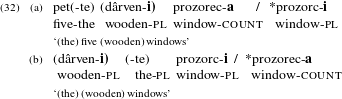
The morphologically visible count form - $a$
is limited to a subset of the masculine paradigm. Standardly, it is only used with inanimate or non-person nouns. Some Bulgarian dialects, however, allow its use with animate masculine nouns as well (Pashov Reference Pashov1989). In non-masculine paradigms, simple plural is used instead.
$a$
is limited to a subset of the masculine paradigm. Standardly, it is only used with inanimate or non-person nouns. Some Bulgarian dialects, however, allow its use with animate masculine nouns as well (Pashov Reference Pashov1989). In non-masculine paradigms, simple plural is used instead.
Examples such as (32) are striking in two respects. First, they demonstrate a nominal morphology that is crucially different from Case and appears only in the context of a numeral. Second, numeral expressions such as (32) manifest the same ‘broken’ noun–adjective agreement pattern that we find in Russian. The only and important difference with Russian is that the ‘broken’ agreement pattern in Bulgarian is not restricted to the lower numerals, but, instead, is generalized to the entire numeral paradigm. This reinforces the view we argued for above, that whatever factor underlies the ‘count’ form, it does not have to be restricted to a particular subset of numbers.
If our proposed approach is on the right track, the appearance of a special morphology on the noun occurring with numerals in Bulgarian is not at all surprising. For us, this special marker is an instantiation of the countability head # whose distinct morphological realization covers the entire numeral paradigm. The fact that it is not a Case morphology, as well as its restricted distribution, supports the view that we may not be dealing with Case morphology on the noun in Russian numeral-based QPs either. Furthermore, the ‘broken’ agreement pattern suggests a mechanism of morphological realization of plurality and countability similar to the one we suggested for Russian, based on the interaction of the number and countability layers, responsible for plurality and atomization. In effect, for Bulgarian we would postulate a structure close or identical to (25), modulo Genitive Case assignment by Q.
The ‘count’ form received a close attention in the Bulgarian traditional and typological literature. Even a cursory look at this literature reveals two major views on the origin on the ‘count’ form. The dominant view is that the count form is a direct descendant of the Old Church Slavonic dual number (e.g. Mirchev Reference Mirchev1958, Pashov Reference Pashov1989). An alternative view sees it as a descendant of the Genitive singular form, similarly to Russian (Kharalampiev Reference Kharalampiev2001, Anna-Maria Totomanova, p.c.). Our proposed model may potentially reconcile these two competing views on the origin of the count form in the Bulgarian grammatical tradition. Essentially, our model suggests that both the dominant and the alternative views are correct, but reflect different stages of grammatical change. In effect, we may postulate a trajectory of historical change underlying this ‘count’ form, whereby the dual form constitutes the initial (Old Church Slavonic) stage, the Genitive singular the intermediate stage, and the modern ‘count’ form the most recent development of the Modern Bulgarian. The major syntactic change, as we saw, happened between the first and second stages, upon emergence of the new grammatical category # (Section 4.3). Given the fact that Bulgarian lost the productive Case morphology, the modern ‘count’ form is in effect a ‘frozen’ Genitive singular marker that lost its initial membership in the respective Case and number declensions. In fact, there is diachronic evidence reported in the literature that the development of the modern ‘count’ form proceeded largely in parallel with the gradual loss of Genitive Case in Bulgarian (and its replacement with prepositional forms) both of which can be traced back to the period around the 13th–14th centuries (e.g. Mirchev Reference Mirchev1958). One may therefore tentatively hypothesize that Bulgarian represents a diachronic stage of development of the Slavic syntactic numeral system whereby the ‘lower’ numeral # $_{\text{[A]}}$
-marked declension has been generalized to the entire numeral paradigm.
$_{\text{[A]}}$
-marked declension has been generalized to the entire numeral paradigm.
7 Countability: Psycholinguistic evidence for #
7.1 The experiment
We conducted a sentence completion experiment that was aimed to test whether the morpho-syntactic mechanism of countability that we postulated for Russian may also be reflected in language use. In particular, we wanted to see whether Russian speakers are sensitive to the countability layer in the structure of numeral-based QPs, in contrast with the usual quantificational Case morphology. In the structure that we are assuming for Russian, the source of the Genitive is Q, the head of the quantificational layer (Section 4.1). Showing that speakers may distinguish the morphology induced by the countability head # and the morphology induced by the quantificational Genitive, in the same structure, may serve as additional evidence for our argument that the nominal morphology in Russian numeral phrases is in effect a morphological realization of the countability head #.
Previous psycholinguistic research on so-called ‘agreement errors’ or ‘agreement attraction’ demonstrated that the human speech production system often faces difficulties in correctly encoding grammatical information such as a particular feature, if/when it mistakenly identifies more than one structural trigger as the relevant source of that feature. For instance, it has long been known that English speakers may make performance errors as in ‘The editor of the books are tall’ under spontaneous or experimentally induced conditions such as limiting the time frame or taxing the working memory. In examples like this, the source of the agreement feature on the auxiliary verb is the head editor, but another, interfering, element books may be seen by the production system as a competing source of agreement (Bock & Miller Reference Bock and Miller1991, among others). This kind of error was argued to signal a special role of the grammatical encoding module of the speech production system, sensitive to and/or interacting with such hardcore syntactic notions as c-command, hierarchy and even Relativized Minimality (Bock & Levelt Reference Bock, Levelt and Gernsbacher1994, Vigliocco & Nicol Reference Vigliocco and Nicol1998, Franck, Vigliocco & Nicol Reference Franck, Vigliocco and Nicol2002, Franck et al. Reference Franck, Lassi, Frauenfelder and Rizzi2006, among others). A different, though conceptually related, strand of research on ‘similarity-based interference’ reports interference effects in language comprehension as well as production, whereby temporary holding an element bearing a particular kind of feature in the working memory impedes memory recall of another element that bears the same type of feature, even if the actual value of that feature is different (e.g. Lewis & Vasishth Reference Lewis and Vasishth2005). These works demonstrate that encoding a feature in the presence of a potential competitor presents a challenge for the production system.
Taking these considerations as a point of departure, we can formulate our empirical predictions. Consider again the original Russian agreement pattern in examples (1) and (2) above. Recall that Russian allows only one inflectional suffix on the noun (see Section 5.4). Let us suppose, as a null hypothesis, that the - $a$
ending in (2) is nothing more than a Genitive singular. The source of that Case ending would then be the only (Genitive) Case assigning head, namely Q, heading the quantificational layer. We hypothesize that if Genitive singular and Genitive plural are ‘alike’ and come from the same source, they may potentially compete with each other in performance under memory-taxing conditions, inducing a similar kind of performance errors as observed in case of ‘agreement errors’, or difficulties caused by similarity-based interference, in language production. Specifically, we expect that (a) speakers will make performance errors in choosing the right ending; (b) such performance errors in both directions (that is, gen.sg instead of gen.pl, and gen.pl instead of gen.sg) should be equally likely (close to a 1:1 ratio); and finally (c) the likelihood of such errors will increase proportionally to the respective difficulty in recall.
$a$
ending in (2) is nothing more than a Genitive singular. The source of that Case ending would then be the only (Genitive) Case assigning head, namely Q, heading the quantificational layer. We hypothesize that if Genitive singular and Genitive plural are ‘alike’ and come from the same source, they may potentially compete with each other in performance under memory-taxing conditions, inducing a similar kind of performance errors as observed in case of ‘agreement errors’, or difficulties caused by similarity-based interference, in language production. Specifically, we expect that (a) speakers will make performance errors in choosing the right ending; (b) such performance errors in both directions (that is, gen.sg instead of gen.pl, and gen.pl instead of gen.sg) should be equally likely (close to a 1:1 ratio); and finally (c) the likelihood of such errors will increase proportionally to the respective difficulty in recall.
As the relevant memory-taxing conditions, we employed the linear (and structural) distance between the Q licensor and the respective noun, in terms of the number of intervening adjectives. That is, in a schematically represented situation in (33), the likelihood of errors is expected to increase progressively on the scale from (33a) to (33c).
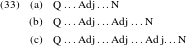
If, on the other hand, the gen.sg and gen.pl are not ‘alike’ in the sense of not coming from the same source, then the competition may not be at issue or at least not be the only factor that affects the choice. We then expect that the ratio of observed performance errors should not be at random. The grammatical sources of each of these endings are then likely to be different.
7.2 Materials
Materials consisted of 48 sentential preambles ending with a numeral phrase containing a missing noun. A lemma for the missing noun was provided separately. The following is an example of a sentential preamble:

The variables manipulated were the following: (a) the type of numeral (higher, lower); (b) the number of intervening adjectives with gen.pl (one, two or three); and (c) the gender of the noun (masculine, feminine, neuter). The items were equally represented across each of these three dimensions, and were counterbalanced using a Latin square design. The items were presented in a pseudo-randomized order to the participants, so that each participant had a unique ordering of items during the trial. Each experimental sentence was followed by a yes/no comprehension question, intended to control whether the participants were attentive to the content of the sentence. In addition, four practice sentences were added to the experimental items.
7.3 Participants
Sixty-two self-reported monolingual Russian adult native speakers participated in the experiment voluntarily and anonymously for no material compensation (age 24–46 years, median age $=$
31 years). All participants were recruited via email and social networking forums and were located in the greater areas of the cities of Moscow, Novgorod and Perm. They had normal or corrected to normal vision. The participants were naïve as to the real purposes of the study.
$=$
31 years). All participants were recruited via email and social networking forums and were located in the greater areas of the cities of Moscow, Novgorod and Perm. They had normal or corrected to normal vision. The participants were naïve as to the real purposes of the study.
7.4 Procedure
The task was a cloze-type sentence completion task. First, an incomplete sentence was presented to a participant word by word in an auto-paced mode: each word was presented for 300 ms followed by a short pause of 100 ms between words. Words appeared exactly in the center of the computer screen replacing one another, so that in order to assess the meaning of the entire sentence the participants could only rely on their working memory, excluding other potential cues, such as relative ‘topological’ positions of the words on the screen. As (34) exemplifies, the numeral-based QP was always sentence-final, usually the (postverbal) subject of the sentence. After the lastly presented item in the sentence, the screen showed the lemma for the missing noun and a type-in window was provided immediately below.
The participants were asked to read each sentence and fill in the missing word form in the window provided, on the basis of their first intuitions and without dwelling on the answer. When a participant typed in the required input, the latter was recorded and the screen showed a comprehension question, followed by two possible answers to it, ‘yes’ or ‘no’, immediately below. The participants were then instructed to either click on the respective answer with the mouse or press the key corresponding to the number of that answer. The participants were also allowed to take a short break before reading the next item, if needed. The experiment was programmed using the Ibex web-based software (by Alex Drummond, http://spellout.net/ibexfarm/).
7.5 Results
The data from five participants were removed from the count: four participants did not understand the task and gave irrelevant responses, and one person’s score on the correctness of the comprehension questions was at chance. This left the data from 57 participants to be included in the analysis. The results were manually coded for the correctness of the word form provided by the participants to the respective sentential preamble. The correctness in this case means choosing either a gen.sg or a gen.pl form on the final noun, depending on the preceding numeral.
We found that participants indeed made performance errors under the induced experimental conditions, in the form of substituting Genitive singular for Genitive plural and vice versa. A total of 231 errors was found, of which 174 (75%) were false gen.sg, 42 (18%) gen.pl, and 15 (6%) miscellaneous errors (e.g. repetition of the lemma). The overall ratio of errors was about 8%, which is comparable to a typical amount of spontaneous production errors in subject–verb agreement reported in the literature (e.g. Franck et al. Reference Franck, Lassi, Frauenfelder and Rizzi2006). The distribution of these performance errors was thus heavily biased towards Genitive singular with a ratio of about 4:1 (Figure 1).
Distribution of performance errors in assigning the correct word form after the numeral, in total.
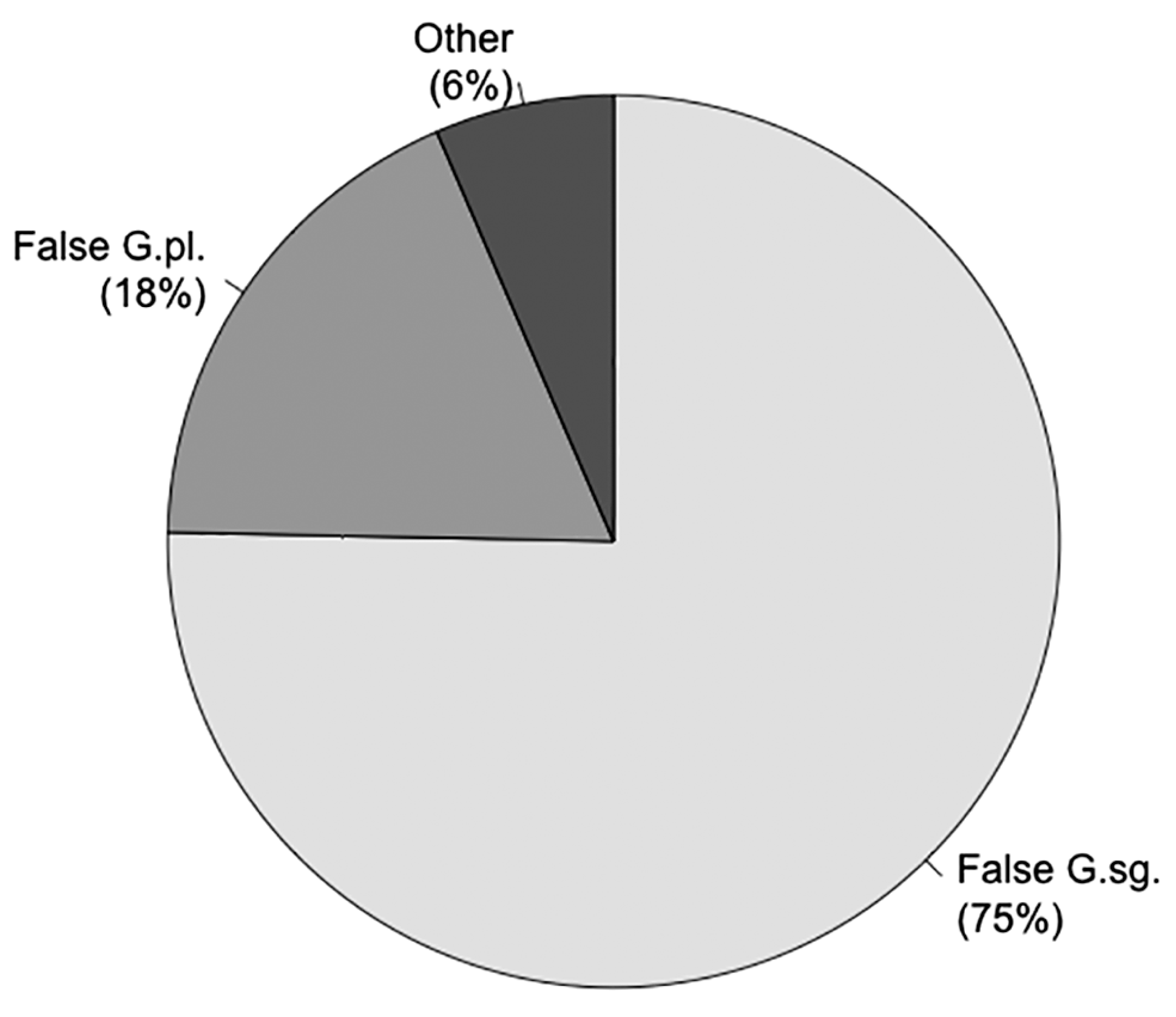
Our statistical models revealed a robust main effect of the numeral type ( $\unicode[STIX]{x1D712}^{2}(1)=14.20$
,
$\unicode[STIX]{x1D712}^{2}(1)=14.20$
, $p=.00016$
).Footnote
[19]
There was no main effect of the number of adjectives accompanying the noun (
$p=.00016$
).Footnote
[19]
There was no main effect of the number of adjectives accompanying the noun ( $\unicode[STIX]{x1D712}^{\text{2}}(2)=3.67$
,
$\unicode[STIX]{x1D712}^{\text{2}}(2)=3.67$
, $p=.159$
), and there was a marginal effect of gender (
$p=.159$
), and there was a marginal effect of gender ( $\unicode[STIX]{x1D712}^{\text{2}}(2)=5.00$
,
$\unicode[STIX]{x1D712}^{\text{2}}(2)=5.00$
, $p=.0817$
), with masculine and neuter nouns being slightly more likely to induce errors than feminine nouns. In other words, in our study the numeral type emerged as the only significant predictor that affected the error ratio.
$p=.0817$
), with masculine and neuter nouns being slightly more likely to induce errors than feminine nouns. In other words, in our study the numeral type emerged as the only significant predictor that affected the error ratio.
7.6 Discussion
The experiment was intended to determine whether the Genitive singular and Genitive plural may compete with each other as two possible values of (Q-induced) Genitive Case under memory-taxing conditions potentially complicating recall of their respective licensor (the quantificational Q head). If the two values competed with each other, then we could possibly see their distribution more or less at random. The observed overwhelming dominance of Genitive singular errors strongly suggests that Russian speakers do not manipulate the two morphological values on an equal basis. This, in turn, is consistent with the hypothesis that the sources for each value are different. This interpretation is further strengthened in light of our finding that in making those errors, speakers are insensitive to the purely performance-based conditions such as the linear/structural distance between the alleged Q licensor and the noun, which would have affected their likelihood if the distance were measured from the same, single licensor.
Under our proposed architecture of the QP, whereby the sources of Genitive plural and Genitive singular are the quantificational (Q) and the countability (#) heads, respectively, the results are not surprising. When lacking full access to the respective feature licensor, as evidenced by the errors, speakers choose to encode something that is present in every item, irrespectively of the numeral type, namely, countability. Put differently, the observed response and error patterns suggest that, when supplying the respective noun forms, the speakers may have not necessarily remembered what the preceding numeral was, but they were always certain that there was a numeral, and consequently, an atomized plurality in the input. Again, this is consistent with the invariant presence of the syntactic licensor of countability in the syntactic structure, consulted by the speakers’ parsing routines.
8 Concluding remarks
This work started with the three well-known agreement puzzles in the internal syntax of Russian numeral phrases, which concern unusual or unexpected patterns of agreement on the noun and accompanying adjective in the presence of a numeral. In the present work we sketched a theory of numeral-based QPs that offers a unified account of these three puzzles. Our proposed account stems from the premise that the structure of a numeral-based QP comprises (at least) three structural layers: the quantificational layer headed by Q, the number layer headed by $\unicode[STIX]{x1D719}$
, and the countability layer headed by #. Each of these heads consists of a particular set of features. Some of those features, such as those of #, are subject to diachronic processes. We have shown that the puzzling agreement patterns in Russian QP are better understood if one takes into account the semantic notion of countability as well as the specifics of the diachronic change within the Russian numeral phrase, at the same time avoiding major overhauls of the syntactic (or semantic) theory. We see the main contribution of the present study as mainly integrative, bringing together different numerosity-related components and spelling out the details of their interaction. We believe our proposals are corroborated by independent cross-linguistic and psycholinguistic considerations (Sections 6 and 7). In view of these results, Russian emerges as a revealing test case for a unified structure of numeral-based QPs along the proposed lines.
$\unicode[STIX]{x1D719}$
, and the countability layer headed by #. Each of these heads consists of a particular set of features. Some of those features, such as those of #, are subject to diachronic processes. We have shown that the puzzling agreement patterns in Russian QP are better understood if one takes into account the semantic notion of countability as well as the specifics of the diachronic change within the Russian numeral phrase, at the same time avoiding major overhauls of the syntactic (or semantic) theory. We see the main contribution of the present study as mainly integrative, bringing together different numerosity-related components and spelling out the details of their interaction. We believe our proposals are corroborated by independent cross-linguistic and psycholinguistic considerations (Sections 6 and 7). In view of these results, Russian emerges as a revealing test case for a unified structure of numeral-based QPs along the proposed lines.
Some questions remain open for further study. For instance, the loss of Genitive-assigning ability of Q in the oblique Case environment needs to be specified more precisely, exploring other possible structural conditions under which it may occur. We also deliberately limited ourselves with simple (one-word) numerals, leaving aside complex cardinals such as ‘twenty three’ or ‘one thousand one hundred and twelve’, although, given the current understanding of the syntax and semantics of these complex cardinals, we expect that the account proposed here can naturally be extended (see Ionin & Matushansky Reference Ionin and Matushansky2006 for relevant discussion). It also seems promising to explore the consequences for Slavic languages beyond Bulgarian (Section 6), as well as for a larger cross-linguistic sample.



