




Introduction
The Oxford English Dictionary (OED), a text that describes itself as “the accepted authority on the English language,” includes fifty-six entries for Korean words.Footnote 1 While these entries comprise a modest sliver – less than one hundredth of one percent – of the dictionary’s total, the September 2021 update of twenty-eight Korean words was swiftly reported by the South Korean government, social media users, and news outlets across six continents.Footnote 2 For many who commented on this update, this lexical set served as undeniable evidence that hallyu, or the global embrace of music, dramas, film, food, and cosmetics from South Korea, was now heard and seen by a powerful institution. As English has long been regarded as a symbol of global modernity, in ways that remain profoundly palpable to many South Koreans (Park Reference Park2009, Reference Park2021; Harkness Reference Harkness2012; Kang Reference Kang2012; Lo and Choi Reference Lo and Choi2017), the fact that a collection of words from Korean had become a part of English, according to the OED, was hailed as a momentous feat.Footnote 3
Yet this update to the OED did not merely signal South Korea’s modern status; it also signaled that of the English speaker, ostensibly documented within the pages of the OED. This dictionary, although maintained by lexicographers at one of the world’s oldest and most prestigious universities, has long sought to portray the English speaker as especially modern. This orientation was articulated a half-century ago in the preface to the first supplement of the first edition, which the then-chief editor described as containing “the most recent accessions to the English language” that are “graced necessarily with ‘modern decorations’” (Burchfield Reference Burchfield1972: v). Today, its quarterly updates continue to showcase its ever-evolving modernity. In this sense, the inclusion of Korean words represented the increasing frequency with which contemporary English speakers were said to incorporate bits of Korean into their speech and writing, offering public evidence of an increasingly salient figure: the Modern English Speaker of Korean (MESK).Footnote 4
This article traces representations of the MESK from its earliest emergence in the first edition of the OED to its present depiction in the third edition, which is currently under revision. I analyze the complete set of fifty-six Korean entries across these editions in terms of their internal discursive structure, focusing on how quotations exemplifying representative uses provide a historical narrative of the MESK’s cross-racial encounters, how entries are defined in ways that locate this figure in relation to Korea, and how this figure’s phonological patterns presuppose a particular racial embodiment. By focusing on lexicographers’ representations of Korean words, I examine how a specific kind of listening subject (Inoue Reference Inoue2006) was represented as eavesdropping on the MESK, an idealized speaker of English, and how this figure was taken to be engaged in its own listening act, as it eavesdropped on Korean speakers. I also consider the significance of these entries in the context of their surrounding texts, including release notes on the OED website and social media discourses, both of which reflect popular understandings of the MESK. This collective set of discourses provides a layered portrait of whose English counts as documentable English and according to whom it counts.
In my analysis of these texts, I show how the figure of the MESK has been represented as evolving over the years, specifically in ways that signal a shift in colonial and economic centers of global power. The figure of the MESK initially surfaced over a century ago in the context of European colonial conquests, manifesting at that time as a Koreanist, a white, masculine observer and translator of a racial other. This figure was represented as having been born in England in the seventeenth century and then becoming an American by the end of the nineteenth. Consistent across these representations was the Koreanist’s curiosity about and expertise in Korea, even while maintaining a safe emotional distance.
Yet practices of listening have arguably undergone a shift in recent decades, as the OED has offered an audible nod to hallyu’s global influence. The most recent Korean entries have thus invoked the Korea Fan, a popular figure of fandom who is frequently feminized and who may not even be white (Chun Reference Chun2017; Wang and Pyun Reference Wang and Pyun2020; Yoo Reference Yoo2023). Notably, this figure’s ardent affective commitment to Korea, manifesting in moments legible as “bilingual” performance, has come to complicate institutional models of language. The specific case of Korean signs offers an especially fruitful lens to examine how a dictionary accommodates the modern English speaker’s shifting subjectivity in ways that may challenge longstanding ideologies of language, race, and gender.
My analysis illustrates how the OED, despite recording echoes of the exuberance that contemporary English speakers express for Korea, relies on tactics of recontextualization (Bauman and Briggs Reference Bauman and Briggs1990) that presuppose a racial boundary between speakers of English and those of Korean. According to the OED, the MESK may carefully gaze at Korea, adopting denotational precision when using words that are said to derive from the Korean language, but it always speaks from a position that is exterior to Korea, restraining its affective intimacy and minimizing phonological alignment with Korean speakers. The discursive consequence is a Korea Fan who evades interpretability as a Koreaboo, a feminized figure of obsessive fandom whose hybrid Korean/English has been an object of popular scorn (Rosenau Reference Rosenau2022). I argue that even if the English speaker is represented as inquisitively gazing across modern frontiers of language and race, its idealized figuration remains oriented to the monolingualism and white masculinity that has long characterized the Koreanist.
Listening to English
A dictionary may be ordinarily defined as “[a] book which explains or translates, usually in alphabetical order, the words of a language or languages,” as suggested by the OED itself,Footnote 5 but linguists today typically recognize that this text’s representation selectively authorizes “who will speak for a nation” (Willinsky Reference Willinsky1994: 234). In other words, lexicographers do not collect already-existing linguistic signs, but they select, transform, and recontextualize (Bauman and Briggs Reference Bauman and Briggs1990) them in ways that idealize a certain kind of speaker. Put differently, a dictionary’s entries do not simply presuppose a “speaking subject,” or a typified figure who uses these words, but also a “listening subject,” or a typified figure whose listening brings this speaking subject into existence (Inoue Reference Inoue2006).
The process by which a speaking subject can be discursively conjured by a listening subject has been pivotally illustrated in Miyako Inoue’s (Reference Inoue2006) account of Japanese “women’s language.” Despite popular accounts in Japan of this register as reflecting women’s “intrinsic nature” (169), Inoue traces how this variety first emerged through late-nineteenth-century written representations by male intellectuals who overheard elite schoolgirls and described them as adopting the “vulgar” language of the lower classes. Yet she shows how these documentations were important not as a representation of actual schoolgirl speech but as a reflection of a collectively experienced male elite anxiety during Japan’s modernization project, as they feared “[the] collapse of the familiar social and moral order” (66) and the nation’s vulnerable status in relation to the West. Representations of schoolgirl speech thus served as an “‘auditory double’ through which the male intellectual heard his own voice” (68). Inoue’s account suggests that languages exist as objects only insofar as they are metapragmatically contextualized as such, not merely by speakers but also by listeners. Furthermore, the value of language relies on ideologies that presuppose particular perspectives of evaluation (Gal and Irvine Reference Gal and Irvine2019) and particular moral interests and political projects (Irvine Reference Irvine1989).
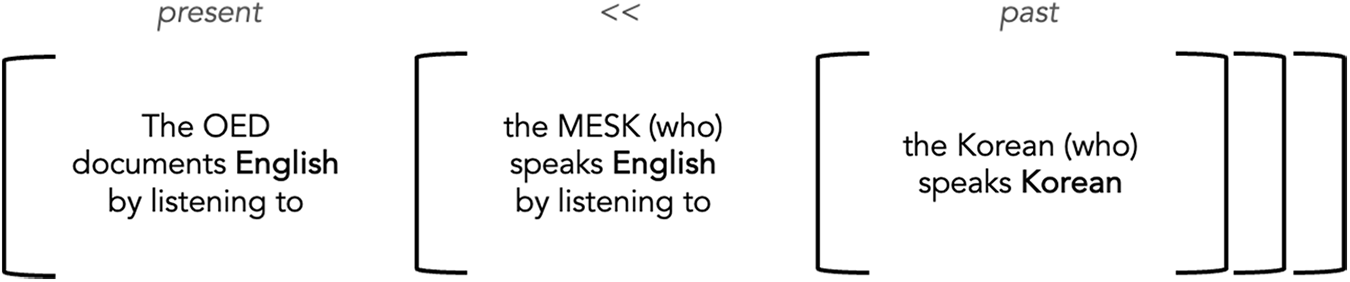
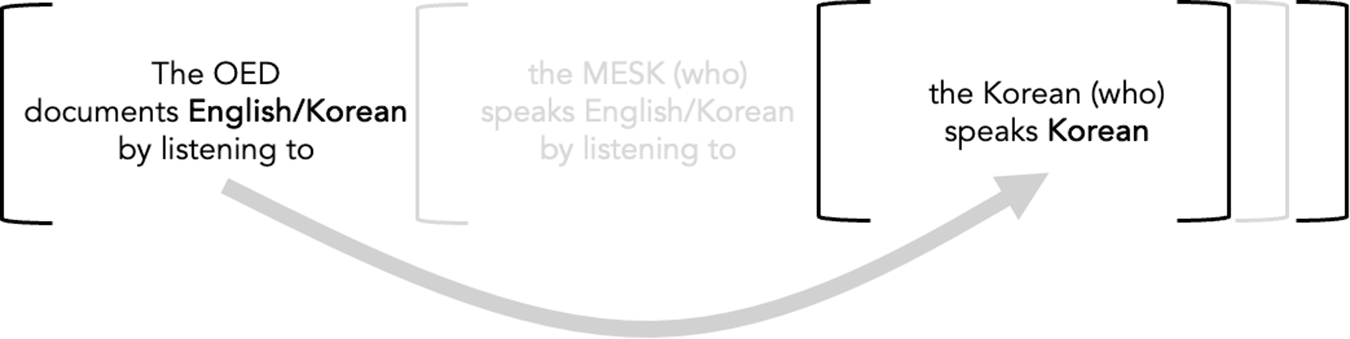
If we apply Inoue’s insights to the present case, we can observe that when Korean words become designated as “foreign loanwords” in the OED, as they are today, this label presupposes not only that a listening subject produces a speaking subject but that this speaking subject is, in turn, positioned as a listening subject in relation to yet another speaking subject. In other words, loanwords represent a “chain” or “pathway” of imagined discourse events (Agha Reference Agha2005; Wortham and Reyes Reference Wortham and Reyes2015): an expert listening subject (lexicographers) who listens to a type of English-speaking subject (the MESK), who listens to a Korean-speaking subject (the Korean). Figure 1 below depicts this presupposed discursive chain (from right to left) of Korean spoken in a past set of moments, which is then spoken as English in a present set of moments, which is then documented in the OED. I suggest that it is this discursive configuration of listening and speaking events that serves as an underlying template for all Korean loanwords in the OED.
Discourse events presupposed in the OED’s Korean word entries.

Listening to the Koreanist
The English documented in the OED initially emerged in the late nineteenth century in the context of a British national project of modernization in ways that may parallel the Japanese case described by Inoue (Reference Inoue2006). Yet nation-building for the United Kingdom relied more centrally on encounters beyond the nation, namely, the nation-state’s practices of colonial expansion and slavery on a global scale. As such, the goal of the OED was “to assemble a history of the nation’s language as a beacon to the moral, intellectual, and aesthetic state of the English people as they were intently given to civilizing the globe” (Willinsky Reference Willinsky1994: 242). Notably, the dictionary emerged at a time when the boundaries of what counted as English could be heard as saliently shifting, specifically as “World Englishes” came to be used in, if not imposed on, colonial settings inhabited by racialized speakers (Kachru Reference Kachru1976).
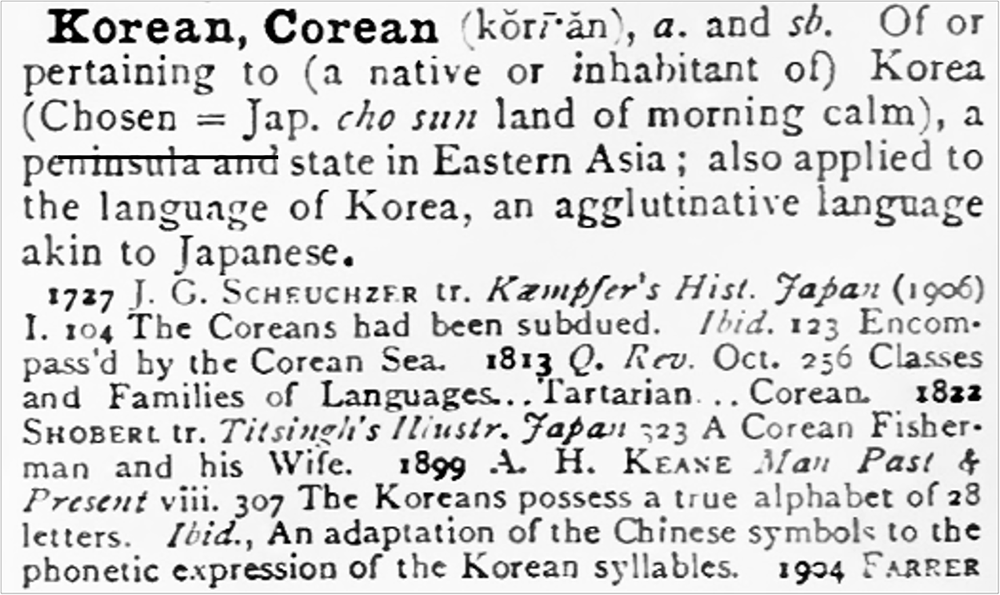
It was in this context of empire-building that the OED first located the English speaker in relation to “Korea” through its entry of the word Korean, also written as Corean, in A New English Dictionary (1933), a “corrected re-issue” of the first edition. As seen below in Figure 2, the English speaker was represented by lexicographers through a quotation of a sentence (“The Coreans had been subdued”), written in 1727 by a Swiss-born naturalist named John Gaspar Scheuchzer, who had moved to England in 1722 at the age of twenty to take a job as a librarian (De Beer Reference De Beer1997). This sentence was taken from Scheuchzer’s English translation of a previously unpublished historical account, written in German by another naturalist named Engelbert Kaempfer. Thus, in this case, the word Corean, a Romanized and adjectival form of Goryeo,Footnote 6 written by a Swiss man in his English translation of a German text, was determined by the OED to be a sufficiently contextualized token of English.
The OED’s (1933) first representation of the English Speaker’s encounter with Korea.

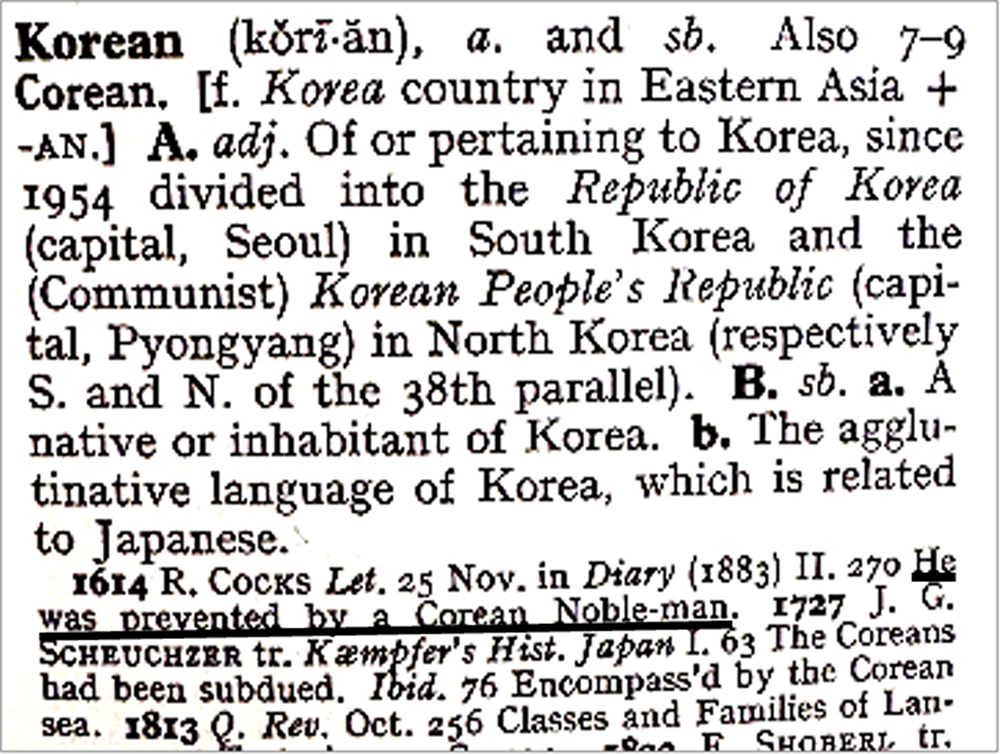
Forty-three years later, in the first edition’s 1976 supplement, which contained entries from H to N, the timeline for the English speaker’s encounter with Koreans was traced to more than two centuries earlier, when the word Korean was said to have appeared in the travel diary of English merchant Richard Cocks in the sentence “He was prevented by a Corean Noble-man” (Figure 3). His diary was not published until 1883, but the token of the word Corean written in the unpublished diary was taken as evidence of the word’s use in 1614 (Salazar Reference Salazar2021). Alongside this historical recasting, the 1976 supplement to the first edition also contained its first collection of Korean words (Hangul, kimchi, kisaeng, kono, makkoli, myon).Footnote 7 With these entries, the MESK became a figure whose language was on its way to becoming recognizably enregistered (Agha Reference Agha2007).
The OED’s (1976) revised representation of the English speaker’s encounter with Korea.

Figure 3 Long description
Korean (kôr′ē-ən), a. and sb. Also 7-9 Corean. [f. Korea country in Eastern Asia + -AN.] A. adj. Of or pertaining to Korea, since 1954 divided into the Republic of Korea (capital, Seoul) in South Korea and the (Communist) Korean People′s Republic (capital, Pyongyang) in North Korea (respectively S. and N. of the 38th parallel). B. sb. a. A native or inhabitant of Korea. b. The agglutinative language of Korea, which is related to Japanese. 1614 R. Cocks Let. 25 Nov. in Diary (1883) II. 270 He was prevented by a Corean Noble-man. 1727 J. W. Courtenay tr. Kempfer′s Hist. Japan I. 75 The Coreans had been subdued. 1804 S. Rousseau tr. The Corean sea. 1813 Q. Rev. Oct. 256 Classes and Families of Lan- guages. 1832 Penny Cycl. V. 380 The Coreans are a people of Mongol origin. 1883 R. Cocks Diary II. 270 The Corean language is agglutinative.
While the figure of the MESK remained largely British throughout the OED’s first edition, with its earliest quotations attributed to British writers, by the second edition in 1989, there were nearly as many quotations assigned to American writers. Then by the third edition, the revisions for which continue today, the figure of the MESK took on a discernible shape as an American. Three examples of the MESK as an American first appeared in the third edition, all from the 1880s. The first, shown in Figure 4, is attributed to William Elliot Griffis, an American who was hired by a Christian mission organization to establish a scientific school in Japan (Beauchamp Reference Beauchamp, Beauchamp and Iriye1990) and who published Corea: The Hermit Nation (Griffis Reference Griffis1882), a historical account that has been viewed as “successfully translating Korea into American terms and parables” (Cheong Reference Cheong2000: 69). In the surrounding text from which the OED drew its quotation, Griffis (Reference Griffis1882) argues that “Corea cannot long remain a hermit nation” as “commerce and pure Christianity will elevate her people” (10). He then describes the Korean word for “common language” (p. 338) or “unmŭn,” in the context of introducing Korea to “the world’s market-place” (p. vi).
A quotation of the first American MESK token in the OED (1882).

The next “American” quotation in Figure 5 was taken from an article titled “Customs of Korea” in The Gospel in All Lands (1888), a monthly missionary magazine of the Methodist Episcopal Church in Baltimore, Maryland. In the article, an unidentified American “correspondent of [the newspaper] the New York World,” who had traveled to Seoul, corrects a prior “misunderstanding” of Koreans as “barbarians.” The writer introduces “kimchi” to readers as a “peculiar kind of pickle” though still similar to German sauerkraut, rendering it recognizably, sufficiently civilized.
A quotation of the second American MESK token in the OED (1888).

A third quotation from the same year, shown in Figure 6 below, appeared in a newspaper for U.S. soldiers in an article by an American world traveler named Frank G. Carpenter. The piece, titled “Capital of Korea,” describes Seoul as “made up of sights strange to American eyes,” including clothing made of cotton and silk, as visual markers of social class in Korea.
A quotation of the third American MESK token in the OED (1888).

In these three examples, taken from texts published in 1882 and 1888, the OED listened to and documented writers who positioned themselves as cultural emissaries, or as Koreanists who translated an “unfamiliar” culture and language for other English speakers. Their English glosses for Korean terms (“[a] system… of writing,” “a peculiar kind of pickle,” “nobles”) not only constructed their expertise but also presupposed the listening subject’s unfamiliarity with both Korea and Korean words.
The glossing of these words may even suggest that writers had originally intended to present these words as “Korean words,” or a moment of code-switching and translation by an English speaker who spoke some Korean. But from the perspective of today’s OED, the emanation of these words from the bodies of white, modern English speakers seemed sufficient for them to be hearable as English (cf. Flores and Rosa Reference Flores and Rosa2015). As Figure 7 represents, the OED’s classification of these instances as evidence of monolingual English denies an interpretation of these MESK as engaging in bilingual Korean-English code-switching.
A denied interpretation of Korean-English code-switching.

Listening to the Korea Fan
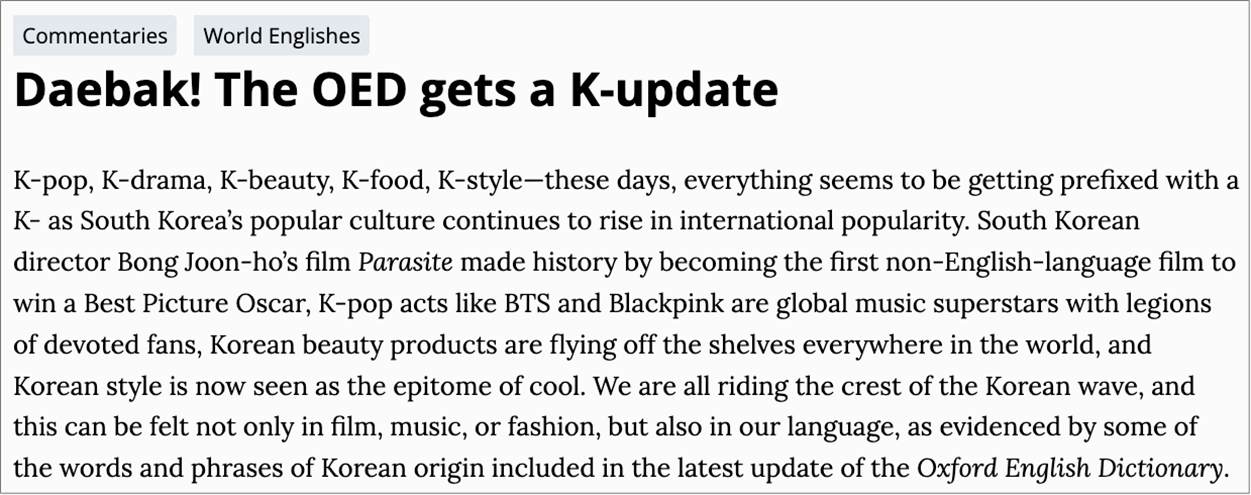
While I have thus far suggested that the early MESK was represented in the OED as a Brit who eventually became more American, the OED’s mode of listening has arguably shifted in recent decades in response to South Korea’s emergence as a site of global modernity (Ahn and Kiaer Reference Ahn and Kiaer2024). Notably, the figure of the English-speaking Koreanist has become saliently complemented by the Korea Fan, a figure characterized by not only a curiosity about Korea but also an emotional commitment to, if not immersion in, Korean culture. This new figure was described, and even playfully embodied, in the release notes that OED’s World English editor, Danica Salazar, wrote as an accompaniment to the September 2021 update (see Figure 8). The title uses the exclamatory Korean interjection daebak! (“amazing”) to playfully stylize the enthusiasm of Korean fandom, and the opening paragraph declares, “We are all riding the crest of the Korean wave, and this can be felt… in our language” (Salazar Reference Salazar2021). The first-person pronouns we and our presuppose an unspecified antecedent of English speakers that includes English speakers across the globe.
Title and opening paragraph of the OED’s (2021) “K-update” release notes.

In the following analysis, I show that the OED’s contextualization of its fifty-six Korean entries lends support for Salazar’s suggestion that the dictionary recognizes the Korea Fan as a newly salient figure of the English speaker. I also illustrate how this figure is represented as characterized by two distinctive characteristics: as being racially diverse and as being able to use Korean words as their very own.
This first characteristic is evident in way that sources and author names, appended to quotations, serve as potential indexes of the racial identities of the English speakers. I coded each of the 235 quotations from the fifty-six entries in terms of what I judged to be racial or national categories potentially legible to the OED’s idealized listening subject. The guiding principle that I adopted was to consider how citation information orients this listening subject to speaking subjects associated with categories of race and nation. For example, a quotation attribution such as “W. E. Griffis, Corea: Hermit Nation” was coded as “White American,” not just because actual readers are likely to assume that Griffis is an Anglo name but also because the citation information invites the listening subject to come to learn that he was a white American, for example, through easy online research. Likewise, a quotation attributed to “S. N. Choi, Year of Impossible Goodbyes,” which refers to a children’s novel by Korean American writer Sook Nyul Choi, was coded as “Korean American.” The name Choi orients the listening subject to the writer’s Korean ethnic identity, and through the clues provided, including the name of the novel, the listening subject is invited to learn that Choi is Korean American. When personal names were unspecified, I coded the quotation only in terms of the source alone. For example, a quotation attributed to the magazine “Korea Mission Field,” without an author, was coded simply as “American”; the listening subject is arguably invited to learn that the magazine was published by Americans evangelicals. My coding of discourse units as belonging to one category or another necessarily blunts the ideological complexity and indexical indeterminacy of in situ sign interpretation, but it also serves as a strategic simplification to help to identify discourse patterns that orients readers to an imagined listening subject in ways that might otherwise be unidentifiable.
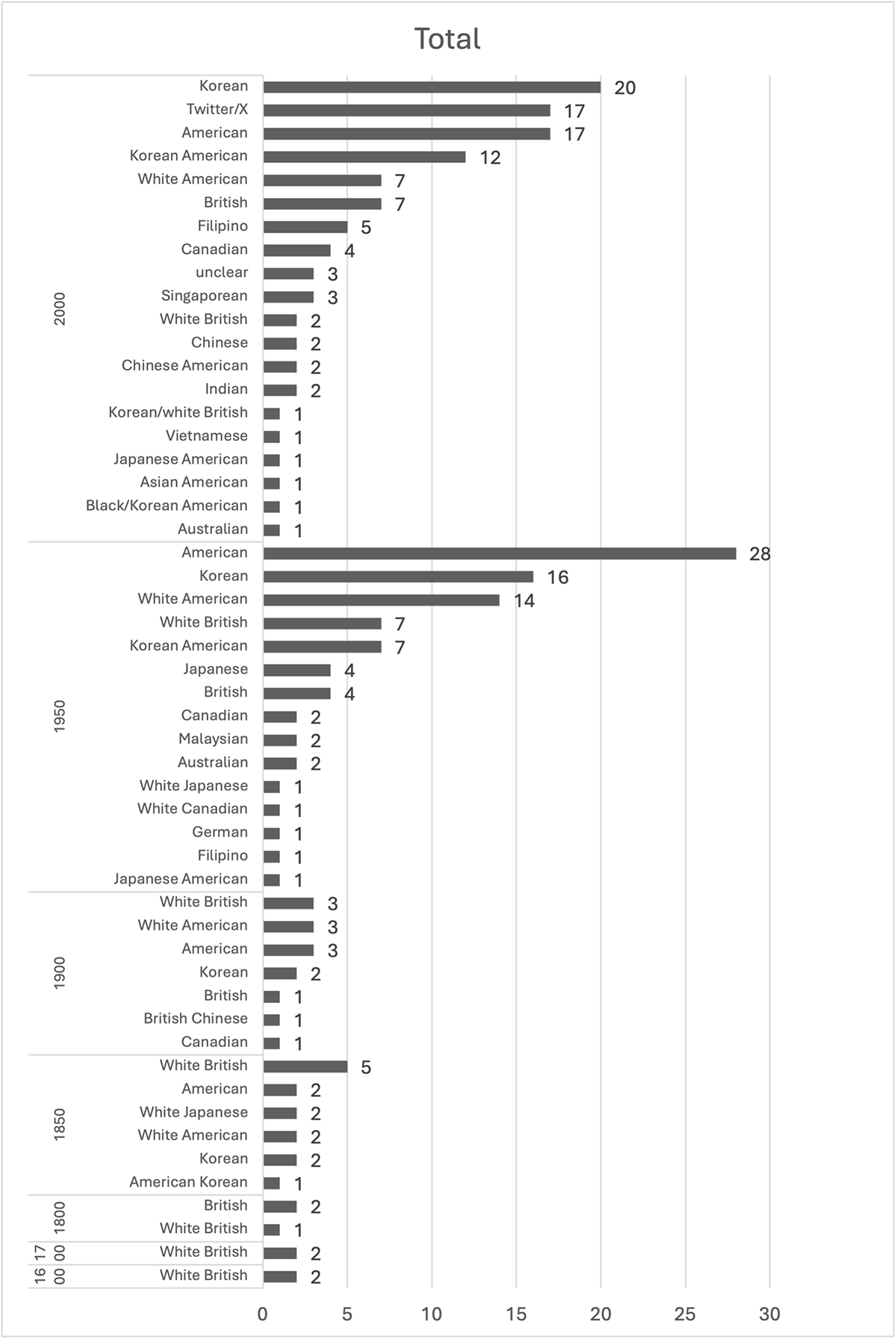
The following graph (Figure 9) summarizes the racial and national associations of MESK quotations. As suggested earlier, quotations were associated with British or White British speaking subjects during the earliest periods (1600-1849) (7 of 7), but by the latter half of the twentieth century (1950 – 1999), this speaking subject had become more American (50 of 91) and still associated with whiteness (60 of 91). By contrast, quotations associated with speaking subjects from between 2000 until the present were far more racially and ethnically disparate, representing speaking subjects who were not just Korean (20 of 109) or Korean American (12 of 109) but also Filipino (5 of 109), Singaporean (3 of 109), Chinese (2 of 109), Indian (2 of 109), or Vietnamese (1 of 109). Notably, American (41 of 109) voices have remained salient, suggesting that ideologies of U.S. colonialism and capitalism continue to shape the OED’s canonical speaker of English.
Racial identities represented in quotations by half centuries.

Figure 9 Long description
A horizontal bar graph titled Total. The horizontal axis shows a numeric scale from 0 to 30, with labeled ticks at 0, 5, 10, 15, 20, 25 and 30. The vertical axis lists four time periods: 2000 to present, 1950, 1900 and 1600 to 1849. 2000 to present: Korean 20; Twixt 17; American 17; Korean American 12; White American 7; American 5; British 5; Filipino 4; Singaporean 3; Indonesian 3; White British 2; Chinese 2; Chinese American 2; Korean British 2; Vietnamese 1; Japanese American 1; Asian American 1; Black Korean American 1. 1950: American 28; White American 16; White British 14; Irish 7; Korean American 7; Korean 4; British 4; Canadian 2; Malaysian 2; Australian 2; White Japanese 1; White Canadian 1; German 1; Filipino 1. 1900: Japanese American 3; White American 3; American 3; Russian 2; Asian 2; Chinese 1; British 1; Canadian 1. 1600 to 1849: White British 5; American 2; White Japanese 2; White American 2; White Korean 2; Korean 2; American Korean 2; British 2; White British 2; White British 2.
The ethnoracial diversity of the MESK in the OED today reflects a growing transnational engagement with Korean popular culture, and the role of English, alongside Korean, as a lingua franca in this engagement. It also arguably reflects the OED’s shifting practices of listening over the past decade, in its efforts to systematically document “World Englishes.” Specifically, Philippine English was officially recognized in 2014 (Salazar Reference Salazar2014), followed by Hong Kong English, Singapore English, and Malaysian English in 2016, Indian English in 2017, South African English in 2018, Nigerian English and Canadian English in 2020, and Bermudian English in 2021 (Salazar Reference Salazar2022). At the same time, even though English-speaking fans in the Philippines and Singapore had begun to visibly engage with Korean popular culture years before North Americans had (Kim Reference Kim2007), the English of these fans had not been hearable as documentable English to OED’s lexicographers until September 2021, several years after the salient emergence of the figure of the Korean Fan in the United States in 2017 (Cho Reference Cho2022). Arguably, many Korean Americans, including myself, have for many decades used about a dozen of OED’s newly recognized Korean words – especially those for address terms and food items – within otherwise English sentences. However, these tokens were inaudible to the OED as documentable uses of English, as they were likely heard instead as bilingual code-switching into Korean.
A second important change in recent years is how the MESK is represented as having adopted a new “role alignment” (Agha Reference Agha2005) or footing (Goffman Reference Goffman1981) with respect to Korean words. Specifically, while the early MESK was represented as framing these words as “foreign” to the listening subject, the contemporary MESK uses these words as their own. This new footing can be seen in techniques that discursively transform once-Korean words into English. One technique is the contextualization of Korean tokens as uses rather than mentions (Quine Reference Quine1940). While older quotations tended to show the MESK as syntactically embedding language in a frame of reflexive lexical citation (“Koreans distinguish between hyõng… and tongsaeng”), recent examples show the MESK adopting them as their own (“You are the girlfriend of my hyung”). Another recent technique is the increasing exclusion of glosses (”hyõng (elder brother)”), as these paraphrases can presuppose the listening subject’s lack of familiarity with the word’s denotation. A third is the eventual removal of visual markings of foreignness, such as diacritics (e.g., “önmun.”), hyphens (e.g., “tae-kwon-do”), italics (e.g., “banchan,” or capitalization for common nouns (e.g., “Makgolli”).
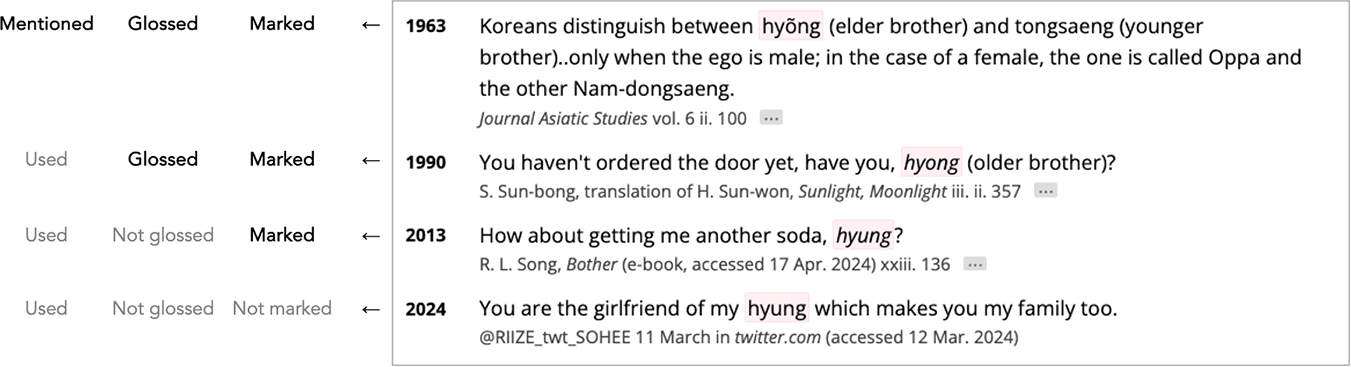
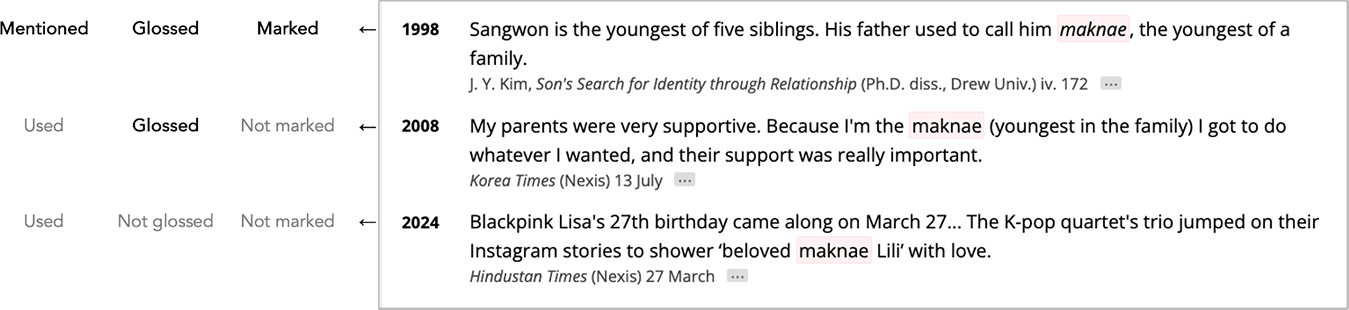
The following sets of quotations, taken from the entries for hyung (Figure 10) and maknae (Figure 11), illustrate how the OED represents English speakers as taking on greater linguistic ownership of Korean words over the years, contextualizing these words as an increasingly unmarked part of their everyday discourse.
Increasing linguistic ownership under the entry for hyung.

Figure 10 Long description
The table has four columns: Year, Used, Glossed and Marked. Row 1: Year 1936, Used ′Koreans distinguish between hyung (older brother) and companions (younger brother) only when the age is male. In the case of a female, the one is called Oppa and the other Nam-dongsaeng.′ Glossed ′Journal Asiatic Studies vol. 6 ii. 193′. Marked ′Yes′. Row 2: Year 1990, Used ′You haven′t entered the door yet, have you, hyung (older brother)?′ Glossed ′S. Samberg, translation of H. Sun-won, Caught in a Snare iii. 35′. Marked ′Yes′. Row 3: Year 2011, Used ′How about getting me another soda, hyung?′ Glossed ′R. E. Song, Abide in book, accessed 17 Aug. 2011′. Marked ′No′. Row 4: Year 2016, Used ′You are the girlfriend of my hyung which makes you my family too.′ Glossed ′Twitter, accessed 17 Mar. 2016′. Marked ′No′.
Increasing linguistic ownership under the entry for maknae.

In Figure 10, the first quotation from 1963 shows the term hyung as mentioned, glossed, and visually marked (with a tilde), presupposing the speaking and listening subjects’ distance from the word. In the 1990 quotation that follows, the word is shown as used with a gloss and with italics (“have you, hyong (older brother)?”). In the 2013 quotation, it is shown as used and unglossed yet with italics, subtly marking its linguistic otherness (“How about getting me another soda, hyung?”). In the 2024 quotation, the term is used without any markings of linguistic difference (“You are the girlfriend of my hyung”), presupposing its familiarity. Figure 11 shows a similar pattern: in the 1998 quotation, the term maknae is mentioned, glossed, and visually marked with italics; in the 2008 quotation, it remains glossed but used without visual markings; and in the 2024 quotation, the term bears no markings of otherness: it is used, unglossed, and absent of visual markings.
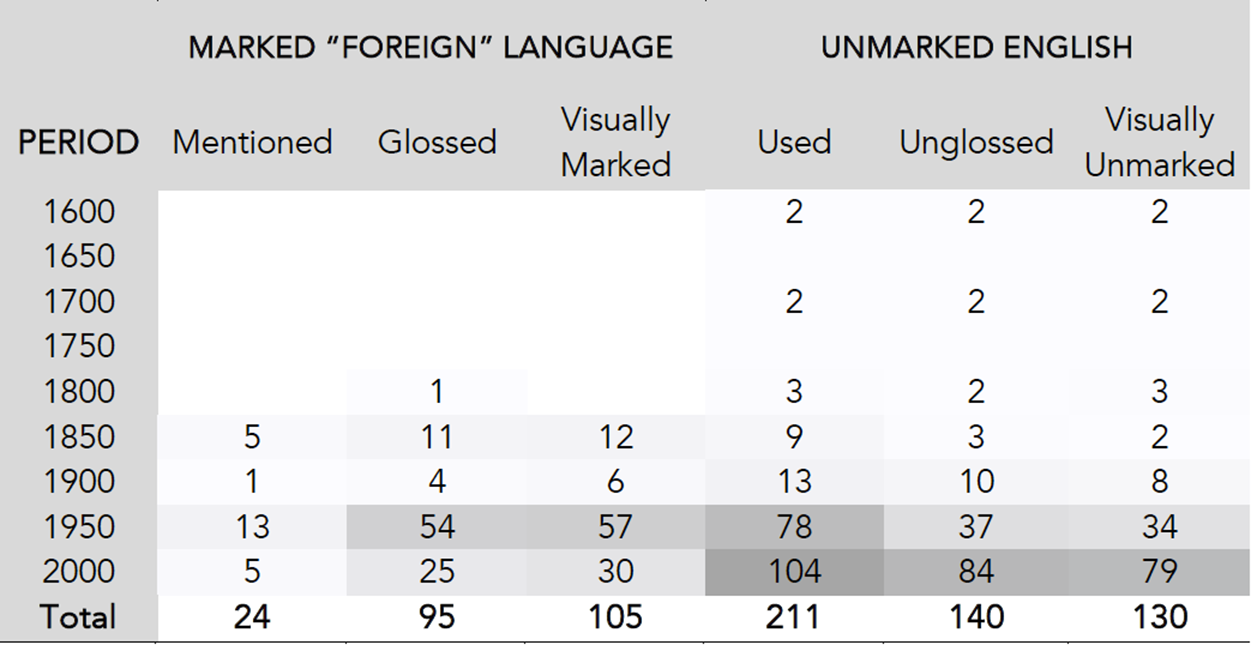
The representation of the MESK as increasingly adopting Korean words as their own can be seen across the full set of 235 quotations. The following table (Figure 12) compares the use of these marking techniques across half-century periods, from the first quotation date in 1614 to the most recent in 2024. A salient change can be seen in the half-centuries before and after 2000, when techniques that marked Korean words as “other” decreased (13 ➔ 5, 54 ➔ 25, and 57 ➔ 30), and those that treated these words as the speaker’s own increased (78 ➔ 104, 37 ➔ 84, and 34 ➔ 79).
Framing of Korean words in OED quotations by half centuries.

Figure 12 Long description
The table has six columns: Period, Mentioned, Glossed, Visually Marked, Used, Unglossed, Visually Unmarked. Row 1: Period 1600, Mentioned 0, Glossed 0, Visually Marked 0, Used 2, Unglossed 2, Visually Unmarked 2. Row 2: Period 1650, Mentioned 0, Glossed 0, Visually Marked 0, Used 2, Unglossed 2, Visually Unmarked 2. Row 3: Period 1700, Mentioned 0, Glossed 0, Visually Marked 0, Used 2, Unglossed 2, Visually Unmarked 2. Row 4: Period 1750, Mentioned 0, Glossed 0, Visually Marked 0, Used 3, Unglossed 3, Visually Unmarked 3. Row 5: Period 1800, Mentioned 5, Glossed 1, Visually Marked 12, Used 3, Unglossed 3, Visually Unmarked 3. Row 6: Period 1850, Mentioned 5, Glossed 11, Visually Marked 12, Used 9, Unglossed 9, Visually Unmarked 9. Row 7: Period 1900, Mentioned 1, Glossed 4, Visually Marked 6, Used 13, Unglossed 13, Visually Unmarked 13. Row 8: Period 1950, Mentioned 13, Glossed 54, Visually Marked 57, Used 78, Unglossed 37, Visually Unmarked 34. Row 9: Period 2000, Mentioned 5, Glossed 25, Visually Marked 30, Used 104, Unglossed 84, Visually Unmarked 79. Row 10: Total, Mentioned 24, Glossed 95, Visually Marked 105, Used 211, Unglossed 140, Visually Unmarked 130.
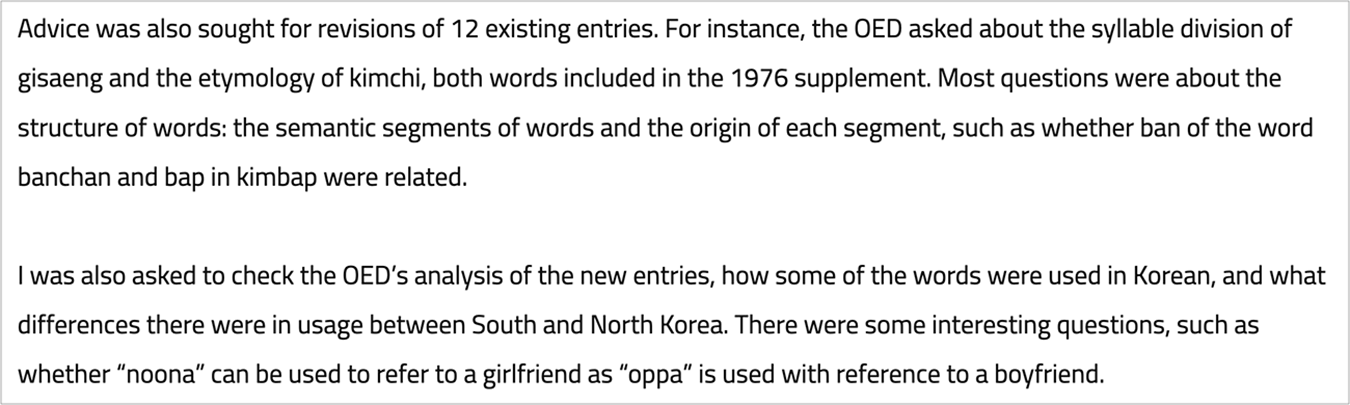
A final technique that suggests a new kind of listening adopted by the OED was its public narration of the method by which Korean words have entered the dictionary. This narration presupposed an epistemic expertise about and proximity to Korea, as “correct” denotational representations of Korea-origin words have become prioritized. As shown in Figure 13, one of the Korean language consultants (Shin Reference Shin2022: para. 19) depicted lexicographers as listening with scientific rigor to the referential aspects of language, namely “the semantic segments and the origin of each segment” as well as what words could “refer to” in “South and North Korea.”
Denotational thoroughness of the OED.

Additionally, the OED displays on its websiteFootnote 8 its “OED Korean project team” that “works in partnership with external experts from or in South Korea to ensure that our entries for words of Korean origin draw from local knowledge and expertise and reflect the everyday reality and distinctive identity of the Korean-speaking community.” Each of these “external experts” has a “Korean” name as well as an academic title or position (Dr, Prof, Professor, Linguist), verifying their linguistic authority not merely as Korean speakers but also as academic experts.
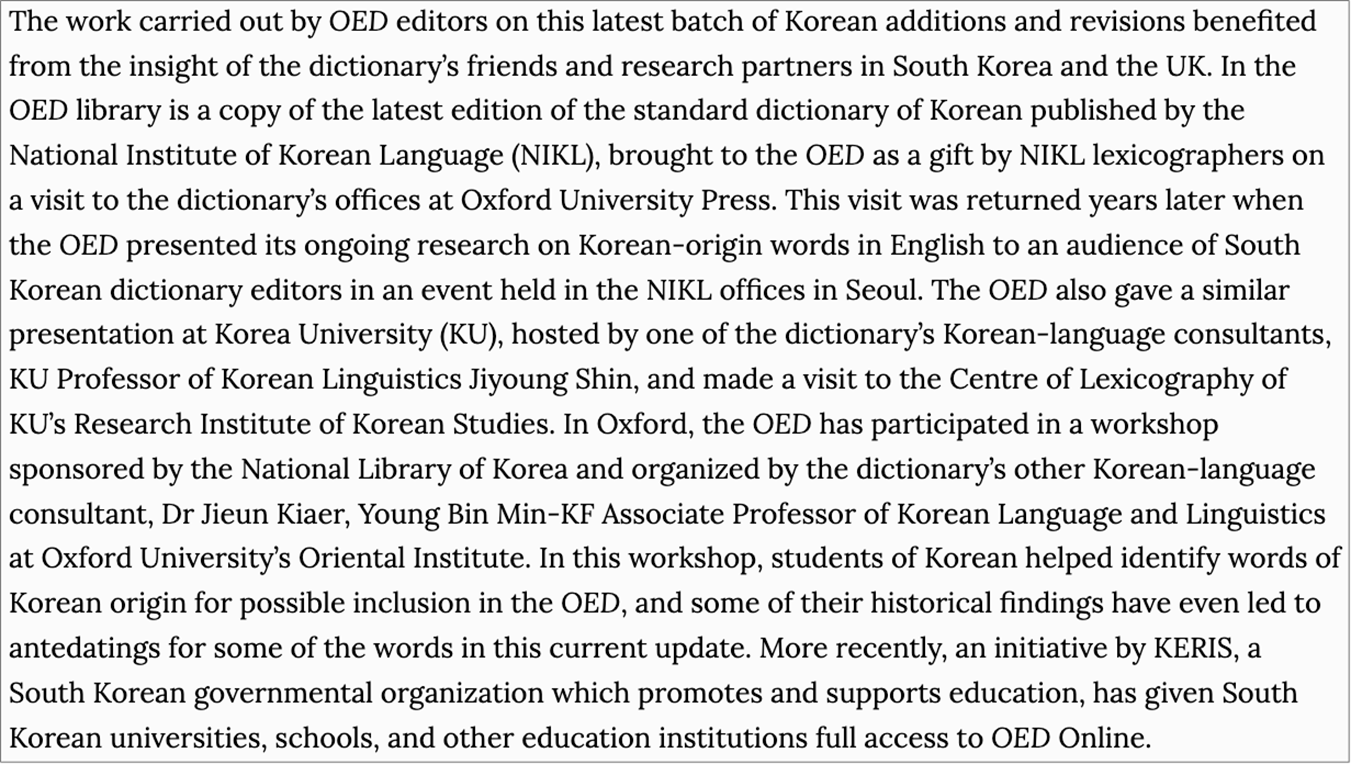
In her release notes (Figure 14), the World English editor (Salazar Reference Salazar2021) refers to these Korean language experts as “friends” and “partners” and represents them as taking an active and willing role in the process, even “gifting” a Korean dictionary to the OED team and inviting the OED team to conferences and workshops in Korea. In other words, the process is framed as a collaborative effort of knowledge production between OED editors and Korean language experts. This public accounting of the process allows the OED to present itself as a modern listening subject: its knowledge production process is framed as rigorously scientific and respectfully collaborative.
Epistemic collaboration represented in the release notes.

Figure 14 Long description
Formal informational passage. The text describes the collaboration between OED editors and Korean language experts. It highlights the exchange of resources, such as the Korean dictionary gifted by NIKL and presentations at Korean institutions. The passage also mentions workshops where Korean students contributed to identifying words for the OED. An initiative by KERIS has provided South Korean educational institutions with full access to OED Online. Transcribed text: The work carried out by OED editors on this latest batch of Korean additions and revisions benefited from the insight of the dictionary′s friends and research partners in South Korea and the UK. In the OED library is a copy of the latest edition of the standard dictionary of Korean published by the National Institute of Korean Language (NIKL), brought to the OED as a gift by NIKL lexicographers on a visit to the dictionary′s offices at Oxford University Press. This visit was returned years later when the OED presented its ongoing research on Korean-origin words in English to an audience of South Korean dictionary editors in an event held in the NIKL offices in Seoul. The OED also gave a similar presentation at Korea University (KU), hosted by one of the dictionary′s Korean-language consultants, KU Professor of Korean Linguistics Hyosun Jhang and made a visit to the Centre of Lexicography at KU′s Research Institute of Korean Studies. On another occasion, the OED has participated in a workshop sponsored by the National Library of Korea and organized by the dictionary′s other Korean-language consultant, Dr Jieun Kiaer, Young Bin Min—KF Associate Professor of Korean Language and Linguistics at Oxford University′s Oriental Institute. In this workshop, students of Korean helped identify words of Korean origin for possible inclusion in the OED and some of their historical findings have even led to antedatings for some of the words in this current update. More recently, an initiative by KERIS, a South Korean governmental organization which promotes and supports education, has given South Korean universities, schools and other education institutions full access to OED Online.
This careful contextualization of Korean words suggests a participant framework in which the OED listens not merely to the MESK but also – if not more intently – to the Korean speaking subject. Depicted in Figure 15 below, this practice of listening contextualizes Korean words in the OED as possibly bearing a “bivalent” status (Woolard Reference Woolard1998), or have what Ahn and Kiaer (Reference Ahn and Kiaer2024) have described as “translingual words” that both originate and exist across multiple languages at once.
Listening to Korean speakers with epistemic thoroughness.

Using these framing techniques, the OED’s entries produce a historical narrative in which the MESK increasingly hears Korean words as their own and idealizes referential consistency as words travel from one kind of speaking subject to another. These representations may present the possibility of a MESK who now aspires to be an incipient bilingual, or an English speaker who speaks some Korean. The next section describes three important discursive tactics of the OED that ensure that such an interpretation remains unlikely.
The Korea fan as Koreanist
I argue in this final section that even while the Korea Fan has emerged as a salient figure who increasingly utters Korean words as their own, the OED’s linguistic descriptions have ensured that a racialized and gendered boundary between what counts as “English” and what counts as “Korean” remains intact. Specifically, even while it presents the MESK as a Korea Fan with precise denotational knowledge of Korean, this figure is idealized as maintaining an affective distance. The MESK performs a kind of “cross-racial curiosity,” displaying the methodical expertise and orderly language of the white masculine Koreanist, while avoiding the feminized fervor of what has popularly been called the Koreaboo.
The Koreaboo, a popularly scorned figure of morally failed fandom, began to gain recognizability in youth-oriented spaces in the United States in the mid-2000s, following the term’s first public use on Urban Dictionary.Footnote 9 Over the decades, its image has become increasingly derisive, as it became most saliently associated with a pathologically excessive desire to emulate Koreans and, in some cases, to become Korean, and terms that suggest an “obsession” or “fetish” (Rosenau Reference Rosenau2022) have been commonly used to describe this feminized figure (Lee et al. Reference Lee, Chu, Han, Jeon, Caputi and Moynagh2024). Metapragmatic accounts have often suggested that this desire is indexed by a set of recognizable linguistic practices, including inappropriately using Korean words of intimacy (e.g., oppa, “older brother from a feminine perspective”; sarang, “love”), speaking to “random” Asians in Korean, using “incorrect Korean,” and “mixing” English and Korean lexically or phonologically (cf. Reyes Reference Reyes2017). The highlighting of such linguistic elements as characteristically those of a Koreaboo relies on a language ideology that prioritizes restraint, purity, and correctness in cross-racial encounters.Footnote 10
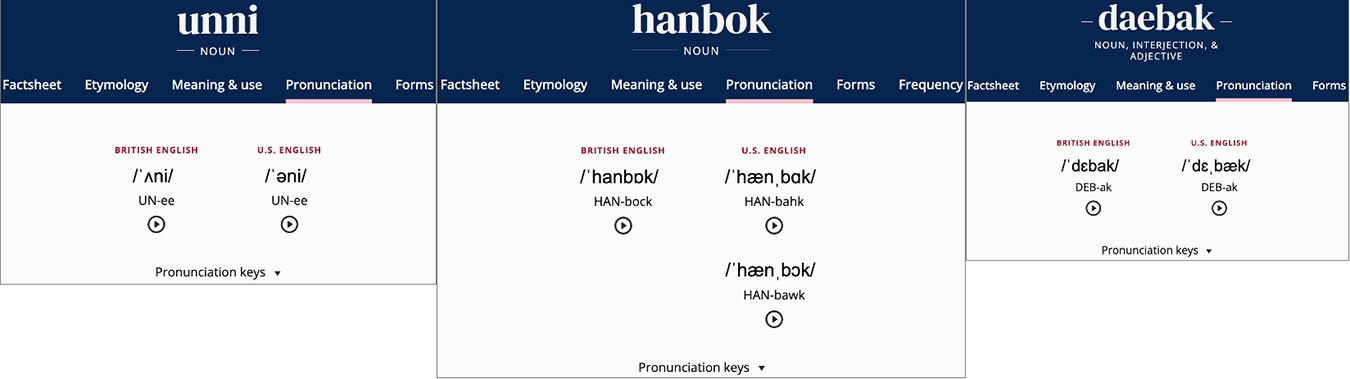
Within the OED, the figure of the overzealous Koreaboo may be largely kept at bay as lexicographers orient to semantic correctness, but the Koreaboo’s “shadow conversation” (Irvine Reference Irvine, Silverstein and Urban2007) arguably still looms through the OED’s techniques of recontextualization. One technique is the erasure of what is hearable as “Korean” phonology, as exemplified in words such as unni, hanbok, and daebak, shown in Figure 16. The word unni (“a girl’s or woman’s elder sister”) is described as pronounced with a simple /n/, thus rhyming with English “honey,” rather than the geminate nasal more commonly used by Korean speakers. The U.S. English pronunciation of hanbok (“a traditional Korean costume”) is described as /ˈhænˌbɑk/, thus rhyming with “Hancock,” with its last syllable a low back /ɑ/ rather than a mid-back /o/, and the pronunciation of daebak (“something lucrative or desirable” or “expressing enthusiastic approval”) is transcribed as /ˈdɛˌbæk/, such that its final syllable contains a low front /æ/ rather than a low back /a/.
Words pronounced with “English” phonology.

These phonological representations are likely hearable to a default listening subject in South Korea as indexes of linguistic “incorrectness” and even “white Americanness.” Yet their forms are likely to be rationalized by lexicographers as an artefact of their linguistic “rigor” and “systematicity”: English words should consistently bear “English phonology.” Through such phonological accommodation to a “white listening subject” (Flores and Rosa Reference Flores and Rosa2015), these OED representations maintain a boundary that is both racial and linguistic, and in doing so, still opens up its legibility as that of a Koreaboo.Footnote 11
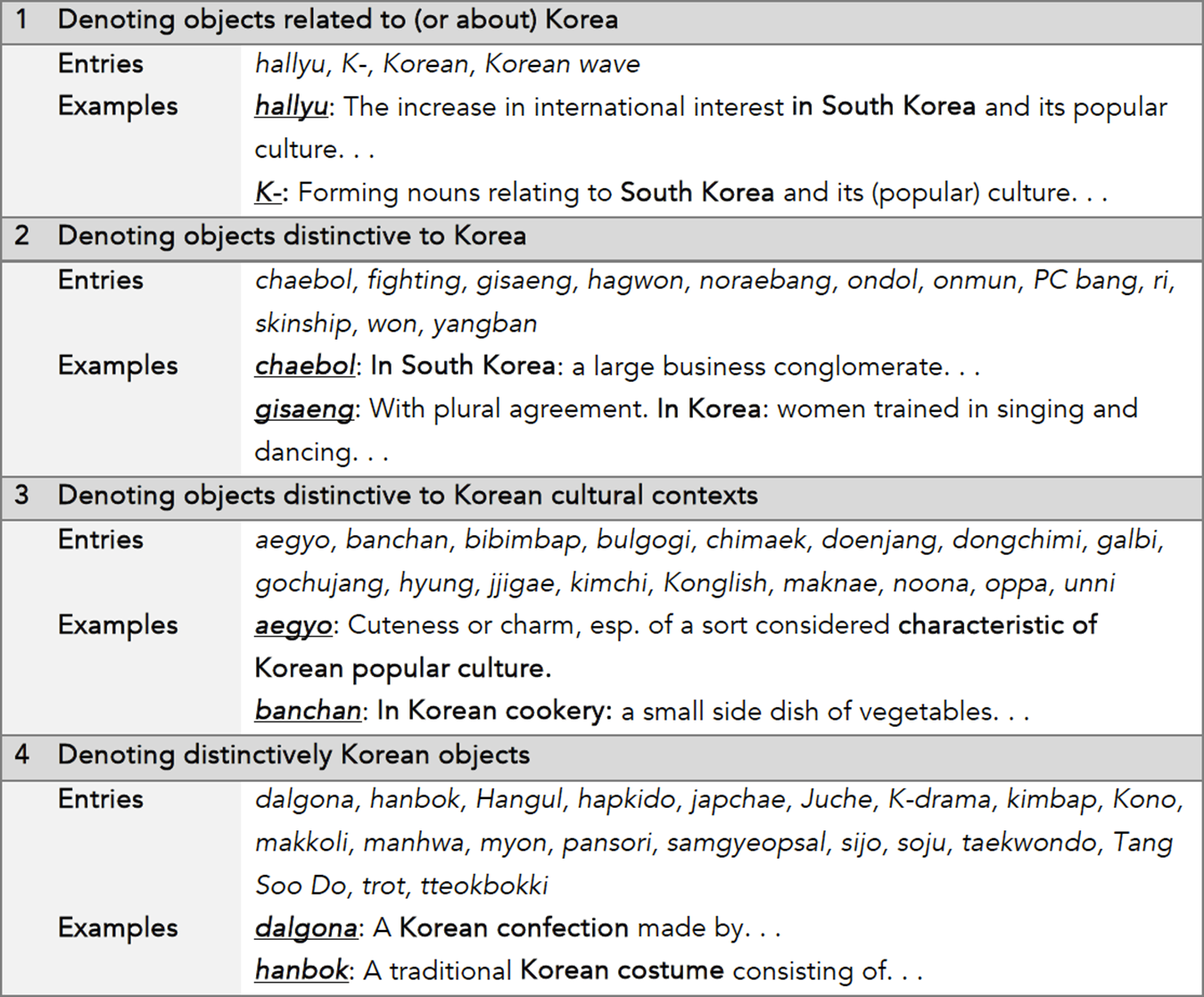
A second technique used to maintain this linguistic and racial boundary is the explicit denotational reference to Korea in definitions. Among the fifty-six entries, only three do not mention “Korea” (mukbang, daebak, and dalgona coffee) while the remaining fifty-three entries fall into one of four categories of explicitly mentioning “Korea” (Figure 17): those that characterize the word as referring to an object or practice (1) that is generally related to Korea (hallyu, K-, Korean, Korean wave); (2) that is distinctively Korean (dalgona, hanbok, Hangul, hapkido, japchae, Juche, K-drama, kimbap, Kono, makkoli, manhwa, myon, pansori, samgyeopsal, sijo, soju, taekwondo, Tang Soo Do, trot, tteokbokki); (3) that has a meaning distinctive to Korea, as a geographical place (chaebol, fighting, gisaeng, hagwon, noraebang, ondol, onmun, PC bang, ri, skinship, won, yangban); and (4) that has a meaning distinctive to Korean cultural or linguistic contexts, regardless of geography (aegyo, banchan, bibimbap, bulgogi, chimaek, doenjang, dongchimi, galbi, gochujang, hyung, jjigae, kimchi, Konglish, maknae, noona, oppa, unni).
Excerpts of example definitions of 53 words that mention “Korea”.

The OED’s explicit reference to “Korea” within most of its entries represents a MESK who uses denotational signs about Koreans, thus presupposing a perspective that is located outside Korea. For example, banchan are “Korean” side dishes and chaebol is a “Korean” business conglomerate from the perspective of a listening subject who is located outside Korea. These explicit references to Korea may be interpretable as signaling a respectful stance towards Korea as a “source” culture, so to avoid semantic or indexical “bleaching” (Bucholtz Reference Bucholtz2011; Squires Reference Squires2014) or racial appropriation (Chun Reference Chun2001; Hill Reference Hill2008; Bucholtz Reference Bucholtz2011; Yoo Reference Yoo2023; Calhoun and Yoo Reference Calhoun and Yoo2024). Such a stance would be consistent with the OED’s showcasing of its collaborative processes of knowledge production discussed in the previous section. At the same time, explicit references to Korea arguably presuppose a perspective of racial exteriority, or the gaze of a white listening subject (Flores and Rosa Reference Flores and Rosa2015).Footnote 12
Finally, the OED was careful to contextualize these new entries as specifically English words; its release notes generally described them as “English words of Korean origin” or words “borrowed from Korean.” For example, Salazar’s editorial release notes (Reference Salazar2021) states that the update contained “words and phrases of Korean origin” or words and phrases that had been “borrowed from Korean.” The maintenance of a clear linguistic distinction is reflected in her discussion of “[h]allyu, a borrowing from Korean, [which] is now also being used in English” (para. 5) and “chimaek (2012) [which is] borrowed from the Korean chimaek” (para. 7). While these etymons may have first been uttered by Korean speakers, they have, according to this account, become new English words, once uttered by English speakers (Figure 18).
Becoming English through the MESK’s utterance.

Notably, journalists in South Korea, the United States, the United Kingdom, and India who reported on the OED’s new entries tended to refer to them as “Korean words” rather than “Korean-origin words,” perhaps because of the newsworthiness of what they framed as Korean words now entering the OED.Footnote 13
References to “Korean words” in news article titles
(1) “Why 26 Korean words have been added to Oxford English Dictionary”Footnote 14
(2) “K-beauty, hallyu and mukbang: dozens of Korean words added to Oxford English Dictionary”Footnote 15
(3) “Dozens of Korean words added to Oxford English Dictionary”Footnote 16
(4) “Oxford English Dictionary adds 26 Korean words to latest edition”Footnote 17
(5) “Oxford English Dictionary adds 26 Korean words to 'enrich the English language”Footnote 18
(6) “Food, fashion, music, and even language from the east Asian country are becoming ubiquitous in UK-life with so called K-culture become so popular with Brits the Oxford English Dictionary added 26 Korean words to [its] latest addition this week”Footnote 19
(7) “From Korean wave to Mukbang: 26 Korean words added to Oxford English Dictionary”Footnote 20
In other words, the status of these entries as newsworthy “spectacle” presupposes what had been long remained unquestioned – the absence of words that are anything other than English.
Conclusion
The OED’s inclusion of Korean words within its pages has invited collective celebrations across the globe, as it has been taken as linguistic evidence that hallyu has made its mark on English, a language that has long served as a symbol of global modernity. Some scholars have even suggested that these entries reflect a contemporary linguistic order shaped by “translingual words” that have emerged in linguistic contact zones beyond traditional Inner Circle countries and that make it impossible to locate their specific geographic origins (Ahn and Kiaer Reference Ahn and Kiaer2024). As I have shown in the article, these lexical inclusions may, indeed, represent a historical shift with respect to the modern English speaker’s relation to Korea, as global signs of hallyu become localized and as resonances of the Korea Fan – specifically a figure who displays enthusiasm for Korea and who uses Korean as their own – have become audible in these entries.
At the same time, I have argued that the OED’s linguistic techniques of “rigor” and “discipline,” as it listens to the MESK, maintain longstanding ideological mappings of race, gender, and language. The MESK may be a Korea Fan, but its idealized form displays the epistemic and affective discipline of the expert, white, masculine Koreanist, often through quotations of white explorers, missionaries, and scholars who avoid the disorderly impulses of the overzealous, feminine Koreaboo, a feminized figure of fandom with unbridled sexual desire (cf. Stanfill Reference Stanfill2013). This finding suggests that even if hallyu’s mark on the English language has become audible through the OED’s quotations of Korea Fans, many who are neither white nor male today, its representations remain constrained by a centuries-old model of the Koreanist and his cross-racial encounter with a still-distant Korea. Notably, the OED is hardly alone in its narrow rendering of the English speaker. Elite institutions in the United States and the United Kingdom, including those that regiment the words on this page, rely on an idealization of the modern English speaker that compels our collective consent to a particular mode of listening. Within the OED and well beyond it, it is a figure of white masculine privilege whose language continues to define the very object that English is.
Acknowledgement
The ideas developed here reflect valuable feedback from Joyhanna Jung Yoo, Mie Hiramoto, and two anonymous reviewers. They also emerge from conversations with Adrienne Lo, Angela Reyes, Brett Sherman, Shannon Gallion, and Altyn Hallayeva. I am grateful to the Research Institute of Korean Studies at Korea University and the Korea Institute at Harvard University for the opportunity to share early versions of this work. All errors are my own.






 Open access

