





Introduction
Soybean and cotton are two of Tennessee’s most valuable row crop commodities, with a total farm gate value of more than US$1.2 billion (USDA-NASS 2021). Palmer amaranth, which is resistant to glyphosate and protoporphyrinogen oxidase inhibitors, remains a constant economic threat to these important production systems (Copeland et al. Reference Copeland, Giacomini, Tranel, Montgomery and Steckel2018; Heap Reference Heap2022; Steckel et al. Reference Steckel, Main, Ellis and Mueller2008). Palmer amaranth is native to the dry southwest of North America and has adapted to thrive in many warm climates across the United States (Sauer Reference Sauer1950). If left uncontrolled, Palmer amaranth can severely decrease cotton and soybean yields and impede harvest efficiency (MacRae et al. Reference MacRae, Webster, Sosnoskie, Culpepper and Kichler2013; Morgan et al. Reference Morgan, Baumann and Chandler2001; Smith et al. Reference Smith, Baker and Steele2000).
In 2017, more postemergence herbicide options became available when XtendiMax® and Enlist One® received registration for over-the-top use on dicamba-resistant or 2,4-D-resistant crops, respectively. When those herbicide technologies were introduced, Palmer amaranth control in Tennessee was very good when dicamba, 2,4-D, and glufosinate were also used (LES, personal observation). Research examining the sensitivity levels of Palmer amaranth sourced in 2019 from growers’ fields to dicamba, 2,4-D, and glufosinate across 21 states including Tennessee found >90% control (Singh et al. Reference Singh, Tyre, Perez-Jones, Krebel, Willis, Herrmann, Klingaman, Head and Aradhya2023). Successful weed control by these auxin herbicides helped drive the adoption of dicamba in Tennessee. By 2019, in the United States 10 million kg of dicamba was used on cotton and soybean fields (USGS 2023). Such reliance has now resulted in resistant biotypes. In 2020, growers in Tennessee began reporting both dicamba and 2,4-D failures in their auxin-resistant soybean and cotton fields. Weed scientists determined that some populations in western Tennessee were resistant to dicamba (Foster and Steckel Reference Foster and Steckel2022). During the same time period, a 2,4-D-resistant Palmer amaranth population was reported on a research farm in Kansas (Shyam et al. Reference Shyam, Borgato, Peterson, Dille and Jugulam2020).
As Palmer amaranth and other weeds grow larger throughout the season, they become more difficult to control. Everitt and Keeling (Reference Everitt and Keeling2007) determined that higher rates of dicamba or 2,4-D were needed to control horseweed (Erigeron canadensis L.) and Russian thistle [Salsola iberica (Sennen & Pau) Botsch. Ex Czerep.] as plant height increased from 3 to 8 cm, from 10 to 15 cm, and from 25 to 46 cm. Similar results were observed when 2,4-D was applied to red morningglory (Ipomoea coccinea) when it was 30 or 60 cm high, and greater control was achieved when the same rate of herbicide was applied to smaller weeds, and a higher rate of the herbicide was needed to control larger morningglories (Siebert et al. Reference Siebert, Griffin and Jones2004).
Weed management strategies used by soybean and cotton growers often depend on a multiple-pass approach, applying a preemergence herbicide at planting and one or more postemergence herbicides throughout the season to control troublesome weed species. Dicamba and 2,4-D will usually control smaller Palmer amaranth (<10 cm) as directed on the XtendiMax and Enlist herbicide labels. Sequential applications of dicamba or 2,4-D with glufosinate can also be effective at controlling small (≤10 cm) Palmer amaranth plants (Ogden and Dotray Reference Ogden and Dotray2021, Reference Ogden and Dotray2022; Smith et al. Reference Smith, Soltani, Kaastra, Hooker, Robinson and Sikkema2019); however, such research has not been conducted on auxin-resistant or glufosinate-resistant Palmer amaranth populations.
The objective of these studies was to determine the impact of weed height on Palmer amaranth control following applications of increasing rates of dicamba or 2,4-D and to examine the effect of timing between sequential applications, and in which order 2,4-D or dicamba should be used with glufosinate to control dicamba-resistant Palmer amaranth.
Materials and Methods
Two studies, one examining the efficacy of sequential herbicide applications on Palmer amaranth control with dicamba, 2,4-D, and glufosinate; and another study evaluating the effect of dicamba and 2,4-D on Palmer amaranth height, were conducted on non-crop field experiments in six site years. They were run in 2021 and 2022 at the West Tennessee AgResearch and Education Center (WTREC; 35.632003°N, 88.855874°W) in Madison County, at a grower’s field site in Madison County (35.781542°N, 88.851567°W), and at a grower’s field site in Lauderdale County (35.715428°N, 89.918452°W). Previous greenhouse dicamba dose-response research showed that the relative resistance factor of Palmer amaranth is 1.85, 2.49, and 14.25 for the WTREC location, the Madison County grower field, and the Lauderdale County site, respectively (Foster and Steckel Reference Foster and Steckel2022).
The sequential application study was performed with treatments applied in a randomized complete block design with three or four replications. The initial herbicide was applied when Palmer amaranth reached an average height of 10 cm, and sequential applications were made either 7 or 21 d later. Herbicide treatments are described in Table 1. All herbicides were applied using a CO2-pressurized backpack sprayer equipped with TeeJet® TTI 11002 nozzles or AIXR 11002 nozzles for glufosinate treatments (Spraying Systems Co., Glendale Heights, IL) calibrated to deliver 140 L ha−1 at 4.8 kph using 220 kPa. Once experiments began, either pyroxasulfone at 0.12 kg ai ha−1 or S-metolachlor at 1.07 kg ai ha−1 was applied to control new flushes of weeds. As needed, clethodim at 0.28 kg ai ha−1 was applied to control native junglerice (Echinochloa colona L.) and goosegrass (Eleusine indica L.) populations.
Dicamba and 2,4-D sequential application treatments, Palmer amaranth control, and stand density 21 d after final treatment. a

a Means within a column with the same letter are not statically different (Tukey’s honestly significant difference test at α = 0.05).
In the weed height study, Palmer amaranth plants were 10, 20, or 30 cm tall at the time of herbicide application. Herbicide treatments included dicamba applied at 0.28 (1/2×), 0.56 (1×), 1.12 (2×), and 2.24 (4×) kg ae ha−1; or 2,4-D applied at 0.53 (1/2×), 1.06 (1×), 2.12 (2×), and 4.24 (4×) kg ae ha−1. These rates were chosen because the rates specified by the XtendiMax and Enlist One labels are 0.56 and 1.06 kg at ha−1, respectively (Anonymous 2022a,b).
Palmer amaranth control was visually evaluated 21 d after the sequential application using a 0% to 100% scale (Frans et al. Reference Frans, Talbert, Marx, Crowley and Camper1986), where 0 = no control and 100 = complete plant necrosis. The number of surviving plants was counted within a random square meter of each plot. Data were analyzed using the GLIMMIX procedure with SAS software (version 9.4; SAS Institute Inc., Cary, NC) for ANOVA and Tukey’s honestly significant difference test at α = 0.05. Year was considered a random effect to broaden the inference space and account for environmental variability when making a recommendation (Blouin et al. Reference Blouin, Webster and Bond2011; Carmer et al. Reference Carmer, Nyquist and Walker1989; Moore and Dixon Reference Moore and Dixon2014). Location was also considered a random effect due to the similarity of Palmer amaranth response across locations. The fixed effects tested were herbicide treatments, herbicide rate, and Palmer amaranth height.
Results and Discussion
Rate by Height and Palmer Amaranth Control
Height, rate, and height by rate interactions were significant for both dicamba (P < 0.0001 for all three variables) and 2,4-D (P < 0.0001 height and rate, P = 0.0349 height*rate) with regard to Palmer amaranth control (Tables 1 and 2). When applied to Palmer amaranth that was ≤10 cm tall, 0.56 kg dicamba ha−1 provided 48% control (Table 2). That height and labeled rate of dicamba are both listed on the XtendiMax® herbicide label (Anonymous 2022a). This is a dramatic reduction from the >90% control of Palmer amaranth treated at the same height and herbicide rate using biotypes collected in 2019 (Singh et al Reference Singh, Tyre, Perez-Jones, Krebel, Willis, Herrmann, Klingaman, Head and Aradhya2023). The greatest control of weeds ≤10 cm in height was achieved following an application of 1.12 or 2.24 kg dicamba ha−1, which was double or quadruple the labeled rate. Similar results were observed when dicamba was applied to 20-cm-tall Palmer amaranth.
Palmer amaranth control 21 d after application as affected by plant height and herbicide dose
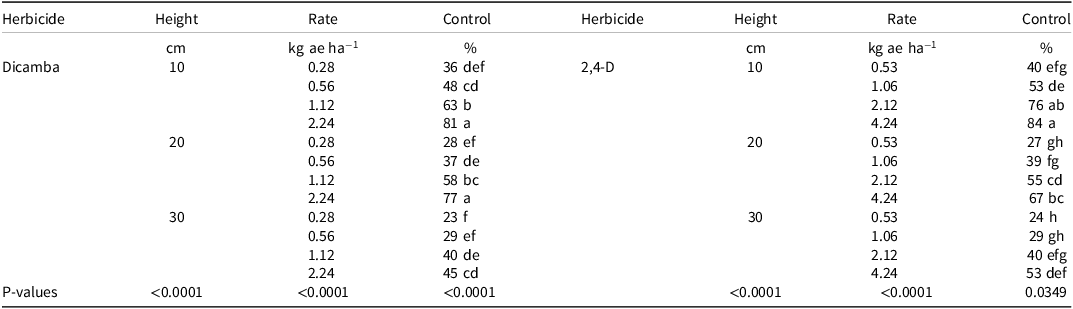
Results were similar for Palmer amaranth height at the time of 2,4-D application. At the maximum single-application labeled rate of 2,4-D of Enlist One® (1.06 kg ae ha−1), Palmer amaranth that was ≤10 cm tall was controlled by 53% (Table 2) (Anonymous 2022b). Greater control occurred when 2.12 or 4.24 kg of 2,4-D ha−1 was applied to Palmer amaranth that was ≤10 cm tall. The 4.24 kg ha−1 rate provided much better control (84%) than the labeled rate on smaller Palmer amaranth. This control from a 4× rate is notably less than the >90% control using a 1× rate with the seed sourced in 2019 (Singh et al. Reference Singh, Tyre, Perez-Jones, Krebel, Willis, Herrmann, Klingaman, Head and Aradhya2023).
Rate by Height and Palmer Amaranth Density
Palmer amaranth height and herbicide rate were both significant (P < 0.05) for dicamba and 2,4-D experiments when weed density was measured (Table 3); however, height by rate interactions were not significant (data not shown). Density was decreased when dicamba was applied to 10- or 20-cm-tall Palmer amaranth compared with the nontreated check. The application to larger, 30-cm-tall plants exhibited density that was similar to the check. Averaged across all heights, Palmer amaranth needed the 4× rate to decrease density compared with the labeled rate of dicamba, which was similar to the check. This level of resistance is consistent with anecdotal reports from growers who have said that they had to increase their herbicide use rates by 3× to 4× to gain adequate Palmer amaranth control in these fields where the seed was sourced (DCF and LES, personal conversations).
Palmer amaranth density 21 d after application as affected by plant height or herbicide dose

The herbicide 2,4-D applied at all plant heights studied here resulted in decreased density compared with nontreated plants. Treating plants that were 10 cm tall resulted in fewer Palmer amaranth plants compared with the taller heights. The three highest rates led to decreased density compared with the nontreated check. It took the 4× (4.24 kg ae ha−1) rate of 2,4-D to reduce Palmer amaranth density compared with the labeled rate (Table 3).
These results agree with those of previous studies that larger weeds are harder to control with 2,4-D and dicamba (Everitt and Keeling Reference Everitt and Keeling2007; Siebert et al. Reference Siebert, Griffin and Jones2004) but our results differed from theirs as higher rates on larger Palmer amaranth improved control only marginally. These data are consistent with previously reported research that Palmer amaranth in Tennessee is resistant to dicamba (Foster and Steckel Reference Foster and Steckel2022). Also, Palmer amaranth that was not well controlled with dicamba in these studies showed similar poor control with the labeled rate of 2,4-D. These data differ from those reported by Singh et al. (Reference Singh, Tyre, Perez-Jones, Krebel, Willis, Herrmann, Klingaman, Head and Aradhya2023) who demonstrated greater than 90% Palmer amaranth control at 0.56 and 1.06 kg ha−1 dicamba and 2,4-D, respectively. Even the 2× and 4× dicamba and 2,4-D rates provided less Palmer amaranth control than that reported by Singh et al. (Reference Singh, Tyre, Perez-Jones, Krebel, Willis, Herrmann, Klingaman, Head and Aradhya2023) from Palmer amaranth sourced from 2019. This may indicate that the confirmed dicamba-resistant populations may be resistant to 2,4-D as well. Further research in the form of a greenhouse rate study with a nonsusceptible population would be needed to confirm this.
These observations are consistent with research first reported in Kansas that confirmed 2,4-D-resistant and dicamba-resistant Palmer amaranth (Peterson et al. Reference Peterson, Jugulam, Shyam and Borgato2019). The researchers in Kansas reported that the Palmer amaranth, which was confirmed to be resistant to 2,4-D and dicamba in 2019, was later shown to be resistant to herbicides from five other site-of-action groups. Also, the resistance mechanism was metabolic based, which can allow weeds to evolve resistance to other herbicides more quickly as well (Shyam et al. Reference Shyam, Borgato, Peterson, Dille and Jugulam2020).
Mixtures and Sequential Palmer Amaranth Control
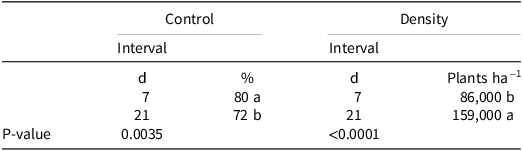
A sequential application 7 d after the initial spray increased Palmer amaranth control compared with a 21-d interval (P = 0.0035; Table 4). Plant density data mirrored these results. At the 7-d interval there were more than 86,000 plants ha−1, whereas waiting 21 d between applications increased that number to more than 158,000 plants ha−1 (P < 0.0001).
P-values for Palmer amaranth control and stand density as affected by interval between sequential herbicide applications
For treatments that included dicamba with a 7- or 21-d interval, there was no difference between dicamba + glyphosate followed by dicamba + glyphosate or glufosinate and glufosinate followed by dicamba + glyphosate, indicating that the order in which herbicides were applied did not matter (Table 1). At both the 7- and 21-d intervals when 2,4-D was used in conjunction with glufosinate, 2,4-D applied first provided better control than glufosinate applied first. One application of 2,4-D did not provide adequate control of Palmer amaranth. However, one application of dicamba + glufosinate provided similar control to that of sequential treatments. The dicamba + glufosinate mixture cannot be recommended because glufosinate is not an approved mixture partner for dicamba due to volatility concerns (Anonymous 2022a).
Mixtures and Sequential Palmer Amaranth Density
All herbicide combinations with a 7-d interval decreased Palmer amaranth density compared with the nontreated control (313,000 plant ha−1; Table 1). At the 21-d interval, only dicamba + glyphosate followed by either dicamba + glyphosate or glufosinate alone led to decreased Palmer amaranth density compared with the nontreated control. While weed control with a single treatment of 2,4-D was only 49%, Palmer amaranth density was comparable to all applications with a 7-d interval.
It is noteworthy that the 2,4-D-alone treatment resulted in 152,000 plants ha−1. The sequential application of 2,4-D + glyphosate at the 7-d interval reduced that population by 50%. However, for the 21-d interval of this treatment, the densities were no different than they were for 2,4-D alone. The Palmer amaranth that survived the initial dicamba or 2,4-D herbicide application typically ranged in response from growing very little after application to almost complete recovery. The timing of that recovery varied across the population but most often showed immediate regrowth from lower lateral growing points. These data suggest that the 21-d interval allowed these Palmer amaranth populations to recover enough to better withstand the follow-up herbicide application.
Similarly, Randell et al. (Reference Randell, Hand, Vance and Culpepper2020) reported that shorter intervals between two glufosinate applications provided better Palmer amaranth control than intervals greater than 10 d. Ogden and Dotray (Reference Ogden and Dotray2021, Reference Ogden and Dotray2022) found that when using 2,4-D, the order of herbicide application did not matter as long as Palmer amaranth plants were <10 cm in height, but when using dicamba, applying the auxin first followed by glufosinate was the best option.
Practical Implications
Dicamba and 2,4-D provided good control of Palmer amaranth in Tennessee as recently as 2018 and 2019. Recent research from Tennessee has shown that by 2020 and 2021 a dicamba-resistant biotype had evolved. When weed control with herbicides at labeled rates proves ineffective, growers often respond by increasing the herbicide rate (LES, personal observations). This is particularly true when no effective alternative herbicide options are available. Our research suggests that this response (increasing herbicide dose) with dicamba and 2,4-D does not provide complete, or even acceptable, control of some Palmer amaranth populations. Sequential applications separated by 7 d provided better weed control than those separated by 21 d. Given that the better 7-d sequential treatments provided less than 90% control and resulted in more than 64,000 surviving Palmer amaranth plants per hectare, it suggests that relying solely on these herbicides for Palmer amaranth control is not a sustainable weed management strategy. Rather, an integrated weed management approach that incorporates herbicides with cultural practices will be needed for consistent weed control. Most notably, these results would suggest that shortening the interval between herbicide applications to 7 d would increase control of auxin-resistant Palmer amaranth regardless of whether growers are using a dicamba-resistant or a 2,4-D-resistant production system. While the Palmer amaranth populations in these experiments were resistant to dicamba and possibly 2,4-D, multiple applications of these herbicides were able to provide some control of these weeds.
Acknowledgments
This research was partially funded by Bayer CropSciences, the Tennessee Soybean Promotion Board, and Cotton Incorporated. No other conflicts of interest are stated.


 Open access

