





The recognition that bullying is a group process (Salmivalli et al., Reference Salmivalli, Lagerspetz, Björkqvist, Österman and Kaukiainen1996) has led anti-bullying intervention efforts to increasingly take a universal approach by fostering healthier classrooms in which the victimization level is minimized. Even though many students profit from a context that – on average – is healthier, this may not be true for those who remain or become victimized. These students may experience even more psychological problems (i.e., depressive symptoms, anxiety, low self-esteem) in these contexts than in less healthy contexts – a phenomenon referred to as the healthy context paradox (Huitsing et al., Reference Huitsing, Lodder, Oldenburg, Schacter, Salmivalli, Juvonen and Veenstra2019; Salmivalli, Reference Salmivalli2018). Research on the healthy context paradox has expanded in the past five years and this phenomenon has been detected across countries (China, the United States, Finland, and the Netherlands). The operationalization of a healthy context varied between previous studies: from low classroom levels of victimization or aggression, or a high classroom level of defending, to the implementation of an anti-bullying program (see Salmivalli et al., Reference Salmivalli, Laninga-Wijnen, Malamut and Garandeau2021 for a review). Most researchers have used the classroom level of victimization as an indicator of a healthy context, which we will adopt as well.
Though previous work has greatly contributed to our knowledge of the healthy context paradox, these studies have been either cross-sectional or have only considered the link between victimization and subsequent maladjustment. Therefore, it is time to rigorously test the validity of the central tenet that victimized students increase in psychological problems especially in healthier classrooms, while ruling out two alternative explanations.
The first alternative explanation for previous cross-sectional findings would be that psychological maladjustment (e.g., depression, anxiety, or low self-esteem) is a stronger predictor of victimization in classrooms where only a few students are victimized. Students with psychological problems may be more victimized in these classrooms as their vulnerability stands out more in low-victimization contexts. In contrast, in classrooms where many are targeted, individual characteristics, such as having high levels of internalizing problems, may play less of a role in predicting victimization. However, because the few longitudinal studies on the healthy context paradox have not examined this direction of effects, this possible explanation cannot yet be ruled out.
Second, previous work has mostly studied the healthy context paradox from a between-person perspective, by examining whether a healthier context exacerbates differences between individuals – for example, students who experience more victimization than their classmates are at higher risk of psychological problems than their classmates, and this risk is stronger in healthier classrooms (e.g., classrooms with lower victimization) – because in such contexts classmates report less problems. Yet, in order to fully understand whether being victimized is especially hurtful for individuals in healthier contexts, it is important to also test whether students’ victimization predicts within-person changes in psychological adjustment (Hankin & Abela, Reference Hankin and Abela J.R.2009). This is essential because, in a healthy context, victims may be worse off psychologically than non-victims (and perhaps this between-person gap is widening), but may still improve somewhat – or remain stable – in their own psychological adjustment. Specifically, two types of within-person differences can be distinguished: (1) relative within-person effects, that is how individuals deviate from their usual level (i.e., mean level across several waves) of victimization or psychological adjustment, and (2) absolute within-person effects, that is how individuals change in absolute ways compared with their prior adjustment level (e.g., Ehm et al., Reference Ehm, Hasselhorn and Schmiedek2019). Therefore, the present study examines whether the classroom level of victimization moderates bidirectional between- and (relative and absolute) within-person associations between victimization and psychological adjustment.
Bidirectional links between victimization and psychological adjustment in healthier contexts
The central argument of the healthy context paradox is that victimization leads to worse psychological problems in healthier contexts, because being victimized in such a context may be particularly hurtful. Several explanations have been offered for why this may occur. According to attribution theory (Weiner, Reference Weiner1985), when individuals face a negative situation, such as being victimized, they try to understand the cause of this situation, and their causal attributions may account for their emotional reactions to the event. Victims of bullying often blame themselves for their plight (e.g., “I am being bullied because I am not a fun child”; Visconti et al., Reference Visconti, Kochenderfer-Ladd and Clifford2013). This may be particularly true in contexts where there are few other victims (Schacter & Juvonen, Reference Schacter and Juvonen2015): in such contexts, it is harder for them to attribute the victimization to an external cause, since most of their classmates are not being targeted. Increased self-blame may exacerbate victims’ psychological problems, including depressive symptoms, anxiety, and low self-esteem (Chen & Graham, Reference Chen and Graham2012). Another possible explanation is that victimized youth may be more socially marginalized in healthier classrooms. Indeed, previous work has shown that victims usually befriend other victims (e.g., Lodder et al., Reference Lodder, Scholte, Cillessen and Giletta2016), and non-victimized peers may be reluctant to befriend them (e.g., Sentse et al., Reference Sentse, Dijkstra, Salmivalli and Cillessen2013). Thus, if there are fewer victims in a classroom, it reduces friendship opportunities for them. Having fewer friendships may underlie the adverse effect of a healthier context on victims’ psychological adjustment (Pan et al., Reference Pan, Li, Ji, Malamut, Zhang and Salmivalli2021). Furthermore, being victimized in a context where others are doing apparently well may encourage upward social comparisons (Garandeau & Salmivalli, Reference Garandeau and Salmivalli2019; Huitsing et al., Reference Huitsing, Lodder, Oldenburg, Schacter, Salmivalli, Juvonen and Veenstra2019). In classrooms where most students are not victimized, those who are might notice that they are worse off than their classmates, which may intensify their negative feelings about their own situation, and increase their psychological problems. Thus, increases in self-blame, fewer friendship opportunities, as well as increases in upward social comparisons may explain why victims are doing worse psychologically in healthier contexts (Pan et al., Reference Pan, Li, Ji, Malamut, Zhang and Salmivalli2021).
Most studies which claim to have identified a healthy context paradox have been cross-sectional. These studies have found that the positive associations between victimization and depressive symptoms (Xiong et al., Reference Xiong, Wang, Wang, Wang and Ren2022; Yun & Juvonen, Reference Yun and Juvonen2020) and somatic complaints (Gini et al., Reference Gini, Holt, Pozzoli and Marino2020), and the negative association between victimization and self-esteem (Huitsing et al., Reference Huitsing, Veenstra, Sainio and Salmivalli2012; Xiong et al., Reference Xiong, Wang, Wang, Wang and Ren2022) were stronger in classrooms with lower levels of victimization. Victims also had higher depressive symptoms in classrooms with more centralized victimization (i.e., classrooms where bullies target few students; Huitsing et al., Reference Huitsing, Veenstra, Sainio and Salmivalli2012). Furthermore, the positive association between victimization and anxiety (Bellmore et al., Reference Bellmore, Witkow, Graham and Juvonen2004) and the negative association between victimization and self-perceived social competence (Morrow et al., Reference Morrow, Hubbard and Sharp2019) were found to be stronger in classrooms with lower descriptive norms of aggression. It should be noted though that low descriptive norms for aggression do not necessarily imply that fewer students are being victimized. Taken together, these findings seem to support the presence of a healthy context paradox.
An alternative explanation for these findings is that the association between initial psychological problems and future victimization is stronger in contexts where victimization is rare (Kaufman et al., Reference Kaufman, Kretschmer, Huitsing and Veenstra2018). Indeed, psychological problems can be both a consequence and an antecedent of victimization (Christina et al., Reference Christina, Magson, Kakar and Rapee2021). However, in classrooms where a large number of students are victimized, victimization may be less likely to be predicted by the personal characteristics of the victims, whereas in classrooms with few victims, personal vulnerability factors, such as depression or anxiety, may be stronger predictors of their victimization. Moreover, assuming that mean levels of psychological maladjustment are lower in classrooms with low levels of victimization, it is conceivable that students with severe psychological problems stand out more in these classrooms. They might then attract more victimization from bullying perpetrators as they may be the only ones appearing as vulnerable. Thus, prior cross-sectional findings suggesting the presence of a healthy context paradox may also have emerged because of the context-dependent effect of maladjustment on the risk for victimization.
Longitudinal studies have the potential to detect the temporal precedence of victimization and psychological adjustment in classrooms with lower versus higher levels of victimization. Existing longitudinal studies on the healthy context paradox have focused on one direction: how victimization influenced psychological adjustment in healthier versus less healthy contexts. In a recent study of Finnish elementary and middle school students, the prospective link between victimization at the start of the school year and psychological problems (low self-esteem, high depressive symptoms) at the end of the school year was stronger in classrooms with a lower level of peer-perceived victimization (Laninga-Wijnen et al., Reference Laninga-Wijnen, Garandeau, Malamut and Salmivalli2023). In another Finnish elementary school sample, youth who were victimized across an entire school year (“stable victims”) felt more depressed and more socially anxious at the end of the year in classrooms where the proportion of victims had decreased, as compared with stable victims in classrooms where the proportion of victims had remained stable or increased (Garandeau et al., Reference Garandeau, Lee and Salmivalli2018). In a Chinese high school sample, students who were physically victimized reported more depressive symptoms two years later in lower-victimization cliques (Zhao & Li, Reference Zhao and Li2022), and in a Chinese elementary school sample, victims had higher depression and a lower self-concept after one year in classrooms where victimization was less prevalent (Pan et al., Reference Pan, Li, Ji, Malamut, Zhang and Salmivalli2021). These findings have been replicated in studies that used other indicators of a healthy context, such as the implementation of an anti-bullying intervention (Huitsing et al., Reference Huitsing, Lodder, Oldenburg, Schacter, Salmivalli, Juvonen and Veenstra2019). Only one study tested for the alternative explanation for the healthy context paradox by examining whether psychologically maladjusted youth would be more likely to be victimized in classrooms with a lower level of victimization (Pan et al., Reference Pan, Li, Ji, Malamut, Zhang and Salmivalli2021). They did not find evidence for this reversed effect. However, they tested this reversed effect in a separate model, and therefore did not consider the moderating role of classroom victimization in bidirectional relations between victimization and adjustment. Consequently, the first way in which our study will put to the test the healthy context paradox is by examining whether this paradox is still present when testing for the two temporal directions simultaneously. We will do this by examining the moderating role of classroom-level victimization in the bidirectional links between students’ victimization and psychological adjustment.
Between- versus within-person dynamics in victimization and psychological adjustment
To test the central tenet that victims develop more psychological problems in healthier contexts (Garandeau & Salmivalli, Reference Garandeau and Salmivalli2019; Huitsing et al., Reference Huitsing, Lodder, Oldenburg, Schacter, Salmivalli, Juvonen and Veenstra2019), most cross-sectional and longitudinal research so far has focused on between-person effects (e.g., Gini et al., Reference Gini, Holt, Pozzoli and Marino2020; Pan et al., Reference Pan, Li, Ji, Malamut, Zhang and Salmivalli2021). Between-person effects refer to differences between individuals, both in terms of victimization and adjustment: Youth who are victimized (more than others) experience greater psychological problems (than others), especially in healthy contexts (where others might be particularly well-adjusted). Thus, these between-person effects tell us about whether differences in adjustment between students depends on their differences in victimization, and whether this varies as a function of classroom-level victimization.
Although studies on between-person processes have yielded important insights, they do not provide a complete picture of the healthy context paradox. There may even be alternate reasons for why these studies detected adverse effects of healthier contexts on victims. For instance, effects in between-person studies may have emerged because non-victimized students benefit more from healthier contexts than victimized students (Laninga-Wijnen et al., Reference Laninga-Wijnen, Garandeau, Malamut and Salmivalli2023). Between-person effects in prior work may therefore have mainly represented the widening gap between victimized and non-victimized students, while victims remained stable in their psychological adjustment or also benefitted from a healthier context but not as much as their non-victimized classmates.
To test the central tenet of the healthy context paradox that victimization is especially hurtful for individuals in healthier contexts, and to rule out alternative explanations for the findings detected in between-person studies, it is important to examine the moderating role of classroom-level victimization in within-person processes. Indeed, if prior findings only reflected a widening gap in the adjustment of victims and non-victims (between-person differences), this would call into question the existence of the healthy context paradox phenomenon in the sense that healthier contexts would not actually exacerbate victimized youth’s problems. Within-person processes refer to changes within individuals, and these can be absolute (i.e., compared with one’s prior level of victimization or psychological adjustment) or relative (i.e., compared with one’s usual level of victimization or psychological adjustment; Mulder & Hamaker, Reference Mulder and Hamaker2021). The mechanisms generally put forward to account for the healthy context paradox – comprising of cognitive processes (i.e., self-blame and upward social comparisons) and social processes (fewer opportunities for friendships) – are consistent with within-person changes, that is, they may not only lead students to have more psychological problems than others, but also more than before, or more than usual. Only one study has examined the healthy context paradox by focusing on absolute, within-person changes (Huitsing et al., Reference Huitsing, Lodder, Oldenburg, Schacter, Salmivalli, Juvonen and Veenstra2019). This study has shown that those who remained or became victimized in schools implementing an anti-bullying program increased in depressive symptoms and decreased in self-esteem (as compared to their prior values), whereas this was not the case for students who remained or became victimized in control schools. However, that study did not examine the moderating effect of classroom level of victimization, and therefore clear evidence of within-person effects in lower-victimization contexts – the ultimate test of the healthy context paradox – is still lacking.
Current study
The aim of this study was to test the central tenet of the healthy context paradox, which is that victimized students are more likely to develop psychological problems (i.e., depressive symptoms, anxiety, and low self-esteem) over time in healthier contexts. First, we tested whether the healthy context paradox would still emerge after simultaneously testing the opposite direction of effect, that the association between initial psychological problems and subsequent victimization is stronger in healthier classrooms (i.e., low-victimization classrooms). Second, we put the key principle of the healthy context paradox to a stringent test by investigating whether within-person changes (absolute or relative) actually do occur.
We hypothesized that the moderating effect of classroom victimization levels would not only reflect a widening gap between victims and non-victims in psychological adjustment (between-person change) but an actual healthy context paradox, in which victimized students’ own maladjustment is exacerbated in lower-victimization classrooms. To account for the other possible temporal direction, we explored whether classroom levels of victimization would moderate between-person and within-person effects of psychological adjustment on students’ later victimization. We examined these questions among Finnish (pre)-adolescents who were followed across three waves within one school year. We focused on classroom-level victimization at the beginning of the school year, because this period may pose the biggest social challenge to students (De Vries et al., Reference de Vries, Kaufman, Veenstra, Laninga-Wijnen and Huitsing2021). Even though the transition to a new school only occurs from grade 6 to grade 7, for all grades the start of the school year has been described as a period of “storming and norming” when friendships and social hierarchies are formed and norms are established (Pellegrini & Long, Reference Pellegrini and Long2002). Previous work has shown that classroom characteristics, including classroom levels of aggression, remain highly stable throughout the school year (Laninga-Wijnen et al., Reference Laninga-Wijnen, Harakeh, Dijkstra, Veenstra and Vollebergh2018). Therefore, we decided to examine whether classroom-level victimization at T1 moderates the bidirectional links between victimization and adjustment from T1 to T2.
Method
Sample and procedure
We used three waves of data collected in Finnish primary and secondary schools in one academic year (2020–2021): October (T1), January (T2), and April (T3). Only students who received active parental consent and gave their assent (70.8%) were included in our analyses. In total, 4,522 students from grades 4 to 9 participated in at least one measurement wave across the school year. To ensure reliability and validity of the classroom-level variables, we selected classrooms with at least 10 participating students across waves, and with a participation rate of at least 40% at T1 (cf. Laninga-Wijnen et al., Reference Laninga-Wijnen, Van den Berg, Garandeau, Mulder and Orobio de Castro2022), resulting in a sample of 3,470 students from 227 classrooms (mean age at T1 = 13.16; SD = 1.80, range from 8 to 17 years). In total, 50.1% of the students identified as girls (1,739), 46.1% identified as boy, 0.9% identified as neither boy nor girl, and 2.9% preferred not to answer. The average number of students per classroom was 15 and ranged from 10 to 34. The proportion of students per grade was: 14.6% in grade 4, 18.5% in grade 5, 13.2% in grade 6, 20.3% in grade 7, 18.3% in grade 8, and 15.2% in grade 9. In total, for 86.5% of the participants, Finnish was the main language spoken at home, whereas for 4.7% the first language spoken at home was not Finnish, and 3.4% spoke both Finnish and another language (e.g., Swedish or Sami). Information about language at home was missing for 5.4% of the participants.
Online questionnaires were administered during regular teaching hours. The administration was supervised by teachers who had been thoroughly instructed two weeks prior to the data collection. The participants were assured of the confidentiality of their answers and it was made clear to them that participation in the study was voluntary and that they could withdraw at any time. The study was approved by the Ethical Board of the University of Turku.
Measures
Individual-level variables
Victimization at T1, T2, and T3
Self-reported victimization was captured with five questions about victimization (cf. Solberg & Olweus, Reference Solberg and Olweus2003). At the start of the questionnaire, a definition of bullying was presented to the participants, including aspects of repetition, power imbalance, and intentionality. Next, students reported the frequency with which they had been bullied during the past couple of months on the following items: “I was purposefully excluded or ignored by my classmates”, “I was hit, kicked or shoved”, “Other pupils spried lies or rumors against me”, “I was called mean names, was made fun of, or teased” and “I was bullied with mean or hurtful messages, calls or pictures, or in other ways on cell phone or over the Internet”. Answers were given on a 5-point Likert scale, with 0 = not at all, 1 = once or twice, 2 = 2-3 times a month, 3 = once a week, and 4 = several times a week. We averaged these five items to create an index of victimization. The reliability of this scale varied from α = .77 to α = .78 across waves.
Depressive symptoms at T1, T2, T3
Ten items from the Children’s Depression Inventory (CDI, Kovacs, Reference Kovacs1992) were used to assess students’ depressive symptoms. For each item, students chose one out of three statements that described how they had felt in the past two weeks, for instance with 0 = “I am sad once in a while”, 1 = “I am sad many times”, and 2 = “I am sad all the time”. Five items were recoded so that higher scores reflect higher depression, and the ten items were averaged. Previous work has shown the validity of this scale in comparable samples (Jelinek et al., Reference Jelinek, Květon, Burešová and Klimusová2021). Reliability of the scale in our sample varied from α = .87 to α = .88 across time points.
Anxiety at T1, T2, T3
The SCAS-C-8 scale (Reardon et al., Reference Reardon, Spence, Hesse, Shakir and Creswell2018) was used to measure anxiety. Examples of items included: “I worry sometimes that bad things will happen to me”, or “I worry about what others may think of me”. Answers were given on a 4-point Likert scale, ranging from 0 = never to 3 = always. The items were averaged to create a scale for anxiety, which has been found to be valid in previous work (Spence, Reference Spence2018). Reliability ranged from α = .84 to α = .88 across waves.
Self-esteem at T1, T2, and T3
Self-esteem was assessed using 10 items about students’ general self-concept. Items were derived from the Rosenberg self-esteem scale (Rosenberg, Reference Rosenberg1965). Participants responded on a 4-point Likert-type scale (0 = strongly disagree, 3 = strongly agree) to questions such as “I feel that I am a person of worth. I am as good as anybody else” or “I feel that I have a number of good qualities”. Five items were recoded so that higher scores reflect higher self-esteem. All items were averaged, and the reliability of the resulting scale varied between α = .89 and α = .91 across waves. Validity of the scale in previous work with comparable samples was appropriate (e.g., Donnellan et al., Reference Donnellan, Ackerman and Brecheen2016).
Control variables
Gender was coded as 1 = boy, 0 = girl. The values of students who did not answer this question or chose the option “I do not feel as a boy nor a girl” were set as missing due to their small percentage (3.8%). Age was defined based on the number of days between participants’ birth date and their login date at T1, and was calculated in years by dividing the number of days by 365.25.
Classroom level
Classroom-level victimization at T1
Individual average scores on self-reported victimization were aggregated at the classroom level to calculate the classroom mean level of victimization.
Analytic strategy
Missing data
Across the three waves, 54.8% of the participants had complete data. The rest of the participants had data on at least one of the study variables in at least one wave. We used independent t-tests to examine whether students with complete data differed from students with incomplete data. At T1, incomplete cases scored significantly higher on depressive symptoms and significantly lower on anxiety, and were older. At T2, incomplete cases scored significantly higher on average self-reported victimization and significantly lower on self-esteem. At T3, incomplete cases scored significantly higher on depressive symptoms. Despite statistically significant differences between students with complete and incomplete data, Cohen’s d showed small to negligible differences between these two groups (d’s varying from .08 to .12). We used Bayesian estimation in Mplus to handle missing data (Enders, Reference Enders2022).
Measurement invariance
Longitudinal measurement invariance was evaluated in order to ensure that the measurement properties of victimization and indicators of psychological adjustment are stable over time. A series of multilevel confirmatory factor analysis was conducted to investigate configural (i.e., equality of factor structure), metric (i.e., equality of factor loadings), and scalar measurement invariance (i.e., equality of intercepts). Results showed that scalar measurement invariance, in which the factor loadings and intercepts are constrained to be equal across time, was tenable for all scales used in the current study. Moreover, all models showed an acceptable model fit, i.e., CFI and TLI >0.90 and RMSEA and SRMR < 0.08 (Little, Reference Little2013). Detailed description of the measurement invariance testing procedure and results of tested models are reported in Supplement S1 in the online supplemental materials.
Transparency and Openness
This article complies to the Journal Article Reporting Standards (Kazak, Reference Kazak2019). All decisions related to the dataset used in this study have been reported. The current study was not pre-registered. Syntaxes needed to reproduce analyses are available on https://osf.io/cn4ad/. The data is available upon request. Data cannot be publicly shared because participants have not been asked consent for this.
Explanation of Models testing Varying Types of Change
In the present study, we used (1) multilevel cross-lagged panel model (ML-CLPM) to investigate relative between-person change (2) multilevel latent change score model (ML-LCSM) to investigate absolute within-person change, and (3) multilevel random-intercept cross-lagged panel (ML-RI-CLPM) to investigate relative within-person change (see Fig. 1 for path diagrams of the three models). We will first shortly describe the various models and the type of change they assess, and then we will explain how we used these models to test our main hypotheses.
Graphical representation of the multilevel cross-lagged panel model (Panel A), multilevel latent change score model (Panel B), and multilevel random intercept cross-lagged panel model (Panel C) with control variables age and gender.

The CLPM (Biesanz, Reference Biesanz and Hoyle2012) investigates relative between-person change, even though it should be noted that within- and between-person change are confounded in these models (Usami et al., Reference Usami, Murayama and Hamaker2019). The CLPM tests whether individual differences ineh one variable (e.g., victimization) is related to relative between-person changes in another variable (e.g., depression). A partial full-forward ML-CLPM was specified in which second-order autoregressive paths were included. For instance, depression at T3 was not only predicted by depression at T2 but also by depression at T1 (cf. Ehm et al., Reference Ehm, Hasselhorn and Schmiedek2019).
The LCSM (McArdle & Hamagami, Reference McArdle, Hamagami, Collins and Sayer2001) can be viewed as an extension of the simple difference score approach for investigating absolute within-person change through the inclusion of latent change factors that represents absolute change between two time points. That is, LCSM tests whether individual differences in one variable (e.g., victimization) is related to absolute within-person changes in another variable (e.g., depression) while statistically controlling for the preceding time point (i.e., proportional change effect). In line with the ML-CLPM, a partial full-forward ML-LCSM was specified in which autoregressive second-order proportional change effects were specified.
The RI-CLPM can be viewed as an extension of the CLPM (Hamaker et al., Reference Hamaker, Kuipers and Grasman2015), which allows the investigation of relative within-person change through the inclusion of random intercepts that account for person-specific time-invariant stability (i.e., between-person variance). The difference between adolescents’ observed and expected scores based on the grand mean and the random intercept represents the person-specific time-varying dynamic component of the measure (i.e., within-person variance). That is, RI-CLPM tests how positive deviations from adolescent’s expected level in one variable (e.g., victimization) is related to adolescent’s expected level in another variables (e.g., depression) at the next time point. Note that unlike ML-CLPM and ML-LCSM, second-order lagged relations are not needed in the ML-RI-CLPM specified in the current study, because the trait-like stability is captured by the random intercepts (Mulder & Hamaker, Reference Mulder and Hamaker2021).
Testing Hypotheses
In Model 1, we estimated ML-CLPM, ML-LCSM, and ML-RI-CLPM to test relative between-person, absolute within-person, and relative within-person bidirectional associations between victimization and psychological adjustment at the student level across time. In Model 2, we included two cross-level interactions between classroom-level victimization at T1 and student-level victimization at T1, and classroom-level victimization at T1 and student-level psychological adjustment at T1. This enabled us to test the healthy context paradox (e.g., low classroom-level victimization enhances the positive association between students’ victimization and psychological problems) while exploring the alternative direction (e.g., low classroom-level victimization enhances the positive association between psychological problems and victimization).
All models were estimated for the three indicators of psychological adjustment (depressive symptoms, anxiety, and self-esteem) separately, controlling for gender and age, as there may be age and gender differences in internalizing symptoms (Cao & Yang, Reference Cao and Yang2018; Kochel et al., Reference Kochel, Ladd and Rudolph2012) as well as in victimization (Caravita & Cillessen, Reference Caravita and Cillessen2012; Smith et al., Reference Smith, Lopez-Castro, Robinson and Görzig2019). Group-mean centering was used for all variables at the student level at T1, latent mean centering equivalent to group-mean centering was used for all variables at the student level at T2 and T3, and grand-mean centering was used for classroom-level victimization (Asparouhov & Muthén, Reference Asparouhov and Muthén2019; Enders & Tofighi, Reference Enders and Tofighi2007). Estimates (Est.) and Standardized Estimates (Std. Est.) were reported.
The Bayesian Markov Chain Monte Carlo (MCMC) estimation method based on non-informative prior distributions according to the program’s default settings was applied in Mplus 8.6 (Muthén & Muthén, Reference Muthén and Muthén2017). In line with the default setting of the problem, two chains were requested for the Gibbs sampler, which is a MCMC technique that draws iteratively on a sequence of parameters, latent variables, and missing observations to construct the posterior distribution, on the basis of the observed data and specifications of the parameters (Asparouhov & Muthén, Reference Asparouhov and Muthén2010). A minimum number of 10,000 iterations were specified. Mplus uses the Gelman-Rubin method by default to detect the convergence of Bayesian estimates based on a cutoff value of 0.05, which compare within and between chain variability of the parameter estimates (Gelman et al., Reference Gelman, Carlin, Stern and Rubin2004). Trace plots for all parameters were manually inspected to check for convergence.
Results
Descriptive statistics
Table 1 displays the means, standard deviations, intraclass correlation coefficients, and bivariate correlation coefficients among the study variables at the student- and classroom level. Correlations at the student level showed that victimization related positively with depressive symptoms (rs ranging .31–.48) and anxiety (rs ranging .24–.38), but negatively with self-esteem (rs ranging −.23 – −.36) across time points. The rank-order stability between T1 and T2 of victimization (r = .52) was smaller than stability in depressive symptoms (r = .72), anxiety (r = .67), and self-esteem (r = .73). Intraclass correlation coefficients (ICCs) showed that between 5% and 6% of the variance in victimization was on the classroom level, whereas 6%–14% of the variance of the indicators of psychological adjustment (i.e., depressive symptoms, anxiety, and self-esteem) was on the classroom level.
Descriptive statistics, bivariate correlation coefficients, and intraclass correlation coefficients

N = 3,470 students from 227 classrooms; ICC(1) intraclass correlation coefficient 1 (proportion of between−classroom variance in total variance); ICC(2) intraclass correlation coefficient 2 (reliability of aggregated variable); statistically significant correlation coefficient at α = .05 are in boldface. Numbers below the diagonal represent within-classroom correlations, and numbers above the diagonal represent between-classroom correlations.
Bidirectional associations between victimization and psychological adjustment
As a first step, before testing the central tenet of the healthy context paradox, we assessed the general bidirectional associations between victimization and psychological adjustment. Accordingly, we first estimated all models without cross-level interactions between classroom-level victimization, individual-level victimization, and psychological adjustment (Model 1). Tables 2, 3, and 4 provide a simplified overview of the results for each outcome variable, whereas Tables S2 to S4 in the supplementary materials provide a full overview of the results.
Multilevel cross−lagged panel model simplified results: unstandardized and standardized bayesian posterior median estimates
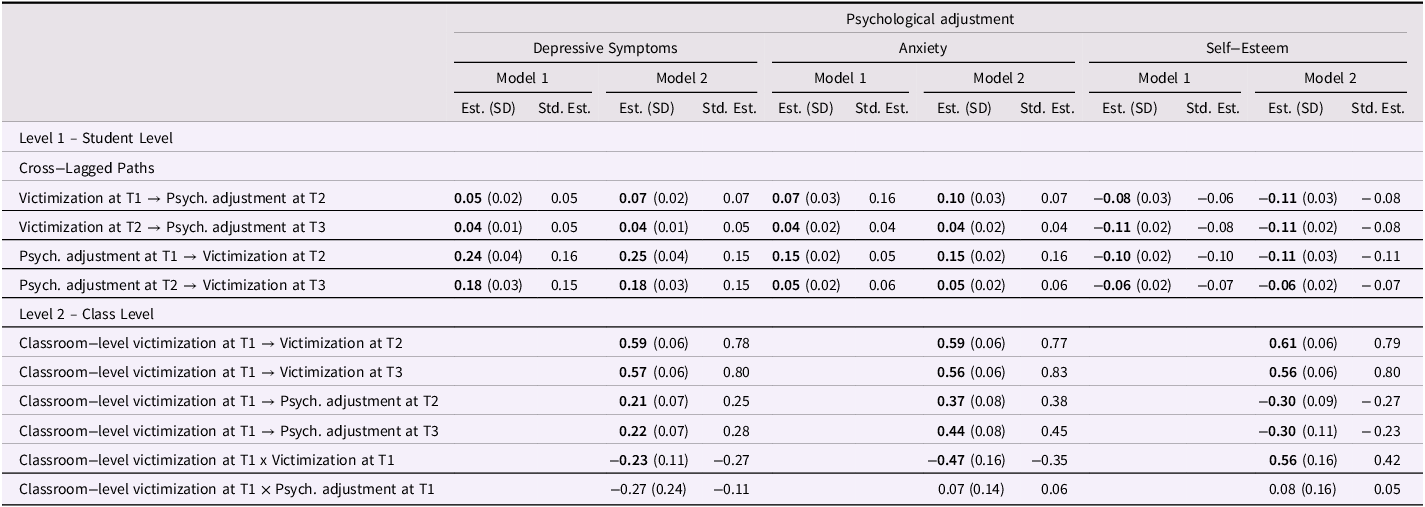
N = 3,470 students in 227 classrooms; Gender: 0 = girl, 1 = boy; Est. = Unstandardized Bayesian posterior median estimate; SD = standard deviation of the posterior distribution; Std. Est. = Standardized estimate; Statistically significant results at α = .05 are shown boldface.
Multilevel latent change score model simplified results: unstandardized and standardized bayesian posterior median estimates

N = 3,470 students in 227 classrooms; Gender: 0 = girl, 1 = boy; Est. = Unstandardized Bayesian posterior median estimate; SD = Standard deviation of the posterior distribution; Std. Est. = Standardized estimate; Statistically significant results at α = .05 are shown boldface.
Multilevel random intercept cross−lagged panel model simplified results: unstandardized and standardized bayesian posterior median estimates

N = 3,470 students in 227 classrooms; Gender: 0 = girl, 1 = boy; Est. = Unstandardized Bayesian posterior median estimate; SD = Standard deviation of the posterior distribution; Std. Est. = Standardized estimate; Statistically significant results at α = .05 are shown boldface.
Relative between-person change
Cross-lagged paths of the CLPM while statistically controlling for age and gender (Model 1, Table 2) showed that students who were more frequently victimized had a stronger between-person rank-order increase in depressive symptoms (Est. = 0.05, 95% CI [0.01, 0.09], Std. Est = 0.05) and anxiety (Est. = 0.07, 95% CI [0.01, 0.13], Std. Est = 0.16), and a between-person rank-order decrease in self-esteem (Est. = −0.08, 95% CI [−0.14, −0.03], Std. Est = −0.06) between T1 and T2. The effect sizes of standardized estimates for depressive symptoms and self-esteem can be considered as small, whereas the effect size for anxiety can be considered as large (Orth et al., Reference Orth, Clark, Donnellan and Robins2022). As for the reversed direction, students who had higher depressive symptoms (Est. = 0.24, 95% CI [0.16, 0.32], Std. Est = 0.16, large effect size) and anxiety (Est. = 0.15, 95% CI [0.11, 0.20], Std. Est = 0.05, small effect size) had a stronger between-person rank-order increase in victimization, while students who had higher self-esteem had a stronger between-person rank-order decrease in victimization (Est. = −0.10, 95% CI [−0.15, −0.06], Std. Est = −0.10, medium effect size) between T1 and T2. The results between T2 and T3 show the same pattern for the bidirectional cross-lagged paths between victimization and the three indicators of psychological adjustment.
Absolute within-person change
Cross-lagged paths of the LCSM while statistically controlling for age and gender (Model 1, Table 3) showed that students who were more frequently victimized had a stronger within-person absolute increase in depressive symptoms (Est. = 0.05, 95% CI [0.01, 0.09], Std. Est = 0.08) and anxiety (Est. = 0.07, 95% CI [0.01, 0.13], Std. Est = 0.08), and a within-person absolute decrease in self-esteem (Est. = −0.08, 95% CI [−0.14, −0.02], Std. Est = −0.08) between T1 and T2. The effect sizes of standardized parameters can be considered as medium (Orth et al., Reference Orth, Clark, Donnellan and Robins2022). As for the reversed direction, students who had higher depressive symptoms (Est. = 0.25, 95% CI [0.17, 0.32], Std. Est = 0.18) and anxiety (Est. = 0.16, 95% CI [0.11, 0.20], Std. Est = 0.18) had a stronger within-person absolute increase in victimization, whereas students who had higher self-esteem had a stronger within-person absolute decrease in victimization (Est. = −0.11, 95% CI [−0.16, −0.06], Std. Est = −0.13) between T1 and T2. The effect sizes of standardized parameters can be considered as large (Orth et al., Reference Orth, Clark, Donnellan and Robins2022). Note that the results between T2 and T3 showed the same pattern for the cross-lagged paths between victimization and the three indicators of psychological adjustment.
Relative within-person change
Cross-lagged paths of the RI-CLPM while statistically controlling for age and gender (Model 1, Table 4) showed no statistically significant association between victimization and within-person rank-order change in depression (Est. = −0.03, 95% CI [−0.15, 0.07], Std. Est = -0.02), anxiety (Est. = -0.06, 95% CI [−0.21, 0.09], Std. Est = −0.04), and self-esteem (Est. = -0.03, 95% CI [−0.16, 0.13], Std. Est = -0.03) from T1 to T2. Results between T2 and T3 showed that students who were more frequently victimized at T2 had a stronger within-person rank-order decrease in self-esteem (Est. = −0.15, 95% CI [−0.22, −0.08], Std. Est = −0.14). The effect sizes of standardized estimates vary from small to large (Orth et al., Reference Orth, Clark, Donnellan and Robins2022). As for the reversed direction, cross-lagged paths of the RI-CLPM showed that students who had higher anxiety (Est. = 0.14, 95% CI [0.03, 0.24], Std. Est = 0.13) had a stronger within-person rank-order increase in victimization between T1 and T2. No statistically significant association was found between depressive symptoms (Est. = 0.10, 95% CI [−0.09, 0.28], Std. Est = 0.07) or self-esteem (Est. = −0.05, 95% CI [−0.19, 0.11], Std. Est = −0.04) and within-person rank-order change in victimization between T1 and T2. However, results between T2 and T3 revealed that students with higher depressive symptoms at T2 had a stronger within-person rank-order increase in victimization (Est. = 0.28, 95% CI [0.13, 0.39], Std. Est = 0.22), which represents a large effect size (Orth et al., Reference Orth, Clark, Donnellan and Robins2022).
Summary across all models
In summary, the findings indicated that the extent to which bidirectional associations were present depended on how change was conceptualized. As for the relative between-person change and absolute within-person change, statistically significant bidirectional relationships were consistently detected. Thus, students with higher levels of victimization were more likely to increase in psychological problems than students with lower levels of victimization, and vice versa. Standardized estimates indicate that the effect sizes for the effects of psychological adjustment on subsequent victimization seemed stronger than the effect sizes for the effect of victimization on subsequent psychological adjustment. Next, regarding relative within-person change, findings only partially supported the hypothesis that there were bidirectional associations between victimization and psychological adjustment over time, as the pattern was not consistently present across time points.
Moderating effects of classroom victimization on between- and within-person bidirectional associations between victimization and adjustment
As a second step, we included cross-level interactions in the previous models to test the moderating role of classroom-level victimization in the between- and within-person bidirectional links between victimization and psychological adjustment (Model 2). Tables 2–4 provide a simplified overview of the results for each outcome variable, and Tables S2, S3 and S4 provide the full results.
Relative between-person change
All cross-level interactions in the ML-CLPM involving classroom-level victimization and individual-level victimization at T1 were statistically significant, while none of the cross-level interactions involving classroom-level victimization and indicators of psychological adjustment were statistically significant (Model 2, Table 2). In line with our hypothesis, results showed that higher classroom-level victimization weakened the association between individual-level victimization and between-person rank-order increase in depressive symptoms (Est. = −0.23, 95% CI [−0.44, −0.02], Std. Est = −0.27) and anxiety (Est. = −0.47, 95% CI [−0.79, −0.15], Std. Est = −0.35), and between-person rank-order decrease in self-esteem (Est. = 0.56, 95% CI [0.24, 0.87], Std. Est = 0.42). These effects can be considered as moderate in size (Mathieu et al., Reference Mathieu, Aguinis, Culpepper and Chen2012). Figure 2, column 1 visualized the cross-level interactions: being victimized was more strongly related to a rank-order increase in depressive symptoms and anxiety, and a rank-order decrease in self-esteem when classroom-level victimization was low. Classroom-level victimization explained 7% of the variance in the slope of depressive symptoms at T2 regressed on victimization T1, 12% of the variance in the slope of anxiety at T2 regressed on victimization T1, and 18% of the variance in the slope of self-esteem at T2 regressed on victimization T1.
Cross-level interactions representing the moderating role of classroom-level victimization in the effect of victimization on psychological adjustment, for ML-CLPM (Column 1), ML-LCSM (Column 2), and ML-RI-CLPM (Column 3). n.s. = not significant.

Absolute within-person change
Cross-level interactions in the ML-LCSM involving classroom-level victimization and individual-level victimization at T1 were all statistically significant, while none of the cross-level interactions involving classroom-level victimization and indicators of psychological adjustment were statistically significant (Model 2, Table 3).
In line with our hypothesis, lower classroom-level victimization exacerbated the effect of individual-level victimization on a within-person absolute increase in depressive symptoms (Est. = −0.24, 95% CI [−0.45, −0.03], Std. Est = −0.28) and anxiety (Est. = −0.48, 95% CI [−0.80, −0.16], Std. Est = −0.36), and a decrease in self-esteem (Est. = 0.56, 95% CI [0.24, 0.88], Std. Est = 0.42). These effects can be considered as moderate in size (Mathieu et al., Reference Mathieu, Aguinis, Culpepper and Chen2012). Figure 2, column 2 visualizes the cross-level interactions: being victimized was more strongly related to an absolute increase in depressive symptoms and anxiety, and absolute decrease in self-esteem when classroom-level of victimization was low. Classroom-level victimization explained 8% of the variance in the slope for depressive symptoms at T2 regressed on victimization at T1, 13% of the variance in the slope of anxiety at T2 regressed on victimization at T1, and 17% of the variance in the slope of self-esteem at T2 regressed on victimization at T1.
Relative within-person change
The cross-level interaction in the ML-RI-CLPM involving classroom-level victimization and individual-level victimization at T1 was statistically significant for self-esteem (Est = 0.88, CI [0.26, 1.15], Std. Est = 0.34), but not for depressive symptoms (Est. = −0.35, 95% CI [−1.01, 0.28], Std. Est = -0.12) or anxiety (Est. = −0.15, 95% CI [−0.96, 0.61], Std. Est = −0.04; Model 2, Table 4). The cross-level interactions are visualized in Figure 2, column 3. The significant cross-level interaction for victimization on self-esteem indicates that more frequently victimized students are more likely to decrease in self-esteem as compared to their usual levels of self-esteem if the classroom-level of victimization is lower. Classroom-level victimization explained 12.0% of the variance in the slope of self-esteem at T2 regressed on victimization at T1. Unfortunately, it was not possible to test for an effect of classroom-level victimization in the reversed direction (i.e., from psychological problems to victimization) due to convergence issues, which emerged as soon as a random slope was specified for the respective predictor in each model.
Summary across all models
In summary, the findings indicate that the healthy context paradox is consistently present in terms of between-person and absolute within-person change across various indicators of psychological adjustment. The healthy context paradox was only partially supported in terms of relative within-person change. More specifically, one out of the three cross-level interactions tested in the RI-CLPM revealed the presence of the healthy context paradox, and it was not possible to investigate the reverse effects due to convergence issues, which implies that these findings should be interpreted with caution. In the CLPM and LCSM, however, there was no indication that maladjusted students were more victimized in classrooms with a lower level of victimization.
Discussion
This study tested the central tenet of the healthy context paradox, which is that victims increase in psychological problems over time in healthier contexts (i.e., in classrooms with lower levels of victimization). This was firstly done by examining whether the healthy context paradox does emerge while simultaneously testing for an alternative explanation, i.e., that the positive association between psychological problems and subsequent victimization is stronger in healthier contexts. Second, we put the key principle of the healthy context paradox to the test by analyzing the role of classroom-level victimization not only in between-person, but also in absolute and relative within-person links between victimization and psychological adjustment. Results supported quite consistently the presence of a healthy context paradox: in seven out of the nine tested effects, the classroom levels of victimization moderated the prospective link of victimization on all indicators of psychological adjustment. These effects emerged after controlling for the alternative direction (i.e., the role of classroom victimization in the effect of psychological problems on subsequent victimization) for which there was no evidence. Next, our findings indicated that victimization is not only predictive of greater psychological problems in healthier contexts in terms of between-person change, but also in terms of absolute within-person change, and possibly to some extent, in terms of relative within-person change. Thus, even though it is good to strive for low levels of victimization, the findings indicate that it is essential to pay attention to students who are still highly victimized in these healthier classrooms - not only because they increase more in psychological problems than others (i.e., their less victimized classmates), but also because their psychological problems become greater than they were before.
Classroom levels of victimization moderate the effect of victimization on adjustment, but not vice versa
The findings of the various models quite consistently indicated the presence of a healthy context paradox: victims were more likely to increase in psychological problems over time in classrooms with lower levels of victimization than in classrooms with higher levels of victimization. The effects were moderate in size, and strongest for self-esteem across models. Various potential explanations for these effects have been offered in the literature (Garandeau & Salmivalli, Reference Garandeau and Salmivalli2019). Consistent with attribution theory (Weiner, Reference Weiner1985), victims are more likely to blame themselves for the victimization in healthier classrooms (Laninga-Wijnen et al., Reference Laninga-Wijnen, Garandeau, Malamut and Salmivalli2023), which could explain why they experience more psychological problems. Furthermore, when frequently victimized children find themselves in a social context where bullying is rare, they are more likely to compare themselves to less- or non-victimized peers, who tend to be happier and more popular or liked (Garandeau & Salmivalli, Reference Garandeau and Salmivalli2019). These upward comparisons may exacerbate victims’ psychological problems. Another possible reason for the healthy context paradox is that healthier contexts negatively influence victims’ opportunities for forming friendships, which potentially worsens victims’ psychological problems. Indeed, one study found that having a lower number of received friendship nominations was a reason why victims had more psychological problems in healthier contexts (Pan et al., Reference Pan, Li, Ji, Malamut, Zhang and Salmivalli2021). Although our study did not test for the specific mechanisms underlying the healthy context paradox, our work hopefully encourages future work to do so. Moreover, these future studies may examine whether various mechanisms may be at play for the different indicators of psychological adjustment, as our findings indicate that the healthy context paradox most strongly emerges for students’ self-esteem.
Importantly, the healthy context paradox in this study emerged after controlling for the alternative direction that severe psychological problems would be more strongly associated with subsequent victimization in healthier classrooms. We assumed the average levels of psychological problems to be lower in classrooms with low levels of victimization, and reasoned that students with more psychological problems would stand out more in these classrooms which would make them easier targets for victimization. However, the effects for this alternate direction were not statistically significant, which is in line with prior work (Pan et al., Reference Pan, Li, Ji, Malamut, Zhang and Salmivalli2021). Thus, although we found that youth with psychological problems were at increased risk of victimization (e.g., Christina et al., Reference Christina, Magson, Kakar and Rapee2021), this tendency was not stronger in classrooms with lower levels of victimization.
Classroom-level victimization affects both between- and within-person effects of victimization on psychological adjustment
We also aimed at further understanding whether victimization can be especially hurtful for individuals in classrooms with lower levels of victimization, by analyzing this question from different perspectives (between-person, absolute and relative within-person). In other words, we tested whether victims in healthier classrooms (i.e., with lower averages of victimization) would be more likely to increase in psychological problems as compared to others, compared to their prior problems, and compared to their usual problems. Previous work mostly considered between-person processes in examining the healthy context paradox (e.g., Pan et al., Reference Pan, Li, Ji, Malamut, Zhang and Salmivalli2021), and the results of our between-person analyses largely replicate prior findings. The between-person analyses using traditional cross-lagged panel analyses indicated that students who were more victimized than others in classrooms with lower levels of victimization experienced a stronger rank-order increase in psychological problems. Thus, the healthy context paradox may - at least partially - represent a widening gap between victimized and non-victimized youth. It should be noted that traditional cross-lagged panel analyses assess mixed rather than pure between-person effects.
In the other models, we tested whether students reported worse psychological problems than before (absolute within-person changes) or than usual (relative within-person changes). In the models analyzing absolute within-person changes, we consistently found that victimized students in healthier classrooms had an absolute increase in psychological problems over time. In other words, students who were more victimized, increased in depressive symptoms and anxiety and decreased in self-esteem, as compared with their prior levels of these psychological indicators, and these effects were stronger in classrooms with lower victimization. These effects may have emerged due to the aforementioned cognitive (self-blame, upward social comparisons) and social (lack of friendships) explanations.
With regard to the effect of classroom-level victimization on relative within-person changes in the victimization-adjustment link, only one out of the three tested cross-level interactions was statistically significant. This interaction suggested that students who scored higher than usual on victimization tended to score lower on self-esteem (as compared with their usual self-esteem) in classrooms with low levels of victimization than in classrooms with high levels of victimization. This effect did not emerge for the two other indicators of psychological adjustment, perhaps because the relative within-person variance in psychological problems was too low to be predicted based on the variables in our model. Another potential reason why we did not detect the healthy context paradox for all outcomes in the ML-RI-CLPM is that it is mostly suited for short-span longitudinal data, as certain individual traits can be expected to be stable across shorter time spans (Hamaker et al., Reference Hamaker, Kuipers and Grasman2015). In this study, we estimated a model across three measurement waves throughout one school year, and it is possible that this timespan was too long. Also, we only had three assessments of psychological adjustment and victimization which may not be sufficient to estimate one’s “usual” levels of victimization or psychological adjustment.
Strengths, limitations, and future directions
This study has several strengths, including its rigorous longitudinal design, the use of advanced multilevel statistical analyses to test various types of change in response to a healthier context, and a recent, large-scale dataset. There are also some limitations. First, for the ML-RI-CLPM, we were not able to examine the alternate direction, i.e., whether classroom-level victimization moderates the prospective effect of psychological problems on victimization. Including the random slope to estimate the cross-level interaction effect for this alternate direction resulted in convergence issues, which might be due to a random slope variance close to zero. Therefore, we decided to not include this random slope, nor a cross-level interaction for this alternate direction. Future work with more measurement waves or a larger sample may be able to determine the moderating role of classroom-level victimization in the bidirectional relative within-person associations between psychological adjustment and victimization. On an additional note, across all models, the effect sizes for the effects of psychological adjustment on subsequent victimization seemed stronger than the effect sizes for the effect of victimization on subsequent psychological adjustment. Thus, the cross-lagged paths that were moderated by classroom-level victimization were those that seemed smallest in size. Given that the cross-lagged paths from psychological adjustment to subsequent victimization did significantly vary across classrooms, future work is encouraged to examine what classroom variables may moderate this link, such as the classroom level of psychological adjustment (Kaufman et al., Reference Kaufman, Huitsing, Bloemberg and Veenstra2021) or classroom bystander behavior (Kärnä et al., Reference Kärnä, Voeten, Poskiparta and Salmivalli2010).
Second, even though this study had proposed several reasons for the presence of the healthy context paradox, no underlying explanatory mechanisms were tested. Future research should examine whether there are unique explanations underlying between- versus within-person changes. To date, one between-person study has found preliminary evidence that victims’ increased self-blame may explain the exacerbated psychological problems (depression and self-esteem) in classrooms with lower levels of peer-perceived victimization (Laninga-Wijnen et al., Reference Laninga-Wijnen, Garandeau, Malamut and Salmivalli2023), and another between-person study found that having fewer friends partially accounted for the enhanced prospective link between victimization and psychological problems (Pan et al., Reference Pan, Li, Ji, Malamut, Zhang and Salmivalli2021). Though plausible, the question of whether these mechanisms also drive relative or absolute within-person changes in psychological problems remains to be tested.
Third, because classrooms levels of victimization have been mostly used to assess the healthy context paradox, we have considered this as our indicator of the healthiness of a classroom. Nevertheless, aggregating individual scores at the classroom level has some limitations. A lower classroom average of victimization could indicate either that all students in the classroom have low scores in victimization or that a few students score high in victimization but most do not experience any victimization. Future work is encouraged to further examine the between- and within-person changes tested in the present study using other operationalizations of classroom victimization (e.g., centralization of victimization or proportion of victims in the classroom). In addition, studies on the healthy context paradox, including the present one, have relied on the assumption that victimized students are aware of the level of victimization in their classroom. Future studies could investigate whether this assumption is supported. Moreover, we only assessed the moderating role of classroom levels of victimization at the first time point. In future studies, it might be also interesting to investigate whether changes in classroom levels of victimization moderate the bidirectional within- and between-person associations between victimization and psychological adjustment. This, however, will require a complex design and a very large sample size to guarantee sufficient power.
A final limitation is that a higher participation rate would have been preferable for a more reliable estimation of classroom victimization levels. Nevertheless, our participation rate is comparable to or higher than other large-scale longitudinal projects that applied a similar active consent procedure (see Shaw et al., Reference Shaw, Cross, Thomas and Zubrick2015, for a review), despite the consent forms being collected during the COVID pandemic. The main reason why the participation rate was not higher is that many parents never returned the consent forms and we used an active consent procedure. Although a lower classroom participation rate could lead to an under-representation of victims, we know of one study that found that victims were not under-represented in studies applying active consent procedures as compared to passive consent procedures (Shaw et al., Reference Shaw, Cross, Thomas and Zubrick2015). If all students had participated, low levels of classroom victimization could not be due to low consent rates, and therefore our effects might be stronger.
Conclusion and practical implications
This study provided evidence for the fundamental principle of the healthy context paradox that being in a lower-victimization classroom exacerbates the negative psychological consequences of victimization. Specifically, victimized youth did not only report more psychological problems than others, but also more than they did before. These findings inform the design of anti-bullying strategies, especially decisions regarding where the focus of anti-bullying efforts should be and how to assess the effectiveness of interventions. Whole-school interventions should not only include universal actions lowering the prevalence of victimization but should systematically include targeted actions for students who remain bullied (Kaufman et al., Reference Kaufman, Huitsing, Bloemberg and Veenstra2021). When evaluating the effectiveness of interventions, a decrease in the overall prevalence of victimization should not be considered sufficient, as this can be accompanied by increases in suffering among those who are victimized despite these anti-bullying efforts. Helping these remaining victims is essential to improve the well-being and psychological adjustment of all students, including those who need it the most.
Supplementary material
The supplementary material for this article can be found at https://doi.org/10.1017/S0954579423001384.
Funding statement
This research was supported by grants from the Academy of Finland, Grant/Award Number: 349560 and NWO (Rubicon grant), Grant/Award Number: 019.211SG.003 awarded to the first author, as well by the INVEST Research Flagship Center (Academy of Finland Flagship Program, decision number: 320162) and an ERC grant (Grant/Award Number:884434) awarded to the last author.
Competing interests
None.


 Open access

