

Introduction
Although the earliest Mesopotamian incantations originated in southern Iraq, the largest collection of Early Dynastic incantations stems from the royal chancellery of Ebla, which contained twenty tablets comprised of spells in Sumerian and an assortment of Semitic languages.Footnote 1 While the language of certain incantations inscribed upon these tablets can be discerned from duplicate compositions and parallel passages, much of the technical vocabulary found in the Semitic incantations remains impenetrable, whilst the Sumerian incantations are frequently composed in a syllabic orthography that prioritizes the phonetic shape of the recitation over its semantic meaning.Footnote 2 These factors, in combination with the obscurity, laconism, and abbreviation that permeate this genre of early Mesopotamian texts, make it challenging to identify the language of a given incantation or understand its contents.Footnote 3 Consequently, the classification of many incantations as Semitic or Sumerian has not been reevaluated since the pioneering efforts made more than twenty-five years ago.Footnote 4 Since knowledge of early Mesopotamian incantations has steadily advanced in the years since these initial identifications were made, several of the texts which had been formerly considered Semitic or Sumerian are ripe for reassessment.
TM 75.G.2459 (ARET 5, 19), Incantation Ten
Among the tablets bearing incantations excavated from Ebla, TM 75.G.2459 (ARET 5, 19) is notable for its exceptional size. While large collective tablets of incantations are known from contemporary sites elsewhere, ARET 5, 19 holds an unprecedented fourteen distinct incantations recorded in Sumerian and one or more Semitic languages among the tablets of Ebla.Footnote 5 Just as the precise number of Semitic languages upon this tablet remains uncertain, the classification of several incantations as Semitic or Sumerian remains tentative.Footnote 6 This study focuses on the tenth incantation inscribed upon ARET 5, 19. Pettinato (Reference Pettinato1979: 337, 349) provided the first transliteration of this incantation and offered selected remarks about its content as spell number twenty-four. Thereafter, Edzard (Reference Edzard1984) published a copy of this composition (plate 26) and photos of the tablet on which it is inscribed (plates 54–55), alongside most of the other tablets bearing incantations from Ebla. Krebernik (Reference Krebernik1984: 170–171) provided the latest edition of this incantation as spell number thirty-three. Since then, the composition has only been subject to selected studies.Footnote 7
The previous editors of this laconic incantation struggled to decipher its content due to two interpretive cruxes, the ambiguous significance of nun ni+maš nun ni+maš in case xii 5 and the obscure meaning of nu.nu in case xii 6. Since this pithy composition otherwise contains only the names and titulature of Ningirima and Enki in addition to the familiar introductory and concluding formulae of the spells from Ebla, the prior editors looked to the two nun signs and the nu.nu to ascribe a function to this spell and hesitantly connected these constructions to the Akkadian noun nūnum. Accordingly, this composition has been identified as an incantation in a Semitic language about fish, couched in heavily logographic writing, and it has been considered a possible attestation of Mesopotamian scribal activity at Ebla since nūnum does not otherwise occur in Eblaite.Footnote 8 This analysis, however, remains uncertain. Since the Semitic identification of the language of this incantation rests solely upon the apparent similarity of nun and nu.nu with Akkadian nūnum, the risk of a coincidental resemblance cannot be discounted, and it seems reasonable to explore the possibility that Sumerian is the language of this composition.
This contribution offers a new interpretation of this incantation as a Sumerian composition featuring syllabic orthography. This analysis postulates the spell is inscribed solely as a string of vocatives which invoke Enki both by name and through his titulature, while also appealing to the deities Ninmaš and Ningirima by name alone. The interpretation advocated in the following edition argues this incantation serves to call upon these deities, implore them to bear witness to the requests of the practitioner recounting the spell, and entreat them to invoke their divine powers and effectuate the appeals he has made on his own behalf or on behalf of his client(s).
Text Edition
rev. xii 4 en2 e2-nu-ru
rev. xii 5 nun ni-maš nun ni-maš
rev. xii 6 nu-nu d nin-girima x
rev. xii 7 d en-ki
rev. xii 8 lugal abzu-ta
rev. xii 9 ud -du 11 -ga
rev. xiii 1 d nin-girima x
Translation
An incantation formula. O prince, O Ninmaš! O prince, O Ninmaš! O prince, O Ningirima! O Enki, king from the Abzu! It is a recited incantation of Ningirima.
Commentary
rev. xii 5. nun ni-maš nun ni-maš (= nun d nin-maš nun d nin-maš): Pettinato (Reference Pettinato1979: 337) first connected the two nun signs and the nu.nu to nūnum. He additionally suggested this spell records only key words of the recitation or is a collection of incipits due to its schematic form. Like Pettinato, Krebernik tentatively proposed the first component of the recurrent nun ni+maš is a singular form of nūnum, while hypothesizing the ni+maš could function as a complex logogram to indicate plurality.Footnote 9 He also interpreted the nu.nu as a plural form of nūnum in status constructus with the deity Ningirima. Bonechi and Catagnoti (Reference Bonechi and Catagnoti1998: 29–30) also followed the earlier reading of nun for nūnum.Footnote 10 These analyses, however, are difficult on both grammatical and interpretive grounds.Footnote 11 Comparable incantations concerning fish in Semitic languages are neither found at Ebla, nor among contemporary incantations.Footnote 12 Moreover, the rest of this spell could equally denote Sumerian, as the ablative case ending in this composition suggests.Footnote 13
Since this incantation mentions Enki by name alongside his titulature in case xii 7 and is clearly related to the following three compositions on the same tablet—each of which are Sumerian and likewise feature Enki—it seems reasonable to interpret each nun ni+maš as a Sumerian formulation.Footnote 14 The sign nun can be understood as nun, the Sumerian term later equated to Akkadian rubû “prince” rather than a form of nūnum. Like the sign’s parallel usage to designate his city of Eridu, nun is a standard epithet of Enki in both literary compositions and the Mesopotamian incantation corpus. Within approximately contemporary Early Dynastic spells from Fara (Šuruppak), for example, the deity ne.dag is called the “child of the prince” (dumu nun) in a manner comparable to the titulature of Asalluhi in later incantations.Footnote 15
Given that the nun signs could refer to Enki’s typical Sumerian title of nun and function as an unmarked vocative like d nin-girima x and d en-ki later in cases xii 6 and xii 7 respectively, perhaps each ni+maš should likewise be analyzed as a vocative form corresponding to a Mesopotamian deity. As the divine determinative can be omitted within incantations written in phonetic orthography from Ebla and elsewhere, the two ni+maš constructions in case xii 5 may be interpreted as ni-maš, a syllabic writing of d nin-maš.Footnote 16 From the third millennium onwards, Ninmaš appears in a wide array of contexts, often in a pairing with Ninpiriⓖ, and is also notably attested alongside Ninpiriⓖ in a spell from the approximately contemporary incantations of Fara, a promising precedent for the possible appearance of this deity in the tenth spell of ARET 5, 19.Footnote 17
rev. xii 6. nu-nu d nin-girima x (= nun d nin-girima x ): Whereas the previous editors interpreted nu.nu as a plural form of nūnum in status constructus, it can also be analyzed as nu-nu, a variant syllabic writing for Enki’s title of nun in case xii 5.Footnote 18 The nu-nu could then stand in apposition to cases xii 7–8: d en-ki lugal abzu-ta, “O Enki, king from the Abzu!” If the final vowel of nu-nu is grammatically significant, it may indicate a vocalic case ending which has undergone vowel harmony. Analyzed as nun-e, the form could be ergative, but the incantation has no corresponding verbal form, and the spell concludes immediately after Enki’s titulature in cases xii 9–xiii 1. This incongruence may suggest the tenth composition inscribed upon ARET 5, 19 is an early exemplar of a text that records an abbreviated written version of a recited incantation, as Pettinato observed.Footnote 19 Such abbreviation is clearly documented in the first half of the second millennium when texts recording incantations become more abundant. As this practice deserves a dedicated study, for the purpose of this contribution it is sufficient to specify that scrutiny of texts with multiple duplicates reveals abridged writings are pervasive within incantations, as earlier research on spells directed against snakebite and scorpion sting has demonstrated.Footnote 20
It is also possible, however, that the final vowel of nu-nu is superfluous. Comparable syllabic writings with redundant final vowels are found in the phonetically inscribed incantations from Ebla, such as din-gi-li hul, where a duplicate spell in conventional orthography also from Ebla reads diⓖir hul.Footnote 21 Moreover, a distinct lack of standardization marks the employment of phonetic writings at Ebla, as incantations written in phonetic orthography frequently utilize different signs to render identical elements. The verbal base nu 2 is written both phonetically as nu and with its conventional sign na 2 within various incantations inscribed upon ARET 5, 19.Footnote 22 Additionally, the conjugation prefix /ba-/ is transcribed with both ba and pa in a single incantation, also upon ARET 5, 19.Footnote 23 Accordingly, the use of both nun and nu-nu to render the same noun in the tenth incantation of ARET 5, 19 may not be unusual. As this interpretation of the spell does not necessitate an abbreviated text, it seems preferable to analyze nu-nu as a pseudo-syllabic writing of nun comparable to din-gi-li for diⓖir. The tenth incantation upon ARET 5, 19 could therefore be understood as a spell that serves to invite Enki, Ninmaš, and Ningirima to listen to the petition of the incantation priest and convince them to grant their power to his cause.
Discussion
Although the tenth incantation upon ARET 5, 19 lacks duplicates in the corpus of early Mesopotamian incantations, its content can be partially understood through comparison with later Sumerian incantations. Similar vocative openings are found within the body of consecration incantations that serve to purify cultic practitioners, sacred objects, and ritual ingredients, including the Old Babylonian torch incantation YBC 1828 (YOS 11, 59), in which the object is referenced with second person pronouns, asserting the use of the vocative.Footnote 24 Given the laconism of the tenth incantation on ARET 5, 19 and the presence of divine names and titulature in the comprehensible sections of this incantation, it might be best to interpret the composition as a list of divine names and titles in the vocative.
Whereas Enki and Ningirima are frequently found within early incantations along with their titulature, the appearance of Ninmaš—if ni+maš indeed refers to this deity—is more surprising. Though Ninmaš appears in numerous and varied contexts, he or she is also found in several Old Babylonian incantations, which can perhaps shed light upon the role of Ninmaš within both this composition and the fifth incantation on VAT 12597 (SF 54) from Fara.Footnote 25 In the Sumerian incantation BM 78185 (CT 44, 31), a spell later incorporated into the canonical udug hul series as the third incantation of the fourth tablet according to Geller’s reconstruction, Ninmaš and Ninpiriⓖ appear among the other netherworld gods whom the sun god visits at night in his capacity as the god of judgement.Footnote 26 Moreover, the pair are also invoked due to their association with the sun god in YBC 4598 (YOS 11, 21), an Akkadian incantation for judicial victory.Footnote 27 Similarly, Ninmaš and Ninpiriⓖ are likely invoked as celestial bodies in the twentieth spell of the Old Babylonian tablet VAT 8379 (VS 17, 10), which is directed against scorpion sting according to its rubric:
d nin-piriⓖ d nin-maš dumu d en-lil 2 -la 2
am dab 5 -ba-gin 7 šu ba-e-la 2
šilam dab 5 -ba-gin 7 a 2 šu ba-e-ni-la 2
gu 4 ur 3 -ra a 2 ba-e-ni-dab 5 a 2 ba-e-ni-la 2
piriⓖ-gin 7 da ⸢ri⸣
ka-inim-ma ⓖiri 2 -tab-a-[kam]
O Ninpiriⓖ, O Ninmaš, children of Enlil, you have caused it to be trapped like a captured wild bull. You have caused the limbs to be trapped like a captured cow. As for the rear ox, you have caused the limbs to be captured. You have caused the limbs to be bound. Set it on a side like a lion! It is an incantation for a scorpion.Footnote 28
The proposed celestial understanding of Ninmaš and Ninpiriⓖ in this spell stems from numerous other scorpion incantations which mark the scorpion with the determinative mul to designate it as the scorpion constellation or otherwise feature celestial imagery.Footnote 29 The contents of this group of incantations can be pieced together to reconstruct a myth wherein the celestial bodies struggle to restrain the scorpion constellation as it attempts to break free of the heavens, an action which would therefore allow its terrestrial counterparts—the scorpions who dwell upon the earth—to run rampant. While incantations containing the motif of the celestial scorpion have not yet been subject to extensive study, new research focusing on this group of spells is currently underway.Footnote 30 Given the inclusion of Ninmaš and Ninpiriⓖ within other early incantations seems contingent upon the celestial affiliations of the pair, particularly their relationship to Utu, perhaps Ninmaš should likewise be understood in light of his or her celestial capacity as part of the entourage of the sun god in the tenth incantation of ARET 5, 19, as well as both the fifth incantation on VAT 12597 (SF 54) and its fragmentary duplicate TSŠ 170, where the same pair of gods might be lost in the break. This suggestion, however, remains speculative, as the precise function of each of these incantations is abstruse.
Conclusion
Although the function of the tenth incantation of ARET 5, 19 remains uncertain, the language of this incantation can more plausibly be classified as Sumerian than Semitic. With the proposed identification of the nun and nu.nu within this spell as components of Enki’s standard titulature as nun and the suggested analysis of ni+maš as a potential phonetic writing of d nin-maš, this laconic composition might be understood as a Sumerian incantation invoking Enki, Ninmaš, and Ningirima rather than a Semitic language spell mentioning fish. Considering this spell appears to consist solely of divine names and titulature, it seems reasonable to suggest this incantation served to invite Enki, Ninmaš, and Ningirima to lend their heavenly power to the petition of the incantation priest who invoked them, though it is also possible that much of the content of this orally recited composition was not committed to the tablet’s clay.
As a Sumerian incantation repeatedly invoking Enki by his title nun, this composition would initiate a series of four sequential Sumerian incantations on ARET 5, 19, each of which invokes Enki by name. Following the tenth incantation, the eleventh composition describes Enki transporting a sick patient to the sanctuary of Ⓖirinun on his barge to receive healing, whereas the twelfth and thirteenth compositions are Sumerian incantations against snakebite that associate the dangerous serpents with Enki through their chthonic associations as creatures who dwell alongside him in the Abzu. These four incantations thus appear to form a conscious grouping of compositions upon ARET 5, 19, and hint at an incentive to gather spells that draw upon Enki’s power in a place far removed from his center of worship in southern Mesopotamia. Through the invocation of Enki and other deities of the ancient south, the rulers of Ebla would have attained additional means by which they could ascertain any negative condition that afflicted them and find the appropriate response, thereby minimizing their own vulnerability and any threat to their kingdom at large.
Acknowledgements
My gratitude goes out to Genevieve Le Ban and Sophie Cohen-Olberding, who kindly offered comments and suggestions on an initial draft of this article. Additional thanks are given to the anonymous reviewers whose feedback vastly improved this manuscript. The responsibility for any omissions, mistakes, and misinterpretations belongs solely to the author. This contribution is dedicated to the former members of the Laboratorio di Epigrafia del Vicino Oriente Antico at Università Ca’ Foscari Venezia, particularly Irene Alberti, Anna Baldon, Valentina Gennaro, Thomas Marampon, and Giorgia Mele, as well as our compatriot in Greek epigraphy, Davide Tronchin. Thank you for providing such a welcome, enjoyable, and stimulating environment for a Canadian who wandered your way.
Appendix
TM 75.G.2459 (ARET 5, 19), Incantation Ten

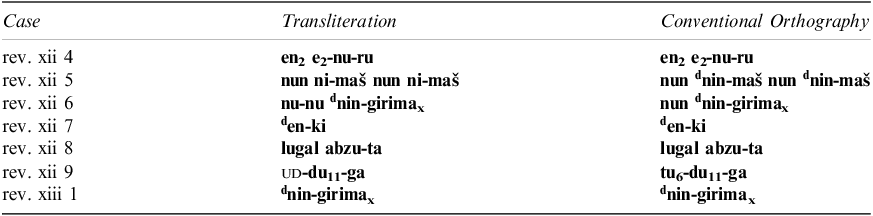
Table A Long description
The table has three columns: Case, Transliteration, and Conventional Orthography. It contains seven rows, each corresponding to a different case from rev. xii 4 to rev. xiii 1. Row 1: Case rev. xii 4, Transliteration en 2 e 2 -nu-ru, Conventional Orthography en 2 e 2 -nu-ru. Row 2: Case rev. xii 5, Transliteration nun ni-ma nun ni-ma, Conventional Orthography nun d nin-ma nun d nin-ma. Row 3: Case rev. xii 6, Transliteration nu-nu d nin-girima x, Conventional Orthography nun d nin-girima x. Row 4: Case rev. xii 7, Transliteration d en-ki, Conventional Orthography d en-ki. Row 5: Case rev. xii 8, Transliteration lugal abzu-ta, Conventional Orthography lugal abzu-ta. Row 6: Case rev. xii 9, Transliteration ud -du 11 -ga, Conventional Orthography tu 6 -du 11 -ga. Row 7: Case rev. xiii 1, Transliteration d nin-girima x, Conventional Orthography d nin-girima x.

 Open access

