


Introduction
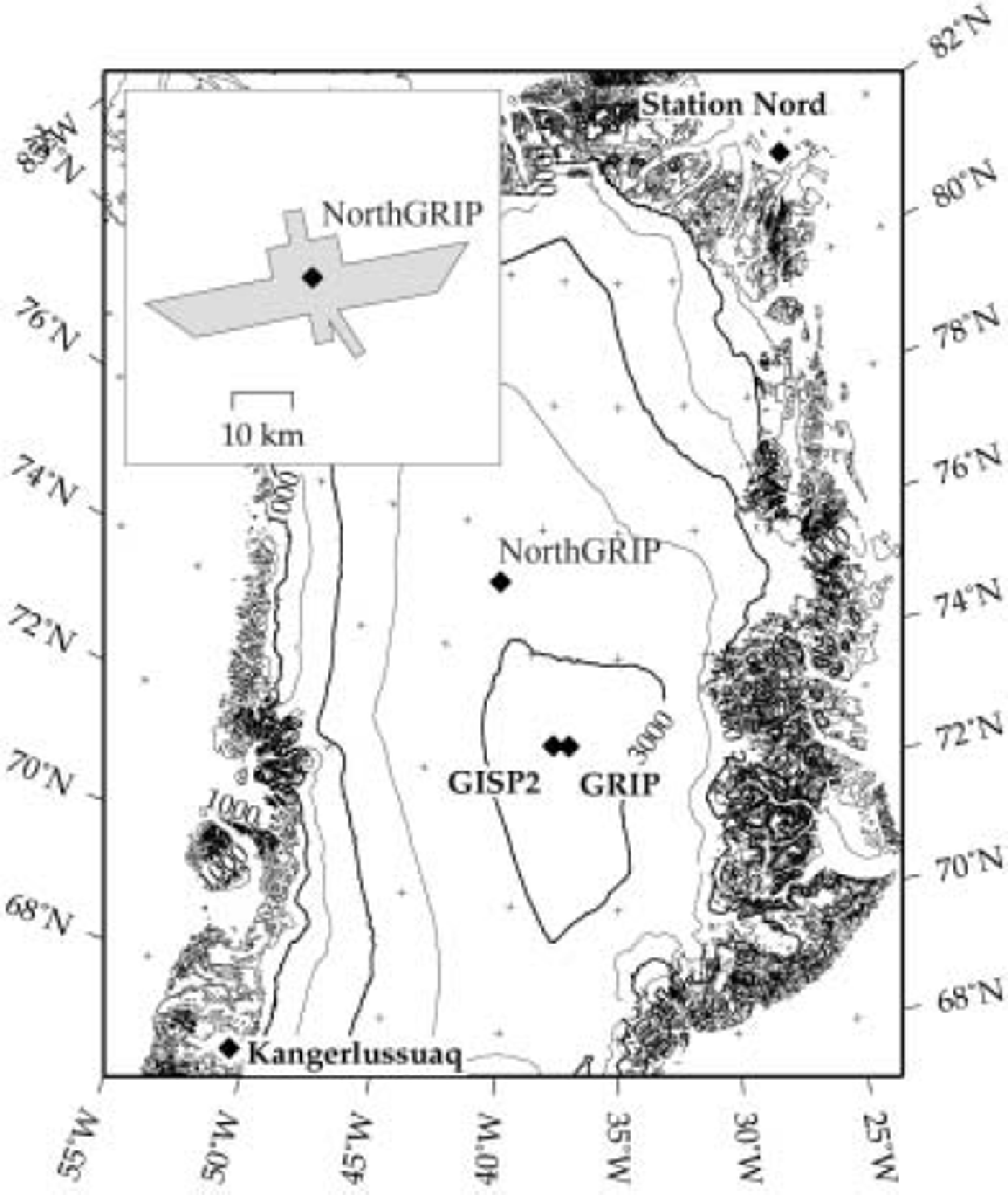
The mass balance of an ice sheet is determined by net precipitation and loss of mass by outflow and melting (Reference PatersonPaterson, 1994). While ice thickness and surface velocities can be evaluated by means of remote sensing (e.g. ground-based and airborne ice-penetrating radar (GPR) and satellite interferometry) the accumulation rate has to be measured by using samples taken from the ice sheet with snow pits, firn and ice cores. Therefore the accumulation measurements are less frequent than ice-thickness or surface velocity data (Reference Giovinetto, Waters and BentleyGiovinetto and others, 1990). For Greenland, for instance, only approximately 360 estimates of accumulation rate were available by 2001 (Reference Bales, McConnell, Mosley-Thompson and CsathoBales and others, 2001). GPR has become a common tool for determining the structure of ice sheets and glaciers (e.g. Reference Nereson, Raymond, Jacobel and WaddingtonNereson and others, 2000; Reference Richardson-NäslundRichardson-Näslund, 2001; Reference Frezzotti, Gandolfi, La Marca and UrbiniFrezzotti and others, 2002; Reference PalliPälli and others, 2002). While low-frequency GPR is used to determine ice thickness and subglacial bed elevation, high-frequency GPR is used to reveal internal structure and layering of the upper part of ice sheets and glaciers. The velocity of the electromagnetic waves in ice can be determined by so-called common-midpoint measurements or by measuring the dielectrical properties of an ice core. By applying the velocity–depth function on the measured travel times, the depths of detected internal horizons can be tied to firn and ice cores (Reference Hempel, Thyssen, Gundestrup, Clausen and MillerHempel and others, 2000). As buried erosional surfaces due to absence of surface melting and wind erosion can be excluded in the investigated area around the North Greenland Icecore Project (NorthGRIP) site, the internal horizons are isochrones (Reference GudmandsenGudmandsen, 1975; Reference Jacobel and HodgeJacobel and Hodge, 1995; Reference Eisen, Nixdorf, Wilhelms and MillerEisen and others, 2004); this allows determination of the accumulation rates along GPR profiles. Mapping internal horizons allows a vast increase in accumulation rate data and makes it possible to assess the representativeness of the data obtained from snow pits and ice-core drill sites and to reveal regional variations. In order to study the local accumulation pattern around the NorthGRIP deep ice-core drill site in north-central Greenland (Fig. 1), a ground-based GPR survey was carried out in 2003 by the Alfred-Wegener-Institut (AWI). By tracking seven internal reflection horizons (IRHs) along all profiles, the temporal variations for seven periods were mapped over the investigated area.
Location map of NorthGRIP deep ice-core drill site and the survey area around NorthGRIP. The inset shows the investigated area around NorthGRIP.
Field Measurements
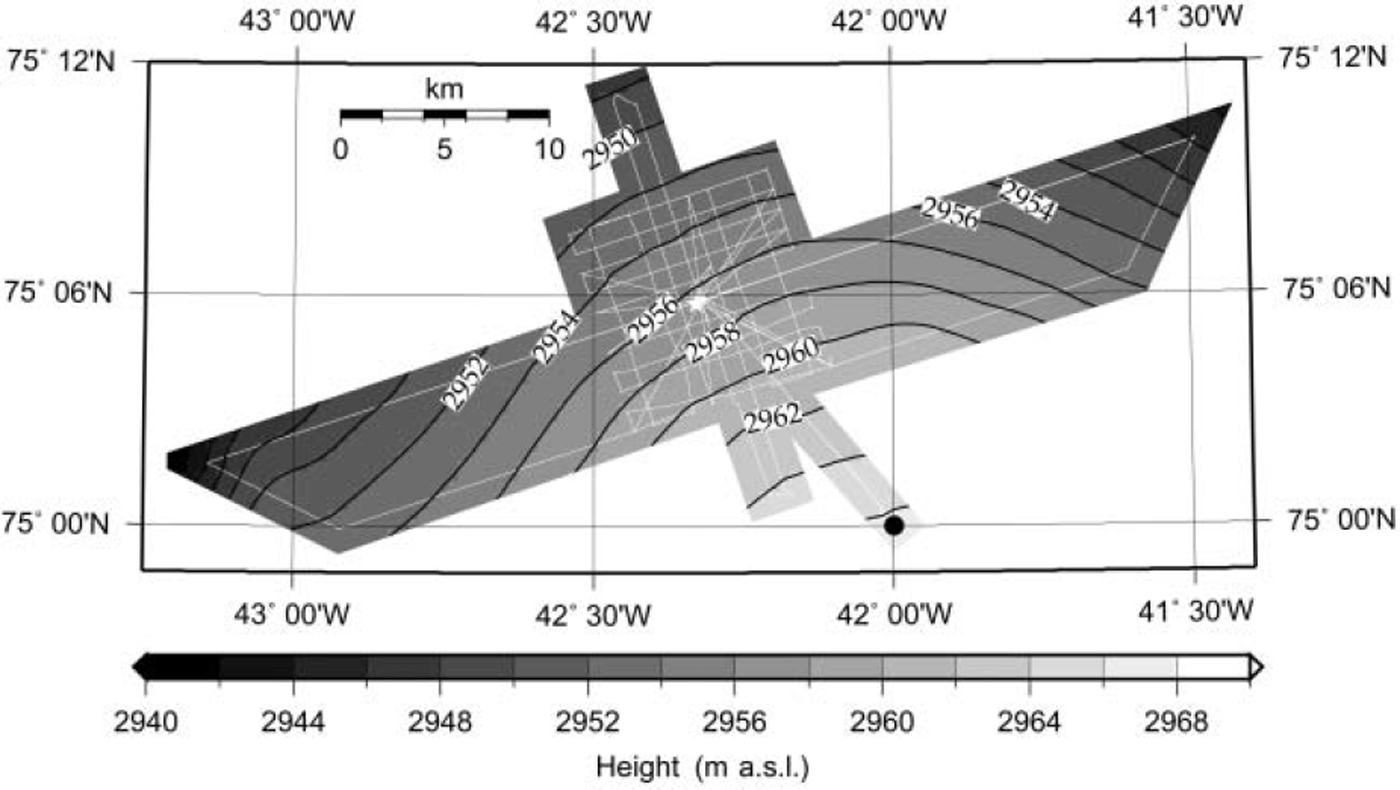
The aim of the survey was to map the internal structure of the upper 100m of ice sheet within a 10km by 10km rectangle around NorthGRIP. The area covered was extended by a set of GPR profiles extending 5 km further along, and 20 km further perpendicular to, the ice divide. The resulting ‘butterfly’-shaped survey pattern is shown as white lines in Figure 2. The line spacing of the grid is 1 km, with the 4 km line parallel to the ridge left out on both sides (Fig. 2). The surveyed area has been completed by a profile to NGT45, the end point of the AWI North Greenland traverse (Reference Shuman, Bromwich, Kipfstuhl and SchwagerShuman and others, 2001). All measurements were carried out using a snowmobile equipped with global positioning system (GPS) for navigational purposes and geodetic measurements, towing a sledge with the operator, the GPR equipment and antennae. The total length of all profiles with GPS and GPR measurements is 430 km.
Survey layout (white lines) and surface topography from kinematic post-differential GPS around NorthGRIP (white star). The black dot marks the drill site NGT 45. The contour line spacing is 2 m.
Kinematic GPS
A Trimble 4000 SSI GPS receiver was operated at a sampling rate of 1 Hz for navigation as well as for determining surface topography along all GPR profiles with the antenna mounted on the towing snowmobile. For differential post-processing of the kinematic GPS data, a GPS reference station was established on the reference GPS point of the NorthGRIP camp site. The calculated surface heights were tied to this reference. The resulting surface topography based on all GPS observations interpolated onto a 10 by 0.250 (approximately 460m by 460 m) grid is shown in Figure 2. Within the 450 km2 area covered by the investigations, no height variation above 20m was found. Along the ice divide running north-northwest the surface slope is 0.8‰, and perpendicular to the ridge 0.5‰.
Ground-penetrating radar
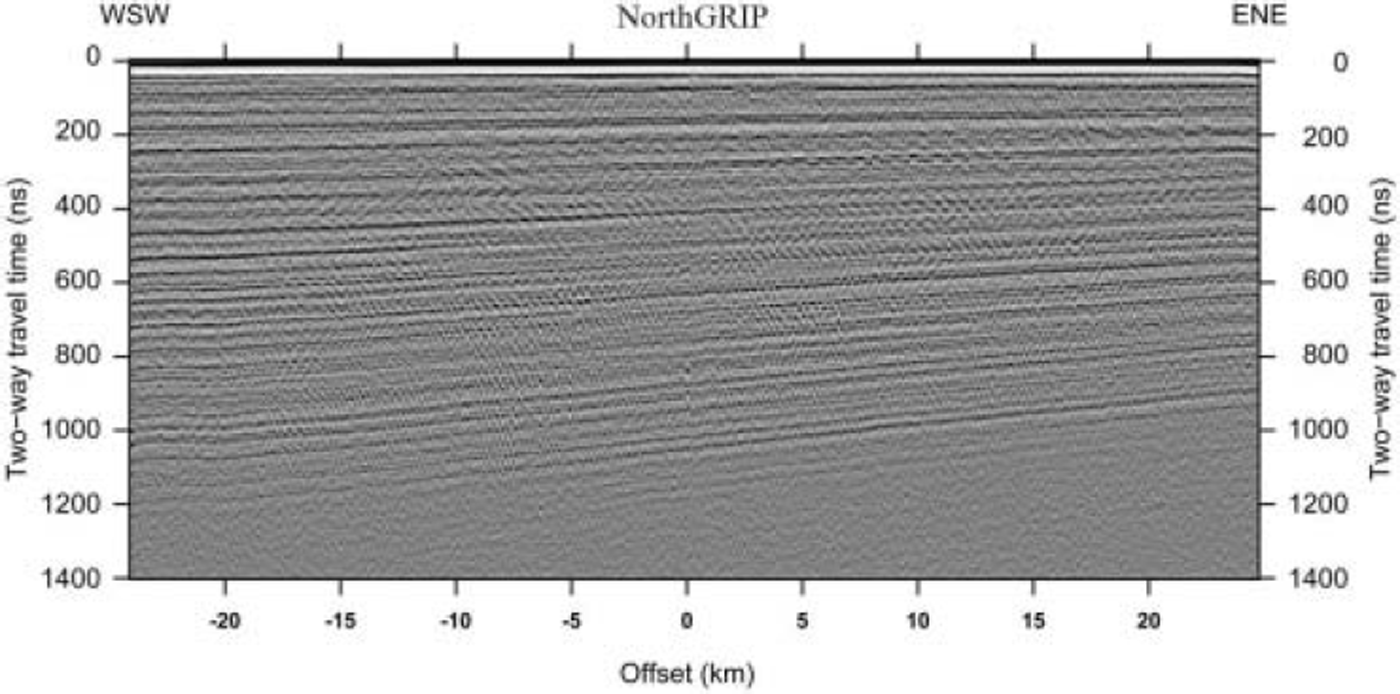
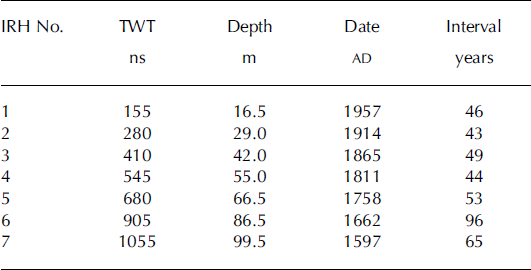
The GPR survey was performed with a commercial RAMAC radar set (Mala Geoscience, Sweden) with shielded antennae operating at a center frequency of 250 MHz. The traces were recorded in a 1500 ns time window with 1024 samples and eight-fold horizontal stacking at 1 m intervals using an odometer. The recorded two-way travel times (TWTs) have been converted to depths based on the density–depth information obtained from a shallow ice core drilled in the immediate vicinity of the NorthGRIP drill site. First analysis of the internal structure included mapping of seven continuous IRHs, the deepest of which is located at a TWT of 1055 ns near NorthGRIP (Fig. 3). TWTs and depths of all seven picked IRHs at NorthGRIP are summarized in Table 1 . Reflector travel times increase steadily from east-northeast to west-southwest, perpendicular to the ice divide, by 40% over a distance of 50 km. Parallel to the ice flow the reflector travel times are nearly constant. The internal structure shows hardly any undulations, not surprisingly as the basal topography is known to be very flat (Reference GoktasGöktas, 1999; Reference Nixdorf and GoktasNixdorf and Göktas, 2001). The observed pattern is therefore most likely caused by a known variation of the accumulation rate across the ice divide, rather than by significant changes of the wave-speed-depth profiles or other dynamical effects. The GPR dataset is therefore used to derive the small-scale spatial variation of accumulation over the past 400 years.
GPR profile obtained with 250 MHz shielded antennae perpendicular to the ice divide across NorthGRIP. The profile runs from west-southwest to east-northeast over a distance of 50 km. NorthGRIP is located in the center; the offset is calculated relative to the drill site. The grayscale indicates strength of the signal envelope.
TWTs and depths of picked IRHs at NorthGRIP
Accumulation Rate
The distribution of accumulation requires the dating of each IRH and calculation of cumulative mass. From dating of volcanic peaks in the electrical conductivity record along the shallow ice core, an age-depth function is available. At the drill site, each reflector is attributed an age from the shallow core. Integration of density yields the cumulative mass. As the horizontal distribution of density with depth is fairly constant across the region of interest, we assume that the cumulative mass-depth distribution is uniform along all GPR profiles, too. The accumulation rate along the profiles for different time intervals is derived from adjacent pairs of IRHs by calculating the ratio of their difference in cumulative mass and difference in age. The resulting time intervals vary between 43 and 96 years. Note that although the resulting accumulation rate is expressed in units of mass per unit area and year, the values represent a low-pass filtered average. The uncertainty of accumulation rate depends on the dating of the IRHs, conversion from travel time to depth, and calculation of cumulative mass. From crossover point analyses within the grid, we found that a typical uncertainty of 5 ns in travel time, corresponding to roughly 0.5 m in depth, results in a relative accumulation rate uncertainty of 6 kg m–2 a-1 on average. Including dating uncertainty, the estimated total uncertainty in accumulation is around ±8-9 kgm–2 a-1 for values close to the GPR profiles. This corresponds to some 5% of the mean accumulation rate at NorthGRIP of 171 kgm–2a–1 for the complete period under consideration, AD 1597-2003.
Spatial distribution
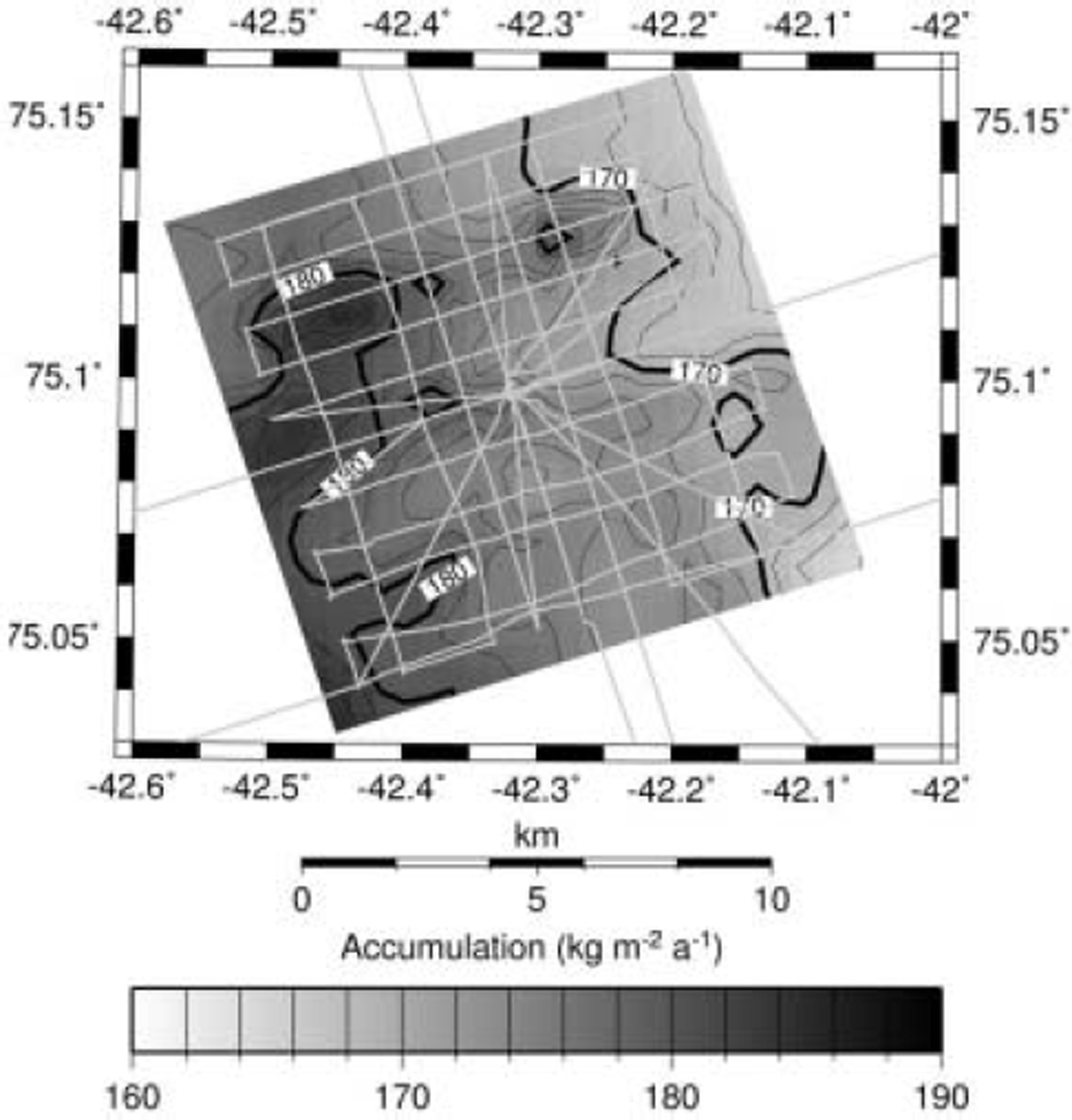
Gridding of accumulation values along the profiles results in a distribution of accumulation around NorthGRIP. As an example, the areal variation of the accumulation rate for the most recent period, 1957-2003, is shown in Figure 4. Within the grid, accumulation rate decreases perpendicular to the ice divide in the west-southwest to east-northeast direction from 180 kg m–2 a-1 to 170 kg m–2 a-1 over 10 km. As would be expected from the distribution of IRH travel times, the accumulation parallel to the topographic divide is almost constant. Small-scale variations in accumulation are in general in the order of 2-3 kg m–2 a-1 km–1. Larger gradients of up to 8kgm–2a–1 km-1 are observed over a distance of 1 km about 4 km directly north and east of the drill site. As these small-scale variations are around 5% of the mean accumulation at NorthGRIP, they are in the same order of magnitude as the uncertainty, and have to be considered with care. Accumulation maps for the other time interval show the same characteristics, with slightly different absolute values, but the same gradients, implying that the accumulation pattern has been constant for the last 400 years.
Regional accumulation pattern around NorthGRIP derived from IRH-1, the shallowest tracked IRH, for the period 1953–2003. Contour line spacing is 2 kgm–2 a–1.
Comparison of temporal and spatial changes
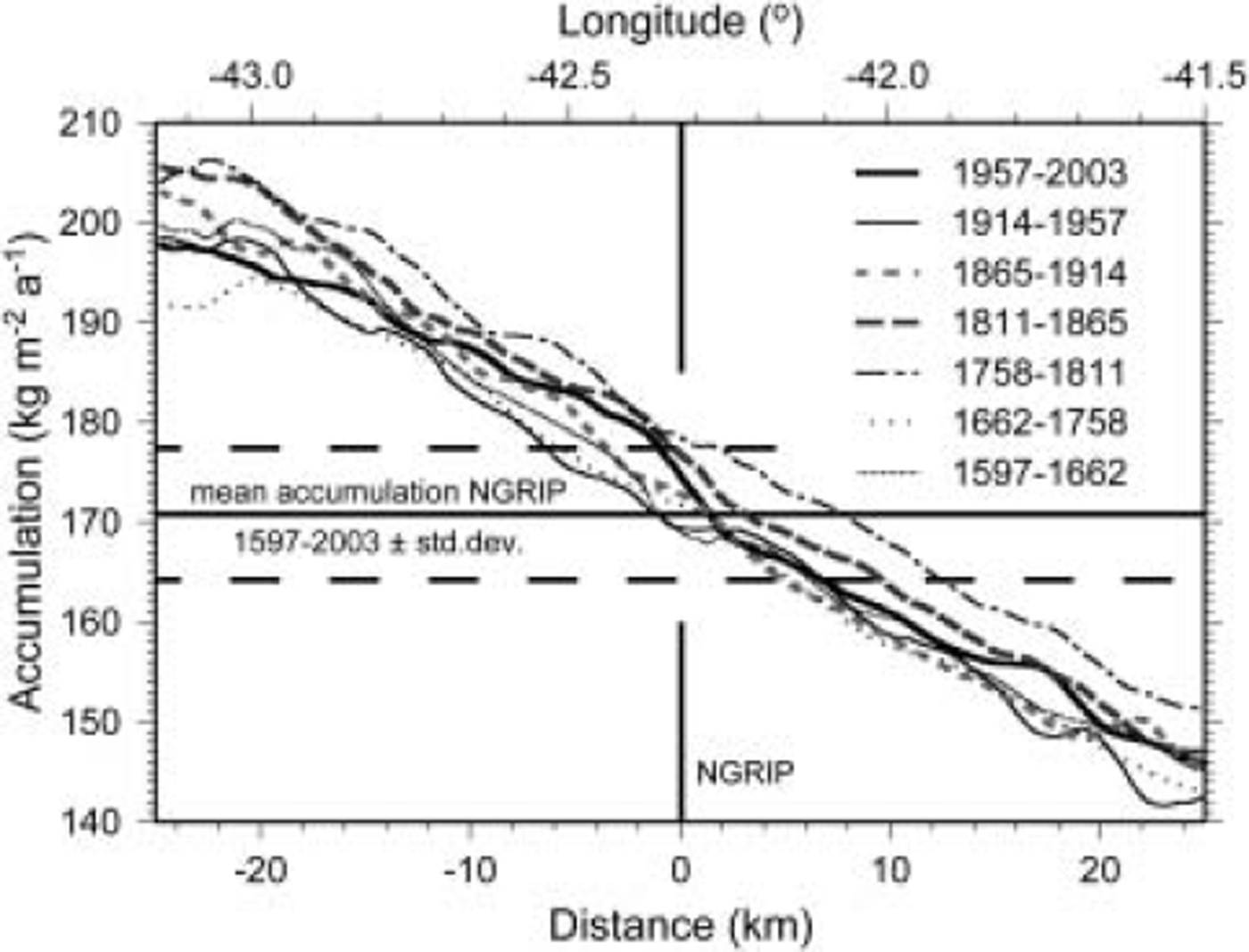
We analyze the variations of accumulation along the 50 km long central profile perpendicular to the ice divide to investigate the temporal character of spatial changes in accumulation. For all seven time intervals, the accumulation decreases at 1.1 kgm–2a–1 km-1 on average over the whole profile (Fig. 5). However, the mean accumulation at NorthGRIP for each period varies between 168 and 179 kgm–2a–1. The temporal variation of accumulation can be directly calculated from the original ice-core record over the last 400 years. Applying a 25 year running mean filter to reduce noise, the resulting 1 a level of standard deviation is 6.5 kg m–2 a-1 for the period 1597-2003.
Accumulation distribution for seven periods (see legend) perpendicular to the ice divide along GPR profile shown in Figure 3. The bar in the center marks the position of NorthGRIP and shows this variation as well as the temporal average.
Discussion and Conclusions
Based on a GPR survey, the structure of the upper 120 m of the ice sheet in the vicinity of the NorthGRIP deep ice-core drill site has been mapped. Dating of seven continuous IRHs in conjunction with data from a shallow core allowed us to evaluate the small-scale variations of the accumulation rate around the drill site. As the surface velocity at NorthGRIP is low (∼1ma–1 in the direction of the ice divide, north-northwest (Reference Hvidberg, Keller and GundestrupHvidberg and others, 2002)) and the strain rates are small (ϵ1 = − 0.4 × 10⁻⁵a–1, ϵ2 = 7.1 × 10⁻⁵a–1 , and ϵ z = 7.36 × 10⁻⁵a–1 (Reference Hvidberg, Keller and GundestrupHvidberg and others, 2002)), advection of ice parcels through stationary small-scale spatial variations in accumulation has a very small effect on values derived from ice cores compared to temporal changes. For instance, whereas the typical temporal changes over 25 years amount to almost 4% of the accumulation mean, transition of a particle trajectory through the largest accumulation anomaly observed in our data (4 km north of NorthGRIP, about 1 km wide) will last around 1000years and result in an apparent decrease in accumulation of <2‰ over the same period. This is an advantage of the NorthGRIP drill site, in contrast to other drilling locations (e.g. South Pole (Reference HamiltonHamilton, 2004) or Dronning Maud Land, Antarctica (Reference Eisen, Rack, Nixdorf and WilhelmsEisen and others, 2005)). The GPR survey also reveals that the accumulation rate of 171 kgm–2a–1 for NorthGRIP is a representative value along the ice divide for the mapped area. Together with the clear west-to-east decrease in accumulation, our results are in agreement with the general trend in accumulation distribution as shown in the accumulation map of Reference Bales, McConnell, Mosley-Thompson and CsathoBales and others (2001). Furthermore we conclude that the accumulation pattern did not change over the considered time period of 400 years, i.e. the spatial trend has been stable and the mean accumulation merely varied over time. If this has been the case for the last several thousand years during the Holocene and ice flow has been comparable to today, advective effects along the particle trajectory upstream of NorthGRIP do not have a significant effect on the interpretation of climatically induced changes in accumulation rates derived from the deep ice core over the last 10kyr.
To investigate the influence of local variations in accumulation during the last ice age, accumulation should be analyzed from high-resolution GPR profiles along the upstream particle trajectories.
Acknowledgements
We thank the NorthGRIP team for their hospitality and support in the field. Thanks are also due to C. Wesche and S. Schober for data handling.



