


Introduction
Elucidating the origins of extractive metallurgy is a key field of research in archaeology, yet copper has largely remained the focus. Only recently have the polymetallic origins of metallurgy been recognised (Radivojevic & Roberts Reference Radivojevic and Roberts2021), shifting attention to the presence and role of other metals. Parallel shifts in research perspectives have also highlighted multiple invention and innovation foci (Radivojevic et al. Reference Radivojevic2010), and subsequent non-linear paths of sociotechnological development (White & Hamilton Reference White, Hamilton, White and Hamilton2018; Montes-Landa et al. Reference Montes-Landa2025a). This paradigm change demands a better understanding of the adoption trajectories of non-copper-based technologies to help clarify their emergence, spread and/or disappearance.
Within this framework, we report on an early lead-smelting tradition newly identified in north-east Iberia. Appearing in the Chalcolithic (early third millennium–2100 BC), concurrently with copper metallurgy, lead smelting was discontinued after the Early–Middle Bronze Age (2100–1600 BC) and no further evidence exists in north-east Iberia until the Phoenician arrival, during the beginning of the first millennium BC. This tradition is therefore a rare example of early innovation discontinuation.
Lead smelting also appeared during the Chalcolithic in southern France, from where it was transmitted to north-east Iberia as part of a dense network of cultural and technological connections. In southern France however, lead smelting continued to be successful into the Bronze Age. This regional disparity warrants further research into the social dynamics of the divergent metallurgical paths observed either side of the Pyrenees.
Evidence for lead smelting was uncovered during the investigation of metallurgical remains from Minferri (Juneda, Lleida). This Early–Middle Bronze Age site (Figure 1a) has also provided the earliest evidence for intentional tin-bronze making in Iberia (Equip Minferri 1997; Alonso & López Reference Alonso and López2000; López Reference López2001; Soriano Reference Soriano2010; Montes-Landa et al. Reference Montes-Landa2025a). Analysis of production residues revealed three lead-smelting slags, which constitute the earliest direct evidence of lead extraction in Iberia. These materials prompt a broader investigation into when and how lead smelting was implemented, and the factors that prevented its wide adoption and spread across the Peninsula.
Locations of the sites mentioned in the text (a) with the analysed slag nodules inset (b) (figure by J. Montes-Landa; base layer from the Institut Cartogràfic i Geologic de Catalunya under a CC-BY 4.0 licence).

Site, materials and methods
The Minferri site spans over 10ha. Of this, 1.5ha have been excavated, revealing the remains of at least three huts and multiple silos and pits of diverse morphology. Silos (storage pits) were generally reused as discard pits and sometimes for burials. Inhabitants of the site were sedentary, practised agriculture and animal husbandry and engaged in metallurgy (Equip Minferri 1997; Alonso & López Reference Alonso and López2000; López Reference López2001; Nieto et al. Reference Nieto, Gardeisen and Chandezon2014).
Macroscopic assessment of the crucibles and production residues (n = 39) and subsequent compositional and microstructural analyses (n = 14) indicate that extractive copper-based metallurgy occurred within simple pit furnaces, using open crucibles covered by charcoal. This approach resulted in heterogeneous reactions under low reducing conditions that were nonetheless sufficient to produce and recycle copper and bronze (Montes-Landa et al. Reference Montes-Landa2025a). Lead isotope analyses link Minferri copper-based production residues to sources within north-eastern (Molar-Bellmunt-Falset (MBF) mining district, Figure 1a) and southern Iberia (Linares, Jaén) (Montero Reference Montero and Rafel2017; Montes-Landa et al. Reference Montes-Landa2025a). In some instances, copper arrived at the site as a raw mineral; in others—and more relevantly for the Linares source—it is perhaps more likely that it arrived as bronze objects, subsequently recycled. Unprocessed ores have not been found at Minferri, but copper ore relics are observable within copper and co-smelting bronze slag (Montes-Landa et al. Reference Montes-Landa2025a).
The three slag nodules discussed in this article (MN159-7126(1), MN159-7126(2) & MN259-8338(2); Figure 1b) were recovered from the fills of pit 159 and silo 259, and are amorphous lumps weighing 10–24g. Radiocarbon estimates from across the site date occupation to c. 2100–1600 cal BC, corresponding to the Early–Middle Bronze Age (Equip Minferri 1997; López Reference López2001; Nieto et al. Reference Nieto, Gardeisen and Chandezon2014; Moya et al. Reference Moya and Leal2025). A new radiocarbon determination on a charred wheat seed (Triticum aestivum/durum) from the same context as MN259-8338(2) (Silo 259, SU8338) provides an estimate of 3470±30 BP (1885–1692 cal BC, Beta-76220) at 95.4% probability, consistent with published dates.
Initial analysis of the unprepared surface of each nodule using portable x-ray fluorescence (pXRF) guided sampling. Samples were then mounted in polished resin blocks for analyses under a digital microscope and a scanning electron microscope capable of energy dispersive x-ray spectroscopy (SEM-EDS). Although some ore relics were identified in the samples (see below), micro x-ray diffraction (µXRD) or µRaman analyses were deemed unsuitable to determine the original mineral types as the relics were heavily distorted by the high-temperature processes and postdepositional weathering. For further descriptions of materials, contexts and methods, see the online supplementary material (OSM).
Results
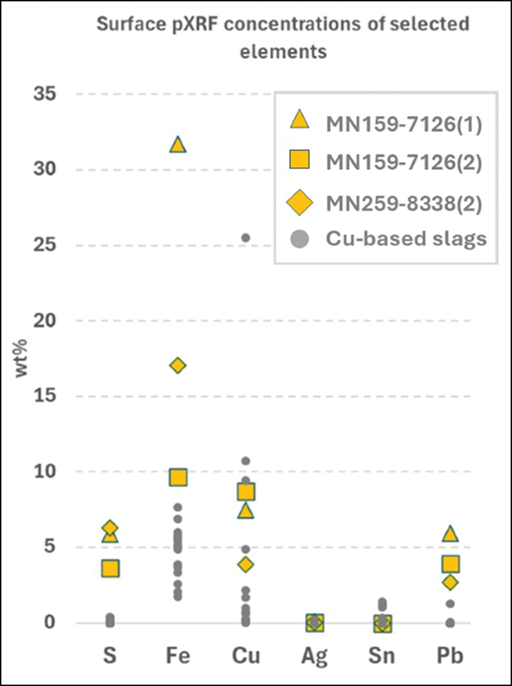
Surface pXRF analyses show that while the copper and tin contents of the slags are within the range of other copper-based slags from the site, proportions of lead, sulphur and iron are higher (Figure 2). The following sections present a summary of the characterisation of each nodule arising from detailed microanalyses under SEM-EDS; further data are available in the OSM.
Bulk composition of the analysed lead slags compared with other contemporaneous copper-based slags from Minferri. Note these are surface pXRF data (figure by J. Montes-Landa, using copper-based slag data from Montes-Landa et al. Reference Montes-Landa2025a).

MN159-7126(1)
MN159-7126(1) is an aluminosilicate rich in iron, lead, calcium and zinc. The low presence of copper (1.0% CuO) and the absence of tin suggest that it is connected to lead metallurgy. Minor amounts of magnesium, sulphur (0.6% SO3), potassium, titanium and manganese were also registered. The distribution of phases is very heterogeneous and has four distinct areas (see Figure S3 in the OSM).
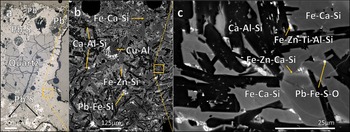
Area 1 is dominated by irregular masses of lead sulphides. Their concentrated shape and disposition in the same area suggest that they might be ore relics, sometimes surrounding corroded lead metal (Figure 3a) (comparisons in Cohen Reference Cohen2008: 117–18). At higher magnification, numerous crystals of a calcium aluminosilicate appear together with sporadic copper-aluminium oxide crystals growing within a dominant glassy matrix made of an iron-calcium silicate. Small patches of other amorphous oxidic phases are also scattered across this area (varied compositions of iron-zinc silicates, iron-zinc-calcium silicates or lead-iron silicates). At very high magnifications, small areas of an iron-zinc-titanium aluminosilicate (with trace copper and lead) and a lead-iron-sulphur oxidised prill (i.e. a spheroid phase made of metal or oxidised metal) can be observed (Figure 3b & c). Many of these oxidic phases contain zinc and/or lead. This microstructure is similar to later Chinese lead-silver slag (Xie & Rehren Reference Xie, Rehren, Mei and Rehren2009).
Plane-polarised light (a) and BSE (b and c) micrographs of area 1 of slag nodule MN159-7126(1). Analytical results are reported in Tables S4 and S5 in the OSM (figure by J. Montes-Landa).

Area 2 combines glassy phases made of an iron silicate and of a lead-iron-calcium aluminosilicate, both with minor zinc. Iron-aluminium oxide crystals with some zinc and trace lead populate both. In the lead-rich glassy phase, oxide crystals of an iron-lead-calcium aluminosilicate are also present (Figure 4b). Parallels to this microstructure can be found in modern lead-smelting slag from Porco-Potosí (Cohen Reference Cohen2008). The analysed lead-sulphur oxidised prills contain occasional strontium (up to 3.3%) and generally low iron (Figure 4). A copper-iron-lead-sulphur prill with 1.3% silver and minor zinc was also analysed, together with a chlorinated lead-bismuth-sulphur prill.
BSE micrographs of area 2 of slag nodule MN159-7126(1). Analytical results are reported in Tables S4 and S5 in the OSM (figure by J. Montes-Landa).

Figure 4 Long description
Panel A: A backscattered electron micrograph of a slag nodule at 250 micrometers scale. The image shows various labeled regions indicating the presence of different elements such as Pb S O. Panel B: A closer view of the same slag nodule at 25 micrometers scale. This image highlights regions with combinations of elements like Cu Fe Pb S, Fe Al, Pb Fe Ca Al Si, Fe Si, and Fe Pb Ca Al Si.
Area 3 has a glassy phase made of an iron silicate that hosts iron-aluminium oxide crystals. Oxidised lead-iron-sulphur phases and some chlorinated copper phases are identified, always filling cracks and pores, and therefore likely resulting from post-depositional alterations and migrations (Figure 5a). Lastly, Area 4 consists of a glassy phase made of an iron-lead-calcium aluminosilicate. It has numerous oxide crystals of an iron silicate with lead and zinc (Figure 5c). This microstructure echoes medieval lead-silver slag from Germany (Rehren et al. Reference Rehren1999). The same prills that appear in other areas (usually rich in lead and sulphur) are observed here too, and a cluster of chlorinated copper prills is observed near the surface, likely constituting post-depositional infilling of pores (Figure 5b).
BSE micrographs of area 3 (a) and area 4 (b and c) of slag nodule MN159-7126(1). The orange square identifies the cluster of Cu-Cl prills. Analytical results are reported in Tables S4 and S5 in the OSM (figure by J. Montes-Landa).

The predominance of lead-rich phases (including metallic lead, silicates and sulphur-bearing phases) is a strong indication that this sample is related to lead smelting, with copper only constituting a minor impurity in the ore. Similar isolated presence of copper has also been attested in lead-smelting slag from El Molar (Tarragona), although chronologically ascribed to the eighth and seventh centuries AD (Gener et al. Reference Gener and Molera2007). Nodule MN159-7126(1) is likely the byproduct of smelting using a lead ore rich in sulphur and iron, and with some possible calcium gangue (i.e. material surrounding or mixed with the ore that cannot be turned into metal), although calcium contributions from the charcoal fuel cannot be ruled out. Zinc, copper, strontium, silver and bismuth were minor impurities of this ore, while silica and alumina might derive from semi-dissolved technical ceramic materials or further gangue.
All the analysed lead-rich prills contain sulphur (or iron and sulphur) in addition to oxygen. While the presence of sulphates in post-depositional infills may result from weathering, its presence in larger and more pristine areas of the slag raises the possibility that the mineral being smelted was a sulphate such as anglesite (PbSO4) rather than the more common sulphide galena (PbS).
MN159-7126(2)
MN159-7126(2) is predominantly an aluminosilicate rich in calcium and iron. It also contains lead, copper, sulphur, titanium and zinc (9.1% PbO, 6.5% CuO and greater than 1% SO3, TiO2 and ZnO). Other minor elements registered are magnesium, phosphorus, chlorine and potassium.
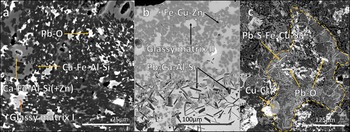
Microstructurally, the sample contains lead-rich masses alongside large clusters of crystals of calcium-iron aluminosilicates, as well as glassy patches of similar composition but richer in iron and zinc (Figure 6a). In other areas, iron-copper-zinc oxide crystals with some lead (up to 1.4% PbO) appear together with crystals of a lead-calcium aluminosilicate (Figure 6b). Dispersed within these phases, oxidised lead-copper-calcium masses and sporadic iron-copper-zinc oxidised prills were analysed. A lead-barium-strontium-sulphur oxidised inclusion is also observed. The glassy phase is an aluminosilicate containing lead, calcium, iron and copper. All the above crystals, often clustered, result from the high-temperature reaction of lead-rich minerals with silicate ceramic or gangue.
BSE micrographs of slag nodule MN159-7126(2). In c, the yellow dashed line isolates a group of phases identified as an ore relic. Analytical results are reported in Tables S6 and S7 in the OSM (figure by J. Montes-Landa).

Figure 6 Long description
Panel A: A microscopic image showing a lead-rich mass and large clusters of calcium-iron aluminosilicates. Glassy patches of similar composition but richer in iron and zinc are also visible. Panel B: Another microscopic image displaying a glassy matrix with phases labeled as Fe-Cu-Zn and Pb-Ca-Al-Si. Panel C: A microscopic image with a group of phases isolated by a yellow dashed line, identified as an ore relic. Various mineral compositions such as Pb-S-Fe-Cu-Si, Cu-Cl, and Pb-O are visible.
One cluster, possibly an ore relic, comprises lead oxide masses, needles made of a lead-sulphur-iron-copper silicate, chlorinated copper phases and other copper-rich phases (Figure 6c). Area analyses bearing copper, lead, iron, sulphur and zinc (20% CuO, 17.7% PbO, 8.4% FeO, 2.3% SO3 and 0.8% ZnO) are suggestive of a polymetallic copper-lead ore such as caledonite (Pb5Cu2(SO4)3(CO3)(OH)6) or linarite (PbCu(SO4)(OH)2). The ore used also contained iron and calcium gangue, and zinc strontium and barium as minor impurities. Some calcium might have also entered the system with charcoal fuel, and aluminium and silica contributions from gangue or molten technical ceramic materials are likely.
MN259-8338(2)
MN259-8338(2) has a thin slag layer and two consecutive layers of altered ceramic in a gradient that represents the progressive alteration of the paste (Figure 7a). The slag layer is an aluminosilicate rich in iron, lead (12.7% PbO), calcium and copper (7.3% CuO), with some zinc. The attached altered ceramic is richer in calcium, while the outermost ceramic layer shows the highest iron (34.5% FeO) and sulphur (12.9% SO3).
BSE micrographs of slag nodule MN259-8338(2): a) general view; b and c) middle altered ceramic layer; d) outer altered ceramic layer. Analytical results are reported in Tables S8 and S9 in the OSM (figure by J. Montes-Landa).

The slag layer is made of three oxide phases (Figure 7a): an iron-copper-zinc phase, a lead silicate phase and a magnesium-calcium-iron silicate phase. These phases have minor copper, iron, lead and/or zinc. The latter phase might correspond to molten ceramic material, as similar phases are found in the altered ceramic layers (Figure 7b–d).
The middle layer (altered ceramic) comprises two different amorphous phases: a magnesium-calcium-iron silicate with minor copper and zinc, and a calcium-iron aluminosilicate (Figure 7b & c). Moreover, darker masses of an iron-copper aluminosilicate with some zinc and lead are found surrounding lead oxide masses and a lead-strontium-sulphur oxidised mass with barium impurities (Figure 7b). These are interpreted as potential polymetallic ore relics. The presence of lead oxide masses might suggest that metallic lead was originally present but subsequently corroded. Alternatively, it might represent an incomplete smelting process in this specific area of the slag. A chlorinated silver-bromine mass was also analysed close to one of these relics; the presence of chlorine and bromine supports the incidence of post-depositional corrosion.
Areas with lead oxide masses surrounded by chlorinated copper phases are also observed in this middle layer (Figure 7c). No sulphur was detected in these instances. These separated phases might represent an original copper-lead metallic mass. During post-depositional weathering, the lead and copper, already immiscible in each other, became even more separated, the former taking up oxygen, and the latter chlorine and oxygen. Minor aluminium, silicon, calcium and iron are also present in these phases. Yet, the abundance of lead in these microstructures indicates that the resulting product was predominantly lead-rich. Copper-lead prills have been found in slag related to the processing of copper-lead minerals at Peñalosa (Moreno et al. Reference Moreno2010) where they are interpreted as resulting from operations aimed to produce copper by oxidising the lead of an original copper-lead mass. However, none of the Peñalosa slag specimens show lead or lead oxide masses that formed independently, as is the case in the present samples. This reinforces the possibility of metallic lead as the main output of the operation that produced the MN259-8338(2) nodule, probably with copper as an impurity.
Finally, in the outer ceramic layer, phases of calcium aluminosilicates, iron-magnesium silicates and iron-aluminium oxide crystals with significant zinc were identified (Figure 7d). Semi-dissolved iron oxide minerals were also analysed. All these phases probably derive from the reaction of the ceramic paste with rock inclusions, which also explains the high bulk iron content. Lead-sulphur oxidised prills are also identified, consistent with the higher levels of sulphur oxide observed in the bulk compositions of this layer (see Table S3 in the OSM). The presence of sulphates as opposed to sulphides can be explained by the effect of post-depositional processes or by the use of a sulphate ore, as already proposed above. The presence of sulphur only in the prills of this layer might indicate that this material became trapped in the semi-molten ceramic matrix early in the process, with the viscosity of the molten ceramic likely preventing sulphur evaporation. This would not be the case for the upper slag layer, which was more exposed to oxygen and to sulphur release.
In sum, MN259-8338(2) could be related to the smelting of a sulphidic copper-lead ore containing iron, calcium and other minor impurities (zinc, strontium, silver and barium). Some calcium contributions from charcoal could be expected. This ore might have been similar to that used in the process that produced MN159-7126(2).
Discussion
Nodule MN159-7126(1) provides the clearest evidence for the processing of a lead ore, likely anglesite (PbSO4), containing iron gangue as well as zinc, copper, strontium, silver and bismuth impurities. At Alforja mine in the MBF mining district (Figure 1a), anglesite forms through the weathering of galena with iron minerals in the absence of other carbonates. It sometimes shows a characteristic green colour (Abella Reference Abella2018). Within the MBF district, anglesite has also been reported at Les Esporres, Eugènia, Regia and El Molar mines. In the Montsant mining district (Figure 1a), anglesite appears at Atrevida and Bessó mines (see https://www.mindat.org/locentry-236428.html), where copper has been exploited since the Early–Middle Bronze Age (Montero Reference Montero and Rafel2017; Rafel et al. Reference Rafel2017, Reference Rafel2018; Montes-Landa et al. Reference Montes-Landa2021).
Nodules MN159-7126(2) and MN259-8338(2) confirm the high-temperature processing of lead-rich ores, most likely the smelting of a sulphidic copper-lead polymetallic ore, perhaps caledonite or linarite. Both minerals are blue, occur in weathering zones of copper-lead deposits and have been reported in Montsant district, at Alforja and Bessó mines (Figure 1a) (see https://www.mindat.org/locentry-1262918.html; https://www.mindat.org/locentry-784637.html).
Given the use of polymetallic ores, both lead and copper could have resulted from these operations as they are naturally immiscible and tend to separate when cooled down slowly (Baron & Cochet Reference Baron and Cochet2003). However, there are substantial compositional and microstructural differences between the three nodules analysed here and copper-based slag previously analysed from Minferri. The latter presents clusters of copper masses/prills, delafossite, cuprite and calcium aluminosilicates (Figure 8a), or clusters of copper masses and solid-state smelting microstructures (SSSM) trapped in iron oxide crystals (Figure 8b). Both associations of phases correspond to copper ore relics. Crucially, copper-based slags from Minferri do not contain lead or sulphur, indicating that copper and tin bronze production relied on lead-poor, oxidic ores. There is also no indication that copper-lead polymetallic ores were used in bronze co-smelting operations at Minferri (Montes-Landa et al. Reference Montes-Landa2025a). This suggests that polymetallic copper-lead ores were primarily exploited for their lead. However, despite these differences, the operations represented by these three samples likely took place in the same installations where copper and bronze were produced (Montes-Landa et al. Reference Montes-Landa2025a). These were open pits where open crucibles covered with charcoal reached at least 1100oC.
SEM-EDS and plane-polarised light micrographs of the typical semi-dissolved copper ores found in copper-based slags at Minferri. SSSM: solid-state smelting microstructure (after Montes-Landa et al. Reference Montes-Landa2025a: fig.4b & fig. SI1.10).

Figure 8 Long description
Panel A: A microscopic image of copper-based slags showing various mineral structures. Visible structures include skeletal cuprite, delafossite, copper prills, quartz, and calcium-aluminum-silicon-oxygen compounds. The image is labeled with these components and includes a scale bar of 125 micrometers. Panel B: Another microscopic image of copper-based slags highlighting different mineral compositions. Visible structures include copper, iron-oxygen compounds, copper-oxygen compounds, and a solid-state smelting microstructure. The image is labeled with these components and includes a scale bar of 200 micrometers.
The lead minerals tentatively identified here are green or blue, visually similar to malachite and azurite, the most common copper ores that were extensively mined in the same districts (Montero Reference Montero and Rafel2017; Rafel et al. Reference Rafel2017, Reference Rafel2018; Montes-Landa et al. Reference Montes-Landa2021). This raises the question of whether lead was intentionally produced. Lead ores could have been selected by mistake, but the otherwise consistent selection of lead-poor copper ores to produce copper and bronze would argue against this. The deliberate selection and use of lead ores is also supported by: 1) evidence for the handling of local lead minerals since the Middle Palaeolithic (c. 125 000–35 000 BC); 2) a locally produced Chalcolithic lead bead from Coveta de l’Heura (Ulldemolins, Figure 1a); and 3) extensive cultural links (including the transmission of metallurgical knowledge) between north-east Iberia and southern France, where contemporaneous lead metallurgy is documented. On this basis, we argue for the existence of a largely unreported, perhaps short-lived, tradition of lead smelting in north-east Iberia.
Galena nodules/blocks of unclear functionality are reported at six Iberian Palaeolithic sites, three of which are in north-east Iberia (Montero et al. Reference Montero2023). Later, in the Neolithic (c. 5600–early third millennium BC), 24 finds are reported from 14 sites in the region, nine of which are in the vicinity of Minferri. The lead isotope signatures of 18 of these finds have been analysed and all but one are consistent with the isotopic field of the MBF mining district. This implies the long-standing recognition and regional transportation of lead minerals, and confirms their use before the implementation of metallurgy.
Metallurgical knowledge was introduced to north-east Iberia from southern France during the Chalcolithic (early third millennium BC) and to date, all identified production residues and artefacts relate to copper metallurgy (Martín et al. Reference Martín, Delives and Montero1999; Soriano Reference Soriano2010; Rafel et al. Reference Rafel2017, Reference Rafel2018; Montes-Landa et al. Reference Montes-Landa2021, Reference Montes-Landa2025b). Very few of these contain substantial amounts of lead, and those initially reported with 3% of lead or more (for example, the crucible residues from Cova Josefina d’Escornalbou and a copper mineral from Coveta de l’Heura) have been shown to contain no lead under invasive analyses (Rovira et al. Reference Rovira1997; Soriano Reference Soriano2010; Montero Reference Montero and Rafel2017; Montes-Landa et al. Reference Montes-Landa2025b). Finding lead impurities in copper artefacts is potentially consistent with the copper yield of a copper-lead polymetallic ore such as that proposed for some of the samples from Minferri. However, this composition might also reflect the exploitation of other copper ores with lead impurities available in the region (Montero Reference Montero and Rafel2017, Reference Montero and Rafel2018).
The only notable exception is a lead bead from Coveta de l’Heura (Figure 1a), dated to the Late Neolithic/Chalcolithic and located just 40km from Minferri. This is currently the earliest known lead item in Iberia (Rafel et al. Reference Rafel2016). Although typologically similar to some French beads, lead isotope analysis links it to the MBF mining district, indirectly indicating local intentional production of lead in addition to copper (Montero Reference Montero and Rafel2017; Soriano et al. Reference Soriano2022). This bead relates to the more abundant Chalcolithic and Early Bronze Age lead beads from Languedoc, which are the first lead items so far identified in western Europe (Arnal et al. Reference Arnal and Ryan1979; Briard Reference Briard and Ryan1979; Guilaine Reference Guilaine1992; Roscian et al. Reference Roscian1992; Vaquer Reference Vaquer1997). French lead beads also follow on from an earlier tradition of galena use (Montero, Reference Montero2023).
Since the Late Neolithic–Chalcolithic transition (early third millennium BC), the Veraza cultural group extended across southern France and north-east Iberia (Martín et al. Reference Martín, Guilaine and Gandelin2023). Early metal artefacts and metallurgical knowledge moved from southern France to north-east Iberia (Mille & Carozza Reference Mille, Carozza, Kienlin and Roberts2009; Soriano Reference Soriano2010; Montes-Landa et al. Reference Montes-Landa2021, Reference Montes-Landa2025b) and links have also been identified in amber and lithics circulation networks (González Reference González2023; Murillo-Barroso et al. Reference Murillo-Barroso2025). Furthermore, in southern France, the only lead-smelting residues analysed thus far, dated to 2850–2580 BC at Le Planet (Fayet, Figure 1a), show that—as at Minferri—lead was extracted from polymetallic ores (in this case buornonite, PbCuSbS3) and natural mixtures of lead and copper minerals (bindheimite—Pb2Sb2O6(O,OH)—with malachite or tetrahedrite). The resulting products were a combination of separate copper and lead masses/ingots (Maillé et al. Reference Maillé and Laroche2019; Costa et al. Reference Costa, Török and Giumlia-Mair2021, Reference Costa2025; Shah et al. Reference Shah2024). This evidence is thus consistent with that of the lead-related operations at Minferri. These cultural and technological connections support the transmission of lead metallurgy from France and hence the intentionality of lead smelting in north-east Iberia.
Outside north-east Iberia, there are no known contemporaneous lead items. Some amorphous fragments from Early Bronze Age El Oficio (Cuevas, Almeria, in southern Iberia, Figure 1a) have been interpreted as potential experimentation (Morell Reference Morell2009). However, this site has abundant materials from later contexts which could imply that the reported lead fragments are more modern intrusions. As they lack analyses and clear contextual discussion in relation to later finds, further research is needed to confirm their relevance. Furthermore, although there is evidence for silver metallurgy in Iberia since the Early Bronze Age, this relied on silver chlorides and required no lead (Montero et al. Reference Montero1995; Bartelheim et al. Reference Bartelheim2012). Cupellation with lead appears only at the end of the Bronze Age, concurrently with Phoenician contacts (Montero et al. Reference Montero2014).
The next oldest lead objects are the Late Bronze Age beads from the Balearic Islands, which are followed by a hiatus in lead artefacts until the fourth/third century BC (Morell Reference Morell2009). In the Peninsula, lead appears in ternary alloys from the Middle–Late Bronze Age, first in Atlantic Iberia and then progressively extending south. No lead or ternary alloys appear in north-east Iberia until the Iron Age (Montero et al. Reference Montero1995; Morell Reference Morell2009), likely linked to lead production as a silver cupellation byproduct. Thus, the lead-making episodes at Minferri seem to be the last of their kind in Iberian Prehistory. Their characterisation situates the origins of lead metallurgy in Iberia half a millennium before the arrival of the Phoenician influences (Rafel et al. Reference Rafel2010; Murillo-Barroso et al. Reference Murillo-Barroso2015), linking it to indigenous dynamics and unrelated to silver extraction processes.
The rare evidence in north-east Iberia suggests that lead smelting was not as prominent as copper smelting. However, the contemporaneous exploitation of both metals since Chalcolithic times in north-east Iberia suggests that polymetallic experimentation was an integral part of metallurgical implementation, a pattern shared with other areas of early innovation in Eastern Europe and Western Asia (Radivojevic & Roberts Reference Radivojevic and Roberts2021). However, while lead making took off in neighbouring, and culturally connected, southern France, artefactual evidence in north-east Iberia is scanty. This represents a rare example of technological discontinuation, a phenomenon difficult to identify archaeologically (but see Radivojevic et al. Reference Radivojevic2013; Erb-Satullo Reference Erb-Satullo2021) but crucial for understanding the dynamics of innovation rejection. The reason for this discontinuation is not currently discernible. It is possible that a different social value for lead compared to copper might have prevented it from remaining socially relevant, but further research on the comparative social dynamics of lead production in north-east Iberia and southern France is needed to help explain why lead was only briefly adopted in Iberia and, ultimately, why certain innovations persist in some regions and not in others.
Beyond Iberia, early lead-production residues unrelated to silver extraction are also scarce. Besides Le Planet materials, only a few examples of sixth/fifth millennium BC lead processing have been reported, including: a slag lump from Belovode (Serbia) (Radivojevic & Roberts Reference Radivojevic and Roberts2021); a melting residue from Pločnik (Serbia) (Glumac & Todd Reference Glumac and Todd1987); and crucibles at Pitrele and Blejeşti (both in Romania) (Hansen et al. Reference Hansen2019). Thus, the Minferri assemblage is an important addition to the data on prehistoric lead residues in Europe.
Conclusion
Microstructural and compositional analyses of three slag nodules from Minferri provide early and direct evidence of lead smelting in north-east Iberia, identifying a previously unknown, and ultimately quite brief, lead-smelting tradition. It was transmitted across the Pyrenees in the early third millennium BC, lasting until the mid-second millennium BC. This pre-dates the previously known lead-related evidence in the area by about half a millennium, which was linked to Phoenician influences, as opposed to indigenous dynamics. Contemporaneous exploitation of copper across north-east Iberia highlights the importance of polymetallic experimentation in early metallurgical implementation. In documenting this early failed innovation, this study contributes to broader debates on the causes of divergent paths of sociotechnological development and brings attention to lead, an overlooked metal in early metallurgy research.
Acknowledgements
We thank our funders (see funding statement) for their support and Ignacio Montero for feedback on early ideas. We gratefully acknowledge the technical support from Catherine Kneale, Tonko Rajkovaca and Simon Griggs at the University of Cambridge.
Funding statement
The Cambridge Trust (Vice Chancellor’s Award), the Arts and Humanities Research Council (DTP2113448) and the Cambridge University Fieldwork Fund funded JML’s PhD work, on which this article is based. MMT’s contribution to the write-up was supported by a European Research Council grant under the Horizon 2020 programme (GA101021480, REVERSEACTION). The Oficina de Suport a la Iniciativa Cultural (Generalitat de Catalunya, CLT009_22_00057) funded the radiocarbon dating.
Online supplementary material (OSM)
To view supplementary material for this article, please visit https://doi.org/10.15184/aqy.2026.10388 and select the supplementary materials tab.
Author contributions: CRediT categories
Julia Montes-Landa: Conceptualization-Equal, Data curation-Lead, Formal analysis-Lead, Funding acquisition-Equal, Investigation-Lead, Methodology-Lead, Project administration-Lead, Resources-Equal, Validation-Equal, Visualization-Lead, Writing - original draft-Lead, Writing - review & editing-Equal. Andreu Moya i Garra: Resources-Equal, Writing - original draft-Supporting, Writing - review & editing-Equal. Natàlia Alonso: Funding acquisition-Supporting, Resources-Equal, Writing - review & editing-Equal. Marcos Martinón-Torres: Conceptualization-Equal, Funding acquisition-Equal, Resources-Equal, Supervision-Lead, Validation-Equal, Writing - review & editing-Equal.





 Open access

