


Introduction
The colonial didemnid ascidian Didemnum vexillum Kott, 2002 (Carpet Sea Squirt) has a global distribution in temperate regions but is considered native to the north-west Pacific (Lambert, Reference Lambert2009; Stefaniak et al., Reference Stefaniak, Zhang, Gittenberger, Smith, Holsinger, Lin and Whitlatch2012). Colonies grow rapidly across supporting surfaces, expanding laterally by budding new colony modules (zooids), enabling overgrowth and smothering of existing biota. Detached colony fragments readily reattach and establish new daughter colonies (Morris and Carman, Reference Morris and Carman2012). When growing on vertical or overhung surfaces, long, dangling colony lobes detach, sink and can establish new colonies on the seabed. D. vexillum has negative impacts on aquaculture operations for both shellfish (e.g. Fletcher et al., Reference Fletcher, Forrest and Bell2013) and fin fish (Çinar and Özgül, Reference Çinar and Özgül2023). The species can dominate extensive areas of natural seabed (Valentine et al., Reference Valentine, Collie, Reid, Asch, Guida and Blackwood2007; Teed et al., Reference Teed, Goodwin, Lawton, Lacoursière-Roussel and Dinning2024) and colonize and grow over protected species (e.g. eel grasses: Carman and Grunden, Reference Carman and Grunden2010). It commonly fouls boat hulls and underwater infrastructure in ports, harbours and marinas (Lambert, Reference Lambert2009). The species shows a relatively broad tolerance of environmental conditions (Ordóñez et al., Reference Ordóñez, Pascual, Fernández-Tejedor, Pineda, Tagliapietra and Turon2015; Legrand et al., Reference Legrand, Svensen, Husa, Lelièvre and Svensen2025). D. vexillum is thus considered a rapidly growing, resilient and impactful pest species of global concern. In Great Britain, it was designated for a period as a priority ‘Alert’ species to be reported immediately when encountered, and was the subject of a government-funded eradication attempt in the Welsh marina where it was first detected in 2008 (Griffith et al., Reference Griffith, Mowat, Holt, Ramsay, Bishop, Lambert and Jenkins2009; Sambrook et al., Reference Sambrook, Holt, Sharp, Griffith, Roche, Newstead, Wyn and Jenkins2014). D. vexillum was the subject of an Invasive Species Action plan by the British-Irish Council in 2024. Nevertheless, D. vexillum has become widespread in marinas and harbours in the UK and occurs on some natural shores and seabeds (e.g. Taylor et al., Reference Taylor, Wood and Bishop2022).
Turon et al. (Reference Turon, Casso, Pascual and Viard2020) reported another didemnid very closely resembling D. vexillum in external appearance, originally distinguished from D. vexillum on the basis of DNA sequence divergence. Subsequent microscopical examination revealed relatively subtle but distinct internal features that enabled the two species to be distinguished on morphological grounds. Turon et al. (Reference Turon, Casso, Pascual and Viard2020) named the newly recognized species D. pseudovexillum Turon & Viard, with a morphological description based on specimens from a marina in Roscoff, north-west France, where the new species occurred alongside D. vexillum. Additionally, the presence of the species in two marinas on the Catalan coast of Spain (north-west Mediterranean) was inferred by Turon et al. (Reference Turon, Casso, Pascual and Viard2020) from DNA sequences obtained in a previous study. A single colony of D. pseudovexillum was subsequently recorded by Virgili et al. (Reference Virgili, Tanduo, Katsanevakis, Terlizzi, Villani, Fontana and Crocetta2022) in Lago Miseno, an Italian coastal lagoon connected by narrow channels to the Tyrrhenian Sea (central-western Mediterranean).
Didemnum pseudovexillum has a colony form and a growth process very similar to D. vexillum, conferring the capacity for lateral expansion of colonies to capture adjacent space. The fact that the two species can grow side-by-side suggests very similar, or at least overlapping, environmental tolerances and requirements, and D. pseudovexillum seems thus far to favour anthropogenic habitats, which D. vexillum also readily colonises. These resemblances make it appear possible that D. pseudovexillum could threaten native biodiversity and human interests in a similar way to D. vexillum. Old records of D. vexillum, particularly those from before the discovery of D. pseudovexillum and any identifications based entirely on field recognition, must be regarded as dubious and possibly relating to D. pseudovexillum (Turon et al., Reference Turon, Casso, Pascual and Viard2020).
To understand the degree of potential threat represented by D. pseudovexillum, there is a need for more information on the species’ distribution, environmental tolerances, habitat preferences and growth rate. Turon et al. (Reference Turon, Casso, Pascual and Viard2020) provisionally categorized D. pseudovexillum as cryptogenic (i.e. of uncertain native vs. non-native status) in the region of its discovery, and information to clarify its biogeographical status, alongside direct observations of any actual impacts, would be valuable for judging the appropriate management responses to this species.
In this note, we detail the first documented occurrence of Didemnum pseudovexillum in the British Isles and report the identity of candidate specimens collected from several marinas in England and Wales.
Materials and methods
A specimen believed to be Didemnum vexillum or D. pseudovexillum was collected by LB from the seabed in a dense seagrass (Zostera marina) bed at 2 m BCD at the mouth of the River Yealm estuary, south Devon, UK, while SCUBA diving on 21 September 2022 (50.3102, −4.0670). In addition, 16 specimens of D. vexillum/pseudovexillum were collected from 11 coastal marinas on the English and Welsh coasts in 2019–2024, the majority arising from a project in which rapid assessment surveys were conducted for marine non-native species (Wood et al., Reference Wood, Tidbury, Edwards, Fonseca, Davison and Bishop2025). Pieces of colony for morphological analysis were preserved in 80% ethanol, while tissue samples for barcoding were preserved in undiluted ethanol.
Sequencing of the COI-5P region was undertaken by the Canadian Centre for DNA Barcoding, University of Guelph, using the primers introduced for D. vexillum by Stefaniak et al. (Reference Stefaniak, Lambert, Gittenberger, Zhang, Lin and Whitlatch2009): Tun_forward 5’ – TCGACTAATCATAAAGATATTAG-3’; Tun_reverse2 5’-AACTTGTATTTAAATTACGATC-3’. Based on the sequence information obtained, specimens were allocated by BOLD (The Barcode of Life Datasystem) to Barcode Index Numbers (BINs), unique identifiers each representing a cluster of sequences considered usually to correspond to a species (Ratnasingham and Hebert, Reference Ratnasingham and Hebert2013).
Specimens were examined for the morphological features given by Turon et al. (Reference Turon, Casso, Pascual and Viard2020) for the separation of D. vexillum and D. pseudovexillum, with reference to the suite of characters distinguishing D. vexillum within the genus Didemnum discussed by Lambert (Reference Lambert2009) and Ordóñez et al. (Reference Ordóñez, Pascual, Fernández-Tejedor, Pineda, Tagliapietra and Turon2015, in their supplementary material). To investigate the calcareous spicules in the tunic, thin pieces of tunic were stripped from the upper (exposed) surface of the colony and cellular components were removed by immersion for c. 10 min at room temperature in household bleach diluted to 10% with water. The pieces were then mounted in water on a slide under a coverslip and viewed under a compound microscope.
Results
Based on its COI sequence, the specimen from the R. Yealm outer estuary was identified by the BOLD System as D. pseudovexillum, while all 16 of the marina specimens were identified as D. vexillum. Spicule morphology (Figure 1) was entirely in agreement with the barcode identifications across all specimens: the D. pseudovexillum specimen had a greater number of rays in each spicule, and the individual rays were blunter than in the D. vexillum specimens, as described by Turon et al. (Reference Turon, Casso, Pascual and Viard2020). Larvae in which the relevant features could be seen were obtained from six of the marina specimens, and all had six pairs of antero-lateral ampullae as expected for D. vexillum (Lambert, Reference Lambert2009). Only a small piece of the Yealm D. vexillum colony was available to slice in order to investigate internal features. The zooids frequently showed the coiled sperm duct (typically with seven turns) overlaying and obscuring the testis. However, only one oocyte was noted, and brooded embryos or larvae were not seen. These observations suggest that the sample studied was reproductive, but predominantly in the male role.
Spicules in the upper layer of the tunic of (A) Didemnum pseudovexillum from the Yealm estuary and (B) D. vexillum from a marina in Plymouth (both Devon, UK). Scale bars: 25 μm.

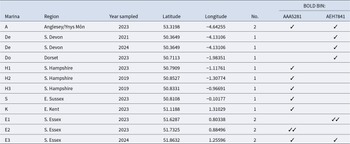
Details of the English and Welsh marinas where Didemnum vexillum/pseudovexillum specimens were collected. All specimens were identified as D. vexillum, allocated to the BOLD barcode identification numbers (BINs) indicated

Marina De was sampled in two different years. No., number of specimens collected.
The specimen from the Yealm estuary was referred by BOLD to the same BIN, BOLD:ACQ4582, as the type material of D. pseudovexillum from Roscoff. The Spanish specimen from L’Escala had a somewhat divergent sequence, with similarities to the other specimens ranging from 94.7 to 95.3%, whereas the remaining specimens (including the Yealm colony) shared resemblances of 99.1–100% (BOLD System Identification Engine v5 used 5 July 2025) (Figure 2). Despite their physical resemblance, D. vexillum and D. pseudovexillum did not appear to be particularly closely related to each other within the genus Didemnum (Figure 3), as shown more clearly by Turon et al. (Reference Turon, Casso, Pascual and Viard2020) in their Figure 5.
Neighbour-joining dendrogram of the COI sequences of Didemnum pseudovexillum from the GenBank database plus the UK specimen reported here. (Alignment by BOLD Aligner; Kimura 2 distance model.) Scale bar: percent dissimilarity between sequences.

Neighbour-joining dendrogram of COI sequences of Didemnum vexillum from English and Welsh marinas plus the UK specimen of D. pseudovexillum, with a species from another didemnid genus (Diplosoma listerianum, specimen from Gosport, UK), for comparison. Letters in bold indicate marina (see Table 1); only barcode-compliant sequences were included. Two specimens each are included for marinas A and E2. Assignment of D. vexillum sequences to BOLD BINs indicated. (Alignment by BOLD Aligner; Kimura 2 distance model.) Scale bar: percent dissimilarity between sequences.

The D. vexillum specimens from English and Welsh marinas were all referred to one or other of two BOLD BINS, BOLD:AAA5281 (nine specimens) and BOLD:AEH7841 (seven specimens) (BOLD System Identification Engine v5 used 8 August 2025) (Figure 3 and Table 1).
Discussion
Prior to the 2020 description and naming of D. pseudovexillum, accompanied by molecular data, occurrences of the species would likely have been recorded as D. vexillum or as an indeterminate Didemnum species. Indeed, it seems surprising that only two earlier didemnid barcode sequences (those from the Catalan coast noted by Turon et al., Reference Turon, Casso, Pascual and Viard2020) have been re-attributed to D. pseudovexillum following the 2020 publication; this suggests that the species has spread or been introduced in Europe relatively recently from an undiscovered existing range.
There are currently few distributional records of D. pseudovexillum, and further information is urgently needed. The data presented here suggest that patterns of occurrence of D. pseudovexillum might differ between Great Britain and continental Europe. The species was not detected in the 11 marinas in Great Britain sampled in the rapid assessment surveys, but in continental Europe, D. pseudovexillum is predominantly recorded from marina sites. The only non-marina site record presently known in continental Europe is from Lago Miseno, but D. pseudovexillum was not detected in the lagoon proper: a single colony was collected from a canalized channel joining the lagoon to the open-sea coast in a small bay in which two marinas and two mussel farms are sited; these might hold the source population of the Miseno record (Virgili et al., Reference Virgili, Tanduo, Katsanevakis, Terlizzi, Villani, Fontana and Crocetta2022).
Two COI sequences (525 and 516 bp) attributed to D. pseudovexillum from the Karimunjawa Marine National Park, Java Sea, Indonesia were recently submitted to GenBank (accession numbers LC871893.2 and LC872758.1). In BLAST searches, both of these sequences had a <90% match to the nearest of the other D. pseudovexillum sequences, so it seems dubious that they are actually D. pseudovexillum.
On the face of it, the failure to record D. pseudovexillum in 11 marinas suggests that the species is considerably less prevalent (if it occurs at all) in GB marinas than in the marina in Roscoff, Brittany, as sampled in 2015 and 2018 (Turon et al., Reference Turon, Casso, Pascual and Viard2020), where D. pseudovexillum was at least as frequent as D. vexillum. The sole record of D. pseudovexillum in Great Britain to date is from a seagrass bed, clearly not an anthropogenic habitat. However, it should be noted that the Yealm estuary hosts considerable leisure-boating activity, including three pontoons and numerous moorings, and has a long history of oyster farming—two potential vectors of introduction into the area. The two visitors’ pontoons were surveyed from the surface for non-native species on 13 July 2018 and 24 July 2025, and the harbourmaster’s pontoon on 22 July 2020 and 24 July 2025; D. vexillum/pseudovexillum was not detected.
The D. vexillum specimens collected from marinas in 2019–2024, and also those included by Graham et al. (Reference Graham, Collins, Lacaze, Brown and McCollin2015), were referred to two BOLD BINs (BOLD:AAA5281and BOLD:AEH7841) that each include sequences from both the introduced and the native ranges of D. vexillum. These BINs fall within the major Clade A of D. vexillum as defined by Stefaniak et al. (Reference Stefaniak, Zhang, Gittenberger, Smith, Holsinger, Lin and Whitlatch2012). A third multiple-sequence BIN within D. vexillum (BOLD:AAA5282) has records from the native range only, while single sequences have been allocated to two further BINs referred to D. vexillum but lacking geographical information in the publicly available data. It would be of interest to compare the D. vexillum OTUs suggested by the BOLD system with the groupings indicated by alternative approaches to species delineation.
Acknowledgements
Various staff members of Natural England and Natural Resources Wales participated in the surveys during which Didemnum samples were collected from marinas. We are grateful to them and to the operators of the marinas for permission to visit their sites. We thank the Department for Environment, Food, and Rural Affairs (Defra) for facilitation of the marina surveys.
Author contributions
L.B. collected the R. Yealm specimen of Didemnum that proved to be D. pseudovexillum. L.B. and C.A.W. contributed to drafting the paper and reviewed and edited the final draft. J.D.D.B. and C.A.W. undertook the surveys of R. Yealm pontoons and led the marina surveys. J.D.D.B. undertook the specimen identifications, wrote the original draft of the paper and edited the final draft. All authors approved the final version.
Funding
The collection of the R. Yealm specimen was made as part of a subtidal survey commissioned by Natural England and funded through Defra’s Marine Natural Capital and Ecosystem Assessment Programme. Most of the marina samples were collected during rapid assessment surveys for non-native species funded by Defra through Natural England and Natural Resources Wales.
Conflict of interest
The authors declare none.
Data availability
The D. pseudovexillum sequence plus representative D. vexillum sequences obtained in this study have been deposited in GenBank with the accession numbers PX171160 to PX171162. The specimen of D. pseudovexillum has been deposited in the collections of the Natural History Museum, London, registration number NHMUK2024.3.



 Open access

