


South Africa experiences the double burden of undernutrition and overweight. A national survey showed that 20·7 % of 1- to 9-year-old children were stunted, 8·1 % were underweight, 5·8 % were wasted, and 14·0 % were either overweight or obese( Reference Kruger, Steyn and Swart 1 ). Overweight/obesity increases progressively as children become older( Reference Kimani-Murage, Kahn and Pettifor 2 ), and the second national youth risk behaviour survey showed that 20 % of secondary-school learners were overweight and 5 % were obese( Reference Reddy, James and Sewpaul 3 ). Overweight/obesity is even more prevalent during adulthood and, in 2003, 54·9 % of adult women and 29·8 % of adult men were either overweight or obese( 4 ).
The majority of the South African population consumes a predominantly cereal-based diet, with a low intake of foods of animal origin, vegetables and fruit( Reference Labadarios, Steyn and Maunder 5 ). The diet has little variety( Reference Labadarios, Steyn and Nel 6 , Reference Steyn, Nel and Nantel 7 ) and is deficient in many of the key micronutrients( Reference Labadarios, Steyn and Maunder 5 ). Vitamin A-rich vegetables and fruit are the most neglected foods( Reference Labadarios, Steyn and Nel 6 ). There are indications that food insecurity has decreased over the past 10 years, yet a substantial proportion of the population is at risk of hunger or experiences hunger( Reference Labadarios, Mchiza and Steyn 8 ). Improving the quality of the diet is therefore challenging. Malnutrition during the school-aged years impacts negatively on the health, development and educational achievement of children, highlighting the importance of nutrition interventions targeting school-aged children in developing countries or countries in transition( Reference Best, Neufingerl and van Geel 9 ).
Government schools in South Africa are grouped in quintiles according to the poverty level of the community where they are located. Schools in quintile 1 are the poorest and all the school funds come from the government; quintile 5 is the least poor and the bulk of the school funds are generated through school fees( 10 ). The National School Nutrition Program (NSNP), which targets schools in quintiles 1 to 3, forms part of the Integrated Food Security Strategy and ‘seeks to contribute towards sustained provision of quality nutrition to learners, skills to establish food production initiatives in schools as well as promotion of healthy lifestyles in the school-communities threatened by poverty and hunger’( 11 ). The NSNP consists of three components: (i) school feeding, with the aim to reduce short-term hunger by providing nutritious meals to learners on all school days, thus enhancing the child's learning capacity; (ii) nutrition education to improve nutritional knowledge as well as healthy eating and lifestyles among school communities; and (iii) sustainable food production initiatives to provide knowledge and transfer skills to schools and communities, thus improving teaching and learning and household food security( 11 ).
A significant number of South African children go to school either hungry( 12 ) or without having eaten breakfast( Reference Temple, Steyn and Myburgh 13 ), which may have detrimental effects on their cognitive abilities and school performance( Reference Grantham-McGregor 14 ), hence the importance of school meals. Schools must serve meals early in the morning, at 10.00 hours( 15 ). Children are encouraged to carry a lunch box for later in the day. Learners can also buy food during school hours. Resource-rich schools usually have a designated tuck shop, while in the poorer schools foods are often sold through vendors. Schools can be a useful channel for promoting and instilling healthy eating habits in youth because of the large captive audience, the natural learning environment and the numerous opportunities for peer interaction. The school food environment, however, needs to be conducive to healthy eating habits.
The Department of Basic Education (DBE), having had full responsibility for the NSNP since 2004, requested the FAO to assist in strengthening the sustainable food production and nutrition education components of the NSNP. This included an assessment of knowledge, perceptions and practices on food production and nutrition of learners, educators and parents; food production in schools and utilisation of garden produce; school food vending and learners’ lunch boxes. The aims of the part of that study reported in the current paper were to assess: (i) school feeding in terms of food items served and inclusion of fruit and vegetables in the school meal; (ii) school vending in terms of type of foods available to learners during school hours; (iii) lunch box of the learners in terms of type of foods brought from home to school; and (iv) nutrition education activities within the classroom. The assessment of agricultural knowledge, perceptions and practices of educators, learners and parents, and of food production practices in schools and utilisation of garden produce, is reported elsewhere( Reference Laurie, Faber and Malebana 16 ).
Methods
Study population and design
South Africa has a total population of 51·7 million people( 17 ). The country is divided into nine provinces, which are subdivided into fifty-three districts (forty-seven municipal and six metropolitan districts). The study included one district in each of the nine provinces. Regions included were: Port Elizabeth and Uitenhage in the Nelson Mandela Bay metropolitan district (total population: 1·1 million( 17 )) in the Eastern Cape Province; Xhariep (total population: 146 250( 17 )) in the Free State Province; Gauteng North in the City of Tshwane metropolitan district (total population: 2·9 million( 17 )) in Gauteng Province; Ethekwini and Pinetown in the Ethekwini metropolitan district (total population: 3·4 million( 17 )) in KwaZulu-Natal Province; Sekhukhune (total population: 1·1 million( 17 )) in Limpopo Province; Nkangala (total population: 1·3 million( 17 )) in Mpumalanga Province; Dr Kenneth Kaunda (total population: 695 933( 17 )) in North West Province; Siyanda (total population: 236 783( 17 )) in Northern Cape Province; and West Coast (total population: 391 766( 17 )) in the Western Cape Province. As the study was the baseline for a project on sustainable food production and practical food and nutrition education in schools, the selection of the regions was based on diverse agro-ecological characteristics which are likely to influence food production and availability of certain types of foods within that environment. Another factor that was taken into consideration was a mixture of urban, peri-urban, farm and rural schools.
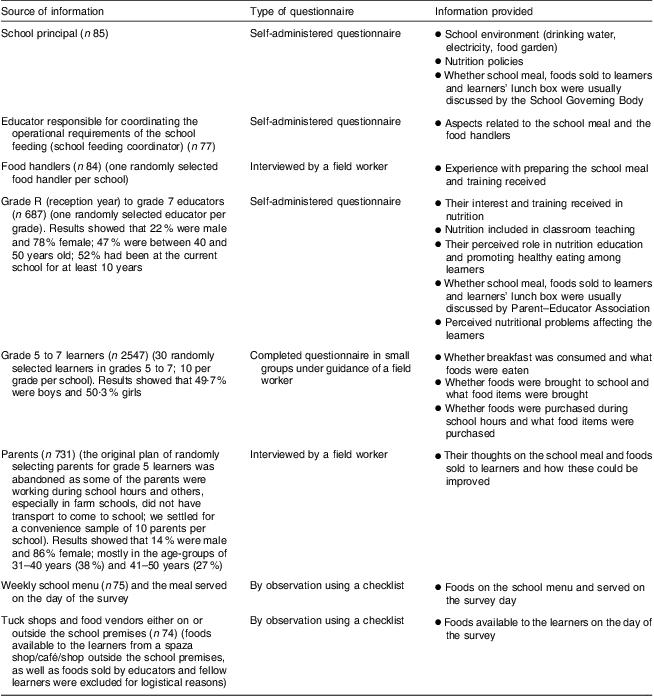
A cross-sectional survey was done in ten quintile 1 to 3 primary schools per district that were purposely selected by the DBE. The total study sample therefore consisted of ninety schools. For each of the ninety selected schools, data were collected from various sources through a set of structured questionnaires. A summary of the participants and information collected is provided in Table 1. In some provinces the anticipated number of completed questionnaires was not reached, as some of the selected study participants were not available on the survey day(s).
Summary of respondents and information collected
Twenty-eight field workers (DBE officials) were trained in data collection during a 5 d training workshop, which included a 1 d test trial in five schools in the Pretoria area. Data were collected from March to October 2010. Schools were informed about the survey dates beforehand. Before going to a school, arrangements were made for completion of consent forms for the learners and for the school to invite the relevant respondents for interviews. Trained officials of the DBE checked the questionnaires for completeness and ensured that vernacular responses had been translated to English before sending the completed questionnaires to the Agricultural Research Council in Pretoria.
Measuring tools
The fifth draft of the ‘National guidelines for the implementation, monitoring and reporting on the National School Nutrition Programme’( 12 ), guidelines received from FAO and reports on previous evaluations of the Primary School Nutrition Programme( Reference McCoy, Barron and Wigton 18 – Reference Wentzel-Viljoen, Swart and Vorster 20 ) were used as framework to develop the measuring tools.
The questionnaires for learners, educators and parents were tested in four schools. Educators evaluated the questionnaires for face validity. The appropriateness of the questions was tested in a group of fifteen learners in grades 5 to 7 (five learners per grade), ten parents and one educator per grade in each of the four schools. The checklists and remaining questionnaires were tested in nine schools. Modifications were made where necessary. The ‘test’ schools were poorly resourced but were not located in the study sites.
The questionnaires for parents, learners and food handlers were translated into six of the national languages used in South Africa (Sepedi, isiXhosa, isiZulu, isiNdebele, Setswana and Afrikaans). The translations were verified through back translations and group discussions to ensure that the meaning of the questions was retained. Corrections were made where needed. Questionnaires for the school principals, educators and school feeding administrators were not translated and were completed in English. The translated questionnaires were piloted in three provinces, one school per province. The schools were chosen in areas that were similar to the selected areas for the survey. The questionnaires were revised where needed.
Data analysis
Descriptive data analysis was done using the statistical software package IBM SPSS Statistics 18. Categorical data were expressed as frequencies and percentages. For the learners, information obtained through open-ended questions was discarded, as most of the answers either did not make sense or were illegible. Missing values were excluded during data analysis.
Ethical considerations
The study was conducted according to the guidelines laid down by the Declaration of Helsinki and all procedures involving human subjects were approved by the Ethics Committee of the Medical Research Council (EC09-015). Permission to do the study was obtained from the relevant senior managers in the provincial Departments of Education and school principals. Written informed consent was obtained from adult respondents (educators, parents involved in school feeding and garden). Written informed consent was obtained from the parents of the selected learners, and the learners gave written assent before completion of the questionnaire.
Results
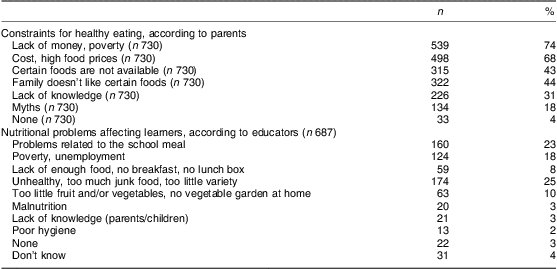
The study sample included rural (49 %), peri-urban (19 %), urban (17 %) and farm (15 %) schools. A tap inside the school yard was the main source of drinking water in 81 % of the schools and 98 % of the schools had electricity. It was reported that 43 % of the schools had a policy on nutrition, which was mostly based on the NSNP guidelines. According to the parents and educators, lack of money/poverty and high food prices were major constraints for healthy eating, affecting the nutrition of the learners (Table 2).
Factors affecting nutrition of learners, according to parents and educators, in a survey of ninety purposively selected poorly resourced schools (ten in each of the nine provinces) in South Africa, March–October 2010
Learners’ breakfast and lunch box
Twenty-two per cent of the learners had not eaten breakfast on the survey day. For those who had eaten breakfast, bread and porridge were the most popular foods, consumed mostly on their own, or with a protein source or fruit/vegetable. Only 24 % of the learners carried a lunch box, mostly containing bread/sandwich (Table 3). Five per cent of the learners brought a drink to school on the survey day.
Breakfast eaten by learners and contents of their lunch box in a survey of ninety purposively selected poorly resourced schools (ten in each of the nine provinces) in South Africa, March–October 2010
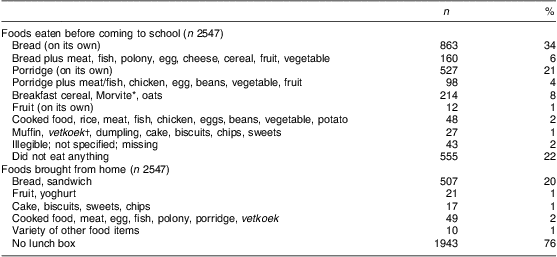
*Vitamin- and mineral-enriched sorghum-based cereal.
†Traditionally made with yeast bread dough that is shaped into balls and deep fried in oil.
Thirteen per cent of the schools had a policy on the foods that learners bring to school, which focused mostly on healthy foods, limiting ‘junk’ food, and including fruit and a drink in the lunch box. The quality of the children's lunch box was usually discussed by the School Governing Body and during Parent–Educator Association meetings in 27 % and 50 % of the schools, respectively.
School feeding programme
The school meal was served to all learners in 77 % of the schools and to only the neediest children in 21 % of the schools. The school meal was served daily in 99 % of the schools. The meal was prepared in proper (38 %) or makeshift (30 %) kitchens, a classroom or office (23 %), outside in the school yard (8 %) or in the community (1 %). In 84 % of the schools, gas was the main fuel used for cooking. The remainder of the schools used wood as an open fire, either inside a room (7 %) or outside (5 %), and electricity (4 %). Food for the meal was obtained mostly from the suppliers (95 % of schools), and to a lesser extent the school's food garden (43 %) and food locally grown in the community (9 %).
More than 60 % of the food handlers had received training in the individual topics listed. Problems experienced with the school meal included lack of storage space (32 %), lack of water (27 %) and insufficient amount and/or poor quality of the food supply (30 %; Table 4). Most of the schools had water and soap available for the food handlers to wash their hands.
Information on the school meal, food handlers’ and parents’ perception of the school meal, in a survey of ninety purposively selected poorly resourced schools (ten in each of the nine provinces) in South Africa, March–October 2010
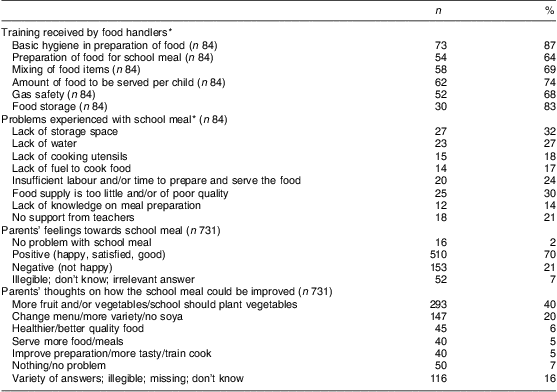
*Information provided by the food handler.
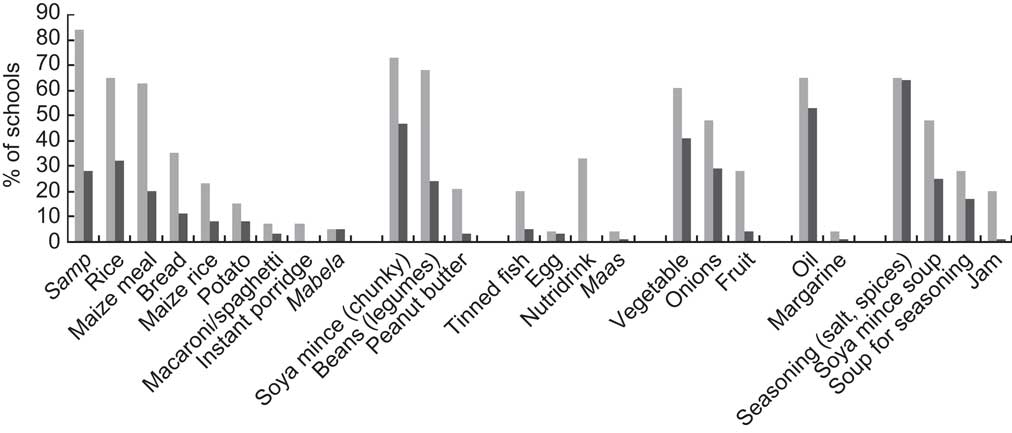
The school meal was assessed particularly for inclusion of vegetables and fruit. Foods on the school menu and those served on the survey day are indicated in Fig. 1. Samp (84 %), soya mince (73 %), beans (68 %), oil (65 %), seasoning (65 %), rice (65 %), maize meal (63 %) and vegetables (61 %) were on the menu in at least 60 % of the schools. Vegetables, mostly cabbage, and to a lesser extent carrot and butternut squash, were on the menu in 61 % of the schools, but were served in only 41 % of the schools on the survey day. Fruit, mostly apple and banana, were on the menu in 28 % of the schools, but were served in only 4 % of the schools on the survey day.
Foods on the school menu (
 $$$$
) and served on the day of the survey (
$$$$
) and served on the day of the survey (
 $$$$
) among ninety purposively selected poorly resourced schools (ten in each of the nine provinces) in South Africa, March–October 2010 (samp = dehulled dried broken maize kernels; Nutridrink = fortified drink; maize rice = also known as mealie rice, finely cut maize in which the bran and germ has been partly removed; mabela = porridge prepared with ground sorghum; maas = fermented milk)
$$$$
) among ninety purposively selected poorly resourced schools (ten in each of the nine provinces) in South Africa, March–October 2010 (samp = dehulled dried broken maize kernels; Nutridrink = fortified drink; maize rice = also known as mealie rice, finely cut maize in which the bran and germ has been partly removed; mabela = porridge prepared with ground sorghum; maas = fermented milk)
Seventy per cent of the parents were positive towards the school meal, of whom 15 % felt positive because many of the children come from poor households. Twenty-one per cent of the parents were negative towards the school meal, mostly because the menu lacked variety and they were generally not happy with the foods on the menu. Six per cent of the parents were very specific in terms of the unacceptability of soya on the menu, and parents in six of the nine provinces suggested that soya be removed from the menu. Parents thought that the school meal could be improved by adding fruit and/or vegetables and changing the menu (Table 4). The quality of the school meal was usually discussed by the School Governing Body and during Parent–Educator Association meetings in 85 % and 59 % of the schools, respectively.
School vending
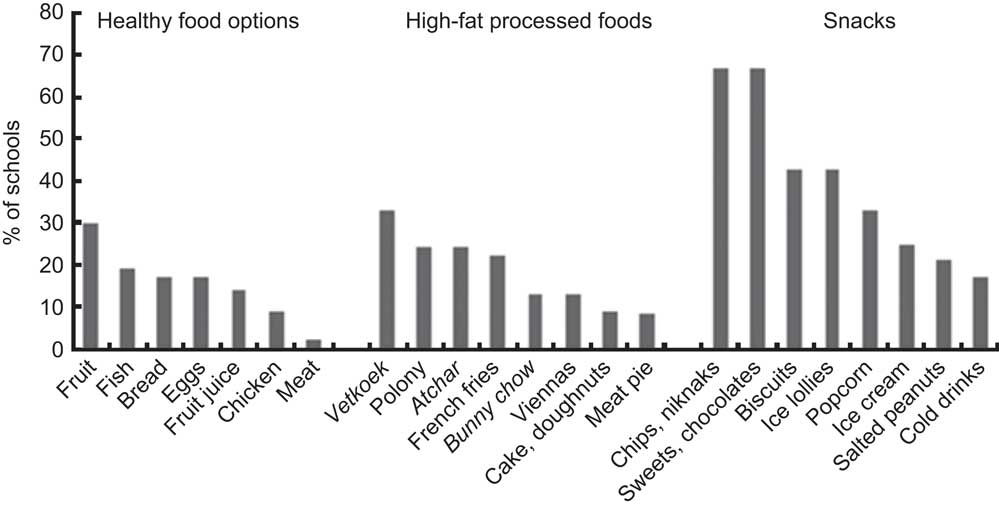
Of the seventy-four schools for which the school vending checklist was completed, eleven did not sell any food to learners during school hours on the survey day. Data on foods sold were obtained from sixty-three schools, of which 29 % sold food through the school's tuck shop (a building/structure on the school premises where food is sold), 49 % through food vendors on the school premises and 22 % through food vendors outside the school premises. A variety of foods were sold, including mostly unhealthy options such as chips/niknaks, sweets/chocolates and biscuits. Peanuts were classified as a snack food, because of the high salt content. Fruit was sold in 30 % of the sixty-three schools for which data were obtained (Fig. 2).
Foods sold at the tuck shop and by food vendors on the day of the survey among ninety purposively selected poorly resourced schools (ten in each of the nine provinces) in South Africa, March–October 2010 (vetkoek = traditionally made with yeast bread dough that is shaped into balls and deep fried in oil; atchar = relish made with unripe green mangoes and chillies and blended with oil; bunny chow = quarter of a loaf of white bread that has been hollowed out and filled with curried meat)
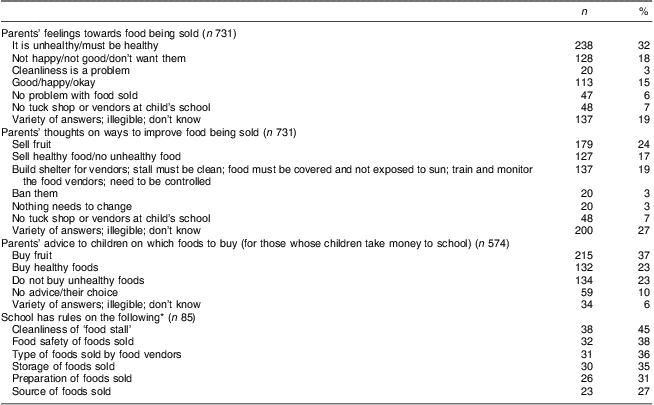
Nineteen per cent of the schools had a policy on the foods sold to the learners, which focused mostly on clean and healthy foods. One of the schools reported that it does not allow vendors on the school premises (Table 5). The quality of food sold during school hours was usually discussed by the School Governing Body and during Parent–Educator Association meetings in 45 % and 44 % of the schools, respectively.
Information related to foods sold at school in a survey of ninety purposively selected poorly resourced schools (ten in each of the nine provinces) in South Africa, March–October 2010
*According to the school principal.
Just over half (57 %) of the learners brought money to school on the survey day (median of R2; approx $US 0·25). Twenty-four per cent of the parents did not know what type of food their children buy at school. Parents advised their children to buy fruit (37 %) and healthy foods (23 %). Thirty-two per cent of the parents thought that the foods sold to the learners were unhealthy or could be healthier. According to the parents, foods sold to learners can be improved by selling fruit (24 %) and healthier food options (17 %). Parents had some concerns regarding the food stall itself, stating that a shelter should be built for the vendors and that the food should be protected from the sun and be clean (Table 5).
Classroom activities
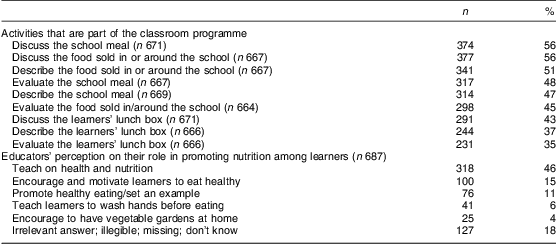
Approximately 15 % of the educators had received training in nutrition and nutrition education, and 83 % showed an interest in nutrition. Nearly all the educators (99 %) agreed that they, as educators, need to promote good health and nutrition among learners, mostly through teaching the learners on health and nutrition (46 %), encouraging the learners to eat healthily (15 %) and by setting an example (11 %; Table 6). Eighty-one per cent of the educators taught nutrition as part of school subjects, particularly life orientation (56 %), reading (25 %) and natural sciences (21 %). The school meal, foods sold in and around the school, and the learners’ lunch box were discussed in the classroom by approximately 50 % or less of the educators (Table 6).
Classroom activities related to nutrition, according to educators, in a survey of ninety purposively selected poorly resourced schools (ten in each of the nine provinces) in South Africa, March–October 2010
Discussion
The current study provided information on the school food environment that should be considered in the school feeding and nutrition education components of the NSNP. Areas of concern that were identified are learners not eating breakfast, low content of vegetables and fruit in the school meal, unhealthy food items sold through tuck shops and vendors, and learners not carrying a lunch box. The study included schools in quintiles 1 to 3, as these schools are the focus of the NSNP, and is therefore focused towards poorly resourced schools. The study included ninety schools that were purposively selected to cover a range of agro-ecological characteristics in all nine provinces of South Africa.
A large proportion of the schools did not comply with the mandate of serving vegetables and/or fruit every day, as stipulated in the 2011–12 Conditional Grant Framework( 15 ). Vegetables and fruit are bulky and perishable, and quality and appearance can be a barrier for consumption( Reference Krølner, Rasmussen and Brug 21 ). Schools need the capacity to appropriately store vegetables and fruit, which could be problematic as many schools lacked storage space. Access to fresh vegetables and fruit can be increased through increased local production, either in the school garden or in the community, and by linking the school to local farmers (www.farmtoschool.org). The agricultural component of the study showed that learners and educators were positive about food gardening( Reference Laurie, Faber and Malebana 16 ). School gardens can also be used as a platform for learning about gardening and healthy eating( 22 ). A horticulture manual was developed to strengthen school gardening activities within the NSNP( 23 ).
The number of children carrying a lunch box was low and, similar to the results of a previous localised study( Reference Abrahams, de Villiers and Steyn 24 ), the contents consisted mostly of bread. Previous studies have shown that learners who attended schools of high socio-economic status were twice as likely to bring food to school( Reference Temple, Steyn and Myburgh 13 ) and that learners from rural and disadvantaged settings were less likely to bring a lunch box to school because of a lack of food available at home( Reference Abrahams, de Villiers and Steyn 24 ).
Learners relied more on vendors and tuck shops for food, than on a lunch box. Foods sold to the learners were mostly unhealthy options, which is in line with previous studies in specific settings( Reference Temple, Steyn and Myburgh 13 , Reference Abrahams, de Villiers and Steyn 24 , Reference Wiles, Green and Veldman 25 ). Parents advised their children to buy healthier food options, but this could only be achieved if these were available and affordable. There are several barriers for selling healthier foods. Tuck shop managers in quintile 5 schools (least poor schools) in a city were shown to be reluctant to stock fruit because when they did stock it, it stayed on the shelf and decayed( Reference Wiles, Green and Veldman 25 ). Other barriers include children's preference for unhealthy foods( Reference Krølner, Rasmussen and Brug 21 , Reference Marracini, Meltzer and Bourne 26 ), a fear of losing income through selling these food items( Reference De Villiers, Steyn and Draper 27 ) and the higher cost of healthier foods( Reference Krølner, Rasmussen and Brug 21 , Reference Temple, Steyn and Fourie 28 ). Against the backdrop of overweight and obesity among schoolchildren in South Africa( Reference Kimani-Murage, Kahn and Pettifor 2 , Reference Reddy, James and Sewpaul 3 ), regulation of foods sold to children during school hours and programmes advocating healthy food options should be encouraged. Furthermore, the concerns of the parents in terms of the stall itself should be addressed, i.e. providing a shelter for the vendors, ensuring that the food is protected from the sun and the dust, and that the stall is clean.
Moore and Tapper( Reference Moore and Tapper 29 ) showed that fruit tuck shops on their own did not change children's snacking behaviour, but those combined with applicable school policies on the types of foods children were allowed to bring to school had a greater impact. Also, children's attitudes, nutrition knowledge, food preference and consumption patterns in terms of vegetables and fruit were shown to be positively affected through school gardens as a component of nutrition education( Reference Somerset and Markwell 30 , Reference Parmer, Salisbury-Glennon and Shannon 31 ). Promoting healthy eating through a comprehensive approach that includes the classroom curriculum, policy and environmental changes, and support of parents and the community, may create a demand for healthier food options to be sold.
A small number of educators had received training in nutrition and nutrition education, but nearly all educators agreed that they, as educators, need to promote good health and nutrition among learners. Educators should be trained in nutrition, preferably as part of their formal training. The nutrition education component of the NSNP was recently strengthened by making available an educators’ manual on nutrition education( 32 ), based on the South African food-based dietary guidelines. Educators should now be provided with creative nutrition education and good classroom materials that include teaching guidelines to ensure that this information is integrated into the classroom curriculum. This will require collaboration between the NSNP and the school curriculum authorities. To ensure that learners are able to incorporate the food-based dietary guidelines into their daily lives, nutrition education in schools should be extended to include the parents. The importance of targeting the family environment for the promotion of healthy eating behaviours among children and adolescents was highlighted by Pearson and co-workers( Reference Pearson, Biddle and Gorely 33 ). Lessons alone, however, will not necessarily result in behaviour change( Reference Ransley, Taylor and Radwan 34 ). Poverty, cultural practices and lack of influence over food choices may limit learners’ ability to change dietary practices( Reference Oosthuizen, Oldewage-Theron and Napier 35 ). Sponsored signage boards on school premises displaying unhealthy foods( Reference De Villiers, Steyn and Draper 27 ) may also be a barrier for instilling healthy dietary practices among schoolchildren.
Poverty was perceived as a major challenge affecting healthy eating among learners. Healthier food choices are, in general, more expensive than commonly consumed foods, and it has been argued that a healthy diet is unaffordable for the large majority of South African households( Reference Temple, Steyn and Fourie 28 ). Cost is a major constraint prohibiting frequent consumption of vegetables and fruit( Reference Love, Maunder and Green 36 , Reference Faber, Laubscher and Laurie 37 ) and households are therefore not able to purchase these regularly. Through nutrition education and food production initiatives within the NSNP in schools, households can be encouraged to plant a variety of vegetables and fruit for home consumption. Multi-component interventions were shown to be effective in promoting a healthy diet in schoolchildren in, for example, Europe( Reference Van Cauwenberghe, Maes and Spittaels 38 ).
Based on the survey results, several recommendations can be made to create, from a nutritional perspective, a healthier food environment at schools. An integrated approach considering socio-economic aspects is needed. Vegetables and fruit should be served in the school meal more often, and schools should have the means to do so. Foods sold to learners through vendors (either on or outside the school premises) and tuck shops should be regulated and children should be encouraged to carry a healthy lunch box. Teaching guidelines are needed to integrate nutrition education into the classroom curriculum and the nutrition education should be extended to include the parents. Horticulture and nutrition education manuals were made available to the schools and it is suggested that in a year or two, a follow-up survey is conducted to assess the use of these manuals within the NSNP in schools.
Acknowledgements
Sources of funding: The study was funded and technically supported by the FAO. Conflicts of interest: The authors have no conflicts of interest. Authors’ contributions: M.F. and S.L. designed the study, developed the questionnaires and trained the field workers; M.F. analysed the data and wrote the manuscript; M.M. and T.M. provided technical input and took responsibility for the execution of the field work; E.M. provided technical input; S.L. and E.M. contributed towards writing of the manuscript. Acknowledgements: The authors thank the nine provincial Departments of Education and District Offices which provided access to the schools to collect data; the officials who conducted the field work; the schools and community members (principals, educators, learners, volunteer food handlers, school gardeners/general workers and parents) who participated in the study; officials from the National and Provincial Departments of Education who assisted with validation and translation of questionnaires; Dr Carl Lombard, statistician in the Biostatistics Unit of the Medical Research Council, for assistance in determining sample sizes; and Mrs Lee-Ann Human of the Nutritional Intervention Research Unit of the Medical Research Council for data management.



