





Introduction
In archaeology, an element is usually understood to be in a systemic context when it is part of a living system, fulfilling various roles. For example, a bronze axe is considered in its systemic context when used within a social group or community, whether for utilitarian or ritual purposes. In its systemic context, the axe is incorporated into a functioning physical and cultural network, a living, dynamic system composed of things, humans, interactions, and behaviours. Once the same axe is permanently discarded and incorporated into a stratification, it is understood to be in an archaeological context – a significantly less dynamic setting – in which it assumes the role of an artefact within a specific layer. Theoretically, if the axe is later recovered and, for instance, exhibited in a display case, where it is observed, studied, or admired, the axe is considered to be in a new systemic context, another living behavioural system in which it acquires a different role.
The concept of systemic context, along with its intricate relationship with the archaeological context, has greatly influenced archaeological thinking, extending beyond the borders of behavioural archaeology, where it originated. However, despite these theoretical tools being applicable, in principle, to any archaeological reality, the debate around their use has been far more active in America than in Europe. This article explores the possibility that this discrepancy may stem from specific characteristics of the systemic context concept itself, and it presents a proposal to reshape this notion to enhance its effectiveness, particularly in the European archaeological environment, where deeply stratified sites are common.
Tackling a terminological and conceptual problem is always challenging and subjective. Nevertheless, the aim is to strive for a broader consensus, a more widely shared terminology, and a more practical conceptual tool. The underlying belief is that theory should not be developed solely for the sake of theory but should have a positive impact on everyday archaeological practice (Giannichedda Reference Giannichedda2002, 11–27), including fieldwork and teaching.
The notions of systemic context and archaeological context: characteristics and limitations
The connection between the material remains recovered in the field and past phenomena has clearly always been at the basis of archaeological inquiry (Gibbon Reference Gibbon2014, 18, fig. 2.1; Sullivan Reference Sullivan1978). With Lewis Binford, this bridging of the gap between the archaeological record (see Patrik Reference Patrik1985) and past behaviour became known as middle-range theory (see Shott Reference Shott1998 for a comprehensive discussion). However, Michael Schiffer and behavioural archaeology made the distinction between the systemic context and the archaeological context explicit, along with the formation processes that link the two (C-cultural transforms and N-natural transforms). This was, indeed, the core of a whole archaeological approach: the factors that bring and transform any material from a systemic context to an archaeological context play the pivotal role in behavioural archaeology.
Interestingly, the definitions and discussions regarding what constitutes a systemic context and an archaeological context, the two pillars of this framework, are relatively scarce. It is worth starting with Schiffer’s original article from 1972 that explicitly addressed the dualism systemic context/archaeological context. Schiffer states that the ‘systemic context labels the condition of an element which is participating in a behavioral system,’ while the ‘archaeological context describes materials which have passed through a cultural system, and which are now the objects of investigation by archaeologists.’ (Schiffer Reference Schiffer1972, 157) These definitions are not further discussed in the paper, yet they raise a few observations. Firstly, ‘systemic context,’ refers to a condition rather than a set of entities. Specifically, it denotes the condition of a single element. On the other hand, the definition of ‘archaeological context’ is less clear, as it may refer to either the condition of a group of materials or the materials themselves. This discrepancy may lead to an ontological inconsistency between the two contexts, making it even more difficult to handle the transition (formation processes) between them. In other publications (e.g., Schiffer Reference Schiffer1996, 4; Schiffer Reference Schiffer2010, 20), it becomes apparent that Schiffer refers in both cases to a situation or the circumstances in which an element is considered, whether it was in a live environment (in the past) or in a stratigraphic one (in the present). A context, therefore, is not conceived as a set of things.
While in behavioural archaeology the use of the term ‘context’, at least in its outlines, is relatively straightforward, its usage varies significantly within the broader archaeological discipline (e.g. Barrett Reference Barrett and Papaconstantinou2006; Crossland Reference Crossland, Boyd and Doonan2020; Papaconstantinou Reference Papaconstantinou and Papaconstantinou2006), highlighting a proper discrepancy. The term can refer to the historical, social, political, or strictly archaeological circumstances in which an event or find is situated. It can also denote the stratigraphic, topographic, and chronological location of an element. In British archaeology, the term ‘context’ is also used to indicate stratigraphic units (or units of stratification –see Harris Reference Harris1979 and, just as an example, the influential MOLA site manuals; see also Lucas Reference Lucas2001, 58); indeed, the investigation and documentation of stratigraphic units is named ‘single context recording’. The Italian equivalent, ‘contesto’, can refer to both an assemblage (a group of finds) and a group of stratigraphic units (see a discussion on the topic in Carandini Reference Carandini1991, 51–52; see also Terrenato Reference Terrenato, Francovich and Manacorda2000). In French, the term ‘contexte’ primarily corresponds to the circumstances in which something was retrieved. In Spanish, ‘contexto’ mainly indicates the stratigraphic unit but can also refer to an assemblage. In summary, the term ‘context’ is used with various nuances, sometimes denoting a circumstance and other times denoting an entity or a group of entities (Giannichedda Reference Giannichedda2006, 125; Lyman Reference Lyman2012, 210–211).
Another aspect highlighted by the 1972 article is an object-oriented perspective. The terms ‘element’ and ‘materials’ are general, and in principle behavioural archaeology targets the whole archaeological record. In the same article, Schiffer defines ‘elements to include foods, fuels, tools, facilities, machines, human beings, and all other materials which one might list in a complete inventory of a cultural system.’ However, the processes involving an element are described using terms such as procurement, manufacture, use, maintenance, and recycling, which are primarily applicable to artefacts rather than human beings or the natural/environmental component (which is not mentioned). Practically, behavioural archaeology primarily focuses on artefacts.
This artefact-centric view is consistent throughout Schiffer’s influential book ‘Formation Processes of the Archaeological Record’ (Schiffer Reference Schiffer1987; second edition, Schiffer Reference Schiffer1996). The book extensively explores the role of formation and transformation processes on objects and assemblages, but discussions of the formation of stratigraphic units are relatively rare. Profiles and cross-sections are significantly absent. Some more conspicuous reflections are only devoted to formation processes at site and regional level (somehow, then, bypassing the role of single stratigraphic units and deposits; see, again, Schiffer Reference Schiffer1972, 156).
This perspective is also apparent in other papers (see Reid et al. Reference Reid, Schiffer and Rathje1975, 864; Schiffer Reference Schiffer1983), and it has not gone unnoticed (Lucas Reference Lucas2012, 74–123). Indeed, this is perfectly consistent with a behavioural approach, where the interaction between people and objects takes centre stage and even leads to the development of object histories or biographies (it is the life history concept; LaMotta and Schiffer Reference LaMotta, Schiffer and Hodder2001, 21–24, with further references; Hahn and Weiss Reference Hahn, Weiss, Hahn and Weiss2013; Peña Reference Peña2007; Skibo and Schiffer Reference Skibo and Schiffer2008). A higher attention is paid to the deposit as a whole in some publications (for a discussion of the topic, see Stein Reference Stein, Goldberg, Holliday and Reid Ferring2001, partic. p. 42), but the imbalance is clear.
The behavioural archaeological context is oddly non-stratigraphic; in fact, behavioural archaeologists seem to have had, particularly during the 1980s, strong ties with that part of geology scholarship critical of the introduction of the Harris matrix and the principles of archaeological stratigraphy (Brown III and Harris Reference Brown, Harris, Harris, Brown and Brown1993; Gasche and Tunca Reference Gasche and Tunca1983; Stein Reference Stein1987), which were more rapidly introduced by large parts of the European archaeological community. Not earlier than the mid-2000s, American archaeologists acknowledged the possibility of excavating archaeological deposits through arbitrary levels (Lyman, O’Brien Reference Lyman and O’Brien2006, 209–212; see also Lucas Reference Lucas2001, 47–48), still considering this practice as stratigraphic excavation.
This observation leads to another aspect of the behavioural archaeology understanding of systemic and archaeological contexts. Despite Schiffer’s important efforts to address specific chronological issues (e.g., Hohokam chronology, old wood effect; Schiffer Reference Schiffer1986; Schiffer Reference Schiffer1996, 305–321), the two cornerstones of behavioural thinking seem to lack temporal depth. The concept of systemic context appears monolithic and non-dynamic, lacking a temporal or palimpsestic dimension (cf. Bailey Reference Bailey2007; Lucas Reference Lucas2012, 115–123). In other words, it is not historically grounded. This of course has a mutual counterpart in the concept of archaeological context, being it in a one-to-one relationship with the systemic context. Indeed, from the very first 1972 article onward, particular attention is devoted to the spatial analysis of the archaeological record, and not to its chronologically palimpsestic nature.
With the clear risk of oversimplifying, one suspects that this aspect may be rooted in the very anthropological nature of American archaeology, as opposed to the more historical roots of European archaeology (Hodder Reference Hodder and Hodder1991; Lucas Reference Lucas2001, 34–35; Trigger Reference Trigger1984; Trigger Reference Trigger and Lamberg Karlovsky1989; Willey and Phillips Reference Willey and Phillips1948, 1–7). Again with the risk of oversimplifying, anthropology also focuses on contemporary, living socio-cultural systems and has less interest in developing robust temporal frameworks. It predominantly requires a strong three-dimensional approach, whereas archaeology cannot disregard a four-dimensional approach.
It is not the aim of this paper to dwell on the distinction between anthropology and archaeology (Earle Reference Earle, Bentley, Maschner and Chippindale2008; Shankland Reference Shankland2012), or between different anthropologies and archaeologies. What is relevant is that sharpening theoretical tools also occurs in a cultural environment (in a systemic context!), and this affects the final shape of the concepts emerging, and their usage or non-usage in different schools.
In later behavioural archaeology works, the use of the term ‘systemic context’ becomes increasingly rare, while ‘behavioural context’ is employed more frequently (see Skibo and Schiffer Reference Skibo and Schiffer2008), which further underscores the anthropological perspective. Between the late 1970s and 1980s, the definitions of ‘systemic context’ and ‘archaeological context’ have been occasionally revisited, partially integrated, or expanded, both within and outside the community of behavioural archaeologists (DeBoer Reference DeBoer, Moore and Keene1983; Sullivan Reference Sullivan1978, 194–198; Urbańczyk Reference Urbańczyk, Donato, Hensel and Tabaczyński1986). Despite these efforts, the original meanings proposed in 1972, more recently thoroughly analysed (Lucas Reference Lucas2012, 74–123), have remained largely unchanged. In this form, they found their way in the literature and even in common archaeological language, with higher peaks in America and lesser fortune on the other side of the Atlantic. In general, the model of a systemic context undergoing transformations and somehow becoming an archaeological context remains accepted way beyond the borders of behavioural archaeology (Lucas Reference Lucas2005, 34).
An alternative notion of systemic context and archaeological context: a proposal
Stretching the notion of systemic context to better fit other archaeological panoramas (including, but not exclusively, the European one), as previously mentioned, is largely arbitrary, and the following proposal should be regarded as a subject of debate. The first step involves semantic simplification, and it is easier to begin with the archaeological context. It has been said that the term context primarily denotes the condition of an object, rather than the object itself or a group of objects. However, it has also been anticipated that the term context is employed when describing and handling the archaeological record, or, more specifically, the archaeological deposit. Here, the archaeological record is simply intended as the material output of past processes; it is not considered as a model, that is a simplified description of a phenomenon (see Clarke Reference Clarke1972 and Orton Reference Orton, Shaw and Jameson1999), as suggested in Patrik (Reference Patrik1985), but as a very comprehensive label (therefore generic, not simplified). Similarly, archaeological deposits are simply understood as the sedimented material outputs of past processes. In this field, the term context (with its linguistic variations) is also meant as a set of entities and, in particular, as a single stratigraphic unit, that is one, recognizable, basic part of the archaeological deposit. Contexts, in this sense, are the bricks of stratification: they are both physical elements and descriptive and hermeneutic devices employed for disentangling stratification (Furlan Reference Furlan, Magnini, Bettineschi and Burigana2021); they represent the basic units of any Harris matrix (Harris Reference Harris1979).
Contexts can also refer to a group of stratigraphic units associated with specific shared formation processes (as suggested, in particular, in Carandini Reference Carandini1991). For example, one context could include four walls constructed approximately simultaneously to build a house, or it could be formed by a series of backfills used to level an area before construction. Most importantly, the main formative event – deposition or removal – of a single stratigraphic unit or of a coherent group of stratigraphic units is linked to a more or less precise moment in time. This is what we usually call dating strata.
With ‘main formative event’, it is meant the deposition of a volume of matter (sediments and artefacts/ecofacts) or, in the case of negative stratigraphic units, an episode of demolition, excavation, or any removal of matter. In both cases, post-depositional processes of any sort continue shaping the units of stratification through time, but most of the times what is of archaeological relevance, although with some relevant exceptions, is when a context was firstly formed, more than how it evolved through time.
In conclusion, in this paper, I make the choice of considering the archaeological context as one or more stratigraphic units whose main formative event happened in the same time frame (phase). Additionally, contexts are many: there is no single archaeological context, but several archaeological contexts succeeding one another in time: cumulatively, they make the archaeological deposit investigated, which is, in turn, just a fraction of the whole archaeological record. This of course does not mean that other groupings and/or sub-groupings of stratigraphic units, for the most various reasons, cannot be used at the same time. As anticipated, this is a deliberate, yet motivated, choice. At this point, having a systemic counterpart to the archaeological contexts, understood in this way, would facilitate reasoning about the transition between the two. This would be further facilitated if the systemic context could be intended as a thing or as a set of things, and not as a circumstance (this, for instance, seems to be implied in Giannichedda Reference Giannichedda2002, 79 and in Carafa Reference Carafa2021, 1–14). And if many systemic contexts are considered, and not just one.
I propose that systemic contexts could be intended as time slices. Systemic contexts succeeded one another through time and they may be viewed as successive temporal ‘slices’, or ‘slices of a living past’, whose depth depends on our capacity to divide the actual time continuous into larger or smaller parts (Figure 1). They could be conceived as discrete time boxes, larger or thinner according to the precision of our knowledge, and therefore according to the temporal structure of the deposit (Holdaway and Wandsnider Reference Holdaway, Wandsnider, Lock and Molyneaux2006, 184), and not to the scale of our research interests (interpretive scales come into play at a later stage, cf. Bailey Reference Bailey2007 and Bintliff Reference Bintliff and Bintliff2004).
A conceptualization of systemic and archaeological contexts at site level. Systemic contexts are seen as sequential spatial-temporal boxes, whereas archaeological contexts are seen as their material output. Spatial-temporal boxes are thicker or thinner according to our ability to date the archaeological contexts within more or less precise time frames (phases). Archaeological contexts can or cannot contain relevant artefacts or ecofacts. The drawing depicts a simple relation 1:1 between systemic contexts and archaeological contexts, but the linkage may also be of the type 1:0 or n:1. Drawing by the author.
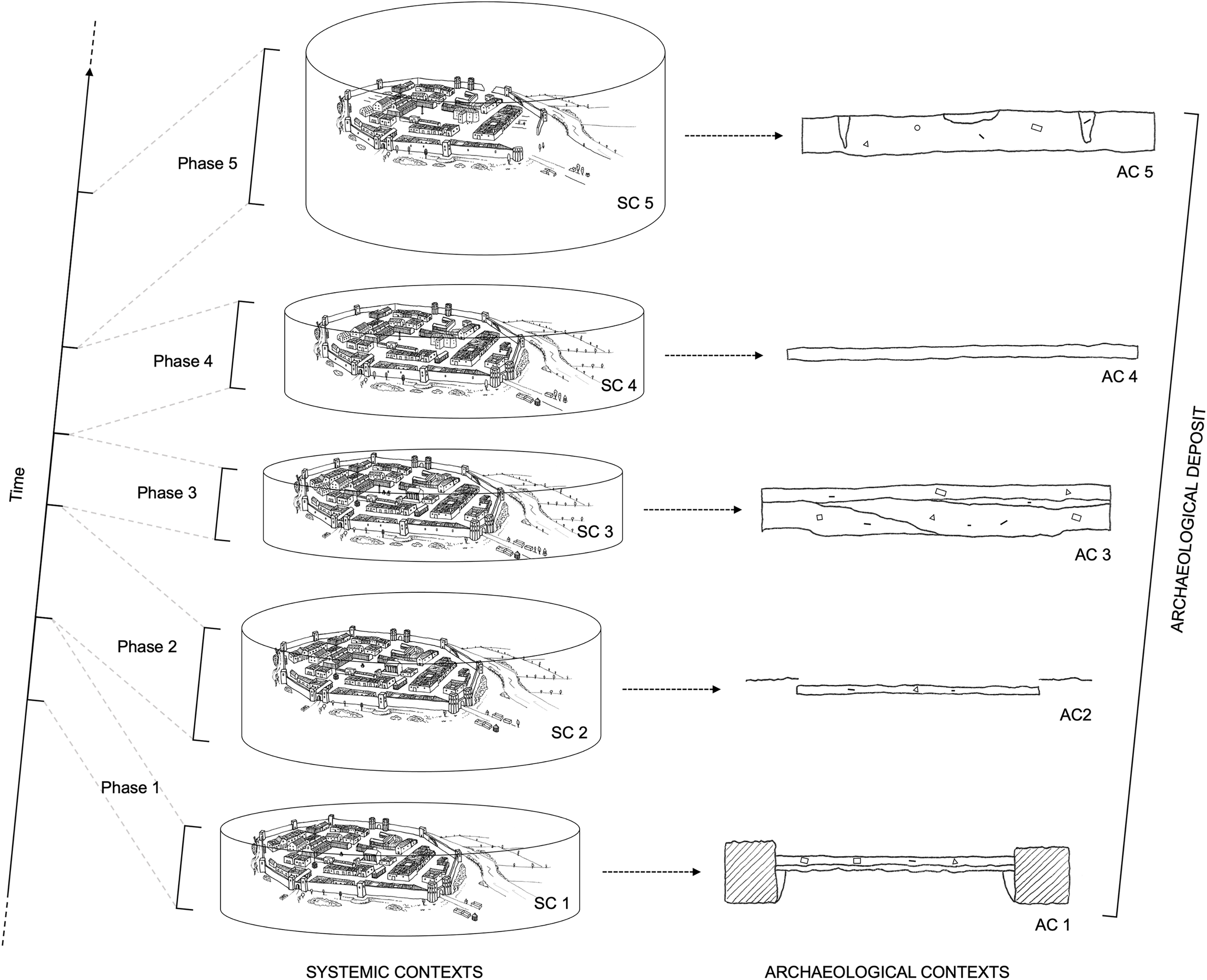
While, theoretically, every moment represents a distinct systemic context, this level of granularity is impractical. Approximation is necessary, and thus the continuous timeline must be divided into discrete chunks. Rather than being intended as a series of circumstances, systemic contexts should be understood as discrete arrays of people, things, environmental elements, behaviours, practices, and even ideas occurring within a specific time frame. In other words, they encompass everything that constitutes a living system during each time segment. One important point needs to be made about the temporal meaning of ‘systemic context’ and its relation to the archaeological one: a given systemic context is populated not only by objects and structures produced within its time frame. It is also made up of things produced in previous systemic contexts, even of people born in previous systemic contexts, and of environmental features somehow inherited. Focusing on artefacts and structures, we can consider that when Cicero went to the Roman Forum, he was surrounded by old and new buildings, all contributing to the systemic context of his time. Heirlooms were part of the domestic assemblage of many families. Sometimes, medieval cities displayed Roman buildings that were still contributing to shaping the systemic context of the period. Being produced or built in one period does not exclude being in use in later periods. It follows that even though a given systemic context were perfectly mirrored archaeologically, the result would still be a temporal palimpsest (or a polychronic ensemble, according to Lucas Reference Lucas2021, 87–90; see also Furlan Reference Furlan2019, 26; Gosden and Kirsanow Reference Gosden, Kirsanow, Lock and Molyneaux2006; Lucas Reference Lucas2005, 37). Even a single systemic context is, therefore, far from monolithic.
Determining the spatial boundaries of a systemic context requires, again, some degree of arbitrariness and can be adjusted based on the object of study (interpretive scale, see above), whether it is a site or an entire region, or on the informative potential of the related archaeological context. Pollen analyses performed on samples collected from a given archaeological context can inform us about the landscape of the related systemic context and have a sub-regional informative potential. The collection of carpological remains from the same context may be of interest on a domestic scale, having mainly an intra-site informative potential. The extension of the systemic context of interest could, therefore, be shaped accordingly. In theory, a systemic context could even be spatially boundless.
Each systemic context could then be intended as a single frame of the movie representing the evolution of a given area, according to the scale of our analysis (for the analogy between cinematic time and archaeological thinking, see Lucas Reference Lucas2021, 120–122). Time slices then become spatial-temporal slices, or boxes.
Finally, each systemic context, in principle, would produce an archaeological context, but this could or could not be documented in a given sequence. A chronological gap in a stratigraphic sequence occurs, for instance, when the refurbishment of a building erases previous floors and walls, eliminating the material outcome of one or more systemic contexts. The existence of these gaps is well known in archaeology (Pałubicka and Tabaczyński Reference Pałubicka, Tabaczyński, Donato, Hensel and Tabaczyński1986), as well as in geology (Sadler Reference Sadler1981; Schindel Reference Schindel1982). The relation systemic context – archaeological context is to be intended, therefore, as 1:1 or 1:0.
At this point, the definition of archaeological context can be further refined as the material output of a single systemic context or, more specifically, as one or more stratigraphic units whose main formative event, natural or anthropogenic, is the product of a given systemic context. Alternatively, the archaeological context could be intended as a transformed subset of the material component of a systemic context. Dating an archaeological context may then be seen as assigning this material component to the right systemic context.
Some stratigraphic units with a long formation process, stretching over the length of multiple systemic contexts, may at first sight create a problem. However, we could also acknowledge that in some cases the relation between the systemic contexts and the archaeological contexts may be many to one (n:1). It is the case, for instance, of basins with long sedimentation processes, where no single units of stratification can be detected but whose formation is particularly long. Plough soils, the slow infilling of culverts and drains (Dobreva, Furlan and Missaglia Reference Dobreva, Furlan, Missaglia, Buora and Magnani2018), and some floor layers (as highlighted in Lucas Reference Lucas2021, 91) also belong to this case.
It should be noted that this revised notion does not imply that the archaeological context directly reveals everything about the systemic context that produced it. The false illusions of a ‘Pompeii premise’ (see partic. Binford Reference Binford1981) have rightly been discarded long ago, and there is no need to revert to them. The complexity underlying the transition from the systemic context to the archaeological context remains fully acknowledged, must be addressed, and its investigation remains one of the key activities of archaeological inquiry. In other words, the extent to which an archaeological context represents the systemic context(s) is, case by case, an open, independent question. Sometimes, we may well never be able to properly relate the two, and we may acknowledge that some archaeological contexts are simply poorly understood.
Finally, this revised notion of systemic and archaeological contexts does not need to be associated with a culture-historical approach, as the two work on different analytical levels. Systemic contexts as space-temporal boxes are neutral per se, and characterizing them with cultural traits is a different issue. This is because what is needed is a basic, very general, flexible, and effective model, not yet a partial conceptual tool, only oriented to some specific aspects of archaeological inquiry.
One among many: a case study from the Roman town of Aquileia
The cross section in Figure 2 depicts only a small portion of the stratification excavated and documented while investigating a large domus in Aquileia (Furlan Reference Furlan, Bonetto, Furlan and Previato2024), a major Roman city along the north Adriatic coast (a comprehensive synthesis is provided in Ghedini et al. Reference Ghedini, Bueno and Novello2009). The sequence, per se, is very simple and its salient features are not uncommon at all; a series of makeups, a mosaic floor and a wall (part of an atrium house) are built in a period included between 100 and 90 BCE. About a couple of hundred years later, the floor is covered with a new mosaic, and finally the wall is partly dismantled and rebuilt in 400–425 CE. Between the three building activities, routine, domestic cleaning prevents the deposition of any sediments and materials: therefore, the three main phases documented are physically and spatially contiguous, yet chronologically well-separated. Each segment of the physical sequence represents a distinct archaeological context, in turn, being the product of a specific systemic context, the spatially and temporally defined system in which each building activity was carried out. Each systemic context includes the people, objects, environmental elements, behaviours etc. occurring at the time of the deposition of each archaeological context. We may approximately define systemic contexts 1, 2 and 3 as Aquileia and its surroundings in the late Roman republican age, in the mid-Roman imperial period, and in Late Antiquity. However, the spatial extension of the systemic contexts considered may vary according to our research interest (e.g. family habits – house – or the local economy – whole site of Aquileia –) or according to the informative potential of each archaeological context (well-preserved pollen grains may lead to investigate the systemic context, in its environmental aspects, on a sub-regional scale, e.g. the Low Friuli Plain where Aquileia is located).
Aquileia (Italy), Fondi Cossar: deposit including archaeological contexts produced by non-contiguous systemic contexts. This means that only some phases and their systemic contexts are documented in the sequence. The cross-section has been published in Furlan (Reference Furlan, Bonetto, Furlan and Previato2024). The Harris matrix below shows the single stratigraphic units grouped in archaeological contexts. These are linked to the systemic contexts by which they were produced and to the time frames (phases) in which their formation occurred. Genetic and cognitive processes at work are indicated with different dotted lines.
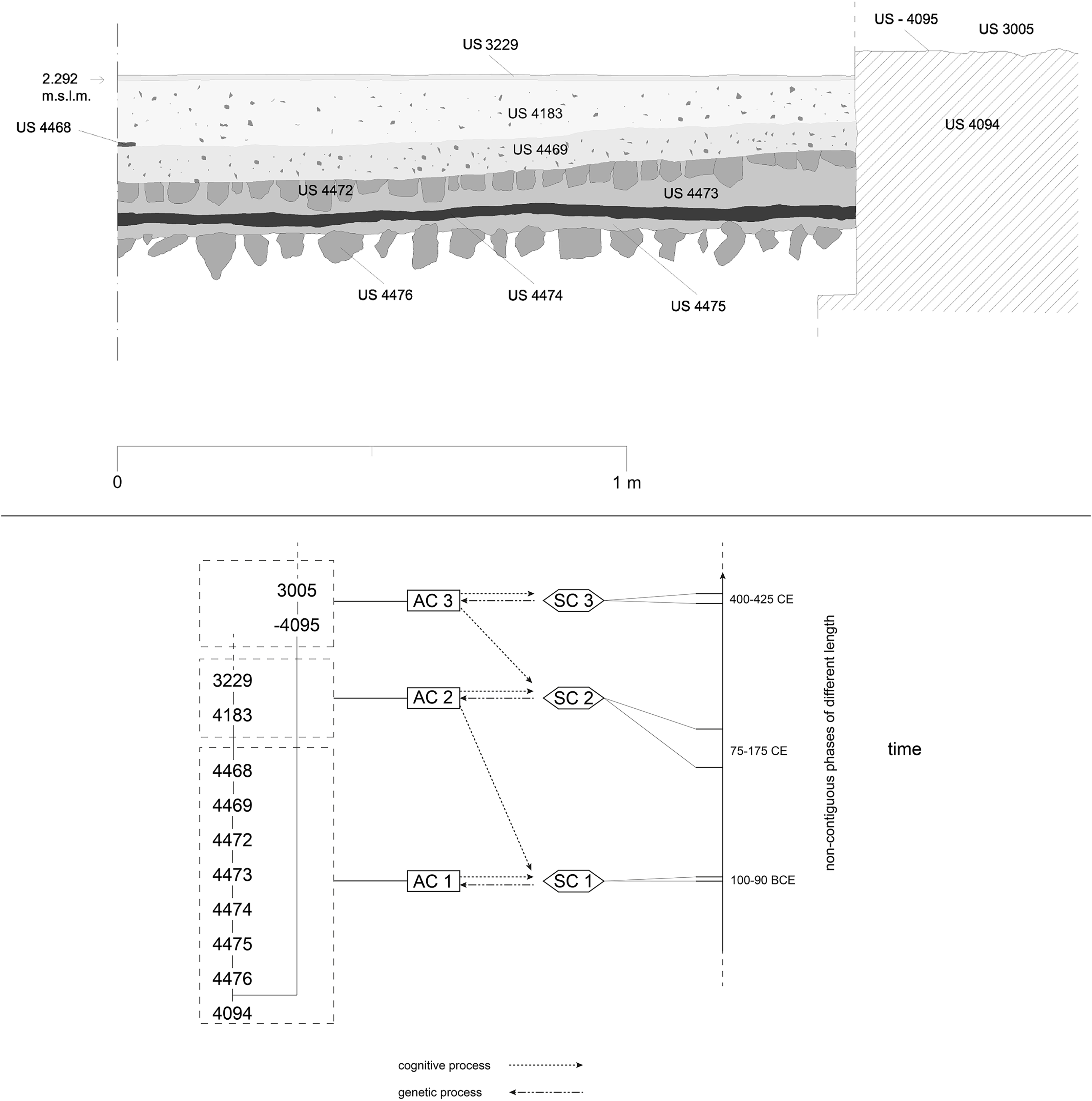
In any case, it is clear that not every systemic context produced an archaeological context in the sequence examined: the early imperial period, for instance, is not documented, yet it clearly existed. Between systemic contexts and archaeological contexts, we have both a 1:1 and a 1:0 relation. The length of each phase, e.g. the time window in which each systemic context can be framed, depends on the precision of the date of formation of each archaeological context, which is, in turn, highly dependent on the quality and quantity of datable finds and on the quality of the stratigraphic units examined (Furlan Reference Furlan2019).
Each archaeological context has been exploited to investigate, more or less effectively, the systemic context that produced it. Theoretically, archaeological contexts can also be used to investigate earlier systemic contexts: for instance, residual materials in AC 2 could be used to draw some conclusions about SC 1. As a matter of fact, residual materials in AC 1 provided relevant information about the first years of the colony of Aquileia (commerce, consumption habits, discard strategies), a moment when the domus was yet to be built (Furlan Reference Furlan, Bonetto, Furlan and Previato2024).
Benefits
After about 50 years since their formal introduction, the notions of systemic and archaeological context remain invaluable in archaeological reasoning. Mostly, I believe, because they force us to think in dynamic and problematic terms, addressing the crucial passage between the two. However, these concepts were developed in a precise cultural and academic environment to address issues that, although general and relevant, did not include the whole variety of archaeological research interests. And yet, the use of the two concepts found its way well beyond the borders of behavioural archaeology. This demonstrates the solidity of the original theoretical frame, but also points to the fundamental question of reworking these tools to address a more general and variegated panorama. A good law enacted for, say, regulating the circulation of red cars, has to be adjusted to regulate the circulation of all cars. In the same way, concepts fruitfully developed with a specific focus on artefacts, behaviour, and non-deeply stratified sites, need some form of adjustment when applied to a more general framework.
To some extent, this model simplifies unnecessary complexity while maintaining true hermeneutical complexity intact (and untouched), providing a more effective framework for studying long-lived sites, especially those urban sites that are characteristic of European archaeology. Each systemic context, or spatial-temporal box, can still be examined individually according to various research lines, including the investigation of material culture, social organization, human-environment interactions, rituals, mind-set, behavioural patterns, architecture, economy, and more. Which theoretical approach is preferred to address these topics, is a different matter. Importantly, the crucial topic of the passage between the systemic context and the archaeological context can still be fully investigated and debated with no substantial difference.
No substantial differences emerge also when studying mono-phase sites. However, this revised model facilitates the study of any aspect of the human past over time (ecological change, settlement dynamics, material culture evolution, development of social structures, etc.), by examining successive systemic contexts and their associated archaeological contexts. This approach seems particularly suitable for studying long-lived sites or regions, and therefore makes it easier to outline any historical discourse.
Turning to archaeological practice, this revised framework also offers a more effective way of addressing issues such as the palimpsesticity of assemblages and residuality, which are common in urban sites. For instance, residuals can be understood as artefacts or ecofacts permanently discarded in a systemic context preceding the one generating the archaeological context where they have been recovered. In other words, they are materials that were discarded and deposited (thus becoming archaeological objects) and subsequently relocated and redeposited in their final position, likely with sediments, after a relevant time interval – or a period that is difficult or impossible to model (Furlan Reference Furlan2019, 33). A false residual is an artefact or eco-fact produced in a systemic context preceding the one generating the archaeological context where it was recovered, but it was still in use at that time, belonging in effect to the systemic context that produced the archaeological context where it was recovered. The issue of manufacturing-deposition lag (Hill Reference Hill and Dickens1982; Peña Reference Peña2007), therefore, can be more easily addressed archaeologically; similarly, intrusive materials can be tackled in this framework.
In the same way, the issue of the persistence of some material features through time can be addressed more straightforwardly: representing in some form not just main formative events, but also use and duration, is a long-standing issue (land use diagrams, Carver diagrams), and it represents one of the main criticisms addressed to the use of Harris matrix (Brown III and Harris Reference Brown, Harris, Harris, Brown and Brown1993, 16–19, with further references). Although, when considering the relation between archaeological and systemic contexts, the model proposed focuses on the moment of formation (see above), acknowledging the usage of a given archaeological context in later systemic contexts does not pose serious problems.
In general, this revised notion allows for the integration of time, assemblages, layers, deposition and redeposition, production, and use within a single theoretical, formative framework.
Furthermore, this model promotes a more balanced perspective in terms of human and other biological or physical aspects of the past. The classic definition of systemic context as the ‘condition of an element which is participating in a behavioural system’ inevitably evokes the necessity of being incorporated into some social activity. It fits perfectly, again, artefacts. The reworked notion of systemic context is more neutral and allows for a more balanced approach, requiring no particular stretches to tackle, for instance, topics related to the ancient environment, climate, geomorphology etc. In this sense it recalls, unsurprisingly, what environmental archaeologists consider as a context: ‘for archaeology, context implies a four-dimensional, spatial-temporal matrix that comprises both a cultural and non-cultural environment, and that can apply to a single artifact or to a constellation of sites. Context, so defined, is the primary focus of several approaches within archaeology.’ (Butzer Reference Butzer1980).
Finally, this reworked notion is more practical, less abstract, and can be more effectively employed when teaching. Presenting a visual representation of a domus in its systemic context, alongside its remains in the field as part of its archaeological context, is likely to be more effective in teaching environments.
Limitations
One of the main limitations of reconsidering the use of theoretical tools is the risk of creating confusion or the need for frequent explanations of their usage. However, introducing new terms in an already overcrowded archaeological landscape, where consensus on even basic terms is often lacking, could have exacerbated the problem even more. The term ‘context’ is already used in the most various ways, and this situation is unlikely to undergo significant changes. On the other hand, leaving important theoretical tools largely untouched and unchallenged for 50 years, despite their various interpretations and usage, is also not ideal.
Finally, these reworked notions may work better at the site level than at the regional scale, as they primarily stem from the necessity of enhancing the effectiveness of the previous notions of systemic and archaeological context within the field of urban archaeology. However, some of the points that emerged are clearly shared by the field of landscape archaeology, making the adoption of the model feasible also on a territorial scale. For instance, the necessity of working at different time scales, i.e., temporal boxes of different extension, and palimpsestically, is generally acknowledged by scholars in landscape studies. Palimpsesticity, in particular, works at any level and can be appreciated in assemblages and stratifications, as well as in landscapes. Indeed, landscape formation processes have already been addressed by behavioural archaeologists (Heilen et al. Reference Heilen, Schiffer, Reid, David and Thomas2008): adjusting a behavioural approach to a more general and neutral theoretical framework in this field could represent a productive research line in the next future. If anything, on a landscape scale, it seems to be more difficult to draw a neat line between the archaeological and the systemic context. As M. Johnson rightly pointed out: ‘Many of the features of archaeological interest are still in what Michael Schiffer would call “systemic context”; that is, they are still part of a living and functioning cultural system.’ (Johnson Reference Johnson2007, xviii)
Conclusions
Most likely, considering contexts as entities more than circumstances is something that unconsciously we already do. Explicitly considering systemic contexts as spatial-temporal boxes and relating them to archaeological contexts representing their material output offers a possible, effective way to formalize and structure this assumption in a broad theoretical perspective. As K. Butzer rightly pointed out, archaeology is ultimately empirical (Butzer Reference Butzer1980, 417), and, therefore, it requires explanatory, descriptive, or organizational models (see Clarke Reference Clarke1972) that, however approximate, must be effective. Proposing a revised notion of systemic and archaeological context aims to enhance the study of long-lived sites, provides a more practical framework that aligns with empirical research, and allows for a more effective investigation of various aspects of the human past over time. This alternative approach also offers a more balanced view of cultural and non-cultural aspects of the past and can be easily integrated into teaching contexts. While there are limitations to this proposal, further discussion and debate may lead to refining and evaluating its applicability in archaeological research.
Acknowledgements
I would like to express my gratitude to the anonymous reviewers for their time and effort in evaluating this paper. Their insightful suggestions and constructive critiques have significantly enhanced the final version. I am also deeply grateful to Uzma Z. Rizvi for her guidance throughout the editorial process.
Funding statement
The work was partially supported by the Danish National Research Foundation under the grant DNRF119 - Centre of Excellence for Urban Network Evolutions (UrbNet).
Competing interests
The author has no competing interests to declare that are relevant to the content of this article.


 Open access

