





1 Introduction
Let X be a rational homogeneous space, and let $i:M \rightarrow X$
be a submanifold of dimension at least two.Footnote
1
We say that the M is normal split in X if the normal sequence
$i:M \rightarrow X$
be a submanifold of dimension at least two.Footnote
1
We say that the M is normal split in X if the normal sequence

admits a splitting morphism  such that $s \circ \mathrm {d}i = \mathrm {id}_{T_M}$
. It is easy to see that
$s \circ \mathrm {d}i = \mathrm {id}_{T_M}$
. It is easy to see that $T_M$
is then globally generated and therefore M is itself a homogeneous space. In our paper [Reference Floris and Höring5] we used the contact structure of
$T_M$
is then globally generated and therefore M is itself a homogeneous space. In our paper [Reference Floris and Höring5] we used the contact structure of $\mathbb {P}(T_X)$
to show that M is actually rational homogeneous, that is, M has no abelian factor. If one specifies the structure of X, much more can be shown:
$\mathbb {P}(T_X)$
to show that M is actually rational homogeneous, that is, M has no abelian factor. If one specifies the structure of X, much more can be shown:
-
• If $X \simeq \mathbb {P}^n$
, then M is a linear subspace [Reference van de Ven16].
$X \simeq \mathbb {P}^n$
, then M is a linear subspace [Reference van de Ven16]. -
• If
$X \simeq Q^n \subset \mathbb {P}^{n+1}$
is a quadric, then M is a linear space or a linear section of X [Reference Jahnke8]. -
• If X is an irreducible Hermitian symmetric space, then so is M [Reference Ding4].


In view of these surprisingly short lists, it is tempting to believe that normal split submanifolds (and their embeddings) can be classified up to projective equivalence. In this article, we build on an ingenious argument of Beauville and Mérindol [Reference Beauville and Mérindol1] to obtain a vast generalization of the divisorial case in van de Ven’s and Jahnke’s theorem.
Theorem 1.1. Let X be a rational homogeneous space, and let $M \subset X$
be a smooth prime divisor that is normal split. Then, there exists a locally trivial fibration
$M \subset X$
be a smooth prime divisor that is normal split. Then, there exists a locally trivial fibration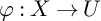 $\varphi : X \rightarrow U$
such that
$\varphi : X \rightarrow U$
such that $U \simeq \mathbb {P}^n$
or
$U \simeq \mathbb {P}^n$
or $U \simeq Q^n$
and M is the pullback of a smooth divisor
$U \simeq Q^n$
and M is the pullback of a smooth divisor $N \subset U$
that is normal split.
$N \subset U$
that is normal split.
Moreover, if $n\geq 3,$
then N is a hyperplane section and if
$n\geq 3,$
then N is a hyperplane section and if $n=2,$
then N is either a hyperplane section or
$n=2,$
then N is either a hyperplane section or $Y=\mathbb {P}^1\times \mathbb {P}^1$
and there is a non-negative integer a such that N has bidegree
$Y=\mathbb {P}^1\times \mathbb {P}^1$
and there is a non-negative integer a such that N has bidegree $(1,a)$
or
$(1,a)$
or $(a,1)$
.
$(a,1)$
.
The most difficult case in the proof of this statement is when the divisor M is ample. In this case, we have $X=U$
and our goal is to show that X is the projective space or a smooth quadric. The key observation is that the divisor
$X=U$
and our goal is to show that X is the projective space or a smooth quadric. The key observation is that the divisor $M \subset X$
satisfies the technical conditions in the paper [Reference Beauville and Mérindol1], and therefore, it is the fixed locus of an involution
$M \subset X$
satisfies the technical conditions in the paper [Reference Beauville and Mérindol1], and therefore, it is the fixed locus of an involution $\sigma $
on X. In particular, we have a two-to-one cover
$\sigma $
on X. In particular, we have a two-to-one cover $X \rightarrow X/\sigma $
. If the Picard number of X is 1, we conclude using a result of Hwang and Mok [Reference Hwang and Mok7]. If the Picard number is at least 2, we study the Mori contractions on X to obtain a contradiction (unless
$X \rightarrow X/\sigma $
. If the Picard number of X is 1, we conclude using a result of Hwang and Mok [Reference Hwang and Mok7]. If the Picard number is at least 2, we study the Mori contractions on X to obtain a contradiction (unless $\dim X=2$
and X is a quadric).
$\dim X=2$
and X is a quadric).
For the general situation, note that a prime divisor M in a rational homogeneous space X always defines a basepoint-free linear system and therefore induces a fibration
 $$ \begin{align*}\varphi:= \varphi_{|M|}: X \rightarrow U \end{align*} $$
onto a variety of dimension $n := \kappa (X, M)$
. Let
$n := \kappa (X, M)$
. Let $N \subset U$
be the smooth ample divisor such that
$N \subset U$
be the smooth ample divisor such that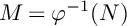 $M=\varphi ^{-1}(N)$
. We show that
$M=\varphi ^{-1}(N)$
. We show that $N \subset U$
normal split and conclude with a case distinction based on our analysis of the ample case.
$N \subset U$
normal split and conclude with a case distinction based on our analysis of the ample case.
2 Notation and basic facts
We work over the complex numbers, for general definitions, we refer to [Reference Hartshorne6]. Varieties will always be supposed to be irreducible and reduced. We use the terminology of [Reference Debarre3], [Reference Kollár and Mori9] for birational geometry and notions from the minimal model program. We follow [Reference Lazarsfeld12] for algebraic notions of positivity.
If X is a projective variety, then $\mbox {Aut}^{\circ }(X)$
denotes the connected component of
$\mbox {Aut}^{\circ }(X)$
denotes the connected component of $\mbox {Aut}(X)$
containing the identity.
$\mbox {Aut}(X)$
containing the identity.
A fibration is a surjective projective morphism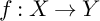 $f: X \rightarrow Y$
with connected fibers between normal varieties such that
$f: X \rightarrow Y$
with connected fibers between normal varieties such that $\dim X>\dim Y$
. The fibration is locally trivial with fiber F if for every
$\dim X>\dim Y$
. The fibration is locally trivial with fiber F if for every $y \in Y,$
there exist an analytic neighborhood
$y \in Y,$
there exist an analytic neighborhood $U \subset Y$
such that
$U \subset Y$
such that $f^{-1} (U)$
is biholomorphic to
$f^{-1} (U)$
is biholomorphic to $U \times F$
.
$U \times F$
.
For a submanifold $i\colon M \hookrightarrow X$
of a complex manifold X, we will simply denote the tangent map by
$i\colon M \hookrightarrow X$
of a complex manifold X, we will simply denote the tangent map by

We recall the three basic examples of normal split submanifolds.
Example 2.1. Let $\tau :X \rightarrow Y$
be a degree two branched covering between complex manifolds. Then, the ramification divisor
$\tau :X \rightarrow Y$
be a degree two branched covering between complex manifolds. Then, the ramification divisor $R \subset X$
is normal split. In fact, the tangent map
$R \subset X$
is normal split. In fact, the tangent map $\mathrm {d}\tau : T_X \rightarrow \tau ^* T_Y$
has rank
$\mathrm {d}\tau : T_X \rightarrow \tau ^* T_Y$
has rank $\dim X-1$
along R and its image is
$\dim X-1$
along R and its image is $\tau ^* T_B$
, where
$\tau ^* T_B$
, where $B \subset Y$
is the branch divisor. Since
$B \subset Y$
is the branch divisor. Since $\tau |_R$
is an isomorphism onto B, the map
$\tau |_R$
is an isomorphism onto B, the map

defines a splitting.
Example 2.2. Let $\tau :X \rightarrow Y$
be a fibration between complex manifolds, and let
$\tau :X \rightarrow Y$
be a fibration between complex manifolds, and let ${\sigma : Y \rightarrow X}$
be a section. Then,
${\sigma : Y \rightarrow X}$
be a section. Then, $M:= \sigma (Y) \subset X$
is normal split. Indeed, since
$M:= \sigma (Y) \subset X$
is normal split. Indeed, since $\tau \circ \sigma =\mathrm {id}_Y$
, it is clear that the restriction of the tangent map
$\tau \circ \sigma =\mathrm {id}_Y$
, it is clear that the restriction of the tangent map $T_\varphi $
to M defines a splitting.
$T_\varphi $
to M defines a splitting.
In particular, if $X=\mathbb {P}^1 \times \mathbb {P}^1$
and
$X=\mathbb {P}^1 \times \mathbb {P}^1$
and $M \in |{\mathcal O}_{\mathbb {P}^1 \times \mathbb {P}^1}(1,a)|$
is a smooth curve, then
$M \in |{\mathcal O}_{\mathbb {P}^1 \times \mathbb {P}^1}(1,a)|$
is a smooth curve, then $M \subset X$
is normal split.
$M \subset X$
is normal split.
Example 2.3. Let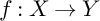 $f:X \rightarrow Y$
be a fibration between rational homogeneous manifolds, and let F be a fiber of f. Then, F is normal split. Indeed, since X is homogeneous, f is smooth, and its fibers are all biholomorphic. By the Fischer–Grauert theorem, f is locally trivial and thus F is normal split. In particular, F is rational homogeneous, for example, by [Reference Floris and Höring5].
$f:X \rightarrow Y$
be a fibration between rational homogeneous manifolds, and let F be a fiber of f. Then, F is normal split. Indeed, since X is homogeneous, f is smooth, and its fibers are all biholomorphic. By the Fischer–Grauert theorem, f is locally trivial and thus F is normal split. In particular, F is rational homogeneous, for example, by [Reference Floris and Höring5].
3 Normal split divisors
The goal of this section is to show the following key step toward Theorem 1.1
Theorem 3.1. Let X be a rational homogeneous space of dimension $n\geq 3$
, and let
$n\geq 3$
, and let $M \subset X$
be a smooth ample divisor that is normal split. Then, either
$M \subset X$
be a smooth ample divisor that is normal split. Then, either $X \simeq \mathbb {P}^n$
or
$X \simeq \mathbb {P}^n$
or $X \simeq Q^n$
. In both cases, M is a hyperplane section.
$X \simeq Q^n$
. In both cases, M is a hyperplane section.
3.1. Involutions and the case of Picard rank 1
We reformulate results in [Reference Beauville and Mérindol1] in the following proposition.
Proposition 3.2. Let X be a rational homogeneous space of dimension $n\geq 3$
and let
$n\geq 3$
and let $M \subset X$
be a smooth ample divisor that is normal split. Assume that
$M \subset X$
be a smooth ample divisor that is normal split. Assume that $(X, {\mathcal O}_X(M))$
is not
$(X, {\mathcal O}_X(M))$
is not $(\mathbb {P}^n, {\mathcal O}_{\mathbb {P}^n}(1))$
. Then, there is an involution of X with fixed locus M.
$(\mathbb {P}^n, {\mathcal O}_{\mathbb {P}^n}(1))$
. Then, there is an involution of X with fixed locus M.
Proof. By [Reference Ramanathan14, Theorem 3.11] the ring of global sections $\bigoplus _{k \in \mathbb {N}} H^0(X, {\mathcal O}_X(kM))$
is generated in degree one, so M is very ample and defines an embedding
$\bigoplus _{k \in \mathbb {N}} H^0(X, {\mathcal O}_X(kM))$
is generated in degree one, so M is very ample and defines an embedding
 $$ \begin{align*}i : X \hookrightarrow \mathbb{P}^N \end{align*} $$
such that $M = X \cap H$
with
$M = X \cap H$
with $H \subset \mathbb {P}^N$
a hyperplane. By [Reference Ramanathan14, Theorem 3.11(i), Remark 3.12] the variety
$H \subset \mathbb {P}^N$
a hyperplane. By [Reference Ramanathan14, Theorem 3.11(i), Remark 3.12] the variety $X \subset \mathbb {P}^N$
is an intersection of quadrics, so we can apply [Reference Beauville and Mérindol1, corollaire 2, remarque (3)] to get the statement. For the convenience of the reader, let us sketch their remarkable argument: note first that the splitting map
$X \subset \mathbb {P}^N$
is an intersection of quadrics, so we can apply [Reference Beauville and Mérindol1, corollaire 2, remarque (3)] to get the statement. For the convenience of the reader, let us sketch their remarkable argument: note first that the splitting map  induces a map
  . Since $M \in |{\mathcal O}_X(1)|,$
the splitting of the normal sequence is thus given by a non-zero morphism
$M \in |{\mathcal O}_X(1)|,$
the splitting of the normal sequence is thus given by a non-zero morphism  . Consider the exact sequence

The section j induces a section  such that $u(s)=0$
. Now consider the twisted Euler sequence restricted to M:
$u(s)=0$
. Now consider the twisted Euler sequence restricted to M:

Since $\dim M \geq 2,$
we have by Kodaira’s theorem
$\dim M \geq 2,$
we have by Kodaira’s theorem $H^0(M, {\mathcal O}_M(-1))=H^1(M, {\mathcal O}_M(-1))=0$
. Thus, the restriction map
$H^0(M, {\mathcal O}_M(-1))=H^1(M, {\mathcal O}_M(-1))=0$
. Thus, the restriction map

is an isomorphism. Repeating the argument for the twisted Euler sequence, we obtain an isomorphism

Thus, up to linear coordinate change, the section s is the restriction of an Euler vector field $l(x) \frac {\partial }{\partial X_0}$
with l a linear form.
$l(x) \frac {\partial }{\partial X_0}$
with l a linear form.
Step 1. We claim that if $x \in M$
, then the projective tangent space
$x \in M$
, then the projective tangent space $\mathbb {P}(T_{X,x}) \subset \mathbb {P}^N$
passes through the point
$\mathbb {P}(T_{X,x}) \subset \mathbb {P}^N$
passes through the point $p:= (1:0: \dots :0)$
.
$p:= (1:0: \dots :0)$
.
Let $V \subset \mathbb {P}^N$
be the vanishing set of the Euler vector field, that is, the union of the hyperplane
$V \subset \mathbb {P}^N$
be the vanishing set of the Euler vector field, that is, the union of the hyperplane $l=0$
and a point. Note that
$l=0$
and a point. Note that $M \not \subset V$
since otherwise
$M \not \subset V$
since otherwise $s=0$
. In order to show the claim, we can assume without loss of generality that
$s=0$
. In order to show the claim, we can assume without loss of generality that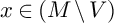 $x \in (M \setminus V)$
, the general case will just follow by passing to the limit.
$x \in (M \setminus V)$
, the general case will just follow by passing to the limit.
We can choose homogeneous polynomials $F_1, \ldots , F_k$
vanishing on X such that
$F_1, \ldots , F_k$
vanishing on X such that ${\mathbb {P}(T_{X,x}) = \cap _{j=1}^k \mathbb {P}(T_{V(F_j), x}),}$
where
${\mathbb {P}(T_{X,x}) = \cap _{j=1}^k \mathbb {P}(T_{V(F_j), x}),}$
where $\mathbb {P}(T_{V(F_j), x}) \subset \mathbb {P}^N$
is the hyperplane defined by the equation
$\mathbb {P}(T_{V(F_j), x}) \subset \mathbb {P}^N$
is the hyperplane defined by the equation $\sum _{i=0}^N \frac {\partial F_j}{\partial X_i}(x) X_i=0$
. It is clearly sufficient to show that
$\sum _{i=0}^N \frac {\partial F_j}{\partial X_i}(x) X_i=0$
. It is clearly sufficient to show that
 $$ \begin{align*}p \in \mathbb{P}(T_{V(F_j), x}). \end{align*} $$
Yet this is equivalent to showing that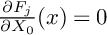 $\frac {\partial F_j}{\partial X_0}(x)=0$
. Since
$\frac {\partial F_j}{\partial X_0}(x)=0$
. Since $x \not \in V$
, the vector field
$x \not \in V$
, the vector field $l(x) \frac {\partial }{\partial X_0}$
does not vanish in a neighborhood of x. Yet the condition
$l(x) \frac {\partial }{\partial X_0}$
does not vanish in a neighborhood of x. Yet the condition $u(s)=0$
is equivalent
$u(s)=0$
is equivalent  , so the derivation $\frac {\partial F_j}{\partial X_0}(x)$
vanishes.
$\frac {\partial F_j}{\partial X_0}(x)$
vanishes.
Step 2. We have $p \not \in M$
. We argue by contradiction. By Step 1, we have
$p \not \in M$
. We argue by contradiction. By Step 1, we have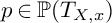 $p \in \mathbb {P}(T_{X,x})$
for every
$p \in \mathbb {P}(T_{X,x})$
for every $x \in M$
. Since
$x \in M$
. Since $M = X \cap H$
is smooth, we have
$M = X \cap H$
is smooth, we have $\mathbb {P}(T_{M,x}) = \mathbb {P}(T_{X,x}) \cap H$
for every
$\mathbb {P}(T_{M,x}) = \mathbb {P}(T_{X,x}) \cap H$
for every $x \in M$
. Thus, we have
$x \in M$
. Thus, we have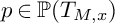 $p \in \mathbb {P}(T_{M,x})$
for every
$p \in \mathbb {P}(T_{M,x})$
for every $x \in M$
. Take now
$x \in M$
. Take now $H_1, \ldots , H_{\dim M-1}$
general hyperplane sections passing through p. Then,
$H_1, \ldots , H_{\dim M-1}$
general hyperplane sections passing through p. Then, $C:= M \cap H_1 \cap \cdots H_{\dim M-1}$
is a smooth curve such that
$C:= M \cap H_1 \cap \cdots H_{\dim M-1}$
is a smooth curve such that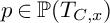 $p \in \mathbb {P}(T_{C,x})$
for every
$p \in \mathbb {P}(T_{C,x})$
for every $x \in C$
. By [Reference Hartshorne6, Chapter IV, Proposition 3.9] the curve C is a line and therefore
$x \in C$
. By [Reference Hartshorne6, Chapter IV, Proposition 3.9] the curve C is a line and therefore $(X, {\mathcal O}_X(M)) \simeq (\mathbb {P}^n, {\mathcal O}_{\mathbb {P}^n}(1))$
, a contradiction to our assumption.
$(X, {\mathcal O}_X(M)) \simeq (\mathbb {P}^n, {\mathcal O}_{\mathbb {P}^n}(1))$
, a contradiction to our assumption.
Step 3. Conclusion. Let $\sigma :\mathbb {P}^N \rightarrow \mathbb {P}^N$
be the involution fixing pointwise the point p and the hyperplane H. Let
$\sigma :\mathbb {P}^N \rightarrow \mathbb {P}^N$
be the involution fixing pointwise the point p and the hyperplane H. Let $Q \subset \mathbb {P}^N$
be a quadric that contains X, then
$Q \subset \mathbb {P}^N$
be a quadric that contains X, then $\sigma (Q)=Q$
by [Reference Beauville and Mérindol1, Corollary 1]. Since X is an intersection of quadrics, we obtain that
$\sigma (Q)=Q$
by [Reference Beauville and Mérindol1, Corollary 1]. Since X is an intersection of quadrics, we obtain that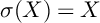 $\sigma (X)=X$
and therefore the sought involution is
$\sigma (X)=X$
and therefore the sought involution is $\sigma _X:=\sigma \vert _X$
. We are left to show that the fixed locus of
$\sigma _X:=\sigma \vert _X$
. We are left to show that the fixed locus of $\sigma _X$
is M, that is, we have to show that
$\sigma _X$
is M, that is, we have to show that $p \not \in X$
. Yet again by [Reference Beauville and Mérindol1, Corollary 1] a quadric Q with
$p \not \in X$
. Yet again by [Reference Beauville and Mérindol1, Corollary 1] a quadric Q with $X \subset Q$
and
$X \subset Q$
and $p \in Q$
is singular in p. Thus, X would be an intersection of quadric cones with vertex the point p, so itself a cone. Yet X is smooth, so we get again
$p \in Q$
is singular in p. Thus, X would be an intersection of quadric cones with vertex the point p, so itself a cone. Yet X is smooth, so we get again $(X, {\mathcal O}_X(M)) \simeq (\mathbb {P}^n, {\mathcal O}_{\mathbb {P}^n}(1))$
, the final contradiction.
$(X, {\mathcal O}_X(M)) \simeq (\mathbb {P}^n, {\mathcal O}_{\mathbb {P}^n}(1))$
, the final contradiction.
It is well-known that if $B \subset \mathbb {P}^N$
is a smooth hypersurface, the variety B is rational homogeneous if and only if
$B \subset \mathbb {P}^N$
is a smooth hypersurface, the variety B is rational homogeneous if and only if $\deg B \leq 2$
. We now combine this basic fact with a difficult result of Hwang and Mok.
$\deg B \leq 2$
. We now combine this basic fact with a difficult result of Hwang and Mok.
Corollary 3.3. Let X be a rational homogeneous space of dimension n and Picard number 1. Let $\tau \colon X\to Y$
be a degree two finite morphism ramified along a smooth divisor H of X. Then, X is a smooth quadric.
$\tau \colon X\to Y$
be a degree two finite morphism ramified along a smooth divisor H of X. Then, X is a smooth quadric.
Proof. By [Reference Hwang and Mok7, Main Theorem] the manifold Y is isomorphic to $\mathbb P^n$
. The ramification divisor is a rational homogeneous space because it is normal split in X. Thus, the branch locus
$\mathbb P^n$
. The ramification divisor is a rational homogeneous space because it is normal split in X. Thus, the branch locus $B \simeq R \subseteq \mathbb P^n$
is homogeneous and therefore of degree at most two. Moreover, B is divisible by 2 in
$B \simeq R \subseteq \mathbb P^n$
is homogeneous and therefore of degree at most two. Moreover, B is divisible by 2 in  , so B is a smooth quadric in $\mathbb P^n$
. The covering
$\mathbb P^n$
. The covering $\tau $
is thus induced by the data
$\tau $
is thus induced by the data  , where H is the hyperplane class. The ramification formula $K_X=\tau ^*(-(n+1)H+H)$
implies that
$K_X=\tau ^*(-(n+1)H+H)$
implies that $-K_X$
is divisible by n. By the Kobayashi–Ochiai criterion, this shows that X is a quadric.
$-K_X$
is divisible by n. By the Kobayashi–Ochiai criterion, this shows that X is a quadric.
Corollary 3.4. Let X be a rational homogeneous space of dimension $n \geq 3$
of Picard number 1, and let
$n \geq 3$
of Picard number 1, and let $M \subset X$
be a smooth ample divisor that is normal split. Then, either
$M \subset X$
be a smooth ample divisor that is normal split. Then, either $X \simeq \mathbb {P}^n$
or
$X \simeq \mathbb {P}^n$
or $X \simeq Q^n$
and M is a hyperplane section.
$X \simeq Q^n$
and M is a hyperplane section.



3.2. Case of higher Picard rank
The goal of this section is to show that in the setup of Theorem 3.1, the Picard number of X is 1. If $\rho (X)>1,$
Proposition 3.2 still provides an involution
$\rho (X)>1,$
Proposition 3.2 still provides an involution $\sigma : X \rightarrow X$
, but the theorem of Hwang and Mok [Reference Hwang and Mok7] does not apply. Thus, we study the Mori fibrations on X and their interaction with the involution
$\sigma : X \rightarrow X$
, but the theorem of Hwang and Mok [Reference Hwang and Mok7] does not apply. Thus, we study the Mori fibrations on X and their interaction with the involution $\sigma $
to obtain a contradiction. Note that Lau [Reference Lau11] generalized [Reference Hwang and Mok7] to rational homogeneous spaces
$\sigma $
to obtain a contradiction. Note that Lau [Reference Lau11] generalized [Reference Hwang and Mok7] to rational homogeneous spaces $X=G/P$
with G a simple Lie group, thereby providing an alternative approach to this setting.
$X=G/P$
with G a simple Lie group, thereby providing an alternative approach to this setting.
Proposition 3.5. Let X be a rational homogeneous space of Picard number at least two, and let $M \subset X$
be a smooth ample divisor that is normal split.
$M \subset X$
be a smooth ample divisor that is normal split.
-
• If
$\dim X=2$
(and hence
$X \simeq \mathbb {P}^1 \times \mathbb {P}^1$
), then M is a section of one of the rulings. -
• If
$\dim X \geq 3$
, there exists an elementary Mori contraction
$X \rightarrow Y$
induced by an extremal ray
$\Gamma $
such that
$(K_X+M) \cdot \Gamma <0$
. Moreover, for each contraction of this type, we have
$\dim X \geq 2 \dim Y$
.





Proof. Without any assumption on the dimension, observe first that $K_M= (K_X+M)|_M$
is not nef since the normal split divisor
$K_M= (K_X+M)|_M$
is not nef since the normal split divisor $M \subset X$
is rational homogeneous [Reference Floris and Höring5]. Applying the cone theorem to the Fano manifold
$M \subset X$
is rational homogeneous [Reference Floris and Höring5]. Applying the cone theorem to the Fano manifold $X,$
we obtain that there exists an extremal ray
$X,$
we obtain that there exists an extremal ray $\Gamma $
such that
$\Gamma $
such that $(K_X+M) \cdot \Gamma <0$
, denote the corresponding contraction by
$(K_X+M) \cdot \Gamma <0$
, denote the corresponding contraction by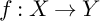 $f: X \rightarrow Y$
.
$f: X \rightarrow Y$
.
1st case. Assume that $\dim X-\dim Y=1$
. Then, the general fiber F is
$\dim X-\dim Y=1$
. Then, the general fiber F is $\mathbb {P}^1$
, so
$\mathbb {P}^1$
, so $K_X \cdot F=-2$
and
$K_X \cdot F=-2$
and $M \cdot F>0$
implies that
$M \cdot F>0$
implies that $M \cdot F=1$
. Thus, M is a rational section of f. Since M is homogeneous, the birational morphism
$M \cdot F=1$
. Thus, M is a rational section of f. Since M is homogeneous, the birational morphism $M \rightarrow Y$
is an isomorphism, hence, M is even a section. By [Reference Kollár10, Appendix, Lemma (1)] this implies that
$M \rightarrow Y$
is an isomorphism, hence, M is even a section. By [Reference Kollár10, Appendix, Lemma (1)] this implies that $\dim X \leq 2$
. Thus, we have
$\dim X \leq 2$
. Thus, we have $\dim X=2$
and M is a section of the ruling f.
$\dim X=2$
and M is a section of the ruling f.
2nd case. Assume that $\dim X-\dim Y>1$
. Note that this implies
$\dim X-\dim Y>1$
. Note that this implies $\dim X>2$
since otherwise we would have
$\dim X>2$
since otherwise we would have $\rho (X)=1$
. Let F be a general fiber of F. Since
$\rho (X)=1$
. Let F be a general fiber of F. Since $(F \cap M) \subset F$
is an ample divisor of dimension at least one, it is connected. Thus, f induces a fibration
$(F \cap M) \subset F$
is an ample divisor of dimension at least one, it is connected. Thus, f induces a fibration $f|_M:M \rightarrow Z$
. Since M is rational homogeneous, the fibration
$f|_M:M \rightarrow Z$
. Since M is rational homogeneous, the fibration $f|_M$
has maximal rank. Thus, a theorem of Sommese [Reference Sommese15, Proposition V] implies that
$f|_M$
has maximal rank. Thus, a theorem of Sommese [Reference Sommese15, Proposition V] implies that $\dim X \geq 2 \dim Y$
.
$\dim X \geq 2 \dim Y$
.
Lemma 3.6. Let X be a rational homogeneous space and let $f\colon X\to Z$
be a fibration. Then, for a fiber
$f\colon X\to Z$
be a fibration. Then, for a fiber $F,$
one has
$F,$
one has $\rho (F)=\rho (X)-\rho (Z)$
.
$\rho (F)=\rho (X)-\rho (Z)$
.
Proof. Since X is rational homogeneous, the fibration f is smooth. Thus, by [Reference Codogni, Fanelli, Svaldi and Tasin2, Theorem 2.2] the local system  is a local system on Z with finite monodromy. Since Z is simply connected, it is a trivial local system. The statement follows.
Let us recall that if X is $\mathbb Q$
-factorial and
$\mathbb Q$
-factorial and $X \rightarrow Y$
is a finite surjective morphism between normal varieties, then Y is
$X \rightarrow Y$
is a finite surjective morphism between normal varieties, then Y is $\mathbb Q$
-factorial [Reference Kollár and Mori9, Lemma 5.16].
$\mathbb Q$
-factorial [Reference Kollár and Mori9, Lemma 5.16].
Lemma 3.7. Let X be a $\mathbb Q$
-factorial normal projective variety. Let
$\mathbb Q$
-factorial normal projective variety. Let $\sigma \colon X\to X$
be a finite order automorphism and let
$\sigma \colon X\to X$
be a finite order automorphism and let $\tau \colon X\to Y:=X/\langle \sigma \rangle $
be the induced Galois cover.
$\tau \colon X\to Y:=X/\langle \sigma \rangle $
be the induced Galois cover.
-
1. If
$\sigma _*\colon N_1(X)_{\mathbb R}\to N_1(X)_{\mathbb R}$
leaves each extremal ray of invariant, then
$\sigma _*$
is the identity. -
2. If
$\sigma _*\colon N_1(X)_{\mathbb R}\to N_1(X)_{\mathbb R}$
is the identity map, then
$\tau _*\colon N_1(X)_{\mathbb R}\to N_1(Y)_{\mathbb R}$
induces an isomorphism .

 invariant, then


 .
.Proof. Fix a $k \in \mathbb {N}$
such that
$k \in \mathbb {N}$
such that $\sigma ^k = \mathrm {id}$
.
$\sigma ^k = \mathrm {id}$
.
We start with (1). Let R be an extremal ray in  , then by assumption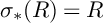 $\sigma _*(R)=R$
. Choose
$\sigma _*(R)=R$
. Choose $0 \neq v\in R$
, then v is an eigenvector with eigenvalue
$0 \neq v\in R$
, then v is an eigenvector with eigenvalue $\lambda \in \mathbb {R}$
. Since
$\lambda \in \mathbb {R}$
. Since $\sigma ^k=id$
, we have
$\sigma ^k=id$
, we have $\sigma _*v=\pm v $
. Yet
$\sigma _*v=\pm v $
. Yet  , so we have $\sigma _*v=v $
. The extremal rays of
$\sigma _*v=v $
. The extremal rays of  span
span $N_1(X)_{\mathbb R}$
, therefore,
$N_1(X)_{\mathbb R}$
, therefore, $\sigma _*$
is the identity.
$\sigma _*$
is the identity.
As for (2), we first prove that $\tau ^*\colon N^1(Y)_{\mathbb R}\to N^1(X)_{\mathbb R}$
is an isomorphism. The map
$\tau ^*\colon N^1(Y)_{\mathbb R}\to N^1(X)_{\mathbb R}$
is an isomorphism. The map $\tau ^*$
is always injective. To show that it is surjective, let
$\tau ^*$
is always injective. To show that it is surjective, let $[D]\in N^1(X)_{\mathbb R}$
. Since
$[D]\in N^1(X)_{\mathbb R}$
. Since $\sigma _*$
and therefore
$\sigma _*$
and therefore $\sigma ^*$
is the identity, we have
$\sigma ^*$
is the identity, we have
 $$ \begin{align*}[kD]=\left(\sum_0^{k-1} (\sigma^i)^*[D]\right)=\tau^*\tau_*[D], \end{align*} $$
proving that $D=\tau ^*\tau _*[1/k D]$
.
$D=\tau ^*\tau _*[1/k D]$
.
Moreover, $\tau ^*$
induces an isomorphism between the nef cones of X and Y. Passing to the dual cones, we get the claim.
$\tau ^*$
induces an isomorphism between the nef cones of X and Y. Passing to the dual cones, we get the claim.
Remark 3.8. Let $\tau : X \rightarrow Y$
be a double cover between projective manifolds of dimension
$\tau : X \rightarrow Y$
be a double cover between projective manifolds of dimension $n \geq 4$
. Then,
$n \geq 4$
. Then, $\tau $
induces an isomorphism from the ramification divisor
$\tau $
induces an isomorphism from the ramification divisor $R \subset X$
onto the branch locus
$R \subset X$
onto the branch locus $B \subset Y$
. Assume that R (or equivalently B) is an ample divisor. Since
$B \subset Y$
. Assume that R (or equivalently B) is an ample divisor. Since $n>3,$
we know by the Lefschetz hyperplane theorem that
$n>3,$
we know by the Lefschetz hyperplane theorem that
 $$ \begin{align*}\rho(X)=\rho(R)=\rho(B)=\rho(Y). \end{align*} $$
We will frequently use the following technical statement.
Lemma 3.9. Let X be a rational homogeneous space, and let
 $$ \begin{align*}f_i:X \rightarrow Z_i \end{align*} $$
be two distinct contractions of extremal rays on X, for $i=1,2$
. Then, the map
$i=1,2$
. Then, the map
 $$ \begin{align*}f:=f_1 \times f_2:X \rightarrow Z_1 \times Z_2 \end{align*} $$
is $\mbox {Aut}^{\circ }(X)$
-equivariant and an embedding, that is, an isomorphism onto its image.
$\mbox {Aut}^{\circ }(X)$
-equivariant and an embedding, that is, an isomorphism onto its image.
Proof. The fibrations $f_i$
are
$f_i$
are $\mbox {Aut}^{\circ }(X)$
-equivariant by Blanchard’s lemma, so it is clear that f is also equivariant. For every point
$\mbox {Aut}^{\circ }(X)$
-equivariant by Blanchard’s lemma, so it is clear that f is also equivariant. For every point $(z_1, z_2) \in f(X)$
, we have
$(z_1, z_2) \in f(X)$
, we have $f^{-1} ((z_1, z_2))= f_1^{-1} (z_1) \cap f_2^{-1} (z_2)$
. Since the extremal rays are distinct, their fibers intersect in at most finitely many points. This implies that
$f^{-1} ((z_1, z_2))= f_1^{-1} (z_1) \cap f_2^{-1} (z_2)$
. Since the extremal rays are distinct, their fibers intersect in at most finitely many points. This implies that $f\colon X \to f(X)$
is finite. Since
$f\colon X \to f(X)$
is finite. Since $\mbox {Aut}^{\circ }(X)$
acts transitively on
$\mbox {Aut}^{\circ }(X)$
acts transitively on $X,$
the equivariance of f implies that
$X,$
the equivariance of f implies that $f(X)$
is smooth and
$f(X)$
is smooth and $f: X \rightarrow f(X)$
is étale. Since
$f: X \rightarrow f(X)$
is étale. Since $f(X)$
is rationally connected and smooth, it is simply connected. Thus, the étale map
$f(X)$
is rationally connected and smooth, it is simply connected. Thus, the étale map $f: X \rightarrow f(X)$
is an isomorphism.
$f: X \rightarrow f(X)$
is an isomorphism.
Lemma 3.10. Let X be a rational homogeneous space, and let $M \subset X$
be a smooth ample divisor. Assume that there is a finite morphism of degree two
$M \subset X$
be a smooth ample divisor. Assume that there is a finite morphism of degree two $\tau \colon X\to Y$
ramified along M such that
$\tau \colon X\to Y$
ramified along M such that $\sigma _*$
is not the identity on
$\sigma _*$
is not the identity on $NE(X)$
, where
$NE(X)$
, where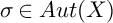 $\sigma \in Aut(X)$
is the automorphism of the cover
$\sigma \in Aut(X)$
is the automorphism of the cover $\tau $
. Then,
$\tau $
. Then, $X\cong \mathbb {P}^1\times \mathbb {P}^1$
.
$X\cong \mathbb {P}^1\times \mathbb {P}^1$
.
Proof. The Mori cone of a Fano manifold is generated by its extremal rays and $\sigma _*$
acts by permutation on them. If the permutation is trivial, then
$\sigma _*$
acts by permutation on them. If the permutation is trivial, then $\sigma _*$
is the identity by Lemma 3.7(1).
$\sigma _*$
is the identity by Lemma 3.7(1).
Thus, we can assume that there exists an extremal ray $\Gamma _1$
such that
$\Gamma _1$
such that $\Gamma _2 := \sigma _* \Gamma _1$
is distinct from
$\Gamma _2 := \sigma _* \Gamma _1$
is distinct from $\Gamma _1$
. Let
$\Gamma _1$
. Let $f_i\colon X\to Z_i$
for
$f_i\colon X\to Z_i$
for $i=1,2$
be the two
$i=1,2$
be the two $Aut^{\circ }(X)$
-equivariant fibrations induced by the two extremal rays of
$Aut^{\circ }(X)$
-equivariant fibrations induced by the two extremal rays of $NE(X)$
. By Lemma 3.9, the map
$NE(X)$
. By Lemma 3.9, the map
 $$ \begin{align*}f:=f_1 \times f_2:X \rightarrow Z_1 \times Z_2 \end{align*} $$
is an isomorphism onto its image.
By the rigidity lemma, there is an isomorphism $\sigma _Z$
making the following diagram commute:
$\sigma _Z$
making the following diagram commute:

Consider now the involution
 $$ \begin{align*}\begin{array}{rcl} i\,{:}\, Z_1\times Z_2&\to &Z_1\times Z_2\\ (z_1,z_2)&\mapsto&(\sigma_Z^{-1}z_2,\sigma_Z z_1). \end{array} \end{align*} $$
Let f be the embedding of Lemma 3.9. The image $f(M) \simeq M \subset Z_1 \times Z_2$
is contained in the fixed locus of i.
$f(M) \simeq M \subset Z_1 \times Z_2$
is contained in the fixed locus of i.
Moreover, i is conjugated by the isomorphism $(id,\sigma _Z^{-1})\colon Z_1\times Z_2\to Z_1\times Z_1$
to the involution
$(id,\sigma _Z^{-1})\colon Z_1\times Z_2\to Z_1\times Z_1$
to the involution
 $$ \begin{align*}\begin{array}{l@{\,}rcl} \iota: & Z_1\times Z_1&\to &Z_1\times Z_1\\ & (z_1,z_2)&\mapsto&(z_2,z_1). \end{array} \end{align*} $$
The fixed locus of $\iota $
is the diagonal
$\iota $
is the diagonal $\Delta \simeq Z_1$
, so we obtain that
$\Delta \simeq Z_1$
, so we obtain that $\dim M \leq \dim Z_1 \leq \dim X-1$
. Since M is a divisor in
$\dim M \leq \dim Z_1 \leq \dim X-1$
. Since M is a divisor in $X,$
we have equality and
$X,$
we have equality and $M \simeq Z_1$
. In particular, we have
$M \simeq Z_1$
. In particular, we have $\rho (M)=\rho (Z_1)=\rho (X)-1$
.
$\rho (M)=\rho (Z_1)=\rho (X)-1$
.
By the Lefschetz hyperplane theorem, the restriction map $N^1(X) \rightarrow N^1(M)$
is injective if
$N^1(X) \rightarrow N^1(M)$
is injective if $\dim X \geq 3$
. Thus, we obtain
$\dim X \geq 3$
. Thus, we obtain $\dim X \leq 2$
and therefore
$\dim X \leq 2$
and therefore $X\cong \mathbb {P}^1\times \mathbb {P}^1$
(note that the case of a projective space is excluded by the condition that
$X\cong \mathbb {P}^1\times \mathbb {P}^1$
(note that the case of a projective space is excluded by the condition that $\sigma _*$
is not the identity).
$\sigma _*$
is not the identity).
Lemma 3.11. Let X be a rational homogeneous space of dimension $n \geq 4$
, and let
$n \geq 4$
, and let $M \subset X$
be a smooth ample divisor. Assume that there is a finite morphism of degree two
$M \subset X$
be a smooth ample divisor. Assume that there is a finite morphism of degree two $\tau \colon X\to Y$
ramified along M such that
$\tau \colon X\to Y$
ramified along M such that $\sigma _*$
is the identity on
$\sigma _*$
is the identity on $NE(X)$
, where
$NE(X)$
, where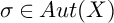 $\sigma \in Aut(X)$
is the automorphism of the cover
$\sigma \in Aut(X)$
is the automorphism of the cover $\tau $
.
$\tau $
.
Then, $-K_X-M$
is ample.
$-K_X-M$
is ample.
Proof. Since $n \geq 4,$
we know by Remark 3.8 that
$n \geq 4,$
we know by Remark 3.8 that $\rho (X)=\rho (Y)$
.
$\rho (X)=\rho (Y)$
.
Since M is rational homogeneous, it is clear that $-K_M=(-K_X-M)|_M$
is ample, but it is not so clear for
$-K_M=(-K_X-M)|_M$
is ample, but it is not so clear for $-K_X-M$
itself. Arguing by contradiction, we set
$-K_X-M$
itself. Arguing by contradiction, we set $0 < \lambda \leq 1$
such that
$0 < \lambda \leq 1$
such that $-K_X - \lambda M$
is a nef, but non-ample divisor class. Note that in general
$-K_X - \lambda M$
is a nef, but non-ample divisor class. Note that in general $\lambda \in \mathbb {R}$
, but since the Mori cone of the Fano manifold X is rational polyhedral, we have
$\lambda \in \mathbb {R}$
, but since the Mori cone of the Fano manifold X is rational polyhedral, we have $\lambda \in \mathbb {Q}$
. Moreover, by the cone theorem, there exists an extremal ray
$\lambda \in \mathbb {Q}$
. Moreover, by the cone theorem, there exists an extremal ray $\Gamma $
such that
$\Gamma $
such that $(-K_X-\lambda M) \cdot \Gamma =0$
, and we denote by
$(-K_X-\lambda M) \cdot \Gamma =0$
, and we denote by
 $$ \begin{align*}f: X \rightarrow T \end{align*} $$
its contraction. Since X is rational homogeneous, the fibration is of fiber type and a locally trivial fibration with general fiber F with $\rho (F)=1$
(by Lemma 3.6).
$\rho (F)=1$
(by Lemma 3.6).
Since $\sigma _*$
acts as the identity on
$\sigma _*$
acts as the identity on $N_1(X)$
, the image of the extremal ray
$N_1(X)$
, the image of the extremal ray $\tau _* \Gamma $
is an extremal ray in
$\tau _* \Gamma $
is an extremal ray in $NE(Y)$
by Lemma 3.7(2), and we denote its contraction by
$NE(Y)$
by Lemma 3.7(2), and we denote its contraction by
 $$ \begin{align*}g: Y \rightarrow U. \end{align*} $$
By the rigidity lemma, we have an induced morphism $\bar \tau :T \rightarrow U$
such that
$\bar \tau :T \rightarrow U$
such that

commutes. Since $\rho (X)=\rho (Y),$
we have
$\rho (X)=\rho (Y),$
we have
 $$ \begin{align*}\rho(T)=\rho(X)-1=\rho(Y)-1=\rho(U). \end{align*} $$
Thus, the morphism $\bar \tau $
is finite, and we claim that it is actually an isomorphism. We argue by contradiction. Since
$\bar \tau $
is finite, and we claim that it is actually an isomorphism. We argue by contradiction. Since $\tau $
is two-to-one, it is clear that
$\tau $
is two-to-one, it is clear that $\bar \tau $
is then also two-to-one. In what follows, we denote by
$\bar \tau $
is then also two-to-one. In what follows, we denote by $G=g^{-1} (u)$
a general g-fiber.
$G=g^{-1} (u)$
a general g-fiber.
1st case. Assume that the fibers of f and g have dimension one. In this case $G \simeq \mathbb {P}^1$
. Since
$G \simeq \mathbb {P}^1$
. Since $\bar \tau ^{-1} (u)$
consists of two points, the preimage
$\bar \tau ^{-1} (u)$
consists of two points, the preimage $\tau ^{-1} (G)$
has two connected components
$\tau ^{-1} (G)$
has two connected components $F_1 \cup F_2$
mapping isomorphically onto G. Yet
$F_1 \cup F_2$
mapping isomorphically onto G. Yet $-K_X \cdot G=2=-K_Y \cdot F_i$
since they are general fibers of the fibrations. Moreover, by the ramification formula,
$-K_X \cdot G=2=-K_Y \cdot F_i$
since they are general fibers of the fibrations. Moreover, by the ramification formula, $-K_X = \tau ^*(-K_Y) - M$
. Since
$-K_X = \tau ^*(-K_Y) - M$
. Since $\tau |_{F_i}$
is an isomorphism, we obtain
$\tau |_{F_i}$
is an isomorphism, we obtain $M \cdot F_i=0$
, a contradiction to the ampleness of M.
$M \cdot F_i=0$
, a contradiction to the ampleness of M.
2nd case. Assume that the fibers of f and g have dimension at least two. In this case, the restriction of g to $M \subset Y$
has connected fibers, since the intersection
$M \subset Y$
has connected fibers, since the intersection $M \cap G \subset G$
is an ample divisor. Since M is rational homogeneous (something that we do not know about Y), we obtain that
$M \cap G \subset G$
is an ample divisor. Since M is rational homogeneous (something that we do not know about Y), we obtain that $g|_M: M \rightarrow U$
is smooth and U is smooth and rational homogeneous by Blanchard’s lemma.
$g|_M: M \rightarrow U$
is smooth and U is smooth and rational homogeneous by Blanchard’s lemma.
The morphism $\bar \tau \colon T\to U$
is a finite morphism of degree two between rational homogeneous, and in particular Fano, varieties. Therefore, it cannot be étale.
$\bar \tau \colon T\to U$
is a finite morphism of degree two between rational homogeneous, and in particular Fano, varieties. Therefore, it cannot be étale.
Since $\bar \tau $
is of degree two and not étale, there exists by purity of branch, a prime divisor
$\bar \tau $
is of degree two and not étale, there exists by purity of branch, a prime divisor $B \subset U$
such that
$B \subset U$
such that $\bar \tau ^* B$
is not reduced. Thus,
$\bar \tau ^* B$
is not reduced. Thus, $f^* \bar \tau ^* B$
has a non-reduced irreducible component. Since g is an elementary Mori contraction, the preimage
$f^* \bar \tau ^* B$
has a non-reduced irreducible component. Since g is an elementary Mori contraction, the preimage $g^{-1} B$
is irreducible. As a consequence of the Graber–Harris–Starr theorem, the irreducible divisor
$g^{-1} B$
is irreducible. As a consequence of the Graber–Harris–Starr theorem, the irreducible divisor $g^* B$
is reduced. Yet
$g^* B$
is reduced. Yet $\tau ^* g^* B = f^* \bar \tau ^* B$
is not reduced, so
$\tau ^* g^* B = f^* \bar \tau ^* B$
is not reduced, so $g^* B$
is an irreducible component of the branch locus of
$g^* B$
is an irreducible component of the branch locus of $\tau $
. Yet
$\tau $
. Yet $\tau $
ramifies exactly along the ample divisor M, a contradiction.
$\tau $
ramifies exactly along the ample divisor M, a contradiction.
This finishes the proof of the claim that $\bar \tau $
is an isomorphism.
$\bar \tau $
is an isomorphism.
Thus, for any point $u \in U$
, we have an induced degree two cover
$u \in U$
, we have an induced degree two cover
 $$ \begin{align*}\tau_F: F := f^{-1} (\bar \tau^{-1}(u)) \rightarrow G := g^{-1} (u) \end{align*} $$
that ramifies along $F \cap M$
. Choose
$F \cap M$
. Choose $u \in U$
general so that G is smooth. The fiber F is rational homogeneous by Example 2.3. Since
$u \in U$
general so that G is smooth. The fiber F is rational homogeneous by Example 2.3. Since $\rho (F)=1,$
we can apply Corollary 3.3 to obtain that F is a quadric
$\rho (F)=1,$
we can apply Corollary 3.3 to obtain that F is a quadric $Q^d$
and
$Q^d$
and $G \simeq \mathbb {P}^d$
. Moreover, the divisor
$G \simeq \mathbb {P}^d$
. Moreover, the divisor $(F \cap M) \subset F$
is a hyperplane section, that is, an element of
$(F \cap M) \subset F$
is a hyperplane section, that is, an element of $|{\mathcal O}_Q(1)|$
.
$|{\mathcal O}_Q(1)|$
.
If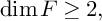 $\dim F \geq 2,$
this gives an immediate contradiction: by assumption,
$\dim F \geq 2,$
this gives an immediate contradiction: by assumption, $K_F+\lambda M_F$
is trivial. Yet for a quadric
$K_F+\lambda M_F$
is trivial. Yet for a quadric $-K_Q \simeq {\mathcal O}_Q(\dim Q)$
, so we obtain
$-K_Q \simeq {\mathcal O}_Q(\dim Q)$
, so we obtain $\lambda = \dim Q>1$
, a contradiction.
$\lambda = \dim Q>1$
, a contradiction.
Thus, we have $\dim F=1$
, in this case, the ramification formula yields
$\dim F=1$
, in this case, the ramification formula yields
 $$ \begin{align*}2 = -K_X \cdot F = \tau^* (-K_Y) \cdot F - M \cdot F = -K_Y \cdot 2G - M \cdot F = 4 - M \cdot F, \end{align*} $$
and therefore $M \cdot F=2$
. Since
$M \cdot F=2$
. Since $X \rightarrow T$
is a
$X \rightarrow T$
is a $\mathbb {P}^1$
-bundle and and
$\mathbb {P}^1$
-bundle and and $M \rightarrow T$
is finite (since M is rational homogeneous), a result of Kollár [Reference Kollár10, Appendix, Lemma (2)] implies
$M \rightarrow T$
is finite (since M is rational homogeneous), a result of Kollár [Reference Kollár10, Appendix, Lemma (2)] implies $\dim T \leq 2$
, the final contradiction.
$\dim T \leq 2$
, the final contradiction.
Proposition 3.12. Let X be a rational homogeneous space of dimension $n \geq 4$
, and let
$n \geq 4$
, and let $M \subset X$
be a smooth ample divisor. Assume that there is a finite morphism of degree two
$M \subset X$
be a smooth ample divisor. Assume that there is a finite morphism of degree two $\tau \colon X\to Y$
ramified along M such that
$\tau \colon X\to Y$
ramified along M such that $\sigma _*$
is the identity on
$\sigma _*$
is the identity on $NE(X)$
, where
$NE(X)$
, where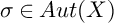 $\sigma \in Aut(X)$
is the automorphism of the cover
$\sigma \in Aut(X)$
is the automorphism of the cover $\tau $
. Then,
$\tau $
. Then, $\rho (X)=1$
.
$\rho (X)=1$
.
Proof. Assume by contradiction that $\rho (X)\geq 2$
. Let
$\rho (X)\geq 2$
. Let $\Gamma $
be any extremal ray in
$\Gamma $
be any extremal ray in  , and let $f: X \rightarrow T$
be its contraction.
$f: X \rightarrow T$
be its contraction.
1st case. Assume first that $\dim X-\dim T=1$
. By Lemma 3.11, we have
$\dim X-\dim T=1$
. By Lemma 3.11, we have ${(-K_X-M) \cdot F>0}$
, which implies that
${(-K_X-M) \cdot F>0}$
, which implies that
 $$ \begin{align*}2 = -K_X \cdot F> M \cdot F \geq 1. \end{align*} $$
Thus, $M \cdot F=1$
, and M being rational homogeneous by example 2.1 and by [Reference Floris and Höring5], it is a section of f. Yet M is ample, so Kollár’s result [Reference Kollár10, Appendix, Lemma (1)] gives
$M \cdot F=1$
, and M being rational homogeneous by example 2.1 and by [Reference Floris and Höring5], it is a section of f. Yet M is ample, so Kollár’s result [Reference Kollár10, Appendix, Lemma (1)] gives $\dim T \leq 1$
, a contradiction.
$\dim T \leq 1$
, a contradiction.
2nd case. Assume now that $\dim X-\dim T>1$
. Applying Proposition 3.5, we see that we even have
$\dim X-\dim T>1$
. Applying Proposition 3.5, we see that we even have $\dim X \geq 2 \dim T$
. Since
$\dim X \geq 2 \dim T$
. Since $\rho (X) \geq 2,$
there are at least two elementary contractions
$\rho (X) \geq 2,$
there are at least two elementary contractions $f_1$
and
$f_1$
and $f_2$
, and their general fibers
$f_2$
, and their general fibers $F_1$
and
$F_1$
and $F_2$
intersect in at most finitely many points. By the first case and the estimate above implies that
$F_2$
intersect in at most finitely many points. By the first case and the estimate above implies that
 $$ \begin{align*}\dim F_1 = \dim F_2 = \frac{1}{2} \dim X. \end{align*} $$
In particular, the morphism $(f_1,f_2)\colon X\to T_1\times T_2$
is surjective and therefore an isomorphism by Lemma 3.9.
$(f_1,f_2)\colon X\to T_1\times T_2$
is surjective and therefore an isomorphism by Lemma 3.9.
Since $\sigma _*$
is the identity, for
$\sigma _*$
is the identity, for $i=1,2,$
there are involutions
$i=1,2,$
there are involutions $\sigma _i$
for
$\sigma _i$
for $i=1,2$
and a commutative diagram
$i=1,2$
and a commutative diagram

But this implies that the fixed locus of $\sigma $
is contained in
$\sigma $
is contained in $p_1^{-1}Fix(\sigma _1)\cap p_2^{-1}Fix(\sigma _2) $
, a contradiction because the fixed locus of
$p_1^{-1}Fix(\sigma _1)\cap p_2^{-1}Fix(\sigma _2) $
, a contradiction because the fixed locus of $\sigma $
is a non-empty ample divisor.
$\sigma $
is a non-empty ample divisor.
We are left with the three-dimensional case.
Proposition 3.13. Let X be a rational homogeneous space of dimension three, and let $M \subset X$
be a smooth ample divisor that is normal split. Then, one has
$M \subset X$
be a smooth ample divisor that is normal split. Then, one has $\rho (X)=1$
.
$\rho (X)=1$
.
The following proof could be carried out without the classification of Mori and Mukai [Reference Mori and Mukai13], but a degree computation in the spirit of [Reference Beauville and Mérindol1, Proposition 3] gives a more streamlined argument.
Proof. Assume by contradiction that $\rho (X)\geq 2$
and let
$\rho (X)\geq 2$
and let $f_i\colon X\to T_i$
for
$f_i\colon X\to T_i$
for $i=1,2$
be two extremal contractions. Since the fibers of
$i=1,2$
be two extremal contractions. Since the fibers of $f_1$
and
$f_1$
and $f_2$
intersect in finitely many points, there are, up to renumbering
$f_2$
intersect in finitely many points, there are, up to renumbering $f_1$
and
$f_1$
and $f_2$
, two possibilities: either
$f_2$
, two possibilities: either $\dim T_1=1$
and
$\dim T_1=1$
and $\dim T_2=2$
, or
$\dim T_2=2$
, or $\dim T_1=\dim T_2=2$
.
$\dim T_1=\dim T_2=2$
.
Since $\rho (X)\geq 2$
, by Proposition 3.2, there is an involution
$\rho (X)\geq 2$
, by Proposition 3.2, there is an involution $\sigma $
whose fixed locus is M. We denote by Y the quotient of X by the action of
$\sigma $
whose fixed locus is M. We denote by Y the quotient of X by the action of $\sigma $
, and by
$\sigma $
, and by $\tau \colon X\to Y$
the degree two morphism ramified along M. Moreover, by [Reference Floris and Höring5] the divisor M is rational homogeneous.
$\tau \colon X\to Y$
the degree two morphism ramified along M. Moreover, by [Reference Floris and Höring5] the divisor M is rational homogeneous.
1st case: Assume that $\dim T_1=1$
and
$\dim T_1=1$
and $\dim T_2=2$
. Since X has an elementary Mori contraction onto a curve, we have
$\dim T_2=2$
. Since X has an elementary Mori contraction onto a curve, we have $\rho (X)=2$
. Thus, Lemma 3.9 implies that
$\rho (X)=2$
. Thus, Lemma 3.9 implies that $X \simeq \mathbb {P}^1 \times \mathbb {P}^2$
. Since the fibers of
$X \simeq \mathbb {P}^1 \times \mathbb {P}^2$
. Since the fibers of $f_1$
and
$f_1$
and $f_2$
have different dimensions, the involution
$f_2$
have different dimensions, the involution $\sigma _*$
acts as the identity and by Lemma 3.7, we have
$\sigma _*$
acts as the identity and by Lemma 3.7, we have $\rho (Y)=\rho (X)=2$
.
$\rho (Y)=\rho (X)=2$
.
The ample divisor M is an element of $|{\mathcal O}_{\mathbb {P}^1 \times \mathbb {P}^2}(a,b)|$
for some
$|{\mathcal O}_{\mathbb {P}^1 \times \mathbb {P}^2}(a,b)|$
for some $a \geq 1, b \geq 1$
. Since M is rational homogeneous, the induced fibration
$a \geq 1, b \geq 1$
. Since M is rational homogeneous, the induced fibration
 $$ \begin{align*}f_1: M \rightarrow \mathbb{P}^1 \end{align*} $$
must be a $\mathbb {P}^1$
-bundle structure. In particular, by the adjunction formula, we have
$\mathbb {P}^1$
-bundle structure. In particular, by the adjunction formula, we have $b \leq 2$
. Since
$b \leq 2$
. Since $K_M^2=8$
for every Hirzebruch surface, a short intersection computation allows to exclude the case
$K_M^2=8$
for every Hirzebruch surface, a short intersection computation allows to exclude the case $b=2$
. Thus, we have
$b=2$
. Thus, we have $b=1$
and it is not difficult to see that a general element in
$b=1$
and it is not difficult to see that a general element in ${\mathcal O}_X(a,1)$
with
${\mathcal O}_X(a,1)$
with $a \in 2 \mathbb {N}$
is indeed isomorphic to
$a \in 2 \mathbb {N}$
is indeed isomorphic to $\mathbb {P}^1 \times \mathbb {P}^1$
. We claim that such an
$\mathbb {P}^1 \times \mathbb {P}^1$
. We claim that such an $M \subset X$
is never normal split and argue by contradiction. Recall that there is a degree two cover
$M \subset X$
is never normal split and argue by contradiction. Recall that there is a degree two cover
 $$ \begin{align*}\tau:\mathbb{P}^1 \times \mathbb{P}^2 \rightarrow Y \end{align*} $$
that ramifies along M. By the ramification formula,
 $$ \begin{align*}\tau^* (-K_Y) \simeq -K_X + M \end{align*} $$
is ample, so Y is Fano. Moreover, we compute
 $$ \begin{align*}(-K_Y)^3 = \frac{1}{2} (-K_X+M)^3 = 8 (2+a). \end{align*} $$
Since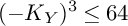 $(-K_Y)^3 \leq 64$
for any smooth Fano threefold [Reference Mori and Mukai13, Corollary 11], we see that
$(-K_Y)^3 \leq 64$
for any smooth Fano threefold [Reference Mori and Mukai13, Corollary 11], we see that $a=2$
or
$a=2$
or $a=4$
.
$a=4$
.
If $a=2,$
we have
$a=2,$
we have $(-K_Y)^3=32$
, so by [Reference Mori and Mukai13, Table 2] the threefold Y is a blow-up of
$(-K_Y)^3=32$
, so by [Reference Mori and Mukai13, Table 2] the threefold Y is a blow-up of $\mathbb {P}^3$
. Yet we know that the Mori contractions of Y are fiber spaces, a contradiction.
$\mathbb {P}^3$
. Yet we know that the Mori contractions of Y are fiber spaces, a contradiction.
If $a=4,$
we have
$a=4,$
we have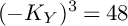 $(-K_Y)^3=48$
, so by [Reference Mori and Mukai13, Table 2] the threefold Y is the flag manifold
$(-K_Y)^3=48$
, so by [Reference Mori and Mukai13, Table 2] the threefold Y is the flag manifold $\mathbb {P}(T_{\mathbb {P}^2})$
. Yet for this threefold, both Mori contractions have one-dimensional fibers, a contradiction to
$\mathbb {P}(T_{\mathbb {P}^2})$
. Yet for this threefold, both Mori contractions have one-dimensional fibers, a contradiction to $\dim T_1=1$
.
$\dim T_1=1$
.
2nd case: Assume that $\dim T_1=\dim T_2=2$
. The surfaces
$\dim T_1=\dim T_2=2$
. The surfaces $T_1$
and
$T_1$
and $T_2$
are rational homogeneous of the same Picard rank. Since M is a rational homogeneous surface, we have
$T_2$
are rational homogeneous of the same Picard rank. Since M is a rational homogeneous surface, we have $\rho (M)\leq 2$
. We get by the Lefschetz theorem,
$\rho (M)\leq 2$
. We get by the Lefschetz theorem,
 $$ \begin{align*}\rho(T_i)=\rho(X)-1 \leq \rho(M)-1\leq 1. \end{align*} $$
Thus, $T_1\cong T_2\cong \mathbb {P}^2$
. Now, the Mori–Mukai classification (or Lemma 3.9) implies that
$T_1\cong T_2\cong \mathbb {P}^2$
. Now, the Mori–Mukai classification (or Lemma 3.9) implies that $X \simeq \mathbb {P}(T_{\mathbb {P}^2}) \subset \mathbb {P}^2 \times \mathbb {P}^2$
.
$X \simeq \mathbb {P}(T_{\mathbb {P}^2}) \subset \mathbb {P}^2 \times \mathbb {P}^2$
.
Since $M \subset X$
is ample, we have
$M \subset X$
is ample, we have $M \in |{\mathcal O}_X(a,b)|$
with
$M \in |{\mathcal O}_X(a,b)|$
with $a \geq 1, b \geq 1$
. Again, recall that there is a degree two morphism
$a \geq 1, b \geq 1$
. Again, recall that there is a degree two morphism $\tau \colon X \rightarrow Y$
ramified along M. The threefold Y is Fano and
$\tau \colon X \rightarrow Y$
ramified along M. The threefold Y is Fano and
 $$ \begin{align*}(-K_Y)^3 = \frac{1}{2} (-K_X+M)^3 = \frac{3}{2} (2+a)(2+b)(4+a+b). \end{align*} $$
Since $a \geq 1, b \geq 1,$
we get
$a \geq 1, b \geq 1,$
we get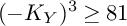 $(-K_Y)^3 \geq 81$
, a contradiction.
$(-K_Y)^3 \geq 81$
, a contradiction.
4 Proof of Theorem 1.1
Proof. Our goal is to reduce Theorem 1.1 to Theorem 3.1 using a diagram chase in the spirit of [Reference Jahnke8, Section 1.4].
Since M is effective and X is homogeneous, the divisor M is base-point-free, and induces a morphism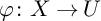 $\varphi \colon X\to U$
. Moreover, there is a smooth ample divisor N on U such that
$\varphi \colon X\to U$
. Moreover, there is a smooth ample divisor N on U such that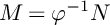 $M=\varphi ^{-1}N$
. After taking the Stein factorization
$M=\varphi ^{-1}N$
. After taking the Stein factorization $\varphi =\nu \circ \psi $
and replacing
$\varphi =\nu \circ \psi $
and replacing $\varphi $
with
$\varphi $
with $\psi $
and N with
$\psi $
and N with $\nu ^{-1}N$
, we may assume that
$\nu ^{-1}N$
, we may assume that $\varphi $
is a fibration.
$\varphi $
is a fibration.
Step 1. We claim that N is normal split in U. Consider the diagram

where s gives the splitting of the normal sequence of M in X. We notice that h is an isomorphism. For a local section v of  , we want to define by diagram chase $\tilde s_U(v)=d\varphi (s(w)),$
where w is a local section of
$\tilde s_U(v)=d\varphi (s(w)),$
where w is a local section of $T_X$
such that
$T_X$
such that $d\varphi (w)=v$
. To show that
$d\varphi (w)=v$
. To show that $\tilde s_U$
is well defined, we assume
$\tilde s_U$
is well defined, we assume $w\in \ker (d\varphi )$
. Let u be a local section of
$w\in \ker (d\varphi )$
. Let u be a local section of $T_{X/U}$
such that
$T_{X/U}$
such that $\alpha (u)=w$
and
$\alpha (u)=w$
and $u'$
such that
$u'$
such that $h(u')=u$
. We want to prove that
$h(u')=u$
. We want to prove that $d\varphi _M(s(w))=0$
. We have
$d\varphi _M(s(w))=0$
. We have
 $$ \begin{align*}d\varphi_M(s(w))=d\varphi_M(s(\alpha(h(u'))))=d\varphi_M(s(i(\alpha_M(u'))))=d\varphi_M(\alpha_M(u'))=0.\end{align*} $$
We defined  such that $\varphi ^*\tau _N\circ \tilde s_U=id$
. Since
$\varphi ^*\tau _N\circ \tilde s_U=id$
. Since $\varphi $
is a fibration and by the projection formula, this yields a section
$\varphi $
is a fibration and by the projection formula, this yields a section  such that $\tau _N\circ s_U=id$
.
$\tau _N\circ s_U=id$
.
Step 2. Conclusion. We make a case distinction in terms of $n := \dim U$
.
$n := \dim U$
.
-
•
$n=1$
; equivalently,
$U \simeq \mathbb {P}^1$
. Then, M is a fiber of the locally trivial fibration
$\varphi $
and obviously normal split. -
•
$n=2$
; equivalently,
$U \simeq \mathbb {P}^2$
or
$U \simeq \mathbb {P}^1 \times \mathbb {P}^1$
. Then, N is completely determined by Van de Ven’s theorem and Proposition 3.5. -
• Finally, if
$n \geq 3,$
we know by Theorem 3.1 that U is the projective space or a quadric, and N is a hyperplane section.




Remark 4.1. In this article, we have focused on the case of divisors, that is, the smallest possible codimension. One might ask if the classification can also be carried out for normal split submanifolds $M \subset X$
of dimension one. In this case
$M \subset X$
of dimension one. In this case $M \simeq \mathbb {P}^1$
, so the only question is to determine the embedding. Unfortunately, there are often many possible choices for the embedding: let
$M \simeq \mathbb {P}^1$
, so the only question is to determine the embedding. Unfortunately, there are often many possible choices for the embedding: let $X = Q^n \subset \mathbb {P}^{n+1}$
be a smooth quadric and let
$X = Q^n \subset \mathbb {P}^{n+1}$
be a smooth quadric and let $S \subset X$
be a linear section of codimension
$S \subset X$
be a linear section of codimension $n-2$
, that is,
$n-2$
, that is, $S \simeq \mathbb {P}^1 \times \mathbb {P}^1$
is a smooth quadric surface in X. Then, S is normal split in X [Reference Jahnke8, Theorem 4.5]. Moreover, let
$S \simeq \mathbb {P}^1 \times \mathbb {P}^1$
is a smooth quadric surface in X. Then, S is normal split in X [Reference Jahnke8, Theorem 4.5]. Moreover, let $M \subset S$
be an irreducible element of
$M \subset S$
be an irreducible element of $|{\mathcal O}_{\mathbb {P}^1 \times \mathbb {P}^1}(1,a)|$
for any
$|{\mathcal O}_{\mathbb {P}^1 \times \mathbb {P}^1}(1,a)|$
for any $a \in \mathbb {N}$
. Then,
$a \in \mathbb {N}$
. Then, $M \subset S$
is normal split by Example 2.2, and therefore,
$M \subset S$
is normal split by Example 2.2, and therefore, $M \subset X$
is normal split by [Reference Jahnke8, Section 1.2].
$M \subset X$
is normal split by [Reference Jahnke8, Section 1.2].
In view of this example, we think that a more reasonable approach is to classify normal split submanifolds of minimal codimension.
Acknowledgements
The authors are partially supported by the project ANR-23-CE40-0026 “Positivity on K-trivial varieties.” A.H. was supported by the France 2030 investment plan managed by the National Research Agency (ANR), as part of the Initiative of Excellence of Université Côte d’Azur under reference number ANR-15-IDEX-01. E.F. was supported by the ANR Project FRACASSO ANR-22-CE40-0009-01 and the Institut Universitaire de France.


 Open access

