


Introduction
The Javan rhinoceros Rhinoceros sondaicus is categorized as Critically Endangered on the IUCN Red List (Ellis & Talukdar, Reference Ellis and Talukdar2020). The species' historical range extended from north-eastern India, Bangladesh, Myanmar, Thailand, Laos, Cambodia, Viet Nam, and possibly southern China, through to Peninsular Malaysia, Sumatra and Java (Rookmaaker, Reference Rookmaaker1980). The last surviving population persists in western Java, in Indonesia's Ujung Kulon National Park (Haryono et al., Reference Haryono, Rahmat, Daryan, Raharja, Muhtarom and Firdaus2015, Reference Haryono, Miller, Lees, Ramono, Purnomo and Long2016; Fig. 1). The human population of Java was c. 152.8 million in 2019, a density of > 1,130 people per km2 and one of the highest human population densities (Worldometer, 2019). With increasing urbanization, the conservation and management of the small remaining population of the Javan rhinoceros and its habitat is crucial for the species’ survival (Hariyadi et al., Reference Hariyadi, Sajuthi, Astuti, Alikoda and Maheshwari2016).
Ujung Kulon National Park, West Java, Indonesia, with the location of the 8-km fence installed to support the conservation of the Javan rhinoceros Rhinoceros sondaicus.
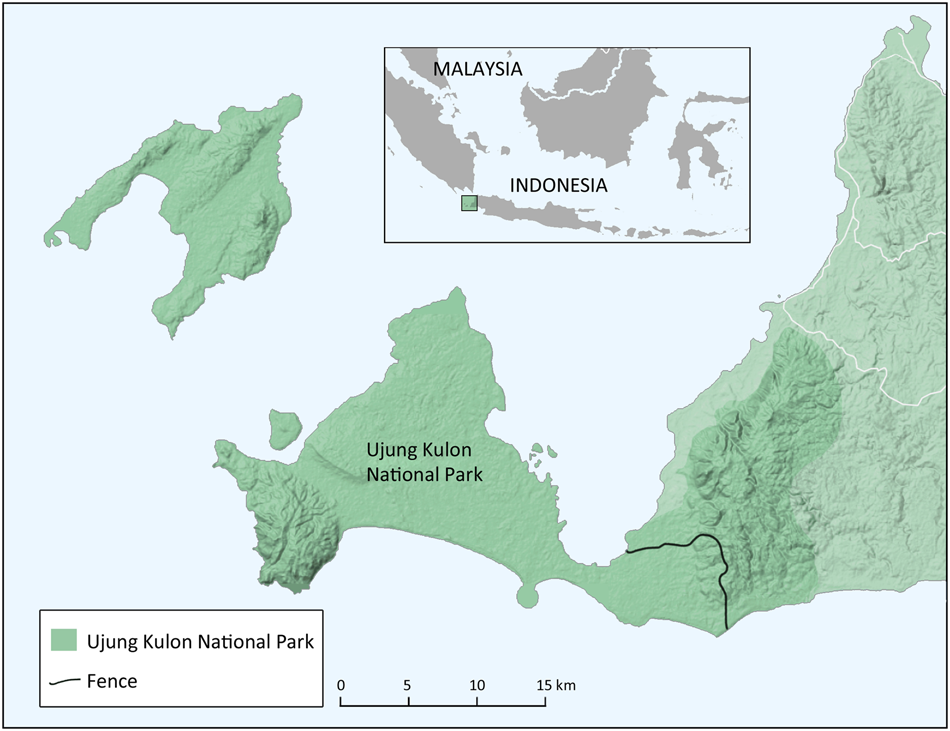
Remnant Javan rhinoceros habitat is threatened by two major factors: the encroachment of human settlements and the increase and dominance of the native arenga palm Arenga obtusifolia over large areas of the Park (Haryono et al., Reference Haryono, Miller, Lees, Ramono, Purnomo and Long2016). Arenga palms now dominate the rainforest canopy across 18,000 ha, reducing available rhinoceros foraging by limiting the growth of native food plants for the rhinoceros (Ramono et al., Reference Ramono, Isnan, Sadjudin, Gunawan, Dahlan and Sectionov2009).
In 2010, to increase the likelihood of the Javan rhinoceros's survival, government authorities established the 5,100 ha Javan Rhino Study and Conservation Area. This included installation of an 8-km rhinoceros-proof fence at the base of the eastern Gunung Honje mountain range (Fig. 1) to protect the species’ habitat and exclude domestic livestock. Frontline staff are critical to the successful management and conservation of the species, with duties that include surveillance and monitoring, and protection of the species and the National Park from illegal activities.
The perspectives of the frontline staff about current management and conservation actions and their outcomes have not been previously evaluated but could help inform conservation planning. Our objectives in this study were to (1) identify frontline management operations, including staff and patrol cycles, (2) identify the perceptions of frontline staff of Javan rhinoceros conservation, including the current operating and management environment, (3) identify risks to the species and determine any gaps in conservation approaches, (4) examine the perceptions of frontline staff of impacts on the local community and their understanding of National Park management and conservation activities, and (5) use these perceptions and informed opinions to support future management actions, including any previously unidentified actions that could improve conservation outcomes for the conservation and management of the species (Moreto et al., Reference Moreto, Gau, Paoline, Singh, Belecky and Long2017).
Study area
The c. 120,000 ha Ujung Kulon National Park encompasses 76,214 ha of terrestrial areas and 44,337 ha of marine habitat (Indonesian Ministry of Forestry, 2010; Fig. 1). The Park lies on a peninsula in south-west Java (Ramono et al., Reference Ramono, Isnan, Sadjudin, Gunawan, Dahlan and Sectionov2009). Ujung Kulon was gazetted as a National Park in 1980 and in 1992 the Park, along with the Krakatau archipelago, was declared Indonesia's first UNESCO World Heritage Site (Haryono et al., Reference Haryono, Miller, Lees, Ramono, Purnomo and Long2016; Fig. 1).
Poaching of the Javan rhinoceros occurred in Ujung Kulon during the late 1980s and early 1990s (Lessee, Reference Lessee1994; van Strien & Sadjudin, Reference van Strien and Sadjudin1995), but instigation of rhinoceros protection units in 1998, in partnership with National Park rangers (Ramono et al., Reference Ramono, Isnan, Sadjudin, Gunawan, Dahlan and Sectionov2009), successfully reduced this poaching (Nardelli, Reference Nardelli2016). The Indonesian and International Rhino Foundations currently employ and manage the Javan rhinoceros protection unit staff in collaboration with Ujung Kulon National Park rangers, who are employed by the Indonesian government through the Ujung Kulon National Park Authority (Haryono et al., Reference Haryono, Rahmat, Daryan, Raharja, Muhtarom and Firdaus2015, Reference Haryono, Miller, Lees, Ramono, Purnomo and Long2016). These combined frontline units have patrolled the Ujung Kulon peninsula since 1998, seeking to identify and control illegal activities (Haryono et al., Reference Haryono, Rahmat, Daryan, Raharja, Muhtarom and Firdaus2015). Five frontline units, consisting of four staff each, were operational in Ujung Kulon National Park at the time this study began in 2015. Each unit has three members recruited from local communities, and one National Park staff member, who is authorized to make arrests. Four frontline units operate across the western peninsula (which holds the main rhinoceros population) and the fifth unit operates across the eastern Gunung Honje area (the Javan Rhino Study and Conservation Area, with a small resident rhinoceros population).
The Ujung Kulon rainforest is a complex mosaic of dense broadleaf evergreen forest (primary or old secondary forest, including palms and bamboo), open broadleaf evergreen forest and open secondary forest (Hoogerwerf, Reference Hoogerwerf1970) interspersed with arenga palms Arenga obtusifolia. All patrolling is on foot, with staff regularly camping out on extended patrols of 5–20 days per month. Patrol tasks are determined by the level of threat (e.g. of poaching activity) but also include routine activities such as camera-trap surveillance, rhinoceros track recording and dung collection for DNA sampling. Patrol operations have frontline units in the field at most times, except during the December–January monsoon period, when access to most of the Park is restricted by heavy rainfall.
Methods
We developed a survey questionnaire (Supplementary Material 1) in English and then translated it into Bahasa Indonesia. We pre-tested the translated questionnaire for clarity, with a rhinoceros protection staff manager, a rhinoceros protection unit staff member, and a National Park ranger, all of whom came from local villages, and the Indonesian interpreter, and revised the questionnaire based on their feedback. The first 15 questions (1–15) focused on determining the frontline recruitment and training environment, seven questions (16–22) on the rhinoceros protection unit and ranger operating environment, and 20 questions (23–42) on frontline staff perspectives on the current conservation approach and on threats.
Thirty-six frontline staff (22 of 25 rhinoceros protection unit staff and 14 of the 16 Ujung Kulon National Park rangers) completed the questionnaire before, during or after the interviews, and were interviewed in person by SGW. The interviews were conducted with National Park management and Indonesian Rhino Foundation support and with the assistance of an Indonesian interpreter. All participants signed a consent form before commencing the interviews.
Interviews lasted c. 30–40 minutes and were conducted during 15–22 September 2015 at the Ujung Kulon National Park operations headquarters in Taman Jaya, and at rhinoceros protection base offices in the villages of Cigorondong and Ujung Jaya. These three villages lie on the western edge of the Gunung Honje eastern section of Ujung Kulon National Park. Staff were interviewed individually, except for one group of three staff who were interviewed together because of time constraints (the staff had to go on patrol). The same interpreter was used in all interviews.
Results
All 36 interviewees were male. Mean length of service was 5.4 ± SD 3.75 years for rhinoceros protection staff and 21.9 ± SD 8.63 years for National Park staff. Seventeen (77%) of the 22 rhinoceros protection unit staff were from villages within the 19 villages of the Ujung Kulon precinct and five came from villages beyond Ujung Kulon. With respect to motivation and training, 86% of rhinoceros protection unit staff indicated they joined to protect the Javan rhinoceros, and 64% of National Park staff indicated they joined to protect the National Park and the Javan rhinoceros. All staff indicated the training was beneficial and that they had opportunity to learn a broad range of skills, including navigation and survey techniques (Table 1). Eighty-two per cent of rhinoceros protection unit staff spent 20 days per month on patrol, and 36% of National Park staff supported rhinoceros protection units for 15 days per month (Table 2).
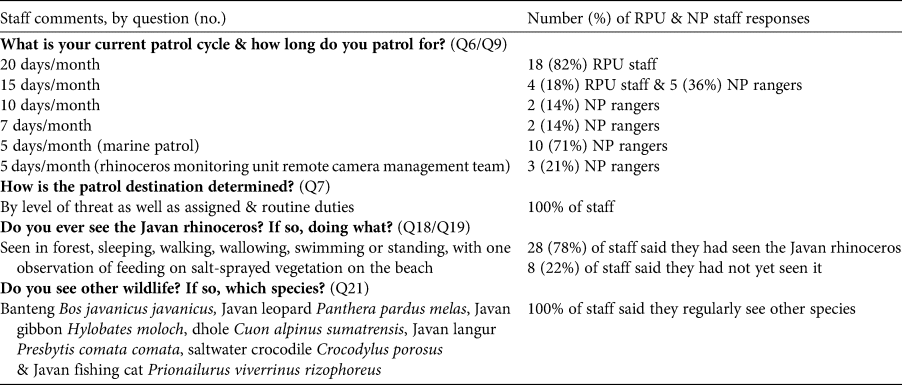
Summary of the response of a total of 36 rhinoceros protection unit (RPU) and National Park (NP) staff to questions regarding recruitment and training. For full list of numbered questions, see Supplementary Material 1.

Summary of the responses of a total of 36 rhinoceros protection unit (RPU) and National Park (NP) staff to questions regarding the patrol operating environment and their observations of wildlife, including the Javan rhinoceros. For full list of numbered questions, see Supplementary Material 1.
Several threats were mentioned by frontline staff, including the expansion of rice fields and gardens, collection of firewood, forest resources, wild honey, birds and fish, and illegal grazing of domestic livestock such as buffalo inside the Park (Fig. 2). Staff noted that the combined impacts of these illegal activities on rhinoceros habitat and Park biodiversity required additional resources for increased protection. For example, 29 (81%) staff said poaching of animals was of concern, and seven (19%) staff were more specific, stating poaching of birds, honey, sea turtles, shrimp and deer was an issue.
Number of frontline staff (of 36) who perceived that each of six issues regarding the reliance of local communities on natural resources from Ujung Kulon National Park was the main threat to the conservation of the Javan rhinoceros.

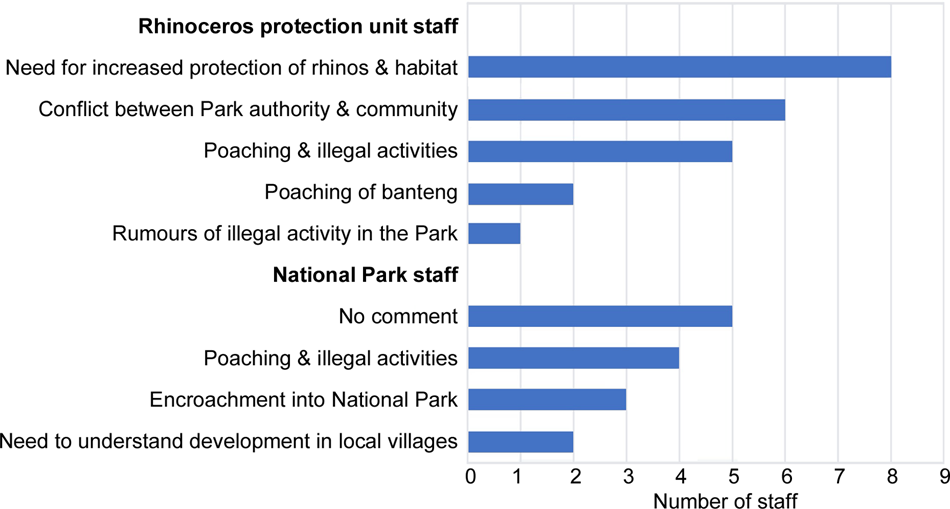
Frontline staff identified commonly encountered issues and threats such as poaching and other illegal activity, encroachment of human activities into the National Park and conflict between the National Park Authority and the local community (Fig. 3). Twenty-four interviewees (67%) were positive about the rhinoceros-proof fence and its purpose to protect the rhinoceros from poaching and disease. However, during post-survey discussions some staff expressed concern regarding members of the local community illegally breaching the fence (erected to prevent livestock intrusion and disease transfer; Fig. 1) to graze buffalo and other domestic livestock in the National Park. Staff noted that the fence is only effective when livestock are excluded. Staff acknowledged that human population growth in and around the eastern Gunung Honje area and broader west Java was a threat to both the National Park and the Javan rhinoceros.
Issues relating to the conservation of the Javan rhinoceros, as identified by staff of rhinoceros protection units and the National Park, with the number of staff who noted each issue was of principal concern.
Rhinoceros protection staff had more direct involvement in fence protection, breaches of the fence by local livestock, arenga palm control work and dealing with community conflict. National Park staff had broader management issues to contend with, such as administration and visitor management. In general, National Park staff were more reserved in their responses, which may be related to their experience regarding what is and is not effective.
Frontline staff identified multiple risks to the future conservation of the Javan rhinoceros, including human population growth, limited law enforcement and weak penalties for offenders, encroachment by people from local communities and by domestic livestock, development of infrastructure such as roads, and other development. Fifty-three per cent of staff indicated that the biggest threat to the Javan rhinoceros is disease transmission from domestic livestock, and most staff noted the importance of the fence.
Given that participants live and work in these communities, they have a good understanding of the risks and potential impacts of improved roads and infrastructure on the National Park and rhinoceros conservation. Staff may potentially have been conflicted about responding openly to questions regarding the benefits of improved roads and infrastructure, knowing the potential risk of increased illegal activity on rhinoceroes and Park resources. All staff noted that local villagers assisted with intelligence gathering regarding poaching and other illegal activities in the National Park, but they did not elaborate on this matter.
Discussion
Our study contributes to the growing literature on the perceptions of conservation field staff (e.g. Gandiwa et al., Reference Gandiwa, Zisadza-Gandiwa, Mango and Jakarasi2014; Moreto & Gau, Reference Moreto, Gau and Gore2017). Poaching of the Javan rhinoceros was not identified by frontline staff to be a major current threat in Java's Ujung Kulon National Park. But the need for several conservation actions was identified, in particular reduction of the risk of disease transmission from domestic livestock to the Javan rhinoceros and increased support for community education and awareness programmes.
The risk of disease transmission to rhinoceroses is well documented. Ujung Kulon National Park experiences periodic herding of domestic livestock, mainly buffalo and goats, on the fringes of the National Park and within it (van Merm, Reference van Merm2008; Haryono et al., Reference Haryono, Miller, Lees, Ramono, Purnomo and Long2016). Anthrax or another infectious agent was implicated in five rhinoceros deaths in 1982 (WWF-IUCN, 1982), and of at least two in 2002–2003, five in 2010–2013 (Hariyadi et al., Reference Hariyadi, Priambudi, Setiawan, Daryan, Purnama and Yayus2012; UKNP, 2012) and two in 2014 (UKNP, 2014).
During 2017, Indonesian authorities tested 104 water buffaloes Bubalis bubalis from the Rancapinang village precinct, one of 19 villages that neighbour the eastern edge of Ujung Kulon, for disease prevalence (Khairani et al., Reference Khairani, Nydam, Felippe, McDonough, Barry and Mahmud2018). They recorded a high prevalence of Trypanosomiasis surra, in 87% (91 individuals) of the buffalo population. Anthrax, Haemorrhagic septicaemia and Brucellosis were not identified in this testing (Khairani et al., Reference Khairani, Nydam, Felippe, McDonough, Barry and Mahmud2018). Frontline staff acknowledged the risk of disease transfer from domestic stock to rhinoceroses was significant, and noted the risk remained because of regular breaches of the rhinoceros-proof fence.
The combined issues of limited law enforcement and intelligence services and low penalties for offenders were viewed by frontline staff as a frustration to their work and an ongoing risk for rhinoceros conservation. Such frustration for frontline staff is common in other rhinoceros range countries. For example, in Mozambique, penalties exist for rhinoceros poaching and the possession of rhinoceros horn, but law enforcement is weak and poaching is considered only a misdemeanour (Save the Rhino International, 2016). However, staff in Ujung Kulon National Park acknowledged that since inception of the frontline units in 1998, their work is meeting the current requirements of Javan rhinoceros protection and conservation. Staff attributed this success to regular patrol cycles and high awareness of patrols in local communities, and this is reflected in the rhinoceros population, which has increased from 50 in 1997 (Foose & van Strien, Reference Foose and van Strien1997) to 75 in 2021 (International Rhino Foundation, 2021).
Nevertheless, globally, populations of rhinoceros species continue to be threatened by human population growth and habitat loss, with ongoing development pressures in and around rhinoceros habitats (Ripple et al., Reference Ripple, Newsome, Wolf, Dirzo, Everatt and Galetti2015; Aryal et al., Reference Aryal, Acharya, Shrestha, Dhakal, Raubenhiemer and Wright2017). Communities living near rhinoceros protection areas or national park buffer zones are increasingly being encouraged and supported to become more involved in rhinoceros conservation (Milliken, Reference Milliken, Emslie and Talukdar2009; Dinerstein, Reference Dinerstein, Wilson and Mittermeier2011; Thapa et al., Reference Thapa, Nepal, Thapa, Bhatta and Wikramanayake2013; Aryal et al., Reference Aryal, Acharya, Shrestha, Dhakal, Raubenhiemer and Wright2017). Communities living in areas adjacent to Ujung Kulon National Park, driven mainly by widespread poverty to encroach on the Park for agricultural land, are putting continual pressure on the current Javan rhinoceros population and habitat (Haryono et al., Reference Haryono, Miller, Lees, Ramono, Purnomo and Long2016). These communities would benefit from increased involvement in and understanding of efforts to conserve the rhinoceros. However, despite ongoing issues with illegal settlements in the National Park, none of the staff commented on this as a threat or an issue (Gunawan et al., Reference Gunawan, Ramono, Gillison and Isnan2012).
The Indonesian archipelago and the Ujung Kulon region lie in one of the most seismically and volcanically active areas globally, adding to the potential threats to the Javan rhinoceros (van Strien & Rookmaaker, Reference van Strien and Rookmaaker2010; Setiawan et al., Reference Setiawan, Gerber, Rahmat, Daryan, Firdaus and Haryono2017). The destructive tsunami of 22 December 2018 in West Java occurred within 2 km of the last surviving rhinoceros population (World Vision, 2018). This catastrophic event, in which 430 people died, including two National Park staff, highlights the risks and challenges faced by the remaining Javan rhinoceroses and the staff who protect and monitor them. As a megaherbivore, the Javan rhinoceros is an apex plant consumer that directly influences its terrestrial ecosystem (Worm & Paine, Reference Worm and Paine2016). Modelling, using historical and contemporary data, found that the loss of this megaherbivore would severely alter ecosystem function and structure (Gill et al., Reference Gill, Williams, Jackson, Lininger and Robson2009; Smit & Prins, Reference Smit and Prins2015) risking collapse of the ecosystem (Codron et al., Reference Codron, Botha-Brink, Codron, Huttenlocker and Angielczyk2017).
Our findings could be used to increase conservation actions that deliver improved outcomes for frontline management of this Critically Endangered mammal and could provide a model for other species with focal protection units located in areas around which rural human populations are active. We provide, based on frontline staff responses to the questionnaire, the following four recommendations for the management of the Javan rhinoceros: (1) instigation of an annual domestic livestock vaccination programme across all 19 villages in the Ujung Kulon precinct, to protect the Javan rhinoceros and other herbivore species in the National Park, (2) in support of such a vaccination programme, regular soil and faecal analyses to identify the presence, location and type of any pathogenic agents both within local villages and Ujung Kulon National Park (the development and implementation of an emergency biosecurity strategy in the event of a disease outbreak is critical to protect the current rhinoceros population), (3) instigation of community education and awareness programmes, to highlight the risks and benefits to both domestic animals and local wildlife of such an initiative, and (4) as a biosecurity measure, building a stock fence across the 1-km wide isthmus separating the peninsula from the eastern Gunung Honje area of the Park, with gates that can be closed in the event of a disease outbreak (this fence would potentially prevent any disease outbreak from infecting the main peninsula rhinoceros population, and otherwise would remain open to facilitate natural movement of animals).
The core frontline staff responsibilities are surveillance, monitoring and protection of the Javan rhinoceros and National Park. The value of our study is threefold. Firstly, it demonstrated that frontline staff could assess conservation approaches and threats (e.g. acknowledgement of the value of the fence and the associated risk of disease spread from domestic livestock). Secondly, these insights could be used by authorities, conservation planners and practitioners to improve and prioritize management actions (e.g. staff concerns regarding the combined negative impacts on habitat and biodiversity from activities such as illegal firewood collection and expansion of rice fields). Thirdly, given that the staff we interviewed live in the communities local to the National Park, understanding local impacts and insights may reveal opportunities to improve relationships and develop conservation-based programmes with local community input (e.g. staff noted that people in the local community were generally not aware of conservation actions such as control of the arenga palm, and that education and awareness of this needed to be improved). Although the conservation programme for the Javan rhinoceros can be viewed as effective (poaching of the Javan rhinoceros has stopped and the population is growing), the value of frontline staff input into conservation management is invaluable, offering unique insights that could potentially reduce future risks and help achieve conservation objectives. Our findings and recommendations have been passed to the relevant authorities.
Acknowledgements
We thank the former Directors of Ujung Kulon National Park Authority, West Java, Indonesia, Haryono and Rahmat, current Director Anggodo and all the Park staff for providing access to camera-trap videos, maps and ongoing in situ support; Aphuy Syamsudin (Ujung Kulon National Park Authority), Inov Sectionov and Hanif Mohammad (International Rhino Foundation), and the late Widodo Ramono, Deddy Wardhana and team at the Indonesian Rhino Foundation for their ongoing support to the Javan rhinoceros research work. SK was supported by the Australian Research Council. DB was supported by grant DE160101182 from Stellenbosch University, South Africa.
Author contributions
Project development: SGW, DB, SK; collection and analysis of data: SGW; writing: SGW, DB, SK.
Conflict of interest
None.
Ethical standards
This research abided by the Oryx guidelines on ethical standards and was approved by the University of Queensland Behavioural and Social Sciences Ethical Review Committee (Approval no. 2015000371). The fieldwork and involvement of participants were approved by the Ujung Kulon National Park Authority and Ministry of Research, Technology and Higher Education, Republic of Indonesia, as part of SGW's foreign research permit (RISTEK 130/SIP/FRP/SM/V/2015).


 Open access

