


The WHO recommends a daily intake of at least 400 g of fruits and vegetables (F&V)( 1 ) in order to prevent many common health problems, such as weight gain( Reference Buijsse, Feskens and Schulze 2 ), type II diabetes( Reference Montonen, Järvinen and Heliövaara 3 ) and CVD( Reference Hung, Joshipura and Jiang 4 ). Enhancing F&V intake among children is important, since consuming plenty of F&V in childhood establishes a pattern that may track into adulthood( Reference Lien, Lytle and Klepp 5 , Reference Te Velde, Twisk and Brug 6 ). Even though there are no special recommendations for children on a European level, many countries suggest that a healthy diet should include at least five handfuls of F&V daily, which among 11-year-old children corresponds to approximately 400 g. In Europe most children do not meet these recommendations( Reference Yngve, Wolf and Poortvliet 7 ). F&V intake is often negatively affected by children's lower socio-economic background( Reference Haapalahti, Mykkänen and Tikkanen 8 – Reference Vereecken, Inchley and Subramanian 11 ). Parental educational level in particular seems to be consistently associated with children's F&V intake( Reference Rasmussen, Krølner and Klepp 12 ). The association between higher education and healthier diet among adults has been reported to be partly mediated by better nutrition knowledge( Reference McLeod, Campbell and Hesketh 13 ). The mediation process between parental educational level and F&V intake among schoolchildren, however, has not been thoroughly examined.
Parents play an important role in providing their children with a sufficient amount of F&V. For instance, F&V intake has been noted to be high even among adolescents with low F&V preferences if F&V were available at home( Reference Neumark-Sztainer, Wall and Perry 14 ). Still, availability alone does not explain F&V intake. In a previous study that used the same instrument as our study and was conducted in nine European countries, availability of vegetables at home was associated with daily vegetable intake only in Iceland, and availability of fruit was not associated with the daily fruit intake in any of the countries( Reference De Bourdeaudhuij, te Velde and Brug 15 ).
As with food choices in general, F&V intake is strongly affected by taste preferences or liking for F&V( Reference Neumark-Sztainer, Wall and Perry 14 , Reference Wind, De Bourdeaudhuij and te Velde 16 ). Psychosocial factors such as knowledge of the recommendations for sufficient F&V intake, self-efficacy to eat F&V and parental facilitation of F&V intake by providing cut-up fruits and vegetables for children have also been reported to be associated with children's F&V intake( Reference De Bourdeaudhuij, te Velde and Brug 15 – Reference Kristjansdottir, Thorsdottir and De Bourdeaudhuij 17 ). In a study by Kristjansdottir et al. ( Reference Kristjansdottir, Thorsdottir and De Bourdeaudhuij 17 ), self-efficacy, knowledge of the F&V recommendations and liking were all associated with both fruit and vegetable consumption of children, even after adjusting for availability. However, knowledge of the determinants of F&V intake seems by no means to be unambiguous; moreover, the determinants for fruit intake v. vegetable intake differ. For instance, in a longitudinal study by Tak et al. ( Reference Tak, te Velde and Brug 18 ), availability and facilitation predicted vegetable intake, whereas for fruit intake, liking was a significant predictor. Knowledge of the F&V recommendations and self-efficacy had no effect on either fruit intake or vegetable intake.
Although the determinants of F&V intake have been examined in many studies, the differences in parental education in relation to these determinants have received less attention. In a Norwegian study, accessibility, a sum variable including both availability and facilitation aspects, explained most of the education and income disparities in F&V intake among adolescents( Reference Bere, van Lenthe and Klepp 19 ). Likewise, a study that compared the baseline cohort from the study mentioned above and a cohort in the same schools seven years later found a greater decrease in F&V intake among adolescents whose parents had lower educational levels as compared with adolescents with more highly educated parents( Reference Hilsen, van Stralen and Klepp 20 ). The impact of parental educational level on decrease in F&V intake was mediated by accessibility and preferences( Reference Hilsen, van Stralen and Klepp 20 ). To the best of our knowledge, no comparative studies have been conducted previously including several countries in Europe to determine the mediation between parental educational level and children's F&V intake.
The aim of the present study was to examine the factors through which parental educational level affects both children's daily fruit intake and children's daily vegetable intake in ten European countries. Determinants investigated as potential mediators were availability of F&V at home, parental facilitation of F&V intake, liking for F&V, self-efficacy to eat F&V and knowledge of the F&V recommendations.
Methods
Study design
The PRO GREENS project (www.progreens.org) was funded by the European Commission and the first phase of the study took place between April and October 2009 in ten European countries: Bulgaria, Finland, Germany, Greece, Iceland, the Netherlands, Norway, Portugal, Slovenia and Sweden. The aim was to recruit a sample of at least 1000 children aged 11 years in each country. The Netherlands and Slovenia provided nationally representative samples whereas the other eight countries recruited regional samples of schools for practical and financial reasons. In Bulgaria, Iceland and Sweden the schools recruited for the project were located in the capital regions, whereas in Germany, Greece and Portugal the schools were situated near the research centres. In Norway the participating schools were situated on the west coast and in the middle part of the country. In Finland only Swedish-speaking schools in the coastal areas were included in the sample. An invitation to participate in the study was mailed to the schools and in some cases followed up with a telephone call. All schools and all classes of grades 5 and 6 within the schools that were willing to participate were included in the study. This yielded in the participation of one to eleven classes per school. A consent form and a questionnaire assessing parental educational level were mailed to the parents if their address was provided by the school, or in other cases the letters and questionnaires were brought home by the children. In Norway parents could also fill in an online questionnaire. Children whose parents allowed their participation filled in a paper-and-pencil questionnaire (except in Norway where the children filled in an online questionnaire) measuring F&V intake and factors related to F&V intake. The study was conducted by the teachers in the classrooms during school hours and children were allowed to ask them some clarifying questions if needed. Except for the dissimilarities that have been mentioned above, all countries followed the same data collection protocol. To ensure the correspondence of the questionnaires in different languages the questionnaires were translated and back-translated by two different persons in each country, prior to their administration.
The study protocol of the PRO GREENS project was approved by the research ethics committees in each country. The parents provided their written informed consent for both themselves and their children.
Measurements
Parental educational level
Parental educational level was defined by the respondent parent, who selected the highest educational level that she/he had attained from among the following alternatives: (i) ‘not completed elementary school’; (ii) ‘elementary school’; (iii) ‘secondary school’; (iv) ‘high school’; (v) ‘college or university’; or (vi) ‘other education’. Owing to differences in the length and requirements of education in different countries, educational level was dichotomized into ‘higher educational level’, which included category v (in Bulgaria and Slovenia, both categories iv and v) and ‘lower to middle educational level’ (all other categories). Thus the higher educational level category includes those parents who had completed a bachelor degree or higher.
Fruit and vegetable intake
F&V intake of each child was measured with an FFQ developed for the Pro Children study and validated in five European countries( Reference Haraldsdóttir, Thorsdottir and Vaz de Almeida 21 ). Questions about the intake frequency of fruit, salad, raw vegetables and cooked vegetables were asked separately. The answer alternatives were: (0) ‘never’; (i) ‘less than 1 day per week’; (ii) ‘1 day per week’; (iii) ‘2–4 days per week’; (iv) ‘5–6 days per week’; (v) ‘every day, once a day’; (vi) ‘every day, twice a day’; and (vii) ‘every day, more than twice a day’. Intakes of salad, raw vegetables and cooked vegetables were added together for the vegetable intake. In order to compare the results with many previous studies, both fruit intake and vegetable intake were dichotomized into a ‘daily intake category’ if a child reported eating at least one portion of fruit or vegetables at least once daily and a ‘non-daily intake category’ if a child reported to eat less than one portion of fruit or vegetables once daily.
Determinants of fruit and vegetable intake
Determinants of F&V intake were measured with questions adopted from the Pro Children questionnaire with minor changes. The development of the questionnaire was based on a theory- and determinant-oriented literature review, qualitative research and pre-testing described in detail by De Bourdeaudhuij et al. ( Reference De Bourdeaudhuij, Klepp and Due 22 ). The questions included in the present study and the Cronbach's α values of the constructs are presented in Table 1.
Reliability of the scales measuring the determinants of children's fruit and vegetable intake in the PRO GREENS project
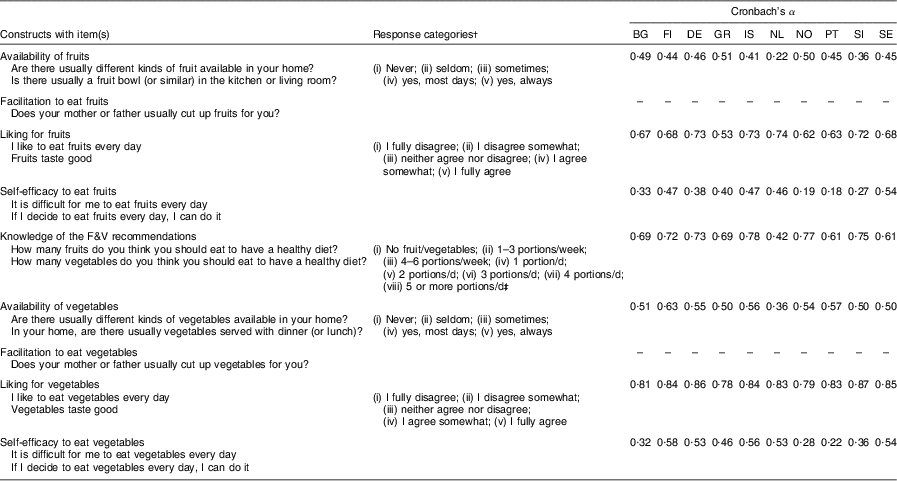
BG, Bulgaria; FI, Finland; DE, Germany; GR, Greece; IS, Iceland; NL, The Netherlands; NO, Norway; PT, Portugal; SI, Slovenia; SE, Sweden; F&V, fruit and vegetable.
†The response categories were the same for the questions measuring availability and facilitation or liking and self-efficacy.
‡For the analyses the answers were recoded to range from 0 to 5 to indicate the amount of fruits and vegetables that the child thinks one should eat per day to have a healthy diet.
Statistical methods
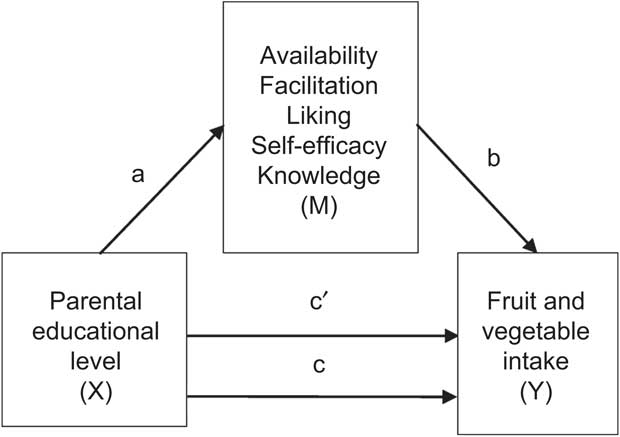
Sample characteristics were derived with the statistical software package IBM SPSS Statistics 20·0 for Windows. Multilevel mediation analyses to assess the associations between parental educational level, a child eating F&V at least once daily and potential mediators (Fig. 1) were conducted with Mplus statistical software version 7·1( Reference Muthén and Muthén 23 ). School-level sampling was taken into account by using schools as the second analyses level in addition to the individual-level characteristics. Regression analyses were conducted separately for each country and adjusted for gender and age. The regression of children's daily F&V intake was first performed v. parental educational level unadjusted for the mediators, with a lower to middle educational level serving as the reference group (path c). Thereafter, this association was examined with adjustments for potential mediators (path c′). Path a designates the association between parental educational level and each individual mediator. Thereafter, the association between each mediator and children's daily F&V intake was examined with adjustments made for all other mediators and parental educational level (path b). The mediation effect (a × b) with 95% confidence interval was calculated for each mediator separately and together. The significance level was set at P < 0·05 for all associations.
The mediation model for associations between parental educational level and children's fruit and vegetable intake. X is the independent variable, Y the dependent variable and M stands for the factors mediating this association. Path a represents the association between X and M, and path b represents the association between M and Y. Path c′ is the direct effect and path c is the total effect between X and Y
Results
Sample characteristics are shown separately for each country and in total in Table 2. The response rate was 72·2% in the total sample, ranging from 51·3% in Norway to 91·8% in Greece. Approximately half of the children were girls and the mean age of the children was 11·3 years. The proportion of parents who had university-level education ranged largely across the countries: in Portugal only 10·2% had university-level education whereas in Bulgaria the percentage was 59·6. In total, 46·5% of children reported eating fruits daily, the range varying from 33·0% in Finland to 55·8% in Iceland. Daily vegetable intake was somewhat more common in the total sample (58·8%) but also there were country differences: 52·2% of the children in Iceland and 70·9% in Finland reported eating vegetables at least once daily.
Characteristics of the study samples in the PRO GREENS project 2009
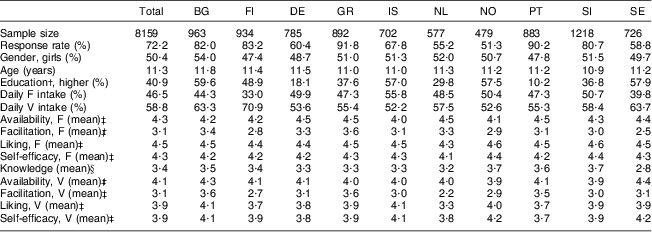
BG, Bulgaria; FI, Finland; DE, Germany; GR, Greece; IS, Iceland; NL, The Netherlands; NO, Norway; PT, Portugal; SI, Slovenia; SE, Sweden; F, fruit; V, vegetable(s).
†Parental educational level, dichotomized as lower to middle or higher.
‡Ranges between 1 and 5.
§Ranges between 0 and 5.
Fruit intake
Unstandardized regression coefficients for the associations between parental educational level, potential mediators and children's daily fruit intake are presented in Table 3. A higher education of the parents was associated with the probability that a child would eat fruits at least once daily (path c) in Bulgaria (P < 0·05), Greece (P < 0·05), Iceland (P < 0·001), Norway (P < 0·001) and Portugal (P < 0·001).
Unstandardized regression coefficients (B) and 95% confidence interval for the associations between parental educational levelFootnote †, potential mediators and children's daily fruit intake, PRO GREENS project 2009Footnote ‡
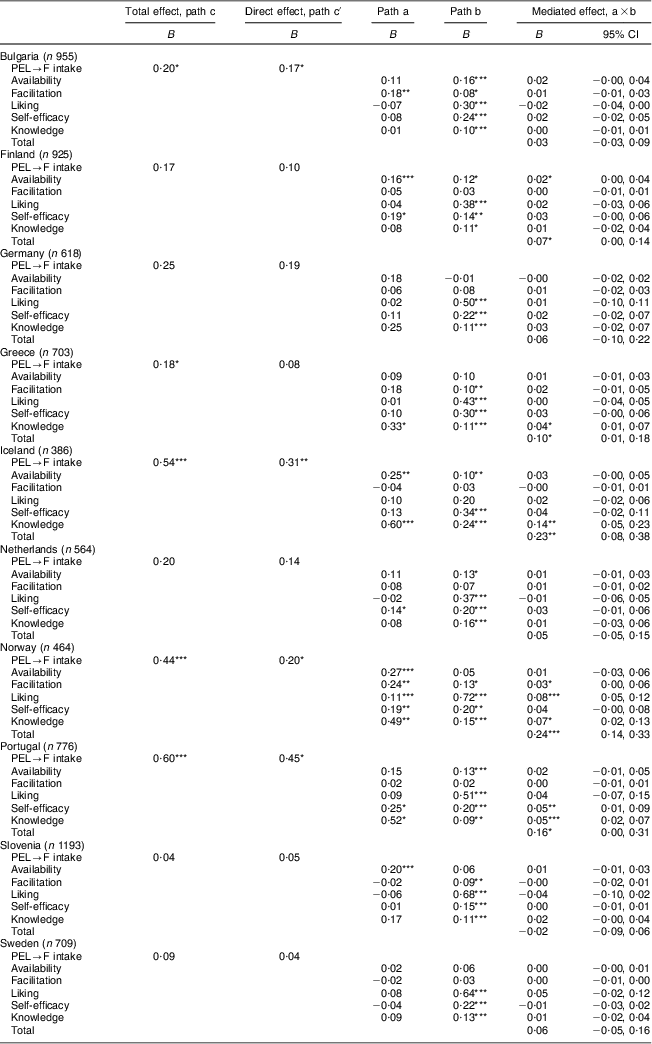
PEL, parental educational level; F, fruit.
Statistical significance of the associations: *P < 0·05, **P < 0·01, ***P < 0·001.
† Parental educational level: lower to middle (reference) v. high.
‡ All analyses adjusted for gender and age.
Parental educational level was associated with potential mediators (path a) to a varying degree in most of the countries except Germany and Sweden. Availability of fruits at home was higher if parents had a university-level education in Finland (P < 0·001), Iceland (P < 0·01), Norway (P < 0·001) and Slovenia (P < 0·001). A positive association between educational level and facilitation was found in Bulgaria (P < 0·01) and Norway (P < 0·01). Liking fruits was more common among children with higher parental education only in Norway (P < 0·001). Children with higher educated parents had higher self-efficacy in Finland (P < 0·05), the Netherlands (P < 0·05), Norway (P < 0·01) and Portugal (P < 0·05). Children's knowledge of the F&V recommendations was higher if the parents had a higher educational level in Greece (P < 0·05), Iceland (P < 0·001), Norway (P < 0·01) and Portugal (P < 0·05).
Also path b, indicating associations between the mediators and children's daily fruit intake when adjusted for parental educational level, showed variances between countries. Liking was the strongest correlate of daily fruit intake, but also self-efficacy and knowledge of the F&V recommendations were strong associates in most countries. Additionally, availability and facilitation were associated with daily fruit intake to some degree.
The mediation of parental educational level on children's daily fruit intake (a × b) was found in Finland, Greece, Iceland, Norway and Portugal. Factors acting as mediators were knowledge of the F&V recommendations in Greece (P < 0·05), Iceland (P < 0·01), Norway (P < 0·05) and Portugal (P < 0·001), liking in Norway (P < 0·001), self-efficacy in Portugal (P < 0·01), facilitation in Norway (P < 0·05) and availability in Finland (P < 0·05). When adjusted for the above-mentioned mediators, the association between parental educational level and children's daily fruit intake (path c′) diminished in Bulgaria, Iceland, Norway and Portugal and became non-significant in Greece.
Vegetable intake
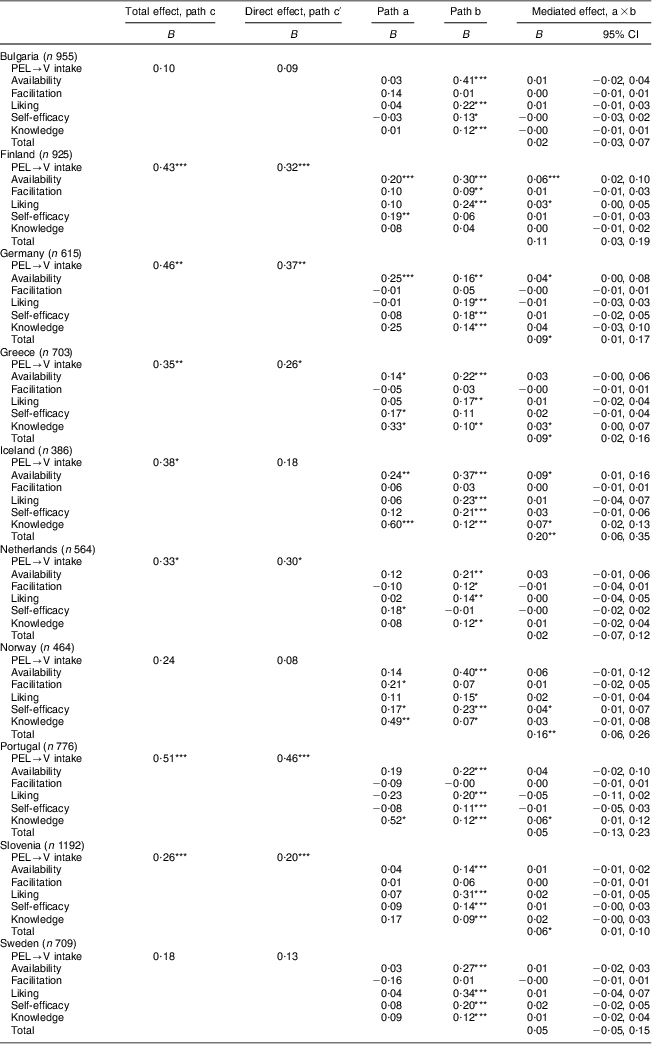
Table 4 shows total, indirect and mediation effects for the association between parental educational level and children's daily vegetable intake. Higher parental education was found to be associated with children's daily vegetable intake (path c) in Finland (P < 0·001), Germany (P < 0·01), Greece (P < 0·01), Iceland (P < 0·05), the Netherlands (P < 0·05), Portugal (P < 0·001) and Slovenia (P < 0·001).
Unstandardized regression coefficients (B) and 95% confidence interval for associations between parental educational levelFootnote †, potential mediators and children's daily vegetable intake, PRO GREENS project 2009Footnote ‡
PEL, parental educational level; V, vegetable.
Statistical significance of the associations: *P < 0·05, **P < 0·01, ***P < 0·001.
† Parental educational level: lower to middle (reference) v. higher.
‡ All analyses adjusted for gender and age.
Between-country differences were present in the associations between parental educational level and mediators (path a). In homes with higher parental educational level availability of vegetables was higher in Finland (P < 0·001), Germany (P < 0·001), Greece (P < 0·05) and Iceland (P < 0·01). Higher educated parents also facilitated vegetable intake in Norway (P < 0·05) and their children's self-efficacy to eat vegetables was higher in Finland (P < 0·01), Greece (P < 0·05), the Netherlands (P < 0·05) and Norway (P < 0·05). As already reported earlier, higher parental educational level was associated with better knowledge of the F&V recommendations in Greece (P < 0·05), Iceland (P < 0·001), Norway (P < 0·01) and Portugal (P < 0·05).
There were some country differences in the associations between potential mediators and children's daily vegetable intake (path b). The strongest correlates of daily vegetable intake in most countries were availability, liking, self-efficacy and knowledge of the F&V recommendations but facilitation was associated with daily vegetable intake only in Finland and the Netherlands.
Parental educational level was mediated on children's daily vegetable intake (a × b) through at least some of the factors examined in Finland, Germany, Greece, Iceland, Norway and Portugal. The strongest mediator was availability of vegetables at home, which was found to be significant in Finland (P < 0·001), Germany (P < 0·05) and Iceland (P < 0·05). Mediation also occurred through knowledge of the F&V recommendations in Greece (P < 0·05), Iceland (P < 0·05) and Portugal (P < 0·05), self-efficacy in Norway (P < 0·05) and liking in Finland (P < 0·05). Adjusted for the above-mentioned mediators, the association between parental education and children's daily vegetable intake (path c′) diminished in Finland, Germany, Greece, Iceland (where the association became non-significant), the Netherlands, Portugal and Slovenia.
Discussion
The aim of the present study was to determine which factors mediate the association between parental educational level and both fruit intake and vegetable intake among children in ten European countries. Parents’ higher education was positively associated with their children's daily fruit intake in five countries, and the factors acting as mediators were knowledge of the F&V recommendations, self-efficacy, facilitation and availability. An association between higher parental educational level and children's more frequent daily vegetable intake was found in seven of the ten countries. The strongest mediators for this association were availability and knowledge of the F&V recommendations, but self-efficacy and liking also acted as mediators.
In general, children whose parents had a higher educational level reported more frequently daily F&V intake. Educational-level differences in children's daily F&V intake, however, were partly modest or were not found in all countries. This contradicts the findings in the review by Rasmussen et al. ( Reference Rasmussen, Krølner and Klepp 12 ), which stated that parental educational level has been consistently associated with children's F&V intake. The lack of this association in the present study can be due to the separate examination of fruit intake and vegetable intake, since in all participating countries (except Sweden) children with higher educated parents reported either more frequent daily fruit or vegetable intake if not both. It may also be that a dichotomized educational level such as the one in the present study was not precise enough to detect the differences in F&V intake or its determinants. In the present study, however, the cross-country differences in the correspondence of educational levels disabled an alternative construction of the educational level variable. Future studies that include many countries should consider using the ISCED (International Standard Classification of Education) guidelines( 24 ) to assess educational level. It should also be noted that we used daily frequency of F&V intake in our analyses. It is possible that even though parents’ education was not associated with children's daily F&V intake in some countries, educational-level differences might have been found if the actual amount of F&V intake had been examined. Still, we chose to use the measurement of daily F&V intake, as the FFQ method is known to be more suitable for ranking subjects according to their usual food intake than the method of 24 h recall( Reference Haraldsdóttir, Thorsdottir and Vaz de Almeida 21 , Reference McPherson, Hoelscher and Alexander 25 ).
Even though children with higher educated parents scored higher in some determinants of F&V intake, educational-level differences were not consistent in all countries. Both in the case of fruit intake and that of vegetable intake, availability and knowledge of the F&V recommendations seemed to be the determinants most positively affected by parents’ education. Also in the level of self-efficacy to eat F&V some educational-level differences were noted. There are few studies that have examined how parental educational level influences the determinants of children's F&V intake. In a study using both education and many factors related to occupational status as indicators of socio-economic position, differences in availability but not in self-efficacy were found( Reference Sandvik, Gjestad and Samdal 26 ). Since nutritional knowledge has been reported to be better among higher educated mothers( Reference Vereecken and Maes 27 ), we assume that this probably affects the nutritional knowledge of their children as well. On the other hand, educational-level differences in liking for fruits were present only in Norway.
The lack of educational-level differences in liking for F&V is an important finding, since in many studies, as well as ours, liking for F&V has been one of the strongest correlates of F&V intake( Reference Neumark-Sztainer, Wall and Perry 14 , Reference De Bourdeaudhuij, te Velde and Brug 15 ). In addition to liking, also knowledge of the F&V recommendations had strong correlation with both fruit intake and vegetable intake. In the case of availability and self-efficacy there seems to be slight difference in the importance of the determinants of fruit intake and vegetable intake. Contrary to the findings from De Bourdeaudhuij et al.( Reference De Bourdeaudhuij, te Velde and Brug 15 ), in our study availability had a strong correlation with vegetable intake in all countries. For fruit intake, self-efficacy was more important in all countries.
Examining the mediation between parental educational level and children's daily F&V intake showed no clear pattern across the countries. Also the importance of the mediators differed somewhat for fruit intake and vegetable intake. In most countries, however, the association between parental educational level and children's F&V intake was mainly mediated by children's knowledge of the F&V recommendations. In the case of vegetable intake, availability was one of the most important determinants to account for educational-level differences. These findings are only somewhat in line with a Norwegian study in which accessibility but not knowledge of the F&V recommendations was found to explain a considerable part of the educational-level differences in F&V intake( Reference Bere, van Lenthe and Klepp 19 ). The dissimilarities of the results between these two studies can be due to the differences in the age of the participants (children v. adolescents), study design (cross-sectional v. longitudinal) or studying fruit intake and vegetable intake separately and not F&V intake together. However, among first-time mothers nutrition knowledge has previously been reported to partly explain the association between their educational level and diet quality( Reference Beydoun and Wang 28 ). This is not surprising, since knowledge of the recommendations is one of the strongest associates of F&V intake among adults( Reference Shaikh, Yaroch and Nebeling 29 ). Parental knowledge of the recommendations can be directly passed to children but also affects the availability of the food at home. Moreover, the association between availability and F&V intake cannot be considered only straightforwardly, as was shown in the mediation analyses by Wind et al. ( Reference Wind, te Velde and Brug 30 ). In their study, which included nine European countries, availability of F&V at home was mediated on children's F&V intake mainly through children's self-efficacy and liking for F&V.
The facts that the mediators examined in the present study did not explain the educational-level differences in children's F&V intake in all countries and that the proportions mediated were moderate indicate that there are other potential mediators. Even though the intra-class correlations in the multilevel analyses were small, also the lack of power can partly have contributed to the significance of the small effect sizes. On the other hand, correlations between examined mediators can have led to lower significance levels of single mediators. In a descriptive study such as ours, it is impossible to go deeper into analyses of the partly contradictory associations observed. Still, a plausible explanation is that between-country differences in food cultures at home and in the arrangements of school meals can affect the importance of the determinants of F&V intake as well as the total F&V intake over the course of a day( Reference Ray, Roos and Brug 31 ). Thus, in-depth, country-specific analyses are needed to clarify the situation in each country if the goal is to diminish educational-level differences in F&V intake.
The strength of the present study is the use of a standardized questionnaire and study protocol in each of the ten countries. This enables comparisons between countries and offers valuable information about the possible mediators between educational level and both fruit intake and vegetable intake from a wider perspective. The main limitations are the lack of a representative sample in most participating countries and a low response rate in some countries, which indicate that the results presented here are not necessarily generalizable to the whole population. This selection bias might also have led to homogeneity in educational level in some of the study samples and, further, to the conservativeness of the results about the mediators of F&V intake.
The mediators were measured with only one or two questions, which can also be seen as a limitation. When studying children, however, the use of single questions to measure a construct is a common practice since the questionnaires can otherwise be too long and demanding for children. Still, internal consistency of some constructs was very low. This was the case with availability of fruits in the Netherlands and with self-efficacy in Norway and Portugal. The lowness of Cronbach's α can partly be due to its sensitivity to the number of items included in a construct, but it is also an indication of the difficulties to form a child-assessed questionnaire that can be understood in the same way in different countries. The problem of low internal consistency of self-efficacy in Norway and Portugal was present as well in the validation study( Reference De Bourdeaudhuij, Klepp and Due 22 ) which otherwise reported moderate to good construct validity in most of the participating countries.
It can be concluded that the pattern of mediation between parental educational level and children's F&V intake differed across ten European countries. Still, the most important mediator for both fruit intake and vegetable intake was children's knowledge of the F&V recommendations. The association between parental education and children's vegetable intake was also mediated by availability of vegetables at home. This implies that interventions that aim to decrease educational-level differences in children's F&V intake should target both children, by increasing their knowledge of healthy diet, and also parents, by encouraging them to provide children with more F&V at home. It is of importance that relevant determinants are targeted in different populations in variable settings.
Acknowledgements
Sources of funding: The PRO GREENS project was made possible through financial support from the European Commission's Programme of Community Action in the Field of Public Health 2003–2008. The study does not necessarily reflect the Commission's views and in no way anticipates its future policy in this area. Additional financial support for the Finnish study group was provided by the Juho Vainio Foundation. The European Commission and the Juho Vainio Foundation had no role in the design, analysis or writing of this article. Conflicts of interest: The authors declare that they have no competing interests. Ethical approval: The parents provided their written informed consent both for themselves and their children. Ethical approvals for this study have been obtained from: (i) the Commission of Medical Ethics at the National Centre of Public Health Protection, Sofia, Bulgaria; (ii) the Ethics Committee at the Department of Public Health, Faculty of Medicine, University of Helsinki, Finland; (iii) the Ethics Committee of the Justus-Liebig University in Giessen, Germany; (iv) the Ministry of Education, Lifelong Learning and Religious Affairs, Greece; (v) the National Bioethics Committee, Reykjavik, Iceland; (vi) the Medisch Etische Toetsingscommissie, VU Medisch Centrum, Amsterdam, the Netherlands; (vii) Norwegian Social Science Data Services (NSD), Bergen, Norway; (viii) the Ministry of Education and headmasters of School Julio Saul Dias and School Frei João de Vila do Conde, Portugal; (ix) the National Medical Ethics Committee of the Republic of Slovenia, Ljubljana, Slovenia; and (x) the Regional Ethical Review Board, Stockholm, Sweden. Authors’ contributions: All authors have participated in the work and writing process of the manuscript and have read and approved the final version. Acknowledgements: The authors would like to express special thanks to all the teachers and children who participated in this survey and to all the staff and students from the ten participating countries who contributed to the data collection and entry.



