




1. Introduction
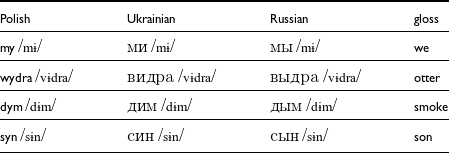
In this paper, we take a closer look at the aspects of articulation of phonemic high central(ized) vowels in three closely related Slavic languages – Polish, Russian and Ukrainian – which in the traditional Slavic transcription are transcribed using the same symbol ‘y’Footnote 1 (cf. Rybka Reference Rybka2015, and references therein). The same symbol is used across the three languages because of the broadly similar quality but also because of the similar phonological behavior. In particular, ‘y’ is a centralized unrounded high vowel which does not palatalize. The vowels also have similar historical genesis (Stieber Reference Stieber1973; Długosz–Kurczabowa & Dubisz Reference Długosz–Kurczabowa and Dubisz1993; Nesset Reference Nesset2015) and cognates are numerous and easy to spot. Some examples of cognates with /ɨ/ come from basic vocabulary, as in Table 1:
Example cognates in their orthographic form and IPA transcription

Authors using the IPA transcription usually transcribe the vowel as /ɨ/ or /ɪ/, as elaborated in section 1.1.2. For the ease of presentation and to avoid confusion with the IPA symbol /y/, the same IPA symbol /ɨ/ will be used throughout the paper with reference to the three phonemes in the three languages, but one of the ultimate goals of the paper is to verify the use of the symbol for the physical realizations of these vowels.
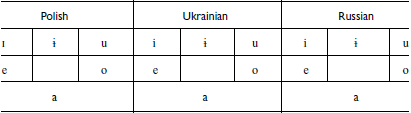
Phonologically, the vowels occupy the same position in the phonemic vowel inventory of the three languages, cf. Table 2.Footnote 2
Phonological underlying vowel inventories of Polish, Ukrainian and Russian

In this paper, we want to take a closer look at the details of articulation of these vowels in the three languages. We take the approach in which we focus on the traditional dimensions of the description of vowels, i.e. the height and fronting of the dorsum, and additionally the position of the tongue root. We ask the following questions: (1) whether the central(ized) vowels in the three languages are significantly different across the languages, (2) how the three vowels are articulatorily distinct from the other high vowels within each individual language, and (3) whether the use of the same or different IPA symbols can be recommended. We anticipate systematic differences, which reflect phonological differences between the languages. We stipulate that since palatalization in Ukrainian is less robust than in Polish, and it is less robust in Polish than in Russian, the contrasts between the front and the central vowel should be realized differently in the three languages. Also, the realization of non-palatalized consonants in Russian with velarization or uvularization (cf. Litvin Reference Litvin2014), and definitely with more velarization than in Polish, lets us suspect a difference in the realization of the vowel /ɨ/, which exclusively patterns with the non-palatalized consonants.
This is the first attempt to compare the articulation of the corresponding vowels in the subset of Slavic languages using instrumental articulatory data and statistical analysis – instead of an impressionistic assessment based on auditory perceptions, and instead of acoustic measurements that, per definition, give us only an indirect understanding of articulationFootnote 3 . An obvious choice for the study is the ultrasound method, which is cheap (once you have access to the equipment) and non-invasive. We have also chosen the 3D imaging equipment for its ease of interpretation. The 3D ultrasound in general produces less ‘noisy’ images than 2D and we have access to the information from parasagittal, coronal, and transverse images to help interpret midsagittal images, which are the focus of this study. Ultrasound images do not normally display the very tip of the tongue which hides in the mandible shadow (this would be visible in Electromagnetic Articulatography, henceforth EMA) but the tip of the tongue is assumed to play no independent role in the production of vowels in the languages we investigate. In contrast, the tongue root position significantly impacts the acoustic properties of vowels, and the ultrasound images show the posterior part of the tongue including the tongue root (which is not visible in EMA). An additional advantage of the ultrasound methodology is that we see the actual shape of the tongue rather than infer it from a limited number of data points.
1.1 Previous research
1.1.1 Ultrasound in linguistic research
While direct ultrasound articulatory studies have first been performed in the late 1960s (Kelsey, Minifie & Hixon Reference Kelsey, Minifie and Hixon1969) and then – primarily in the context of speech production and speech therapy research – throughout the 1980s (Shawker & Sonies Reference Shawker and Sonies1984) and 1990s (cf. Stone Reference Stone2005), it is a relatively new methodology in the repertoire of a linguist, largely replacing earlier methods using X-ray. Ever since, this method has been used to investigate vowels in a number of languages, especially the details of the location of the tongue root and dorsum, the parts which cannot be reliably imaged using other accessible/more cost-effective methods such as the earlier mentioned EMA.
For example, ultrasound imaging has been used to study the tenseness/length distinction in German vowels (Pouplier, Buchwald & Stone Reference Pouplier, Buchwald and Stone2004), tongue root contrast in Dagbani (Hudu Reference Hudu2010), vowels in Yoruba (Allen, Pulleyblank & Ajíbóyè Reference Allen and Pulleyblank2013), vowel harmony in Wolof (Dye Reference Dye2015),vowel harmony in Turkish, Kyrgyz and Kazakh (Washington Reference Washington2016), and Catalan (Recasens Reference Recasens2017), apical vowels in Hefei Mandarin (Kong et al. Reference Kong, Wu, Li and Shen2023) and Jixi–Hui Chinese (see Shao & Ridouane Reference Shao and Ridouane2023), palatalization-triggered allophony in Russian vowels (Cavar & Lulich Reference Cavar and Lulich2021), and pharyngealized vowels in Northern Horpa (Chiu & Sun Reference Chiu and Sun2020). Ultrasound imaging has been used in the study of secondary articulations on consonants: palatalization in Russian (Matsui & Kochetov Reference Matsui and Kochetov2018; Cavar, Nagaraj & Amacker Reference Cavar, Nagaraj and Amacker2020a), Irish (Bennett et al. Reference Bennett, Ní Chiosáin, Padgett and McGuire2018), Polish (Cavar et al. Reference Cavar, Nagaraj and Amacker2020a, Reference Cavar, Rudman and Lulich2020b), Polish sibilants (Bukmaier & Harrington Reference Bukmaier and Harrington2016; Cavar Reference Cavar and Lulich2018), Canadian French rhotics (Mielke Reference Mielke2015), lateral consonants in Brazilian Portuguese (Charles & Lulich Reference Charles and Lulich2019) and in Korean (Hwang, Charles & Lulich Reference Hwang, Charles and Lulich2019), velarization/uvularization in Russian (Litvin Reference Litvin2014), and emphasis in Arabic (Al-Tairi et al. Reference Al-Tairi, Brown, Watson and Gick2017).
Ultrasound has also been used in clinical phonetics (e.g. a study of the modification of vocalic articulation depending on the regular or hard-of-hearing listener by Song (Reference Song2017), to study vowel reduction mechanisms (Strycharczuk, Cavar & Coretta Reference Patrycja, Cavar Malgorzata and Stefano2021), second language learning (e.g. Antolik & Volin Reference Antolík and Volín2019), in sociophonetic studies (e.g. Scobbie, Steward-Smith & Lawson Reference Scobbie, Stuart-Smith and Lawson2012), and in the investigation of language contact, in particular bilingual vowel production (e.g. Kirkham & Nance Reference Kirkham and Nance2017).
While the method has rapidly been gaining in popularity in the last decade, 2D equipment is most commonly used, which typically aims to record a midsagittal cross-section of the vocal tract. From the studies above, only Washington (Reference Washington2016), and Cavar & Lulich (Reference Cavar and Lulich2021) have used 3D equipment. Although 2D mid-sagittal views are presented in this paper, we also use for the data collection a 3D equipment (with time as the fourth dimension). We use 3D recordings to identify unambiguously the mid-sagittal plane, and to help in interpretation of the structures visible in the 2D view by comparison with the adjacent parallel slices and the relevant coronal plane. Finally, the inspection of coronal views allows us to identify grooving in the tongue and any asymmetric articulations. The 3D method has not yet become very popular in the field of speech and language research (cf. Lulich, Berkson & de Jong Reference Lulich, Berkson and de Jong2018) despite being a more versatile method and providing more reliable data than the 2D equipment.
1.1.2 Earlier descriptions and the use of IPA symbols for Polish, Russian and Ukrainian vowels
Slavic linguistic tradition uses the same symbol ‘y’ for the different reincarnations of the centralized high vowel in various Slavic languages: Polish, Upper Sorbian, Lower Sorbian, Belarusian and Russian. As noted in Rybka (Reference Rybka2015:44) the symbol stands for different qualities of vowels and cannot be unambiguously translated to IPA.
Quite a lot of literature has been devoted to the phonetics of Russian and Polish though multiple reasons warrant another articulatory study. First, the high central(ized) vowel is known for its non-uniform articulatory shape of the tongue even within one individual language or dialect (e.g. Koneczna & Zawadowski Reference Koneczna and Zawadowski1951 for Polish; Koneczna & Zawadowski Reference Koneczna and Zawadowski1956 for Russian). Potentially there might be some systematic variation of dialectal or other sociolinguistic nature but to our knowledge it has not been investigated either. The following discussion of the use of phonetic symbols is based on literature that – unless stated otherwise – describes the pronunciation of the standard language as used in media, theater and education at the time of publication. Second, a lot of early historical descriptions were impressionistic, and most of the instrumental studies investigate acoustic properties of the sounds but no articulation. Third, the quality of the vowel in the standard language might have evolved over decades and the images from the 1950s and 1970s might not reflect the current status quo. Fourth, for Ukrainian, there are virtually no modern instrumental articulatory studies available.
Talking about Polish /ɨ/, Benni (Reference Benni1913) describes it as articulated half-way between Polish /i/ and Russian /ɨ/.Footnote 4 Based on X-ray images, Wierzchowska (Reference Wierzchowska1967:123) observes that the centralized vowel in Polish is different from /i/ in that it is produced with less fronting and less raising of the tongue. Additionally, /ɨ/ shows a narrower pharyngeal cavity than /i/ and, unlike /i/, no deep groove along the center of the tongue in the tongue root area. The lips are in the neutral – neither rounded nor spread – position. According to Rocławski (Reference Rocławski1976:75,105), the Polish vowel is a near-close central unrounded [ɪ̠]. Phonetic monographs categorize the vowel as front or front centralized (Sawicka Reference Sawicka1995:119; Wierzchowska Reference Wierzchowska1967) but not central or back.
Newer phonological publications about Polish, which depart from the traditional Slavic transcription, use almost exclusively the symbol /ɨ/ (Rubach Reference Rubach1984; Gussman Reference Gussman2007; Rydzewski Reference Rydzewski2014, etc.). More phonetically oriented publications predominantly use /ɨ/ as well (Jassem Reference Jassem1981; Dukiewicz & Sawicka Reference Dukiewicz and Sawicka1995; Sawicka & Grzybowski 1999; Jassem Reference Jassem2003), but /ɪ/ is also sporadically used (Kavka, Molęda & Widota Reference Kavka, Molęda and Widota2007; Linde-Usiekniewicz Reference Linde-Usiekniewicz2011). Based on acoustic measurements, Jassem (Reference Jassem1974:114) concludes that the vowel ranges from IPA [ɪ] to [ɘ]. Consequently, Rybka (Reference Rybka2015:79ff) proposes [ɪ̠] for narrow transcription and simply /ɪ/ for broad transcription. Rybka (Reference Rybka2015:79) insists that, should the symbol /ɨ/ be used, the candidate for the narrow transcription would be [ɨ̟] (with a plus diacritic under the symbol). Additionally, allophonic variation can be observed: Cavar and Lulich (Reference Cavar and Lulich2020) note that, when following velar stops in newer borrowings, the Polish /ɨ/ is retracted; consequently, the authors label the allophone as [ɨ]. Rocławski (Reference Rocławski1976) reports also a close-mid central unrounded [ɘ̟] as an optional allophone before /r/ and in some unstressed positions.
Most authors using IPA select /ɨ/ for the Russian vowel, cf. Jones & Trofimov (Reference Jones and Trofimov1923), Bolla (Reference Bolla1981), Padgett (Reference Padgett, Hume and Johnson2001), Dalewska Greń (Reference Greń2002:26–27, 43), Ordin (Reference Ordin2011). Rybka (Reference Rybka2015:79) also refers to the Russian vowel using the symbol /ɨ/ or [ɨ̠] in the narrow transcription. Historically, Benni (Reference Benni1913) describes it as a central vowel. Koneczna and Zawadowski (Reference Koneczna and Zawadowski1951) described two types of the Russian /ɨ/ based on X-rays from four speakers. One type was a central vowel produced with an advancement – as compared to /u/ – of the back of the tongue including the tongue root, and a relative widening of the pharyngeal cavity. The production of the vowel was characterized by high muscular tension with deep grooving along the tongue center, especially in the tongue root area (p. 27ff.). The second type, earlier described by Shcherba (Reference Shcherba1912) and Matusevich (Reference Matusevich1948) was a mixed vowel, which formed a long constriction extending from the front to central to back vocalic area. It was also articulated with substantial widening of the pharyngeal cavity and a high level of muscular effort. Jones and Ward (Reference Jones and Ward1969:33) and Lyovin (Reference Lyovin1997) note that the Russian central vowels may be heavily diphthongized, with the initial element approaching [ɯ] ([ɯɨ]). Koneczna and Zawadowski (Reference Koneczna and Zawadowski1951) make a point that none of the vowels they recorded were diphthongized.Footnote 5
As for Ukrainian, earlier impressionistic descriptions of Western Lviv Standard by Broch (Reference Broch1911) and Zilyns’kyj (Reference Zilyns’kyj1979[1933])Footnote 6 label the vowel as ‘a central vowel with a strongly fronted articulation, on the boundary of the front series’ which ‘occupies an intermediate position between /i/ and the tense raised /e/’ (Zilyns’kyj Reference Zilyns’kyj1979:45–46). In isolation, the vowel in the Western Lviv Standard was closer to mid /e/ than to high vowel /i/, lower and more fronted than the Polish /ɨ/. Zilyns’kyj also notes dialectal differences, both in the height and fronting of the vowel. For example, some dialects have a considerably lowered /ɨ/ in general, but in some other dialects the lowering of /ɨ/ is contextual, in particular, restricted to the contexts of labials and liquids in accented syllables. He notes also contextual variation within dialects, for example, /ɨ/ may be sporadically raised in the context of velars.Footnote 7 These descriptions cannot be taken for granted, however, not only because the observations were impressionistic, but also because the pronunciation of the Polish vowel – which is taken as a reference by Zilyns’kyj – has impressionisticallyFootnote 8 somewhat evolved since the 1930s. Bilodid (Reference Bilodid1969) notes a difference between Western and Eastern Ukrainian rendition of the vowel, where the Eastern version is tenser and fronter than the Western one. Brovchenko (Reference Brovchenko1954) describes the vowel as high front retracted, Bilodid (Reference Bilodid1969) – as high front relatively retracted and lowered (as compared to /i/). Steriopolo (Reference Steriopolo2012) based on acoustic data uses the symbol /ɨ/, Press and Pugh (Reference Press and Pugh2015) – /ɪ/, Pompino-Marschall, Steriopolo and Żygis (Reference Pompino-Marschall, Steriopolo and Żygis2016:5–6) – the symbol /ɪ/ or /ɪ̠/. Vakulenko (Reference Vakulenko2018) notes also that the quality of the vowel is influenced by the vowels in following syllables and based on the acoustic data locates the vowel between [ɨ̞̟] (lowered advanced high central) and [ɘ̟] (closed-mid advanced central). In Rusanivs’kyj, Taranenko & Zjabljuk (Reference Rusanivs’kyj, Taranenko and Zjabljuk2004), the Ukrainian vowel is described as retracted close-mid front ([ɪ̞] in narrow transcription. Some authors use the symbol /ɨ/, e.g. Czaplicki (Reference Czaplicki2007), though the choice of the symbol is probably not based in phonetics but rather in phonology. Danylenko and Vakulenko (Reference Danylenko and Vakulenko1995) do not use IPA transcription in their monograph of Ukrainian but refer to the vowel as close-mid front unrounded.Footnote 9 In general, there have been very few studies of the sounds of Ukrainian in the last decades and even fewer instrumental studies. We are not aware of any new articulatory studies of Ukrainian except for the pilot of Cavar et al. (Reference Cavar, Nagaraj and Amacker2020a), which focuses on other aspects of the articulation in Ukrainian.
2. Method
2.1 Instrumentation
In this study, we use a unique system composed of equipment for medical diagnostics including Philips EPIQ 7G machine (core software version 1.5.8; for more information, see Lulich & Pearson Reference Lulich and Pearson2019) and a Philips xMatrix x6-1 digital 3D/4D ultrasound transducer (Lulich et al. Reference Lulich, Berkson and de Jong2018). The ultrasound probe was stabilized under the jaw with an Articulate Instruments Ltd headset (Scobbie, Wrench & van der Linden Reference Scobbie, Wrench and van der Linden2008). The equipment recorded 3D wedge–shaped volumetric images of the tongue, cf. e.g. Cavar and Lulich (Reference Cavar and Lulich2021), with the vision field between 60° and 90°, and the depth of penetration between 7.5cm and 10cm. The mid-sagittal plane has been identified using the grooving along the center of the tongue visible in the coronal plane.
The time resolution was between 9 and 22 frames per second, depending on the size of the volume recorded. The field of view, and the depth of penetration was different for different speakers, depending on the anatomic differences between the speakers. While the time resolution is lower than in 2D ultrasound imaging, the three to five frames per vowelFootnote 10 that we get in our recordings allows us to obtain an image within the central 30% for any monophthong vowel in the study. As the images were processed manually, it can be stated with a high certainty that only in two individual cases a diphthongal pronunciation occurred, one in the Ukrainian vowel /ɨ/ and one in the Russian vowel /ɨ/. In these cases, two frames were traced.
The raw measurements expressed in centimeters were normalized by z–score to compare the articulations directly within each speaker and statistically – across speakers.
At the same time as the ultrasound recordings were taken, we also recorded the audio files using a SHURE KSM32 microphone placed approximately 1 meter in front of the participant, with a sampling rate of 48kHz and 16−bit quantization. The audio data was used primarily to help identify the correct ultrasound frame for analysis.Footnote 11
2.2 Speakers
The data collection took place in the time span 2016–2021 in the Speech Lab of the Department of Speech and Hearing on the Bloomington campus of Indiana University. Ten native speakers of Polish (data from nine speakers were used in this study for the statistical analysis)Footnote 12 , nine native speakers of Russian, and nine native speakers of Ukrainian participated. The Polish speakers all spoke Warsaw standard Polish. Speakers were instructed to speak the standard language, however, we have assigned speakers to a dialect group based on their reported predominant place of living in the country of origin to control for the impact of the dialect.
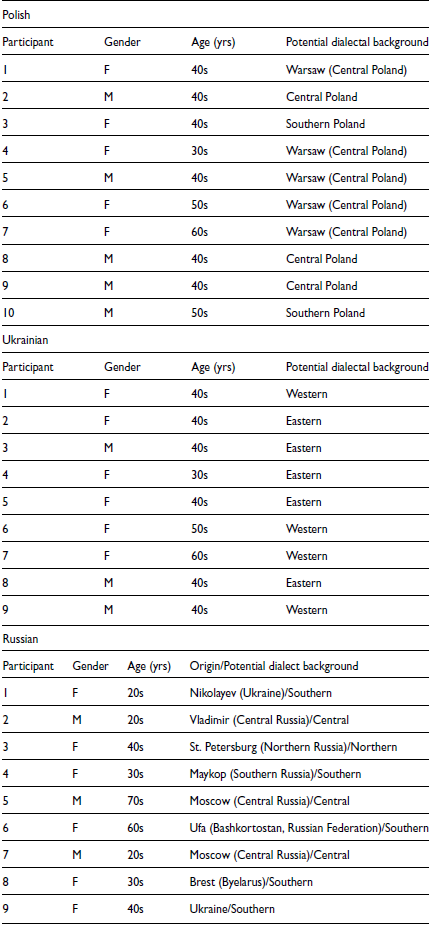
Since the study has been conducted in the United States, all participants spoke English as their second language. However, participants who spoke Polish, Russian or Ukrainian with an unnatural accent, have not been selected for the study. The assessment was impressionistic based on the judgment of native speakers helping with the recruitment of participants.Footnote 13 Basic biographical information of the speakers is summarized in Table 3.
Basic biographical information of the speakers

2.3 Materials
Speakers pronounced nonce disyllabic words of the form CVCV (Russian and Ukrainian) and CVCVC (Polish), with the word stress on the initial syllable. For each word, both syllables contained the same vowel from the set {i, ɨ, u, e, o, a}. For each word, all the consonants were identical and were drawn from the set {p, t, k, t͡ɕ, t͡ʂ} in Polish, {p, t, k, ʂ, ɕ} in Russian, and {p, t, t͡ʃ, ʃ, k, x, ʁ/ʕ} in Ukrainian. Polish speakers 1–5 repeated the word list three times, speakers 6–10 twice. Russian speakers repeated the word list three times (except for speaker 8, who repeated the list twice). The Ukrainian subjects produced only two repetitions. To minimize the effect of consonantal coarticulation, only vowels in the context of labial and dental consonants were included in the statistical analysis.
The images in the descriptive part represent the contours of stressed high vowels in the labial consonant context. Additionally, a contour of the tense allophone of /e/ (in a soft consonant context) has been added for comparison; vowel /e/, however, was not included in the statistical analysis.
For Polish speakers 3 and 4, some individual files were missing or corrupted. This gave 44 vowels /i/, 44 vowels /ɨ/, and 38 vowels /u/ from Polish native speakers, 51 examples of each vowel from the nine Russian speakers, and 35 examples of each vowel from the Ukrainian native speakers, in total 384 vowels.
2.4 Articulatory analysis
The images in this article are created by manually tracing the tongue surface using WASL 10.3.6, a MatLab-based toolbox (e.g. Lulich, Berkson & de Jong Reference Lulich, Berkson and de Jong2018). The tongue contours of single articulations of /ɨ/, /i/, /u/ and /e/ by each individual speaker were overlaid to show the differences between the vowels. In the analysis, we used the frame taken from the steady-state vowel phase, possibly closest to the center of the vowel. The sagittal view images represent the midsagittal plane. The midsagittal plane has been identified in the 3D image by looking at the coronal plane and identifying the groove along the center of the tongue. Another set of images represents the coronal plane in the tongue root area, at the point opposite of the tendon of the genioglossus muscle.
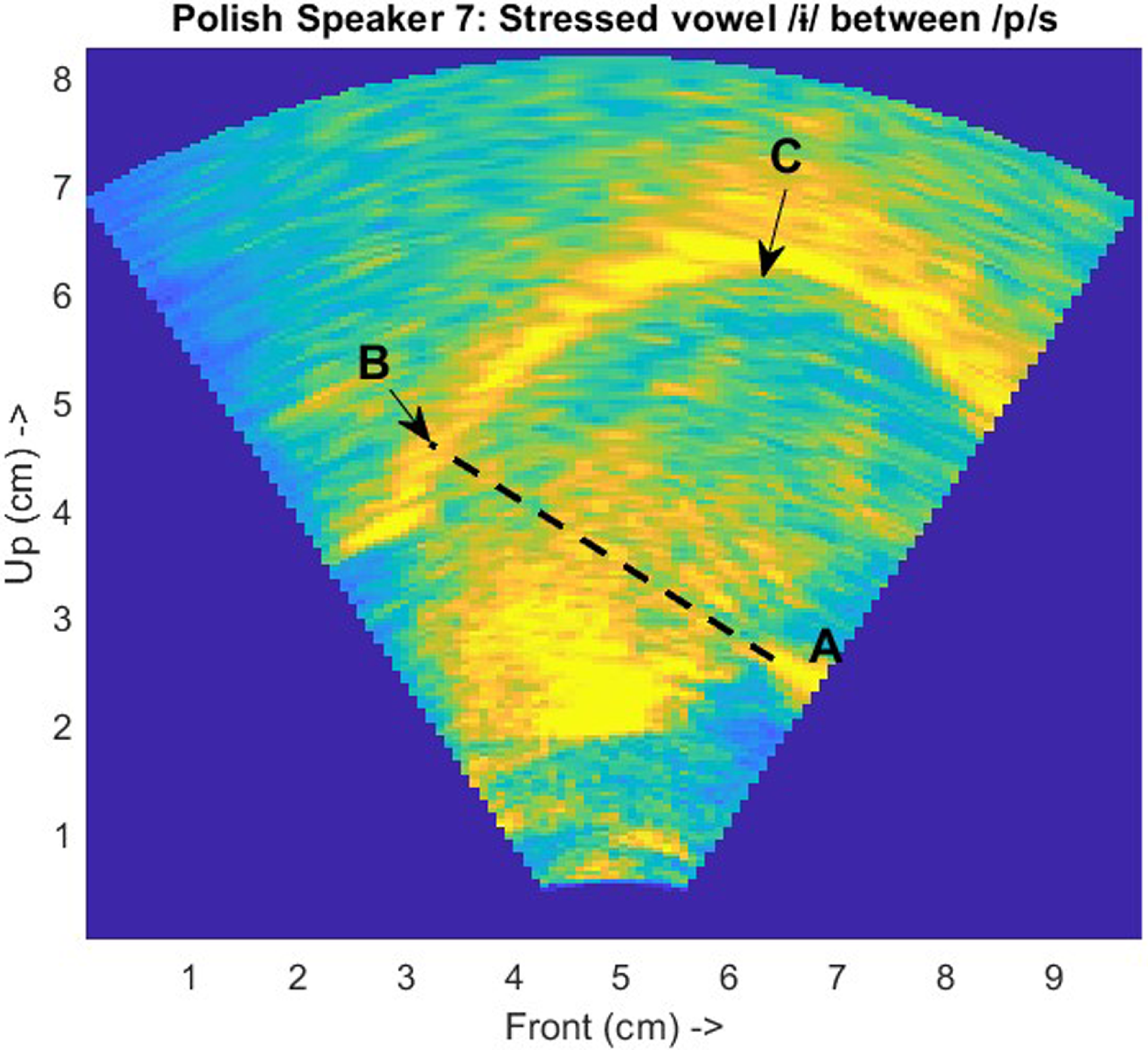
For the quantitative analysis, we have measured the position of the tongue root and the highest point of the tongue dorsum, as in Figure 1.
An example of a raw ultrasound image, the front of the oral cavity on the right. A: The tendon of the genioglossus. B: The tongue root point opposite the tendon of the genioglossus. C: The highest point of the dorsum.

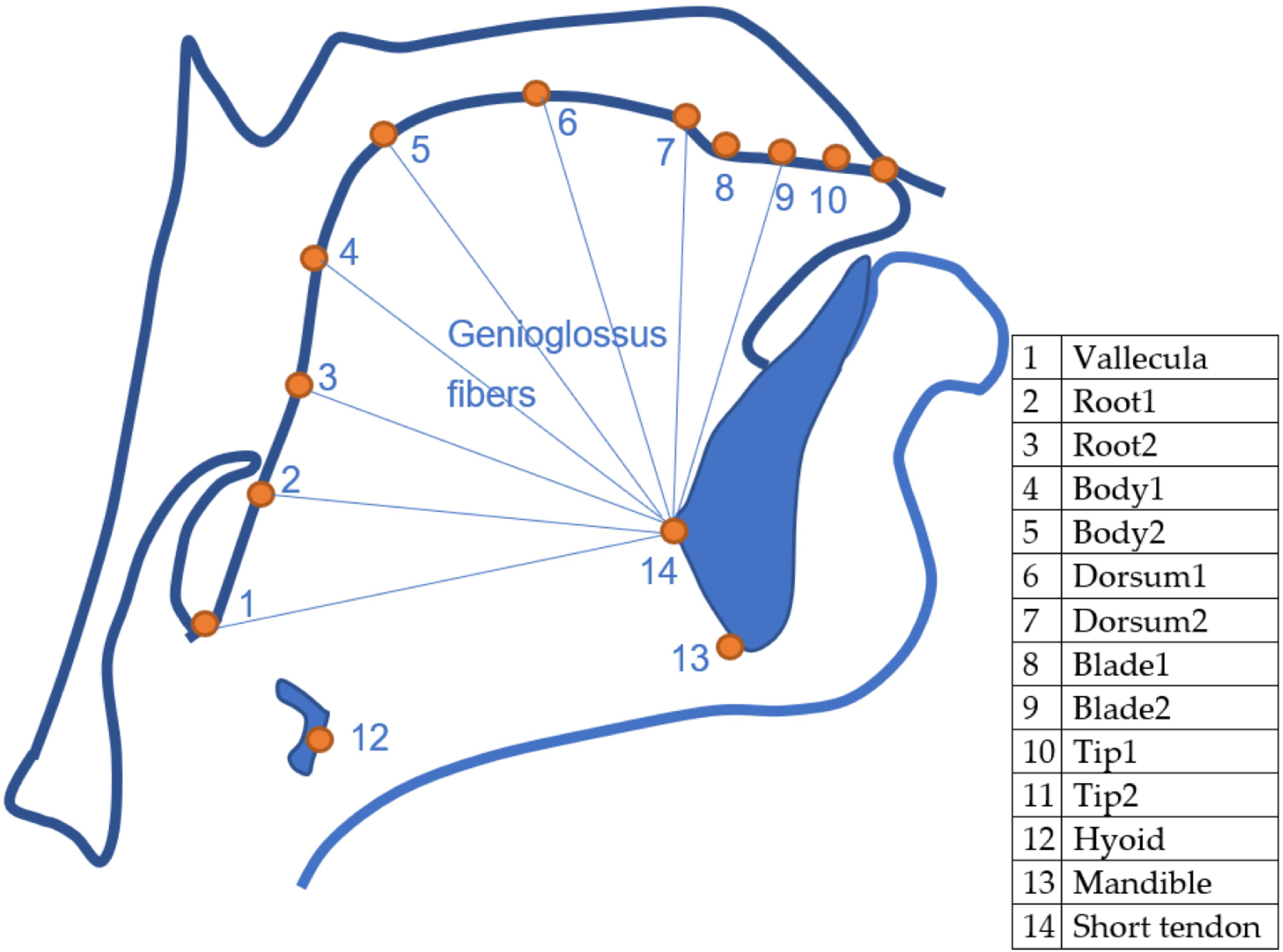
In this paper we adopt the terminology used in the AAA software (Articulatory Instruments Ltd. 2012), as in Figure 2 (cf. Wrench & Balch-Tomes Reference Wrench and Balch-Tomes2022). We can define the dorsum as the area of the tongue between the tongue blade and the body. The tongue root points in our paper roughly correspond to knots in Wrench and Balch-Tomes (Reference Wrench and Balch-Tomes2022), in particular, the tongue root point corresponds to knot 3 and the dorsum point to knot 6.
Anatomy of the tongue. 1 vallecula, 2, 3, 4 tongue root, 5, 6, 7 dorsum, 8, 9 blade, 10,11 tip, 12 hyoid bone, 12 mandible, 14 tendon of the genioglossus (image adopted from Wrench and Balch-Tomes Reference Wrench and Balch-Tomes2022 under Creative Commons Attribution (CC BY) license).

We manually identified the tongue root point in relation to the tendon of the genioglossus, which is always visible. In particular, after identifying the tendon and its orientation, we drew a line continuing from the tendon to the surface of the tongue, along the muscle fibers (often visible in the images, as in Figure 1), and aligning with the point of maximal grooving in the tongue root as seen in the coronal view. The dorsum point was identified as a central point of the tallest area of the tongue (in reference to the y-axis). For the two points, we have recorded x,y coordinates using a WASL function, which were then subject to the quantitative analysis, as described in Section 2.5.
We believe that two properly selected points on the tongue surface can be sufficient for the statistical analysis of the differences in the tongue shape, instead of analyzing and comparing all points on the surface of the tongue. There is a long line of research tracking the movement of a few points on the tongue surface, further using the quantitative scale of point displacement to describe the movement of the tongue (Öhman Reference Öhman1966; Houde Reference Houde1968; Perkell Reference Perkell1969; Kent & Moll Reference Kent and Moll1972; Munhall, Ostry, & Randall Flanagan Reference Munhall, Ostry and Randall Flanagan1991; Mooshammer, Hoole & Kühnert Reference Mooshammer, Hoole and Kuhnert1995; Munhall & Jones Reference Munhall, Jones, Bell–Berti and Raphael1995; Gracco, Shiller & Ostry Reference Gracco, Shiller and Ostry1999). The highest point of the tongue dorsum may be interpreted phonologically to be the articulatory measure for vowel fronting and height as it is traditionally understood in the Bell’s model. However, there is growing evidence that the measure of the tongue dorsum position might not be sufficient.
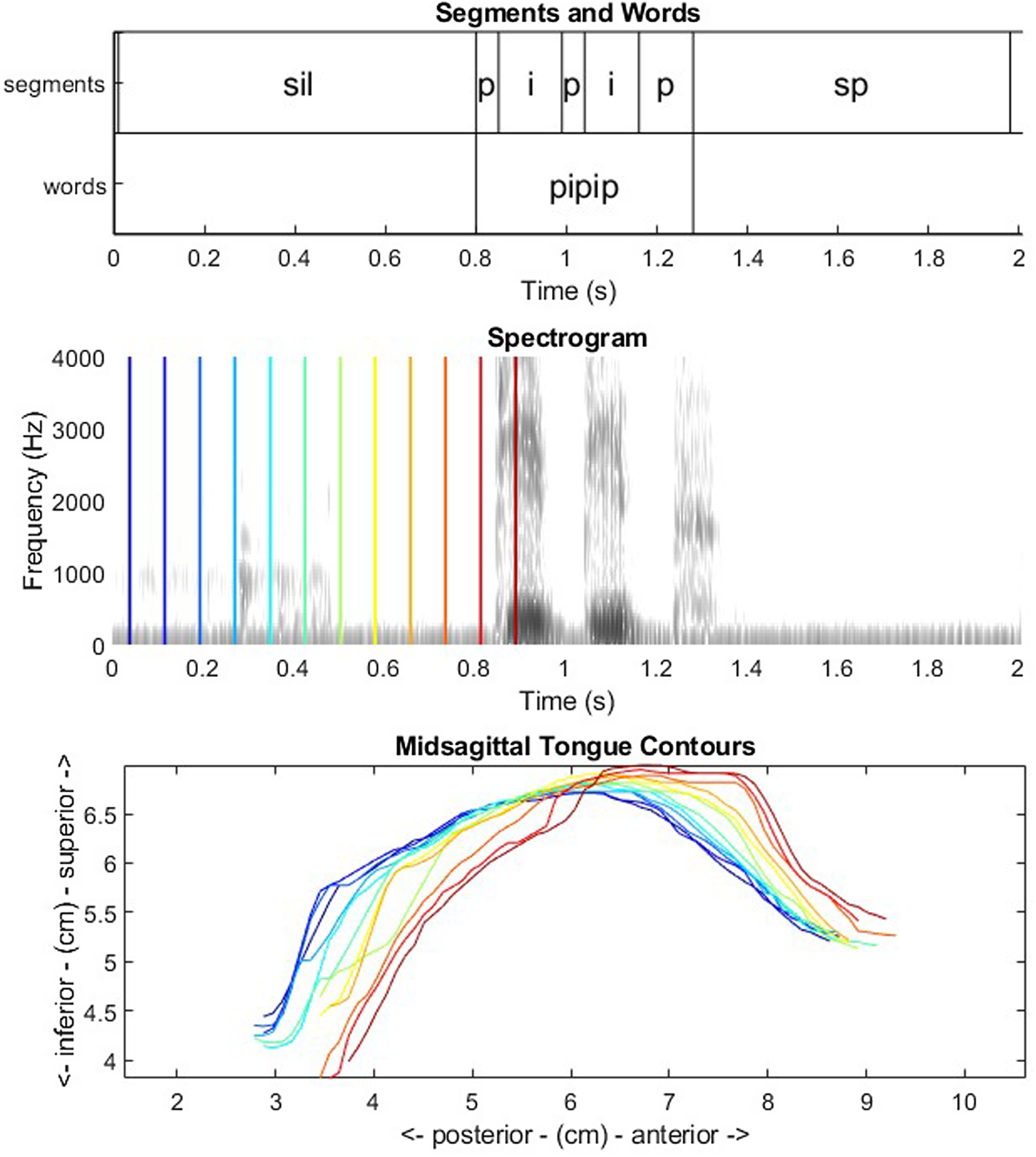
Starting with the research on languages with tongue root harmony processes, it has become clear that the position of the tongue dorsum is not a sufficient indication of the vocalic category and that phonologically distinct vowel categories with an identical or very similar position of the dorsum may differ primarily in the position of the tongue root. To achieve a more complete understanding of the differences in vowels, one would want to track the position of the dorsum and root. This approach can find further support in results of Iskarous (Reference Iskarous2005) who identifies only two major types of articulatory gestures, the arch, and the pivot. The former can be characterized for vowels by squeezing and elevating the dorsum, consequently the gesture can be traced by the changes in the position of the highest dorsum point. The latter is characterized, according to Iskarous (Reference Iskarous2005:376) by two ‘speech tasks’ in two different locations, as illustrated in the bottom panel of Figure 3.
Consecutive frames in the nonce word ‘pipip’ (pronounced by a Polish native speaker) starting from the silence before the occlusion and the burst of the first plosive into the middle of the first vowel. Top panel: phonemic annotation; middle panel: spectrogram with marked time of the consecutive frames; bottom panel: overlaid tracings of the shape of the tongue coded in colors corresponding to the timestamp information in the middle panel. Figure prepared by Sherman Charles.

The bottom panel of Figure 3 represents overlaid consecutive phases of the formation of the vowel /i/ in a nonce word ‘pipip’ pronounced by a Polish subject. The consecutive frames are marked by different colors (the same colors in the bottom and the central panel for the corresponding frames), from the blue (earliest frames even before the consonantal occlusion), over green and yellow, to orange (where consonantal occlusion begins) and red (with the darkest red representing the target posture for the vowel /i/). Given that the tongue is not involved in the formation of the occlusion for the labial consonant, the entire sequence of frames represents the formation of the high front vowel. We can observe that the consecutive phases can be characterized by tongue root lowering and advancement, and radical fronting and raising of the dorsum, that is, two speech tasks in the sense of Iskarous (Reference Iskarous2005), one involving the tongue root and the other involving the dorsum. In contrast, the middle section of the tongue between the tongue root and the dorsum does not change the position but rather functions as a pivot of the movement.
The two points – the point on the tongue root surface opposite the tendon of the genioglossus, and the highest point of the dorsum – are those which change maximally during the transition from the neutral position. It follows that tracking the position of the two points should capture the crucial differences in the tongue position for the different vowels, whether the changes would be reflecting the arch or the pivot mechanism.Footnote 14
2.5 Statistical analysis
We normalized the data using z–score. We looked at the fronting of the tongue dorsum (xTB), height of the dorsum (yTB), fronting of the tongue root (xTR) and the height of the tongue root (yTR) and found the overall mean and standard deviation of these values for each speaker. We subtracted the mean and divided by the standard deviation to normalize the values for that speaker and then repeated the process for all speakers. The reported mean values are normalized, unless stated otherwise.
Our statistical analysis was performed using R (R Core Team 2023). Linear mixed models were constructed using the lme4 package (Bates et al. Reference Bates, Mächler, Bolker and Walker2015). For visualizing model summaries and obtaining p-values adjusted with the Kenward–Rogers approximation, we employed the tab_model function from the sjPlot package (Lüdecke Reference Lüdecke2021). Additionally, we utilized a combination of packages, including lme4 (Bates et al. Reference Bates, Mächler, Bolker and Walker2015), tidyr (Wickham & Henry Reference Wickham and Henry2023), dplyr (Wickham et al. Reference Wickham, François, Henry and Müller2023), and ggplot2 (Wickham Reference Wickham2016), to manage and visualize our data.
We asked first if the vowel category /ɨ/ is articulated differently in the three languages. To answer this question, we analyzed separately four sets of data, including the fronting of the tongue dorsum (xTB), height of the dorsum (yTB), frontness of the tongue root (xTR) and the height of the tongue root (yTR) to find out if the means for the corresponding measures for the vowel /ɨ/ are different between Ukrainian, Russian and Polish speakers after taking out the variation due to repeated measures collected from each speaker. We used linear mixed-effects models. Specifically for this question, we restricted the data to /ɨ/ and used xTB (and then yTB, xTR, and yTR in the consecutive tests) as the response variable. We treated the categorical variable language (with categories Ukrainian, Russian and Polish) as a fixed effect and Place (with categories coronal and labial) as another fixed effect. Because we had multiple measures from each speaker in all cases, speakers were treated as a random factor in order to control for the variation coming from different speakers. We used linear mixed-effects models instead of repeated measures ANOVA because we did not have the same number of samples taken from each speaker, as described in Section 2.3. We repeated this same process for the data restricted to the measures for the other high vowels: /i/ and /u/. We used the linear mixed models to calculate t–scores and then we used the Kenward–Rogers approximation to estimate the degrees of freedom for our model. From here, we could calculate p–values.
We chose to use the standard α = 0.05 as our significance level. However, when we conducted comparisons over three factor levels using two linear mixed models with different reference levels, we used the Holm–Bonferroni method (Holm Reference Holm1979). For example, if α = 0.05 and we are doing a comparison over three factor levels using two linear mixed models, then we would use an adjusted $\alpha/3 = 0.05/3 \approx 0.0167$
. This is a statistical method used to control the family-wise error rate when conducting multiple comparisons. However, it is important to note that while the Holm–Bonferroni method decreases the probability of false positives, it may increase the risk of Type II errors (false negatives), especially for p-values that are close to the threshold. Therefore, in our tables in the appendix, we highlighted significant p-values after the Holm–Bonferroni method in red, but we also highlighted borderline p-values in yellow that may have been excluded due to the higher risk of Type II errors.
$\alpha/3 = 0.05/3 \approx 0.0167$
. This is a statistical method used to control the family-wise error rate when conducting multiple comparisons. However, it is important to note that while the Holm–Bonferroni method decreases the probability of false positives, it may increase the risk of Type II errors (false negatives), especially for p-values that are close to the threshold. Therefore, in our tables in the appendix, we highlighted significant p-values after the Holm–Bonferroni method in red, but we also highlighted borderline p-values in yellow that may have been excluded due to the higher risk of Type II errors.
The second question was how /ɨ/ differs from the front /i/ and back /u/ within the same language respectively. Using the same four sets of data (xTR, yTR, xTB, and yTB), we looked to see if the distribution of values in the four sets is different for the vowel /ɨ/ as compared to the corresponding values for vowels /i/ and /u/ in each language respectively. Here too, we used linear mixed-effects models. We restricted the data to the measurements taken from Polish speakers alone (then, in consecutive tests, only Russian and only Ukrainian). We used xTR, yTR, xTB or yTB, respectively, as the response variable. We treated the categorical variable vowel (with categories /ɨ/, /u/, and /i/) as a fixed effect and Place (with categories coronal and labial) as a fixed effect. Because of the multiple measures from each speaker in all cases, speakers were treated as a random factor to control for the variation coming from different speakers.
We also wanted to see if there were any significant differences between the dialects within either of the languages. We wanted to answer the question if the means of the four measures for Polish speakers alone (then only Russian and only Ukrainian speakers in consecutive tests) are different across the dialects, given that we have accounted for the variation due to repeated measures collected from each speaker. We treated the categorical variable dialect as a fixed effect, the categorical variable Place (with categories coronal and labial) as a fixed effect, and speakers were treated as a random factor in order to control for the variation coming from different speakers.
Finally, we have also conducted an analysis to test if there are significant differences depending on the contact with English as L2. Specifically for this question, we restricted the data to the measurements taken from only one language at a time and used xTB (yTB/xTR/yTR) as the response variable. We treated the categorical variable ‘L2 status’ (with categories Old and New) as a fixed effect, Place as a fixed effect, and Speakers were treated as a random factor to control for the variation coming from different speakers.
3. Results
Before we move on to the statistical analysis, in Sections 3.1.1–3.1.3, we present examples of concrete individual articulations (not averages), illustrating a range of possible articulations, and situating the subsequent statistical results. In all the images, the same color scheme has been adopted (black for /ɨ/, red for /i/, navy for /u/, and pink for the soft consonant context /e/). The front of the oral cavity is always on the right. Apart from the images of the midsagittal cross-section, we present also the images of the coronal cross-section taken at the tongue root point. We believe that a strong grooving at this location indicates a contraction of the genioglossus muscle, that is, the resulting tongue root advancement is an active gesture.
Section 3.2.1. addresses the question of whether the centralized vowel is significantly different across the three languages. Section 3.2.2 focuses on the question of which parameters (dorsum height, dorsum fronting, tongue root height, tongue root fronting) show significant differences for the pairs of the high vowels in Polish. Section 3.2.3 investigates the same questions in the Ukrainian data, and section 3.2.4 – in the Russian data.
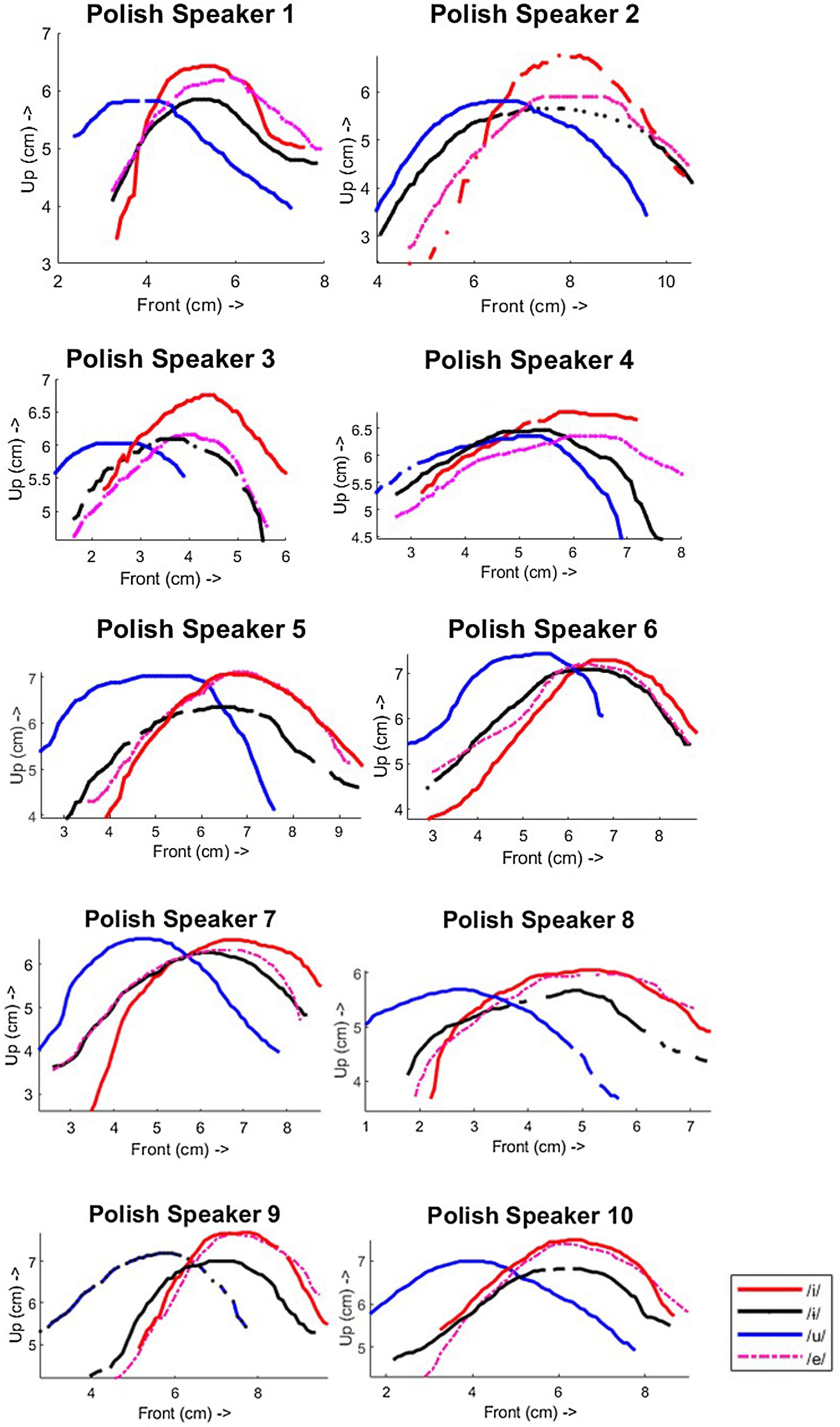
Contours of the surface of the tongue for vowels of standard Polish based on the individual representative 3D ultrasound recordings, midsagittal slice: /ɨ/ (black), /i/ (red), an allophone of /e/ in the context of the palatalized consonants (pink dotted), and /u/ (blue).

3.1 Qualitative articulatory analysis
3.1.1 Polish
Figure 4 represents overlaid tracings of the tongue surface in the individual instances of vowels /i, ɨ, u/ based on the ultrasound images of the individual speakers, that is, each line represents a single articulation. For comparison, we have also included the fronted allophone of /e/ as another example of a front vowel. The vowels /i, ɨ, u/ shown in Figure 4 are articulated in the context of underlyingly non-palatalized /p/. The contour of /e/ represents the vowel in the bilateral context of ‘soft’ prepalatal /ɕ/.Footnote 15 The figure represents the midsagittal cross-section with the front of the oral cavity on the right and the back of the oral cavity on the left. We can see most of the tongue, including the tongue root on the left, tongue dorsum and part of the tongue blade. The very tip of the tongue is not visible, hiding in the shadow of the mandible, but we can infer its position from the direction/angle of the tongue blade.
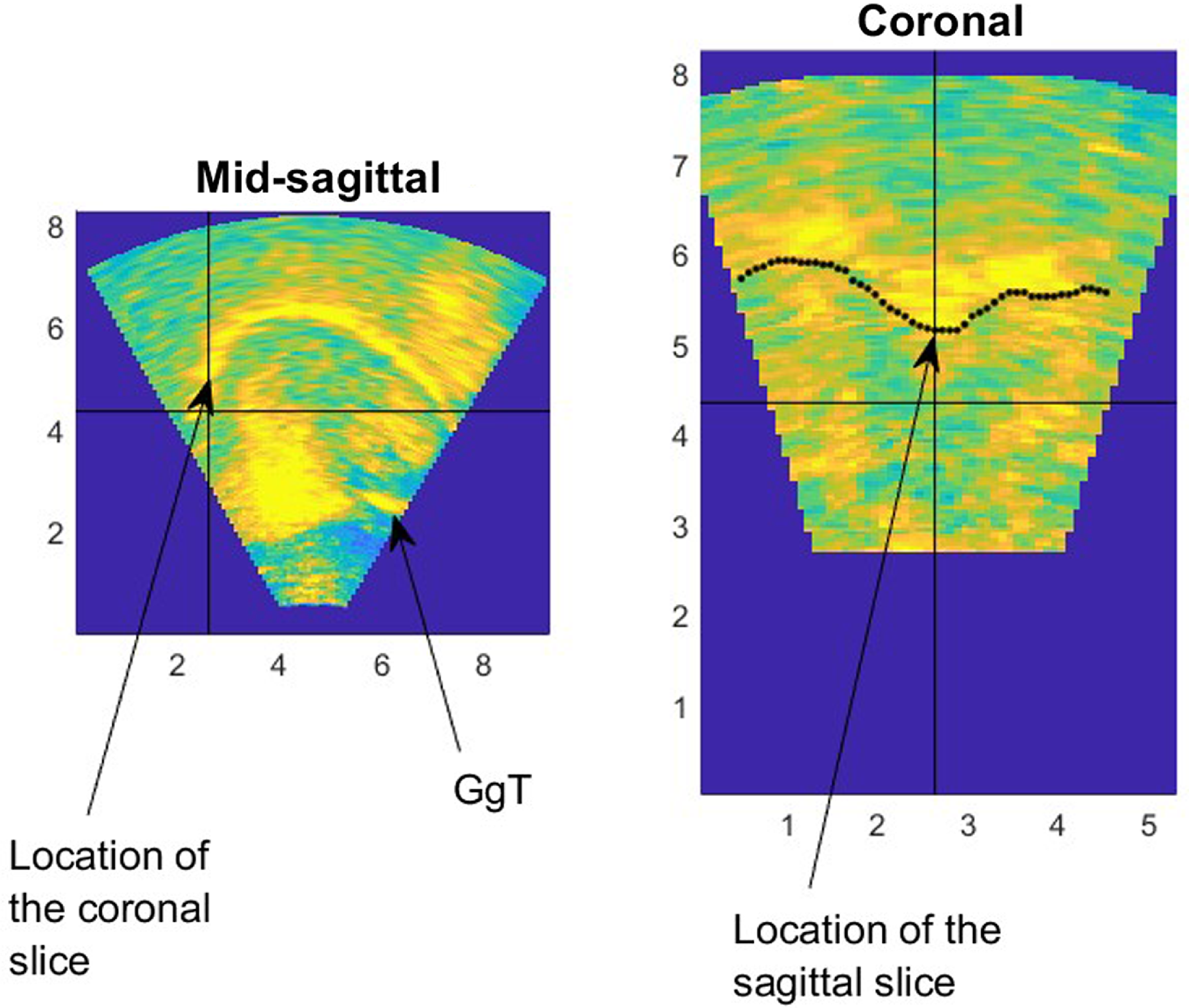
The coronal slice in the analysis of the tongue root grooving.

Impressionistically, Polish /ɨ/ patterns closer with the front vowels (/i/ and fronted allophone of /e/) than with the back high vowel. It is clearly a front vowel for speakers 1, 3, 5, 6, 7, 8, 9 and 10. Although a front vowel, /ɨ/ shows less fronting of the dorsum than /i/ for most speakers (speakers 3, 4, 5, 7, 8, 9, 10). For speakers 1 and 6, however, both vowels do not differ much in terms of the relative fronting of the dorsum, the major difference being the advancement of the tongue root (speaker 6), or the tongue root position and the height of the dorsum (speaker 1). The vowel of speaker 2 has a long flat constriction involving both front and back of the tongue and can be described as mixed. The vowel of speaker 4 can perhaps be described as central with the major constriction between /i/ and /u/.
/ɨ/ is always slightly lower than /i/. In most cases it is also lower than the tense raised allophone of /e/, however, this is because this particular allophone of /e/ tends to merge with /i/. In the cases where the tense allophone of /e/ does not merge with /i/, /ɨ/ and the tense allophone of /e/ show a similar elevation of the dorsum. For speakers 6 and 7, the shape of the tongue in /ɨ/ is actually nearly identical as in the tense allophone of /e/.
All speakers show a relative retraction of the tongue root in comparison to /i/. For speaker 2, the tongue root is strongly retracted, similar to that in the vowel /u/.
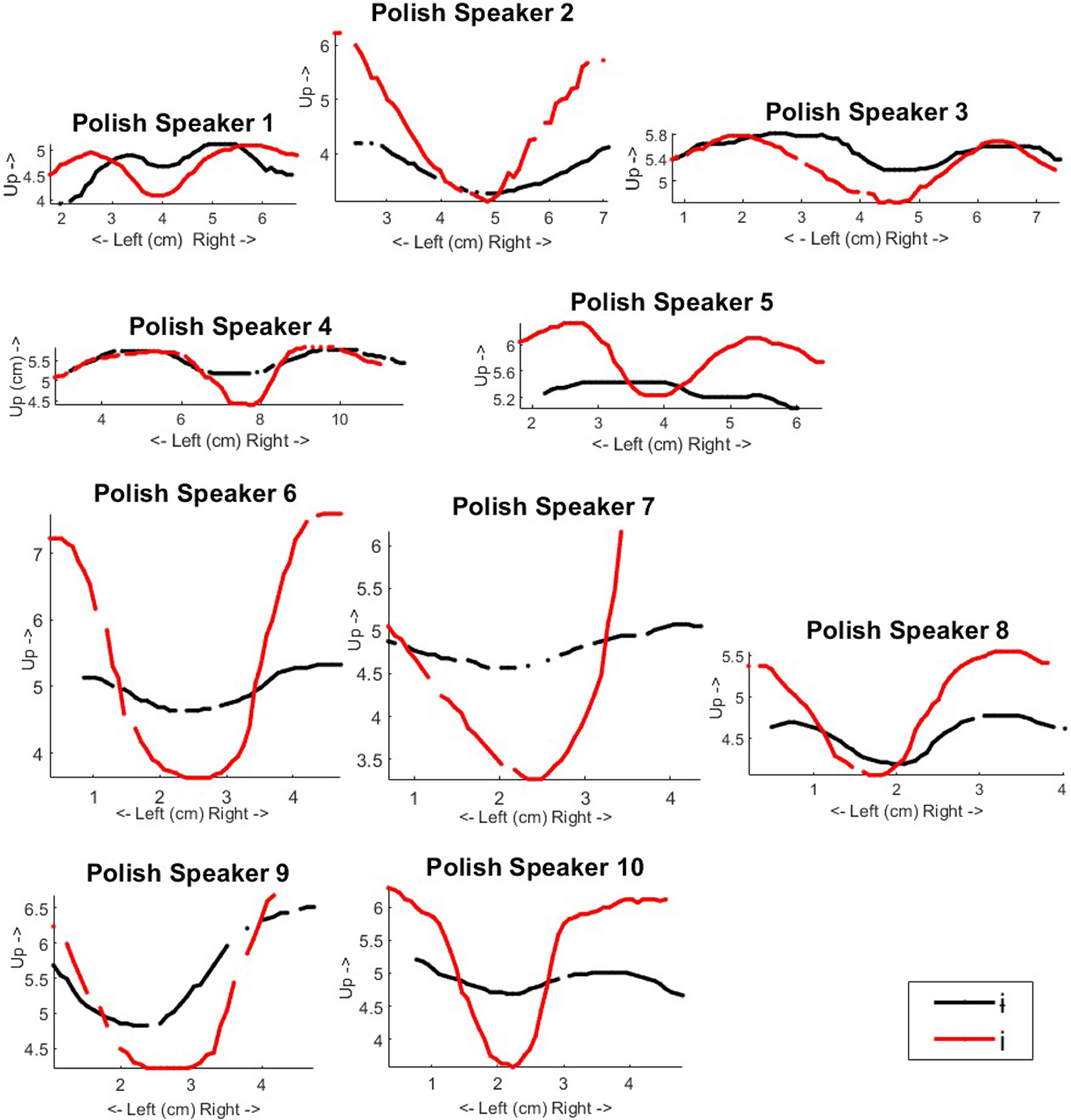
Earlier research (e.g. Wierzchowska Reference Wierzchowska1967) indicated that the /i/ in Polish is produced with a relatively enlarged pharyngeal cavity and a characteristic grooving along the center of the tongue in the tongue root area. To investigate the presence or absence of the grooving, we have looked at the coronal plane. In particular, we identified the coronal slice opposite the tendon of the genioglossus muscle, as in Figure 5, where the location of the coronal slice is shown in the mid-sagittal view in the left panel of the figure, and an example coronal slice is shown in the right panel.
Figure 6 represents the coronal slice opposite the tendon of the genioglossus for the Polish speakers in the study.
The coronal view of the tongue surface in the tongue root area. Polish /i/ (red) and /ɨ/ (black).

For all the Polish speakers, we have observed systematically less grooving in /ɨ/ than in /i/, see Figure 6. One speaker (Speaker 5) has no grooving for /ɨ/ at all.
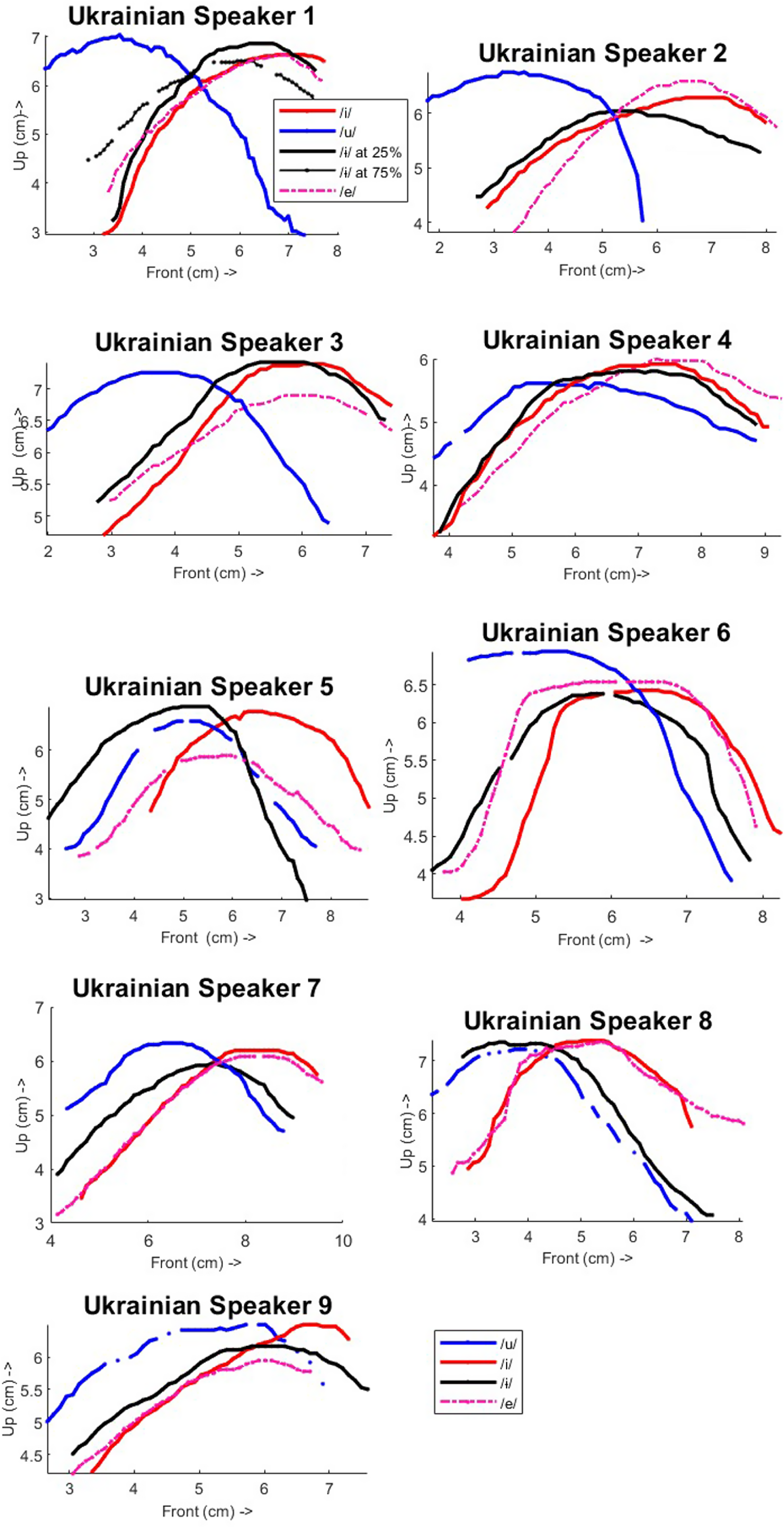
Contours of the surface of the tongue for vowels of Ukrainian based on 3D ultrasound recordings, midsagittal slice: /ɨ/ (black), /i/ (red) and /e/ in the context of palatalized consonants (pink), /u/ (blue).

3.1.2 Ukrainian
Figure 7 represents the Ukrainian vowel tracings like those in Figure 4 for Polish. The vowel /ɨ/ is compared to other high vowels of Ukrainian. We have also included another front vowel for comparison, an allophone of /e/ in the context of palatal /j/ which is unambiguously front (rather than the neutral /e/ which may be centralized).
For speakers 1, 3, 4 and 9, Ukrainian /ɨ/ is a front vowel. For speakers 5 and 8, it is a back vowel, for speakers 6 and 7 – a central vowel. For speaker 2, the dorsum is central, but the tongue root is advanced like in front vowel /i/. Speaker 1 has a slightly diphthongal articulation: the first part of the vowel is traced as a solid line and the second part – as an intermittent line. Speaker 4 merges /ɨ/ with /i/ in the mid-sagittal plane. This variation may be reflecting a dialectal variation beyond the West versus East division (see Section 2.2) as well as the influence of Russian, as discussed in Section 4.
When /ɨ/ is realized as a front vowel, it is always slightly retracted compared to /i/. For some speakers, there is a difference in height (speaker 2 and 9) but for others (speakers 1, 3, 6) /ɨ/ is not lowered in comparison to /i/.
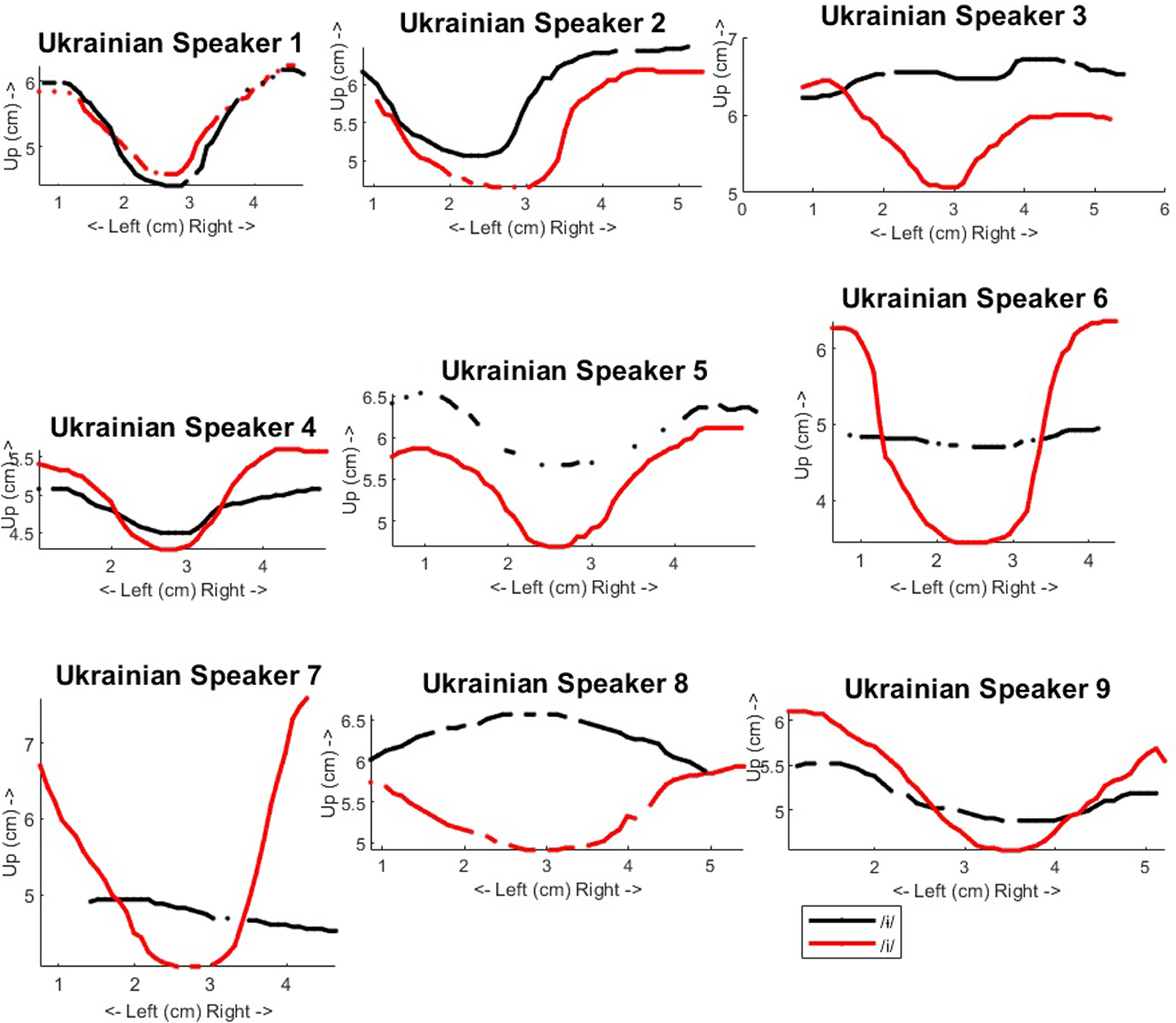
A coronal view of the tongue surface in the tongue root area. Ukrainian /i/ (red) and /ɨ/ (black).

Except for speaker 2, who differentiates /ɨ/ from /i/ by height, all speakers articulate /ɨ/ with a relatively retracted (as compared to vowel /i/) tongue root.
For speakers 6 and 7, who render /ɨ/ as a central vowel, both tongue root and dorsum seem to occupy a position roughly in the middle between /i/ and /u/. Speakers 5 and 8 articulate /ɨ/ as a back vowel similar in the tongue posture to /u/. The acoustic difference must be primarily due to the lip shape.
We have also looked for the characteristic grooving along the center of the tongue root, as in Polish, cf. Figure 8. For some speakers (speakers 3, 4, 6, 7) we have observed a large difference between /i/ and /ɨ/, as we did in Polish, with a central groove in /i/ and no or minimal grooving in /ɨ/. The difference in grooving also shows for speaker 4, who showed very similar /i/ and /ɨ/ in the midsagittal plane. However, speakers 1, 2, and 9 show moderate grooving for both /i/ and /ɨ/. The differences in grooving do not align with the dialectal background of the speakers.
3.1.3 Russian
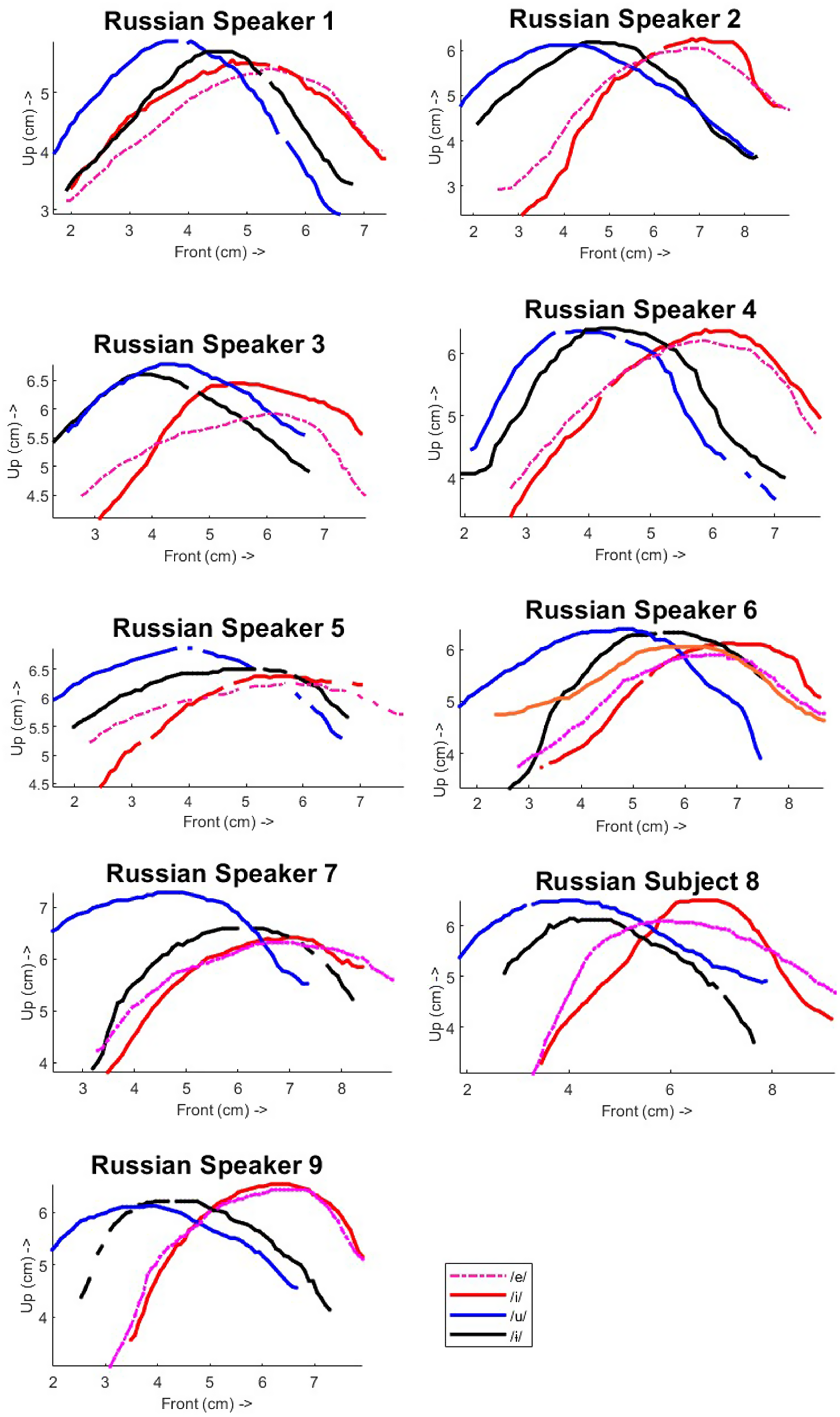
Figure 9 represents the corresponding vowels of Russian in the midsagittal plane, with the front of the oral cavity on the right. Impressionistically, the Russian high central vowel is more retracted than the corresponding Polish and Ukrainian vowels.
Tracings of the surface of the tongue for vowels of standard Russian based on 3D ultrasound recordings, midsagittal slice: /ɨ/ (black), /i/ (red), /e/ in the context of palatalized consonants (pink), and /u/ (blue).

/ɨ/ seems to be a back centralized vowel for speakers 2, 3, 4 and 9. One of the speakers (speaker 8) produced a diphthongized /ɨ/ with the later portion of the vowel relatively retracted into the back vowel area, that is contrary to what we would expect based on the previous accounts (cf. Jones & Ward Reference Jones and Ward1969:33; Lyovin Reference Lyovin1997). For the remainder of the speakers, the dorsum occupies a more central position between /i/ and /u/. The /ɨ/ of Speaker 7 patterns perhaps closer with the front vowels, though it is the most retracted of the front vowels and has more raising of the tongue back towards the velum.
The tongue root is also always substantially retracted in comparison to the vowel /i/ and fronted in comparison with /u/. For speakers 2, 3, 4 the tongue root in /ɨ/ is closer to the position of the tongue root in /u/. Since also the posture of the dorsum in these speakers resembles very closely the posture of the dorsum for /u/, the acoustic difference must be to a large extent dependent on the shape of the lips.
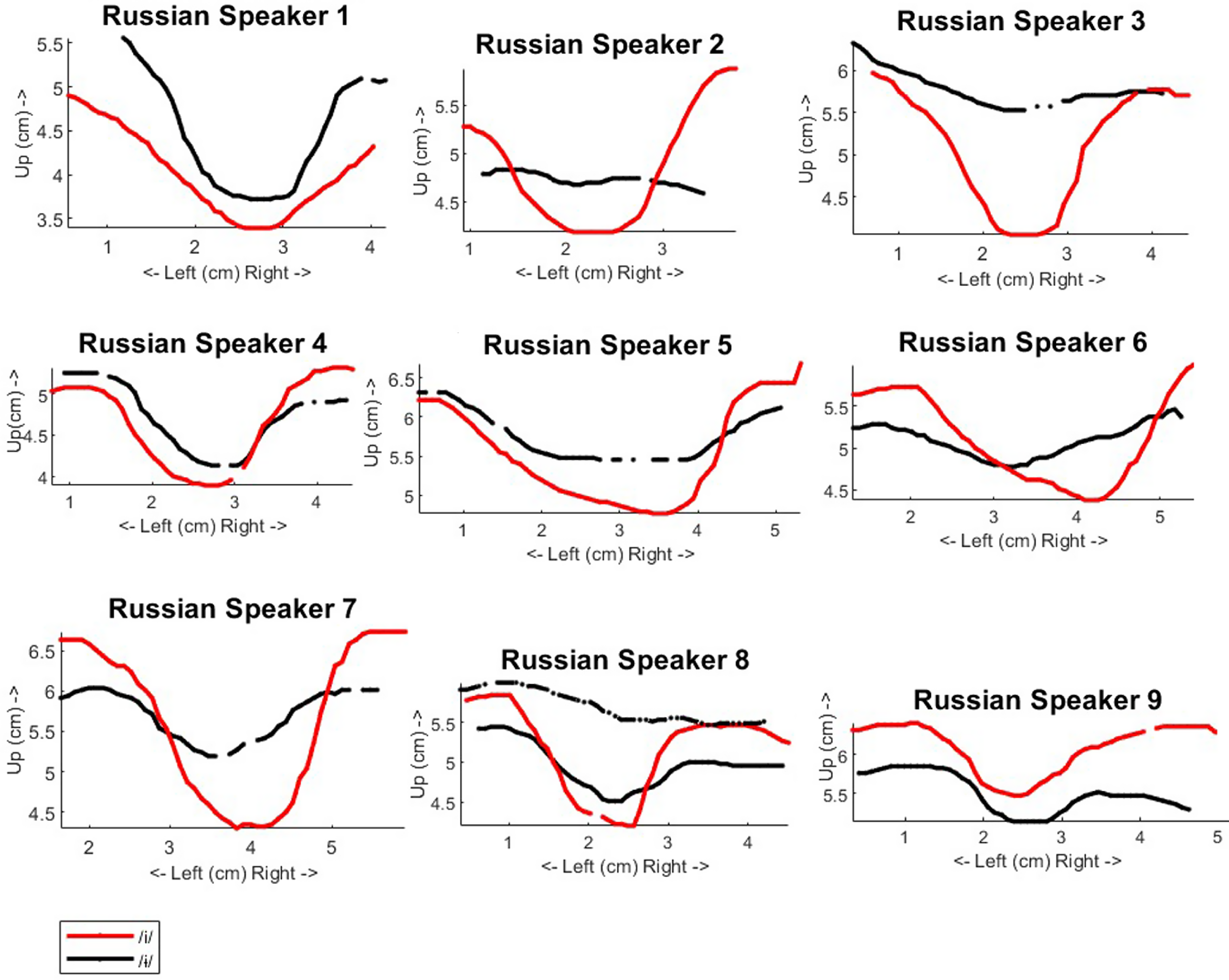
The grooving in the tongue root area for the Russian /ɨ/ is shown in Figure 10.
Coronal view of the tongue surface in the tongue root area. Russian /i/ (red) and /ɨ/ (black).

The difference in grooving is not entirely consistent, as speakers 2 and 3 have little or no grooving in /ɨ/. The bottom line is that – unlike in Polish – /ɨ/ may show quite strong grooving comparable to that of /i/, for example in speakers 1, 4 and 8, confirming the old observations based on few speakers in Koneczna & Zawadowski (Reference Koneczna and Zawadowski1951).
3.2 Quantitative articulatory analysis
3.2.1 Question 1: Is the position of the tongue root and dorsum in the high central vowels different in the three languages?
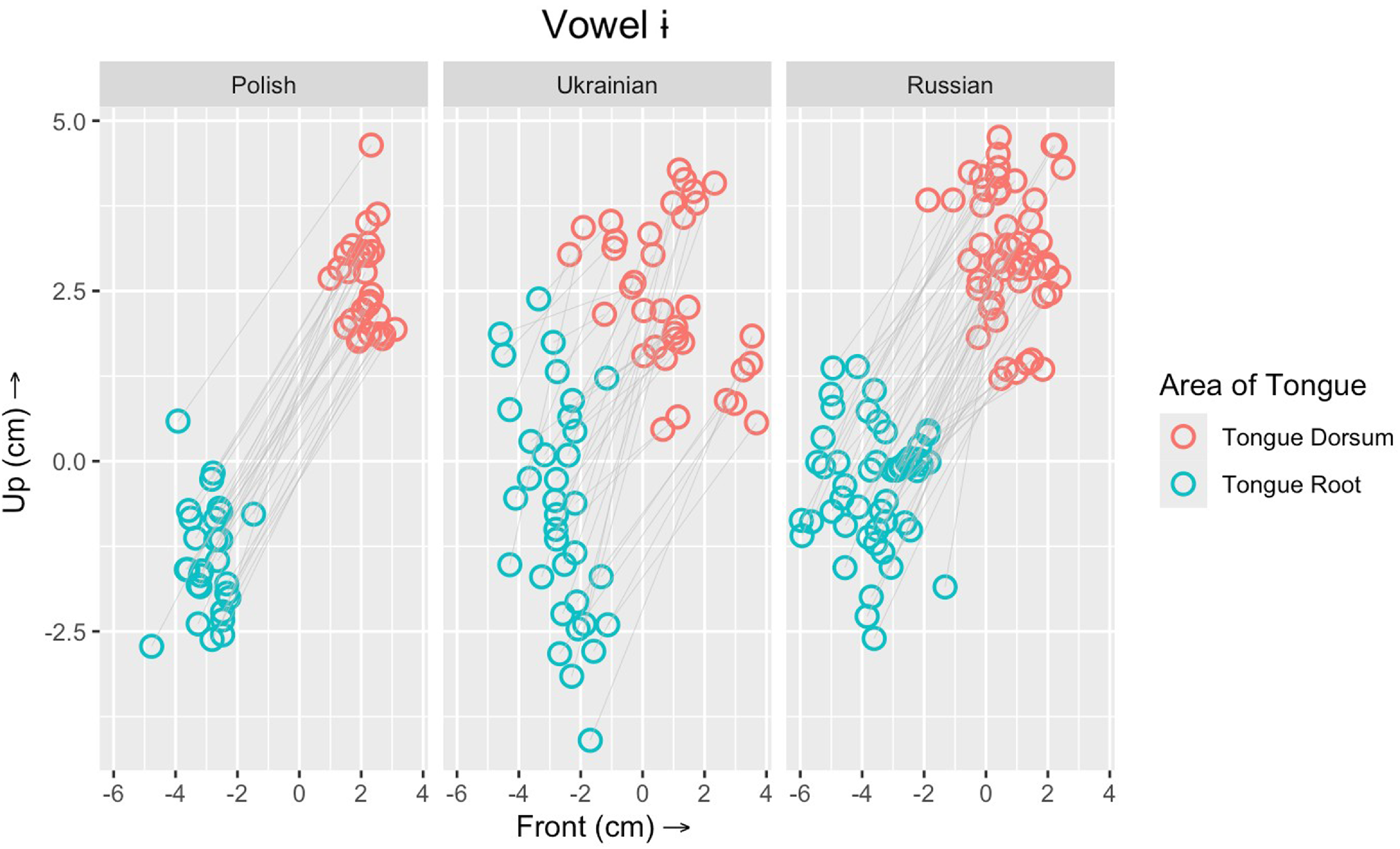
As described in Section 2.4, we have measured the position of the highest point of the tongue dorsum and the point on the tongue root opposite of the tendon of the genioglossus. Figure 11 represents the mean values for individual speakers of the two points in the articulation of the central high vowel in the three languages. The left panel represents the mean values for the Polish speakers, central – for the Ukrainian speakers, and the right panel – for the Russian speakers. The circles in the top right corner of each panel show the average position of the dorsum for a given speaker, the circles in the bottom left corner – the average position of the tongue root point. The corresponding points for individual speakers are connected by a line. While the vowel space for the vowels largely overlaps, the central vowel in Russian is indeed relatively more retracted. The Ukrainian and Polish articulation is more advanced in comparison to Russian, however, in the Polish /ɨ/ the tongue root is often lowered in comparison to the Ukrainian counterpart. The position of the tongue dorsum in Ukrainian shows more variation than in Polish.
Average values of the pairs of points for individual speakers: Polish (left panel), Ukrainian (center), Russian (right panel). In each panel: in the left bottom corner, the point on the tongue root surface opposite of the tendon of the genioglossus, and in the right, top corner, the highest point of the dorsum.

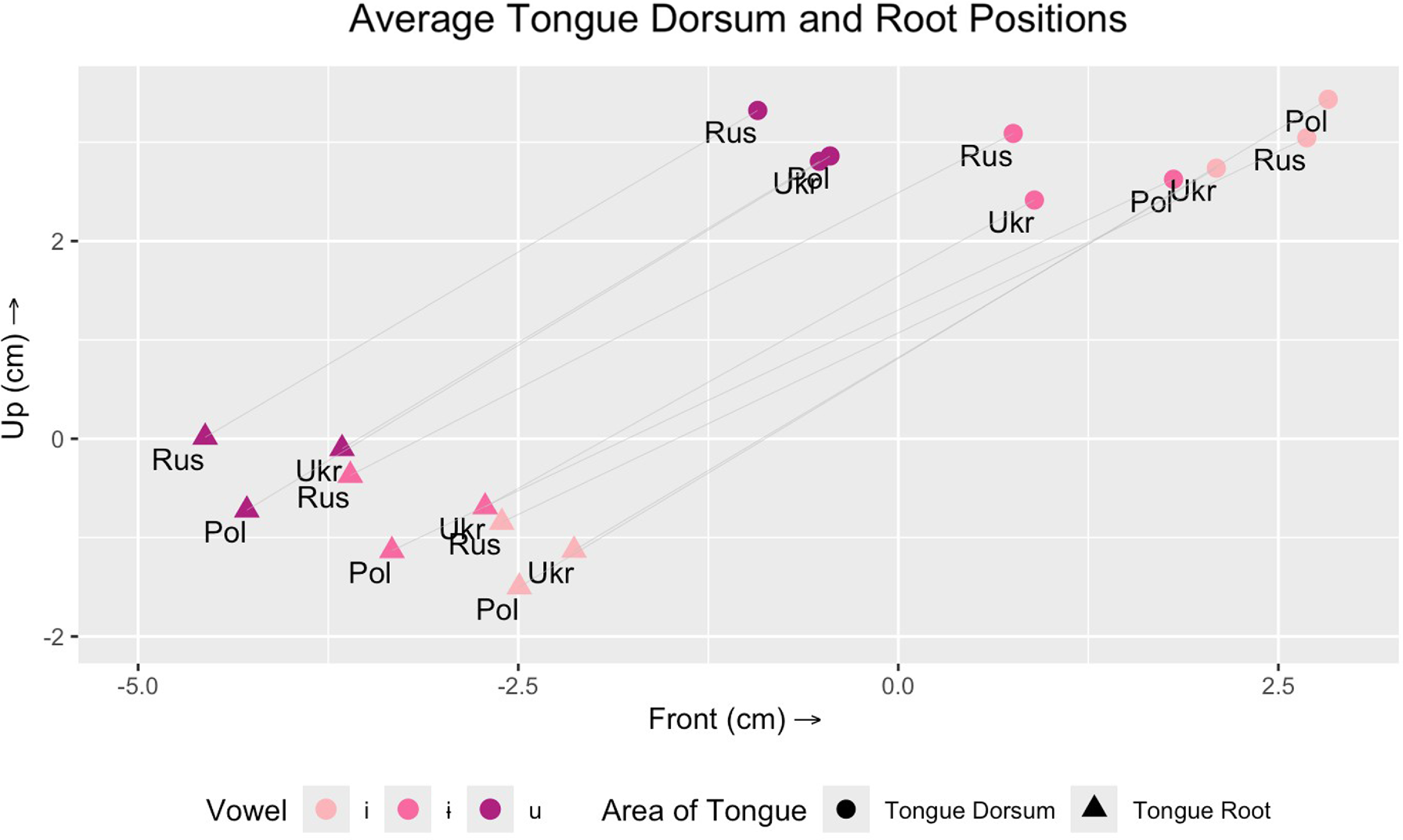
The data is summarized as the averages for each language and represented in Figure 12. Both the dorsum and the tongue root in Russian /ɨ/ is closer to Polish /u/ than to Polish /ɨ/, which confirms earlier impressionistic descriptions pointing to the relative retraction of the Russian vowel.
Average highest dorsum point (circles) and tongue root (triangles) for high vowels in the three languages (Polish, Russian, Ukrainian) for each of the three vowels: /i/(light pink), /ɨ/(dark pink), and /u/(purple).

In the following paragraphs, the focus is on the detailed comparison of the central vowels across the three languages. The data is represented in Figure 13.
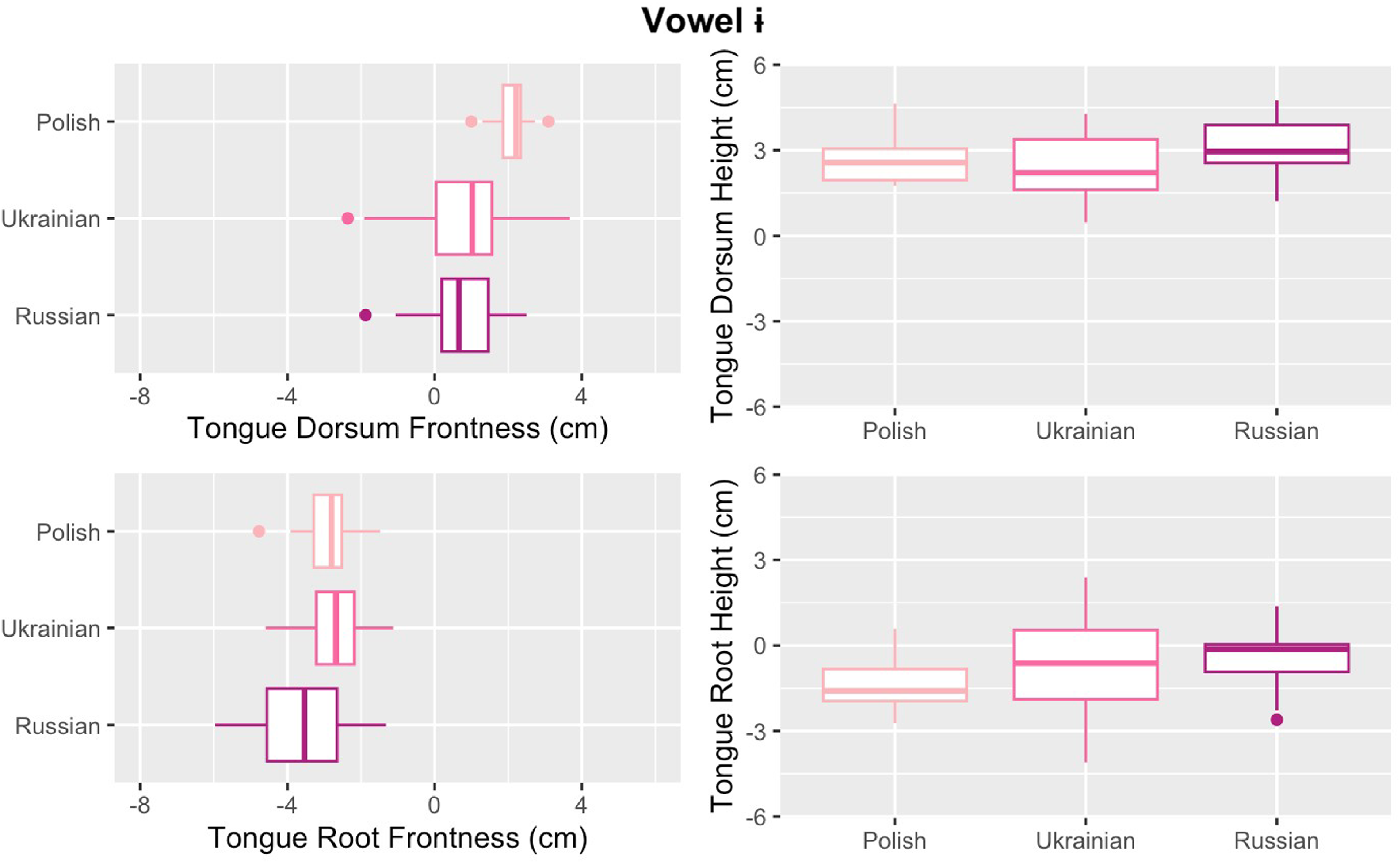
Vowel /ɨ/. The position of the tongue root and tongue dorsum in the three languages. Bottom left: relative fronting of the tongue root. Bottom right: relative raising of the tongue root. Top left: relative fronting of the dorsum. Top right: relative raising of the tongue dorsum.

a. a. Tongue root frontness
During the articulation of /ɨ/ the tongue root is relatively more retracted in Russian than in Ukrainian and Polish. There is no significant difference between Ukrainian and Polish (p = .428, difference of the means = 0.50). The difference in the fronting of the tongue root position between Ukrainian and Russian corresponded with a p-value of p=.045 (difference of the means = 0.84). Although this value is not significant when we use the Holm–Bonferroni, it is worth noting that the Holm–Bonferroni correction has an increased risk of Type II errors. Consequently, this borderline p-value may have fallen into this category of incorrectly classified as not significant. The tongue root in Polish is also fronted relative to the Russian vowel, but the difference between Russian and Polish is not significant (p=.254).
b. b. Tongue root height
The tongue root during the articulation of /ɨ/ in Russian is on average more elevated than in Polish and Ukrainian though only the difference between Russian and Polish is on the border of significant (p=.045; not significant if the Holm–Bonferroni correction is used; the difference of the means = .92). Here too, although this value is just over the border of non-significant when we use the Holm–Bonferroni correction, we would like to note that this correction has an increased risk of Type II errors, so the borderline p-value may have fallen into this category of incorrectly classified as not significant.
The measures of tongue root fronting and elevation are inversely correlated for anatomic reasons: lowering (decreasing values) and fronting the tongue root (increasing values) both indicate the advancement of the tongue root. Thus, the results indicate that the tongue root in both Polish and Ukrainian is more advanced than in Russian.
c. c. Dorsum frontness
The dorsum of /ɨ/ is on average more advanced in our sample in Polish than in Ukrainian, and it is more advanced in Ukrainian than Russian; the difference between Polish and Russian is significant (Polish ∼ Russian p=.007; the difference of the means = 1.30), as is the difference between Polish and Ukrainian (Polish ∼ Ukrainian p=.019; the difference of means = 1.12). The difference between Russian and Ukrainian is not significant, perhaps due to large variance in the Ukrainian data (Russian ∼Ukrainian p=.693; the difference of the means = 0.18).
d. d. Dorsum height
There are no statistically significant differences between the /ɨ/s in the three languages in terms of the height of the dorsumFootnote 16 during the articulation of the central vowel.
e. e. Other high vowels
As for the other high vowels, all the differences across languages are insignificant, perhaps with one exception. The tongue root in the articulation of /u/ is more advanced in Ukrainian than in Russian (p=.038; not significant if Holm–Bonferroni correction is used; the difference of means = 0.87). Tongue root in Ukrainian is also on average more advanced than in Polish, but the difference is not significant. All p–values for the comparisons between the languages are listed in Table A1 in the Appendix and the shapes of vowels /i/ and /u/ are compared across the languages in Figure A1 in the Appendix.
3.2.2 Question 2: How are the three vowels distinct articulatorily from the other high vowels within each individual language? The Polish /ɨ/ compared to the other high vowels in Polish
Polish /ɨ/ from the point of view of the tongue root position seems to be closer to /i/ than to /u/.
a. a. Tongue root frontness
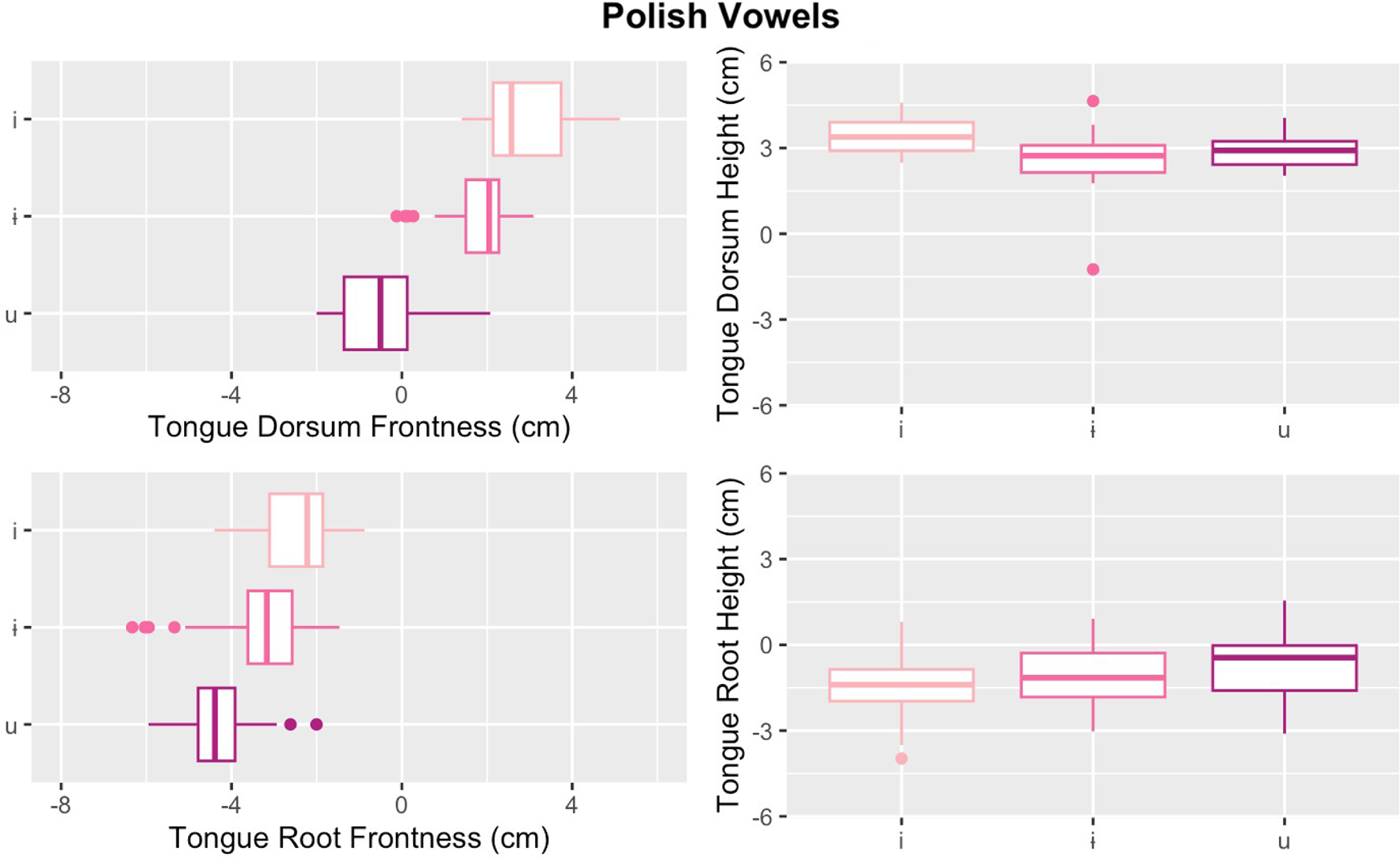
Although all vowels are significantly different from each other (p< .001), the interquartile ranges (IQR) of fronting of the tongue root and dorsum for /ɨ/ and /i/ overlap to some extent. The IQRs do not overlap for the pair /ɨ/ – /u/.
b. b. Tongue root height
With regards to tongue root elevation, /u/ is raised more than /ɨ/ than /i/. IQRs of the three vowels largely overlap and only the difference between /i/ and /u/ is significant (p=.005), cf. Figure 14.
Polish high vowels: /i/ (light pink), /ɨ/ (dark pink), and /u/ (purple). The relative fronting of the tongue root (bottom left), the relative raising of the tongue root (bottom right), the relative fronting of the tongue dorsum (top left), the relative raising of the dorsum (top right).

c. c. Dorsum frontness and height
In terms of the position of the dorsum, all high vowels are significantly different from each other in both raising and fronting (p<.001). The IQRs of dorsum fronting for /ɨ/ marginally overlaps with the typical range for /i/, i.e. /i/ includes many realizations which go more forwards than a typical Polish /ɨ/, and the mean for /i/ is more fronted than the mean for /ɨ/. In terms of the height of the dorsum, the differences are very small but still significant (p<.001 for all the vowel pairs). The IQRs for dorsum height largely overlap, with the lowest average raising for the central vowel. All means are listed in Table A2 in the Appendix, and p-values for the comparisons within language are listed in Table A3.
3.2.3 Question 3: How are the three vowels articulatorily distinct from the other high vowels within each individual language? The Ukrainian high centralized vowel compared to the other Ukrainian vowels
a. a. Tongue root fronting
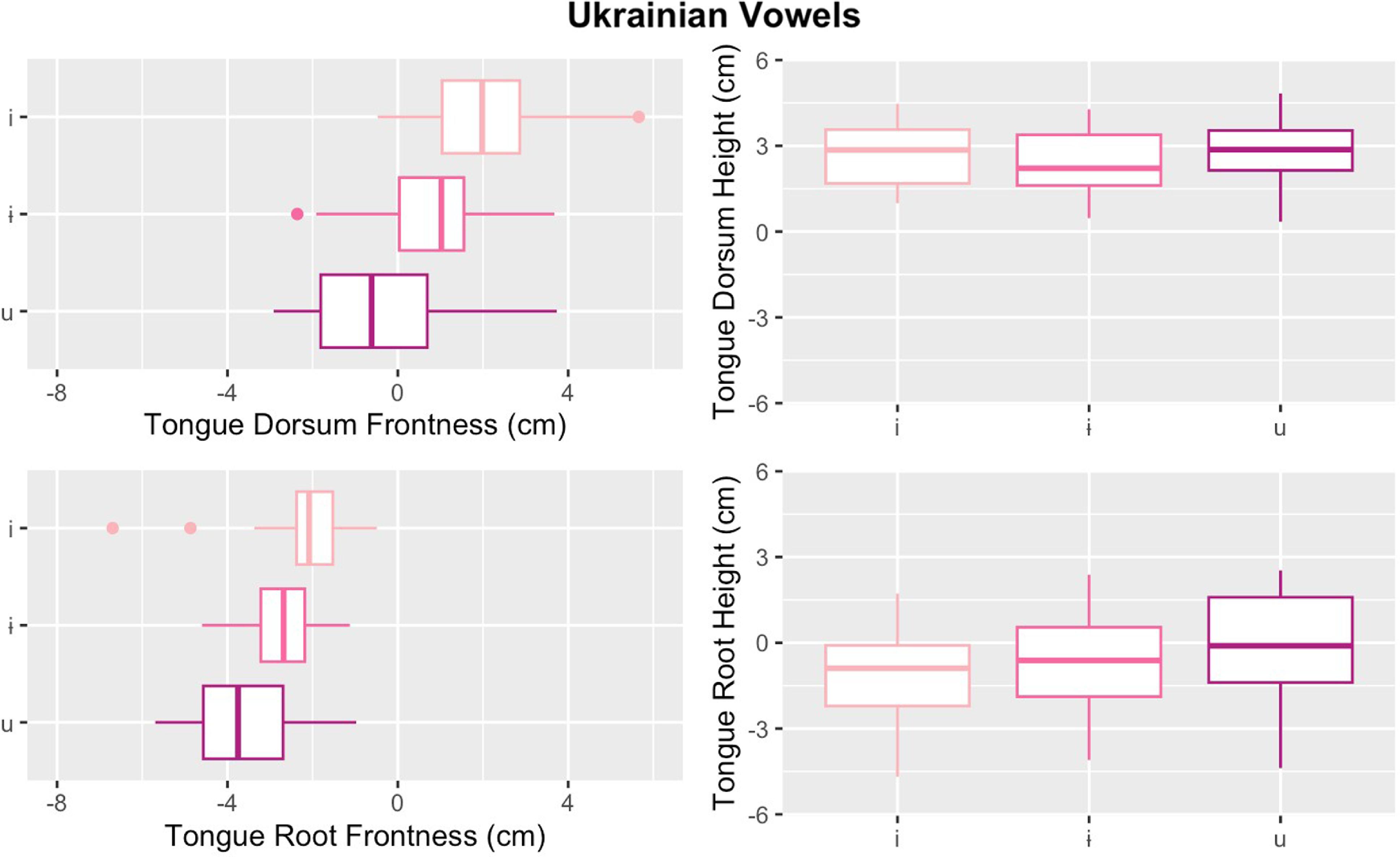
Regarding the tongue root fronting, /u/ is more retracted than /ɨ/ than /i/, and the vowels are significantly different (/i/∼/ɨ/ p<.006, /ɨ/∼/u/ p<.001 and /i/∼/u/ p<.001).
b. b. Tongue root height
In terms of tongue root height, /u/ and /i/ are significantly different (p<.001). /ɨ/ is not significantly different from /i/ (p=.066), while it is significantly different from /u/ (p=.014), cf. Figure 15.
Ukrainian high vowels: /i/ (light pink), /ɨ/(dark pink), and /u/(purple). The relative fronting of the tongue root (bottom left), the relative raising of the tongue root (bottom right), the relative fronting of the tongue dorsum (top left), the relative raising of the dorsum (top right).

c. c. Dorsum frontness
All Ukrainian high vowels are significantly different in tongue dorsum fronting (p<.001) and dorsum height (p<.001). Unlike for Polish, where the dorsum fronting values in /ɨ/ marginally overlap with the more posterior realizations of /i/, here the IQR of /ɨ/ partially overlap with the IQRs of both /i/ and /u/.
d. d. Dorsum height
In terms of the dorsum height, the central vowel is slightly lower than both /i/ and /u/. The vowel pairs are significantly different (p<.001 for /ɨ/∼/u/, p<.001 for the pair /i/∼/ɨ/. /i/∼/u/ are not significantly different (p<.503).
3.2.4 Question 2: How are the three vowels distinct articulatorily from the other high vowels within each individual language? The Russian /ɨ/ compared to the other Russian high vowels
Russian vowels are represented in Figure 16. /ɨ/ from the point of view of articulation seems to resemble more /u/ than /i/.
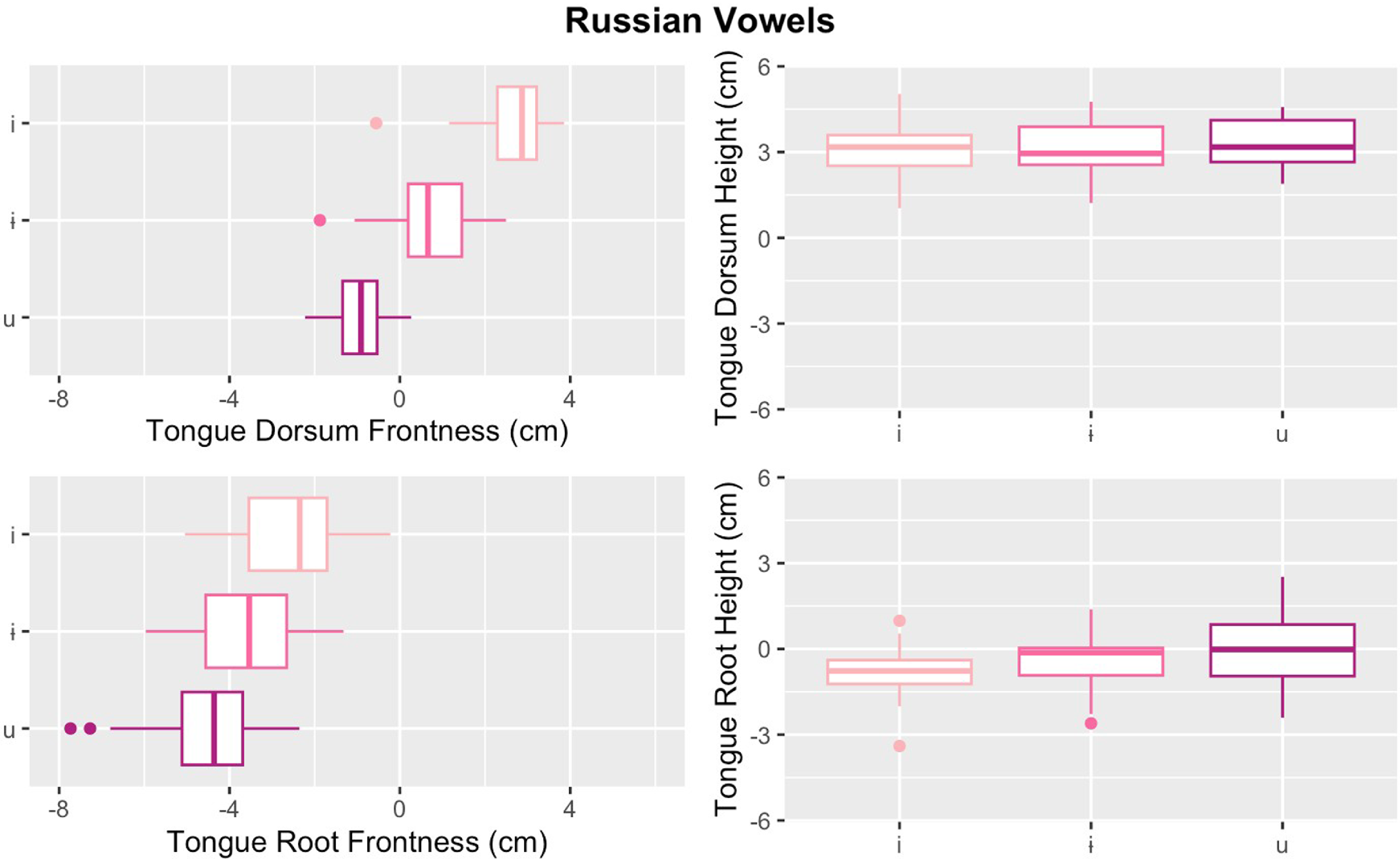
Russian high vowels: /i/ (light pink), /ɨ/ (dark pink), and /u/(purple). The relative fronting of the tongue root (bottom left), the relative raising of the tongue root (bottom right), the relative fronting of the tongue dorsum (top left), the relative raising of the dorsum (top right).

a. a. Tongue root frontness
Regarding the tongue root fronting, the IQR for /ɨ/ overlaps with both /i/ and /u/, but the median is closer to that of the /u/, cf. Table A2 in the Appendix. The differences are significant at p<.001 for all the vowel pairs with respect to the tongue root fronting.
b. b. Tongue root height
Tongue root raising is anatomically correlated with the tongue root retraction and unsurprisingly is the highest for the back vowel /u/ and lowest for the front vowel /i/. All the vowel pairs are significantly different (/u/∼/i/ (p<.001), /ɨ/∼/i/ (p=.007) and /ɨ/∼/u/ (p=.027).
c. c. Dorsum frontness
As for the tongue dorsum, the three vowels are all significantly different in terms of relative fronting (all pairs at p<.001). Unlike in the other two languages, IQRs do not overlap. The mean dorsum fronting of the central vowel (0.661) is closer to /u/ (–0.911) than to /i/ (2.868).
d. d. Dorsum height
The dorsum in /u/ is slightly higher than both /i/ (p<.001) and /ɨ/ (p=.002), but /i/ and /ɨ/ are not significantly different from each other (p=.542).
4. Discussion
Regarding our first research question, whether the three languages have the same /ɨ/, the results indicate small differences between the realization of the centrali(ized) vowel in Polish, Russian and Ukrainian. The dorsum in /ɨ/ in both Russian and Ukrainian is significantly more retracted than in Polish. We have noted also results on the border of significance for the tongue root: more retraction in Russian /ɨ/ than in Ukrainian and more raising than in Polish (the differences are not significant after applying the Holm–Bonferroni correction). Polish and Ukrainian do not differ significantly in the position of the tongue root.
From the articulatory perspective, Russian realizations of /ɨ/ show the most retraction out of the three languages, for both the dorsum and root, which is consistent with earlier impressionistic and instrumental accounts.
Regarding question two, which parameters differentiate between three high vowels in each individual language, tongue root fronting and height, dorsum fronting and height all reflect the difference between the high vowels in each individual language. Nearly all the differences between the vowels of the respective languages turned out to be significant. The tongue root height and dorsum seem a little less effective at differentiating between vowel categories, with a couple of differences insignificant, cf. Table A3 in the Appendix.
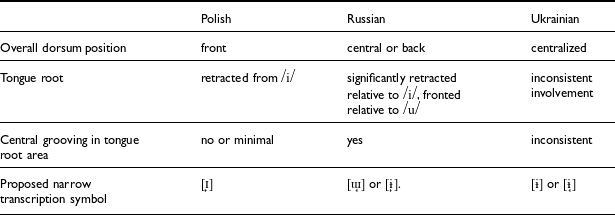
Pulling all the observations together, we can also address the third question, whether the same IPA symbol /ɨ/ best reflects the articulation of the vowel in the three languages. If we compare the Russian /ɨ/ to the remaining Russian high vowels, we see that the tongue root fronting and dorsum fronting interquartile ranges (IQRs) of /ɨ/ overlap with the corresponding IQRs of /u/ and they do not overlap with the IQRs of /i/, cf. Figure 16. Additionally, the medians indicate that both the tongue root and dorsum values in the Russian /ɨ/ are closer to the Russian /u/ than to the Russian /i/, cf. Table A2.2. The deep grooving along the center of the tongue root in /ɨ/ supports the conclusion about the active involvement of the tongue root in the formation of the gesture. We speculate that the grooving forms because the gesture of the tongue root is somewhat antagonistic to the gesture of the dorsum. Consequently, the Russian vowel /ɨ/ should be classified as a back vowel articulated with a relative advancement of the tongue root [ɯ̘]. Alternatively, it might be a central vowel showing an additional tongue root retraction [ɨ̙].
We want to argue that the Polish vowel /ɨ/ is front. The IQR for the dorsum and the tongue root fronting for /ɨ/ overlap partly with the IQR of the Polish /i/. In contrast, /ɨ/ does not overlap with the back vowel /u/ at all. However, /i/ and /ɨ/ in Polish differ also substantially in the position of the tongue root, and it seems that this is what finetunes the posture of the rest of the tongue. The Polish /i/ usually shows strong grooving along the center of the tongue root, which is not the case for /ɨ/. The Polish /ɨ/ should be then transcribed in closer transcription as [ɪ̙].
The Ukrainian /ɨ/ shows a big variation in the position of the tongue root, with IQRs overlapping with IQRs of both /i/ and /u/. The means and medians of the tongue root position in Ukrainian indicate that it is on average more advanced in Ukrainian than in Polish, though the differences are not significant after the Holm–Bonferroni correction. As for the dorsum, the position is more retracted than for the Polish /ɨ/ and advanced as compared to Russian, and both differences are significant. Also, the medians for the tongue root are closer to the medians in /i/ but the medians for the dorsum position are closer to /u/, cf. Table A2.2 in the Appendix. Only two speakers out of nine show a more substantial central grooving of the tongue root in /ɨ/ following the Russian-like pattern. Based on the dorsum position alone, we could propose [ɨ] for the transcription of the Ukrainian vowel. This conclusion diverts from an earlier description as [ɪ] (e.g. Pompino–Marschall et al. 2016) and is more in line with Steriopolo (Reference Steriopolo2012) and Vakulenko (Reference Vakulenko2018). The observed relative fronting of the tongue root might be responsible for the ‘acoustic fronting’ of the vowel. We could encode the relative fronting of the tongue root with the diacritic.
The articulatory data points to the important role of the tongue root in the formation of the contrasts on the front–back axis. One observation is that the acoustic or perceived centralization may be related to a strongly modified position of the tongue root. The Polish vowel /ɨ/ is articulated with the fronting of the dorsum, but the tongue root is retracted in comparison with /i/. The Russian vowel is articulated with the dorsum retracted as for a back vowel but with a relatively fronted tongue root as compared to vowel /u/. The Ukrainian vowel sounds more front than the position of the dorsum would indicate because of the relative advancement of the tongue root.
Further, we have not observed a systematic central position of the vowel dorsum between the front and back position in Polish or Russian /ɨ/. In individual cases, we observed a long constriction extending from front to back. Most of the time, however, the position of the dorsum in ‘central’ vowels in the two languages tends to be either close to the high front vowel (Polish) or close to the high back vowel (Russian). This is not surprising. Earlier studies in physiology have shown that the fronting of the dorsum is enacted by the contraction of the posterior genioglossus muscle (Harris Reference Harris1971; Smith Reference Smith1971; Raphael & Bell-Berti Reference Raphael and Bell–Berti1975; Miyawaki et al. Reference Miyawaki, Hirose, Ushijima and Sawashima1975; Wood Reference Wood1975, Reference Wood1979). This muscle also yields the fronting of the tongue root. It has been previously argued that any advancement of the tongue root yields the relative advancement of the tongue dorsum, and the retracted tongue root position results in a relative retraction of the dorsum (Cavar & Lulich Reference Cavar and Lulich2021, for an overview of arguments; Jang Reference Jang2018; Buchaillard, Perrier & Payan Reference Buchaillard, Perrier and Payan2009). Our findings are summarized in Table 4.
Comparison of the articulation of phonetic realizations of the underlying /ɨ/ in Russian, Polish and Ukrainian

A general question arises then as to what extent the position of the tongue root is already encoded in the vowel symbol itself – as opposed to the use of diacritic. For example, does the symbol [ɪ] automatically indicate that the transcribed vowel has less advancement of the tongue root than vowel [i], or should the use of the symbol be based on the position of the dorsum alone? Are we transcribing pronunciation or acoustics? With expanded access to modern direct articulatory imaging methods, we gain a more direct understanding of how the position of the tongue root influences the quality of the vowel, in particular, that they are correlated, and that in languages in which the tongue root position is not distinctive, the tongue root introduces finer distinctions beyond the binary front–back. These new insights might perhaps inform our phonetic transcription practices in future.
This study has some obvious limitations. First, the 3D ultrasound method is relatively new, and efficient ways of analyzing large amounts of data are still missing. One of the limitations of the method is that there are no easy ways to rotate the images to the occlusal plane using the analysis software we use. Instead, other points of reference have been used. The probe has been aligned with the mandible plane. Further, the tongue root points for the statistical analysis were oriented with relation to the tendon of the genioglossus. Consequently, we believe that the potential rotation of the image would only minimally – if at all – change the location of the points we use for the analysis.
Another limitation of the study is the sampling of participants. The sample has not been well balanced with regards to potential impact of the dialect. This limitation cannot be easily remedied (e.g. by traveling to the speaker communities, using a portable device) due to the current geopolitical situation. To validate the results, we have conducted an analysis on the values for the vowel /ɨ/. The analysis has shown no significant differences between speakers of the different dialectal background in Russian and Ukrainian. However, there is a significant difference in tongue root fronting and dorsum raising between speakers from South–East of Poland versus speakers from Central Poland (as in Table A5 in the Appendix). This might reflect idiolectal traits of the speakers though: there were only two speakers with the South–Eastern dialectal background and eight from Central Poland. Another plausible explanation is that some speakers were trying to speak particularly clearly. An anecdotal observation is that /ɨ/ in Polish is relatively retracted when pronounced in isolation under stress.
One of the reviewers pointed out that the sample includes speakers between 20 and 70 years old, and that age is a factor impacting motor activity. We believe that age did not affect the articulatory target in a systematic way: all speakers spoke at a normal vigorous tempo. There were no perceptible anomalies in the production of older speakers, which has been confirmed by our native speaker consultants. The sample is also not well-balanced with respect to gender; however, gender is not a factor by itself (it is not the case that women produce per se a different vowel quality than men in these languages) but rather the size of the articulators/vocal tract. The size is not a binary measure but rather an individual quality of the speaker, thus, accounted for by normalizing the data per speaker using z–score, and by including the variable speaker as a random effect in our models as described in the statistical analysis section.
Finally, we recruited participants from among the local emigrant population, students, and short-term visitors at Indiana University. As correctly pointed out by the reviewers, the speakers in the study are bilingual and the second language (English) may in principle impact the L1 pronunciation. We assume that the best way to treat the variation potentially related to English as part of the individual variation.Footnote 17 This decision is supported by the results of the analysis we have conducted. Since all speakers are bilingual with English as their L2, we would expect a similar effect for the three language groups, that is, assimilation to the American /ɪ/ in the ‘old’ speakers, but this expectation is not borne out in our data. We found no significant differences for the speakers of Polish. We found significant differences in the dorsum and tongue root retraction of the vowel /ɨ/ in the case of Russian speakers, however, the effect was opposite to what we would expect if the time of stay in the United States were the factor (longer stay in the United States corresponded to the Russian pronunciation less similar to English).Footnote 18 There are also significant differences in the Ukrainian subjects with the vowels relatively more retracted (more dissimilar from English) when produced by ‘new immigrants’.Footnote 19 The distribution of values for fronting and raising of the tongue root, and fronting and raising of the dorsum in the two groups of participants (‘new’ versus ‘old’) and the summary of the statistical analysis are in Figure A2 and Table A6 in the Appendix.
We argue then that the results of our study must primarily be the effect of the L1, given the caveat that exposure to English might have some impact, and that the Ukrainian data inherently show more variation due to language contact and dialectal differences. The size of the vocal tract, the anatomic and motor control differences, and the impact of English and Russian are treated as part of the individual variation. The individual variation has been addressed in the statistical analysis by including as the categorical variable speaker as the random effect in our model, and further subject to normalization using z-score.
An additional problem was the low quality of some audio recordings making it impossible to conduct statistical analysis on the available acoustic data. While multiple studies describe the acoustic characteristics of vowels in Polish, Russian and Ukrainian, it would be ideal to be able to connect concrete articulatory realizations with concrete acoustic effect.
A future study with a bigger and better controlled participant pool should follow. The future study should also ensure good quality audio material for acoustic analysis.
5. Conclusions
The paper presents results of an instrumental articulatory study of the production of vowels which are often transcribed using the same IPA symbol for a central vowel /ɨ/. We recorded 28 speakers of three closely related languages – Russian, Polish and Ukrainian – in which also the vowels function in a similar way in phonology and correspond in cognate words. Based on the ultrasound images, the Russian vowel has been classified as a retracted central vowel or an advanced tongue root back vowel. The Polish vowel is a front vowel articulated with a relative retraction of the tongue root. In Ukrainian, it is a central vowel, potentially modified by advancing the tongue root.
The novelty of the study lies in the detailed description of the behavior of the tongue root. Earlier methods of direct articulatory research could not provide information on the position of the tongue root (e.g. EMA) or could only be used on a very small scale (e.g. X-ray). There are no modern comparative articulatory studies that investigate Slavic languages at this level of detail and using instrumental methods. The study is a particularly important contribution to our understanding of the articulation in Ukrainian, as to our knowledge no new instrumental articulatory studies of Ukrainian exist. Given the dialectal and sociolinguistic variation in the language and the two historical standards,Footnote 20 further research of variants of Ukrainian is a necessary next step.
Acknowledgments
We would like to thank Steven Lulich, Sherman Charles, Max Nelson, Olivia Foley, Young Hwang for the help with data collection, Casey DeBruyn for the help with the annotation of the Polish data, Svitlana Melnyk for the help with the study recruitment, and the participants of the study. We are immensely grateful to the editor and the anonymous reviewers for their feedback.
Supplementary material
To view supplementary material for this article (including audio files to accompany the language examples), please visit https://doi.org/10.1017/S0025100325000040


 Open access

