





Gestational diabetes mellitus (GDM) is the most common pregnancy-related complication, affecting 10.9% of European pregnancies annually(Reference Paulo, Abdo and Bettencourt-Silva1) and 12.4% of pregnancies in Ireland(Reference Crowe, Noctor and Carmody2). The reported prevalence rates of GDM vary (8.9% in northern Europe and 31.5% in eastern Europe)(Reference Paulo, Abdo and Bettencourt-Silva1), and the International Diabetes Federation reports a global prevalence of GDM of 14%(Reference Wang, Li and Chivese3). These variations in the prevalence rates of GDM are believed to be due to differences in access to and levels of maternal care, screening practices and diagnostic practices, that is, timing of screening, type of test used and thresholds used(4).
GDM results in an increased risk of short- and long-term complications for women and their offspring. In the short term, there is an increased risk of adverse pregnancy outcomes(Reference Ye, Luo and Huang5,Reference Metzger, Lowe and Dyer6) , and in the longer term, there is an increased risk of chronic disease, including CVD and type 2 diabetes (T2D)(Reference Kramer, Campbell and Retnakaran7,Reference Vounzoulaki, Khunti and Abner8) . Pregnancy affords a unique opportunity for intervention and has been described as a ‘teachable moment’(Reference Phelan9). However, this opportunity does not seem to extend into the postpartum period when challenges arise in participation in and implementation of diabetes prevention interventions(Reference Makama, Awoke and Skouteris10,Reference Dasgupta, Terkildsen Maindal and Kragelund Nielsen11) .
Evidence-based guidelines, such as those provided by the American Diabetes Association (ADA)(12) and the National Institute for Clinical Excellence (NICE)(13), support health professionals (HCPs) in providing standardised care for individuals with GDM and in postpartum diabetes prevention, yet a lack of consensus regarding which guidelines to adhere persists(Reference O’Reilly, Janus and Dunbar14,Reference Haran, van Driel and Mitchell15) . Moreover, the challenges in diabetes prevention after GDM treatment highlight the need for innovative approaches. This review will explore how implementation science, with its focus on theory-driven strategies and robust evaluation processes, can enhance diabetes prevention activities(Reference Aziz, Absetz and Oldroyd16).
This review will first provide an overview of GDM. Second, it will outline current challenges in diabetes prevention after GDM and opportunities to address them. Finally, the review will explore an implementation science approach and how it may benefit future diabetes prevention research.
Background
GDM is characterised by high blood glucose levels during pregnancy. Commonly, the condition develops in the third trimester (weeks 24 onwards), when a combination of increased demands for insulin and insulin resistance because of pregnancy hormones cause the woman’s glucose levels to rise outside of acceptable target ranges(13). Consistently higher glucose levels are problematic because of their ability to result in short- and long-term complications affecting both mothers and their offspring. In the short term, higher glucose levels have the potential to result in the accelerated growth of the fetus (macrosomia) and the potential for admission to the neonatal intensive care unit. Difficulties at birth are also a risk – birthing a larger infant can result in injuries, such as shoulder dystocia, and increased requirements for caesarean section(Reference Ye, Luo and Huang5). In the long term, GDM confers an increased risk of chronic disease, including obesity, T2D and CVD, for mothers and offspring. Women aged 30 years and older have a twofold increased risk of developing GDM, and women with obesity are more than six times more likely to develop GDM(Reference Wang, Shah and Petito17). Children exposed to higher blood glucose in utero may also be at greater risk of overweight, obesity and T2D(Reference Damm, Houshmand-Oeregaard and Kelstrup18).
Commonly, GDM is identified through early or mid-pregnancy screening activity, typically using the International Association of the Diabetes and Pregnancy Study Groups criteria(4,13) . These criteria diagnose GDM if one or more values equal or exceed thresholds of fasting plasma glucose of 5.1 mmol/l and/or a 2-h plasma glucose level of 8.5 mmol/l following a 75 g oral glucose tolerance test (OGTT)(13). A lack of consensus persists internationally as to who is screened during pregnancy for GDM. Variations persist between health systems in the use of universal versus risk factor-based screening, with cost implications and heterogeneity among populations among considerations. Selective risk factor-based screening is recommended in the UK(13) and is in place across Ireland(Reference Smyth, Dale and Tully19). However, the recent model of care for diabetes in pregnancy in Ireland has moved to recommend universal screening for GDM while acknowledging the resulting resource implications(4).
GDM management should include input from an experienced and suitably qualified multidisciplinary team(4,20) . Once diagnosis is confirmed, regular blood glucose monitoring (commonly four times daily for most individuals managing their GDM with diet and physical activity changes alone, increasing to 8–10 times daily when treated with insulin), medical nutrition therapy (MNT), physical activity and weight management are recommended as first-line treatments to optimise glycaemic management for the duration of pregnancy(13,Reference Duarte-Gardea, Gonzales-Pacheco and Reader21) . In addition, 15–30% of women will require pharmacologic intervention, such as metformin or insulin, to achieve the target glycaemic range(12). Physical activity interventions with exercise components that are in line with general population-based activity recommendations (resistance exercise, aerobic exercise at moderate intensity or a blend of both) have shown overall glycaemic management improvements and reduced need for insulin initiation and reduced insulin dose requirements during pregnancy with GDM(12,Reference Laredo-Aguilera, Gallardo-Bravo and Rabanales-Sotos22) . Dietetic input of a minimum of three appointments of tailored MNT has been shown to reduce medication needs in GDM patients(Reference Wilkinson, McCray and Beckmann23–Reference Wilkinson, McCray and Kempe25) and has been proposed as a minimum standard during pregnancy with GDM(Reference Wilkinson, McCray and Beckmann23–Reference Wilkinson, McCray and Kempe25). However, many dietetic departments fall short of this level of service(Reference Wilkinson, McCray and Kempe25–Reference Lawrence, Wall and Bloomfield27). Despite the evidence supporting the central role that dietetics plays, there are no universal nutritional guidelines for the management of GDM. The Academy of Nutrition and Dietetics published MNT and GDM guidelines back in 2018(Reference Duarte-Gardea, Gonzales-Pacheco and Reader21), but they have not been adopted universally. Certain preconception dietary patterns are associated with a lower risk of GDM; limited evidence from systematic review suggests high intakes of fruits, vegetables, whole grains, nuts, legumes and fish with lower intakes of red and processed meats are associated with reduced GDM(Reference Raghavan, Dreibelbis and Kingshipp28). After a pregnancy with GDM, where strict dietary measures with emphasis on macronutrient distribution, meal timing and portion sizes inform treatment, the postpartum dietary messages can appear to be somewhat conflicting for women regarding their return to ‘normal’ eating(Reference Lawrence, Ward and Wall29).
Risk factors for gestational diabetes mellitus
GDM risk factors are well documented and include BMI, pregnancy history and ethnicity(13) (see Table 1). Weight is a modifiable GDM risk factor, as overweight and obesity contribute to insulin resistance(Reference Wondmkun30). Greater levels of visceral adipose tissue in the first trimester are associated with hyperglycaemia at 24–28 weeks gestation(Reference Martin, Berger and Nisenbaum31). Women with overweight and obesity are more likely to develop GDM, compared with women in a healthy BMI range, and those living with higher classes of obesity are at the highest risk(Reference Chu, Callaghan and Kim32,Reference Santos, Voerman and Amiano33) . Additional risk factors for T2D are well established and include family history, older age, sedentary behaviours, particular ethnic groups and a history of GDM(Reference Kyrou, Tsigos and Mavrogianni34). Factors associated with a lower risk of developing T2D after GDM include gestational weight gain (GWG) within recommended guidelines, healthy eating, breastfeeding and regular physical activity(Reference Kennelly and McAuliffe35).
Risk factors for developing gestational diabetes mellitus. NICE, 2020

It is estimated that 30–50% of European women begin pregnancy living with overweight or obesity(36). While weight gain during pregnancy is normal and expected(37), meta-analysis indicates that less than one-third (30%) of pregnant women gained weight within the recommended GWG guidelines, and 47% of women gained weight exceeding the recommendations(Reference Goldstein, Abell and Ranasinha38). The impact of weight gain differs between women with overweight or obesity and women with normal weights. There is a linear increase in the prevalence of GDM in women with obesity whose weight gain goes from low to adequate to high(Reference Santos, Voerman and Amiano33). Excessive GWG, generally defined as weight gain outside the American Institute of Medicine guidelines(39), has the potential to increase postpartum weight retention (PPWR), which is a contributing factor for long-term obesity development in women(Reference Farpour-Lambert, Ells and Martinez de Tejada40). PPWR predisposes women to higher weight status in subsequent pregnancies and is associated with GDM and T2D in the longer term(Reference Endres, Straub and McKinney41). A large retrospective cohort study demonstrated that significant PPWR after a first pregnancy was related to GDM in a consecutive pregnancy(Reference Makama, Skouteris and Moran42). Researchers have also reported that similar weight gain between two consecutive pregnancies increases the risk for GDM in the second pregnancy(Reference Sorbye, Cnattingius and Skjaerven43,Reference Liu, Song and Meng44) . An increase in BMI between pregnancies increases the risk of GDM for all women; however, women with a healthy BMI are at a greater risk(Reference Timmermans, van de Kant and Oosterman45). An increase of >1 BMI unit from pre-pregnancy to 18 months postpartum is linked to hypertension risk(Reference Kirkegaard, Bliddal and Støvring46), and PPWR is predictive of a higher BMI after 10 years(Reference Rooney and Schauberger47) and of T2D(Reference McAuliffe, Killeen and Jacob48). There are unique opportunities during pregnancy and postpartum follow-up to identify risks and implement primary preventative management strategies for weight management(Reference McAuliffe, Killeen and Jacob48). Weight loss is effective in reducing T2D risk. Haw et al. (Reference Haw, Galaviz and Straus49) reported that every kilogram of weight loss was associated with an additional 7% reduction in the risk of progression to T2D(Reference Haw, Galaviz and Straus49). However, HCPs report concerns that talking about weight could damage the HCP/patient relationship and often avoid the topic because they fear patients may feel they are being stigmatised(Reference Warr, Aveyard and Albury50,Reference Glenister, Malatzky and Wright51) . Similarly, women living with obesity and GDM have reported feeling stigmatised throughout their pregnancies due to frequent HCP commentary on their weight and the need for diet and physical activity change(Reference Jarvie52).
Breastfeeding reduces T2D risk postpartum(Reference Hedeager Momsen, Høtoft and Ørtenblad53). Breastfeeding for more than 3 months has the potential to reduce the risk of future T2D by more than 40% and delay the onset of T2D for up to 10 years(Reference Gunderson, Lewis and Lin54). Atlantic DIP study data(Reference O’Reilly, Avalos and Dennedy55) highlighted that while ethnicity, family history of diabetes, elevated BMI at pregnancy and insulin treatment during pregnancy were all significant predictors of persistent glucose intolerance, lactation at the time of a postpartum OGTT (at 12 weeks postpartum) was significantly associated with reduced odds of persistent dysglycaemia(Reference O’Reilly, Avalos and Dennedy55). A recent meta-analysis demonstrated that breastfeeding for any duration reduced diastolic blood pressure, serum TAG, blood glucose and T2D risk in women with prior GDM(Reference Pathirana, Ali and Lassi56). A further systematic review showed that exclusive breastfeeding for 6–9 weeks significantly reduced T2D risk compared with formula feeding at the 2-year follow-up(Reference Tanase-Nakao, Arata and Kawasaki57). A meta-analysis revealed a 34% decrease in diabetes incidence, and breastfeeding for at least 12 weeks significantly reduced T2D risk at the 15-year follow-up(Reference Feng, Xu and Hu58,Reference Morton, Kirkwood and Thangaratinam59) . In addition to improving glycaemia and reducing CVD and breast and ovarian cancer risk in mothers, the benefits of breastfeeding also extend to infants through a reduced risk of childhood illness and chronic disease(Reference Victora, Bahl and Barros60). Antenatal breastfeeding education combined with maternal support after pregnancy in women with GDM is vital(Reference Jagiello and Azulay Chertok61). There are persistent gaps in breastfeeding promotion for women with GDM and dietitians report a lack of resources and a need for additional training to enhance skills knowledge and confidence(Reference Dunne, Carvalho and Byrne26,Reference Payne, Radcliffe and Blank62,Reference Becker, Quinlan and Ward63) . Staff within GDM services have tended to focus on the short-term benefits of breastfeeding and its benefit for a baby’s health, rather than longer-term benefits such as T2D prevention(Reference Lucas, Williams and Hollar64).
Postpartum follow-up in women with GDM
Up to 50% of women with GDM develop T2D within 10 years of delivery(Reference Damm, Houshmand-Oeregaard and Kelstrup18). The likelihood of future T2D is highest within 5 years, and the prevalence/incidence of T2D varies depending on the diagnostic criteria applied(Reference Lawson and Rajaram65). Such rates suggest that a systematic approach to long-term follow-up after delivery should be applied to mitigate the level of conversion to T2D and/or intervene at the earliest possible opportunity; however, such systematic approaches or monitoring programmes are not standard practices in routine clinical settings(Reference Damm, Houshmand-Oeregaard and Kelstrup18). In diagnosing GDM, women with a high-risk cardiometabolic profile are identified(Reference Kramer, Campbell and Retnakaran7). Additionally, a GDM diagnosis has been shown to have a profound effect on individuals, resulting in fear, anxiety and depression(Reference Lawson and Rajaram65). The diagnosis is linked to both stigma(Reference Davidsen, Maindal and Rod66,Reference Davidsen, Terkildsen Maindal and Byrne67) and weight stigma, which are widely reported in these populations(Reference Hill and Incollingo Rodriguez68,Reference Hailu, Skouteris and Incollingo Rodriguez69) .
Postpartum diabetes screening
Early postpartum identification of abnormal blood glucose levels is important at the population health level, as it allows for preventative approaches to be adopted that can ultimately impact T2D diagnosis rates. Clinical practice guidelines (CPGs) are intended to optimise patient care and are informed by a systematic review of the evidence and expert consensus(Reference Zhang, Zhou and Zhong70). Two internationally recognised CPGs of note are the ADA ‘Management of Diabetes in Pregnancy: Standards of Care in Diabetes’(12) and NICE guidance for ‘Diabetes in pregnancy: management from preconception to the postnatal period’(13). International recommendations from the ADA(12) recommend using an OGTT at 4–12 weeks postpartum after a GDM pregnancy, due to its increased sensitivity in detecting glucose intolerance (for both pre-diabetes and T2D). It is suggested that women are tested every 1–3 years thereafter if the initial 4–12-week postpartum results are normal. These further tests can be performed using any suitable glycaemic test, such as glycated haemoglobin (HbA1c), fasting plasma glucose or OGTT, using non-pregnant thresholds(12). The NICE guidelines differ and advise not to routinely perform an OGTT but instead from 6 to 13 weeks postpartum to use fasting plasma glucose to exclude diabetes and after 13 weeks use HbA1c if fasting plasma glucose is not possible. NICE guidance also states that the level of future diabetes risk advice should be provided in line with early postpartum test results, and an annual HbA1c test should be offered to women with GDM whose postpartum test is within accepted parameters, as the risk of future T2D persists beyond the initial postpartum tests(13). The differing approaches to the recommendations outlined in these clinical practice guidelines (such as approaches to postpartum screening) may reflect the influence of local contextual factors (e.g. health system infrastructure and funding). Despite differences between their approaches to postpartum screening, the guidelines share a vital common goal in recommending regular postpartum monitoring to address the woman’s future chronic disease risk and prevent their progression to T2D.
Postpartum glucose screening attendance varies from 5 to 60%(Reference Tierney, O’Dea and Danyliv71), with the literature showing a year-on-year decrease after the initial year(Reference McGovern, Butler and Jones72). This low uptake of postpartum glucose screening is of concern, as patients with T2D may go undiagnosed and present future health issues, and there is a missed opportunity to establish positive health behaviours to support the prevention of chronic disease. Postpartum screening rates are not captured at the regional or national level; therefore, estimating uptake outside of the local level is difficult. The successful state-funded Health Service Executive (HSE) chronic disease management (CDM) programme in Ireland recently saw additional support added or ‘enhancements of care’. One notable enhancement was the addition of women with a prior GDM history (from January 2023 onwards) to be routinely offered annual follow-ups with their general practitioners (GPs) and practice nurses to address the risk of future chronic disease (T2D and CVD). These visits include preventative advice, relevant blood work and onward referrals to intervention programmes or speciality services as appropriate. Previously, this care was offered in an ad hoc fashion and incurred out of pocket expenses for the woman, as no state funding was provided. While the move is undoubtedly positive, challenges persist with implementation. GDM is generally managed during pregnancy by specialist maternity services, while postpartum follow-up occurs in primary care. Awareness of roles and responsibilities for diabetes prevention activities and risk of associated chronic disease are low across both settings(Reference Van Ryswyk, Middleton and Hague73–Reference Lithgow, Rossi and Griffin76). A danger exists for the CDM programme where the absence of an accompanying care pathway, a tailored education programme specifically for post-GDM women, and the requisite primary care resources might place greater emphasis on monitoring without addressing the broader risk factors and preventing future chronic disease.
Further postpartum screening facilitators include implementing electronic reminders through text messaging, email, automated letters and HCP-mediated communications, all of which can increase screening, monitoring and preventative practices engagement(Reference Carson, Frank and Keely77,Reference Jeppesen, Kristensen and Ovesen78) . Tools supporting HCP and patient conversations are helpful in determining a person’s priorities. This approach is particularly relevant for establishing awareness and increasing the perceived importance of annual reviews. The woman’s identity and priorities shift in the postpartum period with the needs/wants of their children/family becoming their priority and their own needs taking second or even last place. Clear messaging is needed on the woman’s increased risk of developing T2D, and the risk factors that she can modify are imperative to increase engagement in diabetes screening and prevention programmes. Conveying the impact of a GDM diagnosis on offspring is a further essential message. This insight may motivate women to adopt a family approach to health behaviour change, more so than if the behaviour change were to solely benefit the woman herself. Finnish Diabetes Risk Scoring (FINDRISC) is a well-established tool for assessing and communicating the risk of developing T2D, which includes many of the important determinants for women with previous GDM(Reference Lindström and Tuomilehto79). In addition to being validated in the general population, it is also effective in determining those more likely to have diabetes/pre-diabetes postpartum(Reference Crowe, Noctor and Carmody80). Competing demands, lack of childcare support, inconvenience of testing location (often located within secondary care alongside maternity services) and low self-perceived risk of developing T2D are consistently cited as reasons for a woman’s lack of engagement in postpartum diabetes screening. The uptake of the OGTT is poor. It is constrained by the practicalities of the test requiring set appointment times, lasting up to 3 h, causing a financial burden, the glucose test being an unpleasant procedure and challenges in finding locations to perform the test(Reference Van Ryswyk, Middleton and Shute74,Reference Dennison, Fox and Ward75,Reference Dennison, Griffin and Usher-Smith81) .
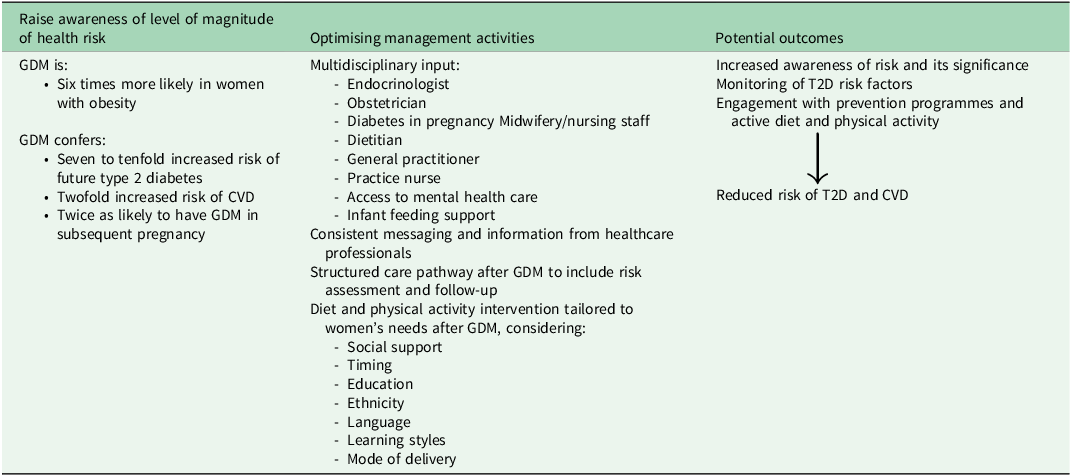
HCPs cite health system challenges and a low awareness of the increased risk that GDM confers for T2D as barriers to optimum care(Reference Dennison, Fox and Ward75,Reference Lithgow, Rossi and Griffin76,Reference Dunne, Culliney and O’Mahony82) . Lithgow et al. (2021)(Reference Lithgow, Rossi and Griffin76) identified hospital and primary care clinician views on their roles in GDM management. Hospital service providers believed that their primary focus was managing GDM, and future prevention was viewed as a lesser priority. As a result, communication regarding the woman’s long-term risk was avoided because of the limited time available and the perception that it would overburden women. Postpartum follow-up and screening were seen as important, but they were perceived as being outside of the hospital service remit(Reference Lithgow, Rossi and Griffin76). Primary care service providers whose core role involves prevention frequently lack the necessary data to support their work. For instance, the maternity setting may fail to provide them with the relevant information required to inform how best to support and guide the woman after GDM(Reference Timm, Nielsen and Christensen83). GPs view postpartum glucose screening as a key prevention activity and that it is best placed within primary care; however, there are several barriers that reduce engagement with testing(Reference Lithgow, Rossi and Griffin76). Lake et al. (Reference Lake, Neven and Williams84) highlighted in their recent systematic review that the barriers to postpartum glucose screening outnumber the facilitators by a ratio of three to one. The recommendations from their evidence synthesis include enhancing communication between HCPs and patients and putting screening forward as a ‘role modelling opportunity’ to set the example of positive health seeking behaviours for their wider family(Reference Lake, Neven and Williams84), this is echoed within Marschner et al. who proposed ways of optimising GDM care (Table 2)(Reference Marschner, Pant and Henry85). A subsequent qualitative study also by Lake et al. (Reference Lake, Williams and Neven86) used a theoretical approach utilising the behaviour change wheel (BCW)(Reference Michie, Atkins and West87) and theoretical domains framework(Reference Cane, O’Connor and Michie88) to explore the determinants of uptake of T2D screening among women with a history of GDM. Modifiable barriers to and enablers of T2D screening were identified (Table 3). Barriers to T2D screening included lack of knowledge, low awareness of short- and long-term T2D risk and multiple competing demands, while antenatal education, screening reminders and social supports were perceived as enablers. The identified barriers and enablers were subsequently mapped to the BCW to highlight the relevant intervention functions and behaviour change techniques (BCTs), which should form the foundation of future intervention strategies(Reference Lake, Williams and Neven86).
Improving awareness and reducing future diabetes risk after gestational diabetes mellitus (GDM). Adapted from Marschner et al., 2023(Reference Marschner, Pant and Henry85)

GDM, gestational diabetes mellitus; T2D, type 2 diabetes.
TDF domains and COM-B components linked to perceived barriers and enablers of type 2 diabetes screening among women with prior gestational diabetes. Adapted from Lake et al., 2023

COM-B, capability-opportunity-motivation-behaviour model; TDF, theoretical domains framework; T2D, type 2 diabetes; GP, general practitioner.
Cost implications
The financial burden of GDM is substantial – it directly increases maternity care costs by about 34% and will have projected future T2D costs(Reference Gillespie, Cullinan and O’Neill89–Reference Gillespie, O’Neill and Avalos91). T2D significantly increases health services usage across the health system; in Ireland, there is an average of 1.49 GP visits and approximately one additional outpatient visit for a person with T2D each year(Reference O’Neill, McHugh and Tracey92). Werbrouck et al. (2019)(Reference Werbrouck, Schmidt and Putman93) systematically reviewed the literature to explore diabetes screening and prevention cost-effectiveness in women with prior GDM. The evidence suggested that an OGTT every 3 years would lead to the lowest cost per case of T2D detected and prevention of future T2D that may be cost effective or cost saving(Reference Werbrouck, Schmidt and Putman93). The implementation of a structured diet and physical activity intervention during pregnancy has demonstrated healthcare cost savings through the reduction of GWG and associated GDM and T2D incidence compared with usual care(Reference Lloyd, Morton and Teede94). Effective interventions targeting the prevention of T2D can simultaneously reduce health burdens and healthcare costs, so investment in future prevention programmes has the potential to considerably alleviate future strain on already limited health resources(Reference Zhou, Siegel and Ng95).
Postpartum diabetes prevention after GDM
UK nutrition guidelines for the prevention and management of diabetes in the general population promote weight loss in high-risk groups, lifestyle intervention, dietary patterns such as the Mediterranean diet, Dietary Approaches to Stop Hypertension (DASH) diet, or plant-based diets, and culturally tailored multicomponent interventions for better long-term health outcomes(Reference Dyson, Twenefour and Breen96). The options for lifestyle interventions include restricted energy intake, reduced total and saturated fat intake, increased fibre intake and increased physical activity(Reference Dyson, Twenefour and Breen96). Postpartum dietary quality is a key factor influencing future chronic disease, and as such, higher quality dietary patterns, such as the Mediterranean diet(Reference Dyson, Twenefour and Breen96), rich in whole grains, fibre, unsaturated fats, vegetables and fruit, while low in red and processed meats and sugar-sweetened beverages, are associated with less long-term weight gain among women with prior GDM(Reference Tobias, Zhang and Chavarro97), reduced T2D risk(Reference D’Arcy, Rayner and Hodge98) and are recommended(Reference Dyson, Twenefour and Breen96). However, this population’s dietary quality is generally suboptimal(Reference Morrison, Koh and Lowe99,Reference O’Reilly, Versace and Mohebbi100) with time constraints, childcare responsibilities and the cost of healthy eating all reported to be barriers to consuming a higher quality dietary pattern(Reference Nicklas, Zera and Seely101,Reference Teh, Quek and Tang102) .
Diet and physical activity interventions are effective in preventing or delaying T2D in high-risk individuals(Reference Ratner, Christophi and Metzger103). Notably, the original diabetes prevention programme showed that achieving and maintaining a 7% weight loss through a healthy diet and physical activity could reduce future T2D risk by half(Reference Ratner, Christophi and Metzger103,Reference Aroda, Christophi and Edelstein104) . When diet and physical activity intervention was compared with metformin, the number needed to prevent one case of T2D in 3 years was 7, whereas the number needed to prevent T2D for the same duration using the oral hypoglycaemic agent metformin was 14(105). Other interventions have addressed the future T2D risk through targeting health behaviour(Reference Pedersen, Terkildsen Maindal and Juul106) and whole family-based approaches(Reference Maindal, Timm and Dahl-Petersen107,Reference Torenholt, Schwennesen and Willaing108) . Reviews of diet- and physical activity-based interventions have demonstrated significant reductions in T2D incidence; one reported a 58% reduction(Reference Peacock, Bogossian and McIntyre109), another demonstrated such interventions yielded a 24% lower T2D incidence when compared to routine care(Reference Retnakaran, Viana and Kramer110) and a third examining randomised controlled trials (RCTs) showed a 53% reduction in T2D incidence(Reference Uusitupa, Khan and Viguiliouk111). Effective intervention components include energy intake reduction (total calories) coupled with regular physical activity (150 min moderate intensity per week) and the programme lasting 6 weeks or longer(Reference Hedeager Momsen, Høtoft and Ørtenblad53). While many interventions demonstrate positive effects, long-term follow-up data are lacking; a recent systematic review and meta-analysis highlighted that two-thirds of included studies reported 1 year or less of follow-up(Reference Dennison, Oliver-Williams and Qi112). Research on diet and physical activity interventions has almost exclusively been conducted in high-income countries; however, a recent systematic review and meta-analysis synthesised findings from RCTs over the past two decades in low- and middle-income countries. While extensive heterogeneity was evident across interventions, evidence suggests that diet and physical activity-based interventions are effective in delaying T2D and improving cardiometabolic health among at-risk populations in low- and middle-income countries(Reference Sagastume, Siero and Mertens113). Online communication platforms offer increasing opportunities for connection and access to information(Reference Suarez-Lledo and Alvarez-Galvez114,Reference Cheng, Hao and Tsofliou115) , and women have expressed a preference for postpartum information to be delivered online(Reference Dunne and O’Reilly116), valuing its flexibility(Reference Lim, Tan and Madden117). Social support during the postpartum period can facilitate behavioural change(Reference Lim, Tan and Madden117,Reference Negron, Martin and Almog118) .
The postpartum period is a significant time with emotional and physical changes, presenting barriers to physical activity recommendations(Reference Parsons, Sparrow and Ismail119). Diet and physical activity modification resulting in weight loss has been shown to be challenging in this population(Reference Ratner, Christophi and Metzger103,Reference Gilinsky, Kirk and Hughes120,Reference Gray, McKellar and O’Reilly121) . GDM requires women to implement significant antenatal diet and physical activity alterations to achieve normoglycaemia(12). This radical adjustment and pressure to conform to more restrictive dietary and physical activity behaviours can have a significant opposite impact on postpartum behaviours(Reference Tierney, O’Dea and Danyliv71). To mitigate future T2D, CVD and obesity risk, women are advised to achieve a healthy postpartum weight(Reference Lim, O’Reilly and Behrens122). Peacock et al. reported that dietary interventions resulted in weight loss and altered dietary intake but achieved greater success in women who had not experienced excessive GWG(Reference Peacock, Bogossian and McIntyre109). Intervention timing is critical to effectiveness, with three potential time periods for interventions proposed: prenatal, early postpartum and late postpartum(Reference Jones, Fraley and Mazzawi123). The use of postpartum interventions is a well-documented health promotion challenge(Reference Dasgupta, Terkildsen Maindal and Kragelund Nielsen11), with barriers that include attending programmes not specifically tailored to the needs of postpartum mothers, unpredictability of the baby’s routine and difficulty getting out of the house)(Reference Christie, Roach and Kennedy124). Physical activity is a known T2D protector(Reference Kriska, Rockette-Wagner and Edelstein125) and works for women with prior GDM(Reference Hedeager Momsen, Høtoft and Ørtenblad53). However, despite its benefits, physical activity barriers are commonly cited(Reference Ioannou, Humphreys and Homer126,Reference Ioannou, Humphreys and Homer127) . Family-based physical activity interventions and various forms of social support (family, partner or community) and organisational support (childcare, time) can influence physical activity levels(Reference Dennison, Fox and Ward75,Reference Ioannou, Humphreys and Homer126) .
Diabetes prevention programmes use clinical practice guidelines to inform their structured education that will address the modifiable risk factors associated with its prevalence; they also use approaches that can be tailored to meet population needs, for example, cultural considerations, language and location(Reference Lagisetty, Priyadarshini and Terrell128). Many of the available clinical practice guidelines for GDM management include nutritional care(13,20,Reference Hod, Kapur and Sacks129) , but they have different levels of nutrition guidance provided(Reference Tsirou, Grammatikopoulou and Theodoridis130,Reference Mustafa, Hofer and Harding131) . Clinical practice guidelines should provide appropriate nutrition information for HCPs involved in GDM care and should cover the woman’s pregnancy to postpartum journey with advice tailored to each stage. Dietetic practice requires much more detailed MNT covering standardised structured antenatal and postpartum diabetes prevention education. Delivering MNT requires comprehensive collaboration with the multidisciplinary care team and multidisciplinary higher-level management support to develop the implementation plan alongside procuring adequate levels of associated staffing(Reference Wilkinson, O’Brien and McCray132). The challenge for GDM is that this process requires increased communication and collaboration across specialised maternity services and primary care settings where streamlined nutrition and dietetic pathways typically do not exist. GPs, practice nurses and other primary care HCPs (such as community dietitians and public health nurses) are likely to have frequent contact with new parents through routine clinical care, childhood immunisations, breastfeeding support and other health promotion initiatives. Many women will also attend organised group activities for information sharing and peer support(Reference Ingstrup, Wozniak and Mathe133). These interactions all offer opportunities for brief interventions in promoting optimal nutrition, physical activity and future health. Therefore, it is essential that HCP messages are aligned with best practices and consistent and relevant to the woman’s life stage to support optimum behaviour change.
Implementation science and diabetes prevention
The significant gap between research evidence and its translation into real-world practice is often referred to as the ‘know-do’ gap that hinders progress in health care(Reference Skivington, Matthews and Simpson134). This challenge is particularly pronounced in diabetes prevention interventions designed to support women after GDM(Reference Lake, Neven and Williams84,Reference Adam, McIntyre and Tsoi135,Reference Neven, Lake and Williams136) . The field of implementation science is growing rapidly, offering an opportunity to more rapidly scale interventions into healthcare practices through evidence and theory-informed approaches to bridge this gap. Implementation science in nutrition and dietetics is an emerging field and offers a robust structure and foundation for design implementation and evaluation of interventions(Reference Murofushi, Badaracco and County137,Reference Young, Hickman and Campbell138) .
The complex intervention framework of the UK Medical Research Council (MRC) and National Institute for Health Research highlights the need for a flexible approach that considers the specific needs and challenges of targeted setting(Reference Skivington, Matthews and Simpson134,Reference Craig, Dieppe and Macintyre139) . The framework, which was updated in 2019 and 2021, provides a valuable roadmap for developing and evaluating complex interventions aimed at improving health outcomes(Reference Skivington, Matthews and Simpson134,Reference Craig, Dieppe and Macintyre139) . However, intervention complexity itself can significantly impact implementation and effectiveness across diverse settings. Challenges arise from standardising intervention design and delivery, adapting to local contexts, considering the people involved (staff and patients), navigating the organisational environment and developing appropriate outcome measures(Reference Datta and Petticrew140). A key update within the framework emphasises how interventions interact with their context and with system-level changes. This shift aims to identify the conditions necessary for achieving intended change mechanisms and ensure effectiveness in real-world settings(Reference Skivington, Matthews and Simpson134). The framework advocates for the systematic development and evaluation of interventions based on evidence and theory. There are four iterative phases: (1) development/identification, which involves defining the intervention based on evidence and theory; (2) exploration of feasibility and acceptability, which assesses how realistic and acceptable the intervention is for target users and settings; (3) evaluation, which formally tests the intervention’s effectiveness in achieving desired outcomes; and (4) implementation, which focuses on integrating the intervention into routine practice and ensuring its sustainability(Reference Skivington, Matthews and Simpson134). Each component addresses core elements such as contextual considerations, programme theory, stakeholder engagement, identifying key uncertainties, intervention refinement and economic considerations. Troughton et al. (Reference Troughton, Chatterjee and Hill141) demonstrate a worked example of how the MRC framework supported the development feasibility and piloting phases of their group-based lifestyle intervention to prevent T2D in people identified as ‘at risk’(Reference Troughton, Chatterjee and Hill141). The MRC framework encourages early consideration of implementation throughout the development and evaluation process, increasing the intervention’s potential for successful adoption across settings. This approach aligns with effectiveness-implementation hybrid designs(Reference Curran, Bauer and Mittman142), where implementation and effectiveness are evaluated concurrently across three hybrid designs, each with a varying balance between implementation and effectiveness assessment.
Intervention complexity can be defined in various ways, including the number of interacting components, targeted groups or organisational levels, variability of outcomes, the degree of tailoring and whether the intervention has a nonlinear causal pathway(Reference Petticrew143). To address real-world complexities, healthcare research increasingly utilises systems thinking and conceptual mapping approaches. These methods focus on the dynamic relationships between ‘people, processes, activities, settings and structures’ within a system(Reference Baugh Littlejohns, Near and McKee144,Reference Wutzke, Morrice and Benton145) . The Consolidated Framework for Implementation Research (CFIR) provides a comprehensive taxonomy of factors influencing intervention implementation, allowing researchers to tailor strategies to address specific barriers within different healthcare systems and settings(Reference Damschroder, Aron and Keith146). A 2016 qualitative interview study by Bernstein et al. (Reference Bernstein, McCloskey and Gebel147) set out to identify barriers and facilitators to postpartum glucose testing and referral, including patient and provider perspectives. The authors used the CFIR to provide a systematic approach to their analysis and mapped the data to four domains: intervention attributes, the characteristics of individuals and the inner and outer contexts(Reference Bernstein, McCloskey and Gebel147). More recently, implementation factors influencing the UK National Diabetes Prevention Programme (National DPP) were explored using the CFIR inner and outer setting domain constructs(Reference Madrigal, Manders and Kegler148). Inner setting domain constructs offer insights into factors influencing implementation from within the organisation, such as culture, preparedness for implementation and networks and communications. Outer setting domain constructs explore external contexts that influence intervention implementation, such as population needs and resources, peer pressure and external policies and incentives. The findings of this study indicated multiple factors internal to the organisation, which can impact intervention implementation success, in particular leadership engagement and implementation climate, offering valuable insights into facilitating the successful implementation of the National DPP(Reference Madrigal, Manders and Kegler148). The use of frameworks such as CFIR enables researchers to use a common language and approach to synthesise findings on factors influencing implementation.
Implementation theories offer a framework for developing implementation strategies and exploring factors influencing successful or unsuccessful intervention implementation(Reference Nilsen149). These theories have diverse aims, including guiding evidence-based practice application, exploring implementation influences and evaluating intervention implementation itself(Reference Nilsen149). The exploration, preparation, implementation, sustainment (EPIS) framework(Reference Aarons, Hurlburt and Horwitz150) and normalisation process theory (NPT)(Reference May, Cummings and Girling151) fall within the first two categories and help identify barriers and facilitators to implementation. The EPIS framework, developed from the public sector and allied health service implementation literature, outlines four phases: exploration (assessing health needs and identifying best practices), preparation (identifying potential contextual barriers and facilitators), implementation (adopting evidence-based practice) and sustainment (ongoing support structures and processes to ensure delivery achieves the intended impacts)(Reference Aarons, Hurlburt and Horwitz150,Reference Moullin, Dickson and Stadnick152) . The EPIS framework also describes common and unique factors within the outer system context, inner organisational context and innovation itself, all of which influence implementation across different phases and is like the CFIR framework in this respect. Bridging factors, which acknowledge the interconnectedness of these contexts, are key components of the EPIS framework. Systematic reviews further highlight the flexibility and robustness for the use of the EPIS framework across various income settings(Reference Moullin, Dickson and Stadnick152). The ‘Bump2Baby and me’ project(Reference O’Reilly, Laws and Maindal153) investigated the effectiveness of a mHealth coaching programme including nutrition and physical activity supports in pregnancy and postpartum for women with high risk of developing GDM. Researchers used the EPIS framework to frame the project, such as in evaluating needs to ensure intervention fit (exploration phase) and in planning for intervention readiness (preparation phase)(Reference O’Reilly, Laws and Maindal153).
On the other hand, the NPT provides an explanatory model for understanding the influence of implementation. It can be used alongside the EPIS to explore relevant contextual and innovation-related factors. Developed within diverse healthcare systems, the NPT focuses on the individual and collective behaviours observed in implementation processes(Reference May154). As an action theory, it describes the mechanisms of social action involved in implementing a new practice. NPT identifies four key constructs that are crucial for successful implementation: coherence, which is the degree to which stakeholders understand and make sense of the new intervention, ensuring buy-in and reducing resistance; cognitive participation, which assesses the level of buy-in and engagement from stakeholders involved in implementing the intervention, highlighting the importance of addressing potential concerns; collective action, which examines the resources and support structures available to facilitate implementation; and refractory monitoring, which focuses on the ongoing appraisal and feedback mechanisms employed to assess the intervention’s effectiveness and make necessary adjustments during implementation(Reference May, Finch and Ballini155). Regular monitoring allows course correction and adaptation to ensure that the intervention remains effective within the real-world healthcare environment(Reference Finch, Rapley and Girling156). NPT was applied to identify factors contributing to the successful implementation of a recent postpartum diabetes prevention quality improvement study based in general practice(Reference O’Reilly, May and Ford157). The study found the NPT constructs to be more visible within actively participating practices, and these practices exhibited higher levels of change in diabetes screening, diabetes prevention planning and weight monitoring activities, when compared with moderately participating practices(Reference O’Reilly, May and Ford157).
Theory plays a crucial role in intervention development, particularly in behaviour change. The BCW is a popular framework that ensures comprehensive intervention coverage, focusing on the core determinants of behaviour: capability, opportunity and motivation(Reference Michie, van Stralen and West158). This foundation is further elaborated upon in the capability-opportunity-motivation-behaviour model (COM-B), which provides a detailed breakdown of these determinants(Reference Michie, Ashford and Sniehotta159). Lake et al. (Reference Lake, Williams and Neven86) used the COM-B to map barriers and enablers to postpartum T2D screening to identify which intervention functions and BCTs could inform the development of an effective intervention to increase T2D screening post-GDM(Reference Lake, Williams and Neven86). The BCT taxonomy provides a standardised way to describe the specific BCT components within interventions using 93 distinct techniques(Reference Michie, Richardson and Johnston160). This taxonomy, derived from BCW development and physical activity/nutrition BCTs, facilitates clear communication, replication and systematic evidence syntheses to identify the most effective BCTs for specific behaviours and contexts.
Evaluation plays a critical role in understanding implementation success, and several frameworks guide this process. However, the chosen frameworks should place a strong emphasis on implementation aspects. RE-AIM(Reference Glasgow, Glanz, Lewis and Rimer161,Reference Glasgow, Vogt and Boles162) is a commonly used framework that provides a comprehensive approach to evaluating programme implementation, encompassing five key dimensions: reach (percentage of target population reached), effectiveness (programme impact on intended outcomes), adoption (setting or organisation uptake), implementation (fidelity to programme design) and maintenance (sustained delivery over time)(Reference Glasgow, Vogt and Boles162). This framework offers a valuable tool for researchers to assess the public health impact of interventions, considering not only intervention effectiveness but also real-world factors influencing programme success. Studies have shown its utility in evaluating diverse programmes across various settings, including community health initiatives, chronic disease management interventions and diabetes prevention interventions(Reference Glasgow, Harden and Gaglio163,Reference Aziz, Mathews and Absetz164) . By applying the RE-AIM framework, researchers can gain a holistic understanding of programme strengths and weaknesses, informing strategies to optimise public health impacts.
Evidence-based guidelines serve as a critical foundation for effective interventions. These guidelines synthesise robust scientific evidence into practical recommendations for healthcare professionals, providing a standardised approach to interventions and ensuring consistency and quality in patient care. However, simply disseminating guidelines is insufficient. Studies have identified several barriers to guideline use, including lack of awareness, lack of familiarity with recommendations, disagreement with guidance and perceived lack of applicability in real-world practice(12,Reference Adam, McIntyre and Tsoi135,Reference Lim, Chen and Makama165) . Conversely, factors that enable guideline use include strong leadership support, clear and concise recommendations and integration with existing workflows(Reference Lake, Neven and Williams84).
Quality improvement collaboratives (QICs) provide another powerful tool for driving implementation(Reference Knight, Ford and Audehm166). QICs bring together healthcare professionals from different practices to share best practices, troubleshoot challenges and collaboratively implement evidence-based interventions. A multilevel QIC approach including provider education, written supporting materials and a variety of reminder methods (electronic health provider as well as patient) increased postpartum glucose screening rates(Reference Vesco, Dietz and Bulkley167). O’Reilly et al. (Reference O’Reilly, Dunbar and Best168) demonstrated improved diabetes screening and BMI monitoring in women with previous GDM at postpartum follow-up through a quality improvement multicomponent intervention approach within primary care general practice where following the implementation of an intervention with plan–do–study–act feedback components to support ongoing engagement, rates of postpartum diabetes screening increased from 43 to 60%, annual diabetes screening rates increased from 26 to 61% and a 20% increase in BMI monitoring was observed(Reference O’Reilly, Dunbar and Best168). By fostering a culture of learning and continuous improvement, QICs can significantly enhance the uptake and effectiveness of interventions within general practice settings, yielding cost savings to the health system when applied at scale(Reference de la Perrelle, Radisic and Cations169).
Conclusion
There are several challenges and opportunities for diabetes prevention after pregnancy complicated by GDM. Ambiguity in healthcare roles and responsibilities, coupled with limited awareness of associated risks, complicates intervention efforts. However, advances in knowledge, intervention strategies and implementation science offer promise. Primary care is the ideal location for health-promoting interventions, postpartum T2D risk assessment and ongoing follow-up for pregnant women with GDM. However, guidelines outlining the role of primary care staff (particularly GPs and practice nurses) lack consistency, which may negatively influence the provision of T2D risk management for women with GDM. Coordinated efforts, guided by clinical guidelines and public health policy, are crucial for mitigating T2D risk and promoting lifelong health after GDM.
Acknowledgements
We would like to thank the Maternity Dietitians Ireland group and the HSE Self-Management and Education Supports (SMES) team for their ongoing support.
Author contributions
Pauline Dunne: Conceptualisation, writing – original draft, review and editing. Deirbhile Sherry: writing, review and editing. Sharleen O’ Reilly: Conceptualisation, writing, review and editing and supervision. All authors have been involved in revising the manuscript and approved the final version of the manuscript submitted for publication. All authors agree to be accountable for all aspects of the work.
Financial support
This work was completed as a component of doctoral research for PD and was funded by a Health Research Board Collaborative Doctoral Award, 2019 (CDA-2019-001).
Competing interests
There are no conflicts of interest.



 Open access

